
Chapter 1 – Introduction 1 Background 2 Issues in
TD
Published · 55 slides · 0 views
1 / 1








Description
Chapter 1 Introduction 1 Background 2 Issues in London and West Essex: Half of people born since 1960 will be diagnosed with cancer in their lifetime with that proportion continuing to rise. Cancer is the biggest cause of death from
Related Topics
Share
Embed code
Download this presentation From Below
"Chapter 1 – Introduction 1 Background 2 Issues in" is the property of its rightful owner. Permission is granted to download and print the materials on this website for personal, non-commercial use only, and to display it on your personal computer provided you do not modify the materials and that you retain all copyright notices contained in the materials. By downloading content from our website, you accept the terms of this agreement.
Presentation Transcript
01
Chapter 1 – Introduction 1<br>
02
Background 2 Issues in London and West Essex:
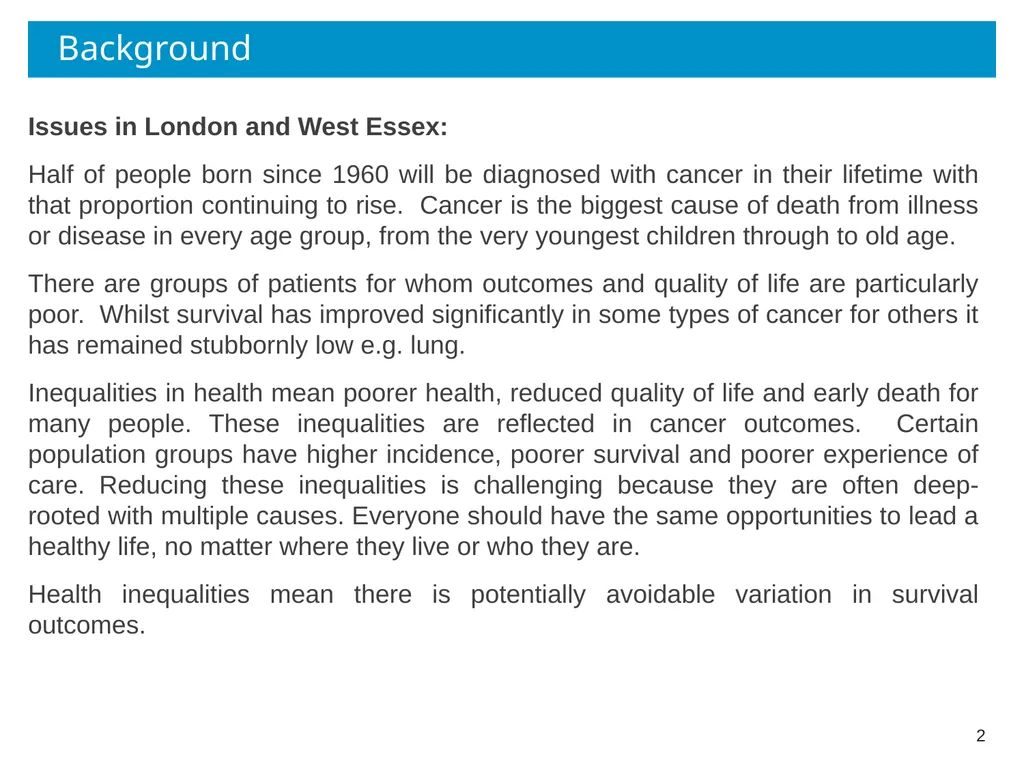
Half of people born since 1960 will be diagnosed with cancer in their lifetime with that proportion continuing to rise. Cancer is the biggest cause of death from illness or disease in every age group, from the very youngest children through to old age.
There are groups of patients for whom outcomes and quality of life are particularly poor. Whilst survival has improved significantly in some types of cancer for others it has remained stubbornly low e.g. lung.
Inequalities in health mean poorer health, reduced quality of life and early death for many people. These inequalities are reflected in cancer outcomes. Certain population groups have higher incidence, poorer survival and poorer experience of care. Reducing these inequalities is challenging because they are often deep-rooted with multiple causes. Everyone should have the same opportunities to lead a healthy life, no matter where they live or who they are.
Health inequalities mean there is potentially avoidable variation in survival outcomes.<br>
Half of people born since 1960 will be diagnosed with cancer in their lifetime with that proportion continuing to rise. Cancer is the biggest cause of death from illness or disease in every age group, from the very youngest children through to old age.
There are groups of patients for whom outcomes and quality of life are particularly poor. Whilst survival has improved significantly in some types of cancer for others it has remained stubbornly low e.g. lung.
Inequalities in health mean poorer health, reduced quality of life and early death for many people. These inequalities are reflected in cancer outcomes. Certain population groups have higher incidence, poorer survival and poorer experience of care. Reducing these inequalities is challenging because they are often deep-rooted with multiple causes. Everyone should have the same opportunities to lead a healthy life, no matter where they live or who they are.
Health inequalities mean there is potentially avoidable variation in survival outcomes.<br>
03
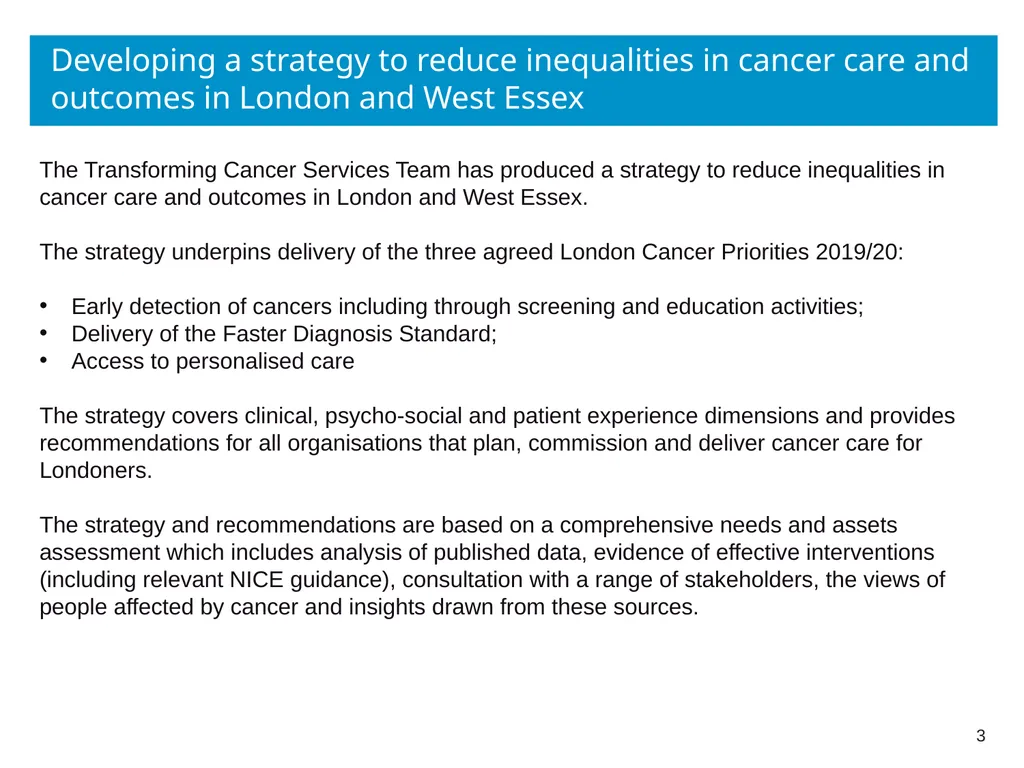
Developing a strategy to reduce inequalities in cancer care and outcomes in London and West Essex 3 The Transforming Cancer Services Team has produced a strategy to reduce inequalities in cancer care and outcomes in London and West Essex.
The strategy underpins delivery of the three agreed London Cancer Priorities 2019/20:
Early detection of cancers including through screening and education activities;
Delivery of the Faster Diagnosis Standard;
Access to personalised care
The strategy covers clinical, psycho-social and patient experience dimensions and provides recommendations for all organisations that plan, commission and deliver cancer care for Londoners.
The strategy and recommendations are based on a comprehensive needs and assets assessment which includes analysis of published data, evidence of effective interventions (including relevant NICE guidance), consultation with a range of stakeholders, the views of people affected by cancer and insights drawn from these sources.<br>
The strategy underpins delivery of the three agreed London Cancer Priorities 2019/20:
Early detection of cancers including through screening and education activities;
Delivery of the Faster Diagnosis Standard;
Access to personalised care
The strategy covers clinical, psycho-social and patient experience dimensions and provides recommendations for all organisations that plan, commission and deliver cancer care for Londoners.
The strategy and recommendations are based on a comprehensive needs and assets assessment which includes analysis of published data, evidence of effective interventions (including relevant NICE guidance), consultation with a range of stakeholders, the views of people affected by cancer and insights drawn from these sources.<br>
04
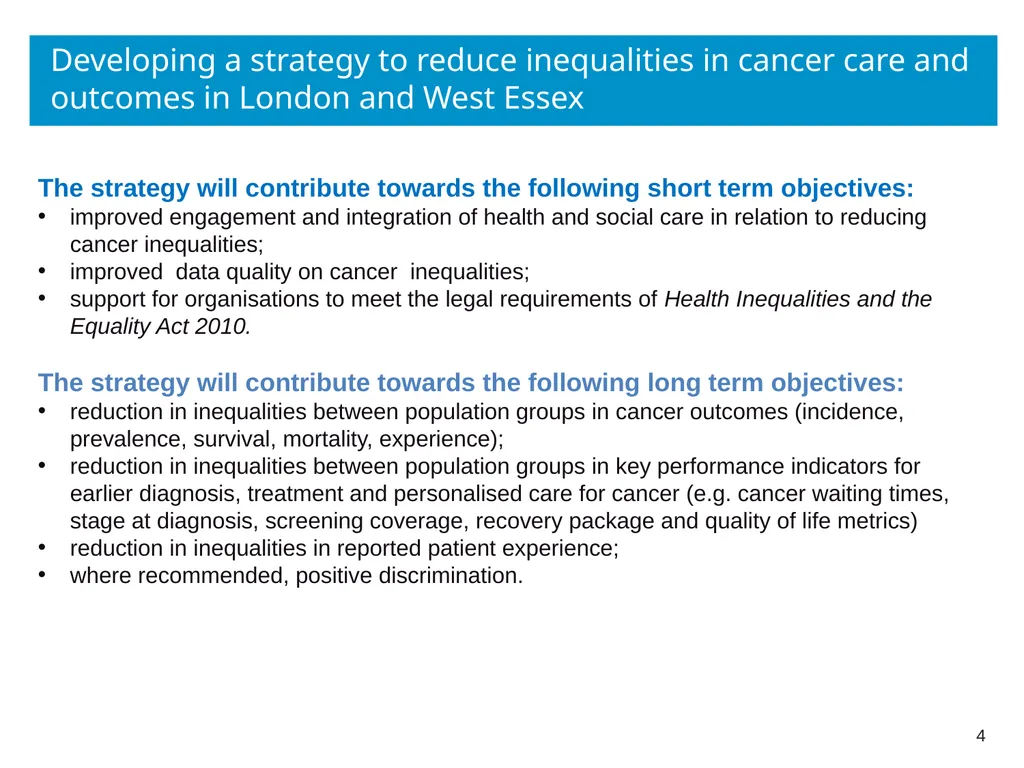
4 The strategy will contribute towards the following short term objectives:
improved engagement and integration of health and social care in relation to reducing cancer inequalities;
improved data quality on cancer inequalities;
support for organisations to meet the legal requirements of Health Inequalities and the Equality Act 2010.
The strategy will contribute towards the following long term objectives:
reduction in inequalities between population groups in cancer outcomes (incidence, prevalence, survival, mortality, experience);
reduction in inequalities between population groups in key performance indicators for earlier diagnosis, treatment and personalised care for cancer (e.g. cancer waiting times, stage at diagnosis, screening coverage, recovery package and quality of life metrics)
reduction in inequalities in reported patient experience;
where recommended, positive discrimination. Developing a strategy to reduce inequalities in cancer care and outcomes in London and West Essex<br>
improved engagement and integration of health and social care in relation to reducing cancer inequalities;
improved data quality on cancer inequalities;
support for organisations to meet the legal requirements of Health Inequalities and the Equality Act 2010.
The strategy will contribute towards the following long term objectives:
reduction in inequalities between population groups in cancer outcomes (incidence, prevalence, survival, mortality, experience);
reduction in inequalities between population groups in key performance indicators for earlier diagnosis, treatment and personalised care for cancer (e.g. cancer waiting times, stage at diagnosis, screening coverage, recovery package and quality of life metrics)
reduction in inequalities in reported patient experience;
where recommended, positive discrimination. Developing a strategy to reduce inequalities in cancer care and outcomes in London and West Essex<br>
05
London and West Essex Cancer Inequalities Strategy Outline Summary 5 The London and West Essex Cancer Inequalities Strategy is divided into five chapters:
Chapter 1 Introduction
Chapter 2 Early diagnosis and inequalities
Chapter 3 Inequalities in access and treatment for cancer
Chapter 4 Inequalities in personalised care for cancer
Chapter 5 Summary of recommendations
An Inequalities Snapshot has also been developed for each STP (Appendices).<br>
Chapter 1 Introduction
Chapter 2 Early diagnosis and inequalities
Chapter 3 Inequalities in access and treatment for cancer
Chapter 4 Inequalities in personalised care for cancer
Chapter 5 Summary of recommendations
An Inequalities Snapshot has also been developed for each STP (Appendices).<br>
06
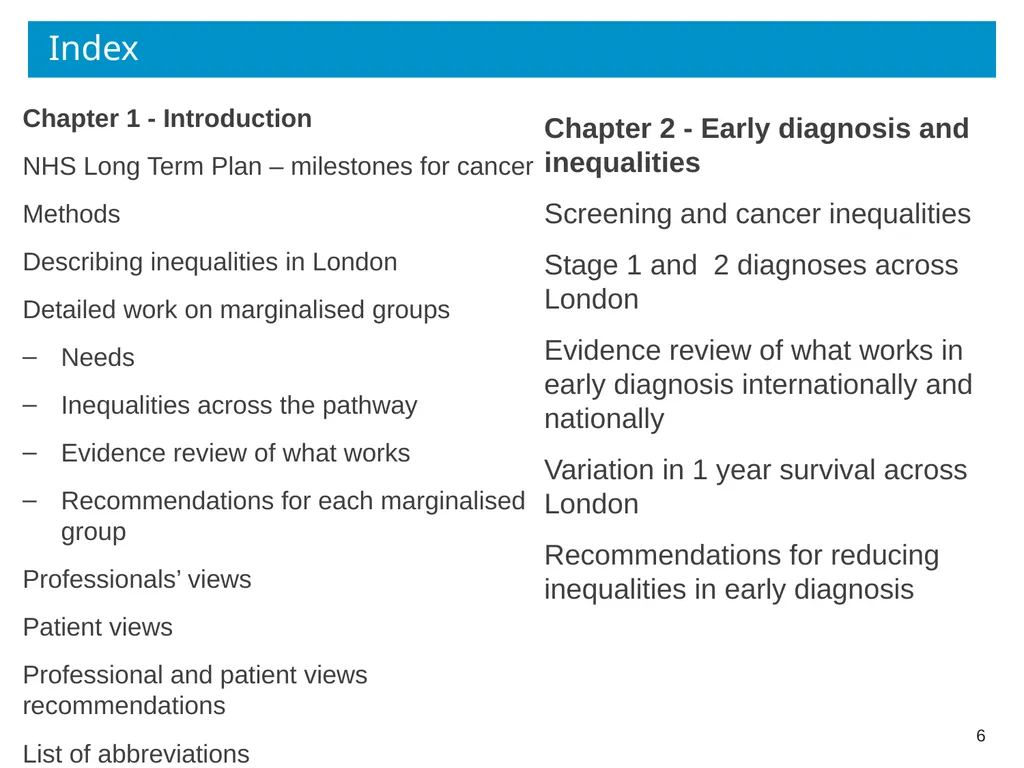
Index 6 Chapter 1 - Introduction
NHS Long Term Plan – milestones for cancer
Methods
Describing inequalities in London
Detailed work on marginalised groups
Needs
Inequalities across the pathway
Evidence review of what works
Recommendations for each marginalised group
Professionals’ views
Patient views
Professional and patient views recommendations
List of abbreviations Chapter 2 - Early diagnosis and inequalities
Screening and cancer inequalities
Stage 1 and 2 diagnoses across London
Evidence review of what works in early diagnosis internationally and nationally
Variation in 1 year survival across London
Recommendations for reducing inequalities in early diagnosis<br>
NHS Long Term Plan – milestones for cancer
Methods
Describing inequalities in London
Detailed work on marginalised groups
Needs
Inequalities across the pathway
Evidence review of what works
Recommendations for each marginalised group
Professionals’ views
Patient views
Professional and patient views recommendations
List of abbreviations Chapter 2 - Early diagnosis and inequalities
Screening and cancer inequalities
Stage 1 and 2 diagnoses across London
Evidence review of what works in early diagnosis internationally and nationally
Variation in 1 year survival across London
Recommendations for reducing inequalities in early diagnosis<br>
07
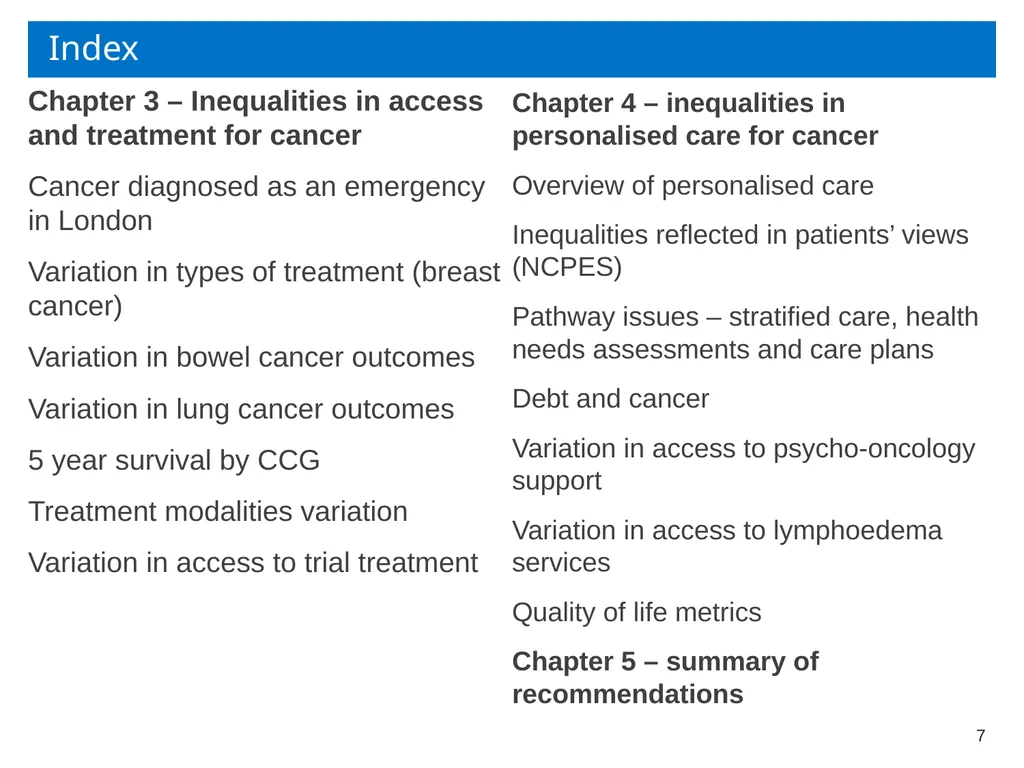
Index 7 Chapter 3 – Inequalities in access and treatment for cancer
Cancer diagnosed as an emergency in London
Variation in types of treatment (breast cancer)
Variation in bowel cancer outcomes
Variation in lung cancer outcomes
5 year survival by CCG
Treatment modalities variation
Variation in access to trial treatment Chapter 4 – inequalities in personalised care for cancer
Overview of personalised care
Inequalities reflected in patients’ views (NCPES)
Pathway issues – stratified care, health needs assessments and care plans
Debt and cancer
Variation in access to psycho-oncology support
Variation in access to lymphoedema services
Quality of life metrics
Chapter 5 – summary of recommendations<br>
Cancer diagnosed as an emergency in London
Variation in types of treatment (breast cancer)
Variation in bowel cancer outcomes
Variation in lung cancer outcomes
5 year survival by CCG
Treatment modalities variation
Variation in access to trial treatment Chapter 4 – inequalities in personalised care for cancer
Overview of personalised care
Inequalities reflected in patients’ views (NCPES)
Pathway issues – stratified care, health needs assessments and care plans
Debt and cancer
Variation in access to psycho-oncology support
Variation in access to lymphoedema services
Quality of life metrics
Chapter 5 – summary of recommendations<br>
08
The NHS Long Term Plan<br>
09
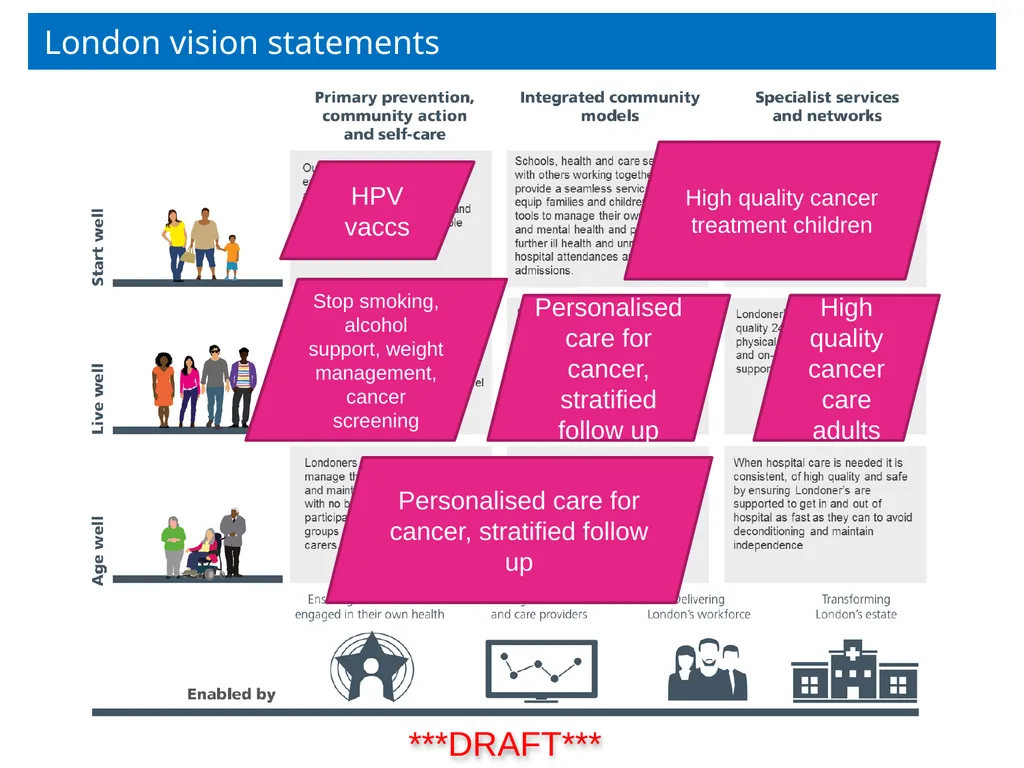
***DRAFT*** London vision statements HPV vaccs Stop smoking, alcohol support, weight management, cancer screening Personalised care for cancer, stratified follow up High quality cancer care adults High quality cancer treatment children Personalised care for cancer, stratified follow up<br>
10
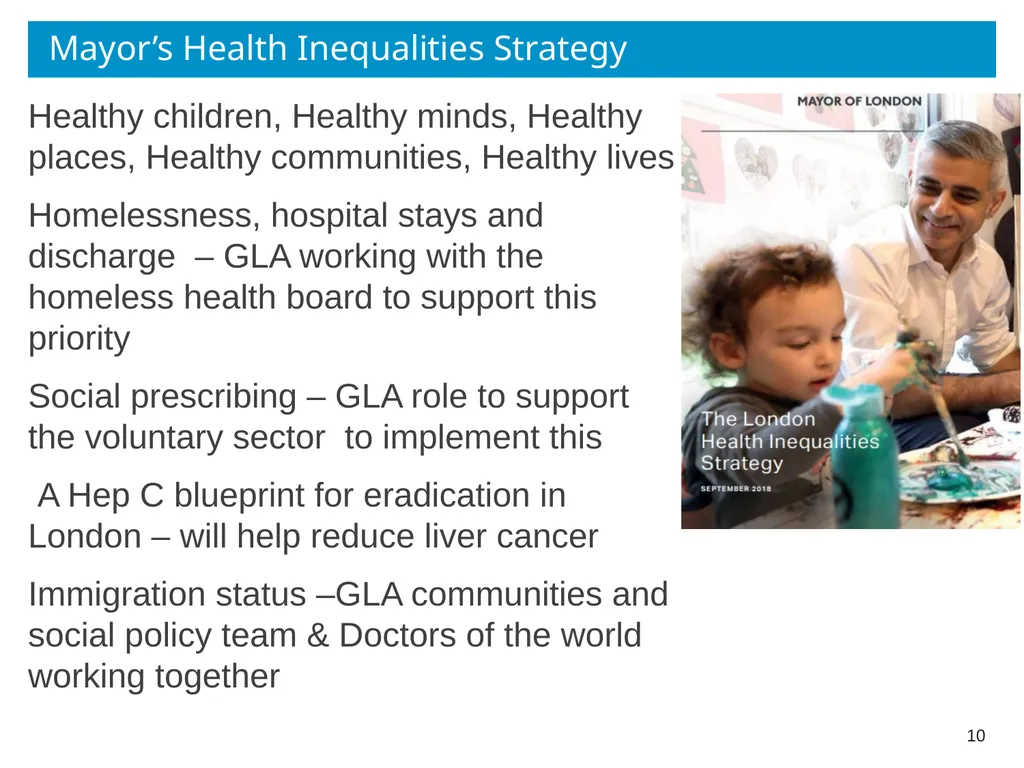
Mayor’s Health Inequalities Strategy 10 Healthy children, Healthy minds, Healthy places, Healthy communities, Healthy lives
Homelessness, hospital stays and discharge – GLA working with the homeless health board to support this priority
Social prescribing – GLA role to support the voluntary sector to implement this
A Hep C blueprint for eradication in London – will help reduce liver cancer
Immigration status –GLA communities and social policy team & Doctors of the world working together<br>
Homelessness, hospital stays and discharge – GLA working with the homeless health board to support this priority
Social prescribing – GLA role to support the voluntary sector to implement this
A Hep C blueprint for eradication in London – will help reduce liver cancer
Immigration status –GLA communities and social policy team & Doctors of the world working together<br>
11
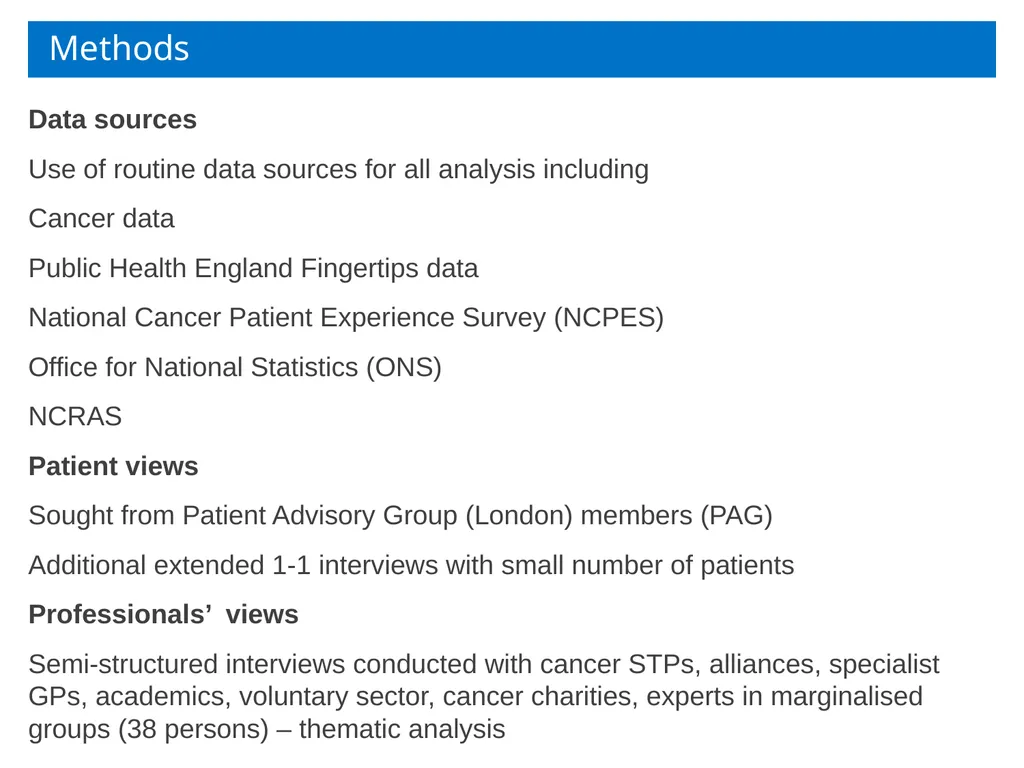
Methods 11 Data sources
Use of routine data sources for all analysis including
Cancer data
Public Health England Fingertips data
National Cancer Patient Experience Survey (NCPES)
Office for National Statistics (ONS)
NCRAS
Patient views
Sought from Patient Advisory Group (London) members (PAG)
Additional extended 1-1 interviews with small number of patients
Professionals’ views
Semi-structured interviews conducted with cancer STPs, alliances, specialist GPs, academics, voluntary sector, cancer charities, experts in marginalised groups (38 persons) – thematic analysis<br>
Use of routine data sources for all analysis including
Cancer data
Public Health England Fingertips data
National Cancer Patient Experience Survey (NCPES)
Office for National Statistics (ONS)
NCRAS
Patient views
Sought from Patient Advisory Group (London) members (PAG)
Additional extended 1-1 interviews with small number of patients
Professionals’ views
Semi-structured interviews conducted with cancer STPs, alliances, specialist GPs, academics, voluntary sector, cancer charities, experts in marginalised groups (38 persons) – thematic analysis<br>
12
Describing cancer inequalities 12<br>
13
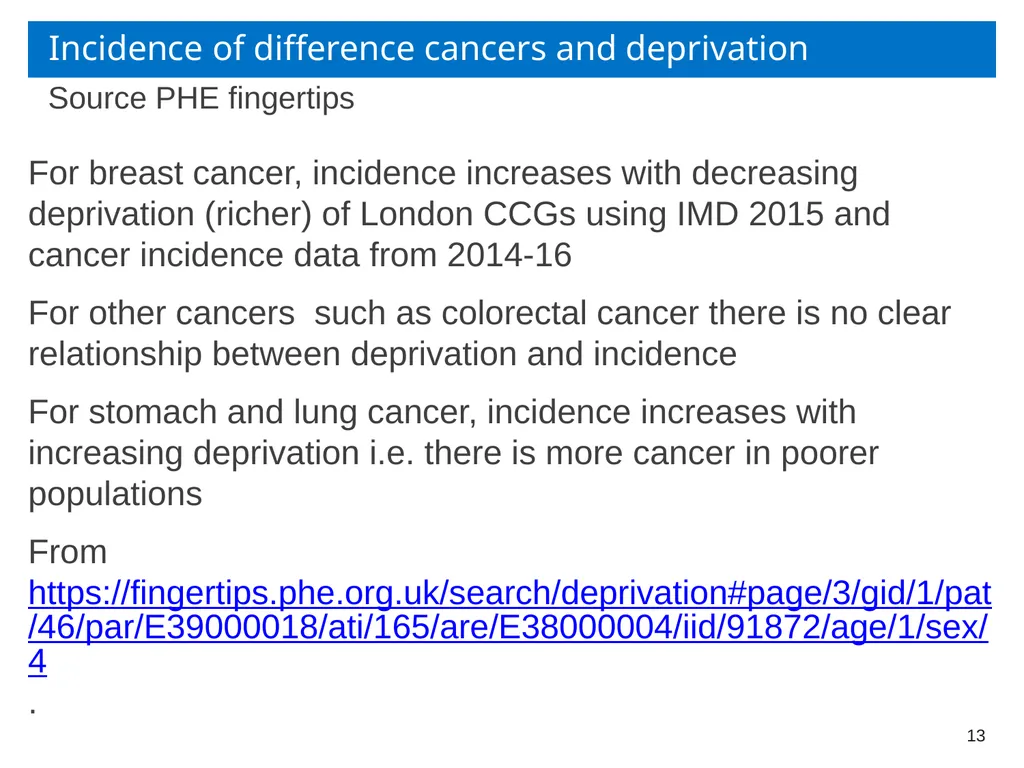
Incidence of difference cancers and deprivation Source PHE fingertips 13 For breast cancer, incidence increases with decreasing deprivation (richer) of London CCGs using IMD 2015 and cancer incidence data from 2014-16
For other cancers such as colorectal cancer there is no clear relationship between deprivation and incidence
For stomach and lung cancer, incidence increases with increasing deprivation i.e. there is more cancer in poorer populations
From https://fingertips.phe.org.uk/search/deprivation#page/3/gid/1/pat/46/par/E39000018/ati/165/are/E38000004/iid/91872/age/1/sex/4.<br>
For other cancers such as colorectal cancer there is no clear relationship between deprivation and incidence
For stomach and lung cancer, incidence increases with increasing deprivation i.e. there is more cancer in poorer populations
From https://fingertips.phe.org.uk/search/deprivation#page/3/gid/1/pat/46/par/E39000018/ati/165/are/E38000004/iid/91872/age/1/sex/4.<br>
14
Incidence of breast cancer and deprivation Breast cancer – as CCG deprivation increases, incidence goes down. Source: IMD 2015 14<br>
15
Incidence of stomach cancer and deprivation As deprivation increases for CCGs (poorer), so too does incidence of stomach cancer 15<br>
16
Incidence of lung cancer and deprivation As deprivation increases for CCGs (poorer), incidence increases 16<br>
17
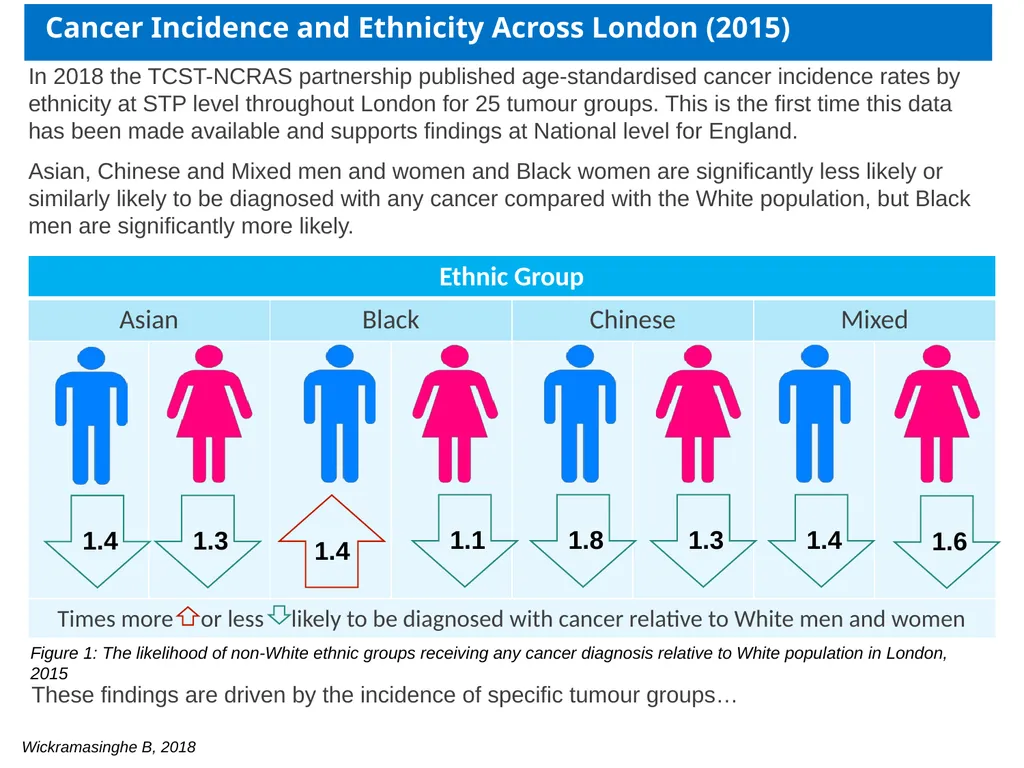
Cancer Incidence and Ethnicity Across London (2015) In 2018 the TCST-NCRAS partnership published age-standardised cancer incidence rates by ethnicity at STP level throughout London for 25 tumour groups. This is the first time this data has been made available and supports findings at National level for England. Asian, Chinese and Mixed men and women and Black women are significantly less likely or similarly likely to be diagnosed with any cancer compared with the White population, but Black men are significantly more likely. Figure 1: The likelihood of non-White ethnic groups receiving any cancer diagnosis relative to White population in London, 2015 These findings are driven by the incidence of specific tumour groups… Wickramasinghe B, 2018<br>
18
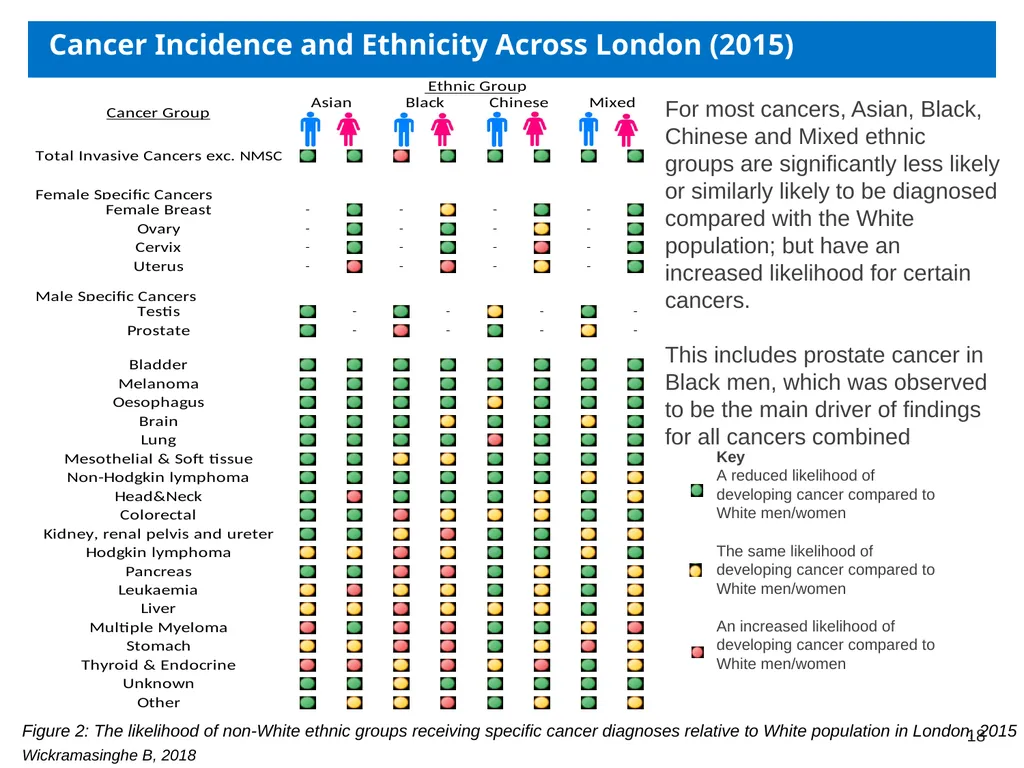
Cancer Incidence and Ethnicity Across London (2015) 18 For most cancers, Asian, Black, Chinese and Mixed ethnic groups are significantly less likely or similarly likely to be diagnosed compared with the White population; but have an increased likelihood for certain cancers.
This includes prostate cancer in Black men, which was observed to be the main driver of findings for all cancers combined Figure 2: The likelihood of non-White ethnic groups receiving specific cancer diagnoses relative to White population in London, 2015 Wickramasinghe B, 2018<br>
This includes prostate cancer in Black men, which was observed to be the main driver of findings for all cancers combined Figure 2: The likelihood of non-White ethnic groups receiving specific cancer diagnoses relative to White population in London, 2015 Wickramasinghe B, 2018<br>
19
Inequalities in cancer prevention: HPV vaccination 19 Not all CI overlap, highest City and lowest H&F
Note that all 8 NWL CCGs are red
Too early to find relationship between HPV and cervical cancer incidence as first cohort from 2009 only just turning 23yo
Messages to parents to reassure – new policy should include all boys
Please note that England’s mortality from throat and anal cancer (related to HPV infection) is increasing (ONS up to 2017)<br>
Note that all 8 NWL CCGs are red
Too early to find relationship between HPV and cervical cancer incidence as first cohort from 2009 only just turning 23yo
Messages to parents to reassure – new policy should include all boys
Please note that England’s mortality from throat and anal cancer (related to HPV infection) is increasing (ONS up to 2017)<br>
20
Marginalised groups and cancer 20<br>
21
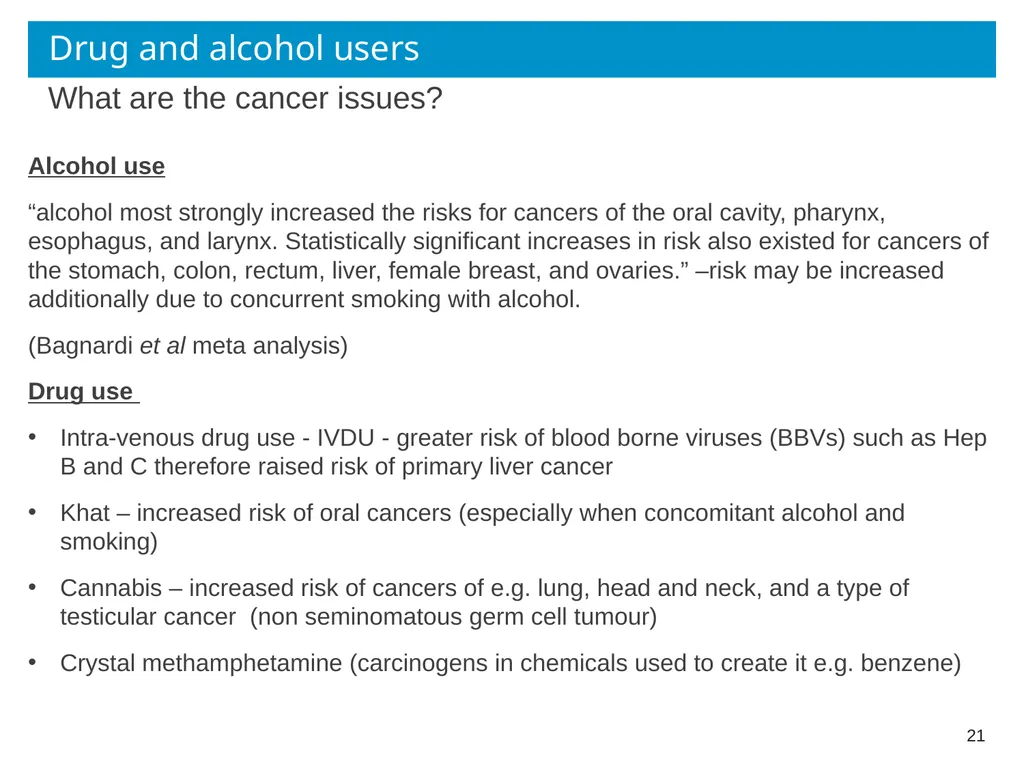
Drug and alcohol users What are the cancer issues? 21 Alcohol use
“alcohol most strongly increased the risks for cancers of the oral cavity, pharynx, esophagus, and larynx. Statistically significant increases in risk also existed for cancers of the stomach, colon, rectum, liver, female breast, and ovaries.” –risk may be increased additionally due to concurrent smoking with alcohol.
(Bagnardi et al meta analysis)
Drug use
Intra-venous drug use - IVDU - greater risk of blood borne viruses (BBVs) such as Hep B and C therefore raised risk of primary liver cancer
Khat – increased risk of oral cancers (especially when concomitant alcohol and smoking)
Cannabis – increased risk of cancers of e.g. lung, head and neck, and a type of testicular cancer (non seminomatous germ cell tumour)
Crystal methamphetamine (carcinogens in chemicals used to create it e.g. benzene)<br>
“alcohol most strongly increased the risks for cancers of the oral cavity, pharynx, esophagus, and larynx. Statistically significant increases in risk also existed for cancers of the stomach, colon, rectum, liver, female breast, and ovaries.” –risk may be increased additionally due to concurrent smoking with alcohol.
(Bagnardi et al meta analysis)
Drug use
Intra-venous drug use - IVDU - greater risk of blood borne viruses (BBVs) such as Hep B and C therefore raised risk of primary liver cancer
Khat – increased risk of oral cancers (especially when concomitant alcohol and smoking)
Cannabis – increased risk of cancers of e.g. lung, head and neck, and a type of testicular cancer (non seminomatous germ cell tumour)
Crystal methamphetamine (carcinogens in chemicals used to create it e.g. benzene)<br>
22
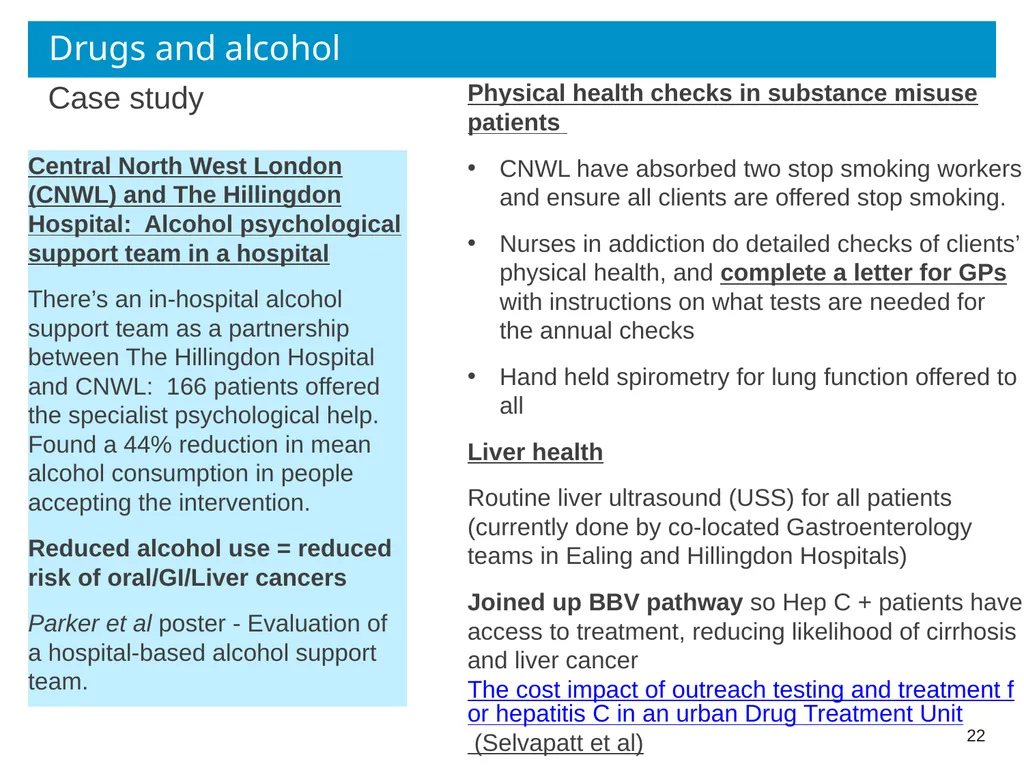
Drugs and alcohol Case study 22 Central North West London (CNWL) and The Hillingdon Hospital: Alcohol psychological support team in a hospital
There’s an in-hospital alcohol support team as a partnership between The Hillingdon Hospital and CNWL: 166 patients offered the specialist psychological help. Found a 44% reduction in mean alcohol consumption in people accepting the intervention.
Reduced alcohol use = reduced risk of oral/GI/Liver cancers
Parker et al poster - Evaluation of a hospital-based alcohol support team. Physical health checks in substance misuse patients
CNWL have absorbed two stop smoking workers and ensure all clients are offered stop smoking.
Nurses in addiction do detailed checks of clients’ physical health, and complete a letter for GPs with instructions on what tests are needed for the annual checks
Hand held spirometry for lung function offered to all
Liver health
Routine liver ultrasound (USS) for all patients (currently done by co-located Gastroenterology teams in Ealing and Hillingdon Hospitals)
Joined up BBV pathway so Hep C + patients have access to treatment, reducing likelihood of cirrhosis and liver cancer The cost impact of outreach testing and treatment for hepatitis C in an urban Drug Treatment Unit (Selvapatt et al)<br>
There’s an in-hospital alcohol support team as a partnership between The Hillingdon Hospital and CNWL: 166 patients offered the specialist psychological help. Found a 44% reduction in mean alcohol consumption in people accepting the intervention.
Reduced alcohol use = reduced risk of oral/GI/Liver cancers
Parker et al poster - Evaluation of a hospital-based alcohol support team. Physical health checks in substance misuse patients
CNWL have absorbed two stop smoking workers and ensure all clients are offered stop smoking.
Nurses in addiction do detailed checks of clients’ physical health, and complete a letter for GPs with instructions on what tests are needed for the annual checks
Hand held spirometry for lung function offered to all
Liver health
Routine liver ultrasound (USS) for all patients (currently done by co-located Gastroenterology teams in Ealing and Hillingdon Hospitals)
Joined up BBV pathway so Hep C + patients have access to treatment, reducing likelihood of cirrhosis and liver cancer The cost impact of outreach testing and treatment for hepatitis C in an urban Drug Treatment Unit (Selvapatt et al)<br>
23
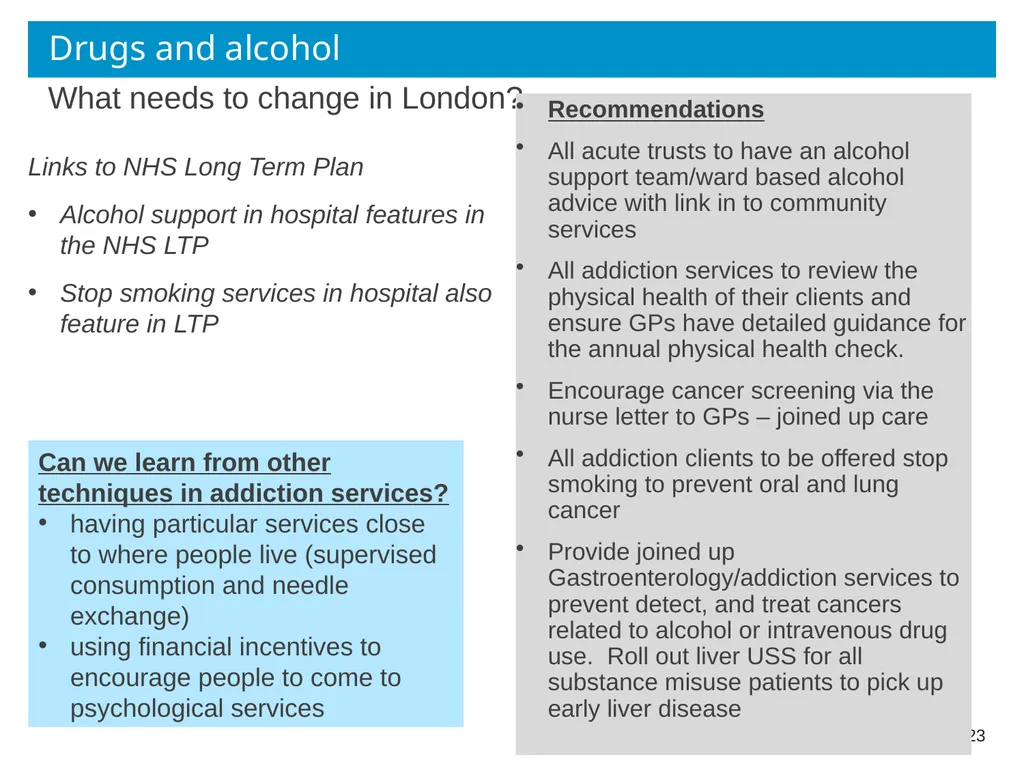
Drugs and alcohol What needs to change in London? 23 Links to NHS Long Term Plan
Alcohol support in hospital features in the NHS LTP
Stop smoking services in hospital also feature in LTP Recommendations
All acute trusts to have an alcohol support team/ward based alcohol advice with link in to community services
All addiction services to review the physical health of their clients and ensure GPs have detailed guidance for the annual physical health check.
Encourage cancer screening via the nurse letter to GPs – joined up care
All addiction clients to be offered stop smoking to prevent oral and lung cancer
Provide joined up Gastroenterology/addiction services to prevent detect, and treat cancers related to alcohol or intravenous drug use. Roll out liver USS for all substance misuse patients to pick up early liver disease Can we learn from other techniques in addiction services?
having particular services close to where people live (supervised consumption and needle exchange)
using financial incentives to encourage people to come to psychological services<br>
Alcohol support in hospital features in the NHS LTP
Stop smoking services in hospital also feature in LTP Recommendations
All acute trusts to have an alcohol support team/ward based alcohol advice with link in to community services
All addiction services to review the physical health of their clients and ensure GPs have detailed guidance for the annual physical health check.
Encourage cancer screening via the nurse letter to GPs – joined up care
All addiction clients to be offered stop smoking to prevent oral and lung cancer
Provide joined up Gastroenterology/addiction services to prevent detect, and treat cancers related to alcohol or intravenous drug use. Roll out liver USS for all substance misuse patients to pick up early liver disease Can we learn from other techniques in addiction services?
having particular services close to where people live (supervised consumption and needle exchange)
using financial incentives to encourage people to come to psychological services<br>
24
Severe mental illness (SMI) and cancer What are the cancer issues? 24 Higher risk of cancer with SMI
People with SMI (most commonly schizophrenia and bipolar disorder) at greater risk of poor physical health (NHS LTP 2019)
Higher obesity, high levels dual diagnosis (self medicating with alcohol/drugs 75% of SMI), smoking (50% in inpatients)
People in contact with mental health services 30% more likely to die from cancer than rest of population (Clifton et al) https://www.ncbi.nlm.nih.gov/pubmed/27405348
Lower screening coverage
Woodhead et al 2016 – lower odds ratio for attending women’s breast and cervical screening, especially related to schizophrenia, depot medication and severity of illness OR 0.45-0.59 https://www.ncbi.nlm.nih.gov/pubmed/27769213 Difficulty coping with cancer treatment – (Howard et al, 2010) https://www.thelancet.com/journals/lanonc/article/PIIS1470-2045(10)70085-1/fulltext
Poorer outcomes for cancer if people are a user of psychiatric services before their diagnosis – reasons could be biological/stress mechanisms, or that patients received sub standard care (Klaassen et al 2019)
Worse cancer outcomes in breast cancer for women with bipolar disorder or depression (Kanani et al 2016)<br>
People with SMI (most commonly schizophrenia and bipolar disorder) at greater risk of poor physical health (NHS LTP 2019)
Higher obesity, high levels dual diagnosis (self medicating with alcohol/drugs 75% of SMI), smoking (50% in inpatients)
People in contact with mental health services 30% more likely to die from cancer than rest of population (Clifton et al) https://www.ncbi.nlm.nih.gov/pubmed/27405348
Lower screening coverage
Woodhead et al 2016 – lower odds ratio for attending women’s breast and cervical screening, especially related to schizophrenia, depot medication and severity of illness OR 0.45-0.59 https://www.ncbi.nlm.nih.gov/pubmed/27769213 Difficulty coping with cancer treatment – (Howard et al, 2010) https://www.thelancet.com/journals/lanonc/article/PIIS1470-2045(10)70085-1/fulltext
Poorer outcomes for cancer if people are a user of psychiatric services before their diagnosis – reasons could be biological/stress mechanisms, or that patients received sub standard care (Klaassen et al 2019)
Worse cancer outcomes in breast cancer for women with bipolar disorder or depression (Kanani et al 2016)<br>
25
Annual physical health checks for people with SMI Focus on cardiovascular disease (CVD) and risk factors like smoking/alcohol, but no mention of cancer in the checks 25 Best in Hounslow, worst in Croydon<br>
26
Mental health services Case studies from South London and the Maudsley (SLAM) 26 Respiratory team specialist in reach
Excellent focus on physical health King’s in reach respiratory specialist expertise for MH patients, 81% of whom smoke
Public Health strategy which includes cancer
SLAM has a public health strategy with four clear areas of focus: one of which is cancer, which is explicitly included. The work to improve physical health around cancer has a clear basis: 12% of SLAM patients died of cancer, and of those people, 21% died of cancer of the digestive organs (highest proportion).
For cancer – the ways SLAM will prevent it, and ensure good care are as follows: focus on alcohol, blood borne virus (BBV) and vaccinations for Hepatitis B, screening. Importantly, they commit to having in house cancer screening for people who can’t get out to primary care for their screens e.g. cervical screening
Ref https://www.kingshealthpartners.org/our-work/mind-and-body/our-projects/physical-healthcare-in-severe-mental-illness and below<br>
Excellent focus on physical health King’s in reach respiratory specialist expertise for MH patients, 81% of whom smoke
Public Health strategy which includes cancer
SLAM has a public health strategy with four clear areas of focus: one of which is cancer, which is explicitly included. The work to improve physical health around cancer has a clear basis: 12% of SLAM patients died of cancer, and of those people, 21% died of cancer of the digestive organs (highest proportion).
For cancer – the ways SLAM will prevent it, and ensure good care are as follows: focus on alcohol, blood borne virus (BBV) and vaccinations for Hepatitis B, screening. Importantly, they commit to having in house cancer screening for people who can’t get out to primary care for their screens e.g. cervical screening
Ref https://www.kingshealthpartners.org/our-work/mind-and-body/our-projects/physical-healthcare-in-severe-mental-illness and below<br>
27
Mental health What needs to change in London? 27 Links to NHS Long term plan:
The refreshed health check referred to in the LTP has several components – the checks relevant for cancer are: weight, smoking, alcohol
Currently London’s 2018-19 performance is 29% having their annual heath check (good opportunity for physical health checks): more focussed on CVD. From 19-20 will be health checks in acute and MH trusts as well as in primary care for MH patients with SMI. Great variation between CCGs.
By 2020-21, NHS will ensure increase in MH clients having their physical health needs met by having yearly health checks Recommendations (In line with SLAM)
Provide alcohol support for MH clients (dual diagnosis is very common)
Ensure MH clients have their Hep B vaccinations, and harm minimisation support
Include cancer screening on the annual physical health checks for MH whether in primary or secondary care<br>
The refreshed health check referred to in the LTP has several components – the checks relevant for cancer are: weight, smoking, alcohol
Currently London’s 2018-19 performance is 29% having their annual heath check (good opportunity for physical health checks): more focussed on CVD. From 19-20 will be health checks in acute and MH trusts as well as in primary care for MH patients with SMI. Great variation between CCGs.
By 2020-21, NHS will ensure increase in MH clients having their physical health needs met by having yearly health checks Recommendations (In line with SLAM)
Provide alcohol support for MH clients (dual diagnosis is very common)
Ensure MH clients have their Hep B vaccinations, and harm minimisation support
Include cancer screening on the annual physical health checks for MH whether in primary or secondary care<br>
28
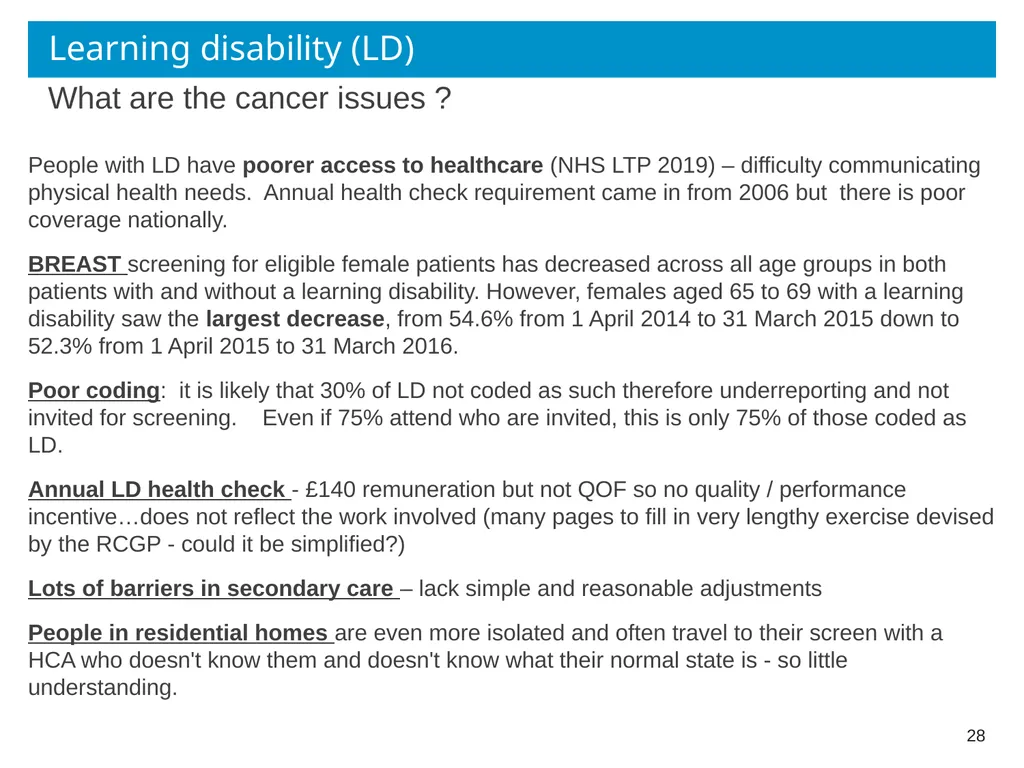
Learning disability (LD) What are the cancer issues ? 28 People with LD have poorer access to healthcare (NHS LTP 2019) – difficulty communicating physical health needs. Annual health check requirement came in from 2006 but there is poor coverage nationally.
BREAST screening for eligible female patients has decreased across all age groups in both patients with and without a learning disability. However, females aged 65 to 69 with a learning disability saw the largest decrease, from 54.6% from 1 April 2014 to 31 March 2015 down to 52.3% from 1 April 2015 to 31 March 2016.
Poor coding: it is likely that 30% of LD not coded as such therefore underreporting and not invited for screening. Even if 75% attend who are invited, this is only 75% of those coded as LD.
Annual LD health check - £140 remuneration but not QOF so no quality / performance incentive…does not reflect the work involved (many pages to fill in very lengthy exercise devised by the RCGP - could it be simplified?)
Lots of barriers in secondary care – lack simple and reasonable adjustments
People in residential homes are even more isolated and often travel to their screen with a HCA who doesn't know them and doesn't know what their normal state is - so little understanding.<br>
BREAST screening for eligible female patients has decreased across all age groups in both patients with and without a learning disability. However, females aged 65 to 69 with a learning disability saw the largest decrease, from 54.6% from 1 April 2014 to 31 March 2015 down to 52.3% from 1 April 2015 to 31 March 2016.
Poor coding: it is likely that 30% of LD not coded as such therefore underreporting and not invited for screening. Even if 75% attend who are invited, this is only 75% of those coded as LD.
Annual LD health check - £140 remuneration but not QOF so no quality / performance incentive…does not reflect the work involved (many pages to fill in very lengthy exercise devised by the RCGP - could it be simplified?)
Lots of barriers in secondary care – lack simple and reasonable adjustments
People in residential homes are even more isolated and often travel to their screen with a HCA who doesn't know them and doesn't know what their normal state is - so little understanding.<br>
29
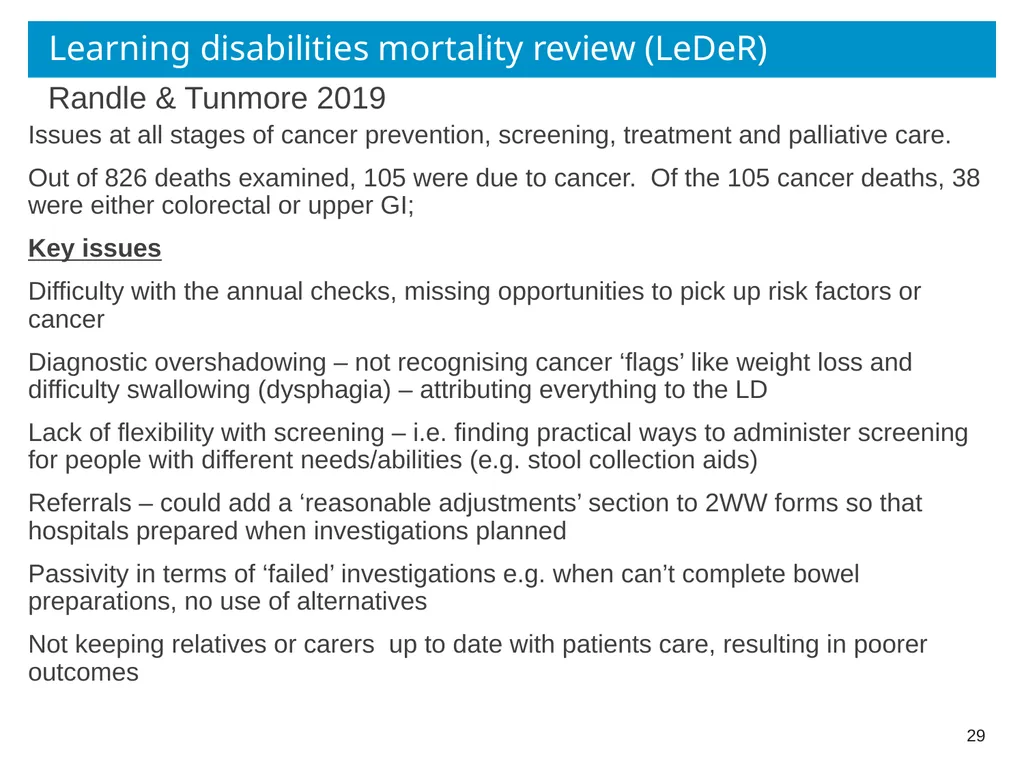
Learning disabilities mortality review (LeDeR) Randle & Tunmore 2019 29 Issues at all stages of cancer prevention, screening, treatment and palliative care.
Out of 826 deaths examined, 105 were due to cancer. Of the 105 cancer deaths, 38 were either colorectal or upper GI;
Key issues
Difficulty with the annual checks, missing opportunities to pick up risk factors or cancer
Diagnostic overshadowing – not recognising cancer ‘flags’ like weight loss and difficulty swallowing (dysphagia) – attributing everything to the LD
Lack of flexibility with screening – i.e. finding practical ways to administer screening for people with different needs/abilities (e.g. stool collection aids)
Referrals – could add a ‘reasonable adjustments’ section to 2WW forms so that hospitals prepared when investigations planned
Passivity in terms of ‘failed’ investigations e.g. when can’t complete bowel preparations, no use of alternatives
Not keeping relatives or carers up to date with patients care, resulting in poorer outcomes<br>
Out of 826 deaths examined, 105 were due to cancer. Of the 105 cancer deaths, 38 were either colorectal or upper GI;
Key issues
Difficulty with the annual checks, missing opportunities to pick up risk factors or cancer
Diagnostic overshadowing – not recognising cancer ‘flags’ like weight loss and difficulty swallowing (dysphagia) – attributing everything to the LD
Lack of flexibility with screening – i.e. finding practical ways to administer screening for people with different needs/abilities (e.g. stool collection aids)
Referrals – could add a ‘reasonable adjustments’ section to 2WW forms so that hospitals prepared when investigations planned
Passivity in terms of ‘failed’ investigations e.g. when can’t complete bowel preparations, no use of alternatives
Not keeping relatives or carers up to date with patients care, resulting in poorer outcomes<br>
30
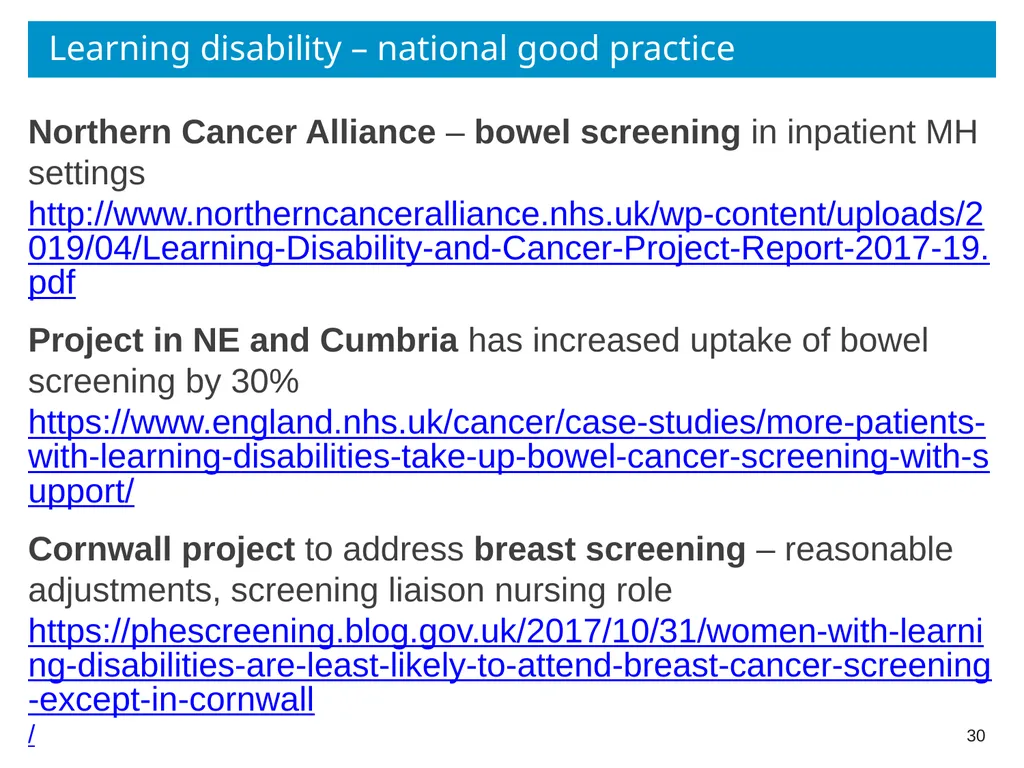
Learning disability – national good practice 30 Northern Cancer Alliance – bowel screening in inpatient MH settings http://www.northerncanceralliance.nhs.uk/wp-content/uploads/2019/04/Learning-Disability-and-Cancer-Project-Report-2017-19.pdf
Project in NE and Cumbria has increased uptake of bowel screening by 30% https://www.england.nhs.uk/cancer/case-studies/more-patients-with-learning-disabilities-take-up-bowel-cancer-screening-with-support/
Cornwall project to address breast screening – reasonable adjustments, screening liaison nursing role https://phescreening.blog.gov.uk/2017/10/31/women-with-learning-disabilities-are-least-likely-to-attend-breast-cancer-screening-except-in-cornwall/<br>
Project in NE and Cumbria has increased uptake of bowel screening by 30% https://www.england.nhs.uk/cancer/case-studies/more-patients-with-learning-disabilities-take-up-bowel-cancer-screening-with-support/
Cornwall project to address breast screening – reasonable adjustments, screening liaison nursing role https://phescreening.blog.gov.uk/2017/10/31/women-with-learning-disabilities-are-least-likely-to-attend-breast-cancer-screening-except-in-cornwall/<br>
31
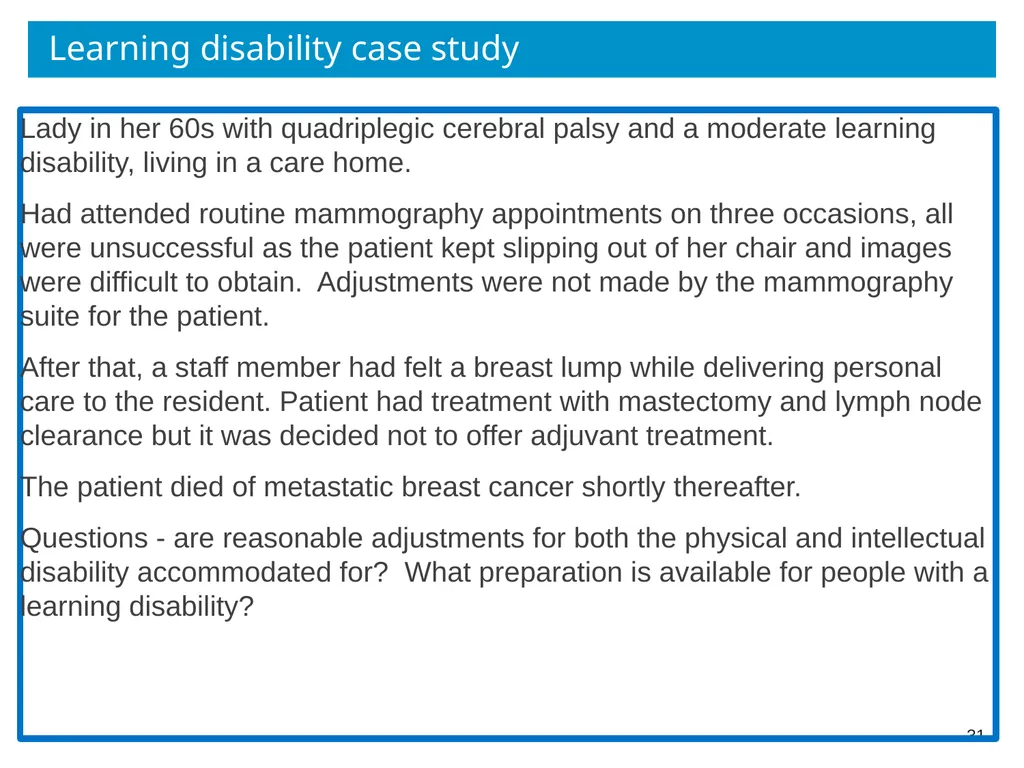
Learning disability case study 31 Lady in her 60s with quadriplegic cerebral palsy and a moderate learning disability, living in a care home.
Had attended routine mammography appointments on three occasions, all were unsuccessful as the patient kept slipping out of her chair and images were difficult to obtain. Adjustments were not made by the mammography suite for the patient.
After that, a staff member had felt a breast lump while delivering personal care to the resident. Patient had treatment with mastectomy and lymph node clearance but it was decided not to offer adjuvant treatment.
The patient died of metastatic breast cancer shortly thereafter.
Questions - are reasonable adjustments for both the physical and intellectual disability accommodated for? What preparation is available for people with a learning disability?<br>
Had attended routine mammography appointments on three occasions, all were unsuccessful as the patient kept slipping out of her chair and images were difficult to obtain. Adjustments were not made by the mammography suite for the patient.
After that, a staff member had felt a breast lump while delivering personal care to the resident. Patient had treatment with mastectomy and lymph node clearance but it was decided not to offer adjuvant treatment.
The patient died of metastatic breast cancer shortly thereafter.
Questions - are reasonable adjustments for both the physical and intellectual disability accommodated for? What preparation is available for people with a learning disability?<br>
32
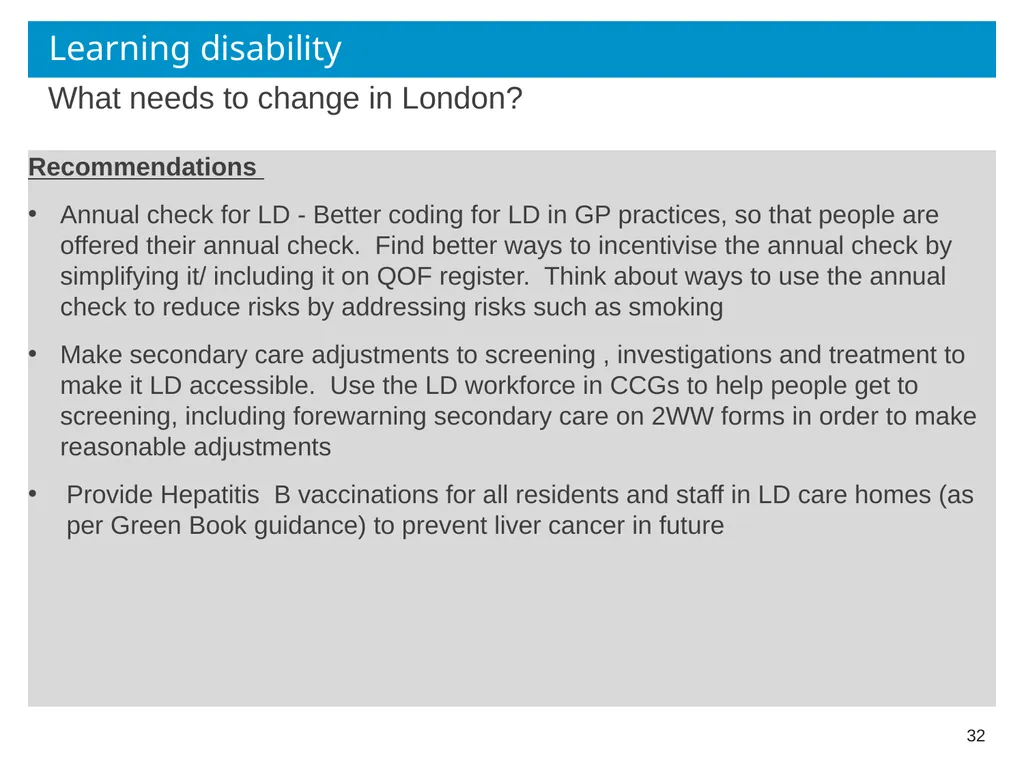
Learning disability What needs to change in London? 32 Recommendations
Annual check for LD - Better coding for LD in GP practices, so that people are offered their annual check. Find better ways to incentivise the annual check by simplifying it/ including it on QOF register. Think about ways to use the annual check to reduce risks by addressing risks such as smoking
Make secondary care adjustments to screening , investigations and treatment to make it LD accessible. Use the LD workforce in CCGs to help people get to screening, including forewarning secondary care on 2WW forms in order to make reasonable adjustments
Provide Hepatitis B vaccinations for all residents and staff in LD care homes (as per Green Book guidance) to prevent liver cancer in future<br>
Annual check for LD - Better coding for LD in GP practices, so that people are offered their annual check. Find better ways to incentivise the annual check by simplifying it/ including it on QOF register. Think about ways to use the annual check to reduce risks by addressing risks such as smoking
Make secondary care adjustments to screening , investigations and treatment to make it LD accessible. Use the LD workforce in CCGs to help people get to screening, including forewarning secondary care on 2WW forms in order to make reasonable adjustments
Provide Hepatitis B vaccinations for all residents and staff in LD care homes (as per Green Book guidance) to prevent liver cancer in future<br>
33
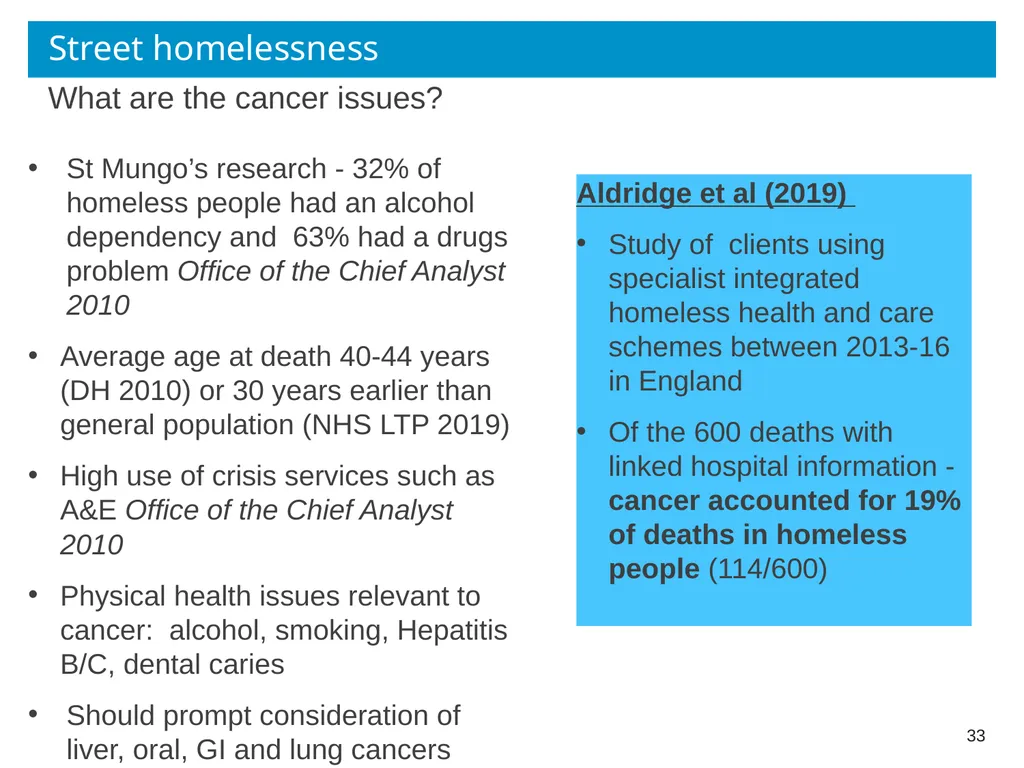
Street homelessness What are the cancer issues? 33 St Mungo’s research - 32% of homeless people had an alcohol dependency and 63% had a drugs problem Office of the Chief Analyst 2010
Average age at death 40-44 years (DH 2010) or 30 years earlier than general population (NHS LTP 2019)
High use of crisis services such as A&E Office of the Chief Analyst 2010
Physical health issues relevant to cancer: alcohol, smoking, Hepatitis B/C, dental caries
Should prompt consideration of liver, oral, GI and lung cancers Aldridge et al (2019)
Study of clients using specialist integrated homeless health and care schemes between 2013-16 in England
Of the 600 deaths with linked hospital information - cancer accounted for 19% of deaths in homeless people (114/600)<br>
Average age at death 40-44 years (DH 2010) or 30 years earlier than general population (NHS LTP 2019)
High use of crisis services such as A&E Office of the Chief Analyst 2010
Physical health issues relevant to cancer: alcohol, smoking, Hepatitis B/C, dental caries
Should prompt consideration of liver, oral, GI and lung cancers Aldridge et al (2019)
Study of clients using specialist integrated homeless health and care schemes between 2013-16 in England
Of the 600 deaths with linked hospital information - cancer accounted for 19% of deaths in homeless people (114/600)<br>
34
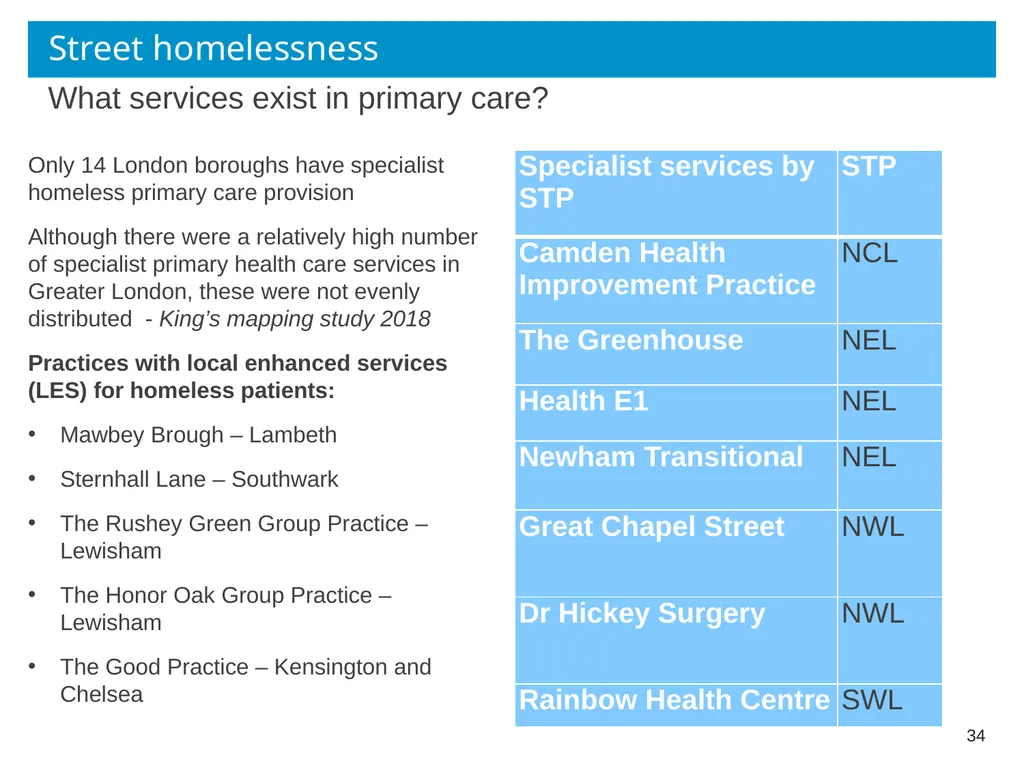
Street homelessness What services exist in primary care? 34 Only 14 London boroughs have specialist homeless primary care provision
Although there were a relatively high number of specialist primary health care services in Greater London, these were not evenly distributed - King’s mapping study 2018
Practices with local enhanced services (LES) for homeless patients:
Mawbey Brough – Lambeth
Sternhall Lane – Southwark
The Rushey Green Group Practice – Lewisham
The Honor Oak Group Practice – Lewisham
The Good Practice – Kensington and Chelsea<br>
Although there were a relatively high number of specialist primary health care services in Greater London, these were not evenly distributed - King’s mapping study 2018
Practices with local enhanced services (LES) for homeless patients:
Mawbey Brough – Lambeth
Sternhall Lane – Southwark
The Rushey Green Group Practice – Lewisham
The Honor Oak Group Practice – Lewisham
The Good Practice – Kensington and Chelsea<br>
35
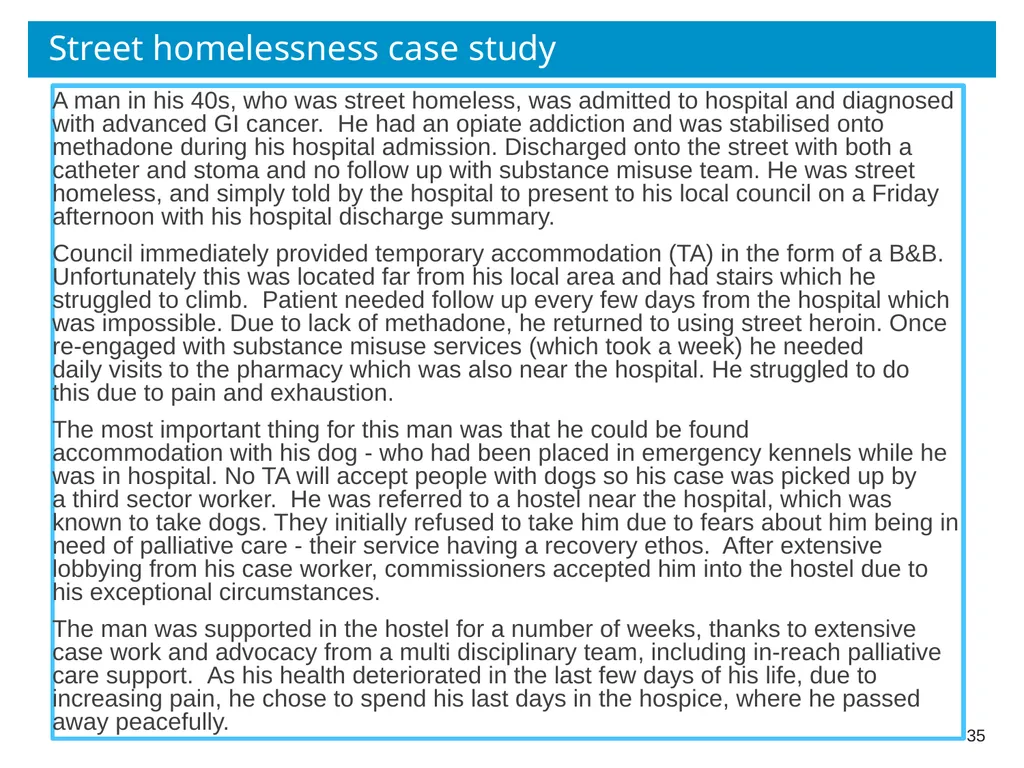
Street homelessness case study 35 A man in his 40s, who was street homeless, was admitted to hospital and diagnosed with advanced GI cancer. He had an opiate addiction and was stabilised onto methadone during his hospital admission. Discharged onto the street with both a catheter and stoma and no follow up with substance misuse team. He was street homeless, and simply told by the hospital to present to his local council on a Friday afternoon with his hospital discharge summary.
Council immediately provided temporary accommodation (TA) in the form of a B&B. Unfortunately this was located far from his local area and had stairs which he struggled to climb. Patient needed follow up every few days from the hospital which was impossible. Due to lack of methadone, he returned to using street heroin. Once re-engaged with substance misuse services (which took a week) he needed daily visits to the pharmacy which was also near the hospital. He struggled to do this due to pain and exhaustion.
The most important thing for this man was that he could be found accommodation with his dog - who had been placed in emergency kennels while he was in hospital. No TA will accept people with dogs so his case was picked up by a third sector worker. He was referred to a hostel near the hospital, which was known to take dogs. They initially refused to take him due to fears about him being in need of palliative care - their service having a recovery ethos. After extensive lobbying from his case worker, commissioners accepted him into the hostel due to his exceptional circumstances.
The man was supported in the hostel for a number of weeks, thanks to extensive case work and advocacy from a multi disciplinary team, including in-reach palliative care support. As his health deteriorated in the last few days of his life, due to increasing pain, he chose to spend his last days in the hospice, where he passed away peacefully.<br>
Council immediately provided temporary accommodation (TA) in the form of a B&B. Unfortunately this was located far from his local area and had stairs which he struggled to climb. Patient needed follow up every few days from the hospital which was impossible. Due to lack of methadone, he returned to using street heroin. Once re-engaged with substance misuse services (which took a week) he needed daily visits to the pharmacy which was also near the hospital. He struggled to do this due to pain and exhaustion.
The most important thing for this man was that he could be found accommodation with his dog - who had been placed in emergency kennels while he was in hospital. No TA will accept people with dogs so his case was picked up by a third sector worker. He was referred to a hostel near the hospital, which was known to take dogs. They initially refused to take him due to fears about him being in need of palliative care - their service having a recovery ethos. After extensive lobbying from his case worker, commissioners accepted him into the hostel due to his exceptional circumstances.
The man was supported in the hostel for a number of weeks, thanks to extensive case work and advocacy from a multi disciplinary team, including in-reach palliative care support. As his health deteriorated in the last few days of his life, due to increasing pain, he chose to spend his last days in the hospice, where he passed away peacefully.<br>
36
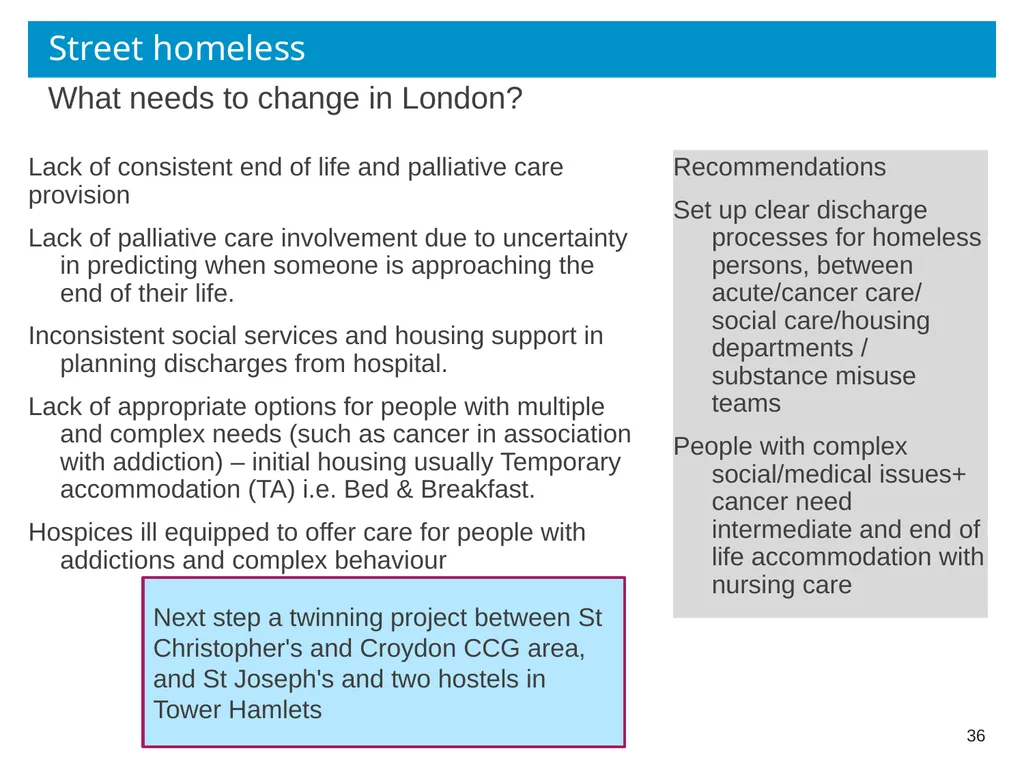
Street homeless What needs to change in London? 36 Lack of consistent end of life and palliative care provision
Lack of palliative care involvement due to uncertainty in predicting when someone is approaching the end of their life.
Inconsistent social services and housing support in planning discharges from hospital.
Lack of appropriate options for people with multiple and complex needs (such as cancer in association with addiction) – initial housing usually Temporary accommodation (TA) i.e. Bed & Breakfast.
Hospices ill equipped to offer care for people with addictions and complex behaviour Recommendations
Set up clear discharge processes for homeless persons, between acute/cancer care/ social care/housing departments / substance misuse teams
People with complex social/medical issues+ cancer need intermediate and end of life accommodation with nursing care Next step a twinning project between St Christopher's and Croydon CCG area, and St Joseph's and two hostels in Tower Hamlets<br>
Lack of palliative care involvement due to uncertainty in predicting when someone is approaching the end of their life.
Inconsistent social services and housing support in planning discharges from hospital.
Lack of appropriate options for people with multiple and complex needs (such as cancer in association with addiction) – initial housing usually Temporary accommodation (TA) i.e. Bed & Breakfast.
Hospices ill equipped to offer care for people with addictions and complex behaviour Recommendations
Set up clear discharge processes for homeless persons, between acute/cancer care/ social care/housing departments / substance misuse teams
People with complex social/medical issues+ cancer need intermediate and end of life accommodation with nursing care Next step a twinning project between St Christopher's and Croydon CCG area, and St Joseph's and two hostels in Tower Hamlets<br>
37
People in contact with criminal justice system What are the cancer issues? 37 Risk factors relevant to prisons
High rates smoking and substance misuse (Davies et al 2010) –lung, head and neck cancers, and higher rates Hep B and C (liver cancer)
Lower Cervical screen uptake 68% versus 80% in community population (Plugge et al 2006)
Access to screening requires an address
Downey et al (1994) – higher rates cervical abnormality on screening - abnormal cervical smear rate of 13% (double that in the general practice population) among 5081 women offered a health check on admission to Holloway Prison Davies et al (2010) cancer in London prisons – 31 new cases of cancer diagnosed every 5 years
In women, 83% (85/102) of diagnoses were in situ carcinoma of the cervix, and in men, 19% (11/57) were of lung cancer.
Average age at cancer diagnosis was young (49 years in men and 32 in women)
“Action for London 2007 –2012: A Nursing Vision for Cancer Care in the Capital …prevention, treatment and palliative care of cancer in prisoners …potential concern.” (Davies et al 2010)<br>
High rates smoking and substance misuse (Davies et al 2010) –lung, head and neck cancers, and higher rates Hep B and C (liver cancer)
Lower Cervical screen uptake 68% versus 80% in community population (Plugge et al 2006)
Access to screening requires an address
Downey et al (1994) – higher rates cervical abnormality on screening - abnormal cervical smear rate of 13% (double that in the general practice population) among 5081 women offered a health check on admission to Holloway Prison Davies et al (2010) cancer in London prisons – 31 new cases of cancer diagnosed every 5 years
In women, 83% (85/102) of diagnoses were in situ carcinoma of the cervix, and in men, 19% (11/57) were of lung cancer.
Average age at cancer diagnosis was young (49 years in men and 32 in women)
“Action for London 2007 –2012: A Nursing Vision for Cancer Care in the Capital …prevention, treatment and palliative care of cancer in prisoners …potential concern.” (Davies et al 2010)<br>
38
Prisons and cancer – snapshot March 2019 What needs to change in London? 38 There have been a small number of deaths from cancer in London prisons from Jan 2018-March 2019
8 prisons and 2 Immigration Removal Centres in London – all male
<30 people living with cancer in London prisons as at end March 2019. Recommendations
Ensure that first part of GP registration (called GMS1) is able to be completed whilst still in prison in order to then complete the registration with a GP in the community, to ensure that screening and other medical care is continued on release<br>
8 prisons and 2 Immigration Removal Centres in London – all male
<30 people living with cancer in London prisons as at end March 2019. Recommendations
Ensure that first part of GP registration (called GMS1) is able to be completed whilst still in prison in order to then complete the registration with a GP in the community, to ensure that screening and other medical care is continued on release<br>
39
Vulnerable women: Sex workers What are the cancer issues? 39 Baker et al (2003) for sex workers, there is an assumption that sexually transmitted infections are the main physical health problem. Actually there is a range of other issues – scabies, thrombosis, dental issues, abscesses. Hep B, alcohol and drug use. A study of 75 sex workers.https://www.ncbi.nlm.nih.gov/pmc/articles/PMC141189/
“Although most women acknowledged the need for mammograms or pap smears, few had had these tests done recently”.
That should prompt consideration of liver, cervical, oral, breast and cervical cancers.
Ersan et al (2013) study of 239 Turkish sex workers – 40% prevalence of HPV-18, increased risk of cervical cancer https://www.ncbi.nlm.nih.gov/pmc/articles/PMC4261505/<br>
“Although most women acknowledged the need for mammograms or pap smears, few had had these tests done recently”.
That should prompt consideration of liver, cervical, oral, breast and cervical cancers.
Ersan et al (2013) study of 239 Turkish sex workers – 40% prevalence of HPV-18, increased risk of cervical cancer https://www.ncbi.nlm.nih.gov/pmc/articles/PMC4261505/<br>
40
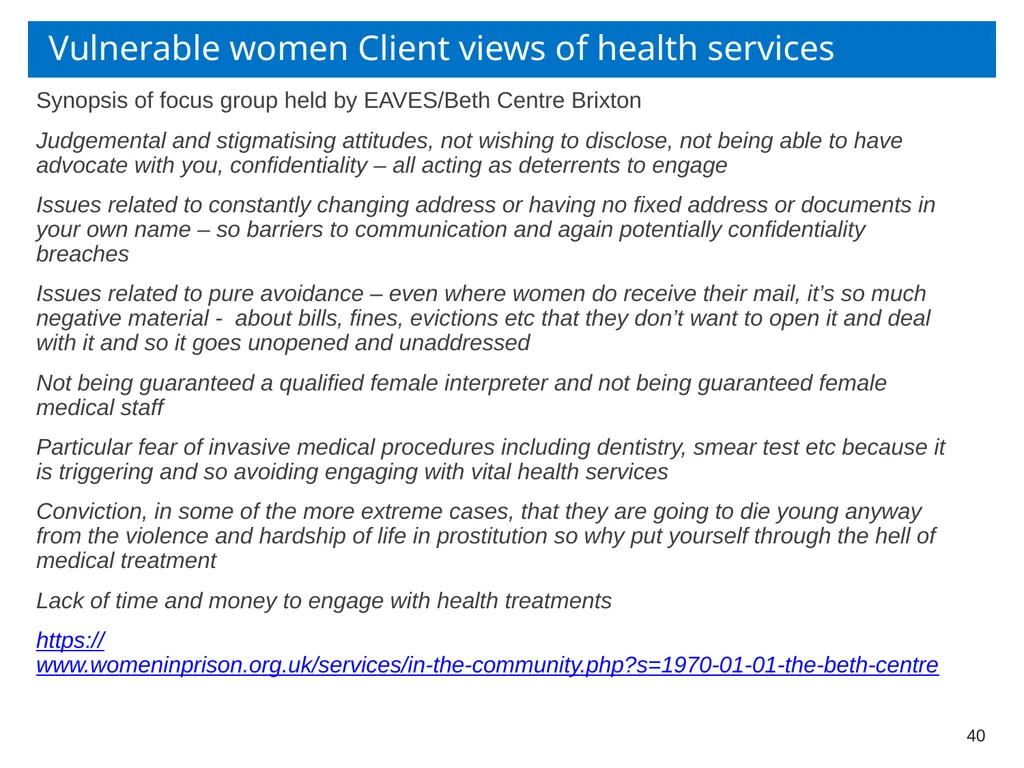
Vulnerable women Client views of health services 40 Synopsis of focus group held by EAVES/Beth Centre Brixton
Judgemental and stigmatising attitudes, not wishing to disclose, not being able to have advocate with you, confidentiality – all acting as deterrents to engage
Issues related to constantly changing address or having no fixed address or documents in your own name – so barriers to communication and again potentially confidentiality breaches
Issues related to pure avoidance – even where women do receive their mail, it’s so much negative material - about bills, fines, evictions etc that they don’t want to open it and deal with it and so it goes unopened and unaddressed
Not being guaranteed a qualified female interpreter and not being guaranteed female medical staff
Particular fear of invasive medical procedures including dentistry, smear test etc because it is triggering and so avoiding engaging with vital health services
Conviction, in some of the more extreme cases, that they are going to die young anyway from the violence and hardship of life in prostitution so why put yourself through the hell of medical treatment
Lack of time and money to engage with health treatments
https://www.womeninprison.org.uk/services/in-the-community.php?s=1970-01-01-the-beth-centre<br>
Judgemental and stigmatising attitudes, not wishing to disclose, not being able to have advocate with you, confidentiality – all acting as deterrents to engage
Issues related to constantly changing address or having no fixed address or documents in your own name – so barriers to communication and again potentially confidentiality breaches
Issues related to pure avoidance – even where women do receive their mail, it’s so much negative material - about bills, fines, evictions etc that they don’t want to open it and deal with it and so it goes unopened and unaddressed
Not being guaranteed a qualified female interpreter and not being guaranteed female medical staff
Particular fear of invasive medical procedures including dentistry, smear test etc because it is triggering and so avoiding engaging with vital health services
Conviction, in some of the more extreme cases, that they are going to die young anyway from the violence and hardship of life in prostitution so why put yourself through the hell of medical treatment
Lack of time and money to engage with health treatments
https://www.womeninprison.org.uk/services/in-the-community.php?s=1970-01-01-the-beth-centre<br>
41
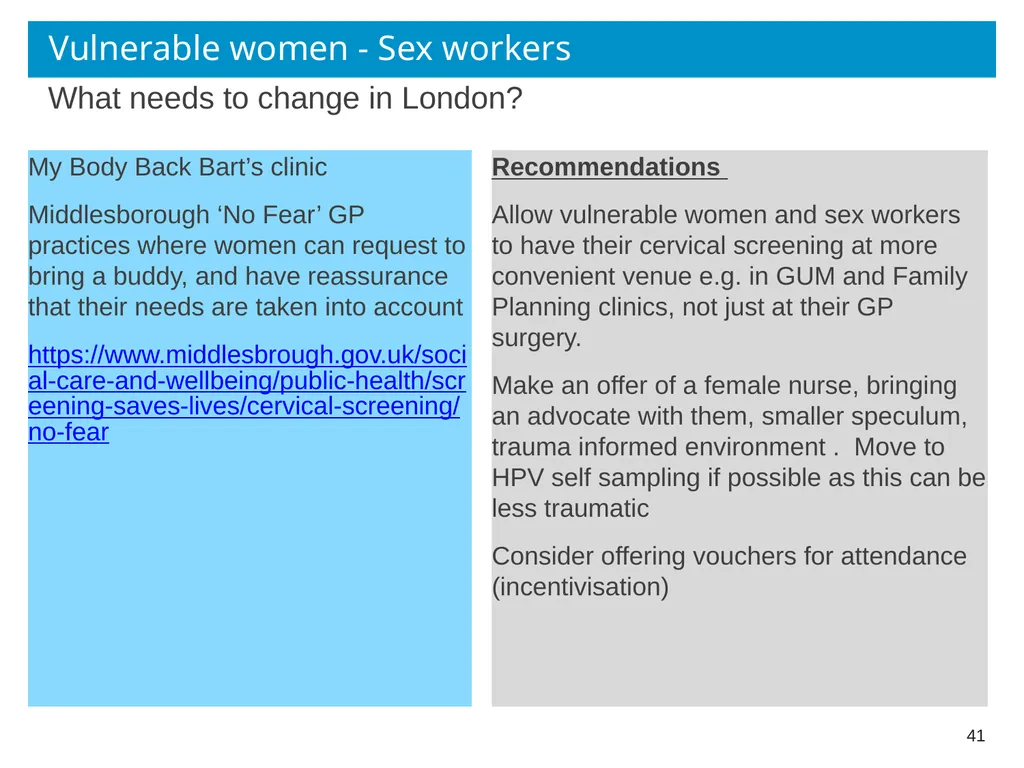
Vulnerable women - Sex workers What needs to change in London? 41 My Body Back Bart’s clinic
Middlesborough ‘No Fear’ GP practices where women can request to bring a buddy, and have reassurance that their needs are taken into account
https://www.middlesbrough.gov.uk/social-care-and-wellbeing/public-health/screening-saves-lives/cervical-screening/no-fear Recommendations
Allow vulnerable women and sex workers to have their cervical screening at more convenient venue e.g. in GUM and Family Planning clinics, not just at their GP surgery.
Make an offer of a female nurse, bringing an advocate with them, smaller speculum, trauma informed environment . Move to HPV self sampling if possible as this can be less traumatic
Consider offering vouchers for attendance (incentivisation)<br>
Middlesborough ‘No Fear’ GP practices where women can request to bring a buddy, and have reassurance that their needs are taken into account
https://www.middlesbrough.gov.uk/social-care-and-wellbeing/public-health/screening-saves-lives/cervical-screening/no-fear Recommendations
Allow vulnerable women and sex workers to have their cervical screening at more convenient venue e.g. in GUM and Family Planning clinics, not just at their GP surgery.
Make an offer of a female nurse, bringing an advocate with them, smaller speculum, trauma informed environment . Move to HPV self sampling if possible as this can be less traumatic
Consider offering vouchers for attendance (incentivisation)<br>
42
Undocumented migrants What are the cancer issues? 42 Immigration and access to care
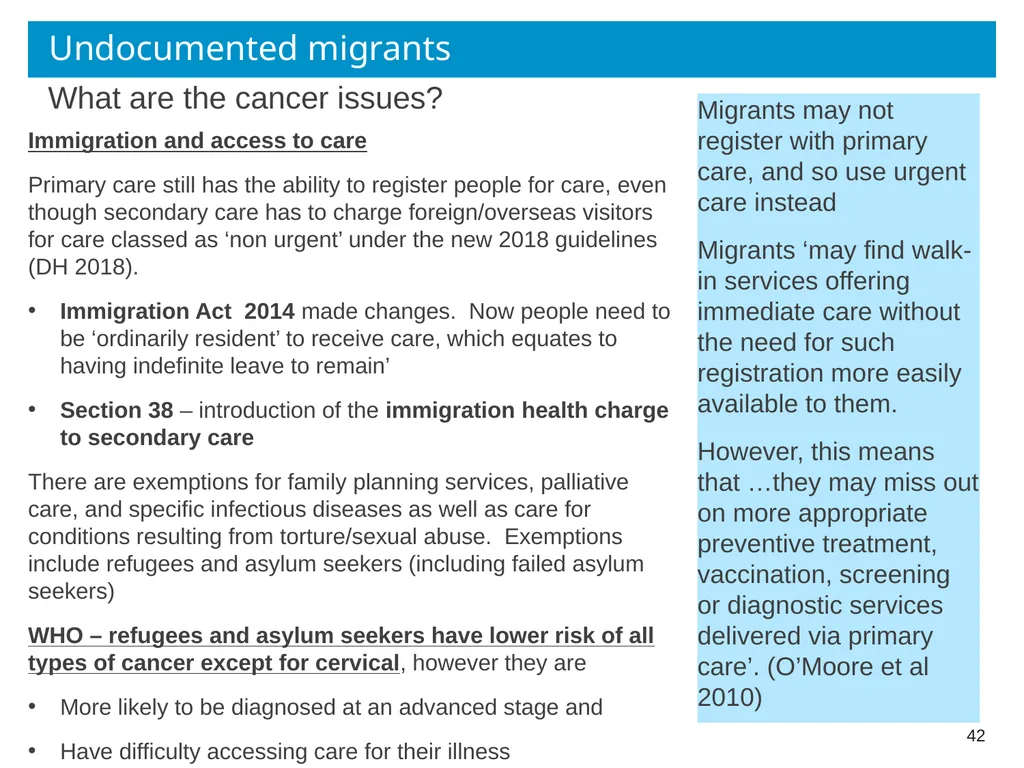
Primary care still has the ability to register people for care, even though secondary care has to charge foreign/overseas visitors for care classed as ‘non urgent’ under the new 2018 guidelines (DH 2018).
Immigration Act 2014 made changes. Now people need to be ‘ordinarily resident’ to receive care, which equates to having indefinite leave to remain’
Section 38 – introduction of the immigration health charge to secondary care
There are exemptions for family planning services, palliative care, and specific infectious diseases as well as care for conditions resulting from torture/sexual abuse. Exemptions include refugees and asylum seekers (including failed asylum seekers)
WHO – refugees and asylum seekers have lower risk of all types of cancer except for cervical, however they are
More likely to be diagnosed at an advanced stage and
Have difficulty accessing care for their illness Migrants may not register with primary care, and so use urgent care instead
Migrants ‘may find walk-in services offering immediate care without the need for such registration more easily available to them.
However, this means that …they may miss out on more appropriate preventive treatment, vaccination, screening or diagnostic services delivered via primary care’. (O’Moore et al 2010)<br>
Primary care still has the ability to register people for care, even though secondary care has to charge foreign/overseas visitors for care classed as ‘non urgent’ under the new 2018 guidelines (DH 2018).
Immigration Act 2014 made changes. Now people need to be ‘ordinarily resident’ to receive care, which equates to having indefinite leave to remain’
Section 38 – introduction of the immigration health charge to secondary care
There are exemptions for family planning services, palliative care, and specific infectious diseases as well as care for conditions resulting from torture/sexual abuse. Exemptions include refugees and asylum seekers (including failed asylum seekers)
WHO – refugees and asylum seekers have lower risk of all types of cancer except for cervical, however they are
More likely to be diagnosed at an advanced stage and
Have difficulty accessing care for their illness Migrants may not register with primary care, and so use urgent care instead
Migrants ‘may find walk-in services offering immediate care without the need for such registration more easily available to them.
However, this means that …they may miss out on more appropriate preventive treatment, vaccination, screening or diagnostic services delivered via primary care’. (O’Moore et al 2010)<br>
43
Undocumented migrants and cancer What are the cancer issues? 43 Not able to register with a GP
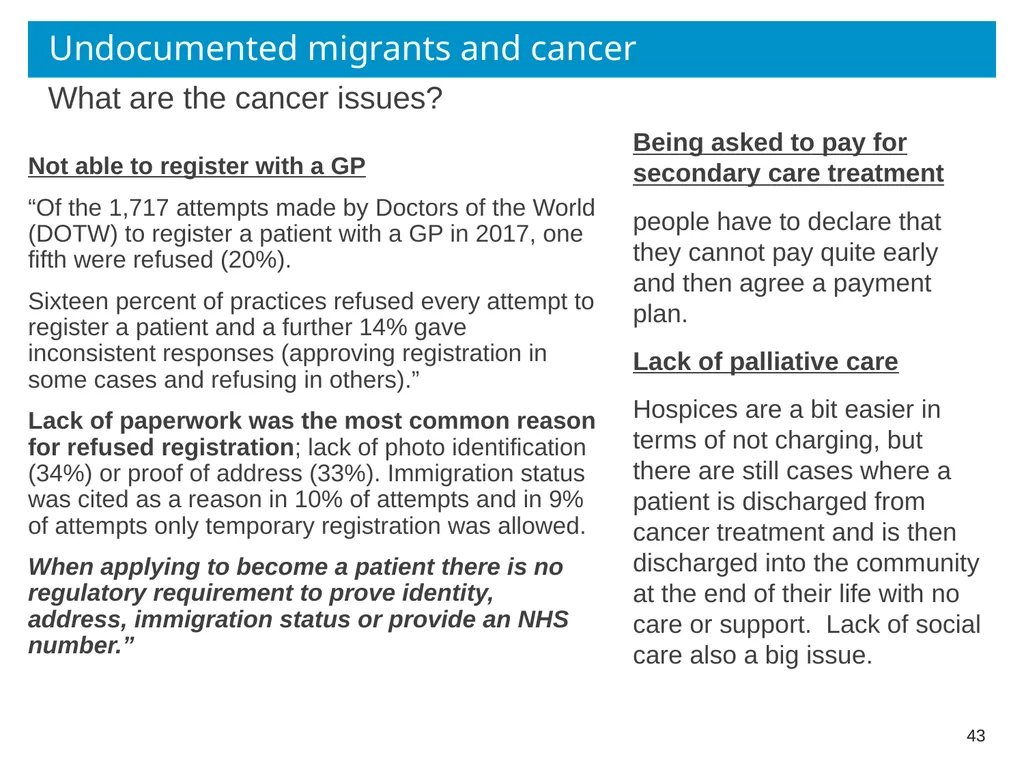
“Of the 1,717 attempts made by Doctors of the World (DOTW) to register a patient with a GP in 2017, one fifth were refused (20%).
Sixteen percent of practices refused every attempt to register a patient and a further 14% gave inconsistent responses (approving registration in some cases and refusing in others).”
Lack of paperwork was the most common reason for refused registration; lack of photo identification (34%) or proof of address (33%). Immigration status was cited as a reason in 10% of attempts and in 9% of attempts only temporary registration was allowed.
When applying to become a patient there is no regulatory requirement to prove identity, address, immigration status or provide an NHS number.” Being asked to pay for secondary care treatment
people have to declare that they cannot pay quite early and then agree a payment plan.
Lack of palliative care
Hospices are a bit easier in terms of not charging, but there are still cases where a patient is discharged from cancer treatment and is then discharged into the community at the end of their life with no care or support. Lack of social care also a big issue.<br>
“Of the 1,717 attempts made by Doctors of the World (DOTW) to register a patient with a GP in 2017, one fifth were refused (20%).
Sixteen percent of practices refused every attempt to register a patient and a further 14% gave inconsistent responses (approving registration in some cases and refusing in others).”
Lack of paperwork was the most common reason for refused registration; lack of photo identification (34%) or proof of address (33%). Immigration status was cited as a reason in 10% of attempts and in 9% of attempts only temporary registration was allowed.
When applying to become a patient there is no regulatory requirement to prove identity, address, immigration status or provide an NHS number.” Being asked to pay for secondary care treatment
people have to declare that they cannot pay quite early and then agree a payment plan.
Lack of palliative care
Hospices are a bit easier in terms of not charging, but there are still cases where a patient is discharged from cancer treatment and is then discharged into the community at the end of their life with no care or support. Lack of social care also a big issue.<br>
44
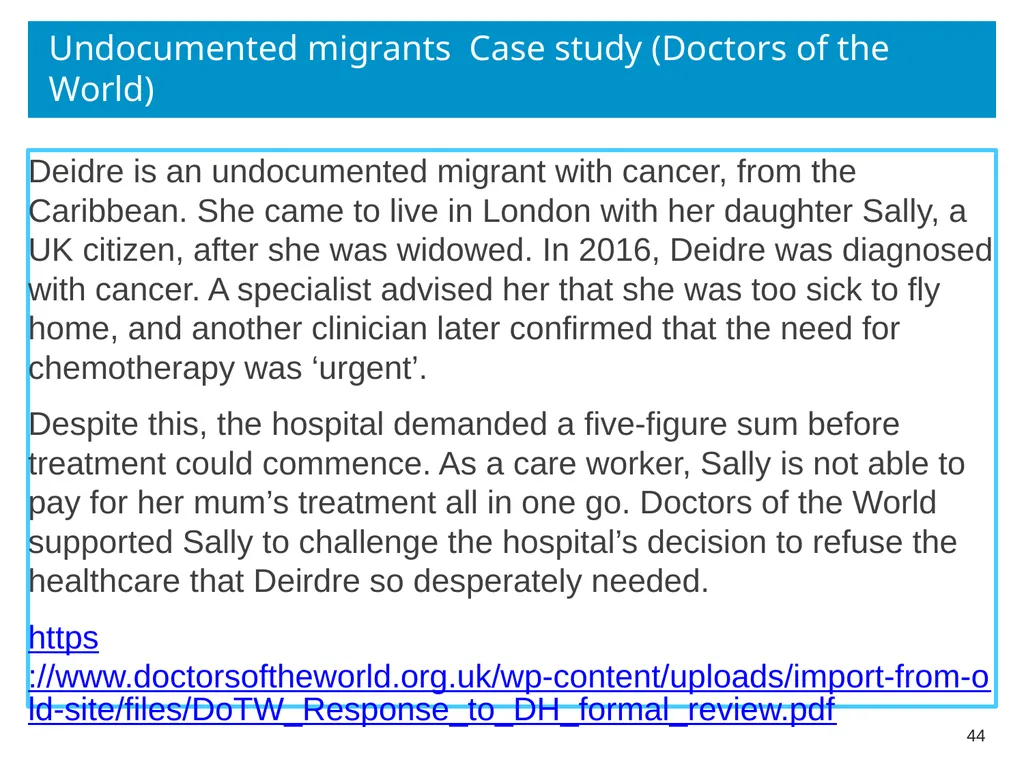
Undocumented migrants Case study (Doctors of the World) 44 Deidre is an undocumented migrant with cancer, from the Caribbean. She came to live in London with her daughter Sally, a UK citizen, after she was widowed. In 2016, Deidre was diagnosed with cancer. A specialist advised her that she was too sick to fly home, and another clinician later confirmed that the need for chemotherapy was ‘urgent’.
Despite this, the hospital demanded a five-figure sum before treatment could commence. As a care worker, Sally is not able to pay for her mum’s treatment all in one go. Doctors of the World supported Sally to challenge the hospital’s decision to refuse the healthcare that Deirdre so desperately needed.
https://www.doctorsoftheworld.org.uk/wp-content/uploads/import-from-old-site/files/DoTW_Response_to_DH_formal_review.pdf<br>
Despite this, the hospital demanded a five-figure sum before treatment could commence. As a care worker, Sally is not able to pay for her mum’s treatment all in one go. Doctors of the World supported Sally to challenge the hospital’s decision to refuse the healthcare that Deirdre so desperately needed.
https://www.doctorsoftheworld.org.uk/wp-content/uploads/import-from-old-site/files/DoTW_Response_to_DH_formal_review.pdf<br>
45
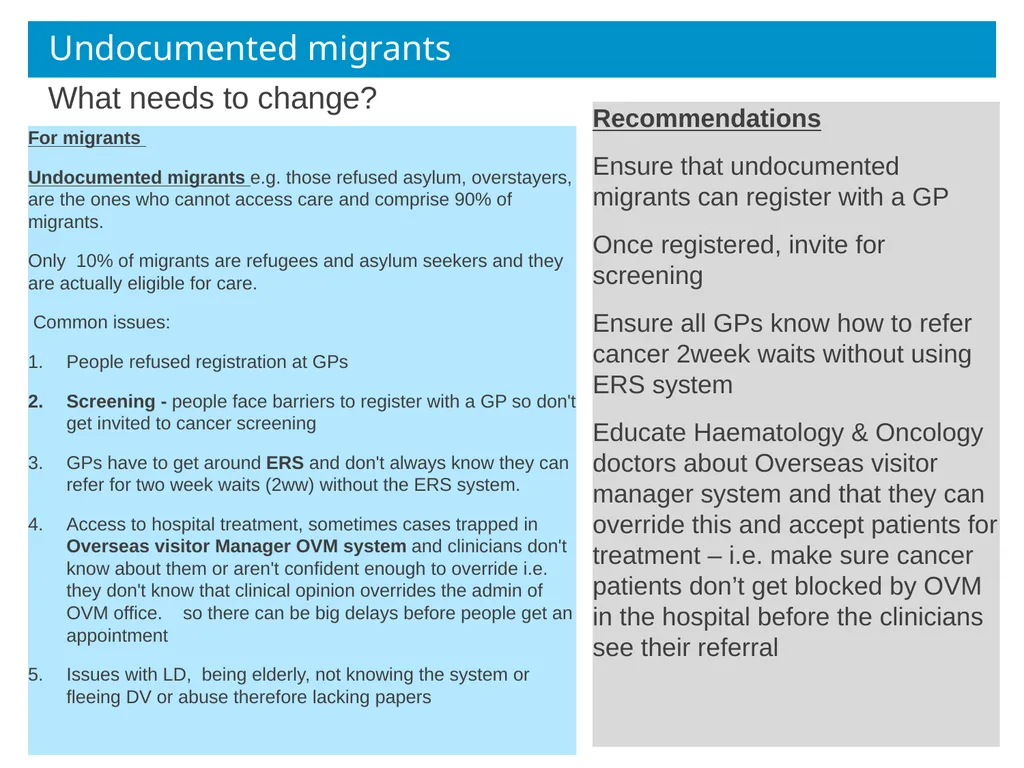
Undocumented migrants What needs to change? 45 For migrants
Undocumented migrants e.g. those refused asylum, overstayers, are the ones who cannot access care and comprise 90% of migrants.
Only 10% of migrants are refugees and asylum seekers and they are actually eligible for care.
Common issues:
People refused registration at GPs
Screening - people face barriers to register with a GP so don't get invited to cancer screening
GPs have to get around ERS and don't always know they can refer for two week waits (2ww) without the ERS system.
Access to hospital treatment, sometimes cases trapped in Overseas visitor Manager OVM system and clinicians don't know about them or aren't confident enough to override i.e. they don't know that clinical opinion overrides the admin of OVM office. so there can be big delays before people get an appointment
Issues with LD, being elderly, not knowing the system or fleeing DV or abuse therefore lacking papers Recommendations
Ensure that undocumented migrants can register with a GP
Once registered, invite for screening
Ensure all GPs know how to refer cancer 2week waits without using ERS system
Educate Haematology & Oncology doctors about Overseas visitor manager system and that they can override this and accept patients for treatment – i.e. make sure cancer patients don’t get blocked by OVM in the hospital before the clinicians see their referral<br>
Undocumented migrants e.g. those refused asylum, overstayers, are the ones who cannot access care and comprise 90% of migrants.
Only 10% of migrants are refugees and asylum seekers and they are actually eligible for care.
Common issues:
People refused registration at GPs
Screening - people face barriers to register with a GP so don't get invited to cancer screening
GPs have to get around ERS and don't always know they can refer for two week waits (2ww) without the ERS system.
Access to hospital treatment, sometimes cases trapped in Overseas visitor Manager OVM system and clinicians don't know about them or aren't confident enough to override i.e. they don't know that clinical opinion overrides the admin of OVM office. so there can be big delays before people get an appointment
Issues with LD, being elderly, not knowing the system or fleeing DV or abuse therefore lacking papers Recommendations
Ensure that undocumented migrants can register with a GP
Once registered, invite for screening
Ensure all GPs know how to refer cancer 2week waits without using ERS system
Educate Haematology & Oncology doctors about Overseas visitor manager system and that they can override this and accept patients for treatment – i.e. make sure cancer patients don’t get blocked by OVM in the hospital before the clinicians see their referral<br>
46
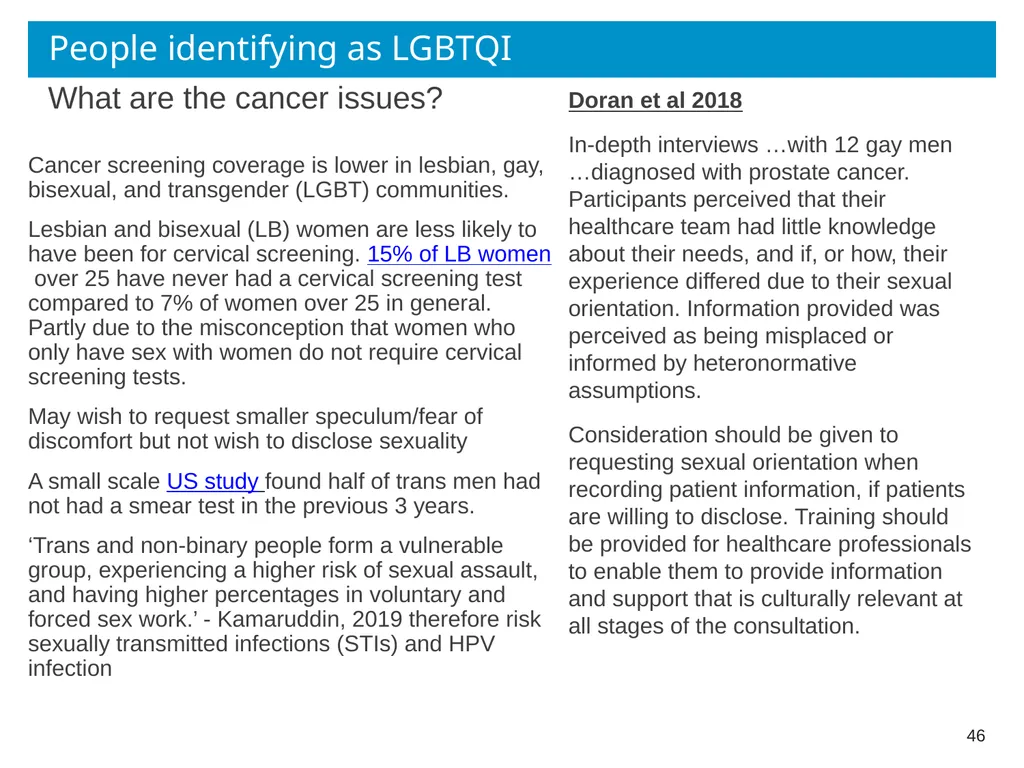
People identifying as LGBTQI What are the cancer issues? 46 Cancer screening coverage is lower in lesbian, gay, bisexual, and transgender (LGBT) communities.
Lesbian and bisexual (LB) women are less likely to have been for cervical screening. 15% of LB women over 25 have never had a cervical screening test compared to 7% of women over 25 in general. Partly due to the misconception that women who only have sex with women do not require cervical screening tests.
May wish to request smaller speculum/fear of discomfort but not wish to disclose sexuality
A small scale US study found half of trans men had not had a smear test in the previous 3 years.
‘Trans and non-binary people form a vulnerable group, experiencing a higher risk of sexual assault, and having higher percentages in voluntary and forced sex work.’ - Kamaruddin, 2019 therefore risk sexually transmitted infections (STIs) and HPV infection Doran et al 2018
In-depth interviews …with 12 gay men …diagnosed with prostate cancer. Participants perceived that their healthcare team had little knowledge about their needs, and if, or how, their experience differed due to their sexual orientation. Information provided was perceived as being misplaced or informed by heteronormative assumptions.
Consideration should be given to requesting sexual orientation when recording patient information, if patients are willing to disclose. Training should be provided for healthcare professionals to enable them to provide information and support that is culturally relevant at all stages of the consultation.<br>
Lesbian and bisexual (LB) women are less likely to have been for cervical screening. 15% of LB women over 25 have never had a cervical screening test compared to 7% of women over 25 in general. Partly due to the misconception that women who only have sex with women do not require cervical screening tests.
May wish to request smaller speculum/fear of discomfort but not wish to disclose sexuality
A small scale US study found half of trans men had not had a smear test in the previous 3 years.
‘Trans and non-binary people form a vulnerable group, experiencing a higher risk of sexual assault, and having higher percentages in voluntary and forced sex work.’ - Kamaruddin, 2019 therefore risk sexually transmitted infections (STIs) and HPV infection Doran et al 2018
In-depth interviews …with 12 gay men …diagnosed with prostate cancer. Participants perceived that their healthcare team had little knowledge about their needs, and if, or how, their experience differed due to their sexual orientation. Information provided was perceived as being misplaced or informed by heteronormative assumptions.
Consideration should be given to requesting sexual orientation when recording patient information, if patients are willing to disclose. Training should be provided for healthcare professionals to enable them to provide information and support that is culturally relevant at all stages of the consultation.<br>
47
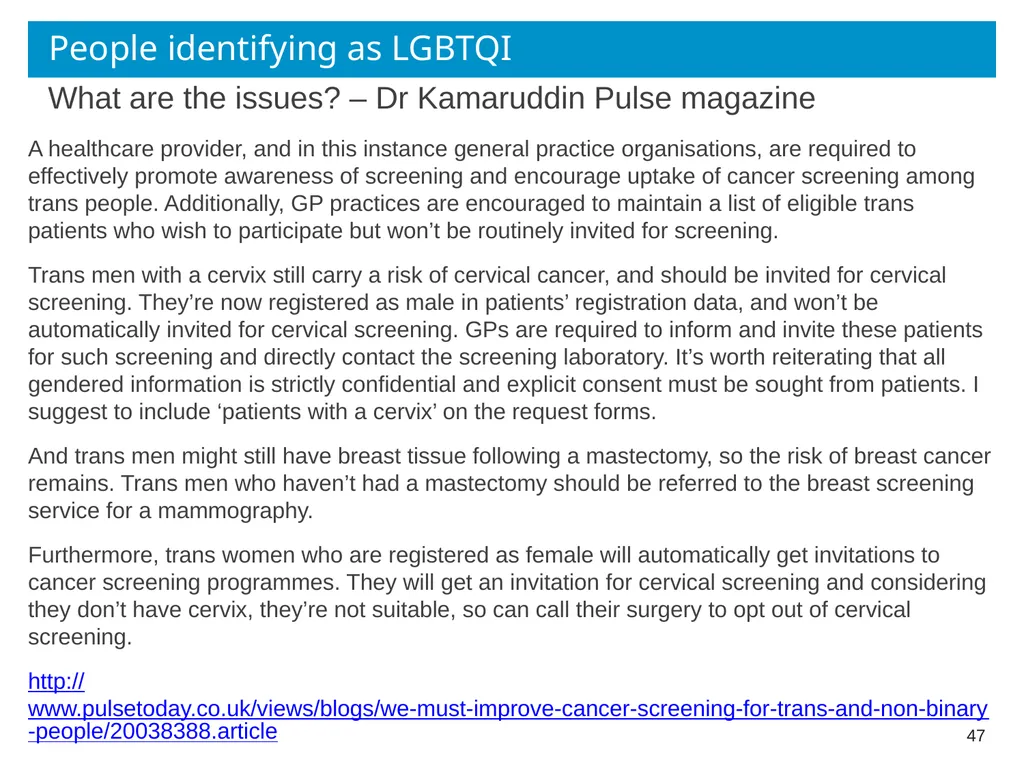
People identifying as LGBTQI What are the issues? – Dr Kamaruddin Pulse magazine 47 A healthcare provider, and in this instance general practice organisations, are required to effectively promote awareness of screening and encourage uptake of cancer screening among trans people. Additionally, GP practices are encouraged to maintain a list of eligible trans patients who wish to participate but won’t be routinely invited for screening.
Trans men with a cervix still carry a risk of cervical cancer, and should be invited for cervical screening. They’re now registered as male in patients’ registration data, and won’t be automatically invited for cervical screening. GPs are required to inform and invite these patients for such screening and directly contact the screening laboratory. It’s worth reiterating that all gendered information is strictly confidential and explicit consent must be sought from patients. I suggest to include ‘patients with a cervix’ on the request forms.
And trans men might still have breast tissue following a mastectomy, so the risk of breast cancer remains. Trans men who haven’t had a mastectomy should be referred to the breast screening service for a mammography.
Furthermore, trans women who are registered as female will automatically get invitations to cancer screening programmes. They will get an invitation for cervical screening and considering they don’t have cervix, they’re not suitable, so can call their surgery to opt out of cervical screening.
http://www.pulsetoday.co.uk/views/blogs/we-must-improve-cancer-screening-for-trans-and-non-binary-people/20038388.article<br>
Trans men with a cervix still carry a risk of cervical cancer, and should be invited for cervical screening. They’re now registered as male in patients’ registration data, and won’t be automatically invited for cervical screening. GPs are required to inform and invite these patients for such screening and directly contact the screening laboratory. It’s worth reiterating that all gendered information is strictly confidential and explicit consent must be sought from patients. I suggest to include ‘patients with a cervix’ on the request forms.
And trans men might still have breast tissue following a mastectomy, so the risk of breast cancer remains. Trans men who haven’t had a mastectomy should be referred to the breast screening service for a mammography.
Furthermore, trans women who are registered as female will automatically get invitations to cancer screening programmes. They will get an invitation for cervical screening and considering they don’t have cervix, they’re not suitable, so can call their surgery to opt out of cervical screening.
http://www.pulsetoday.co.uk/views/blogs/we-must-improve-cancer-screening-for-trans-and-non-binary-people/20038388.article<br>
48
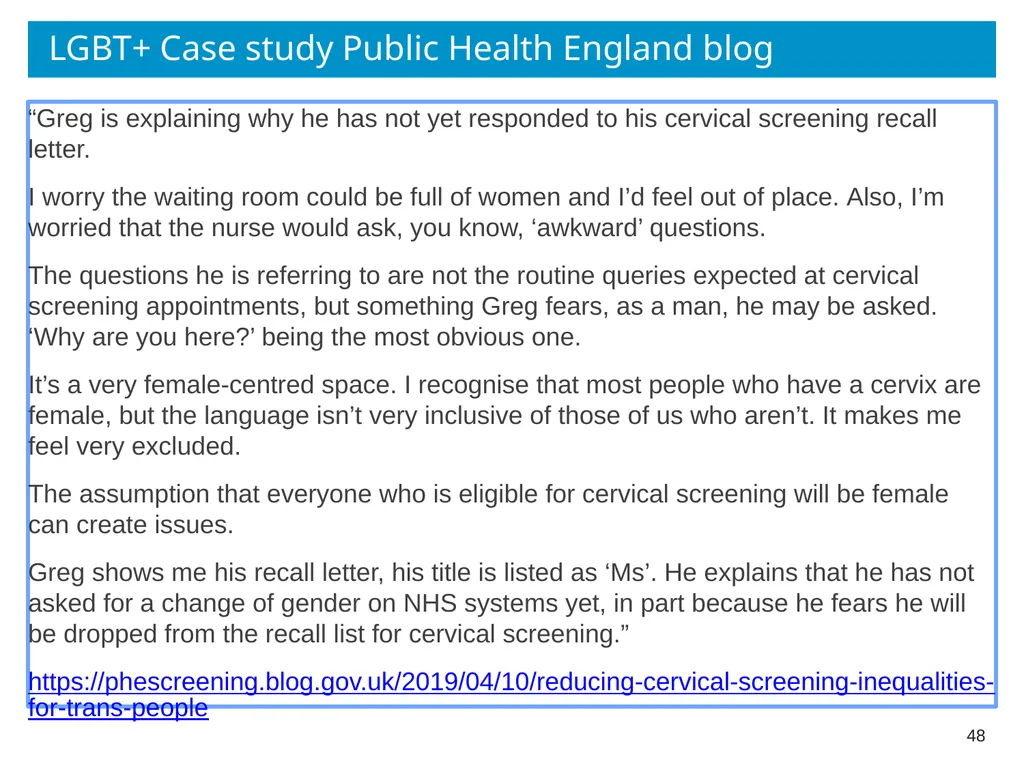
LGBT+ Case study Public Health England blog 48 “Greg is explaining why he has not yet responded to his cervical screening recall letter.
I worry the waiting room could be full of women and I’d feel out of place. Also, I’m worried that the nurse would ask, you know, ‘awkward’ questions.
The questions he is referring to are not the routine queries expected at cervical screening appointments, but something Greg fears, as a man, he may be asked. ‘Why are you here?’ being the most obvious one.
It’s a very female-centred space. I recognise that most people who have a cervix are female, but the language isn’t very inclusive of those of us who aren’t. It makes me feel very excluded.
The assumption that everyone who is eligible for cervical screening will be female can create issues.
Greg shows me his recall letter, his title is listed as ‘Ms’. He explains that he has not asked for a change of gender on NHS systems yet, in part because he fears he will be dropped from the recall list for cervical screening.”
https://phescreening.blog.gov.uk/2019/04/10/reducing-cervical-screening-inequalities-for-trans-people<br>
I worry the waiting room could be full of women and I’d feel out of place. Also, I’m worried that the nurse would ask, you know, ‘awkward’ questions.
The questions he is referring to are not the routine queries expected at cervical screening appointments, but something Greg fears, as a man, he may be asked. ‘Why are you here?’ being the most obvious one.
It’s a very female-centred space. I recognise that most people who have a cervix are female, but the language isn’t very inclusive of those of us who aren’t. It makes me feel very excluded.
The assumption that everyone who is eligible for cervical screening will be female can create issues.
Greg shows me his recall letter, his title is listed as ‘Ms’. He explains that he has not asked for a change of gender on NHS systems yet, in part because he fears he will be dropped from the recall list for cervical screening.”
https://phescreening.blog.gov.uk/2019/04/10/reducing-cervical-screening-inequalities-for-trans-people<br>
49
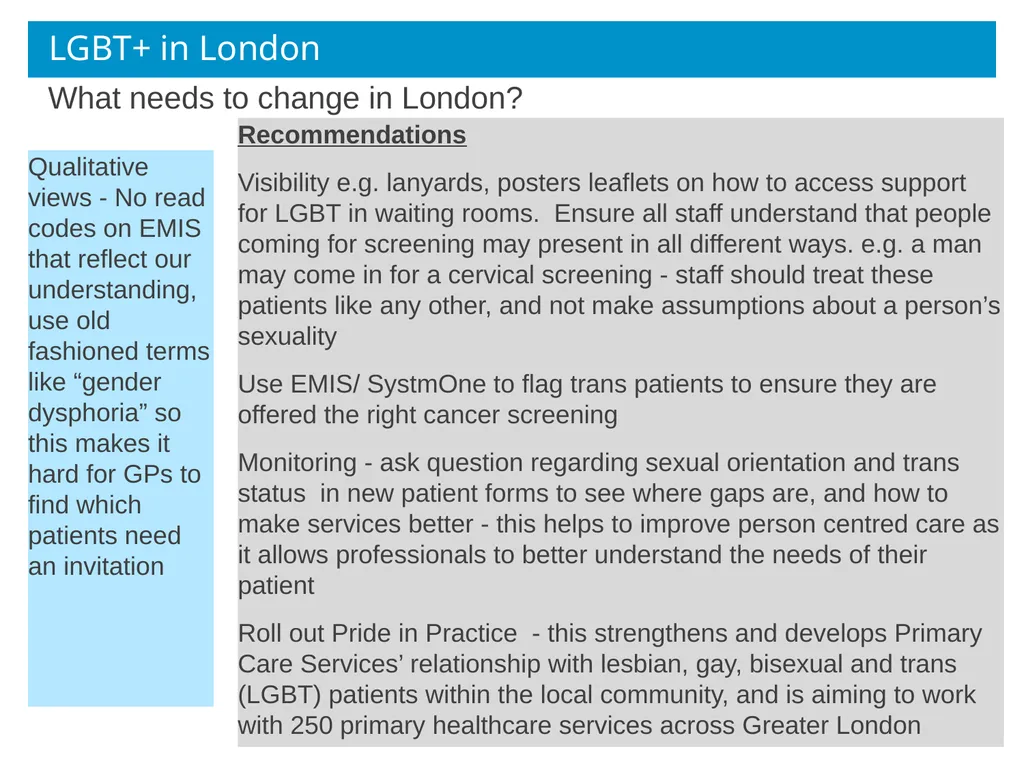
LGBT+ in London What needs to change in London? 49 Qualitative views - No read codes on EMIS that reflect our understanding, use old fashioned terms like “gender dysphoria” so this makes it hard for GPs to find which patients need an invitation Recommendations
Visibility e.g. lanyards, posters leaflets on how to access support for LGBT in waiting rooms. Ensure all staff understand that people coming for screening may present in all different ways. e.g. a man may come in for a cervical screening - staff should treat these patients like any other, and not make assumptions about a person’s sexuality
Use EMIS/ SystmOne to flag trans patients to ensure they are offered the right cancer screening
Monitoring - ask question regarding sexual orientation and trans status in new patient forms to see where gaps are, and how to make services better - this helps to improve person centred care as it allows professionals to better understand the needs of their patient
Roll out Pride in Practice - this strengthens and develops Primary Care Services’ relationship with lesbian, gay, bisexual and trans (LGBT) patients within the local community, and is aiming to work with 250 primary healthcare services across Greater London<br>
Visibility e.g. lanyards, posters leaflets on how to access support for LGBT in waiting rooms. Ensure all staff understand that people coming for screening may present in all different ways. e.g. a man may come in for a cervical screening - staff should treat these patients like any other, and not make assumptions about a person’s sexuality
Use EMIS/ SystmOne to flag trans patients to ensure they are offered the right cancer screening
Monitoring - ask question regarding sexual orientation and trans status in new patient forms to see where gaps are, and how to make services better - this helps to improve person centred care as it allows professionals to better understand the needs of their patient
Roll out Pride in Practice - this strengthens and develops Primary Care Services’ relationship with lesbian, gay, bisexual and trans (LGBT) patients within the local community, and is aiming to work with 250 primary healthcare services across Greater London<br>
50
Views of patients and professionals on cancer inequalities 50<br>
51
Professionals’ views 51<br>
52
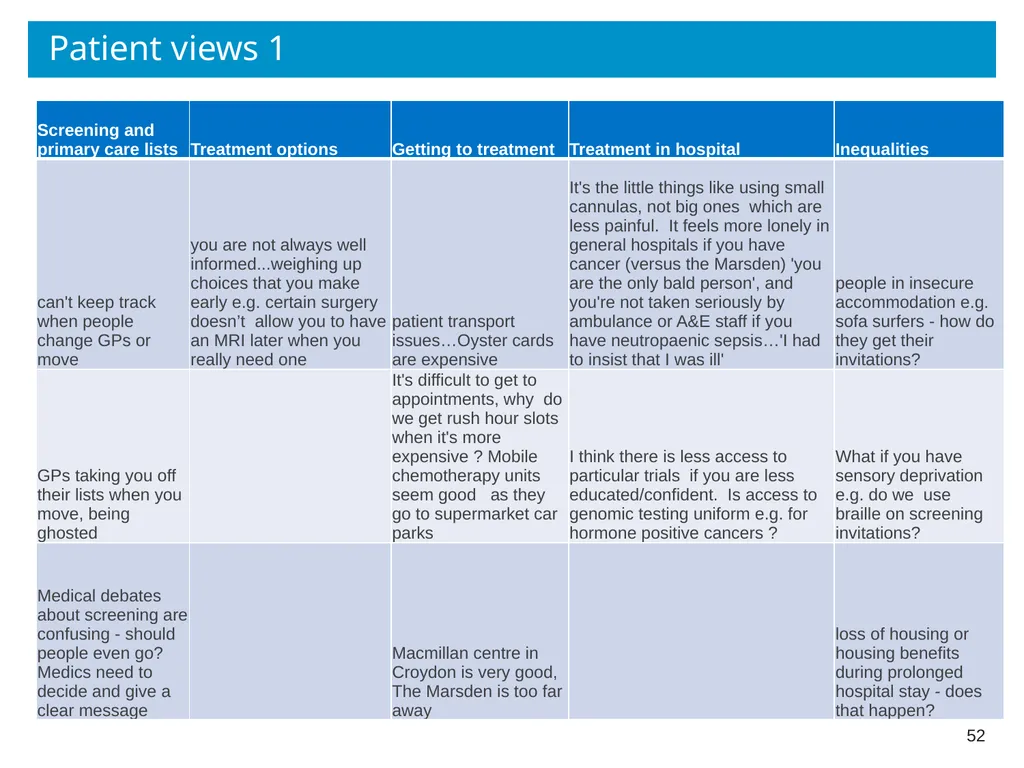
Patient views 1 52<br>
53
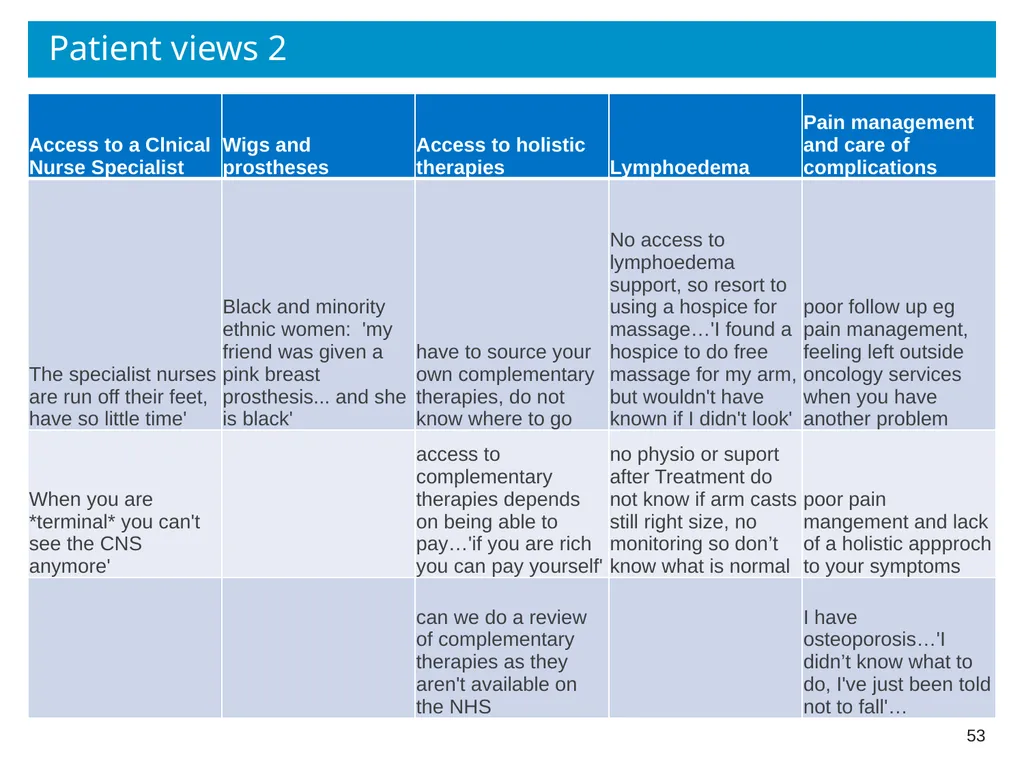
Patient views 2 53<br>
54
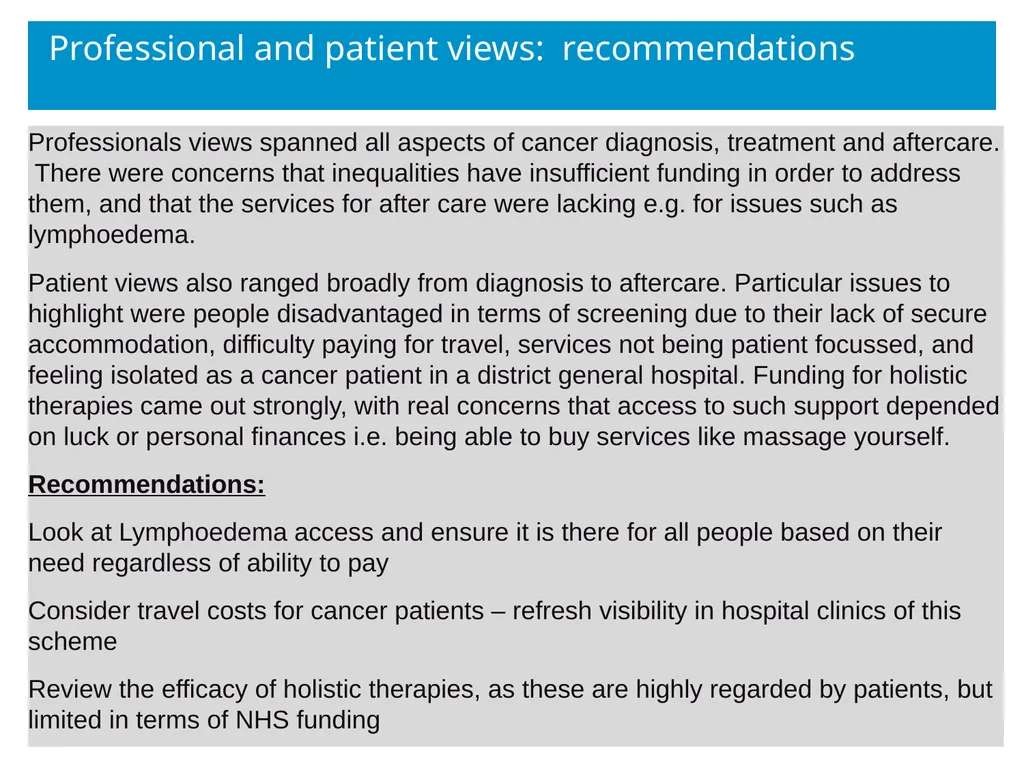
Professional and patient views: recommendations 54 Professionals views spanned all aspects of cancer diagnosis, treatment and aftercare. There were concerns that inequalities have insufficient funding in order to address them, and that the services for after care were lacking e.g. for issues such as lymphoedema.
Patient views also ranged broadly from diagnosis to aftercare. Particular issues to highlight were people disadvantaged in terms of screening due to their lack of secure accommodation, difficulty paying for travel, services not being patient focussed, and feeling isolated as a cancer patient in a district general hospital. Funding for holistic therapies came out strongly, with real concerns that access to such support depended on luck or personal finances i.e. being able to buy services like massage yourself.
Recommendations:
Look at Lymphoedema access and ensure it is there for all people based on their need regardless of ability to pay
Consider travel costs for cancer patients – refresh visibility in hospital clinics of this scheme
Review the efficacy of holistic therapies, as these are highly regarded by patients, but limited in terms of NHS funding<br>
Patient views also ranged broadly from diagnosis to aftercare. Particular issues to highlight were people disadvantaged in terms of screening due to their lack of secure accommodation, difficulty paying for travel, services not being patient focussed, and feeling isolated as a cancer patient in a district general hospital. Funding for holistic therapies came out strongly, with real concerns that access to such support depended on luck or personal finances i.e. being able to buy services like massage yourself.
Recommendations:
Look at Lymphoedema access and ensure it is there for all people based on their need regardless of ability to pay
Consider travel costs for cancer patients – refresh visibility in hospital clinics of this scheme
Review the efficacy of holistic therapies, as these are highly regarded by patients, but limited in terms of NHS funding<br>
55
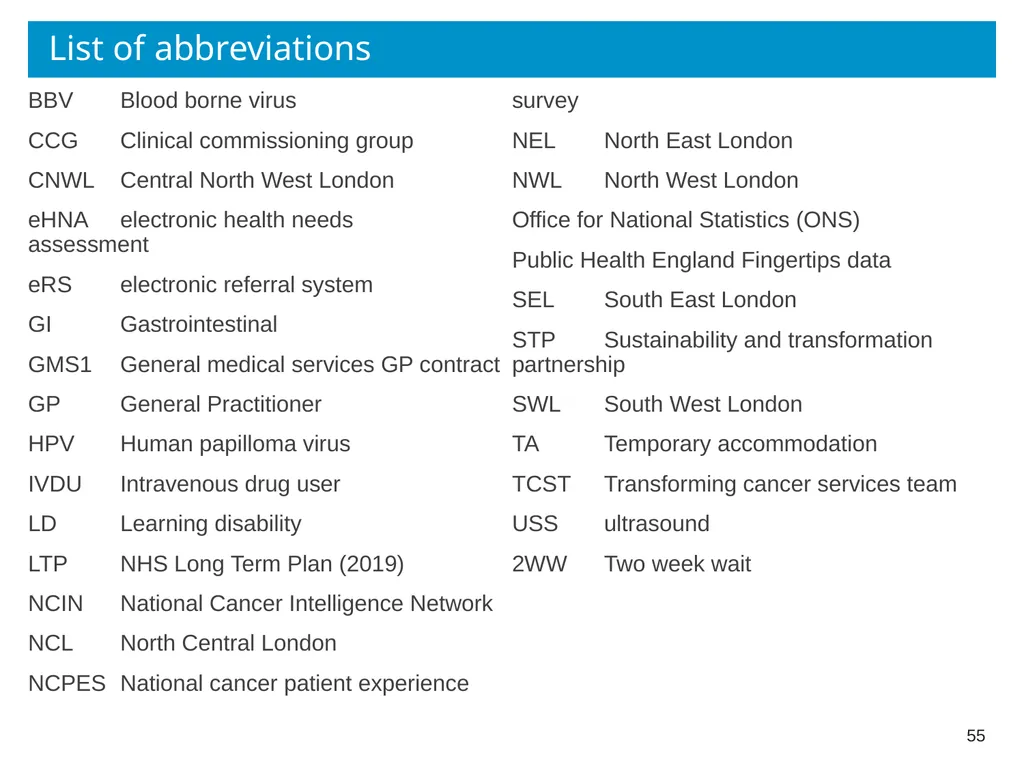
List of abbreviations 55 BBV Blood borne virus
CCG Clinical commissioning group
CNWL Central North West London
eHNA electronic health needs assessment
eRS electronic referral system
GI Gastrointestinal
GMS1 General medical services GP contract
GP General Practitioner
HPV Human papilloma virus
IVDU Intravenous drug user
LD Learning disability
LTP NHS Long Term Plan (2019)
NCIN National Cancer Intelligence Network
NCL North Central London
NCPES National cancer patient experience survey
NEL North East London
NWL North West London
Office for National Statistics (ONS)
Public Health England Fingertips data
SEL South East London
STP Sustainability and transformation partnership
SWL South West London
TA Temporary accommodation
TCST Transforming cancer services team
USS ultrasound
2WW Two week wait<br>
CCG Clinical commissioning group
CNWL Central North West London
eHNA electronic health needs assessment
eRS electronic referral system
GI Gastrointestinal
GMS1 General medical services GP contract
GP General Practitioner
HPV Human papilloma virus
IVDU Intravenous drug user
LD Learning disability
LTP NHS Long Term Plan (2019)
NCIN National Cancer Intelligence Network
NCL North Central London
NCPES National cancer patient experience survey
NEL North East London
NWL North West London
Office for National Statistics (ONS)
Public Health England Fingertips data
SEL South East London
STP Sustainability and transformation partnership
SWL South West London
TA Temporary accommodation
TCST Transforming cancer services team
USS ultrasound
2WW Two week wait<br>