
CHAPTER 1: Introduction 2 Why “Learn”? Machine
Description: CHAPTER 1: Introduction 2 Why Learn? Machine learning is programming computers to optimize a performance criterion using example data or past experience. There is no need to learn to calculate payroll Learning is used when: Human
Related Topics
Download Presentation
"CHAPTER 1: Introduction 2 Why “Learn”? Machine" is the property of its rightful owner. Permission is granted to download and print the materials on this website for personal, non-commercial use only, and to display it on your personal computer provided you do not modify the materials and that you retain all copyright notices contained in the materials. By downloading content from our website, you accept the terms of this agreement.
Presentation Transcript
slide1. CHAPTER 1:
Introduction<br>
slide2. 2 Why “Learn”? Machine learning is programming computers to optimize a performance criterion using example data or past experience.
There is no need to “learn” to calculate payroll
Learning is used when:
Human expertise does not exist (navigating on Mars),
Humans are unable to explain their expertise (speech recognition)
Solution changes in time (routing on a computer network)
Solution needs to be adapted to particular cases (user biometrics)<br>
slide3. 3 What We Talk About When We Talk About“Learning” Learning general models from a data of particular examples
Data is cheap and abundant (data warehouses, data marts); knowledge is expensive and scarce.
Example in retail: Customer transactions to consumer behavior:
People who bought “Da Vinci Code” also bought “The Five People You Meet in Heaven” (www.amazon.com)
Build a model that is a good and useful approximation to the data.<br>
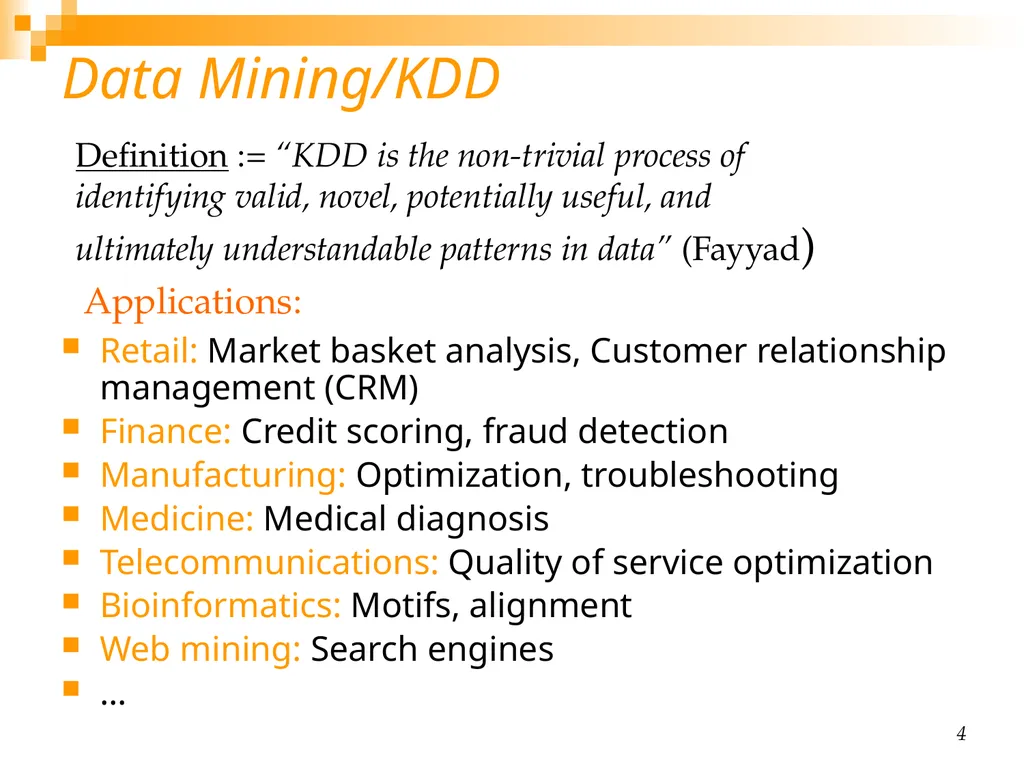
slide4. 4 Data Mining/KDD Retail: Market basket analysis, Customer relationship management (CRM)
Finance: Credit scoring, fraud detection
Manufacturing: Optimization, troubleshooting
Medicine: Medical diagnosis
Telecommunications: Quality of service optimization
Bioinformatics: Motifs, alignment
Web mining: Search engines
... Definition := “KDD is the non-trivial process of
identifying valid, novel, potentially useful, and
ultimately understandable patterns in data” (Fayyad) Applications:<br>
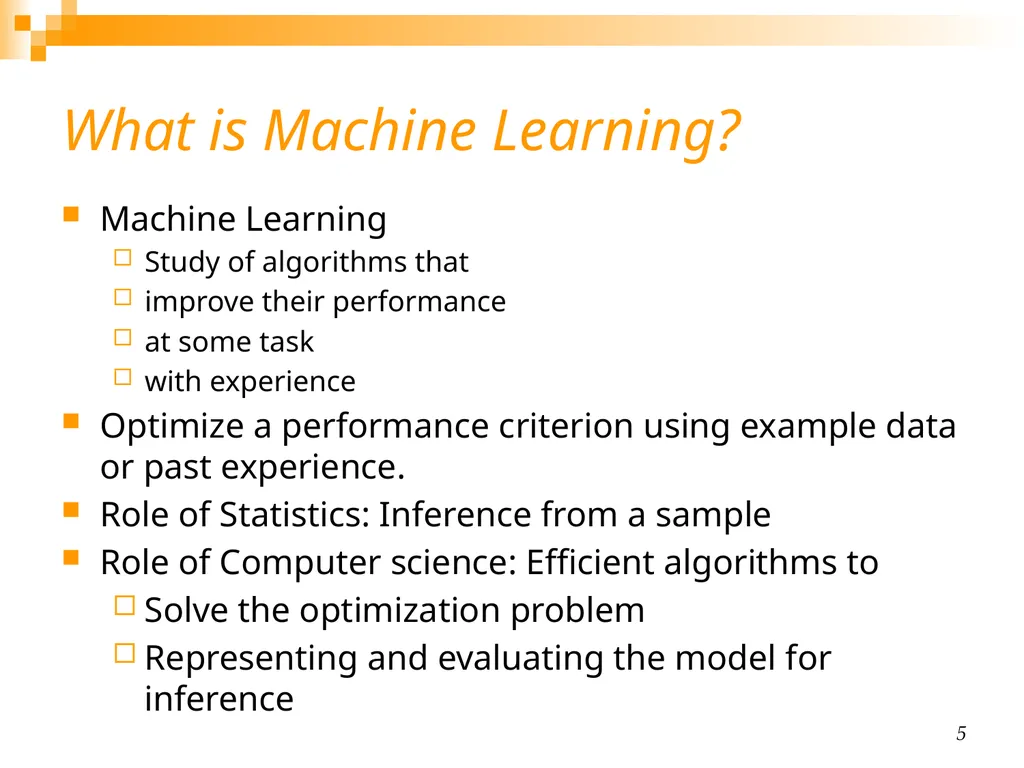
slide5. 5 What is Machine Learning? Machine Learning
Study of algorithms that
improve their performance
at some task
with experience
Optimize a performance criterion using example data or past experience.
Role of Statistics: Inference from a sample
Role of Computer science: Efficient algorithms to
Solve the optimization problem
Representing and evaluating the model for inference<br>
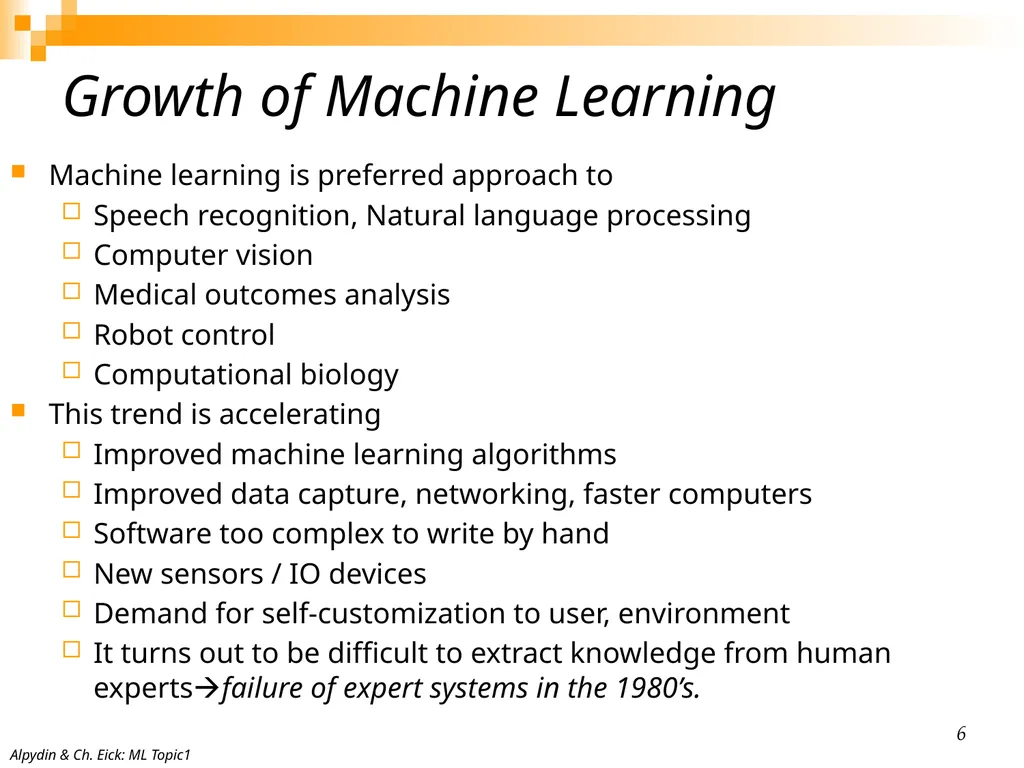
slide6. Growth of Machine Learning Machine learning is preferred approach to
Speech recognition, Natural language processing
Computer vision
Medical outcomes analysis
Robot control
Computational biology
This trend is accelerating
Improved machine learning algorithms
Improved data capture, networking, faster computers
Software too complex to write by hand
New sensors / IO devices
Demand for self-customization to user, environment
It turns out to be difficult to extract knowledge from human expertsfailure of expert systems in the 1980’s. Alpydin & Ch. Eick: ML Topic1 6<br>
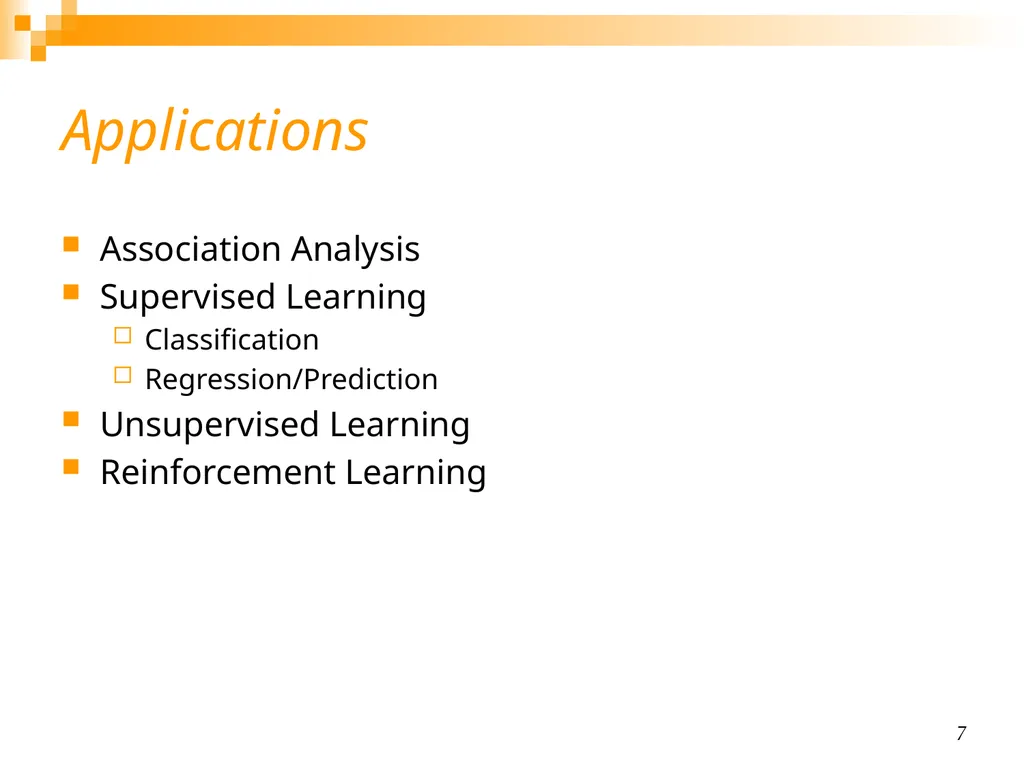
slide7. 7 Applications Association Analysis
Supervised Learning
Classification
Regression/Prediction
Unsupervised Learning
Reinforcement Learning<br>
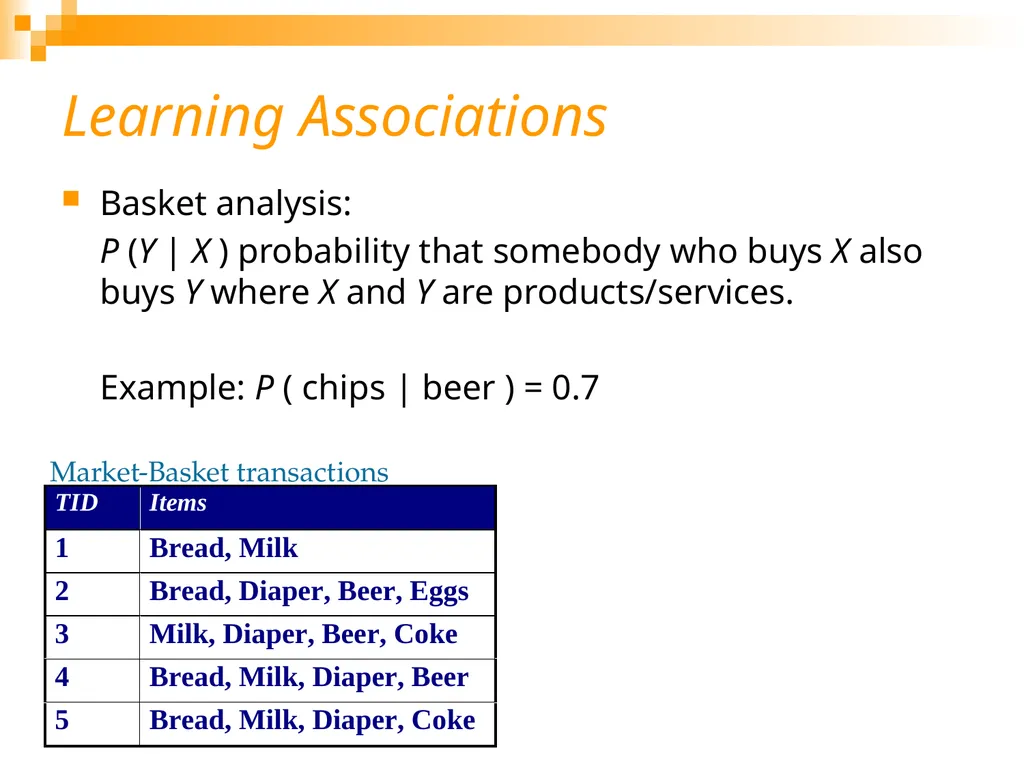
slide8. Learning Associations Basket analysis:
P (Y | X ) probability that somebody who buys X also buys Y where X and Y are products/services.
Example: P ( chips | beer ) = 0.7 Market-Basket transactions<br>
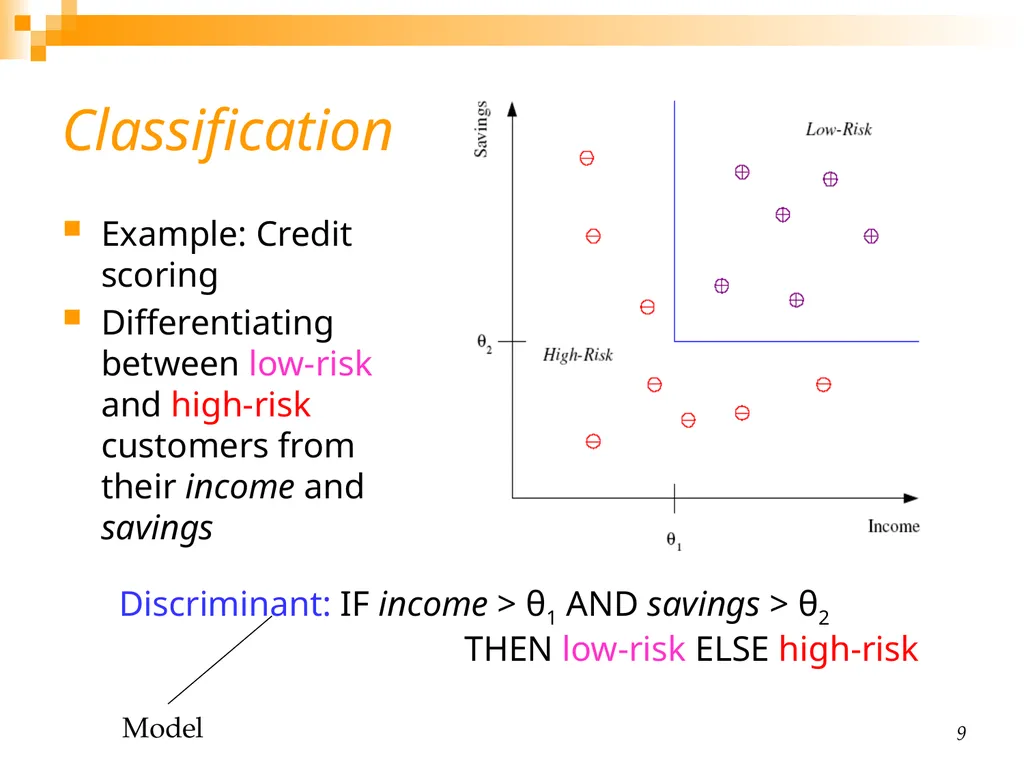
slide9. 9 Classification Example: Credit scoring
Differentiating between low-risk and high-risk customers from their income and savings Discriminant: IF income > θ1 AND savings > θ2
THEN low-risk ELSE high-risk Model<br>
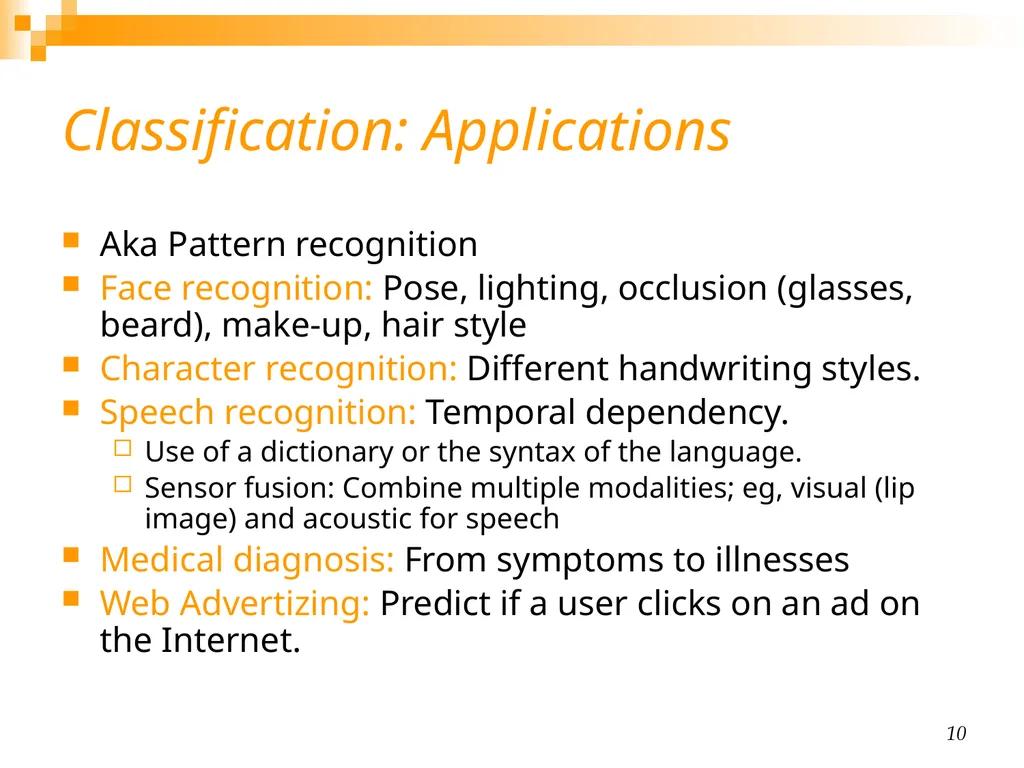
slide10. 10 Classification: Applications Aka Pattern recognition
Face recognition: Pose, lighting, occlusion (glasses, beard), make-up, hair style
Character recognition: Different handwriting styles.
Speech recognition: Temporal dependency.
Use of a dictionary or the syntax of the language.
Sensor fusion: Combine multiple modalities; eg, visual (lip image) and acoustic for speech
Medical diagnosis: From symptoms to illnesses
Web Advertizing: Predict if a user clicks on an ad on the Internet.<br>
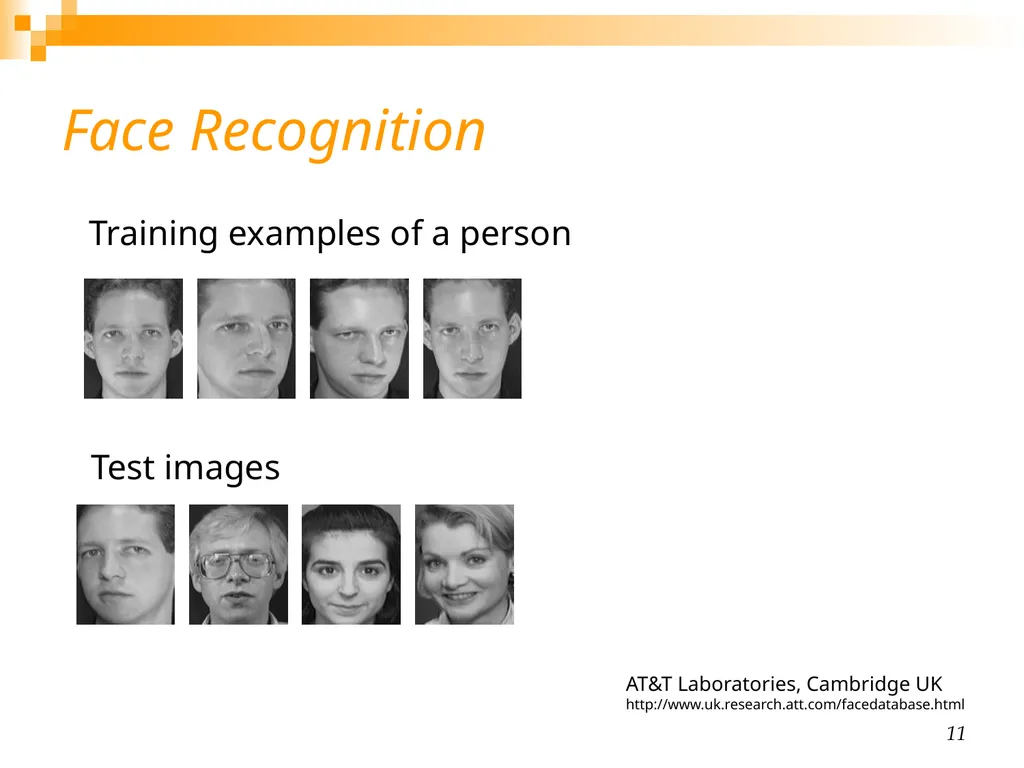
slide11. 11 Face Recognition Training examples of a person Test images AT&T Laboratories, Cambridge UK
http://www.uk.research.att.com/facedatabase.html<br>
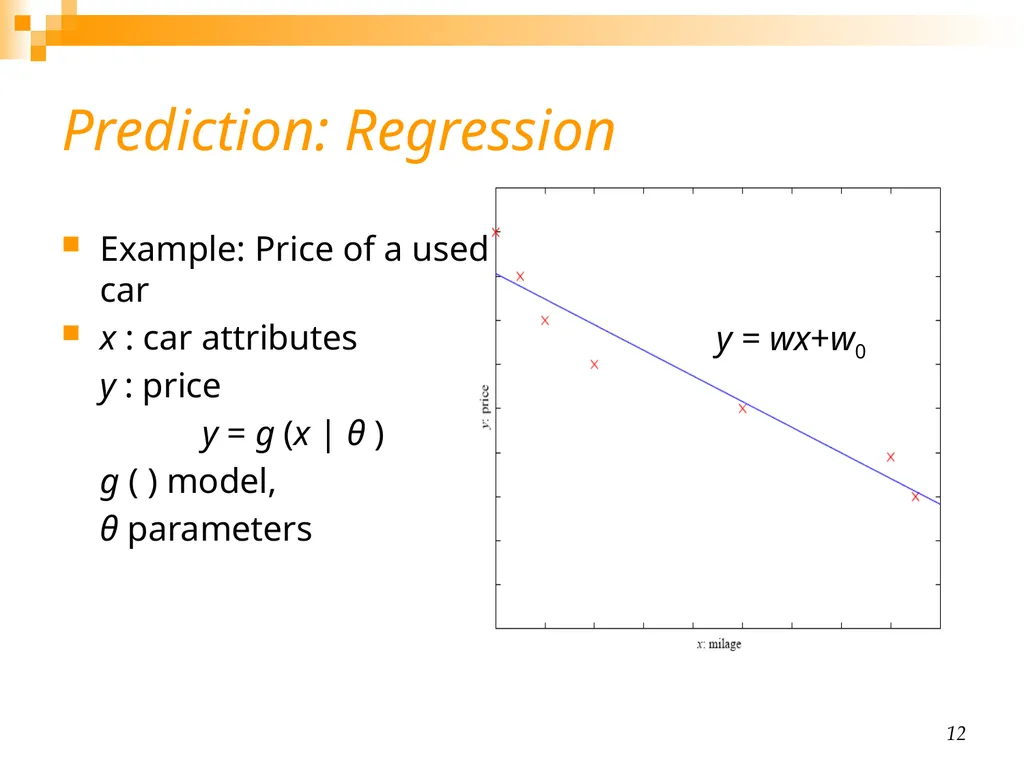
slide12. 12 Prediction: Regression Example: Price of a used car
x : car attributes
y : price
y = g (x | θ )
g ( ) model,
θ parameters y = wx+w0<br>
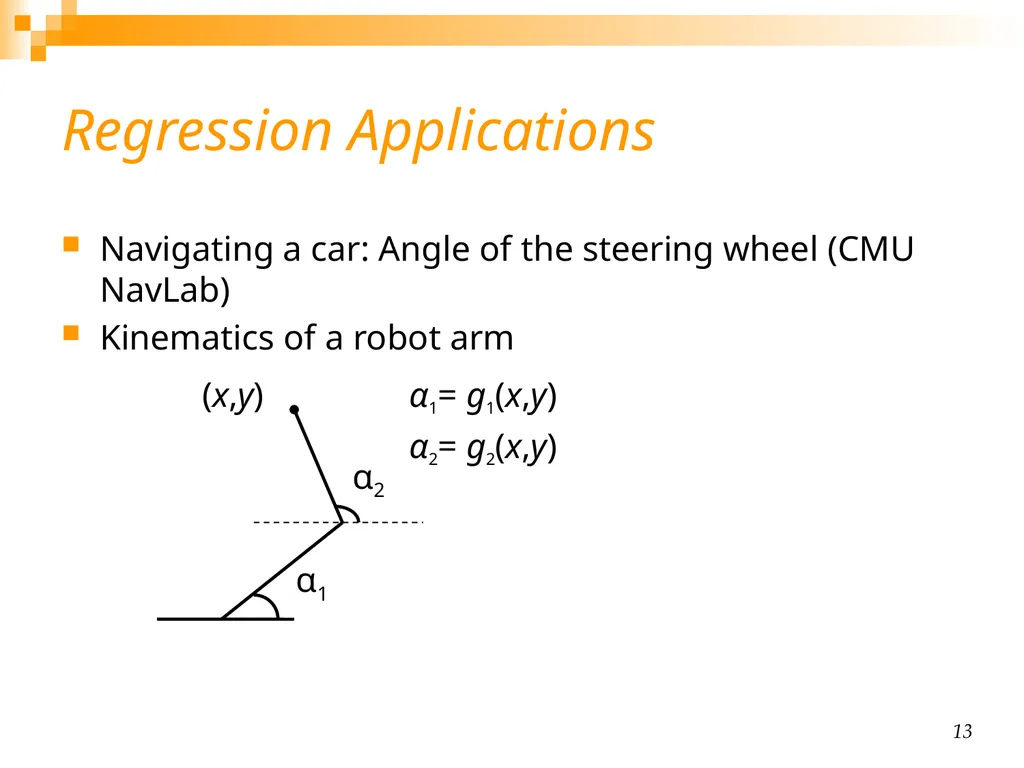
slide13. 13 Regression Applications Navigating a car: Angle of the steering wheel (CMU NavLab)
Kinematics of a robot arm α1= g1(x,y)
α2= g2(x,y)<br>
slide14. 14 Supervised Learning: Uses Prediction of future cases: Use the rule to predict the output for future inputs
Knowledge extraction: The rule is easy to understand
Compression: The rule is simpler than the data it explains
Outlier detection: Exceptions that are not covered by the rule, e.g., fraud Example: decision trees tools that create rules<br>
slide15. 15 Unsupervised Learning Learning “what normally happens”
No output
Clustering: Grouping similar instances
Other applications: Summarization, Association Analysis
Example applications
Customer segmentation in CRM
Image compression: Color quantization
Bioinformatics: Learning motifs<br>
slide16. 16 Reinforcement Learning Topics:
Policies: what actions should an agent take in a particular situation
Utility estimation: how good is a state (used by policy)
No supervised output but delayed reward
Credit assignment problem (what was responsible for the outcome)
Applications:
Game playing
Robot in a maze
Multiple agents, partial observability, ...<br>
slide17. 17 Resources: Datasets UCI Repository: http://www.ics.uci.edu/~mlearn/MLRepository.html
UCI KDD Archive: http://kdd.ics.uci.edu/summary.data.application.html
Statlib: http://lib.stat.cmu.edu/
Delve: http://www.cs.utoronto.ca/~delve/<br>
slide18. 18 Resources: Journals Journal of Machine Learning Research www.jmlr.org
Machine Learning
IEEE Transactions on Neural Networks
IEEE Transactions on Pattern Analysis and Machine Intelligence
Annals of Statistics
Journal of the American Statistical Association
...<br>
slide19. 19 Resources: Conferences International Conference on Machine Learning (ICML)
European Conference on Machine Learning (ECML)
Neural Information Processing Systems (NIPS)
Computational Learning
International Joint Conference on Artificial Intelligence (IJCAI)
ACM SIGKDD Conference on Knowledge Discovery and Data Mining (KDD)
IEEE Int. Conf. on Data Mining (ICDM)<br>
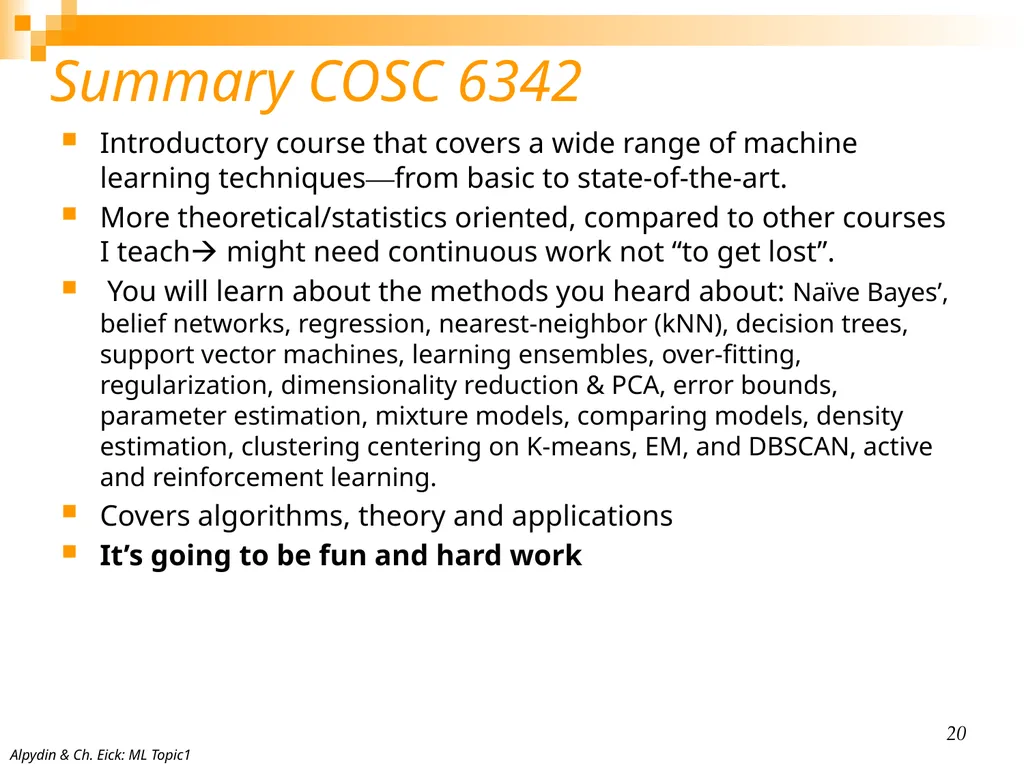
slide20. Summary COSC 6342 Introductory course that covers a wide range of machine learning techniques—from basic to state-of-the-art.
More theoretical/statistics oriented, compared to other courses I teach might need continuous work not “to get lost”.
You will learn about the methods you heard about: Naïve Bayes’, belief networks, regression, nearest-neighbor (kNN), decision trees, support vector machines, learning ensembles, over-fitting, regularization, dimensionality reduction & PCA, error bounds, parameter estimation, mixture models, comparing models, density estimation, clustering centering on K-means, EM, and DBSCAN, active and reinforcement learning.
Covers algorithms, theory and applications
It’s going to be fun and hard work Alpydin & Ch. Eick: ML Topic1 20<br>
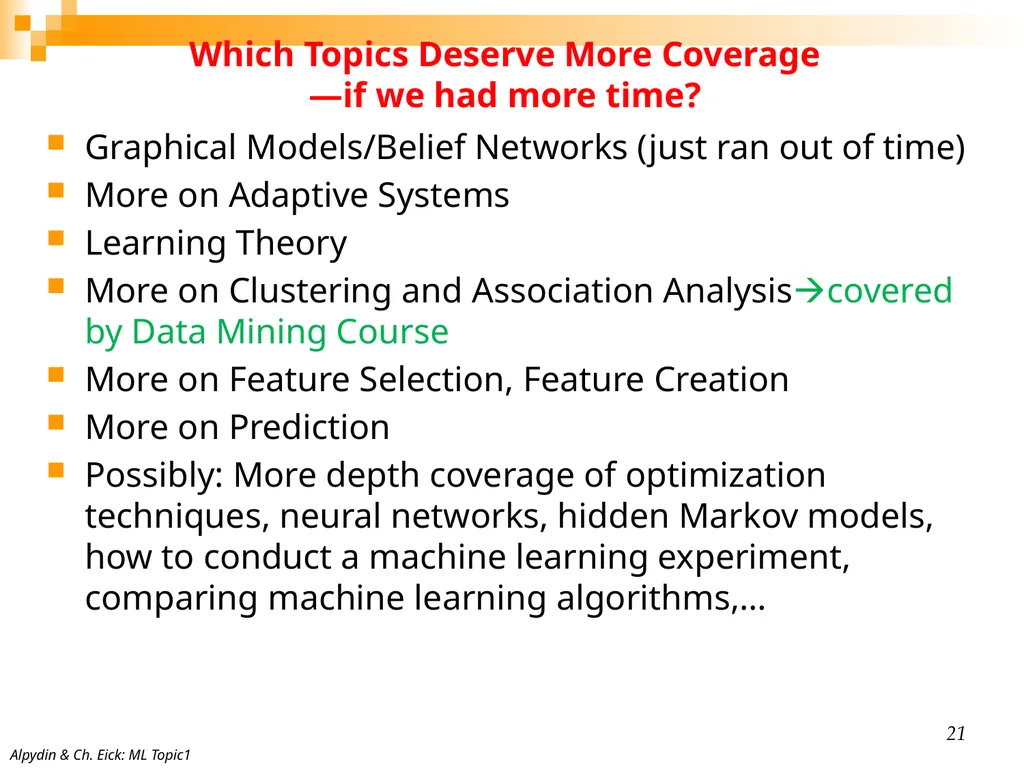
slide21. Which Topics Deserve More Coverage —if we had more time? Graphical Models/Belief Networks (just ran out of time)
More on Adaptive Systems
Learning Theory
More on Clustering and Association Analysiscovered by Data Mining Course
More on Feature Selection, Feature Creation
More on Prediction
Possibly: More depth coverage of optimization techniques, neural networks, hidden Markov models, how to conduct a machine learning experiment, comparing machine learning algorithms,… Alpydin & Ch. Eick: ML Topic1 21<br>
slide2. 2 Why “Learn”? Machine learning is programming computers to optimize a performance criterion using example data or past experience.
There is no need to “learn” to calculate payroll
Learning is used when:
Human expertise does not exist (navigating on Mars),
Humans are unable to explain their expertise (speech recognition)
Solution changes in time (routing on a computer network)
Solution needs to be adapted to particular cases (user biometrics)<br>
slide3. 3 What We Talk About When We Talk About“Learning” Learning general models from a data of particular examples
Data is cheap and abundant (data warehouses, data marts); knowledge is expensive and scarce.
Example in retail: Customer transactions to consumer behavior:
People who bought “Da Vinci Code” also bought “The Five People You Meet in Heaven” (www.amazon.com)
Build a model that is a good and useful approximation to the data.<br>
slide4. 4 Data Mining/KDD Retail: Market basket analysis, Customer relationship management (CRM)
Finance: Credit scoring, fraud detection
Manufacturing: Optimization, troubleshooting
Medicine: Medical diagnosis
Telecommunications: Quality of service optimization
Bioinformatics: Motifs, alignment
Web mining: Search engines
... Definition := “KDD is the non-trivial process of
identifying valid, novel, potentially useful, and
ultimately understandable patterns in data” (Fayyad) Applications:<br>
slide5. 5 What is Machine Learning? Machine Learning
Study of algorithms that
improve their performance
at some task
with experience
Optimize a performance criterion using example data or past experience.
Role of Statistics: Inference from a sample
Role of Computer science: Efficient algorithms to
Solve the optimization problem
Representing and evaluating the model for inference<br>
slide6. Growth of Machine Learning Machine learning is preferred approach to
Speech recognition, Natural language processing
Computer vision
Medical outcomes analysis
Robot control
Computational biology
This trend is accelerating
Improved machine learning algorithms
Improved data capture, networking, faster computers
Software too complex to write by hand
New sensors / IO devices
Demand for self-customization to user, environment
It turns out to be difficult to extract knowledge from human expertsfailure of expert systems in the 1980’s. Alpydin & Ch. Eick: ML Topic1 6<br>
slide7. 7 Applications Association Analysis
Supervised Learning
Classification
Regression/Prediction
Unsupervised Learning
Reinforcement Learning<br>
slide8. Learning Associations Basket analysis:
P (Y | X ) probability that somebody who buys X also buys Y where X and Y are products/services.
Example: P ( chips | beer ) = 0.7 Market-Basket transactions<br>
slide9. 9 Classification Example: Credit scoring
Differentiating between low-risk and high-risk customers from their income and savings Discriminant: IF income > θ1 AND savings > θ2
THEN low-risk ELSE high-risk Model<br>
slide10. 10 Classification: Applications Aka Pattern recognition
Face recognition: Pose, lighting, occlusion (glasses, beard), make-up, hair style
Character recognition: Different handwriting styles.
Speech recognition: Temporal dependency.
Use of a dictionary or the syntax of the language.
Sensor fusion: Combine multiple modalities; eg, visual (lip image) and acoustic for speech
Medical diagnosis: From symptoms to illnesses
Web Advertizing: Predict if a user clicks on an ad on the Internet.<br>
slide11. 11 Face Recognition Training examples of a person Test images AT&T Laboratories, Cambridge UK
http://www.uk.research.att.com/facedatabase.html<br>
slide12. 12 Prediction: Regression Example: Price of a used car
x : car attributes
y : price
y = g (x | θ )
g ( ) model,
θ parameters y = wx+w0<br>
slide13. 13 Regression Applications Navigating a car: Angle of the steering wheel (CMU NavLab)
Kinematics of a robot arm α1= g1(x,y)
α2= g2(x,y)<br>
slide14. 14 Supervised Learning: Uses Prediction of future cases: Use the rule to predict the output for future inputs
Knowledge extraction: The rule is easy to understand
Compression: The rule is simpler than the data it explains
Outlier detection: Exceptions that are not covered by the rule, e.g., fraud Example: decision trees tools that create rules<br>
slide15. 15 Unsupervised Learning Learning “what normally happens”
No output
Clustering: Grouping similar instances
Other applications: Summarization, Association Analysis
Example applications
Customer segmentation in CRM
Image compression: Color quantization
Bioinformatics: Learning motifs<br>
slide16. 16 Reinforcement Learning Topics:
Policies: what actions should an agent take in a particular situation
Utility estimation: how good is a state (used by policy)
No supervised output but delayed reward
Credit assignment problem (what was responsible for the outcome)
Applications:
Game playing
Robot in a maze
Multiple agents, partial observability, ...<br>
slide17. 17 Resources: Datasets UCI Repository: http://www.ics.uci.edu/~mlearn/MLRepository.html
UCI KDD Archive: http://kdd.ics.uci.edu/summary.data.application.html
Statlib: http://lib.stat.cmu.edu/
Delve: http://www.cs.utoronto.ca/~delve/<br>
slide18. 18 Resources: Journals Journal of Machine Learning Research www.jmlr.org
Machine Learning
IEEE Transactions on Neural Networks
IEEE Transactions on Pattern Analysis and Machine Intelligence
Annals of Statistics
Journal of the American Statistical Association
...<br>
slide19. 19 Resources: Conferences International Conference on Machine Learning (ICML)
European Conference on Machine Learning (ECML)
Neural Information Processing Systems (NIPS)
Computational Learning
International Joint Conference on Artificial Intelligence (IJCAI)
ACM SIGKDD Conference on Knowledge Discovery and Data Mining (KDD)
IEEE Int. Conf. on Data Mining (ICDM)<br>
slide20. Summary COSC 6342 Introductory course that covers a wide range of machine learning techniques—from basic to state-of-the-art.
More theoretical/statistics oriented, compared to other courses I teach might need continuous work not “to get lost”.
You will learn about the methods you heard about: Naïve Bayes’, belief networks, regression, nearest-neighbor (kNN), decision trees, support vector machines, learning ensembles, over-fitting, regularization, dimensionality reduction & PCA, error bounds, parameter estimation, mixture models, comparing models, density estimation, clustering centering on K-means, EM, and DBSCAN, active and reinforcement learning.
Covers algorithms, theory and applications
It’s going to be fun and hard work Alpydin & Ch. Eick: ML Topic1 20<br>
slide21. Which Topics Deserve More Coverage —if we had more time? Graphical Models/Belief Networks (just ran out of time)
More on Adaptive Systems
Learning Theory
More on Clustering and Association Analysiscovered by Data Mining Course
More on Feature Selection, Feature Creation
More on Prediction
Possibly: More depth coverage of optimization techniques, neural networks, hidden Markov models, how to conduct a machine learning experiment, comparing machine learning algorithms,… Alpydin & Ch. Eick: ML Topic1 21<br>