
Chapter 1 Introduction to IoT Bahga & Madisetti, ©


Description: Chapter 1 Introduction to IoT Bahga Madisetti, 2015 Book website: http:www.internet-of-things-book.com Outline Definition of IoT Characteristics of IoT Physical design of IoT Logical design of IoT IoT protocols IoT levels and
Related Topics
Download Presentation
"Chapter 1 Introduction to IoT Bahga & Madisetti, ©" is the property of its rightful owner. Permission is granted to download and print the materials on this website for personal, non-commercial use only, and to display it on your personal computer provided you do not modify the materials and that you retain all copyright notices contained in the materials. By downloading content from our website, you accept the terms of this agreement.
Presentation Transcript
slide1. Chapter 1 Introduction to IoT Bahga & Madisetti, © 2015 Book website: http://www.internet-of-things-book.com<br>
slide2. Outline Definition of IoT
Characteristics of IoT
Physical design of IoT
Logical design of IoT
IoT protocols
IoT levels and deployment templates Bahga & Madisetti, © 2015 Book website: http://www.internet-of-things-book.com<br>
slide3. Definition of IoT A dynamic global network infrastructure with self-configuring capabilities based on standard and interoperable communication protocols where physical and virtual "things" have identities, physical attributes and virtual personalities, use intelligent interfaces, are seamlessly integrated into the information network, and often communicate data associated with users and their environments. Bahga & Madisetti, © 2015 Book website: http://www.internet-of-things-book.com<br>
slide4. Characteristics of IoT Dynamic and self-adapting
Self-configuring
Interoperable communication protocols
Unique identity
Integrated into the information network Bahga & Madisetti, © 2015 Book website: http://www.internet-of-things-book.com<br>
slide5. Physical Design of IoT The "Things" in IoT usually refers to IoT devices which have unique identities and can perform remote sensing and actuating and have monitoring capabilities.
IoT devices can:
Exchange data with other connected devices and applications (directly or indirectly), or
Collect data from other devices and process the data locally, or
Send the data to centralized servers or cloud-based application back-ends for processing the data, or
Perform some tasks locally and other tasks within the IoT infrastructure, based on temporal and space constraints Bahga & Madisetti, © 2015 Book website: http://www.internet-of-things-book.com<br>
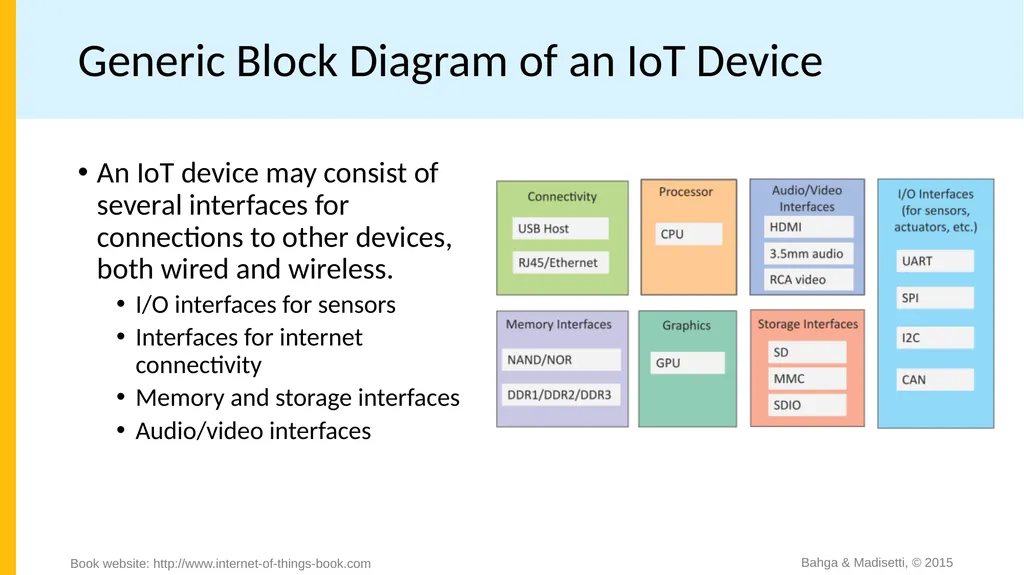
slide6. Generic Block Diagram of an IoT Device An IoT device may consist of several interfaces for connections to other devices, both wired and wireless.
I/O interfaces for sensors
Interfaces for internet connectivity
Memory and storage interfaces
Audio/video interfaces Bahga & Madisetti, © 2015 Book website: http://www.internet-of-things-book.com<br>
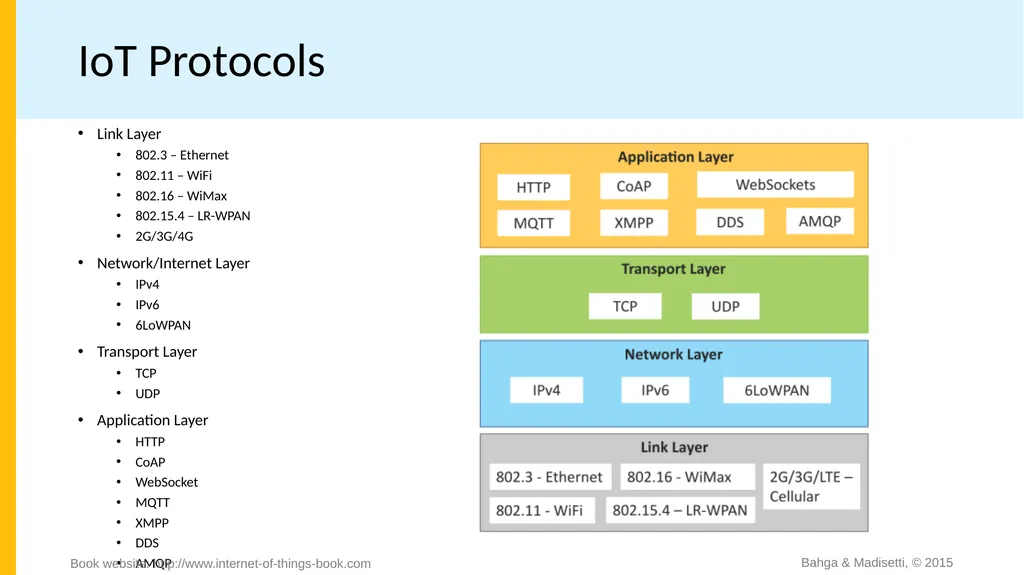
slide7. IoT Protocols Link Layer
802.3 – Ethernet
802.11 – WiFi
802.16 – WiMax
802.15.4 – LR-WPAN
2G/3G/4G
Network/Internet Layer
IPv4
IPv6
6LoWPAN
Transport Layer
TCP
UDP
Application Layer
HTTP
CoAP
WebSocket
MQTT
XMPP
DDS
AMQP Bahga & Madisetti, © 2015 Book website: http://www.internet-of-things-book.com<br>
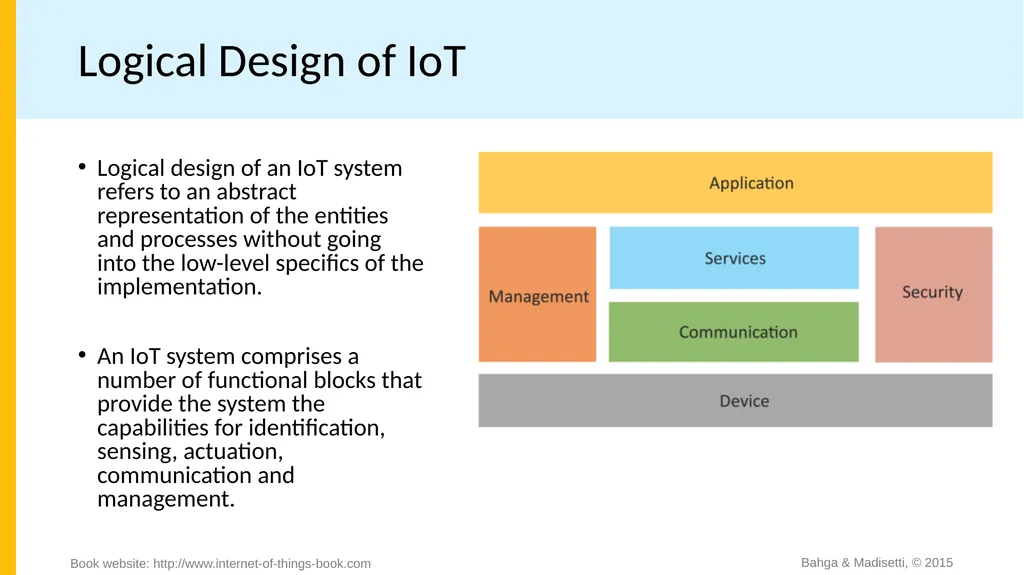
slide8. Logical Design of IoT Logical design of an IoT system refers to an abstract representation of the entities and processes without going into the low-level specifics of the implementation.
An IoT system comprises a number of functional blocks that provide the system the capabilities for identification, sensing, actuation, communication and management. Bahga & Madisetti, © 2015 Book website: http://www.internet-of-things-book.com<br>
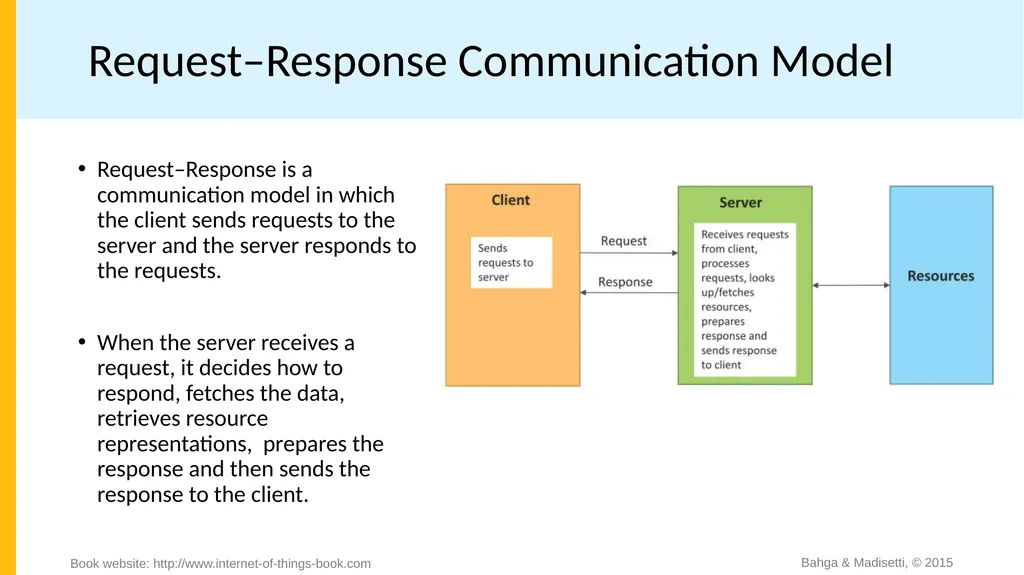
slide9. Request–Response Communication Model Request–Response is a communication model in which the client sends requests to the server and the server responds to the requests.
When the server receives a request, it decides how to respond, fetches the data, retrieves resource representations, prepares the response and then sends the response to the client. Bahga & Madisetti, © 2015 Book website: http://www.internet-of-things-book.com<br>
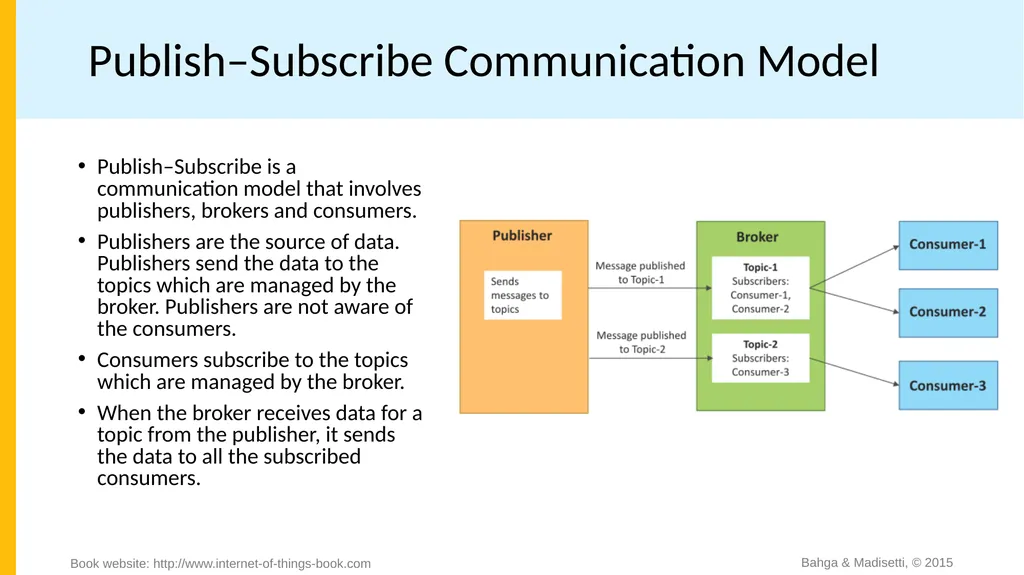
slide10. Publish–Subscribe Communication Model Publish–Subscribe is a communication model that involves publishers, brokers and consumers.
Publishers are the source of data. Publishers send the data to the topics which are managed by the broker. Publishers are not aware of the consumers.
Consumers subscribe to the topics which are managed by the broker.
When the broker receives data for a topic from the publisher, it sends the data to all the subscribed consumers. Bahga & Madisetti, © 2015 Book website: http://www.internet-of-things-book.com<br>
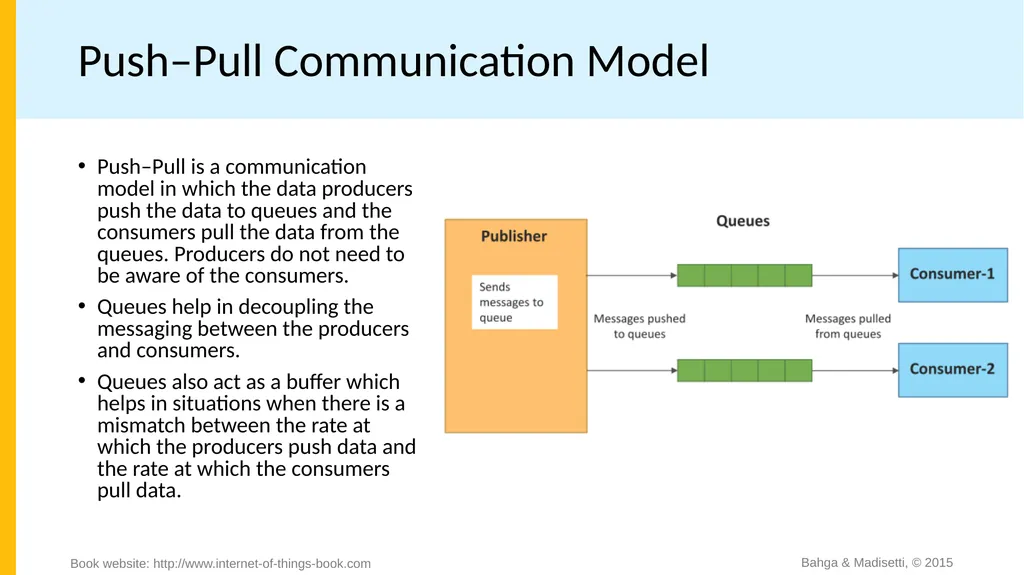
slide11. Push–Pull Communication Model Push–Pull is a communication model in which the data producers push the data to queues and the consumers pull the data from the queues. Producers do not need to be aware of the consumers.
Queues help in decoupling the messaging between the producers and consumers.
Queues also act as a buffer which helps in situations when there is a mismatch between the rate at which the producers push data and the rate at which the consumers pull data. Bahga & Madisetti, © 2015 Book website: http://www.internet-of-things-book.com<br>
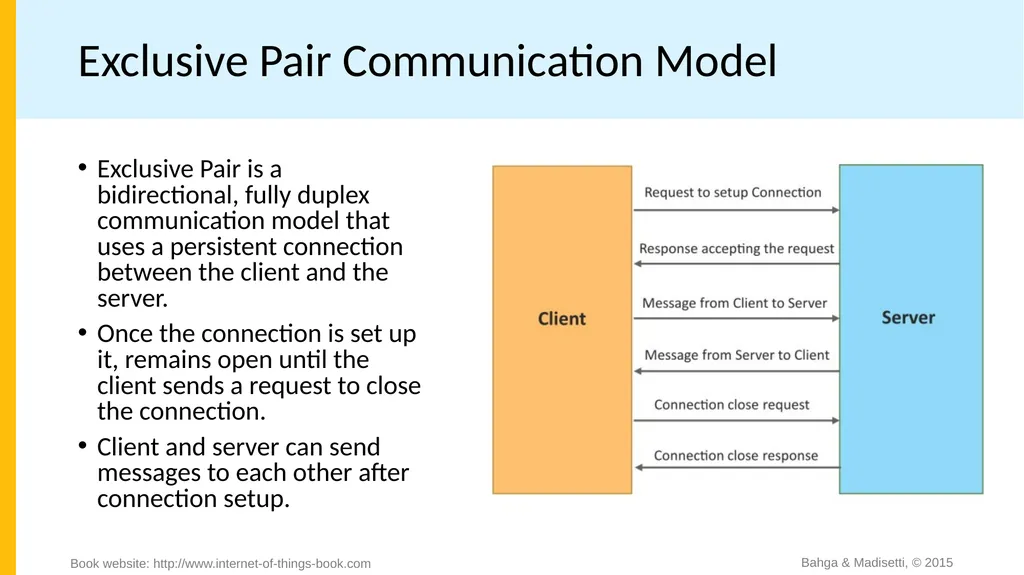
slide12. Exclusive Pair Communication Model Exclusive Pair is a bidirectional, fully duplex communication model that uses a persistent connection between the client and the server.
Once the connection is set up it, remains open until the client sends a request to close the connection.
Client and server can send messages to each other after connection setup. Bahga & Madisetti, © 2015 Book website: http://www.internet-of-things-book.com<br>
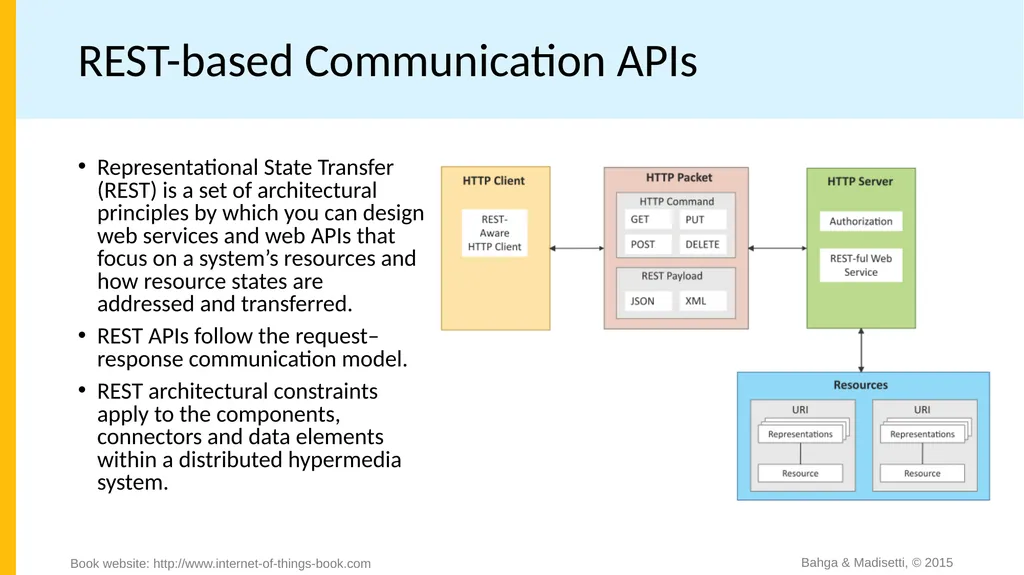
slide13. REST-based Communication APIs Representational State Transfer (REST) is a set of architectural principles by which you can design web services and web APIs that focus on a system’s resources and how resource states are addressed and transferred.
REST APIs follow the request–response communication model.
REST architectural constraints apply to the components, connectors and data elements within a distributed hypermedia system. Bahga & Madisetti, © 2015 Book website: http://www.internet-of-things-book.com<br>
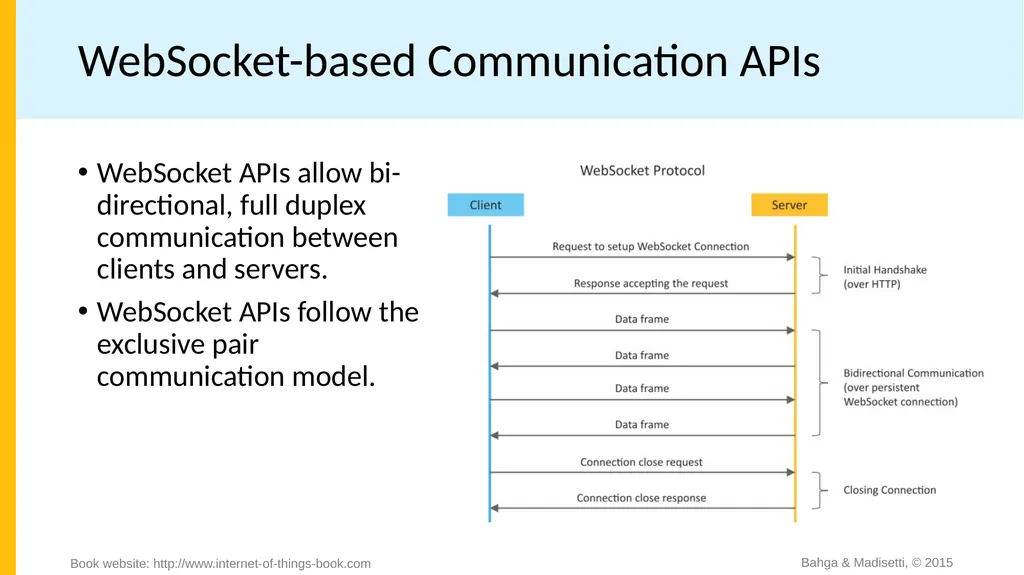
slide14. WebSocket-based Communication APIs WebSocket APIs allow bi-directional, full duplex communication between clients and servers.
WebSocket APIs follow the exclusive pair communication model. Bahga & Madisetti, © 2015 Book website: http://www.internet-of-things-book.com<br>
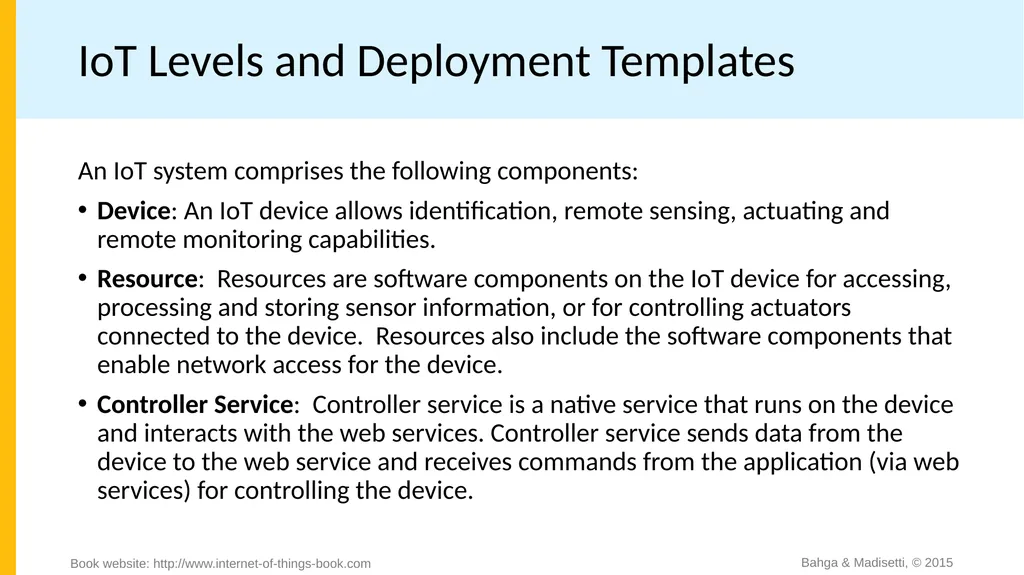
slide15. IoT Levels and Deployment Templates An IoT system comprises the following components:
Device: An IoT device allows identification, remote sensing, actuating and remote monitoring capabilities.
Resource: Resources are software components on the IoT device for accessing, processing and storing sensor information, or for controlling actuators connected to the device. Resources also include the software components that enable network access for the device.
Controller Service: Controller service is a native service that runs on the device and interacts with the web services. Controller service sends data from the device to the web service and receives commands from the application (via web services) for controlling the device. Bahga & Madisetti, © 2015 Book website: http://www.internet-of-things-book.com<br>
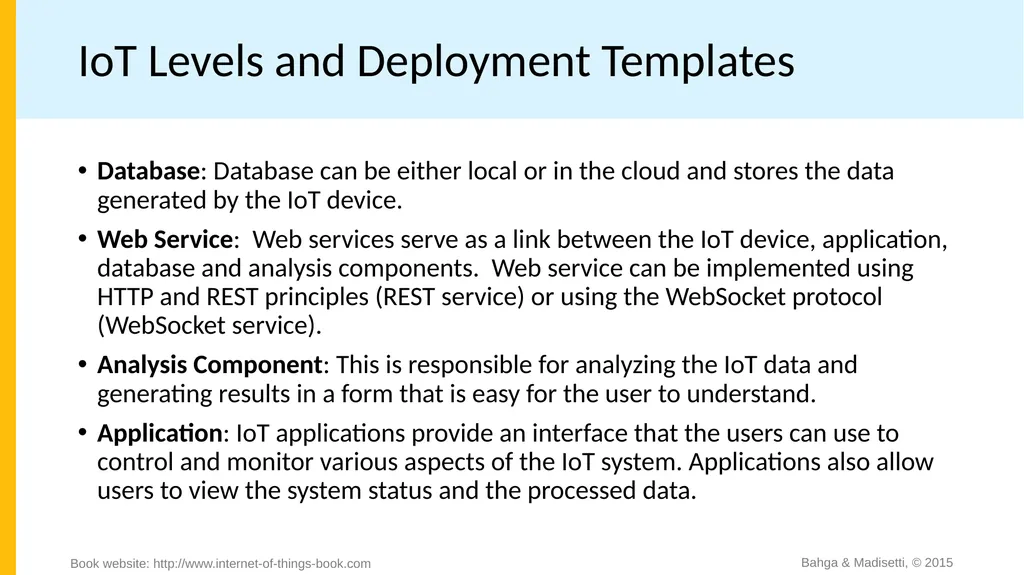
slide16. IoT Levels and Deployment Templates Database: Database can be either local or in the cloud and stores the data generated by the IoT device.
Web Service: Web services serve as a link between the IoT device, application, database and analysis components. Web service can be implemented using HTTP and REST principles (REST service) or using the WebSocket protocol (WebSocket service).
Analysis Component: This is responsible for analyzing the IoT data and generating results in a form that is easy for the user to understand.
Application: IoT applications provide an interface that the users can use to control and monitor various aspects of the IoT system. Applications also allow users to view the system status and the processed data. Bahga & Madisetti, © 2015 Book website: http://www.internet-of-things-book.com<br>
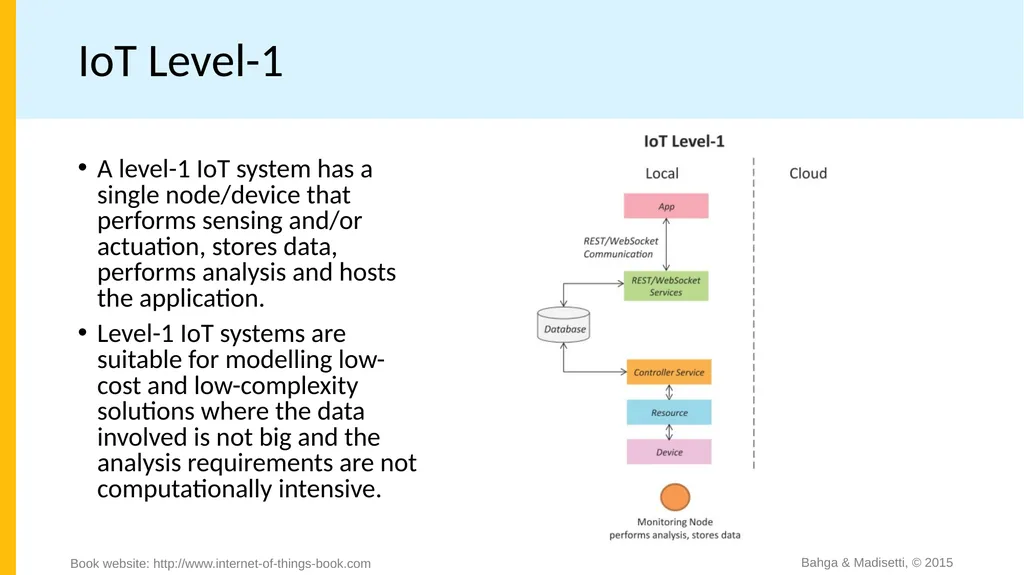
slide17. IoT Level-1 A level-1 IoT system has a single node/device that performs sensing and/or actuation, stores data, performs analysis and hosts the application.
Level-1 IoT systems are suitable for modelling low-cost and low-complexity solutions where the data involved is not big and the analysis requirements are not computationally intensive. Bahga & Madisetti, © 2015 Book website: http://www.internet-of-things-book.com<br>
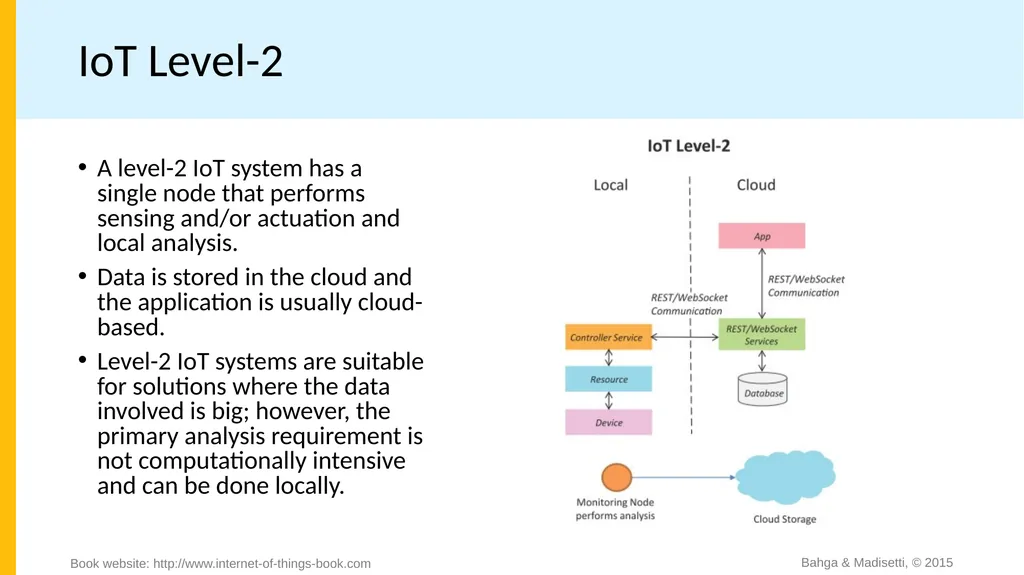
slide18. IoT Level-2 A level-2 IoT system has a single node that performs sensing and/or actuation and local analysis.
Data is stored in the cloud and the application is usually cloud-based.
Level-2 IoT systems are suitable for solutions where the data involved is big; however, the primary analysis requirement is not computationally intensive and can be done locally. Bahga & Madisetti, © 2015 Book website: http://www.internet-of-things-book.com<br>
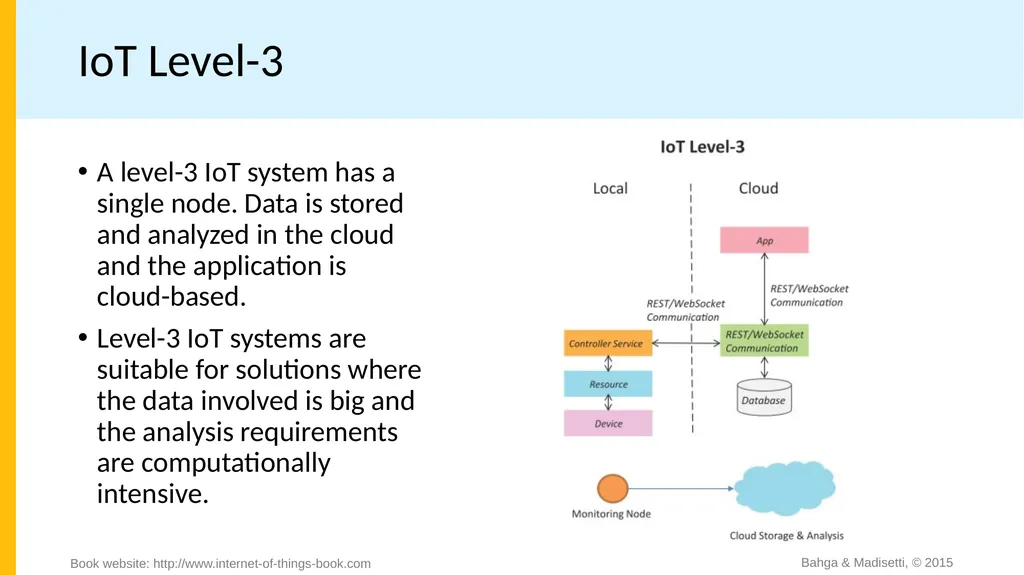
slide19. IoT Level-3 A level-3 IoT system has a single node. Data is stored and analyzed in the cloud and the application is cloud-based.
Level-3 IoT systems are suitable for solutions where the data involved is big and the analysis requirements are computationally intensive. Bahga & Madisetti, © 2015 Book website: http://www.internet-of-things-book.com<br>
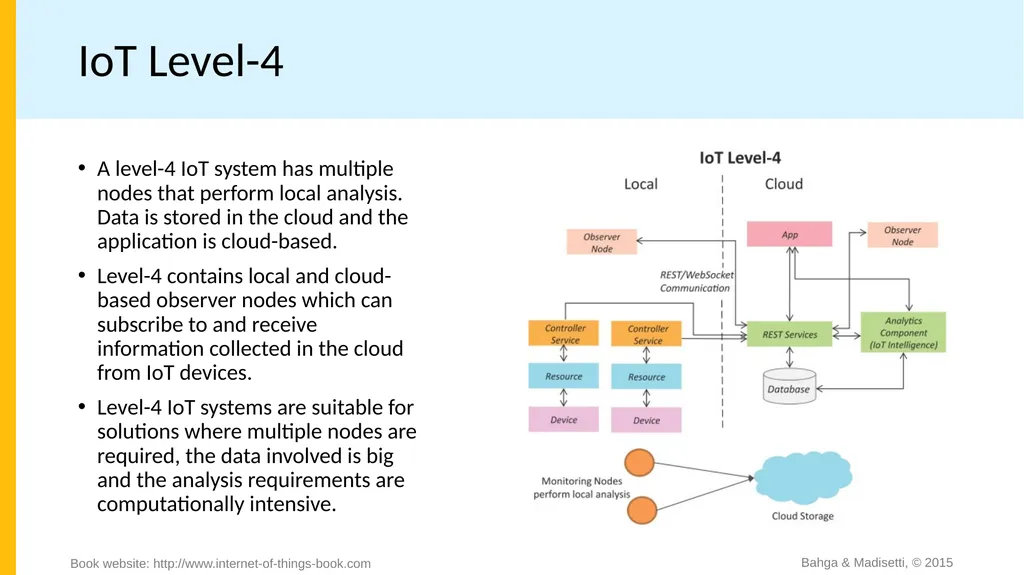
slide20. IoT Level-4 A level-4 IoT system has multiple nodes that perform local analysis. Data is stored in the cloud and the application is cloud-based.
Level-4 contains local and cloud-based observer nodes which can subscribe to and receive information collected in the cloud from IoT devices.
Level-4 IoT systems are suitable for solutions where multiple nodes are required, the data involved is big and the analysis requirements are computationally intensive. Bahga & Madisetti, © 2015 Book website: http://www.internet-of-things-book.com<br>
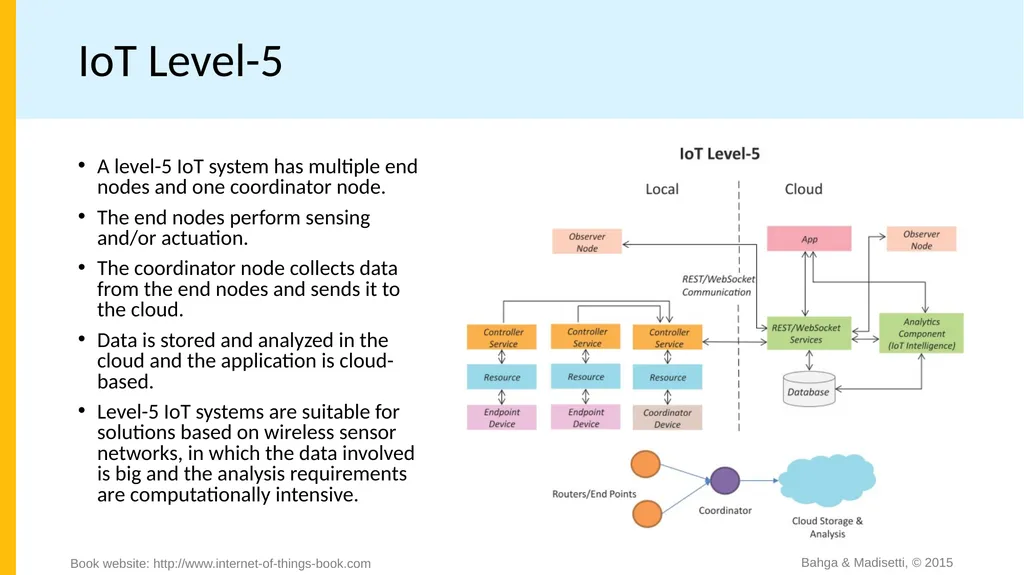
slide21. IoT Level-5 A level-5 IoT system has multiple end nodes and one coordinator node.
The end nodes perform sensing and/or actuation.
The coordinator node collects data from the end nodes and sends it to the cloud.
Data is stored and analyzed in the cloud and the application is cloud-based.
Level-5 IoT systems are suitable for solutions based on wireless sensor networks, in which the data involved is big and the analysis requirements are computationally intensive. Bahga & Madisetti, © 2015 Book website: http://www.internet-of-things-book.com<br>
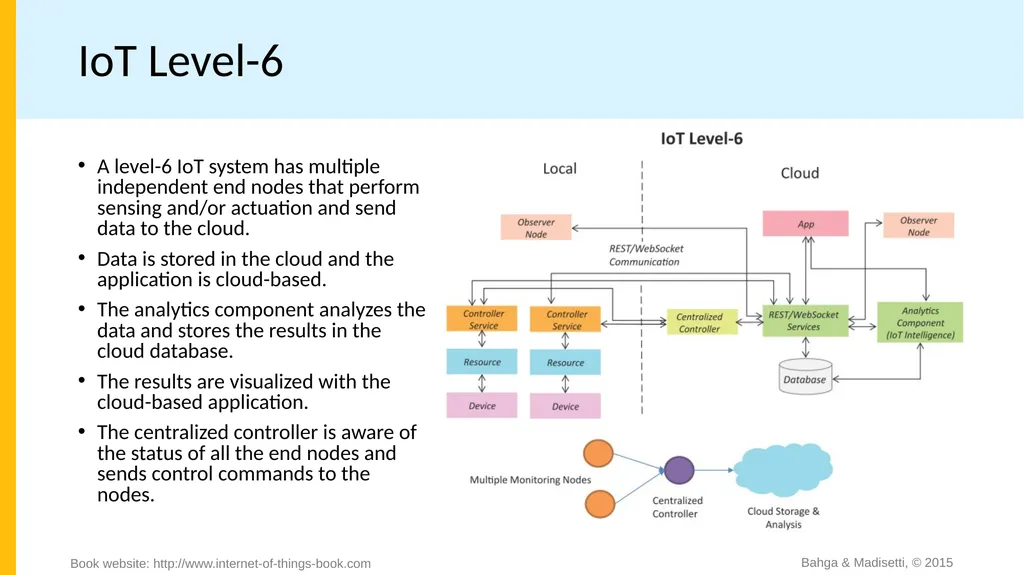
slide22. IoT Level-6 A level-6 IoT system has multiple independent end nodes that perform sensing and/or actuation and send data to the cloud.
Data is stored in the cloud and the application is cloud-based.
The analytics component analyzes the data and stores the results in the cloud database.
The results are visualized with the cloud-based application.
The centralized controller is aware of the status of all the end nodes and sends control commands to the nodes. Bahga & Madisetti, © 2015 Book website: http://www.internet-of-things-book.com<br>
slide2. Outline Definition of IoT
Characteristics of IoT
Physical design of IoT
Logical design of IoT
IoT protocols
IoT levels and deployment templates Bahga & Madisetti, © 2015 Book website: http://www.internet-of-things-book.com<br>
slide3. Definition of IoT A dynamic global network infrastructure with self-configuring capabilities based on standard and interoperable communication protocols where physical and virtual "things" have identities, physical attributes and virtual personalities, use intelligent interfaces, are seamlessly integrated into the information network, and often communicate data associated with users and their environments. Bahga & Madisetti, © 2015 Book website: http://www.internet-of-things-book.com<br>
slide4. Characteristics of IoT Dynamic and self-adapting
Self-configuring
Interoperable communication protocols
Unique identity
Integrated into the information network Bahga & Madisetti, © 2015 Book website: http://www.internet-of-things-book.com<br>
slide5. Physical Design of IoT The "Things" in IoT usually refers to IoT devices which have unique identities and can perform remote sensing and actuating and have monitoring capabilities.
IoT devices can:
Exchange data with other connected devices and applications (directly or indirectly), or
Collect data from other devices and process the data locally, or
Send the data to centralized servers or cloud-based application back-ends for processing the data, or
Perform some tasks locally and other tasks within the IoT infrastructure, based on temporal and space constraints Bahga & Madisetti, © 2015 Book website: http://www.internet-of-things-book.com<br>
slide6. Generic Block Diagram of an IoT Device An IoT device may consist of several interfaces for connections to other devices, both wired and wireless.
I/O interfaces for sensors
Interfaces for internet connectivity
Memory and storage interfaces
Audio/video interfaces Bahga & Madisetti, © 2015 Book website: http://www.internet-of-things-book.com<br>
slide7. IoT Protocols Link Layer
802.3 – Ethernet
802.11 – WiFi
802.16 – WiMax
802.15.4 – LR-WPAN
2G/3G/4G
Network/Internet Layer
IPv4
IPv6
6LoWPAN
Transport Layer
TCP
UDP
Application Layer
HTTP
CoAP
WebSocket
MQTT
XMPP
DDS
AMQP Bahga & Madisetti, © 2015 Book website: http://www.internet-of-things-book.com<br>
slide8. Logical Design of IoT Logical design of an IoT system refers to an abstract representation of the entities and processes without going into the low-level specifics of the implementation.
An IoT system comprises a number of functional blocks that provide the system the capabilities for identification, sensing, actuation, communication and management. Bahga & Madisetti, © 2015 Book website: http://www.internet-of-things-book.com<br>
slide9. Request–Response Communication Model Request–Response is a communication model in which the client sends requests to the server and the server responds to the requests.
When the server receives a request, it decides how to respond, fetches the data, retrieves resource representations, prepares the response and then sends the response to the client. Bahga & Madisetti, © 2015 Book website: http://www.internet-of-things-book.com<br>
slide10. Publish–Subscribe Communication Model Publish–Subscribe is a communication model that involves publishers, brokers and consumers.
Publishers are the source of data. Publishers send the data to the topics which are managed by the broker. Publishers are not aware of the consumers.
Consumers subscribe to the topics which are managed by the broker.
When the broker receives data for a topic from the publisher, it sends the data to all the subscribed consumers. Bahga & Madisetti, © 2015 Book website: http://www.internet-of-things-book.com<br>
slide11. Push–Pull Communication Model Push–Pull is a communication model in which the data producers push the data to queues and the consumers pull the data from the queues. Producers do not need to be aware of the consumers.
Queues help in decoupling the messaging between the producers and consumers.
Queues also act as a buffer which helps in situations when there is a mismatch between the rate at which the producers push data and the rate at which the consumers pull data. Bahga & Madisetti, © 2015 Book website: http://www.internet-of-things-book.com<br>
slide12. Exclusive Pair Communication Model Exclusive Pair is a bidirectional, fully duplex communication model that uses a persistent connection between the client and the server.
Once the connection is set up it, remains open until the client sends a request to close the connection.
Client and server can send messages to each other after connection setup. Bahga & Madisetti, © 2015 Book website: http://www.internet-of-things-book.com<br>
slide13. REST-based Communication APIs Representational State Transfer (REST) is a set of architectural principles by which you can design web services and web APIs that focus on a system’s resources and how resource states are addressed and transferred.
REST APIs follow the request–response communication model.
REST architectural constraints apply to the components, connectors and data elements within a distributed hypermedia system. Bahga & Madisetti, © 2015 Book website: http://www.internet-of-things-book.com<br>
slide14. WebSocket-based Communication APIs WebSocket APIs allow bi-directional, full duplex communication between clients and servers.
WebSocket APIs follow the exclusive pair communication model. Bahga & Madisetti, © 2015 Book website: http://www.internet-of-things-book.com<br>
slide15. IoT Levels and Deployment Templates An IoT system comprises the following components:
Device: An IoT device allows identification, remote sensing, actuating and remote monitoring capabilities.
Resource: Resources are software components on the IoT device for accessing, processing and storing sensor information, or for controlling actuators connected to the device. Resources also include the software components that enable network access for the device.
Controller Service: Controller service is a native service that runs on the device and interacts with the web services. Controller service sends data from the device to the web service and receives commands from the application (via web services) for controlling the device. Bahga & Madisetti, © 2015 Book website: http://www.internet-of-things-book.com<br>
slide16. IoT Levels and Deployment Templates Database: Database can be either local or in the cloud and stores the data generated by the IoT device.
Web Service: Web services serve as a link between the IoT device, application, database and analysis components. Web service can be implemented using HTTP and REST principles (REST service) or using the WebSocket protocol (WebSocket service).
Analysis Component: This is responsible for analyzing the IoT data and generating results in a form that is easy for the user to understand.
Application: IoT applications provide an interface that the users can use to control and monitor various aspects of the IoT system. Applications also allow users to view the system status and the processed data. Bahga & Madisetti, © 2015 Book website: http://www.internet-of-things-book.com<br>
slide17. IoT Level-1 A level-1 IoT system has a single node/device that performs sensing and/or actuation, stores data, performs analysis and hosts the application.
Level-1 IoT systems are suitable for modelling low-cost and low-complexity solutions where the data involved is not big and the analysis requirements are not computationally intensive. Bahga & Madisetti, © 2015 Book website: http://www.internet-of-things-book.com<br>
slide18. IoT Level-2 A level-2 IoT system has a single node that performs sensing and/or actuation and local analysis.
Data is stored in the cloud and the application is usually cloud-based.
Level-2 IoT systems are suitable for solutions where the data involved is big; however, the primary analysis requirement is not computationally intensive and can be done locally. Bahga & Madisetti, © 2015 Book website: http://www.internet-of-things-book.com<br>
slide19. IoT Level-3 A level-3 IoT system has a single node. Data is stored and analyzed in the cloud and the application is cloud-based.
Level-3 IoT systems are suitable for solutions where the data involved is big and the analysis requirements are computationally intensive. Bahga & Madisetti, © 2015 Book website: http://www.internet-of-things-book.com<br>
slide20. IoT Level-4 A level-4 IoT system has multiple nodes that perform local analysis. Data is stored in the cloud and the application is cloud-based.
Level-4 contains local and cloud-based observer nodes which can subscribe to and receive information collected in the cloud from IoT devices.
Level-4 IoT systems are suitable for solutions where multiple nodes are required, the data involved is big and the analysis requirements are computationally intensive. Bahga & Madisetti, © 2015 Book website: http://www.internet-of-things-book.com<br>
slide21. IoT Level-5 A level-5 IoT system has multiple end nodes and one coordinator node.
The end nodes perform sensing and/or actuation.
The coordinator node collects data from the end nodes and sends it to the cloud.
Data is stored and analyzed in the cloud and the application is cloud-based.
Level-5 IoT systems are suitable for solutions based on wireless sensor networks, in which the data involved is big and the analysis requirements are computationally intensive. Bahga & Madisetti, © 2015 Book website: http://www.internet-of-things-book.com<br>
slide22. IoT Level-6 A level-6 IoT system has multiple independent end nodes that perform sensing and/or actuation and send data to the cloud.
Data is stored in the cloud and the application is cloud-based.
The analytics component analyzes the data and stores the results in the cloud database.
The results are visualized with the cloud-based application.
The centralized controller is aware of the status of all the end nodes and sends control commands to the nodes. Bahga & Madisetti, © 2015 Book website: http://www.internet-of-things-book.com<br>