
CHAPTER 10 Response and Size-Up Objectives (1 of
A
Published · 57 slides · 0 views
1 / 1
Description
CHAPTER 10 Response and Size-Up Objectives (1 of 2) Describe your role in assuring safe and efficient response to an emergency scene. Describe how to ride an emergency vehicle safely. Objectives (2 of 2) Describe how to dismount an
Related Topics
Share
Embed code
Download this presentation From Below
"CHAPTER 10 Response and Size-Up Objectives (1 of" is the property of its rightful owner. Permission is granted to download and print the materials on this website for personal, non-commercial use only, and to display it on your personal computer provided you do not modify the materials and that you retain all copyright notices contained in the materials. By downloading content from our website, you accept the terms of this agreement.
Presentation Transcript
01
CHAPTER 10 Response and Size-Up<br>
02
Objectives (1 of 2) Describe your role in assuring safe and efficient response to an emergency scene.
Describe how to ride an emergency vehicle safely.<br>
Describe how to ride an emergency vehicle safely.<br>
03
Objectives (2 of 2) Describe how to dismount an emergency vehicle safely.
Describe how to shut off utilities.
Define and describe size-up.<br>
Describe how to shut off utilities.
Define and describe size-up.<br>
04
Introduction (1 of 4) Response involves a series of actions that begins when a crew is dispatched to an alarm and ends with their arrival at the emergency scene.
Response action includes
Receiving the alarm
Donning PPE
Mounting the apparatus
Transporting equipment and personnel to the emergency incident quickly and safely<br>
Response action includes
Receiving the alarm
Donning PPE
Mounting the apparatus
Transporting equipment and personnel to the emergency incident quickly and safely<br>
05
Introduction (2 of 4) Preparations for response
Checking personal equipment
Ensuring the fire apparatus is ready
Preparing equipment
Familiarity with response area, buildings, and SOPs<br>
Checking personal equipment
Ensuring the fire apparatus is ready
Preparing equipment
Familiarity with response area, buildings, and SOPs<br>
06
Introduction (3 of 4) Apparatus driver response actions include
Considering road and traffic conditions
Determining the best route to the incident
Identifying nearby hydrant locations or water sources
Selecting the best position for the apparatus at the incident scene<br>
Considering road and traffic conditions
Determining the best route to the incident
Identifying nearby hydrant locations or water sources
Selecting the best position for the apparatus at the incident scene<br>
07
Introduction (4 of 4) Size-up: systematic process of information gathering and situation evaluation that begins when an alarm is received
Continues during response and includes the initial observations made upon arrival at the incident scene
Essential for determining the appropriate strategy and tactics<br>
Continues during response and includes the initial observations made upon arrival at the incident scene
Essential for determining the appropriate strategy and tactics<br>
08
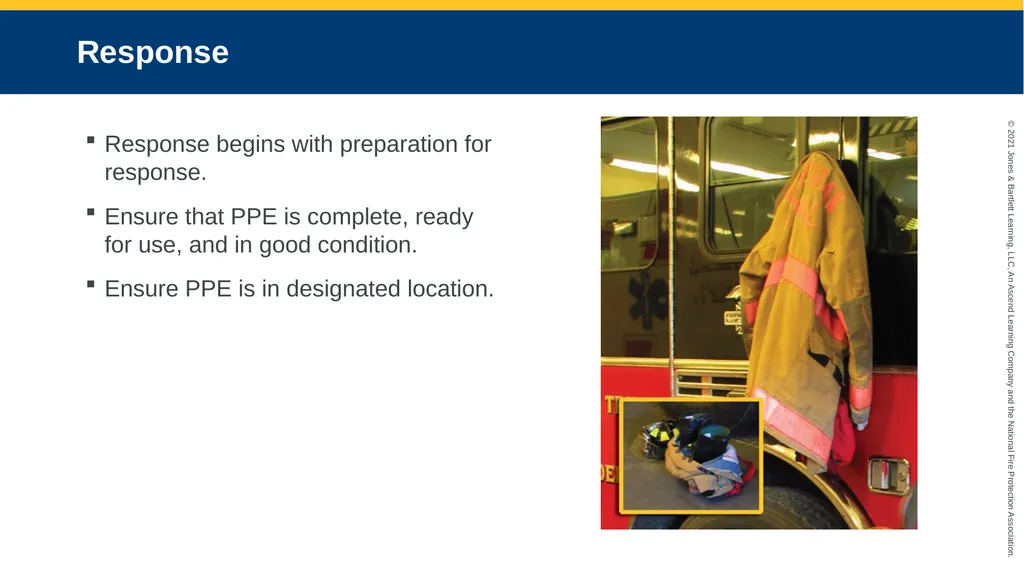
Response Response begins with preparation for response.
Ensure that PPE is complete, ready for use, and in good condition.
Ensure PPE is in designated location.<br>
Ensure that PPE is complete, ready for use, and in good condition.
Ensure PPE is in designated location.<br>
09
Methods of Alert Radio
Pager
Plant alarm
Telephone
Public address systems
Sirens or horns<br>
Pager
Plant alarm
Telephone
Public address systems
Sirens or horns<br>
10
Alarm Receipt Dispatch messages
Computer-aided dispatch systems
Prompt and efficient response
Walk briskly to the apparatus.<br>
Computer-aided dispatch systems
Prompt and efficient response
Walk briskly to the apparatus.<br>
11
Riding the Apparatus (1 of 3) Don PPE before mounting the apparatus.
Don SCBA at the scene, unless seat-mounted.
All equipment should be properly mounted, stowed, or secured.
Be careful when mounting and dismounting apparatus.<br>
Don SCBA at the scene, unless seat-mounted.
All equipment should be properly mounted, stowed, or secured.
Be careful when mounting and dismounting apparatus.<br>
12
Riding the Apparatus (2 of 3) All brigade members must be seated in their assigned riding positions with seatbelts and/or harnesses fastened before apparatus can move.
Never unbuckle your seatbelt to don clothing or equipment while en route.
Wear hearing protection if provided.<br>
Never unbuckle your seatbelt to don clothing or equipment while en route.
Wear hearing protection if provided.<br>
13
Riding the Apparatus (3 of 3) During transport, limit conversation.
Listen for instructions and additional information.
During the ride to the incident, consider any relevant factors that could affect the situation.<br>
Listen for instructions and additional information.
During the ride to the incident, consider any relevant factors that could affect the situation.<br>
14
Emergency Response Fire apparatus operators must always exercise caution when driving to an incident.
Requires special driver training, license
Most states and provinces allow drivers of emergency vehicles to disregard specific traffic regulations when responding, apparatus drivers must always consider the actions of other drivers first.<br>
Requires special driver training, license
Most states and provinces allow drivers of emergency vehicles to disregard specific traffic regulations when responding, apparatus drivers must always consider the actions of other drivers first.<br>
15
Personal Vehicles Brigade members who respond in personal vehicles must follow specific laws, regulations, and SOPs.
Brigade members driving their privately owned vehicle must follow all applicable state and local regulations.<br>
Brigade members driving their privately owned vehicle must follow all applicable state and local regulations.<br>
16
Prohibited Practices Do not ignore SOPs.
Do not unfasten your seatbelt.
Do not dismount until the vehicle comes to a complete stop.
Never stand while riding.
Do not hold onto the side of a moving vehicle.
Do not ride on the rear step.<br>
Do not unfasten your seatbelt.
Do not dismount until the vehicle comes to a complete stop.
Never stand while riding.
Do not hold onto the side of a moving vehicle.
Do not ride on the rear step.<br>
17
Dismounting a Stopped Apparatus Ensure the apparatus comes to a full stop.
Check for traffic before opening doors.
Check for other hazards present.
Use handrails when dismounting.<br>
Check for traffic before opening doors.
Check for other hazards present.
Use handrails when dismounting.<br>
18
Traffic Safety on the Scene Traffic safety should be a major concern for first arriving units.
Drivers may not see emergency workers or realize how much room brigade members need to work safely.
Follow SOPs to close streets.
Highways are very dangerous.
Use traffic cones, high-visibility safety vests.<br>
Drivers may not see emergency workers or realize how much room brigade members need to work safely.
Follow SOPs to close streets.
Highways are very dangerous.
Use traffic cones, high-visibility safety vests.<br>
19
Arrival at the Incident Scene (1 of 2) Brigade members should work in assigned teams called companies or crews.
Teamwork and discipline are essential.
Command structure plans, coordinates, and directs operations.<br>
Teamwork and discipline are essential.
Command structure plans, coordinates, and directs operations.<br>
20
Arrival at the Incident Scene (2 of 2) Brigade members responding on an apparatus comprise the crew assigned to that vehicle and take direction from the brigade leader.
Brigade members who arrive independent of an apparatus must report to IC to be assigned to a company/crew.<br>
Brigade members who arrive independent of an apparatus must report to IC to be assigned to a company/crew.<br>
21
Freelancing Dangerous practice of acting independently of command instruction
This activity is unacceptable and is not tolerated.
The safety of every person at the scene can be compromised by freelancing.
Do not respond to an emergency incident unless you have been dispatched.<br>
This activity is unacceptable and is not tolerated.
The safety of every person at the scene can be compromised by freelancing.
Do not respond to an emergency incident unless you have been dispatched.<br>
22
Personnel Accountability System Used to track every brigade members at every incident scene
Maintains an updated list of the brigade members assigned to each vehicle or crew
Tracks each crew’s assignment<br>
Maintains an updated list of the brigade members assigned to each vehicle or crew
Tracks each crew’s assignment<br>
23
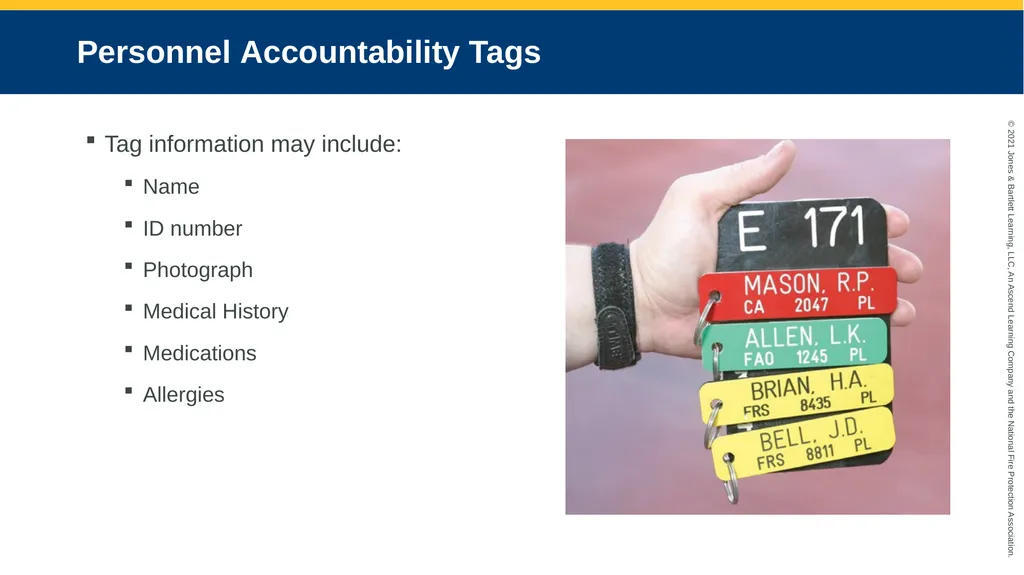
Personnel Accountability Tags Tag information may include:
Name
ID number
Photograph
Medical History
Medications
Allergies<br>
Name
ID number
Photograph
Medical History
Medications
Allergies<br>
24
Controlling Utilities One of the first tasks that must be accomplished
Follow SOPs.
Task often assigned to a certain company/crew or plant maintenance personnel.
All brigade members should know how to shut off building utilities.<br>
Follow SOPs.
Task often assigned to a certain company/crew or plant maintenance personnel.
All brigade members should know how to shut off building utilities.<br>
25
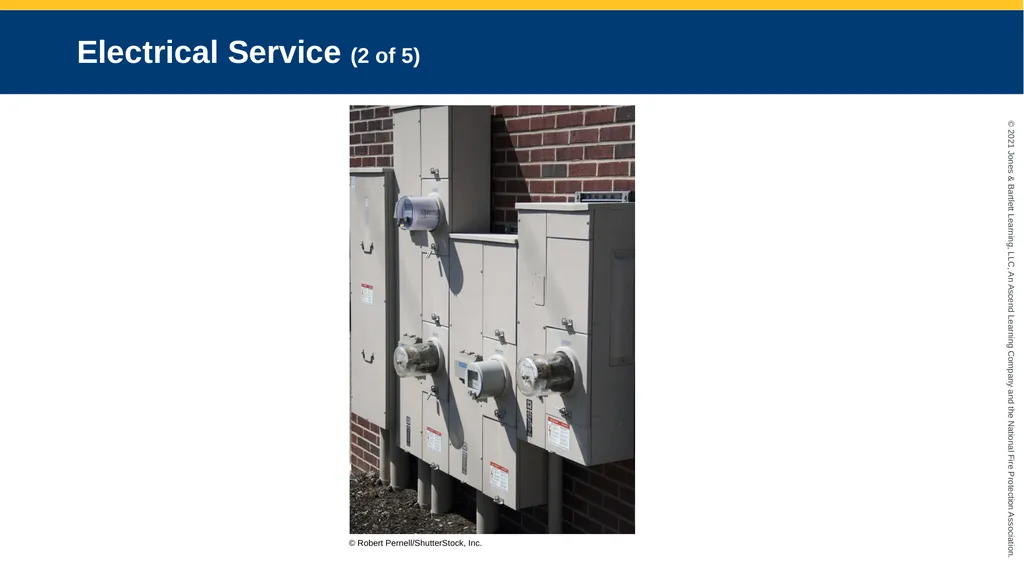
Electrical Service (1 of 5) Know what types of electrical drops and meters are in use in your area.
Work with utility companies for specific training.
High-voltage systems require electric company or trained personnel from premises to shut off electricity.<br>
Work with utility companies for specific training.
High-voltage systems require electric company or trained personnel from premises to shut off electricity.<br>
26
Electrical Service (2 of 5) © Robert Pernell/ShutterStock, Inc.<br>
27
Electrical Service (3 of 5) Installations
Service drop from above-ground utility wires
Underground connections
Inside meters
Multiple services
Separate electric meters
Brigade members must know what types of electrical services are commonly used in their communities.<br>
Service drop from above-ground utility wires
Underground connections
Inside meters
Multiple services
Separate electric meters
Brigade members must know what types of electrical services are commonly used in their communities.<br>
28
Electrical Service (4 of 5) Work with utility companies for specific training.
Often a main disconnect switch can be operated to interrupt the power.
Large systems involving high-voltage equipment should be done by personnel qualified to do so with the proper PPE.<br>
Often a main disconnect switch can be operated to interrupt the power.
Large systems involving high-voltage equipment should be done by personnel qualified to do so with the proper PPE.<br>
29
Electrical Service (5 of 5) The electric company should be called to shut down power from a remote location, like a utility pole.
Necessary if outside wires are damaged by fire, if brigade members are working with ladders or aerial apparatus, or if risk of explosion exists<br>
Necessary if outside wires are damaged by fire, if brigade members are working with ladders or aerial apparatus, or if risk of explosion exists<br>
30
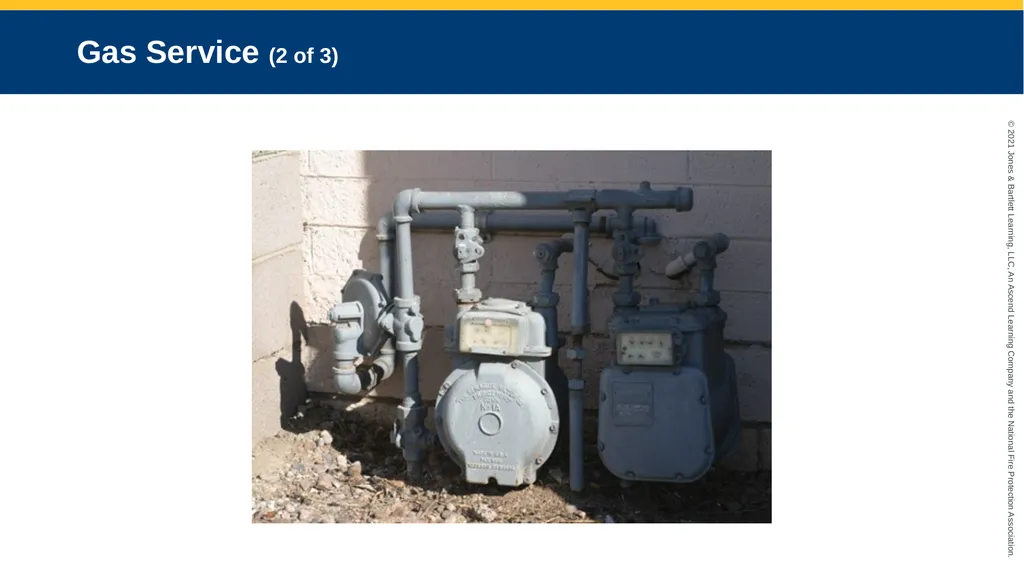
Gas Service (1 of 3) Natural gas and liquefied propane (LP) are used for heating and cooking and industrial processes.
Natural gas is delivered through underground pipes.
LP gas is delivered by a tank truck or stored in a tank on the premises.<br>
Natural gas is delivered through underground pipes.
LP gas is delivered by a tank truck or stored in a tank on the premises.<br>
31
Gas Service (2 of 3)<br>
32
Gas Service (3 of 3) A single valve usually controls the natural gas supply to a building.
The valve for an LP gas system is usually located at the storage tank.
Once shut off, the gas must not be reopened until the system has been inspected and readied by a qualified person.<br>
The valve for an LP gas system is usually located at the storage tank.
Once shut off, the gas must not be reopened until the system has been inspected and readied by a qualified person.<br>
33
Water Service Can usually be shut off by closing one valve at the entry point
Many systems allow the water service to be turned off at the connection between the utility pipes and the building’s system.<br>
Many systems allow the water service to be turned off at the connection between the utility pipes and the building’s system.<br>
34
Size-up (1 of 2) Process of evaluating an emergency situation to determine what actions need to be taken and what resources are needed to control an emergency
IC uses size-up to develop initial plan.
At major incidents, size-up might continue through several stages.
Ongoing<br>
IC uses size-up to develop initial plan.
At major incidents, size-up might continue through several stages.
Ongoing<br>
35
Size-up (2 of 2) Brigade members must understand how:
To formulate an operational plan
To gather and process information
This information can change plans during the operation
Brigade members are often asked to obtain information or report observations for ongoing size-up.<br>
To formulate an operational plan
To gather and process information
This information can change plans during the operation
Brigade members are often asked to obtain information or report observations for ongoing size-up.<br>
36
Managing Information Information must be continually reassessed to ensure action plan is still valid.
Two categories of information:
Facts
Probabilities<br>
Two categories of information:
Facts
Probabilities<br>
37
Facts Data elements that are accurate and based on prior knowledge, a reliable source of information, or an immediate, on-site observation
Initial dispatch information
Time of day/week
Weather conditions Preincident plan
Direct visual observations
Progress reports<br>
Initial dispatch information
Time of day/week
Weather conditions Preincident plan
Direct visual observations
Progress reports<br>
38
Probabilities (1 of 2) Events and outcomes that can be predicted or anticipated based on facts, observations, common sense, and previous experiences
Brigade members use probabilities to anticipate or predict what is likely to happen in various situations.<br>
Brigade members use probabilities to anticipate or predict what is likely to happen in various situations.<br>
39
Probabilities (2 of 2) Attack plan based on probabilities, predicting where the fire is likely to spread and anticipating potential problems
IC must quickly identify the probabilities that apply to a given situation.
IC also evaluates the potential for building collapse.<br>
IC must quickly identify the probabilities that apply to a given situation.
IC also evaluates the potential for building collapse.<br>
40
Resources (1 of 3) Include all of the means that are available to fight a fire or conduct emergency operations at an emergency incident
Requirements depend on the size and type of incident.
Availability depends on the capacity of a fire brigade to deliver resources to the scene.<br>
Requirements depend on the size and type of incident.
Availability depends on the capacity of a fire brigade to deliver resources to the scene.<br>
41
Resources (2 of 3) Basic resources are personnel and equipment.
Firefighting resources are usually defined as the number of crews, equipment, and command officers required to control a particular fire.
Water supply is a critical resource.<br>
Firefighting resources are usually defined as the number of crews, equipment, and command officers required to control a particular fire.
Water supply is a critical resource.<br>
42
Resources (3 of 3) Size-up enables the IC to determine what resources will be needed and ensures their availability.
Mutual aid agreements
Effective organization
Equipment and procedures must be standardized.<br>
Mutual aid agreements
Effective organization
Equipment and procedures must be standardized.<br>
43
Incident Action Plan (1 of 3) Outlines the steps needed to control the situation
Based on information gathered during size-up
Revised and expanded during incident<br>
Based on information gathered during size-up
Revised and expanded during incident<br>
44
Incident Action Plan (2 of 3) Based on five basic fire ground priorities:
Rescue victims
Protect exposures
Confine the fire
Extinguish the fire
Salvage property and overhaul the fire<br>
Rescue victims
Protect exposures
Confine the fire
Extinguish the fire
Salvage property and overhaul the fire<br>
45
Incident Action Plan (3 of 3) Saving lives is the highest priority.
Saving property is the remaining priority.
Priorities are not separate and exclusive.
Priorities guide the IC in making decisions.<br>
Saving property is the remaining priority.
Priorities are not separate and exclusive.
Priorities guide the IC in making decisions.<br>
46
Rescue Always the highest priority!
Need for rescue depends on:
Type of occupancy
Time of day
Degree of risk to the occupant’s lives
Often the best way to protect lives is to extinguish the fire quickly.<br>
Need for rescue depends on:
Type of occupancy
Time of day
Degree of risk to the occupant’s lives
Often the best way to protect lives is to extinguish the fire quickly.<br>
47
Exposure Protection Keep the fire spreading beyond the area of origin or involvement.
Keep fire from spreading from structure of origin to an exposure.
IC must sometimes weigh potential losses.<br>
Keep fire from spreading from structure of origin to an exposure.
IC must sometimes weigh potential losses.<br>
48
Confinement Focus on confining fire to a specific area.
IC defines a perimeter and plans operations so fire does not expand beyond the area.
Thermal imaging devices are valuable tools for finding fires in void spaces.<br>
IC defines a perimeter and plans operations so fire does not expand beyond the area.
Thermal imaging devices are valuable tools for finding fires in void spaces.<br>
49
Extinguishment Depending on size of fire and the risk, IC mounts either:
Offensive attack
Defensive attack<br>
Offensive attack
Defensive attack<br>
50
Offensive Attack Used with most small fires
Fire brigade members enter structure, seek out seat of the fire, and overpower it.<br>
Fire brigade members enter structure, seek out seat of the fire, and overpower it.<br>
51
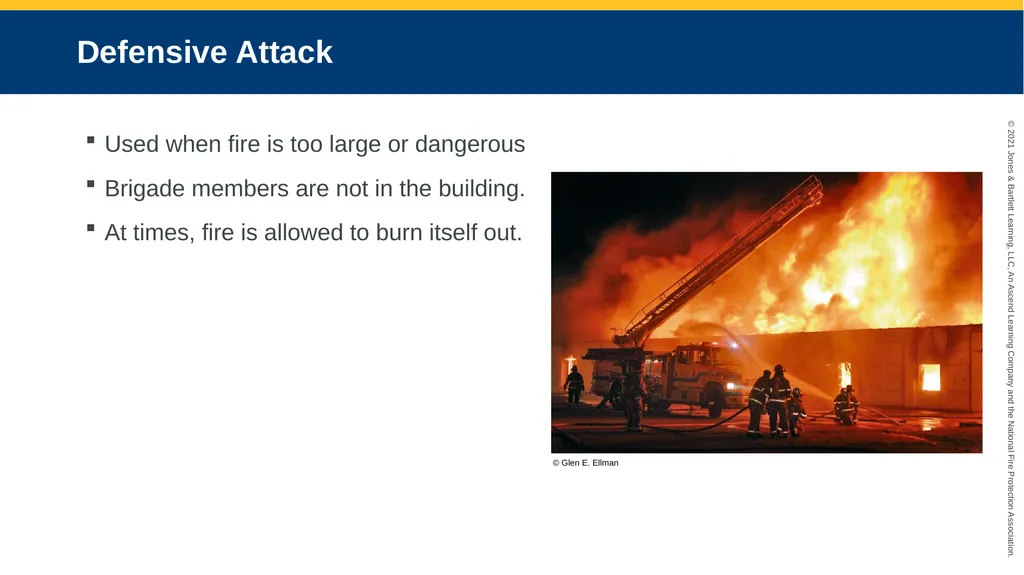
Defensive Attack Used when fire is too large or dangerous
Brigade members are not in the building.
At times, fire is allowed to burn itself out. © Glen E. Ellman<br>
Brigade members are not in the building.
At times, fire is allowed to burn itself out. © Glen E. Ellman<br>
52
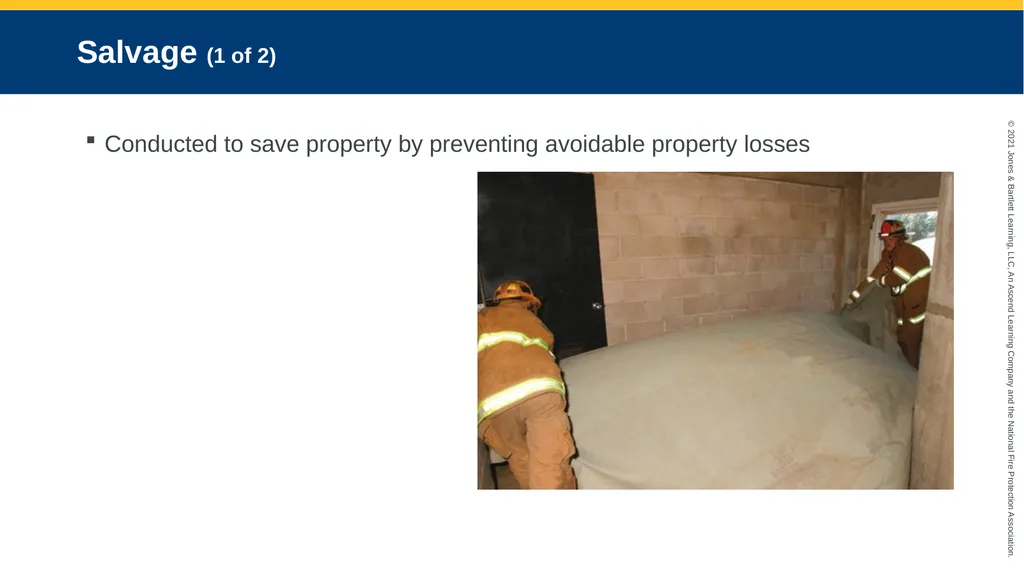
Salvage (1 of 2) Conducted to save property by preventing avoidable property losses<br>
53
Salvage (2 of 2) Removal or protection of property that could be damaged during firefighting or overhaul
Goal to reduce smoke and water damage to structure and contents<br>
Goal to reduce smoke and water damage to structure and contents<br>
54
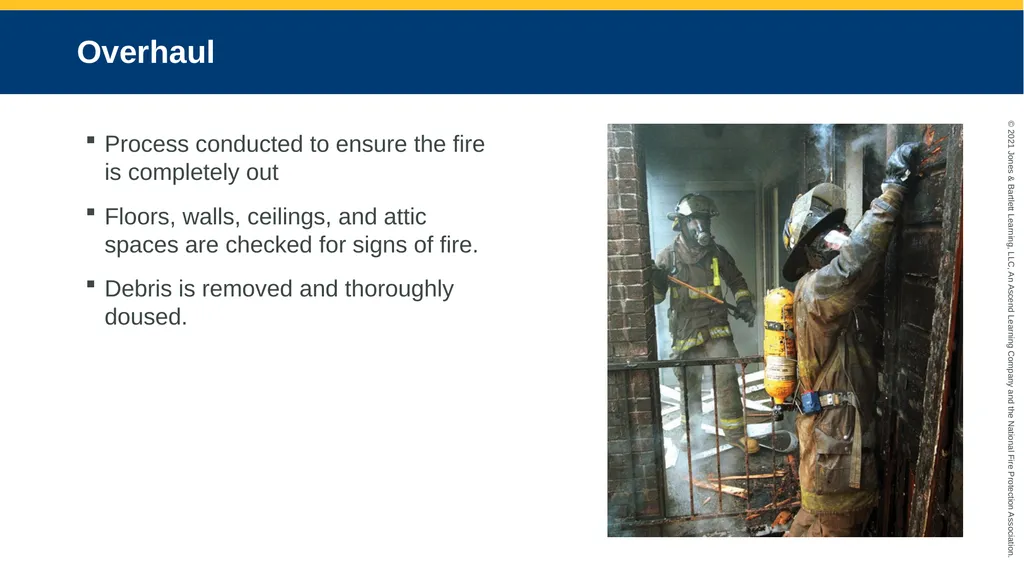
Overhaul Process conducted to ensure the fire is completely out
Floors, walls, ceilings, and attic spaces are checked for signs of fire.
Debris is removed and thoroughly doused.<br>
Floors, walls, ceilings, and attic spaces are checked for signs of fire.
Debris is removed and thoroughly doused.<br>
55
Summary (1 of 3) Preparation begins long before an alarm is received.
Adhere to safe operating practices when responding to an incident:
Remain seated and wearing a seat belt.
Use caution in driving to ensure arrival on scene.<br>
Adhere to safe operating practices when responding to an incident:
Remain seated and wearing a seat belt.
Use caution in driving to ensure arrival on scene.<br>
56
Summary (2 of 3) Safe practices (continued):
Be alert for traffic when dismounting on roadways.
Brigade members must understand how to size-up an incident.
Size-up determines incident action plan.<br>
Be alert for traffic when dismounting on roadways.
Brigade members must understand how to size-up an incident.
Size-up determines incident action plan.<br>
57
Summary (3 of 3) Specific actions taken are based on incident priorities:
Rescue any victims.
Protect exposures.
Confine the fire.
Extinguish the fire.
Salvage property and overhaul the fire.<br>
Rescue any victims.
Protect exposures.
Confine the fire.
Extinguish the fire.
Salvage property and overhaul the fire.<br>