04
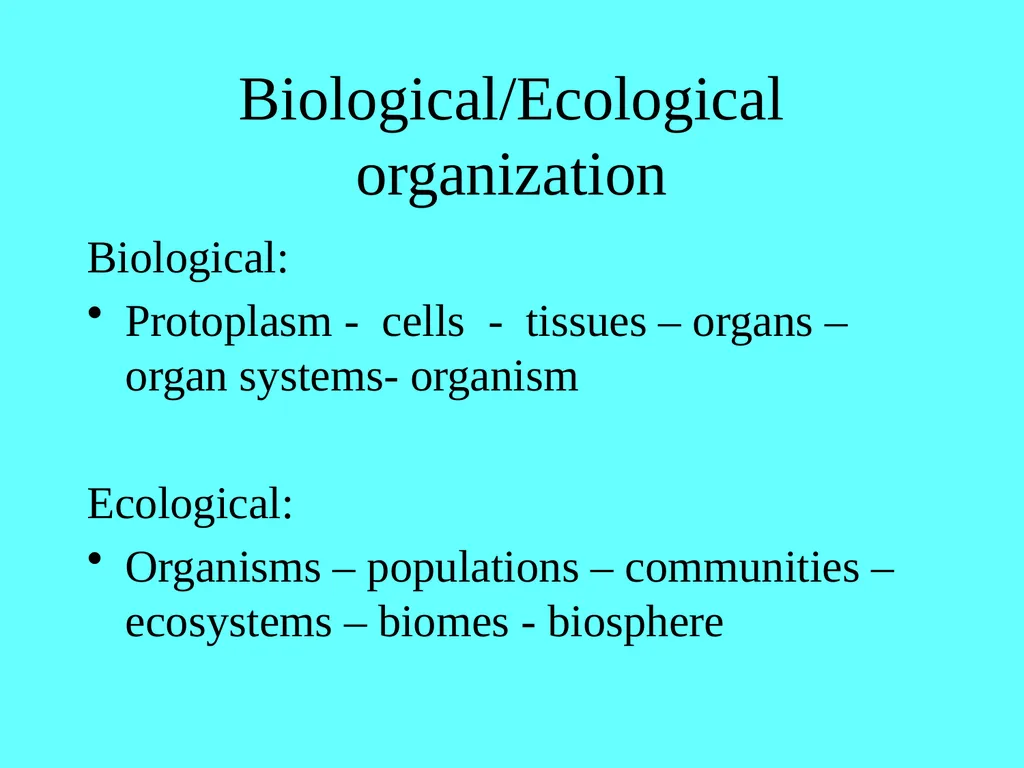
Biological/Ecological organization Biological:
Protoplasm - cells - tissues – organs – organ systems- organism
Ecological:
Organisms – populations – communities – ecosystems – biomes - biosphere<br>
05
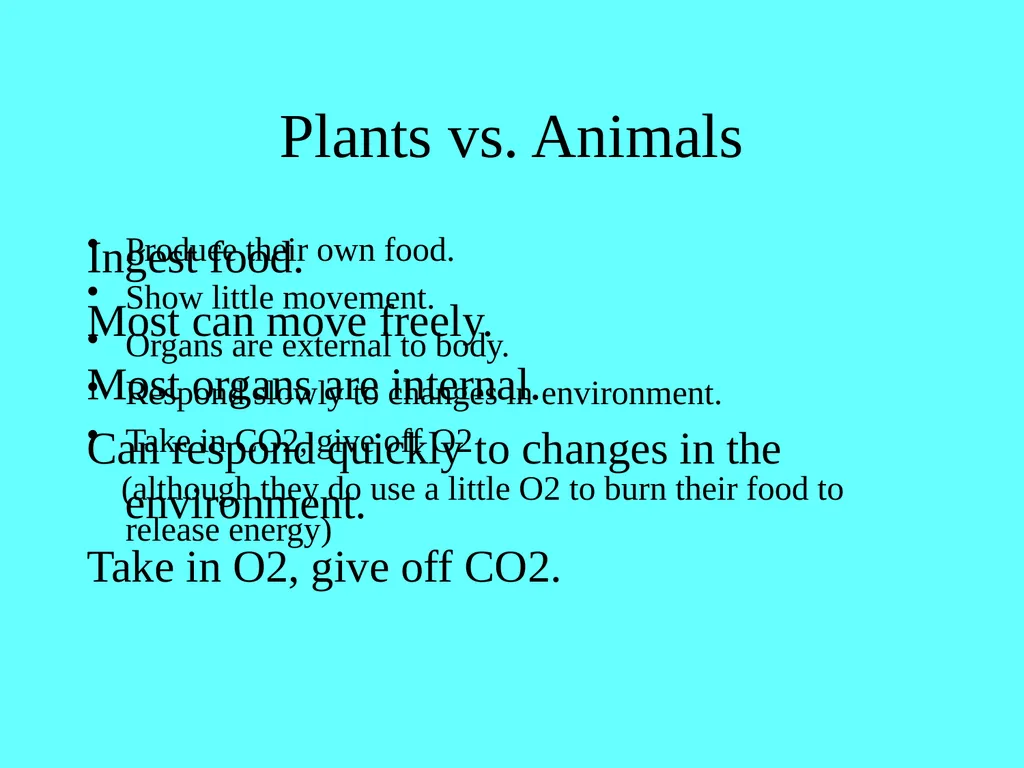
Plants vs. Animals Produce their own food.
Show little movement.
Organs are external to body.
Respond slowly to changes in environment.
Take in CO2, give off O2
(although they do use a little O2 to burn their food to release energy) Ingest food.
Most can move freely.
Most organs are internal.
Can respond quickly to changes in the environment.
Take in O2, give off CO2.<br>
06
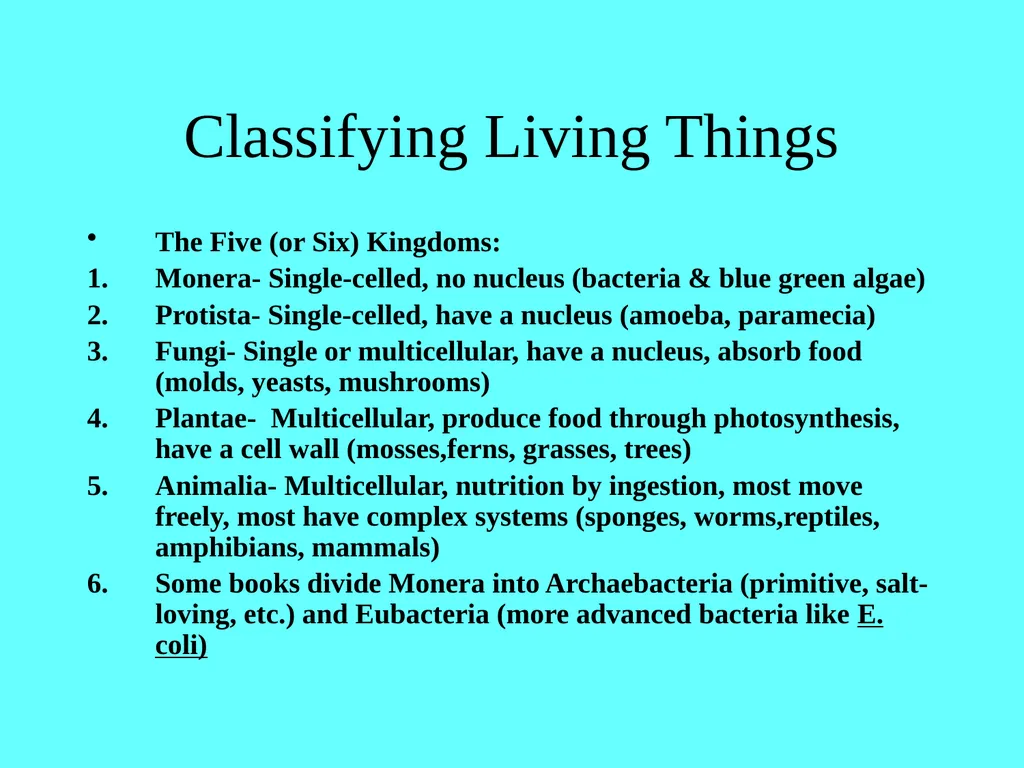
Classifying Living Things The Five (or Six) Kingdoms:
Monera- Single-celled, no nucleus (bacteria & blue green algae)
Protista- Single-celled, have a nucleus (amoeba, paramecia)
Fungi- Single or multicellular, have a nucleus, absorb food (molds, yeasts, mushrooms)
Plantae- Multicellular, produce food through photosynthesis, have a cell wall (mosses,ferns, grasses, trees)
Animalia- Multicellular, nutrition by ingestion, most move freely, most have complex systems (sponges, worms,reptiles, amphibians, mammals)
Some books divide Monera into Archaebacteria (primitive, salt-loving, etc.) and Eubacteria (more advanced bacteria like E. coli)<br>
07
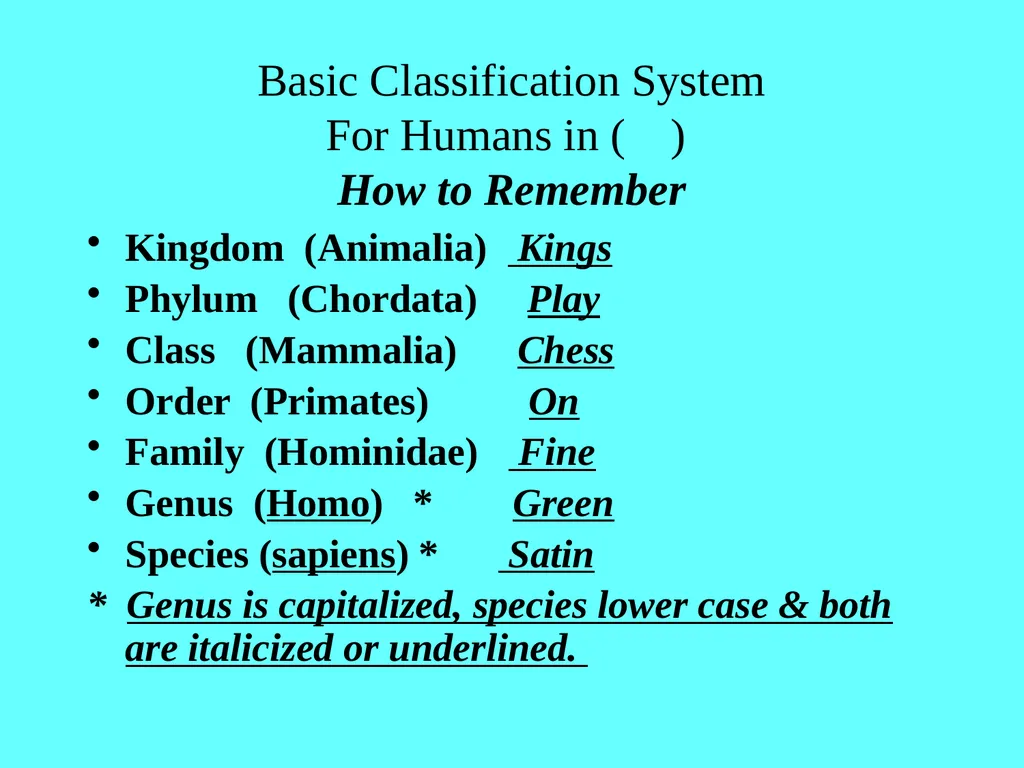
Basic Classification System�For Humans in ( ) �How to Remember Kingdom (Animalia) Kings
Phylum (Chordata) Play
Class (Mammalia) Chess
Order (Primates) On
Family (Hominidae) Fine
Genus (Homo) * Green
Species (sapiens) * Satin
* Genus is capitalized, species lower case & both are italicized or underlined.<br>
08
The Plant Kingdom�Structure of Flowering Plants<br>
09
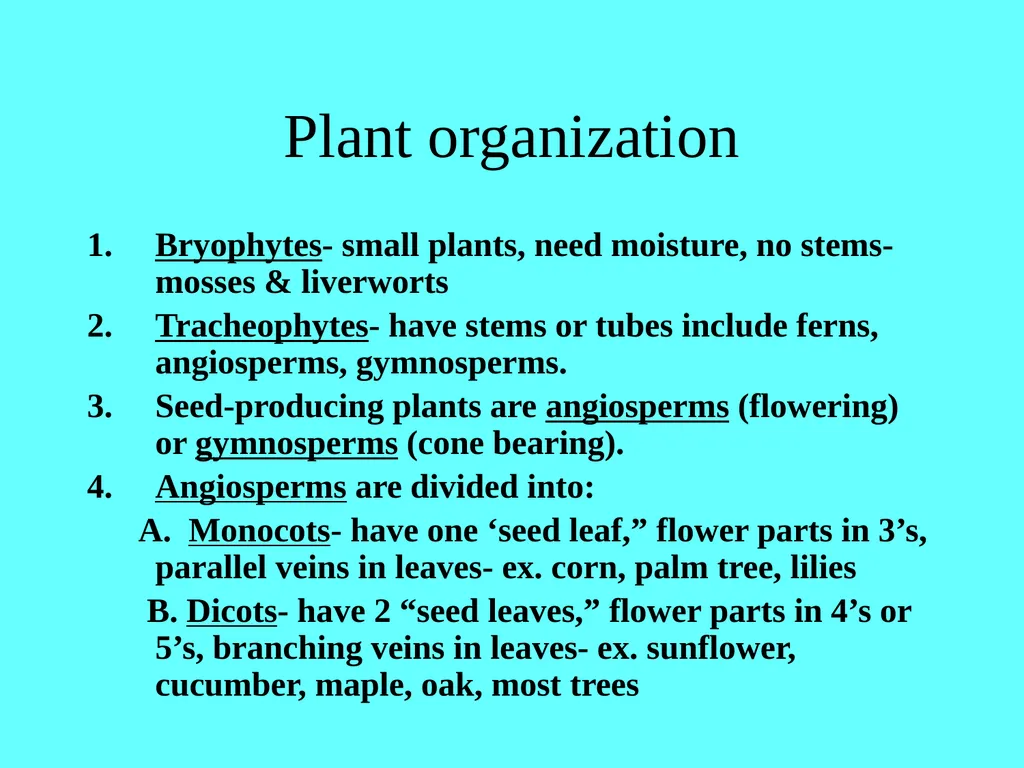
Plant organization Bryophytes- small plants, need moisture, no stems- mosses & liverworts
Tracheophytes- have stems or tubes include ferns, angiosperms, gymnosperms.
Seed-producing plants are angiosperms (flowering) or gymnosperms (cone bearing).
Angiosperms are divided into:
A. Monocots- have one ‘seed leaf,” flower parts in 3’s, parallel veins in leaves- ex. corn, palm tree, lilies
B. Dicots- have 2 “seed leaves,” flower parts in 4’s or 5’s, branching veins in leaves- ex. sunflower, cucumber, maple, oak, most trees<br>
10
The Animal Kingdom�At least a million species- new ones discovered every year! Vertebrates (have backbones) vs. invertebrates (no backbones) Most animals are invertebrates- insects (a class in the phylum Arthropoda are the largest group.
Animal life cycles like grasshopper; egg-nymph-adult (incomplete metamorphosis) or butterfly- egg-larva-pupa-adult (complete metamorphosis) are important in nature and PSSA testing.
Mammals- feed milk to their young, usually have hair or fur, young usually born live.<br>
12
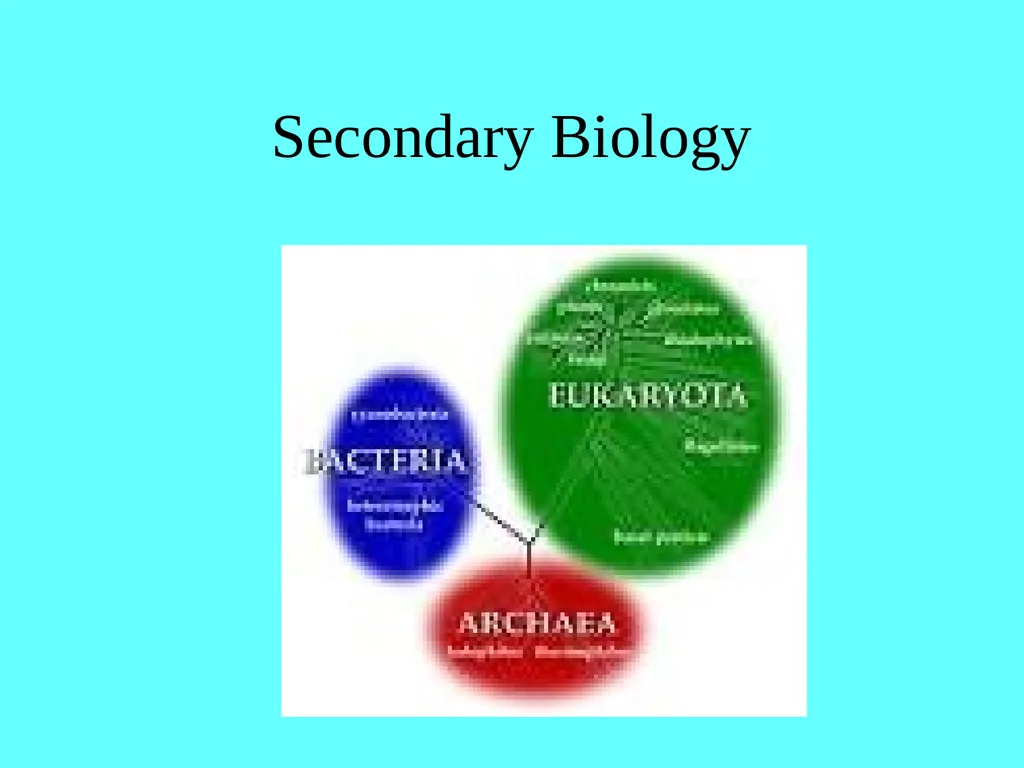
Archaea Archaea Domain: Archaea are prokaryotic cells which are typically characterized by membranes
that are branched hydrocarbon chains attached to glycerol by ether linkages. The presence of this ether containing linkages in Archaea adds to their ability of withstanding extreme temperature and<br>
13
Archaea (cont’d) highly acidic conditions. Extreme halophiles - i.e. organisms which thrive in highly salty
environment, and hyperthermophiles - i.e. the organisms which thrive in extremely hot
environment, are best examples of Archaea.<br>
14
Bacteria Bacteria Domain: Even though bacteria are prokaryotic cells just like Archaea, their membranes
are made of unbranched fatty acid chains attached to glycerol by ester linkages. Cyanobacteria
and mycoplasmas are the best examples of bacteria. As they don't have ether containing linkages<br>
15
Bacteria like Archaea, they are grouped into a different category - and hence a different domain. There is a
great deal of diversity in this domain, such that it is next to impossible to determine how many
species of bacteria exist on the planet.<br>
16
Eukarya Eukarya Domain: As the name suggests, the Eukaryote are eukaryotic cells which have
membranes that are pretty similar to that of bacteria. Eukaryote are further grouped into Kingdom
Protista (algae, protozoans, etc.), Kingdom Fungi (yeast, mold, etc.), Kingdom Plantae (flowering<br>
17
Eukarya (2nd page) plants, ferns, etc.) and Kingdom Animalia (insects, vertebrates, etc.). Not all Eukaryotes have a cell
wall, and even if they do they don't contain peptidoglycan as bacteria do. While cells are organized<br>
18
Eukarya (3rd page) into tissues in case of kingdom Plantae as well as kingdom Animalia, the presence of cell walls is
only restricted to the members of kingdom Plantae.<br>
19
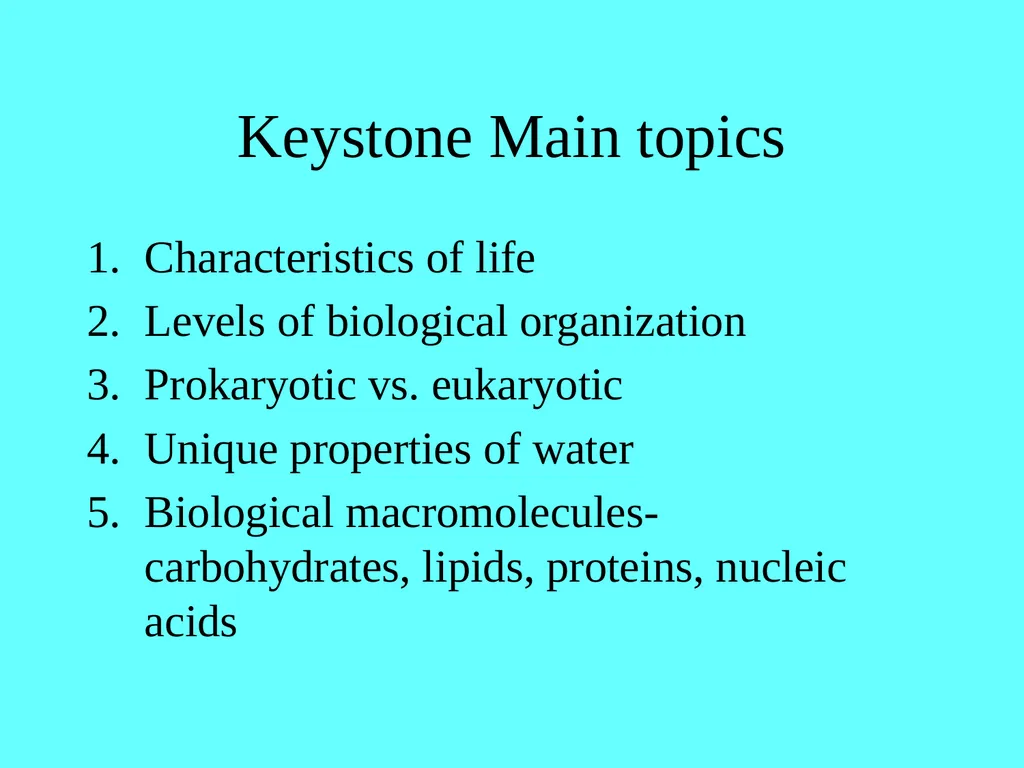
Keystone Main topics Characteristics of life
Levels of biological organization
Prokaryotic vs. eukaryotic
Unique properties of water
Biological macromolecules- carbohydrates, lipids, proteins, nucleic acids<br>
20
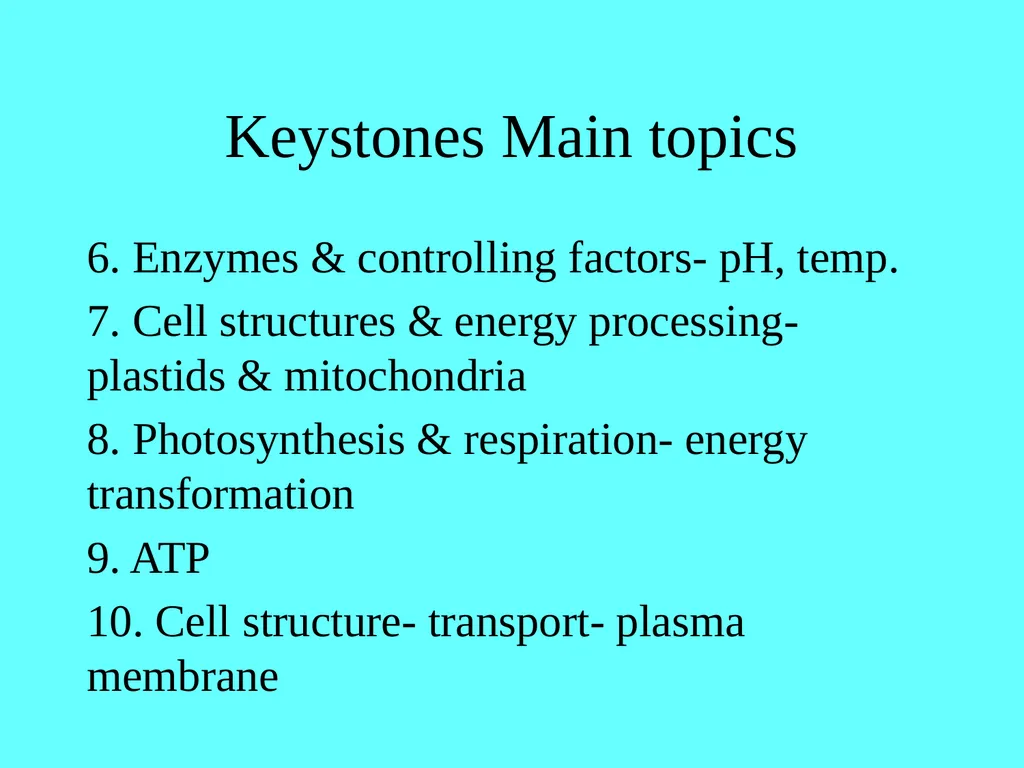
Keystones Main topics 6. Enzymes & controlling factors- pH, temp.
7. Cell structures & energy processing- plastids & mitochondria
8. Photosynthesis & respiration- energy transformation
9. ATP
10. Cell structure- transport- plasma membrane<br>
21
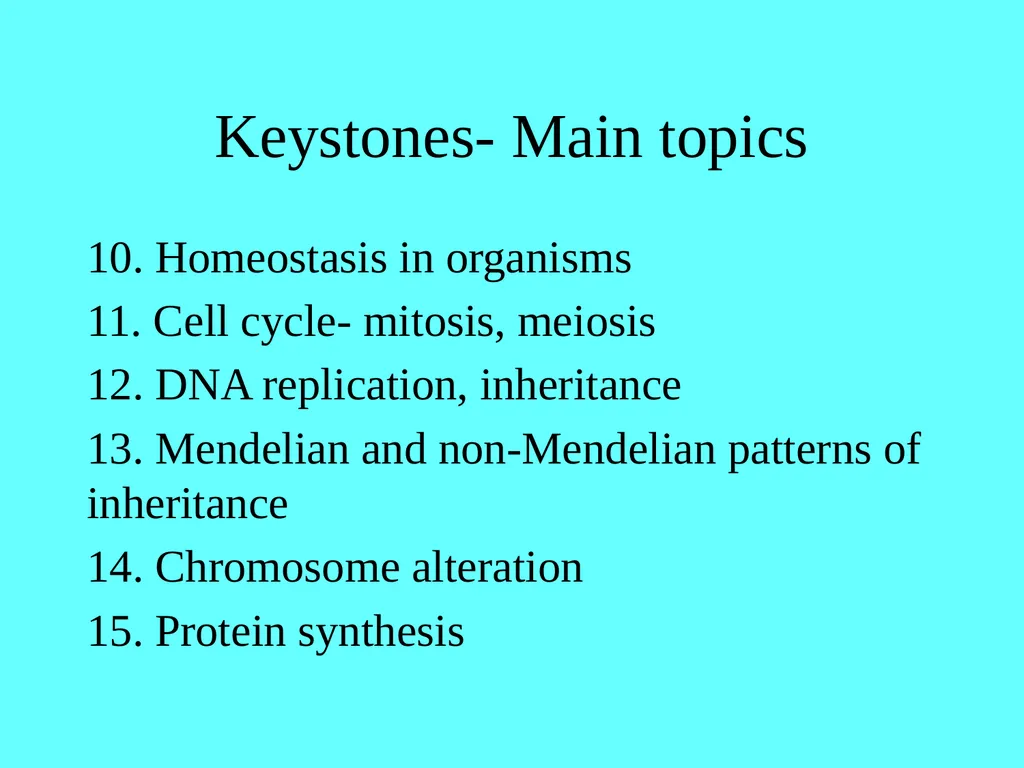
Keystones- Main topics 10. Homeostasis in organisms
11. Cell cycle- mitosis, meiosis
12. DNA replication, inheritance
13. Mendelian and non-Mendelian patterns of inheritance
14. Chromosome alteration
15. Protein synthesis<br>
22
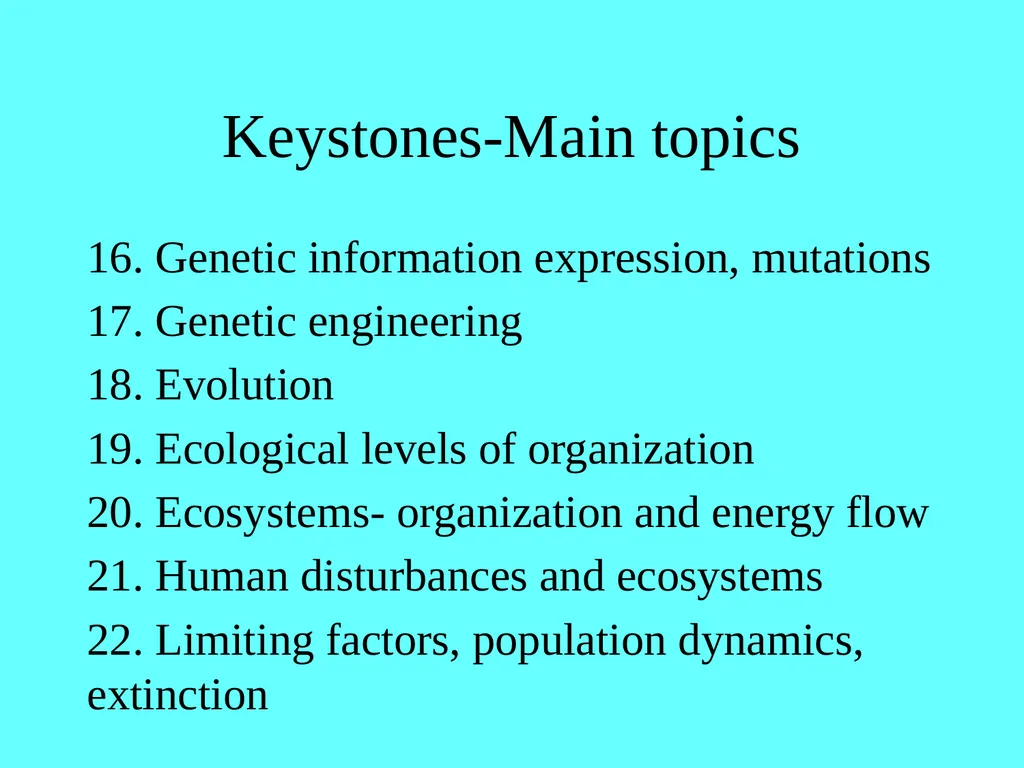
Keystones-Main topics 16. Genetic information expression, mutations
17. Genetic engineering
18. Evolution
19. Ecological levels of organization
20. Ecosystems- organization and energy flow
21. Human disturbances and ecosystems
22. Limiting factors, population dynamics, extinction<br>