04
Goal of Behavioral Psychotherapy The primary goal of behavioral psychotherapy is observable behavior change
No emphasis on internal, mental processes
In contrast to previous approaches (e.g., psychodynamic and humanistic)<br>
05
Goal of Behavioral Psychotherapy (cont.) Emphasis on empiricism
Study of human behavior should be scientific
Clinical methods should be scientifically evaluated via testable hypotheses and empirical data based on observable variables
For example, baseline measures of problem behavior at outset; subsequent measures after some therapy<br>
06
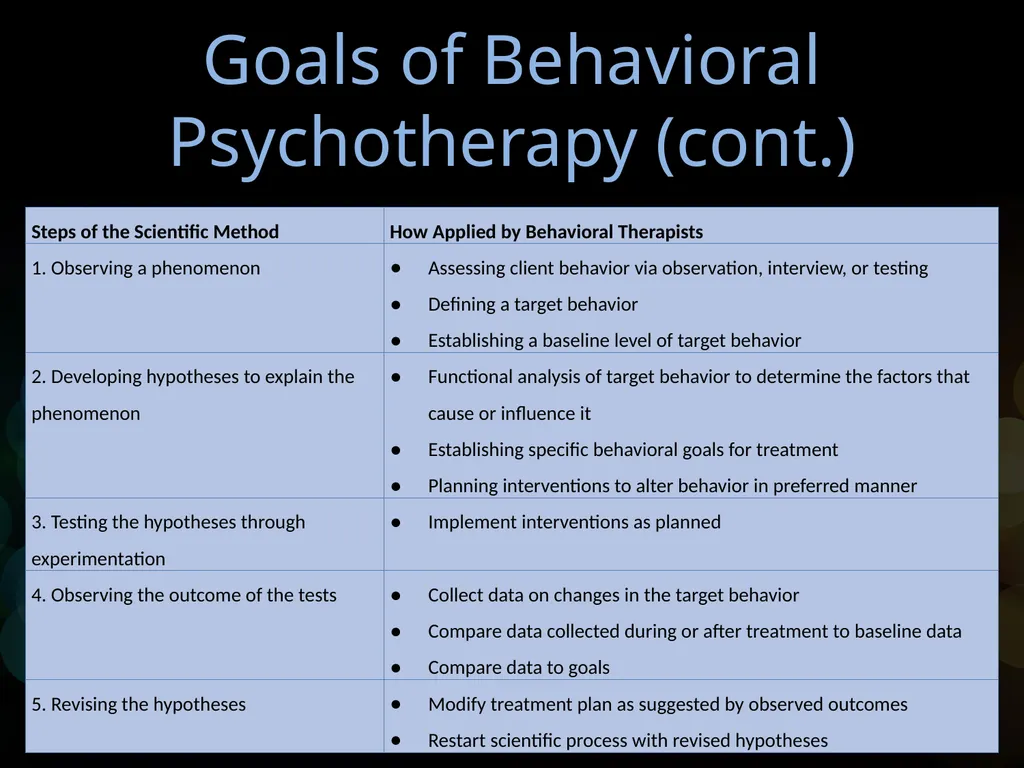
Goals of Behavioral Psychotherapy (cont.)<br>
07
Goal of Behavioral Psychotherapy (cont.) Defining problems behaviorally
Client behaviors are not symptoms of some underlying problem—those behaviors are the problem
Behavioral definitions make it easy to identify target behaviors and measure changes in therapy
Clients’ own definitions can be very hard to assess or measure<br>
08
Goal of Behavioral Psychotherapy (cont.) Measuring change observably
Other kinds of therapists may measure change in clients in more inferential ways, but behavioral therapists use more unambiguous indications of progress
Introspection is not an acceptable way to measure progress—not directly observable<br>
09
Two Types of Conditioning Classical conditioning
Exemplified by Pavlov’s dog studies
UCS evokes UCR
UCS and CS are paired (occur together)
CS evokes CR
CR is essentially the same as UCR, but in response to CS
Generalization or discrimination to similar stimuli may take place<br>
10
Two Types of Conditioning (cont.) Operant conditioning
The organism “operates” on the environment, notices the consequences of the behavior, and incorporates those consequences into decisions regarding future behavior
More active style of learning than classical conditioning
Contingencies, or internal “if…then…” statements, are the product of operant conditioning<br>
11
Techniques Based on Classical Conditioning Exposure therapy
Systematic desensitization
Assertiveness training<br>
12
Techniques Based on Classical Conditioning (cont.) Exposure therapy
Version of “facing your fears”
Often used to treat anxiety disorders
Client is repeatedly “exposed” to the feared object and the expected aversive outcome does not take place client no longer experiences the fear response<br>
13
Techniques Based on Classical Conditioning (cont.) Exposure therapy (cont.)
Exposure is typically gradual (“graded” exposure), following an anxiety hierarchy
Exposures can be imaginal or in vivo (real)<br>
14
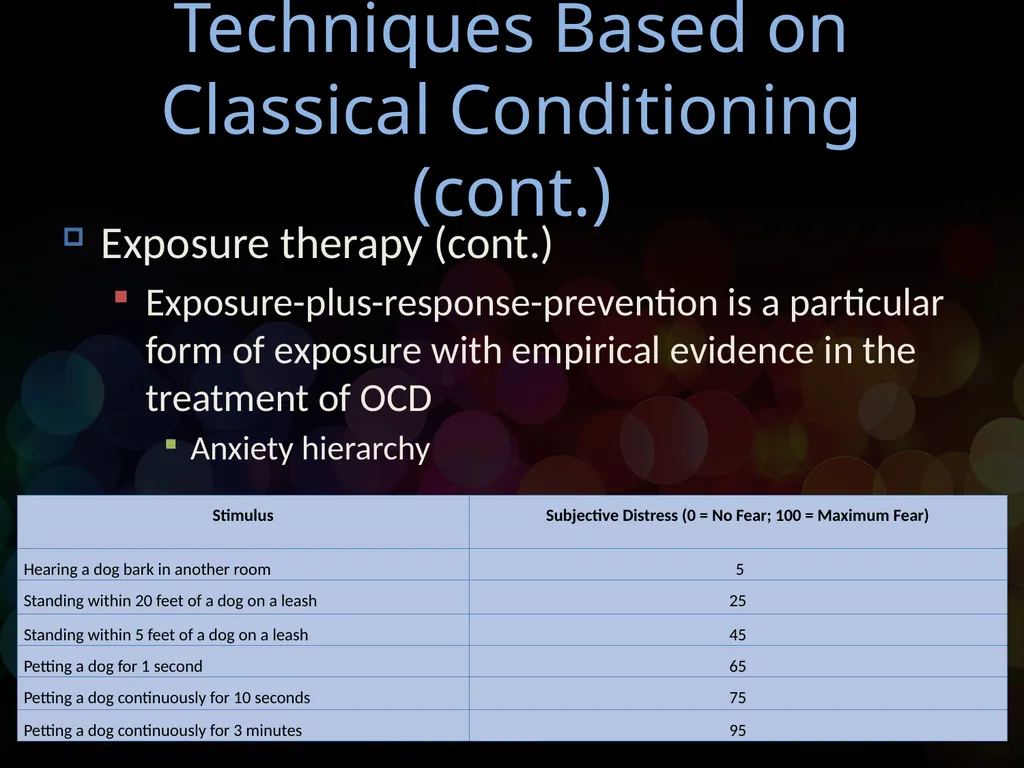
Techniques Based on Classical Conditioning (cont.) Exposure therapy (cont.)
Exposure-plus-response-prevention is a particular form of exposure with empirical evidence in the treatment of OCD
Anxiety hierarchy<br>
15
Techniques Based on Classical Conditioning (cont.) Systematic desensitization
Often used for phobias and other anxiety disorders
Similar to exposure therapy, but relaxation training is included
Relaxation is incompatible with anxiety
Counterconditioning occurs when relaxation response replaces anxiety response<br>
16
Techniques Based on Classical Conditioning (cont.) Assertiveness training
A specific application of classical conditioning that targets clients’ social anxieties
Benefits people whose timidity negatively influences their lives
Includes elements of exposure and systematic desensitization
Facing interpersonal fears
Includes direct instructions, modeling, rehearsal, and homework<br>
17
Techniques Based on Operant Conditioning Contingency management
Extinction
Token economies
Shaping
Behavioral activation
Observational learning (or modeling)<br>
18
Techniques Based on Operant Conditioning (cont.) Contingency management
Powerful way to change behavior change the contingencies controlling it
If consequences change, behavior changes
Reinforcement and punishment should be identified and altered as needed
Reinforcement is typically preferred over punishment
Aversion therapy is one type based on punishment of unwanted behavior<br>
19
Techniques Based on Operant Conditioning (cont.) Extinction
Removal of an expected reinforcement that results in decreased frequency of a behavior
Effective way to decrease unwanted behaviors
Initially, can cause extinction burst (an increase in unwanted behavior), but ultimately, if reinforcement is still withheld, decrease will occur<br>
20
Techniques Based on Operant Conditioning (cont.) Token economies
Setting in which clients earn tokens for participating in predetermined target behaviors
Tokens can be traded for reinforcements
Most feasible in sites where behavior is continuously monitored
e.g., Inpatient unit, correctional facility<br>
21
Techniques Based on Operant Conditioning (cont.) Shaping
Reinforcing successive approximations of the target behavior
Reward each “baby step” toward the desired behavior
Best for changing behaviors that are complex, challenging, or novel for client<br>
22
Techniques Based on Operant Conditioning (cont.) Behavioral activation
Based on simple idea that depressed people lack positive reinforcement
Goal is to increase frequency of positively reinforcing behaviors
Structured daily routine including rewarding behaviors (recalled from non-depressed time)
May have classical conditioning components too<br>
23
Techniques Based on Operant Conditioning (cont.) Observational learning (or modeling)
Learning from the contingencies applied to other people
Client observes demonstration of desired behavior and its consequences client given chances to imitate it
Both imitation and vicarious learning can occur
Certain qualities of the model influence effectiveness of observational learning
For example, similarity to client increases learning<br>
24
Alternatives to Behavior Therapy Behavioral consultation
Indirect way for a behavior therapist to modify a client’s behavior
Three parties involved: the client, the consultee, and the consultant (therapist)
Consultee spends significant time in natural setting with client
e.g., Parent, caretaker, manager<br>
25
Alternatives to Behavior Therapy (cont.) Parent training
Specific form of behavioral consultation
Parents seek help with problematic behaviors of their children
Teacher training
Specific form of behavioral consultation
Teachers seek help with problematic behaviors of their students<br>
26
How Well Does Behavioral Therapy Work? Behavioral therapies have a significant amount of empirical support, especially in comparison to most other forms of therapy
Especially for anxiety disorders, depression, and children’s behavior disorders
May also be most empirically testable forms of therapy<br>