
CHAPTER 16 Gastrointestinal, Genitourinary, and
LV
Published · 74 slides · 0 views
1 / 1


Description
CHAPTER 16 Gastrointestinal, Genitourinary, and Reproductive System Emergencies The following presentation will utilize two symbols to identify material necessary for an OEC Technician to comprehend: Meets a Chapter Objective. This symbol
Related Topics
Share
Embed code
Download this presentation From Below
"CHAPTER 16 Gastrointestinal, Genitourinary, and" is the property of its rightful owner. Permission is granted to download and print the materials on this website for personal, non-commercial use only, and to display it on your personal computer provided you do not modify the materials and that you retain all copyright notices contained in the materials. By downloading content from our website, you accept the terms of this agreement.
Presentation Transcript
01
CHAPTER 16 Gastrointestinal,
Genitourinary,
and
Reproductive System
Emergencies<br>
02
The following presentation will utilize two symbols to identify material necessary for an OEC Technician to comprehend: Meets a Chapter Objective.
This symbol will have the corresponding Objective Number denoted within. Identifies a Key Term.
The Key Term will be underlined for easy identification. key term<br>
This symbol will have the corresponding Objective Number denoted within. Identifies a Key Term.
The Key Term will be underlined for easy identification. key term<br>
03
Objectives 16-1 List the possible causes of emergencies involving the gastrointestinal, genitourinary, and reproductive systems.
16-2 List the signs and symptoms of emergencies involving the genitourinary system.
16-3 List the signs and symptoms of emergencies involving the gastrointestinal system.
16-4 List the signs and symptoms of emergencies related to the reproductive system.
16-5 Describe and demonstrate how to assess the abdomen.
16-6 Describe and demonstrate the management of a patient with a gastrointestinal, genitourinary, or reproductive emergency.<br>
16-2 List the signs and symptoms of emergencies involving the genitourinary system.
16-3 List the signs and symptoms of emergencies involving the gastrointestinal system.
16-4 List the signs and symptoms of emergencies related to the reproductive system.
16-5 Describe and demonstrate how to assess the abdomen.
16-6 Describe and demonstrate the management of a patient with a gastrointestinal, genitourinary, or reproductive emergency.<br>
04
Key Terms Acute abdomen
Bladder infection
Ectopic pregnancy
Guarding
Hematemesis
Jaundice
Melena
Ovarian cyst
Pancreatitis
Pelvic inflammatory disease
Peritoneum
Peritonitis
Referred pain<br>
Bladder infection
Ectopic pregnancy
Guarding
Hematemesis
Jaundice
Melena
Ovarian cyst
Pancreatitis
Pelvic inflammatory disease
Peritoneum
Peritonitis
Referred pain<br>
05
Chapter Overview<br>
06
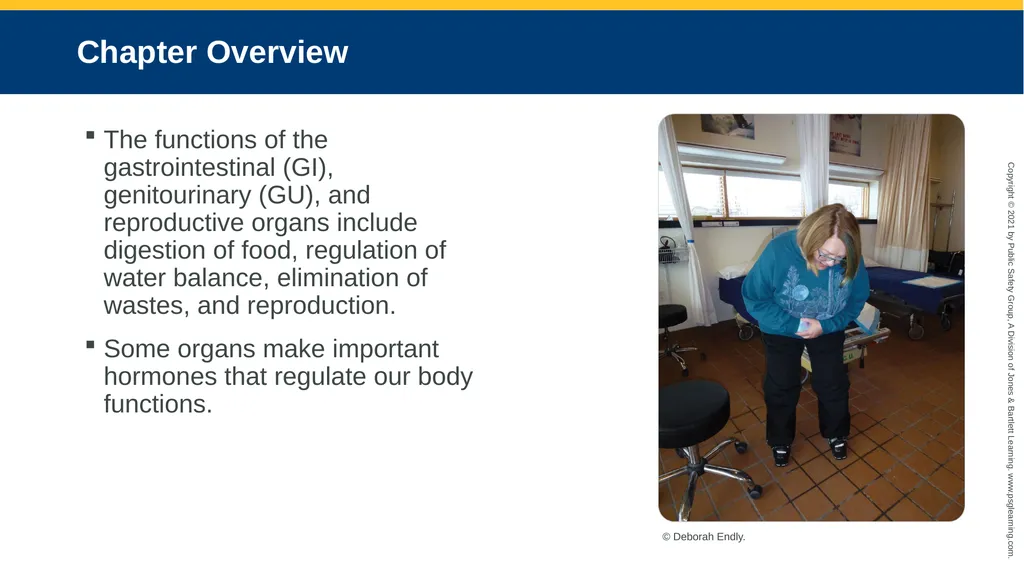
Chapter Overview The functions of the gastrointestinal (GI), genitourinary (GU), and reproductive organs include digestion of food, regulation of water balance, elimination of wastes, and reproduction.
Some organs make important hormones that regulate our body functions. © Deborah Endly.<br>
Some organs make important hormones that regulate our body functions. © Deborah Endly.<br>
07
Chapter Overview Understanding will greatly assist OEC technicians in identifying common disorders of these systems.
Patients can present unique challenges to OEC technicians:
Symptoms may be vague or misleading.
Patients often do not seek care until their symptoms are unbearable.
Severe pain or embarrassment may make a thorough exam difficult.<br>
Patients can present unique challenges to OEC technicians:
Symptoms may be vague or misleading.
Patients often do not seek care until their symptoms are unbearable.
Severe pain or embarrassment may make a thorough exam difficult.<br>
08
Chapter Overview Know basics of this process and how you can assist the pregnant patient.
With a basic understanding of the anatomy and physiology of abdominal and pelvic structures and of the types of medical conditions that could be encountered, OEC technicians can effectively manage initial care of most GI, GU, and gynecologic problems.
Goal: To rapidly identify any potentially serious emergency, render emergency care, and move the patient quickly toward definitive care.
Not to diagnose the exact cause<br>
With a basic understanding of the anatomy and physiology of abdominal and pelvic structures and of the types of medical conditions that could be encountered, OEC technicians can effectively manage initial care of most GI, GU, and gynecologic problems.
Goal: To rapidly identify any potentially serious emergency, render emergency care, and move the patient quickly toward definitive care.
Not to diagnose the exact cause<br>
09
Anatomy and Physiology<br>
10
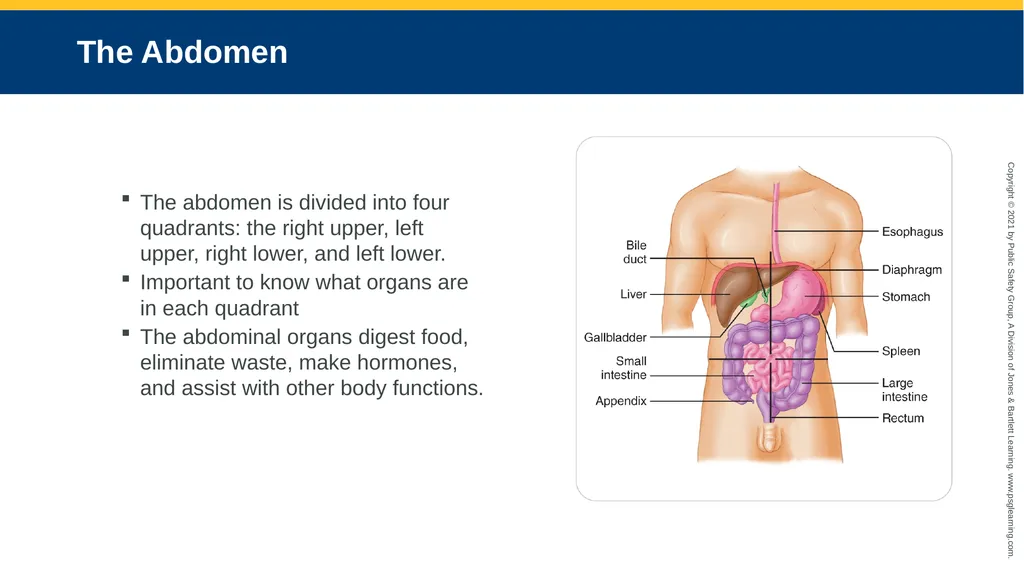
The Abdomen The abdomen is divided into four quadrants: the right upper, left upper, right lower, and left lower.
Important to know what organs are in each quadrant
The abdominal organs digest food, eliminate waste, make hormones, and assist with other body functions.<br>
Important to know what organs are in each quadrant
The abdominal organs digest food, eliminate waste, make hormones, and assist with other body functions.<br>
11
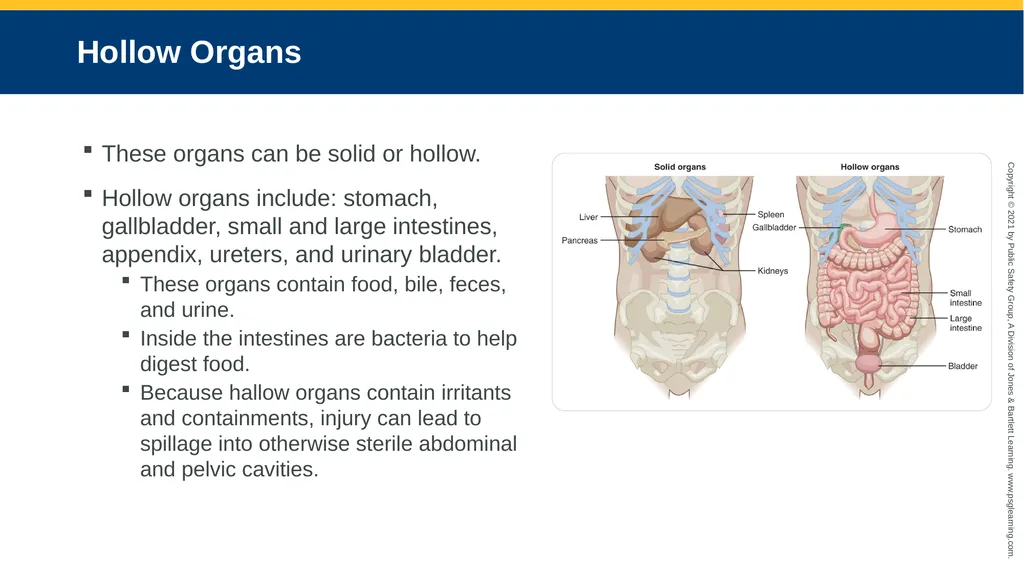
Hollow Organs These organs can be solid or hollow.
Hollow organs include: stomach, gallbladder, small and large intestines, appendix, ureters, and urinary bladder.
These organs contain food, bile, feces, and urine.
Inside the intestines are bacteria to help digest food.
Because hallow organs contain irritants and containments, injury can lead to spillage into otherwise sterile abdominal and pelvic cavities.<br>
Hollow organs include: stomach, gallbladder, small and large intestines, appendix, ureters, and urinary bladder.
These organs contain food, bile, feces, and urine.
Inside the intestines are bacteria to help digest food.
Because hallow organs contain irritants and containments, injury can lead to spillage into otherwise sterile abdominal and pelvic cavities.<br>
12
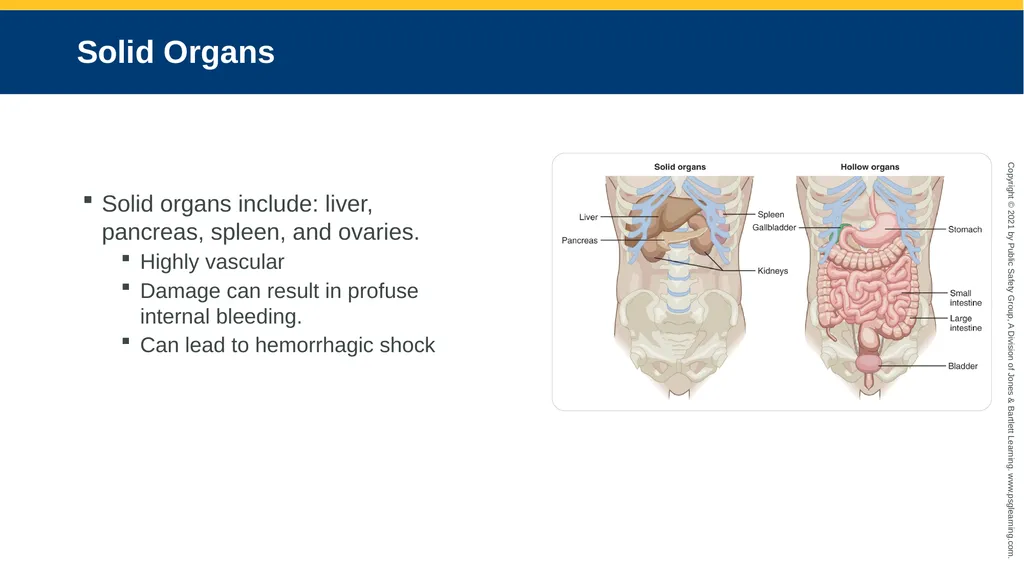
Solid Organs Solid organs include: liver, pancreas, spleen, and ovaries.
Highly vascular
Damage can result in profuse internal bleeding.
Can lead to hemorrhagic shock<br>
Highly vascular
Damage can result in profuse internal bleeding.
Can lead to hemorrhagic shock<br>
13
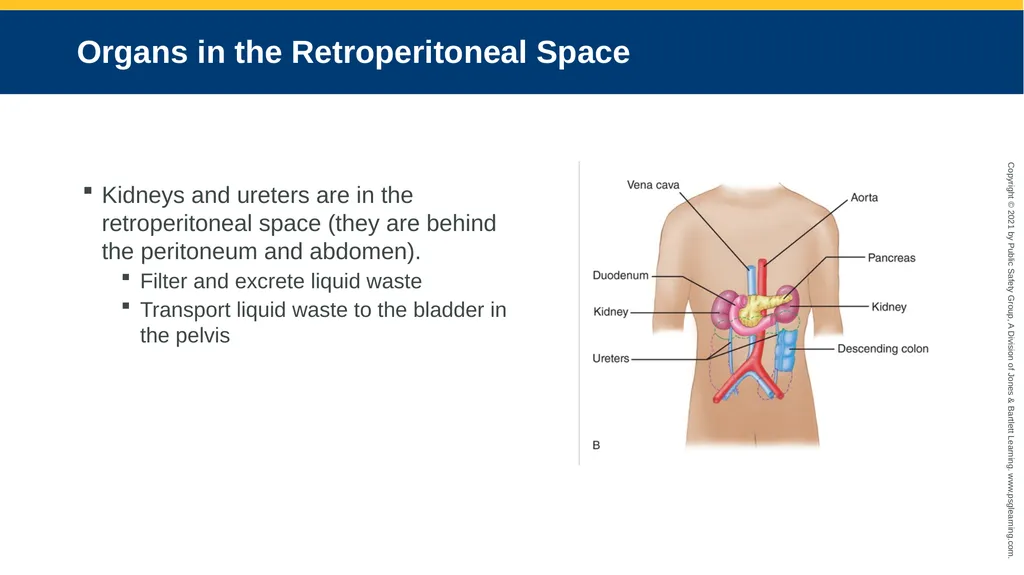
Organs in the Retroperitoneal Space Kidneys and ureters are in the retroperitoneal space (they are behind the peritoneum and abdomen).
Filter and excrete liquid waste
Transport liquid waste to the bladder in the pelvis<br>
Filter and excrete liquid waste
Transport liquid waste to the bladder in the pelvis<br>
14
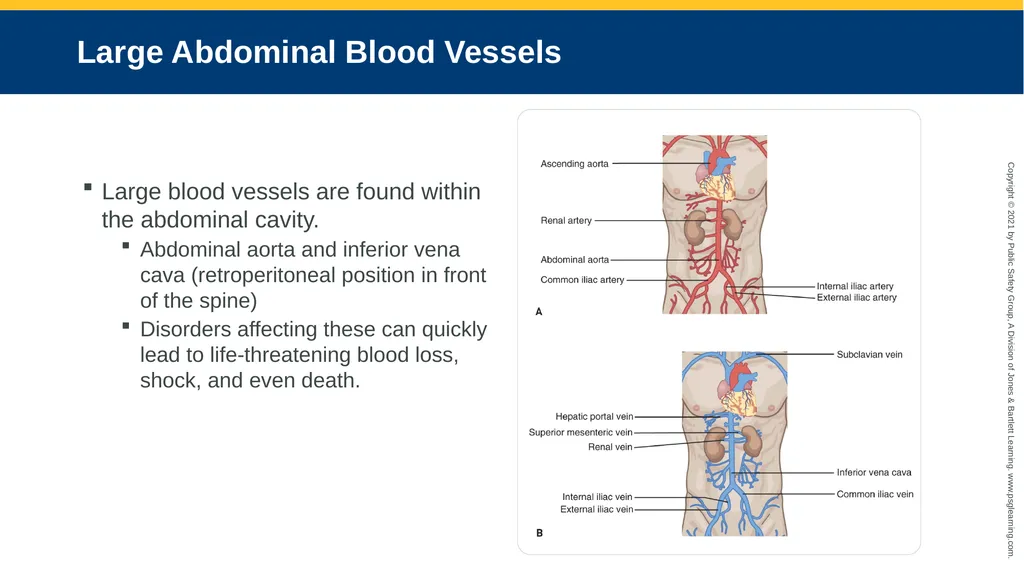
Large Abdominal Blood Vessels Large blood vessels are found within the abdominal cavity.
Abdominal aorta and inferior vena cava (retroperitoneal position in front of the spine)
Disorders affecting these can quickly lead to life-threatening blood loss, shock, and even death.<br>
Abdominal aorta and inferior vena cava (retroperitoneal position in front of the spine)
Disorders affecting these can quickly lead to life-threatening blood loss, shock, and even death.<br>
15
Abdominal Pain Abdominal pain may be felt in a specific organ, in a general area of the body, or in a part of the body distant from the source of pain.
Parietal Pain
Sensory nerves are in the skin and peritoneum.
Enable a person to perceive touch, pressure, heat, cold, and pain
When these nerves become irritated, the location of the pain can be precisely pinpointed.
Visceral Pain
Irritation of visceral nerves is described as diffuse or spread over a large area.
The patient cannot point to the exact location of the pain.
Referred Pain
Distention and contraction of the peritoneum stimulates various visceral stretch receptors that can cause pain to be perceived at the distant location.<br>
Parietal Pain
Sensory nerves are in the skin and peritoneum.
Enable a person to perceive touch, pressure, heat, cold, and pain
When these nerves become irritated, the location of the pain can be precisely pinpointed.
Visceral Pain
Irritation of visceral nerves is described as diffuse or spread over a large area.
The patient cannot point to the exact location of the pain.
Referred Pain
Distention and contraction of the peritoneum stimulates various visceral stretch receptors that can cause pain to be perceived at the distant location.<br>
16
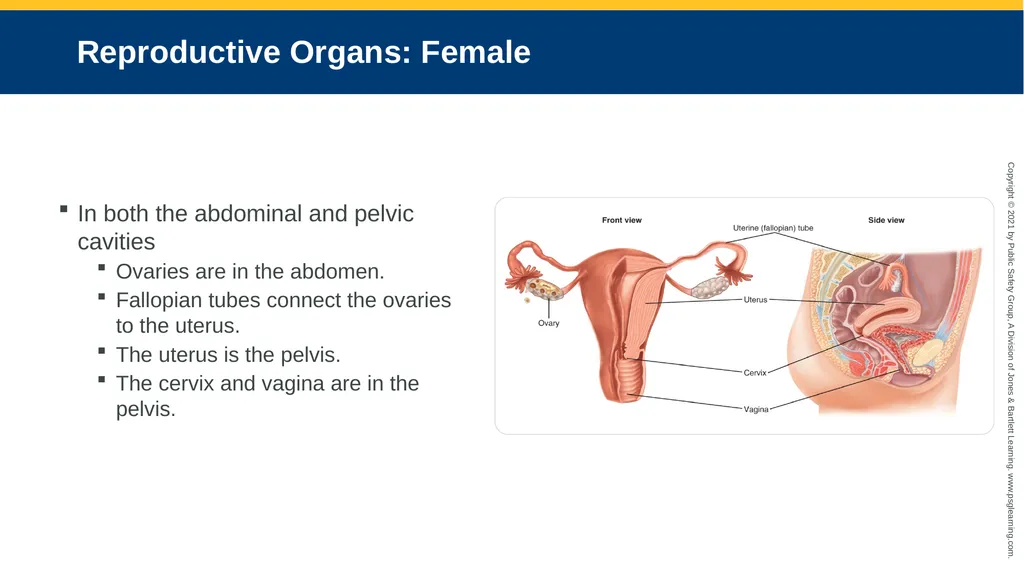
Reproductive Organs: Female In both the abdominal and pelvic cavities
Ovaries are in the abdomen.
Fallopian tubes connect the ovaries to the uterus.
The uterus is the pelvis.
The cervix and vagina are in the pelvis.<br>
Ovaries are in the abdomen.
Fallopian tubes connect the ovaries to the uterus.
The uterus is the pelvis.
The cervix and vagina are in the pelvis.<br>
17
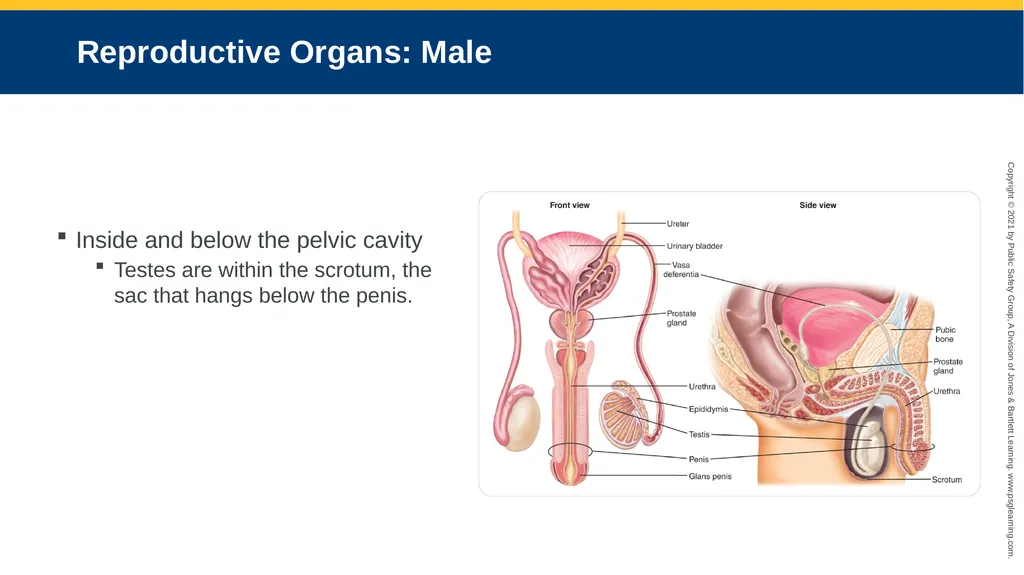
Reproductive Organs: Male Inside and below the pelvic cavity
Testes are within the scrotum, the sac that hangs below the penis.<br>
Testes are within the scrotum, the sac that hangs below the penis.<br>
18
Common Medical Problems<br>
19
Gastroenteritis An inflammatory condition involving the stomach lining and/or intestines
Typically caused by bacterial, viral, or parasitic infection
Presents with cramping abdominal pain, bloating, nausea, vomiting, and diarrhea
Fever may or may not be present.
Generally not life threatening
Symptoms resolve quickly.
If vomiting and diarrhea symptoms persist for over 24 hours, the patient could become dehydrated.
If blood appears in vomit or stool, the condition may be due to undiagnosed GI bleeding.
Patient should be encouraged to seek follow-up care at a medical facility. 16-1
16-3<br>
Typically caused by bacterial, viral, or parasitic infection
Presents with cramping abdominal pain, bloating, nausea, vomiting, and diarrhea
Fever may or may not be present.
Generally not life threatening
Symptoms resolve quickly.
If vomiting and diarrhea symptoms persist for over 24 hours, the patient could become dehydrated.
If blood appears in vomit or stool, the condition may be due to undiagnosed GI bleeding.
Patient should be encouraged to seek follow-up care at a medical facility. 16-1
16-3<br>
20
Bacteria, Viruses, and Protozoa Can also cause pain and diarrhea
Some illnesses are self-limiting, lasting generally less than 24 hours, whereas others can be deadly, especially in the young, elderly, or infirm.
Prominent among the bacterial, viral, and protozoan, agents of GI ailments are the following organisms:
Staphylococcus bacteria grow everywhere in the environment.
Salmonella bacteria in undercooked poultry can cause the same problems as Staphylococcus food poisoning.
Although salmonellosis is usually self-limiting, the illness lasts longer than food poisoning with Staphylococcus, lasting up to 3 or 4 days. 16-1<br>
Some illnesses are self-limiting, lasting generally less than 24 hours, whereas others can be deadly, especially in the young, elderly, or infirm.
Prominent among the bacterial, viral, and protozoan, agents of GI ailments are the following organisms:
Staphylococcus bacteria grow everywhere in the environment.
Salmonella bacteria in undercooked poultry can cause the same problems as Staphylococcus food poisoning.
Although salmonellosis is usually self-limiting, the illness lasts longer than food poisoning with Staphylococcus, lasting up to 3 or 4 days. 16-1<br>
21
Bacteria, Viruses, and Protozoa (Cont’d) Escherichia coli (E. coli)
Norovirus, or Norwalk virus
Very contagious gastroenteritis spread by the fecal/oral route, through direct contact, or through contaminated food or water
Giardia lamblia and Cryptosporidium
Protozoa present in untreated surface water in outdoor environments 16-1<br>
Norovirus, or Norwalk virus
Very contagious gastroenteritis spread by the fecal/oral route, through direct contact, or through contaminated food or water
Giardia lamblia and Cryptosporidium
Protozoa present in untreated surface water in outdoor environments 16-1<br>
22
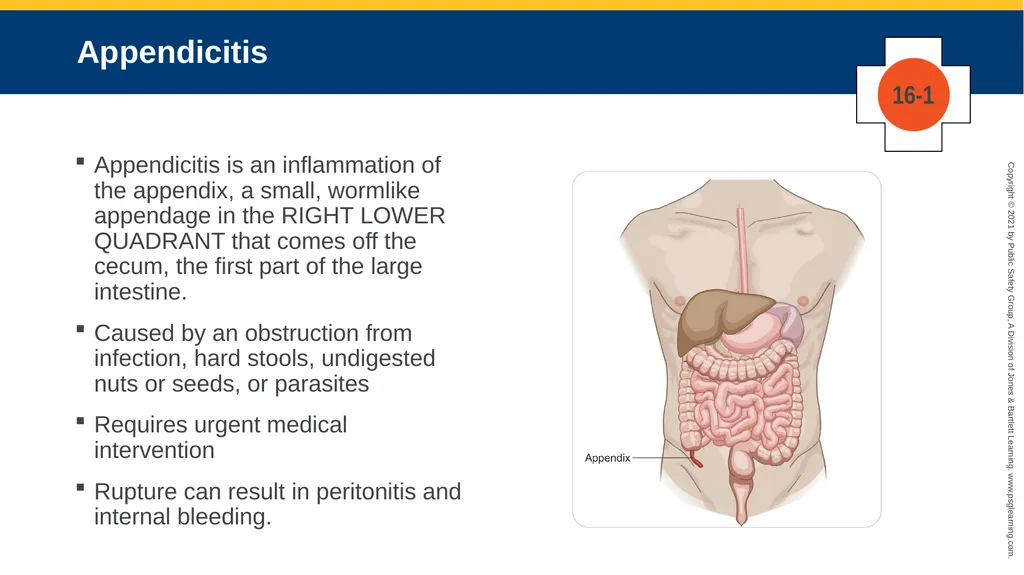
Appendicitis Appendicitis is an inflammation of the appendix, a small, wormlike appendage in the RIGHT LOWER QUADRANT that comes off the cecum, the first part of the large intestine.
Caused by an obstruction from infection, hard stools, undigested nuts or seeds, or parasites
Requires urgent medical intervention
Rupture can result in peritonitis and internal bleeding. 16-1<br>
Caused by an obstruction from infection, hard stools, undigested nuts or seeds, or parasites
Requires urgent medical intervention
Rupture can result in peritonitis and internal bleeding. 16-1<br>
23
Appendicitis: Signs and Symptoms Patients with appendicitis often INITIALLY present with:
Generalized periumbilical (around the navel)
Upper abdominal visceral pain that may initially be dismissed as indigestion or a muscle spasm
Pain grows in severity and typically moves to the right lower quadrant as parietal pain.
Often accompanied by abdominal guarding, nausea, vomiting, and fever, but rarely diarrhea 16-1<br>
Generalized periumbilical (around the navel)
Upper abdominal visceral pain that may initially be dismissed as indigestion or a muscle spasm
Pain grows in severity and typically moves to the right lower quadrant as parietal pain.
Often accompanied by abdominal guarding, nausea, vomiting, and fever, but rarely diarrhea 16-1<br>
24
Pancreatitis A very painful condition in which the pancreas becomes inflamed
Damage happens when the digestive enzymes are activated before they are released into the small intestine and begin attacking the pancreas.
Can be mild or life threatening
Can occur suddenly or become chronic, recurring throughout one’s life.
Number one cause of pancreatitis is excessive long-term alcohol consumption.
Also caused by gallstones, medications, trauma, viral infections, and pancreatic tumors or cancer 16-1<br>
Damage happens when the digestive enzymes are activated before they are released into the small intestine and begin attacking the pancreas.
Can be mild or life threatening
Can occur suddenly or become chronic, recurring throughout one’s life.
Number one cause of pancreatitis is excessive long-term alcohol consumption.
Also caused by gallstones, medications, trauma, viral infections, and pancreatic tumors or cancer 16-1<br>
25
Acute Pancreatitis: Signs and Symptoms Acute pancreatitis is a serious emergency that can result in death if not treated quickly.
Sudden onset of moderate-to-severe parietal pain in both upper quadrants, often with referred pain to the back or left shoulder
Pain is usually constant and worsens with movement.
Abdomen is usually distended and is very tender to palpation.
Guarding (spasm of the abdominal wall when palpated)
Nausea and vomiting
Low-grade fever
Vital signs may be elevated.
Shock-like signs 16-3<br>
Sudden onset of moderate-to-severe parietal pain in both upper quadrants, often with referred pain to the back or left shoulder
Pain is usually constant and worsens with movement.
Abdomen is usually distended and is very tender to palpation.
Guarding (spasm of the abdominal wall when palpated)
Nausea and vomiting
Low-grade fever
Vital signs may be elevated.
Shock-like signs 16-3<br>
26
Chronic Pancreatitis: Signs and Symptoms An ongoing condition that causes scar tissue to form within the pancreas, which results in decreased pancreatic function
Signs and symptoms similar to those of acute pancreatitis
May be present for days
Often worsen after eating a meal or drinking alcohol
Untreated, pancreatitis can lead to decreased pancreatic function and even to diabetes if enough pancreatic cells are destroyed. 16-3<br>
Signs and symptoms similar to those of acute pancreatitis
May be present for days
Often worsen after eating a meal or drinking alcohol
Untreated, pancreatitis can lead to decreased pancreatic function and even to diabetes if enough pancreatic cells are destroyed. 16-3<br>
27
Hepatitis Inflammation of the liver
Untreated can result in decreased liver function and a host of related problems
Can be acute
May become chronic
The most common cause of hepatitis is a viral infection.
Also can be caused by bacteria, alcohol, medications, chemicals, and autoimmune disorders 16-1<br>
Untreated can result in decreased liver function and a host of related problems
Can be acute
May become chronic
The most common cause of hepatitis is a viral infection.
Also can be caused by bacteria, alcohol, medications, chemicals, and autoimmune disorders 16-1<br>
28
Hepatitis: Signs and Symptoms Patients with hepatitis generally present with flulike symptoms such as fatigue, loss of appetite, headache, nausea, and vomiting that may last for several weeks.
May have a low-grade fever
Parietal-type abdominal pain is a common finding.
Typically located in the right upper quadrant and/or in the epigastrium, which is the area just below the sternum
Hallmark sign of hepatitis is jaundice:
Dull yellowing of the skin and mucous membranes
Evident first in the white part of the eyes (the sclera)
See a physician promptly. 16-3<br>
May have a low-grade fever
Parietal-type abdominal pain is a common finding.
Typically located in the right upper quadrant and/or in the epigastrium, which is the area just below the sternum
Hallmark sign of hepatitis is jaundice:
Dull yellowing of the skin and mucous membranes
Evident first in the white part of the eyes (the sclera)
See a physician promptly. 16-3<br>
29
Cholecystitis Cholecystitis is an inflammation of the gallbladder that, like pancreatitis and hepatitis, can be acute or chronic.
Gallstone that is blocking the duct that exits the gallbladder, causing a backup of bile, irritation, and sometimes infection of the gallbladder
Alcoholism, trauma, and rarely cancer of the gallbladder 16-1<br>
Gallstone that is blocking the duct that exits the gallbladder, causing a backup of bile, irritation, and sometimes infection of the gallbladder
Alcoholism, trauma, and rarely cancer of the gallbladder 16-1<br>
30
Cholecystitis: Signs and Symptoms Tenderness or pain in the right upper quadrant, nausea, and vomiting
History of abdominal pain following a meal, especially meals involving fatty or greasy foods
Fever
Jaundice
Excruciating pain
Localized in the abdomen or (more commonly) the flank
May radiate into the groin 16-3<br>
History of abdominal pain following a meal, especially meals involving fatty or greasy foods
Fever
Jaundice
Excruciating pain
Localized in the abdomen or (more commonly) the flank
May radiate into the groin 16-3<br>
31
Bladder Infections and Pyelonephritis The urine in the bladder is sterile.
When bacteria get into the bladder, cystitis or a bladder infection occurs.
Painful urination, blood in the urine, fever, and sometimes severe abdominal/pelvic pain
Bacteria can travel up the ureters and infect the entire urinary system.
Pyelonephritis is a bacterial infection involving one or both kidneys and the ureters, the tubes leading to the urinary bladder.
Acutely or chronic
Repeated infections can cause decreased kidney function, septic shock, and even death in rare cases.
Young, elderly, and people with poor health are very susceptible to kidney infections. 16-1
16-2<br>
When bacteria get into the bladder, cystitis or a bladder infection occurs.
Painful urination, blood in the urine, fever, and sometimes severe abdominal/pelvic pain
Bacteria can travel up the ureters and infect the entire urinary system.
Pyelonephritis is a bacterial infection involving one or both kidneys and the ureters, the tubes leading to the urinary bladder.
Acutely or chronic
Repeated infections can cause decreased kidney function, septic shock, and even death in rare cases.
Young, elderly, and people with poor health are very susceptible to kidney infections. 16-1
16-2<br>
32
Acute Pyelonephritis Pyelonephritis is caused by a bacterial infection that typically begins in the urinary bladder.
Bacteria enter the urinary tract through the urethra and travel up to the urinary bladder.
Untreated bacteria continue to grow and travel up the ureters to the kidneys.
Women are more prone to urinary tract infections than are men.
Infection throughout the body, known as sepsis, kidney stones, and kidney failure 16-1<br>
Bacteria enter the urinary tract through the urethra and travel up to the urinary bladder.
Untreated bacteria continue to grow and travel up the ureters to the kidneys.
Women are more prone to urinary tract infections than are men.
Infection throughout the body, known as sepsis, kidney stones, and kidney failure 16-1<br>
33
Acute Pyelonephritis: Signs and Symptoms Patients with a kidney infection appear ill and present with a variety of signs and symptoms, including:
Severe abdominal, flank, or back pain
Fever; warm or hot skin
Chills and shivering
Nausea and vomiting
Pain or increased frequency of urination
Abnormal urine 16-2<br>
Severe abdominal, flank, or back pain
Fever; warm or hot skin
Chills and shivering
Nausea and vomiting
Pain or increased frequency of urination
Abnormal urine 16-2<br>
34
Nephrolithiasis Nephrolithiasis is the presence of kidney stones, which are formed when mineralized salts within the kidneys crystallize into small, hardened deposits that grow over time.
Stones may travel out of the kidney and become trapped within one or both ureters.
Urine flow may become blocked, causing pressure, spasm, and intense pain.
Causes include increased levels of stone-forming chemicals within the kidney, dehydration, and congenital kidney defects.
Certain medical conditions such as obesity and gout increase risk.
Patients with a kidney stone that has become lodged within a ureter are usually in severe distress and are generally in excruciating pain.
Pain may be localized in the abdomen or flank and may radiate into the groin. 16-1
16-2<br>
Stones may travel out of the kidney and become trapped within one or both ureters.
Urine flow may become blocked, causing pressure, spasm, and intense pain.
Causes include increased levels of stone-forming chemicals within the kidney, dehydration, and congenital kidney defects.
Certain medical conditions such as obesity and gout increase risk.
Patients with a kidney stone that has become lodged within a ureter are usually in severe distress and are generally in excruciating pain.
Pain may be localized in the abdomen or flank and may radiate into the groin. 16-1
16-2<br>
35
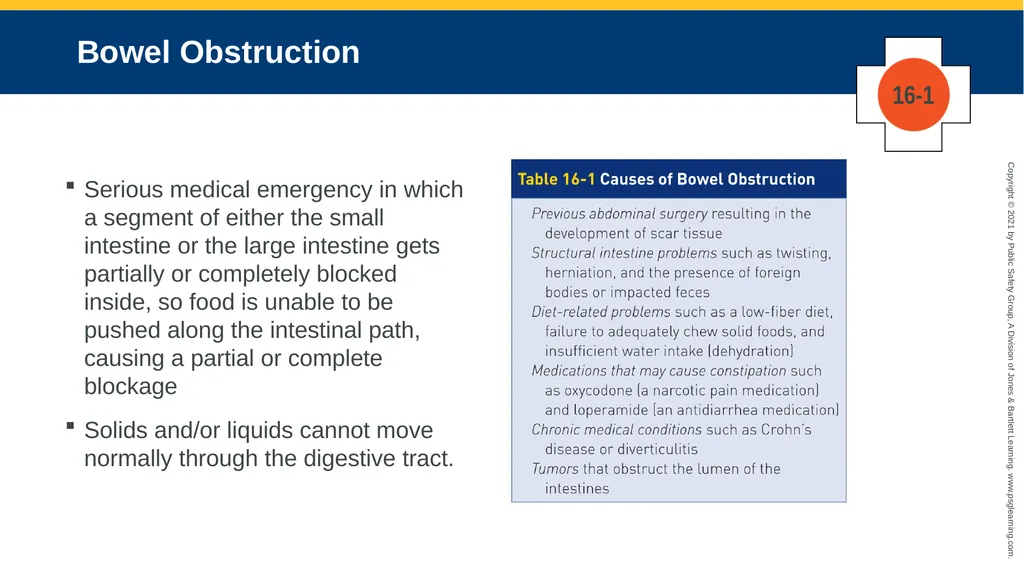
Bowel Obstruction Serious medical emergency in which a segment of either the small intestine or the large intestine gets partially or completely blocked inside, so food is unable to be pushed along the intestinal path, causing a partial or complete blockage
Solids and/or liquids cannot move normally through the digestive tract. 16-1<br>
Solids and/or liquids cannot move normally through the digestive tract. 16-1<br>
36
Bowel Obstructions: Sign and Symptoms Patients with bowel obstruction commonly present with a history of constipation, abdominal pain, guarding, profound nausea, and vomiting.
Fever may or may not be present.
Abdomen may be bloated or grossly distended.
Vital signs may initially be elevated, indicating severe distress, but can quickly fall, leading to shock and even death if the condition is not recognized and treated rapidly. 16-1<br>
Fever may or may not be present.
Abdomen may be bloated or grossly distended.
Vital signs may initially be elevated, indicating severe distress, but can quickly fall, leading to shock and even death if the condition is not recognized and treated rapidly. 16-1<br>
37
Perforated Bowel True emergency where a hole or tear develops in the intestinal wall, resulting in the contents leaking into the abdominal cavity
Can rapidly lead to peritonitis, sepsis, and death if not rapidly corrected by surgery
Causes include bowel obstruction, excess stomach acid, ulcerative disease, trauma, cancer of the bowel, a ruptured appendix, and chronic weakness of the intestinal wall.
Intense, visceral abdominal pain that worsens with movement or deep inspiration and is accompanied by:
Guarding
High fever
Severe nausea
Intense vomiting 16-1
16-3<br>
Can rapidly lead to peritonitis, sepsis, and death if not rapidly corrected by surgery
Causes include bowel obstruction, excess stomach acid, ulcerative disease, trauma, cancer of the bowel, a ruptured appendix, and chronic weakness of the intestinal wall.
Intense, visceral abdominal pain that worsens with movement or deep inspiration and is accompanied by:
Guarding
High fever
Severe nausea
Intense vomiting 16-1
16-3<br>
38
Gastritis Inflammation of the stomach
Can occur due to many reasons, including alcohol use, chronic vomiting, use of certain medications, and infections
Causes “heartburn”-type symptoms
Stomach makes hydrochloric acid to help digest food.
When too much acid is made, the wall of the stomach becomes inflamed, a condition commonly referred to as indigestion. 16-1<br>
Can occur due to many reasons, including alcohol use, chronic vomiting, use of certain medications, and infections
Causes “heartburn”-type symptoms
Stomach makes hydrochloric acid to help digest food.
When too much acid is made, the wall of the stomach becomes inflamed, a condition commonly referred to as indigestion. 16-1<br>
39
Esophagitis Esophagitis is caused by gastro-esophageal reflux disease (GERD), a condition in which stomach contents mixed with hydrochloric acid flow back into the esophagus.
Hiatal Hernia
Allows the sphincter or valve at the bottom of the esophagus to malfunction
Normally, this valve allows food into the stomach but not back up into the esophagus.
Food and acid reflux into the bottom of the esophagus.
Damaging the tube that empties into the stomach 16-1<br>
Hiatal Hernia
Allows the sphincter or valve at the bottom of the esophagus to malfunction
Normally, this valve allows food into the stomach but not back up into the esophagus.
Food and acid reflux into the bottom of the esophagus.
Damaging the tube that empties into the stomach 16-1<br>
40
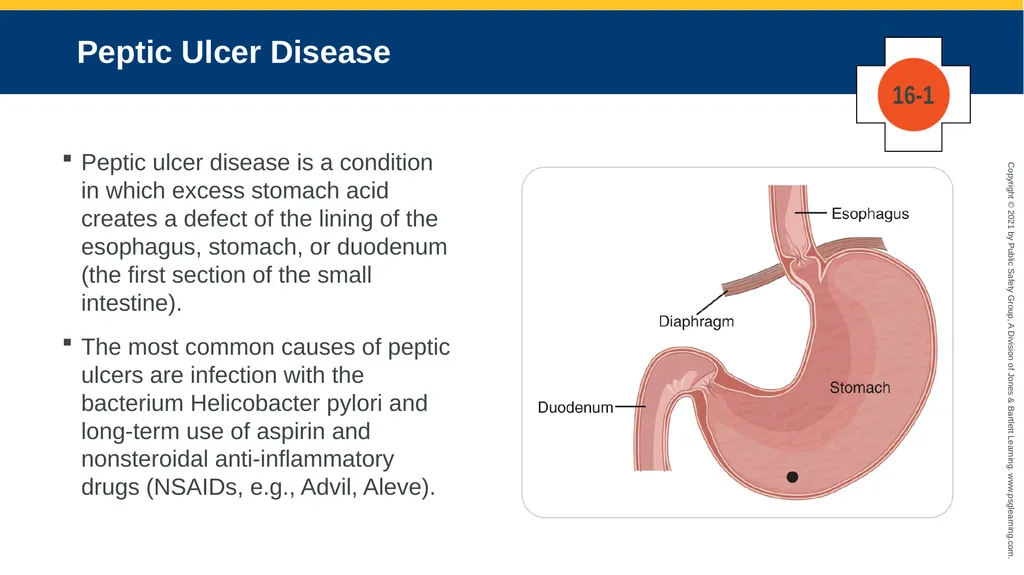
Peptic Ulcer Disease Peptic ulcer disease is a condition in which excess stomach acid creates a defect of the lining of the esophagus, stomach, or duodenum (the first section of the small intestine).
The most common causes of peptic ulcers are infection with the bacterium Helicobacter pylori and long-term use of aspirin and nonsteroidal anti-inflammatory drugs (NSAIDs, e.g., Advil, Aleve). 16-1<br>
The most common causes of peptic ulcers are infection with the bacterium Helicobacter pylori and long-term use of aspirin and nonsteroidal anti-inflammatory drugs (NSAIDs, e.g., Advil, Aleve). 16-1<br>
41
Peptic Ulcer Disease: Signs and Symptoms Factors that can cause excessive acid production in the stomach include smoking and consumption of fatty foods, caffeine, and alcohol.
Although stress and spicy foods do not cause peptic ulcers, they can make symptoms worse.
Patients with inflammation of the upper GI tract may present with chest pain, upper abdominal pain, nausea, or a complaint of a sour taste in the mouth.
Heartburn pain
May be difficult to differentiate pain from these conditions from pain resulting from acute heart disease
Assume pain is of a serious nature until proven otherwise. 16-3<br>
Although stress and spicy foods do not cause peptic ulcers, they can make symptoms worse.
Patients with inflammation of the upper GI tract may present with chest pain, upper abdominal pain, nausea, or a complaint of a sour taste in the mouth.
Heartburn pain
May be difficult to differentiate pain from these conditions from pain resulting from acute heart disease
Assume pain is of a serious nature until proven otherwise. 16-3<br>
42
Upper GI Bleeding In severe cases of inflammation of the upper GI tract, erosions (damage to the inside wall of the GI tract) can penetrate a blood vessel within the upper GI tract, causing a life-threatening hemorrhage known as a GI bleed.
Can be caused by use of certain medications (e.g., aspirin), alcohol consumption, tears within the esophagus or intestines, ulcers, or ruptured blood vessels
Upper GI bleeding can present as blood-tinged vomit, known as hematemesis.
Acute bleeding is bright red, whereas older blood has a “coffee grounds” appearance.
Recommend EMS transfer to hospital care for any patient who presents with blood or “coffee grounds” in the vomit, or significant bright red blood in stools, called hematochezia, or black stools, called melena 16-1
16-3<br>
Can be caused by use of certain medications (e.g., aspirin), alcohol consumption, tears within the esophagus or intestines, ulcers, or ruptured blood vessels
Upper GI bleeding can present as blood-tinged vomit, known as hematemesis.
Acute bleeding is bright red, whereas older blood has a “coffee grounds” appearance.
Recommend EMS transfer to hospital care for any patient who presents with blood or “coffee grounds” in the vomit, or significant bright red blood in stools, called hematochezia, or black stools, called melena 16-1
16-3<br>
43
Abdominal Aortic Aneurysm The abdominal aorta’s wall can become weakened and develop a bulge or ballooning, known as an aneurysm.
Chronic, uncontrolled high blood pressure, arteriosclerosis, and genetic factors are usual causes.
Rupture of an aneurysm is usually fatal due to massive blood loss.
If the aneurysm is leaking slowly, it may be possible to save the patient.
Patients with an abdominal aortic aneurysm typically present in shock and may complain of flank, lower back, or abdominal pain, weakness, and/or dizziness.
Medical history often includes recent fainting spells, smoking, and alcoholism.
Often have unequal femoral pulses<br>
Chronic, uncontrolled high blood pressure, arteriosclerosis, and genetic factors are usual causes.
Rupture of an aneurysm is usually fatal due to massive blood loss.
If the aneurysm is leaking slowly, it may be possible to save the patient.
Patients with an abdominal aortic aneurysm typically present in shock and may complain of flank, lower back, or abdominal pain, weakness, and/or dizziness.
Medical history often includes recent fainting spells, smoking, and alcoholism.
Often have unequal femoral pulses<br>
44
Female Reproductive Organ Conditions The abdominal and pelvic cavities contain the structures of the female reproductive system, which, when affected by disease, can cause signs and symptoms similar to those of acute abdomen.
Common conditions related to obstetrics and gynecology are ectopic pregnancy, ovarian cysts, bladder infections, and pelvic inflammatory disease.<br>
Common conditions related to obstetrics and gynecology are ectopic pregnancy, ovarian cysts, bladder infections, and pelvic inflammatory disease.<br>
45
Ectopic Pregnancy Following fertilization of an egg, which normally occurs in the fallopian tube, the egg travels down the tube and implants into the uterine wall.
If the egg implants in the fallopian tube or somewhere outside the uterus, an ectopic pregnancy occurs.
Fetus cannot grow in the small fallopian tube.
As the fetus grows in this tube, severe pain occurs as the tube dilates.
Bleeding usually occurs and can be massive. 16-1
16-4<br>
If the egg implants in the fallopian tube or somewhere outside the uterus, an ectopic pregnancy occurs.
Fetus cannot grow in the small fallopian tube.
As the fetus grows in this tube, severe pain occurs as the tube dilates.
Bleeding usually occurs and can be massive. 16-1
16-4<br>
46
Ovarian Cyst A fluid-filled sac or pocket in an ovary or on its surface
Eggs (ova), which develop and mature in the ovaries, are released in monthly cycles during the childbearing years.
Most ovarian cysts present little or no discomfort and are harmless, but some may cause problems such as rupture, bleeding, or pain.
Majority disappear without treatment within a few months. 16-1<br>
Eggs (ova), which develop and mature in the ovaries, are released in monthly cycles during the childbearing years.
Most ovarian cysts present little or no discomfort and are harmless, but some may cause problems such as rupture, bleeding, or pain.
Majority disappear without treatment within a few months. 16-1<br>
47
Ovarian Cysts: Signs and Symptoms Some ovarian cysts, especially those that have ruptured can cause serious symptoms, similar to those of an acute abdomen.
Pelvic pain, fullness in the abdomen, and bloating are common symptoms.
If fever, vomiting, or severe pain occur, rapid medical follow-up is needed.
When internal bleeding occurs from an ovarian cyst, shock can occur.
Moreover, surgery may be required in certain situations to remove the cyst(s). 16-1
16-4<br>
Pelvic pain, fullness in the abdomen, and bloating are common symptoms.
If fever, vomiting, or severe pain occur, rapid medical follow-up is needed.
When internal bleeding occurs from an ovarian cyst, shock can occur.
Moreover, surgery may be required in certain situations to remove the cyst(s). 16-1
16-4<br>
48
Pelvic Inflammatory Disease Pelvic inflammatory disease is an infection of the organs of a woman’s reproductive system.
The infection can occur in the uterus, ovaries, fallopian tubes, and cervix.
Usually caused by a sexually transmitted infection, such as chlamydia or gonorrhea, and is treated with antibiotics.
Other infections that are not sexually transmitted can also cause pelvic inflammatory disease. 16-1<br>
The infection can occur in the uterus, ovaries, fallopian tubes, and cervix.
Usually caused by a sexually transmitted infection, such as chlamydia or gonorrhea, and is treated with antibiotics.
Other infections that are not sexually transmitted can also cause pelvic inflammatory disease. 16-1<br>
49
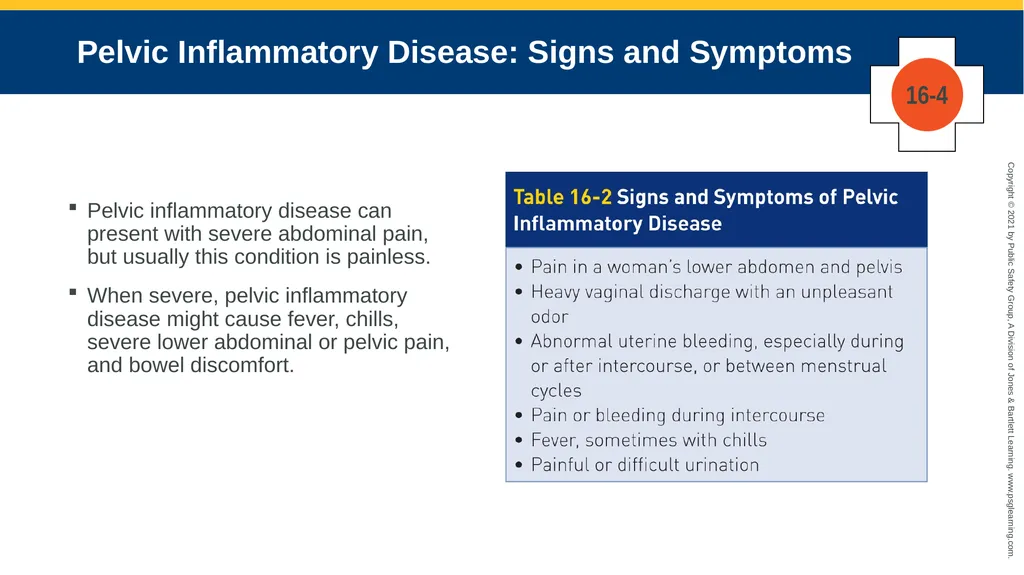
Pelvic Inflammatory Disease: Signs and Symptoms Pelvic inflammatory disease can present with severe abdominal pain, but usually this condition is painless.
When severe, pelvic inflammatory disease might cause fever, chills, severe lower abdominal or pelvic pain, and bowel discomfort. 16-4<br>
When severe, pelvic inflammatory disease might cause fever, chills, severe lower abdominal or pelvic pain, and bowel discomfort. 16-4<br>
50
Male Reproductive Organ Conditions Testicle Trauma
Trauma to the testicles is very painful and can cause severe problems with swelling, bleeding into the scrotum, rupture of the testicle, and later infection inside the scrotum.
Severe trauma usually requires follow-up with a physician, especially if swelling occurs. 16-1<br>
Trauma to the testicles is very painful and can cause severe problems with swelling, bleeding into the scrotum, rupture of the testicle, and later infection inside the scrotum.
Severe trauma usually requires follow-up with a physician, especially if swelling occurs. 16-1<br>
51
Testicular Torsion A condition in which a testicle rotates, twisting the spermatic cord and artery that brings blood to the testicle
Reduced blood flow causes sudden and often severe pain and swelling.
Testicular torsion is most common between the ages of 12 and 18 years but can occur at any age.
Usually requires emergency surgery
If treated quickly, the testicle can usually be saved.
When blood flow has been cut off for too long, a testicle may be so damaged that it may have to be removed. 16-1<br>
Reduced blood flow causes sudden and often severe pain and swelling.
Testicular torsion is most common between the ages of 12 and 18 years but can occur at any age.
Usually requires emergency surgery
If treated quickly, the testicle can usually be saved.
When blood flow has been cut off for too long, a testicle may be so damaged that it may have to be removed. 16-1<br>
52
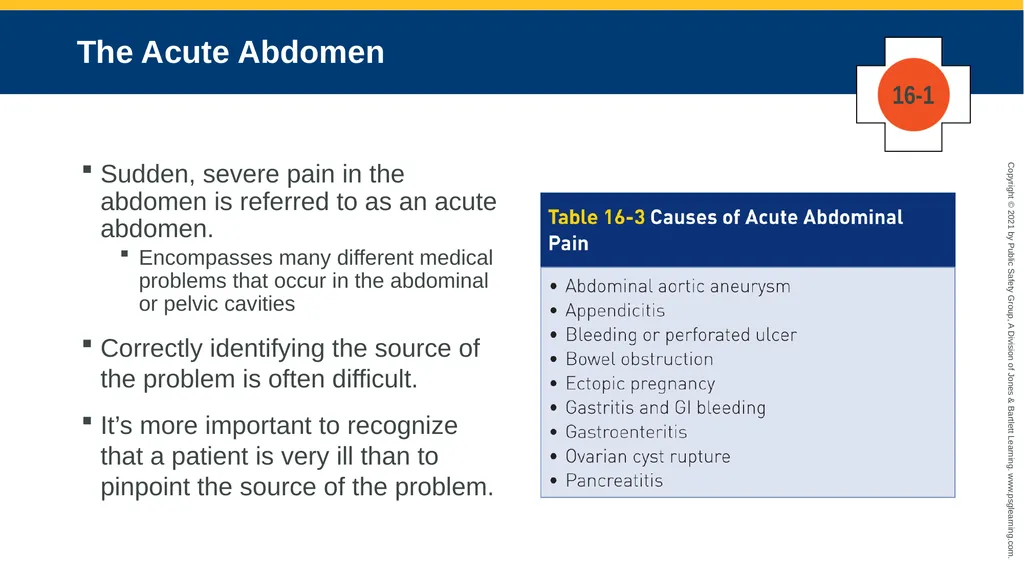
The Acute Abdomen Sudden, severe pain in the abdomen is referred to as an acute abdomen.
Encompasses many different medical problems that occur in the abdominal or pelvic cavities
Correctly identifying the source of the problem is often difficult.
It’s more important to recognize that a patient is very ill than to pinpoint the source of the problem. 16-1<br>
Encompasses many different medical problems that occur in the abdominal or pelvic cavities
Correctly identifying the source of the problem is often difficult.
It’s more important to recognize that a patient is very ill than to pinpoint the source of the problem. 16-1<br>
53
The Acute Abdomen: Signs and Symptoms The hallmark of acute abdomen is severe pain from inflammation of the peritoneum, known as peritonitis.
Peritoneum is a thin membrane that lines the abdominal cavity.
When contacted by blood or contaminants (e.g., gastric contents, urine, feces), nerve endings become irritated, resulting in pain.
Guarding
Makes the abdominal wall rigid and hard
Can cause abdominal pain, nausea, vomiting, fever, and shock 16-1<br>
Peritoneum is a thin membrane that lines the abdominal cavity.
When contacted by blood or contaminants (e.g., gastric contents, urine, feces), nerve endings become irritated, resulting in pain.
Guarding
Makes the abdominal wall rigid and hard
Can cause abdominal pain, nausea, vomiting, fever, and shock 16-1<br>
54
Patient Assessment<br>
55
Patient Assessment Patients with possible GI, GU, or Reproductive System Emergencies, ask about their medical history and pain symptoms:
SAMPLE
Signs and Symptoms, Allergies, Medications, Past Medical History, Last Oral Intake, Events Leading Up to the Problem
OPQRST
Onset, Provocation, Quality, Radiation, Severity, and Time
Attempt to determine if pain is constant or intermittent, how long the pain has been present, and whether the pain has moved since its initial onset.
Ask about any factors that aggravate or relieve the condition, such as motion, coughing, breathing, belching, or urination. 16-5<br>
SAMPLE
Signs and Symptoms, Allergies, Medications, Past Medical History, Last Oral Intake, Events Leading Up to the Problem
OPQRST
Onset, Provocation, Quality, Radiation, Severity, and Time
Attempt to determine if pain is constant or intermittent, how long the pain has been present, and whether the pain has moved since its initial onset.
Ask about any factors that aggravate or relieve the condition, such as motion, coughing, breathing, belching, or urination. 16-5<br>
56
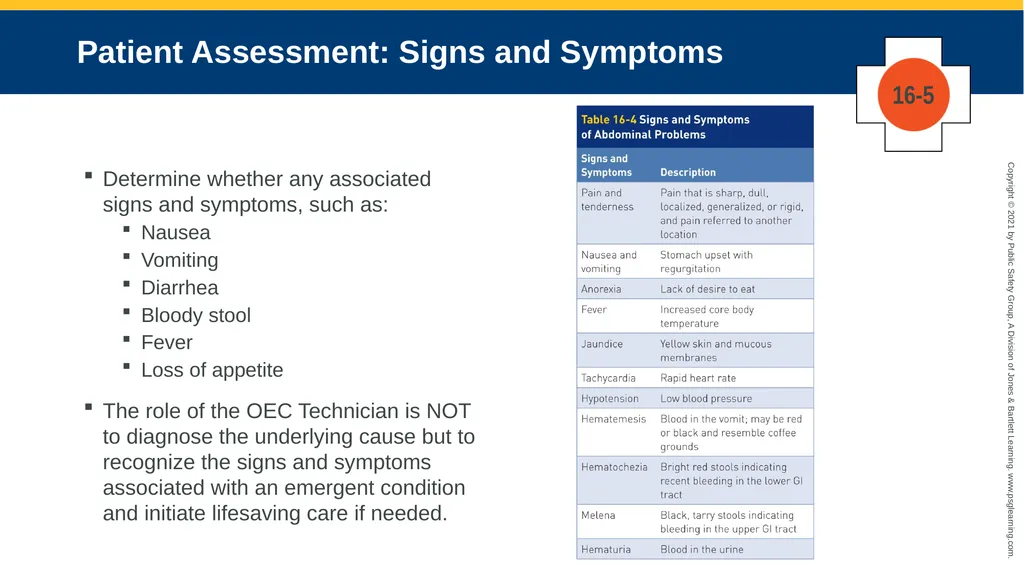
Patient Assessment: Signs and Symptoms Determine whether any associated signs and symptoms, such as:
Nausea
Vomiting
Diarrhea
Bloody stool
Fever
Loss of appetite
The role of the OEC Technician is NOT to diagnose the underlying cause but to recognize the signs and symptoms associated with an emergent condition and initiate lifesaving care if needed. 16-5<br>
Nausea
Vomiting
Diarrhea
Bloody stool
Fever
Loss of appetite
The role of the OEC Technician is NOT to diagnose the underlying cause but to recognize the signs and symptoms associated with an emergent condition and initiate lifesaving care if needed. 16-5<br>
57
Patient Assessment: Signs and Symptoms (Cont’d) Nausea: A feeling of impending vomiting
Vomiting: Occurs when the muscles of the wall of the stomach violently contract, sending up the esophagus and out the mouth stomach contents
If excessive or occurs over time without fluid replacement can cause dehydration
In an unresponsive patient:
Aspiration, where foreign material gets into the lungs, can lead to a lung infection, a potentially life-threatening condition.
Quickly clean or suction vomit out of an unresponsive patient and place them in a recover position when possible.
Colic: Intermittent, severe abdominal pain caused by the obstruction and distention of a hollow organ.
Common causes are gallbladder, bowel ureter obstruction 16-5<br>
Vomiting: Occurs when the muscles of the wall of the stomach violently contract, sending up the esophagus and out the mouth stomach contents
If excessive or occurs over time without fluid replacement can cause dehydration
In an unresponsive patient:
Aspiration, where foreign material gets into the lungs, can lead to a lung infection, a potentially life-threatening condition.
Quickly clean or suction vomit out of an unresponsive patient and place them in a recover position when possible.
Colic: Intermittent, severe abdominal pain caused by the obstruction and distention of a hollow organ.
Common causes are gallbladder, bowel ureter obstruction 16-5<br>
58
Patient Assessment: Signs and Symptoms (Cont’d) Diarrhea: Passage of frequent, liquid stools
GI Bleeding:
Hematochezia: bright red stools
Indicates the recent bleeding is occurring within the LOWER GI tract
Melena: tarry, black, foul-smelling stools
Indicates bleeding originating within the UPPER GI tract
Constipation: inability to excrete feces
Obstipation, or chronic constipation, can cause bowel obstructions. 16-5<br>
GI Bleeding:
Hematochezia: bright red stools
Indicates the recent bleeding is occurring within the LOWER GI tract
Melena: tarry, black, foul-smelling stools
Indicates bleeding originating within the UPPER GI tract
Constipation: inability to excrete feces
Obstipation, or chronic constipation, can cause bowel obstructions. 16-5<br>
59
Physical Exam of The Abdomen Begin your physical examination of patients with acute abdominal or pelvic pain by calming the patients to ease their anxiety.
Ask permission to examine the abdomen.
Explain what you are going to do before starting any examination.
Place the patient into a position of comfort: a supine position with the knees slightly flexed allows the abdominal and pelvic muscles to relax.
Move the patient to a warm location, as this will make the exam much easier.
Make sure your hands are warm when conducting this exam. 16-5<br>
Ask permission to examine the abdomen.
Explain what you are going to do before starting any examination.
Place the patient into a position of comfort: a supine position with the knees slightly flexed allows the abdominal and pelvic muscles to relax.
Move the patient to a warm location, as this will make the exam much easier.
Make sure your hands are warm when conducting this exam. 16-5<br>
60
Physical Exam of The Abdomen: Inspection Typically a two-step process involving inspection and palpation
Step 1: Inspection
The area is exposed and observed for clinical signs such as trauma, distention, bulging, or discoloration.
Note whether the patient is motionless or is unable to sit still, as well as how the abdominal wall moves with the patient’s respirations. 16-5<br>
Step 1: Inspection
The area is exposed and observed for clinical signs such as trauma, distention, bulging, or discoloration.
Note whether the patient is motionless or is unable to sit still, as well as how the abdominal wall moves with the patient’s respirations. 16-5<br>
61
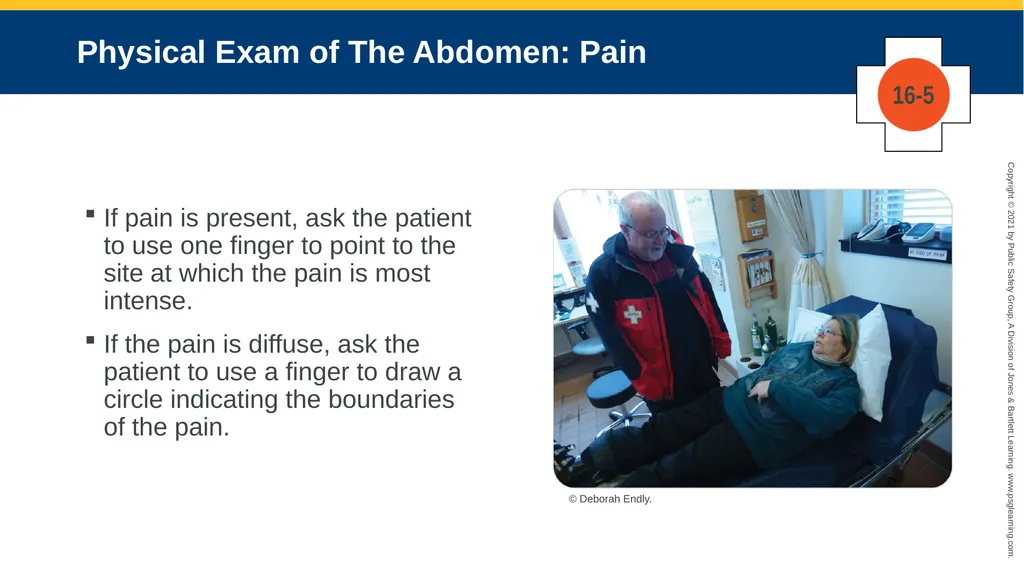
Physical Exam of The Abdomen: Pain If pain is present, ask the patient to use one finger to point to the site at which the pain is most intense.
If the pain is diffuse, ask the patient to use a finger to draw a circle indicating the boundaries of the pain. 16-5 © Deborah Endly.<br>
If the pain is diffuse, ask the patient to use a finger to draw a circle indicating the boundaries of the pain. 16-5 © Deborah Endly.<br>
62
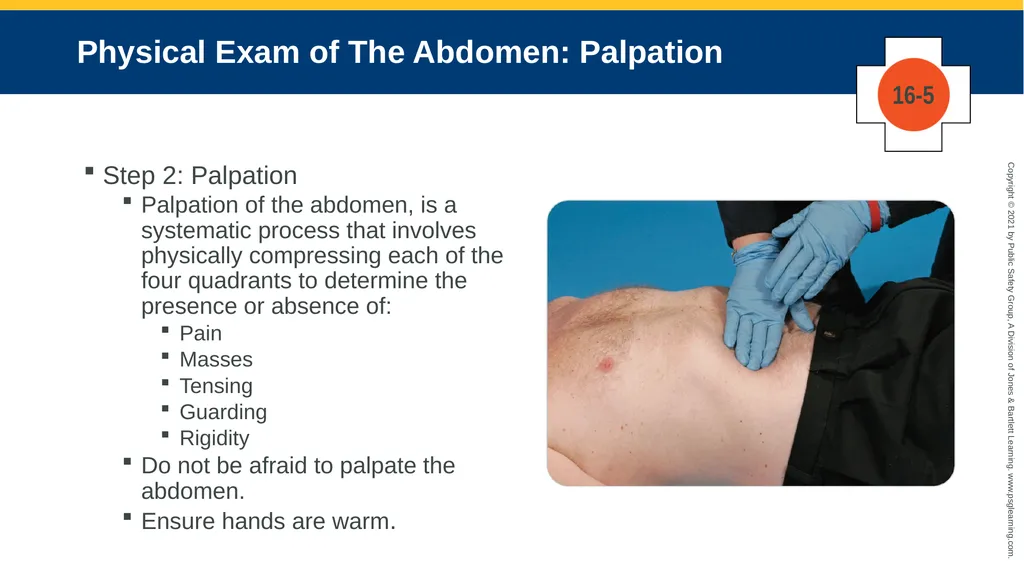
Physical Exam of The Abdomen: Palpation Step 2: Palpation
Palpation of the abdomen, is a systematic process that involves physically compressing each of the four quadrants to determine the presence or absence of:
Pain
Masses
Tensing
Guarding
Rigidity
Do not be afraid to palpate the abdomen.
Ensure hands are warm. 16-5<br>
Palpation of the abdomen, is a systematic process that involves physically compressing each of the four quadrants to determine the presence or absence of:
Pain
Masses
Tensing
Guarding
Rigidity
Do not be afraid to palpate the abdomen.
Ensure hands are warm. 16-5<br>
63
Physical Exam of The Abdomen: Palpation Begin palpating the abdomen in the quadrant farthest away from the site of the pain.
Examine the painful quadrant last.
Place one hand atop the other and gently place them on the patient’s abdomen.
Rest hands in this position for a moment to allow the patient to become comfortable. 16-5<br>
Examine the painful quadrant last.
Place one hand atop the other and gently place them on the patient’s abdomen.
Rest hands in this position for a moment to allow the patient to become comfortable. 16-5<br>
64
Physical Exam of The Abdomen: Palpation Gentle downward pressure
Note patient’s response and whether the abdominal muscles suddenly tense in response.
Slowly release the pressure, gently gliding your hands from one quadrant to the next, and then repeat the process for each quadrant.
Note any evidence of tenderness upon examination.
Palpate gently just above the pubic bone in the midline, where the bladder is located.
Inspect and palpate the right and left flank areas individually.
Note any discoloration or tenderness. 16-5<br>
Note patient’s response and whether the abdominal muscles suddenly tense in response.
Slowly release the pressure, gently gliding your hands from one quadrant to the next, and then repeat the process for each quadrant.
Note any evidence of tenderness upon examination.
Palpate gently just above the pubic bone in the midline, where the bladder is located.
Inspect and palpate the right and left flank areas individually.
Note any discoloration or tenderness. 16-5<br>
65
Management<br>
66
Management The treatment of patients with an abdominal problem in outdoor settings generally involves supportive care.
Many serious conditions require an in-depth evaluation by a physician, and surgical correction and/or long-term care are often required.
Can do many things to improve a patient’s overall comfort and the subsequent outcome
Need to determine if the problem is serious and requires further care, NOT what the specific abdominal problem is 16-6<br>
Many serious conditions require an in-depth evaluation by a physician, and surgical correction and/or long-term care are often required.
Can do many things to improve a patient’s overall comfort and the subsequent outcome
Need to determine if the problem is serious and requires further care, NOT what the specific abdominal problem is 16-6<br>
67
Management Initial treatment includes assessing and correcting any problems involving excessive bleeding and the ABCDs.
Move the patient to a location that has a comfortable temperature.
If outdoors, keep patients warm by using jackets or blankets as needed.
During the physical exam of the abdomen, place the person in a position of comfort.
For most patients, this is either a supine position with the knees slightly flexed or a seated position with the head raised 45 to 60 degrees.
Patients may be restless, so be empathetic to their discomfort and help them remain calm. 16-6<br>
Move the patient to a location that has a comfortable temperature.
If outdoors, keep patients warm by using jackets or blankets as needed.
During the physical exam of the abdomen, place the person in a position of comfort.
For most patients, this is either a supine position with the knees slightly flexed or a seated position with the head raised 45 to 60 degrees.
Patients may be restless, so be empathetic to their discomfort and help them remain calm. 16-6<br>
68
Management: Supplemental Oxygen and Suction Provide supplemental oxygen as needed for serious problems such as shock, typically using a nonrebreather mask and pulse oximeter.
Anticipate vomiting and be ready to clear the airway by removing the oxygen mask and turning the patient onto his or her side in the recovery position.
If the patient continues to vomit, consider placing the patient on a nasal cannula.
Suction the airway as needed to prevent aspiration.
Despite their requests, do not give patients anything to eat or drink because some abdominal and pelvic conditions require surgical intervention.
The presence of food or liquids in the stomach can worsen some problems, can cause the patient to vomit, and can make surgery, when needed, more dangerous. 16-6<br>
Anticipate vomiting and be ready to clear the airway by removing the oxygen mask and turning the patient onto his or her side in the recovery position.
If the patient continues to vomit, consider placing the patient on a nasal cannula.
Suction the airway as needed to prevent aspiration.
Despite their requests, do not give patients anything to eat or drink because some abdominal and pelvic conditions require surgical intervention.
The presence of food or liquids in the stomach can worsen some problems, can cause the patient to vomit, and can make surgery, when needed, more dangerous. 16-6<br>
69
Management Continue to monitor the patient’s vital signs, because they can change rapidly.
Anticipate shock and treat accordingly if the patient exhibits the characteristic clinical signs:
Fast pulse, rapid breathing, low blood pressure
With few exceptions, patients with significant abdominal or pelvic pain require further evaluation.
Transfer patients to a higher level of care or encourage them to seek physician evaluation and definitive treatment.
When the problem is severe, transfer by ambulance using ALS if available. 16-6<br>
Anticipate shock and treat accordingly if the patient exhibits the characteristic clinical signs:
Fast pulse, rapid breathing, low blood pressure
With few exceptions, patients with significant abdominal or pelvic pain require further evaluation.
Transfer patients to a higher level of care or encourage them to seek physician evaluation and definitive treatment.
When the problem is severe, transfer by ambulance using ALS if available. 16-6<br>
70
Case Study<br>
71
CASE PRESENTATION You are working first-aid duty in the patrol room when a 25-year-old woman slowly walks in holding her abdomen and complaining of severe abdominal pain. You steer the patient to the nearest exam table and begin to assess her condition. Moments later, she vomits. The vomit is clear and does not appear to contain blood. The patient apologizes and states that she started feeling ill this morning but decided to come skiing anyway to be with her family.<br>
72
CASE PRESENTATION She has not suffered any recent trauma and is not currently taking any medications. There is nothing pertinent in the patient’s past medical history. She says that she has never experienced anything like this before and describes her abdominal pain as “intense.”
What should you do?<br>
What should you do?<br>
73
CASE UPDATE On examination of the patient, you notice that she is pale, is sweating, and feels warm to the touch. She relates that her pain was originally near her navel but has now “moved down and to the right.” Her last menstrual period was 2 months ago. Examination of the abdomen reveals severe tenderness in the right lower quadrant. She tells you that every bump in the road on the way to the ski hill felt like she was “being stabbed in my gut.” The patient’s heart rate is 116 beats per minute, blood pressure is 132/88 mm Hg, and respirations are 20 breaths per minute and shallow.
What do you think is wrong with the patient?<br>
What do you think is wrong with the patient?<br>
74
CASE OUTCOME As you examine the patient and listen to her story, you become concerned that the patient may have an acute abdomen, possibly appendicitis, ectopic pregnancy, or ruptured ovarian cyst. You place the patient on oxygen, keep her comfortable, and have her transported to the hospital. A week later, the patient’s sister comes to the patrol room to thank you and the other patrollers for taking such great care of her sister. She reports that she had surgery for acute appendicitis and is now doing well. It was important that you recognized she had a serious problem, not what the exact problem was.<br>