
Chapter 19: The International Monetary Fund An
LV
Published · 50 slides · 0 views
1 / 1
Description
Chapter 19: The International Monetary Fund An Introduction to International Economics: New Perspectives on the World Economy Kenneth A. Reinert, Cambridge University Press 2021 Analytical Elements Countries Currencies Financial assets
Related Topics
Share
Embed code
Download this presentation From Below
"Chapter 19: The International Monetary Fund An" is the property of its rightful owner. Permission is granted to download and print the materials on this website for personal, non-commercial use only, and to display it on your personal computer provided you do not modify the materials and that you retain all copyright notices contained in the materials. By downloading content from our website, you accept the terms of this agreement.
Presentation Transcript
01
Chapter 19: The International Monetary Fund An Introduction to International Economics: New Perspectives on the World Economy © Kenneth A. Reinert,
Cambridge University Press 2021<br>
Cambridge University Press 2021<br>
02
Analytical Elements Countries
Currencies
Financial assets © Kenneth A. Reinert,
Cambridge University Press 2021<br>
Currencies
Financial assets © Kenneth A. Reinert,
Cambridge University Press 2021<br>
03
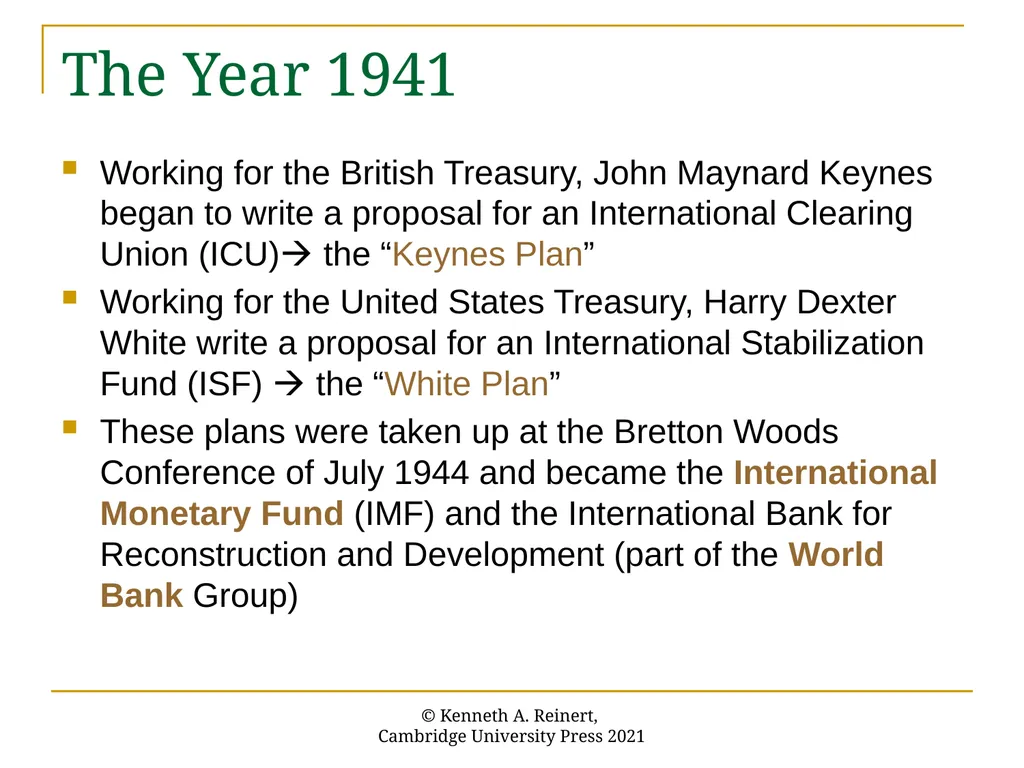
The Year 1941 Working for the British Treasury, John Maynard Keynes began to write a proposal for an International Clearing Union (ICU) the “Keynes Plan”
Working for the United States Treasury, Harry Dexter White write a proposal for an International Stabilization Fund (ISF) the “White Plan”
These plans were taken up at the Bretton Woods Conference of July 1944 and became the International Monetary Fund (IMF) and the International Bank for Reconstruction and Development (part of the World Bank Group) © Kenneth A. Reinert,
Cambridge University Press 2021<br>
Working for the United States Treasury, Harry Dexter White write a proposal for an International Stabilization Fund (ISF) the “White Plan”
These plans were taken up at the Bretton Woods Conference of July 1944 and became the International Monetary Fund (IMF) and the International Bank for Reconstruction and Development (part of the World Bank Group) © Kenneth A. Reinert,
Cambridge University Press 2021<br>
04
Some Monetary History Throughout 20th century, countries struggled with various arrangements for the conduct of international finance
None proved satisfactory
In each case, the systems set up by international economists were overtaken by events
Appears international financial system had a dynamic of its own, stronger than the governance systems it overturned © Kenneth A. Reinert,
Cambridge University Press 2021<br>
None proved satisfactory
In each case, the systems set up by international economists were overtaken by events
Appears international financial system had a dynamic of its own, stronger than the governance systems it overturned © Kenneth A. Reinert,
Cambridge University Press 2021<br>
05
The Gold Standard Late 19th and early 20th centuries were characterized by a highly integrated world economy
Supported from approximately 1870 to 1914 by an international financial arrangement known as the gold standard
Each country defined the value of its currency in terms of gold
Most countries also held gold as official reserves
Since value of each currency was defined in terms of gold, rates of exchange among the currencies were fixed © Kenneth A. Reinert,
Cambridge University Press 2021<br>
Supported from approximately 1870 to 1914 by an international financial arrangement known as the gold standard
Each country defined the value of its currency in terms of gold
Most countries also held gold as official reserves
Since value of each currency was defined in terms of gold, rates of exchange among the currencies were fixed © Kenneth A. Reinert,
Cambridge University Press 2021<br>
06
The Gold Standard When World War I began in 1914, the countries involved in that conflict suspended the convertibility of their currencies into gold
After the war, there were unsuccessful attempt to return international financial system back to gold standard © Kenneth A. Reinert,
Cambridge University Press 2021<br>
After the war, there were unsuccessful attempt to return international financial system back to gold standard © Kenneth A. Reinert,
Cambridge University Press 2021<br>
07
The Gold Exchange Standard In 1922, there was an attempt to rebuild the pre-World War I gold standard.
New gold standard was different from the pre-war standard due to then current gold shortage
Countries that were not important financial centers did not hold gold reserves but instead held gold-convertible currencies
For this reason, the new gold standard was known as the gold exchange standard
Goal was to set major rates at their pre-war levels, especially British pound
In 1925, it was set to gold at the overvalued, pre-war rate of US$4.86 per pound
Caused balance of payments problems and market expectations of devaluation © Kenneth A. Reinert,
Cambridge University Press 2021<br>
New gold standard was different from the pre-war standard due to then current gold shortage
Countries that were not important financial centers did not hold gold reserves but instead held gold-convertible currencies
For this reason, the new gold standard was known as the gold exchange standard
Goal was to set major rates at their pre-war levels, especially British pound
In 1925, it was set to gold at the overvalued, pre-war rate of US$4.86 per pound
Caused balance of payments problems and market expectations of devaluation © Kenneth A. Reinert,
Cambridge University Press 2021<br>
08
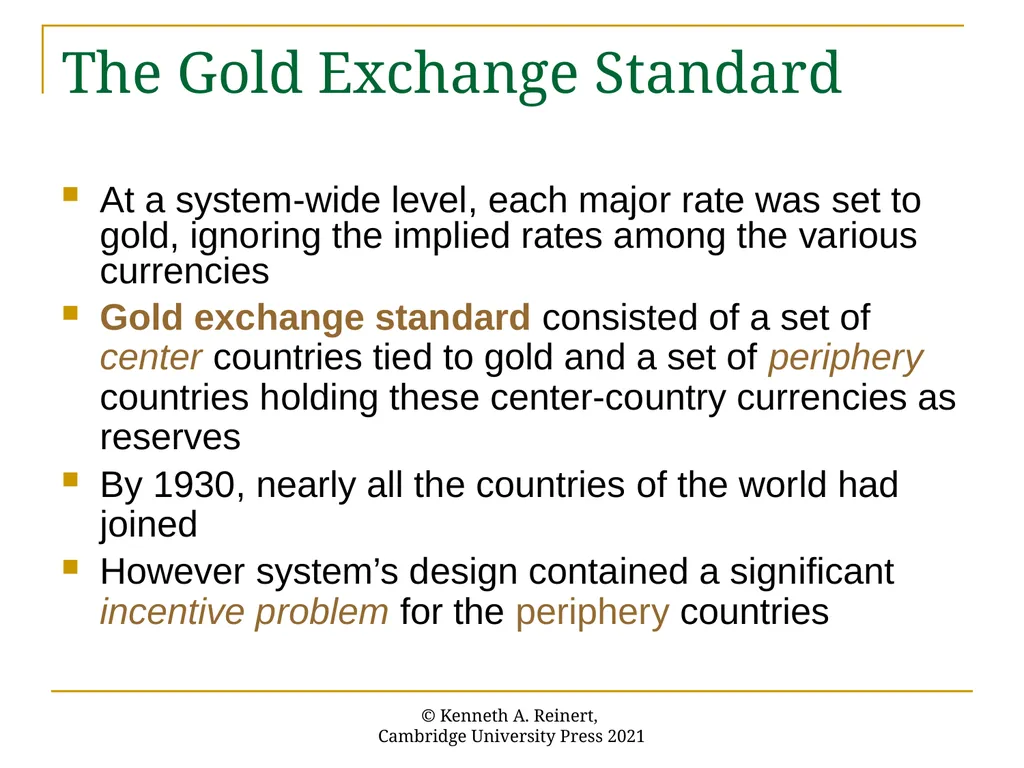
The Gold Exchange Standard At a system-wide level, each major rate was set to gold, ignoring the implied rates among the various currencies
Gold exchange standard consisted of a set of center countries tied to gold and a set of periphery countries holding these center-country currencies as reserves
By 1930, nearly all the countries of the world had joined
However system’s design contained a significant incentive problem for the periphery countries © Kenneth A. Reinert,
Cambridge University Press 2021<br>
Gold exchange standard consisted of a set of center countries tied to gold and a set of periphery countries holding these center-country currencies as reserves
By 1930, nearly all the countries of the world had joined
However system’s design contained a significant incentive problem for the periphery countries © Kenneth A. Reinert,
Cambridge University Press 2021<br>
09
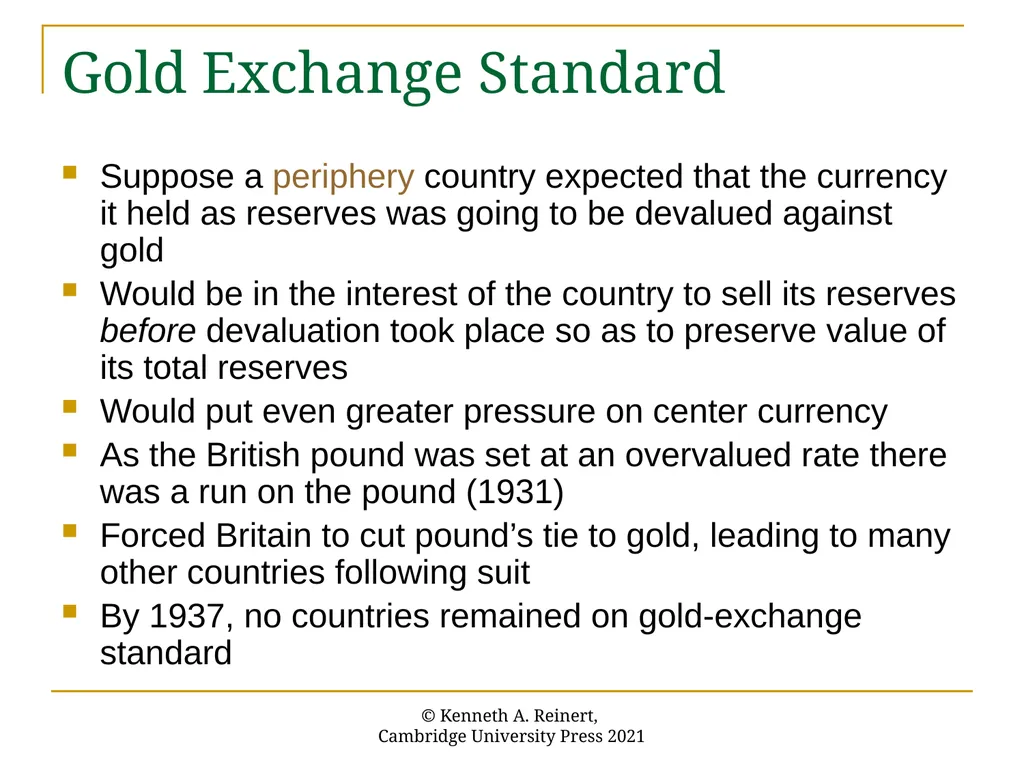
Gold Exchange Standard Suppose a periphery country expected that the currency it held as reserves was going to be devalued against gold
Would be in the interest of the country to sell its reserves before devaluation took place so as to preserve value of its total reserves
Would put even greater pressure on center currency
As the British pound was set at an overvalued rate there was a run on the pound (1931)
Forced Britain to cut pound’s tie to gold, leading to many other countries following suit
By 1937, no countries remained on gold-exchange standard © Kenneth A. Reinert,
Cambridge University Press 2021<br>
Would be in the interest of the country to sell its reserves before devaluation took place so as to preserve value of its total reserves
Would put even greater pressure on center currency
As the British pound was set at an overvalued rate there was a run on the pound (1931)
Forced Britain to cut pound’s tie to gold, leading to many other countries following suit
By 1937, no countries remained on gold-exchange standard © Kenneth A. Reinert,
Cambridge University Press 2021<br>
10
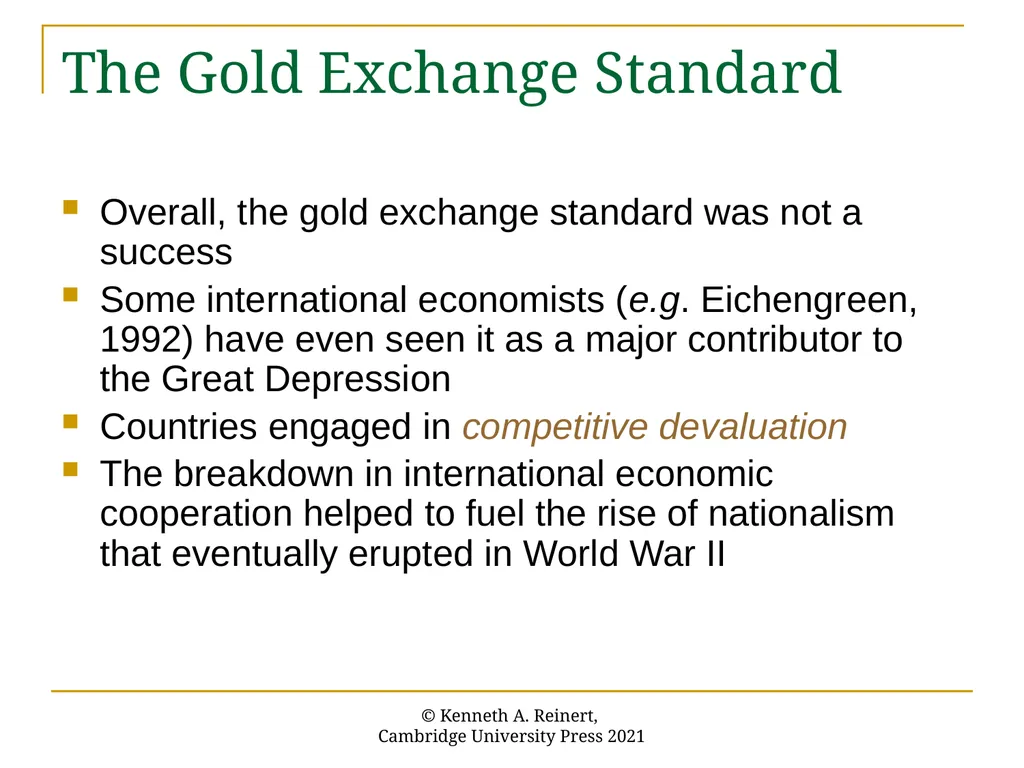
The Gold Exchange Standard Overall, the gold exchange standard was not a success
Some international economists (e.g. Eichengreen, 1992) have even seen it as a major contributor to the Great Depression
Countries engaged in competitive devaluation
The breakdown in international economic cooperation helped to fuel the rise of nationalism that eventually erupted in World War II © Kenneth A. Reinert,
Cambridge University Press 2021<br>
Some international economists (e.g. Eichengreen, 1992) have even seen it as a major contributor to the Great Depression
Countries engaged in competitive devaluation
The breakdown in international economic cooperation helped to fuel the rise of nationalism that eventually erupted in World War II © Kenneth A. Reinert,
Cambridge University Press 2021<br>
11
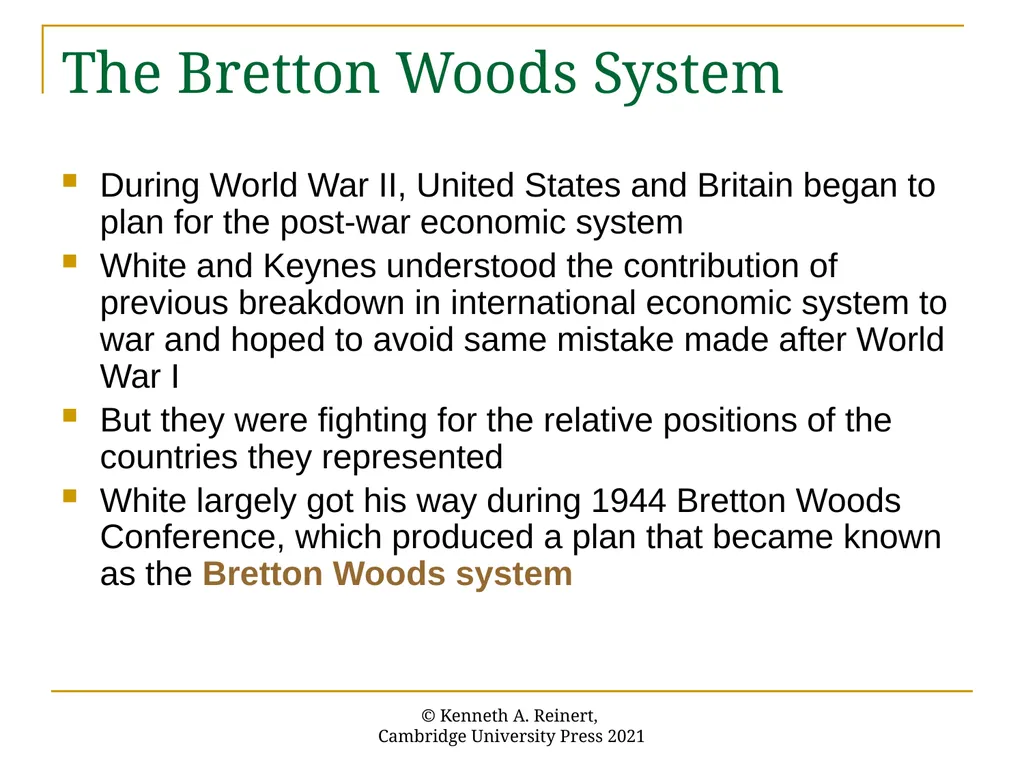
The Bretton Woods System During World War II, United States and Britain began to plan for the post-war economic system
White and Keynes understood the contribution of previous breakdown in international economic system to war and hoped to avoid same mistake made after World War I
But they were fighting for the relative positions of the countries they represented
White largely got his way during 1944 Bretton Woods Conference, which produced a plan that became known as the Bretton Woods system © Kenneth A. Reinert,
Cambridge University Press 2021<br>
White and Keynes understood the contribution of previous breakdown in international economic system to war and hoped to avoid same mistake made after World War I
But they were fighting for the relative positions of the countries they represented
White largely got his way during 1944 Bretton Woods Conference, which produced a plan that became known as the Bretton Woods system © Kenneth A. Reinert,
Cambridge University Press 2021<br>
12
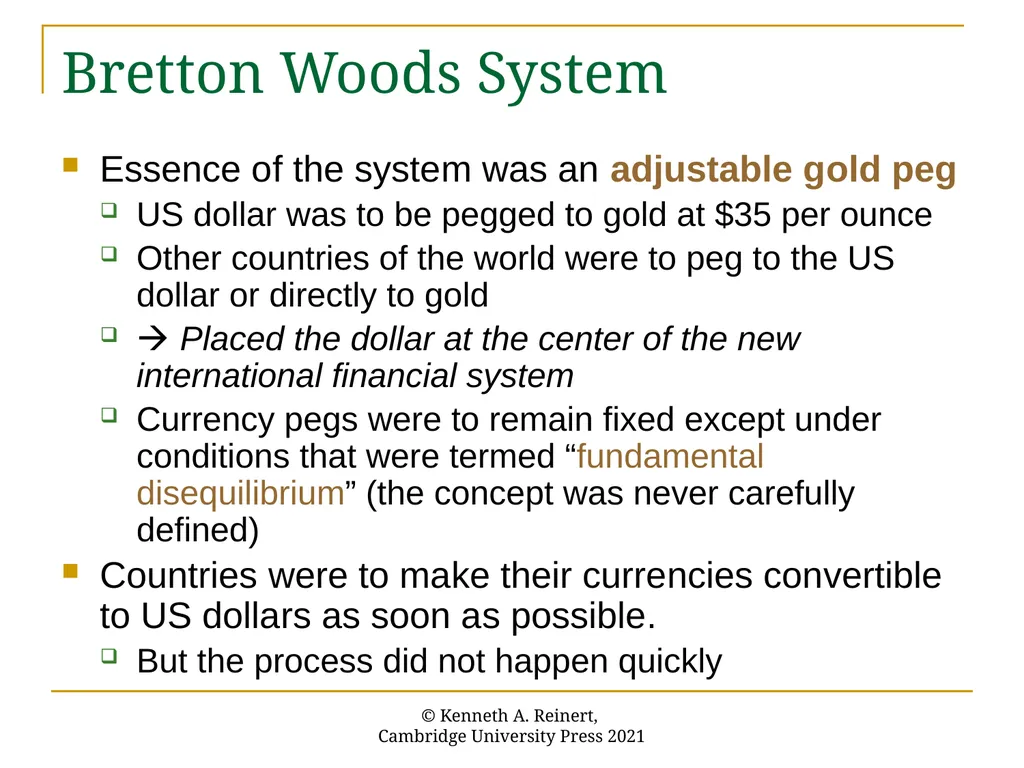
Bretton Woods System Essence of the system was an adjustable gold peg
US dollar was to be pegged to gold at $35 per ounce
Other countries of the world were to peg to the US dollar or directly to gold
Placed the dollar at the center of the new international financial system
Currency pegs were to remain fixed except under conditions that were termed “fundamental disequilibrium” (the concept was never carefully defined)
Countries were to make their currencies convertible to US dollars as soon as possible.
But the process did not happen quickly © Kenneth A. Reinert,
Cambridge University Press 2021<br>
US dollar was to be pegged to gold at $35 per ounce
Other countries of the world were to peg to the US dollar or directly to gold
Placed the dollar at the center of the new international financial system
Currency pegs were to remain fixed except under conditions that were termed “fundamental disequilibrium” (the concept was never carefully defined)
Countries were to make their currencies convertible to US dollars as soon as possible.
But the process did not happen quickly © Kenneth A. Reinert,
Cambridge University Press 2021<br>
13
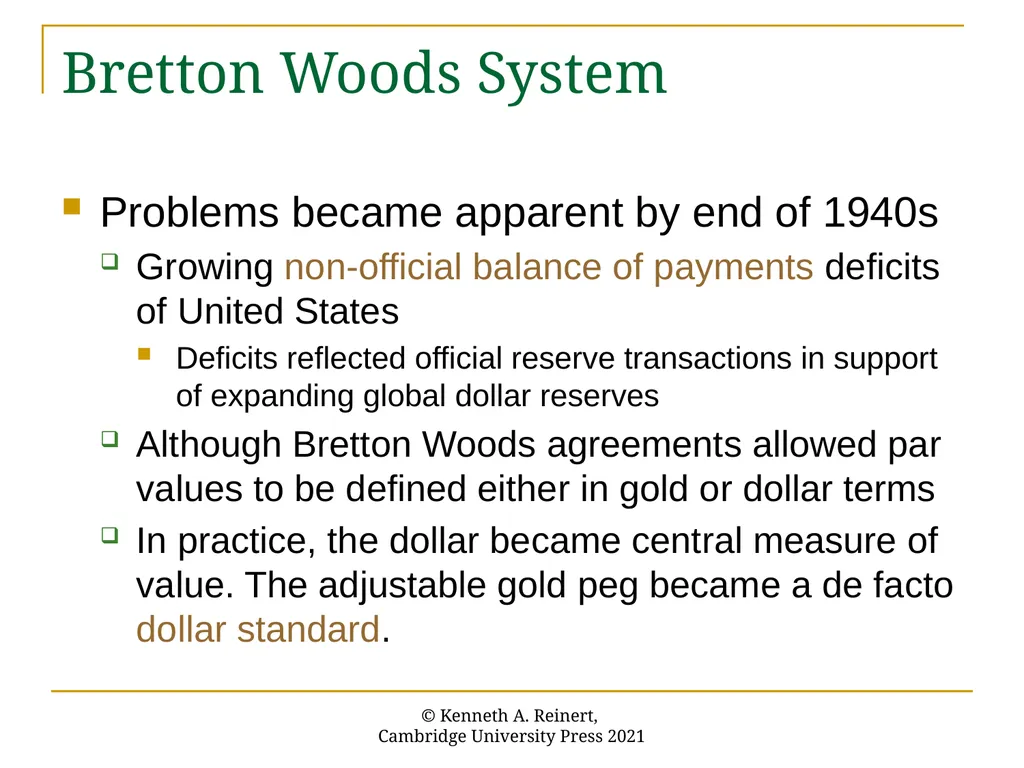
Bretton Woods System Problems became apparent by end of 1940s
Growing non-official balance of payments deficits of United States
Deficits reflected official reserve transactions in support of expanding global dollar reserves
Although Bretton Woods agreements allowed par values to be defined either in gold or dollar terms
In practice, the dollar became central measure of value. The adjustable gold peg became a de facto dollar standard. © Kenneth A. Reinert,
Cambridge University Press 2021<br>
Growing non-official balance of payments deficits of United States
Deficits reflected official reserve transactions in support of expanding global dollar reserves
Although Bretton Woods agreements allowed par values to be defined either in gold or dollar terms
In practice, the dollar became central measure of value. The adjustable gold peg became a de facto dollar standard. © Kenneth A. Reinert,
Cambridge University Press 2021<br>
14
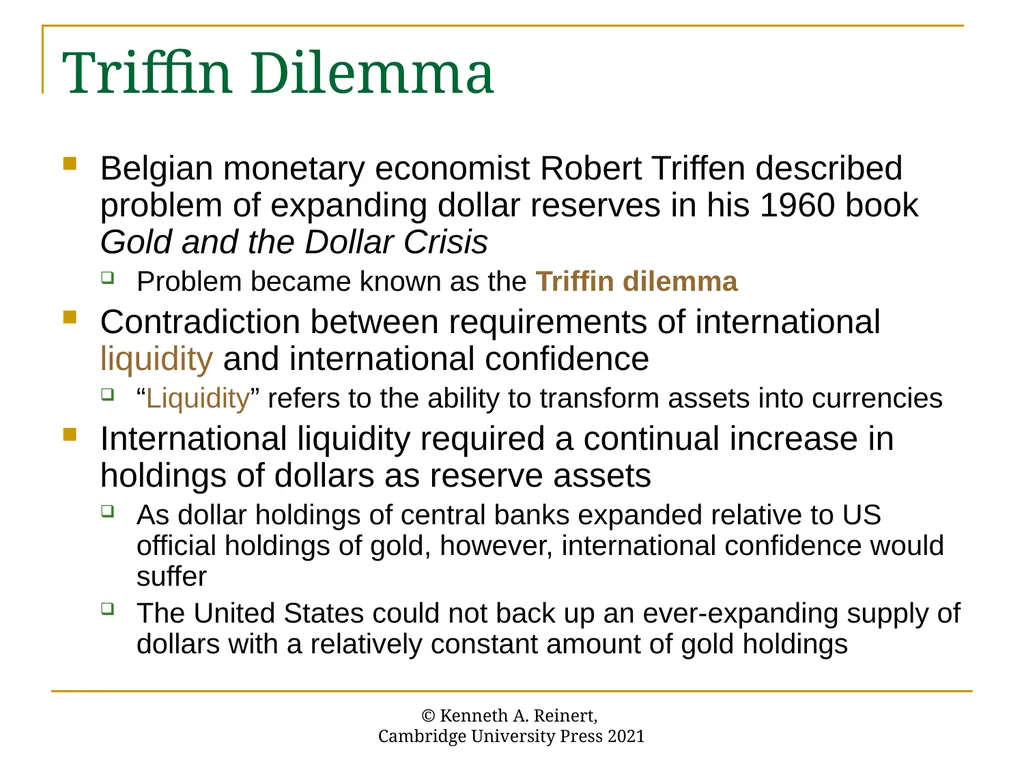
Triffin Dilemma Belgian monetary economist Robert Triffen described problem of expanding dollar reserves in his 1960 book Gold and the Dollar Crisis
Problem became known as the Triffin dilemma
Contradiction between requirements of international liquidity and international confidence
“Liquidity” refers to the ability to transform assets into currencies
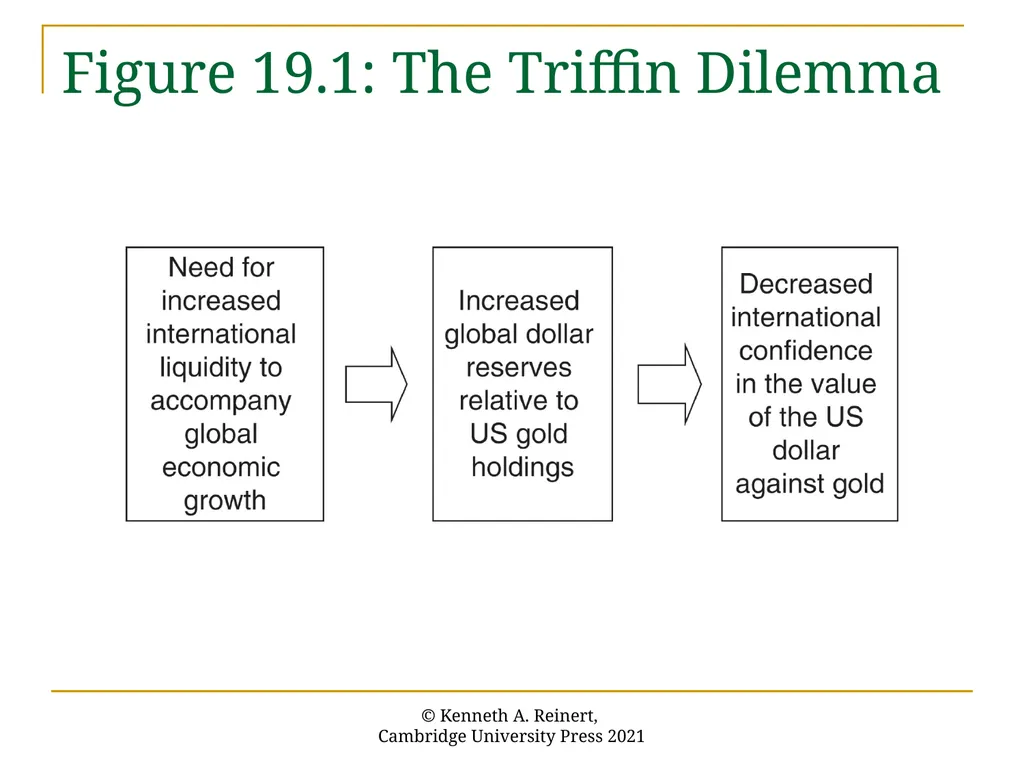
International liquidity required a continual increase in holdings of dollars as reserve assets
As dollar holdings of central banks expanded relative to US official holdings of gold, however, international confidence would suffer
The United States could not back up an ever-expanding supply of dollars with a relatively constant amount of gold holdings © Kenneth A. Reinert,
Cambridge University Press 2021<br>
Problem became known as the Triffin dilemma
Contradiction between requirements of international liquidity and international confidence
“Liquidity” refers to the ability to transform assets into currencies
International liquidity required a continual increase in holdings of dollars as reserve assets
As dollar holdings of central banks expanded relative to US official holdings of gold, however, international confidence would suffer
The United States could not back up an ever-expanding supply of dollars with a relatively constant amount of gold holdings © Kenneth A. Reinert,
Cambridge University Press 2021<br>
15
Figure 19.1: The Triffin Dilemma © Kenneth A. Reinert,
Cambridge University Press 2021<br>
Cambridge University Press 2021<br>
16
Triffin Dilemma In October 1960 London gold market price rose above $35 to $40 an ounce
Calls for a change in the gold-dollar parity
In January 1961, the Kennedy Administration pledged to maintain $35 per ounce convertibility
U.S. joined with other European countries and set up a gold pool in which their central banks would buy and sell gold to support the $35 price in London market
At 1964 annual IMF meeting in Tokyo, representatives began to talk publicly about potential reforms in international financial system
Attention was given to the creation of reserve assets alternative to US dollar and gold
In 1965, the United States Treasury announced that it was ready to join in international discussions on potential reforms
Johnson Administration was more flexible than the Kennedy Administration © Kenneth A. Reinert,
Cambridge University Press 2021<br>
Calls for a change in the gold-dollar parity
In January 1961, the Kennedy Administration pledged to maintain $35 per ounce convertibility
U.S. joined with other European countries and set up a gold pool in which their central banks would buy and sell gold to support the $35 price in London market
At 1964 annual IMF meeting in Tokyo, representatives began to talk publicly about potential reforms in international financial system
Attention was given to the creation of reserve assets alternative to US dollar and gold
In 1965, the United States Treasury announced that it was ready to join in international discussions on potential reforms
Johnson Administration was more flexible than the Kennedy Administration © Kenneth A. Reinert,
Cambridge University Press 2021<br>
17
Triffin Dilemma British pound was devalued in November of 1967
President Johnson issued a statement recommitting the United States to $35 per ounce gold price
However, in early months of 1968, the rush out of dollars began
In early 1971, capital began to flow out of dollar assets and into German mark assets
Thereafter, capital flowed from dollar assets to yen assets
US President Nixon accepted US Treasury Secretary John Connally’s recommendation to close its “gold window” © Kenneth A. Reinert,
Cambridge University Press 2021<br>
President Johnson issued a statement recommitting the United States to $35 per ounce gold price
However, in early months of 1968, the rush out of dollars began
In early 1971, capital began to flow out of dollar assets and into German mark assets
Thereafter, capital flowed from dollar assets to yen assets
US President Nixon accepted US Treasury Secretary John Connally’s recommendation to close its “gold window” © Kenneth A. Reinert,
Cambridge University Press 2021<br>
18
The Non-System At Smithsonian conference in 1971, several countries revalued their currencies against dollar
Gold price was raised to $38 per ounce
In June 1972, a large flow out of US dollars into European currencies and Japanese yen occurred
Flows stabilized, but new crisis reappeared in January 1973
On February 12th, US announced a second devaluation of the dollar against gold to $42
The international financial system had crossed a threshold, although this was not fully appreciated at the time © Kenneth A. Reinert,
Cambridge University Press 2021<br>
Gold price was raised to $38 per ounce
In June 1972, a large flow out of US dollars into European currencies and Japanese yen occurred
Flows stabilized, but new crisis reappeared in January 1973
On February 12th, US announced a second devaluation of the dollar against gold to $42
The international financial system had crossed a threshold, although this was not fully appreciated at the time © Kenneth A. Reinert,
Cambridge University Press 2021<br>
19
The Non-System During 1974 and 1975, countries went through nearly continuous consultation and disagreement in a process of accommodating their thinking to floating rates
In November 1975, proposed amendment to IMF’s Articles of Agreement restricted allowable exchange rate arrangements to
Currencies fixed to anything other than gold
Cooperative arrangements for managed values among countries
Floating © Kenneth A. Reinert,
Cambridge University Press 2021<br>
In November 1975, proposed amendment to IMF’s Articles of Agreement restricted allowable exchange rate arrangements to
Currencies fixed to anything other than gold
Cooperative arrangements for managed values among countries
Floating © Kenneth A. Reinert,
Cambridge University Press 2021<br>
20
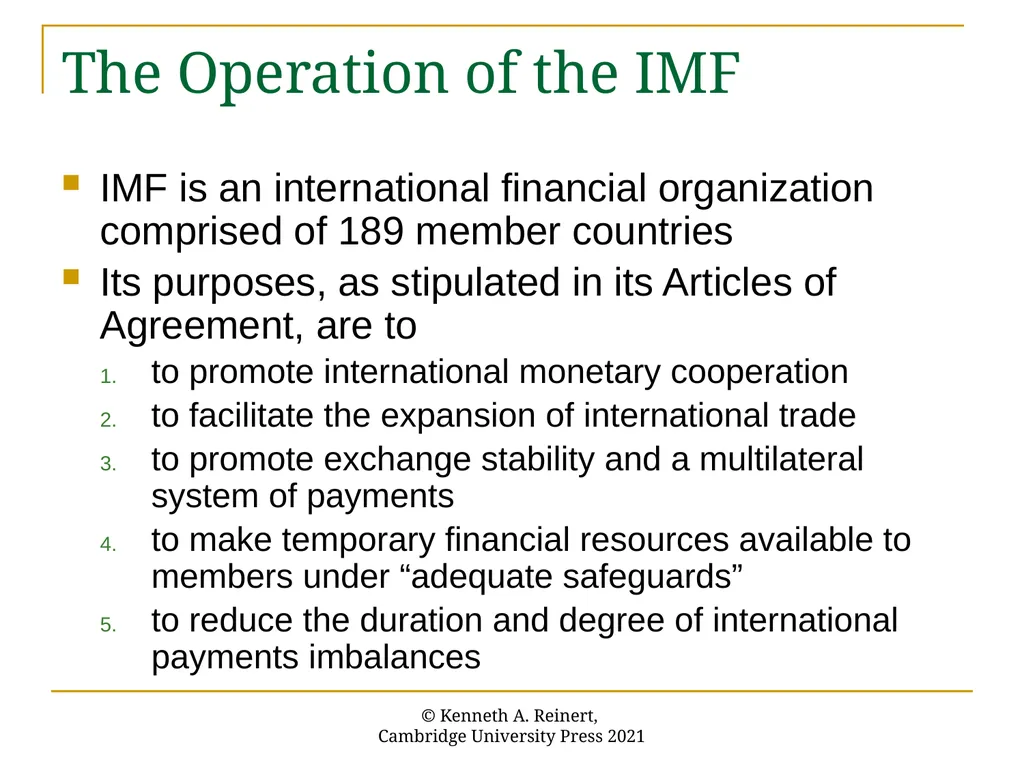
The Operation of the IMF IMF is an international financial organization comprised of 189 member countries
Its purposes, as stipulated in its Articles of Agreement, are to
to promote international monetary cooperation
to facilitate the expansion of international trade
to promote exchange stability and a multilateral system of payments
to make temporary financial resources available to members under “adequate safeguards”
to reduce the duration and degree of international payments imbalances © Kenneth A. Reinert,
Cambridge University Press 2021<br>
Its purposes, as stipulated in its Articles of Agreement, are to
to promote international monetary cooperation
to facilitate the expansion of international trade
to promote exchange stability and a multilateral system of payments
to make temporary financial resources available to members under “adequate safeguards”
to reduce the duration and degree of international payments imbalances © Kenneth A. Reinert,
Cambridge University Press 2021<br>
21
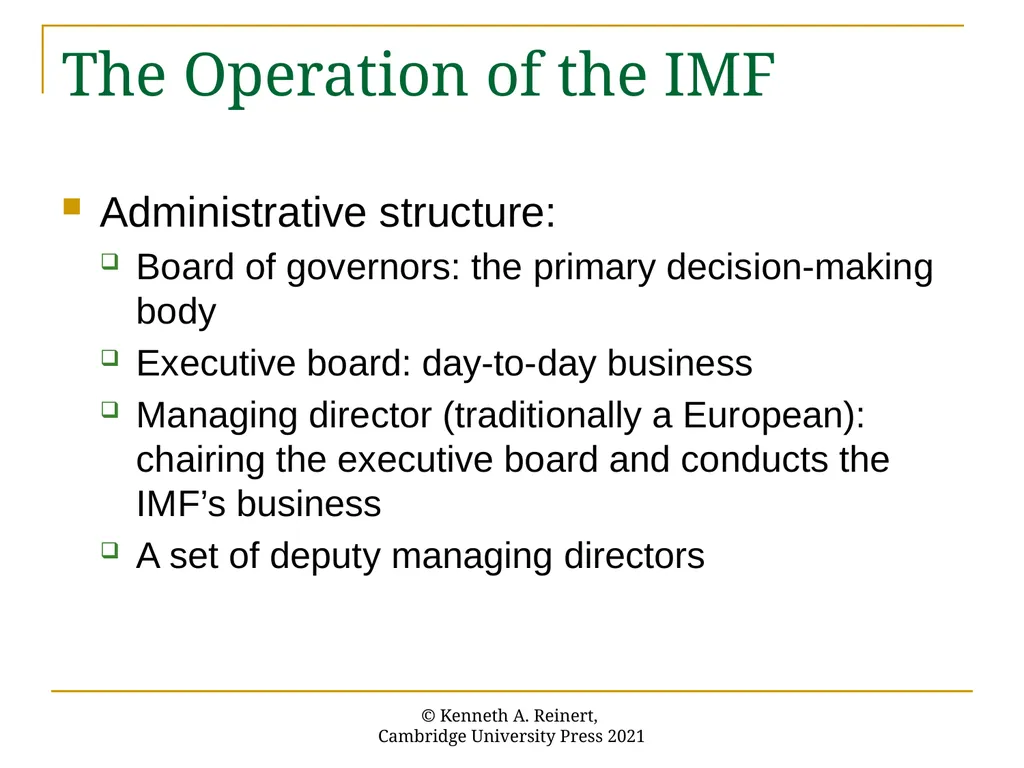
The Operation of the IMF Administrative structure:
Board of governors: the primary decision-making body
Executive board: day-to-day business
Managing director (traditionally a European): chairing the executive board and conducts the IMF’s business
A set of deputy managing directors © Kenneth A. Reinert,
Cambridge University Press 2021<br>
Board of governors: the primary decision-making body
Executive board: day-to-day business
Managing director (traditionally a European): chairing the executive board and conducts the IMF’s business
A set of deputy managing directors © Kenneth A. Reinert,
Cambridge University Press 2021<br>
22
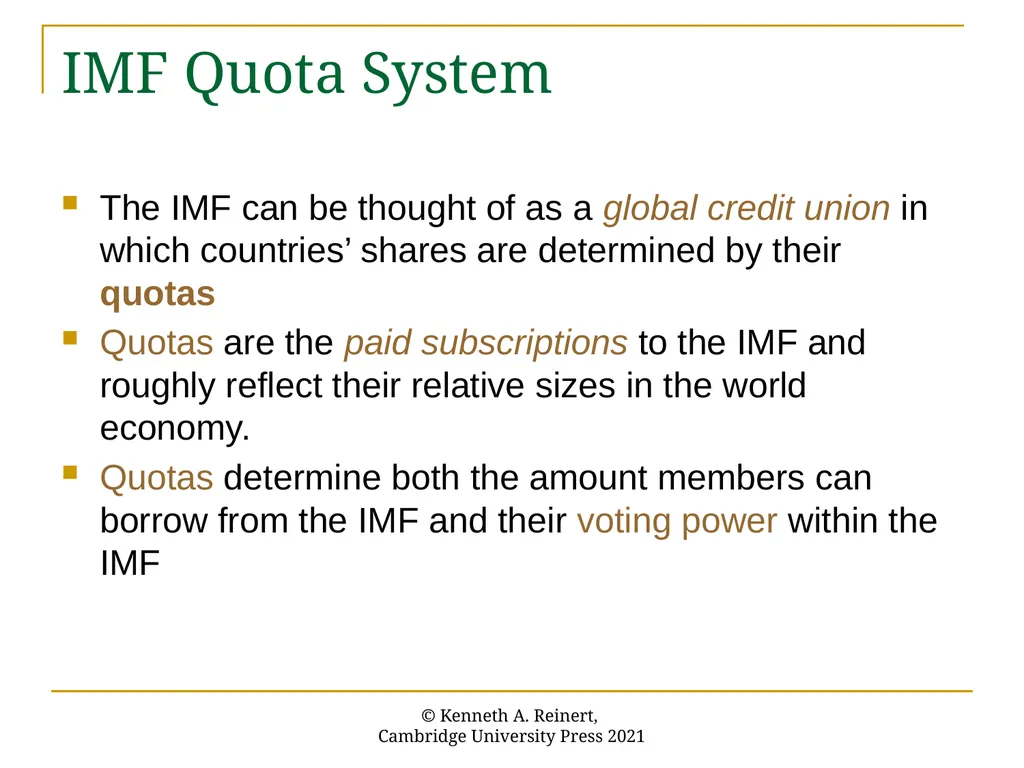
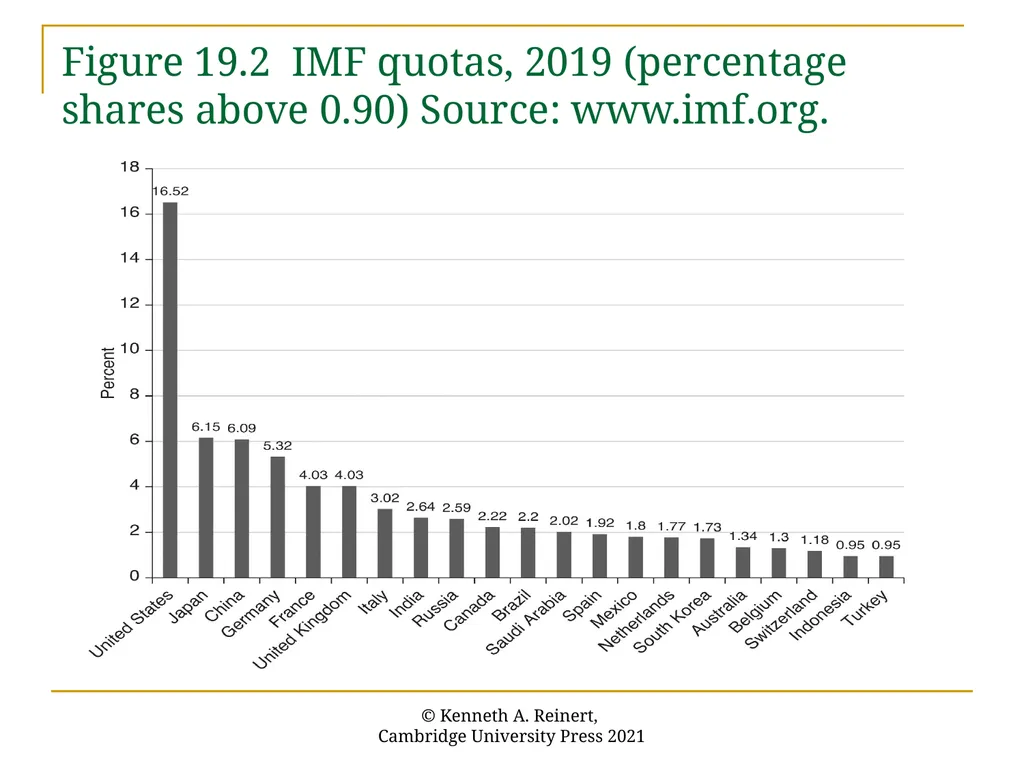
IMF Quota System The IMF can be thought of as a global credit union in which countries’ shares are determined by their quotas
Quotas are the paid subscriptions to the IMF and roughly reflect their relative sizes in the world economy.
Quotas determine both the amount members can borrow from the IMF and their voting power within the IMF © Kenneth A. Reinert,
Cambridge University Press 2021<br>
Quotas are the paid subscriptions to the IMF and roughly reflect their relative sizes in the world economy.
Quotas determine both the amount members can borrow from the IMF and their voting power within the IMF © Kenneth A. Reinert,
Cambridge University Press 2021<br>
23
Figure 19.2 IMF quotas, 2019 (percentage shares above 0.90) Source: www.imf.org. © Kenneth A. Reinert,
Cambridge University Press 2021<br>
Cambridge University Press 2021<br>
24
IMF lending In times of difficulty, an IMF member country gains access to the Fund’s resources through a somewhat complex borrowing process
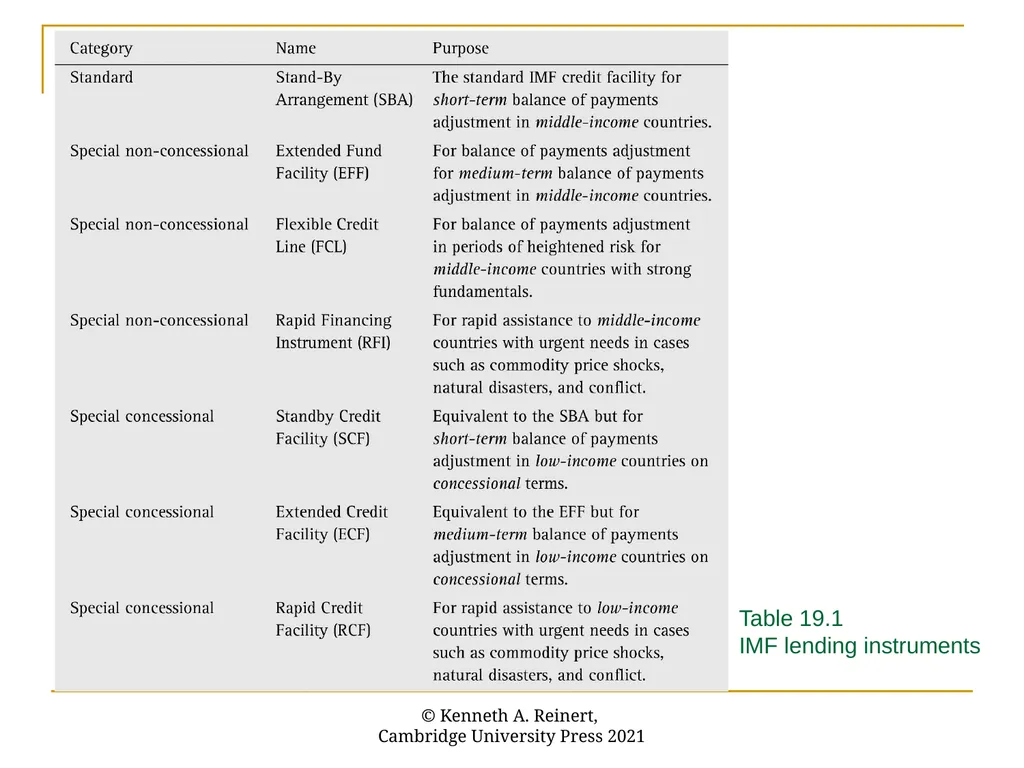
The IMF provides resources for adjustment through various “lending instruments,” summarized in Table 19.1 © Kenneth A. Reinert,
Cambridge University Press 2021<br>
The IMF provides resources for adjustment through various “lending instruments,” summarized in Table 19.1 © Kenneth A. Reinert,
Cambridge University Press 2021<br>
25
© Kenneth A. Reinert,
Cambridge University Press 2021 Table 19.1
IMF lending instruments<br>
Cambridge University Press 2021 Table 19.1
IMF lending instruments<br>
26
IMF lending Under normal circumstances, the amount of resources an IMF member can access is determined by its quota amount.
Through a complex process involving lending “tranches,” a member can borrow up to 145% of its quota annually and 435% cumulatively.
in recent years, this limit has been exceeded.
A country requesting access to IMF resources has to sign a letter of intent committing itself to a certain set of policy changes. These policy changes are known as conditionalities
Conditionality is a central feature of both IMF and World Bank lending.
Whether a country meets the conditionalities of a lending arrangement is determined by a process of IMF monitoring. © Kenneth A. Reinert,
Cambridge University Press 2021<br>
Through a complex process involving lending “tranches,” a member can borrow up to 145% of its quota annually and 435% cumulatively.
in recent years, this limit has been exceeded.
A country requesting access to IMF resources has to sign a letter of intent committing itself to a certain set of policy changes. These policy changes are known as conditionalities
Conditionality is a central feature of both IMF and World Bank lending.
Whether a country meets the conditionalities of a lending arrangement is determined by a process of IMF monitoring. © Kenneth A. Reinert,
Cambridge University Press 2021<br>
27
IMF lending The above lending arrangements reflect the dominance of the White Plan over the Keynes Plan
Keynes Plan penalized both creditors and debtors symmetrically: spread international adjustment responsibilities between countries with balance of payments surpluses and countries with deficits alike
This feature was left out in the final agreements, global adjustment being the responsibility of the deficit countries © Kenneth A. Reinert,
Cambridge University Press 2021<br>
Keynes Plan penalized both creditors and debtors symmetrically: spread international adjustment responsibilities between countries with balance of payments surpluses and countries with deficits alike
This feature was left out in the final agreements, global adjustment being the responsibility of the deficit countries © Kenneth A. Reinert,
Cambridge University Press 2021<br>
28
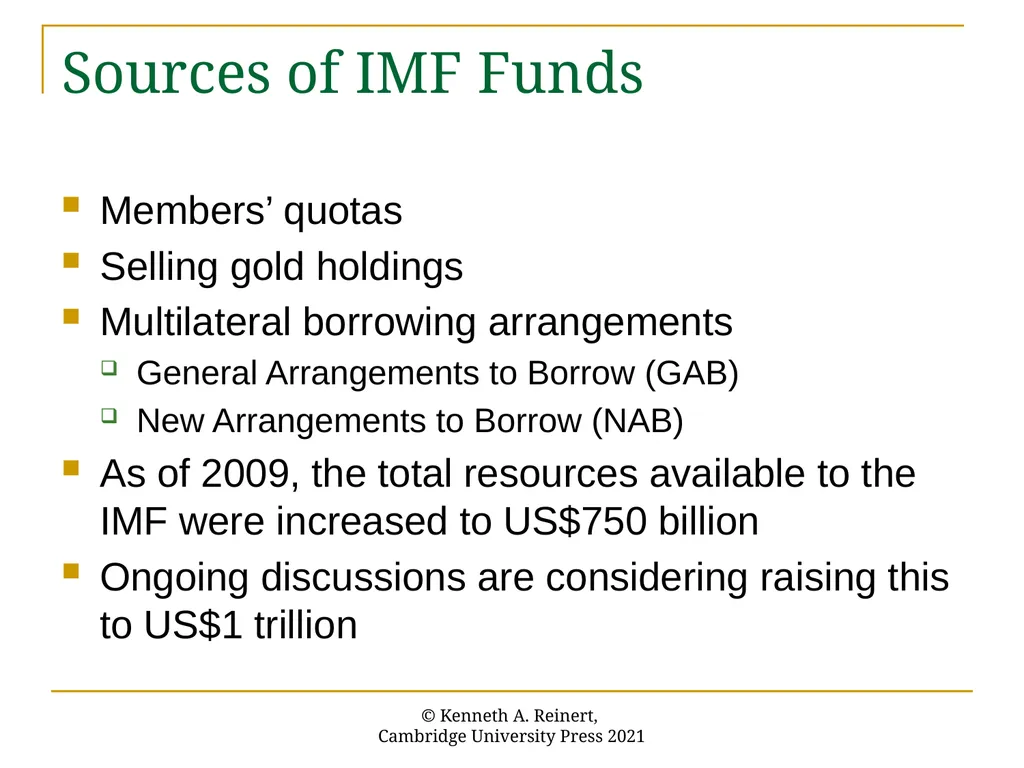
Sources of IMF Funds Members’ quotas
Selling gold holdings
Multilateral borrowing arrangements
General Arrangements to Borrow (GAB)
New Arrangements to Borrow (NAB)
As of 2009, the total resources available to the IMF were increased to US$750 billion
Ongoing discussions are considering raising this to US$1 trillion © Kenneth A. Reinert,
Cambridge University Press 2021<br>
Selling gold holdings
Multilateral borrowing arrangements
General Arrangements to Borrow (GAB)
New Arrangements to Borrow (NAB)
As of 2009, the total resources available to the IMF were increased to US$750 billion
Ongoing discussions are considering raising this to US$1 trillion © Kenneth A. Reinert,
Cambridge University Press 2021<br>
29
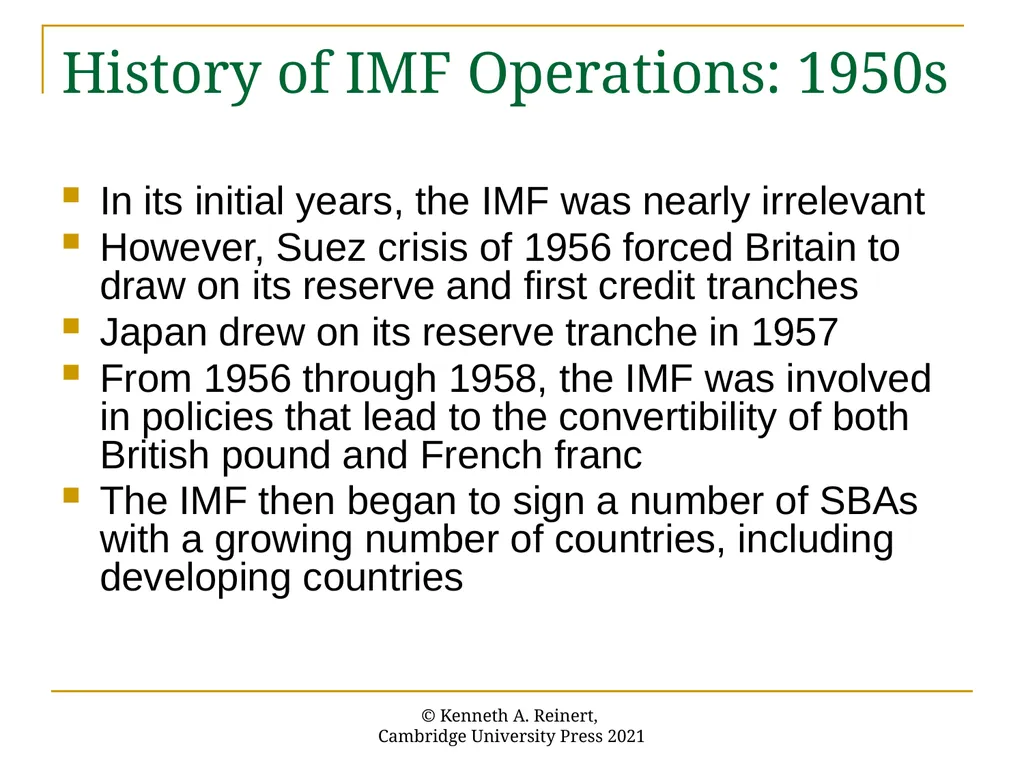
History of IMF Operations: 1950s In its initial years, the IMF was nearly irrelevant
However, Suez crisis of 1956 forced Britain to draw on its reserve and first credit tranches
Japan drew on its reserve tranche in 1957
From 1956 through 1958, the IMF was involved in policies that lead to the convertibility of both British pound and French franc
The IMF then began to sign a number of SBAs with a growing number of countries, including developing countries © Kenneth A. Reinert,
Cambridge University Press 2021<br>
However, Suez crisis of 1956 forced Britain to draw on its reserve and first credit tranches
Japan drew on its reserve tranche in 1957
From 1956 through 1958, the IMF was involved in policies that lead to the convertibility of both British pound and French franc
The IMF then began to sign a number of SBAs with a growing number of countries, including developing countries © Kenneth A. Reinert,
Cambridge University Press 2021<br>
30
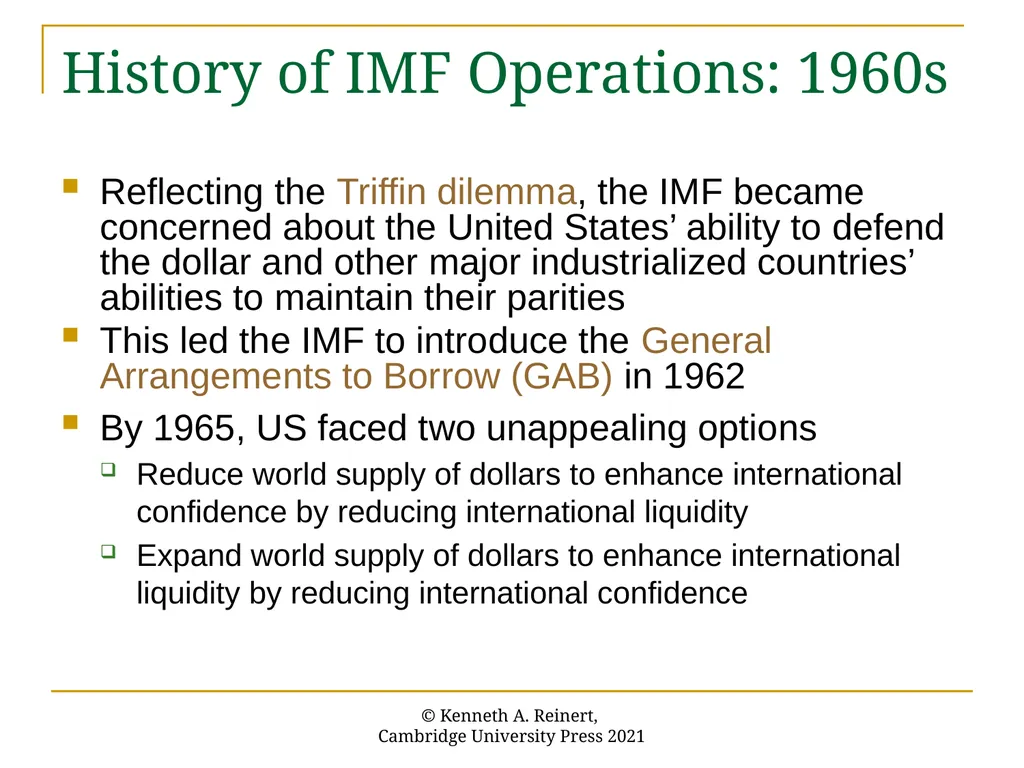
History of IMF Operations: 1960s Reflecting the Triffin dilemma, the IMF became concerned about the United States’ ability to defend the dollar and other major industrialized countries’ abilities to maintain their parities
This led the IMF to introduce the General Arrangements to Borrow (GAB) in 1962
By 1965, US faced two unappealing options
Reduce world supply of dollars to enhance international confidence by reducing international liquidity
Expand world supply of dollars to enhance international liquidity by reducing international confidence © Kenneth A. Reinert,
Cambridge University Press 2021<br>
This led the IMF to introduce the General Arrangements to Borrow (GAB) in 1962
By 1965, US faced two unappealing options
Reduce world supply of dollars to enhance international confidence by reducing international liquidity
Expand world supply of dollars to enhance international liquidity by reducing international confidence © Kenneth A. Reinert,
Cambridge University Press 2021<br>
31
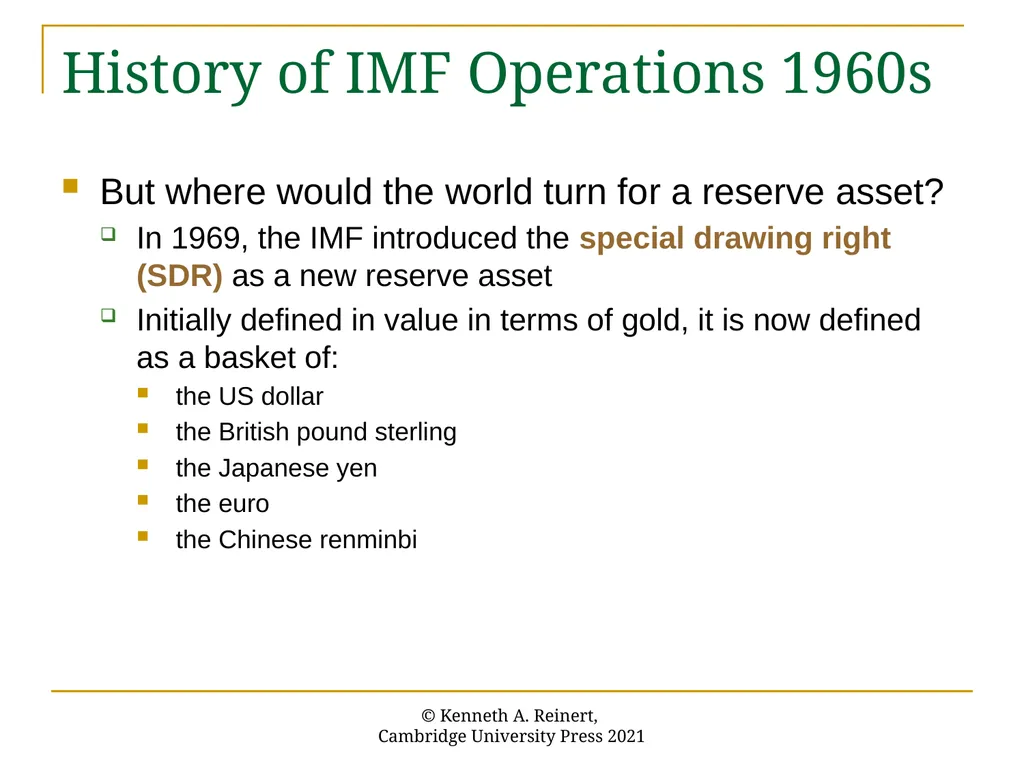
History of IMF Operations 1960s But where would the world turn for a reserve asset?
In 1969, the IMF introduced the special drawing right (SDR) as a new reserve asset
Initially defined in value in terms of gold, it is now defined as a basket of:
the US dollar
the British pound sterling
the Japanese yen
the euro
the Chinese renminbi © Kenneth A. Reinert,
Cambridge University Press 2021<br>
In 1969, the IMF introduced the special drawing right (SDR) as a new reserve asset
Initially defined in value in terms of gold, it is now defined as a basket of:
the US dollar
the British pound sterling
the Japanese yen
the euro
the Chinese renminbi © Kenneth A. Reinert,
Cambridge University Press 2021<br>
32
Oil Shocks, Crises, and Adjustment--
the 1970s: oil shocks The oil price increases of 1973-1974 caused substantial balance of payments difficulties for many countries of the world
In 1974 and 1975, the IMF established special oil facilities to assist these countries
The IMF acted as an intermediary, borrowing the funds from oil-producing countries and lending them to oil-importing countries
Despite these facilities, most of the oil producing country revenues were “recycled” to other countries via the commercial banking system © Kenneth A. Reinert,
Cambridge University Press 2021<br>
In 1974 and 1975, the IMF established special oil facilities to assist these countries
The IMF acted as an intermediary, borrowing the funds from oil-producing countries and lending them to oil-importing countries
Despite these facilities, most of the oil producing country revenues were “recycled” to other countries via the commercial banking system © Kenneth A. Reinert,
Cambridge University Press 2021<br>
33
Oil Shocks, Crises, and Adjustment--
the 1970s: oil shocks In 1976, IMF began to sound warnings about sustainability of LMIC borrowing from commercial banking system
Banking system reacted with hostility to these warnings, arguing that the IMF had no place interfering with private transactions
The 1980s began with a significant increase in real interest rates and a significant decline in non-oil commodity prices
Increased cost of borrowing and reduced export revenues © Kenneth A. Reinert,
Cambridge University Press 2021<br>
Banking system reacted with hostility to these warnings, arguing that the IMF had no place interfering with private transactions
The 1980s began with a significant increase in real interest rates and a significant decline in non-oil commodity prices
Increased cost of borrowing and reduced export revenues © Kenneth A. Reinert,
Cambridge University Press 2021<br>
34
Oil Shocks, Crises, and Adjustment –
the 1980s: Latin America and Africa In 1982, IMF calculated that US banking system outstanding loans to Latin America represented approximately 100% of total bank capital
In August 1982 Mexico announced it would stop servicing its foreign currency debt
At the end of the month, Mexican government nationalized its banking system
1982 also found debt crises beginning in Argentina and Brazil
In 1986 and 1987, the IMF introduced new borrowing facilities, which raised the credit ceiling to 250% of quota © Kenneth A. Reinert,
Cambridge University Press 2021<br>
In August 1982 Mexico announced it would stop servicing its foreign currency debt
At the end of the month, Mexican government nationalized its banking system
1982 also found debt crises beginning in Argentina and Brazil
In 1986 and 1987, the IMF introduced new borrowing facilities, which raised the credit ceiling to 250% of quota © Kenneth A. Reinert,
Cambridge University Press 2021<br>
35
Oil Shocks, Crises, and Adjustment –
the 1980s: Latin America and Africa Despite the efforts, international commercial banks began to withdraw credit from many LMICs.
The debt crisis became global.
Many LMICs used trade surpluses to finance debt repayment net capital outflows
A lost decade for many LMICs, particularly in Latin America and Africa
Led to a new policy era for the IMF and World Bank known as the Washington Consensus © Kenneth A. Reinert,
Cambridge University Press 2021<br>
The debt crisis became global.
Many LMICs used trade surpluses to finance debt repayment net capital outflows
A lost decade for many LMICs, particularly in Latin America and Africa
Led to a new policy era for the IMF and World Bank known as the Washington Consensus © Kenneth A. Reinert,
Cambridge University Press 2021<br>
36
Oil Shocks, Crises, and Adjustment--
the 1990s: Mexican and Asian financial crises Despite flows of private capital into LMICs in the 1990s, a number of highly indebted countries began to show increasing levels of unpaid IMF obligations. International adjustment was not functioning well.
Mexico underwent a second crisis in 1994-1995.
In 1997, crises struck a number of Asian countries (most notably Thailand, Indonesia, South Korea, and Malaysia), leading to sharp depreciation.
During the Asian financial crisis, questions were raised about the appropriateness of the IMF’s response and its advocacy of liberalizing capital accounts in the run-up of the crisis © Kenneth A. Reinert,
Cambridge University Press 2021<br>
Mexico underwent a second crisis in 1994-1995.
In 1997, crises struck a number of Asian countries (most notably Thailand, Indonesia, South Korea, and Malaysia), leading to sharp depreciation.
During the Asian financial crisis, questions were raised about the appropriateness of the IMF’s response and its advocacy of liberalizing capital accounts in the run-up of the crisis © Kenneth A. Reinert,
Cambridge University Press 2021<br>
37
Oil Shocks, Crises, and Adjustment—
the 1990s: the Russian Crisis The Russian economy was hit by a crisis in 1998
IMF support of the Russian transition had begun in the early 1990s
The IMF arranged a very large loan to Russia in 1995
This proved to be insufficient as a full-fledged banking and currency crisis occurred in 1998
This required the IMF to draw on the GAB for the first time since 1978
The IMF’s role here was severely criticized © Kenneth A. Reinert,
Cambridge University Press 2021<br>
IMF support of the Russian transition had begun in the early 1990s
The IMF arranged a very large loan to Russia in 1995
This proved to be insufficient as a full-fledged banking and currency crisis occurred in 1998
This required the IMF to draw on the GAB for the first time since 1978
The IMF’s role here was severely criticized © Kenneth A. Reinert,
Cambridge University Press 2021<br>
38
Oil Shocks, Crises, and Adjustment—
the 1990s: Brazil and Argentina In 1998, the IMF tried to support the Brazilian currency to attempt to insulate it from the Asian and Russian crises
The IMF failed, and Brazil was forced to devalue in 1999
The IMF had also been involved for some years in supporting a currency board in Argentina
This came spectacularly undone in 2001 and left the IMF open to criticism for not having mapped out an exit strategy for the country © Kenneth A. Reinert,
Cambridge University Press 2021<br>
The IMF failed, and Brazil was forced to devalue in 1999
The IMF had also been involved for some years in supporting a currency board in Argentina
This came spectacularly undone in 2001 and left the IMF open to criticism for not having mapped out an exit strategy for the country © Kenneth A. Reinert,
Cambridge University Press 2021<br>
39
Recent Events The early 2000s found the IMF sinking into irrelevance
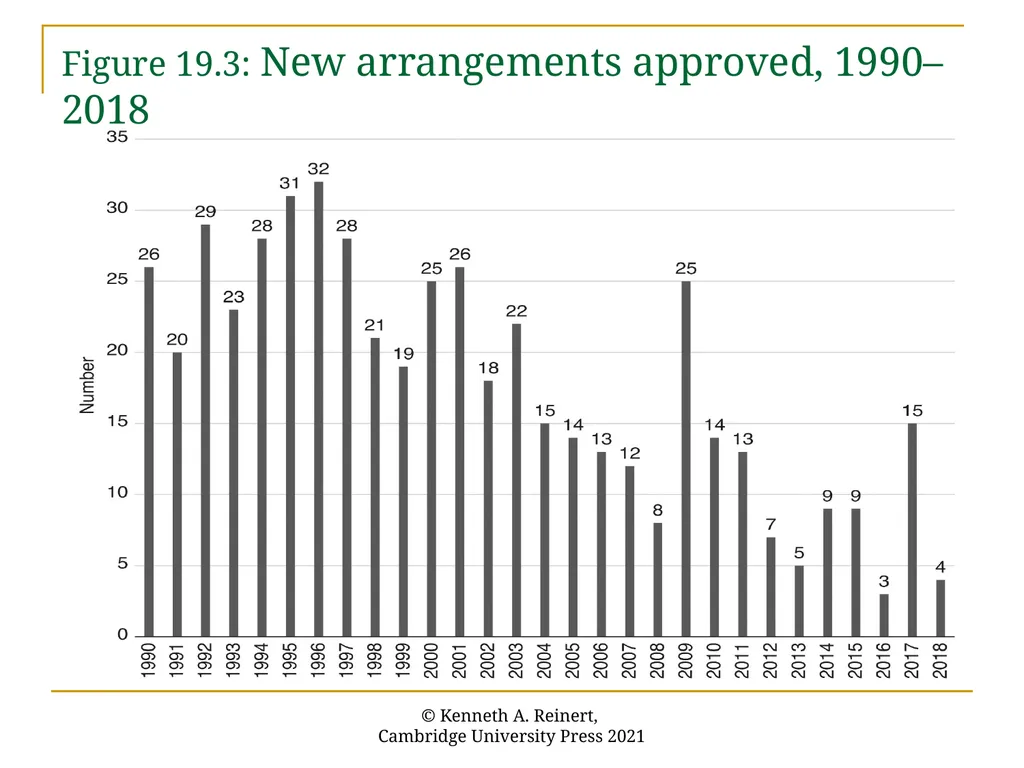
Between 2003 and 2008, the number of new arrangements declined precipitously (see Figure 19.3)
This reflected booming private capital markets and the accumulation of large foreign reserve balances in many Asian countries
Because the IMF’s operating budget depends on its loan charges, this proved to be difficult
The 2008 GFC gave renewed life to the IMF © Kenneth A. Reinert,
Cambridge University Press 2021<br>
Between 2003 and 2008, the number of new arrangements declined precipitously (see Figure 19.3)
This reflected booming private capital markets and the accumulation of large foreign reserve balances in many Asian countries
Because the IMF’s operating budget depends on its loan charges, this proved to be difficult
The 2008 GFC gave renewed life to the IMF © Kenneth A. Reinert,
Cambridge University Press 2021<br>
40
Figure 19.3: New arrangements approved, 1990–2018 © Kenneth A. Reinert,
Cambridge University Press 2021<br>
Cambridge University Press 2021<br>
41
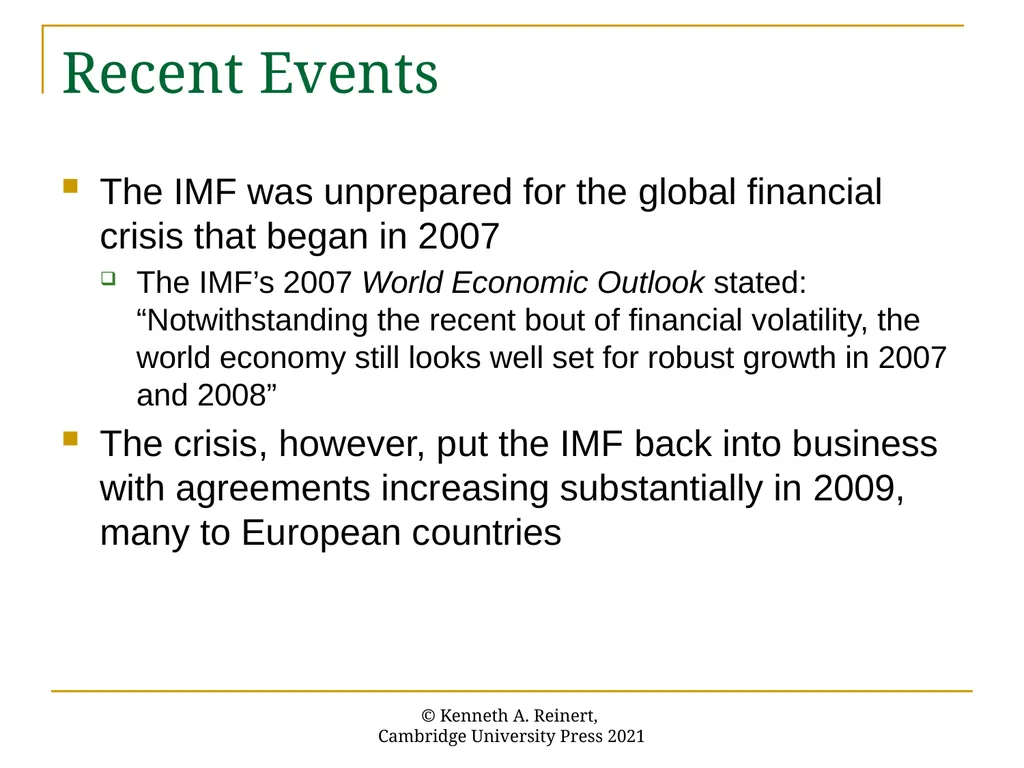
Recent Events The IMF was unprepared for the global financial crisis that began in 2007
The IMF’s 2007 World Economic Outlook stated: “Notwithstanding the recent bout of financial volatility, the world economy still looks well set for robust growth in 2007 and 2008”
The crisis, however, put the IMF back into business with agreements increasing substantially in 2009, many to European countries © Kenneth A. Reinert,
Cambridge University Press 2021<br>
The IMF’s 2007 World Economic Outlook stated: “Notwithstanding the recent bout of financial volatility, the world economy still looks well set for robust growth in 2007 and 2008”
The crisis, however, put the IMF back into business with agreements increasing substantially in 2009, many to European countries © Kenneth A. Reinert,
Cambridge University Press 2021<br>
42
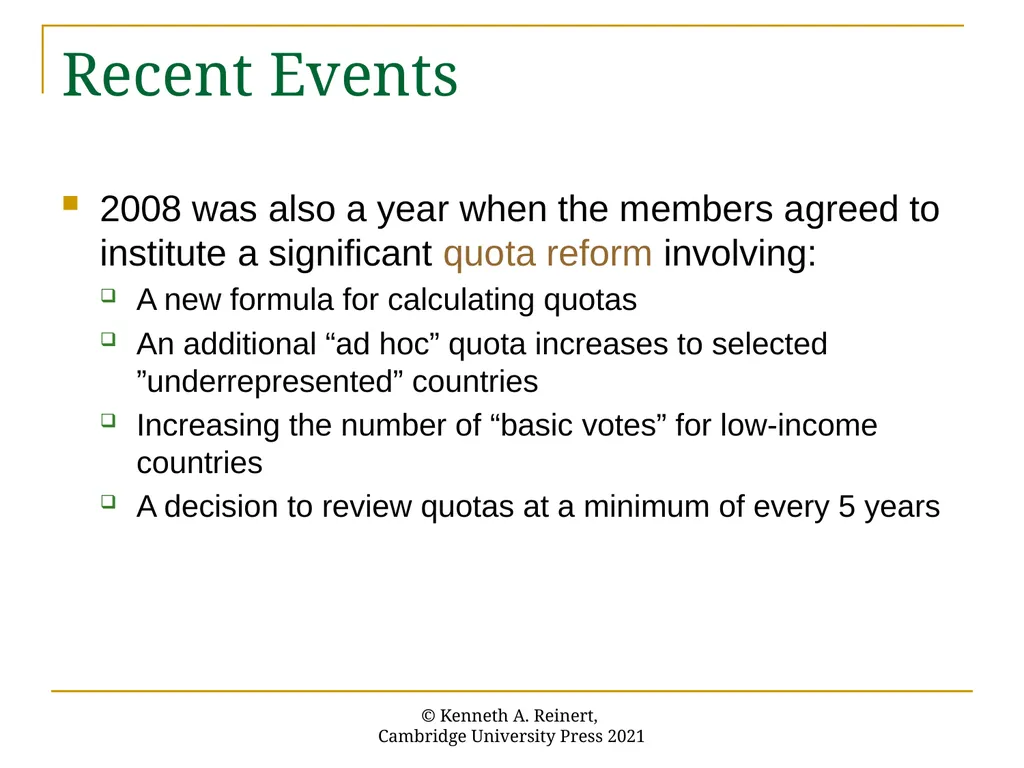
Recent Events 2008 was also a year when the members agreed to institute a significant quota reform involving:
A new formula for calculating quotas
An additional “ad hoc” quota increases to selected ”underrepresented” countries
Increasing the number of “basic votes” for low-income countries
A decision to review quotas at a minimum of every 5 years © Kenneth A. Reinert,
Cambridge University Press 2021<br>
A new formula for calculating quotas
An additional “ad hoc” quota increases to selected ”underrepresented” countries
Increasing the number of “basic votes” for low-income countries
A decision to review quotas at a minimum of every 5 years © Kenneth A. Reinert,
Cambridge University Press 2021<br>
43
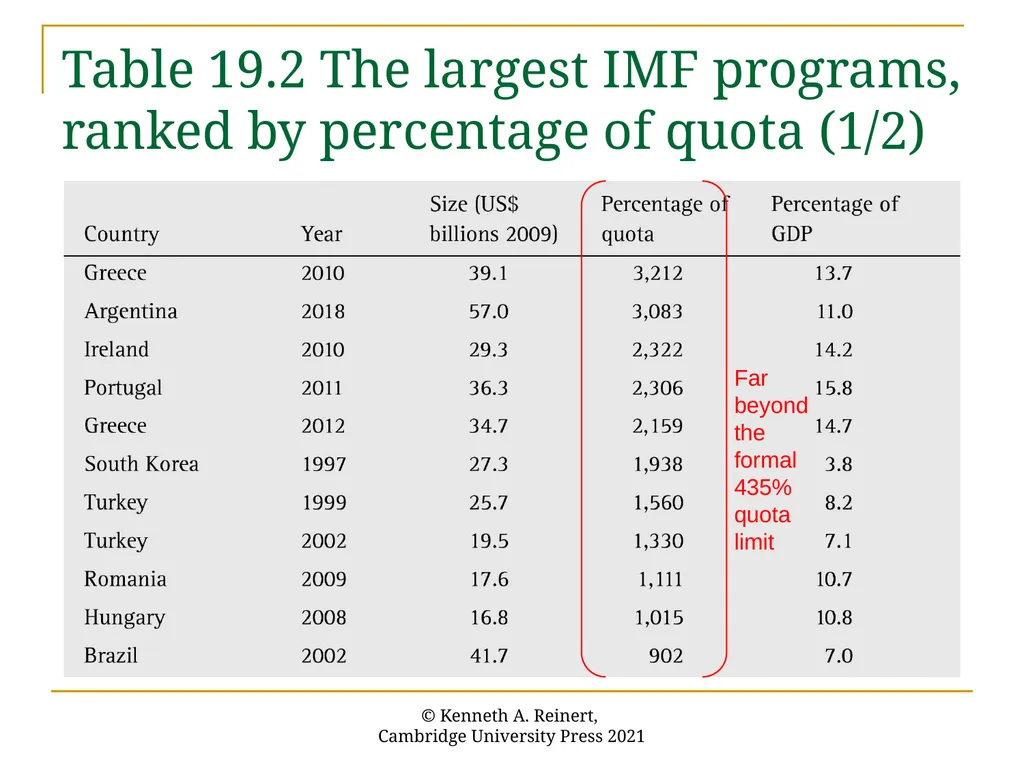
Table 19.2 The largest IMF programs, ranked by percentage of quota (1/2) © Kenneth A. Reinert,
Cambridge University Press 2021 Far beyond the formal 435% quota limit<br>
Cambridge University Press 2021 Far beyond the formal 435% quota limit<br>
44
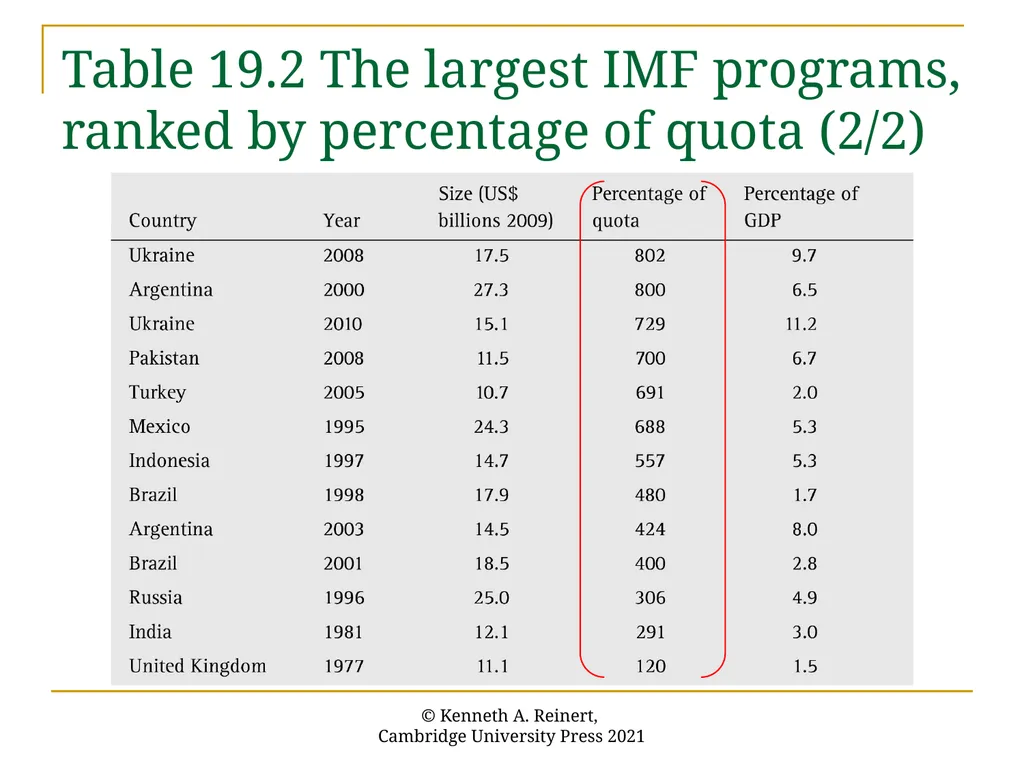
Table 19.2 The largest IMF programs, ranked by percentage of quota (2/2) © Kenneth A. Reinert,
Cambridge University Press 2021<br>
Cambridge University Press 2021<br>
45
The Political Economy of IMF Lending The analysis of the political economy of IMF lending takes place in terms of two variables
The value of loans (L)
The number and strength of conditions (C)
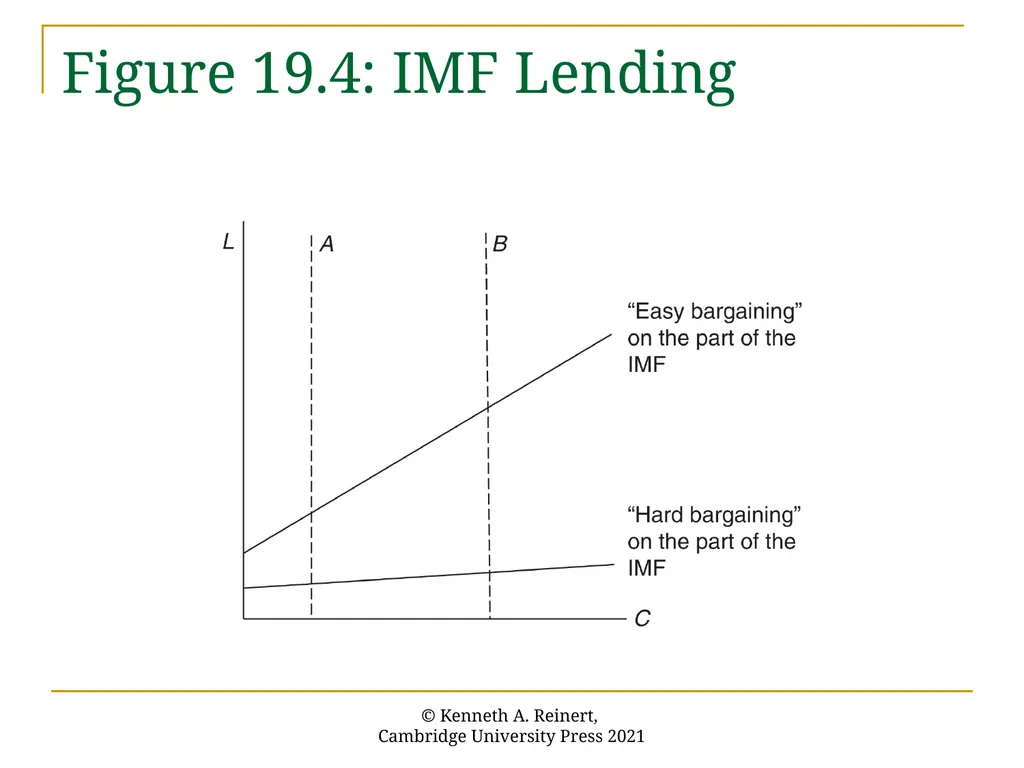
These are depicted in Figure 19.4 in terms of a “hard bargaining” line and an “soft bargaining” line
IMF member country governments weigh the (marginal) benefits and costs of approaching the IMF for a loan
Sovereignty costs are part of these calculations © Kenneth A. Reinert,
Cambridge University Press 2021<br>
The value of loans (L)
The number and strength of conditions (C)
These are depicted in Figure 19.4 in terms of a “hard bargaining” line and an “soft bargaining” line
IMF member country governments weigh the (marginal) benefits and costs of approaching the IMF for a loan
Sovereignty costs are part of these calculations © Kenneth A. Reinert,
Cambridge University Press 2021<br>
46
Figure 19.4: IMF Lending © Kenneth A. Reinert,
Cambridge University Press 2021<br>
Cambridge University Press 2021<br>
47
The Political Economy of IMF Lending Newer thinking and research suggests that, in some cases, country governments might prefer points along line B in Figure 19.4 to points along line A
This would be to push reforms through in the face of domestic political opposition
Here blame is shifted to the IMF
Research also suggests that country government failures to abide by conditionality agreements can simply be the result of a change in the benefit-cost calculations of member country governments © Kenneth A. Reinert,
Cambridge University Press 2021<br>
This would be to push reforms through in the face of domestic political opposition
Here blame is shifted to the IMF
Research also suggests that country government failures to abide by conditionality agreements can simply be the result of a change in the benefit-cost calculations of member country governments © Kenneth A. Reinert,
Cambridge University Press 2021<br>
48
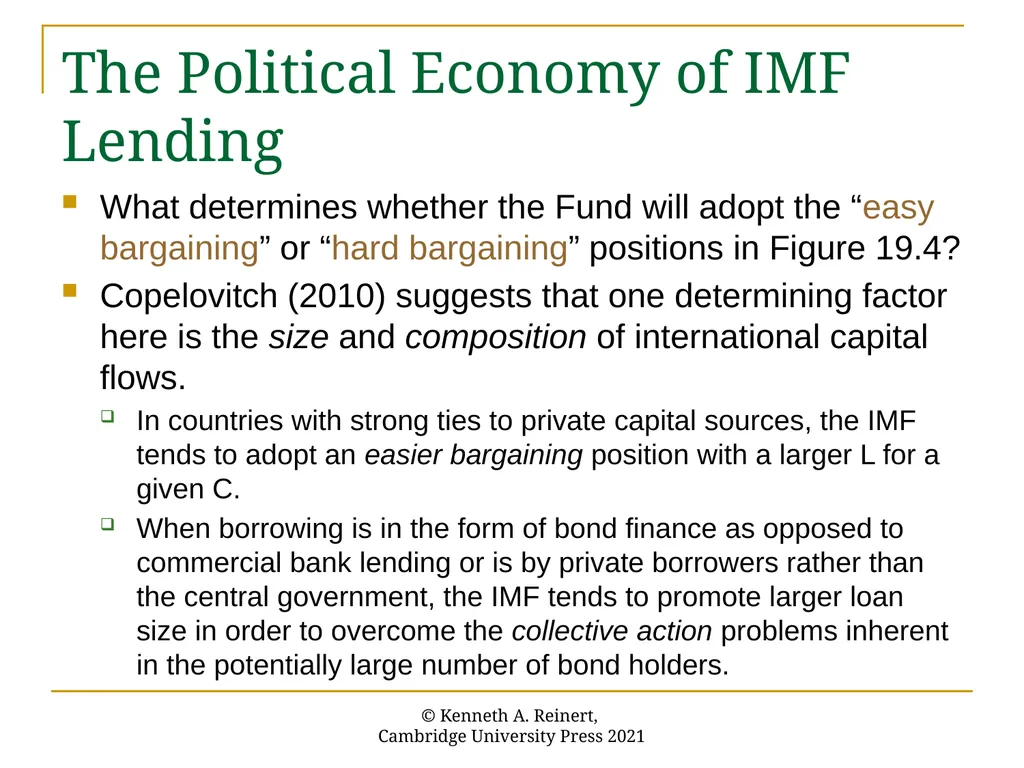
The Political Economy of IMF Lending What determines whether the Fund will adopt the “easy bargaining” or “hard bargaining” positions in Figure 19.4?
Copelovitch (2010) suggests that one determining factor here is the size and composition of international capital flows.
In countries with strong ties to private capital sources, the IMF tends to adopt an easier bargaining position with a larger L for a given C.
When borrowing is in the form of bond finance as opposed to commercial bank lending or is by private borrowers rather than the central government, the IMF tends to promote larger loan size in order to overcome the collective action problems inherent in the potentially large number of bond holders. © Kenneth A. Reinert,
Cambridge University Press 2021<br>
Copelovitch (2010) suggests that one determining factor here is the size and composition of international capital flows.
In countries with strong ties to private capital sources, the IMF tends to adopt an easier bargaining position with a larger L for a given C.
When borrowing is in the form of bond finance as opposed to commercial bank lending or is by private borrowers rather than the central government, the IMF tends to promote larger loan size in order to overcome the collective action problems inherent in the potentially large number of bond holders. © Kenneth A. Reinert,
Cambridge University Press 2021<br>
49
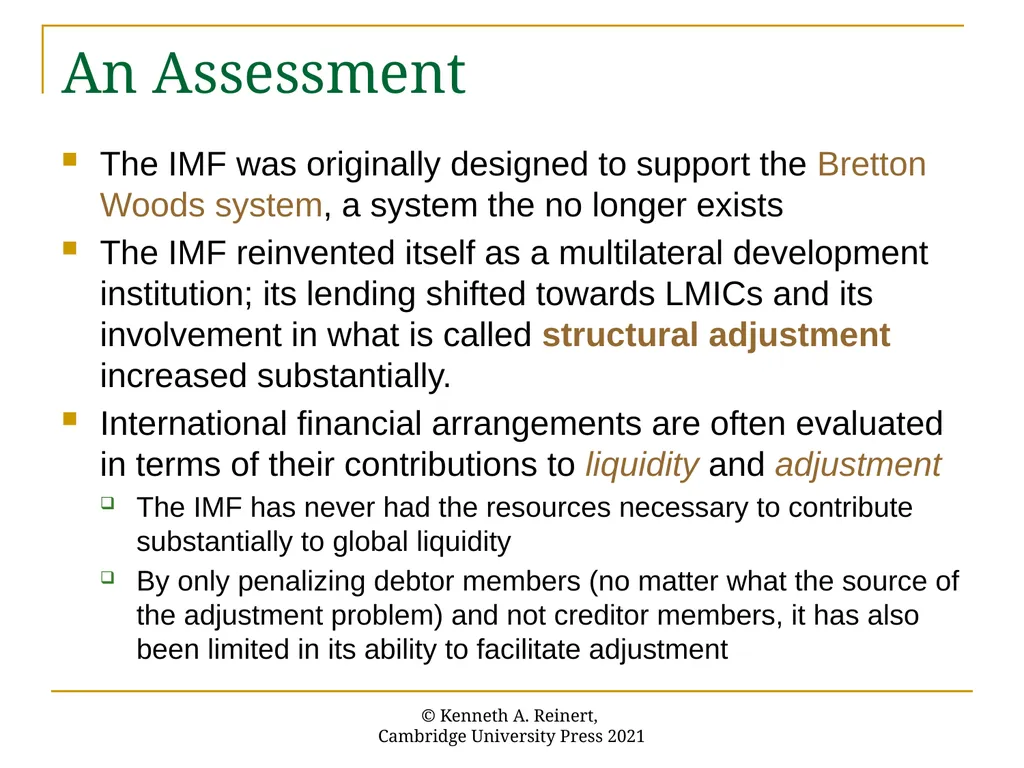
An Assessment The IMF was originally designed to support the Bretton Woods system, a system the no longer exists
The IMF reinvented itself as a multilateral development institution; its lending shifted towards LMICs and its involvement in what is called structural adjustment increased substantially.
International financial arrangements are often evaluated in terms of their contributions to liquidity and adjustment
The IMF has never had the resources necessary to contribute substantially to global liquidity
By only penalizing debtor members (no matter what the source of the adjustment problem) and not creditor members, it has also been limited in its ability to facilitate adjustment © Kenneth A. Reinert,
Cambridge University Press 2021<br>
The IMF reinvented itself as a multilateral development institution; its lending shifted towards LMICs and its involvement in what is called structural adjustment increased substantially.
International financial arrangements are often evaluated in terms of their contributions to liquidity and adjustment
The IMF has never had the resources necessary to contribute substantially to global liquidity
By only penalizing debtor members (no matter what the source of the adjustment problem) and not creditor members, it has also been limited in its ability to facilitate adjustment © Kenneth A. Reinert,
Cambridge University Press 2021<br>
50
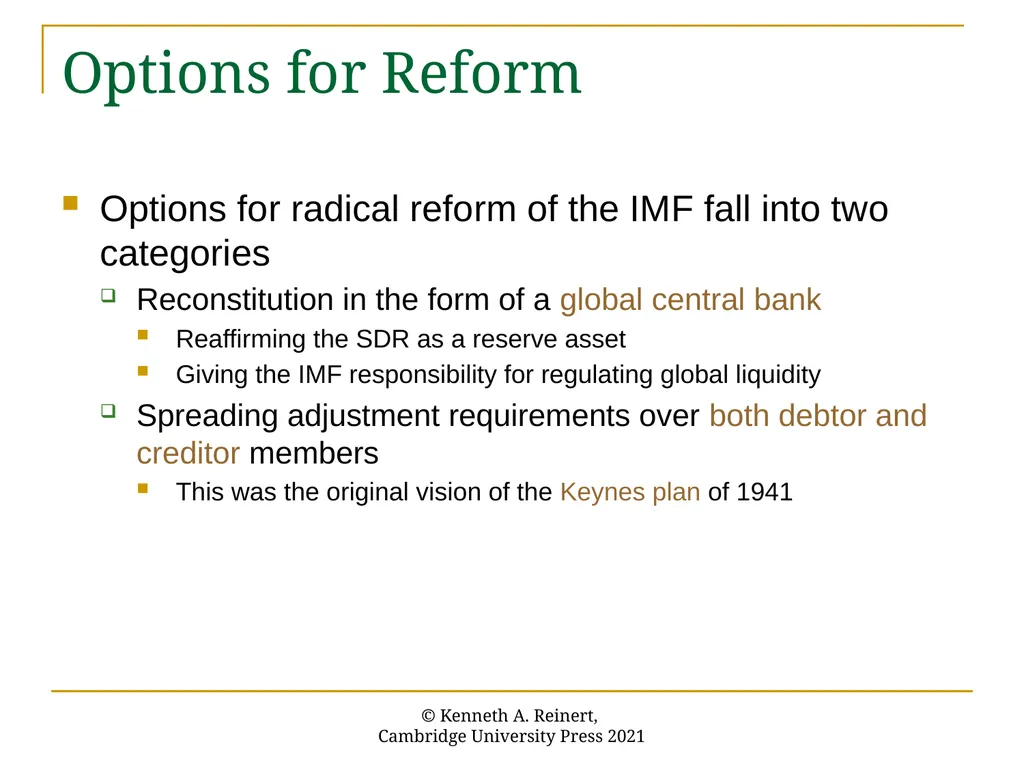
Options for Reform Options for radical reform of the IMF fall into two categories
Reconstitution in the form of a global central bank
Reaffirming the SDR as a reserve asset
Giving the IMF responsibility for regulating global liquidity
Spreading adjustment requirements over both debtor and creditor members
This was the original vision of the Keynes plan of 1941 © Kenneth A. Reinert,
Cambridge University Press 2021<br>
Reconstitution in the form of a global central bank
Reaffirming the SDR as a reserve asset
Giving the IMF responsibility for regulating global liquidity
Spreading adjustment requirements over both debtor and creditor members
This was the original vision of the Keynes plan of 1941 © Kenneth A. Reinert,
Cambridge University Press 2021<br>