
Chapter 2 Toxicology Toxicology was defined as the
NS
Published · 32 slides · 0 views

1 / 1





Description
Chapter 2 Toxicology Toxicology was defined as the science of poisons All substances are poisons; there is none which is not a poison. The right dose differentiates a poison and a remedy. A fundamental principle of toxicology is There
Related Topics
Share
Embed code
Download this presentation From Below
"Chapter 2 Toxicology Toxicology was defined as the" is the property of its rightful owner. Permission is granted to download and print the materials on this website for personal, non-commercial use only, and to display it on your personal computer provided you do not modify the materials and that you retain all copyright notices contained in the materials. By downloading content from our website, you accept the terms of this agreement.
Presentation Transcript
01
Chapter 2 Toxicology<br>
02
Toxicology was defined as the science of poisons
“All substances are poisons; there is none which is not a poison. The right dose differentiates a poison and a remedy.”
A fundamental principle of toxicology is
“There are no harmless substances, only harmless ways of using substances”
Toxicology is more adequately defined as the qualitative and quantitative study of the adverse effects of toxicants on biological organisms Toxicology<br>
“All substances are poisons; there is none which is not a poison. The right dose differentiates a poison and a remedy.”
A fundamental principle of toxicology is
“There are no harmless substances, only harmless ways of using substances”
Toxicology is more adequately defined as the qualitative and quantitative study of the adverse effects of toxicants on biological organisms Toxicology<br>
03
Quantity and variety of chemicals used by the chemical process industries,
Chemical engineers must be knowledgeable about
The way toxicants enter biological organisms
The way toxicants are eliminated from biological organisms
The effects of toxicants on biological organisms
Methods to prevent or reduce the entry of toxicants into biological organisms
The first three areas are related to toxicology
The last area is essentially industrial hygiene Toxicology<br>
Chemical engineers must be knowledgeable about
The way toxicants enter biological organisms
The way toxicants are eliminated from biological organisms
The effects of toxicants on biological organisms
Methods to prevent or reduce the entry of toxicants into biological organisms
The first three areas are related to toxicology
The last area is essentially industrial hygiene Toxicology<br>
04
Toxicant can be a chemical or physical agent, including dusts, fibers, noise, and radiation
Example: of a physical agent is asbestos fiber, a known cause of lung damage and cancer.
Toxicity of a chemical or physical agent is a property of the agent
The toxic hazard of a substance can be reduced by the application of appropriate industrial hygiene techniques.
The toxicity, however, cannot be changed Toxicology<br>
Example: of a physical agent is asbestos fiber, a known cause of lung damage and cancer.
Toxicity of a chemical or physical agent is a property of the agent
The toxic hazard of a substance can be reduced by the application of appropriate industrial hygiene techniques.
The toxicity, however, cannot be changed Toxicology<br>
05
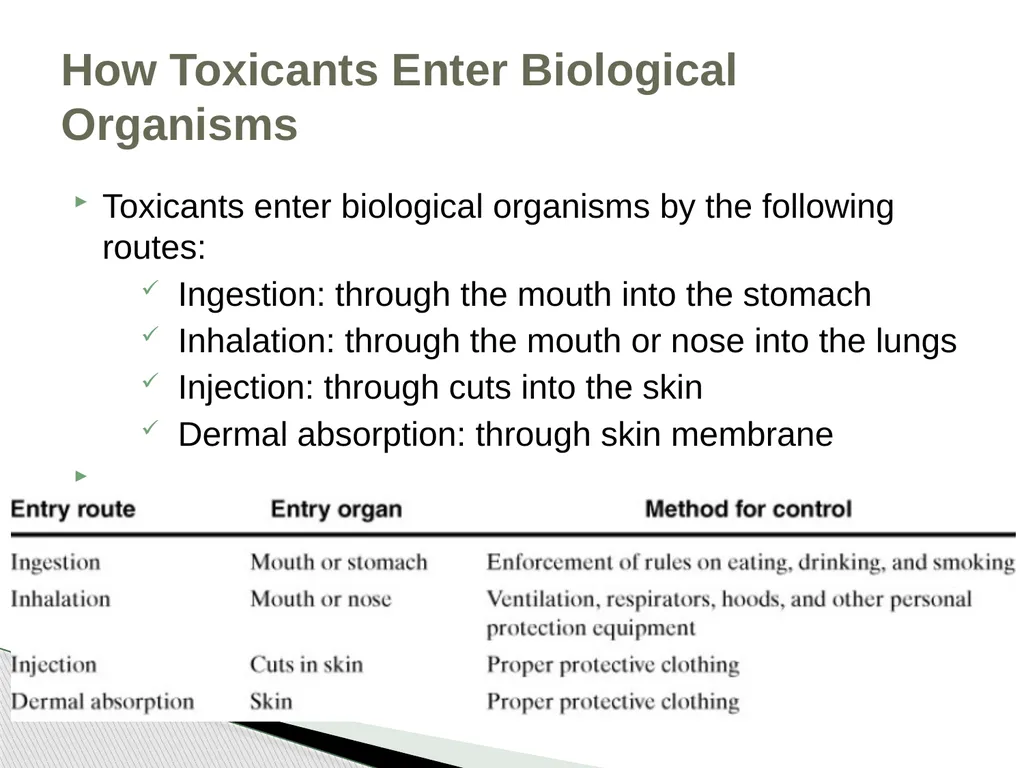
Toxicants enter biological organisms by the following routes:
Ingestion: through the mouth into the stomach
Inhalation: through the mouth or nose into the lungs
Injection: through cuts into the skin
Dermal absorption: through skin membrane How Toxicants Enter Biological Organisms<br>
Ingestion: through the mouth into the stomach
Inhalation: through the mouth or nose into the lungs
Injection: through cuts into the skin
Dermal absorption: through skin membrane How Toxicants Enter Biological Organisms<br>
06
All these entry routes are controlled by the application of proper industrial hygiene techniques
Inhalation and dermal routes are the most significant to industrial facilities
Inhalation is the easiest to quantify by the direct measurement of airborne concentrations
vapor, but small solid and liquid particles can also contribute
Toxicants that enter by injection and dermal absorption are difficult to measure and quantify.
Some toxicants are absorbed rapidly through the skin. How Toxicants Enter Biological Organisms<br>
Inhalation and dermal routes are the most significant to industrial facilities
Inhalation is the easiest to quantify by the direct measurement of airborne concentrations
vapor, but small solid and liquid particles can also contribute
Toxicants that enter by injection and dermal absorption are difficult to measure and quantify.
Some toxicants are absorbed rapidly through the skin. How Toxicants Enter Biological Organisms<br>
07
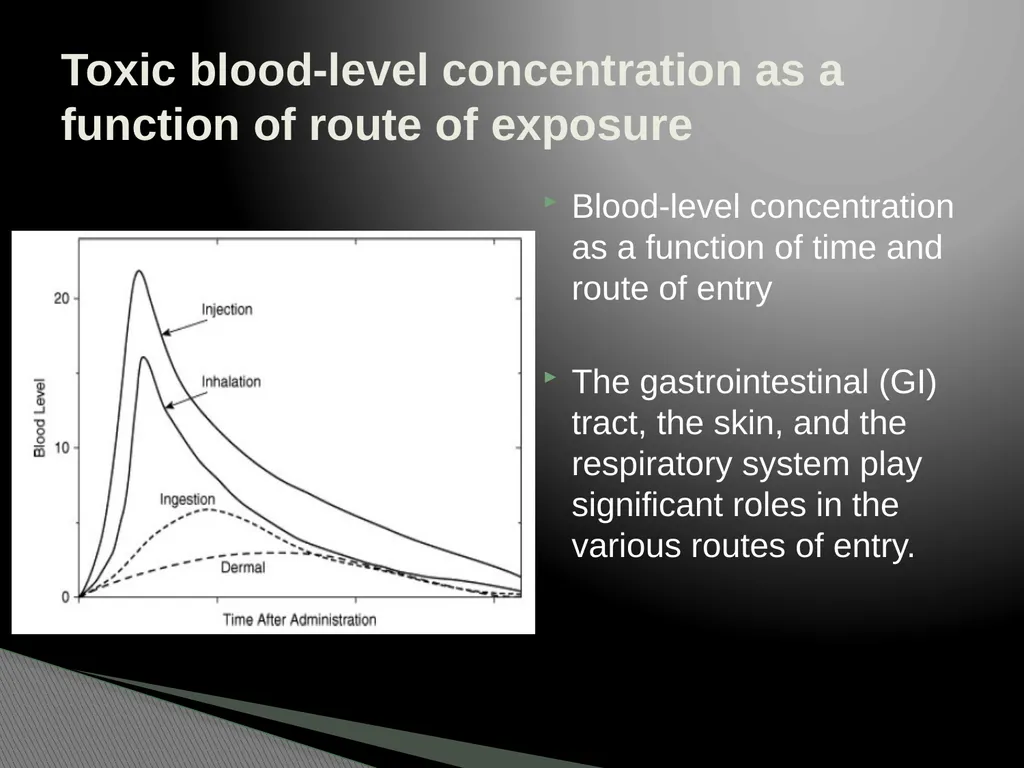
Blood-level concentration as a function of time and route of entry
The gastrointestinal (GI) tract, the skin, and the respiratory system play significant roles in the various routes of entry. Toxic blood-level concentration as a function of route of exposure<br>
The gastrointestinal (GI) tract, the skin, and the respiratory system play significant roles in the various routes of entry. Toxic blood-level concentration as a function of route of exposure<br>
08
Toxicants are eliminated or rendered inactive by the following routes
Excretion: through the kidneys, liver, lungs, or other organs
Detoxification: by changing the chemical into something less harmful by biotransformation
Storage: in the fatty tissue
The toxicants are extracted by the kidneys from the bloodstream and are excreted in the urine
The digestive tract tends to selectively detoxify certain agents
Inhalation, injection, or dermal absorption generally arrive in the bloodstream unchanged How Toxicants Are Eliminated from Biological Organisms<br>
Excretion: through the kidneys, liver, lungs, or other organs
Detoxification: by changing the chemical into something less harmful by biotransformation
Storage: in the fatty tissue
The toxicants are extracted by the kidneys from the bloodstream and are excreted in the urine
The digestive tract tends to selectively detoxify certain agents
Inhalation, injection, or dermal absorption generally arrive in the bloodstream unchanged How Toxicants Are Eliminated from Biological Organisms<br>
09
The lungs : Volatile Chloroform and alcohol,
Example: Excreted partially by this route
The liver: (detoxification) Biotransformation reactions can also occur in the blood, intestinal tract wall, skin, kidneys, and other organs
Storage: (Depositing) chemical agent mostly in the fatty areas of the organism but also in the bones, blood, liver, and kidney.
Storage can create a future problem if fatty deposits are metabolized; the stored chemical agents will be released into the bloodstream, resulting in possible damage. Eliminated from Biological Organisms<br>
Example: Excreted partially by this route
The liver: (detoxification) Biotransformation reactions can also occur in the blood, intestinal tract wall, skin, kidneys, and other organs
Storage: (Depositing) chemical agent mostly in the fatty areas of the organism but also in the bones, blood, liver, and kidney.
Storage can create a future problem if fatty deposits are metabolized; the stored chemical agents will be released into the bloodstream, resulting in possible damage. Eliminated from Biological Organisms<br>
10
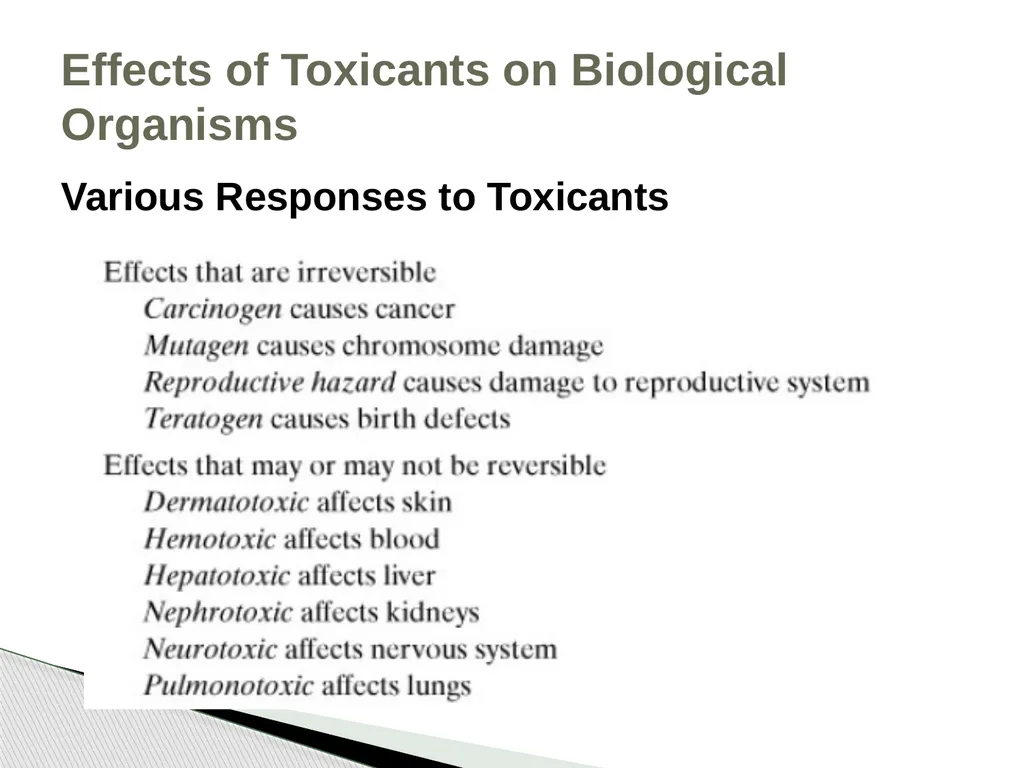
Various Responses to Toxicants Effects of Toxicants on Biological Organisms<br>
11
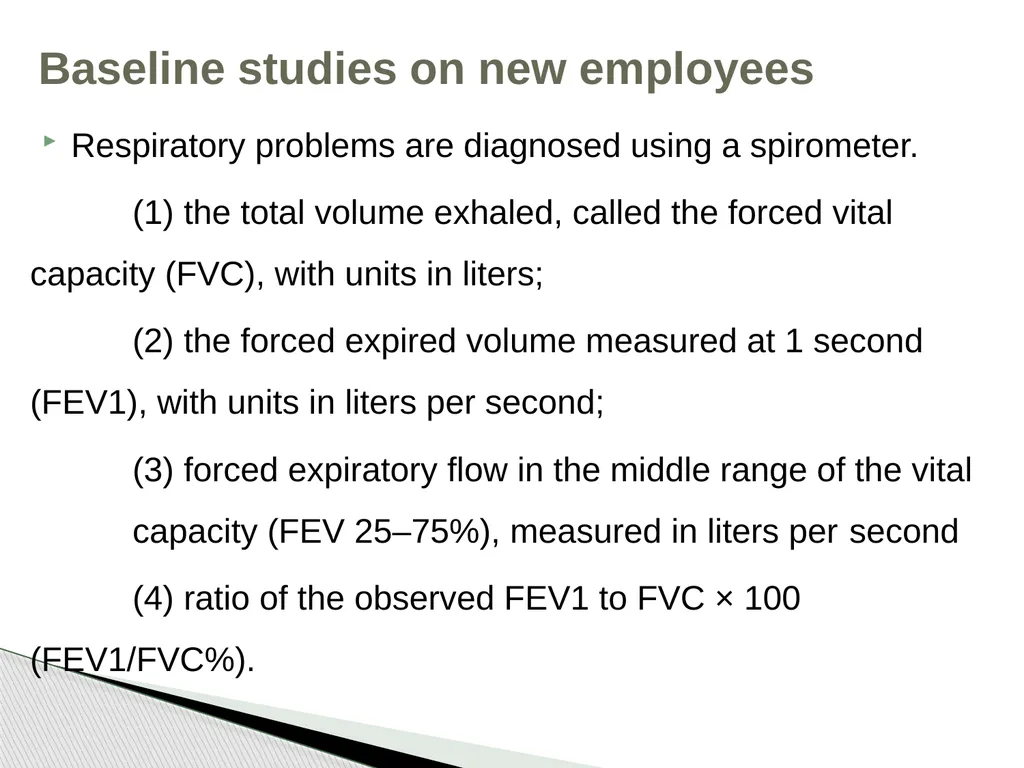
Respiratory problems are diagnosed using a spirometer.
(1) the total volume exhaled, called the forced vital capacity (FVC), with units in liters;
(2) the forced expired volume measured at 1 second (FEV1), with units in liters per second;
(3) forced expiratory flow in the middle range of the vital capacity (FEV 25–75%), measured in liters per second
(4) ratio of the observed FEV1 to FVC × 100 (FEV1/FVC%). Baseline studies on new employees<br>
(1) the total volume exhaled, called the forced vital capacity (FVC), with units in liters;
(2) the forced expired volume measured at 1 second (FEV1), with units in liters per second;
(3) forced expiratory flow in the middle range of the vital capacity (FEV 25–75%), measured in liters per second
(4) ratio of the observed FEV1 to FVC × 100 (FEV1/FVC%). Baseline studies on new employees<br>
12
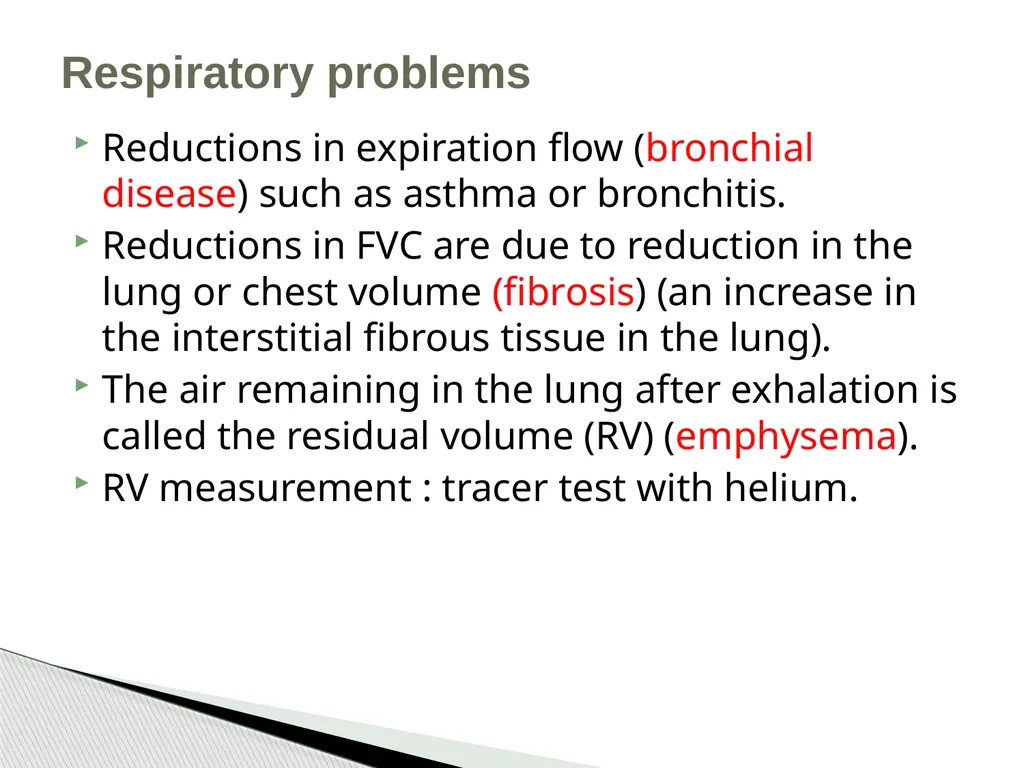
Reductions in expiration flow (bronchial disease) such as asthma or bronchitis.
Reductions in FVC are due to reduction in the lung or chest volume (fibrosis) (an increase in the interstitial fibrous tissue in the lung).
The air remaining in the lung after exhalation is called the residual volume (RV) (emphysema).
RV measurement : tracer test with helium. Respiratory problems<br>
Reductions in FVC are due to reduction in the lung or chest volume (fibrosis) (an increase in the interstitial fibrous tissue in the lung).
The air remaining in the lung after exhalation is called the residual volume (RV) (emphysema).
RV measurement : tracer test with helium. Respiratory problems<br>
13
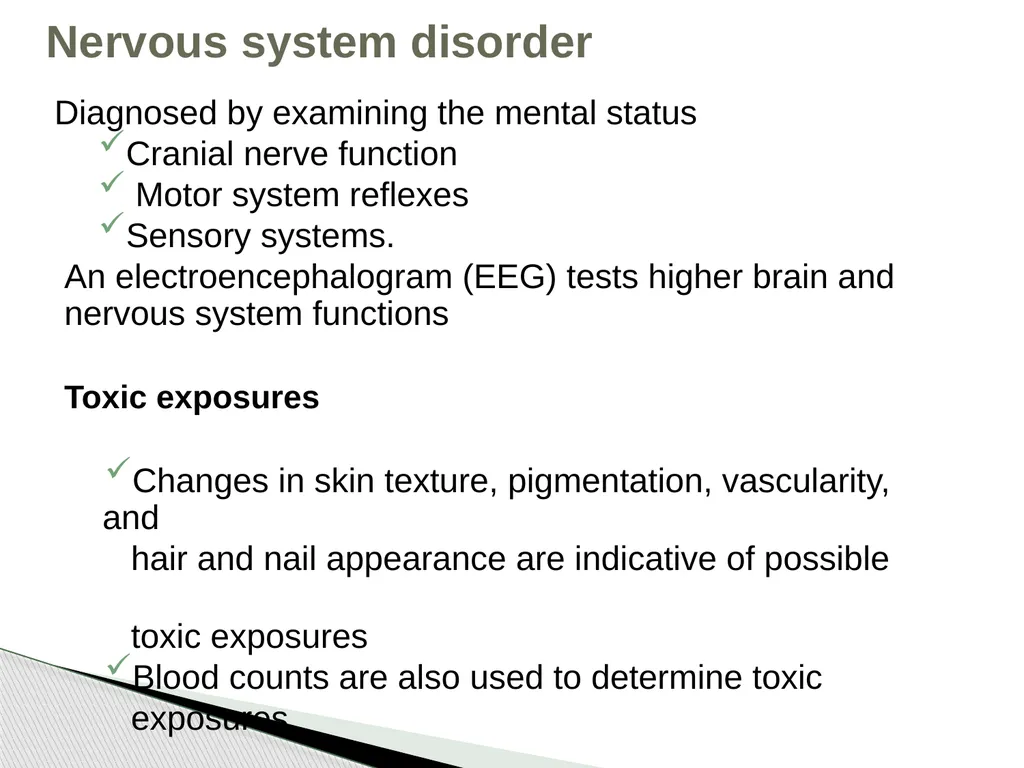
Diagnosed by examining the mental status
Cranial nerve function
Motor system reflexes
Sensory systems.
An electroencephalogram (EEG) tests higher brain and nervous system functions
Toxic exposures
Changes in skin texture, pigmentation, vascularity, and
hair and nail appearance are indicative of possible
toxic exposures
Blood counts are also used to determine toxic
exposures Nervous system disorder<br>
Cranial nerve function
Motor system reflexes
Sensory systems.
An electroencephalogram (EEG) tests higher brain and nervous system functions
Toxic exposures
Changes in skin texture, pigmentation, vascularity, and
hair and nail appearance are indicative of possible
toxic exposures
Blood counts are also used to determine toxic
exposures Nervous system disorder<br>
14
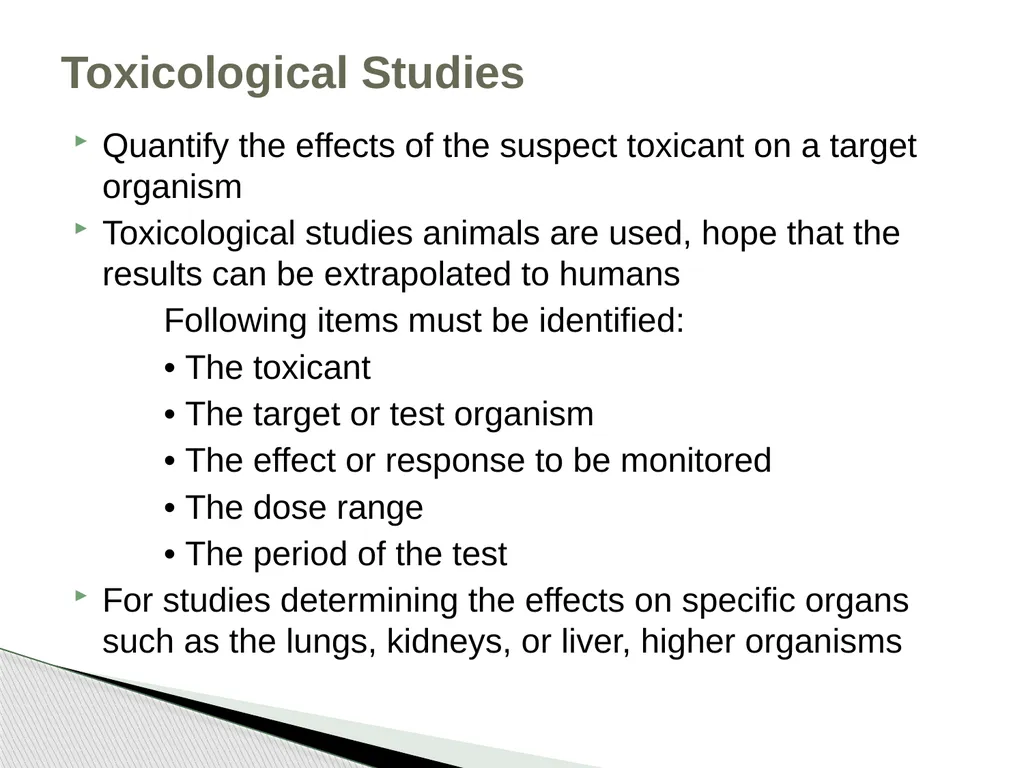
Quantify the effects of the suspect toxicant on a target organism
Toxicological studies animals are used, hope that the results can be extrapolated to humans
Following items must be identified:
• The toxicant
• The target or test organism
• The effect or response to be monitored
• The dose range
• The period of the test
For studies determining the effects on specific organs such as the lungs, kidneys, or liver, higher organisms Toxicological Studies<br>
Toxicological studies animals are used, hope that the results can be extrapolated to humans
Following items must be identified:
• The toxicant
• The target or test organism
• The effect or response to be monitored
• The dose range
• The period of the test
For studies determining the effects on specific organs such as the lungs, kidneys, or liver, higher organisms Toxicological Studies<br>
15
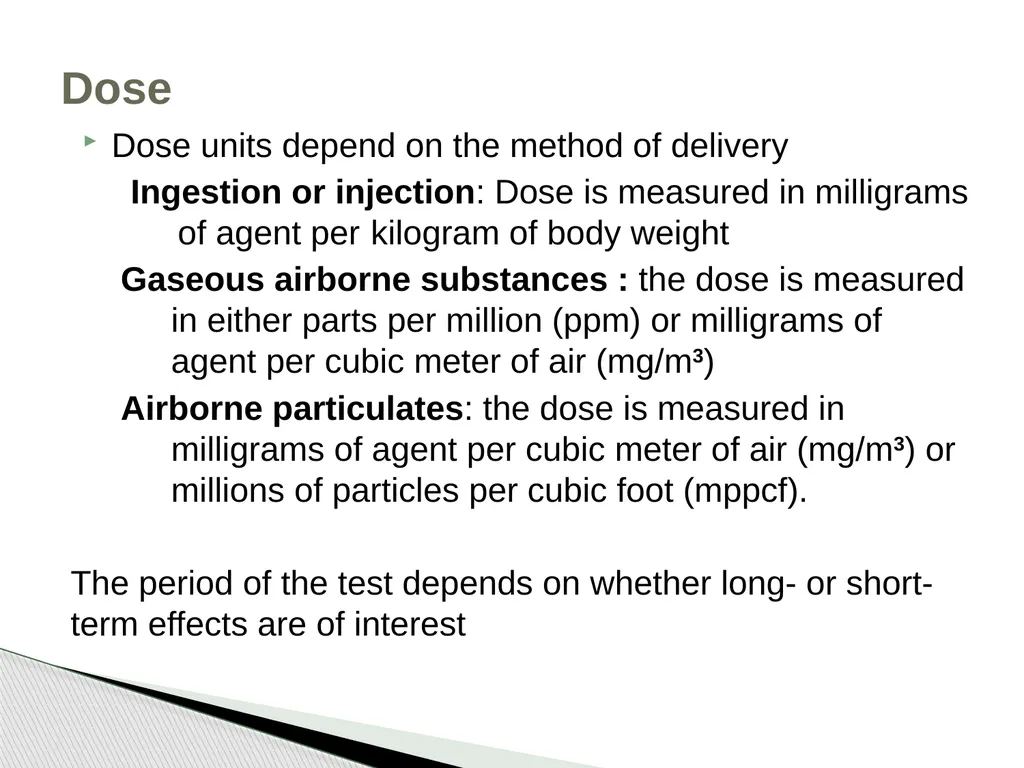
Dose units depend on the method of delivery
Ingestion or injection: Dose is measured in milligrams of agent per kilogram of body weight
Gaseous airborne substances : the dose is measured in either parts per million (ppm) or milligrams of agent per cubic meter of air (mg/m3)
Airborne particulates: the dose is measured in milligrams of agent per cubic meter of air (mg/m3) or millions of particles per cubic foot (mppcf).
The period of the test depends on whether long- or short-term effects are of interest Dose<br>
Ingestion or injection: Dose is measured in milligrams of agent per kilogram of body weight
Gaseous airborne substances : the dose is measured in either parts per million (ppm) or milligrams of agent per cubic meter of air (mg/m3)
Airborne particulates: the dose is measured in milligrams of agent per cubic meter of air (mg/m3) or millions of particles per cubic foot (mppcf).
The period of the test depends on whether long- or short-term effects are of interest Dose<br>
16
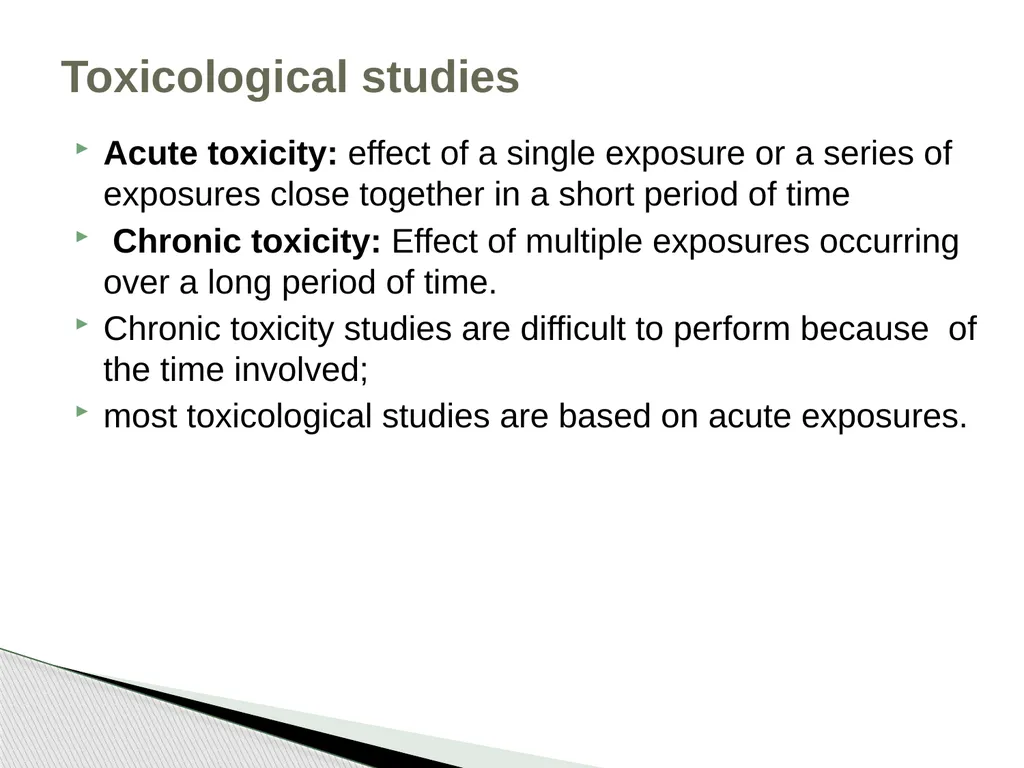
Acute toxicity: effect of a single exposure or a series of exposures close together in a short period of time
Chronic toxicity: Effect of multiple exposures occurring over a long period of time.
Chronic toxicity studies are difficult to perform because of the time involved;
most toxicological studies are based on acute exposures. Toxicological studies<br>
Chronic toxicity: Effect of multiple exposures occurring over a long period of time.
Chronic toxicity studies are difficult to perform because of the time involved;
most toxicological studies are based on acute exposures. Toxicological studies<br>
17
25/8/20 End of lecturer -3
Thank you<br>
Thank you<br>
18
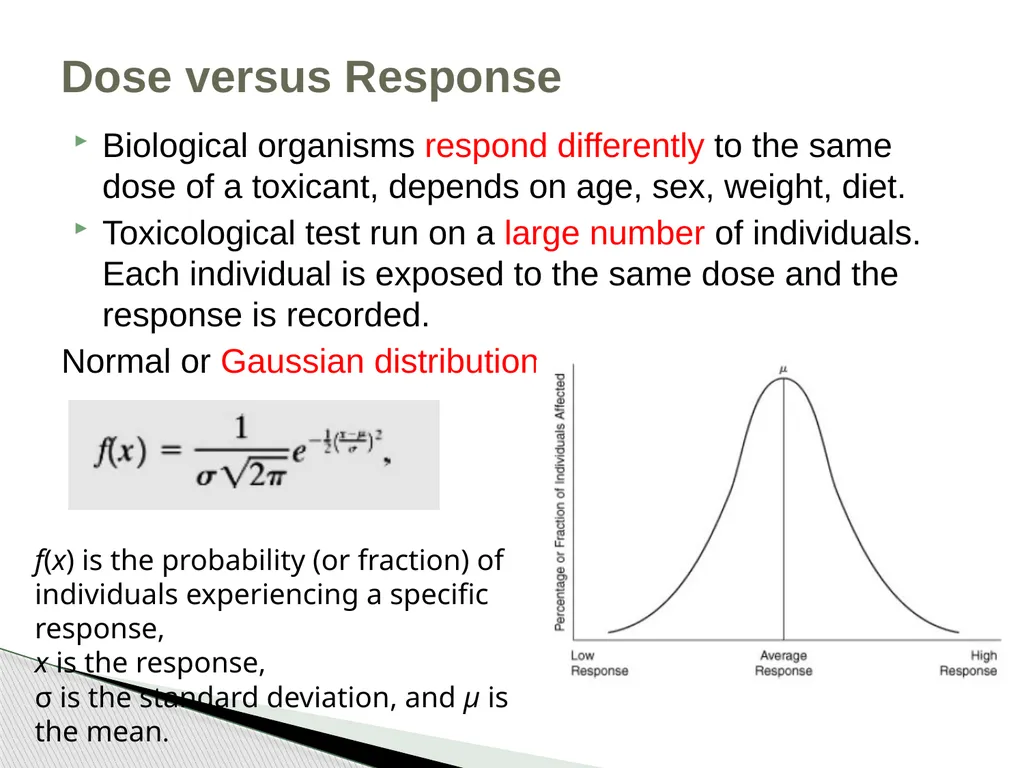
Biological organisms respond differently to the same dose of a toxicant, depends on age, sex, weight, diet.
Toxicological test run on a large number of individuals. Each individual is exposed to the same dose and the response is recorded.
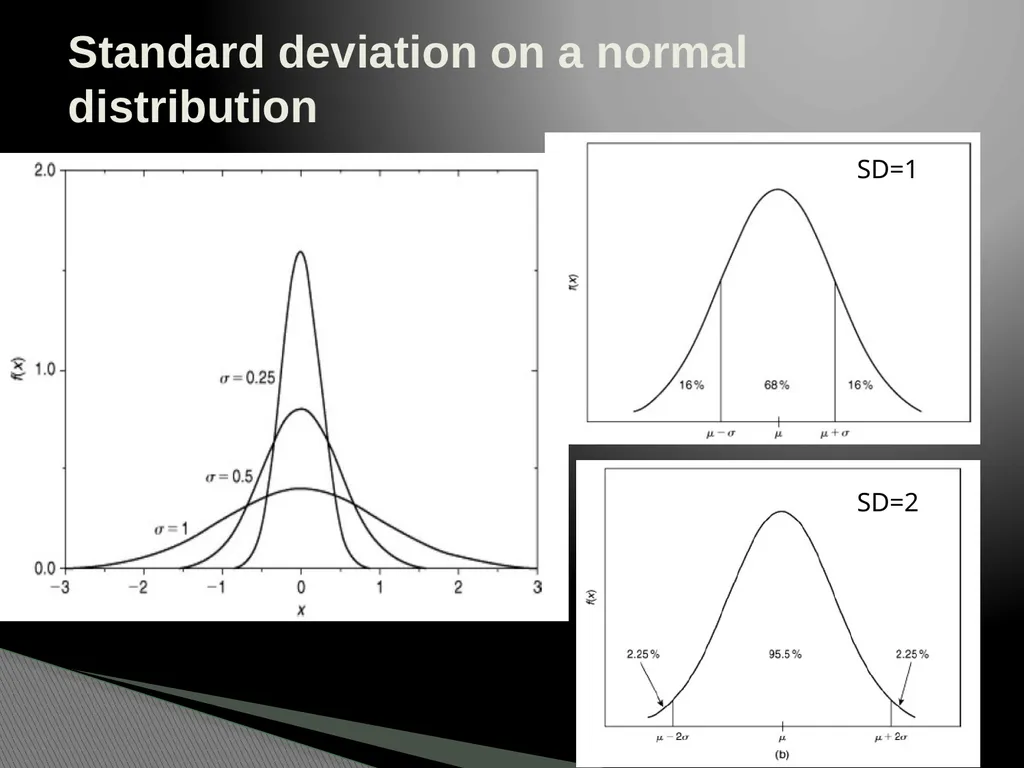
Normal or Gaussian distribution Dose versus Response f(x) is the probability (or fraction) of individuals experiencing a specific response,
x is the response,
σ is the standard deviation, and μ is the mean.<br>
Toxicological test run on a large number of individuals. Each individual is exposed to the same dose and the response is recorded.
Normal or Gaussian distribution Dose versus Response f(x) is the probability (or fraction) of individuals experiencing a specific response,
x is the response,
σ is the standard deviation, and μ is the mean.<br>
19
Standard deviation on a normal distribution SD=1 SD=2<br>
20
As the standard deviation decreases, the distribution curve becomes more pronounced around the mean value.
The area under the curve represents the percentage of individuals affected for a specified response interval.
1 standard deviation of the mean represents 68% of the individuals
Response interval of 2 standard deviations represents 95.5% of the total individuals
The area under the entire curve represents 100% of the individuals. Standard deviation on a normal distribution<br>
The area under the curve represents the percentage of individuals affected for a specified response interval.
1 standard deviation of the mean represents 68% of the individuals
Response interval of 2 standard deviations represents 95.5% of the total individuals
The area under the entire curve represents 100% of the individuals. Standard deviation on a normal distribution<br>
21
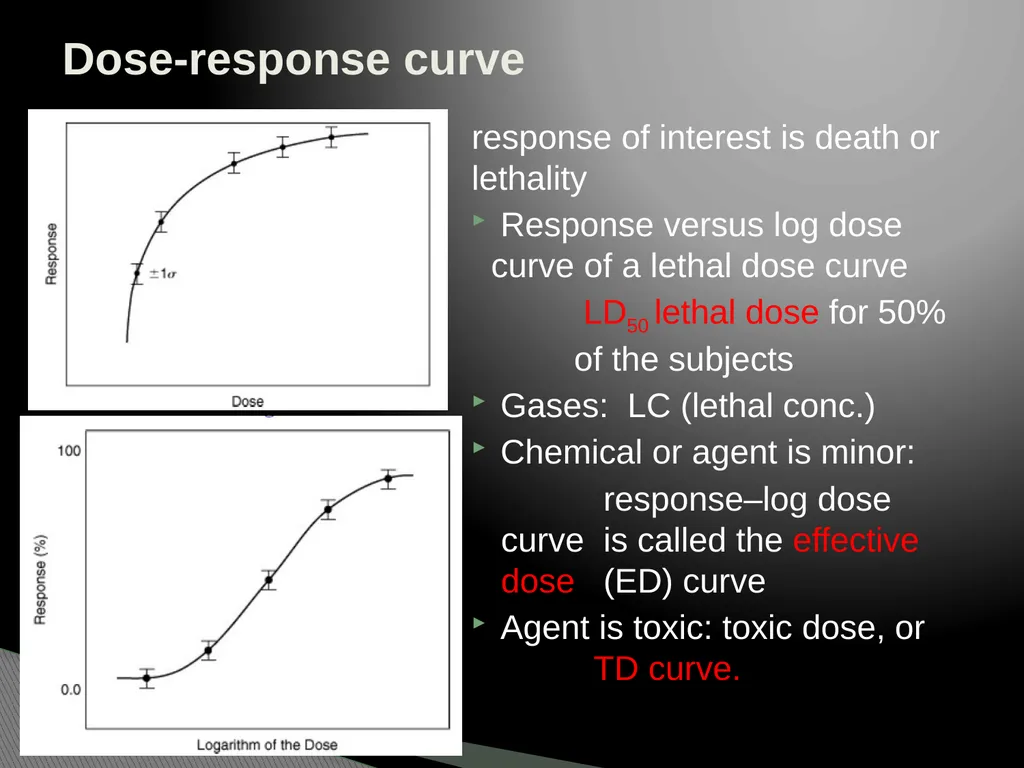
response of interest is death or lethality
Response versus log dose curve of a lethal dose curve
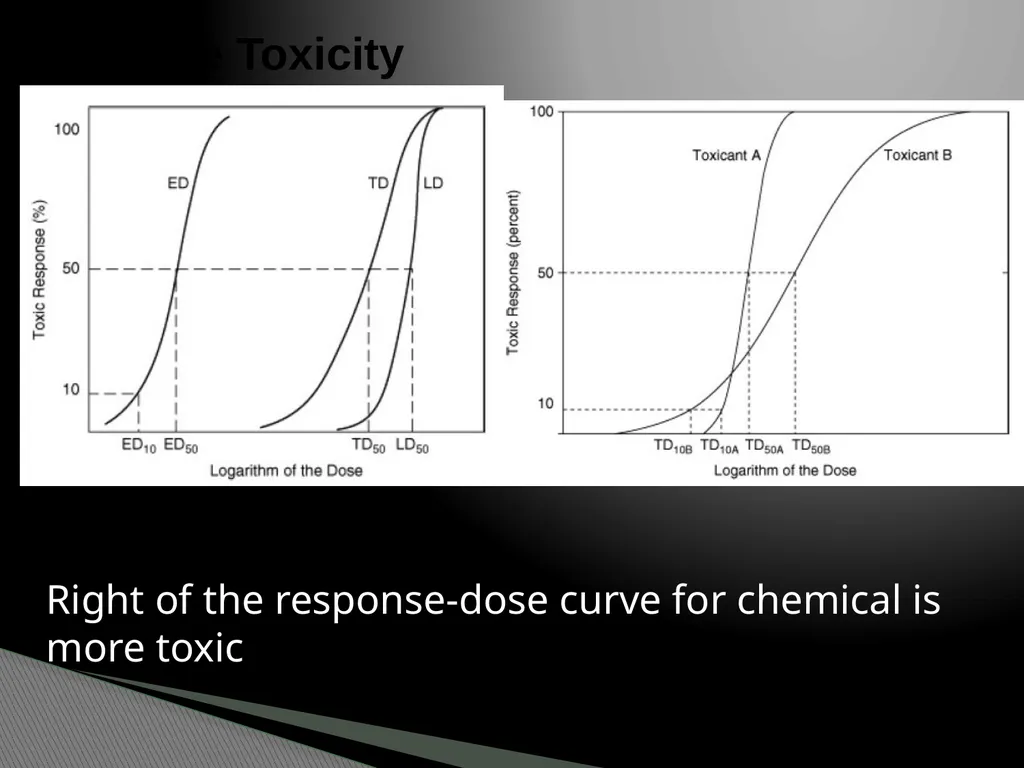
LD50 lethal dose for 50% of the subjects
Gases: LC (lethal conc.)
Chemical or agent is minor:
response–log dose curve is called the effective dose (ED) curve
Agent is toxic: toxic dose, or TD curve. Dose-response curve<br>
Response versus log dose curve of a lethal dose curve
LD50 lethal dose for 50% of the subjects
Gases: LC (lethal conc.)
Chemical or agent is minor:
response–log dose curve is called the effective dose (ED) curve
Agent is toxic: toxic dose, or TD curve. Dose-response curve<br>
22
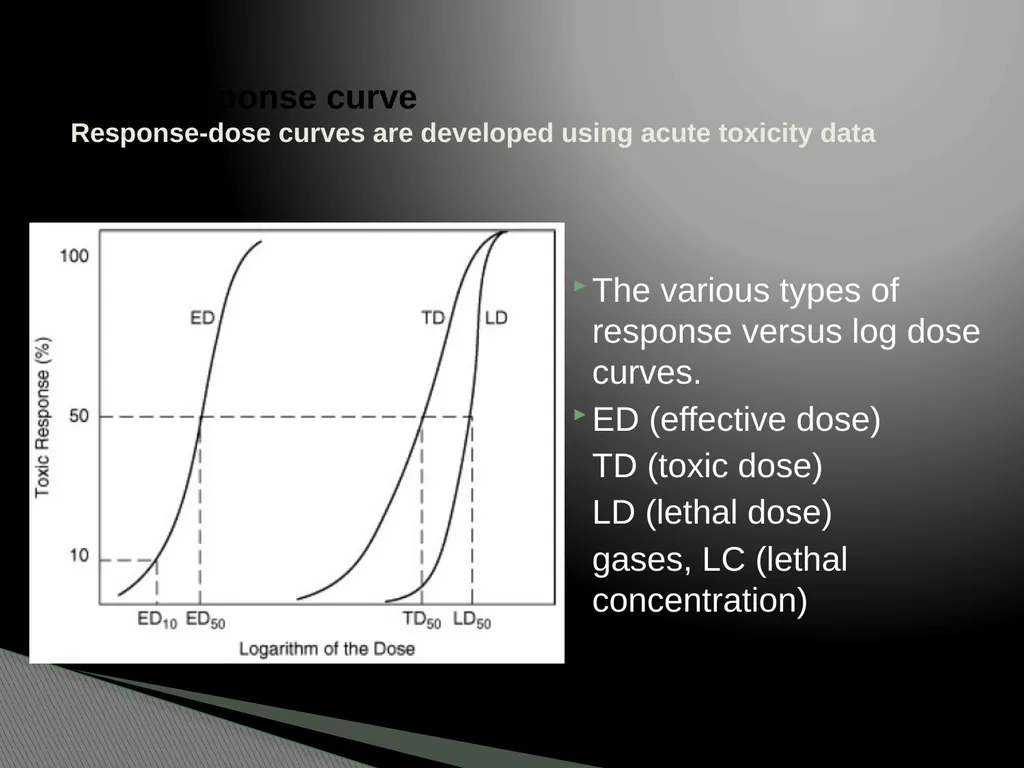
The various types of response versus log dose curves.
ED (effective dose)
TD (toxic dose)
LD (lethal dose)
gases, LC (lethal concentration) Dose-response curve Response-dose curves are developed using acute toxicity data<br>
ED (effective dose)
TD (toxic dose)
LD (lethal dose)
gases, LC (lethal concentration) Dose-response curve Response-dose curves are developed using acute toxicity data<br>
23
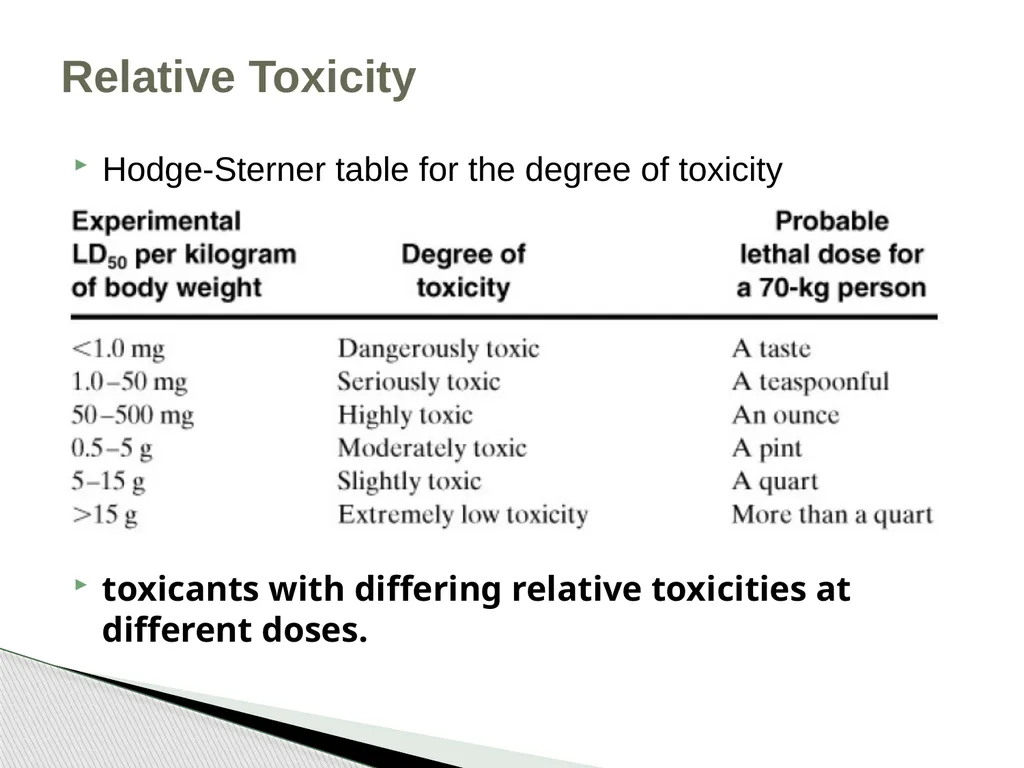
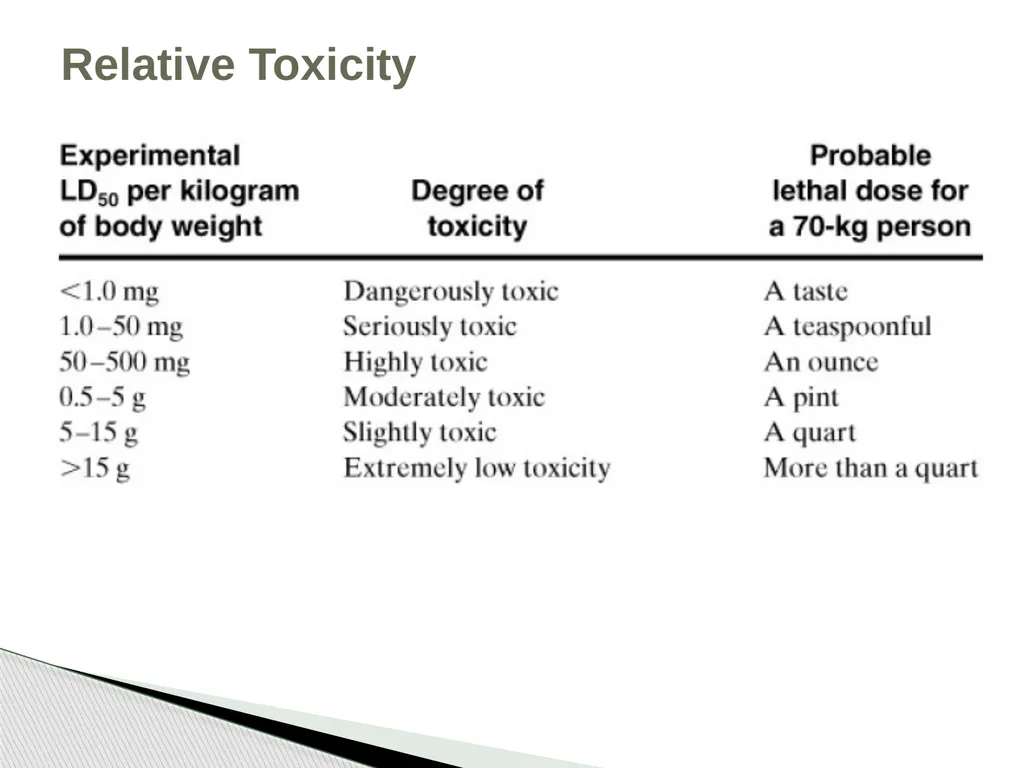
Hodge-Sterner table for the degree of toxicity
toxicants with differing relative toxicities at different doses. Relative Toxicity<br>
toxicants with differing relative toxicities at different doses. Relative Toxicity<br>
24
Right of the response-dose curve for chemical is more toxic Relative Toxicity<br>
25
Relative Toxicity<br>
26
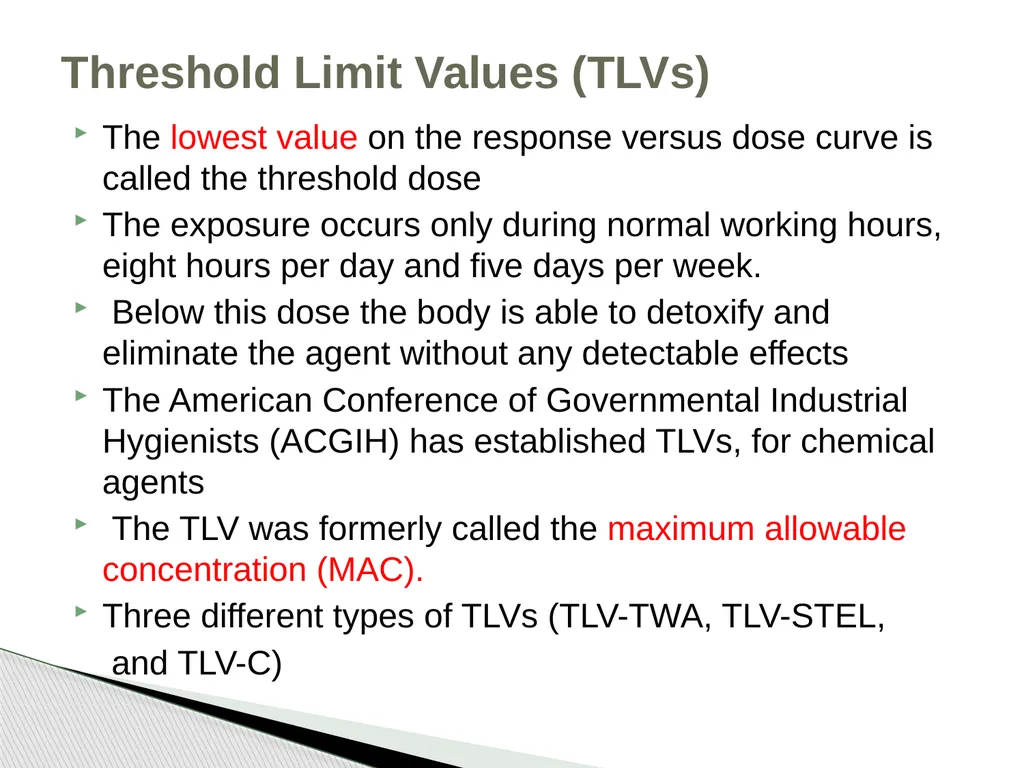
The lowest value on the response versus dose curve is called the threshold dose
The exposure occurs only during normal working hours, eight hours per day and five days per week.
Below this dose the body is able to detoxify and eliminate the agent without any detectable effects
The American Conference of Governmental Industrial Hygienists (ACGIH) has established TLVs, for chemical agents
The TLV was formerly called the maximum allowable concentration (MAC).
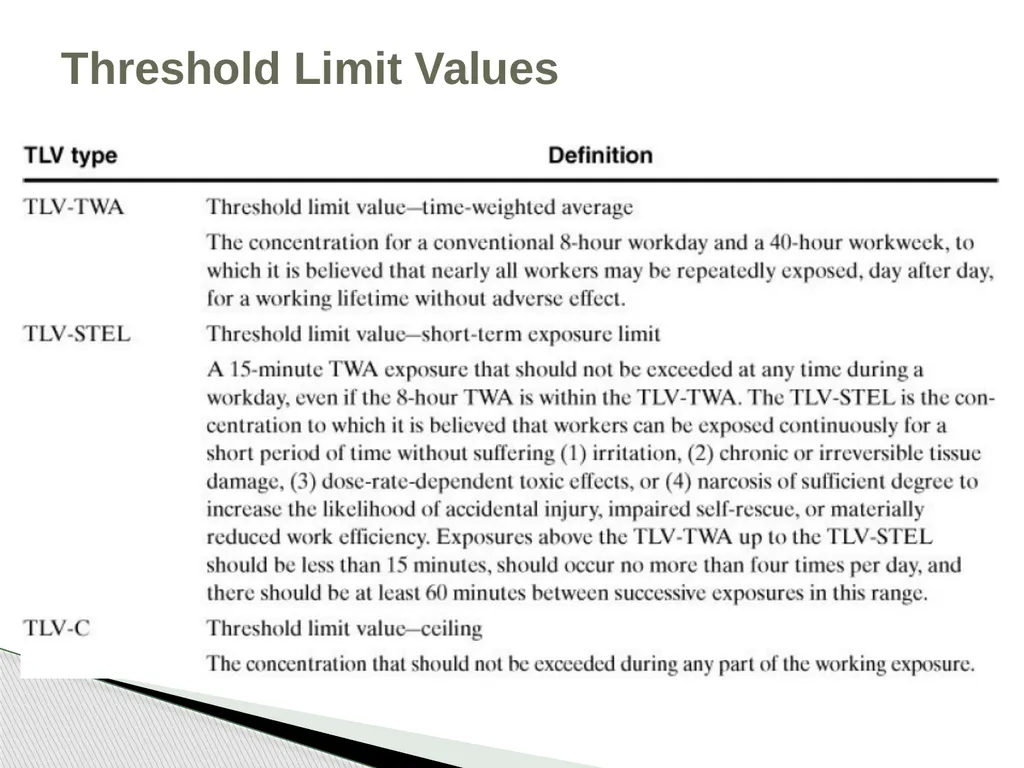
Three different types of TLVs (TLV-TWA, TLV-STEL,
and TLV-C) Threshold Limit Values (TLVs)<br>
The exposure occurs only during normal working hours, eight hours per day and five days per week.
Below this dose the body is able to detoxify and eliminate the agent without any detectable effects
The American Conference of Governmental Industrial Hygienists (ACGIH) has established TLVs, for chemical agents
The TLV was formerly called the maximum allowable concentration (MAC).
Three different types of TLVs (TLV-TWA, TLV-STEL,
and TLV-C) Threshold Limit Values (TLVs)<br>
27
Threshold Limit Values<br>
28
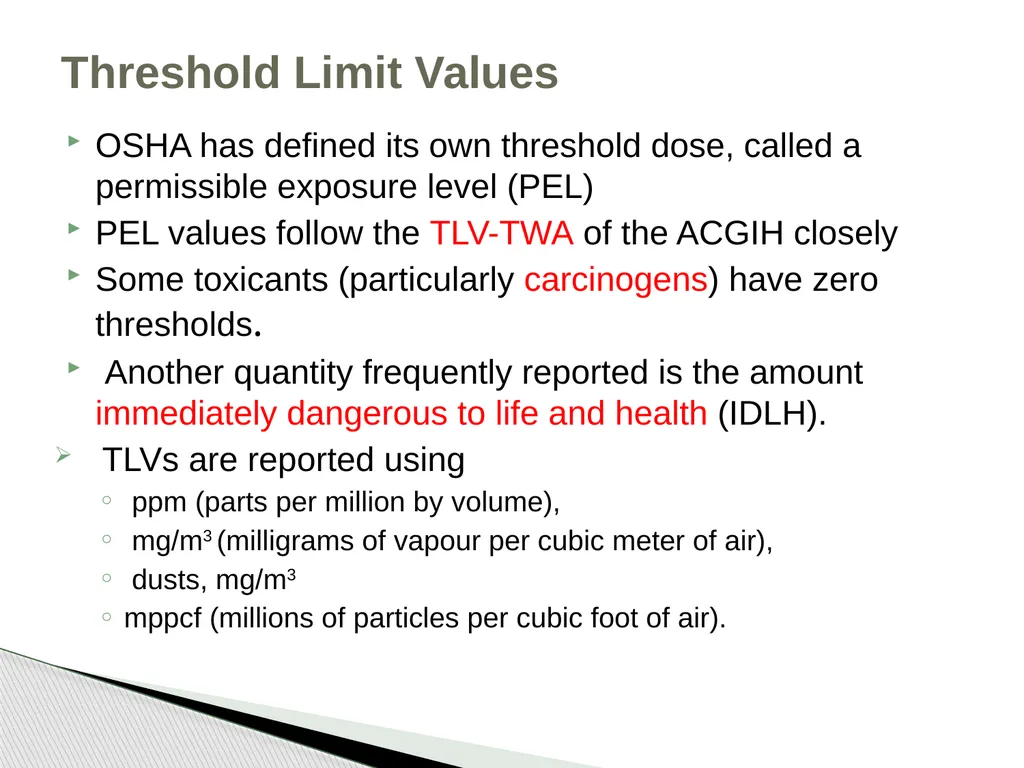
OSHA has defined its own threshold dose, called a permissible exposure level (PEL)
PEL values follow the TLV-TWA of the ACGIH closely
Some toxicants (particularly carcinogens) have zero thresholds.
Another quantity frequently reported is the amount immediately dangerous to life and health (IDLH).
TLVs are reported using
ppm (parts per million by volume),
mg/m3 (milligrams of vapour per cubic meter of air),
dusts, mg/m3
mppcf (millions of particles per cubic foot of air). Threshold Limit Values<br>
PEL values follow the TLV-TWA of the ACGIH closely
Some toxicants (particularly carcinogens) have zero thresholds.
Another quantity frequently reported is the amount immediately dangerous to life and health (IDLH).
TLVs are reported using
ppm (parts per million by volume),
mg/m3 (milligrams of vapour per cubic meter of air),
dusts, mg/m3
mppcf (millions of particles per cubic foot of air). Threshold Limit Values<br>
29
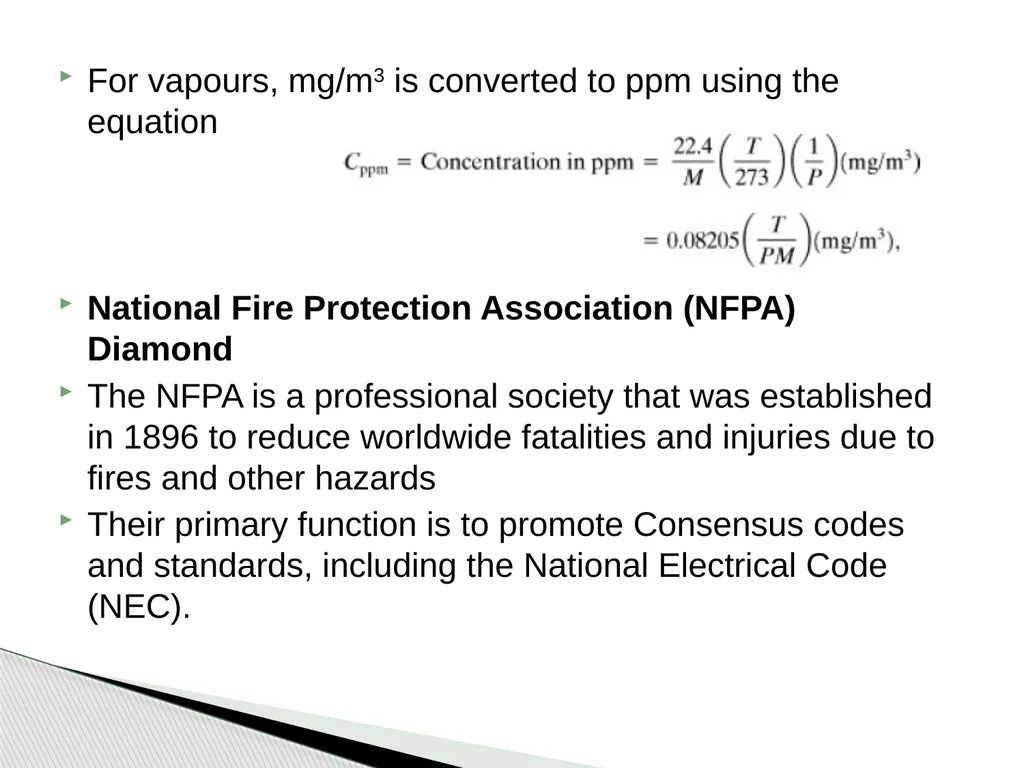
For vapours, mg/m3 is converted to ppm using the equation
National Fire Protection Association (NFPA) Diamond
The NFPA is a professional society that was established in 1896 to reduce worldwide fatalities and injuries due to fires and other hazards
Their primary function is to promote Consensus codes and standards, including the National Electrical Code (NEC).<br>
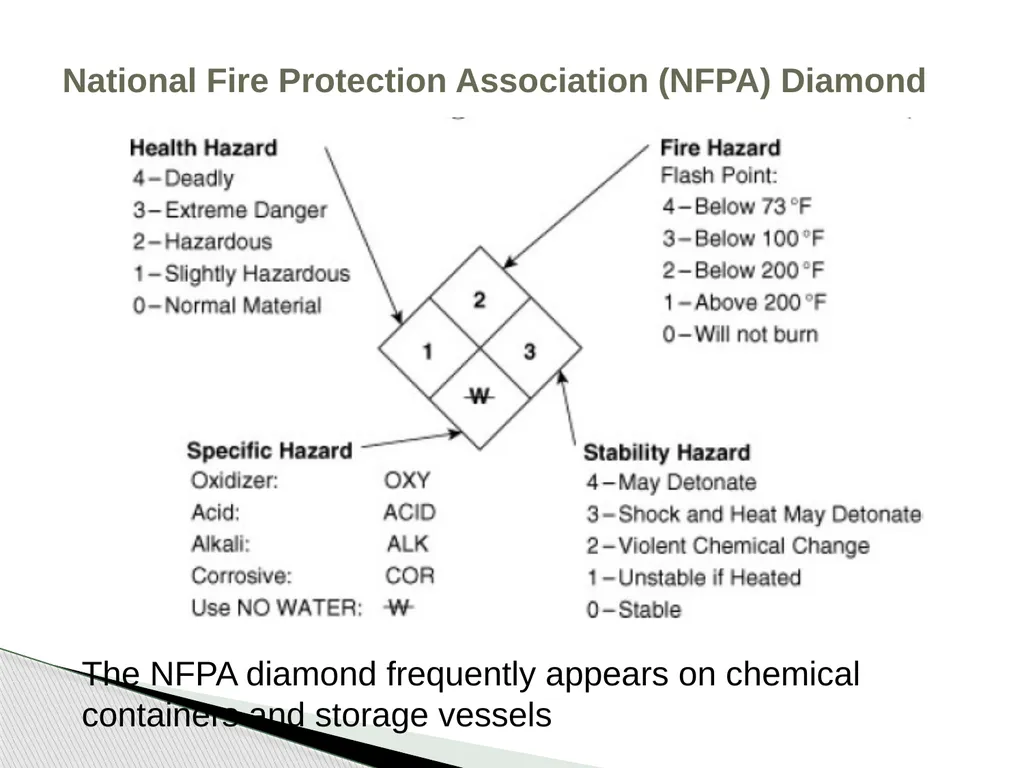
National Fire Protection Association (NFPA) Diamond
The NFPA is a professional society that was established in 1896 to reduce worldwide fatalities and injuries due to fires and other hazards
Their primary function is to promote Consensus codes and standards, including the National Electrical Code (NEC).<br>
30
National Fire Protection Association (NFPA) Diamond The NFPA diamond frequently appears on chemical containers and storage vessels<br>
31
American Conference of Governmental Industrial Hygienists (ACGIH), www.acgih.org.
NIOSH Pocket Guide to Chemical Hazards. www.cdc.gov/niosh/npg/
Society of Toxicology www.toxicology.org.
TOXNET, Toxicology Data Network provided by the U.S. www.toxnet.nlm.nih.gov.
U.S. Department of Labor, Occupational Safety and Health Administration.
www.osha.gov On-Line Resources<br>
NIOSH Pocket Guide to Chemical Hazards. www.cdc.gov/niosh/npg/
Society of Toxicology www.toxicology.org.
TOXNET, Toxicology Data Network provided by the U.S. www.toxnet.nlm.nih.gov.
U.S. Department of Labor, Occupational Safety and Health Administration.
www.osha.gov On-Line Resources<br>
32
27/8/20 END of Lecturer-4
Thankyou<br>
Thankyou<br>