
CHAPTER 22 Toxicology National EMS Education
FD
Published · 131 slides · 0 views

1 / 1


Description
CHAPTER 22 Toxicology National EMS Education Standard Competencies (1 of 3) Medicine Applies fundamental knowledge to provide basic emergency care and transportation based on assessment findings for an acutely ill patient. National EMS
Related Topics
Share
Embed code
Download this presentation From Below
"CHAPTER 22 Toxicology National EMS Education" is the property of its rightful owner. Permission is granted to download and print the materials on this website for personal, non-commercial use only, and to display it on your personal computer provided you do not modify the materials and that you retain all copyright notices contained in the materials. By downloading content from our website, you accept the terms of this agreement.
Presentation Transcript
01
CHAPTER 22 Toxicology<br>
02
National EMS Education Standard Competencies (1 of 3) Medicine
Applies fundamental knowledge to provide basic emergency care and transportation based on assessment findings for an acutely ill patient.<br>
Applies fundamental knowledge to provide basic emergency care and transportation based on assessment findings for an acutely ill patient.<br>
03
National EMS Education Standard Competencies (2 of 3) Toxicology
Recognition and management of
Carbon monoxide poisoning
Nerve agent poisoning
How and when to contact a poison control center<br>
Recognition and management of
Carbon monoxide poisoning
Nerve agent poisoning
How and when to contact a poison control center<br>
04
National EMS Education Standard Competencies (3 of 3) Anatomy, physiology, pathophysiology, assessment, and management of
Inhaled poisons
Ingested poisons
Injected poisons
Absorbed poisons
Alcohol intoxication and withdrawal<br>
Inhaled poisons
Ingested poisons
Injected poisons
Absorbed poisons
Alcohol intoxication and withdrawal<br>
05
Introduction (1 of 2) Every day, we come into contact with potentially poisonous things.
Acute poisoning affects over 2 million people each year.
Chronic poisoning is more common.<br>
Acute poisoning affects over 2 million people each year.
Chronic poisoning is more common.<br>
06
Introduction (2 of 2) Deaths caused by poisoning are fairly rare.
Poisoning in children has decreased steadily since the 1960s due to child-resistant caps.
Deaths caused by chronic poisoning in adults have been rising as a result of drug abuse.<br>
Poisoning in children has decreased steadily since the 1960s due to child-resistant caps.
Deaths caused by chronic poisoning in adults have been rising as a result of drug abuse.<br>
07
Identifying the Patient and the Poison (1 of 6) Toxicology is the study of toxic or poisonous substances.
Poison: any substance whose chemical action can damage body structures or impair body function
Toxin: a poisonous substance produced by bacteria, animals, or plants
Substance abuse: the misuse of any substance to produce a desired effect.
Overdose: a toxic dose of a drug.<br>
Poison: any substance whose chemical action can damage body structures or impair body function
Toxin: a poisonous substance produced by bacteria, animals, or plants
Substance abuse: the misuse of any substance to produce a desired effect.
Overdose: a toxic dose of a drug.<br>
08
Identifying the Patient and the Poison (2 of 6) Your primary responsibility to the patient is to recognize that a poisoning has occurred.
Pay attention to your surroundings.
Very small amounts of some poisons can cause considerable damage or death.
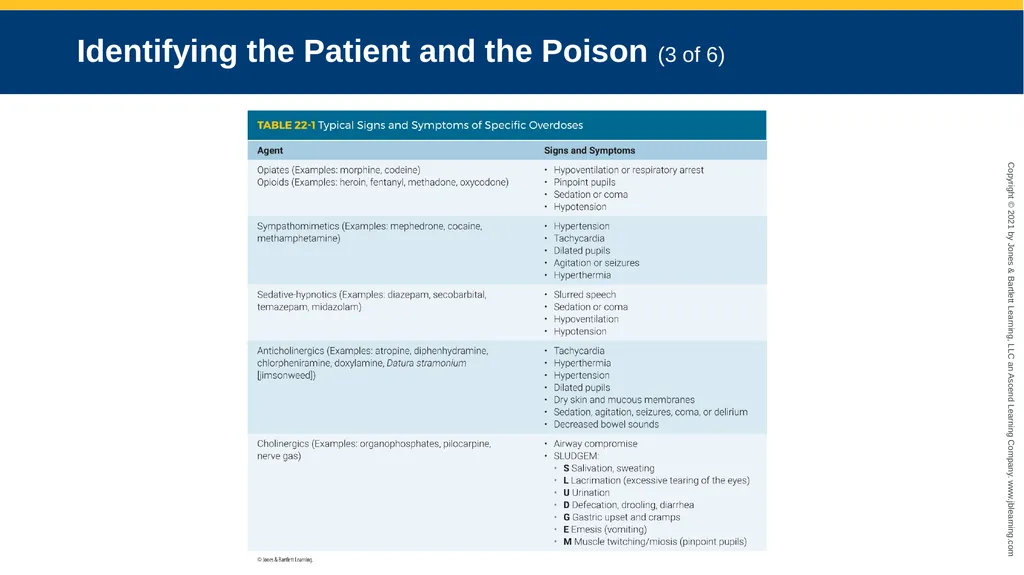
The signs and symptoms of poisoning vary according to the specific agent.<br>
Pay attention to your surroundings.
Very small amounts of some poisons can cause considerable damage or death.
The signs and symptoms of poisoning vary according to the specific agent.<br>
09
Identifying the Patient and the Poison (3 of 6)<br>
10
Identifying the Patient and the Poison (4 of 6) If possible, ask the patient:
What substance did you take?
When did you take it (or become exposed to it)?
How much did you ingest?
Did you have anything to eat or drink before or after you took it?
Has anyone given you an antidote or any substance orally since you ingested it?
How much do you weigh?<br>
What substance did you take?
When did you take it (or become exposed to it)?
How much did you ingest?
Did you have anything to eat or drink before or after you took it?
Has anyone given you an antidote or any substance orally since you ingested it?
How much do you weigh?<br>
11
Identifying the Patient and the Poison (5 of 6) Try to determine the nature of the poison.
Look around the immediate area for clues.
Take any suspicious material with you.
Containers at the scene can provide critical information.<br>
Look around the immediate area for clues.
Take any suspicious material with you.
Containers at the scene can provide critical information.<br>
12
Identifying the Patient and the Poison (6 of 6) If the patient vomits, examine the contents for pill fragments.
Note and document anything unusual that you see.<br>
Note and document anything unusual that you see.<br>
13
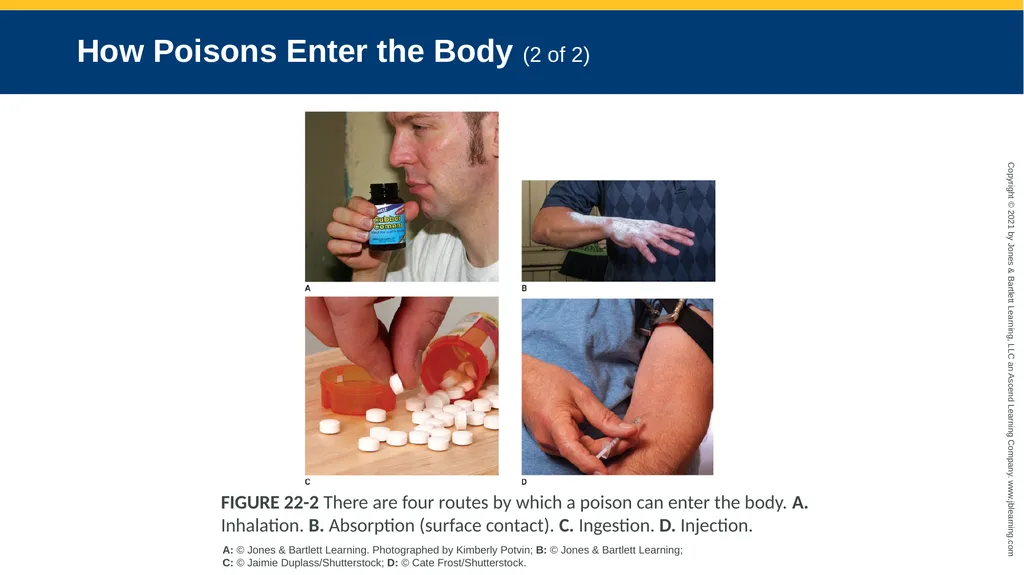
How Poisons Enter the Body (1 of 2) How you provide treatment depends on how the poison got into the patient’s body.
Four routes to consider:
Inhalation
Absorption
Ingestion
Injection
All four routes can lead to life-threatening conditions.<br>
Four routes to consider:
Inhalation
Absorption
Ingestion
Injection
All four routes can lead to life-threatening conditions.<br>
14
How Poisons Enter the Body (2 of 2) FIGURE 22-2 There are four routes by which a poison can enter the body. A. Inhalation. B. Absorption (surface contact). C. Ingestion. D. Injection. A: © Jones & Bartlett Learning. Photographed by Kimberly Potvin; B: © Jones & Bartlett Learning;
C: © Jaimie Duplass/Shutterstock; D: © Cate Frost/Shutterstock.<br>
C: © Jaimie Duplass/Shutterstock; D: © Cate Frost/Shutterstock.<br>
15
Inhaled Poisons (1 of 3) Move the patient into fresh air immediately.
The patient may require supplemental oxygen.
If you suspect the presence of a toxic gas, call for specialized resources such as the hazmat team.<br>
The patient may require supplemental oxygen.
If you suspect the presence of a toxic gas, call for specialized resources such as the hazmat team.<br>
16
Inhaled Poisons (2 of 3) Some patients may need decontamination by the hazmat team after removal from the toxic environment.
All patients who have inhaled poison require immediate transport.
Be prepared to use supplemental oxygen.
Make sure a suctioning unit is available.<br>
All patients who have inhaled poison require immediate transport.
Be prepared to use supplemental oxygen.
Make sure a suctioning unit is available.<br>
17
Inhaled Poisons (3 of 3) Some patients use inhaled poisons to commit suicide in a vehicle.
Exhaust fumes contain high levels of carbon monoxide.<br>
Exhaust fumes contain high levels of carbon monoxide.<br>
18
Absorbed and Surface Contact Poisons (1 of 6) Can affect the patient in many ways:
Skin, mucous membrane, or eye damage
Chemical burns
Rashes or lesions
Systemic effects
It is important to distinguish between contact burns and contact absorption.<br>
Skin, mucous membrane, or eye damage
Chemical burns
Rashes or lesions
Systemic effects
It is important to distinguish between contact burns and contact absorption.<br>
19
Absorbed and Surface Contact Poisons (2 of 6) Signs and symptoms include:
A history of exposure
Liquid or powder on a patient’s skin
Burns
Itching
Irritation
Redness of skin
Typical odors of the substance<br>
A history of exposure
Liquid or powder on a patient’s skin
Burns
Itching
Irritation
Redness of skin
Typical odors of the substance<br>
20
Absorbed and Surface Contact Poisons (3 of 6) Emergency treatment:
Avoid contaminating yourself or others.
Remove the substance from patient as rapidly as possible.
Remove all contaminated clothing.
Flush and wash the skin.<br>
Avoid contaminating yourself or others.
Remove the substance from patient as rapidly as possible.
Remove all contaminated clothing.
Flush and wash the skin.<br>
21
Absorbed and Surface Contact Poisons (4 of 6) If dry powder has been spilled, brush off the powder, flood the area with water for 15 to 20 minutes, then wash skin with soap and water.
If liquid has been spilled onto the skin, flood for 15 to 20 minutes.<br>
If liquid has been spilled onto the skin, flood for 15 to 20 minutes.<br>
22
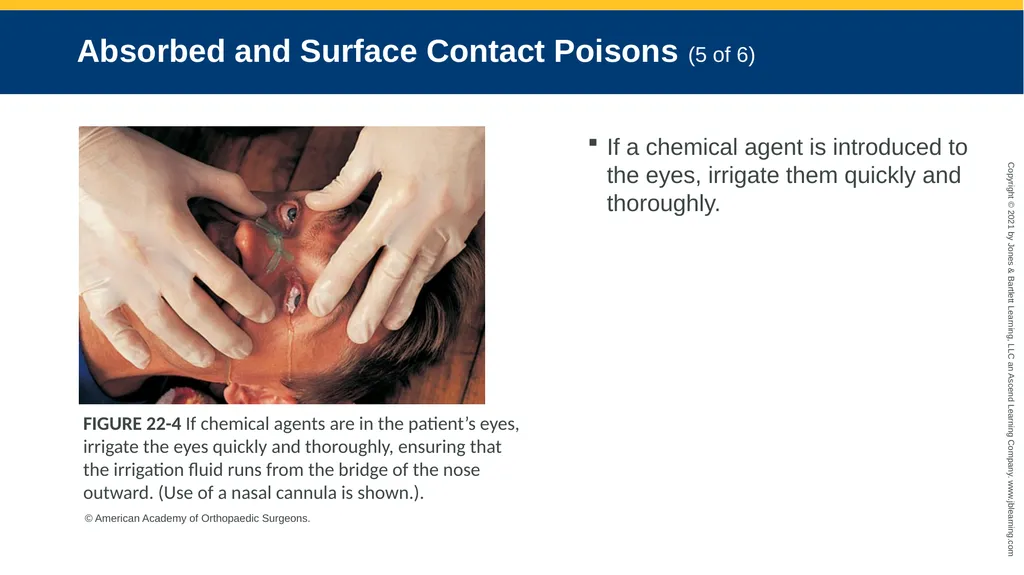
Absorbed and Surface Contact Poisons (5 of 6) If a chemical agent is introduced to the eyes, irrigate them quickly and thoroughly. FIGURE 22-4 If chemical agents are in the patient’s eyes, irrigate the eyes quickly and thoroughly, ensuring that the irrigation fluid runs from the bridge of the nose outward. (Use of a nasal cannula is shown.). © American Academy of Orthopaedic Surgeons.<br>
23
Absorbed and Surface Contact Poisons (6 of 6) Many chemical burns occur in an industrial setting.
Safety showers and specific protocols for handling surface burns may be available.
Hazmat team should be available to assist you.
After decontamination, promptly transport to the ED for definitive care.
Obtain material safety data sheets.<br>
Safety showers and specific protocols for handling surface burns may be available.
Hazmat team should be available to assist you.
After decontamination, promptly transport to the ED for definitive care.
Obtain material safety data sheets.<br>
24
Ingested Poisons (1 of 4) About 80% of poisoning is by mouth.
Liquids
Household cleaners
Contaminated food
Plants
Drugs<br>
Liquids
Household cleaners
Contaminated food
Plants
Drugs<br>
25
Ingested Poisons (2 of 4) Usually accidental in children and deliberate in adults
Signs and symptoms include burns around the mouth, gastrointestinal pain, vomiting, cardiac dysrhythmias, and seizures.<br>
Signs and symptoms include burns around the mouth, gastrointestinal pain, vomiting, cardiac dysrhythmias, and seizures.<br>
26
Ingested Poisons (3 of 4) Treat signs and symptoms and notify the poison center and medical control of the patient’s condition.
Consider whether there is unabsorbed poison remaining in the gastrointestinal tract and whether you can safely and effectively prevent its absorption.<br>
Consider whether there is unabsorbed poison remaining in the gastrointestinal tract and whether you can safely and effectively prevent its absorption.<br>
27
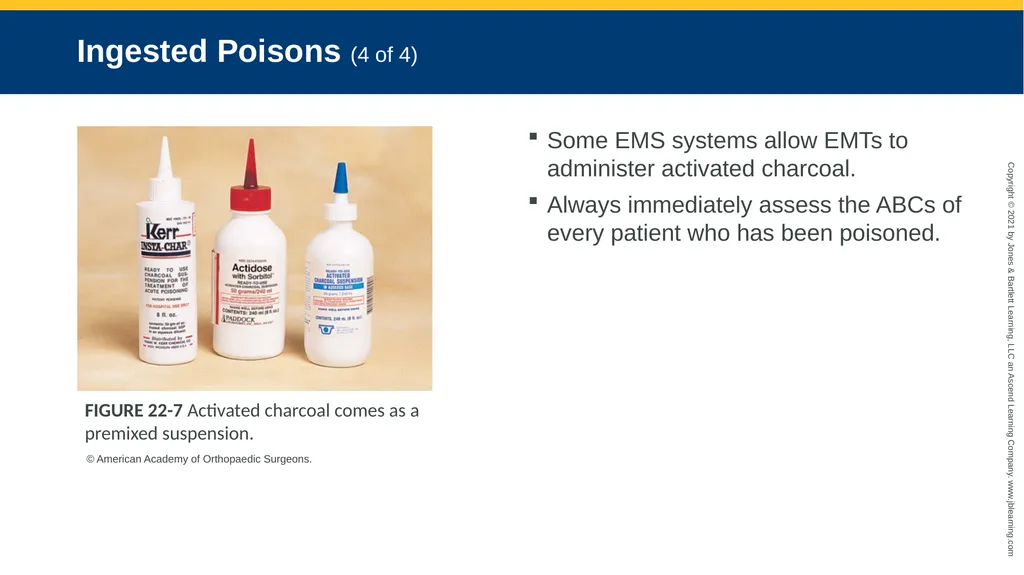
Ingested Poisons (4 of 4) Some EMS systems allow EMTs to administer activated charcoal.
Always immediately assess the ABCs of every patient who has been poisoned. FIGURE 22-7 Activated charcoal comes as a premixed suspension. © American Academy of Orthopaedic Surgeons.<br>
Always immediately assess the ABCs of every patient who has been poisoned. FIGURE 22-7 Activated charcoal comes as a premixed suspension. © American Academy of Orthopaedic Surgeons.<br>
28
Injected Poisons (1 of 2) Exposure includes intravenous drug abuse and envenomation by insects, arachnids, and reptiles.
Usually absorbed quickly into the body or cause intense local tissue destruction
Cannot be diluted or removed from the body in the field<br>
Usually absorbed quickly into the body or cause intense local tissue destruction
Cannot be diluted or removed from the body in the field<br>
29
Injected Poisons (2 of 2) Signs and symptoms may include weakness, dizziness, fever/chills, unresponsiveness, and excitability.
Monitor the airway, provide high-flow oxygen, and be alert for nausea and vomiting.
Remove rings, watches, and bracelets from areas around the injection site if swelling occurs.<br>
Monitor the airway, provide high-flow oxygen, and be alert for nausea and vomiting.
Remove rings, watches, and bracelets from areas around the injection site if swelling occurs.<br>
30
Scene Size-up Take standard precautions and look for clues:
Is there an odor in the room? Is the scene safe?
Are there medication bottles lying around? Is there medication missing that might indicate an overdose?
Are alcoholic beverage containers present?
Are there syringes or other drug paraphernalia?
Is there a suspicious odor that may indicate the presence of a drug laboratory?<br>
31
Primary Assessment (1 of 3) Determine the severity of the patient’s condition.
Obtain a general impression.
Assess the level of consciousness.
Determine any life threats.
Do not assume a conscious, alert, and oriented patient is in stable condition.<br>
Obtain a general impression.
Assess the level of consciousness.
Determine any life threats.
Do not assume a conscious, alert, and oriented patient is in stable condition.<br>
32
Primary Assessment (2 of 3) Airway and breathing
Ensure that the patient has an open airway and adequate ventilation.
If patient has difficulty breathing or an inhalation injury, begin oxygen therapy.
Have suction available; these patients are susceptible to vomiting.
Circulation
Assess the pulse and skin condition.
Will vary depending on the substance involved<br>
33
Primary Assessment (3 of 3) Transport decision
Consider prompt transport for patients with obvious alterations in the XABCs or for patients you have determined have a poor general impression.
Everyone who is exposed to the hazardous material must be thoroughly decontaminated by the hazmat team before leaving the scene.<br>
Consider prompt transport for patients with obvious alterations in the XABCs or for patients you have determined have a poor general impression.
Everyone who is exposed to the hazardous material must be thoroughly decontaminated by the hazmat team before leaving the scene.<br>
34
History Taking (1 of 3) Investigate the chief complaint.
If your patient is responsive, begin with an evaluation of the exposure and the SAMPLE history.
If your patient is unresponsive, obtain the history from other sources.<br>
If your patient is responsive, begin with an evaluation of the exposure and the SAMPLE history.
If your patient is unresponsive, obtain the history from other sources.<br>
35
History Taking (2 of 3) In addition to SAMPLE, ask the following questions:
What is the substance involved?
When did the patient become exposed to it?
How much did the patient ingest or what was the level of exposure?<br>
What is the substance involved?
When did the patient become exposed to it?
How much did the patient ingest or what was the level of exposure?<br>
36
History Taking (3 of 3) Questions (cont’d):
Over what period did the patient take or was exposed to the substance?
Has the patient or a bystander performed any intervention?
How much does the patient weigh?<br>
Over what period did the patient take or was exposed to the substance?
Has the patient or a bystander performed any intervention?
How much does the patient weigh?<br>
37
Secondary Assessment Physical examinations
Focus on the area of the body involved with the poisoning or the route of exposure.
A general review of all body systems may help to identify systemic problems.
A complete set of baseline vital signs is important.<br>
Focus on the area of the body involved with the poisoning or the route of exposure.
A general review of all body systems may help to identify systemic problems.
A complete set of baseline vital signs is important.<br>
38
Reassessment (1 of 3) Reassess the adequacy of the XABCs.
Repeat vital signs; compare them with the baseline set.
Evaluate your interventions.
Every 15 minutes for a stable patient
Every 5 minutes, or constantly, for a patient who has consumed a harmful or lethal dose<br>
Repeat vital signs; compare them with the baseline set.
Evaluate your interventions.
Every 15 minutes for a stable patient
Every 5 minutes, or constantly, for a patient who has consumed a harmful or lethal dose<br>
39
Reassessment (2 of 3) Treatment
Supporting the XABCs is your most important task.
Contact medical control or a poison center to discuss treatment options.
Manage airborne exposures with oxygen.
Remove contact exposures with water.
Consider activated charcoal for ingestions.<br>
Supporting the XABCs is your most important task.
Contact medical control or a poison center to discuss treatment options.
Manage airborne exposures with oxygen.
Remove contact exposures with water.
Consider activated charcoal for ingestions.<br>
40
Reassessment (3 of 3) Communication and documentation
Report as much information as you have about the poison or chemical to the hospital.
Bring the material data sheet to the hospital if the poisoning occurred in a work setting.<br>
Report as much information as you have about the poison or chemical to the hospital.
Bring the material data sheet to the hospital if the poisoning occurred in a work setting.<br>
41
Emergency Medical Care (1 of 6) Ensure scene safety.
Remove tablets or fragments from the patient’s mouth.
Wash or brush the poison from the patient’s skin.<br>
Remove tablets or fragments from the patient’s mouth.
Wash or brush the poison from the patient’s skin.<br>
42
Emergency Medical Care (2 of 6) Assess and maintain the patient’s XABCs.
Provide oxygen and perform assisted ventilations if necessary.
Treat for shock and transport the patient promptly to the nearest hospital.
Some EMS systems allow EMTs to give activated charcoal by mouth.<br>
Provide oxygen and perform assisted ventilations if necessary.
Treat for shock and transport the patient promptly to the nearest hospital.
Some EMS systems allow EMTs to give activated charcoal by mouth.<br>
43
Emergency Medical Care (3 of 6) Activated charcoal binds to specific toxins, which are then carried out of the body in the stool.
Contraindicated in patients who have:
Ingested alkali poisons, cyanide, ethanol, iron, lithium, methanol, mineral acids, or organic solvents
A decreased LOC and cannot protect their airway<br>
Contraindicated in patients who have:
Ingested alkali poisons, cyanide, ethanol, iron, lithium, methanol, mineral acids, or organic solvents
A decreased LOC and cannot protect their airway<br>
44
Emergency Medical Care (4 of 6) If local protocol permits, you may carry a premixed suspension of 50 g of activated charcoal.
The usual dose for an adult or child is 1 g per kilogram of body weight.<br>
The usual dose for an adult or child is 1 g per kilogram of body weight.<br>
45
Emergency Medical Care (5 of 6) Before you give a patient charcoal, obtain approval from medical control.
Shake the bottle vigorously.
You may need to convince the patient to drink it, but never force it.
Record the time when you administered activated charcoal.
If the patient refuses activated charcoal, document the refusal and transport the patient for further evaluation.<br>
Shake the bottle vigorously.
You may need to convince the patient to drink it, but never force it.
Record the time when you administered activated charcoal.
If the patient refuses activated charcoal, document the refusal and transport the patient for further evaluation.<br>
46
Emergency Medical Care (6 of 6) Side effects are constipation and black stools.
If the patient has ingested a poison that causes nausea, he or she may vomit after taking charcoal.<br>
If the patient has ingested a poison that causes nausea, he or she may vomit after taking charcoal.<br>
47
Specific Poisons (1 of 2) Over time, a person who routinely misuses a substance may need increasing amounts of it to achieve the same result.
This is called developing a tolerance.
A person with an addiction has an overwhelming need to continue using the substance, at whatever cost.
Almost any substance can be abused.<br>
This is called developing a tolerance.
A person with an addiction has an overwhelming need to continue using the substance, at whatever cost.
Almost any substance can be abused.<br>
48
Specific Poisons (2 of 2) The importance of safety awareness and standard precautions cannot be overemphasized.
Known drug abusers have a fairly high incidence of serious and undiagnosed infections, including HIV and hepatitis.<br>
Known drug abusers have a fairly high incidence of serious and undiagnosed infections, including HIV and hepatitis.<br>
49
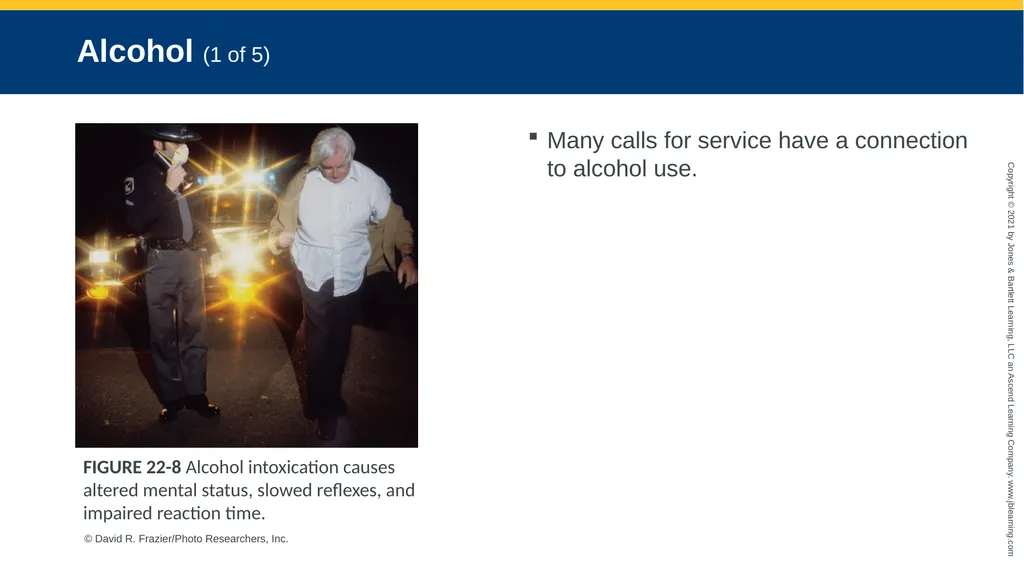
Alcohol (1 of 5) Many calls for service have a connection to alcohol use. FIGURE 22-8 Alcohol intoxication causes altered mental status, slowed reflexes, and impaired reaction time. © David R. Frazier/Photo Researchers, Inc.<br>
50
Alcohol (2 of 5) Alcohol can damage the liver, whether thorough chronic overuse or occasional heavy use (binge drinking).
Binge use can be more damaging than chronic use, depending on the frequency of the binging and the surrounding circumstances.<br>
Binge use can be more damaging than chronic use, depending on the frequency of the binging and the surrounding circumstances.<br>
51
Alcohol (3 of 5) Alcohol is a powerful CNS depressant.
Decreases activity and excitement
Induces sleep
Dulls the sense of awareness, slows reflexes, and reduces reaction time
May cause aggressive and inappropriate behavior and lack of coordination
Alcohol increases the effects of other drugs and is commonly taken with other substances.<br>
Decreases activity and excitement
Induces sleep
Dulls the sense of awareness, slows reflexes, and reduces reaction time
May cause aggressive and inappropriate behavior and lack of coordination
Alcohol increases the effects of other drugs and is commonly taken with other substances.<br>
52
Alcohol (4 of 5) If a patient exhibits signs of serious CNS depression, provide respiratory support.
May cause vomiting
Patients may experience frightening hallucinations, or delirium tremens (DTs).<br>
May cause vomiting
Patients may experience frightening hallucinations, or delirium tremens (DTs).<br>
53
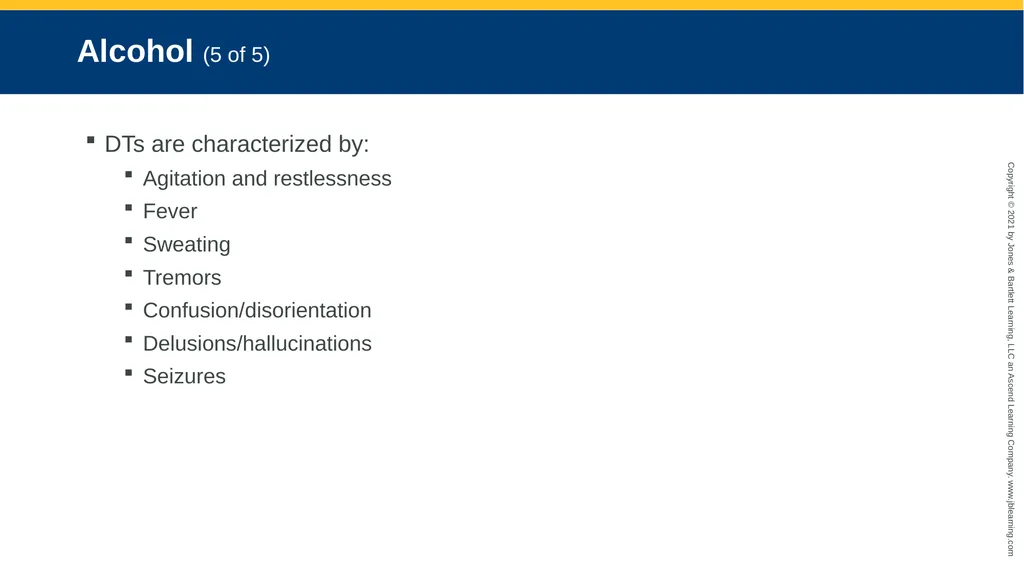
Alcohol (5 of 5) DTs are characterized by:
Agitation and restlessness
Fever
Sweating
Tremors
Confusion/disorientation
Delusions/hallucinations
Seizures<br>
Agitation and restlessness
Fever
Sweating
Tremors
Confusion/disorientation
Delusions/hallucinations
Seizures<br>
54
Opioids (1 of 7) An opioid is a type of narcotic medication used to relieve pain.
An opiate is a subset of the opioid family, and refers to natural, nonsynthetic opioids.
Named for the opium in poppy seeds, from which codeine and morphine are derived<br>
An opiate is a subset of the opioid family, and refers to natural, nonsynthetic opioids.
Named for the opium in poppy seeds, from which codeine and morphine are derived<br>
55
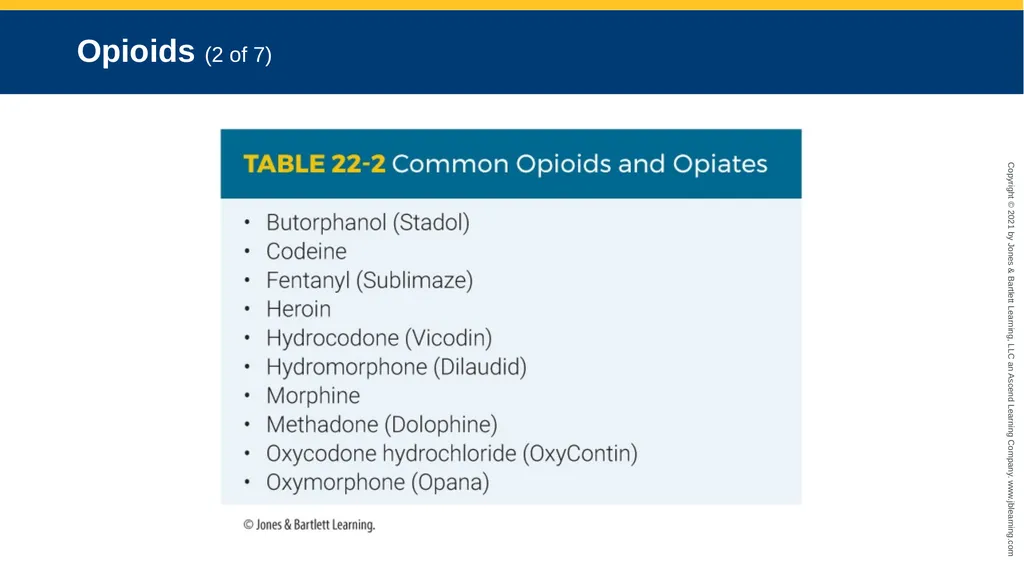
Opioids (2 of 7)<br>
56
Opioids (3 of 7) Prescription opioid drugs are among the most commonly abused drugs in the United States.
Some people become physically dependent on opioids after taking an appropriate medical prescription.<br>
Some people become physically dependent on opioids after taking an appropriate medical prescription.<br>
57
Opioids (4 of 7) These agents are CNS depressants and can cause severe respiratory depression and then cardiac arrest if not treated promptly.
Tolerance develops quickly.
Some users may require massive doses to experience the same high.
Often cause nausea and vomiting
May lead to hypotension<br>
Tolerance develops quickly.
Some users may require massive doses to experience the same high.
Often cause nausea and vomiting
May lead to hypotension<br>
58
Opioids (5 of 7) Although seizures are uncommon, they can occur.
Patients typically appear sedated or unconscious and cyanotic with pinpoint pupils.<br>
Patients typically appear sedated or unconscious and cyanotic with pinpoint pupils.<br>
59
Opioids (6 of 7) Naloxone reverses the effects of opiate or opioid overdose.
Can be given intravenously, intramuscularly, or intranasally
In many EMS systems, EMTs administer naloxone by the intranasal route.
Should only be used when the patient has agonal respirations or is apneic<br>
Can be given intravenously, intramuscularly, or intranasally
In many EMS systems, EMTs administer naloxone by the intranasal route.
Should only be used when the patient has agonal respirations or is apneic<br>
60
Opioids (7 of 7) Naloxone (cont’d)
In some areas, lay people are permitted to administer naloxone.
Find out from bystanders if the patient was given naloxone.<br>
In some areas, lay people are permitted to administer naloxone.
Find out from bystanders if the patient was given naloxone.<br>
61
Sedative-Hypnotic Drugs (1 of 2) Barbiturates and benzodiazepines are CNS depressants.
Alter the level of consciousness.
Patient may appear drowsy, peaceful, or intoxicated.<br>
Alter the level of consciousness.
Patient may appear drowsy, peaceful, or intoxicated.<br>
62
Sedative-Hypnotic Drugs (2 of 2) These agents are generally taken by mouth.
Occasionally, they are dissolved in water and injected.
IV sedative-hypnotic drugs quickly induce tolerance.
These drugs may be given to people as a “knock-out” drink.
Treatment is to ensure airway is patent, assist ventilation, and provide prompt transport.<br>
Occasionally, they are dissolved in water and injected.
IV sedative-hypnotic drugs quickly induce tolerance.
These drugs may be given to people as a “knock-out” drink.
Treatment is to ensure airway is patent, assist ventilation, and provide prompt transport.<br>
63
Abused Inhalants (1 of 2) These agents are inhaled.
Acetone, toluene, xylene, hexane
Found in glues, cleaning compounds, paint thinners, and lacquers
Gasoline and halogenated hydrocarbons are also abused.
Commonly abused by teenagers<br>
Acetone, toluene, xylene, hexane
Found in glues, cleaning compounds, paint thinners, and lacquers
Gasoline and halogenated hydrocarbons are also abused.
Commonly abused by teenagers<br>
64
Abused Inhalants (2 of 2) Always use special care.
Halogenated hydrocarbon solvents can make the heart hypersensitive to the patient’s own adrenaline.
Keep patients from struggling or exerting themselves.
Use a stretcher to move the patient, give oxygen, and transport to the hospital.<br>
Halogenated hydrocarbon solvents can make the heart hypersensitive to the patient’s own adrenaline.
Keep patients from struggling or exerting themselves.
Use a stretcher to move the patient, give oxygen, and transport to the hospital.<br>
65
Hydrogen Sulfide (1 of 2) Hydrogen sulfide
A highly toxic, colorless, and flammable gas with a distinctive rotten-egg odor
Affects all organs, but it has the most impact on the lungs and CNS.
Used to commit suicide
If you suspect the presence of a toxic gas, wait for a hazmat team to tell you the scene is safe.<br>
A highly toxic, colorless, and flammable gas with a distinctive rotten-egg odor
Affects all organs, but it has the most impact on the lungs and CNS.
Used to commit suicide
If you suspect the presence of a toxic gas, wait for a hazmat team to tell you the scene is safe.<br>
66
Hydrogen Sulfide (2 of 2) Signs and symptoms:
Nausea and vomiting, confusion, dyspnea, a loss of consciousness, seizures, shock, coma, and cardiopulmonary arrest
Once the patient has been decontaminated, management is largely supportive.
Monitor and assist the patient’s respiratory and cardiovascular functions.
Provide rapid transport.<br>
Nausea and vomiting, confusion, dyspnea, a loss of consciousness, seizures, shock, coma, and cardiopulmonary arrest
Once the patient has been decontaminated, management is largely supportive.
Monitor and assist the patient’s respiratory and cardiovascular functions.
Provide rapid transport.<br>
67
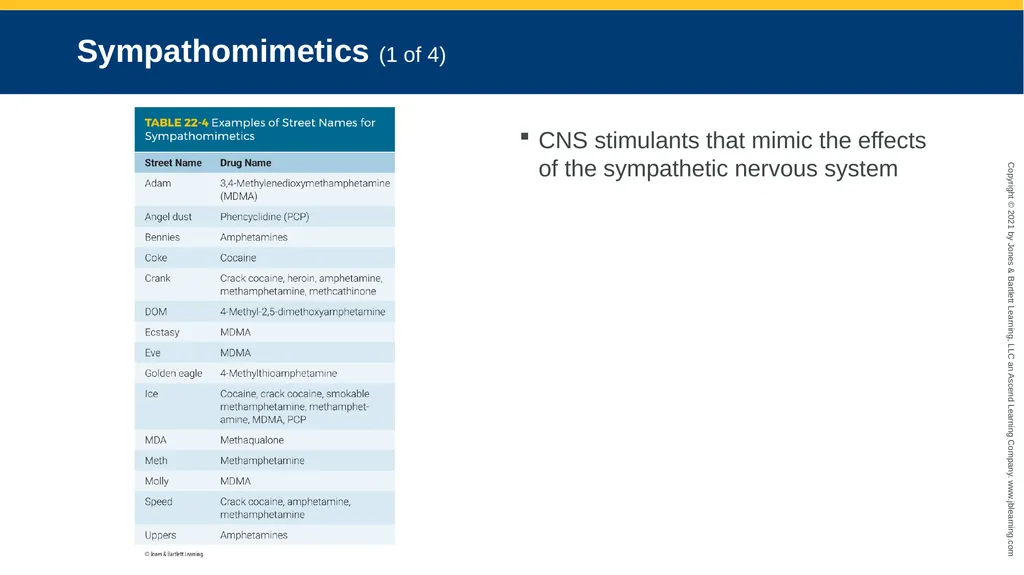
Sympathomimetics (1 of 4) CNS stimulants that mimic the effects of the sympathetic nervous system<br>
68
Sympathomimetics (2 of 4) Produce an excited state.
Frequently cause hypertension, tachycardia, and dilated pupils
Includes amphetamines, methamphetamines, phentermine hydrochloride, and Benzedrine
Designer drugs, such as MDMA, are also frequently abused.
Commonly taken by mouth; also injected by drug abusers<br>
Frequently cause hypertension, tachycardia, and dilated pupils
Includes amphetamines, methamphetamines, phentermine hydrochloride, and Benzedrine
Designer drugs, such as MDMA, are also frequently abused.
Commonly taken by mouth; also injected by drug abusers<br>
69
Sympathomimetics (3 of 4) Cocaine may be taken in a number of different ways.
Can be absorbed through all mucous membranes and even across the skin
Immediate effects include excitement and euphoria and last less than an hour.
Smoked crack is the most potent.<br>
Can be absorbed through all mucous membranes and even across the skin
Immediate effects include excitement and euphoria and last less than an hour.
Smoked crack is the most potent.<br>
70
Sympathomimetics (4 of 4) Acute overdose is a genuine emergency.
Patients have a high risk of seizures, cardiac dysrhythmias, and stroke.
Patients may experience hallucinations or paranoia.
Do not leave the patient unattended.
Provide prompt transport.<br>
Patients have a high risk of seizures, cardiac dysrhythmias, and stroke.
Patients may experience hallucinations or paranoia.
Do not leave the patient unattended.
Provide prompt transport.<br>
71
Synthetic Cathinones (Bath Salts) (1 of 2) An emerging class of drugs similar to MDMA.
Produce euphoria, increased mental clarity, and sexual arousal.
Most users of this drug snort or insufflate the powder nasally.
Effects reportedly last as long as 48 hours.<br>
Produce euphoria, increased mental clarity, and sexual arousal.
Most users of this drug snort or insufflate the powder nasally.
Effects reportedly last as long as 48 hours.<br>
72
Synthetic Cathinones (Bath Salts) (2 of 2) Adverse effects include:
Teeth grinding, appetite loss, muscle twitching, lip-smacking, confusion, gastrointestinal conditions, paranoia, headache, elevated heart rate, and hallucinations
Keep the patient calm and transport.
Consider ALS assistance.<br>
Teeth grinding, appetite loss, muscle twitching, lip-smacking, confusion, gastrointestinal conditions, paranoia, headache, elevated heart rate, and hallucinations
Keep the patient calm and transport.
Consider ALS assistance.<br>
73
Marijuana (1 of 4) Marijuana is abused throughout the world.
THC is the chemical in the marijuana plant that produces its high.
Produces euphoria, relaxation, and drowsiness
Impairs short-term memory and the capacity to do complex thinking
Could progress to depression and confusion<br>
THC is the chemical in the marijuana plant that produces its high.
Produces euphoria, relaxation, and drowsiness
Impairs short-term memory and the capacity to do complex thinking
Could progress to depression and confusion<br>
74
Marijuana (2 of 4) With very high doses, patients may experience hallucinations or become very anxious or paranoid.
Reassure the patient and transport with a minimum amount of excitement.
Marijuana is often used as a vehicle to get other drugs into the body.<br>
Reassure the patient and transport with a minimum amount of excitement.
Marijuana is often used as a vehicle to get other drugs into the body.<br>
75
Marijuana (3 of 4) Several states have legalized the recreational use of marijuana, and others allow for the medical use of marijuana and products that contain THC.
“Edibles” infused with marijuana
Ingestion can lead to cannabinoid hyperemesis syndrome.<br>
“Edibles” infused with marijuana
Ingestion can lead to cannabinoid hyperemesis syndrome.<br>
76
Marijuana (4 of 4) Synthetic marijuana or “Spice”
A variety of herbal incense or smoking blends that resemble THC and produce a similar high
Powerful and unpredictable effects may result, ranging from simple euphoria to complete loss of consciousness.<br>
A variety of herbal incense or smoking blends that resemble THC and produce a similar high
Powerful and unpredictable effects may result, ranging from simple euphoria to complete loss of consciousness.<br>
77
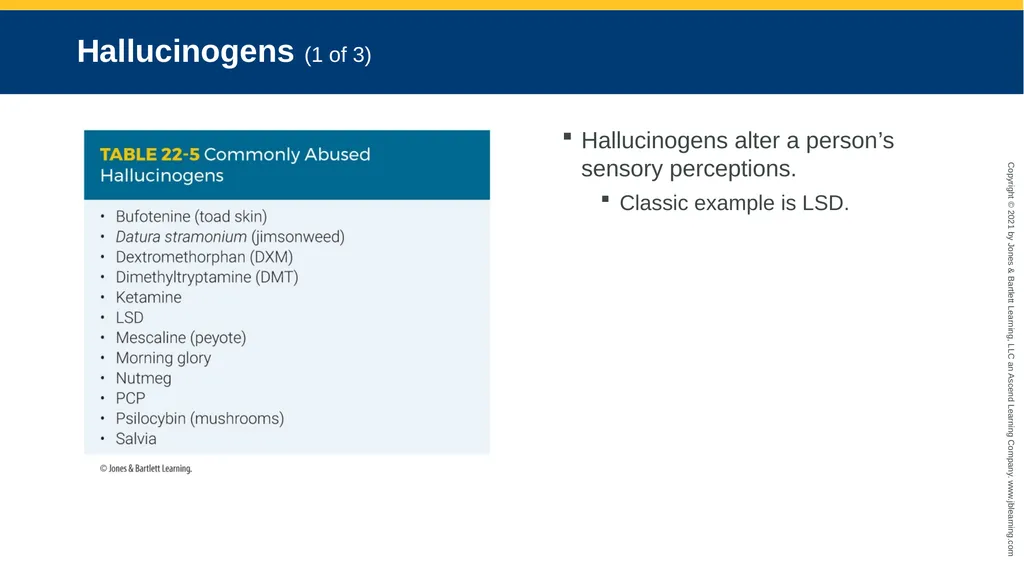
Hallucinogens (1 of 3) Hallucinogens alter a person’s sensory perceptions.
Classic example is LSD.<br>
Classic example is LSD.<br>
78
Hallucinogens (2 of 3) These agents:
Cause visual hallucinations
Intensify vision and hearing
Generally separate the user from reality
Patients experiencing a “bad trip” have hypertension, tachycardia, anxiety, and paranoia.<br>
Cause visual hallucinations
Intensify vision and hearing
Generally separate the user from reality
Patients experiencing a “bad trip” have hypertension, tachycardia, anxiety, and paranoia.<br>
79
Hallucinogens (3 of 3) Use a calm, professional manner.
Provide emotional support.
Do not use restraints unless you or the patient is in danger of injury.
Watch the patient carefully throughout transport and do not leave unattended.
Request ALS assistance when appropriate.<br>
Provide emotional support.
Do not use restraints unless you or the patient is in danger of injury.
Watch the patient carefully throughout transport and do not leave unattended.
Request ALS assistance when appropriate.<br>
80
Anticholinergic Agents (1 of 2) Have properties that block the parasympathetic nerve.
“Hot as a hare, blind as a bat, dry as a bone, red as a beet, and mad as a hatter.”
Common drugs include atropine, Benadryl, jimsonweed, and amitriptyline.<br>
“Hot as a hare, blind as a bat, dry as a bone, red as a beet, and mad as a hatter.”
Common drugs include atropine, Benadryl, jimsonweed, and amitriptyline.<br>
81
Anticholinergic Agents (2 of 2) Some tricyclic antidepressants have significant anticholinergic effects.
Death from these agents can be rapid.
The patient can go from “normal” to seizure and death within 30 minutes.
Transport immediately.
Consider ALS backup.<br>
Death from these agents can be rapid.
The patient can go from “normal” to seizure and death within 30 minutes.
Transport immediately.
Consider ALS backup.<br>
82
Cholinergic Agents (1 of 5) Overstimulate normal body functions that are controlled by the parasympathetic nerves.
Include “nerve gases” designed for chemical warfare and organophosphate insecticides<br>
Include “nerve gases” designed for chemical warfare and organophosphate insecticides<br>
83
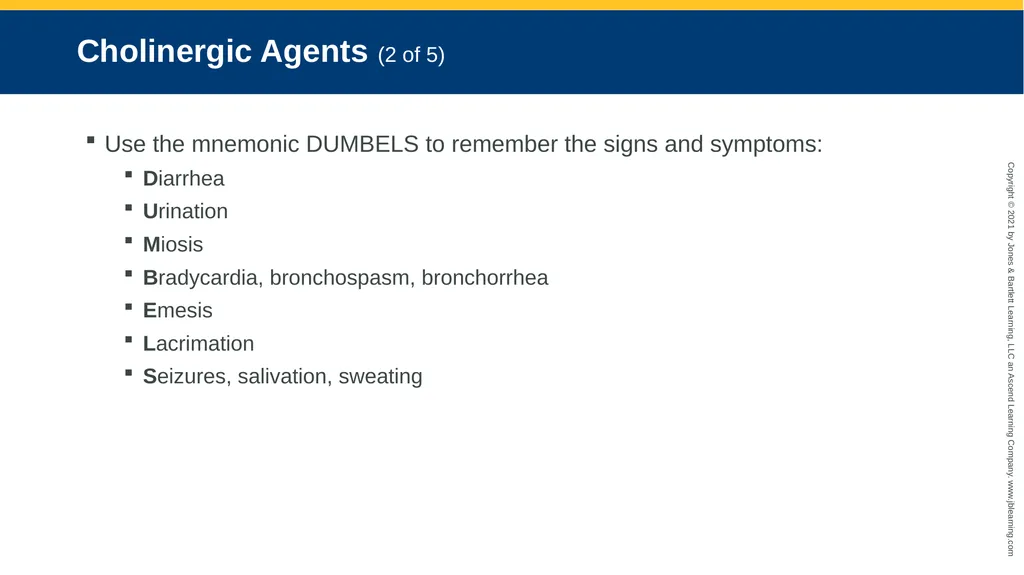
Cholinergic Agents (2 of 5) Use the mnemonic DUMBELS to remember the signs and symptoms:
Diarrhea
Urination
Miosis
Bradycardia, bronchospasm, bronchorrhea
Emesis
Lacrimation
Seizures, salivation, sweating<br>
Diarrhea
Urination
Miosis
Bradycardia, bronchospasm, bronchorrhea
Emesis
Lacrimation
Seizures, salivation, sweating<br>
84
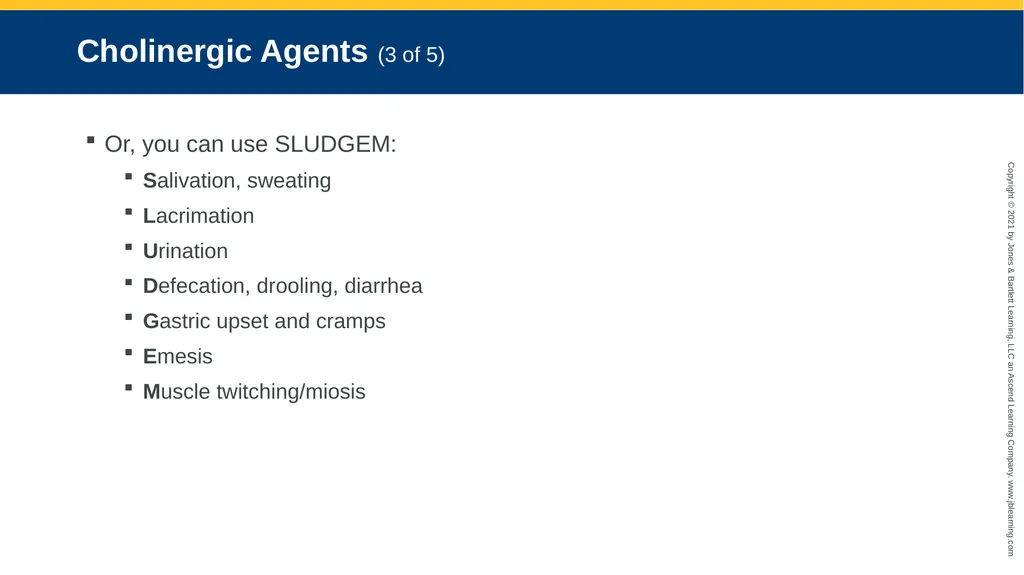
Cholinergic Agents (3 of 5) Or, you can use SLUDGEM:
Salivation, sweating
Lacrimation
Urination
Defecation, drooling, diarrhea
Gastric upset and cramps
Emesis
Muscle twitching/miosis<br>
Salivation, sweating
Lacrimation
Urination
Defecation, drooling, diarrhea
Gastric upset and cramps
Emesis
Muscle twitching/miosis<br>
85
Cholinergic Agents (4 of 5) The most important consideration is to avoid exposure yourself.
Decontamination may take priority over immediate transport.
Hazmat team will provide decontamination and contain the exposure chemical.
After decontamination:
Decrease the secretions in the mouth and trachea.
Provide airway support.<br>
Decontamination may take priority over immediate transport.
Hazmat team will provide decontamination and contain the exposure chemical.
After decontamination:
Decrease the secretions in the mouth and trachea.
Provide airway support.<br>
86
Cholinergic Agents (5 of 5) Antidote kit may be available.
DuoDote Auto-Injector
The kit consists of a single auto-injector containing atropine and pralidoxime.
If a known exposure to nerve agents with manifestation of signs and symptoms has occurred, use the antidote kit on yourself.<br>
DuoDote Auto-Injector
The kit consists of a single auto-injector containing atropine and pralidoxime.
If a known exposure to nerve agents with manifestation of signs and symptoms has occurred, use the antidote kit on yourself.<br>
87
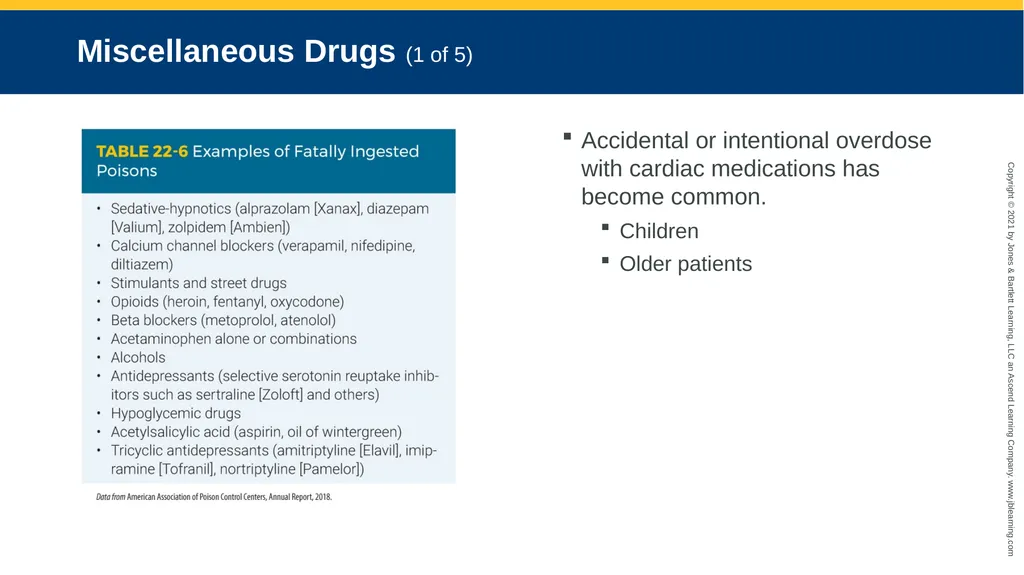
Miscellaneous Drugs (1 of 5) Accidental or intentional overdose with cardiac medications has become common.
Children
Older patients<br>
Children
Older patients<br>
88
Miscellaneous Drugs (2 of 5) Signs and symptoms depend on the medication ingested.
Contact the poison center as soon as possible.<br>
Contact the poison center as soon as possible.<br>
89
Miscellaneous Drugs (3 of 5) Aspirin poisoning remains a potentially lethal condition.
Ingesting too many aspirin may result in:
Nausea
Vomiting
Hyperventilation
Ringing in the ears<br>
Ingesting too many aspirin may result in:
Nausea
Vomiting
Hyperventilation
Ringing in the ears<br>
90
Miscellaneous Drugs (4 of 5) Patients with this problem have:
Anxiety
Confusion
Tachypnea
Hyperthermia
Danger of having seizures<br>
Anxiety
Confusion
Tachypnea
Hyperthermia
Danger of having seizures<br>
91
Miscellaneous Drugs (5 of 5) Overdosing with acetaminophen is also very common.
Some alcohols, including methyl alcohol and ethylene glycol, are even more toxic than ethyl alcohol (drinking alcohol).<br>
Some alcohols, including methyl alcohol and ethylene glycol, are even more toxic than ethyl alcohol (drinking alcohol).<br>
92
Food Poisoning (1 of 6) Almost always caused by eating food contaminated by bacteria
Two main types:
Organism itself may cause disease.
Organism may produce toxins that cause disease.<br>
Two main types:
Organism itself may cause disease.
Organism may produce toxins that cause disease.<br>
93
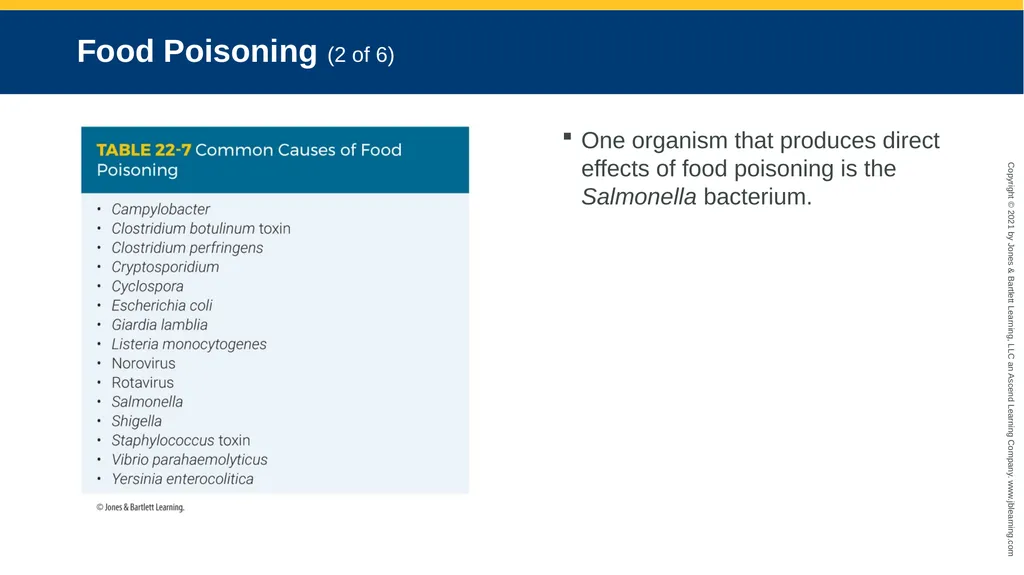
Food Poisoning (2 of 6) One organism that produces direct effects of food poisoning is the Salmonella bacterium.<br>
94
Food Poisoning (3 of 6) Causes salmonellosis
Characterized by severe GI symptoms within 72 hours of ingestion, including nausea, vomiting, abdominal pain, and diarrhea
Proper cooking kills bacteria, and proper cleanliness in the kitchen prevents the contamination of uncooked foods.<br>
Characterized by severe GI symptoms within 72 hours of ingestion, including nausea, vomiting, abdominal pain, and diarrhea
Proper cooking kills bacteria, and proper cleanliness in the kitchen prevents the contamination of uncooked foods.<br>
95
Food Poisoning (4 of 6) The more common cause of food poisoning is the ingestion of powerful toxins produced by bacteria, often in leftovers.
The bacterium Staphylococcus is quick to grow and produce toxins in food.
Foods left unrefrigerated are a common vehicle.
Symptoms usually within start 2 to 3 hours or as long as 8 to 12 hours after ingestion.<br>
The bacterium Staphylococcus is quick to grow and produce toxins in food.
Foods left unrefrigerated are a common vehicle.
Symptoms usually within start 2 to 3 hours or as long as 8 to 12 hours after ingestion.<br>
96
Food Poisoning (5 of 6) The most severe form of toxin ingestion is botulism.
Can result from eating improperly canned food
Symptoms are neurologic:
Blurring of vision
Weakness
Difficulty in speaking and breathing<br>
Can result from eating improperly canned food
Symptoms are neurologic:
Blurring of vision
Weakness
Difficulty in speaking and breathing<br>
97
Food Poisoning (6 of 6) Do not try to determine the specific cause of acute GI problems.
Gather as much history as possible from the patient.
When two or more persons have the same illness, take along the suspected food.<br>
Gather as much history as possible from the patient.
When two or more persons have the same illness, take along the suspected food.<br>
98
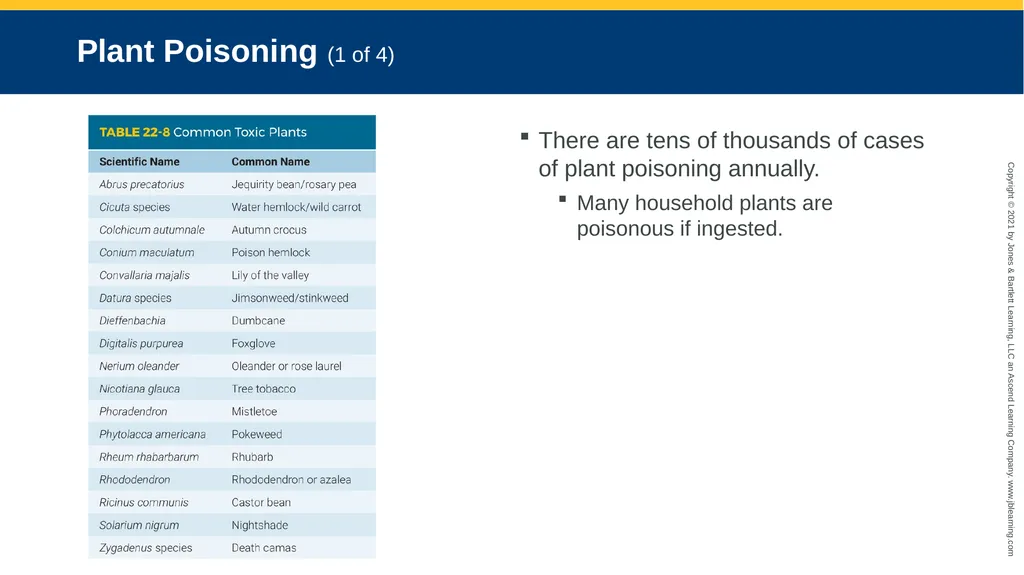
Plant Poisoning (1 of 4) There are tens of thousands of cases of plant poisoning annually.
Many household plants are poisonous if ingested.<br>
Many household plants are poisonous if ingested.<br>
99
Plant Poisoning (2 of 4) It is impossible to memorize every plant or poison, let alone their effects.
Assess the patient’s airway and vital signs.
Notify the regional poison center.
Take the plant to the emergency department.<br>
Assess the patient’s airway and vital signs.
Notify the regional poison center.
Take the plant to the emergency department.<br>
100
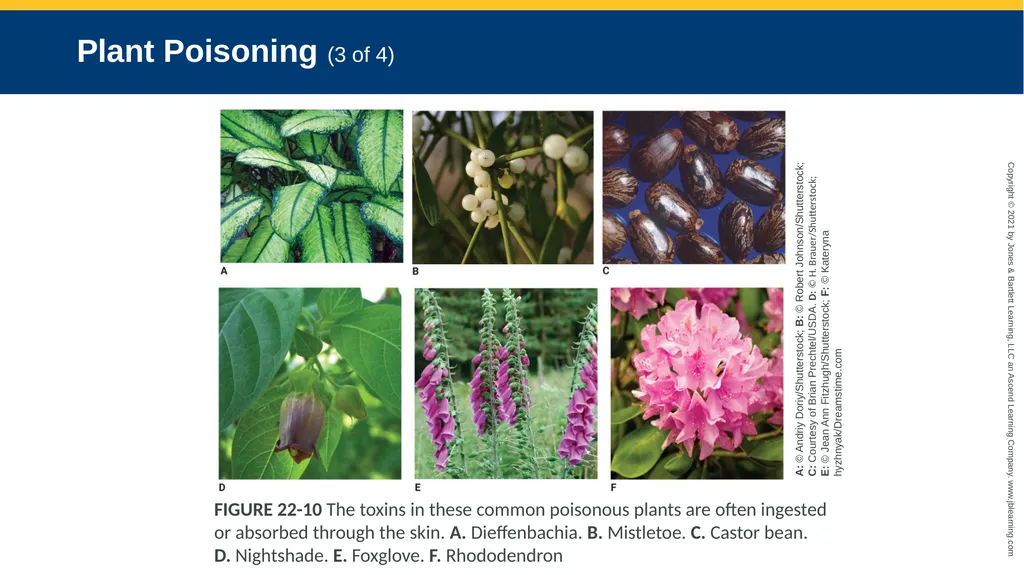
Plant Poisoning (3 of 4) FIGURE 22-10 The toxins in these common poisonous plants are often ingested or absorbed through the skin. A. Dieffenbachia. B. Mistletoe. C. Castor bean.
D. Nightshade. E. Foxglove. F. Rhododendron A: © Andriy Doriy/Shutterstock; B: © Robert Johnson/Shutterstock;
C: Courtesy of Brian Prechtel/USDA. D: © H. Brauer/Shutterstock;
E: © Jean Ann Fitzhugh/Shutterstock; F: © Kateryna hyzhnyak/Dreamstime.com<br>
D. Nightshade. E. Foxglove. F. Rhododendron A: © Andriy Doriy/Shutterstock; B: © Robert Johnson/Shutterstock;
C: Courtesy of Brian Prechtel/USDA. D: © H. Brauer/Shutterstock;
E: © Jean Ann Fitzhugh/Shutterstock; F: © Kateryna hyzhnyak/Dreamstime.com<br>
101
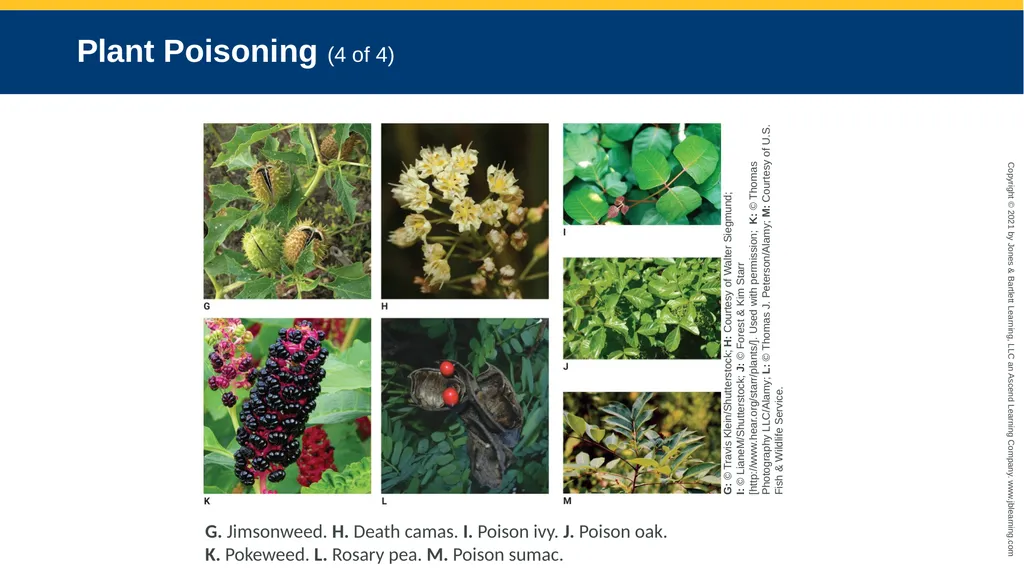
Plant Poisoning (4 of 4) G. Jimsonweed. H. Death camas. I. Poison ivy. J. Poison oak.
K. Pokeweed. L. Rosary pea. M. Poison sumac. G: © Travis Klein/Shutterstock; H: Courtesy of Walter Siegmund;
I: © LianeM/Shutterstock; J: © Forest & Kim Starr [http://www.hear.org/starr/plants/]. Used with permission; K: © Thomas Photography LLC/Alamy; L: © Thomas J. Peterson/Alamy; M: Courtesy of U.S. Fish & Wildlife Service.<br>
102
Review Which of the following questions is of LEAST pertinence for the EMT to ask a patient who intentionally overdosed on a medication?
“How much do you weigh?”
“How much did you ingest?”
“What substance did you take?”
“Why did you take the medication?”<br>
“How much do you weigh?”
“How much did you ingest?”
“What substance did you take?”
“Why did you take the medication?”<br>
103
Review Answer: D
Rationale: Determining what the patient ingested, how much was ingested, and the patient’s weight are all pertinent and have a direct impact on the care that is provided during the acute phase. Why the patient ingested the medication does not have a direct impact on acute care; therefore, it is the least pertinent question to ask.<br>
Rationale: Determining what the patient ingested, how much was ingested, and the patient’s weight are all pertinent and have a direct impact on the care that is provided during the acute phase. Why the patient ingested the medication does not have a direct impact on acute care; therefore, it is the least pertinent question to ask.<br>
104
Review Which of the following questions is of LEAST pertinence for the EMT to ask a patient who intentionally overdosed on a medication?
“How much do you weigh?” Rationale: This is a very pertinent question and can impact treatment.
“How much did you ingest?” Rationale: This is a very pertinent question and can impact treatment.
“What substance did you take?” Rationale: This is a very pertinent question and can impact treatment.
“Why did you take the medication?” Rationale: Correct answer<br>
105
Review A 30-year-old male who ingested an unknown substance begins to vomit. You should:
collect the vomitus and bring it to the hospital.
apply a bag-mask device.
analyze the vomitus and try to identify the poison.
suction his oropharynx for no longer than 30 seconds.<br>
collect the vomitus and bring it to the hospital.
apply a bag-mask device.
analyze the vomitus and try to identify the poison.
suction his oropharynx for no longer than 30 seconds.<br>
106
Review Answer: A
Rationale: If the patient vomits, examine the contents for pill fragments. Ensure that you are wearing proper personal protective equipment for this activity. Note and document anything unusual that you see. You should try to collect the vomitus in a separate plastic bag so that it can be analyzed at the hospital.<br>
Rationale: If the patient vomits, examine the contents for pill fragments. Ensure that you are wearing proper personal protective equipment for this activity. Note and document anything unusual that you see. You should try to collect the vomitus in a separate plastic bag so that it can be analyzed at the hospital.<br>
107
Review A 30-year-old male who ingested an unknown substance begins to vomit.
You should:
collect the vomitus and bring it to the hospital. Rationale: Correct answer
apply a bag-mask device. Rationale: This will not help get rid of the vomitus.
analyze the vomitus and try to identify the poison. Rationale: This should be left for the hospital to do.
suction his oropharynx for no longer than 30 seconds. Rationale: You should suction for no longer than 15 seconds.<br>
108
Review When caring for a patient with a surface contact poisoning, it is important to remember to:
prevent contamination of the patient.
avoid contaminating yourself or others.
let the hospital remove the surface poison.
immediately flush dry chemicals with water.<br>
prevent contamination of the patient.
avoid contaminating yourself or others.
let the hospital remove the surface poison.
immediately flush dry chemicals with water.<br>
109
Review Answer: B
Response: Emergency care for a patient with a surface contact poisoning includes avoiding contaminating yourself and others and removing the irritating or corrosive substance from the patient as rapidly as possible. Dry chemicals must be brushed from the body prior to flushing with water.<br>
Response: Emergency care for a patient with a surface contact poisoning includes avoiding contaminating yourself and others and removing the irritating or corrosive substance from the patient as rapidly as possible. Dry chemicals must be brushed from the body prior to flushing with water.<br>
110
Review When caring for a patient with a contact poisoning, it is important to remember to:
prevent contamination of the patient. Rationale: The patient is already contaminated, and you must try to minimize further contamination.
avoid contaminating yourself or others. Rationale: Correct answer
let the hospital remove the surface poison. Rationale: Remove irritating or corrosive substances as rapidly as possible.
immediately flush dry chemicals with water. Rationale: You must brush off dry chemicals first before washing.<br>
111
Review Most poisonings occur via the _________ route.
injection
ingestion
inhalation
absorption<br>
injection
ingestion
inhalation
absorption<br>
112
Review Answer: B
Rationale: Approximately 80% of all poisonings occur by ingestion.<br>
Rationale: Approximately 80% of all poisonings occur by ingestion.<br>
113
Review Most poisonings occur via the _________ route.
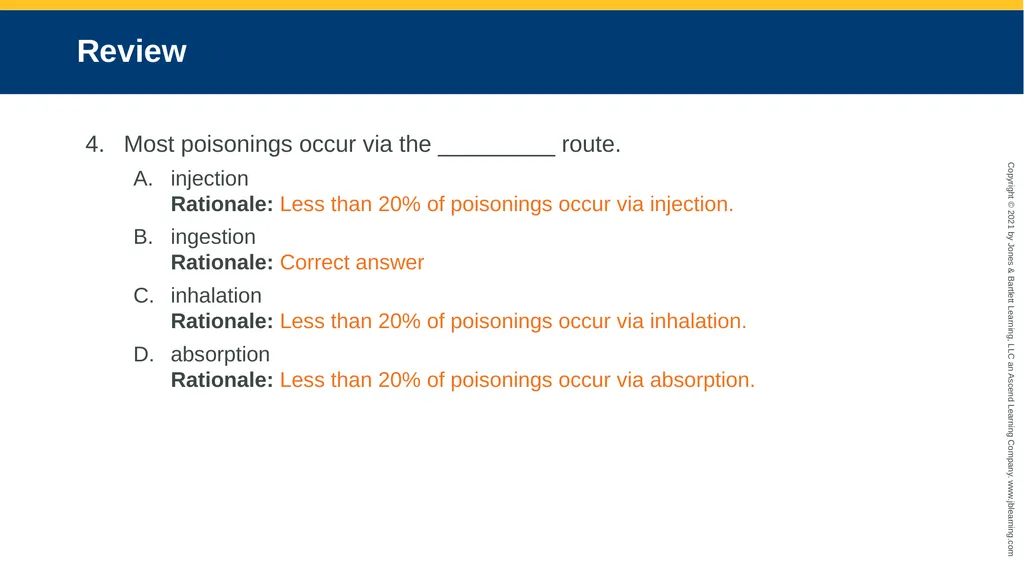
injection Rationale: Less than 20% of poisonings occur via injection.
ingestion Rationale: Correct answer
inhalation Rationale: Less than 20% of poisonings occur via inhalation.
absorption Rationale: Less than 20% of poisonings occur via absorption.<br>
injection Rationale: Less than 20% of poisonings occur via injection.
ingestion Rationale: Correct answer
inhalation Rationale: Less than 20% of poisonings occur via inhalation.
absorption Rationale: Less than 20% of poisonings occur via absorption.<br>
114
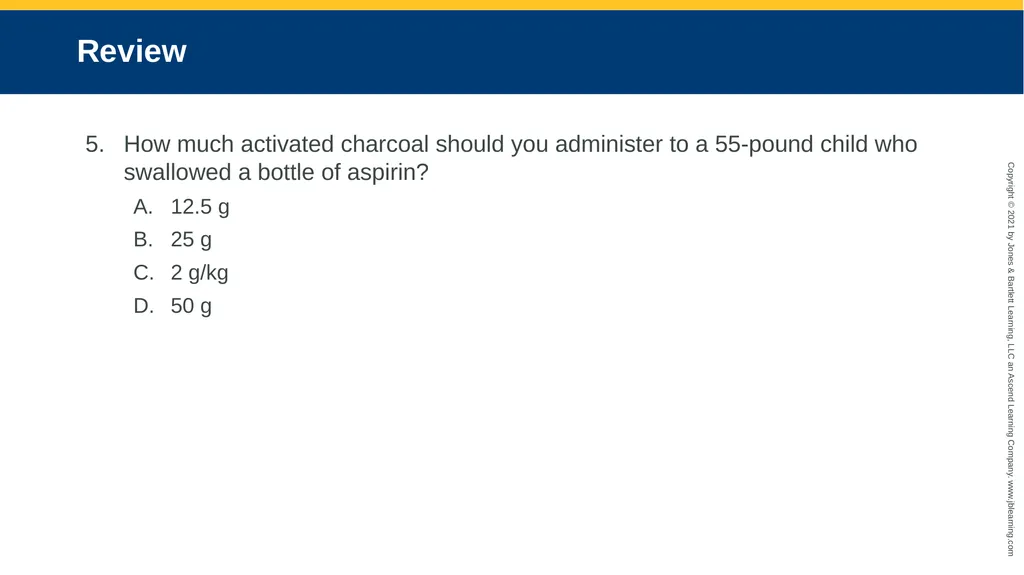
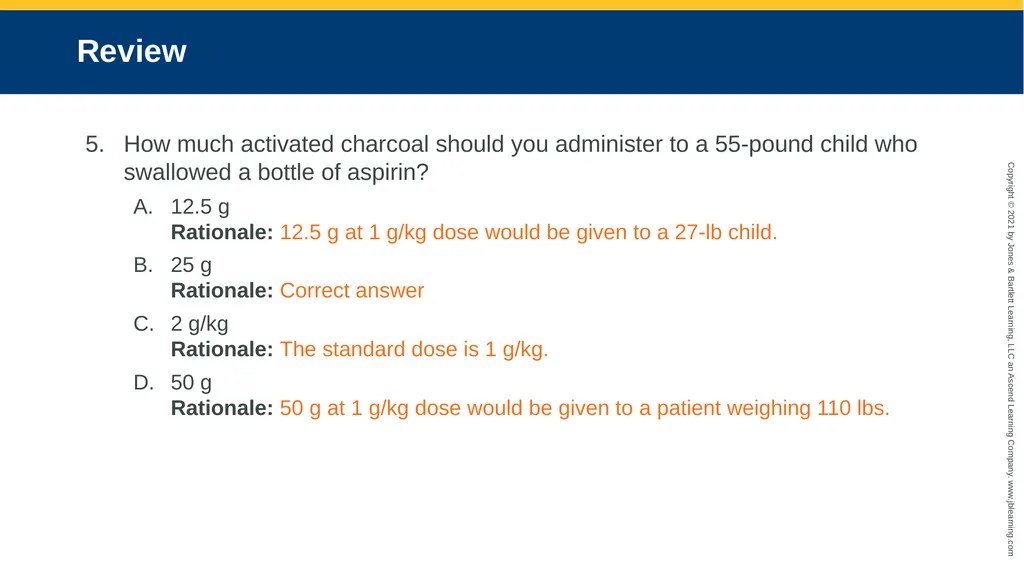
Review How much activated charcoal should you administer to a 55-pound child who swallowed a bottle of aspirin?
12.5 g
25 g
2 g/kg
50 g<br>
12.5 g
25 g
2 g/kg
50 g<br>
115
Review Answer: B
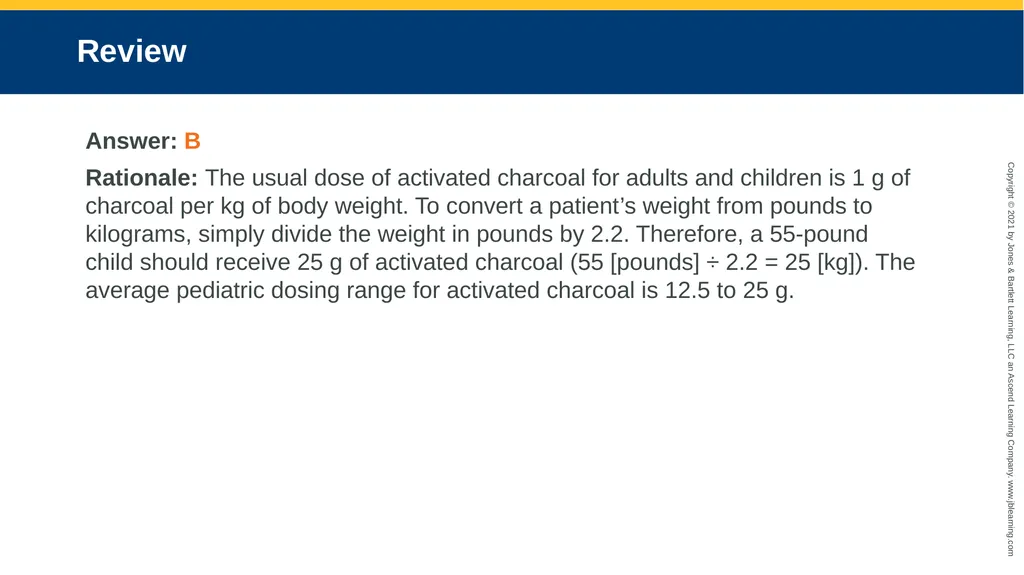
Rationale: The usual dose of activated charcoal for adults and children is 1 g of charcoal per kg of body weight. To convert a patient’s weight from pounds to kilograms, simply divide the weight in pounds by 2.2. Therefore, a 55-pound child should receive 25 g of activated charcoal (55 [pounds] ÷ 2.2 = 25 [kg]). The average pediatric dosing range for activated charcoal is 12.5 to 25 g.<br>
Rationale: The usual dose of activated charcoal for adults and children is 1 g of charcoal per kg of body weight. To convert a patient’s weight from pounds to kilograms, simply divide the weight in pounds by 2.2. Therefore, a 55-pound child should receive 25 g of activated charcoal (55 [pounds] ÷ 2.2 = 25 [kg]). The average pediatric dosing range for activated charcoal is 12.5 to 25 g.<br>
116
Review How much activated charcoal should you administer to a 55-pound child who swallowed a bottle of aspirin?
12.5 g Rationale: 12.5 g at 1 g/kg dose would be given to a 27-lb child.
25 g Rationale: Correct answer
2 g/kg Rationale: The standard dose is 1 g/kg.
50 g Rationale: 50 g at 1 g/kg dose would be given to a patient weighing 110 lbs.<br>
12.5 g Rationale: 12.5 g at 1 g/kg dose would be given to a 27-lb child.
25 g Rationale: Correct answer
2 g/kg Rationale: The standard dose is 1 g/kg.
50 g Rationale: 50 g at 1 g/kg dose would be given to a patient weighing 110 lbs.<br>
117
Review After taking Vicodin for 2 years for chronic pain, a 40-year-old woman finds that her usual dosage is no longer effective and goes to the doctor to request a higher dosage. This is an example of:
addiction.
dependence.
tolerance.
drug abuse.<br>
addiction.
dependence.
tolerance.
drug abuse.<br>
118
Review Answer: C
Rationale: A person who takes a medication for a prolonged period of time often finds that higher doses of the medication are required to achieve the same effect. This is called tolerance.<br>
Rationale: A person who takes a medication for a prolonged period of time often finds that higher doses of the medication are required to achieve the same effect. This is called tolerance.<br>
119
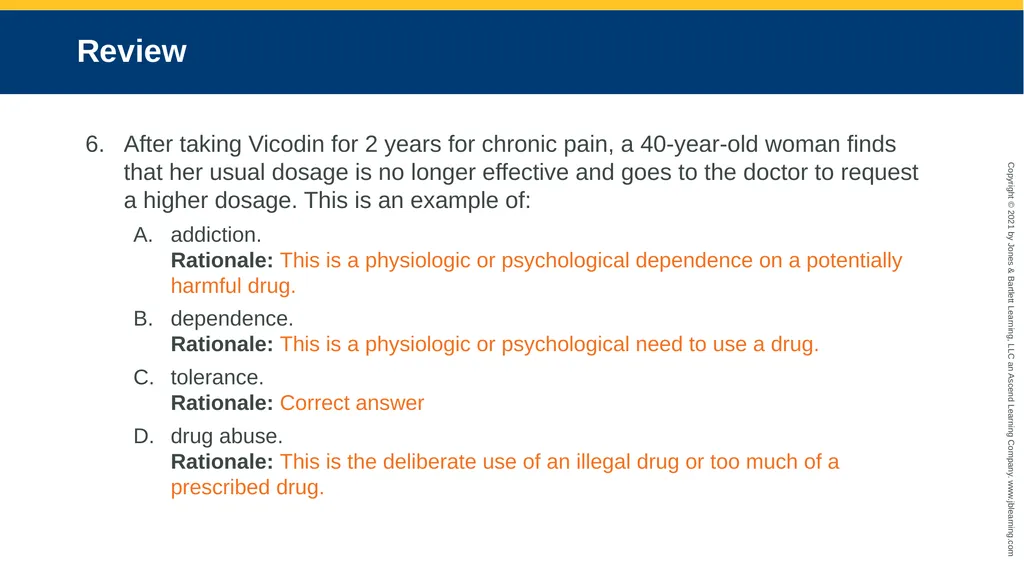
Review After taking Vicodin for 2 years for chronic pain, a 40-year-old woman finds that her usual dosage is no longer effective and goes to the doctor to request a higher dosage. This is an example of:
addiction. Rationale: This is a physiologic or psychological dependence on a potentially harmful drug.
dependence. Rationale: This is a physiologic or psychological need to use a drug.
tolerance. Rationale: Correct answer
drug abuse. Rationale: This is the deliberate use of an illegal drug or too much of a prescribed drug.<br>
120
Review Which of the following effects does drinking alcohol NOT produce?
Induction of sleep
Slowing of reflexes
Inappropriate behavior
Increased sense of awareness<br>
Induction of sleep
Slowing of reflexes
Inappropriate behavior
Increased sense of awareness<br>
121
Review Answer: D
Rationale: Drinking alcohol (ethyl alcohol) is both a sedative (decreases activity and excitement) and a hypnotic (induces sleep). It dulls the sense of awareness, slows reflexes, and reduces reaction time. It may also cause aggressive or inappropriate behavior and lack of coordination.<br>
Rationale: Drinking alcohol (ethyl alcohol) is both a sedative (decreases activity and excitement) and a hypnotic (induces sleep). It dulls the sense of awareness, slows reflexes, and reduces reaction time. It may also cause aggressive or inappropriate behavior and lack of coordination.<br>
122
Review Which of the following effects does drinking alcohol NOT produce?
Induction of sleep Rationale: It is a hypnotic and induces sleep.
Slowing of reflexes Rationale: It is a sedative and reduces reaction time.
Inappropriate behavior Rationale: It may cause aggressive or inappropriate behavior.
Increased sense of awareness Rationale: Correct answer<br>
Induction of sleep Rationale: It is a hypnotic and induces sleep.
Slowing of reflexes Rationale: It is a sedative and reduces reaction time.
Inappropriate behavior Rationale: It may cause aggressive or inappropriate behavior.
Increased sense of awareness Rationale: Correct answer<br>
123
Review A 21-year-old male was found unconscious in an alley. Your initial assessment reveals that his respirations are slow and shallow, and his pulse is slow and weak. Further assessment reveals that his pupils are bilaterally constricted. His presentation is MOST consistent with an overdose of:
cocaine.
an opioid.
a stimulant drug.
methamphetamine.<br>
cocaine.
an opioid.
a stimulant drug.
methamphetamine.<br>
124
Review Answer: B
Rationale: Opioids are central nervous system depressant drugs; when taken in excess, they cause respiratory depression, bradycardia, and hypotension. Another common sign is miosis (constricted [pinpoint]) pupils. Cocaine, stimulant drugs (uppers), and methamphetamine have the opposite effect; they stimulate the central nervous system and cause tachycardia and hypertension.<br>
Rationale: Opioids are central nervous system depressant drugs; when taken in excess, they cause respiratory depression, bradycardia, and hypotension. Another common sign is miosis (constricted [pinpoint]) pupils. Cocaine, stimulant drugs (uppers), and methamphetamine have the opposite effect; they stimulate the central nervous system and cause tachycardia and hypertension.<br>
125
Review A 21-year-old male was found unconscious in an alley. Your initial assessment reveals that his respirations are slow and shallow, and his pulse is slow and weak. Further assessment reveals that his pupils are bilaterally constricted. His presentation is MOST consistent with an overdose of:
cocaine. Rationale: This increases the vitals, heart rate, pulse, and breathing.
an opioid. Rationale: Correct answer
a stimulant drug. Rationale: This increases the vitals, heart rate, pulse, and breathing.
methamphetamine. Rationale: This increases the vitals, heart rate, pulse, and breathing.<br>
126
Review The mnemonic DUMBELS can be used to recall the signs and symptoms of a cholinergic drug poisoning. The “E” in DUMBELS stands for:
emesis.
erythema.
ecchymosis.
elevated blood pressure.<br>
emesis.
erythema.
ecchymosis.
elevated blood pressure.<br>
127
Review Answer: A
Rationale: The mnemonic “DUMBELS,” which can help you recall the signs and symptoms of cholinergic drug poisoning (ie, organophosphates), stands for excessive defecation, urination, miosis (pupillary constriction), bronchorrhea, emesis, lacrimation, and salivation.<br>
Rationale: The mnemonic “DUMBELS,” which can help you recall the signs and symptoms of cholinergic drug poisoning (ie, organophosphates), stands for excessive defecation, urination, miosis (pupillary constriction), bronchorrhea, emesis, lacrimation, and salivation.<br>
128
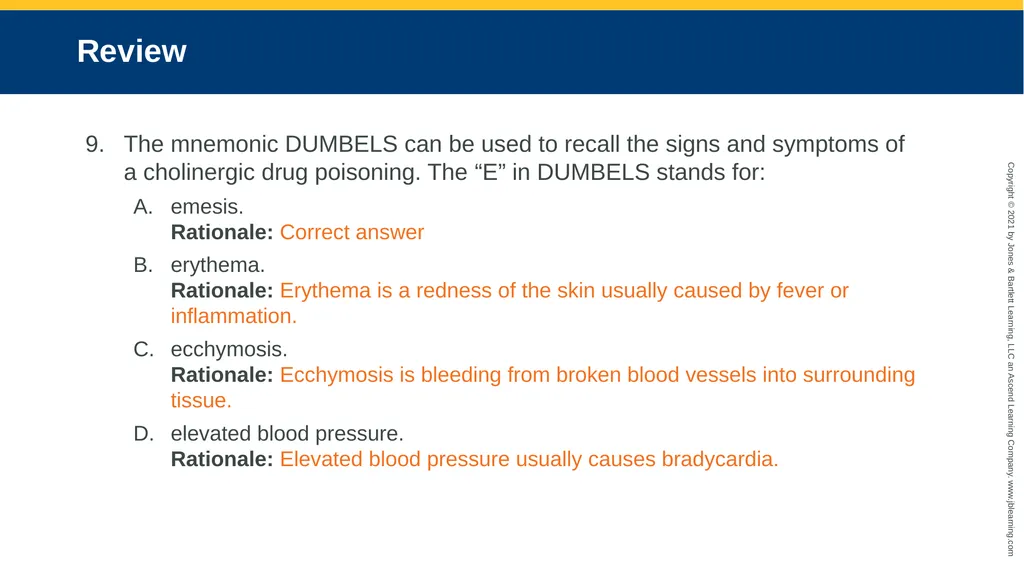
Review The mnemonic DUMBELS can be used to recall the signs and symptoms of a cholinergic drug poisoning. The “E” in DUMBELS stands for:
emesis. Rationale: Correct answer
erythema. Rationale: Erythema is a redness of the skin usually caused by fever or inflammation.
ecchymosis. Rationale: Ecchymosis is bleeding from broken blood vessels into surrounding tissue.
elevated blood pressure. Rationale: Elevated blood pressure usually causes bradycardia.<br>
129
Review Food poisoning is almost always caused by eating food that contains:
fungi.
viruses.
bacteria.
protozoa.<br>
fungi.
viruses.
bacteria.
protozoa.<br>
130
Review Answer: C
Rationale: Food poisoning is almost always caused by eating food that contains bacteria. Salmonella poisoning and botulism—two common forms of food poisoning—are both caused by bacteria.<br>
Rationale: Food poisoning is almost always caused by eating food that contains bacteria. Salmonella poisoning and botulism—two common forms of food poisoning—are both caused by bacteria.<br>
131
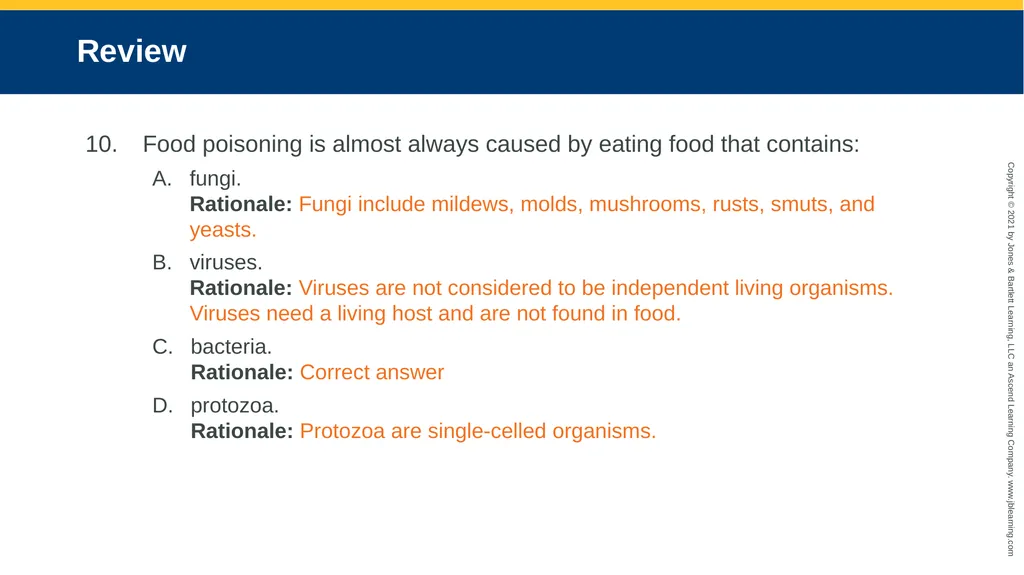
Review Food poisoning is almost always caused by eating food that contains:
fungi. Rationale: Fungi include mildews, molds, mushrooms, rusts, smuts, and yeasts.
viruses. Rationale: Viruses are not considered to be independent living organisms. Viruses need a living host and are not found in food.
bacteria. Rationale: Correct answer
protozoa. Rationale: Protozoa are single-celled organisms.<br>