
Chapter 27 Animal Reproduction and Development
DP
Published · 58 slides · 0 views
1 / 1


Description
Chapter 27 Animal Reproduction and Development Starr, Biology Today and Tomorrow with Physiology, 6th Edition. 2021 Cengage. All Rights Reserved. May not be scanned, copied or duplicated, or posted to a publicly accessible website, in
Related Topics
Share
Embed code
Download this presentation From Below
"Chapter 27 Animal Reproduction and Development" is the property of its rightful owner. Permission is granted to download and print the materials on this website for personal, non-commercial use only, and to display it on your personal computer provided you do not modify the materials and that you retain all copyright notices contained in the materials. By downloading content from our website, you accept the terms of this agreement.
Presentation Transcript
01
Chapter 27 Animal Reproduction and Development Starr, Biology Today and Tomorrow with Physiology, 6th Edition. © 2021 Cengage. All Rights Reserved. May not be scanned, copied or duplicated, or posted to a publicly accessible website, in whole or in part.<br>
02
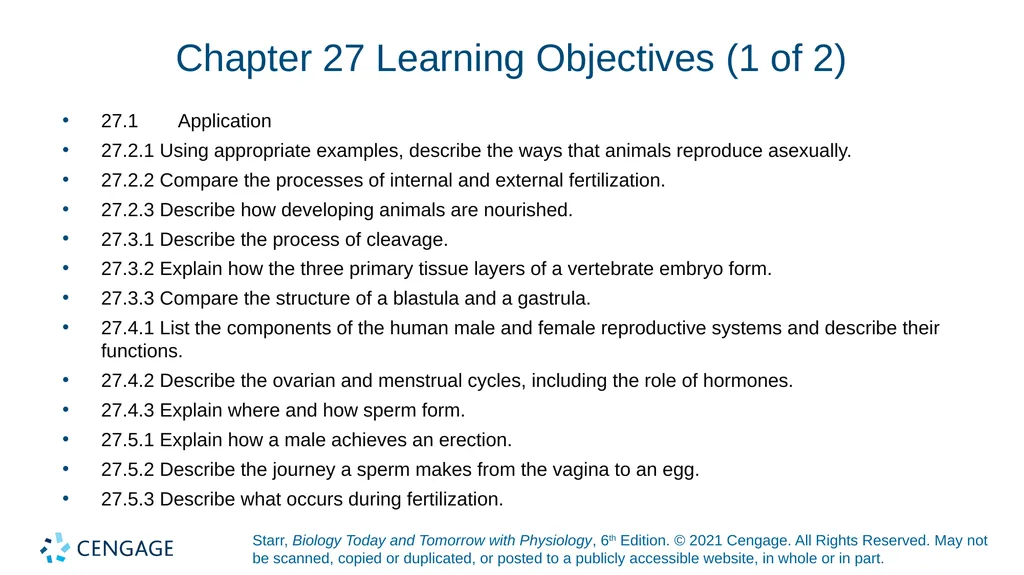
Chapter 27 Learning Objectives (1 of 2) 27.1 Application
27.2.1 Using appropriate examples, describe the ways that animals reproduce asexually.
27.2.2 Compare the processes of internal and external fertilization.
27.2.3 Describe how developing animals are nourished.
27.3.1 Describe the process of cleavage.
27.3.2 Explain how the three primary tissue layers of a vertebrate embryo form.
27.3.3 Compare the structure of a blastula and a gastrula.
27.4.1 List the components of the human male and female reproductive systems and describe their functions.
27.4.2 Describe the ovarian and menstrual cycles, including the role of hormones.
27.4.3 Explain where and how sperm form.
27.5.1 Explain how a male achieves an erection.
27.5.2 Describe the journey a sperm makes from the vagina to an egg.
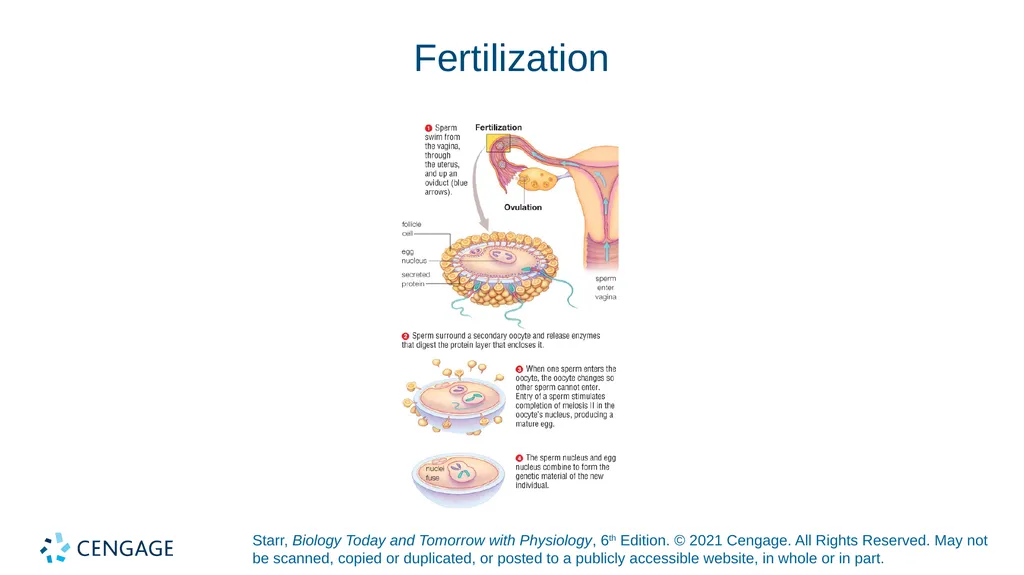
27.5.3 Describe what occurs during fertilization.<br>
27.2.1 Using appropriate examples, describe the ways that animals reproduce asexually.
27.2.2 Compare the processes of internal and external fertilization.
27.2.3 Describe how developing animals are nourished.
27.3.1 Describe the process of cleavage.
27.3.2 Explain how the three primary tissue layers of a vertebrate embryo form.
27.3.3 Compare the structure of a blastula and a gastrula.
27.4.1 List the components of the human male and female reproductive systems and describe their functions.
27.4.2 Describe the ovarian and menstrual cycles, including the role of hormones.
27.4.3 Explain where and how sperm form.
27.5.1 Explain how a male achieves an erection.
27.5.2 Describe the journey a sperm makes from the vagina to an egg.
27.5.3 Describe what occurs during fertilization.<br>
03
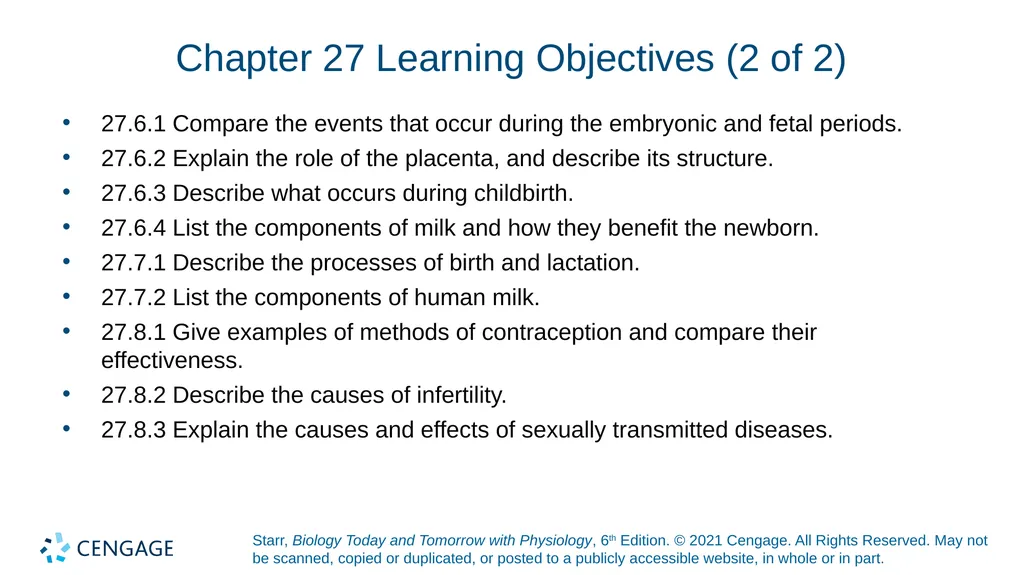
Chapter 27 Learning Objectives (2 of 2) 27.6.1 Compare the events that occur during the embryonic and fetal periods.
27.6.2 Explain the role of the placenta, and describe its structure.
27.6.3 Describe what occurs during childbirth.
27.6.4 List the components of milk and how they benefit the newborn.
27.7.1 Describe the processes of birth and lactation.
27.7.2 List the components of human milk.
27.8.1 Give examples of methods of contraception and compare their effectiveness.
27.8.2 Describe the causes of infertility.
27.8.3 Explain the causes and effects of sexually transmitted diseases.<br>
27.6.2 Explain the role of the placenta, and describe its structure.
27.6.3 Describe what occurs during childbirth.
27.6.4 List the components of milk and how they benefit the newborn.
27.7.1 Describe the processes of birth and lactation.
27.7.2 List the components of human milk.
27.8.1 Give examples of methods of contraception and compare their effectiveness.
27.8.2 Describe the causes of infertility.
27.8.3 Explain the causes and effects of sexually transmitted diseases.<br>
04
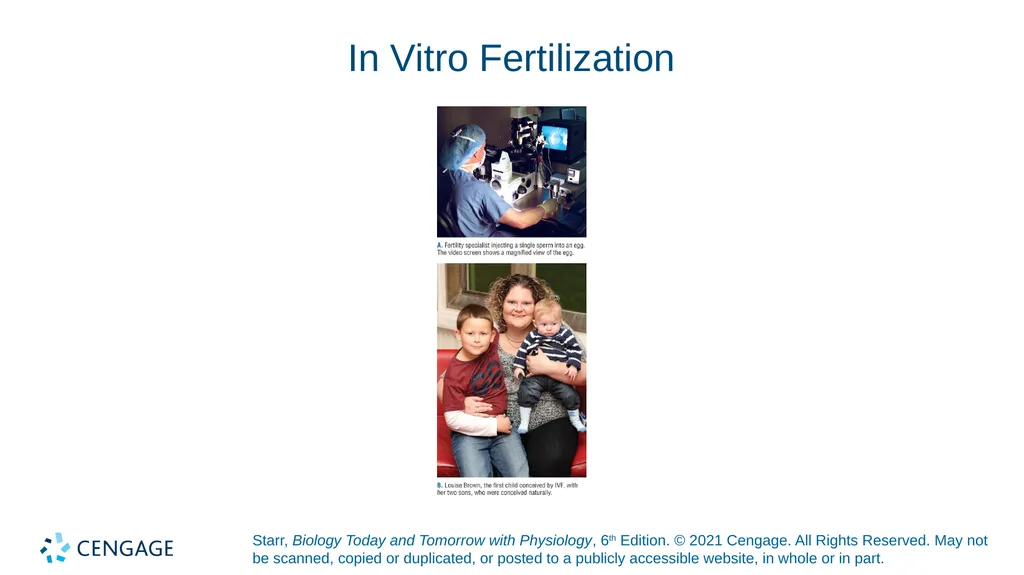
27.1 Assisted Reproductive Technology In vitro fertilization (IVF)
An assisted reproductive technique that combines eggs and sperm outside the body
After fertilization, each zygote undergoes mitotic divisions, forming a ball of cells that is placed in a woman’s womb.
With all IVF procedures, parents can screen embryos for genetic defects before they are implanted.<br>
An assisted reproductive technique that combines eggs and sperm outside the body
After fertilization, each zygote undergoes mitotic divisions, forming a ball of cells that is placed in a woman’s womb.
With all IVF procedures, parents can screen embryos for genetic defects before they are implanted.<br>
05
In Vitro Fertilization<br>
06
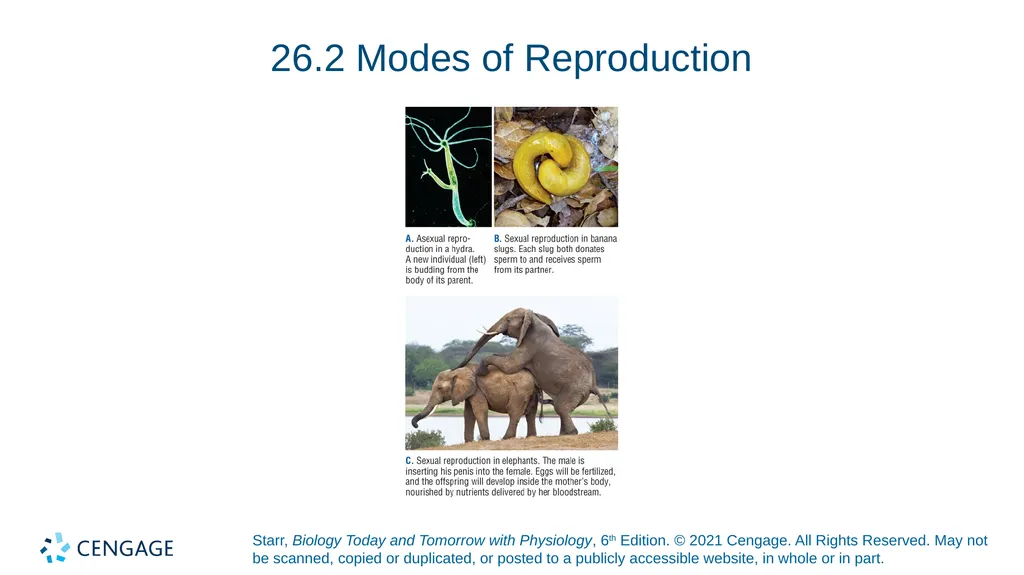
27.2 Modes of Reproduction Asexual reproduction
Offspring arise from one parent and inherit that parent’s genes only.
Advantageous in a stable environment
No mammal has been reported to reproduce asexually.<br>
Offspring arise from one parent and inherit that parent’s genes only.
Advantageous in a stable environment
No mammal has been reported to reproduce asexually.<br>
07
26.2 Modes of Reproduction<br>
08
Sexual Reproduction Gametes from two parents combine at fertilization.
Offspring inherit a combination of traits.
Produces variable offspring—advantageous in changing environments
Energetically costly
Some species (e.g., aphids) switch between sexual and asexual reproduction.<br>
Offspring inherit a combination of traits.
Produces variable offspring—advantageous in changing environments
Energetically costly
Some species (e.g., aphids) switch between sexual and asexual reproduction.<br>
09
Variations on Sexual Reproduction Hermaphrodite
Individual that produces both eggs and sperm
Simultaneous hermaphrodites produce eggs and sperm at the same time; can fertilize themselves or exchange genes with a partner.
Sequential hermaphrodites switch from one sex to another over the course of a lifetime.<br>
Individual that produces both eggs and sperm
Simultaneous hermaphrodites produce eggs and sperm at the same time; can fertilize themselves or exchange genes with a partner.
Sequential hermaphrodites switch from one sex to another over the course of a lifetime.<br>
10
External or Internal Fertilization With external fertilization, large numbers of sperm and eggs are released into water.
Aquatic invertebrates, fishes, amphibians
Most animals on land have internal fertilization; sperm and egg meet in the female’s body.
Reduces number of gametes produced
Allows development in the mother’s body
Yolk
Thick fluid rich in nutrients deposited in an egg as it forms; nourishes developing animal<br>
Aquatic invertebrates, fishes, amphibians
Most animals on land have internal fertilization; sperm and egg meet in the female’s body.
Reduces number of gametes produced
Allows development in the mother’s body
Yolk
Thick fluid rich in nutrients deposited in an egg as it forms; nourishes developing animal<br>
11
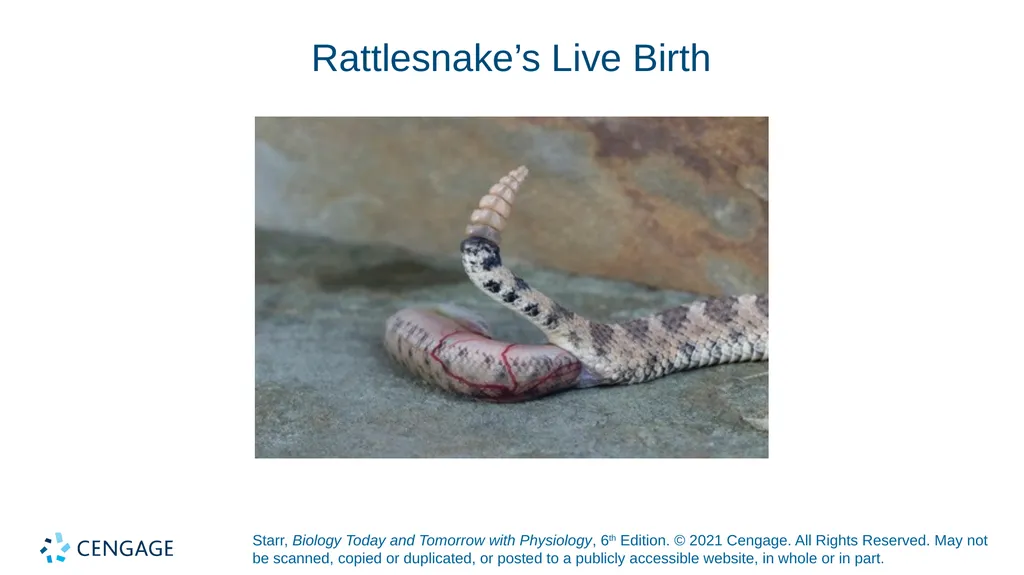
Rattlesnake’s Live Birth<br>
12
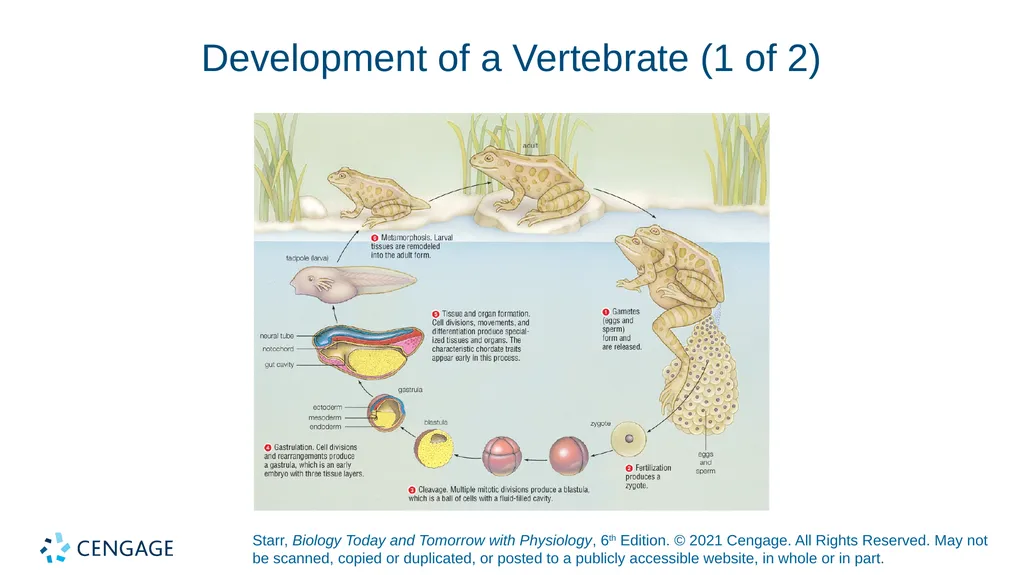
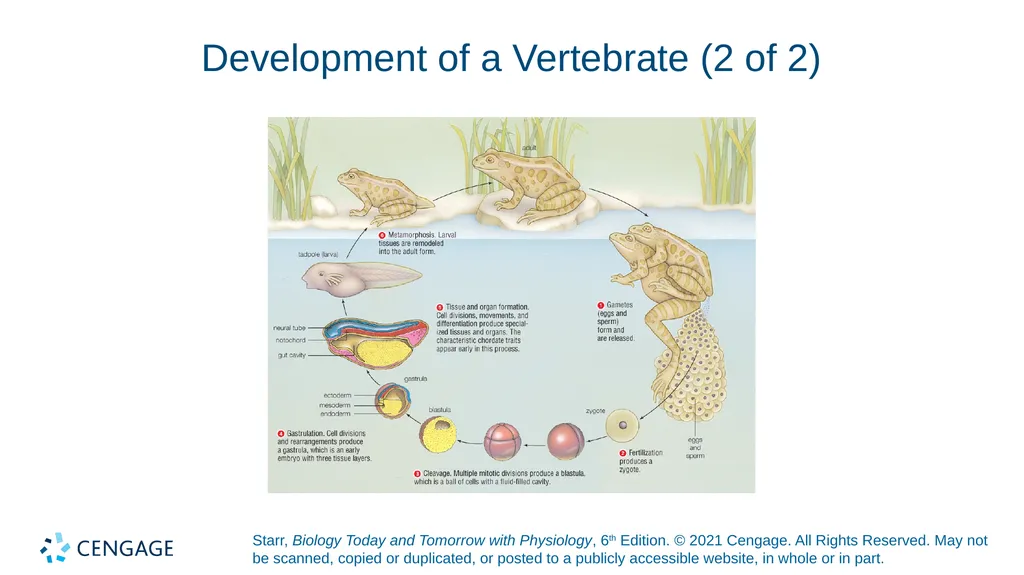
27.3 Stages of Animal Development (1 of 2) Sexual reproduction begins with the formation of gametes by meiosis in gonads.
Sperm: male gametes
Eggs: female gametes
Fertilization
Unity of a sperm and an egg
Zygote
First cell of a new individual
Development
Processes that transform a zygote into an adult animal<br>
Sperm: male gametes
Eggs: female gametes
Fertilization
Unity of a sperm and an egg
Zygote
First cell of a new individual
Development
Processes that transform a zygote into an adult animal<br>
13
Stages of Animal Development (2 of 2) Cleavage
Mitotic divisions of an animal cell
Increases the number of cells but not the original volume of the zygote
Ends with formation of a blastula
Blastula: hollow ball of cells
Gastrulation
Cells organized into primary tissue layers.
Movements produce a three-layered gastrula.
Gastrula: three-layered developmental stage formed by gastrulation in an animal<br>
Mitotic divisions of an animal cell
Increases the number of cells but not the original volume of the zygote
Ends with formation of a blastula
Blastula: hollow ball of cells
Gastrulation
Cells organized into primary tissue layers.
Movements produce a three-layered gastrula.
Gastrula: three-layered developmental stage formed by gastrulation in an animal<br>
14
Development of a Vertebrate (1 of 2)<br>
15
Development of a Vertebrate (2 of 2)<br>
16
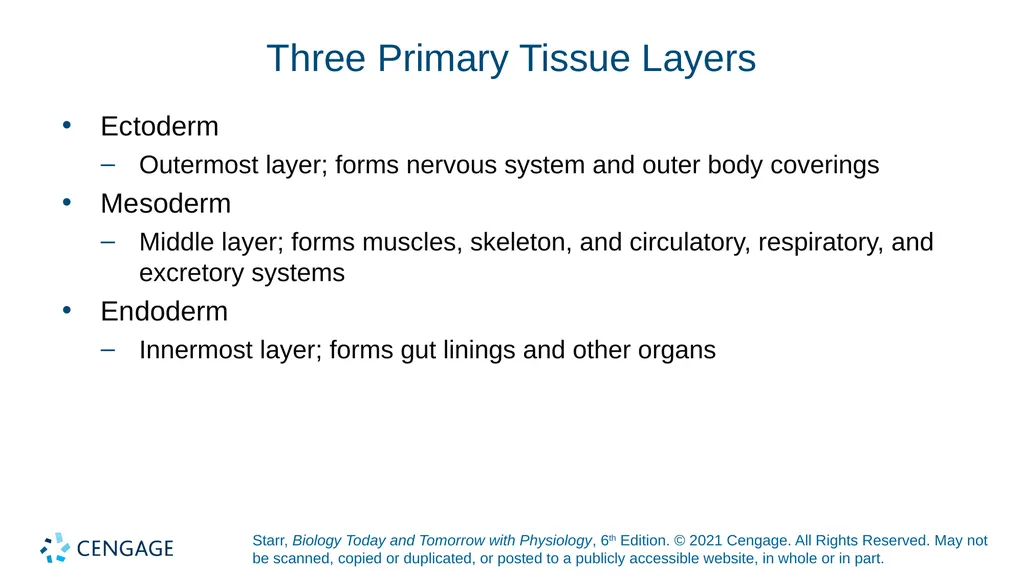
Three Primary Tissue Layers Ectoderm
Outermost layer; forms nervous system and outer body coverings
Mesoderm
Middle layer; forms muscles, skeleton, and circulatory, respiratory, and excretory systems
Endoderm
Innermost layer; forms gut linings and other organs<br>
Outermost layer; forms nervous system and outer body coverings
Mesoderm
Middle layer; forms muscles, skeleton, and circulatory, respiratory, and excretory systems
Endoderm
Innermost layer; forms gut linings and other organs<br>
17
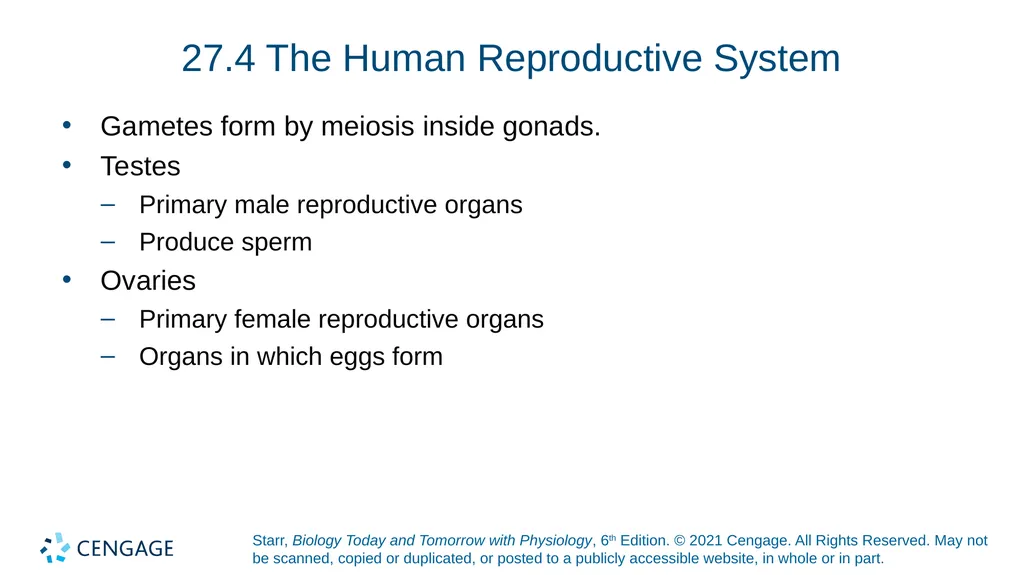
27.4 The Human Reproductive System Gametes form by meiosis inside gonads.
Testes
Primary male reproductive organs
Produce sperm
Ovaries
Primary female reproductive organs
Organs in which eggs form<br>
Testes
Primary male reproductive organs
Produce sperm
Ovaries
Primary female reproductive organs
Organs in which eggs form<br>
18
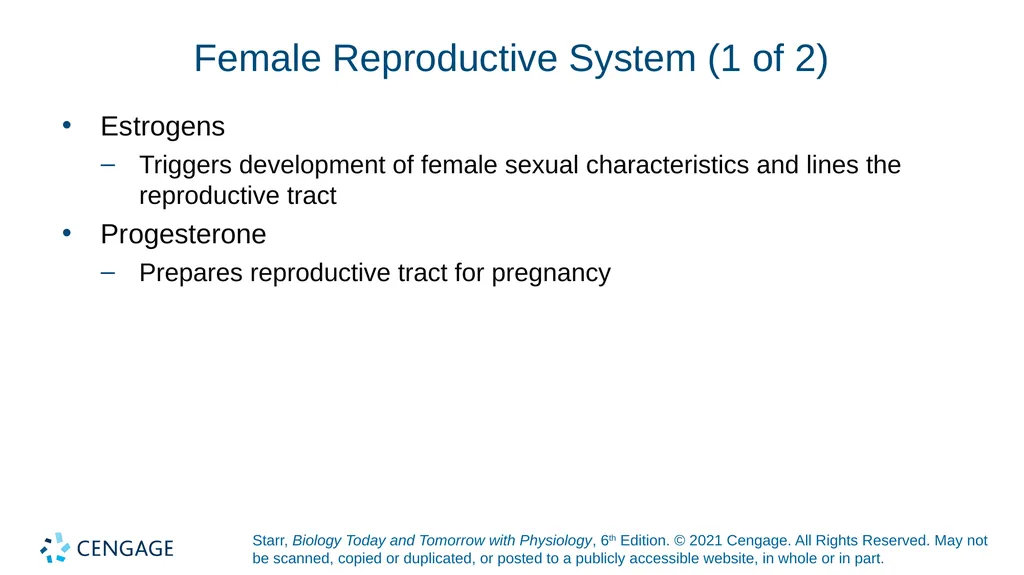
Female Reproductive System (1 of 2) Estrogens
Triggers development of female sexual characteristics and lines the reproductive tract
Progesterone
Prepares reproductive tract for pregnancy<br>
Triggers development of female sexual characteristics and lines the reproductive tract
Progesterone
Prepares reproductive tract for pregnancy<br>
19
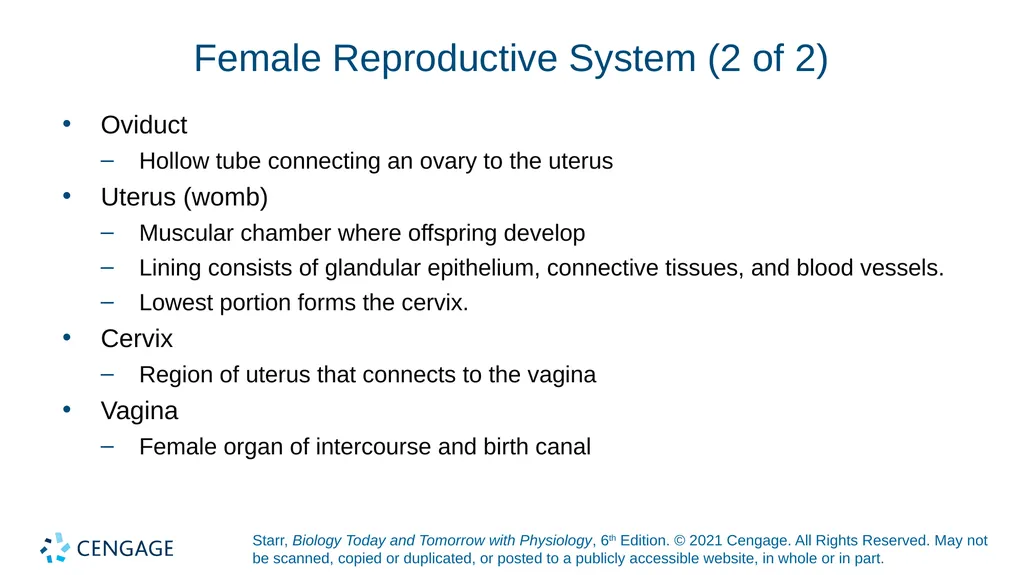
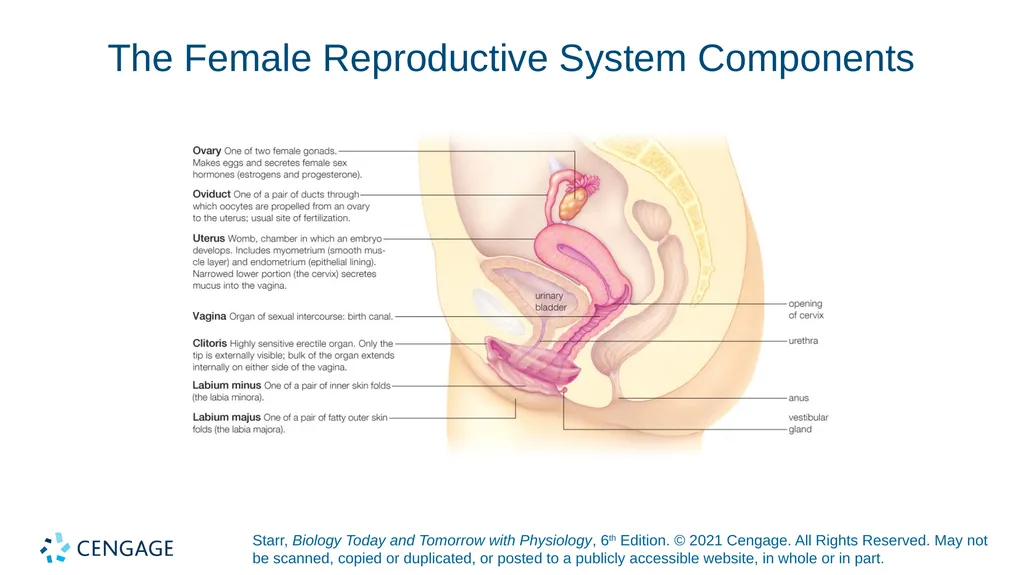
Female Reproductive System (2 of 2) Oviduct
Hollow tube connecting an ovary to the uterus
Uterus (womb)
Muscular chamber where offspring develop
Lining consists of glandular epithelium, connective tissues, and blood vessels.
Lowest portion forms the cervix.
Cervix
Region of uterus that connects to the vagina
Vagina
Female organ of intercourse and birth canal<br>
Hollow tube connecting an ovary to the uterus
Uterus (womb)
Muscular chamber where offspring develop
Lining consists of glandular epithelium, connective tissues, and blood vessels.
Lowest portion forms the cervix.
Cervix
Region of uterus that connects to the vagina
Vagina
Female organ of intercourse and birth canal<br>
20
The Female Reproductive System Components<br>
21
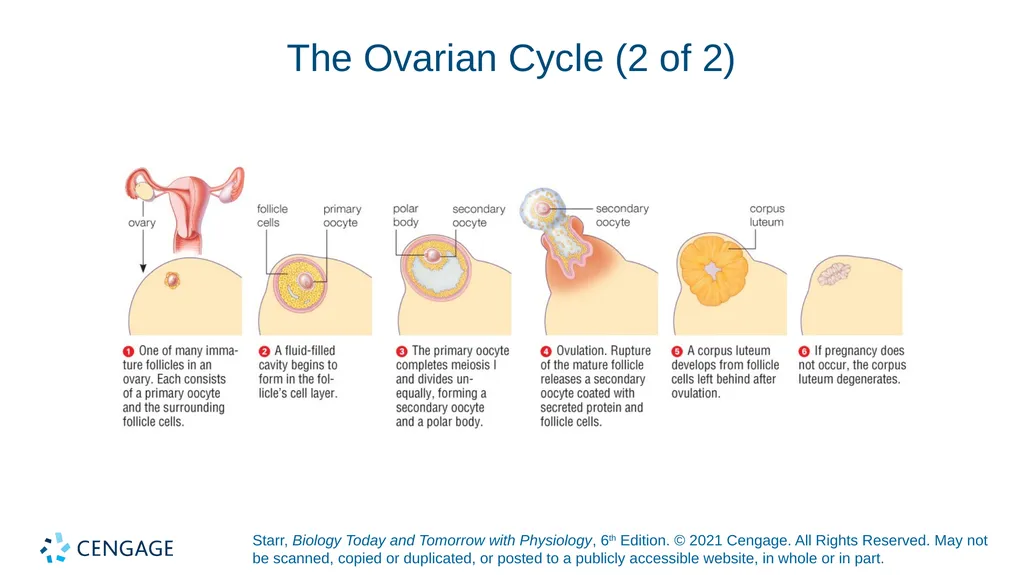
Egg Production and Release (1 of 2) Female germ cells do not divide after birth; a female is born with immature eggs (oocytes) in her ovaries.
Ovarian follicle
Consists of a primary oocyte and the cells around it<br>
Ovarian follicle
Consists of a primary oocyte and the cells around it<br>
22
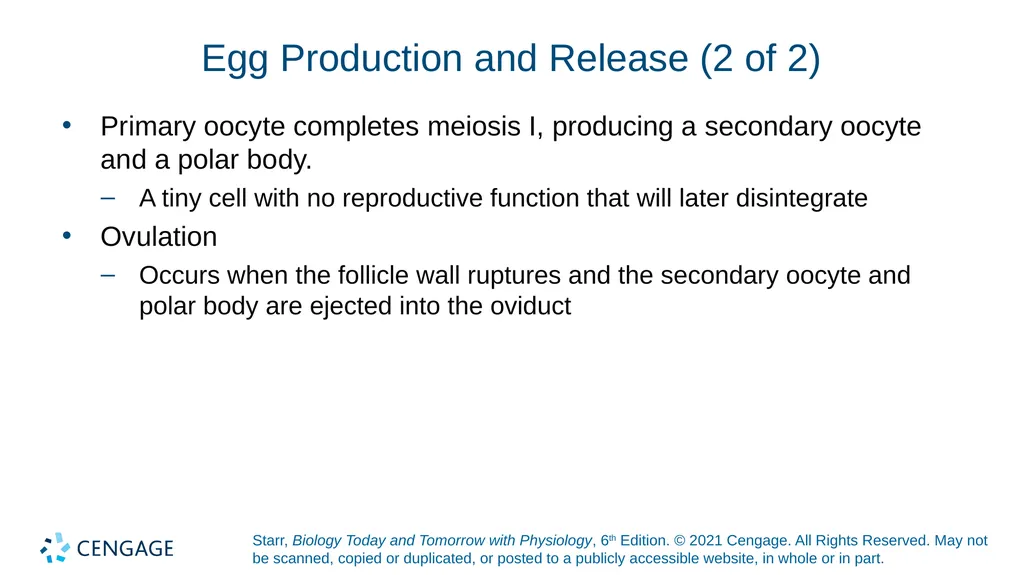
Egg Production and Release (2 of 2) Primary oocyte completes meiosis I, producing a secondary oocyte and a polar body.
A tiny cell with no reproductive function that will later disintegrate
Ovulation
Occurs when the follicle wall ruptures and the secondary oocyte and polar body are ejected into the oviduct<br>
A tiny cell with no reproductive function that will later disintegrate
Ovulation
Occurs when the follicle wall ruptures and the secondary oocyte and polar body are ejected into the oviduct<br>
23
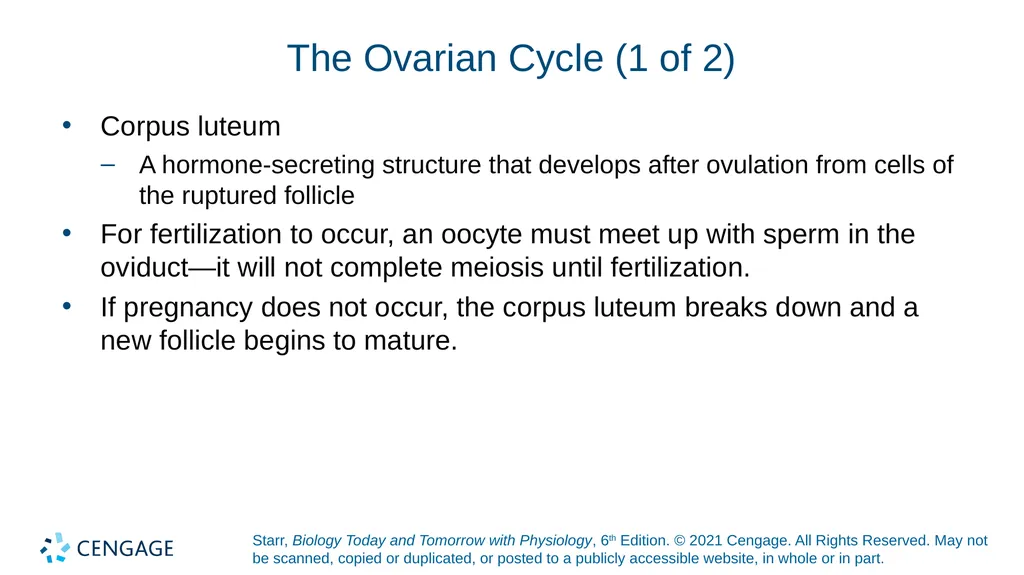
The Ovarian Cycle (1 of 2) Corpus luteum
A hormone-secreting structure that develops after ovulation from cells of the ruptured follicle
For fertilization to occur, an oocyte must meet up with sperm in the oviduct—it will not complete meiosis until fertilization.
If pregnancy does not occur, the corpus luteum breaks down and a new follicle begins to mature.<br>
A hormone-secreting structure that develops after ovulation from cells of the ruptured follicle
For fertilization to occur, an oocyte must meet up with sperm in the oviduct—it will not complete meiosis until fertilization.
If pregnancy does not occur, the corpus luteum breaks down and a new follicle begins to mature.<br>
24
The Ovarian Cycle (2 of 2)<br>
25
The Menstrual Cycle Cyclic events in the ovaries are coordinated with cyclic changes in the uterus.
Menstrual cycle
Approximately monthly cycle in which the uterine lining thickens in preparation for pregnancy, then is shed if pregnancy does not occur
Menstruation
Flow of blood and uterine lining out through the vagina<br>
Menstrual cycle
Approximately monthly cycle in which the uterine lining thickens in preparation for pregnancy, then is shed if pregnancy does not occur
Menstruation
Flow of blood and uterine lining out through the vagina<br>
26
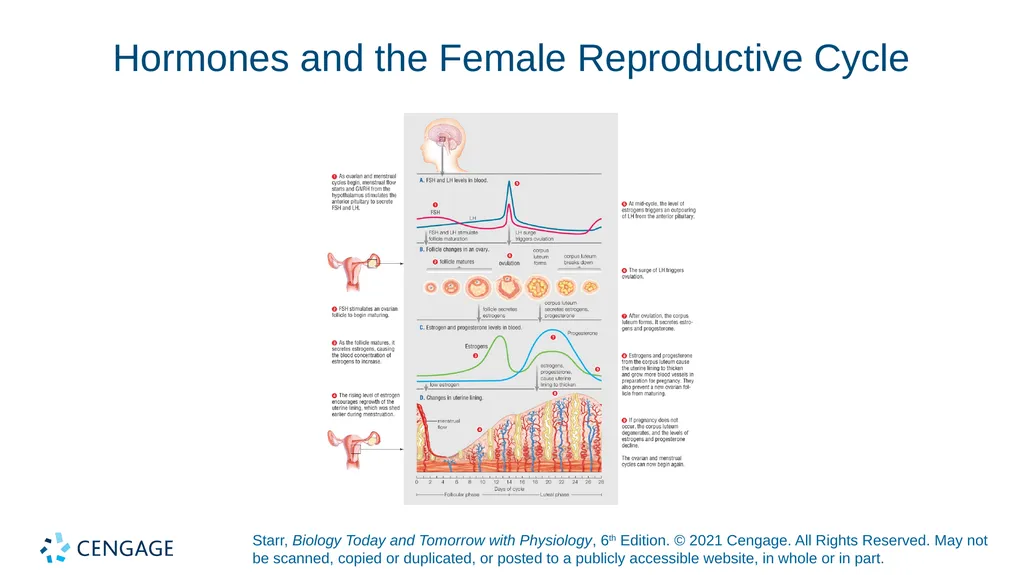
Hormones and the Menstrual Cycle Ovaries are controlled by GnRH.
Controls FSH and LH secretion
FSH encourages follicle maturation.
A surge of LH near the midpoint of the cycle triggers ovulation.
After ovulation, estrogen levels decline.
Corpus luteum forms; secretes estrogens and progesterone to prepare for pregnancy.
If pregnancy does not occur:
Corpus luteum breaks down; hormone levels fall; uterine lining is shed.
Pituitary begins secreting FSH and LH again.<br>
Controls FSH and LH secretion
FSH encourages follicle maturation.
A surge of LH near the midpoint of the cycle triggers ovulation.
After ovulation, estrogen levels decline.
Corpus luteum forms; secretes estrogens and progesterone to prepare for pregnancy.
If pregnancy does not occur:
Corpus luteum breaks down; hormone levels fall; uterine lining is shed.
Pituitary begins secreting FSH and LH again.<br>
27
Hormones and the Female Reproductive Cycle<br>
28
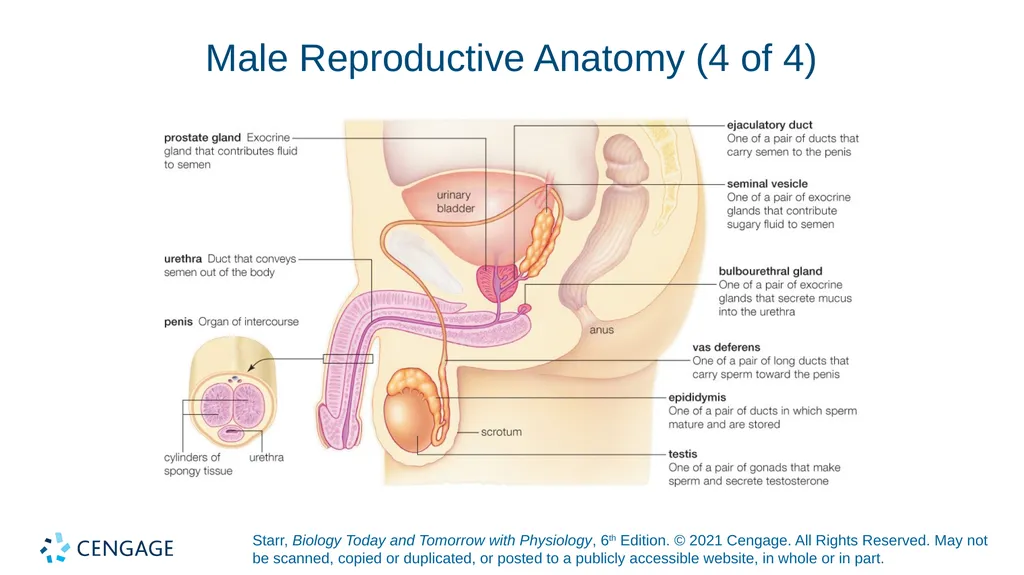
Male Reproductive Anatomy (1 of 4) Scrotum
A pouch of skin and smooth muscle below the bones of the pelvic girdle that holds the testes
At puberty, production of sperm and testosterone begins, and secondary sexual characteristics develop.
Immature sperm move from a testis into the epididymis.
A coiled duct on top of the testes where the sperm mature<br>
A pouch of skin and smooth muscle below the bones of the pelvic girdle that holds the testes
At puberty, production of sperm and testosterone begins, and secondary sexual characteristics develop.
Immature sperm move from a testis into the epididymis.
A coiled duct on top of the testes where the sperm mature<br>
29
Male Reproductive Anatomy (2 of 4) Mature sperm are carried by the vas deferens.
A duct that carries sperm to an ejaculatory duct
Erection occurs when blood fills spongy tissues in the penis.<br>
A duct that carries sperm to an ejaculatory duct
Erection occurs when blood fills spongy tissues in the penis.<br>
30
Male Reproductive Anatomy (3 of 4) Ejaculation
Smooth muscle in walls of epididymides and vasa deferentia propels semen out of the body
Semen
Mixture of sperm, proteins, nutrients, ions, and signaling molecules
Seminal vesicles
Secrete fructose-rich fluid into the vas deferentia; main source of semen volume
Prostate gland
Secretions raise pH of semen
Encircles male urethra; enlarges with age<br>
Smooth muscle in walls of epididymides and vasa deferentia propels semen out of the body
Semen
Mixture of sperm, proteins, nutrients, ions, and signaling molecules
Seminal vesicles
Secrete fructose-rich fluid into the vas deferentia; main source of semen volume
Prostate gland
Secretions raise pH of semen
Encircles male urethra; enlarges with age<br>
31
Male Reproductive Anatomy (4 of 4)<br>
32
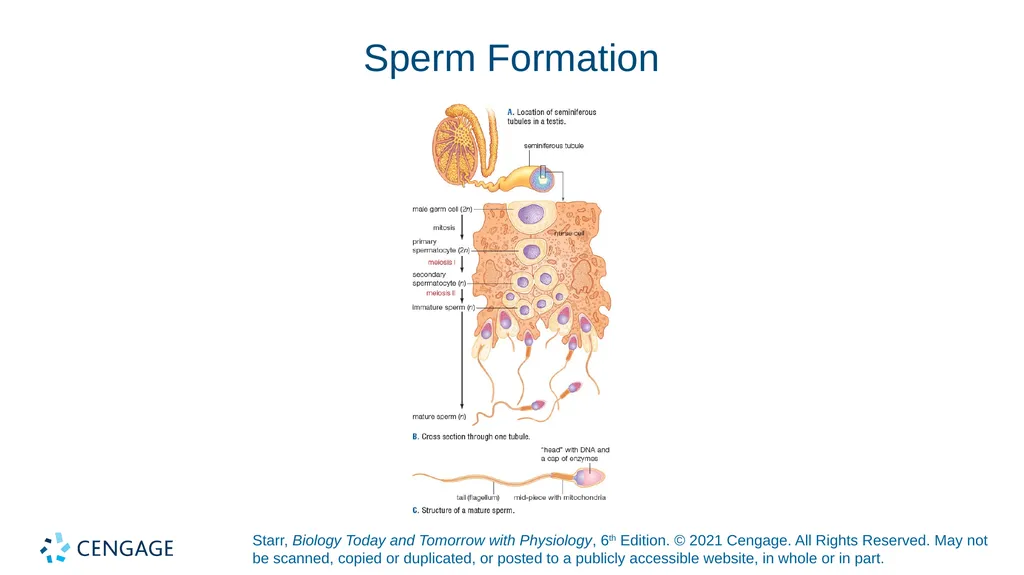
How Sperm Form (1 of 2) Sperm form in seminiferous tubules in testes.
Diploid germ cells divide by mitosis and differentiate into primary spermatocytes.
Primary spermatocytes undergo meiosis and become secondary spermatocytes.
Structure of a mature sperm
Head containing DNA (haploid)
Enzyme-containing cap that helps penetrate egg
Flagellum powered by mitochondria<br>
Diploid germ cells divide by mitosis and differentiate into primary spermatocytes.
Primary spermatocytes undergo meiosis and become secondary spermatocytes.
Structure of a mature sperm
Head containing DNA (haploid)
Enzyme-containing cap that helps penetrate egg
Flagellum powered by mitochondria<br>
33
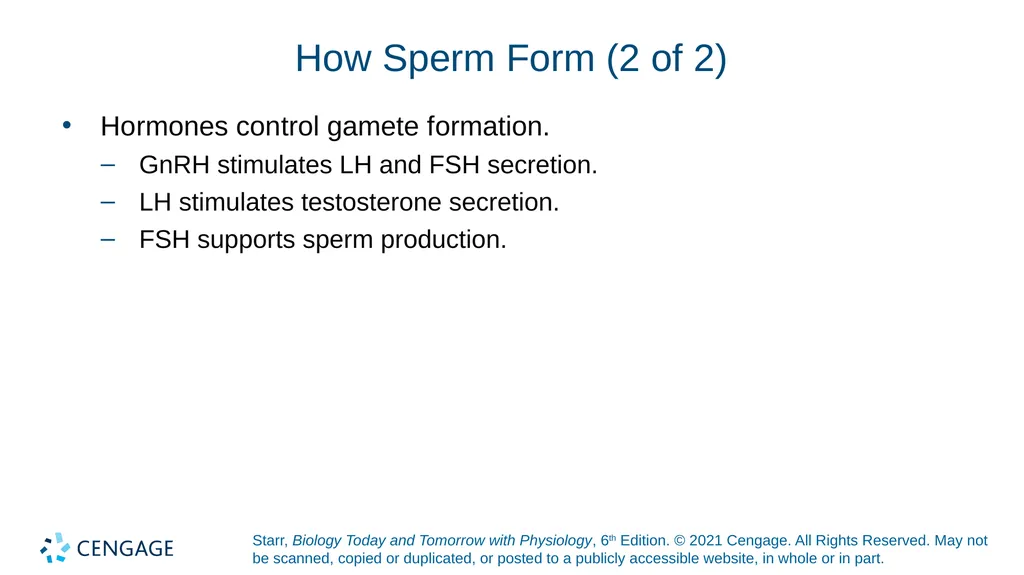
How Sperm Form (2 of 2) Hormones control gamete formation.
GnRH stimulates LH and FSH secretion.
LH stimulates testosterone secretion.
FSH supports sperm production.<br>
GnRH stimulates LH and FSH secretion.
LH stimulates testosterone secretion.
FSH supports sperm production.<br>
34
Sperm Formation<br>
35
27.5 Bringing Gametes Together Hormones and nerves govern physiological changes that occur during arousal and intercourse.
For males, penis becomes erect as a result of increased fluid pressure inside its spongy tissue.
For females, sexual excitement increases blood flow to the vaginal wall, labia, and clitoris.
Orgasm: sexual climax
Neurotransmitter release causes smooth muscle contractions accompanied by a feeling of release and pleasure.<br>
For males, penis becomes erect as a result of increased fluid pressure inside its spongy tissue.
For females, sexual excitement increases blood flow to the vaginal wall, labia, and clitoris.
Orgasm: sexual climax
Neurotransmitter release causes smooth muscle contractions accompanied by a feeling of release and pleasure.<br>
36
A Sperm’s Journey Only a few hundred sperm survive the journey through the vagina to the oviduct where fertilization typically occurs.
As estrogen level’s increase leading to ovulation, a woman’s cervical mucus thins and becomes more alkaline.
Sperm can more easily swim through cervical canal to reach oviducts.
Ovulation occurs in only one ovary at a time so only half the sperm that reach the ovaries can possibly fertilize an egg.<br>
As estrogen level’s increase leading to ovulation, a woman’s cervical mucus thins and becomes more alkaline.
Sperm can more easily swim through cervical canal to reach oviducts.
Ovulation occurs in only one ovary at a time so only half the sperm that reach the ovaries can possibly fertilize an egg.<br>
37
Fertilization<br>
38
27.6 Human Development Prenatal development occurs from fertilization to birth, about 38 weeks in humans.
Cell divisions transform a single-celled zygote into a newborn with many different cells of different types.
Fertilization
Typically occurs in upper region of oviduct
Sometimes two eggs mature and are released at the same time.
If each is fertilized by a different sperm fraternal twins result.<br>
Cell divisions transform a single-celled zygote into a newborn with many different cells of different types.
Fertilization
Typically occurs in upper region of oviduct
Sometimes two eggs mature and are released at the same time.
If each is fertilized by a different sperm fraternal twins result.<br>
39
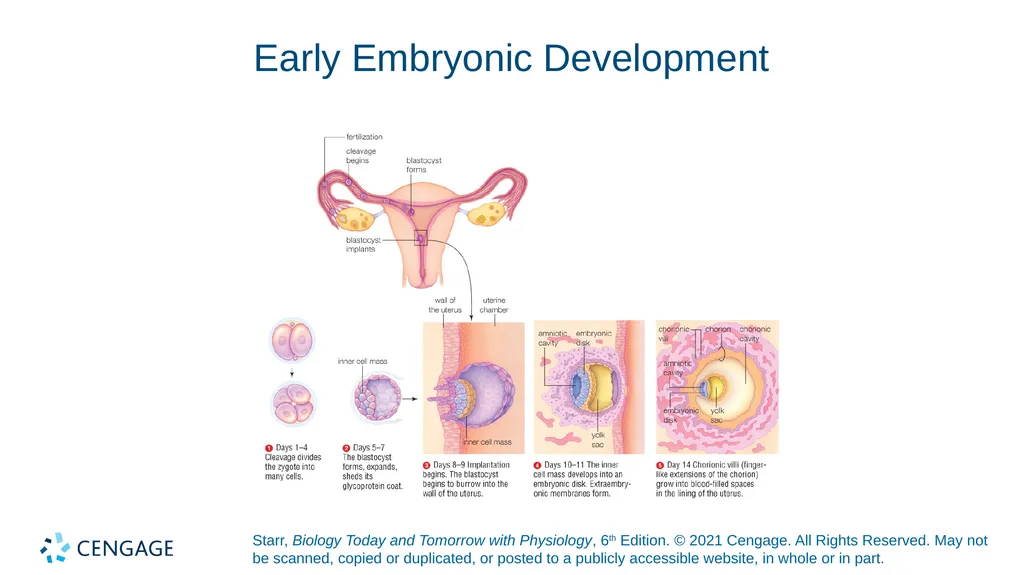
From Cleavage to Implantation Cleavage begins within a day of fertilization.
A blastocyst forms by the fifth day.
Implantation begins around the sixth day when the blastocyst attaches and burrows into the endometrium.
Amnion
A membrane that encloses a fluid-filled amniotic cavity
This fluid acts as a buoyant cradle where the embryo grows and moves freely.<br>
A blastocyst forms by the fifth day.
Implantation begins around the sixth day when the blastocyst attaches and burrows into the endometrium.
Amnion
A membrane that encloses a fluid-filled amniotic cavity
This fluid acts as a buoyant cradle where the embryo grows and moves freely.<br>
40
Cleavage and Implantation Chorion
Extraembryonic membrane of amniotes
Chorionic villi form part of the placenta.
Placenta
Organ composed of maternal and embryonic tissues that allows the exchange of materials between mother and embryo
Human chorionic gonadotropin (HCG)
Maintains the uterus to sustain a pregnancy
Detected in home pregnancy tests<br>
Extraembryonic membrane of amniotes
Chorionic villi form part of the placenta.
Placenta
Organ composed of maternal and embryonic tissues that allows the exchange of materials between mother and embryo
Human chorionic gonadotropin (HCG)
Maintains the uterus to sustain a pregnancy
Detected in home pregnancy tests<br>
41
Early Embryonic Development<br>
42
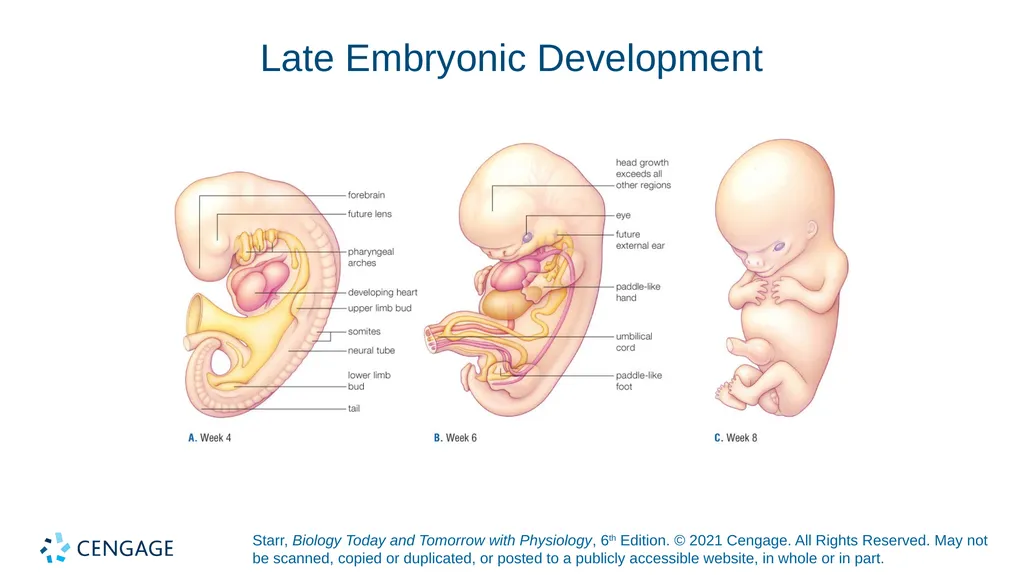
Late Embryonic Development<br>
43
Fetal Development Apoptosis
Process by which cells self-destruct
Sculpts individual digits; eliminates the embryonic tail
Weeks 8–9: Organ systems have formed; the embryo becomes a fetus.
Fetus
Developing human between nine weeks and birth
Heartbeat is detected at about five months.
After seven months, it can survive if born prematurely
Full term is 38 weeks (9 months)<br>
Process by which cells self-destruct
Sculpts individual digits; eliminates the embryonic tail
Weeks 8–9: Organ systems have formed; the embryo becomes a fetus.
Fetus
Developing human between nine weeks and birth
Heartbeat is detected at about five months.
After seven months, it can survive if born prematurely
Full term is 38 weeks (9 months)<br>
44
Functions of the Placenta Oxygen and nutrients diffuse from mother to embryo; wastes diffuse from embryo to mother.
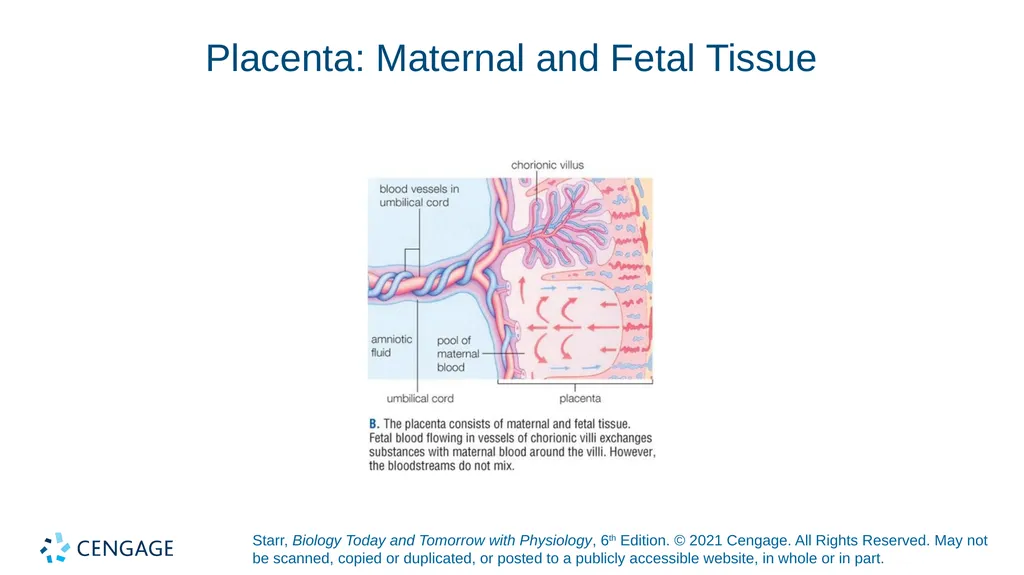
Embryonic blood vessels extend through the umbilical cord to the placenta, into chorionic villi surrounded by pools of maternal blood.
Maternal and embryonic bloodstreams never mix.
Placenta produces HCG, progesterone, and estrogens that maintain the uterine lining.<br>
Embryonic blood vessels extend through the umbilical cord to the placenta, into chorionic villi surrounded by pools of maternal blood.
Maternal and embryonic bloodstreams never mix.
Placenta produces HCG, progesterone, and estrogens that maintain the uterine lining.<br>
45
Placenta: Maternal and Fetal Tissue<br>
46
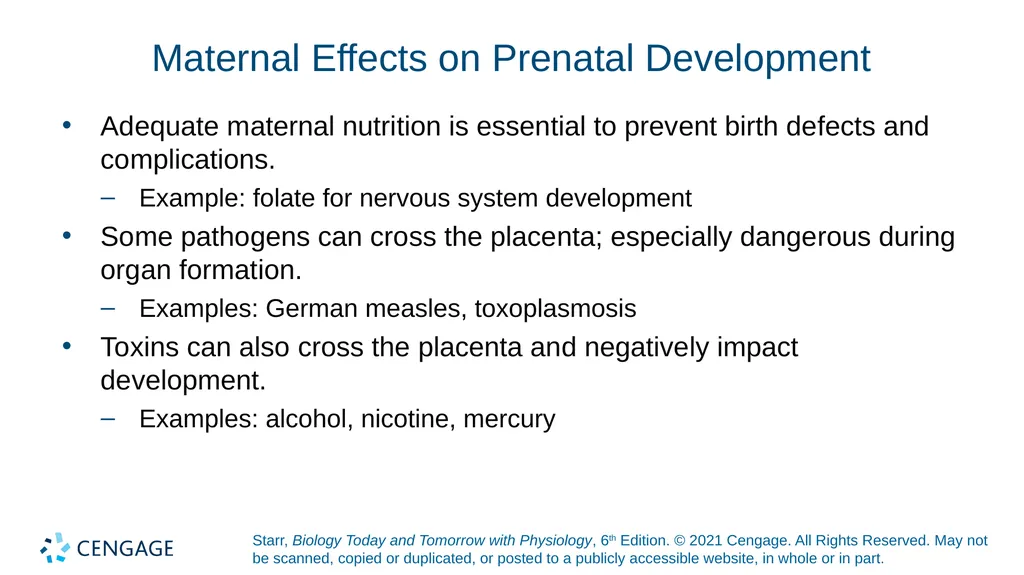
Maternal Effects on Prenatal Development Adequate maternal nutrition is essential to prevent birth defects and complications.
Example: folate for nervous system development
Some pathogens can cross the placenta; especially dangerous during organ formation.
Examples: German measles, toxoplasmosis
Toxins can also cross the placenta and negatively impact development.
Examples: alcohol, nicotine, mercury<br>
Example: folate for nervous system development
Some pathogens can cross the placenta; especially dangerous during organ formation.
Examples: German measles, toxoplasmosis
Toxins can also cross the placenta and negatively impact development.
Examples: alcohol, nicotine, mercury<br>
47
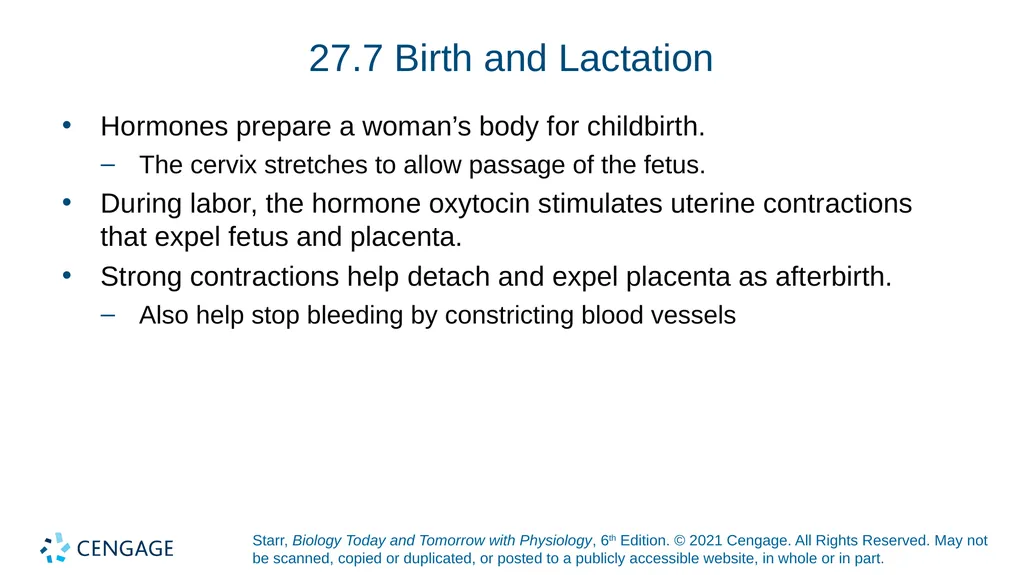
27.7 Birth and Lactation Hormones prepare a woman’s body for childbirth.
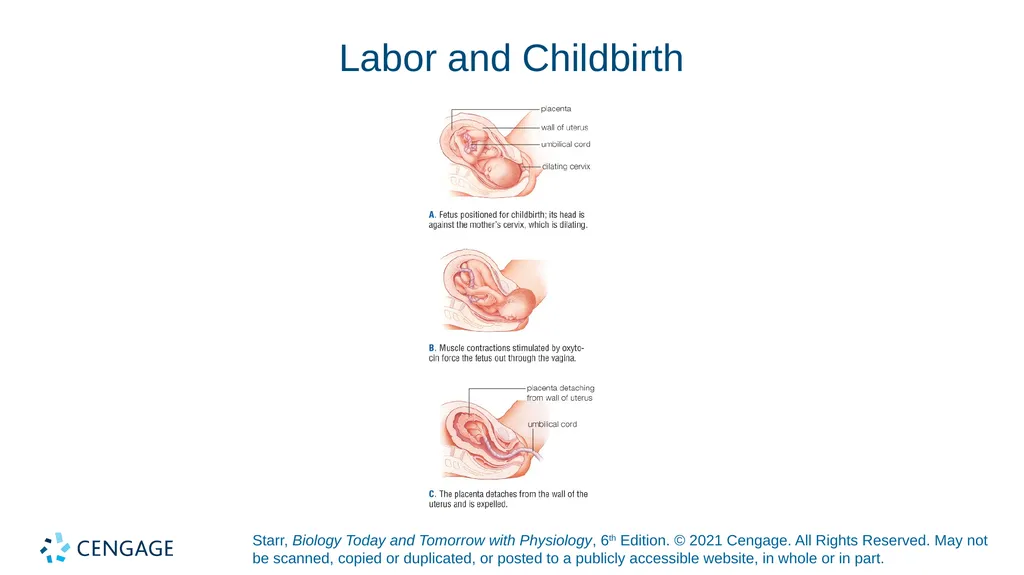
The cervix stretches to allow passage of the fetus.
During labor, the hormone oxytocin stimulates uterine contractions that expel fetus and placenta.
Strong contractions help detach and expel placenta as afterbirth.
Also help stop bleeding by constricting blood vessels<br>
The cervix stretches to allow passage of the fetus.
During labor, the hormone oxytocin stimulates uterine contractions that expel fetus and placenta.
Strong contractions help detach and expel placenta as afterbirth.
Also help stop bleeding by constricting blood vessels<br>
48
Labor and Childbirth<br>
49
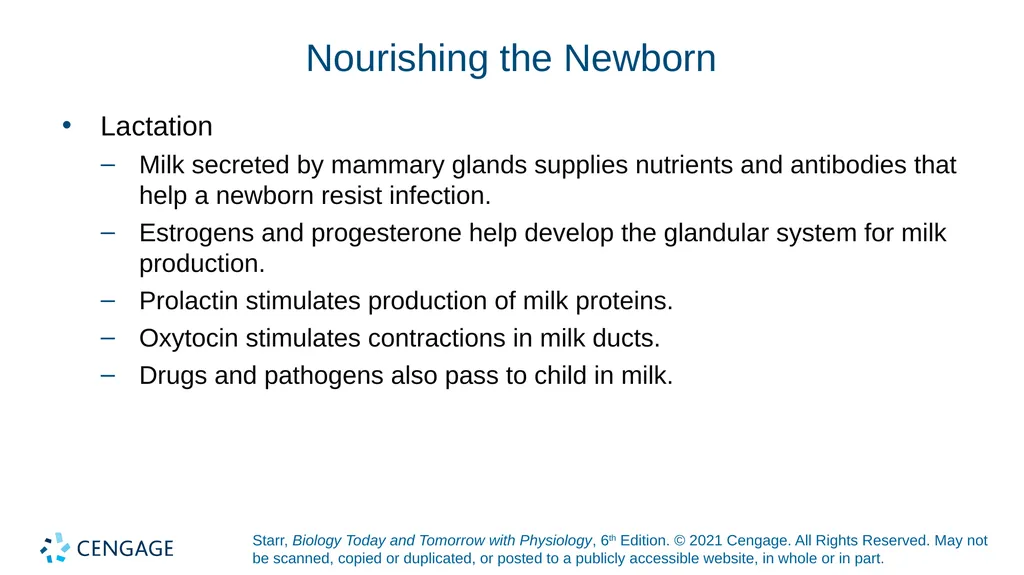
Nourishing the Newborn Lactation
Milk secreted by mammary glands supplies nutrients and antibodies that help a newborn resist infection.
Estrogens and progesterone help develop the glandular system for milk production.
Prolactin stimulates production of milk proteins.
Oxytocin stimulates contractions in milk ducts.
Drugs and pathogens also pass to child in milk.<br>
Milk secreted by mammary glands supplies nutrients and antibodies that help a newborn resist infection.
Estrogens and progesterone help develop the glandular system for milk production.
Prolactin stimulates production of milk proteins.
Oxytocin stimulates contractions in milk ducts.
Drugs and pathogens also pass to child in milk.<br>
50
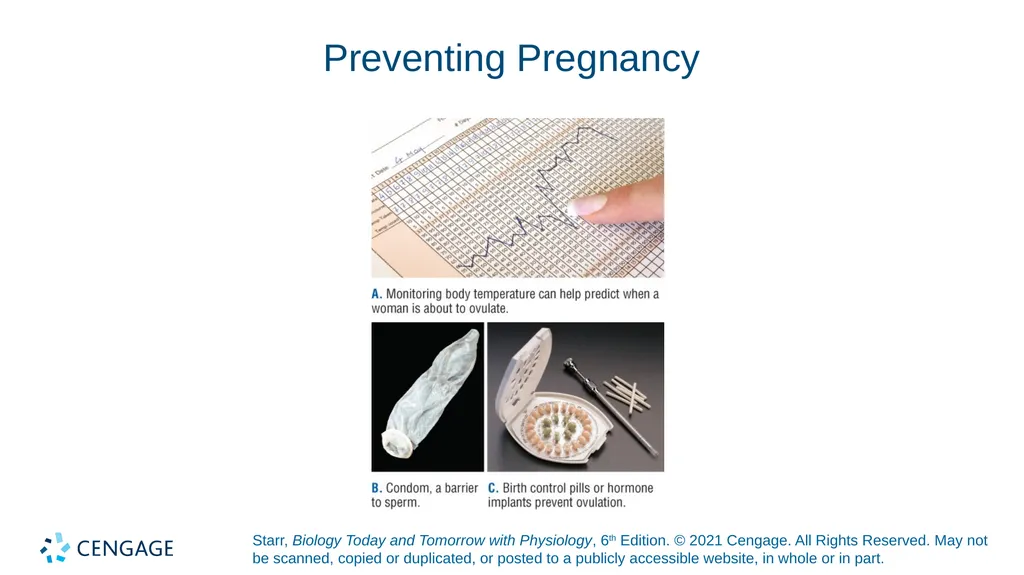
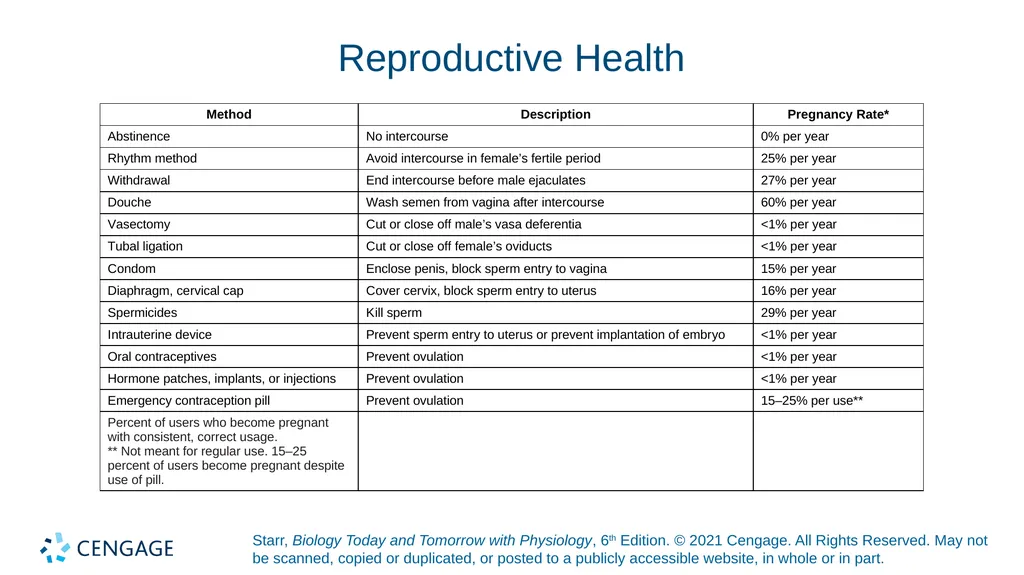
27.8 Fertility and Reproductive Health Contraception
Methods to prevent pregnancy<br>
Methods to prevent pregnancy<br>
51
Preventing Pregnancy<br>
52
Reproductive Health<br>
53
Infertility About 10 percent of couples in the United States are infertile.
Causes of female infertility include age, obesity, hormonal disorders, endometriosis, uterine problems, and STDs.
Male infertility can be due to few or abnormal sperm, ejaculation problems, hormonal disorders, and STDs.<br>
Causes of female infertility include age, obesity, hormonal disorders, endometriosis, uterine problems, and STDs.
Male infertility can be due to few or abnormal sperm, ejaculation problems, hormonal disorders, and STDs.<br>
54
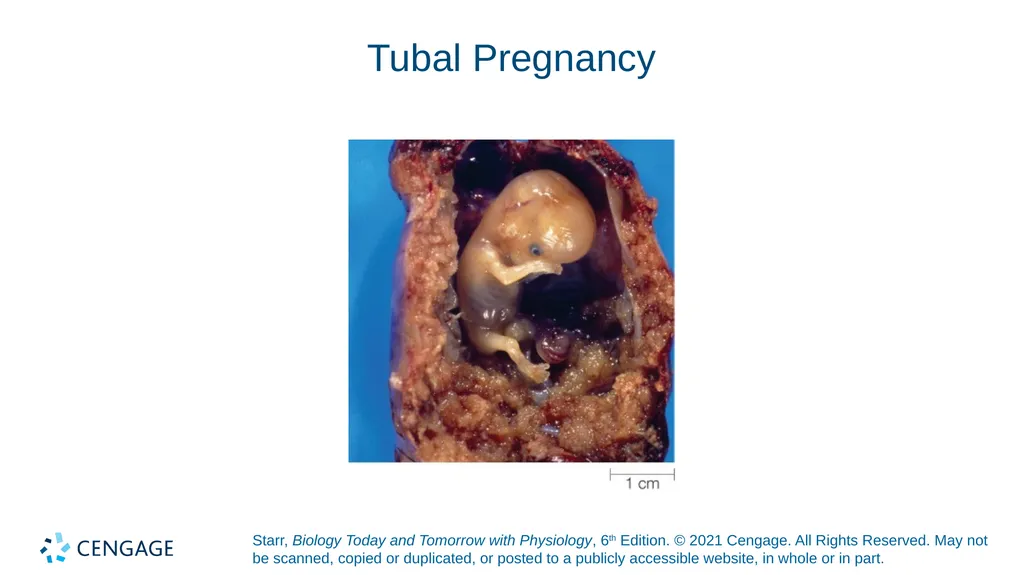
Tubal Pregnancy<br>
55
Sexually Transmitted Disease (STDs) Infectious diseases caused by protozoan, bacterial, and viral pathogens that can live in the reproductive tract and are spread by unsafe sex
If untreated, STDs can cause sterility and harm health of parents and their offspring.
Women contract STDs more easily and have more complications from them.<br>
If untreated, STDs can cause sterility and harm health of parents and their offspring.
Women contract STDs more easily and have more complications from them.<br>
56
Common STDs Viruses
HPV causes genital warts and cervical cancer.
Genital herpes causes sores and birth defects.
HIV leads to AIDS and opportunistic infections.
Protozoans
Trichomoniasis can cause infertility.
Bacteria
Chlamydia infection can cause infertility.
Gonorrhea can cause sterility.
Syphilis damages internal organs, brain, and spinal cord.<br>
HPV causes genital warts and cervical cancer.
Genital herpes causes sores and birth defects.
HIV leads to AIDS and opportunistic infections.
Protozoans
Trichomoniasis can cause infertility.
Bacteria
Chlamydia infection can cause infertility.
Gonorrhea can cause sterility.
Syphilis damages internal organs, brain, and spinal cord.<br>
57
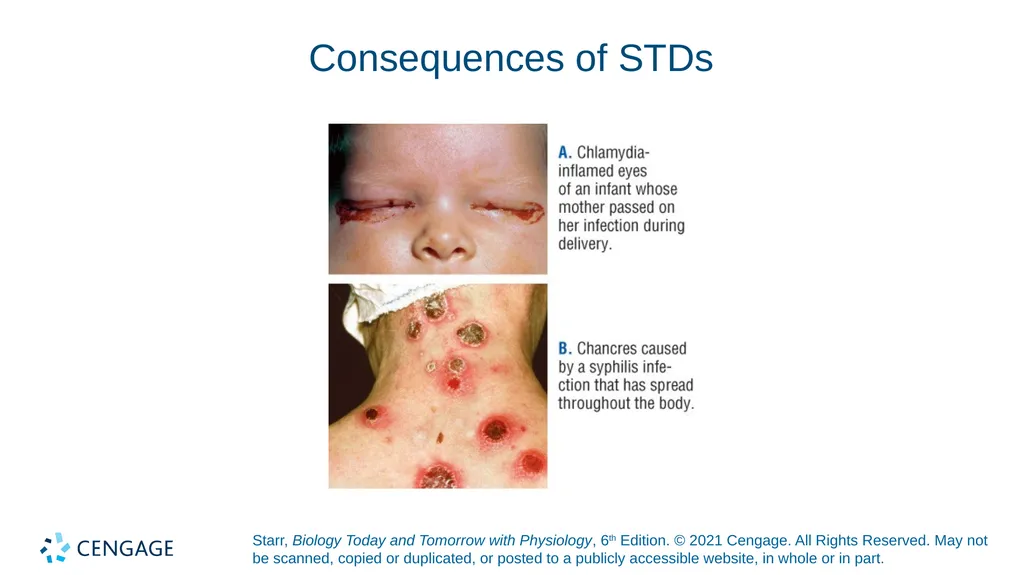
Consequences of STDs<br>
58
Points to Ponder What effects do prescription and recreational drugs have on embryonic development?
Compare and discuss the effectiveness of various forms of birth control.
What are the ramifications of each type?<br>
Compare and discuss the effectiveness of various forms of birth control.
What are the ramifications of each type?<br>