04
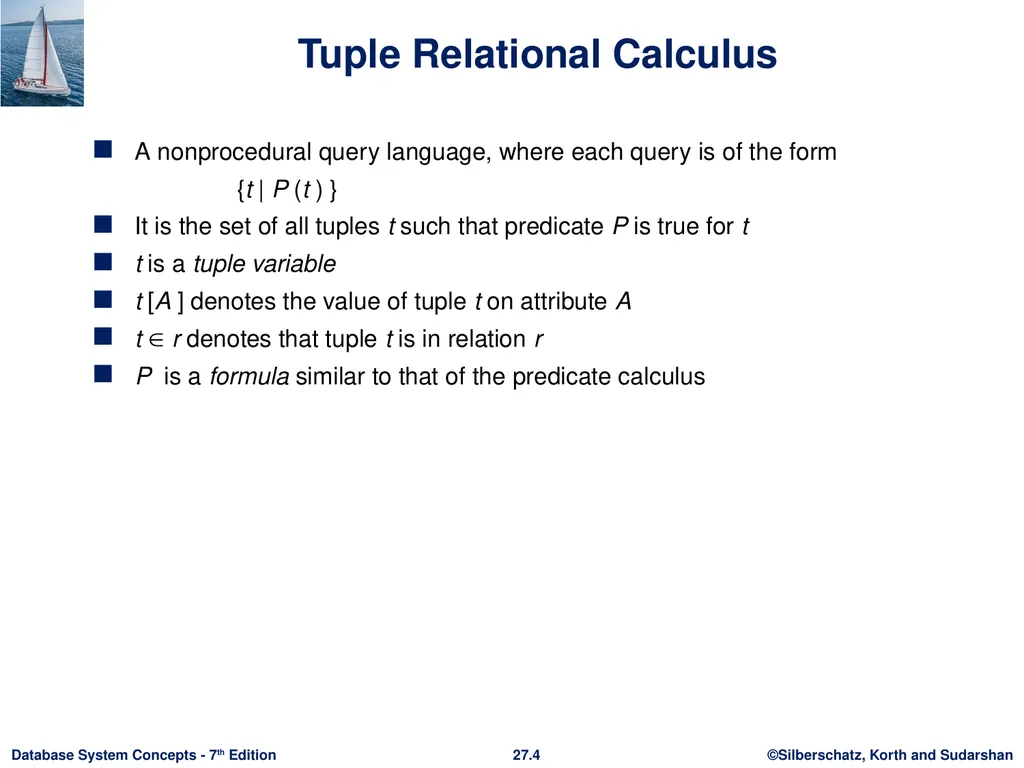
Tuple Relational Calculus A nonprocedural query language, where each query is of the form
{t | P (t ) }
It is the set of all tuples t such that predicate P is true for t
t is a tuple variable
t [A ] denotes the value of tuple t on attribute A
t r denotes that tuple t is in relation r
P is a formula similar to that of the predicate calculus<br>
05
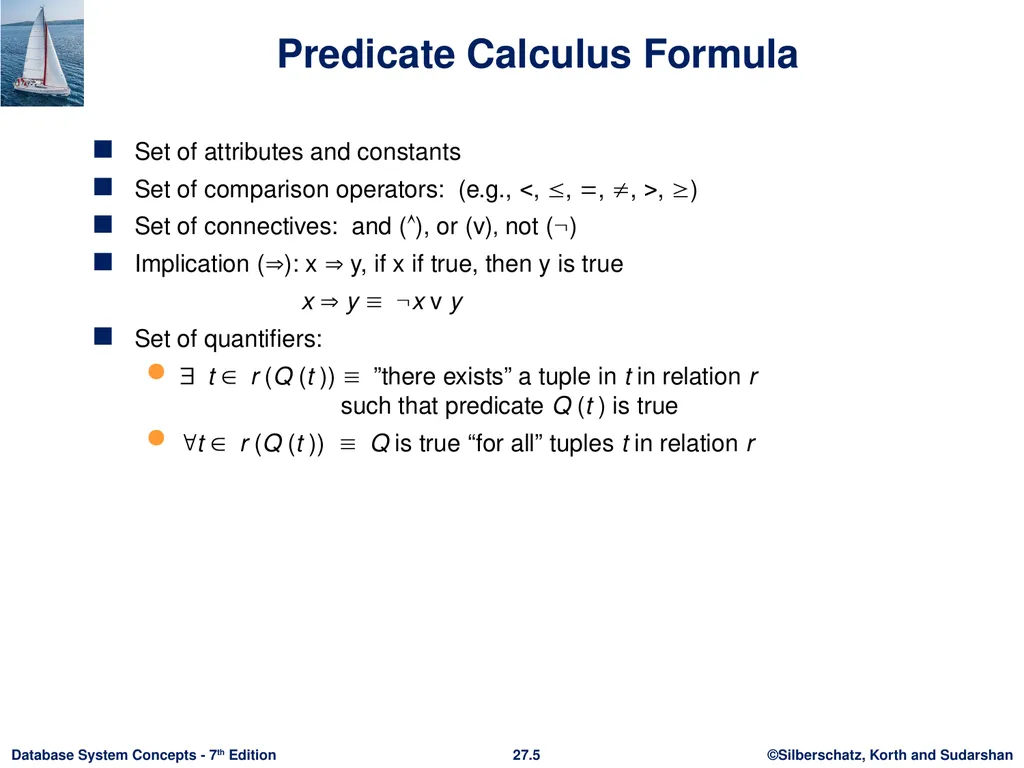
Predicate Calculus Formula Set of attributes and constants
Set of comparison operators: (e.g., , , , , , )
Set of connectives: and (), or (v)‚ not ()
Implication (): x y, if x if true, then y is true
x y x v y
Set of quantifiers:
t r (Q (t )) ”there exists” a tuple in t in relation r� such that predicate Q (t ) is true
t r (Q (t )) Q is true “for all” tuples t in relation r<br>
06
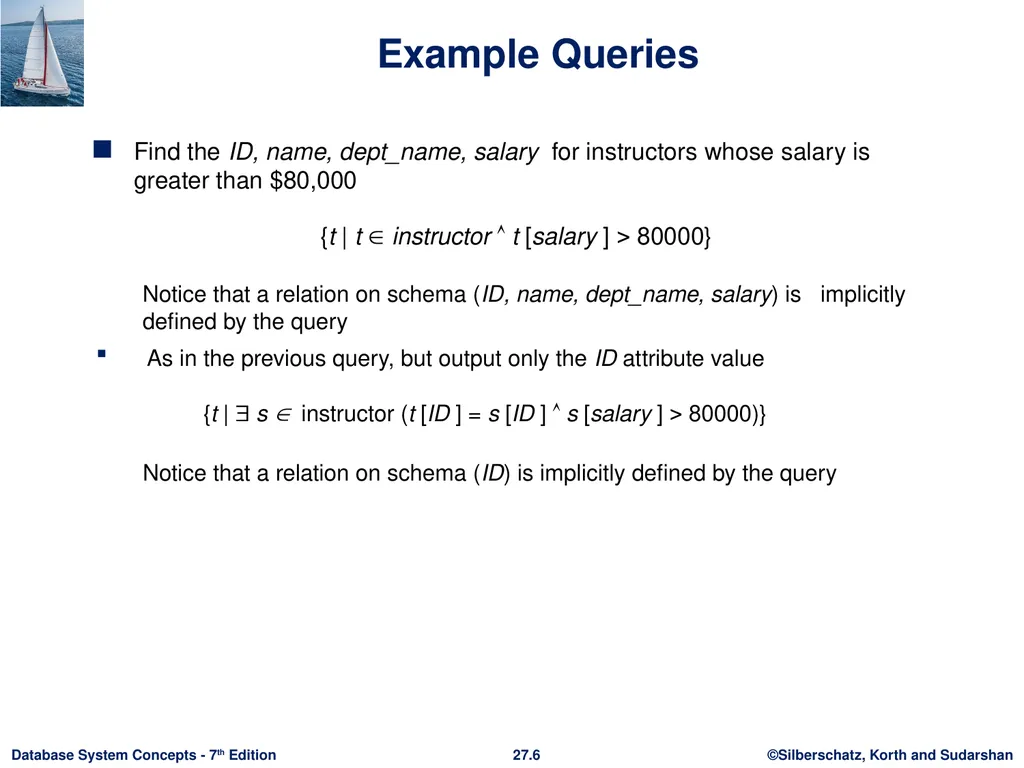
Example Queries Find the ID, name, dept_name, salary for instructors whose salary is greater than $80,000 As in the previous query, but output only the ID attribute value
{t | s instructor (t [ID ] = s [ID ] s [salary ] 80000)} {t | t instructor t [salary ] 80000} Notice that a relation on schema (ID) is implicitly defined by the query Notice that a relation on schema (ID, name, dept_name, salary) is implicitly defined by the query<br>
07
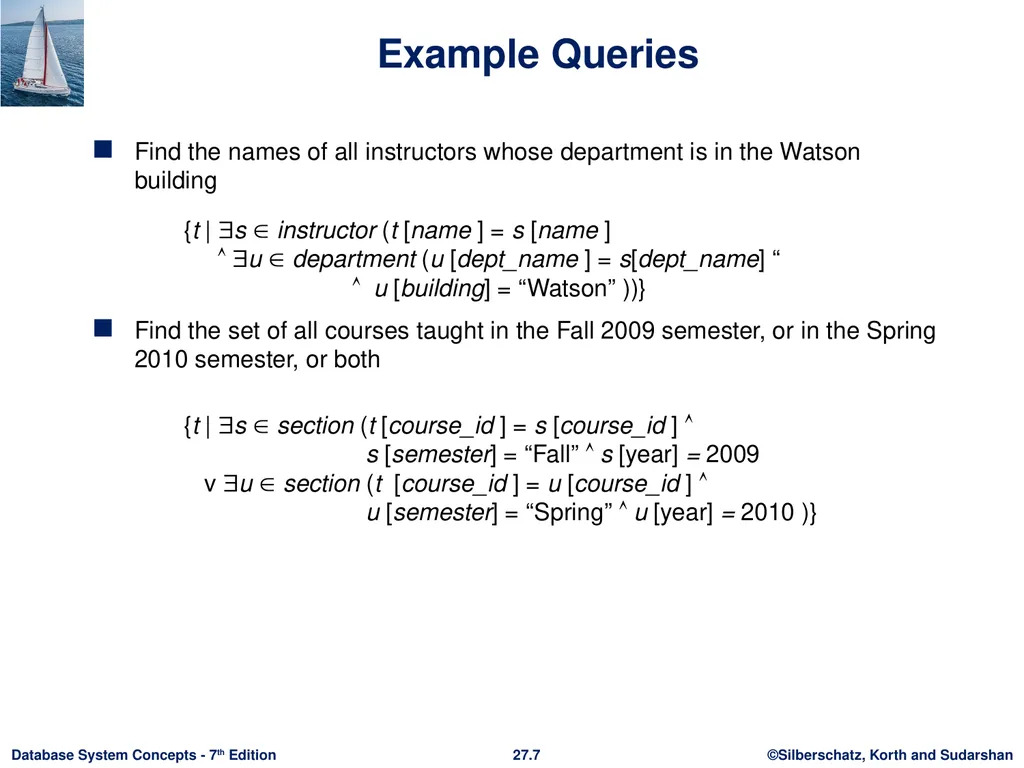
Example Queries Find the names of all instructors whose department is in the Watson building
Find the set of all courses taught in the Fall 2009 semester, or in the Spring 2010 semester, or both {t | s section (t [course_id ] = s [course_id ] � s [semester] = “Fall” s [year] = 2009 � v u section (t [course_id ] = u [course_id ] � u [semester] = “Spring” u [year] = 2010 )} {t | s instructor (t [name ] = s [name ] � u department (u [dept_name ] = s[dept_name] “� u [building] = “Watson” ))}<br>
08
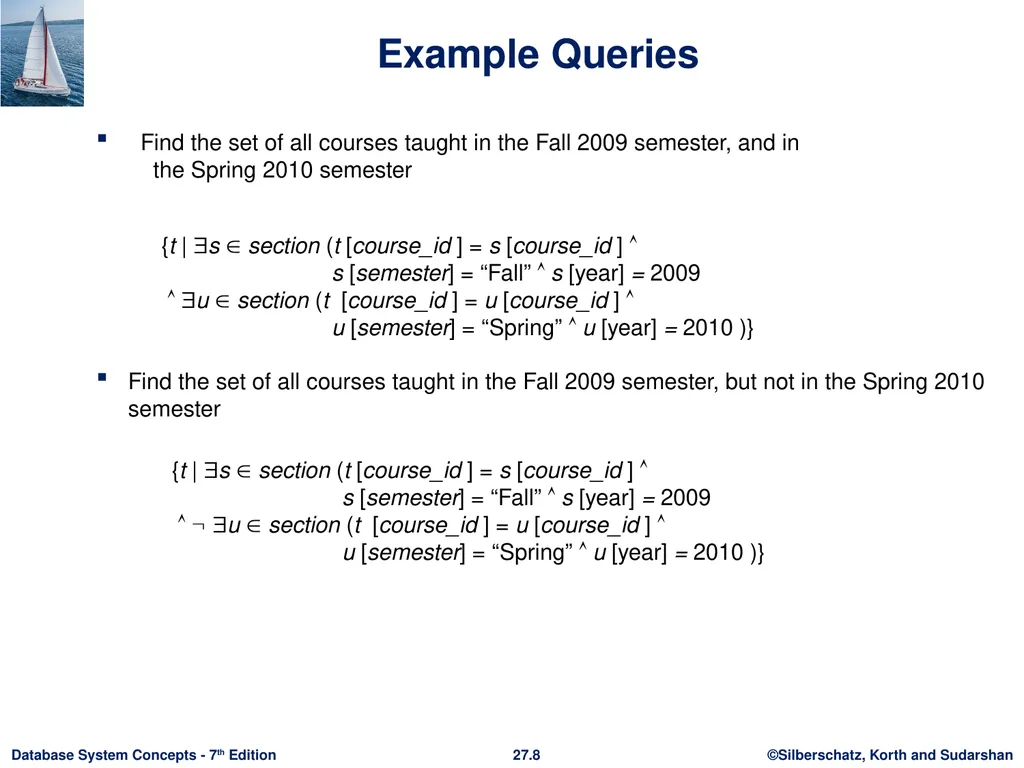
Example Queries {t | s section (t [course_id ] = s [course_id ] � s [semester] = “Fall” s [year] = 2009 � u section (t [course_id ] = u [course_id ] � u [semester] = “Spring” u [year] = 2010 )} Find the set of all courses taught in the Fall 2009 semester, and in � the Spring 2010 semester
Find the set of all courses taught in the Fall 2009 semester, but not in the Spring 2010 semester {t | s section (t [course_id ] = s [course_id ] � s [semester] = “Fall” s [year] = 2009 � u section (t [course_id ] = u [course_id ] � u [semester] = “Spring” u [year] = 2010 )}<br>
09
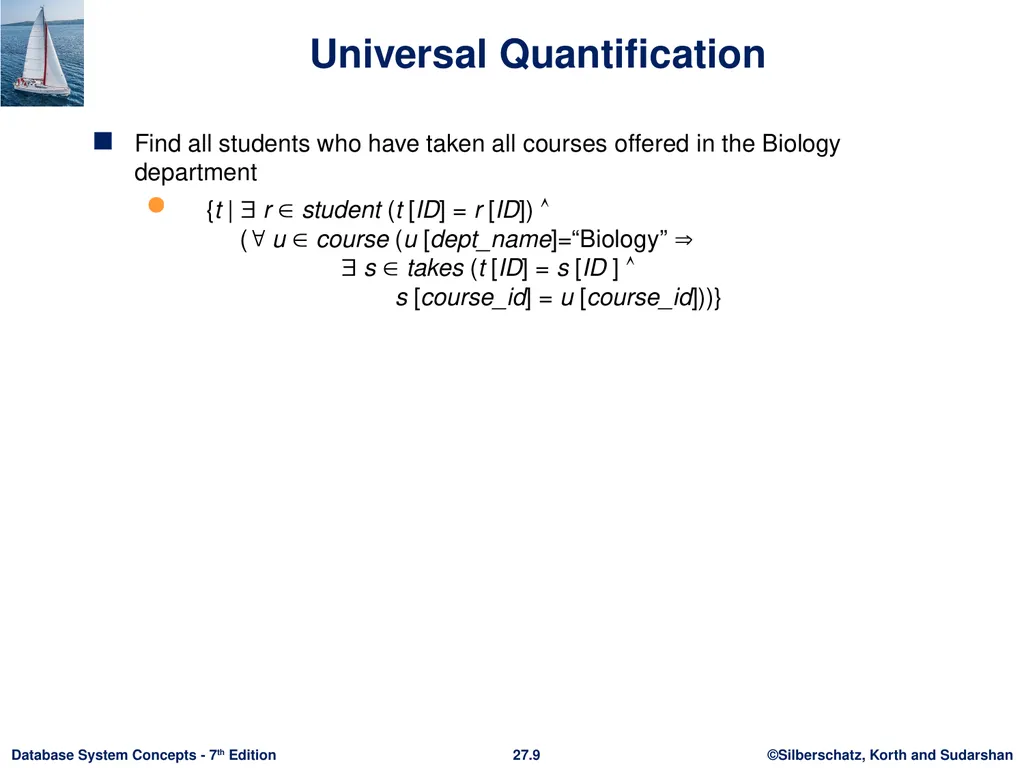
Universal Quantification Find all students who have taken all courses offered in the Biology department
{t | r student (t [ID] = r [ID]) � ( u course (u [dept_name]=“Biology” � s takes (t [ID] = s [ID ] � s [course_id] = u [course_id]))}<br>
10
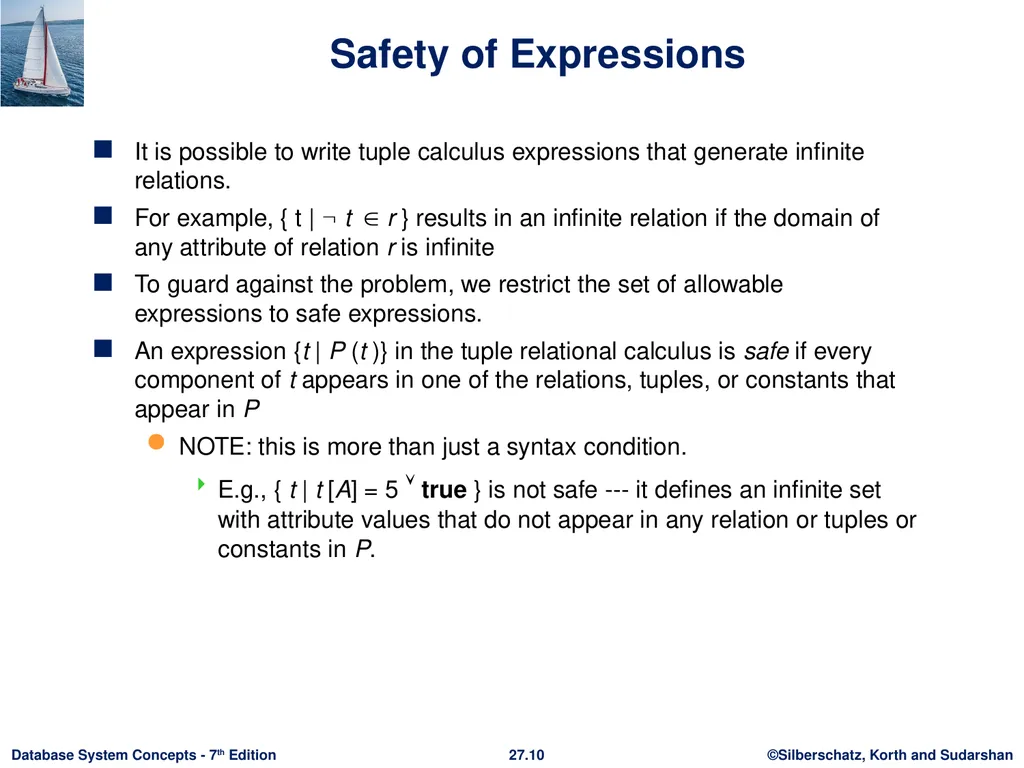
Safety of Expressions It is possible to write tuple calculus expressions that generate infinite relations.
For example, { t | t r } results in an infinite relation if the domain of any attribute of relation r is infinite
To guard against the problem, we restrict the set of allowable expressions to safe expressions.
An expression {t | P (t )} in the tuple relational calculus is safe if every component of t appears in one of the relations, tuples, or constants that appear in P
NOTE: this is more than just a syntax condition.
E.g., { t | t [A] = 5 true } is not safe --- it defines an infinite set with attribute values that do not appear in any relation or tuples or constants in P.<br>
11
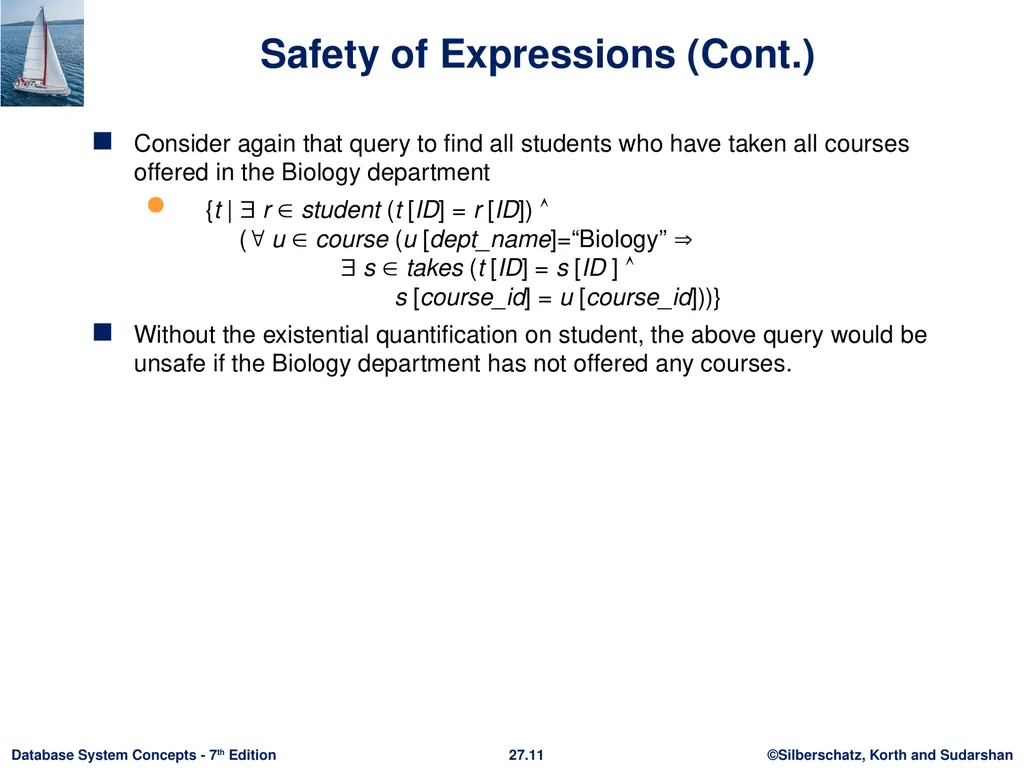
Safety of Expressions (Cont.) Consider again that query to find all students who have taken all courses offered in the Biology department
{t | r student (t [ID] = r [ID]) � ( u course (u [dept_name]=“Biology” � s takes (t [ID] = s [ID ] � s [course_id] = u [course_id]))}
Without the existential quantification on student, the above query would be unsafe if the Biology department has not offered any courses.<br>
12
Domain Relational Calculus<br>
13
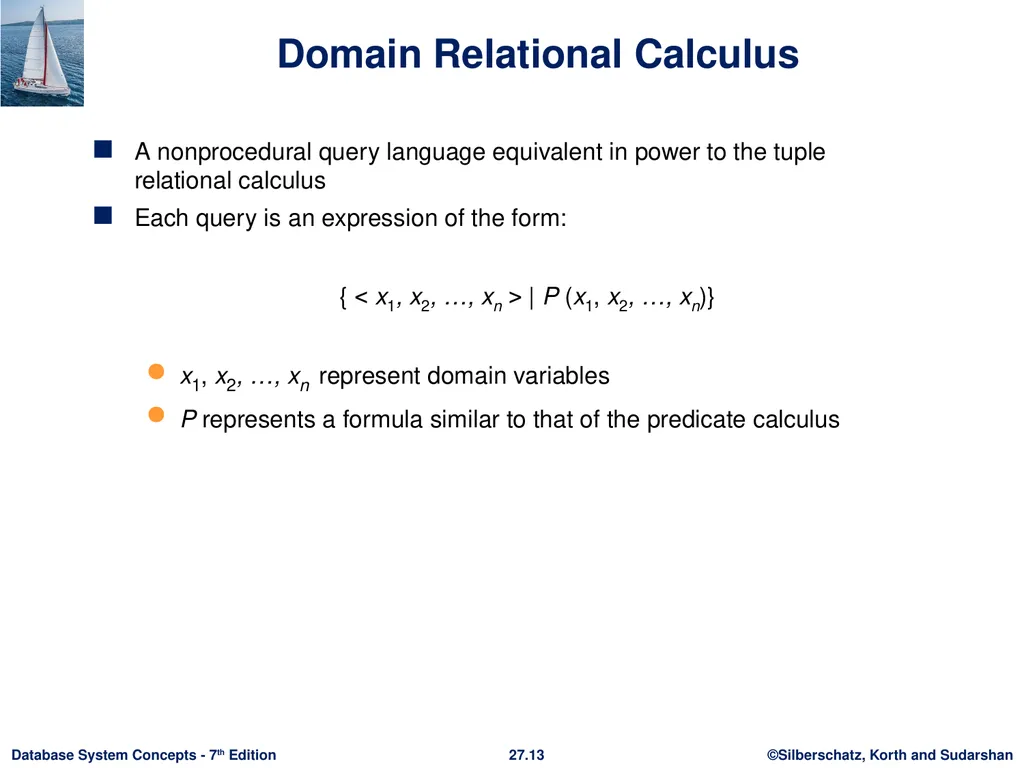
Domain Relational Calculus A nonprocedural query language equivalent in power to the tuple relational calculus
Each query is an expression of the form:
{ x1, x2, …, xn | P (x1, x2, …, xn)}�
x1, x2, …, xn represent domain variables
P represents a formula similar to that of the predicate calculus<br>
14
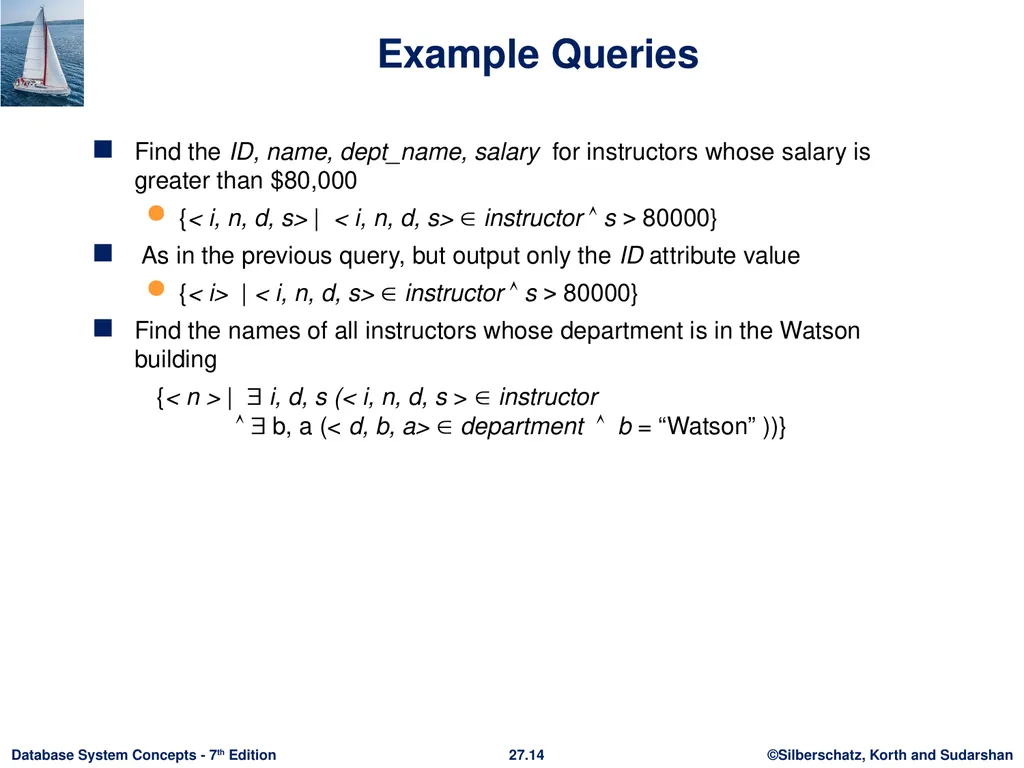
Example Queries Find the ID, name, dept_name, salary for instructors whose salary is greater than $80,000
{< i, n, d, s> | < i, n, d, s> instructor s 80000}
As in the previous query, but output only the ID attribute value
{< i> | < i, n, d, s> instructor s 80000}
Find the names of all instructors whose department is in the Watson building
{< n > | i, d, s (< i, n, d, s > instructor � b, a (< d, b, a> department b = “Watson” ))}<br>
15
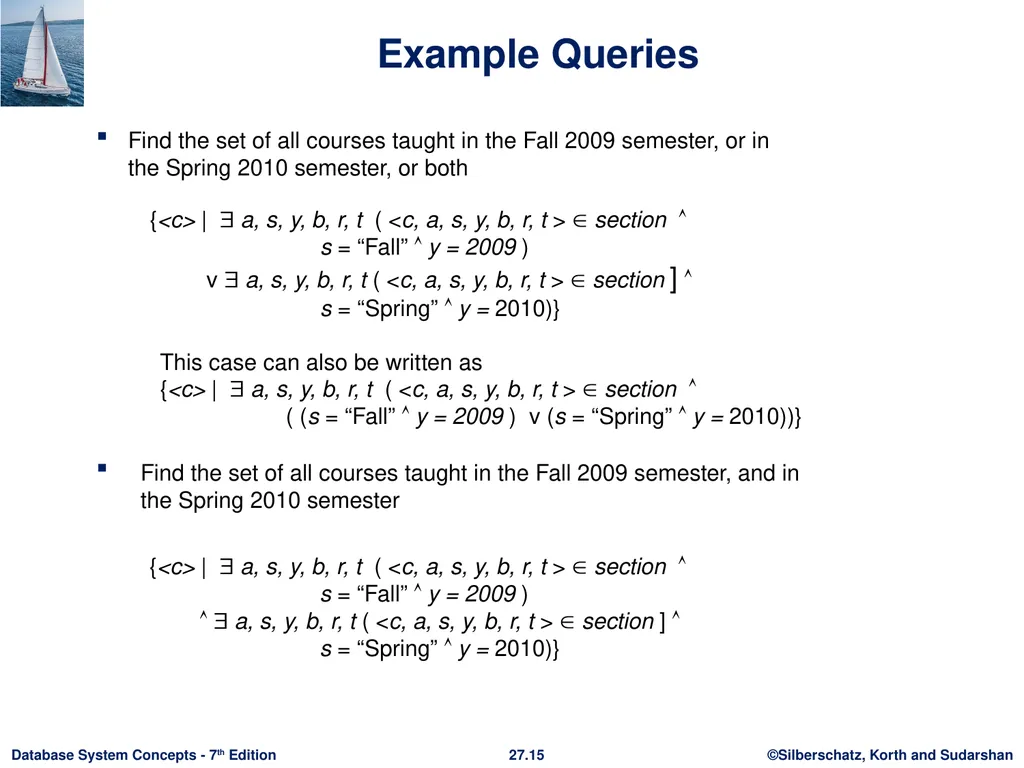
Example Queries {<c> | a, s, y, b, r, t ( <c, a, s, y, b, r, t > section � s = “Fall” y = 2009 )� v a, s, y, b, r, t ( <c, a, s, y, b, r, t > section ] � s = “Spring” y = 2010)} Find the set of all courses taught in the Fall 2009 semester, or in �the Spring 2010 semester, or both This case can also be written as�{<c> | a, s, y, b, r, t ( <c, a, s, y, b, r, t > section � ( (s = “Fall” y = 2009 ) v (s = “Spring” y = 2010))} Find the set of all courses taught in the Fall 2009 semester, and in � the Spring 2010 semester {<c> | a, s, y, b, r, t ( <c, a, s, y, b, r, t > section � s = “Fall” y = 2009 )� a, s, y, b, r, t ( <c, a, s, y, b, r, t > section ] � s = “Spring” y = 2010)}<br>
16
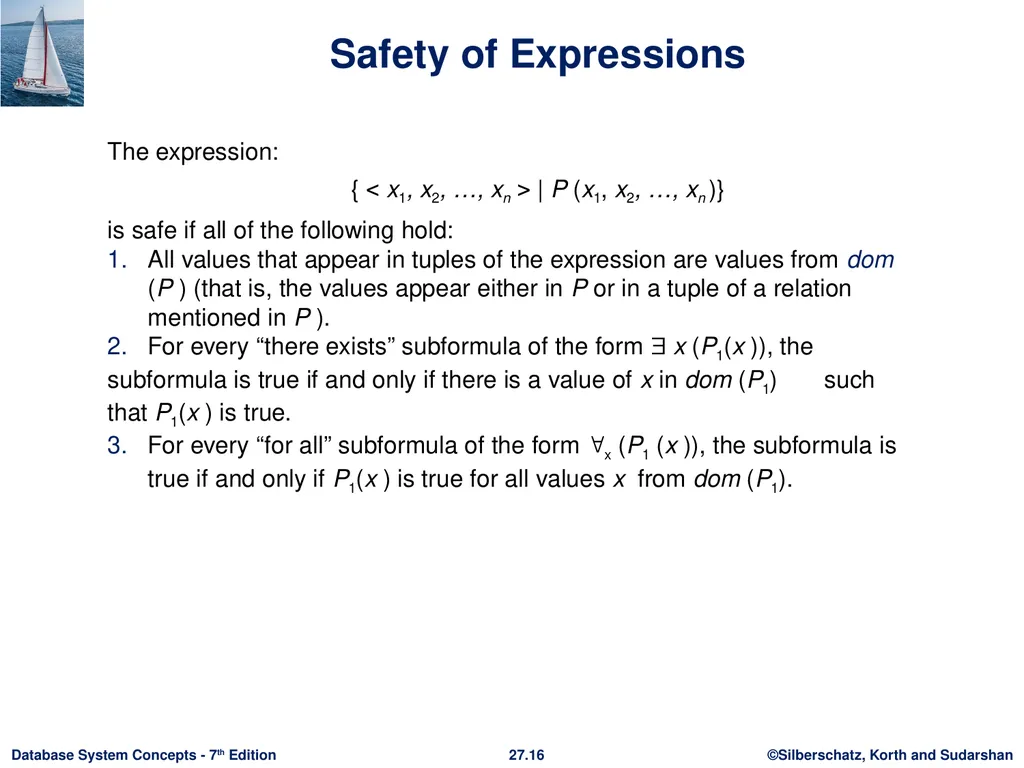
Safety of Expressions The expression:
{ x1, x2, …, xn | P (x1, x2, …, xn )}
is safe if all of the following hold:
1. All values that appear in tuples of the expression are values from dom
(P ) (that is, the values appear either in P or in a tuple of a relation
mentioned in P ).
2. For every “there exists” subformula of the form x (P1(x )), the subformula is true if and only if there is a value of x in dom (P1) such that P1(x ) is true.
3. For every “for all” subformula of the form x (P1 (x )), the subformula is
true if and only if P1(x ) is true for all values x from dom (P1).<br>
17
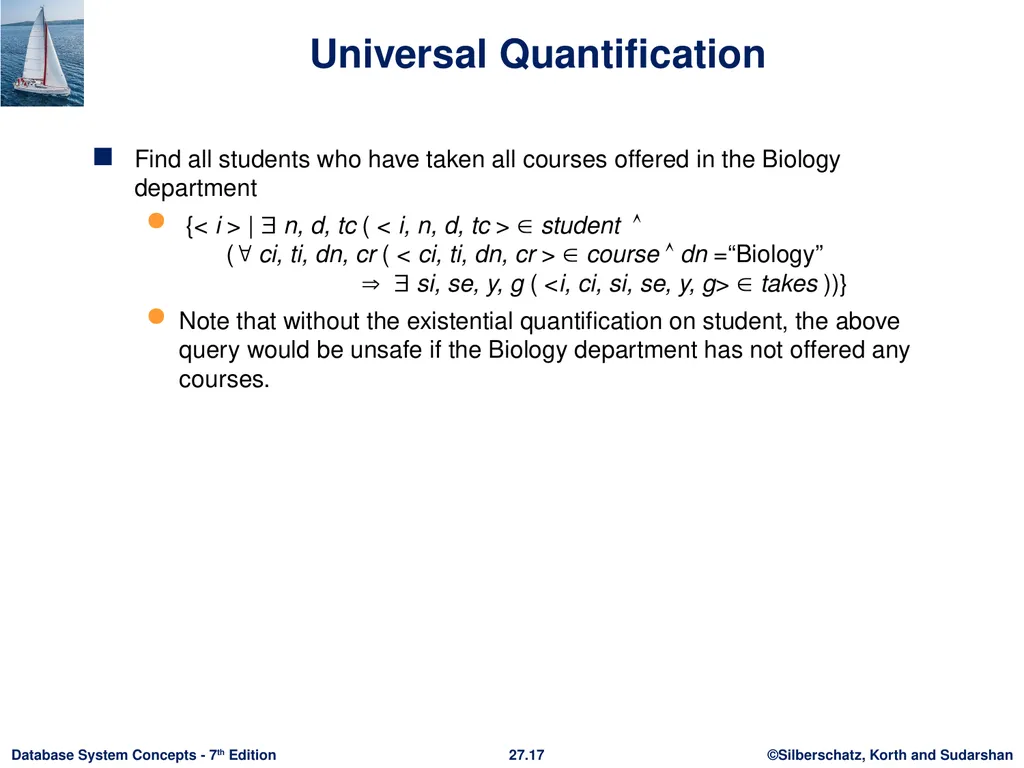
Universal Quantification Find all students who have taken all courses offered in the Biology department
{< i > | n, d, tc ( < i, n, d, tc > student � ( ci, ti, dn, cr ( < ci, ti, dn, cr > course dn =“Biology” � si, se, y, g ( <i, ci, si, se, y, g> takes ))}
Note that without the existential quantification on student, the above query would be unsafe if the Biology department has not offered any courses.<br>