
Chapter 3 Pride and Regret Avoiding Regret and



Description: Chapter 3 Pride and Regret Avoiding Regret and Seeking Pride People avoid actions that create regret People seek actions that create pride Fearing regret and seeking pride causes investors to be pre-disposed to selling winners too early and
Related Topics
Download Presentation
"Chapter 3 Pride and Regret Avoiding Regret and" is the property of its rightful owner. Permission is granted to download and print the materials on this website for personal, non-commercial use only, and to display it on your personal computer provided you do not modify the materials and that you retain all copyright notices contained in the materials. By downloading content from our website, you accept the terms of this agreement.
Presentation Transcript
slide1. Chapter 3
Pride and Regret<br>
slide2. Avoiding Regret and Seeking Pride People avoid actions that create regret
People seek actions that create pride
Fearing regret and seeking pride causes investors to be pre-disposed to selling winners too early and riding losers too long. This is called the disposition effect. 2<br>
slide3. Investors are 50% more likely to sell a winner than a loser
The winner stock sold ends up beating the market over the next year by an average 2.35%
The loser stocks that the investors kept under-performed the market by –1.06% Trades in 10,000 brokerage accounts from a nationwide discount brokerage show when a stock is sold: Terrance Odean, “Are Investors Reluctant to Realize Their Loses?” Journal of Finance 53(1998): 1775-1798. 3<br>
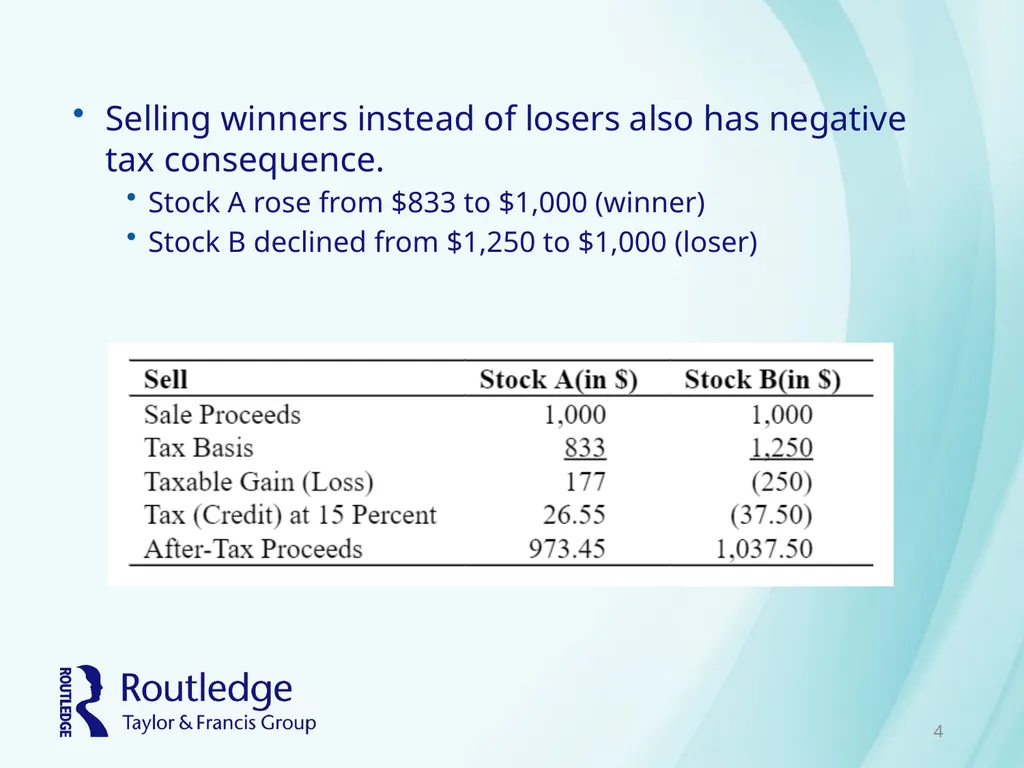
slide4. Selling winners instead of losers also has negative tax consequence.
Stock A rose from $833 to $1,000 (winner)
Stock B declined from $1,250 to $1,000 (loser) 4<br>
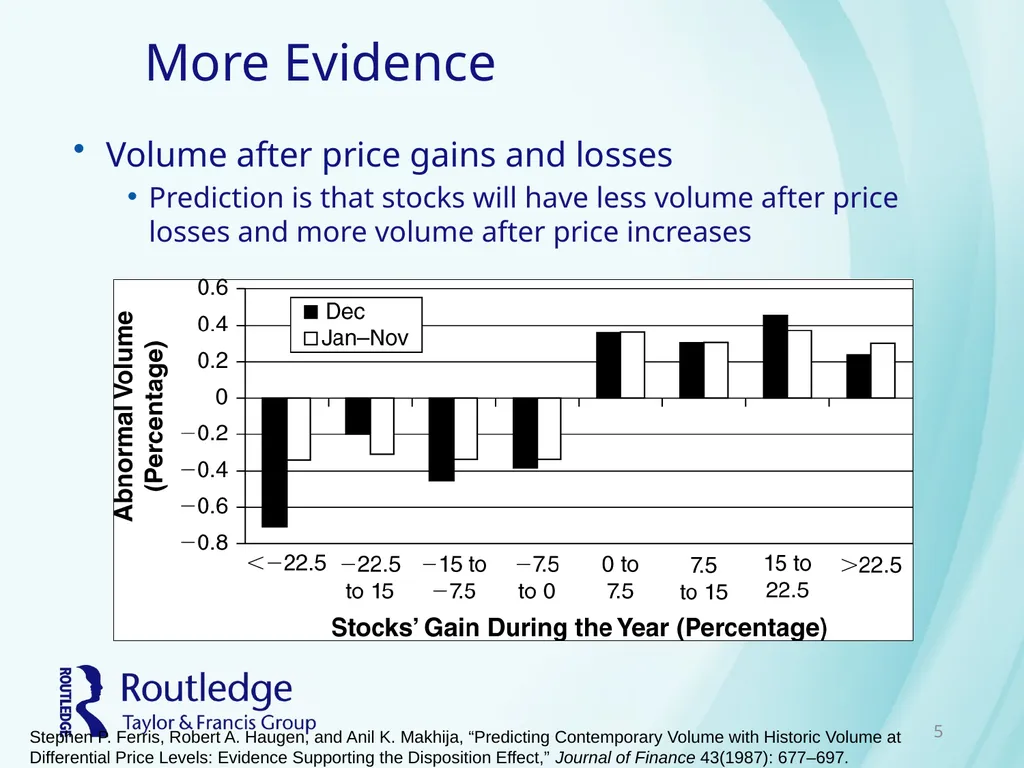
slide5. More Evidence Volume after price gains and losses
Prediction is that stocks will have less volume after price losses and more volume after price increases Stephen P. Ferris, Robert A. Haugen, and Anil K. Makhija, “Predicting Contemporary Volume with Historic Volume at Differential Price Levels: Evidence Supporting the Disposition Effect,” Journal of Finance 43(1987): 677–697. 5<br>
slide6. Return of stocks and holding period
Prediction is that stocks sold quickly have high returns while stocks held longer have lower returns. Gary G. Schlarbaum, Wilbur G. Lewellen, and Ronald C. Lease, “Realized Returns on Common Stock Investments: The Experience of Individual Investors,” Journal of Business 51(1978): 299–325. 6<br>
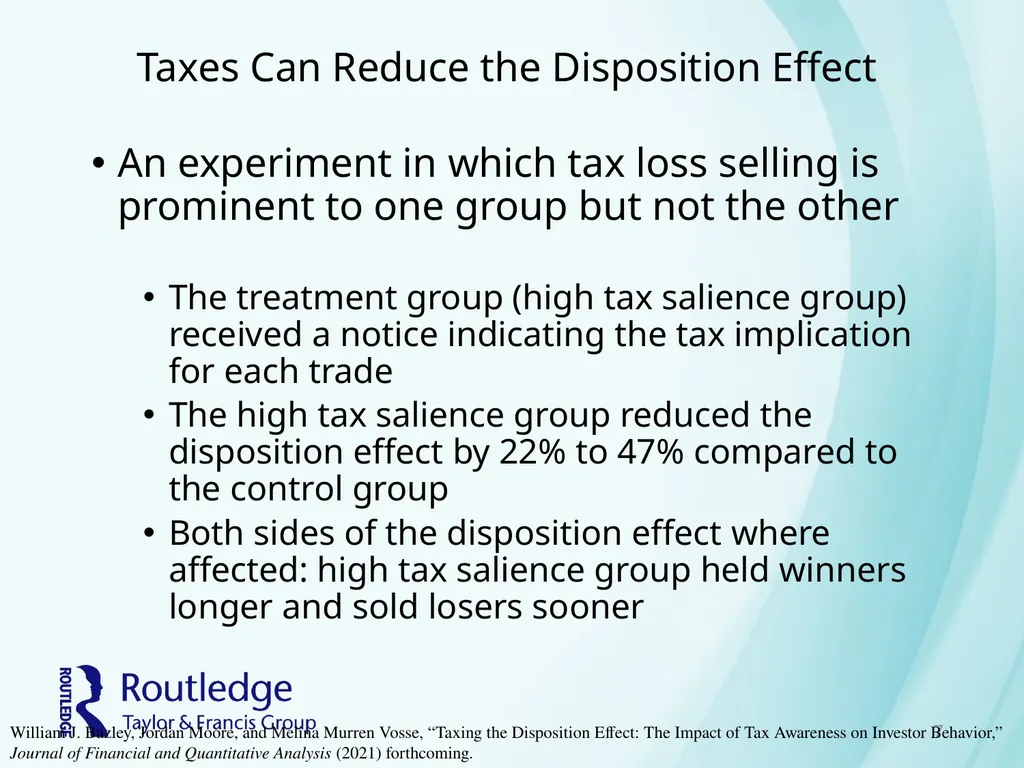
slide7. 7 Taxes Can Reduce the Disposition Effect An experiment in which tax loss selling is prominent to one group but not the other
The treatment group (high tax salience group) received a notice indicating the tax implication for each trade
The high tax salience group reduced the disposition effect by 22% to 47% compared to the control group
Both sides of the disposition effect where affected: high tax salience group held winners longer and sold losers sooner William J. Bazley, Jordan Moore, and Melina Murren Vosse, “Taxing the Disposition Effect: The Impact of Tax Awareness on Investor Behavior,” Journal of Financial and Quantitative Analysis (2021) forthcoming.<br>
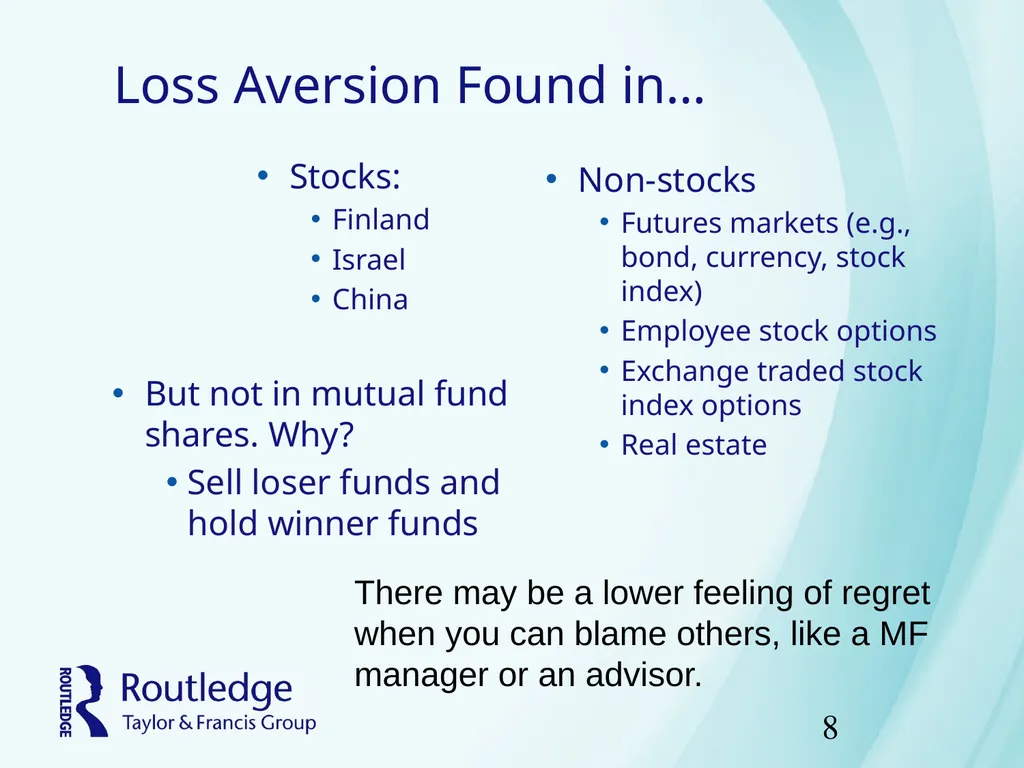
slide8. Loss Aversion Found in… Stocks:
Finland
Israel
China Non-stocks
Futures markets (e.g., bond, currency, stock index)
Employee stock options
Exchange traded stock index options
Real estate But not in mutual fund shares. Why?
Sell loser funds and hold winner funds There may be a lower feeling of regret when you can blame others, like a MF manager or an advisor. 8<br>
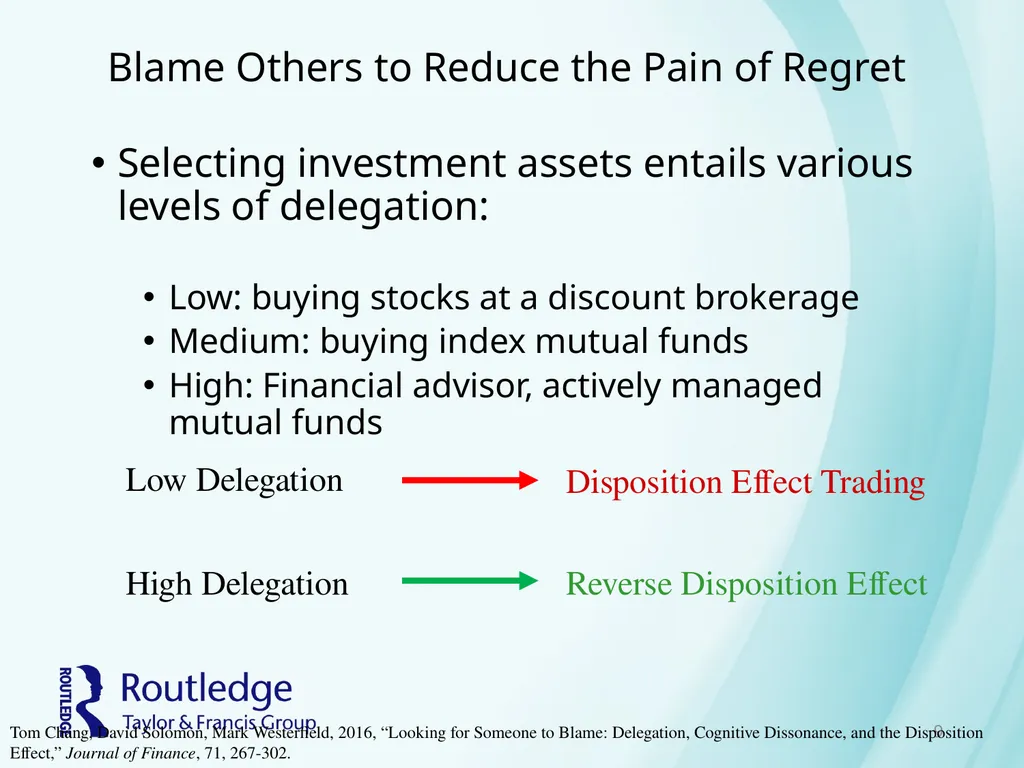
slide9. 9 Blame Others to Reduce the Pain of Regret Selecting investment assets entails various levels of delegation:
Low: buying stocks at a discount brokerage
Medium: buying index mutual funds
High: Financial advisor, actively managed mutual funds Low Delegation High Delegation Disposition Effect Trading Reverse Disposition Effect Tom Chang, David Solomon, Mark Westerfield, 2016, “Looking for Someone to Blame: Delegation, Cognitive Dissonance, and the Disposition Effect,” Journal of Finance, 71, 267-302.<br>
slide10. Impact of Loss Aversion When Selling Adaptations when selling at a loss
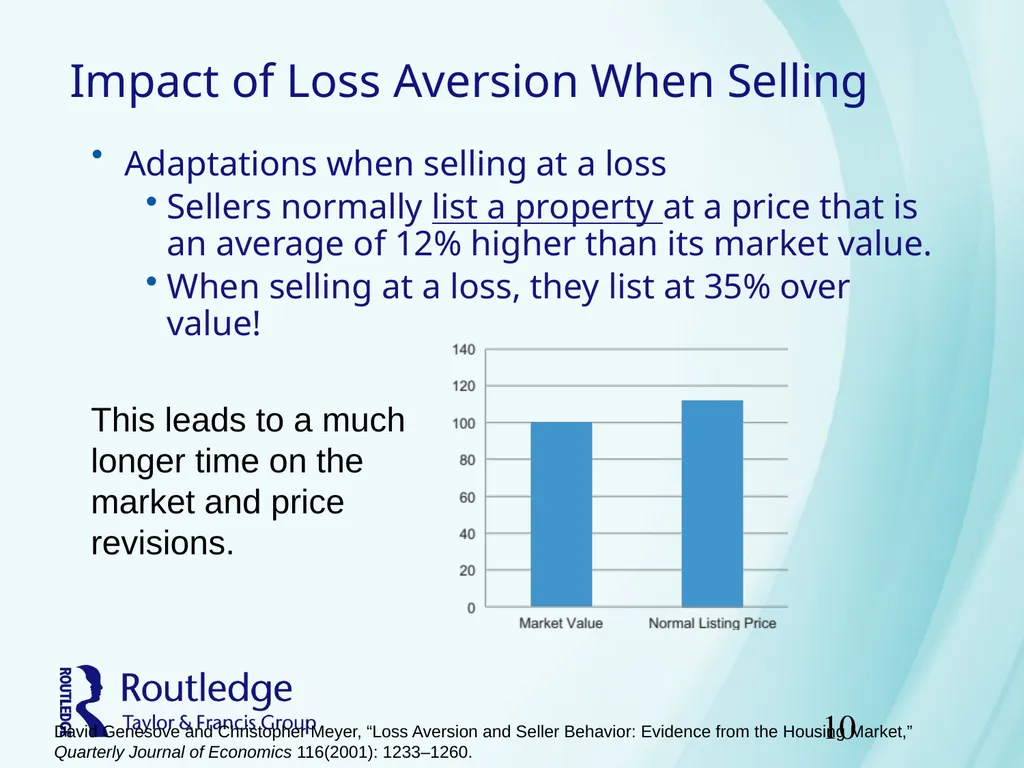
Sellers normally list a property at a price that is an average of 12% higher than its market value.
When selling at a loss, they list at 35% over value! This leads to a much longer time on the market and price revisions. David Genesove and Christopher Meyer, “Loss Aversion and Seller Behavior: Evidence from the Housing Market,” Quarterly Journal of Economics 116(2001): 1233–1260. 10<br>
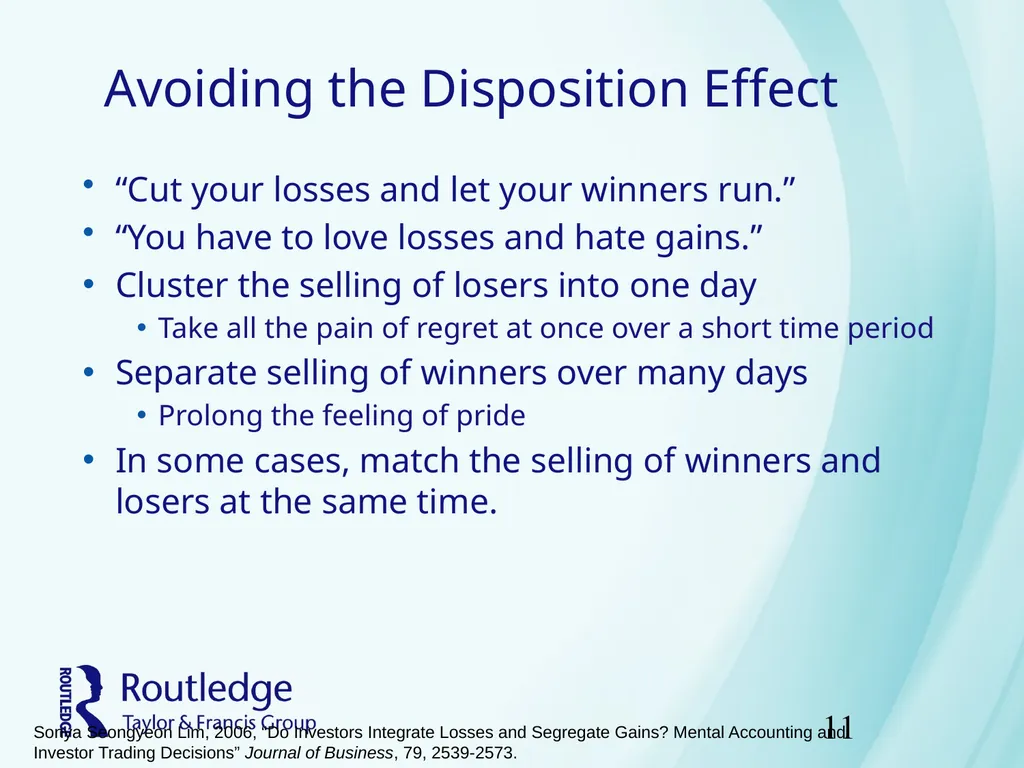
slide11. Avoiding the Disposition Effect “Cut your losses and let your winners run.”
“You have to love losses and hate gains.”
Cluster the selling of losers into one day
Take all the pain of regret at once over a short time period
Separate selling of winners over many days
Prolong the feeling of pride
In some cases, match the selling of winners and losers at the same time. Sonya Seongyeon Lim, 2006, “Do Investors Integrate Losses and Segregate Gains? Mental Accounting and Investor Trading Decisions” Journal of Business, 79, 2539-2573. 11<br>
slide12. Your Decision or Act of God? The feeling of regret is strong if it is clear that you made a bad choice
You pick one company and its price declines while the other firms in the industry rise
The feeling of regret is weak if it is clear that the ramifications of the choice were out of your control
Your stock declines in a general marker decline 12<br>
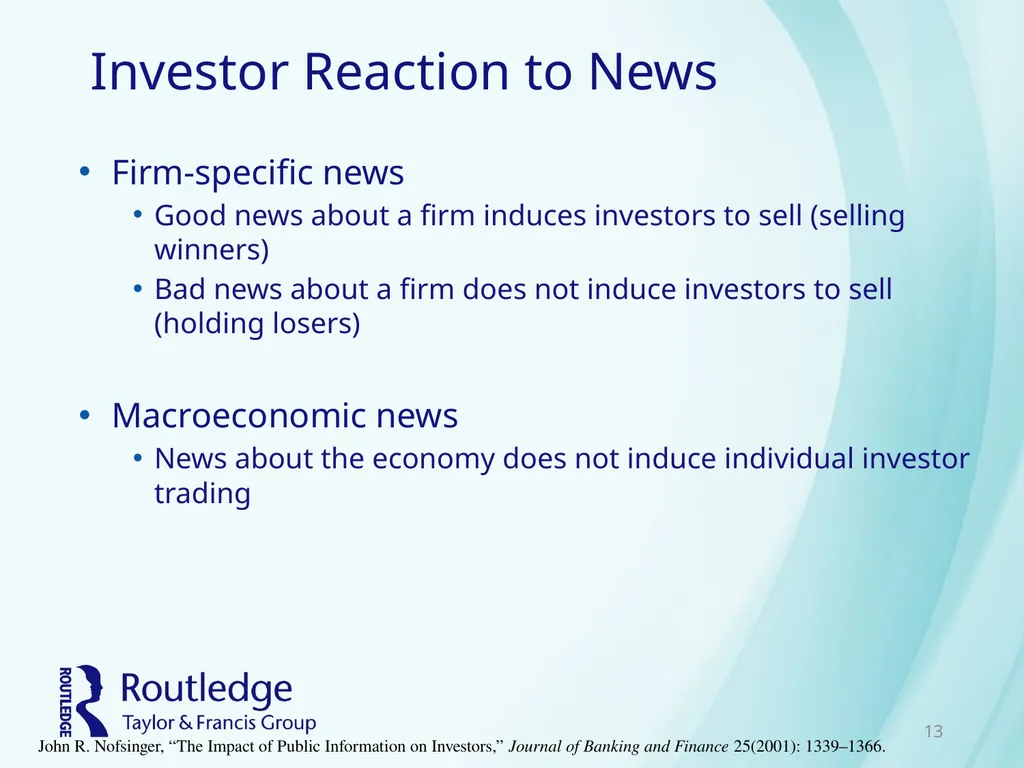
slide13. Investor Reaction to News Firm-specific news
Good news about a firm induces investors to sell (selling winners)
Bad news about a firm does not induce investors to sell (holding losers)
Macroeconomic news
News about the economy does not induce individual investor trading John R. Nofsinger, “The Impact of Public Information on Investors,” Journal of Banking and Finance 25(2001): 1339–1366. 13<br>
slide14. Blackjack Rules The dealer hands you two cards, facing up. The dealer also receives two cards, but you can only see one.
To win, your cards must total more than the dealer’s.
You can request more cards to increase your total, but if your total exceeds 21, you lose immediately. 14<br>
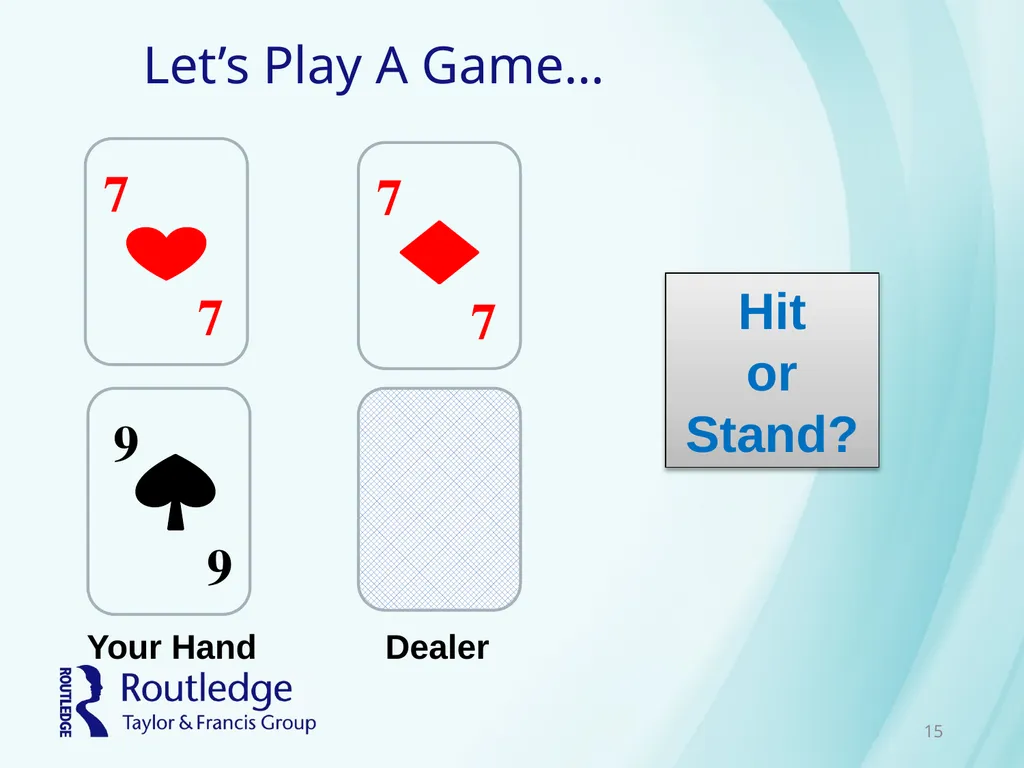
slide15. Let’s Play A Game… Hit
or
Stand? Your Hand Dealer 7 7 7 7 9 9 15<br>
slide16. Blackjack Experts say you should take another card (hit)
Most players do not take a card (stand)
Why? 16<br>
slide17. Regret Aversion Taking action and losing feels worse than “doing nothing” and losing
Although the outcome is the same, regret plays a larger role post-action 17<br>
slide18. Consider this Example You have been selecting the same lottery ticket numbers every week for months.
Not surprisingly, you have not won. A friend suggests a different set of numbers.
Do you change numbers? 18<br>
slide19. Odds of winning are the same, new numbers or old numbers
However, the feeling of regret is different.
Regret of Omission
Regret that you did not do something
I should have bought that stock
Regret of Commission
Regret that you did do something
I should not have bought the stock
Regret of commission is stronger
Most people don’t change numbers Lottery Example Continued 19<br>
slide20. Reference Points What is a profit or a loss?
To determine a profit or loss, you need to compare the current price to a reference point.
Investors also fixate (anchor) on specific stock prices (Reference Points)
Purchase price
Highest price
Highest recent price
Most recent price 20<br>
slide21. Reference Points - continued Example
You purchased a stock for $50 per share
At the end of the first year it traded for $60
Now it trades for $55
Do you consider this a winner or a loser?
Do you have a profit of $5 or a lose of $5?
The reference point you use can dramatically impact your view and thus your actions! 21<br>
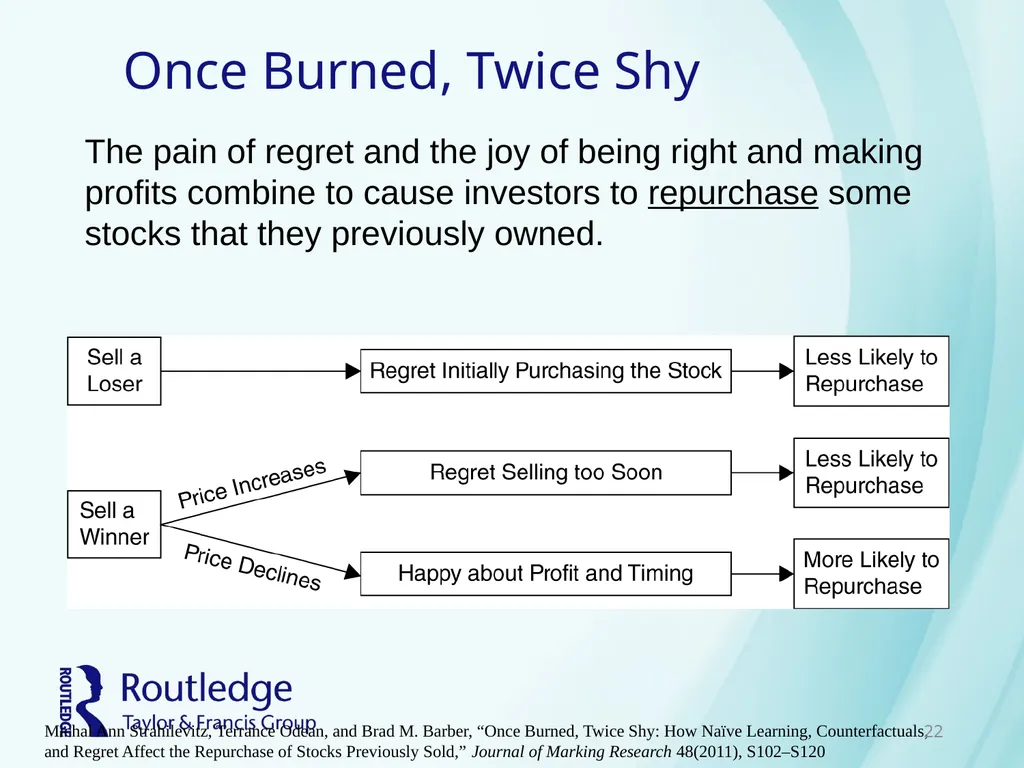
slide22. Once Burned, Twice Shy Michal Ann Strahilevitz, Terrance Odean, and Brad M. Barber, “Once Burned, Twice Shy: How Naïve Learning, Counterfactuals, and Regret Affect the Repurchase of Stocks Previously Sold,” Journal of Marking Research 48(2011), S102–S120 The pain of regret and the joy of being right and making profits combine to cause investors to repurchase some stocks that they previously owned. 22<br>
slide23. Repurchasing stock previously sold is a fairly pervasive behavior
About 40 percent of investing households making at least one repurchase
Most likely to occur if it was the most recent stock sold
People tend to more easily recall the most recent events. Thus, the most recent stock sale is the most salient and on the investor’s mind
This behavior is sub-optimal and that more sophisticated investors are less likely to engage in it 23 John R. Nofsinger and Abhishek Varma, “Availability, Recency, and Sophistication in the Repurchasing Behavior of Retail Investors,” Journal of Banking & Finance 37 (2013): 2572–2585.<br>
slide24. Summary Avoiding the emotional pain of regret causes investors to sell winners too soon and hold on to losers too long.
This causes a loss of wealth from taxes and a bias toward holding stocks that perform poorly.
The disposition effect can be seen in many markets around the world.
Reference points are important for a person’s attitude about current investment positions
Investors repurchase stocks sold as winners, whose price subsequently falls. 24<br>
slide2. Avoiding Regret and Seeking Pride People avoid actions that create regret
People seek actions that create pride
Fearing regret and seeking pride causes investors to be pre-disposed to selling winners too early and riding losers too long. This is called the disposition effect. 2<br>
slide3. Investors are 50% more likely to sell a winner than a loser
The winner stock sold ends up beating the market over the next year by an average 2.35%
The loser stocks that the investors kept under-performed the market by –1.06% Trades in 10,000 brokerage accounts from a nationwide discount brokerage show when a stock is sold: Terrance Odean, “Are Investors Reluctant to Realize Their Loses?” Journal of Finance 53(1998): 1775-1798. 3<br>
slide4. Selling winners instead of losers also has negative tax consequence.
Stock A rose from $833 to $1,000 (winner)
Stock B declined from $1,250 to $1,000 (loser) 4<br>
slide5. More Evidence Volume after price gains and losses
Prediction is that stocks will have less volume after price losses and more volume after price increases Stephen P. Ferris, Robert A. Haugen, and Anil K. Makhija, “Predicting Contemporary Volume with Historic Volume at Differential Price Levels: Evidence Supporting the Disposition Effect,” Journal of Finance 43(1987): 677–697. 5<br>
slide6. Return of stocks and holding period
Prediction is that stocks sold quickly have high returns while stocks held longer have lower returns. Gary G. Schlarbaum, Wilbur G. Lewellen, and Ronald C. Lease, “Realized Returns on Common Stock Investments: The Experience of Individual Investors,” Journal of Business 51(1978): 299–325. 6<br>
slide7. 7 Taxes Can Reduce the Disposition Effect An experiment in which tax loss selling is prominent to one group but not the other
The treatment group (high tax salience group) received a notice indicating the tax implication for each trade
The high tax salience group reduced the disposition effect by 22% to 47% compared to the control group
Both sides of the disposition effect where affected: high tax salience group held winners longer and sold losers sooner William J. Bazley, Jordan Moore, and Melina Murren Vosse, “Taxing the Disposition Effect: The Impact of Tax Awareness on Investor Behavior,” Journal of Financial and Quantitative Analysis (2021) forthcoming.<br>
slide8. Loss Aversion Found in… Stocks:
Finland
Israel
China Non-stocks
Futures markets (e.g., bond, currency, stock index)
Employee stock options
Exchange traded stock index options
Real estate But not in mutual fund shares. Why?
Sell loser funds and hold winner funds There may be a lower feeling of regret when you can blame others, like a MF manager or an advisor. 8<br>
slide9. 9 Blame Others to Reduce the Pain of Regret Selecting investment assets entails various levels of delegation:
Low: buying stocks at a discount brokerage
Medium: buying index mutual funds
High: Financial advisor, actively managed mutual funds Low Delegation High Delegation Disposition Effect Trading Reverse Disposition Effect Tom Chang, David Solomon, Mark Westerfield, 2016, “Looking for Someone to Blame: Delegation, Cognitive Dissonance, and the Disposition Effect,” Journal of Finance, 71, 267-302.<br>
slide10. Impact of Loss Aversion When Selling Adaptations when selling at a loss
Sellers normally list a property at a price that is an average of 12% higher than its market value.
When selling at a loss, they list at 35% over value! This leads to a much longer time on the market and price revisions. David Genesove and Christopher Meyer, “Loss Aversion and Seller Behavior: Evidence from the Housing Market,” Quarterly Journal of Economics 116(2001): 1233–1260. 10<br>
slide11. Avoiding the Disposition Effect “Cut your losses and let your winners run.”
“You have to love losses and hate gains.”
Cluster the selling of losers into one day
Take all the pain of regret at once over a short time period
Separate selling of winners over many days
Prolong the feeling of pride
In some cases, match the selling of winners and losers at the same time. Sonya Seongyeon Lim, 2006, “Do Investors Integrate Losses and Segregate Gains? Mental Accounting and Investor Trading Decisions” Journal of Business, 79, 2539-2573. 11<br>
slide12. Your Decision or Act of God? The feeling of regret is strong if it is clear that you made a bad choice
You pick one company and its price declines while the other firms in the industry rise
The feeling of regret is weak if it is clear that the ramifications of the choice were out of your control
Your stock declines in a general marker decline 12<br>
slide13. Investor Reaction to News Firm-specific news
Good news about a firm induces investors to sell (selling winners)
Bad news about a firm does not induce investors to sell (holding losers)
Macroeconomic news
News about the economy does not induce individual investor trading John R. Nofsinger, “The Impact of Public Information on Investors,” Journal of Banking and Finance 25(2001): 1339–1366. 13<br>
slide14. Blackjack Rules The dealer hands you two cards, facing up. The dealer also receives two cards, but you can only see one.
To win, your cards must total more than the dealer’s.
You can request more cards to increase your total, but if your total exceeds 21, you lose immediately. 14<br>
slide15. Let’s Play A Game… Hit
or
Stand? Your Hand Dealer 7 7 7 7 9 9 15<br>
slide16. Blackjack Experts say you should take another card (hit)
Most players do not take a card (stand)
Why? 16<br>
slide17. Regret Aversion Taking action and losing feels worse than “doing nothing” and losing
Although the outcome is the same, regret plays a larger role post-action 17<br>
slide18. Consider this Example You have been selecting the same lottery ticket numbers every week for months.
Not surprisingly, you have not won. A friend suggests a different set of numbers.
Do you change numbers? 18<br>
slide19. Odds of winning are the same, new numbers or old numbers
However, the feeling of regret is different.
Regret of Omission
Regret that you did not do something
I should have bought that stock
Regret of Commission
Regret that you did do something
I should not have bought the stock
Regret of commission is stronger
Most people don’t change numbers Lottery Example Continued 19<br>
slide20. Reference Points What is a profit or a loss?
To determine a profit or loss, you need to compare the current price to a reference point.
Investors also fixate (anchor) on specific stock prices (Reference Points)
Purchase price
Highest price
Highest recent price
Most recent price 20<br>
slide21. Reference Points - continued Example
You purchased a stock for $50 per share
At the end of the first year it traded for $60
Now it trades for $55
Do you consider this a winner or a loser?
Do you have a profit of $5 or a lose of $5?
The reference point you use can dramatically impact your view and thus your actions! 21<br>
slide22. Once Burned, Twice Shy Michal Ann Strahilevitz, Terrance Odean, and Brad M. Barber, “Once Burned, Twice Shy: How Naïve Learning, Counterfactuals, and Regret Affect the Repurchase of Stocks Previously Sold,” Journal of Marking Research 48(2011), S102–S120 The pain of regret and the joy of being right and making profits combine to cause investors to repurchase some stocks that they previously owned. 22<br>
slide23. Repurchasing stock previously sold is a fairly pervasive behavior
About 40 percent of investing households making at least one repurchase
Most likely to occur if it was the most recent stock sold
People tend to more easily recall the most recent events. Thus, the most recent stock sale is the most salient and on the investor’s mind
This behavior is sub-optimal and that more sophisticated investors are less likely to engage in it 23 John R. Nofsinger and Abhishek Varma, “Availability, Recency, and Sophistication in the Repurchasing Behavior of Retail Investors,” Journal of Banking & Finance 37 (2013): 2572–2585.<br>
slide24. Summary Avoiding the emotional pain of regret causes investors to sell winners too soon and hold on to losers too long.
This causes a loss of wealth from taxes and a bias toward holding stocks that perform poorly.
The disposition effect can be seen in many markets around the world.
Reference points are important for a person’s attitude about current investment positions
Investors repurchase stocks sold as winners, whose price subsequently falls. 24<br>