
Chapter 3 Semantics 1 CHAPTER 3 Types and
GB
Published · 32 slides · 0 views
1 / 1




Description
Chapter 3 Semantics 1 CHAPTER 3 Types and dimensions of meaning 3.1 Introduction 3.2 Descriptive and non-descriptive meaning 3.3 Dimensions of non-descriptive meaning 3.4 Non-descriptive dimensions Discussion questions and exercises 2 3.1
Related Topics
Share
Embed code
Download this presentation From Below
"Chapter 3 Semantics 1 CHAPTER 3 Types and" is the property of its rightful owner. Permission is granted to download and print the materials on this website for personal, non-commercial use only, and to display it on your personal computer provided you do not modify the materials and that you retain all copyright notices contained in the materials. By downloading content from our website, you accept the terms of this agreement.
Presentation Transcript
01
Chapter 3 Semantics 1<br>
02
CHAPTER 3
Types and dimensions of meaning
3.1 Introduction
3.2 Descriptive and non-descriptive meaning
3.3 Dimensions of non-descriptive meaning
3.4 Non-descriptive dimensions
Discussion questions and exercises 2<br>
Types and dimensions of meaning
3.1 Introduction
3.2 Descriptive and non-descriptive meaning
3.3 Dimensions of non-descriptive meaning
3.4 Non-descriptive dimensions
Discussion questions and exercises 2<br>
03
3.1 Introduction
We need to explore what counts as meaning. Meaning is anything that affects the relative normality of grammatical expressions. This is an example of a contextual approach to meaning, because relative normality is a concept which applies only to combinations of elements; that is to say, it implies that meaning is to be studied by observing the interactions between elements and other elements, in larger constructions such as sentences. It follows from this characterization that if two expressions differ in meaning, then this will show up in the fact that a context can be found in which they differ in normality; conversely, two expressions with the same meaning will have the same normality in all contexts. So, for instance, we know that dog and cat differ in meaning (to take a crudely obvious case) because (for example) Our cat has had kittens is more normal than ?Our dog has just had kittens. Likewise, we know that pullover and sweater are at least very close in meaning, because of the difficulty in finding contexts in which they differ in normality. 3<br>
We need to explore what counts as meaning. Meaning is anything that affects the relative normality of grammatical expressions. This is an example of a contextual approach to meaning, because relative normality is a concept which applies only to combinations of elements; that is to say, it implies that meaning is to be studied by observing the interactions between elements and other elements, in larger constructions such as sentences. It follows from this characterization that if two expressions differ in meaning, then this will show up in the fact that a context can be found in which they differ in normality; conversely, two expressions with the same meaning will have the same normality in all contexts. So, for instance, we know that dog and cat differ in meaning (to take a crudely obvious case) because (for example) Our cat has had kittens is more normal than ?Our dog has just had kittens. Likewise, we know that pullover and sweater are at least very close in meaning, because of the difficulty in finding contexts in which they differ in normality. 3<br>
04
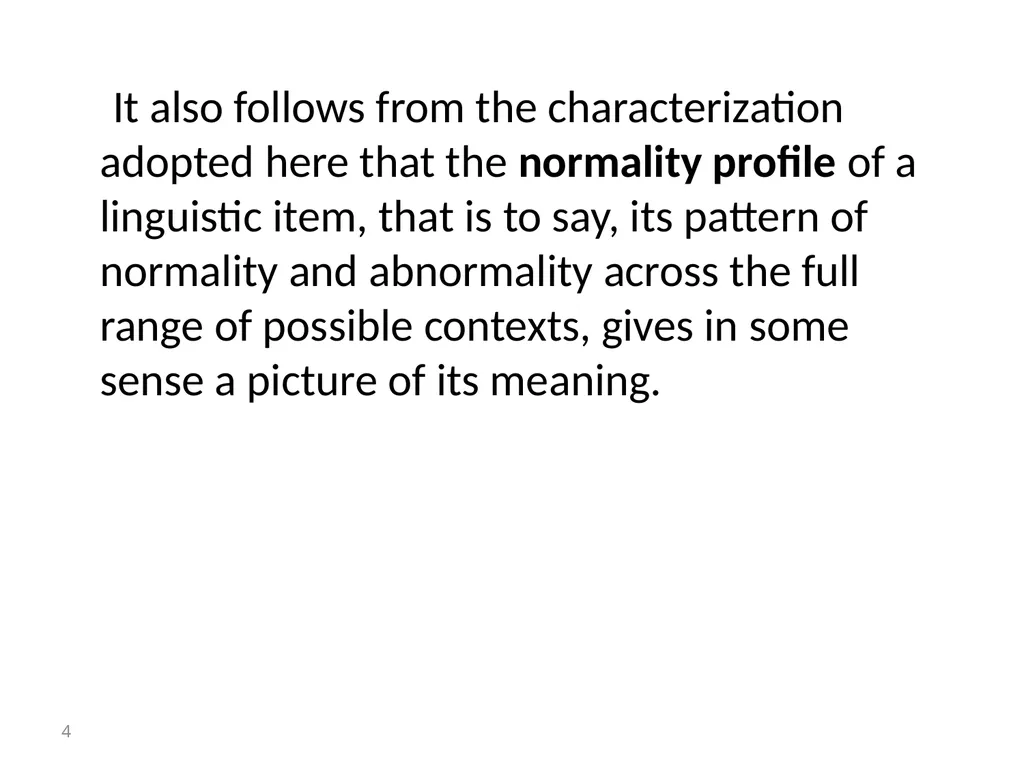
It also follows from the characterization adopted here that the normality profile of a linguistic item, that is to say, its pattern of normality and abnormality across the full range of possible contexts, gives in some sense a picture of its meaning. 4<br>
05
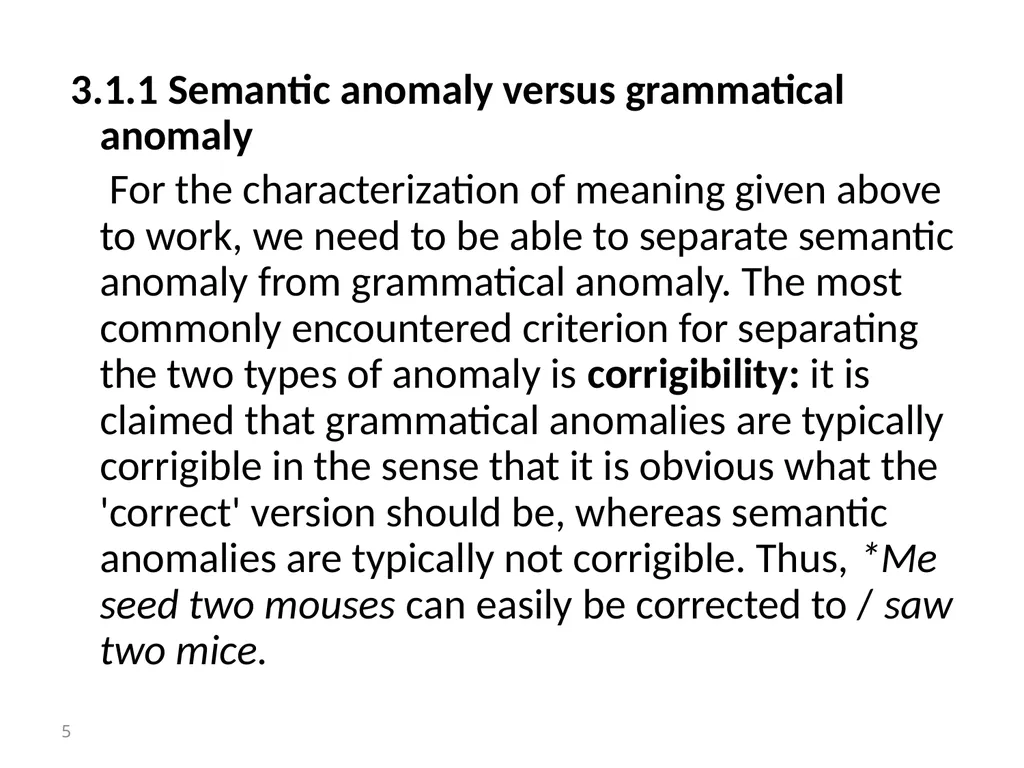
3.1.1 Semantic anomaly versus grammatical anomaly
For the characterization of meaning given above to work, we need to be able to separate semantic anomaly from grammatical anomaly. The most commonly encountered criterion for separating the two types of anomaly is corrigibility: it is claimed that grammatical anomalies are typically corrigible in the sense that it is obvious what the 'correct' version should be, whereas semantic anomalies are typically not corrigible. Thus, *Me seed two mouses can easily be corrected to / saw two mice. 5<br>
For the characterization of meaning given above to work, we need to be able to separate semantic anomaly from grammatical anomaly. The most commonly encountered criterion for separating the two types of anomaly is corrigibility: it is claimed that grammatical anomalies are typically corrigible in the sense that it is obvious what the 'correct' version should be, whereas semantic anomalies are typically not corrigible. Thus, *Me seed two mouses can easily be corrected to / saw two mice. 5<br>
06
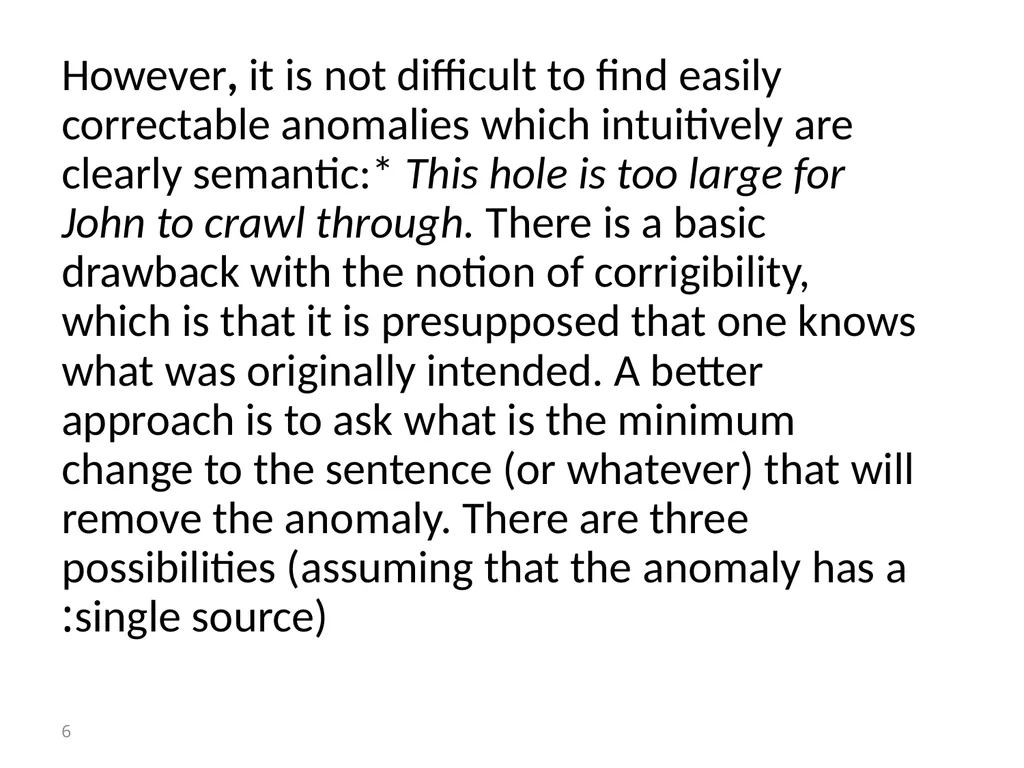
However, it is not difficult to find easily correctable anomalies which intuitively are clearly semantic:* This hole is too large for John to crawl through. There is a basic drawback with the notion of corrigibility, which is that it is presupposed that one knows what was originally intended. A better approach is to ask what is the minimum change to the sentence (or whatever) that will remove the anomaly. There are three possibilities (assuming that the anomaly has a single source): 6<br>
07
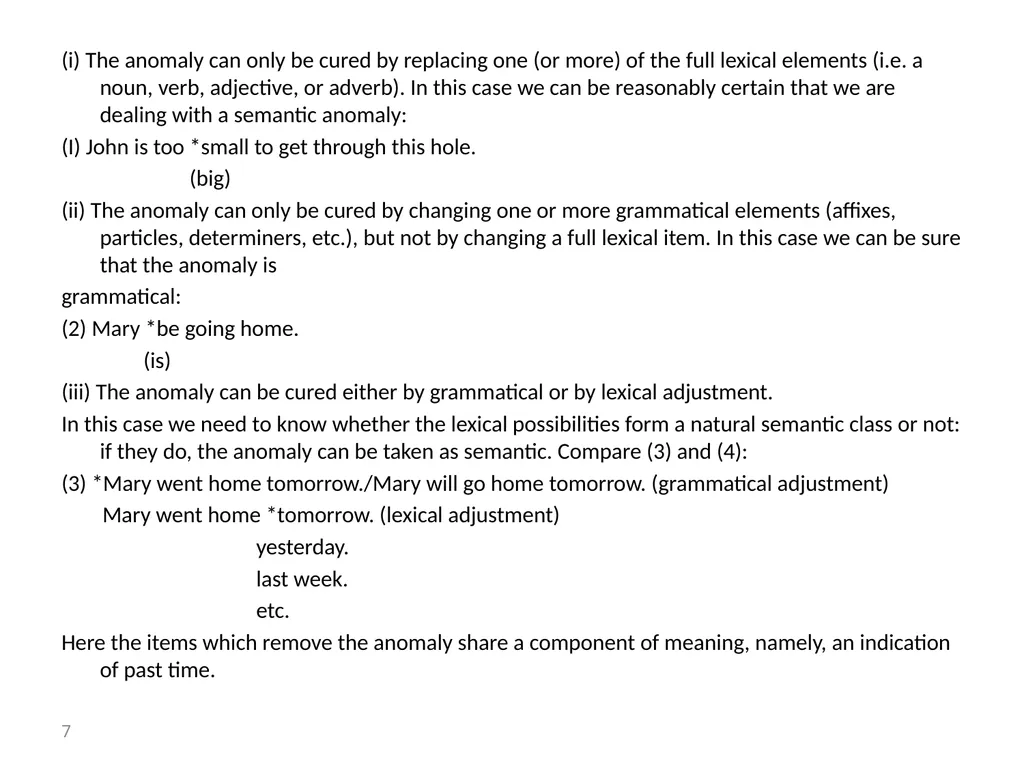
(i) The anomaly can only be cured by replacing one (or more) of the full lexical elements (i.e. a noun, verb, adjective, or adverb). In this case we can be reasonably certain that we are dealing with a semantic anomaly:
(I) John is too *small to get through this hole.
(big)
(ii) The anomaly can only be cured by changing one or more grammatical elements (affixes, particles, determiners, etc.), but not by changing a full lexical item. In this case we can be sure that the anomaly is
grammatical:
(2) Mary *be going home.
(is)
(iii) The anomaly can be cured either by grammatical or by lexical adjustment.
In this case we need to know whether the lexical possibilities form a natural semantic class or not: if they do, the anomaly can be taken as semantic. Compare (3) and (4):
(3) *Mary went home tomorrow./Mary will go home tomorrow. (grammatical adjustment)
Mary went home *tomorrow. (lexical adjustment)
yesterday.
last week.
etc.
Here the items which remove the anomaly share a component of meaning, namely, an indication of past time. 7<br>
08
3.1.2 Types of anomaly
We have so far treated anomaly as a unitary phenomenon, without trying to
distinguish different sorts. But it is sometimes useful to make a distinction between different types of anomaly.
3.1.2.1 Pleonasm
John chewed it with his teeth.
It was stolen illegally.
Mary deliberately made a speech.
These examples give a feeling of redundancy: how else can you chew something, if not with your teeth? How can anybody make a speech accidentally?
3.1.2.2 Dissonance
The balloon rose ever lower.
The hamster was only slightly dead.
Singing hypotenuses melted in every eye.
Here there is a sense of ill-matched meanings clashing, giving rise to paradox, contradiction, a need to look for figurative readings (interpretability varies). 8<br>
09
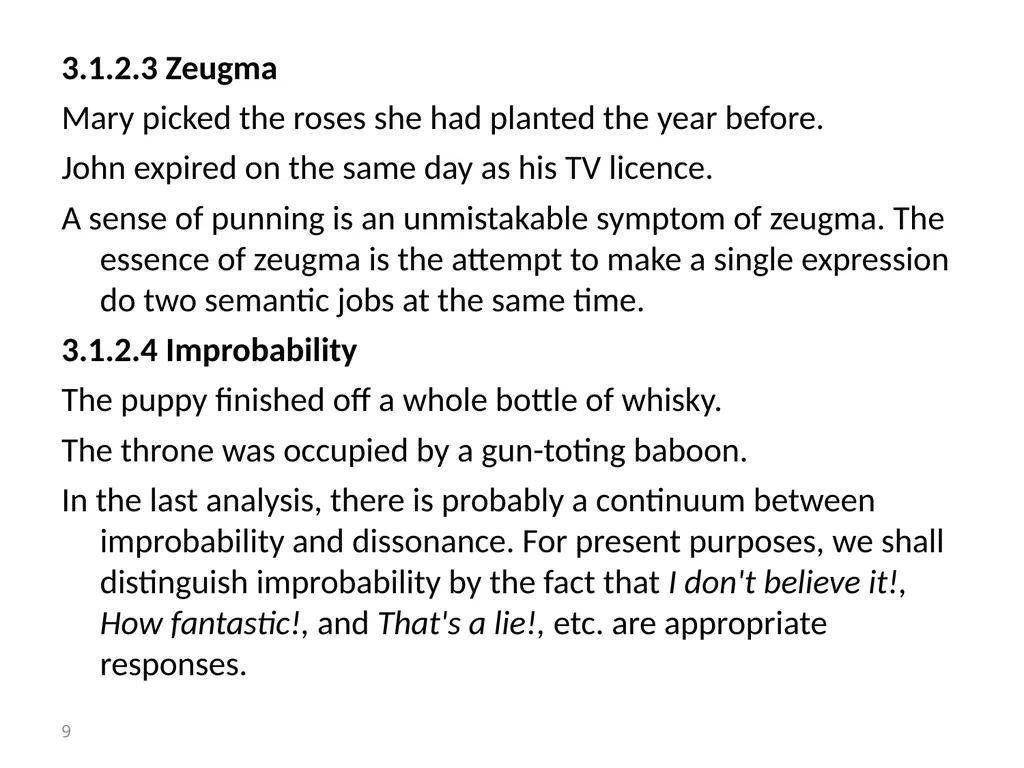
3.1.2.3 Zeugma
Mary picked the roses she had planted the year before.
John expired on the same day as his TV licence.
A sense of punning is an unmistakable symptom of zeugma. The essence of zeugma is the attempt to make a single expression do two semantic jobs at the same time.
3.1.2.4 Improbability
The puppy finished off a whole bottle of whisky.
The throne was occupied by a gun-toting baboon.
In the last analysis, there is probably a continuum between improbability and dissonance. For present purposes, we shall distinguish improbability by the fact that I don't believe it!, How fantastic!, and That's a lie!, etc. are appropriate responses. 9<br>
10
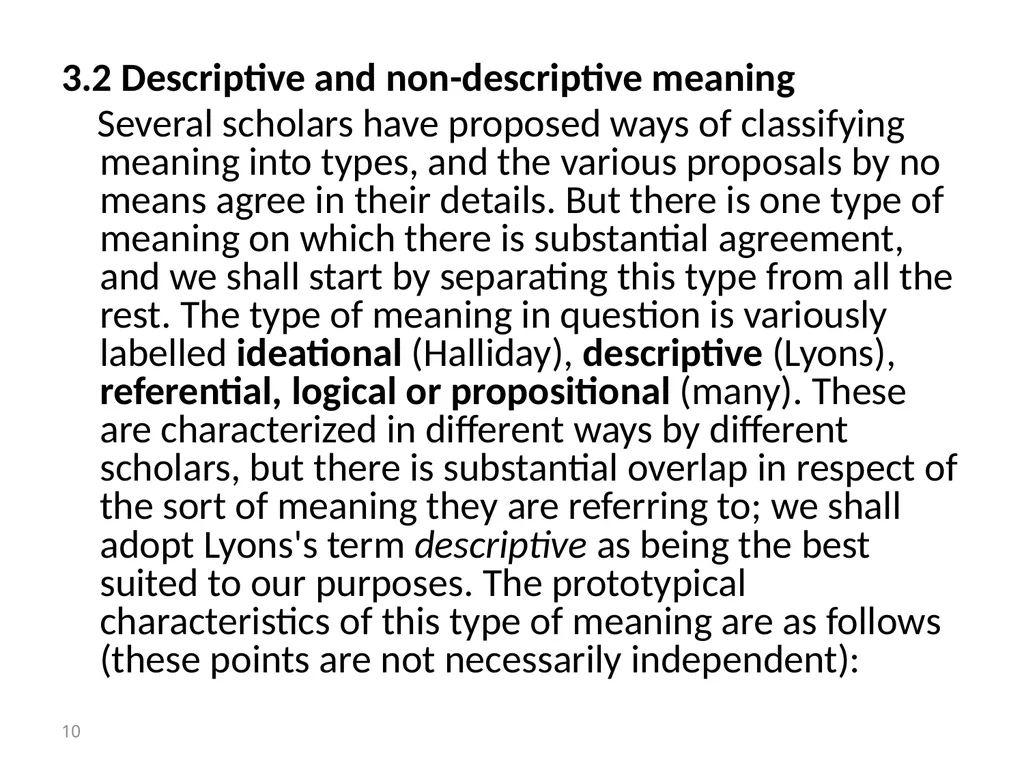
3.2 Descriptive and non-descriptive meaning
Several scholars have proposed ways of classifying meaning into types, and the various proposals by no means agree in their details. But there is one type of meaning on which there is substantial agreement, and we shall start by separating this type from all the rest. The type of meaning in question is variously labelled ideational (Halliday), descriptive (Lyons), referential, logical or propositional (many). These are characterized in different ways by different scholars, but there is substantial overlap in respect of the sort of meaning they are referring to; we shall adopt Lyons's term descriptive as being the best suited to our purposes. The prototypical characteristics of this type of meaning are as follows (these points are not necessarily independent): 10<br>
Several scholars have proposed ways of classifying meaning into types, and the various proposals by no means agree in their details. But there is one type of meaning on which there is substantial agreement, and we shall start by separating this type from all the rest. The type of meaning in question is variously labelled ideational (Halliday), descriptive (Lyons), referential, logical or propositional (many). These are characterized in different ways by different scholars, but there is substantial overlap in respect of the sort of meaning they are referring to; we shall adopt Lyons's term descriptive as being the best suited to our purposes. The prototypical characteristics of this type of meaning are as follows (these points are not necessarily independent): 10<br>
11
(i) It is this aspect of the meaning of a sentence which determines whether or not any proposition it expresses is true or false (see the discussion in Chapter 2). This property justifies the labels logical and propositional for this type of meaning.
(ii) It is this aspect of the meaning of an expression which constrains what the expression can be used to refer to; from another point of view, it is this type of meaning which guides the hearer in identifying the intended referent(s); this is the motivation for the label referential.
(iii) It is objective in the sense that it interposes a kind of distance between the speaker and what he says. It is displaced in Hockett's sense of not being tied to the here-and-now of the current speech situation. 11<br>
12
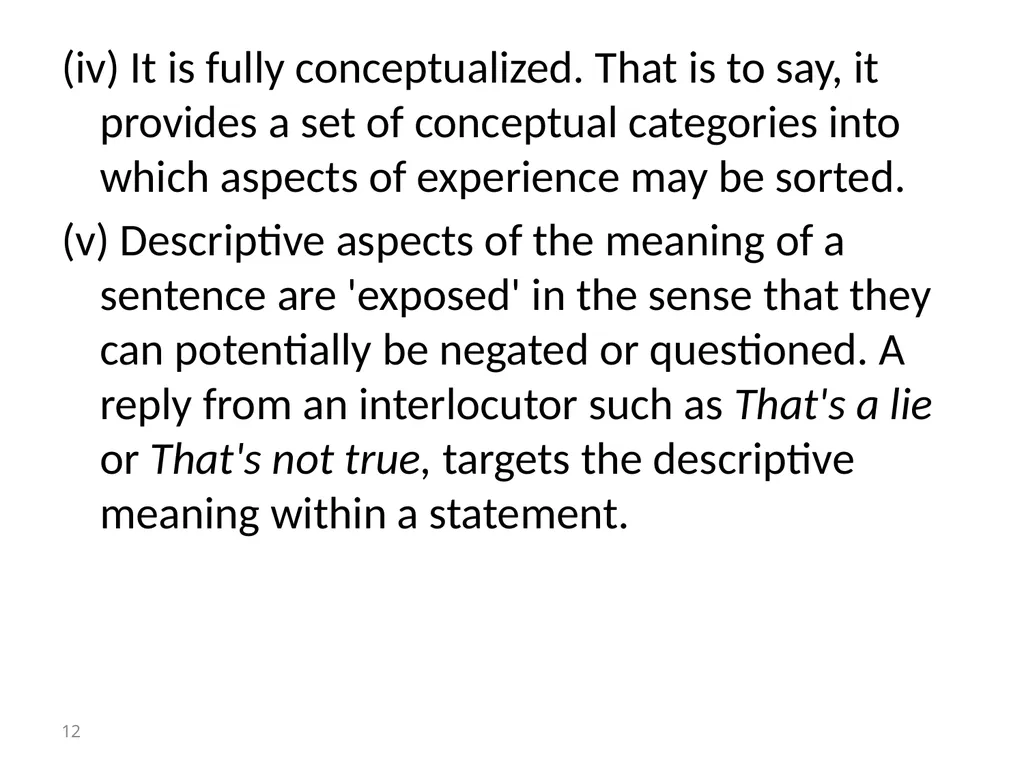
(iv) It is fully conceptualized. That is to say, it provides a set of conceptual categories into which aspects of experience may be sorted.
(v) Descriptive aspects of the meaning of a sentence are 'exposed' in the sense that they can potentially be negated or questioned. A reply from an interlocutor such as That's a lie or That's not true, targets the descriptive meaning within a statement. 12<br>
(v) Descriptive aspects of the meaning of a sentence are 'exposed' in the sense that they can potentially be negated or questioned. A reply from an interlocutor such as That's a lie or That's not true, targets the descriptive meaning within a statement. 12<br>
13
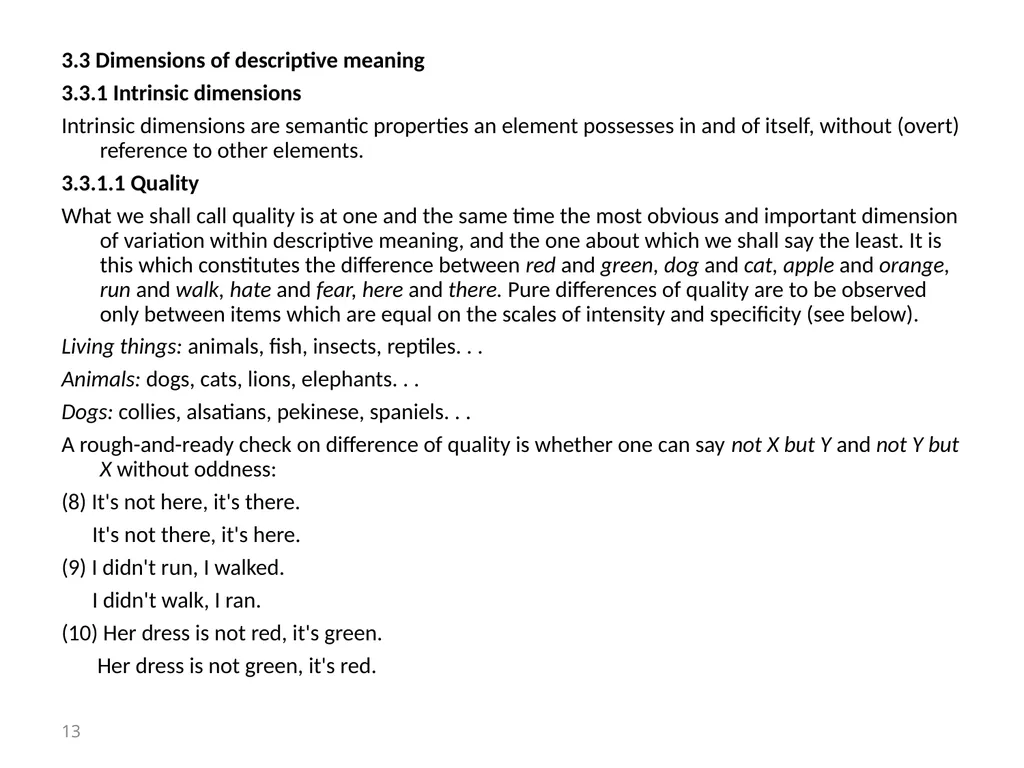
3.3 Dimensions of descriptive meaning
3.3.1 Intrinsic dimensions
Intrinsic dimensions are semantic properties an element possesses in and of itself, without (overt) reference to other elements.
3.3.1.1 Quality
What we shall call quality is at one and the same time the most obvious and important dimension of variation within descriptive meaning, and the one about which we shall say the least. It is this which constitutes the difference between red and green, dog and cat, apple and orange, run and walk, hate and fear, here and there. Pure differences of quality are to be observed only between items which are equal on the scales of intensity and specificity (see below).
Living things: animals, fish, insects, reptiles. . .
Animals: dogs, cats, lions, elephants. . .
Dogs: collies, alsatians, pekinese, spaniels. . .
A rough-and-ready check on difference of quality is whether one can say not X but Y and not Y but X without oddness:
(8) It's not here, it's there.
It's not there, it's here.
(9) I didn't run, I walked.
I didn't walk, I ran.
(10) Her dress is not red, it's green.
Her dress is not green, it's red. 13<br>
14
3.3.1.2 Intensity
Descriptive meaning may vary in intensity, without change of quality. For instance, one would not wish to say that large and huge differ in quality: they designate the same area of semantic quality space, but differ in intensity. We can conclude that huge is more intense than large, and terrified than scared. 14<br>
Descriptive meaning may vary in intensity, without change of quality. For instance, one would not wish to say that large and huge differ in quality: they designate the same area of semantic quality space, but differ in intensity. We can conclude that huge is more intense than large, and terrified than scared. 14<br>
15
3.3.1.3 Specificity
(18) It's a dog unilaterally entails It's an animal.
It's not an animal unilaterally entails It's not a dog.
From all this, we can conclude that dog is more specific than animal (alternatively, animal is more general than dog). Similarly, slap is more specific than hit, scarlet is more specific than red, woman is more specific than person. It is possible to distinguish several types of specificity. All the cases illustrated above involve type-specificity, that is to say, the more specific term denotes a subtype included within the more general type. But there is also part-specificity, illustrated by, for instance, hand-finger (where finger is the more specific), bicycle: wheel, university: faculty. John injured his finger is more specific than John injured his hand. 15<br>
16
3.3.1.4 Vagueness
Before examining this notion in greater detail, it is necessary to make as clear a distinction as possible between it and certain other notions with which it is often coupled in discussions, if not actually confused. The first of these is generality. Although someone who says I saw a reptile is not giving as much information as someone who says I saw a snake, they are not being any more vague. That is to say, the notion "reptile" is as clearly delimitable as the notion "snake", it is just that it denotes a more inclusive class. Another notion which must be distinguished from vagueness is abstractness. For instance, the notion of "entailment" is abstract, but is relatively well defined, and therefore not vague. 16<br>
Before examining this notion in greater detail, it is necessary to make as clear a distinction as possible between it and certain other notions with which it is often coupled in discussions, if not actually confused. The first of these is generality. Although someone who says I saw a reptile is not giving as much information as someone who says I saw a snake, they are not being any more vague. That is to say, the notion "reptile" is as clearly delimitable as the notion "snake", it is just that it denotes a more inclusive class. Another notion which must be distinguished from vagueness is abstractness. For instance, the notion of "entailment" is abstract, but is relatively well defined, and therefore not vague. 16<br>
17
Under the heading of vagueness we shall distinguish two different subdimensions. The first is ill-definedness, and the second is laxness. Ill-definedness is well illustrated by terms which designate a region on a gradable scale such as middle-aged. Age varies continuously: middle-aged occupies a region on this scale. But at what age does someone begin to be middle-aged, and at what age does one cease to be middle-aged and become old? There is quite an overlap between middle-aged and in their fifties, but the latter is significantly better defined: we know in principle how to determine whether someone is in their fifties or not. 17<br>
18
The second subtype of vagueness is laxness (vs. strictness) of application. For some terms, their essence is easily defined, but they are habitually applied in a loose way. This seems to be a characteristic of individual words. For instance, the notion of a circle is capable of a clear definition, and everyone is capable of grasping the strict notion, even if they cannot give a correct mathematical specification. But the word circle is habitually used very loosely, as in, for instance, The mourners stood in a circle round the grave. No one expects the people to form an exact circle here. 18<br>
19
3.3.1.5 Basicness
Another dimension along which descriptive meanings can vary is that of basicness: some meanings are considered more basic than others. A distinction is made between words or features which are close to concrete everyday experience, and those which, though in some way ultimately derived from these, are to various degrees remote from actual bodily experience. The distinction we are making here corresponds to one meaning of concrete (has spatio-temporal location) as opposed to abstract (does not have spatio-temporal location). A standard picture of meaning within the philosophy of language identifies a set of words, known as the observation vocabulary, whose meanings are fixed by their relations with observable properties of the environment. 19<br>
Another dimension along which descriptive meanings can vary is that of basicness: some meanings are considered more basic than others. A distinction is made between words or features which are close to concrete everyday experience, and those which, though in some way ultimately derived from these, are to various degrees remote from actual bodily experience. The distinction we are making here corresponds to one meaning of concrete (has spatio-temporal location) as opposed to abstract (does not have spatio-temporal location). A standard picture of meaning within the philosophy of language identifies a set of words, known as the observation vocabulary, whose meanings are fixed by their relations with observable properties of the environment. 19<br>
20
1. A general assumption is that the concrete/observable/basic terms will be the first learned, probably the first to arise in the evolution of human language. Cognitive linguists believe that cognition is built up as it were from concrete to abstract, and concrete domains function as source domains for metaphorical processes involved in creating abstract domains.
2. Another way of looking at more and less basic meanings is in terms of independence and dependence: one meaning may presuppose, or depend on, another. As an example of dependency, consider the case of acceleration. This presupposes/depends on the notion of speed, which in turn presupposes the yet more basic notion of movement, down to the most basic notions of all: physical object, location, and time. Notice that acceleration is not more specific than speed, in the way that dog is more specific than animal, or finger than hand, but it is more complex, in that it builds on more basic meanings. 20<br>
2. Another way of looking at more and less basic meanings is in terms of independence and dependence: one meaning may presuppose, or depend on, another. As an example of dependency, consider the case of acceleration. This presupposes/depends on the notion of speed, which in turn presupposes the yet more basic notion of movement, down to the most basic notions of all: physical object, location, and time. Notice that acceleration is not more specific than speed, in the way that dog is more specific than animal, or finger than hand, but it is more complex, in that it builds on more basic meanings. 20<br>
21
3. A natural way of thinking about this type of dependency is in terms of constituency: the dependent meanings, being more complex, are built up out of the more basic meanings. For instance, if we define acceleration as "rate of change of speed with time", we incorporate the simpler notion "speed" into the definition. A similar definition of speed would not need to make any reference to a notion of "acceleration" (e.g. "rate of change of location with time"). In a similar way, the meaning of stallion is built out of the more basic meanings "male" and "horse". On this view, the most basic meanings are the so-called semantic primes—elementary notions out of which all other meanings are built. 21<br>
22
3.3.1.6 Viewpoint
A number of linguistic expressions encode as part of their meaning a particular viewpoint on the events or states of affairs designated. Perhaps the most obvious example of this is provided by deictic expressions, such as this, that, here, there, now, then, and so on, which are usually claimed to encode the viewpoint of the speaker at the moment of utterance. So, for instance, the book on the table, if it was valid for one speaker in a particular context, would be valid for anyone present; however, the validity of this book here, as a description of the same book, would clearly depend on the position of the speaker relative to the book in question. There are less obvious encodings of viewpoint. Consider the difference between (20), (21), (22), and (23):
(20) The village is on the north side of the hill.
(21) The village is on the other side of the hill.
(22) The village is over the hill.
(23) The village is round the other side of the hill. 22<br>
23
It is easy to envisage a situation in which all four sentences give the same information. But they differ in respect of implicit viewpoint: (20) gives what might be called a viewpoint-free description of the position of the village; (21) requires knowledge of a reference point to be interpretable (other side from what?); (22) and (23) adopt (and encode) different viewpoints, but are similar in that they take the viewpoint of someone travelling to the village from the speaker's location, in the case of (22) a journey straight over the hill, in the case of (23) a less strenuous journey round the hill. 23<br>
24
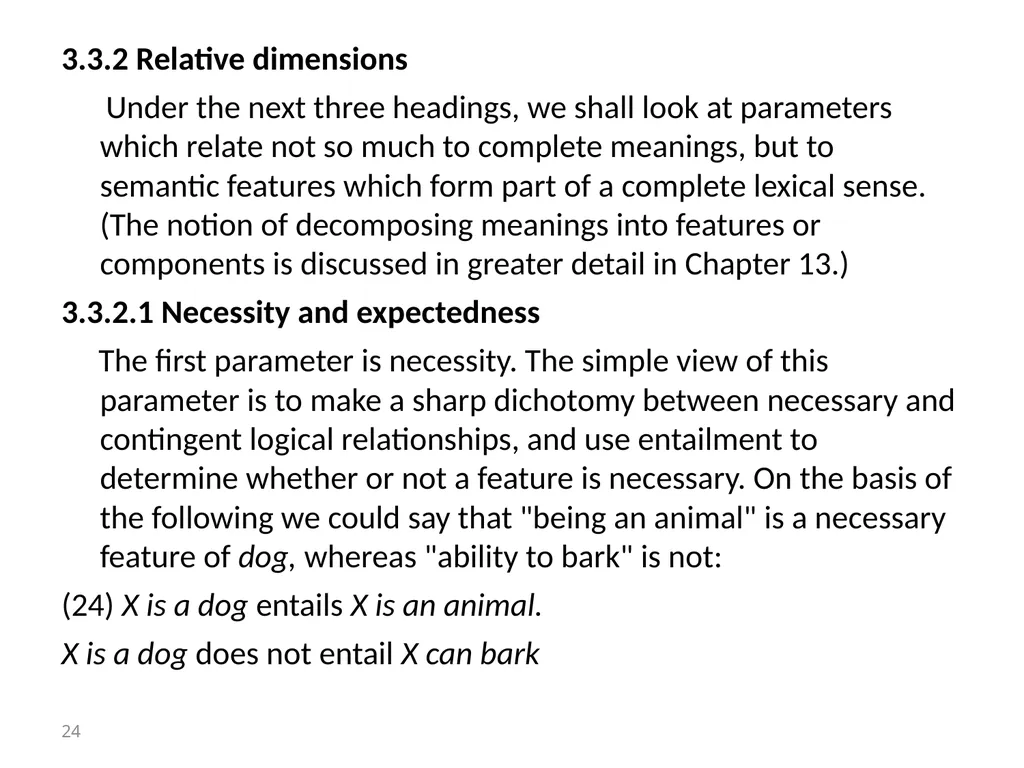
3.3.2 Relative dimensions
Under the next three headings, we shall look at parameters which relate not so much to complete meanings, but to semantic features which form part of a complete lexical sense. (The notion of decomposing meanings into features or components is discussed in greater detail in Chapter 13.)
3.3.2.1 Necessity and expectedness
The first parameter is necessity. The simple view of this parameter is to make a sharp dichotomy between necessary and contingent logical relationships, and use entailment to determine whether or not a feature is necessary. On the basis of the following we could say that "being an animal" is a necessary feature of dog, whereas "ability to bark" is not:
(24) X is a dog entails X is an animal.
X is a dog does not entail X can bark 24<br>
25
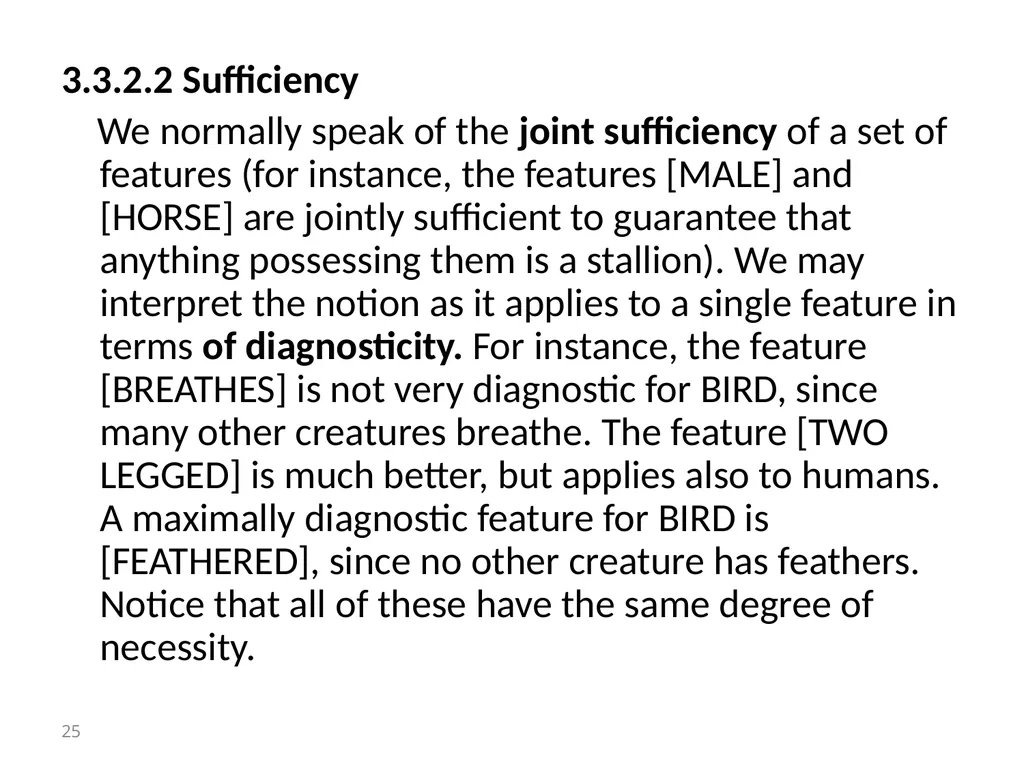
3.3.2.2 Sufficiency
We normally speak of the joint sufficiency of a set of features (for instance, the features [MALE] and [HORSE] are jointly sufficient to guarantee that anything possessing them is a stallion). We may interpret the notion as it applies to a single feature in terms of diagnosticity. For instance, the feature [BREATHES] is not very diagnostic for BIRD, since many other creatures breathe. The feature [TWO LEGGED] is much better, but applies also to humans. A maximally diagnostic feature for BIRD is [FEATHERED], since no other creature has feathers. Notice that all of these have the same degree of necessity. 25<br>
We normally speak of the joint sufficiency of a set of features (for instance, the features [MALE] and [HORSE] are jointly sufficient to guarantee that anything possessing them is a stallion). We may interpret the notion as it applies to a single feature in terms of diagnosticity. For instance, the feature [BREATHES] is not very diagnostic for BIRD, since many other creatures breathe. The feature [TWO LEGGED] is much better, but applies also to humans. A maximally diagnostic feature for BIRD is [FEATHERED], since no other creature has feathers. Notice that all of these have the same degree of necessity. 25<br>
26
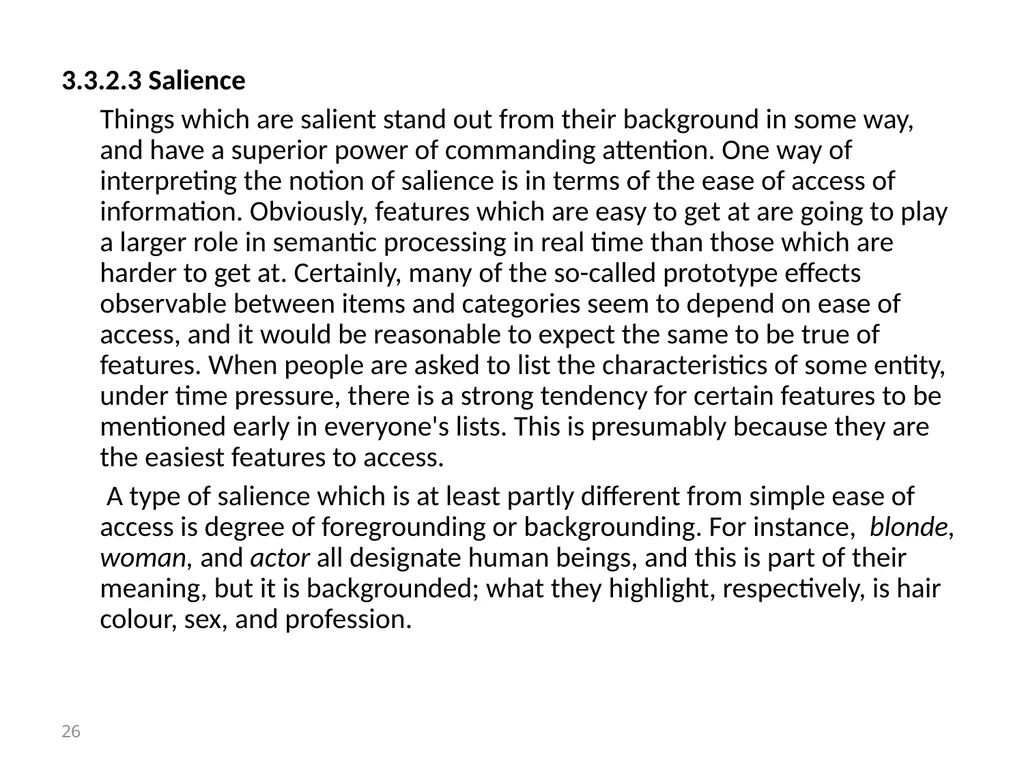
3.3.2.3 Salience
Things which are salient stand out from their background in some way, and have a superior power of commanding attention. One way of interpreting the notion of salience is in terms of the ease of access of information. Obviously, features which are easy to get at are going to play a larger role in semantic processing in real time than those which are harder to get at. Certainly, many of the so-called prototype effects observable between items and categories seem to depend on ease of access, and it would be reasonable to expect the same to be true of features. When people are asked to list the characteristics of some entity, under time pressure, there is a strong tendency for certain features to be mentioned early in everyone's lists. This is presumably because they are the easiest features to access.
A type of salience which is at least partly different from simple ease of access is degree of foregrounding or backgrounding. For instance, blonde, woman, and actor all designate human beings, and this is part of their meaning, but it is backgrounded; what they highlight, respectively, is hair colour, sex, and profession. 26<br>
27
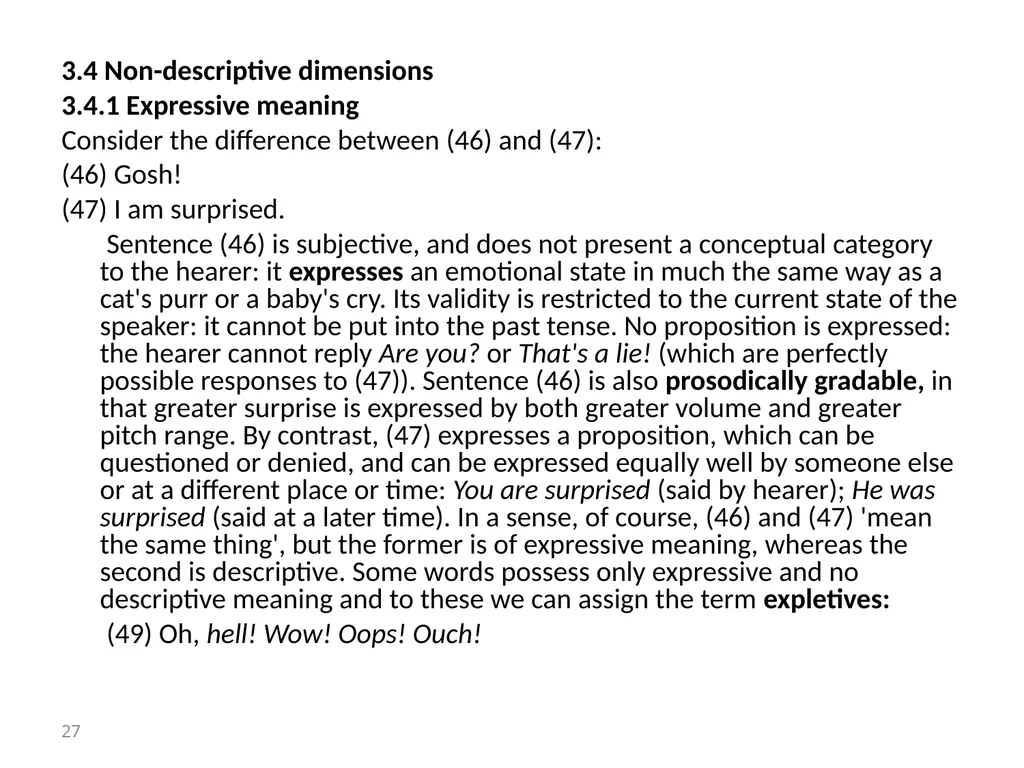
3.4 Non-descriptive dimensions
3.4.1 Expressive meaning
Consider the difference between (46) and (47):
(46) Gosh!
(47) I am surprised.
Sentence (46) is subjective, and does not present a conceptual category to the hearer: it expresses an emotional state in much the same way as a cat's purr or a baby's cry. Its validity is restricted to the current state of the speaker: it cannot be put into the past tense. No proposition is expressed: the hearer cannot reply Are you? or That's a lie! (which are perfectly possible responses to (47)). Sentence (46) is also prosodically gradable, in that greater surprise is expressed by both greater volume and greater pitch range. By contrast, (47) expresses a proposition, which can be questioned or denied, and can be expressed equally well by someone else or at a different place or time: You are surprised (said by hearer); He was surprised (said at a later time). In a sense, of course, (46) and (47) 'mean the same thing', but the former is of expressive meaning, whereas the second is descriptive. Some words possess only expressive and no descriptive meaning and to these we can assign the term expletives:
(49) Oh, hell! Wow! Oops! Ouch! 27<br>
28
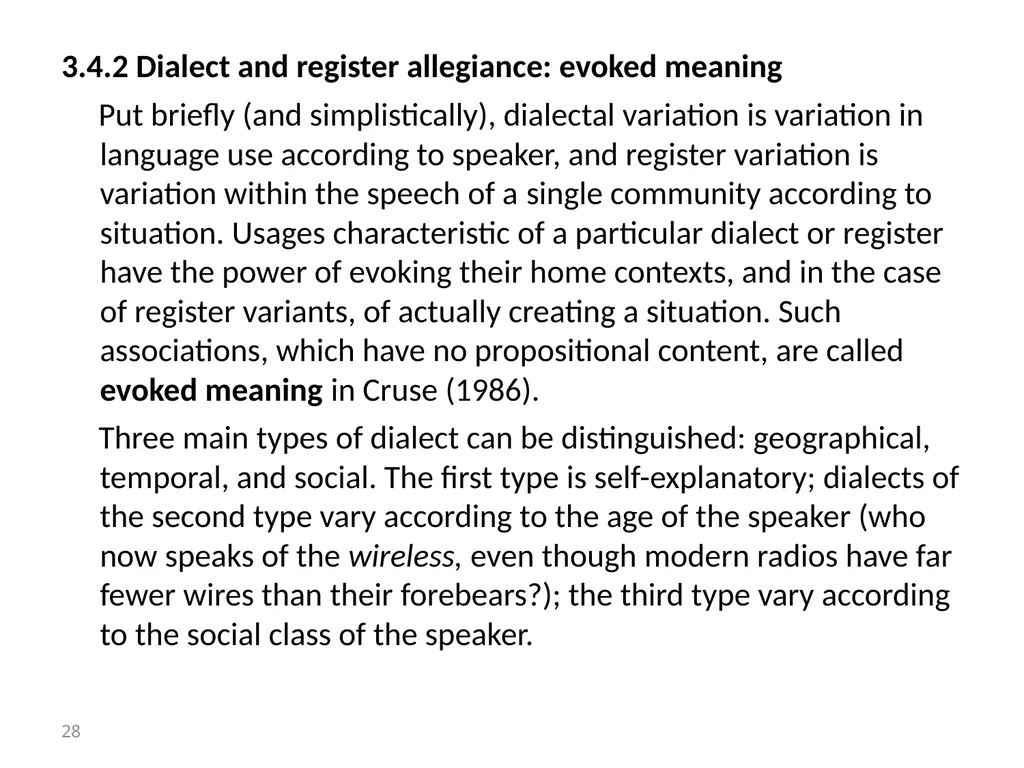
3.4.2 Dialect and register allegiance: evoked meaning
Put briefly (and simplistically), dialectal variation is variation in language use according to speaker, and register variation is variation within the speech of a single community according to situation. Usages characteristic of a particular dialect or register have the power of evoking their home contexts, and in the case of register variants, of actually creating a situation. Such associations, which have no propositional content, are called evoked meaning in Cruse (1986).
Three main types of dialect can be distinguished: geographical, temporal, and social. The first type is self-explanatory; dialects of the second type vary according to the age of the speaker (who now speaks of the wireless, even though modern radios have far fewer wires than their forebears?); the third type vary according to the social class of the speaker. 28<br>
29
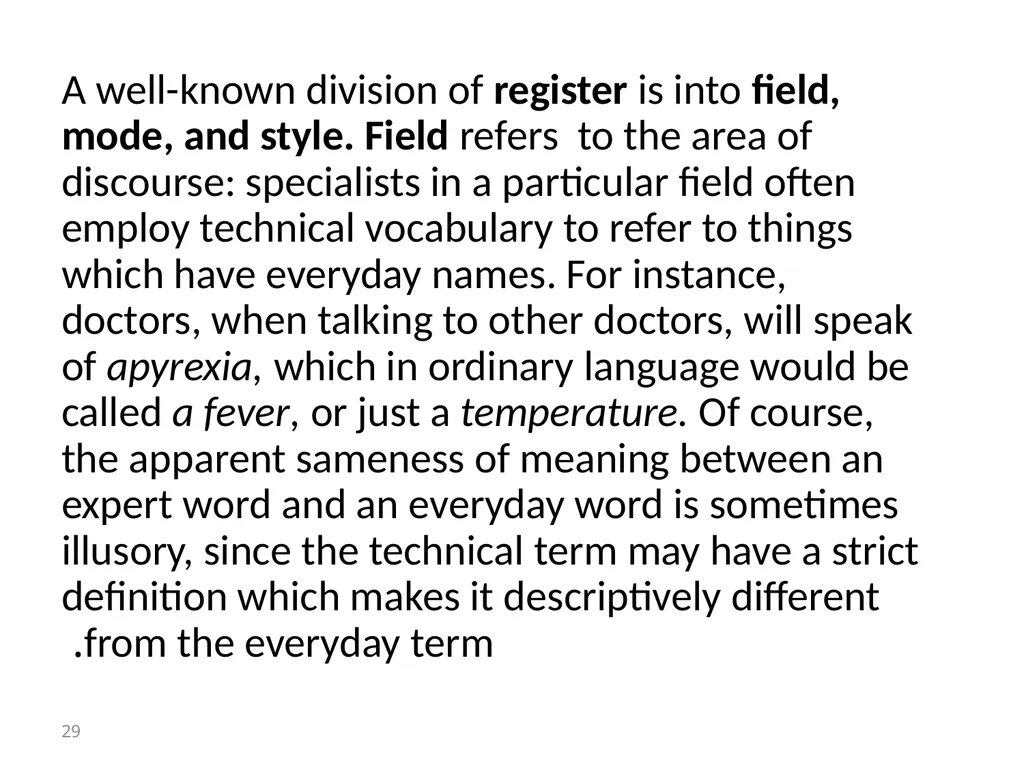
A well-known division of register is into field, mode, and style. Field refers to the area of discourse: specialists in a particular field often employ technical vocabulary to refer to things which have everyday names. For instance, doctors, when talking to other doctors, will speak of apyrexia, which in ordinary language would be called a fever, or just a temperature. Of course, the apparent sameness of meaning between an expert word and an everyday word is sometimes illusory, since the technical term may have a strict definition which makes it descriptively different from the everyday term. 29<br>
30
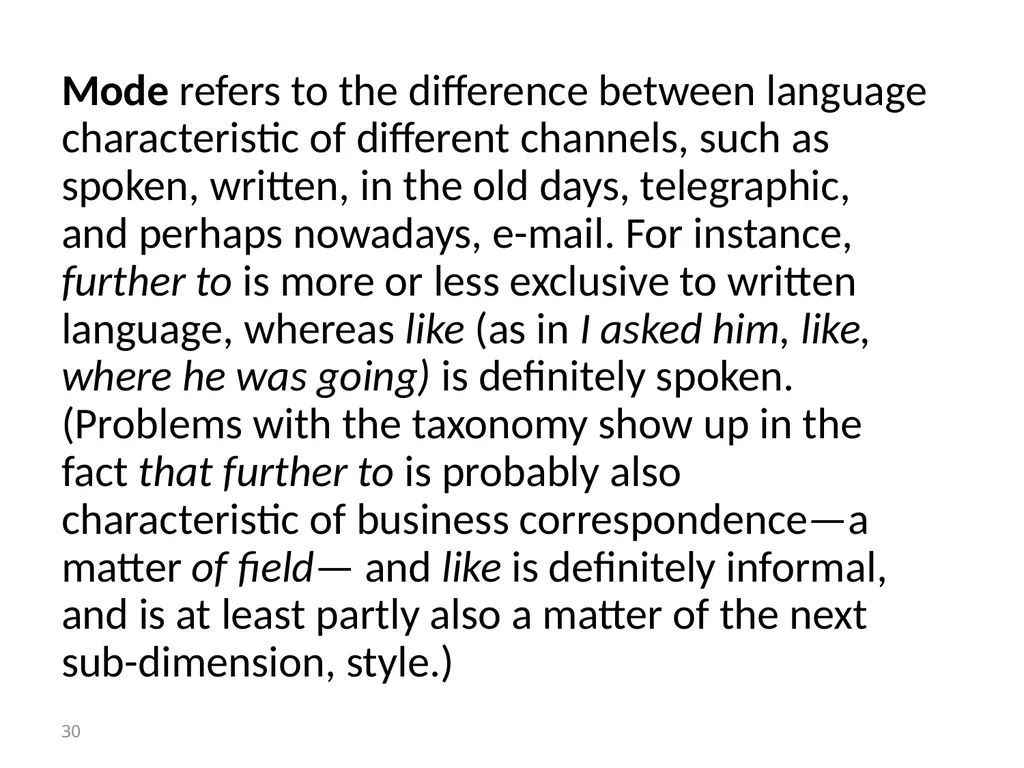
Mode refers to the difference between language characteristic of different channels, such as spoken, written, in the old days, telegraphic, and perhaps nowadays, e-mail. For instance, further to is more or less exclusive to written language, whereas like (as in I asked him, like, where he was going) is definitely spoken. (Problems with the taxonomy show up in the fact that further to is probably also characteristic of business correspondence—a matter of field— and like is definitely informal, and is at least partly also a matter of the next sub-dimension, style.) 30<br>
31
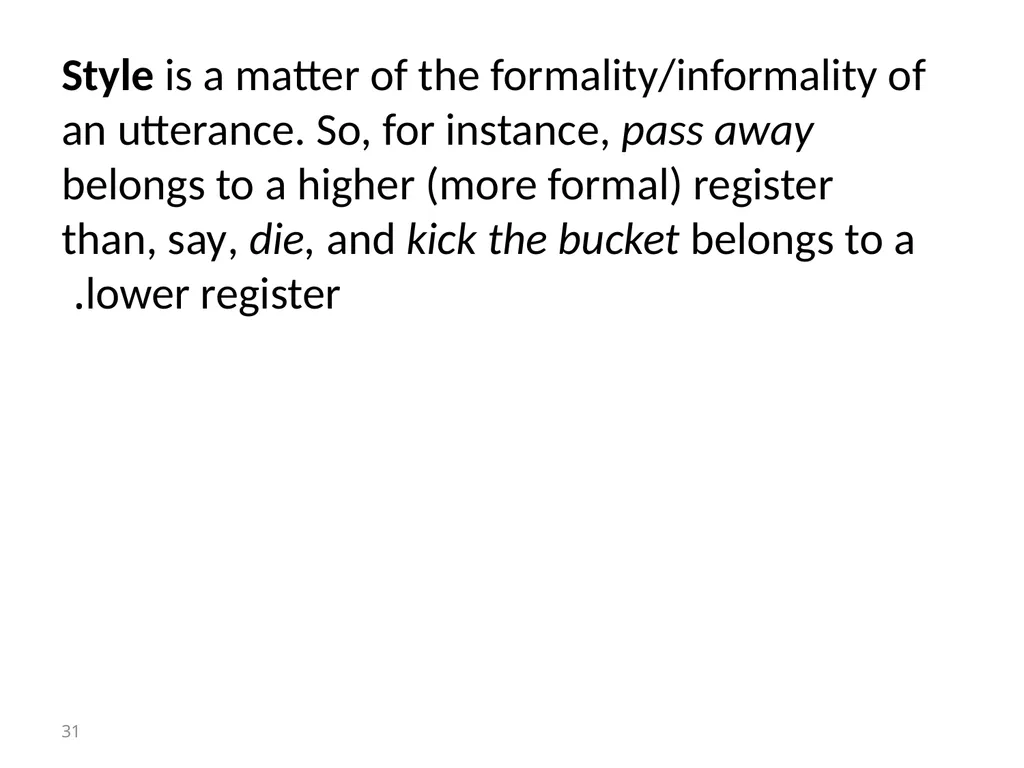
Style is a matter of the formality/informality of an utterance. So, for instance, pass away belongs to a higher (more formal) register than, say, die, and kick the bucket belongs to a lower register. 31<br>
32
Homework
1, 4 & 5 (p. 62 & 63) 32<br>
1, 4 & 5 (p. 62 & 63) 32<br>