
CHAPTER 4 Individual Variations © 2018 McGraw-Hill
EM
Published · 40 slides · 0 views
1 / 1

Description
CHAPTER 4 Individual Variations 2018 McGraw-Hill Higher Education. All rights reserved. Learning Goals Discuss what intelligence is, how it is measured, theories of multiple intelligences, the neuroscience of intelligence, and some
Related Topics
Share
Embed code
Download this presentation From Below
"CHAPTER 4 Individual Variations © 2018 McGraw-Hill" is the property of its rightful owner. Permission is granted to download and print the materials on this website for personal, non-commercial use only, and to display it on your personal computer provided you do not modify the materials and that you retain all copyright notices contained in the materials. By downloading content from our website, you accept the terms of this agreement.
Presentation Transcript
01
CHAPTER 4 Individual Variations © 2018 McGraw-Hill Higher Education. All rights reserved.<br>
02
Learning Goals Discuss what intelligence is, how it is measured, theories of multiple intelligences, the neuroscience of intelligence, and some controversies and issues about its use by educators
Describe learning and thinking styles
Characterize the nature of personality and temperament<br>
Describe learning and thinking styles
Characterize the nature of personality and temperament<br>
03
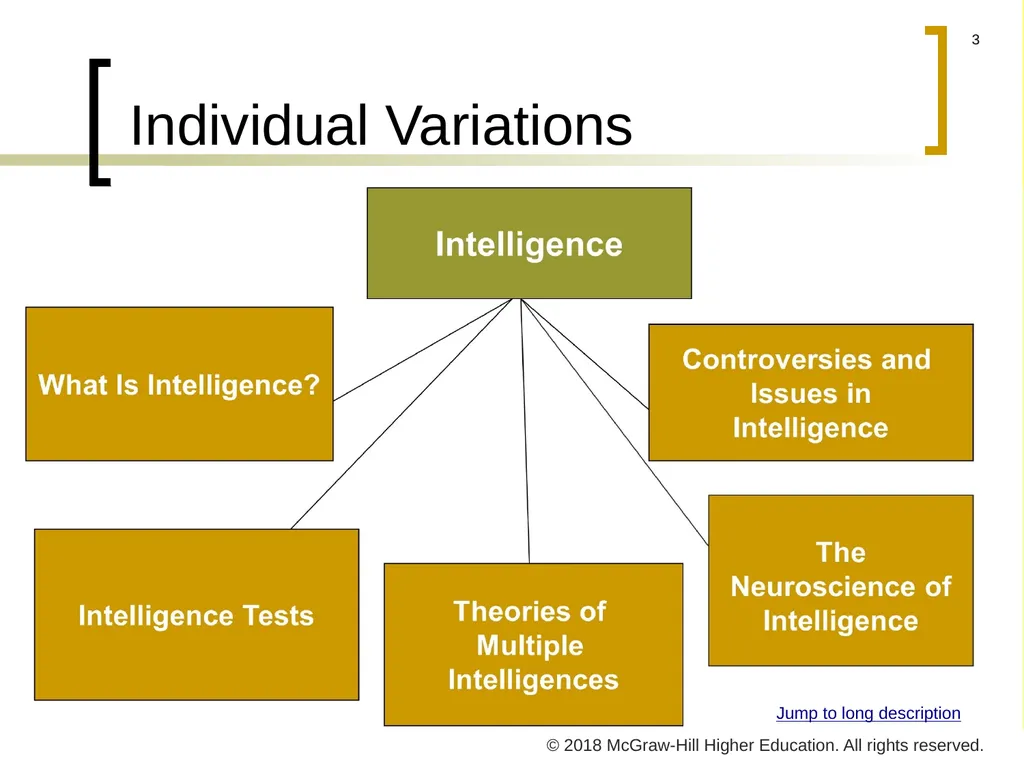
Individual Variations Jump to long description<br>
04
Connecting with Teachers Shiffy Landa, a first-grade teacher in St. Louis, Missouri, uses Howard Gardner’s multiple-intelligences approach in her classroom
It is the best way to reach children because they have many different kinds of abilities
She doesn’t stand in front of the room and lecture her students
She acts as a facilitator
Her students work in cooperative learning groups to develop their interpersonal intelligences
She educates her students’ parents with parent education classes<br>
It is the best way to reach children because they have many different kinds of abilities
She doesn’t stand in front of the room and lecture her students
She acts as a facilitator
Her students work in cooperative learning groups to develop their interpersonal intelligences
She educates her students’ parents with parent education classes<br>
05
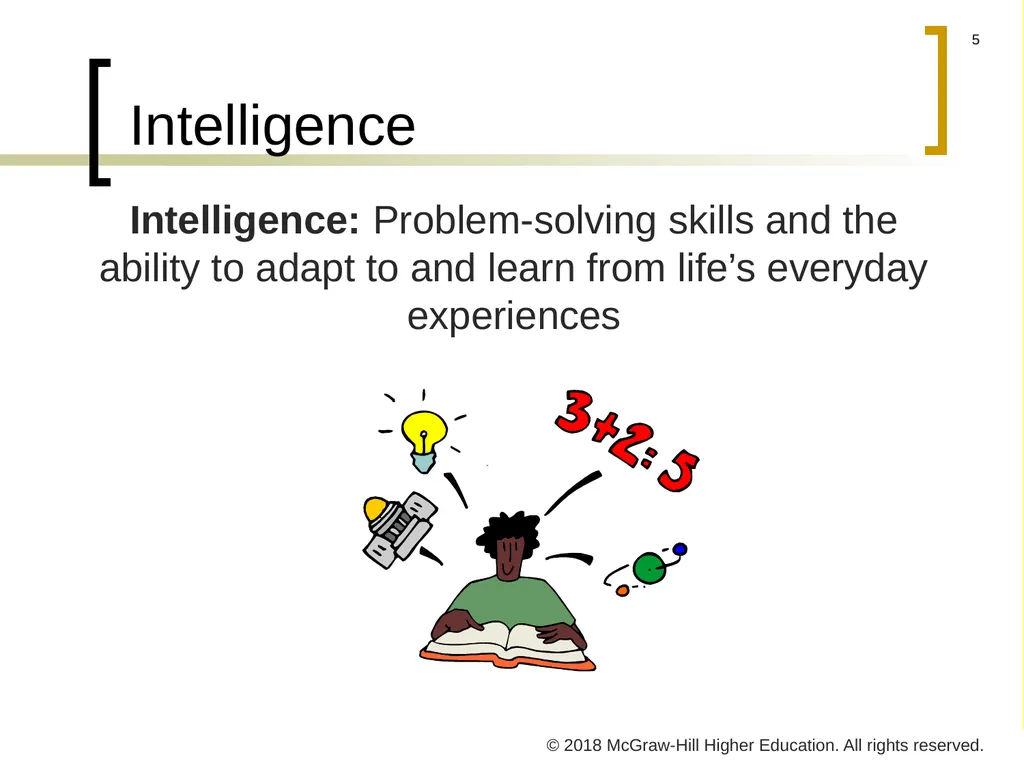
Intelligence Intelligence: Problem-solving skills and the ability to adapt to and learn from life’s everyday experiences<br>
06
Binet Intelligence Tests Mental Age (MA) An individual’s level of mental development relative to others Intelligence Quotient (IQ) Person’s mental age divided by chronological age (CA), multiplied by 100 Normal Distribution A symmetrical distribution
Majority of scores fall in the middle of the possible range of scores
Few scores appear in the extremes<br>
Majority of scores fall in the middle of the possible range of scores
Few scores appear in the extremes<br>
07
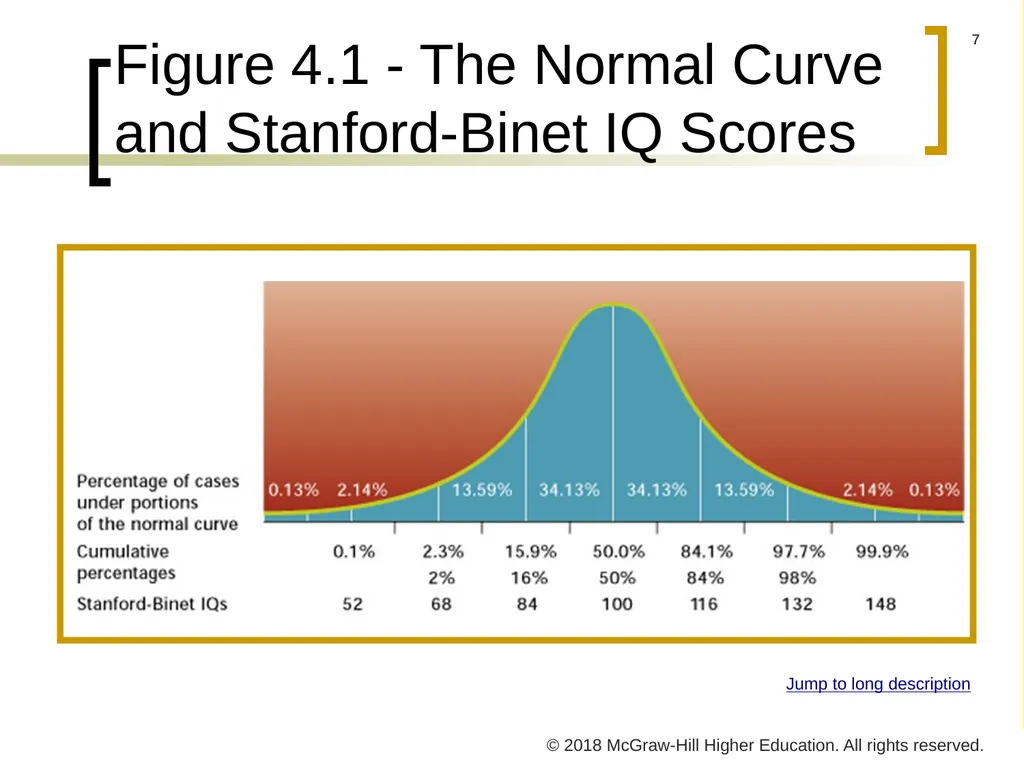
Figure 4.1 - The Normal Curve and Stanford-Binet IQ Scores Jump to long description<br>
08
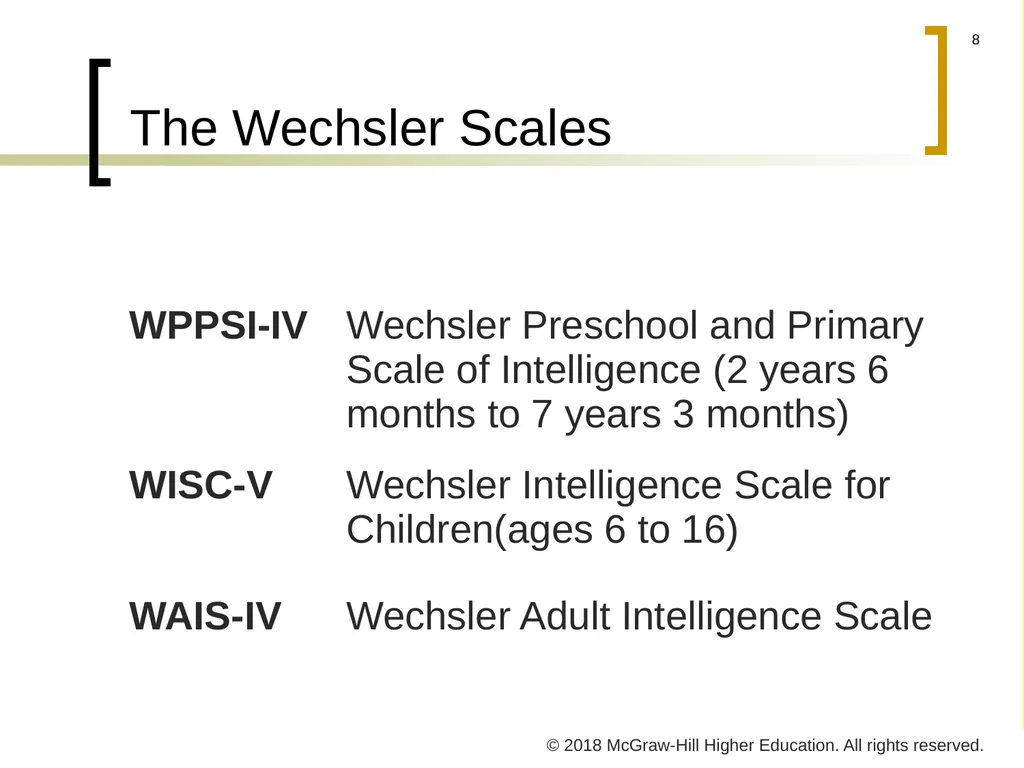
The Wechsler Scales<br>
09
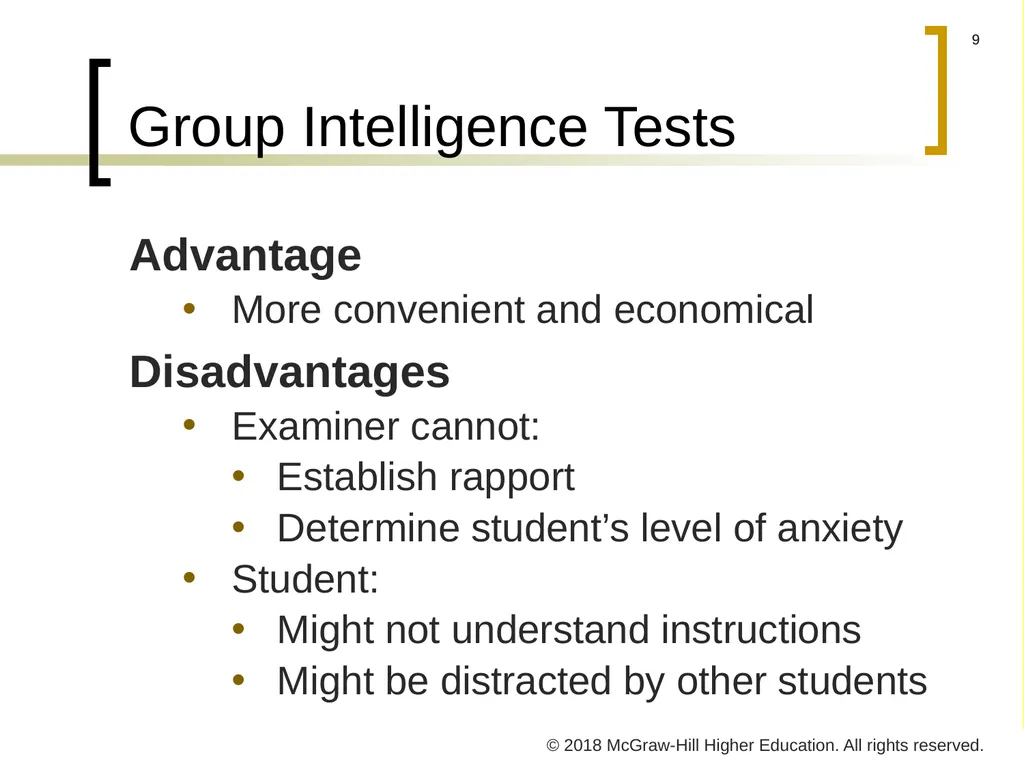
Group Intelligence Tests Advantage
More convenient and economical Disadvantages
Examiner cannot:
Establish rapport
Determine student’s level of anxiety
Student:
Might not understand instructions
Might be distracted by other students<br>
More convenient and economical Disadvantages
Examiner cannot:
Establish rapport
Determine student’s level of anxiety
Student:
Might not understand instructions
Might be distracted by other students<br>
10
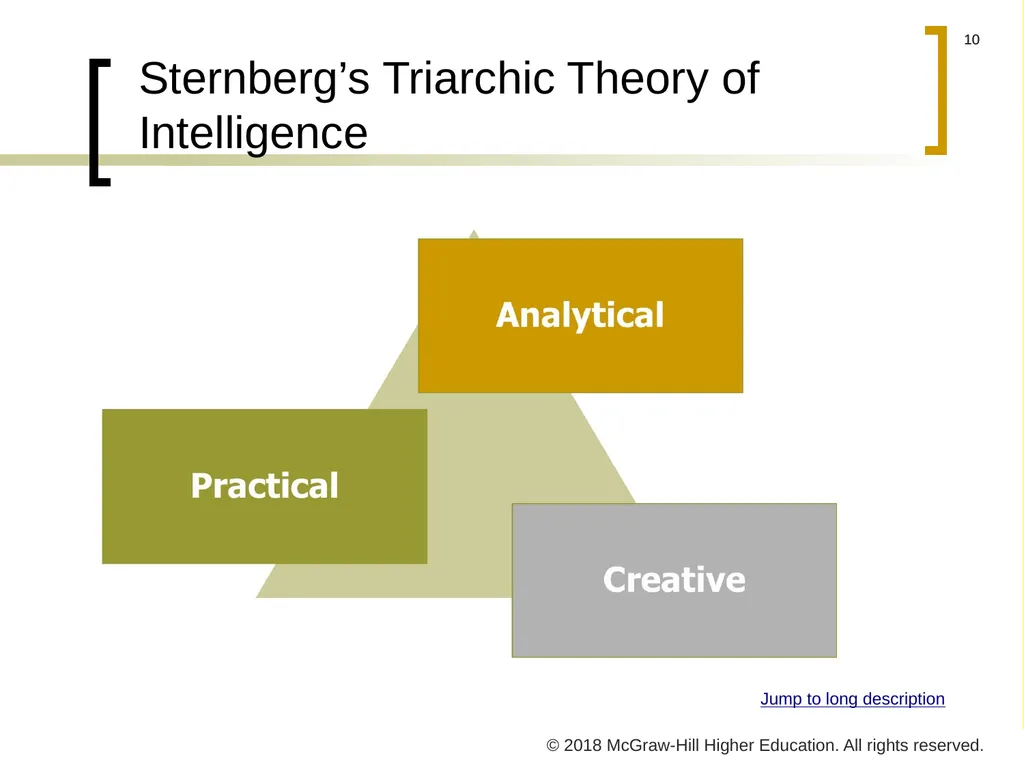
Sternberg’s Triarchic Theory of Intelligence Jump to long description<br>
11
Sternberg’s Triarchic Theory
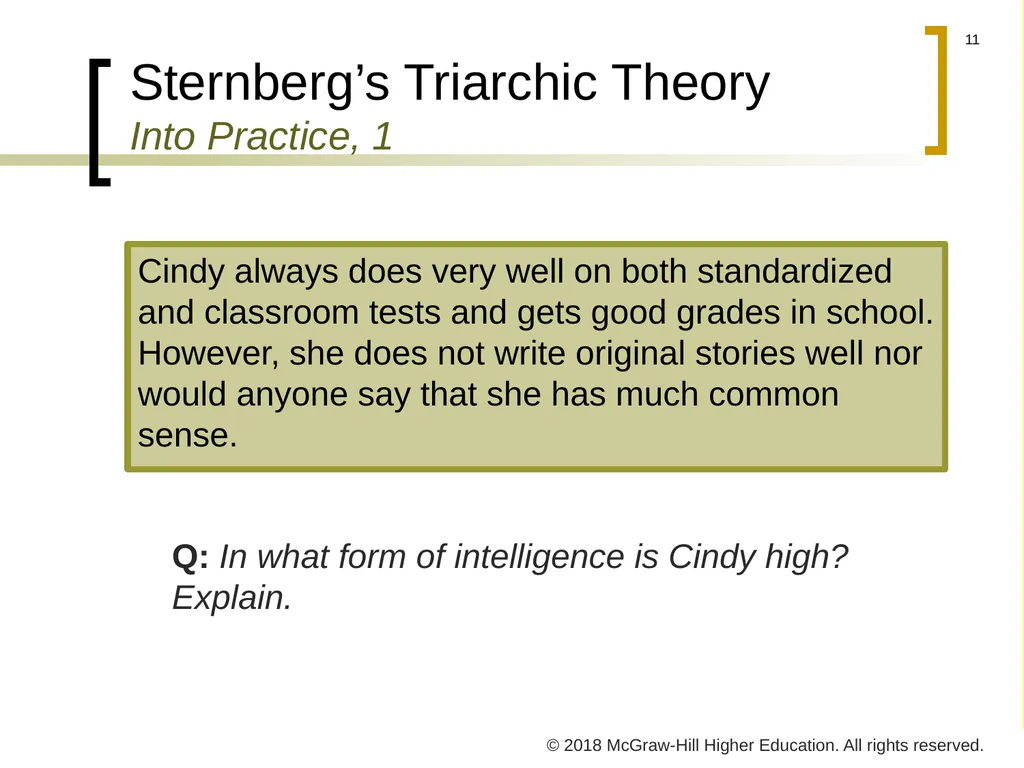
Into Practice, 1 Cindy always does very well on both standardized and classroom tests and gets good grades in school. However, she does not write original stories well nor would anyone say that she has much common sense. Q: In what form of intelligence is Cindy high? Explain.<br>
12
Sternberg’s Triarchic Theory
Into Practice, 2 Trent does not do well on standardized tests. His grades are not very high. However, Trent is very imaginative and a wonderful storyteller. Trent’s classmates beg him to read his stories to the class. Trent hopes to be a novelist one day. However, he often turns in work that does not conform to teacher expectations or directions. Q: In what form of intelligence is Trent high? Explain.<br>
13
Sternberg’s Triarchic Theory
Into Practice, 3 Ken doesn’t do very well in school. However, he is very popular with his peers and has excellent leadership skills. Q: In what form of intelligence is Ken high? Explain.<br>
14
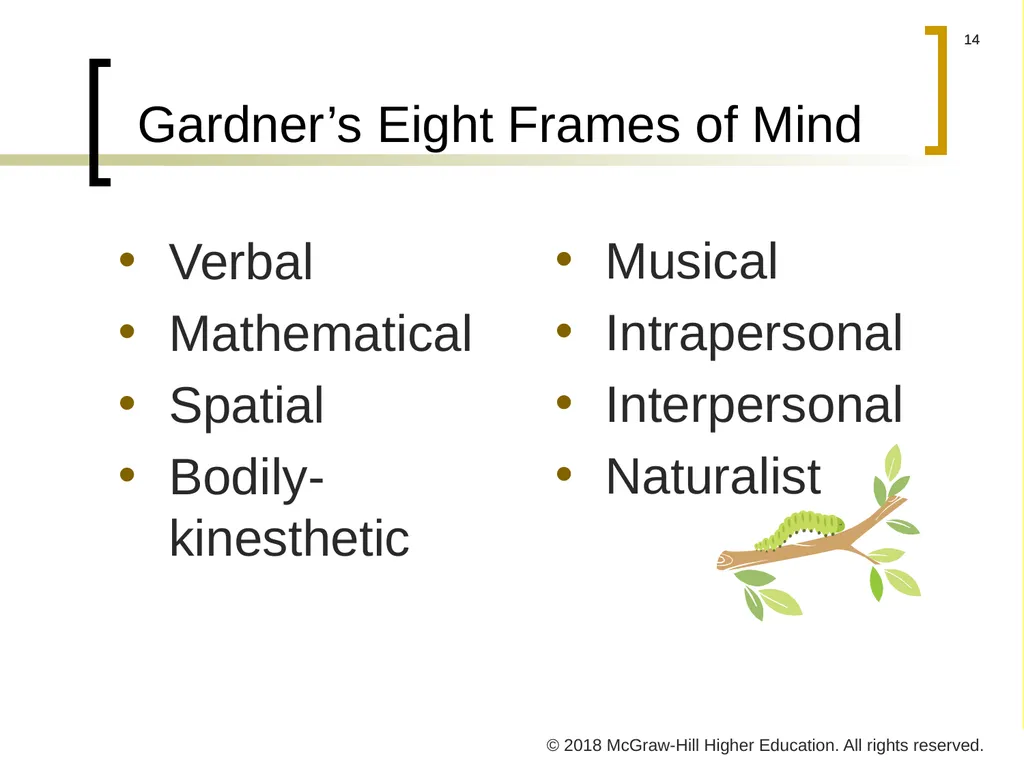
Gardner’s Eight Frames of Mind Verbal
Mathematical
Spatial
Bodily-kinesthetic Musical
Intrapersonal
Interpersonal
Naturalist<br>
Mathematical
Spatial
Bodily-kinesthetic Musical
Intrapersonal
Interpersonal
Naturalist<br>
15
Gardner’s Eight Frames of Mind
Theory into Practice, 1 Carrie loves to read and write stories. Q: Which of Gardner's eight frames of mind is she displaying when she engages in these activities? Explain.<br>
16
Gardner’s Eight Frames of Mind
Theory into Practice, 2 Jane is an excellent athlete, excelling at soccer, basketball, and baseball. Q: Which of Gardner's eight frames of mind is Jane displaying when she engages in these activities? Explain.<br>
17
Gardner’s Eight Frames of Mind
Theory into Practice, 3 Steve loves to play the piano, trumpet, and drums and is quite good at all of them. Q: Which of Gardner's eight frames of mind is Steve displaying when he engages in these activities? Explain.<br>
18
Gardner’s Eight Frames of Mind
Theory into Practice, 4 Tanesha is a good friend. People often open up to her and tell her things they would not share with other people. She never betrays their trust. Q: Which of Gardner's eight frames of mind is Tanesha displaying when she engages in these activities? Explain.<br>
19
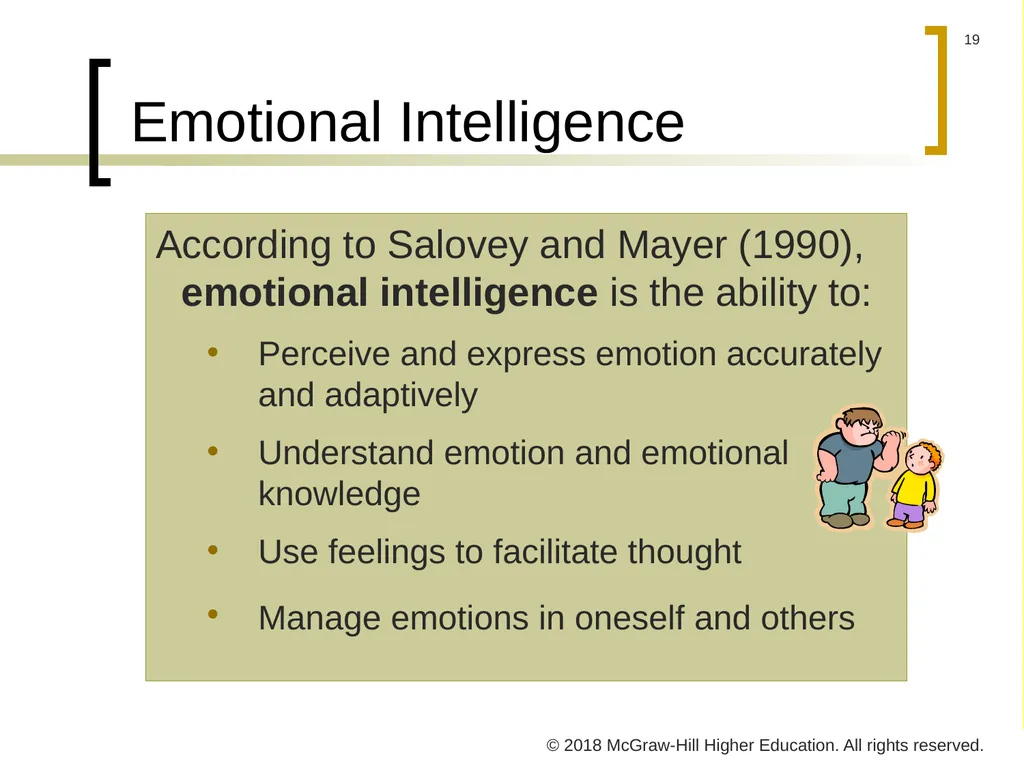
Emotional Intelligence According to Salovey and Mayer (1990), emotional intelligence is the ability to:
Perceive and express emotion accurately and adaptively
Understand emotion and emotional knowledge
Use feelings to facilitate thought
Manage emotions in oneself and others<br>
Perceive and express emotion accurately and adaptively
Understand emotion and emotional knowledge
Use feelings to facilitate thought
Manage emotions in oneself and others<br>
20
Enter the Debate Should schools use intelligence tests for placement purposes? YES More convenient and economical NO<br>
21
The Neuroscience of Intelligence Interest in the neuroscience of intelligence has increased
Questions include:
Is having a bigger brain linked to higher intelligence?
Is intelligence located in certain brain regions?
Is the speed at which the brain processes information linked to intelligence?<br>
Questions include:
Is having a bigger brain linked to higher intelligence?
Is intelligence located in certain brain regions?
Is the speed at which the brain processes information linked to intelligence?<br>
22
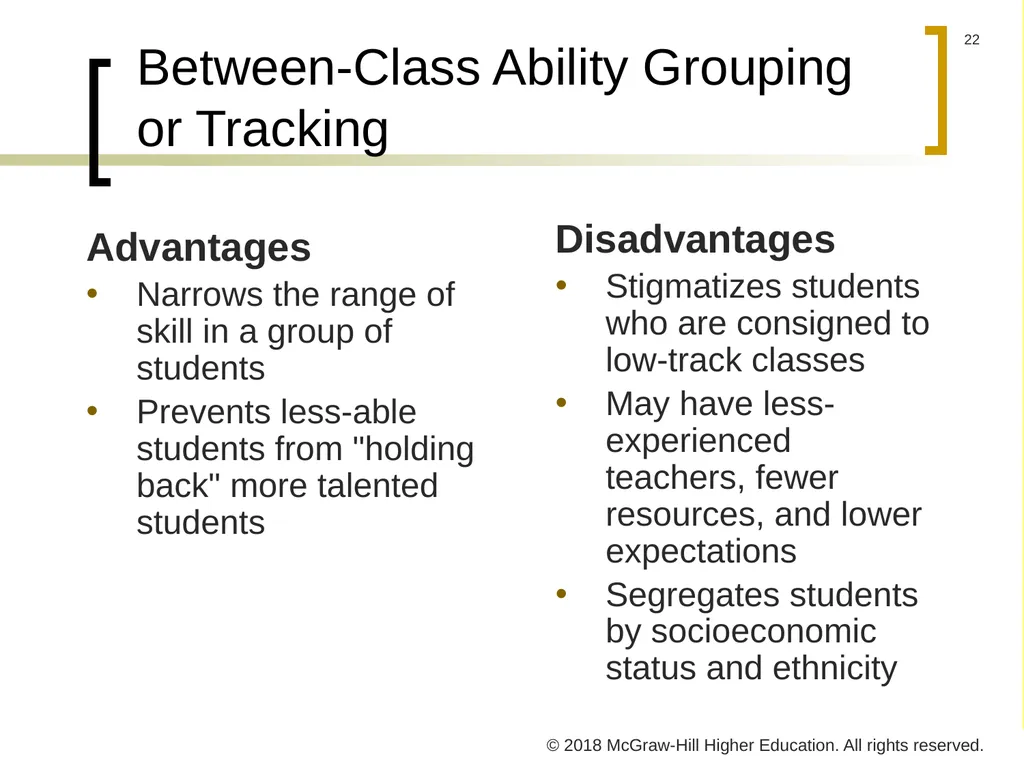
Between-Class Ability Grouping or Tracking Advantages
Narrows the range of skill in a group of students
Prevents less-able students from "holding back" more talented students Disadvantages
Stigmatizes students who are consigned to low-track classes
May have less-experienced teachers, fewer resources, and lower expectations
Segregates students by socioeconomic status and ethnicity<br>
Narrows the range of skill in a group of students
Prevents less-able students from "holding back" more talented students Disadvantages
Stigmatizes students who are consigned to low-track classes
May have less-experienced teachers, fewer resources, and lower expectations
Segregates students by socioeconomic status and ethnicity<br>
23
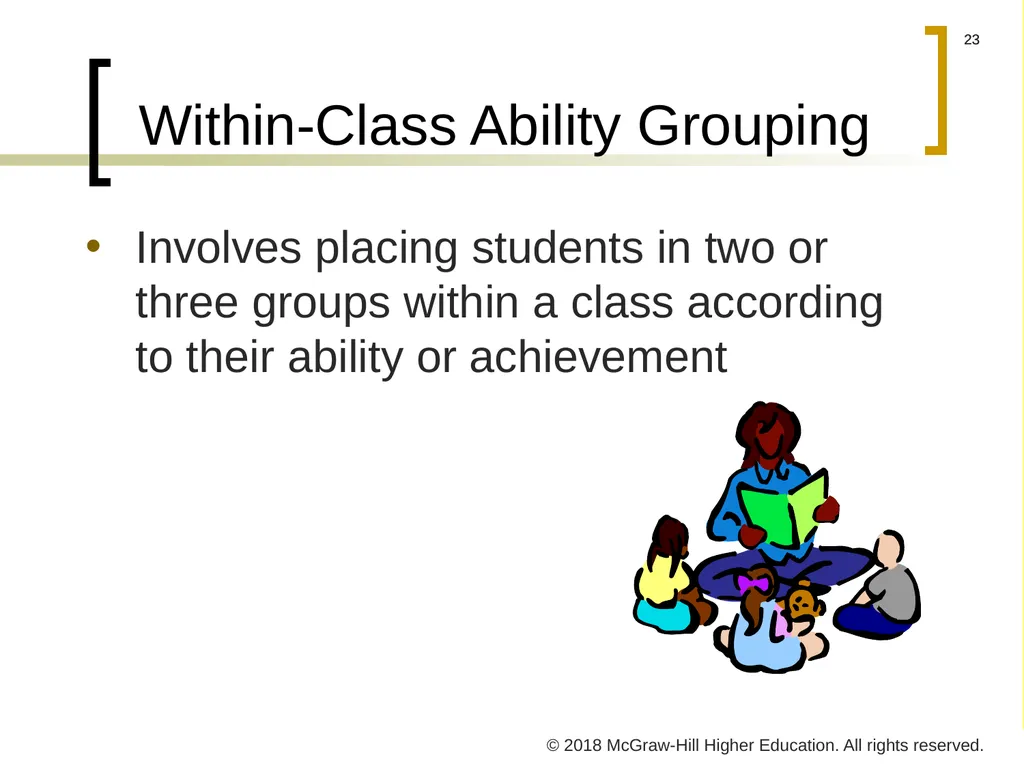
Within-Class Ability Grouping Involves placing students in two or three groups within a class according to their ability or achievement<br>
24
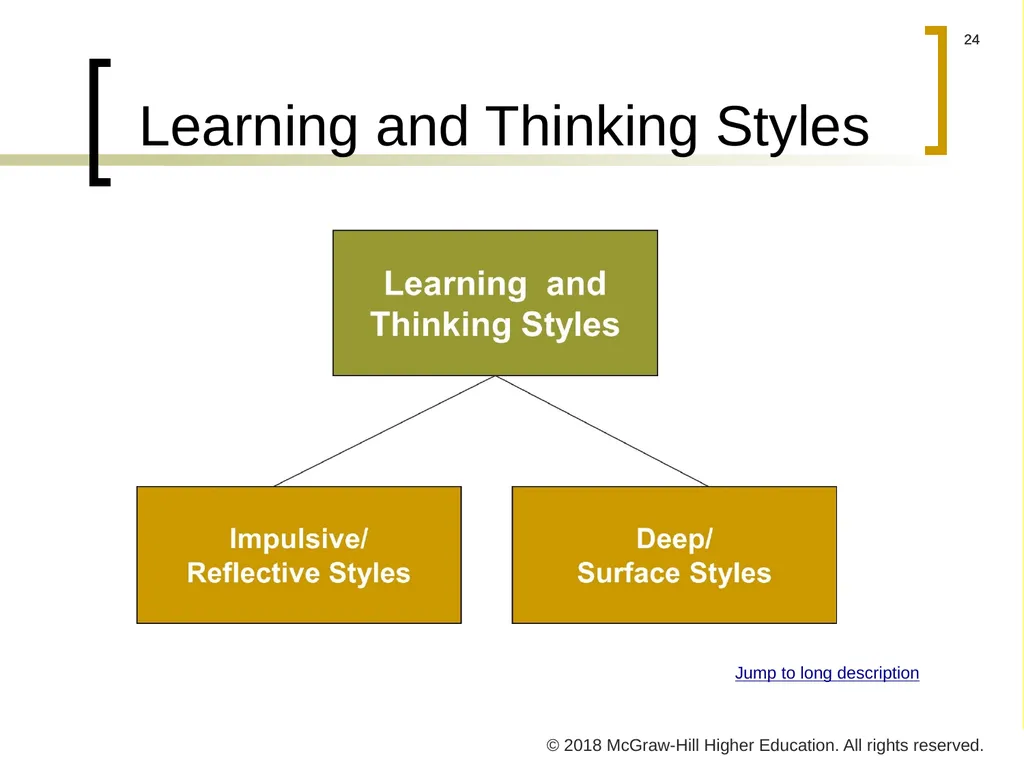
Learning and Thinking Styles Jump to long description<br>
25
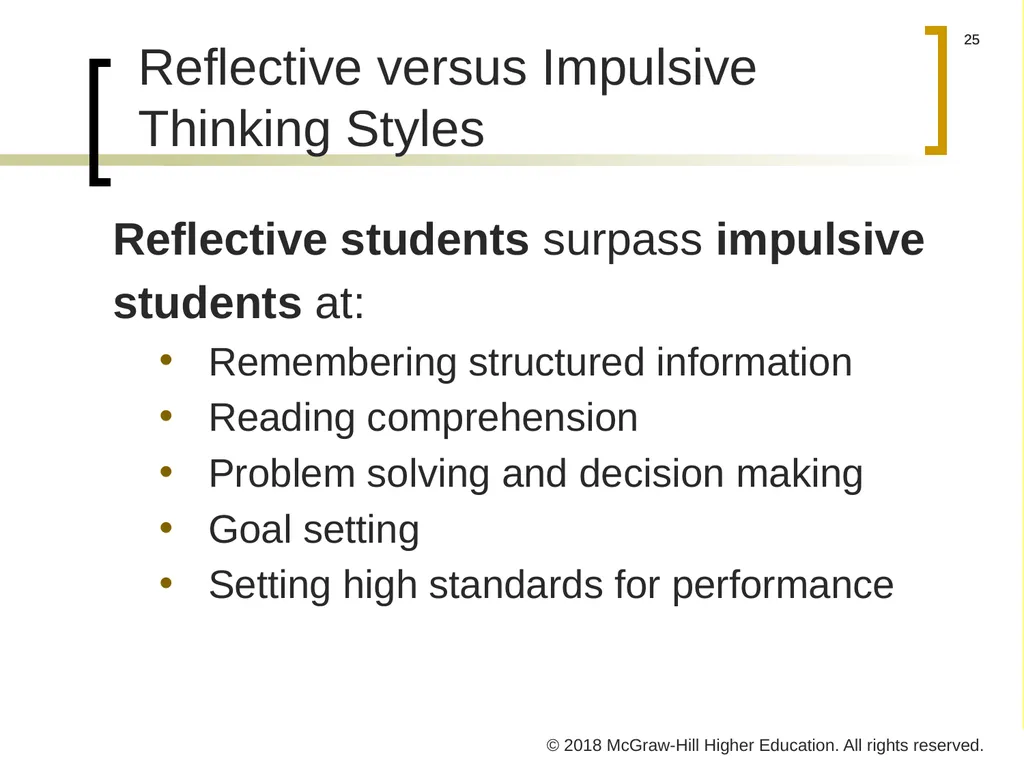
Reflective versus Impulsive Thinking Styles Reflective students surpass impulsive
students at:
Remembering structured information
Reading comprehension
Problem solving and decision making
Goal setting
Setting high standards for performance<br>
students at:
Remembering structured information
Reading comprehension
Problem solving and decision making
Goal setting
Setting high standards for performance<br>
26
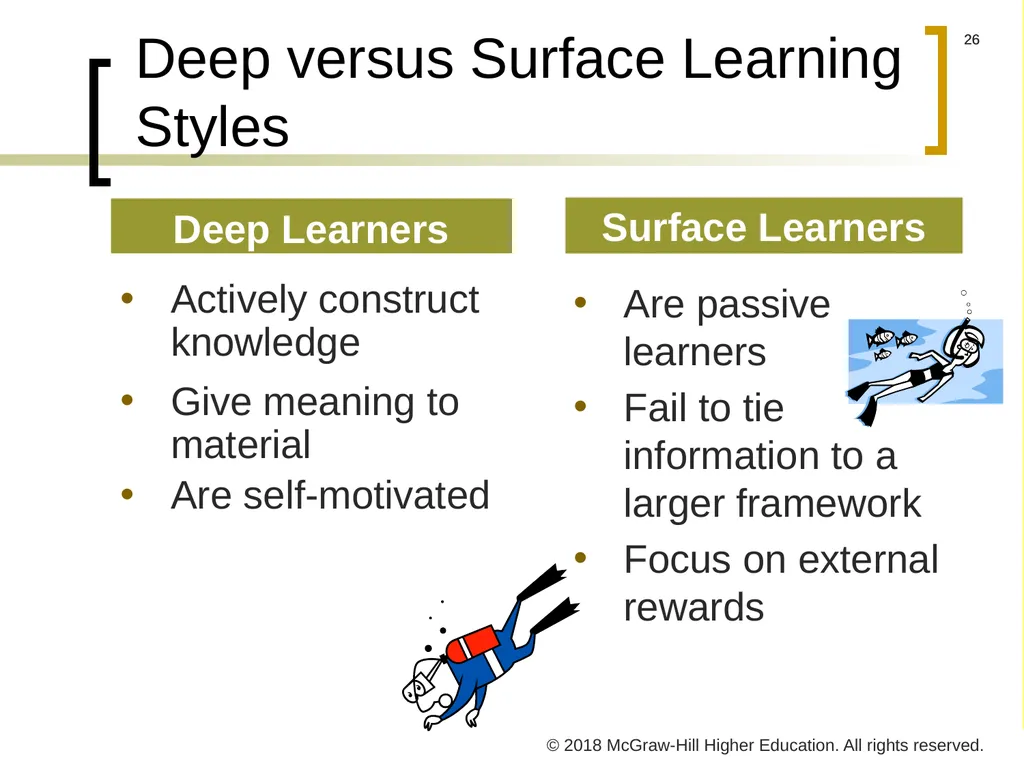
Deep versus Surface Learning Styles Deep Learners Actively construct knowledge
Give meaning to material
Are self-motivated Surface Learners Are passive learners
Fail to tie information to a larger framework
Focus on external rewards<br>
Give meaning to material
Are self-motivated Surface Learners Are passive learners
Fail to tie information to a larger framework
Focus on external rewards<br>
27
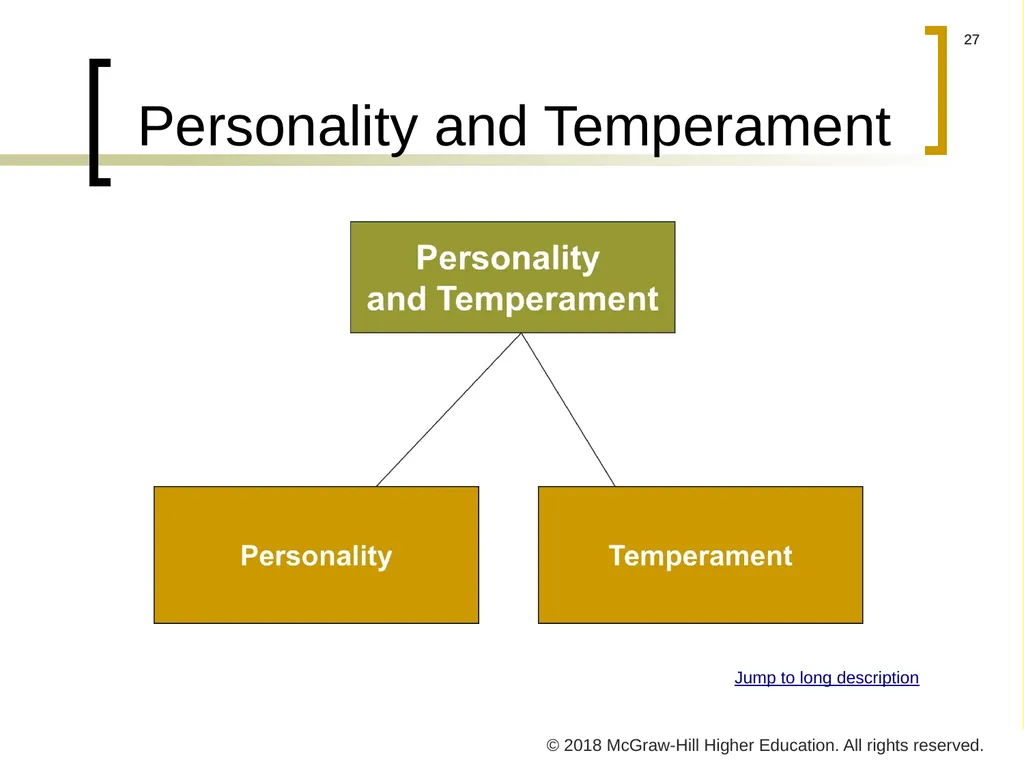
Personality and Temperament Jump to long description<br>
28
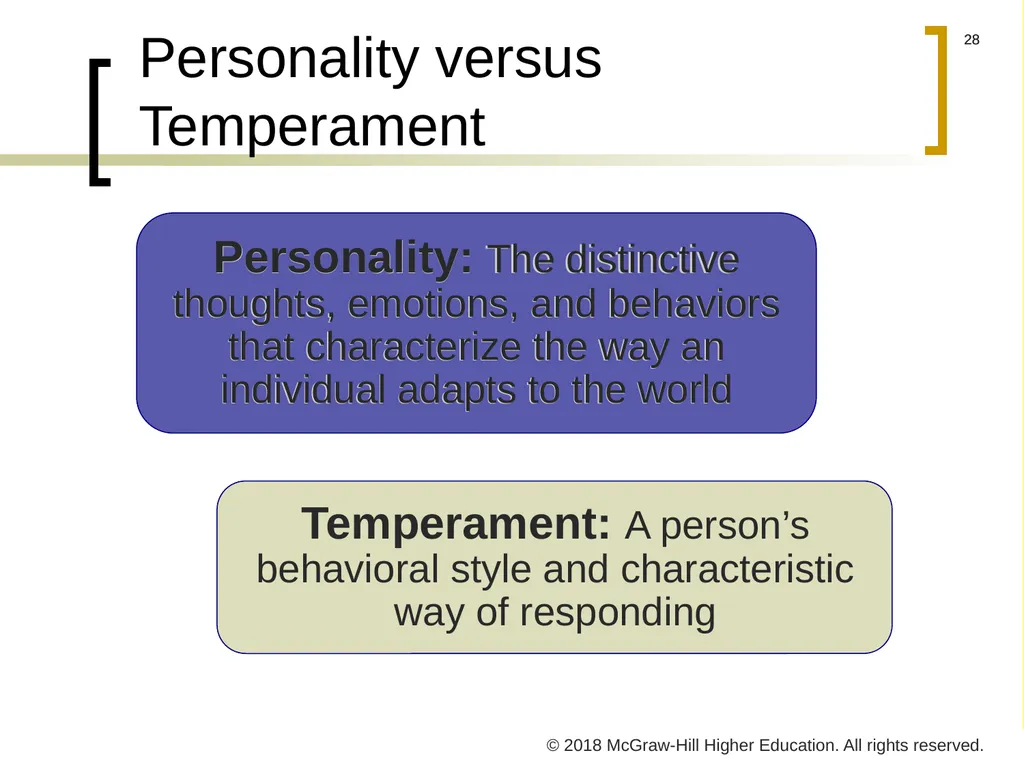
Personality versus Temperament Personality: The distinctive thoughts, emotions, and behaviors that characterize the way an individual adapts to the world Temperament: A person’s behavioral style and characteristic way of responding<br>
29
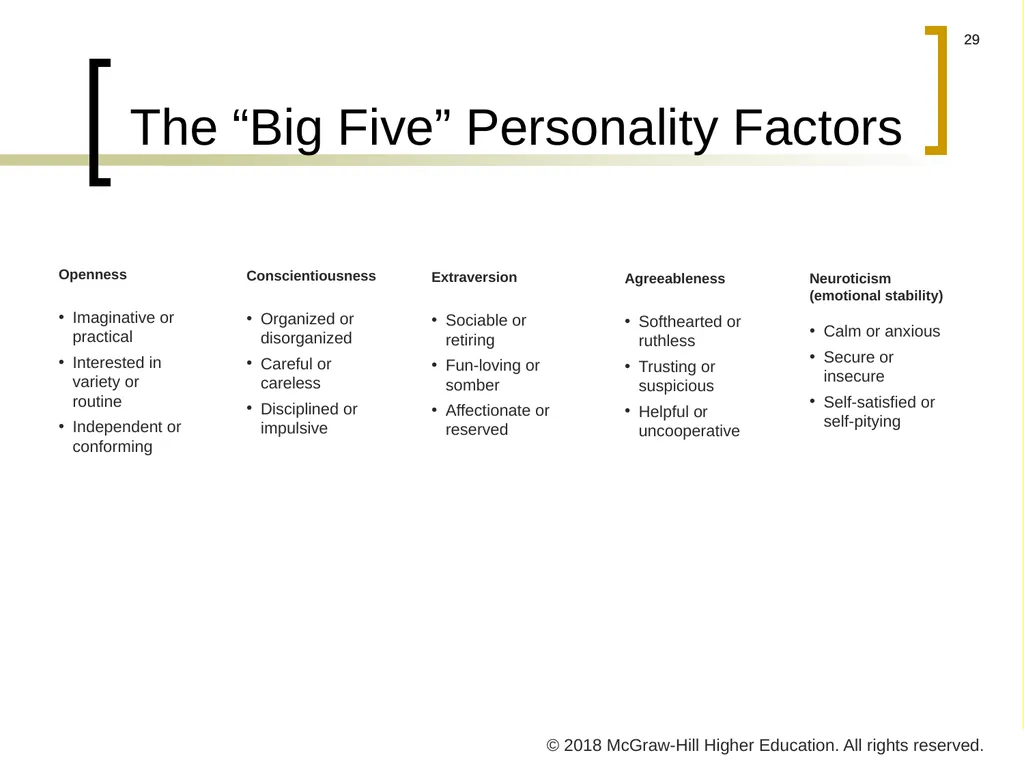
The “Big Five” Personality Factors Openness
Imaginative or practical
Interested in variety or routine
Independent or conforming Conscientiousness
Organized or disorganized
Careful or careless
Disciplined or impulsive Extraversion
Sociable or retiring
Fun-loving or somber
Affectionate or reserved Agreeableness
Softhearted or ruthless
Trusting or suspicious
Helpful or uncooperative Neuroticism (emotional stability)
Calm or anxious
Secure or insecure
Self-satisfied or self-pitying<br>
Imaginative or practical
Interested in variety or routine
Independent or conforming Conscientiousness
Organized or disorganized
Careful or careless
Disciplined or impulsive Extraversion
Sociable or retiring
Fun-loving or somber
Affectionate or reserved Agreeableness
Softhearted or ruthless
Trusting or suspicious
Helpful or uncooperative Neuroticism (emotional stability)
Calm or anxious
Secure or insecure
Self-satisfied or self-pitying<br>
30
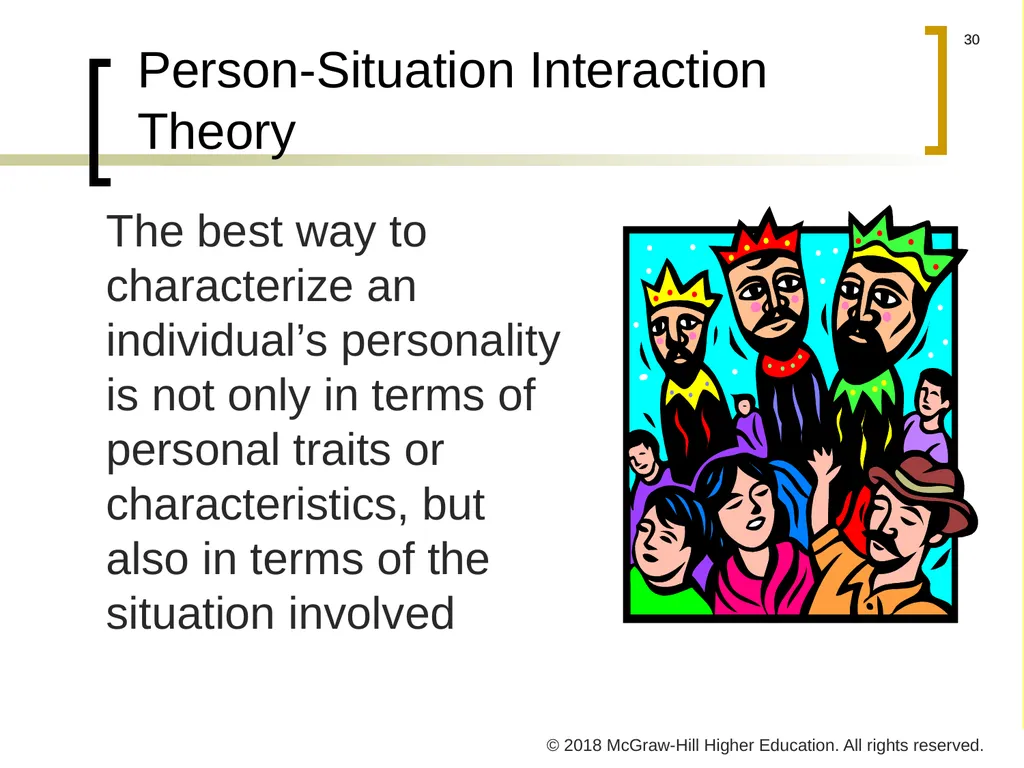
Person-Situation Interaction Theory The best way to characterize an individual’s personality is not only in terms of personal traits or characteristics, but also in terms of the situation involved<br>
31
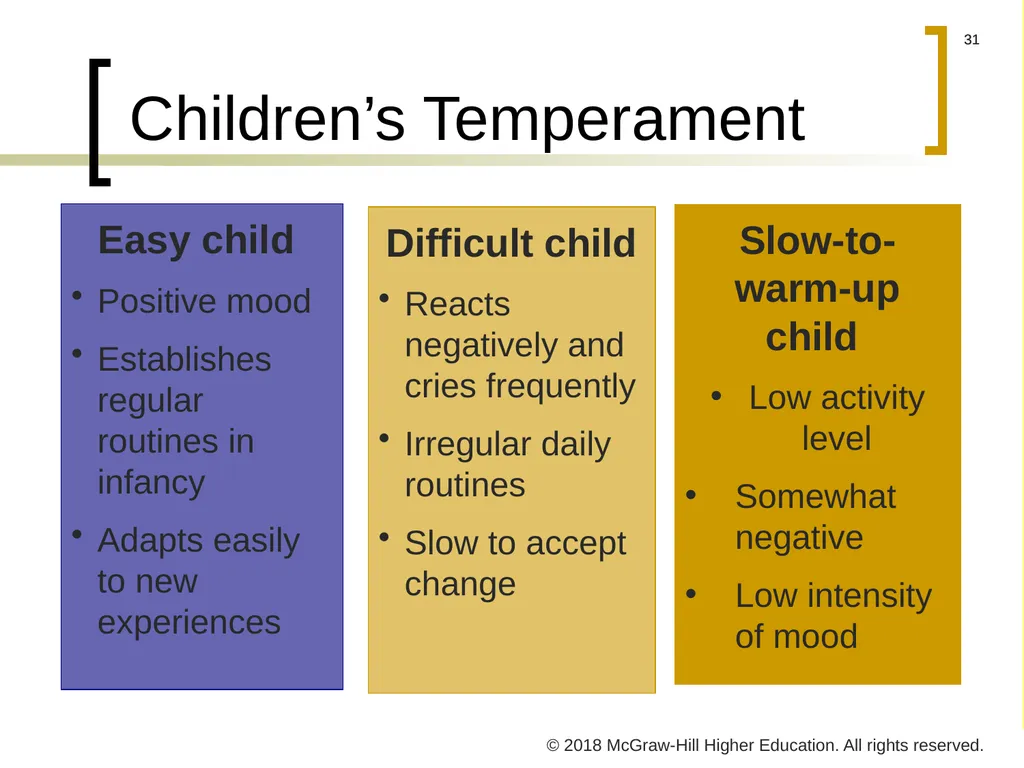
Children’s Temperament Easy child
Positive mood
Establishes regular routines in infancy
Adapts easily to new experiences Difficult child
Reacts negatively and cries frequently
Irregular daily routines
Slow to accept change Slow-to-warm-up child
Low activity level
Somewhat negative
Low intensity of mood<br>
Positive mood
Establishes regular routines in infancy
Adapts easily to new experiences Difficult child
Reacts negatively and cries frequently
Irregular daily routines
Slow to accept change Slow-to-warm-up child
Low activity level
Somewhat negative
Low intensity of mood<br>
32
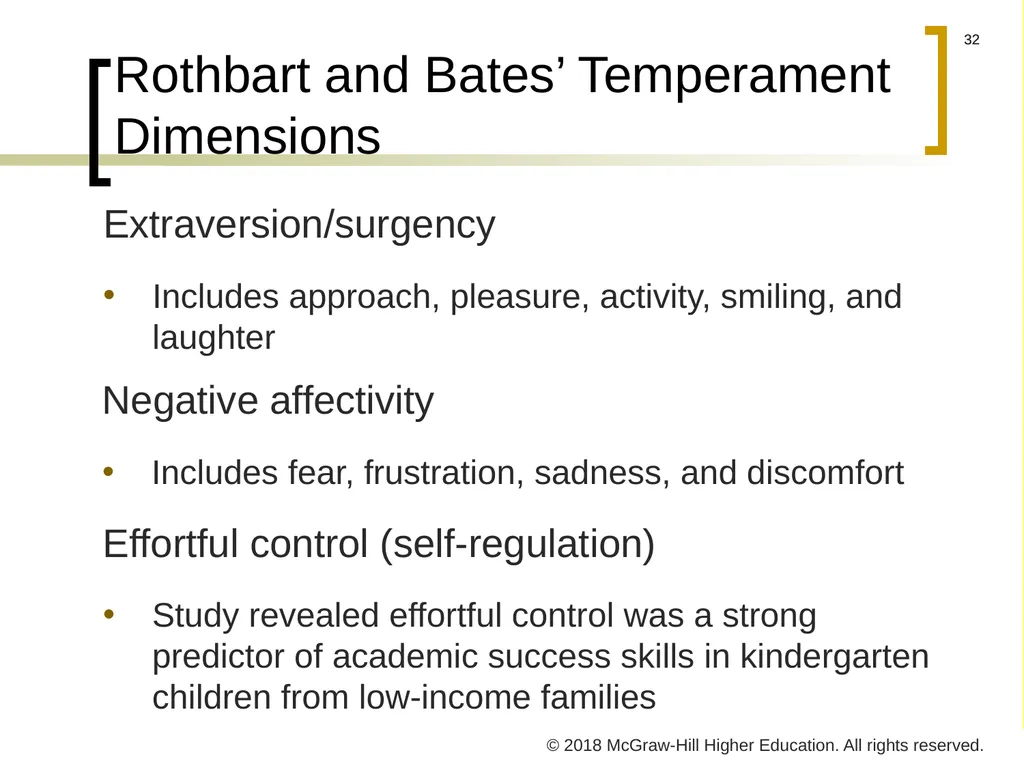
Rothbart and Bates’ Temperament Dimensions Extraversion/surgency
Includes approach, pleasure, activity, smiling, and laughter Negative affectivity
Includes fear, frustration, sadness, and discomfort Effortful control (self-regulation)
Study revealed effortful control was a strong predictor of academic success skills in kindergarten children from low-income families<br>
Includes approach, pleasure, activity, smiling, and laughter Negative affectivity
Includes fear, frustration, sadness, and discomfort Effortful control (self-regulation)
Study revealed effortful control was a strong predictor of academic success skills in kindergarten children from low-income families<br>
33
Classroom Connections: Crack the Case: Workshops, 1 What are the issues in this case?
To what extent should teachers adapt their instruction to the strengths, learning styles, and personalities of their students? Why?
What will you do in your classroom to accommodate individual differences such as students’ strengths, learning styles, and personalities?<br>
To what extent should teachers adapt their instruction to the strengths, learning styles, and personalities of their students? Why?
What will you do in your classroom to accommodate individual differences such as students’ strengths, learning styles, and personalities?<br>
34
Classroom Connections: Crack the Case—Workshops, 2 What other individual differences do you think you might have to accommodate? How will you do this?
On which theory is Ms. Jacobson basing her comments regarding Joe and Martha?<br>
On which theory is Ms. Jacobson basing her comments regarding Joe and Martha?<br>
35
Appendix of Image for Long Descriptions<br>
36
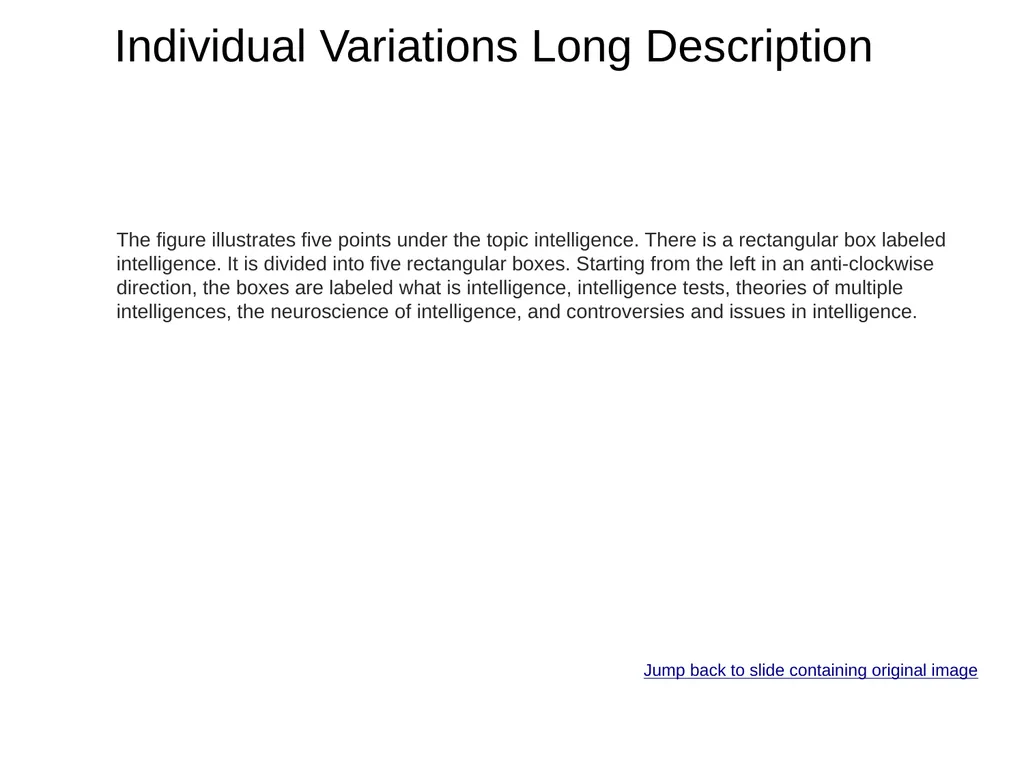
Individual Variations Long Description The figure illustrates five points under the topic intelligence. There is a rectangular box labeled intelligence. It is divided into five rectangular boxes. Starting from the left in an anti-clockwise direction, the boxes are labeled what is intelligence, intelligence tests, theories of multiple intelligences, the neuroscience of intelligence, and controversies and issues in intelligence. Jump back to slide containing original image<br>
37
Figure 4.1 - The Normal Curve and Stanford-Binet IQ Scores Long Description This is a graph that illustrates the normal curve and Stanford-Binet IQ Scores. The graph shows that most of the population falls in the middle range of scores. Extremely high and extremely low scores are rare. More than two-thirds of the scores fall between 84 and 116. Only about 1 in 50 individuals has an IQ of more than 132, and only about 1 in 50 individuals has an IQ of less than 68. Jump back to slide containing original image<br>
38
Sternberg’s Triarchic Theory of Intelligence Long Description This figure illustrates Sternberg’s triarchic theory of intelligence. There is a triangle on which three rectangular boxes are placed. The box at the top is labeled analytical, the box at the bottom left is labeled practical, and the box at the bottom right is labeled creative. Jump back to slide containing original image<br>
39
Learning and Thinking Styles Long Description This figure illustrates learning and thinking styles. There is a large rectangular box labeled learning and thinking styles. It is divided into two small rectangular boxes. Starting from the left, the boxes read impulsive or reflective styles and deep or surface styles. Jump back to slide containing original image<br>
40
Personality and Temperament Long Description This figure shows the two topics under personality and temperament. There is a large rectangular box with two small rectangular boxes emerging out of it. The large box is labeled personality and temperament. Out of the two small boxes, the box on the left is labeled personality and the box on the right is labeled temperament. Jump back to slide containing original image<br>