
Chapter 44 Geriatric Emergencies Introduction
CB
Published · 242 slides · 0 views

1 / 1



Description
Chapter 44 Geriatric Emergencies Introduction Geriatrics is the assessment and treatment of disease in those 65 years or older. People 65 years and older make up an ever-increasing proportion of patients in the health care system.
Related Topics
Share
Embed code
Download this presentation From Below
"Chapter 44 Geriatric Emergencies Introduction" is the property of its rightful owner. Permission is granted to download and print the materials on this website for personal, non-commercial use only, and to display it on your personal computer provided you do not modify the materials and that you retain all copyright notices contained in the materials. By downloading content from our website, you accept the terms of this agreement.
Presentation Transcript
01
Chapter 44
Geriatric Emergencies<br>
02
Introduction Geriatrics is the assessment and treatment of disease in those 65 years or older.
People 65 years and older make up an ever-increasing proportion of patients in the health care system.<br>
People 65 years and older make up an ever-increasing proportion of patients in the health care system.<br>
03
Introduction Old-age dependency ratio
Number of older people for every 100 younger adults (age 18 to 64)
Used to compare age structures between different societies.<br>
Number of older people for every 100 younger adults (age 18 to 64)
Used to compare age structures between different societies.<br>
04
Introduction Graying of America
Describes increasing number of older Americans
Increase in both the number of older Americans and the need for physicians
Need for cost-effective and efficient services<br>
Describes increasing number of older Americans
Increase in both the number of older Americans and the need for physicians
Need for cost-effective and efficient services<br>
05
Introduction Most prehospital geriatric patients do not reside in nursing homes.
Nursing home admissions are increasing as the number of older patients increases.
A countertrend is that older persons are maintaining independent lives.<br>
Nursing home admissions are increasing as the number of older patients increases.
A countertrend is that older persons are maintaining independent lives.<br>
06
Introduction Considerations in deciding living arrangements:
Marital status
Financial resources
Religious beliefs
Ethnicity
Gender
General health
Grown children affected by decision<br>
Marital status
Financial resources
Religious beliefs
Ethnicity
Gender
General health
Grown children affected by decision<br>
07
Introduction Grown children affected by decision
May seek help from
Medical social workers
Professional care managers
Discharge planners at health care facilities
Other private and public resources<br>
May seek help from
Medical social workers
Professional care managers
Discharge planners at health care facilities
Other private and public resources<br>
08
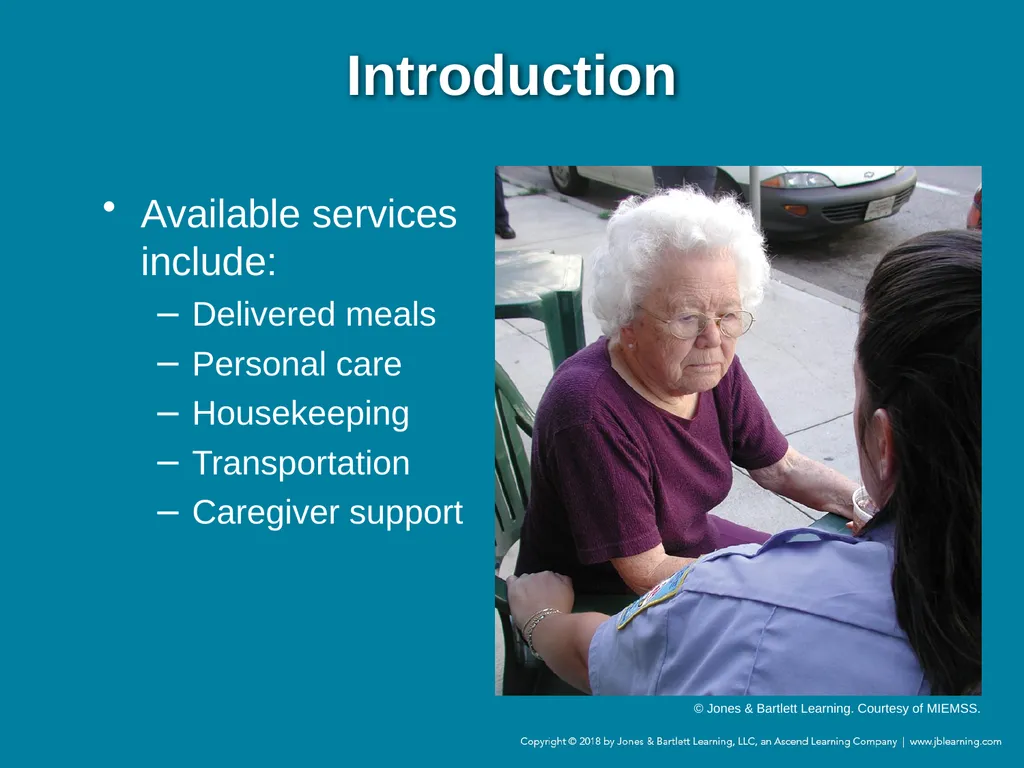
Introduction Available services include:
Delivered meals
Personal care
Housekeeping
Transportation
Caregiver support © Jones & Bartlett Learning. Courtesy of MIEMSS.<br>
Delivered meals
Personal care
Housekeeping
Transportation
Caregiver support © Jones & Bartlett Learning. Courtesy of MIEMSS.<br>
09
Introduction Financial situation affects living conditions and decisions
Older people who live in poverty may make lifestyle choices that pose serious risks to their health.<br>
Older people who live in poverty may make lifestyle choices that pose serious risks to their health.<br>
10
Introduction Psychosocial factors influencing aging
Feeling useless or unproductive in society, leading to self-esteem issues
Mourning/feeling frustrated over loss of ability
Feeling freedom or sense of accomplishment in retirement<br>
Feeling useless or unproductive in society, leading to self-esteem issues
Mourning/feeling frustrated over loss of ability
Feeling freedom or sense of accomplishment in retirement<br>
11
Introduction Crisis of integrity versus despair:
Integrity: pride in accomplishments
Despair: haven’t accomplished goals
Bereavement over loss of friends and loved ones<br>
Integrity: pride in accomplishments
Despair: haven’t accomplished goals
Bereavement over loss of friends and loved ones<br>
12
Geriatric Anatomy and Physiology Aging process begins in the late 20s, early 30s.
Organ and tissue aging may be accelerated by:
Genetics
Preexisting disease
Diet and activity levels
Toxin exposure<br>
Organ and tissue aging may be accelerated by:
Genetics
Preexisting disease
Diet and activity levels
Toxin exposure<br>
13
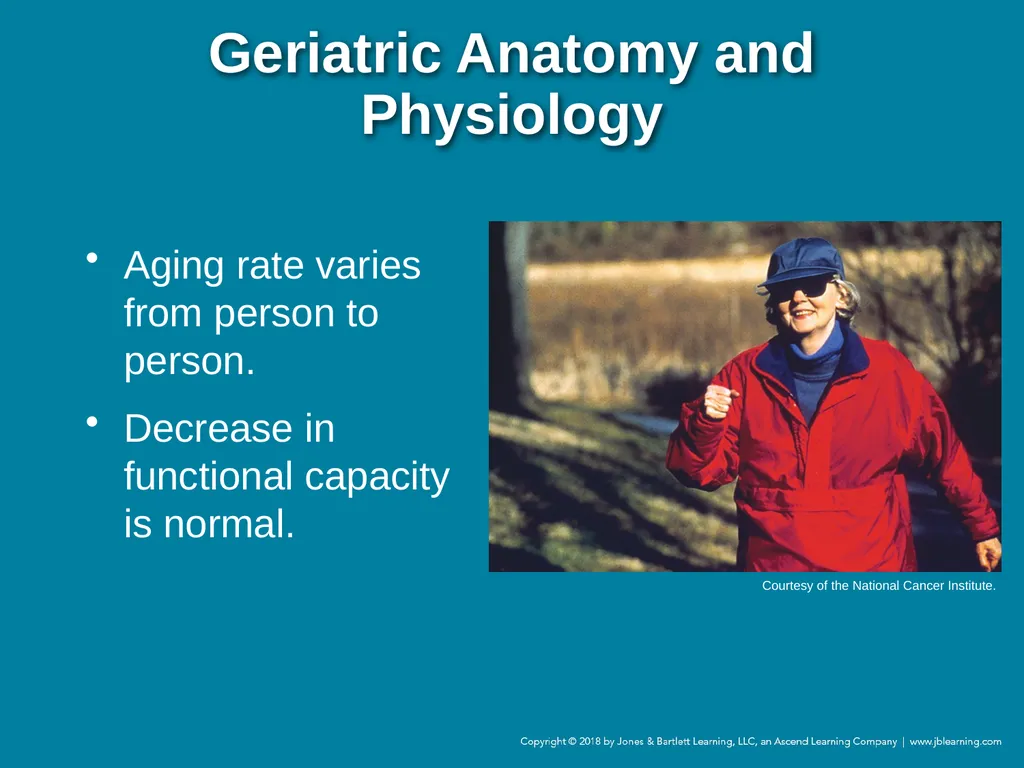
Geriatric Anatomy and Physiology Aging rate varies from person to person.
Decrease in functional capacity is normal. Courtesy of the National Cancer Institute.<br>
Decrease in functional capacity is normal. Courtesy of the National Cancer Institute.<br>
14
Changes in the Respiratory System Respiratory capacity undergoes a large reduction with age.
Vital capacity decreases, and residual volume increases.
Changes in blood flow distribution in the lungs result in declining PaO2.<br>
Vital capacity decreases, and residual volume increases.
Changes in blood flow distribution in the lungs result in declining PaO2.<br>
15
Changes in the Respiratory System Decreased sensitivity/CNS response to arterial blood gases changes
Limited lung volume and maximal inspiratory pressure
Limited chest expansion<br>
Limited lung volume and maximal inspiratory pressure
Limited chest expansion<br>
16
Changes in the Respiratory System The ability to modify respiratory rate/tidal volume in response to changes is limited.
Defense mechanisms are less effective.<br>
Defense mechanisms are less effective.<br>
17
Changes in the Cardiovascular System The cardiovascular system decreases in efficiency with age.
Heart hypertrophies<br>
Heart hypertrophies<br>
18
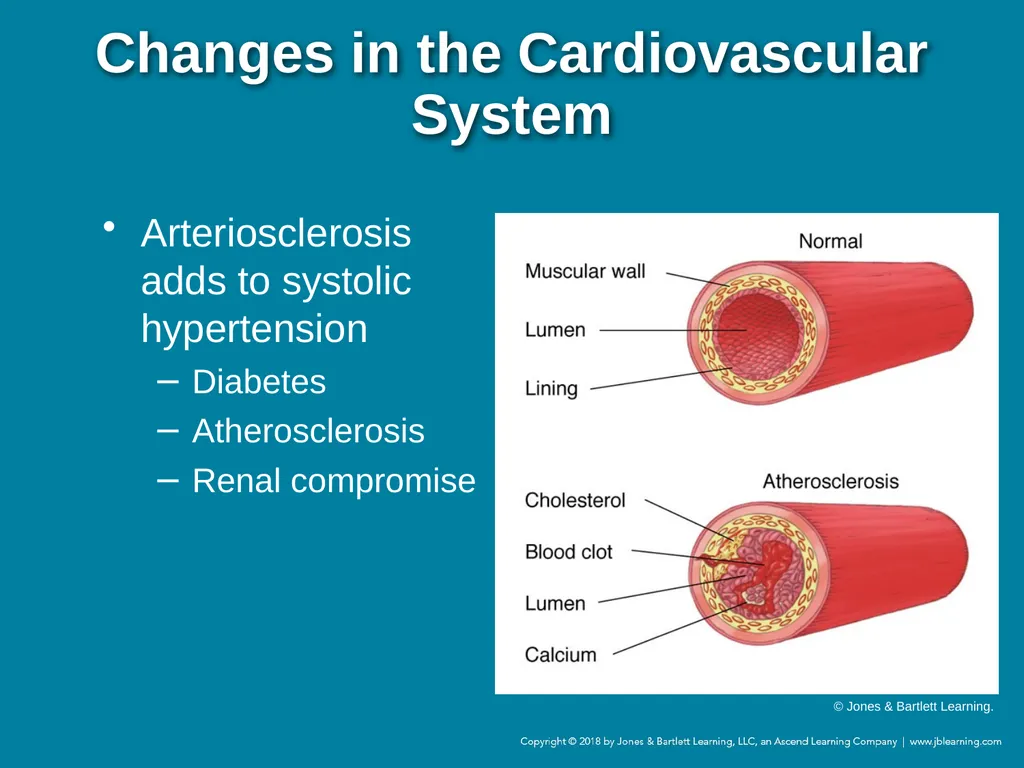
Changes in the Cardiovascular System Arteriosclerosis adds to systolic hypertension
Diabetes
Atherosclerosis
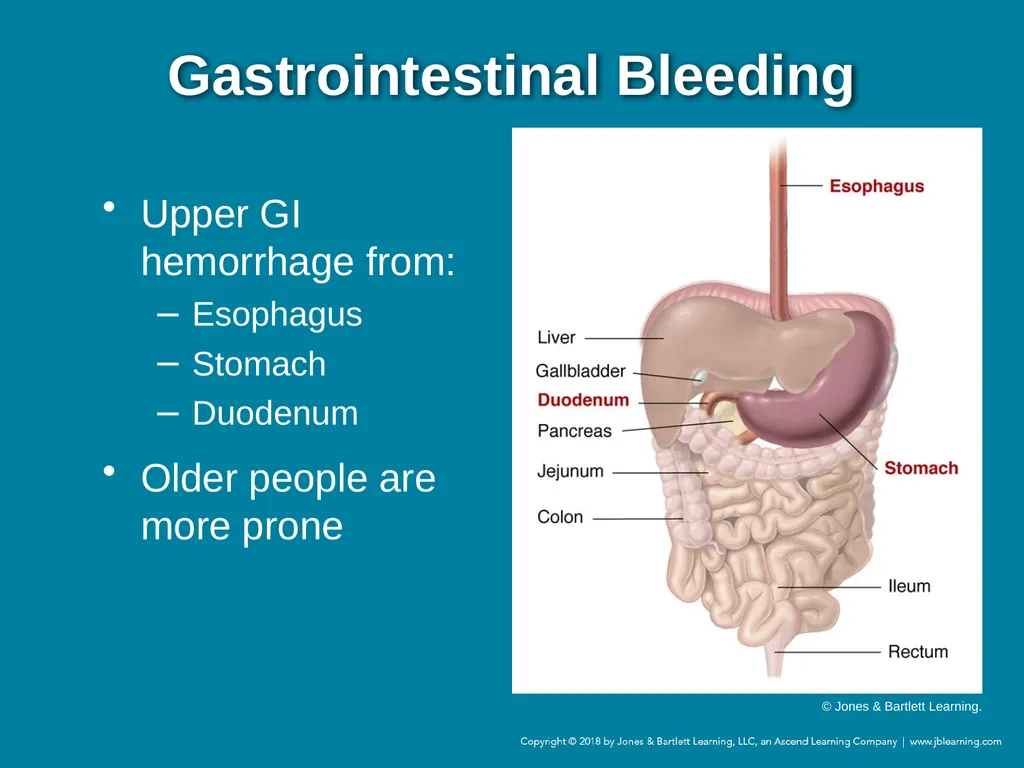
Renal compromise © Jones & Bartlett Learning.<br>
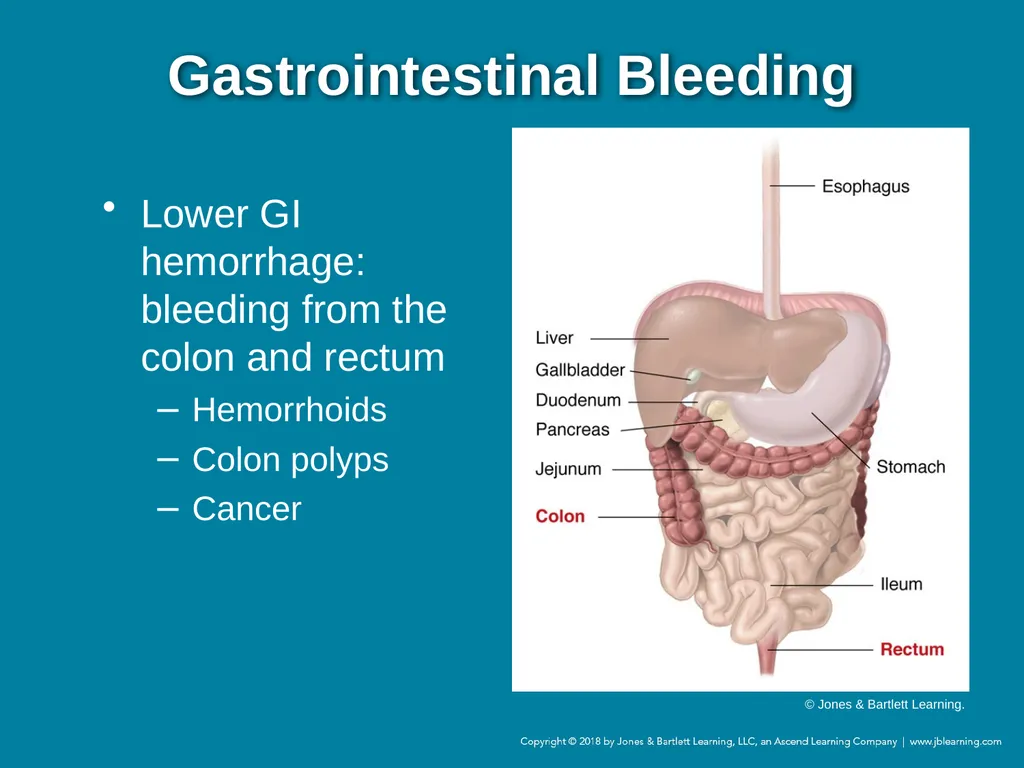
Diabetes
Atherosclerosis
Renal compromise © Jones & Bartlett Learning.<br>
19
Changes in the Cardiovascular System Vascular stiffening occurs as collagen and elastin production changes with age.
In aortic sclerosis, the aortic valve thickens from fibrosis and calcification.
Peripheral vessel walls lose elasticity.<br>
In aortic sclerosis, the aortic valve thickens from fibrosis and calcification.
Peripheral vessel walls lose elasticity.<br>
20
Changes in the Cardiovascular System The heart’s electrical conduction system undergoes changes over time.
The number of pacemaker cells decreases with age.
Bradycardia can occur.
Failure of the SA node can lead to atrial dysrhythmias.<br>
The number of pacemaker cells decreases with age.
Bradycardia can occur.
Failure of the SA node can lead to atrial dysrhythmias.<br>
21
Changes in the Cardiovascular System Aging makes the cardiovascular system more vulnerable to dysfunction.
Potential cardiac compromises should be recognized and treated quickly.<br>
Potential cardiac compromises should be recognized and treated quickly.<br>
22
Changes in the Nervous System A neurologic exam will reflect aging-related changes in the nervous system.
The brain decreases in weight and volume.<br>
The brain decreases in weight and volume.<br>
23
Changes in the Nervous System As mental function declines, so does the regulation of:
Respiratory rate and depth
Pulse rate
Blood pressure
Hunger and thirst
Temperature<br>
Respiratory rate and depth
Pulse rate
Blood pressure
Hunger and thirst
Temperature<br>
24
Sensory Changes Most sensory organs decline with age.
Do not assume geriatric patients are deaf or blind.
Vision changes may begin as early as 40 years.
Cataracts
Glaucoma<br>
Do not assume geriatric patients are deaf or blind.
Vision changes may begin as early as 40 years.
Cataracts
Glaucoma<br>
25
Sensory Changes Visual acuity decreases even without disease
Difficulty seeing at night
Inability to adjust to rapid changes
Presbyopia (far-sightedness)
Difficulty differentiating between colors<br>
Difficulty seeing at night
Inability to adjust to rapid changes
Presbyopia (far-sightedness)
Difficulty differentiating between colors<br>
26
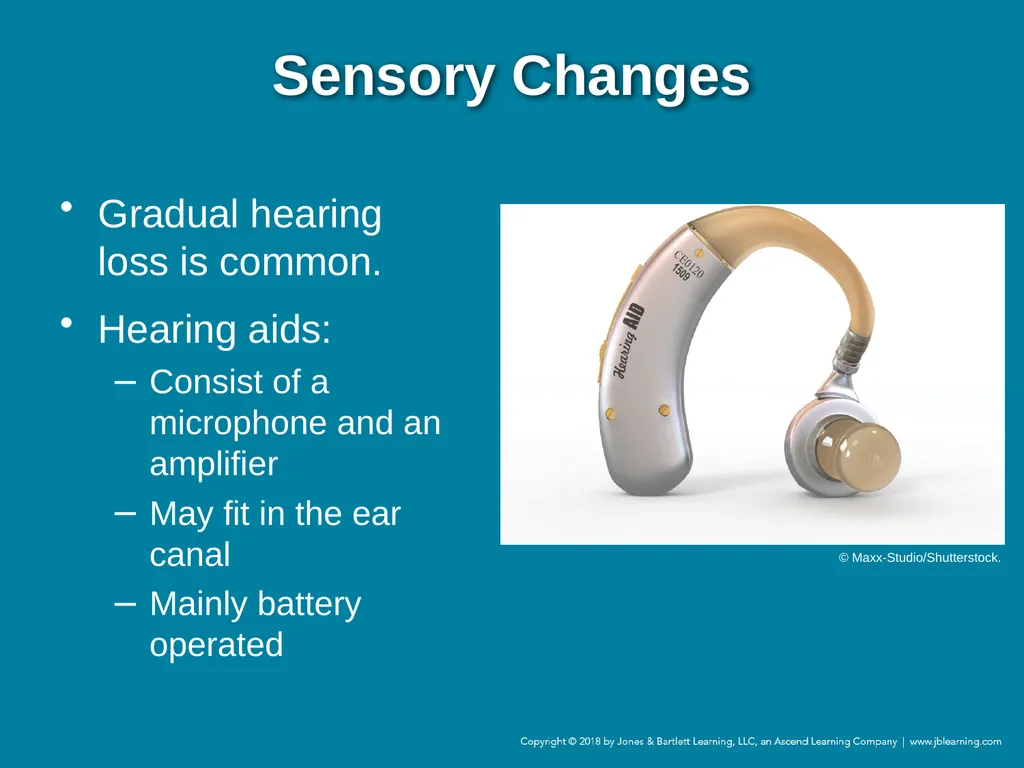
Sensory Changes Gradual hearing loss is common.
Hearing aids:
Consist of a microphone and an amplifier
May fit in the ear canal
Mainly battery operated © Maxx-Studio/Shutterstock.<br>
Hearing aids:
Consist of a microphone and an amplifier
May fit in the ear canal
Mainly battery operated © Maxx-Studio/Shutterstock.<br>
27
Sensory Changes Ménière disease: hearing-related impairment
Onset in middle age
Symptom cycles last several months:
Vertigo
Hearing loss and tinnitus
Pressure in ear<br>
Onset in middle age
Symptom cycles last several months:
Vertigo
Hearing loss and tinnitus
Pressure in ear<br>
28
Sensory Changes Other sensory changes:
Changes in appetite
Decrease in sense of touch
Sense of smell last to diminish<br>
Changes in appetite
Decrease in sense of touch
Sense of smell last to diminish<br>
29
Sensory Changes Changes may make it difficult to produce speech that is loud enough, clear, and well spaced.
Sense of body position may become impaired.<br>
Sense of body position may become impaired.<br>
30
Changes in the Digestive System Changes may be first noted in the mouth.
Fewer taste buds
Reduction of saliva
Dental loss<br>
Fewer taste buds
Reduction of saliva
Dental loss<br>
31
Changes in the Digestive System Ill-fitting dentures may cause risk of:
Choking
Heartburn
Abdominal pain<br>
Choking
Heartburn
Abdominal pain<br>
32
Changes in the Digestive System Gastric secretions are reduced.
Heart burn
Indigestion
Acid reflux<br>
Heart burn
Indigestion
Acid reflux<br>
33
Changes in the Digestive System Slight changes in small and large bowel functions from aging
The rectal sphincter decreases in size and strength, causing incontinence.
Slowing peristalsis causes increased constipation.<br>
The rectal sphincter decreases in size and strength, causing incontinence.
Slowing peristalsis causes increased constipation.<br>
34
Changes in the Digestive System Constipation also caused or worsened by:
Some medications
Diet changes
Decreased physical activity
Can cause straining bowel movements<br>
Some medications
Diet changes
Decreased physical activity
Can cause straining bowel movements<br>
35
Changes in the Digestive System Hepatic enzyme changes: some activity declines and others’ increases.
Enzyme systems that detoxify drugs decline.
Taking numerous medications increases the risk for hepatic damage or drug toxicity.<br>
Enzyme systems that detoxify drugs decline.
Taking numerous medications increases the risk for hepatic damage or drug toxicity.<br>
36
Changes in the Renal System Kidneys decline in weight with age.
Loss of functioning nephron units
Small effective filtering surface<br>
Loss of functioning nephron units
Small effective filtering surface<br>
37
Changes in the Renal System Aging kidneys respond slowly to sodium deficiency, causing electrolyte imbalance.
Rapid development of severe dehydration
Exacerbated by decreased thirst mechanism<br>
Rapid development of severe dehydration
Exacerbated by decreased thirst mechanism<br>
38
Changes in the Renal System At risk of overhydration with large sodium loads
Lower glomerular filtration rate.
The patient is prone to serious or lethal hyperkalemia if he or she becomes acidotic or the potassium load is increased.<br>
Lower glomerular filtration rate.
The patient is prone to serious or lethal hyperkalemia if he or she becomes acidotic or the potassium load is increased.<br>
39
Changes in the Endocrine System Greater risk for developing type 2 diabetes.
Difficulty metabolizing carbohydrates
Comorbid disorders (medications can affect glucose metabolism)<br>
Difficulty metabolizing carbohydrates
Comorbid disorders (medications can affect glucose metabolism)<br>
40
Changes in the Endocrine System Increase in ADH as people age:
Causes electrolyte and fluid imbalances
May present as pedal or other peripheral edema
Menopause: decrease in hormone secretion<br>
Causes electrolyte and fluid imbalances
May present as pedal or other peripheral edema
Menopause: decrease in hormone secretion<br>
41
Changes in the Immunologic System Every immune system function is affected by aging.
More prone to infection and secondary complications.
Infections manifest differently in older people.<br>
More prone to infection and secondary complications.
Infections manifest differently in older people.<br>
42
Changes in the Integumentary System Wrinkling and resiliency loss in skin
Thinner, drier, less elastic, more fragile skin
Subcutaneous fat thinner, bruising
Decreasing elastin and collagen
Skin more prone to tenting in skin turgor tests<br>
Thinner, drier, less elastic, more fragile skin
Subcutaneous fat thinner, bruising
Decreasing elastin and collagen
Skin more prone to tenting in skin turgor tests<br>
43
Changes in the Integumentary System Sebaceous glands produce less oil, so the skin is drier.
Decreased sweat gland activity
Thinner or no hair
Gray or white hair<br>
Decreased sweat gland activity
Thinner or no hair
Gray or white hair<br>
44
Changes in the Integumentary System Blood vessels are affected by atherosclerosis, providing less oxygenated blood to the skin.
Production of new skin takes longer
Thin and brittle fingernails and toenails<br>
Production of new skin takes longer
Thin and brittle fingernails and toenails<br>
45
Homeostatic and Other Changes Homeostatic capabilities decrease with age.
Thirst mechanism
Temperature regulating mechanism
Blood glucose regulatory system<br>
Thirst mechanism
Temperature regulating mechanism
Blood glucose regulatory system<br>
46
Changes in the Musculoskeletal System Decrease in bone mass in men and women
Causes brittle, easily breakable bones
Joint problems
Tendons and ligaments lose elasticity
Synovial fluids thicken
Cartilage decreases<br>
Causes brittle, easily breakable bones
Joint problems
Tendons and ligaments lose elasticity
Synovial fluids thicken
Cartilage decreases<br>
47
Changes in the Musculoskeletal System Height decreases, posture changes.
Arthritic joints increase.
Muscle mass and strength decrease.
Muscles atrophy from prolonged immobility.<br>
Arthritic joints increase.
Muscle mass and strength decrease.
Muscles atrophy from prolonged immobility.<br>
48
Changes in the Musculoskeletal System More susceptible to bone fractures from falls
Falls more likely to occur
Difficulty with tasks requiring fine motor coordination or hand and finger strength<br>
Falls more likely to occur
Difficulty with tasks requiring fine motor coordination or hand and finger strength<br>
49
Geriatric Patient Assessment Illness not inevitable with aging
Widespread incorrect belief that older adults are hypochondriacs
Older patients tend to not complain, even with real symptoms.<br>
Widespread incorrect belief that older adults are hypochondriacs
Older patients tend to not complain, even with real symptoms.<br>
50
Geriatric Patient Assessment Signs, symptoms altered from aging
Myocardial infarctions may not present with chest pain.
Pneumonia may not include fever.
Uncontrolled diabetes may present as hyperosmolar nonketotic coma or hyperosmolar hyperglycemic nonketotic coma.
Some afflictions present as delirium.<br>
Myocardial infarctions may not present with chest pain.
Pneumonia may not include fever.
Uncontrolled diabetes may present as hyperosmolar nonketotic coma or hyperosmolar hyperglycemic nonketotic coma.
Some afflictions present as delirium.<br>
51
Geriatric Patient Assessment Debilitating health problems include:
Hypertension and heart disease
Arthritis
Cancer
Diabetes
Stroke
COPD<br>
Hypertension and heart disease
Arthritis
Cancer
Diabetes
Stroke
COPD<br>
52
Geriatric Patient Assessment Multiple pathologic conditions:
Symptoms of one disease may hide or alter symptoms of another.
Disturbance in one body system may cause a domino effect.
It may be difficult to determine which condition is causing which symptoms.<br>
Symptoms of one disease may hide or alter symptoms of another.
Disturbance in one body system may cause a domino effect.
It may be difficult to determine which condition is causing which symptoms.<br>
53
Scene Size-Up Ensure scene safety.
Determine the mechanism of injury or illness.
Factors affecting the assessment.
Sensory alterations
Verbal communication skills
Mental and physical capabilities<br>
Determine the mechanism of injury or illness.
Factors affecting the assessment.
Sensory alterations
Verbal communication skills
Mental and physical capabilities<br>
54
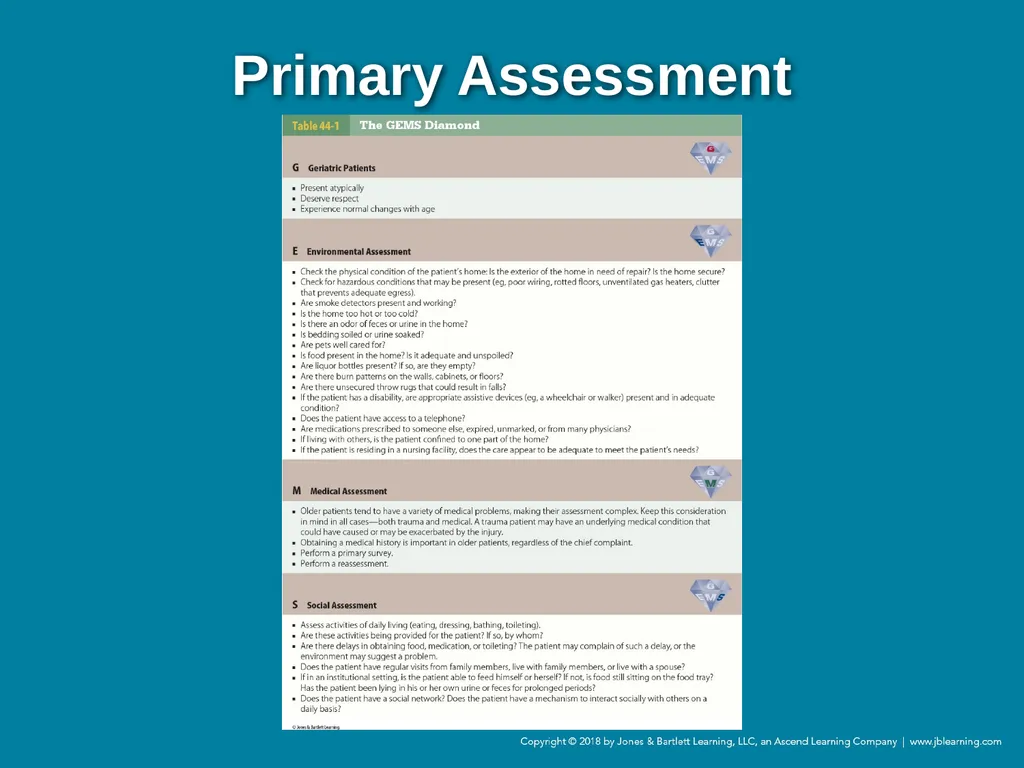
Primary Assessment Use GEMS diamond to form a general impression.
G—Geriatric patient
E—Environmental assessment
M—Medical assessment
S—Social assessment<br>
G—Geriatric patient
E—Environmental assessment
M—Medical assessment
S—Social assessment<br>
55
Primary Assessment<br>
56
Primary Assessment Airway and breathing
Geriatric patients are predisposed to airway problems.
Ensure airway is not obstructed.
Anatomic changes lessen effective breathing.
Treat with oxygen as soon as possible.<br>
Geriatric patients are predisposed to airway problems.
Ensure airway is not obstructed.
Anatomic changes lessen effective breathing.
Treat with oxygen as soon as possible.<br>
57
Primary Assessment Circulation
If circulation is compromised, the patient has fewer reserves in a circulatory crisis.
Lower heart rate
Radial pulse difficult to find
Heart rhythm issues and irregular pulse
Treat with oxygen as soon as possible.<br>
If circulation is compromised, the patient has fewer reserves in a circulatory crisis.
Lower heart rate
Radial pulse difficult to find
Heart rhythm issues and irregular pulse
Treat with oxygen as soon as possible.<br>
58
Primary Assessment Transport decision
Determine life-threatening conditions.
Treat to the best of your ability.
Provide transport to priority patients.
Older people will easily decompensate.<br>
Determine life-threatening conditions.
Treat to the best of your ability.
Provide transport to priority patients.
Older people will easily decompensate.<br>
59
History Taking Use good communication skills.
Thoroughly take a history if possible.
Listen to the patient; wait for answers.
Explain the plan.
Preserve the patient’s dignity.<br>
Thoroughly take a history if possible.
Listen to the patient; wait for answers.
Explain the plan.
Preserve the patient’s dignity.<br>
60
History Taking Comprehensive history includes:
Chief complaint
Present illness or injury
Pertinent medical history
Current health care status and needs<br>
Chief complaint
Present illness or injury
Pertinent medical history
Current health care status and needs<br>
61
History Taking Pertinent medical history includes:
Current cardiovascular health
Exercise tolerance
Diet history
Medications
Smoking and drinking habits
Sleep patterns
Other intrinsic and extrinsic factors<br>
Current cardiovascular health
Exercise tolerance
Diet history
Medications
Smoking and drinking habits
Sleep patterns
Other intrinsic and extrinsic factors<br>
62
History Taking Determining the chief complaint may be difficult because patients might:
Believe symptoms are just part of getting old
Ignore legitimate symptoms because they don’t want to be labeled a hypochondriac
Underreport symptoms or report vague symptoms<br>
Believe symptoms are just part of getting old
Ignore legitimate symptoms because they don’t want to be labeled a hypochondriac
Underreport symptoms or report vague symptoms<br>
63
History Taking If the chief complaint seems trivial, use a standard list of screening questions to evaluate major organ systems functions.
The list should be designed to evaluate major organ systems functions.
Follow up on any positive answers.<br>
The list should be designed to evaluate major organ systems functions.
Follow up on any positive answers.<br>
64
History Taking After deducing the chief complaint, conduct a history of present illness.
May be difficult to separate from chronic problems
How does this differ from last week?
What happened today to make you call?<br>
May be difficult to separate from chronic problems
How does this differ from last week?
What happened today to make you call?<br>
65
History Taking Obtain a detailed history of medications.
Have the patient list by name, dosing and frequency, and provider.
Obtain permission to bring medications to the hospital.<br>
Have the patient list by name, dosing and frequency, and provider.
Obtain permission to bring medications to the hospital.<br>
66
Secondary Assessment Adjust usual methods to fit older patients.
Limit physical manipulation.
Be aware of body temperature.
Only remove clothing as necessary for inspection and palpation, and re-cover immediately.<br>
Limit physical manipulation.
Be aware of body temperature.
Only remove clothing as necessary for inspection and palpation, and re-cover immediately.<br>
67
Secondary Assessment Postural BP changes vary with older people.
Marked BP changes and pulse rate—possible hypovolemia or overmedication
Normal BP tends to be higher.<br>
Marked BP changes and pulse rate—possible hypovolemia or overmedication
Normal BP tends to be higher.<br>
68
Secondary Assessment Observe respiratory rate.
Tachypnea can indicate acute illness.
Take lung sounds in all fields.
Listen for carotid bruits and note JVD.
Note any dentures.<br>
Tachypnea can indicate acute illness.
Take lung sounds in all fields.
Listen for carotid bruits and note JVD.
Note any dentures.<br>
69
Reassessment Reassess often: conditions deteriorate quickly.
Repeat primary assessment.
Reassess vital signs.
Reassess the patient’s complaint.
Recheck interventions.
Treat changes.<br>
Repeat primary assessment.
Reassess vital signs.
Reassess the patient’s complaint.
Recheck interventions.
Treat changes.<br>
70
Pneumonia Inflammation of the lung from infection by:
Bacteria
Viruses
Other organisms<br>
Bacteria
Viruses
Other organisms<br>
71
Pneumonia Pneumonia has the biggest impact on very young children and older adults.
Those considered at risk include:
Older people
Those with underlying health problems
Those with a depressed immune system
Those who are generally immobile, confined to bed, or have conditions that limit deep breathing<br>
Those considered at risk include:
Older people
Those with underlying health problems
Those with a depressed immune system
Those who are generally immobile, confined to bed, or have conditions that limit deep breathing<br>
72
Pneumonia Pneumonia symptoms in older patients:
Acute confusion (delirium)
Normal temperature
Wheezing
Abdominal pain
Rhonchi in affected lobes<br>
Acute confusion (delirium)
Normal temperature
Wheezing
Abdominal pain
Rhonchi in affected lobes<br>
73
Pneumonia Treatment is supportive, including:
Fluids
Oxygen via nasal cannula or mask
Analgesics for fever<br>
Fluids
Oxygen via nasal cannula or mask
Analgesics for fever<br>
74
Pneumonia Preventive measures
Pneumococcus vaccine
Booster doses after 3 to 5 years
Cessation of smoking
Respiratory exercises when confined to bed<br>
Pneumococcus vaccine
Booster doses after 3 to 5 years
Cessation of smoking
Respiratory exercises when confined to bed<br>
75
Chronic Obstructive Pulmonary Disease Set of diseases characterized by bronchial obstruction and airway inflammation:
Chronic bronchitis
Emphysema
Asthma<br>
Chronic bronchitis
Emphysema
Asthma<br>
76
Chronic Obstructive Pulmonary Disease Difficult to distinguish between diseases
Age-related loss of lung’s elastic tissue and decreased ability to fight infection
Baseline disability of COPD exacerbated<br>
Age-related loss of lung’s elastic tissue and decreased ability to fight infection
Baseline disability of COPD exacerbated<br>
77
Chronic Obstructive Pulmonary Disease Preventative measures:
Cessation of smoking
Avoidance of certain environmental pollutants
Immunization for influenza and pneumococcal pneumonia<br>
Cessation of smoking
Avoidance of certain environmental pollutants
Immunization for influenza and pneumococcal pneumonia<br>
78
Chronic Obstructive Pulmonary Disease Treatment:
Supplemental oxygen
CPAP
Bronchodilators
Inhaled or oral steroids
Antibiotics<br>
Supplemental oxygen
CPAP
Bronchodilators
Inhaled or oral steroids
Antibiotics<br>
79
Asthma Onset can occur in old age, with these symptoms:
Shortness of breath
Chronic or nocturnal cough
Wheezing
If it worsens with exertion, the patient is more susceptible to attacks.<br>
Shortness of breath
Chronic or nocturnal cough
Wheezing
If it worsens with exertion, the patient is more susceptible to attacks.<br>
80
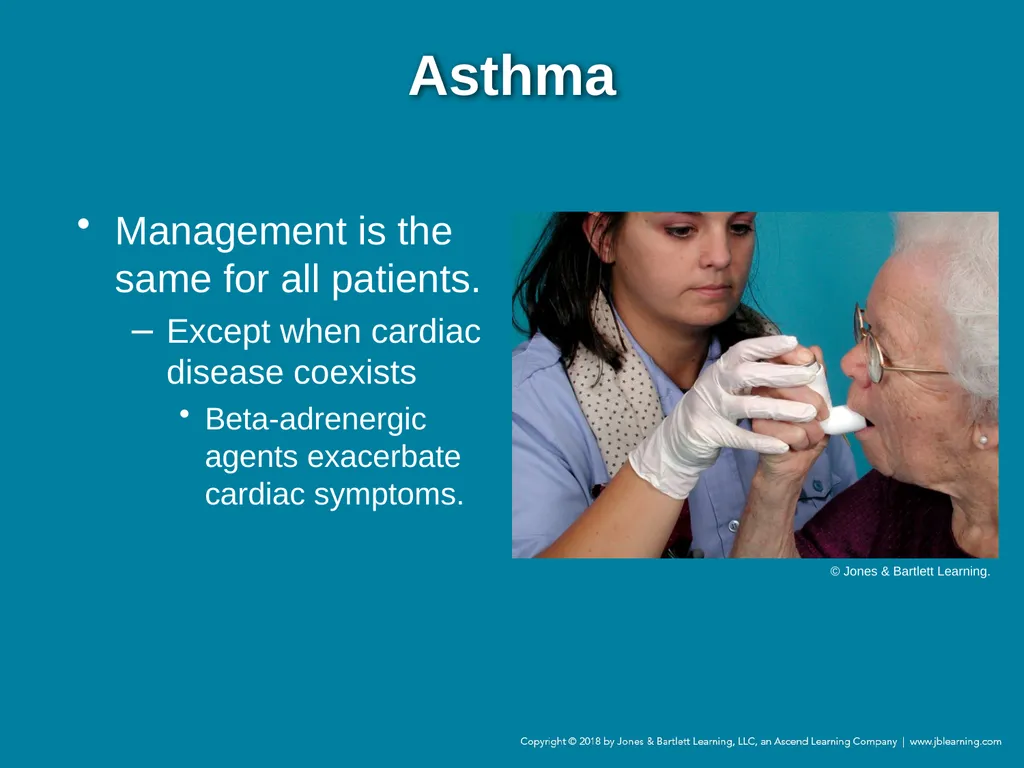
Asthma Management is the same for all patients.
Except when cardiac disease coexists
Beta-adrenergic agents exacerbate cardiac symptoms. © Jones & Bartlett Learning.<br>
Except when cardiac disease coexists
Beta-adrenergic agents exacerbate cardiac symptoms. © Jones & Bartlett Learning.<br>
81
Pulmonary Embolism A clot blocks the blood vessel supplying the lung.
Prevention is based on risk level.
Risk increases with age.<br>
Prevention is based on risk level.
Risk increases with age.<br>
82
Pulmonary Embolism Classic triad (dyspnea, chest pain, hemoptysis) is often altered or absent.
If suspected, check lower leg for:
Swelling
Erythema
Warmth or tenderness
Prehospital treatment largely supportive after ensuring airway and ventilation<br>
If suspected, check lower leg for:
Swelling
Erythema
Warmth or tenderness
Prehospital treatment largely supportive after ensuring airway and ventilation<br>
83
Cardiovascular Conditions Heart diseases are the leading cause of death among older adults in the United States.
Coronary artery disease is the number one cause.<br>
Coronary artery disease is the number one cause.<br>
84
Acute Coronary Syndrome Chest pain may be absent or not as intense in older patients. Older patients may report:
Dyspnea
Syncope
Weakness
Confusion
Nausea
Vomiting<br>
Dyspnea
Syncope
Weakness
Confusion
Nausea
Vomiting<br>
85
Heart Failure Risk factors:
Gender
Ethnicity
Family history and genetics
Long-term alcohol abuse
Multiple medical conditions Prevention:
Smoking cessation
Healthy diet
Blood glucose control
Exercise
Weight control
Hypertension control<br>
Gender
Ethnicity
Family history and genetics
Long-term alcohol abuse
Multiple medical conditions Prevention:
Smoking cessation
Healthy diet
Blood glucose control
Exercise
Weight control
Hypertension control<br>
86
Heart Failure Acute exacerbation results in pulmonary edema.
May present with dyspnea or orthopnea.
Decreased oxygenation to all organ systems leads to mental changes.
Peripheral edema may indicate worsening congestive heart failure.<br>
May present with dyspnea or orthopnea.
Decreased oxygenation to all organ systems leads to mental changes.
Peripheral edema may indicate worsening congestive heart failure.<br>
87
Heart Failure Presentation may be masked by symptoms and signs of old age or be shared by other chronic illnesses.
Acute exacerbation is often linked to:
Poor diet
Medication noncompliance
Onset of dysrhythmias
Acute myocardial ischemia<br>
Acute exacerbation is often linked to:
Poor diet
Medication noncompliance
Onset of dysrhythmias
Acute myocardial ischemia<br>
88
Heart Failure Prehospital treatment is same as with other populations.
Familiarize yourself with medications and their implications for treatment.
Complete an evaluation of ecto2 immediately.<br>
Familiarize yourself with medications and their implications for treatment.
Complete an evaluation of ecto2 immediately.<br>
89
Heart Failure Other treatment includes:
Fluid monitoring; avoidance of fluid overload
CPAP
If atrial fibrillation or flutter—digoxin or diltiazem
If atrial dysrhythmias—anticoagulation to prevent thromboembolism<br>
Fluid monitoring; avoidance of fluid overload
CPAP
If atrial fibrillation or flutter—digoxin or diltiazem
If atrial dysrhythmias—anticoagulation to prevent thromboembolism<br>
90
Dysrhythmias Occur when the heart’s electrical system has an interruption or malfunction
Causes heartbeats that are:
Too fast
Too slow
Irregular
Absent<br>
Causes heartbeats that are:
Too fast
Too slow
Irregular
Absent<br>
91
Dysrhythmias In the older population, usually a result of:
Age-related heart changes
Existing cardiac disease
Adverse drug effects
A combination of factors<br>
Age-related heart changes
Existing cardiac disease
Adverse drug effects
A combination of factors<br>
92
Dysrhythmias Atrial fibrillation increases risk of stroke and heart failure.
Allows blood stasis<br>
Allows blood stasis<br>
93
Dysrhythmias Bradycardias more common in older people
Aging conduction system.
Beta-blockers or calcium channel blockers may slow the heart.
Relatively benign conditions such as constipation can cause bradycardia.
Often treated with an internal pacemaker.<br>
Aging conduction system.
Beta-blockers or calcium channel blockers may slow the heart.
Relatively benign conditions such as constipation can cause bradycardia.
Often treated with an internal pacemaker.<br>
94
Hypertension More than half of older people are hypertensive.
Controlling systolic and diastolic hypertension helps prevent stroke and myocardial infarctions.<br>
Controlling systolic and diastolic hypertension helps prevent stroke and myocardial infarctions.<br>
95
Hypertension Emergencies require controlled blood pressure decline, which often cannot be done in the field.
If there is a rapid onset of systolic hypertension, use antihypertensive therapy.<br>
If there is a rapid onset of systolic hypertension, use antihypertensive therapy.<br>
96
Aneurysms Weakness in an artery produces a balloon defect that weakens the wall.
Congenital or acquired
Contributing factors:
Hypertension
Atherosclerotic disease
Obesity<br>
Congenital or acquired
Contributing factors:
Hypertension
Atherosclerotic disease
Obesity<br>
97
Aneurysms New headache or change in chronic headache could indicate early cerebral bleeding.
Anticoagulants increase damaging effects.<br>
Anticoagulants increase damaging effects.<br>
98
Aneurysms Preventive measures:
Proper diet
Exercise
Smoking cessation
Cholesterol control<br>
Proper diet
Exercise
Smoking cessation
Cholesterol control<br>
99
Aneurysms Asymptomatic until they become large or rupture
Early symptoms related to compression:
Difficulty swallowing
Hoarseness<br>
Early symptoms related to compression:
Difficulty swallowing
Hoarseness<br>
100
Aneurysms Treatment of abdominal emergencies is surgery.
Recognize the problem early
Assess
Stabilize
Transport rapidly<br>
Recognize the problem early
Assess
Stabilize
Transport rapidly<br>
101
Traumatic Aortic Disruption Also known as aortic dissection.
The interior wall tears and blood collects between arterial wall layers.
Makes arterial wall prone to rupture.
Thoracic dissection can cause chest pain and mimic cardiac ischemia.<br>
The interior wall tears and blood collects between arterial wall layers.
Makes arterial wall prone to rupture.
Thoracic dissection can cause chest pain and mimic cardiac ischemia.<br>
102
Stroke The leading cause of long-term disability.
Risk doubles each decade after 55 years.
Hypertension (primary risk factor)
Family history
Smoking
Diabetes
High cholesterol
Heart disease<br>
Risk doubles each decade after 55 years.
Hypertension (primary risk factor)
Family history
Smoking
Diabetes
High cholesterol
Heart disease<br>
103
Stroke Reduce risk factors for prevention.
Improve diet.
Exercise.
Lower cholesterol. Prehospital care:
Early recognition
Discovery of conditions that mimic stroke
Timely transport
Use of stroke assessment tool<br>
Improve diet.
Exercise.
Lower cholesterol. Prehospital care:
Early recognition
Discovery of conditions that mimic stroke
Timely transport
Use of stroke assessment tool<br>
104
Stroke Family members/caregivers give information about:
Baseline cognitive status, physical status
Personality
ADL
Evaluate the patient’s ability to perform basic cognitive functions.<br>
Baseline cognitive status, physical status
Personality
ADL
Evaluate the patient’s ability to perform basic cognitive functions.<br>
105
Transient Ischemic Attack You cannot distinguish between stroke or transient ischemic attack in the field.
Patients with previous transient ischemic attacks have higher risk of stroke.<br>
Patients with previous transient ischemic attacks have higher risk of stroke.<br>
106
Neurologic Conditions Normal age-related cognitive changes:
Relatively isolated
Not sudden or extreme<br>
Relatively isolated
Not sudden or extreme<br>
107
Delirium A symptom, not a disease
Temporary
Reflects underlying disturbance Characterized by:
Disorganized thoughts
Inattention
Memory loss
Disorientation
Personality changes
Hallucinations
Delusions<br>
Temporary
Reflects underlying disturbance Characterized by:
Disorganized thoughts
Inattention
Memory loss
Disorientation
Personality changes
Hallucinations
Delusions<br>
108
Delirium Symptoms may mimic:
Intoxication
Drug abuse
Severe psychologic disorders<br>
Intoxication
Drug abuse
Severe psychologic disorders<br>
109
Delirium Assess for recent changes in:
Level of consciousness or orientation
Vital signs
Temperature
Glucose level
Medications<br>
Level of consciousness or orientation
Vital signs
Temperature
Glucose level
Medications<br>
110
Delirium Often replaces or confounds typical presentations caused by:
Medical problems
Adverse medication effects
Drug or alcohol withdrawal<br>
Medical problems
Adverse medication effects
Drug or alcohol withdrawal<br>
111
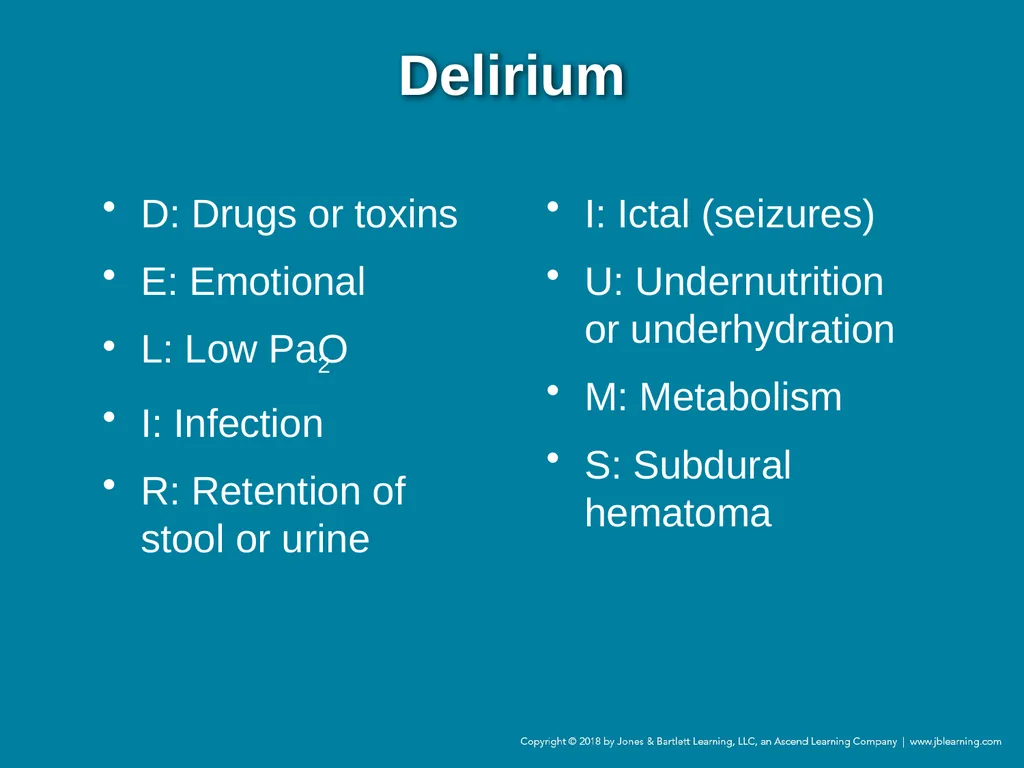
Delirium D: Drugs or toxins
E: Emotional
L: Low PaO2
I: Infection
R: Retention of stool or urine I: Ictal (seizures)
U: Undernutrition or underhydration
M: Metabolism
S: Subdural hematoma<br>
E: Emotional
L: Low PaO2
I: Infection
R: Retention of stool or urine I: Ictal (seizures)
U: Undernutrition or underhydration
M: Metabolism
S: Subdural hematoma<br>
112
Delirium Onset is abrupt (hours to days).
Delirium usually resolves with treatment of the underlying problem.
Treatment may be complicated by uncooperative behavior.<br>
Delirium usually resolves with treatment of the underlying problem.
Treatment may be complicated by uncooperative behavior.<br>
113
Dementia Produces irreversible brain failure.
Symptoms include:
Short-term memory loss, short attention span
Jargon aphasia
Confusion and disorientation
Difficulty retaining new information
Personality changes<br>
Symptoms include:
Short-term memory loss, short attention span
Jargon aphasia
Confusion and disorientation
Difficulty retaining new information
Personality changes<br>
114
Dementia May be caused by conditions that impair vascular and neurologic brain structures:
Infection
Stroke
Head injury
Poor nutrition
Medications<br>
Infection
Stroke
Head injury
Poor nutrition
Medications<br>
115
Dementia Two most common degenerative dementias:
Alzheimer disease
Multi-infarct or vascular dementia
May also be caused by:
Brain tumors
Emotional disorders
Parkinson disease
Huntington chorea<br>
Alzheimer disease
Multi-infarct or vascular dementia
May also be caused by:
Brain tumors
Emotional disorders
Parkinson disease
Huntington chorea<br>
116
Dementia Diagnosed when two or more cognitive or psychomotor brain functions are impaired:
Language
Memory
Visual perception
Emotional behavior/personality
Cognitive skills<br>
Language
Memory
Visual perception
Emotional behavior/personality
Cognitive skills<br>
117
Dementia Symptoms:
Progressive loss of cognitive function
Impairment of long- or short-term memory
Loss of communication skills
Inability to perform daily activities
Change in temperament and affect<br>
Progressive loss of cognitive function
Impairment of long- or short-term memory
Loss of communication skills
Inability to perform daily activities
Change in temperament and affect<br>
118
Dementia There is no treatment, but we can treat the underlying medical problem.
Obtain baseline abilities from caregivers.
Ask about new changes that prompted the call.
Be cautious of patients.<br>
Obtain baseline abilities from caregivers.
Ask about new changes that prompted the call.
Be cautious of patients.<br>
119
Alzheimer Disease Most common form of dementia
Progressive function loss with subtle symptoms
Losing things, difficulty recalling names
Losing ability to think and reason clearly
Forgetting identities and own experiences<br>
Progressive function loss with subtle symptoms
Losing things, difficulty recalling names
Losing ability to think and reason clearly
Forgetting identities and own experiences<br>
120
Alzheimer Disease Symptoms may present as:
Confusion
Changes in personality or judgment
Extreme difficulty with daily activities<br>
Confusion
Changes in personality or judgment
Extreme difficulty with daily activities<br>
121
Alzheimer Disease Stages
Mild cognitive impairment
Forgetfulness
Difficulty in performing more than one task
Diminished problem-solving skills Early-stage disease
Language problems
Misplacing items
Getting lost
Personality changes<br>
Mild cognitive impairment
Forgetfulness
Difficulty in performing more than one task
Diminished problem-solving skills Early-stage disease
Language problems
Misplacing items
Getting lost
Personality changes<br>
122
Alzheimer Disease Stages (cont’d)
Progressed disease
Forgetting current events
Changing sleep patterns
Difficulty reading and writing At severe or end stage, cannot:
Understand language
Recognize close family members
Perform self-care
Interact verbally<br>
Progressed disease
Forgetting current events
Changing sleep patterns
Difficulty reading and writing At severe or end stage, cannot:
Understand language
Recognize close family members
Perform self-care
Interact verbally<br>
123
Alzheimer Disease Diagnosed by excluding other dementia causes
Prehospital treatment centers on supportive care and treating symptoms.<br>
Prehospital treatment centers on supportive care and treating symptoms.<br>
124
Alzheimer Disease Daily medication may include:
Antidepressants
Cholinesterase inhibitors to prevent further decline
No single cause has been identified; it is not believed to be part of the normal aging process.<br>
Antidepressants
Cholinesterase inhibitors to prevent further decline
No single cause has been identified; it is not believed to be part of the normal aging process.<br>
125
Parkinson Disease Age-related neurologic disorder with two or more of these symptoms:
Resting tremor of extremity
Slowness of movement
Rigidity or stiffness of extremities or trunk
Poor balance<br>
Resting tremor of extremity
Slowness of movement
Rigidity or stiffness of extremities or trunk
Poor balance<br>
126
Parkinson Disease Wide range of functional loss:
Dyskinesia
Dementia
Depression
Autonomic dysfunction
Postural instability<br>
Dyskinesia
Dementia
Depression
Autonomic dysfunction
Postural instability<br>
127
Seizures Incidence increased in older adults because of increase in risk factors:
Stroke
Dementia
Primary or metastatic brain tumors
Acute metabolic disorders<br>
Stroke
Dementia
Primary or metastatic brain tumors
Acute metabolic disorders<br>
128
Gastrointestinal Conditions Constipation is a frequent problem, but it should not be the initial assumption with acute abdominal pain.
Investigate causes with high mortality first.<br>
Investigate causes with high mortality first.<br>
129
Gastrointestinal Conditions When assessing, ask for:
Food and fluid intake
History of abdominal complaints
Current bowel and bladder habits
Medications and supplements<br>
Food and fluid intake
History of abdominal complaints
Current bowel and bladder habits
Medications and supplements<br>
130
Bowel Obstruction Large bowel obstructions likely from:
Cancer
Impacted stool
Sigmoid volvulus Small bowel obstruction secondary to gallstones<br>
Cancer
Impacted stool
Sigmoid volvulus Small bowel obstruction secondary to gallstones<br>
131
Bowel Obstruction Large and small intestine obstruction from:
Adhesions from previous surgery
Infection
Fascial defect (hernia)<br>
Adhesions from previous surgery
Infection
Fascial defect (hernia)<br>
132
Gastroesophageal Reflux Disease May be a symptom of a more serious cardiac condition.
Perform a 12-lead ECG and transport.<br>
Perform a 12-lead ECG and transport.<br>
133
Biliary Disease May present with or without small bowel obstruction and include:
Cirrhosis
Hepatitis
Cholecystitis Signs and symptoms:
Jaundice
Fever
RUQ pain
Vomiting or nausea<br>
Cirrhosis
Hepatitis
Cholecystitis Signs and symptoms:
Jaundice
Fever
RUQ pain
Vomiting or nausea<br>
134
Peptic Ulcer Disease Main risk factors:
Regular NSAID use
Helicobacter pylori
Other medications
Stress Main symptom:
Dyspepsia that improves immediately after eating<br>
Regular NSAID use
Helicobacter pylori
Other medications
Stress Main symptom:
Dyspepsia that improves immediately after eating<br>
135
Gastrointestinal Bleeding Almost always from physiologic changes or pathologic processes.
Decreased peristalsis increases the likelihood of irritating substances damaging the gastric lining.
Older patients often take medication that alters coagulation.<br>
Decreased peristalsis increases the likelihood of irritating substances damaging the gastric lining.
Older patients often take medication that alters coagulation.<br>
136
Gastrointestinal Bleeding Pathologic processes causing GI bleeding:
Ulcers and varices
Cancers of the GI tract
Diverticulitis
Cirrhosis
Bowel obstruction<br>
Ulcers and varices
Cancers of the GI tract
Diverticulitis
Cirrhosis
Bowel obstruction<br>
137
Gastrointestinal Bleeding Esophagus
Varices and alcohol abuse
Violent vomiting, large amount of red, uncoagulated blood Stomach
Peptic ulcer disease
Red or darker, coffee-ground emesis<br>
Varices and alcohol abuse
Violent vomiting, large amount of red, uncoagulated blood Stomach
Peptic ulcer disease
Red or darker, coffee-ground emesis<br>
138
Gastrointestinal Bleeding Bloody stool
Bleeding from lower GI
Digested blood from stomach
Stool dark and tarry Bright red blood in stool
Diverticulitis
Large bowel obstruction
Anal fissures
Hemorrhoids<br>
Bleeding from lower GI
Digested blood from stomach
Stool dark and tarry Bright red blood in stool
Diverticulitis
Large bowel obstruction
Anal fissures
Hemorrhoids<br>
139
Gastrointestinal Bleeding Upper GI hemorrhage from:
Esophagus
Stomach
Duodenum
Older people are more prone © Jones & Bartlett Learning.<br>
Esophagus
Stomach
Duodenum
Older people are more prone © Jones & Bartlett Learning.<br>
140
Gastrointestinal Bleeding Lower GI hemorrhage: bleeding from the colon and rectum
Hemorrhoids
Colon polyps
Cancer © Jones & Bartlett Learning.<br>
Hemorrhoids
Colon polyps
Cancer © Jones & Bartlett Learning.<br>
141
Gastrointestinal Bleeding Risk factors:
History of previous lower GI bleeds
Signs or symptoms of colon cancer
Recent constipation or diarrhea
Use of blood thinners<br>
History of previous lower GI bleeds
Signs or symptoms of colon cancer
Recent constipation or diarrhea
Use of blood thinners<br>
142
Gastrointestinal Bleeding If hematocrit and hemoglobin decrease significantly during interfacility transport, you may need to give blood.
Severe lower GI bleeding requires immediate transport.<br>
Severe lower GI bleeding requires immediate transport.<br>
143
Gastrointestinal Bleeding Signs and symptoms from hypovolemia:
Agitation
Dizziness
Syncope
Hypotension
AMS Signs and symptoms from underlying disease:
Jaundice
Hepatomegaly
Constipation or diarrhea
Pain with voiding
Abdominal pain<br>
Agitation
Dizziness
Syncope
Hypotension
AMS Signs and symptoms from underlying disease:
Jaundice
Hepatomegaly
Constipation or diarrhea
Pain with voiding
Abdominal pain<br>
144
Gastrointestinal Bleeding Bleeding severity is more important than cause in the prehospital setting.
Slow bleeding
Pulse rate and systolic BP normal
Brisk bleeding
Hematemesis
Melena<br>
Slow bleeding
Pulse rate and systolic BP normal
Brisk bleeding
Hematemesis
Melena<br>
145
Urinary Tract Infections UTIs are the most common hospital-associated infection causing sepsis.
They are more common in women.
After age 50, risk increases for men.<br>
They are more common in women.
After age 50, risk increases for men.<br>
146
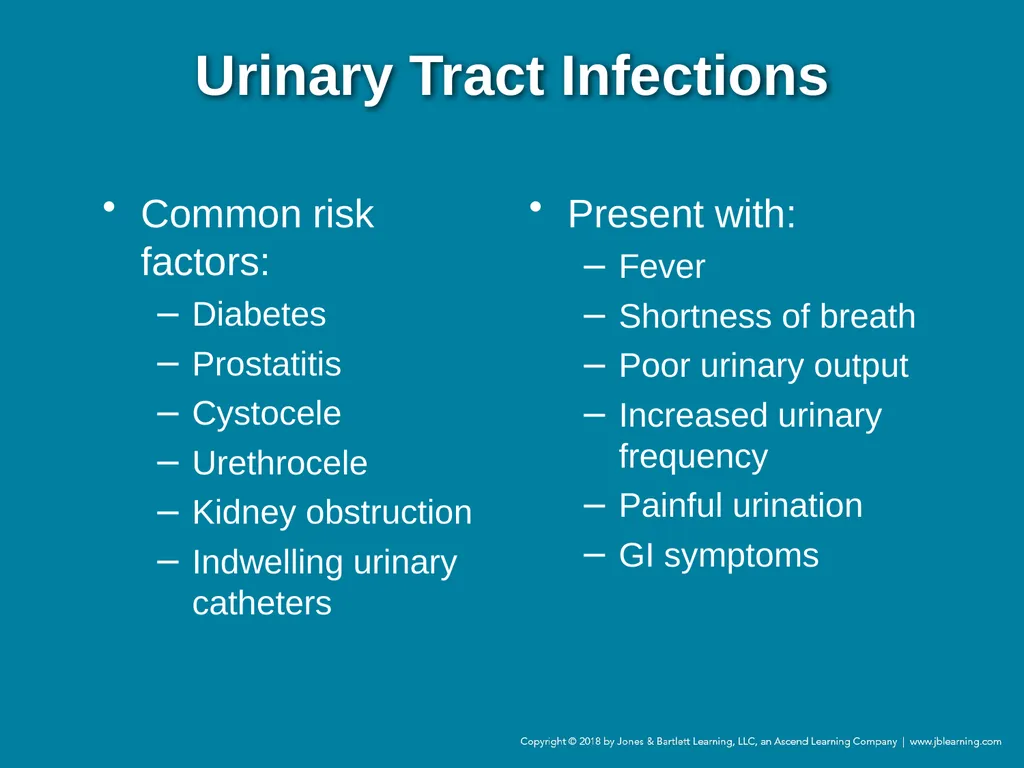
Urinary Tract Infections Common risk factors:
Diabetes
Prostatitis
Cystocele
Urethrocele
Kidney obstruction
Indwelling urinary catheters Present with:
Fever
Shortness of breath
Poor urinary output
Increased urinary frequency
Painful urination
GI symptoms<br>
Diabetes
Prostatitis
Cystocele
Urethrocele
Kidney obstruction
Indwelling urinary catheters Present with:
Fever
Shortness of breath
Poor urinary output
Increased urinary frequency
Painful urination
GI symptoms<br>
147
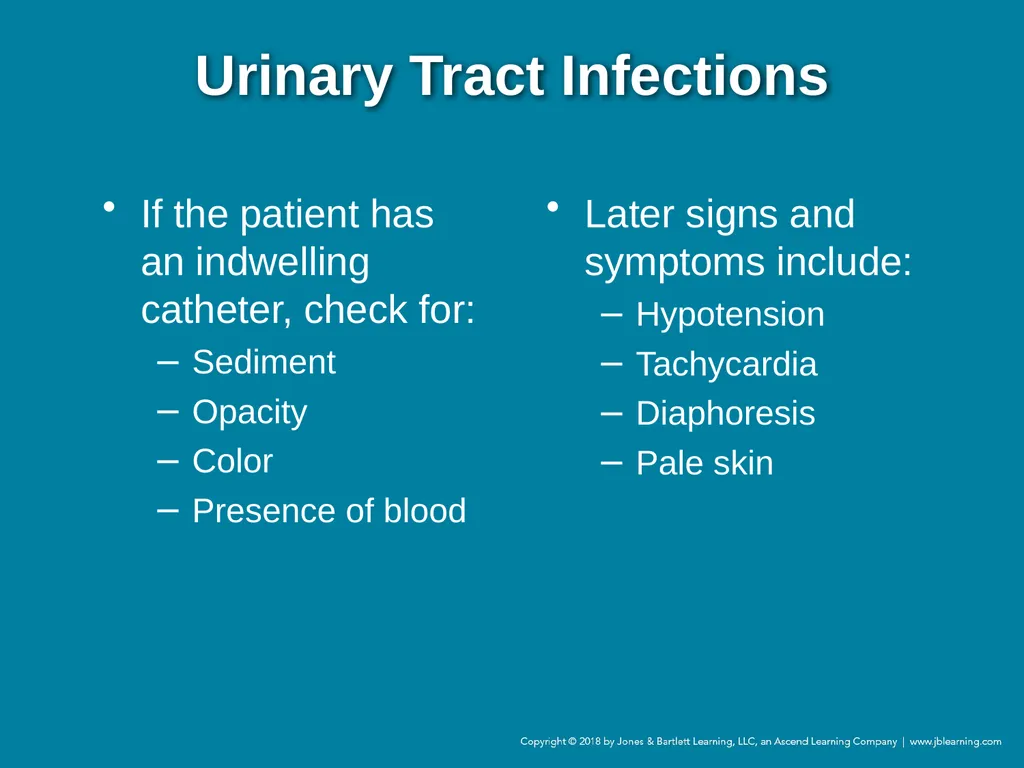
Urinary Tract Infections If the patient has an indwelling catheter, check for:
Sediment
Opacity
Color
Presence of blood Later signs and symptoms include:
Hypotension
Tachycardia
Diaphoresis
Pale skin<br>
Sediment
Opacity
Color
Presence of blood Later signs and symptoms include:
Hypotension
Tachycardia
Diaphoresis
Pale skin<br>
148
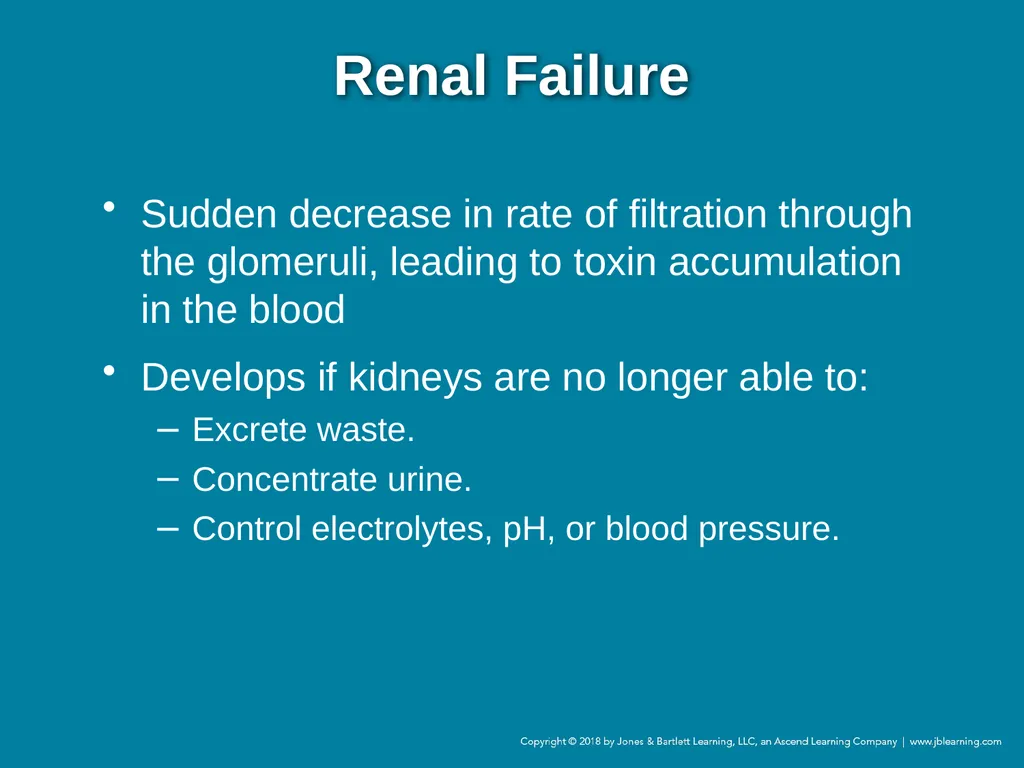
Renal Failure Sudden decrease in rate of filtration through the glomeruli, leading to toxin accumulation in the blood
Develops if kidneys are no longer able to:
Excrete waste.
Concentrate urine.
Control electrolytes, pH, or blood pressure.<br>
Develops if kidneys are no longer able to:
Excrete waste.
Concentrate urine.
Control electrolytes, pH, or blood pressure.<br>
149
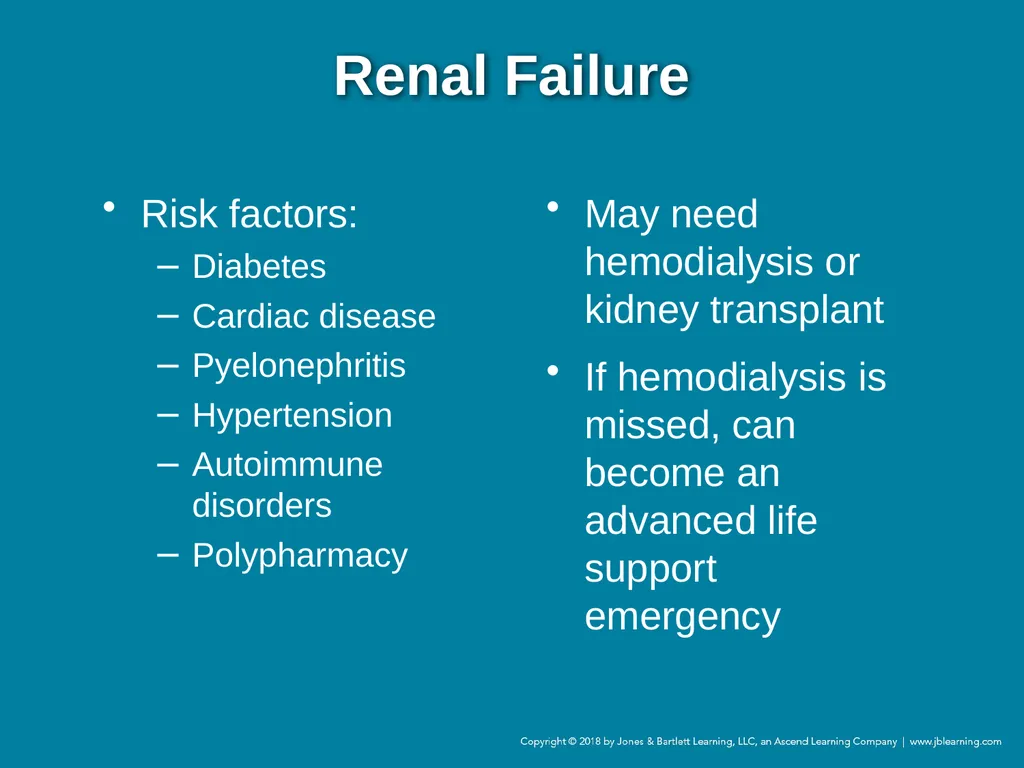
Renal Failure Risk factors:
Diabetes
Cardiac disease
Pyelonephritis
Hypertension
Autoimmune disorders
Polypharmacy May need hemodialysis or kidney transplant
If hemodialysis is missed, can become an advanced life support emergency<br>
Diabetes
Cardiac disease
Pyelonephritis
Hypertension
Autoimmune disorders
Polypharmacy May need hemodialysis or kidney transplant
If hemodialysis is missed, can become an advanced life support emergency<br>
150
Renal Failure Symptoms from missed hemodialysis treatment include:
Hypertension
Headache and fatigue
Anxiety
Anorexia and vomiting
Increased dark urination<br>
Hypertension
Headache and fatigue
Anxiety
Anorexia and vomiting
Increased dark urination<br>
151
Renal Failure Obtain a 12-lead ECG to check electrolytes.
Monitor:
All vital signs
etco2
Breath and bowel signs Transport to a facility with hemodialysis capabilities.
Administer fluids as necessary.
Treat any dysrhythmias.<br>
Monitor:
All vital signs
etco2
Breath and bowel signs Transport to a facility with hemodialysis capabilities.
Administer fluids as necessary.
Treat any dysrhythmias.<br>
152
Incontinence Few admit the problem, and fewer seek help.
Incontinence can lead to:
Skin irritation and breakdown
Urinary tract infections<br>
Incontinence can lead to:
Skin irritation and breakdown
Urinary tract infections<br>
153
Incontinence As people age:
Bladder capacity decreases.
Sphincter muscle strength decreases.
Urinary sphincter pressure triggers the need to urinate.
Sphincter tone decrease means less indication of a full bladder.<br>
Bladder capacity decreases.
Sphincter muscle strength decreases.
Urinary sphincter pressure triggers the need to urinate.
Sphincter tone decrease means less indication of a full bladder.<br>
154
Incontinence Two major types
Stress
During activities such as coughing, laughing, sneezing, lifting, and exercise
Urge
Triggered by hot or cold fluids, running water<br>
Stress
During activities such as coughing, laughing, sneezing, lifting, and exercise
Urge
Triggered by hot or cold fluids, running water<br>
155
Incontinence Be discreet and nonjudgmental.
If possible, help patients gather incontinence supplies before transport.
Cover the patient until clothes can be changed.
Try to reduce the time patients wear urine-soaked clothing during transport.<br>
If possible, help patients gather incontinence supplies before transport.
Cover the patient until clothes can be changed.
Try to reduce the time patients wear urine-soaked clothing during transport.<br>
156
Incontinence Urinary retention: opposite of incontinence
May come from many medical causes:
Benign prostate enlargement
Inflammation from bladder and urinary tract infections
Placement and removal of urinary catheter
Loss of bladder wall elasticity<br>
May come from many medical causes:
Benign prostate enlargement
Inflammation from bladder and urinary tract infections
Placement and removal of urinary catheter
Loss of bladder wall elasticity<br>
157
Incontinence Temporary retention may lead to:
Pain
Abdominal distention
Acute or chronic renal failure<br>
Pain
Abdominal distention
Acute or chronic renal failure<br>
158
Endocrine Conditions Geriatric patients may present with:
Grave disease (hyperthyroidism)
Addison disease (hypoadrenalism)
Cushing syndrome (hyperadrenalism)
Osteoporosis
Diabetes<br>
Grave disease (hyperthyroidism)
Addison disease (hypoadrenalism)
Cushing syndrome (hyperadrenalism)
Osteoporosis
Diabetes<br>
159
Diabetic Disorders Type 2
Adult onset
Non–insulin-dependent diabetes mellitus
Type 1
Juvenile diabetes
Insulin-dependent diabetes mellitus<br>
Adult onset
Non–insulin-dependent diabetes mellitus
Type 1
Juvenile diabetes
Insulin-dependent diabetes mellitus<br>
160
Diabetic Disorders Risk factors:
Normal aging
Having more than one chronic disease
Family history
Genetics
Diet
Obesity
Sedentary lifestyle<br>
Normal aging
Having more than one chronic disease
Family history
Genetics
Diet
Obesity
Sedentary lifestyle<br>
161
Diabetic Disorders Causes two life-threatening conditions:
Hypoglycemia
Blood glucose levels drop to 45 mg/dL or less
Hyperglycemia
Blood glucose exceeds normal range of 70 to 120 mg/dL<br>
Hypoglycemia
Blood glucose levels drop to 45 mg/dL or less
Hyperglycemia
Blood glucose exceeds normal range of 70 to 120 mg/dL<br>
162
Diabetic Disorders Geriatric patients at increased risk for hypoglycemia:
Confusion about medication doses or usage
Inadequate or irregular dietary intake
Inability to recognize warning signs due to cognitive problems
Blunted warning signs<br>
Confusion about medication doses or usage
Inadequate or irregular dietary intake
Inability to recognize warning signs due to cognitive problems
Blunted warning signs<br>
163
Diabetic Disorders Delirium may be the only indication of hypoglycemia.
Other symptoms:
Mental status changes
Diaphoresis
Decreased respiratory effort<br>
Other symptoms:
Mental status changes
Diaphoresis
Decreased respiratory effort<br>
164
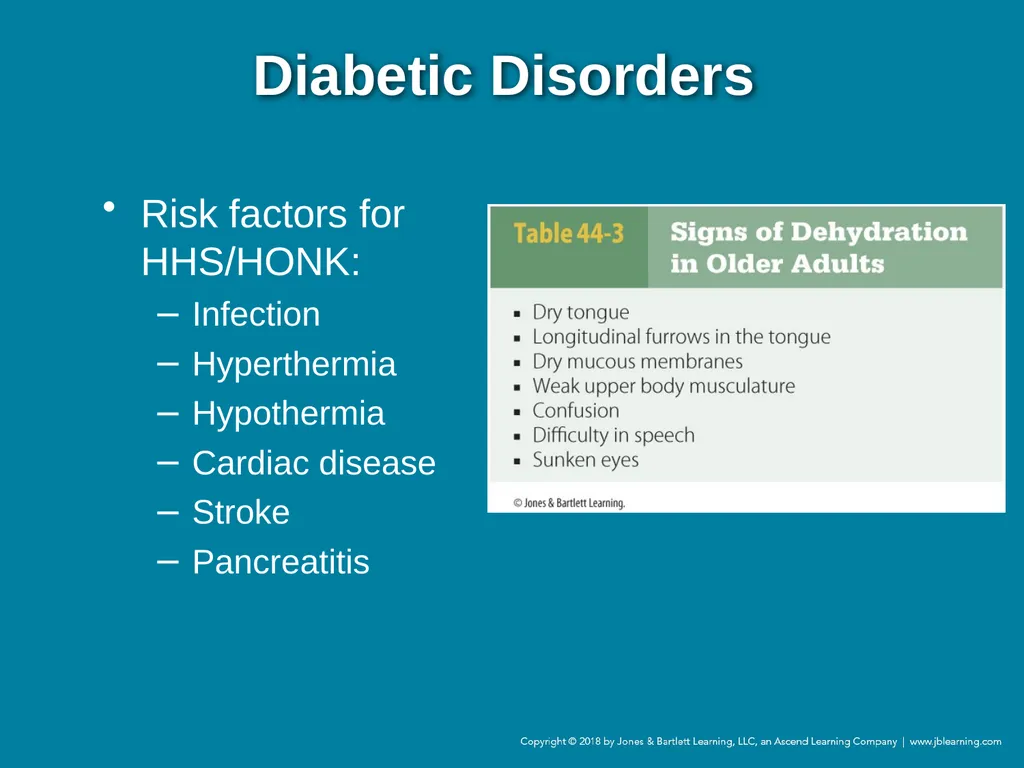
Diabetic Disorders Risk factors for HHS/HONK:
Infection
Hyperthermia
Hypothermia
Cardiac disease
Stroke
Pancreatitis<br>
Infection
Hyperthermia
Hypothermia
Cardiac disease
Stroke
Pancreatitis<br>
165
Diabetic Disorders Signs and symptoms of HHS/HONK:
Dizziness
Confusion
Altered mental status
Polydipsia<br>
Dizziness
Confusion
Altered mental status
Polydipsia<br>
166
Diabetic Disorders Assess vital signs every 15 minutes.
Obtain a 12-lead ECG.
Monitor etco2 and ventilatory status throughout transport.
Monitor fluid resuscitation and electrolyte balance.<br>
Obtain a 12-lead ECG.
Monitor etco2 and ventilatory status throughout transport.
Monitor fluid resuscitation and electrolyte balance.<br>
167
Diabetic Disorders Prevention lifestyle changes:
Dietary restrictions
Exercise
Controlling obesity
Long-term management:
Limiting carbohydrate intake
Taking insulin and antihyperglycemic agents<br>
Dietary restrictions
Exercise
Controlling obesity
Long-term management:
Limiting carbohydrate intake
Taking insulin and antihyperglycemic agents<br>
168
Thyroid Disorders Many older patients are asymptomatic.
Hypothyroidism manifests by general slowing of the metabolic process from reduction or absence of thyroid hormone.<br>
Hypothyroidism manifests by general slowing of the metabolic process from reduction or absence of thyroid hormone.<br>
169
Thyroid Disorders Signs and symptoms may look like aging:
Cold intolerance
Constipation
Dry skin
Weakness
Weight gain<br>
Cold intolerance
Constipation
Dry skin
Weakness
Weight gain<br>
170
Thyroid Disorders May require supplemental oxygen
Hypoglycemia may require D50.
Hypothyroid often involves diminished respiratory effort.
Continued hormone level decrease may cause myxedema coma and physiologic decompensation.<br>
Hypoglycemia may require D50.
Hypothyroid often involves diminished respiratory effort.
Continued hormone level decrease may cause myxedema coma and physiologic decompensation.<br>
171
Immunologic Conditions Infections can be severe and dangerous in.
Sepsis may occur.<br>
Sepsis may occur.<br>
172
Immunologic Conditions Patient may be:
Hot and flushed
Tachycardic
Tachypneic
Other signs:
Oral temp greater than 100.4°F or less than 96.8°F
Respiratory rate more than 20 breaths/min
Pulse rate more than 90 beats/min<br>
Hot and flushed
Tachycardic
Tachypneic
Other signs:
Oral temp greater than 100.4°F or less than 96.8°F
Respiratory rate more than 20 breaths/min
Pulse rate more than 90 beats/min<br>
173
Toxicologic Conditions Older adults are prone to adverse reactions from changes in:
Drug metabolism
Drug elimination
Body composition
Responsiveness of drugs that affect the CNS<br>
Drug metabolism
Drug elimination
Body composition
Responsiveness of drugs that affect the CNS<br>
174
Toxicologic Conditions Body changes may affect medication use.
Vision decline leads to errors in administration of medicine.
Short-term memory loss may lead to taking more than normal doses.<br>
Vision decline leads to errors in administration of medicine.
Short-term memory loss may lead to taking more than normal doses.<br>
175
Polypharmacy and Medication Noncompliance Polypharmacy becomes problematic when medications interact.
The chance of being hospitalized increases with the number of medications.
Medications may not be received because of caregiver theft.<br>
The chance of being hospitalized increases with the number of medications.
Medications may not be received because of caregiver theft.<br>
176
Polypharmacy and Medication Noncompliance Noncompliance includes:
Failure to fill prescription
Administering medication improperly
Taking inappropriate medication<br>
Failure to fill prescription
Administering medication improperly
Taking inappropriate medication<br>
177
Polypharmacy and Medication Noncompliance Other issues:
Taking medication prescribed by different doctors who don’t know the full medication regimen
Taking medication prescribed for someone else
Difficulty understanding the drug regimen
Difficulty opening medication containers<br>
Taking medication prescribed by different doctors who don’t know the full medication regimen
Taking medication prescribed for someone else
Difficulty understanding the drug regimen
Difficulty opening medication containers<br>
178
Pharmacokinetics Toxic effects of drugs from aging-related alterations in pharmacokinetics
Predisposed to reactions by physiologic changes in body systems and composition
Medications affecting the CNS are the most common source of adverse reactions.<br>
Predisposed to reactions by physiologic changes in body systems and composition
Medications affecting the CNS are the most common source of adverse reactions.<br>
179
Pharmacokinetics Reduction in nervous system response increases risk of adverse anticholinergic effects.
Reduced beta-adrenergic receptor sensitivity causes most bronchodilators to be ineffective.<br>
Reduced beta-adrenergic receptor sensitivity causes most bronchodilators to be ineffective.<br>
180
Pharmacokinetics Diuretics, antihypertensive
Cause hypotension and orthostatic changes from reduced cardiac output, total body water decrease
Decreased glucose tolerance
Hyperglycemic effects from diuretics and corticosteroids<br>
Cause hypotension and orthostatic changes from reduced cardiac output, total body water decrease
Decreased glucose tolerance
Hyperglycemic effects from diuretics and corticosteroids<br>
181
Pharmacokinetics Pharmacokinetics can be influenced by:
Diet
Smoking
Alcohol consumption
Other drug use<br>
Diet
Smoking
Alcohol consumption
Other drug use<br>
182
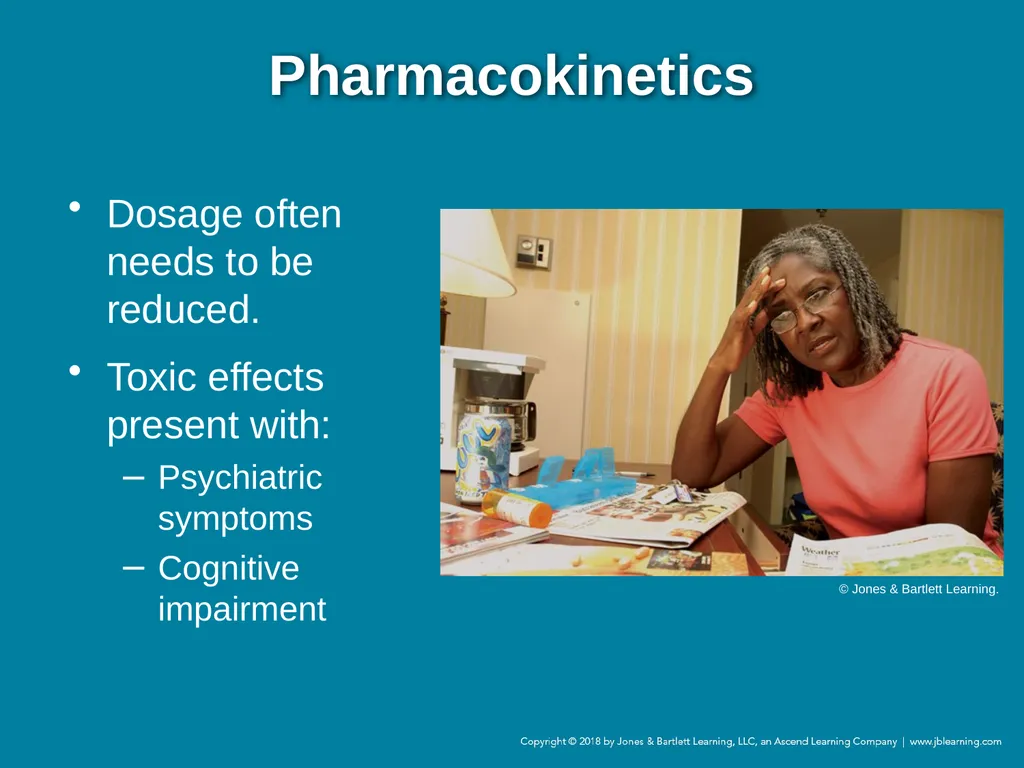
Pharmacokinetics Dosage often needs to be reduced.
Toxic effects present with:
Psychiatric symptoms
Cognitive impairment © Jones & Bartlett Learning.<br>
Toxic effects present with:
Psychiatric symptoms
Cognitive impairment © Jones & Bartlett Learning.<br>
183
Drug and Alcohol Abuse Often in response to life-changing events:
Loss of spouse
Declining health
Low self-esteem<br>
Loss of spouse
Declining health
Low self-esteem<br>
184
Drug and Alcohol Abuse Prevalence attributed to:
Number of prescribed medications
Heightened vulnerability to abuse
Decreased body mass and total body water, leading to higher blood alcohol concentrations
Slower alcohol elimination from body<br>
Number of prescribed medications
Heightened vulnerability to abuse
Decreased body mass and total body water, leading to higher blood alcohol concentrations
Slower alcohol elimination from body<br>
185
Drug and Alcohol Abuse Recognizing abuse can be difficult:
May be well hidden or accepted by family and friends.
Ask about the issue; it can complicate the assessment.<br>
May be well hidden or accepted by family and friends.
Ask about the issue; it can complicate the assessment.<br>
186
Psychologic Conditions Depression not a part of normal aging.
Medical disease
May be normal, short-term reaction to an event
Concern when persists for weeks<br>
Medical disease
May be normal, short-term reaction to an event
Concern when persists for weeks<br>
187
Depression Growing incidence in relation to progressive population aging
Treatable with medication and therapy
Can mimic effects of other medical problems<br>
Treatable with medication and therapy
Can mimic effects of other medical problems<br>
188
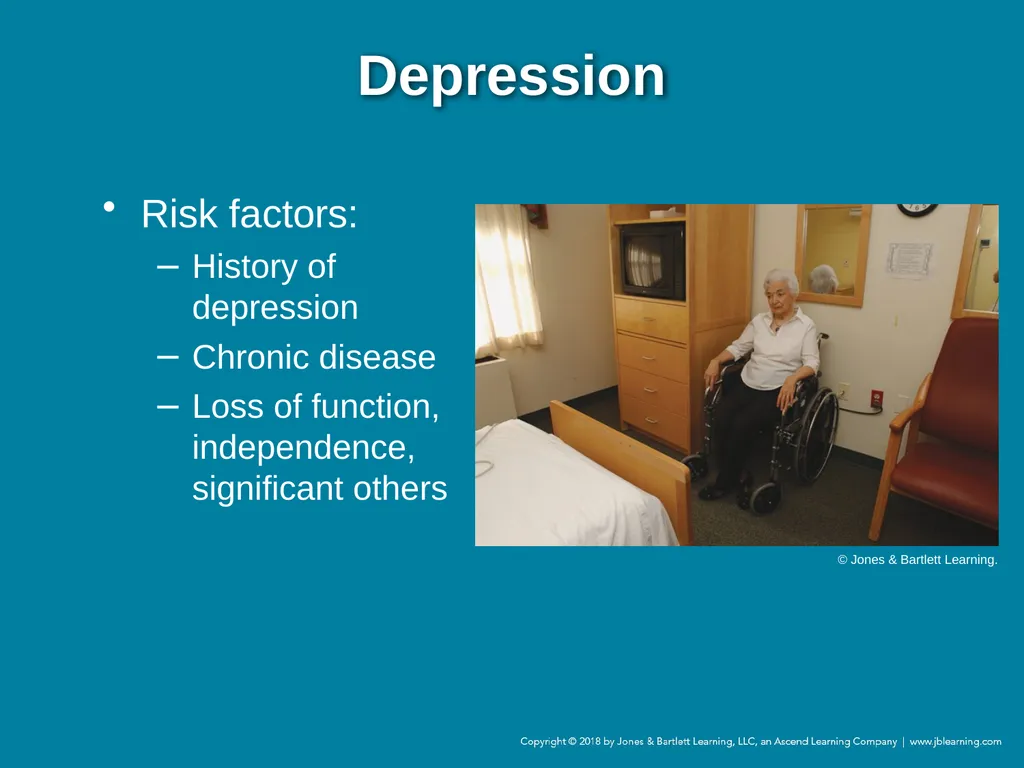
Depression Risk factors:
History of depression
Chronic disease
Loss of function, independence, significant others © Jones & Bartlett Learning.<br>
History of depression
Chronic disease
Loss of function, independence, significant others © Jones & Bartlett Learning.<br>
189
Depression Older patients tend to not complain about feelings; it may be difficult to recognize.
Majority of geriatric suicides occur in people with:
Terminal illness
Debilitating cardiac or neurologic condition<br>
Majority of geriatric suicides occur in people with:
Terminal illness
Debilitating cardiac or neurologic condition<br>
190
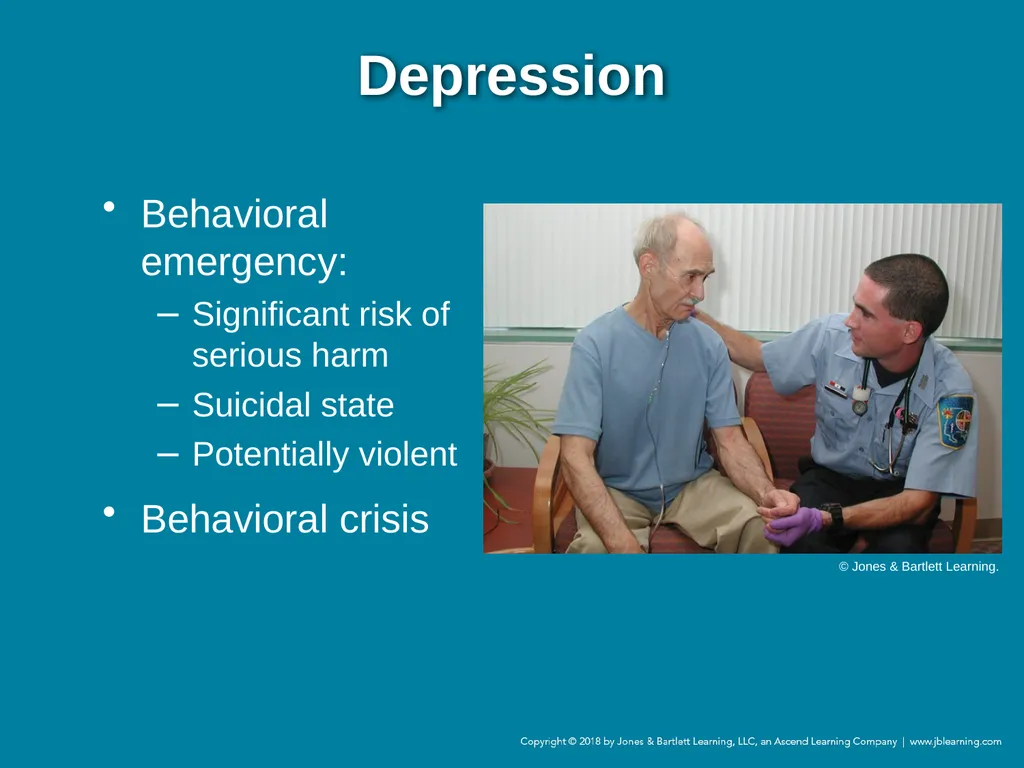
Depression Behavioral emergency:
Significant risk of serious harm
Suicidal state
Potentially violent
Behavioral crisis © Jones & Bartlett Learning.<br>
Significant risk of serious harm
Suicidal state
Potentially violent
Behavioral crisis © Jones & Bartlett Learning.<br>
191
Mental Illness A patient who is psychotic is out of touch with reality.
Symptoms may include:
Angry or excited for no reason
Antisocial or loner behavior
Sleeping during the day, awake at night<br>
Symptoms may include:
Angry or excited for no reason
Antisocial or loner behavior
Sleeping during the day, awake at night<br>
192
Integumentary Conditions Older patients are at higher risk for secondary infection.
Wounds take longer to heal.
Cumulative sun and toxin exposure increase their chance of developing skin cancer.<br>
Wounds take longer to heal.
Cumulative sun and toxin exposure increase their chance of developing skin cancer.<br>
193
Herpes Zoster Also known as shingles
Caused by reactivation of varicella virus on nerve roots
Commonly affects thoracic nerve and ophthalmic division of the trigeminal nerve<br>
Caused by reactivation of varicella virus on nerve roots
Commonly affects thoracic nerve and ophthalmic division of the trigeminal nerve<br>
194
Herpes Zoster Symptoms
Pain in affected area
Cluster of tiny blisters on reddened skin
Usually unilateral rash Treatment
Narcotic pain relievers
Antiviral medications<br>
Pain in affected area
Cluster of tiny blisters on reddened skin
Usually unilateral rash Treatment
Narcotic pain relievers
Antiviral medications<br>
195
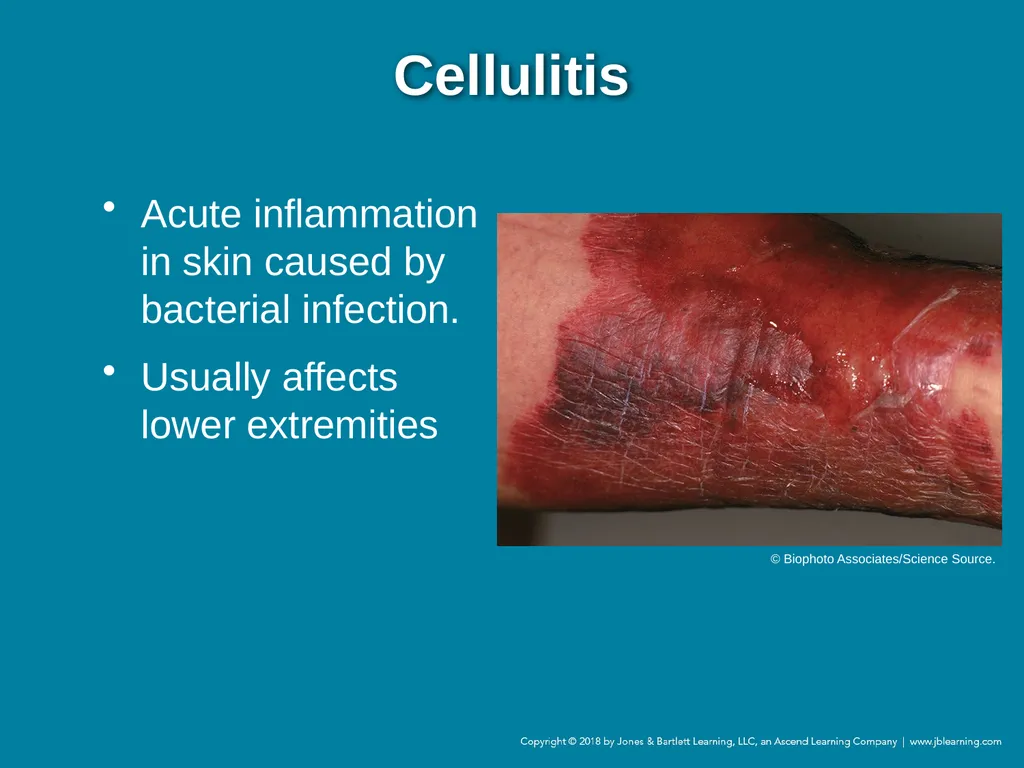
Cellulitis Acute inflammation in skin caused by bacterial infection.
Usually affects lower extremities © Biophoto Associates/Science Source.<br>
Usually affects lower extremities © Biophoto Associates/Science Source.<br>
196
Cellulitis Symptoms
Fever and chills
Warmth, swelling, redness, tenderness, and enlarged nodes in affected area
Elevated white blood cell count
Presence of bacteria Treatment
Antibiotic therapy
Fluid intake
Local dressing on any open sores<br>
Fever and chills
Warmth, swelling, redness, tenderness, and enlarged nodes in affected area
Elevated white blood cell count
Presence of bacteria Treatment
Antibiotic therapy
Fluid intake
Local dressing on any open sores<br>
197
Pressure Ulcers Occur from pressure applied to body tissue, resulting in lack of perfusion and necrosis
Possible risk factors:
Brain or spinal cord injury
Neuromuscular disorders
Nutritional problems<br>
Possible risk factors:
Brain or spinal cord injury
Neuromuscular disorders
Nutritional problems<br>
198
Pressure Ulcers Most commonly located on:
Lower legs
Sacrum
Greater trochanter
Glutes<br>
Lower legs
Sacrum
Greater trochanter
Glutes<br>
199
Pressure Ulcers Classified as:
Stage 1: persistent skin redness that does not disappear when pressure is relieved
Stage 2: partial thickness lost; appears as abrasion, blister, shallow crater
Stage 3: full skin thickness lost, exposing subcutaneous tissue
Stage 4: full thickness and subcutaneous tissue lost, exposing muscle, bone<br>
Stage 1: persistent skin redness that does not disappear when pressure is relieved
Stage 2: partial thickness lost; appears as abrasion, blister, shallow crater
Stage 3: full skin thickness lost, exposing subcutaneous tissue
Stage 4: full thickness and subcutaneous tissue lost, exposing muscle, bone<br>
200
Pressure Ulcers Prehospital treatment is mostly BLS.
Monitor body temperature and vital signs.
Administer oxygen
Establish IV line and consider a fluid bolus.<br>
Monitor body temperature and vital signs.
Administer oxygen
Establish IV line and consider a fluid bolus.<br>
201
Musculoskeletal Conditions Physical ability changes and affects confidence in mobility
Muscles atrophy and weaken.
Muscle fibers become fewer and smaller.
Motor neuron numbers decline.
Strength declines.<br>
Muscles atrophy and weaken.
Muscle fibers become fewer and smaller.
Motor neuron numbers decline.
Strength declines.<br>
202
Musculoskeletal Conditions Stooped posture from atrophy of body’s supporting structures
Two of three older patients will have some degree of kyphosis.
Lost height results from spinal column compression.<br>
Two of three older patients will have some degree of kyphosis.
Lost height results from spinal column compression.<br>
203
Osteoporosis Decrease in bone mass, leading to:
Bone strength reduction
Greater susceptibility to fractures Influenced by:
Genetics
Smoking
Activity level
Diet
Hormonal factors
Body weight and structure<br>
Bone strength reduction
Greater susceptibility to fractures Influenced by:
Genetics
Smoking
Activity level
Diet
Hormonal factors
Body weight and structure<br>
204
Osteoporosis Type I
Rapid bone loss occurring in women during years after menopause
Most common fractures:
Radius
Hip Type II
In both men and women
Most common fractures:
Hip
Vertebrae<br>
Rapid bone loss occurring in women during years after menopause
Most common fractures:
Radius
Hip Type II
In both men and women
Most common fractures:
Hip
Vertebrae<br>
205
Osteoporosis Treatment:
Bisphosphonates
Calcium and vitamin D supplementation
Activity and low-impact exercise<br>
Bisphosphonates
Calcium and vitamin D supplementation
Activity and low-impact exercise<br>
206
Arthritis Osteoarthritis: progressive joint disease
Formation of bone spurs in joints, leading to stiffness
Thought to result from:
Joint wear and tear
Repetitive joint trauma<br>
Formation of bone spurs in joints, leading to stiffness
Thought to result from:
Joint wear and tear
Repetitive joint trauma<br>
207
Arthritis Patients report pain that worsens with:
Exertion
Temperature changes and humidity
Treatment includes:
Anti-inflammatory medications
Physical therapy<br>
Exertion
Temperature changes and humidity
Treatment includes:
Anti-inflammatory medications
Physical therapy<br>
208
Arthritis Rheumatoid arthritis:
Long-term autoimmune disorder with inflammation of joints and surrounding tissue Symptoms bilateral, affecting:
Hands
Feet
Wrists
Ankles
Knees<br>
Long-term autoimmune disorder with inflammation of joints and surrounding tissue Symptoms bilateral, affecting:
Hands
Feet
Wrists
Ankles
Knees<br>
209
Management of Medical Emergencies in Older Adults Most prehospital care is supportive.
Pain relief
Palliative support
Treatment for emergency and chief complaint<br>
Pain relief
Palliative support
Treatment for emergency and chief complaint<br>
210
Geriatric Trauma Emergencies Factors that place an older person at higher risk of trauma:
Slower reflexes and reduction in agility
Visual and hearing deficits
Equilibrium disorders
Reduction in agility<br>
Slower reflexes and reduction in agility
Visual and hearing deficits
Equilibrium disorders
Reduction in agility<br>
211
Geriatric Trauma Emergencies Less favorable outcomes in trauma due to:
Changes in homeostatic compensatory mechanisms
Aging effects on body systems
Preexisting conditions<br>
Changes in homeostatic compensatory mechanisms
Aging effects on body systems
Preexisting conditions<br>
212
Geriatric Trauma Emergencies Successful treatment when trauma-related blood loss is compensated enough for:
Increased pulse rate
Increased respirations
Adequate vasoconstriction<br>
Increased pulse rate
Increased respirations
Adequate vasoconstriction<br>
213
Geriatric Trauma Emergencies Unsuccessful recovery likely if:
Decreased respiratory function
Impaired renal activity
Ineffective vasoconstriction
More likely to sustain serious injury due to:
Stiffened blood vessels
Fragile tissue
Demineralized bones<br>
Decreased respiratory function
Impaired renal activity
Ineffective vasoconstriction
More likely to sustain serious injury due to:
Stiffened blood vessels
Fragile tissue
Demineralized bones<br>
214
Geriatric Trauma Emergencies Most cases involve falls or motor vehicles
Falls are associated with:
Higher incidence of anxiety and depression
Loss of confidence
Postfall syndrome<br>
Falls are associated with:
Higher incidence of anxiety and depression
Loss of confidence
Postfall syndrome<br>
215
Geriatric Trauma Emergencies Falls are divided into two categories:
Extrinsic causes
Intrinsic causes
Risk increases with preexisting gait abnormalities and cognitive impairment.<br>
Extrinsic causes
Intrinsic causes
Risk increases with preexisting gait abnormalities and cognitive impairment.<br>
216
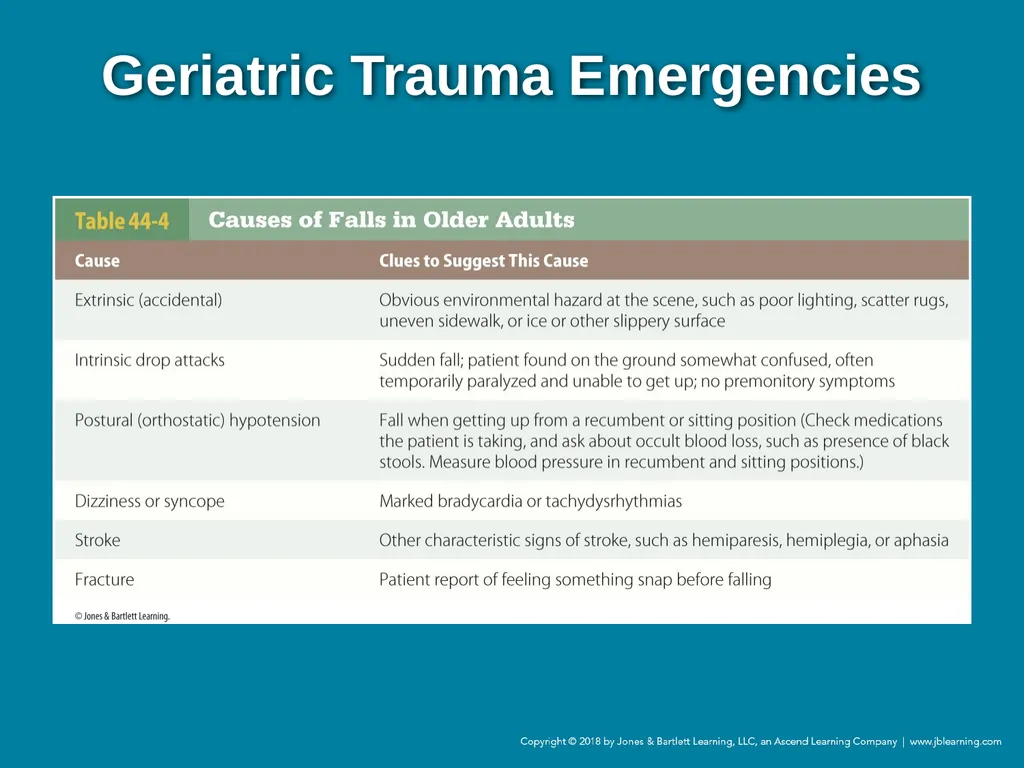
Geriatric Trauma Emergencies<br>
217
Geriatric Trauma Emergencies Home safety assessment by EMS
Check for:
Clear pathway to and from bathroom
Handrails in bathtubs and on steps
Loose rugs or other objects on floor
Wheelchair ramps with grip tape<br>
Check for:
Clear pathway to and from bathroom
Handrails in bathtubs and on steps
Loose rugs or other objects on floor
Wheelchair ramps with grip tape<br>
218
Geriatric Trauma Emergencies Older adults are far more likely to be fatally injured in a motor vehicle crash.
At higher risk for crashes due to:
Vision impairment
Errors in judgment
Underlying medical conditions<br>
At higher risk for crashes due to:
Vision impairment
Errors in judgment
Underlying medical conditions<br>
219
Geriatric Trauma Emergencies Conditions that can influence outcomes:
Cirrhosis
Congenital coagulopathy
COPD
Ischemic heart disease
Diabetes mellitus<br>
Cirrhosis
Congenital coagulopathy
COPD
Ischemic heart disease
Diabetes mellitus<br>
220
Pathophysiology Head trauma: increased fragility of cerebral blood vessels, enlarged subdural space
Hematoma often develops over days or weeks.
As intracranial pressure increases:
The patient’s state of consciousness becomes depressed.
The patient becomes drowsy.<br>
Hematoma often develops over days or weeks.
As intracranial pressure increases:
The patient’s state of consciousness becomes depressed.
The patient becomes drowsy.<br>
221
Pathophysiology Spinal cord injury and compression
Degenerative spinal changes cause arthritic spurs and vertebral canal narrowing.
Even a sudden movement of the neck may cause spinal cord injury.<br>
Degenerative spinal changes cause arthritic spurs and vertebral canal narrowing.
Even a sudden movement of the neck may cause spinal cord injury.<br>
222
Pathophysiology Chest injuries are exacerbated by rib brittleness and stiffening of the chest wall.
Abdominal trauma often causes liver injury.
Orthopaedic injuries are common results of falls.<br>
Abdominal trauma often causes liver injury.
Orthopaedic injuries are common results of falls.<br>
223
Pathophysiology Burns have significant risk of morbidity and mortality, especially if:
Preexisting medication conditions are present
Defense mechanism against infection are weakened.
Fluid replacement is complicated by renal compromise.
Monitor hydration status.<br>
Preexisting medication conditions are present
Defense mechanism against infection are weakened.
Fluid replacement is complicated by renal compromise.
Monitor hydration status.<br>
224
Pathophysiology Internal temperature regulation slows.
Delayed ability to recognize temperature fluctuations Heat gain/loss slowed by:
Atherosclerotic vessels
Slowed circulation
Decreased sweat production<br>
Delayed ability to recognize temperature fluctuations Heat gain/loss slowed by:
Atherosclerotic vessels
Slowed circulation
Decreased sweat production<br>
225
Pathophysiology Thermoregulation affected by:
Chronic disease
Medications
Alcohol use Half of hypothermia deaths are in older people.
Hyperthermia death rates more than double in older adults.<br>
Chronic disease
Medications
Alcohol use Half of hypothermia deaths are in older people.
Hyperthermia death rates more than double in older adults.<br>
226
Pathophysiology Check for environmental emergencies in extreme hot and cold.
You may need to keep the patient compartment at higher-than-normal temperature.<br>
You may need to keep the patient compartment at higher-than-normal temperature.<br>
227
Assessment and Management of Trauma Check mechanism of injury.
Check for possible medical problem before the trauma.
Initial management follows ABCDEs first.<br>
Check for possible medical problem before the trauma.
Initial management follows ABCDEs first.<br>
228
Assessment and Management of Trauma © Jones & Bartlett Learning. © Jones & Bartlett Learning. © Jones & Bartlett Learning.<br>
229
Assessment and Management of Trauma Check for rib fracture when assessing breathing.
Obtain baseline BP.
Normal blood pressure may be hypotension in an older person.<br>
Obtain baseline BP.
Normal blood pressure may be hypotension in an older person.<br>
230
Assessment and Management of Trauma Do neurologic status assessment using AVPU scale.
Try to obtain complete history of the event from the patient and bystanders. © Jones & Bartlett Learning. Courtesy of MIEMSS.<br>
Try to obtain complete history of the event from the patient and bystanders. © Jones & Bartlett Learning. Courtesy of MIEMSS.<br>
231
Assessment and Management of Trauma Obtain a list of regular medications, especially those that may affect treatment.
Beta blockers
Antihypertensives
Diabetes medications<br>
Beta blockers
Antihypertensives
Diabetes medications<br>
232
Assessment and Management of Trauma Conduct secondary assessment, watching for signs of injury to the:
Head
Cervical spine
Ribs and abdomen
Long bones
Remember the patient’s pain perception may be decreased.<br>
Head
Cervical spine
Ribs and abdomen
Long bones
Remember the patient’s pain perception may be decreased.<br>
233
Assessment and Management of Trauma Additional treatment based on injuries
Be cautious about isotonic solutions.
Monitor cardiac rhythm throughout.
Preserve temperature.
Consider pain medication.
Immobilize the cervical spine before transporting.<br>
Be cautious about isotonic solutions.
Monitor cardiac rhythm throughout.
Preserve temperature.
Consider pain medication.
Immobilize the cervical spine before transporting.<br>
234
Elder Abuse Any form of mistreatment that results in harm or loss to an older person
Physical
Sexual
Emotional
Neglect
Financial<br>
Physical
Sexual
Emotional
Neglect
Financial<br>
235
Elder Abuse Average victim:
77.9 years old
Female
Has multiple chronic conditions
Unable to function on his or her own
Dependent for at least part of his or her care<br>
77.9 years old
Female
Has multiple chronic conditions
Unable to function on his or her own
Dependent for at least part of his or her care<br>
236
Elder Abuse The abuser is almost always known to the abused.
Often a family member
Often occurs in the patient’s or caregiver’s home
Sometimes in long-term care facilities<br>
Often a family member
Often occurs in the patient’s or caregiver’s home
Sometimes in long-term care facilities<br>
237
Elder Abuse Clues:
Unexplained injuries that do not fit stated cause
Hygiene
Patient interacting with caregivers
Listen to the patient’s concerns about his or her care. © Jones & Bartlett Learning. Courtesy of MIEMSS.<br>
Unexplained injuries that do not fit stated cause
Hygiene
Patient interacting with caregivers
Listen to the patient’s concerns about his or her care. © Jones & Bartlett Learning. Courtesy of MIEMSS.<br>
238
Elder Abuse If the patient is stable but in an unsafe situation, see if he or she will allow transport.
If the patient refuses, suggest local adult protective services.
If immediately unsafe, notify law enforcement.<br>
If the patient refuses, suggest local adult protective services.
If immediately unsafe, notify law enforcement.<br>
239
Elder Abuse Many states have elder abuse statutes.
Reporting suspected abuse may be mandatory.
Definition may vary state by state.
If abuse is suspected as cause of injury:
Objectively document observations.
Report findings and suspicions to the receiving facility.<br>
Reporting suspected abuse may be mandatory.
Definition may vary state by state.
If abuse is suspected as cause of injury:
Objectively document observations.
Report findings and suspicions to the receiving facility.<br>
240
End-of-Life Care Paramedics will be involved with end-of-life care for patients.
Do not resuscitate does not mean “do not respond to the needs of a terminal patient.”<br>
Do not resuscitate does not mean “do not respond to the needs of a terminal patient.”<br>
241
End-of-Life Care Paramedics should:
Treat various disorders.
Administer medication.
Perform other treatments.
Be caring and concerned.<br>
Treat various disorders.
Administer medication.
Perform other treatments.
Be caring and concerned.<br>
242
End-of-Life Care The community may have a local hospice.
Terminal care for patients
Support for families © Photofusion Picture Library/Alamy.<br>
Terminal care for patients
Support for families © Photofusion Picture Library/Alamy.<br>