
Chapter 5 Subject Verb Agreement A verb should

Description: Chapter 5 Subject Verb Agreement A verb should agree in number with its subject. Singular A word that refers to one person, place, thing, or idea. He washes the dishes. (He is a singular subject so washes agrees.) Plural A word that refers
Related Topics
Download Presentation
"Chapter 5 Subject Verb Agreement A verb should" is the property of its rightful owner. Permission is granted to download and print the materials on this website for personal, non-commercial use only, and to display it on your personal computer provided you do not modify the materials and that you retain all copyright notices contained in the materials. By downloading content from our website, you accept the terms of this agreement.
Presentation Transcript
slide1. Chapter 5 Subject Verb Agreement<br>
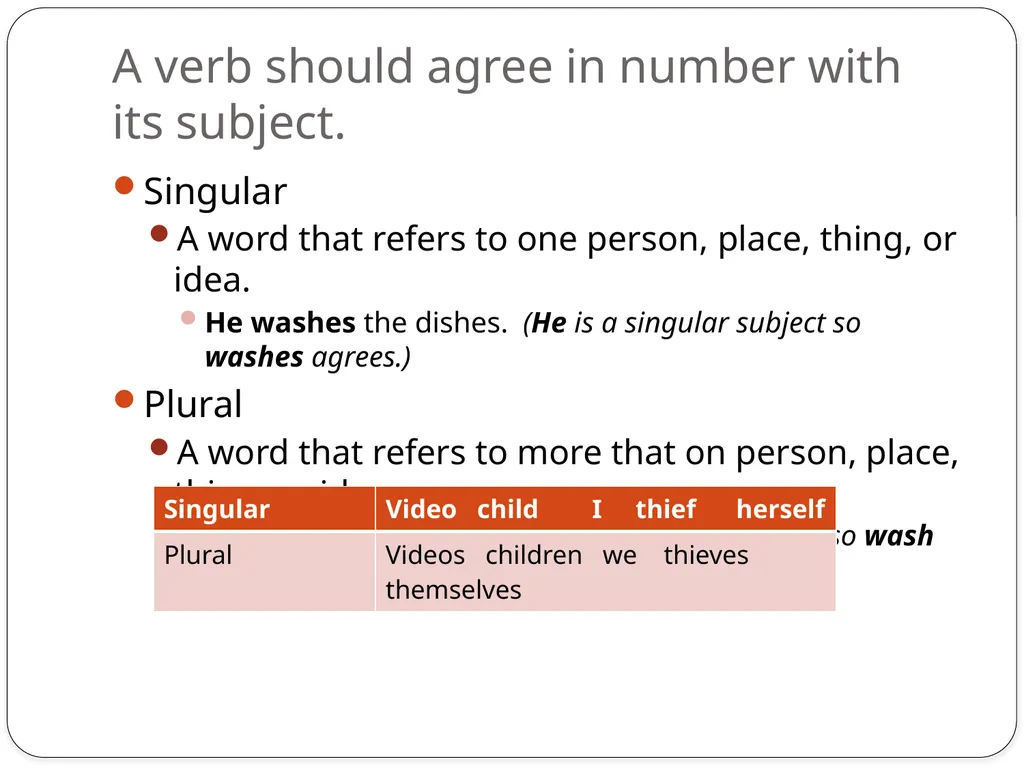
slide2. A verb should agree in number with its subject. Singular
A word that refers to one person, place, thing, or idea.
He washes the dishes. (He is a singular subject so washes agrees.)
Plural
A word that refers to more that on person, place, thing, or idea.
They wash the dishes. (They is a plural subject, so wash agrees.)<br>
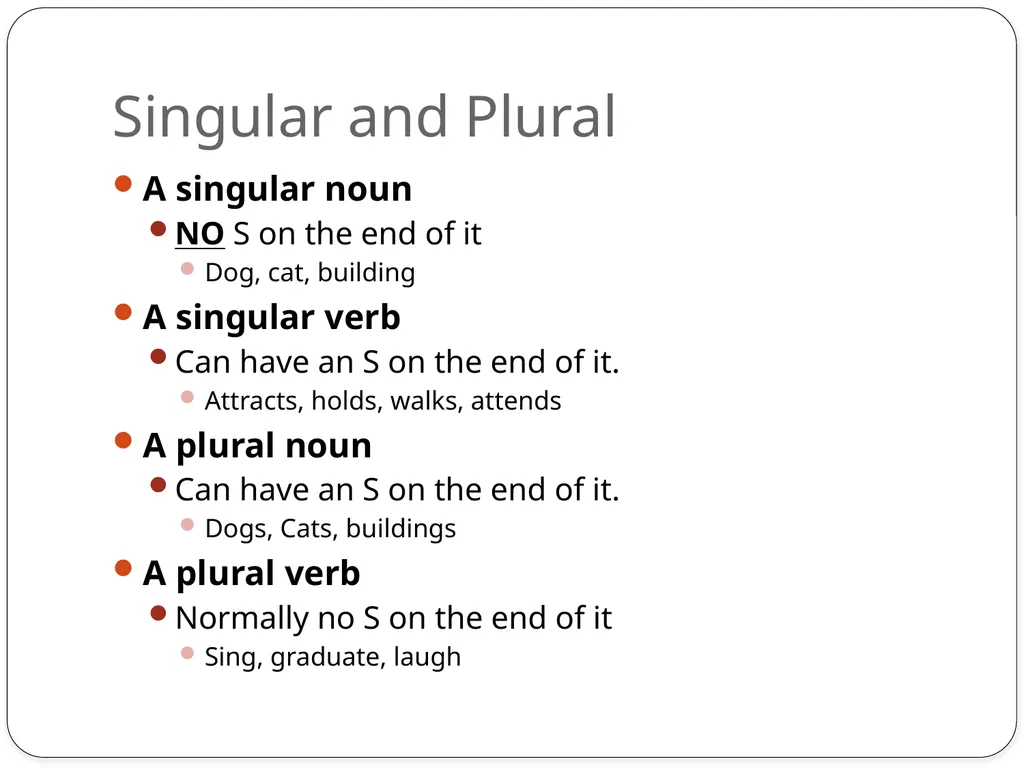
slide3. Singular and Plural A singular noun
NO S on the end of it
Dog, cat, building
A singular verb
Can have an S on the end of it.
Attracts, holds, walks, attends
A plural noun
Can have an S on the end of it.
Dogs, Cats, buildings
A plural verb
Normally no S on the end of it
Sing, graduate, laugh<br>
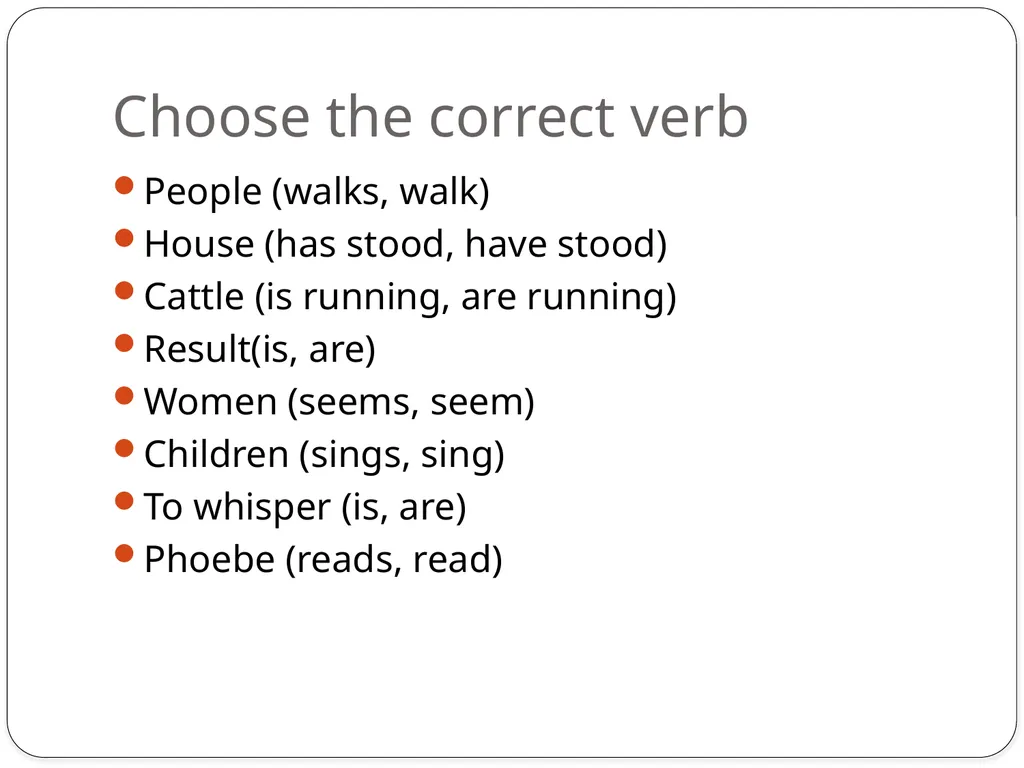
slide4. Choose the correct verb People (walks, walk)
House (has stood, have stood)
Cattle (is running, are running)
Result(is, are)
Women (seems, seem)
Children (sings, sing)
To whisper (is, are)
Phoebe (reads, read)<br>
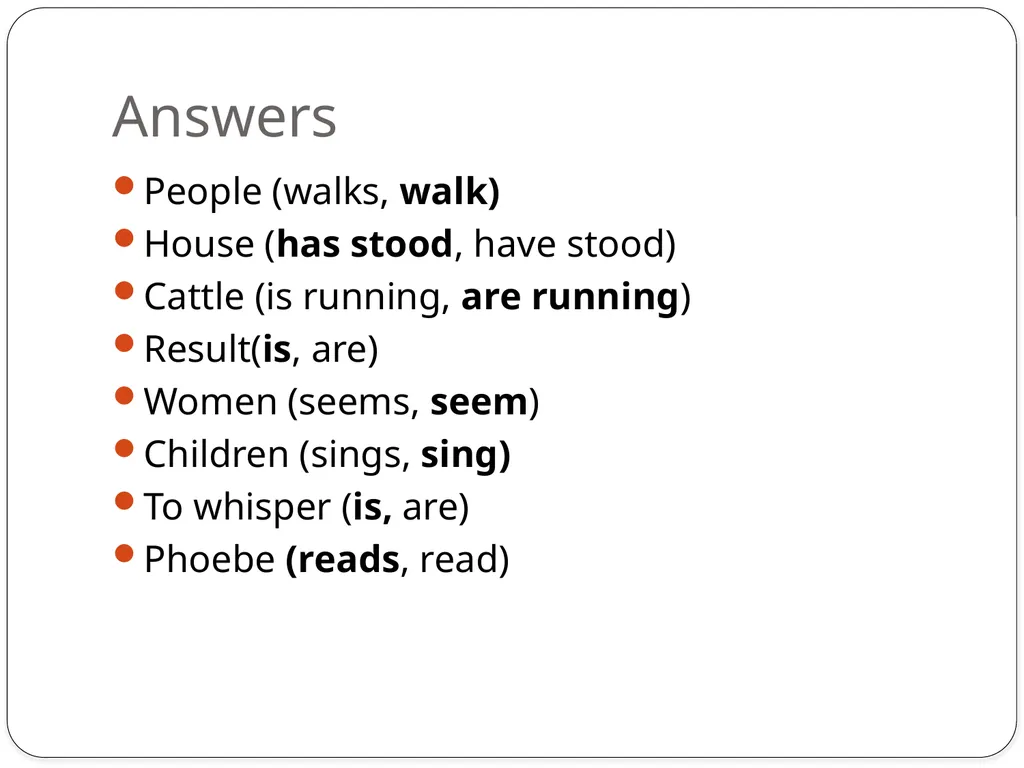
slide5. Answers People (walks, walk)
House (has stood, have stood)
Cattle (is running, are running)
Result(is, are)
Women (seems, seem)
Children (sings, sing)
To whisper (is, are)
Phoebe (reads, read)<br>
slide6. The number of the subject usually is not determined by a word in a phrase or clause following the subject. The apartments across the street do not have balconies.
Do have agrees with apartments, not street.
The planes pulling up to the gate were purchased by a movie company.
Were purchased agrees with planes, not gate.
Eli, one of my friends, was late.
Was agrees with Eli, not friends.
The movie that I saw two weeks ago was reviewed in today’s paper.
Was reviewed agrees with movie, not weeks.<br>
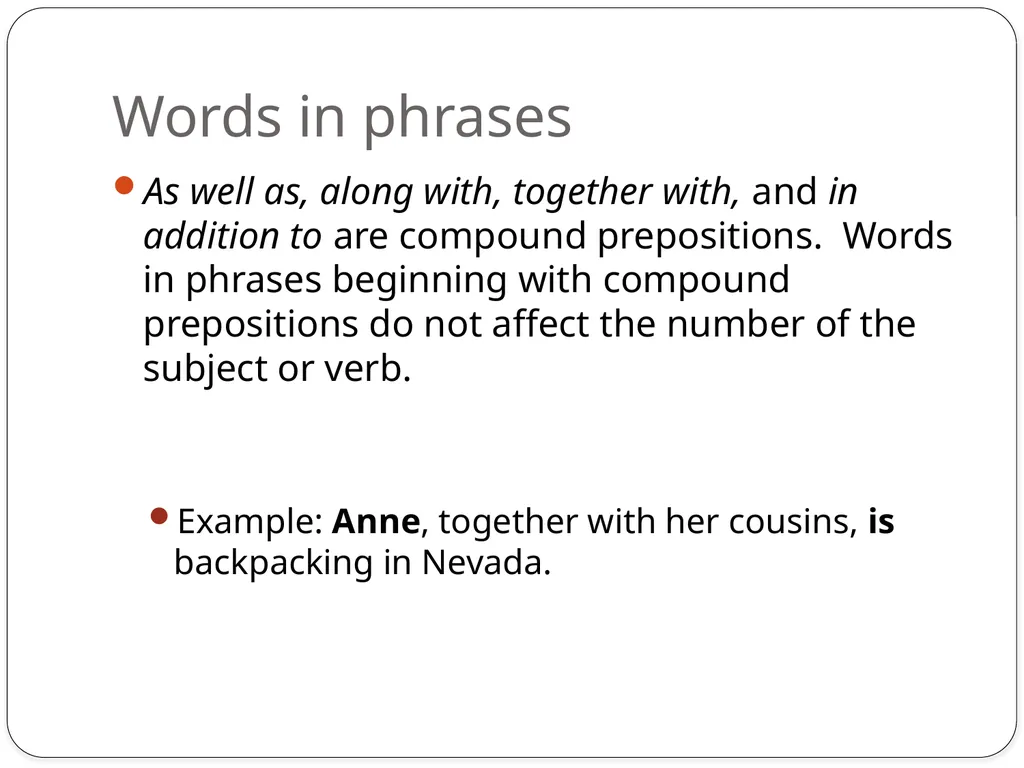
slide7. Words in phrases As well as, along with, together with, and in addition to are compound prepositions. Words in phrases beginning with compound prepositions do not affect the number of the subject or verb.
Example: Anne, together with her cousins, is backpacking in Nevada.<br>
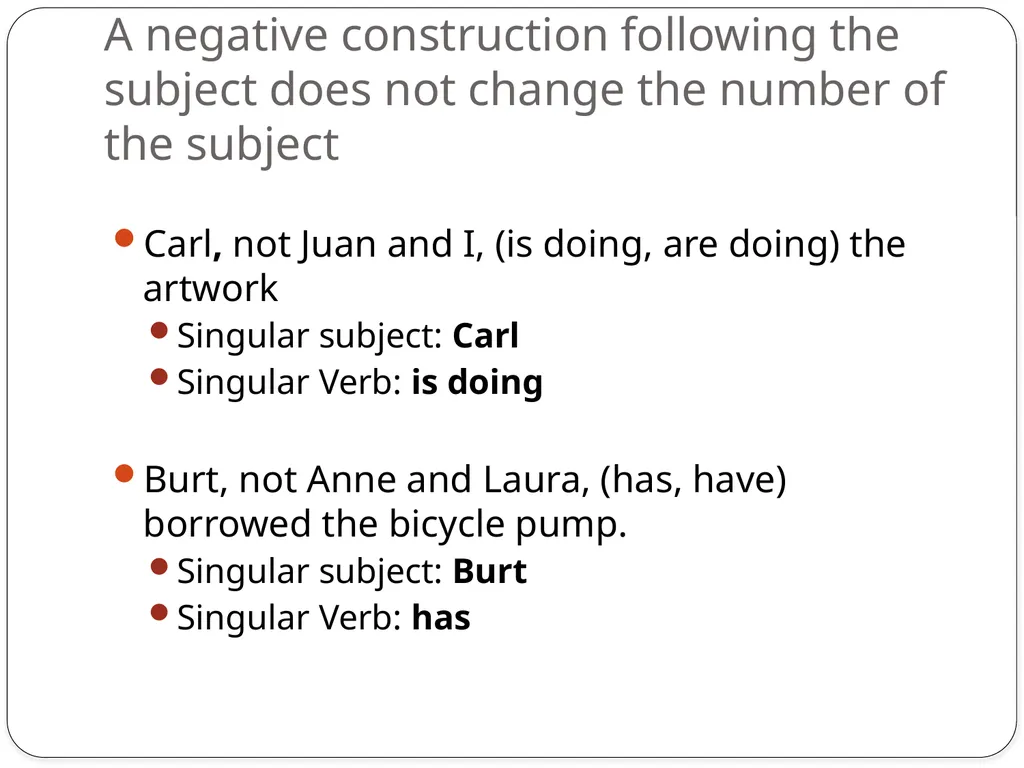
slide8. A negative construction following the subject does not change the number of the subject Carl, not Juan and I, (is doing, are doing) the artwork
Singular subject: Carl
Singular Verb: is doing
Burt, not Anne and Laura, (has, have) borrowed the bicycle pump.
Singular subject: Burt
Singular Verb: has<br>
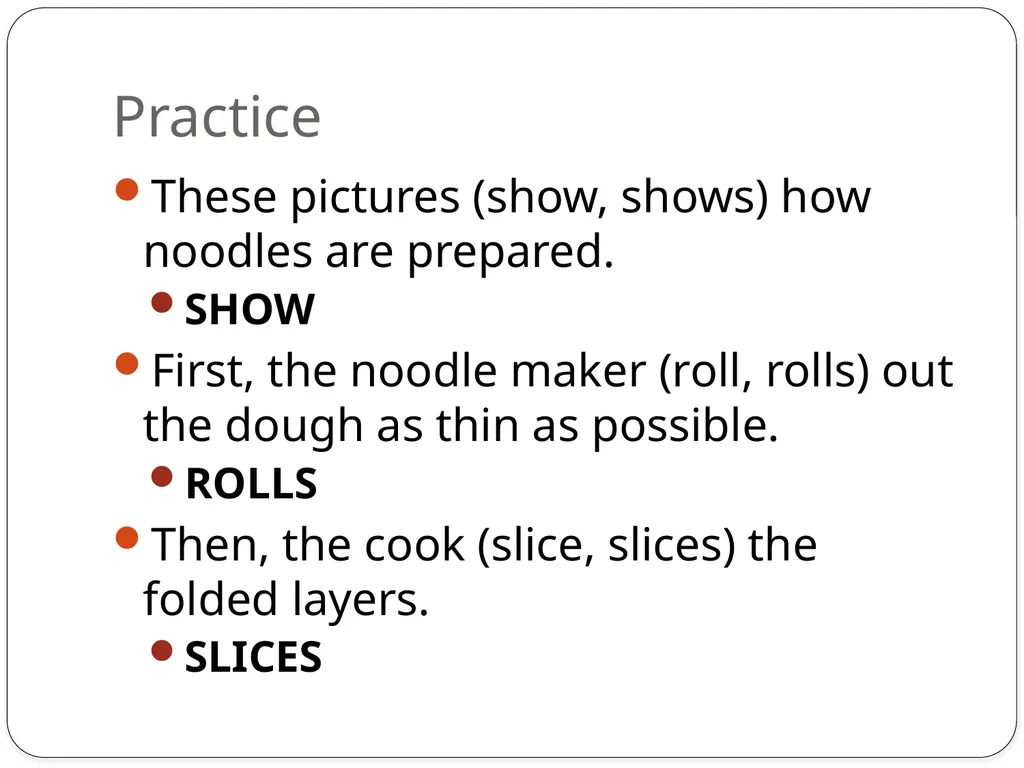
slide9. Practice These pictures (show, shows) how noodles are prepared.
SHOW
First, the noodle maker (roll, rolls) out the dough as thin as possible.
ROLLS
Then, the cook (slice, slices) the folded layers.
SLICES<br>
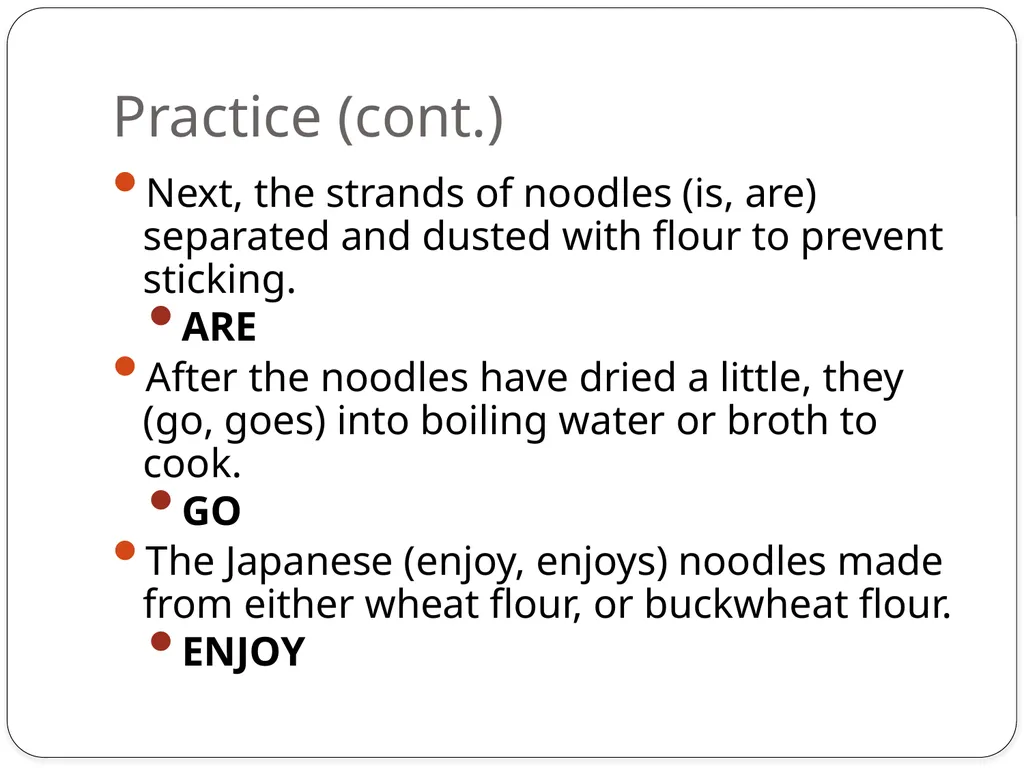
slide10. Practice (cont.) Next, the strands of noodles (is, are) separated and dusted with flour to prevent sticking.
ARE
After the noodles have dried a little, they (go, goes) into boiling water or broth to cook.
GO
The Japanese (enjoy, enjoys) noodles made from either wheat flour, or buckwheat flour.
ENJOY<br>
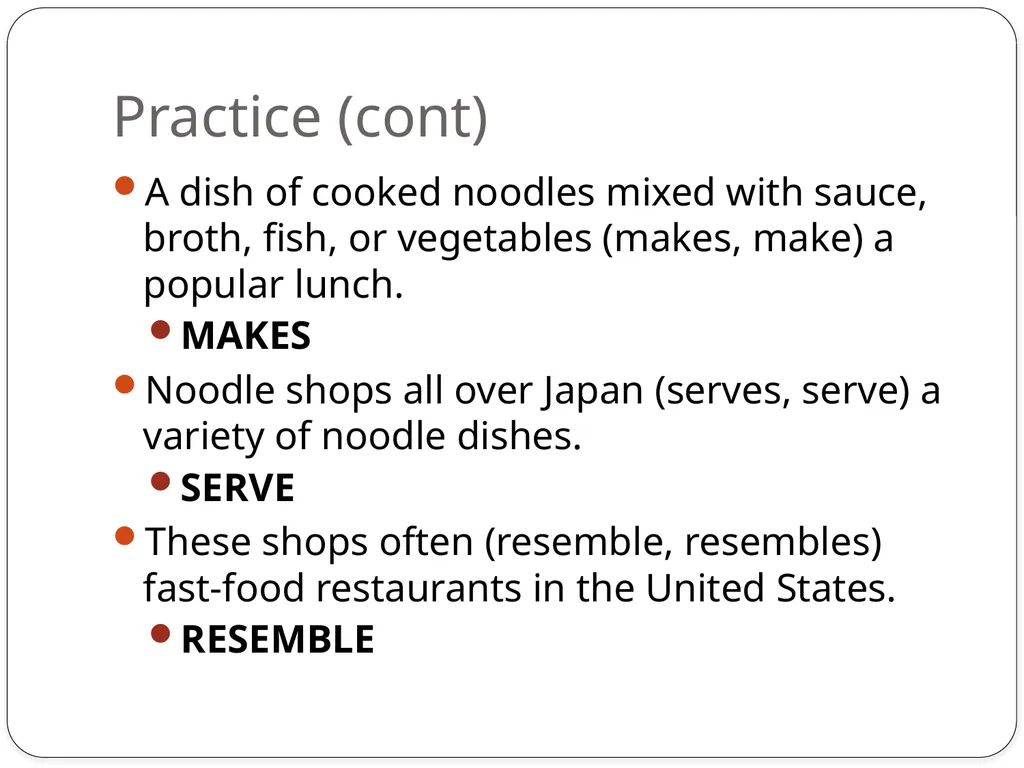
slide11. Practice (cont) A dish of cooked noodles mixed with sauce, broth, fish, or vegetables (makes, make) a popular lunch.
MAKES
Noodle shops all over Japan (serves, serve) a variety of noodle dishes.
SERVE
These shops often (resemble, resembles) fast-food restaurants in the United States.
RESEMBLE<br>
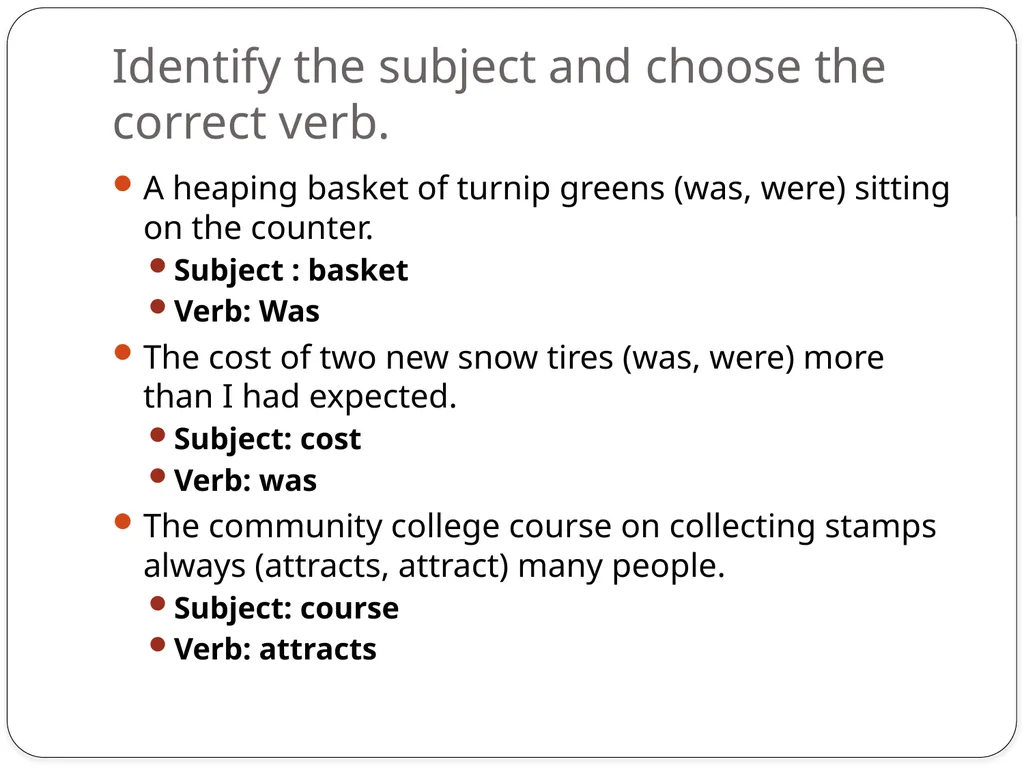
slide12. Identify the subject and choose the correct verb. A heaping basket of turnip greens (was, were) sitting on the counter.
Subject : basket
Verb: Was
The cost of two new snow tires (was, were) more than I had expected.
Subject: cost
Verb: was
The community college course on collecting stamps always (attracts, attract) many people.
Subject: course
Verb: attracts<br>
slide2. A verb should agree in number with its subject. Singular
A word that refers to one person, place, thing, or idea.
He washes the dishes. (He is a singular subject so washes agrees.)
Plural
A word that refers to more that on person, place, thing, or idea.
They wash the dishes. (They is a plural subject, so wash agrees.)<br>
slide3. Singular and Plural A singular noun
NO S on the end of it
Dog, cat, building
A singular verb
Can have an S on the end of it.
Attracts, holds, walks, attends
A plural noun
Can have an S on the end of it.
Dogs, Cats, buildings
A plural verb
Normally no S on the end of it
Sing, graduate, laugh<br>
slide4. Choose the correct verb People (walks, walk)
House (has stood, have stood)
Cattle (is running, are running)
Result(is, are)
Women (seems, seem)
Children (sings, sing)
To whisper (is, are)
Phoebe (reads, read)<br>
slide5. Answers People (walks, walk)
House (has stood, have stood)
Cattle (is running, are running)
Result(is, are)
Women (seems, seem)
Children (sings, sing)
To whisper (is, are)
Phoebe (reads, read)<br>
slide6. The number of the subject usually is not determined by a word in a phrase or clause following the subject. The apartments across the street do not have balconies.
Do have agrees with apartments, not street.
The planes pulling up to the gate were purchased by a movie company.
Were purchased agrees with planes, not gate.
Eli, one of my friends, was late.
Was agrees with Eli, not friends.
The movie that I saw two weeks ago was reviewed in today’s paper.
Was reviewed agrees with movie, not weeks.<br>
slide7. Words in phrases As well as, along with, together with, and in addition to are compound prepositions. Words in phrases beginning with compound prepositions do not affect the number of the subject or verb.
Example: Anne, together with her cousins, is backpacking in Nevada.<br>
slide8. A negative construction following the subject does not change the number of the subject Carl, not Juan and I, (is doing, are doing) the artwork
Singular subject: Carl
Singular Verb: is doing
Burt, not Anne and Laura, (has, have) borrowed the bicycle pump.
Singular subject: Burt
Singular Verb: has<br>
slide9. Practice These pictures (show, shows) how noodles are prepared.
SHOW
First, the noodle maker (roll, rolls) out the dough as thin as possible.
ROLLS
Then, the cook (slice, slices) the folded layers.
SLICES<br>
slide10. Practice (cont.) Next, the strands of noodles (is, are) separated and dusted with flour to prevent sticking.
ARE
After the noodles have dried a little, they (go, goes) into boiling water or broth to cook.
GO
The Japanese (enjoy, enjoys) noodles made from either wheat flour, or buckwheat flour.
ENJOY<br>
slide11. Practice (cont) A dish of cooked noodles mixed with sauce, broth, fish, or vegetables (makes, make) a popular lunch.
MAKES
Noodle shops all over Japan (serves, serve) a variety of noodle dishes.
SERVE
These shops often (resemble, resembles) fast-food restaurants in the United States.
RESEMBLE<br>
slide12. Identify the subject and choose the correct verb. A heaping basket of turnip greens (was, were) sitting on the counter.
Subject : basket
Verb: Was
The cost of two new snow tires (was, were) more than I had expected.
Subject: cost
Verb: was
The community college course on collecting stamps always (attracts, attract) many people.
Subject: course
Verb: attracts<br>