CHAPTER 6 BUILDING AND MAINTAINING GOOD CREDIT Fin 235 Spring 2013 BUILDING AND MAINTAINING GOOD CREDIT LEARNING OBJECTIVES Explain reasons for and against using credit. Establish your own debt limit. Achieve a good credit reputation.
Related Topics
Share
Embed code
Download this presentation From Below
"CHAPTER 6 BUILDING AND MAINTAINING GOOD CREDIT Fin" is the property of its rightful owner. Permission is granted to
download and print the materials on this website for personal, non-commercial use only, and to display it
on your personal computer provided you do not modify the materials and that you retain all copyright
notices contained in the materials. By downloading content from our website, you accept the terms of this
agreement.
Presentation Transcript
01
CHAPTER 6 BUILDING AND MAINTAINING GOOD CREDIT Fin 235
Spring 2013<br>
02
BUILDING AND MAINTAINING GOOD CREDIT LEARNING OBJECTIVES
Explain reasons for and against using credit.
Establish your own debt limit.
Achieve a good credit reputation.
Describe common sources of consumer credit.
Identify signs of over-indebtedness and describe options available for debt relief.<br>
03
BUILDING AND MAINTAINING GOOD CREDIT using credit pros and cons
Positives
Convenience
Emergencies
Making reservations
Own expensive products sooner
Take advantage of free credit
Protections against fraud
Obtain and education<br>
04
BUILDING AND MAINTAINING GOOD CREDIT Negatives
Credit reduces financial responsibility
It is tempting to spend more
Easy to become financially overstretched
Interest is costly
Potential for bankruptcy increases<br>
05
BUILDING AND MAINTAINING GOOD CREDIT Privacy / Security Issues
Offer no other personal information when using a credit card
Check receipts against credit card statements (online access to account)
Only give your card numbers when you initiate the contact
Review your credit reports regularly
Report lost or stolen cards or suspicious activity immediately
”Opt out” of account information sharing
Do not respond to e-mail requests for account verification
Place a security freeze on your credit bureau files<br>
06
BUILDING AND MAINTAINING GOOD CREDIT managing debt
Debt payments-to-disposable income should not exceed 14% (see Table 6-1 page 175)
Debt-to-Equity ratio should not exceed 33% (see Table 6-2 page 176)
You should be able to eradicate non-mortgage debt in 4 years.<br>
07
BUILDING AND MAINTAINING GOOD CREDIT Student debt
Choose the most advantageous repayment pattern allowed.
Repay electronically.
Make payments on-time, every time.
Consolidate your student loans.<br>
08
BUILDING AND MAINTAINING GOOD CREDIT obtaining credit
Application to credit card / bank / finance company
Federal law imposes new standards on creditworthiness
Three Credit Bureaus (free every 4 months)
Trans Union (1-800-680-7289)
Equifax (1-800-525-6285)
Experian (1-800-397-3742)<br>
09
BUILDING AND MAINTAINING GOOD CREDIT Building a Good Credit History
Have a checking and savings account
Have telephone and utilities bill in your name
Acquire and use a oil-company credit card
Apply for bank credit card (at your bank is best)
Get a small short-term cash loan and put it in savings account
Pay-off student loans as quickly as possible
Regularly monitor credit report
Don’t cancel unused credit cards<br>
10
BUILDING AND MAINTAINING GOOD CREDIT Sources of consumer loans
Banks, Savings and Loan, Credit Unions (least expensive)
Finance Companies (most expensive)
Life Insurance companies against cash values of whole life policies<br>
11
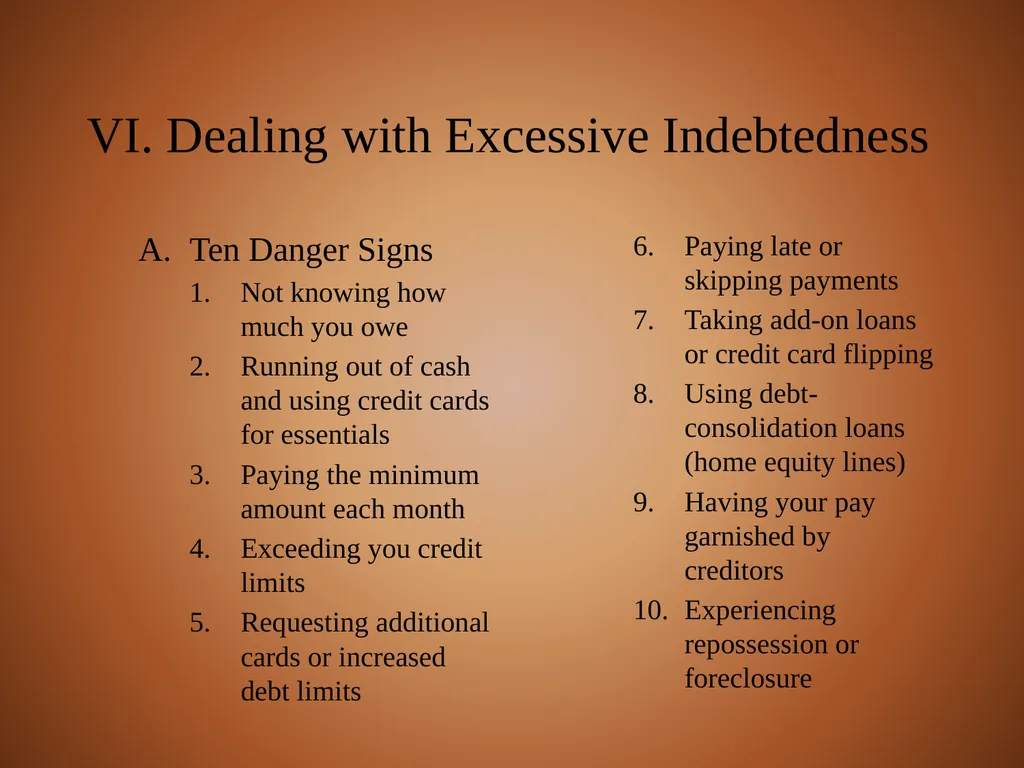
VI. Dealing with Excessive Indebtedness Ten Danger Signs
Not knowing how much you owe
Running out of cash and using credit cards for essentials
Paying the minimum amount each month
Exceeding you credit limits
Requesting additional cards or increased debt limits Paying late or skipping payments
Taking add-on loans or credit card flipping
Using debt-consolidation loans (home equity lines)
Having your pay garnished by creditors
Experiencing repossession or foreclosure<br>
12
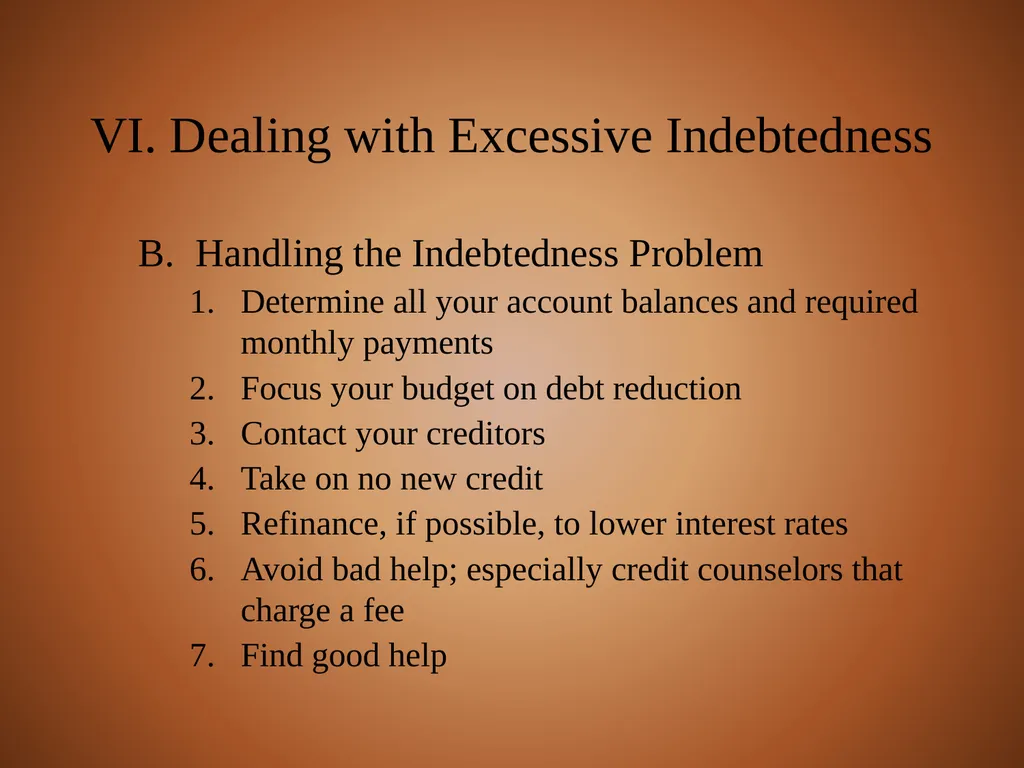
VI. Dealing with Excessive Indebtedness Handling the Indebtedness Problem
Determine all your account balances and required monthly payments
Focus your budget on debt reduction
Contact your creditors
Take on no new credit
Refinance, if possible, to lower interest rates
Avoid bad help; especially credit counselors that charge a fee
Find good help<br>
13
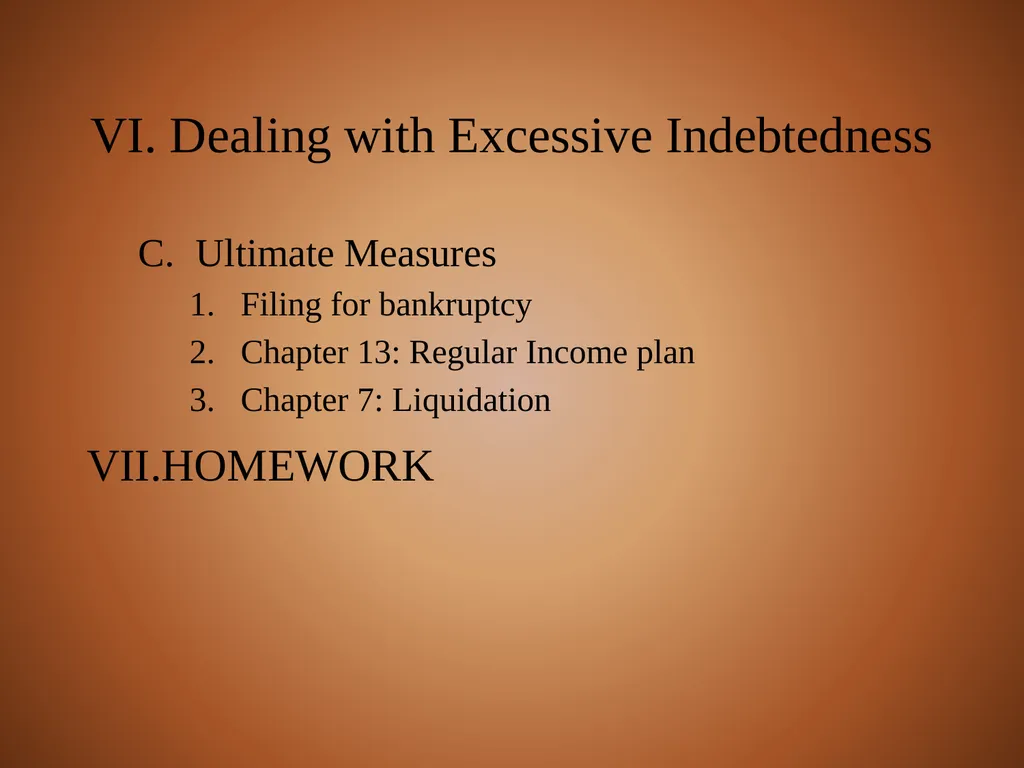
VI. Dealing with Excessive Indebtedness Ultimate Measures
Filing for bankruptcy
Chapter 13: Regular Income plan
Chapter 7: Liquidation
HOMEWORK<br>
14
VII. HOMEWORK Do the Math: 3
Personal Financial Manager: 1 (getting a free copy of your credit report), 4
Be Your Own Personal Financial Planner*
2 – Setting Debt Limits (W/S 25)
3 – List your outstanding installment loans (W/S 26)
5 – List your student loans (W/S 27)
* Much of this information is confidential and should not be turned in with homework.<br>