Chapter 8 concept test If this bonsai pine tree produced cones (which contain seeds), and you took one of the seeds and planted it, what would the adult tree look like? Dwarfed, in a bonsai-like form Tall, like a regular pine tree. It is
"Chapter 8 concept test If this bonsai pine tree" is the property of its rightful owner. Permission is granted to
download and print the materials on this website for personal, non-commercial use only, and to display it
on your personal computer provided you do not modify the materials and that you retain all copyright
notices contained in the materials. By downloading content from our website, you accept the terms of this
agreement.
Presentation Transcript
01
Chapter 8 concept test<br>
02
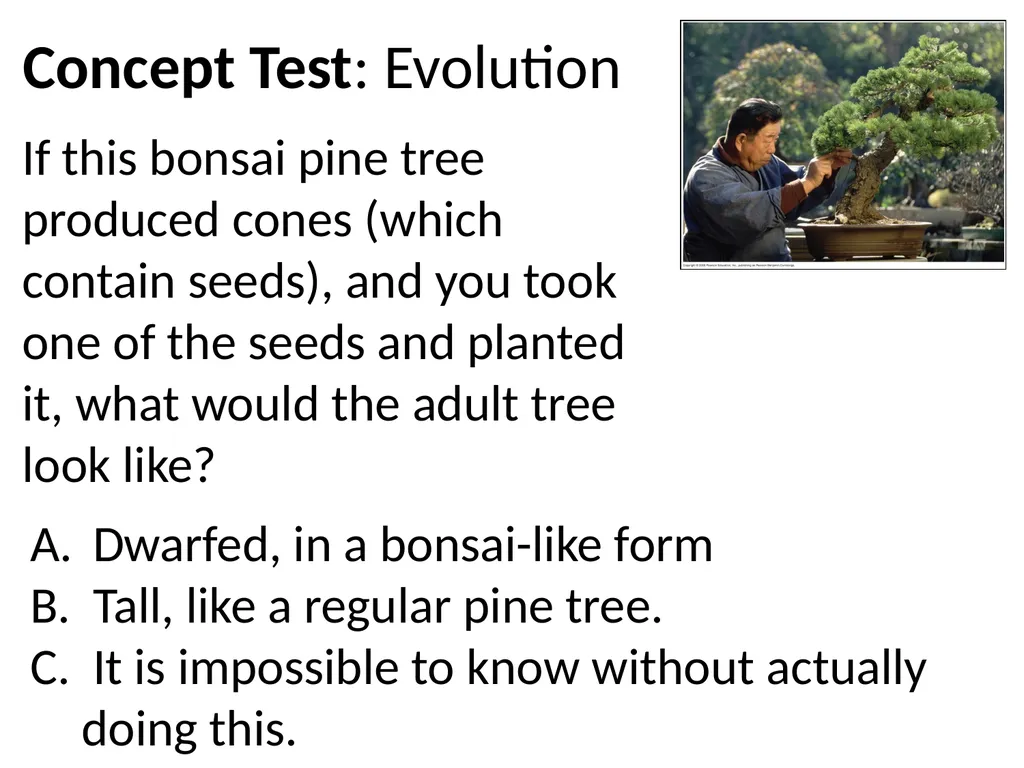
If this bonsai pine tree produced cones (which contain seeds), and you took one of the seeds and planted it, what would the adult tree look like? Dwarfed, in a bonsai-like form
Tall, like a regular pine tree.
It is impossible to know without actually doing this. Concept Test: Evolution<br>
03
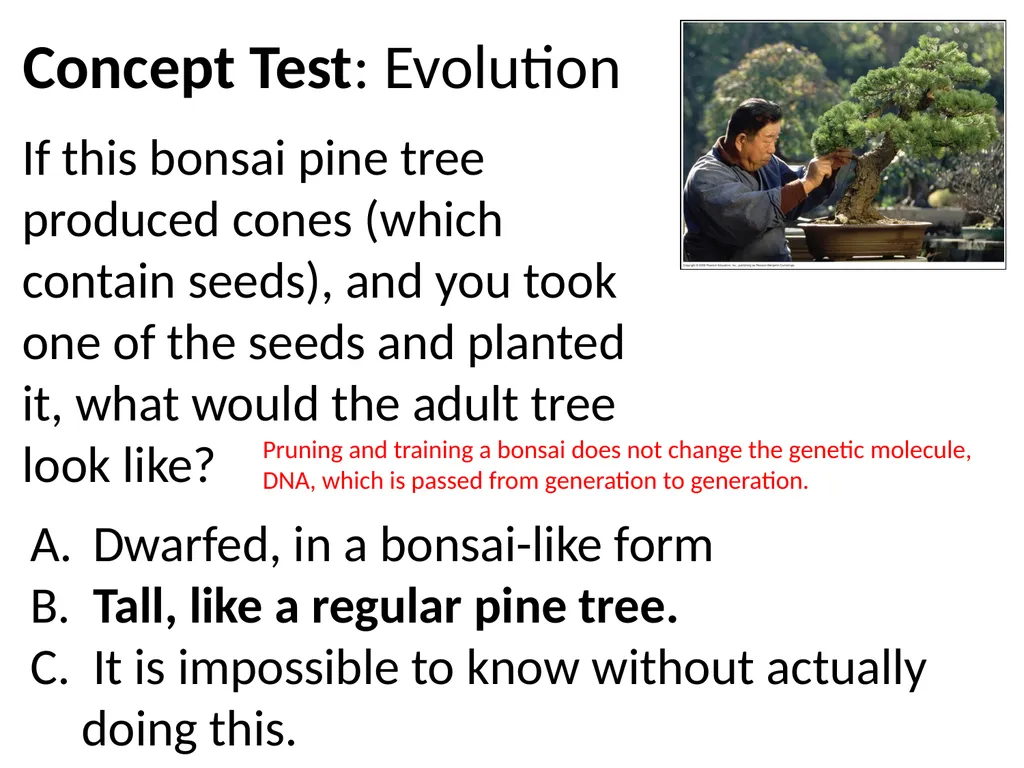
If this bonsai pine tree produced cones (which contain seeds), and you took one of the seeds and planted it, what would the adult tree look like? Dwarfed, in a bonsai-like form
Tall, like a regular pine tree.
It is impossible to know without actually doing this. Concept Test: Evolution Pruning and training a bonsai does not change the genetic molecule, DNA, which is passed from generation to generation.<br>
04
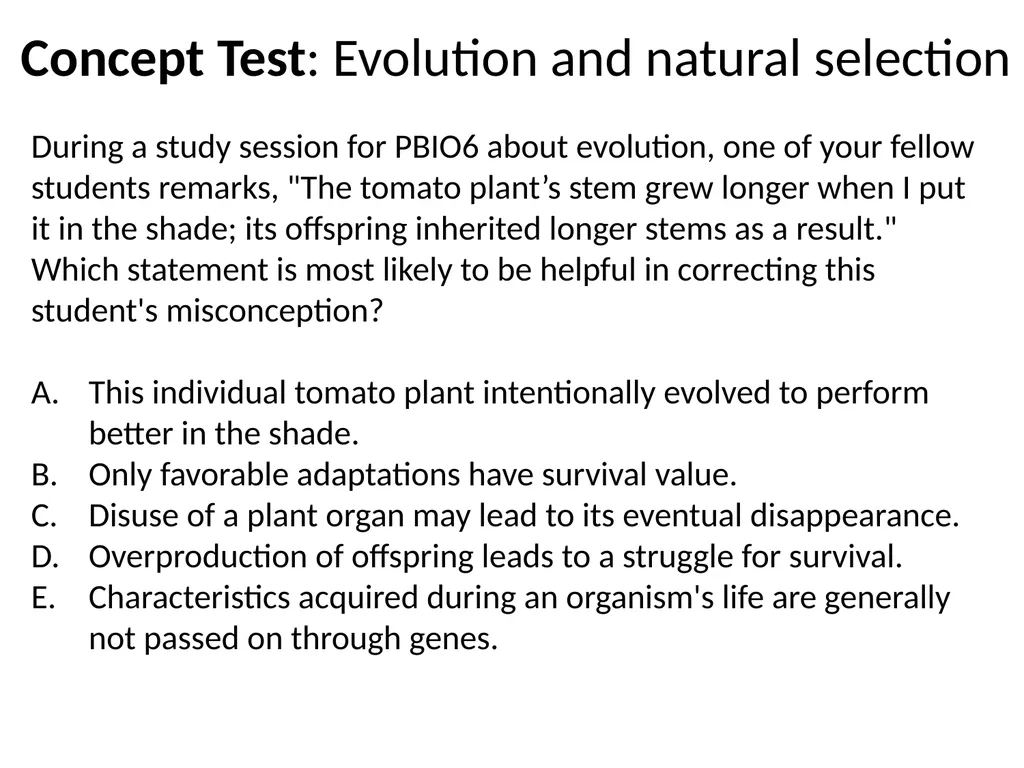
During a study session for PBIO6 about evolution, one of your fellow students remarks, "The tomato plant’s stem grew longer when I put it in the shade; its offspring inherited longer stems as a result." Which statement is most likely to be helpful in correcting this student's misconception?
This individual tomato plant intentionally evolved to perform better in the shade.
Only favorable adaptations have survival value.
Disuse of a plant organ may lead to its eventual disappearance.
Overproduction of offspring leads to a struggle for survival.
Characteristics acquired during an organism's life are generally not passed on through genes. Concept Test: Evolution and natural selection<br>
05
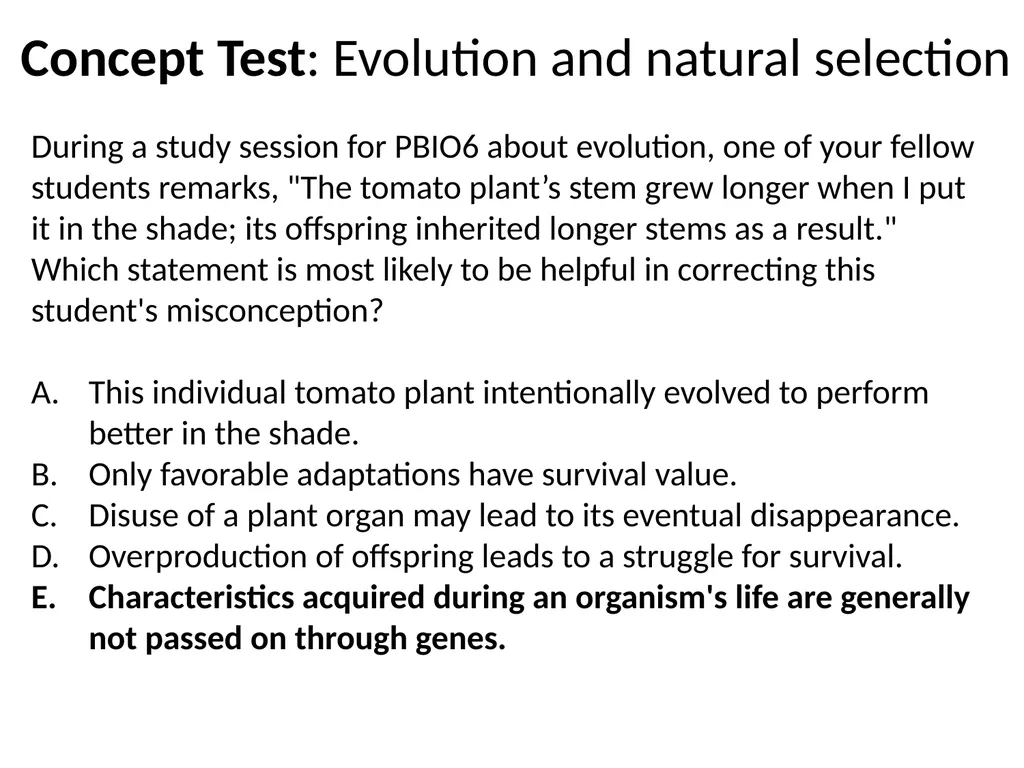
During a study session for PBIO6 about evolution, one of your fellow students remarks, "The tomato plant’s stem grew longer when I put it in the shade; its offspring inherited longer stems as a result." Which statement is most likely to be helpful in correcting this student's misconception?
This individual tomato plant intentionally evolved to perform better in the shade.
Only favorable adaptations have survival value.
Disuse of a plant organ may lead to its eventual disappearance.
Overproduction of offspring leads to a struggle for survival.
Characteristics acquired during an organism's life are generally not passed on through genes. Concept Test: Evolution and natural selection<br>
06
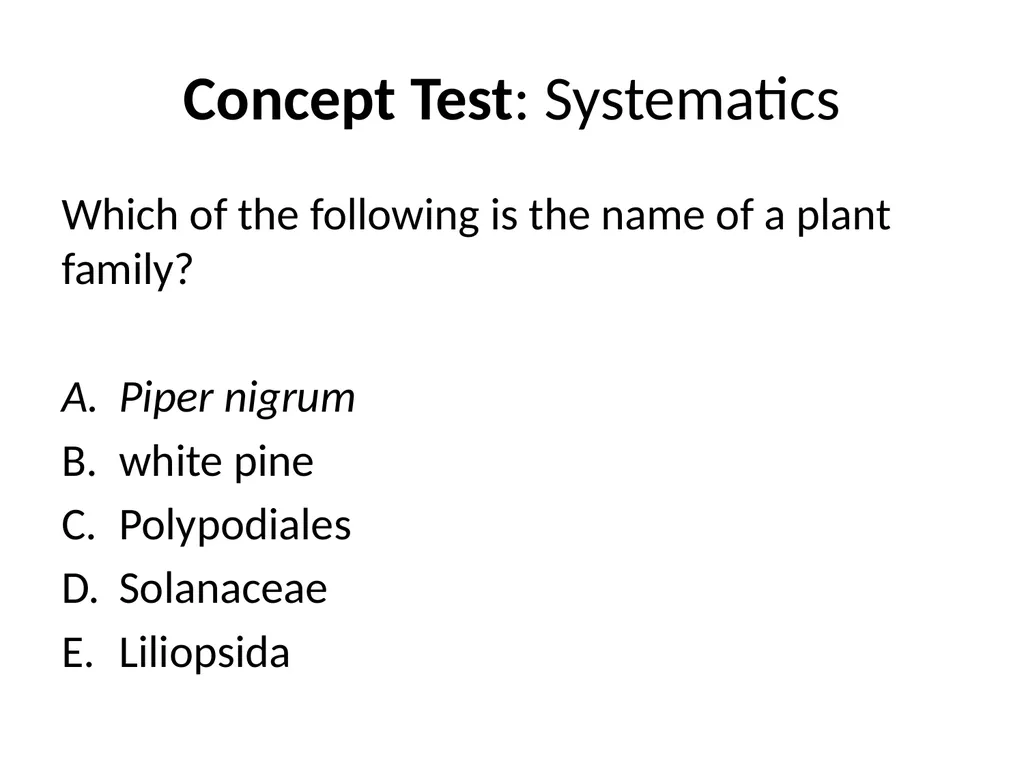
Concept Test: Systematics Which of the following is the name of a plant family?
Piper nigrum
white pine
Polypodiales
Solanaceae
Liliopsida<br>
07
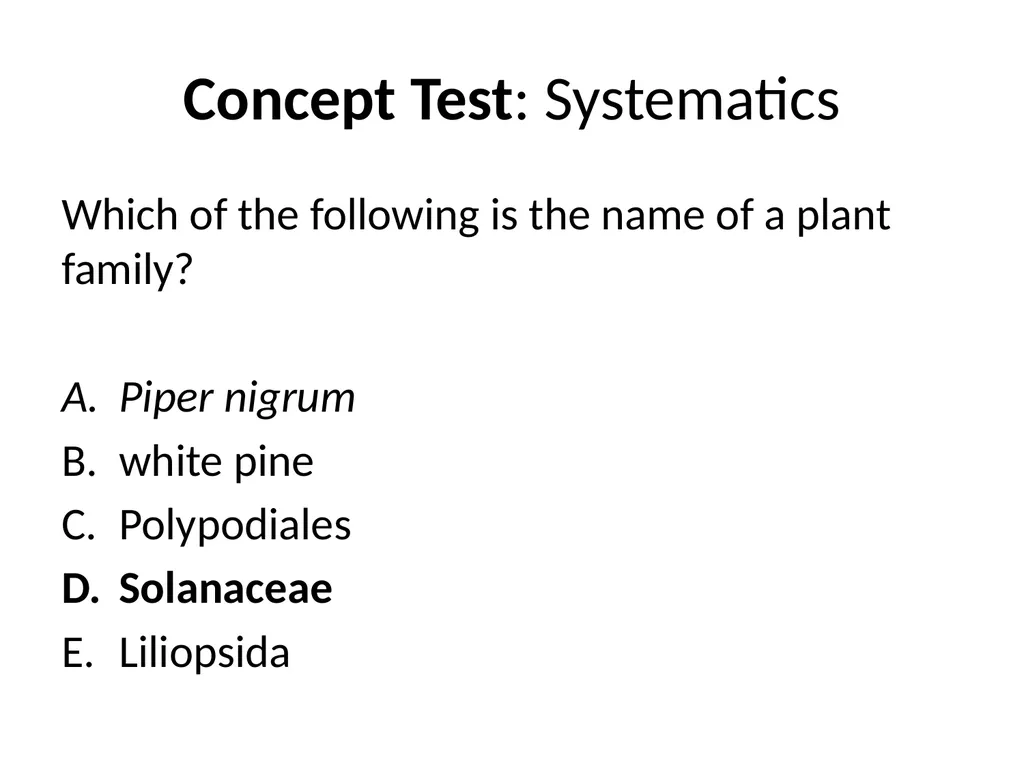
Concept Test: Systematics Which of the following is the name of a plant family?
Piper nigrum
white pine
Polypodiales
Solanaceae
Liliopsida<br>