
Chapter 8: Introduction to Plants 8-1: The Plant
DJ
Published · 25 slides · 0 views

1 / 1



Description
Chapter 8: Introduction to Plants 8-1: The Plant Kingdom Members of the plant kingdom share important characteristics: Eukaryotes Multicellular Autotrophs Perform Photosynthesis to make food. Living on Land Unlike something like
Related Topics
Share
Embed code
Download this presentation From Below
"Chapter 8: Introduction to Plants 8-1: The Plant" is the property of its rightful owner. Permission is granted to download and print the materials on this website for personal, non-commercial use only, and to display it on your personal computer provided you do not modify the materials and that you retain all copyright notices contained in the materials. By downloading content from our website, you accept the terms of this agreement.
Presentation Transcript
01
Chapter 8: Introduction to Plants<br>
02
8-1: The Plant Kingdom
Members of the plant kingdom share important characteristics:
Eukaryotes
Multicellular
Autotrophs
Perform Photosynthesis to make food.
Living on Land
Unlike something like multicellular algae, plants do not have water surrounding them to help them:
Hold their bodies toward the light
Obtain nutrients
Reproduce<br>
03
For a plant to survive on land they must:
Have a way to obtain water/materials
Retain water
Transport materials throughout their body
Support their body
Reproduce successfully
Obtaining Water and Materials
Plants must have adaptations that allow them to obtain water and materials from the soil.
Retaining Water
Because there is more water in plant cells than there is in the air, a plant must have an adaptation to reduce water loss to the air.
Cuticle- waxy water-proof layer of a plant<br>
04
Transporting Materials
Just like our bodies, plants need to transport materials to its entire body.
In general: -water and minerals are absorbed by the bottom of the plant and need to move up.
-Food is made in the top of the plant and need to move down.
Most plants have tissues that allow them to perform this task.
Tissue- group of cells performing a task
Vascular Tissue- internal system of tubelike structures that transport materials in a plant.
Plants with vascular tissue are called vascular plants and can grow tall.<br>
05
Support
Land plants do not have water to support them toward the light.
The photosynthesizing parts of plants (leaves, stems) need as much exposure to sunlight as possible.
In vascular plants, the vascular system strengthens and supports the plant to reach for the light.
Reproduction
All plants reproduce sexually and it involves fertilization.<br>
06
Fertilization- when a sperm cell unites with an egg cell.
Zygote- the fertilized egg
In water, the sperm cell can swim to the egg. But land plants need an adaptation to make it possible for fertilization to occur.
Plants have a complex life cycle made up of two different stages or generations.
Stage 1: the sporophyte produces spores that eventually grow into new organisms.
Stage 2- the spore develops into the gametophyte that produces two different gametes- sperm cells and egg cells.<br>
07
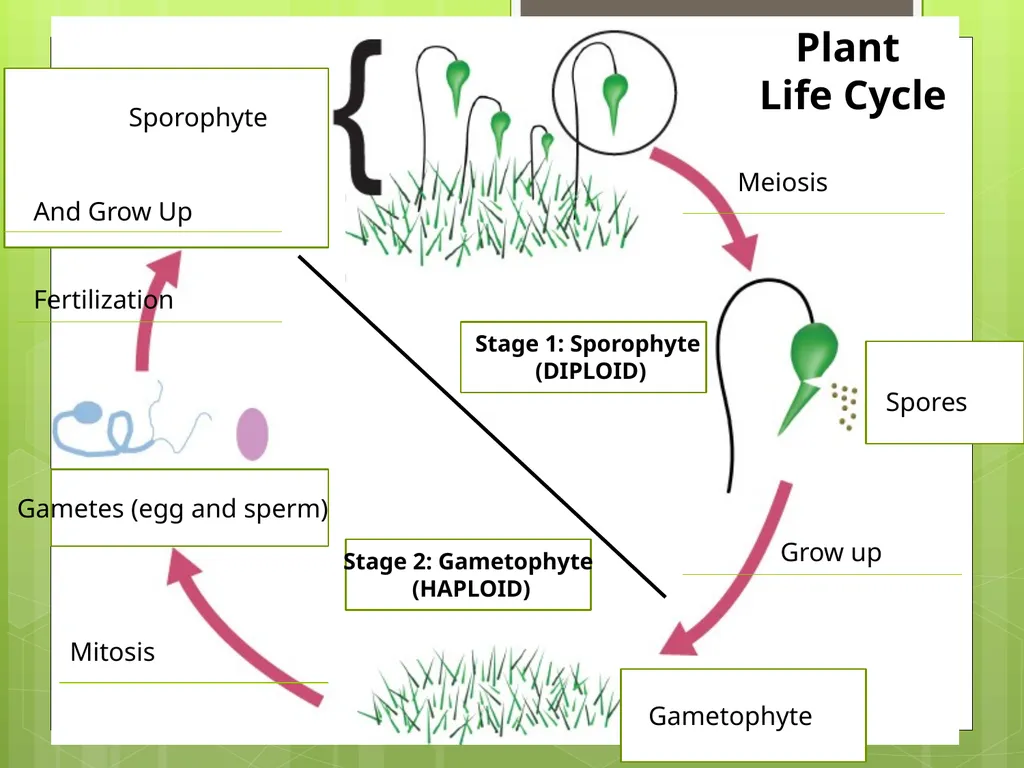
Plant
Life Cycle Sporophyte Meiosis Spores Gametophyte Gametes (egg and sperm) Mitosis Fertilization Grow up Stage 1: Sporophyte
(DIPLOID) Stage 2: Gametophyte
(HAPLOID) And Grow Up<br>
Life Cycle Sporophyte Meiosis Spores Gametophyte Gametes (egg and sperm) Mitosis Fertilization Grow up Stage 1: Sporophyte
(DIPLOID) Stage 2: Gametophyte
(HAPLOID) And Grow Up<br>
08
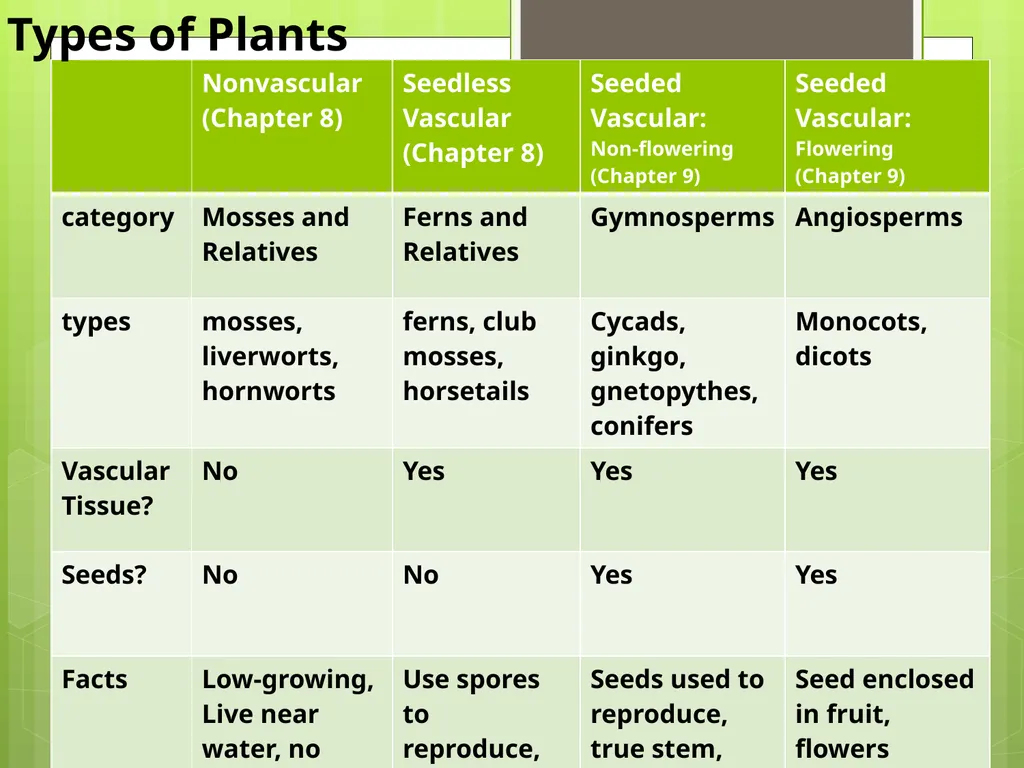
Types of Plants<br>
09
8-2 Nonvascular Plants
General Characteristics of Nonvascular Plants:
Low-growing
Lack vascular tissue- system of tubelike structures that transport water and other materials throughout the plant.
Passing of materials is just from cell to cell.
Lack roots
Obtain water directly from surroundings
Sperm cells use the watery environment to swim to the egg cells.
Examples of nonvascular plants: mosses, liverworts, hornworts<br>
10
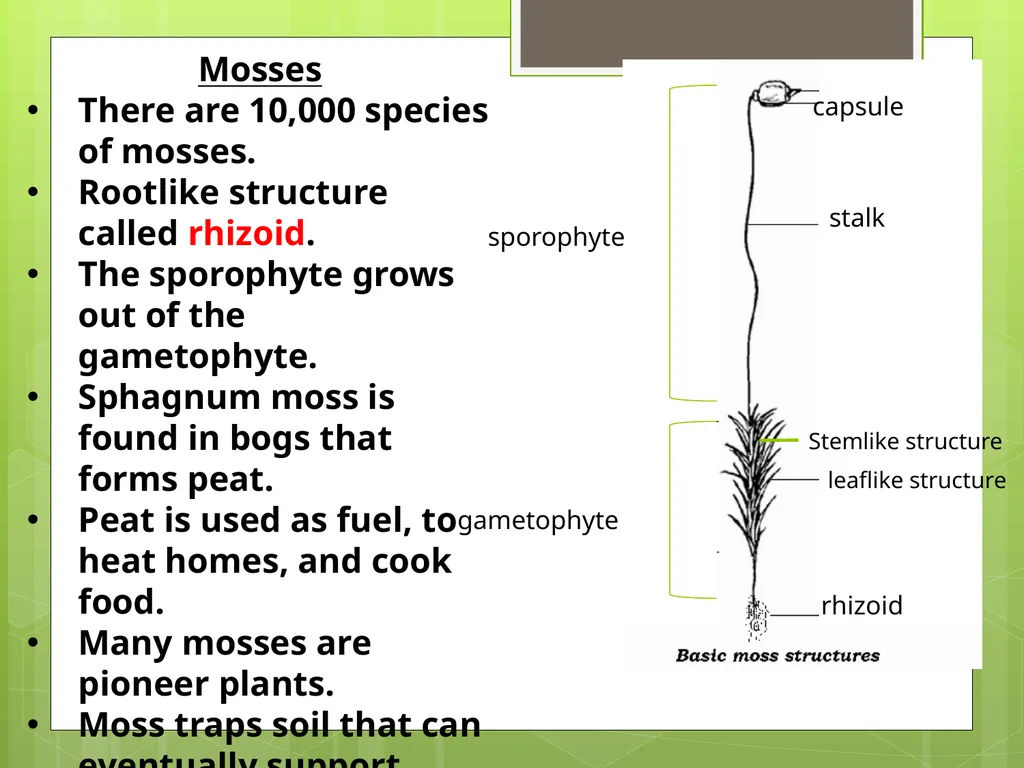
Mosses
There are 10,000 species of mosses.
Rootlike structure called rhizoid.
The sporophyte grows out of the gametophyte.
Sphagnum moss is found in bogs that forms peat.
Peat is used as fuel, to heat homes, and cook food.
Many mosses are pioneer plants.
Moss traps soil that can eventually support other plants. capsule stalk leaflike structure rhizoid Stemlike structure sporophyte gametophyte<br>
11
Liverworts and Hornworts
8,000 species of liverworts.
Found growing as a thick crust on moist rocks or soil along streams.
Most liverworts grow flat on the ground.
Fewer than 100 species of hornworts.
Seldom found on rocks or tree trunks.
Live in moist soil, often mixed with grass plants.<br>
8,000 species of liverworts.
Found growing as a thick crust on moist rocks or soil along streams.
Most liverworts grow flat on the ground.
Fewer than 100 species of hornworts.
Seldom found on rocks or tree trunks.
Live in moist soil, often mixed with grass plants.<br>
12
8-2 Review
What are five general characteristics of nonvascular plants?
What are three examples of nonvascular plants?
Draw and label the parts of a moss plant.
Where do liverworts grow?
Where do hornworts grow?<br>
What are five general characteristics of nonvascular plants?
What are three examples of nonvascular plants?
Draw and label the parts of a moss plant.
Where do liverworts grow?
Where do hornworts grow?<br>
13
8-3: Seedless Vascular Plants
General Characteristics of Seedless Vascular Plants:
Vascular Tissue present
Use spores to reproduce
Examples: ferns, club mosses, and horsetails
Vascular Tissue:
Vascular Tissue allows plants to grow tall.
Vascular plants are better suited for life on land because vascular tissue solves the problems of support and transportation.
Transportation- food and water are transported quickly through the vascular tissue.<br>
14
Support- Vascular tissue strengthens the plants body like a bundle of straws.
Spores for Reproduction:
Vascular plants still need to grow in moist surroundings.
Plant releases spores into surroundings
They grow into gametophytes
Gametophyte produces egg and sperm cells
There must be enough water for fertilization to occur.<br>
Spores for Reproduction:
Vascular plants still need to grow in moist surroundings.
Plant releases spores into surroundings
They grow into gametophytes
Gametophyte produces egg and sperm cells
There must be enough water for fertilization to occur.<br>
15
Ferns
First fern appeared on land 400 million years ago
12,000 species alive today
Range in size from very tiny to tall trees.
Fern Structure
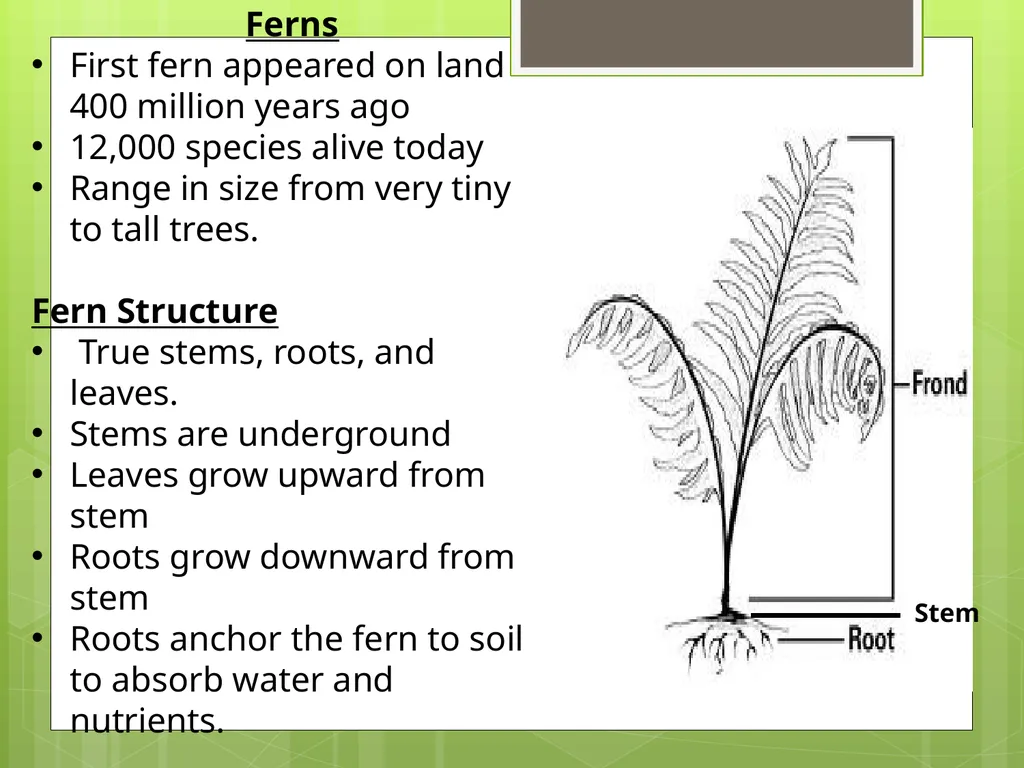
True stems, roots, and leaves.
Stems are underground
Leaves grow upward from stem
Roots grow downward from stem
Roots anchor the fern to soil to absorb water and nutrients. Stem<br>
16
Fern Structure (cont.)
The leaves are called fronds.
Has a divided leaf structure.
Cuticle helps the plant retain water.
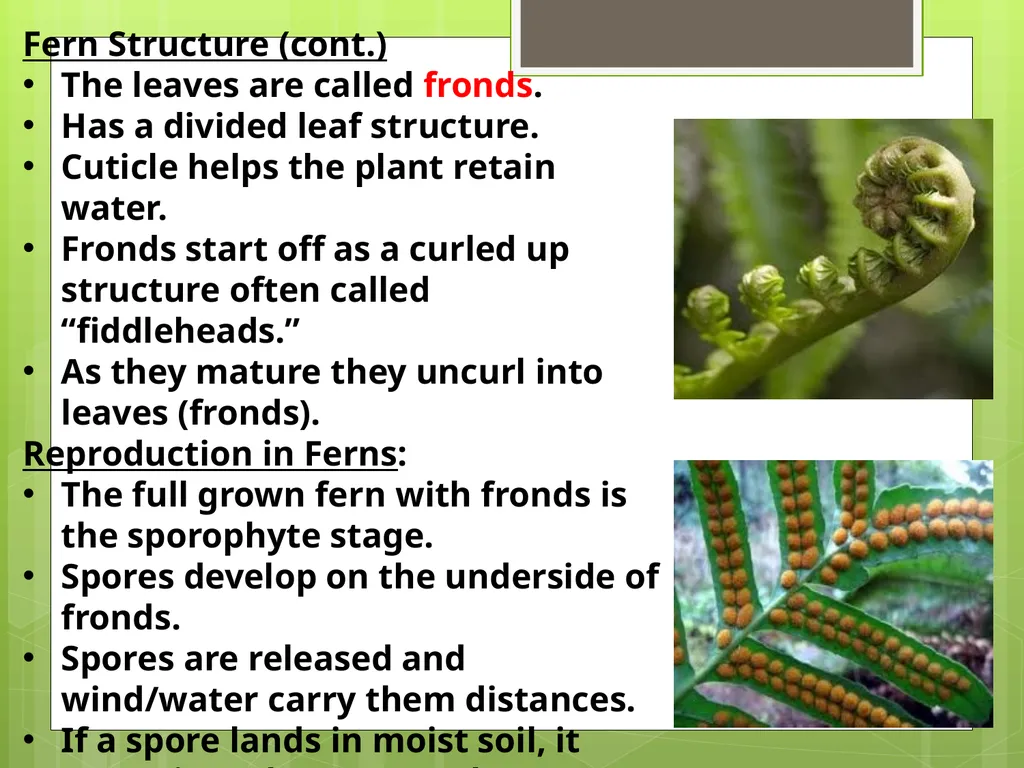
Fronds start off as a curled up structure often called “fiddleheads.”
As they mature they uncurl into leaves (fronds).
Reproduction in Ferns:
The full grown fern with fronds is the sporophyte stage.
Spores develop on the underside of fronds.
Spores are released and wind/water carry them distances.
If a spore lands in moist soil, it grows into the gametophyte stage.<br>
17
The Importance of Ferns
Ferns make nice houseplants because they are attractive and easy to grow.
Ferns can help grow other kinds of plants.
Some ferns are good to eat especially when they are fiddleheads.
In some farms, ferns are grown to provide a place for bacteria to grow. That bacteria is used as a natural fertilizer.<br>
18
Seedless Vascular Plants: Club Mosses and Horsetails
Like ferns, club mosses and horsetails have
true roots, leaves and stems.
They also have a similar life cycle.
There are only a few species alive today.
Do not be confused by their name: Club Mosses are not mosses because they have vascular tissue!
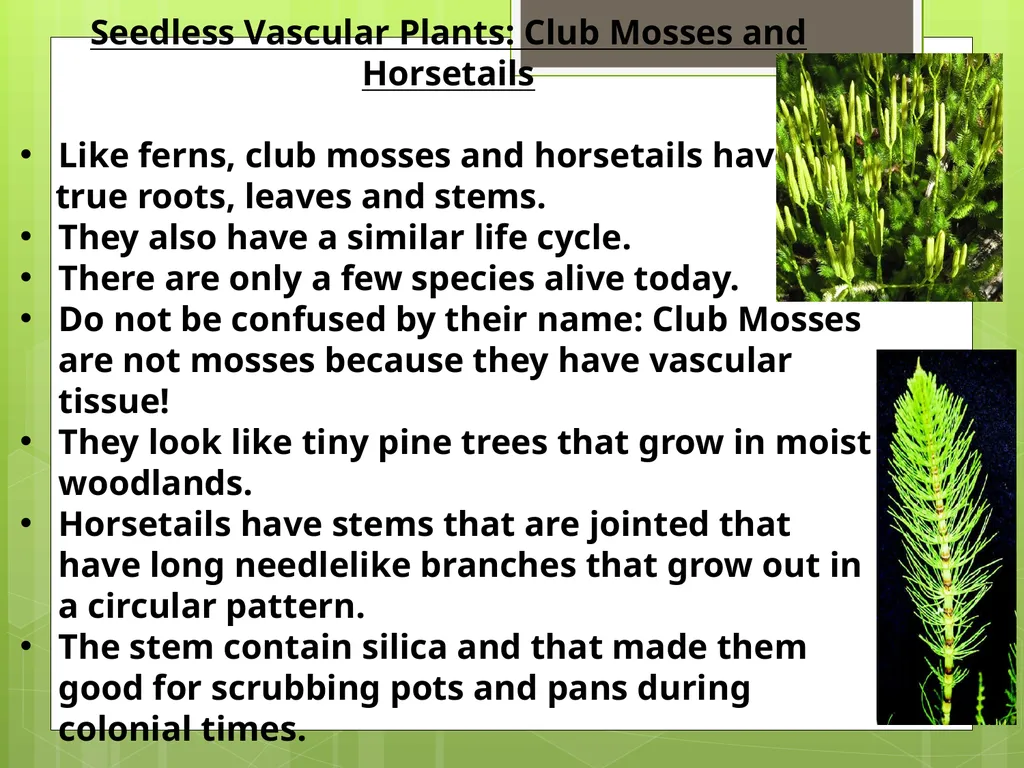
They look like tiny pine trees that grow in moist woodlands.
Horsetails have stems that are jointed that have long needlelike branches that grow out in a circular pattern.
The stem contain silica and that made them good for scrubbing pots and pans during colonial times.<br>
19
Draw it!
A frond is a leaf of a fern. It is a large leaf with a “divided leaf structure” meaning several long, thin leaves branch off of a central stem-like structure. What does a frond look like? DRAW IT!<br>
A frond is a leaf of a fern. It is a large leaf with a “divided leaf structure” meaning several long, thin leaves branch off of a central stem-like structure. What does a frond look like? DRAW IT!<br>
20
Draw it!
A fern is a vascular plant. It has vascular tissue that supports and transports materials. Vascular tissue is like a bundle of straws. What would it look like if you cut a fern stem in half and looked down at it? DRAW IT!<br>
A fern is a vascular plant. It has vascular tissue that supports and transports materials. Vascular tissue is like a bundle of straws. What would it look like if you cut a fern stem in half and looked down at it? DRAW IT!<br>
21
Draw it!
A young fern frond is called a fiddlehead. It is a curled up baby frond that uncurls as the plant matures. It kind of looks like a new years eve horn that you blow into. DRAW IT!<br>
A young fern frond is called a fiddlehead. It is a curled up baby frond that uncurls as the plant matures. It kind of looks like a new years eve horn that you blow into. DRAW IT!<br>
22
Draw it!
Spores develop in little containers on the underside of the fronds. They look like simple little brown dots, but they actually contain thousands of spores. What would a frond look like from underneath? DRAW IT!<br>
Spores develop in little containers on the underside of the fronds. They look like simple little brown dots, but they actually contain thousands of spores. What would a frond look like from underneath? DRAW IT!<br>
23
8-4: Feeding the World
Farmers need to be able to grow enough food for our growing world.
In laboratories scientists are developing plants that are more resistant to insects, disease, and drought.
They are also developing plants that produce more food per plant with new high-tech practices involving genetic engineering.
Producing Better Plants
Wheat, rice, and corn are the major sources of food for people on earth today.<br>
24
One challenge for farmers is that these crops only grow in certain climates.
Another challenge is that plants only produce a limited amount of food per plant.
Genetic engineering of plants have helped to solve these problems.
Plants can grow in a wider range of climates, be resistant to damage, and produce more food.
Improving the Efficiency of Farms
New technology using satellites help farmers with “precision farming”- knowing just how much fertilizer and water each field requires.
Precision farming saves farmers time and money, and helps farmers maintain ideal conditions for growing.<br>
25
Precision farming also benefits the environment because farmers use only as much fertilizer as the soil needs.
Less fertilizer means less nutrients drain off into lakes and rivers- thus reducing the chance of algal blooms.
Hydroponics
In some areas of the world, poor soil does not support the growth of crops.
In these areas, people can use hydroponics- a method where plants are grown in nutrient-rich solutions instead of soil.
Unfortunately, hydroponics is expensive, but it does help grow crops in some areas.<br>