
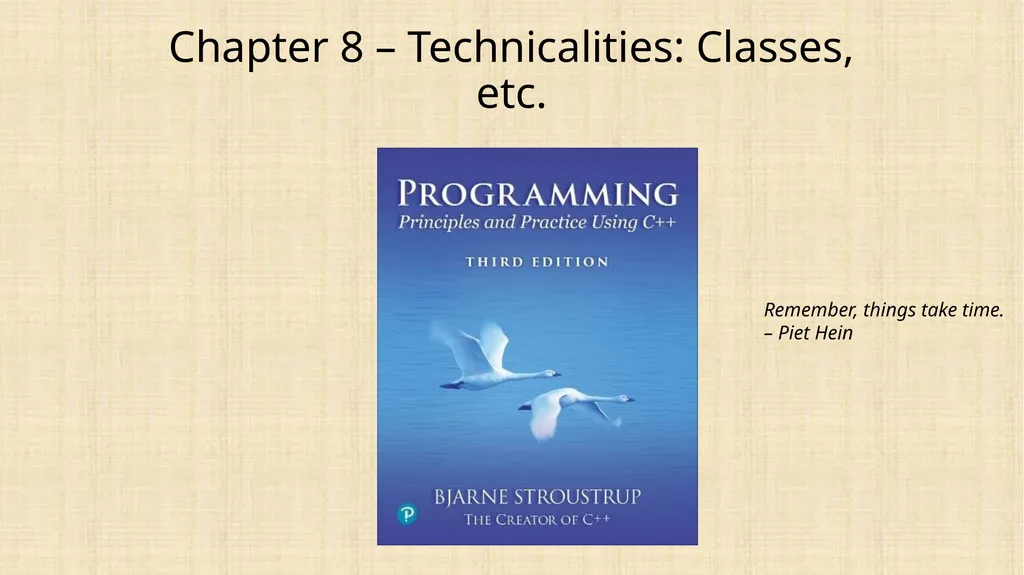
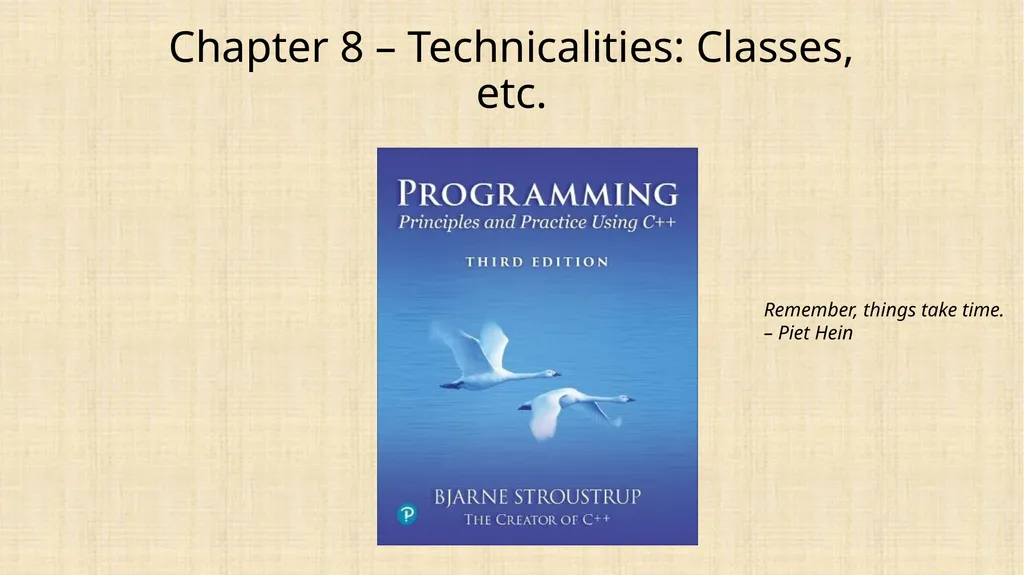
Chapter 8 – Technicalities: Classes, etc.
LD
Published · 32 slides · 0 views
1 / 1
Description
Chapter 8 Technicalities: Classes, etc. Remember, things take time. Piet Hein Abstract This lecture presents language technicalities, mostly related to user defined types; that is, classes and enumerations.
Related Topics
Share
Embed code
Download this presentation From Below
"Chapter 8 – Technicalities: Classes, etc." is the property of its rightful owner. Permission is granted to download and print the materials on this website for personal, non-commercial use only, and to display it on your personal computer provided you do not modify the materials and that you retain all copyright notices contained in the materials. By downloading content from our website, you accept the terms of this agreement.
Presentation Transcript
01
Chapter 8 – Technicalities: Classes, etc. Remember, things take time.
– Piet Hein<br>
– Piet Hein<br>
02
Abstract This lecture presents language technicalities, mostly related to user defined types; that is, classes and enumerations. Stroustrup/Programming/2024/Chapter8 2<br>
03
Overview Classes
Implementation and interface
Constructors
Member functions
Enumerations
Operator overloading Stroustrup/Programming/2024/Chapter8 3<br>
Implementation and interface
Constructors
Member functions
Enumerations
Operator overloading Stroustrup/Programming/2024/Chapter8 3<br>
04
Classes The idea:
A class directly represents a concept in a program
If you can think of “it” as a separate entity, it is plausible that it could be a class or an object of a class
Examples: vector, matrix, input stream, string, FFT, valve controller, robot arm, device driver, picture on screen, dialog box, graph, window, temperature reading, clock
A class is a (user-defined) type that specifies how objects of its type can be created and used
In C++ (as in most modern languages), a class is the key building block for large programs
And very useful for small ones also
The concept was originally introduced in Simula67 Stroustrup/Programming/2024/Chapter8 4<br>
A class directly represents a concept in a program
If you can think of “it” as a separate entity, it is plausible that it could be a class or an object of a class
Examples: vector, matrix, input stream, string, FFT, valve controller, robot arm, device driver, picture on screen, dialog box, graph, window, temperature reading, clock
A class is a (user-defined) type that specifies how objects of its type can be created and used
In C++ (as in most modern languages), a class is the key building block for large programs
And very useful for small ones also
The concept was originally introduced in Simula67 Stroustrup/Programming/2024/Chapter8 4<br>
05
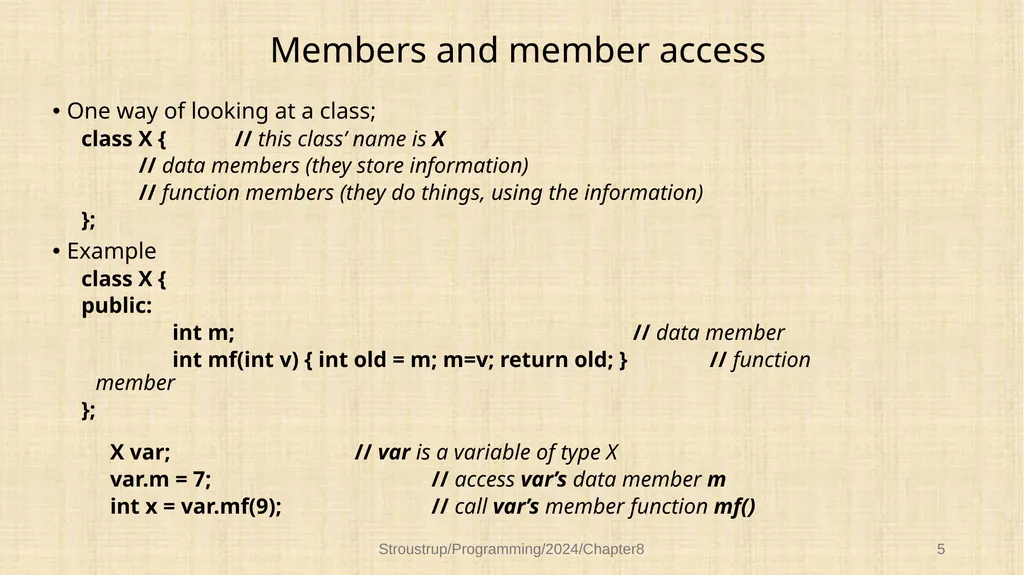
Members and member access One way of looking at a class;
class X { // this class’ name is X
// data members (they store information)
// function members (they do things, using the information)
};
Example
class X {
public:
int m; // data member
int mf(int v) { int old = m; m=v; return old; } // function member
};
X var; // var is a variable of type X
var.m = 7; // access var’s data member m
int x = var.mf(9); // call var’s member function mf() Stroustrup/Programming/2024/Chapter8 5<br>
class X { // this class’ name is X
// data members (they store information)
// function members (they do things, using the information)
};
Example
class X {
public:
int m; // data member
int mf(int v) { int old = m; m=v; return old; } // function member
};
X var; // var is a variable of type X
var.m = 7; // access var’s data member m
int x = var.mf(9); // call var’s member function mf() Stroustrup/Programming/2024/Chapter8 5<br>
06
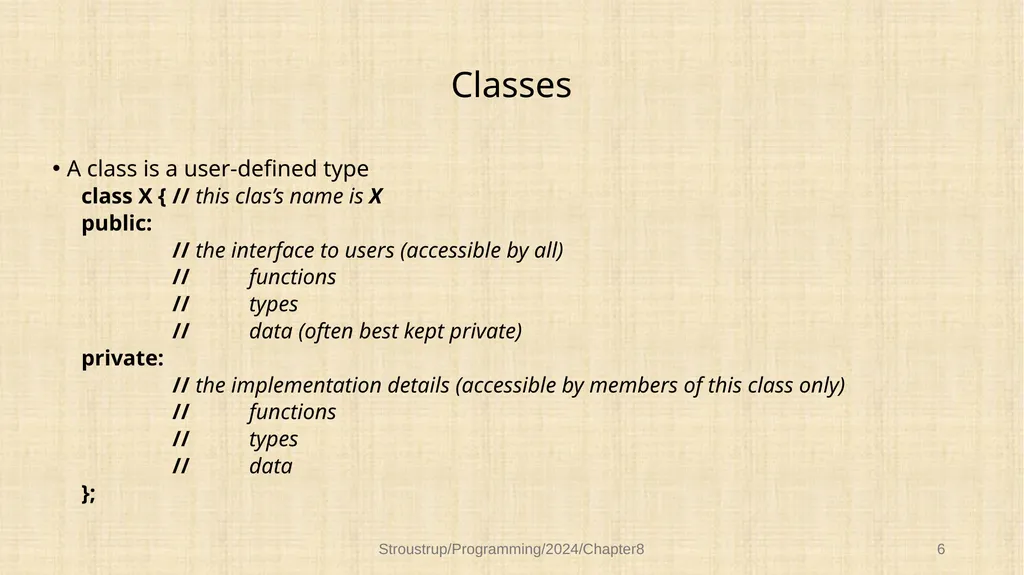
Classes A class is a user-defined type
class X { // this clas’s name is X
public:
// the interface to users (accessible by all)
// functions
// types
// data (often best kept private)
private:
// the implementation details (accessible by members of this class only)
// functions
// types
// data
}; Stroustrup/Programming/2024/Chapter8 6<br>
class X { // this clas’s name is X
public:
// the interface to users (accessible by all)
// functions
// types
// data (often best kept private)
private:
// the implementation details (accessible by members of this class only)
// functions
// types
// data
}; Stroustrup/Programming/2024/Chapter8 6<br>
07
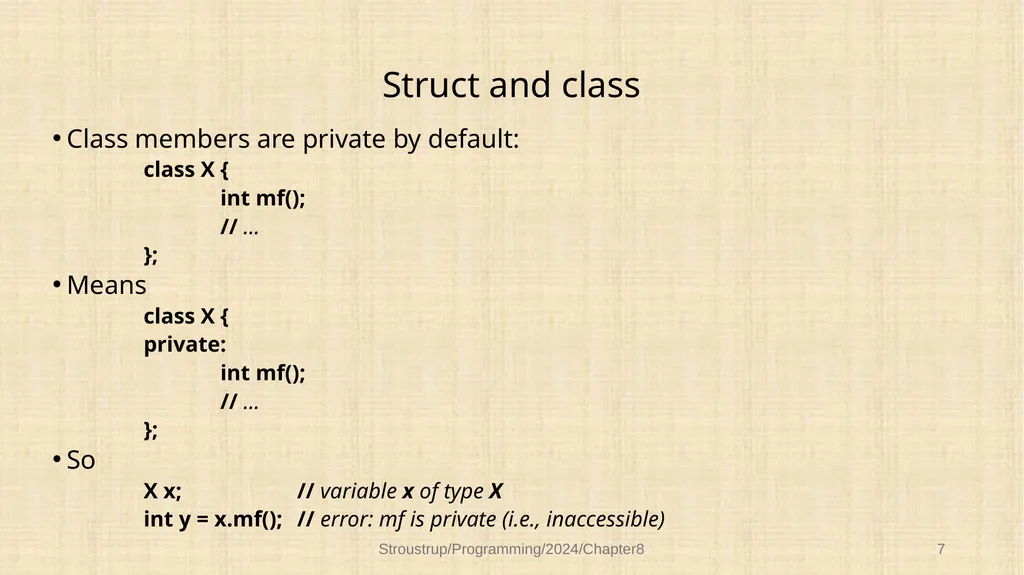
Struct and class Class members are private by default:
class X {
int mf();
// …
};
Means
class X {
private:
int mf();
// …
};
So
X x; // variable x of type X
int y = x.mf(); // error: mf is private (i.e., inaccessible) Stroustrup/Programming/2024/Chapter8 7<br>
class X {
int mf();
// …
};
Means
class X {
private:
int mf();
// …
};
So
X x; // variable x of type X
int y = x.mf(); // error: mf is private (i.e., inaccessible) Stroustrup/Programming/2024/Chapter8 7<br>
08
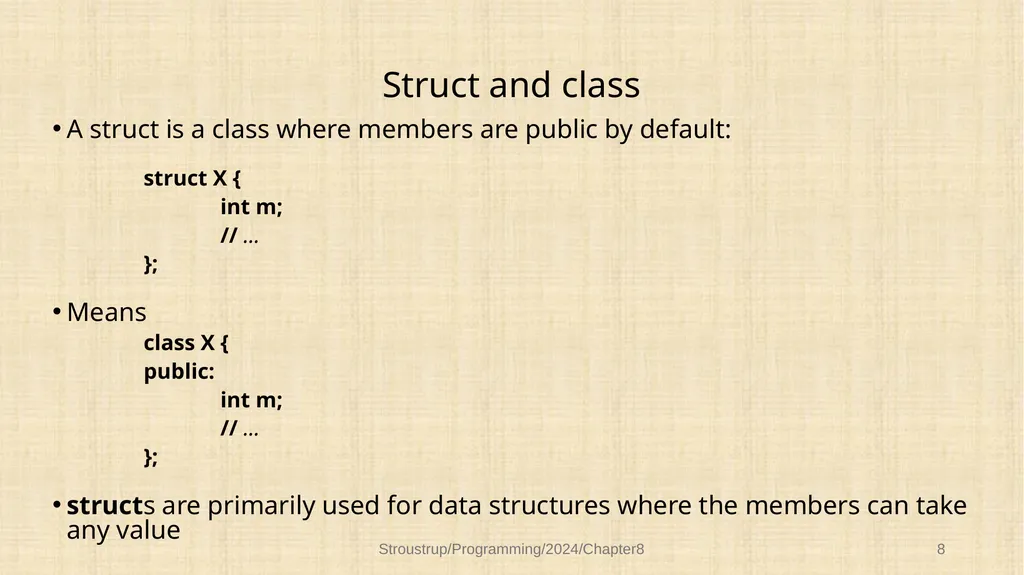
Struct and class A struct is a class where members are public by default:
struct X {
int m;
// …
};
Means
class X {
public:
int m;
// …
};
structs are primarily used for data structures where the members can take any value Stroustrup/Programming/2024/Chapter8 8<br>
struct X {
int m;
// …
};
Means
class X {
public:
int m;
// …
};
structs are primarily used for data structures where the members can take any value Stroustrup/Programming/2024/Chapter8 8<br>
09
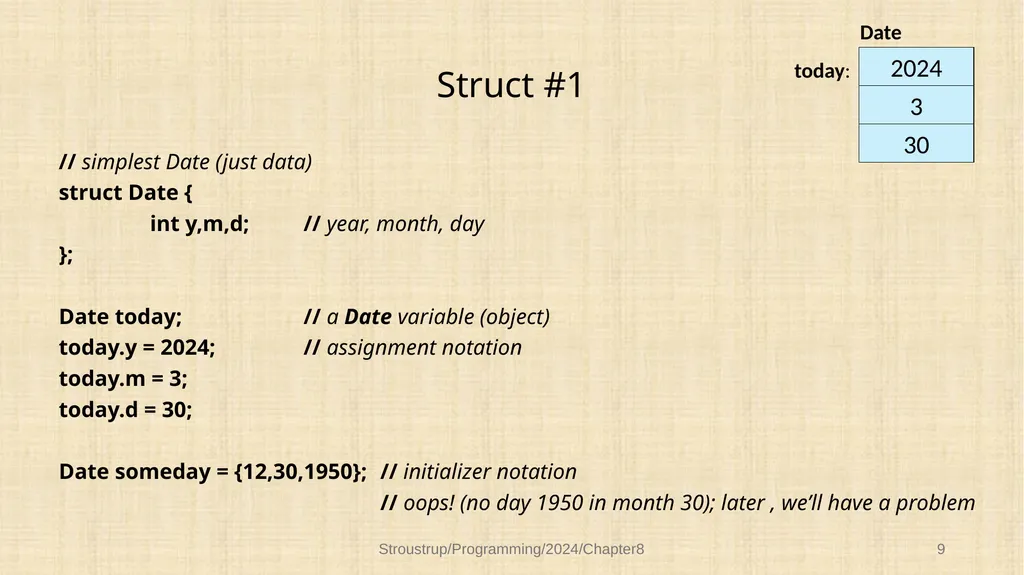
Struct #1 // simplest Date (just data)
struct Date {
int y,m,d; // year, month, day
};
Date today; // a Date variable (object)
today.y = 2024; // assignment notation
today.m = 3;
today.d = 30;
Date someday = {12,30,1950}; // initializer notation
// oops! (no day 1950 in month 30); later , we’ll have a problem Stroustrup/Programming/2024/Chapter8 9 2024 30 3 Date today:<br>
struct Date {
int y,m,d; // year, month, day
};
Date today; // a Date variable (object)
today.y = 2024; // assignment notation
today.m = 3;
today.d = 30;
Date someday = {12,30,1950}; // initializer notation
// oops! (no day 1950 in month 30); later , we’ll have a problem Stroustrup/Programming/2024/Chapter8 9 2024 30 3 Date today:<br>
10
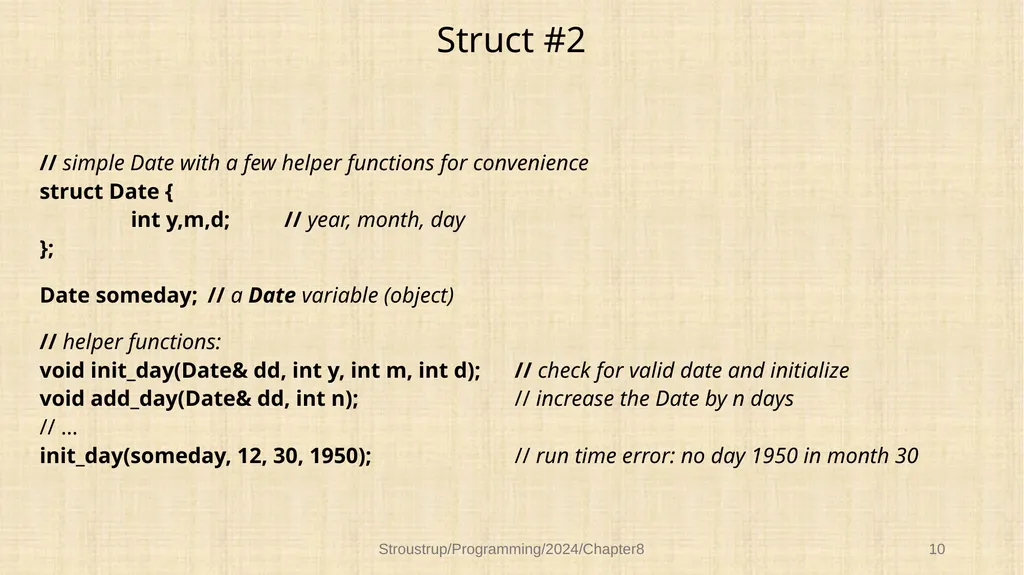
Struct #2 // simple Date with a few helper functions for convenience
struct Date {
int y,m,d; // year, month, day
};
Date someday; // a Date variable (object)
// helper functions:
void init_day(Date& dd, int y, int m, int d); // check for valid date and initialize
void add_day(Date& dd, int n); // increase the Date by n days
// …
init_day(someday, 12, 30, 1950); // run time error: no day 1950 in month 30 Stroustrup/Programming/2024/Chapter8 10<br>
struct Date {
int y,m,d; // year, month, day
};
Date someday; // a Date variable (object)
// helper functions:
void init_day(Date& dd, int y, int m, int d); // check for valid date and initialize
void add_day(Date& dd, int n); // increase the Date by n days
// …
init_day(someday, 12, 30, 1950); // run time error: no day 1950 in month 30 Stroustrup/Programming/2024/Chapter8 10<br>
11
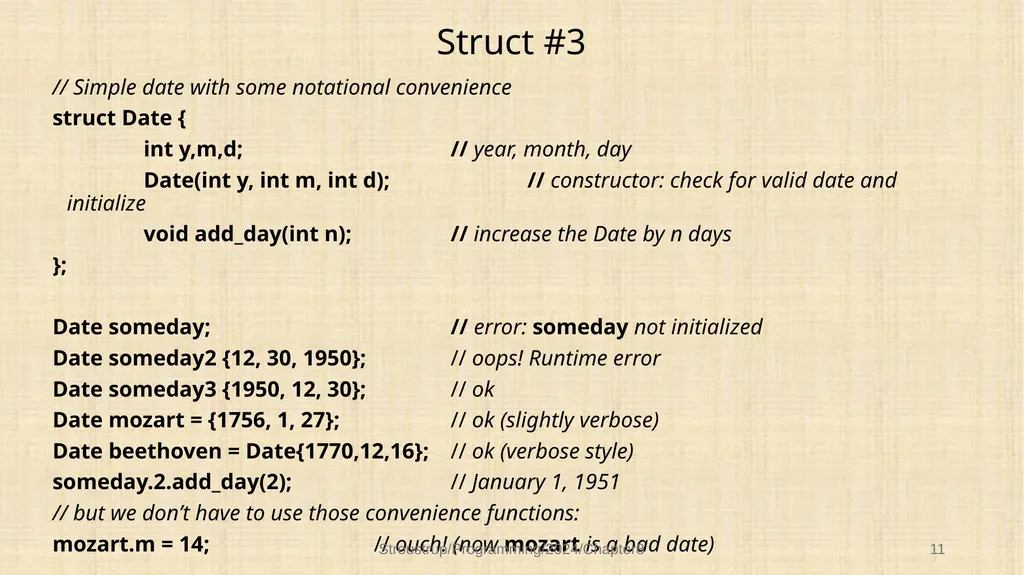
Struct #3 // Simple date with some notational convenience
struct Date {
int y,m,d; // year, month, day
Date(int y, int m, int d); // constructor: check for valid date and initialize
void add_day(int n); // increase the Date by n days
};
Date someday; // error: someday not initialized
Date someday2 {12, 30, 1950}; // oops! Runtime error
Date someday3 {1950, 12, 30}; // ok
Date mozart = {1756, 1, 27}; // ok (slightly verbose)
Date beethoven = Date{1770,12,16}; // ok (verbose style)
someday.2.add_day(2); // January 1, 1951
// but we don’t have to use those convenience functions:
mozart.m = 14; // ouch! (now mozart is a bad date) Stroustrup/Programming/2024/Chapter8 11<br>
struct Date {
int y,m,d; // year, month, day
Date(int y, int m, int d); // constructor: check for valid date and initialize
void add_day(int n); // increase the Date by n days
};
Date someday; // error: someday not initialized
Date someday2 {12, 30, 1950}; // oops! Runtime error
Date someday3 {1950, 12, 30}; // ok
Date mozart = {1756, 1, 27}; // ok (slightly verbose)
Date beethoven = Date{1770,12,16}; // ok (verbose style)
someday.2.add_day(2); // January 1, 1951
// but we don’t have to use those convenience functions:
mozart.m = 14; // ouch! (now mozart is a bad date) Stroustrup/Programming/2024/Chapter8 11<br>
12
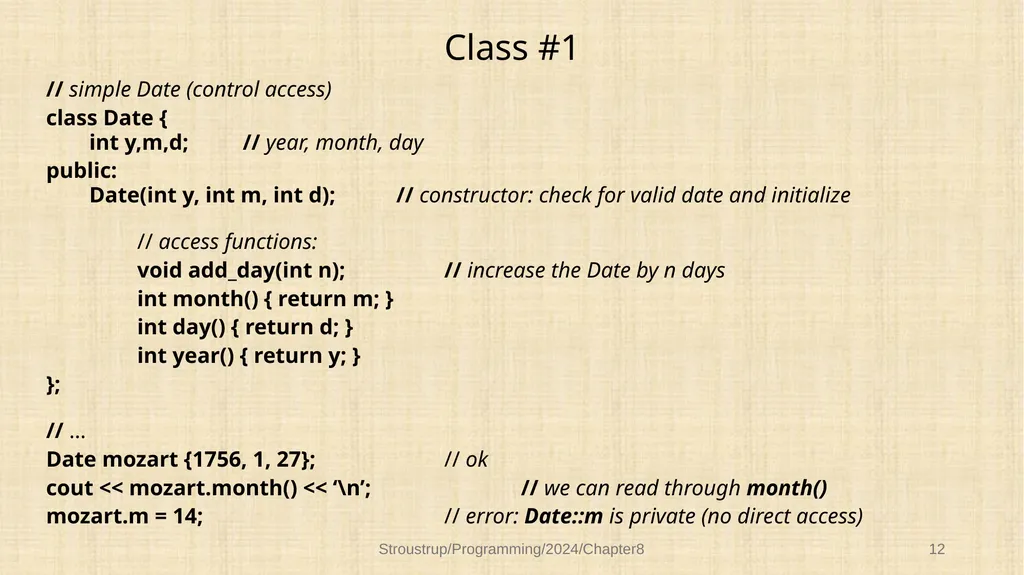
Class #1 // simple Date (control access)
class Date {
int y,m,d; // year, month, day
public:
Date(int y, int m, int d); // constructor: check for valid date and initialize
// access functions:
void add_day(int n); // increase the Date by n days
int month() { return m; }
int day() { return d; }
int year() { return y; }
};
// …
Date mozart {1756, 1, 27}; // ok
cout << mozart.month() << ‘\n’; // we can read through month()
mozart.m = 14; // error: Date::m is private (no direct access) Stroustrup/Programming/2024/Chapter8 12<br>
class Date {
int y,m,d; // year, month, day
public:
Date(int y, int m, int d); // constructor: check for valid date and initialize
// access functions:
void add_day(int n); // increase the Date by n days
int month() { return m; }
int day() { return d; }
int year() { return y; }
};
// …
Date mozart {1756, 1, 27}; // ok
cout << mozart.month() << ‘\n’; // we can read through month()
mozart.m = 14; // error: Date::m is private (no direct access) Stroustrup/Programming/2024/Chapter8 12<br>
13
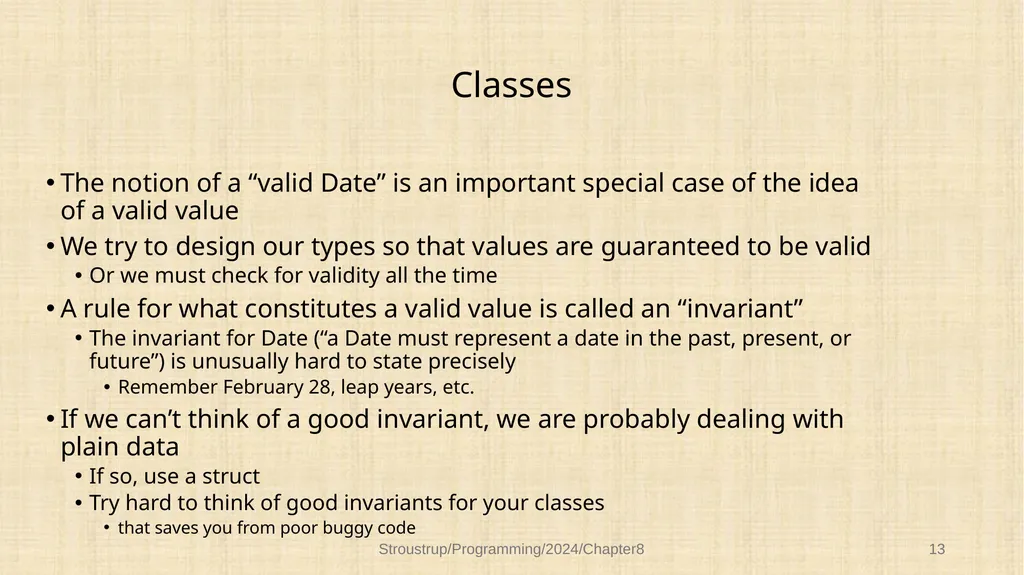
Classes The notion of a “valid Date” is an important special case of the idea of a valid value
We try to design our types so that values are guaranteed to be valid
Or we must check for validity all the time
A rule for what constitutes a valid value is called an “invariant”
The invariant for Date (“a Date must represent a date in the past, present, or future”) is unusually hard to state precisely
Remember February 28, leap years, etc.
If we can’t think of a good invariant, we are probably dealing with plain data
If so, use a struct
Try hard to think of good invariants for your classes
that saves you from poor buggy code Stroustrup/Programming/2024/Chapter8 13<br>
We try to design our types so that values are guaranteed to be valid
Or we must check for validity all the time
A rule for what constitutes a valid value is called an “invariant”
The invariant for Date (“a Date must represent a date in the past, present, or future”) is unusually hard to state precisely
Remember February 28, leap years, etc.
If we can’t think of a good invariant, we are probably dealing with plain data
If so, use a struct
Try hard to think of good invariants for your classes
that saves you from poor buggy code Stroustrup/Programming/2024/Chapter8 13<br>
14
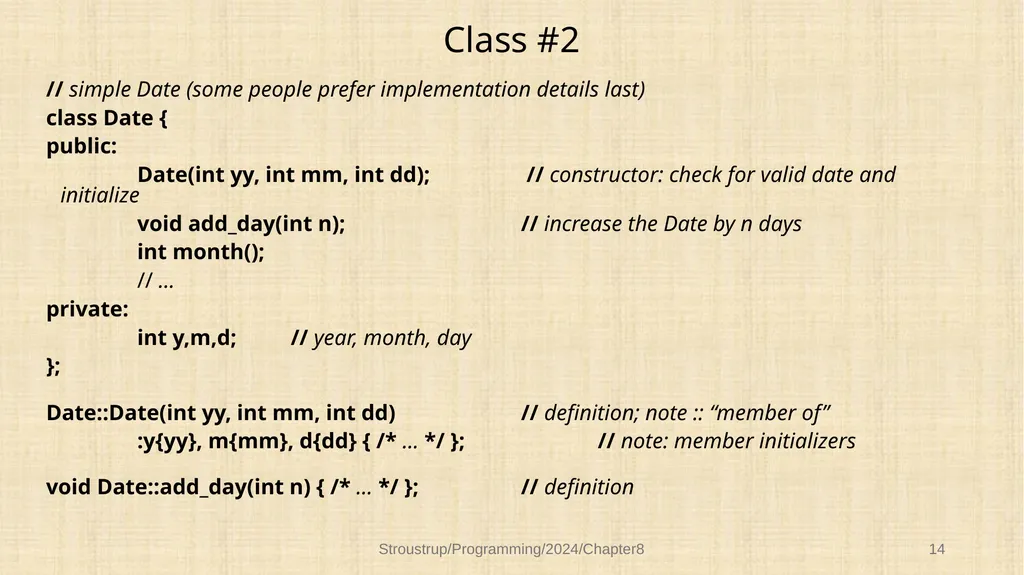
Class #2 // simple Date (some people prefer implementation details last)
class Date {
public:
Date(int yy, int mm, int dd); // constructor: check for valid date and initialize
void add_day(int n); // increase the Date by n days
int month();
// …
private:
int y,m,d; // year, month, day
};
Date::Date(int yy, int mm, int dd) // definition; note :: “member of”
:y{yy}, m{mm}, d{dd} { /* … */ }; // note: member initializers
void Date::add_day(int n) { /* … */ }; // definition Stroustrup/Programming/2024/Chapter8 14<br>
class Date {
public:
Date(int yy, int mm, int dd); // constructor: check for valid date and initialize
void add_day(int n); // increase the Date by n days
int month();
// …
private:
int y,m,d; // year, month, day
};
Date::Date(int yy, int mm, int dd) // definition; note :: “member of”
:y{yy}, m{mm}, d{dd} { /* … */ }; // note: member initializers
void Date::add_day(int n) { /* … */ }; // definition Stroustrup/Programming/2024/Chapter8 14<br>
15
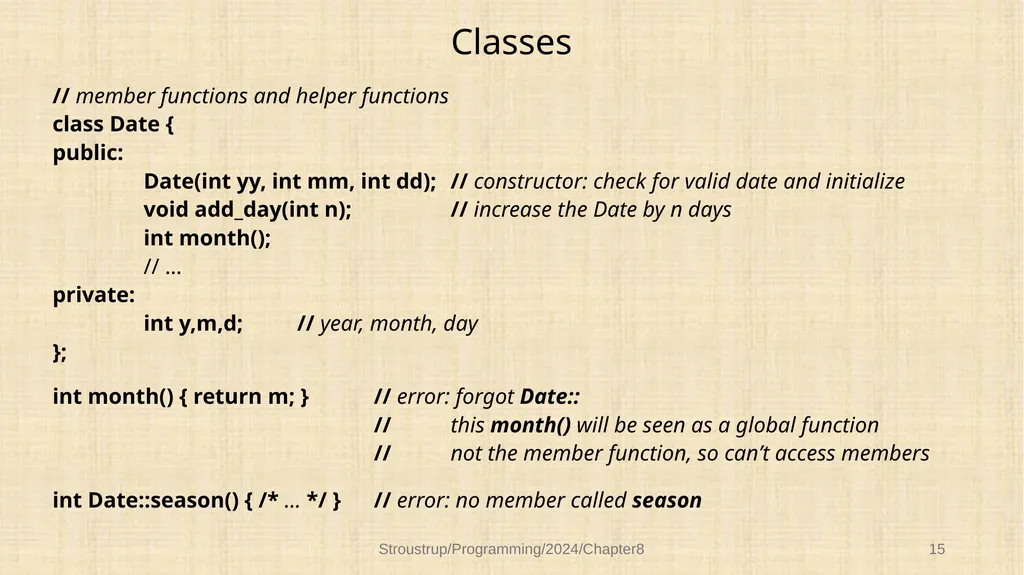
Classes // member functions and helper functions
class Date {
public:
Date(int yy, int mm, int dd); // constructor: check for valid date and initialize
void add_day(int n); // increase the Date by n days
int month();
// …
private:
int y,m,d; // year, month, day
};
int month() { return m; } // error: forgot Date::
// this month() will be seen as a global function
// not the member function, so can’t access members
int Date::season() { /* … */ } // error: no member called season Stroustrup/Programming/2024/Chapter8 15<br>
class Date {
public:
Date(int yy, int mm, int dd); // constructor: check for valid date and initialize
void add_day(int n); // increase the Date by n days
int month();
// …
private:
int y,m,d; // year, month, day
};
int month() { return m; } // error: forgot Date::
// this month() will be seen as a global function
// not the member function, so can’t access members
int Date::season() { /* … */ } // error: no member called season Stroustrup/Programming/2024/Chapter8 15<br>
16
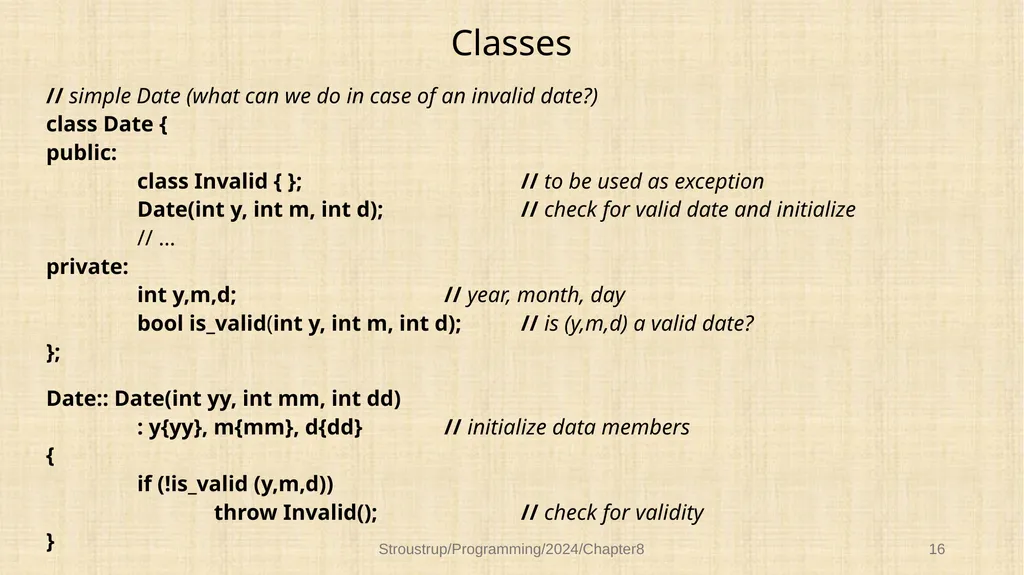
Classes // simple Date (what can we do in case of an invalid date?)
class Date {
public:
class Invalid { }; // to be used as exception
Date(int y, int m, int d); // check for valid date and initialize
// …
private:
int y,m,d; // year, month, day
bool is_valid(int y, int m, int d); // is (y,m,d) a valid date?
};
Date:: Date(int yy, int mm, int dd)
: y{yy}, m{mm}, d{dd} // initialize data members
{
if (!is_valid (y,m,d))
throw Invalid(); // check for validity
} Stroustrup/Programming/2024/Chapter8 16<br>
class Date {
public:
class Invalid { }; // to be used as exception
Date(int y, int m, int d); // check for valid date and initialize
// …
private:
int y,m,d; // year, month, day
bool is_valid(int y, int m, int d); // is (y,m,d) a valid date?
};
Date:: Date(int yy, int mm, int dd)
: y{yy}, m{mm}, d{dd} // initialize data members
{
if (!is_valid (y,m,d))
throw Invalid(); // check for validity
} Stroustrup/Programming/2024/Chapter8 16<br>
17
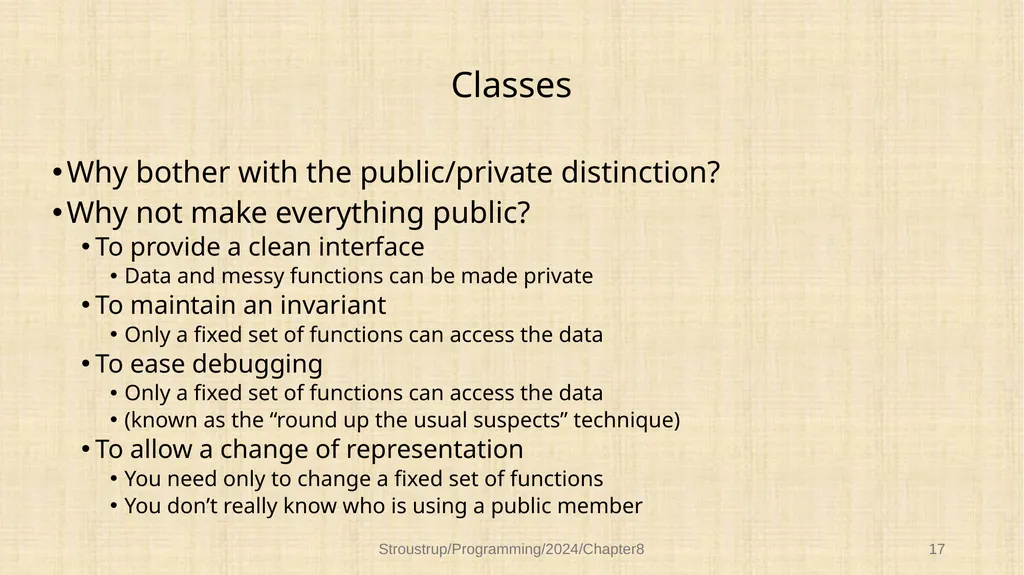
Classes Why bother with the public/private distinction?
Why not make everything public?
To provide a clean interface
Data and messy functions can be made private
To maintain an invariant
Only a fixed set of functions can access the data
To ease debugging
Only a fixed set of functions can access the data
(known as the “round up the usual suspects” technique)
To allow a change of representation
You need only to change a fixed set of functions
You don’t really know who is using a public member Stroustrup/Programming/2024/Chapter8 17<br>
Why not make everything public?
To provide a clean interface
Data and messy functions can be made private
To maintain an invariant
Only a fixed set of functions can access the data
To ease debugging
Only a fixed set of functions can access the data
(known as the “round up the usual suspects” technique)
To allow a change of representation
You need only to change a fixed set of functions
You don’t really know who is using a public member Stroustrup/Programming/2024/Chapter8 17<br>
18
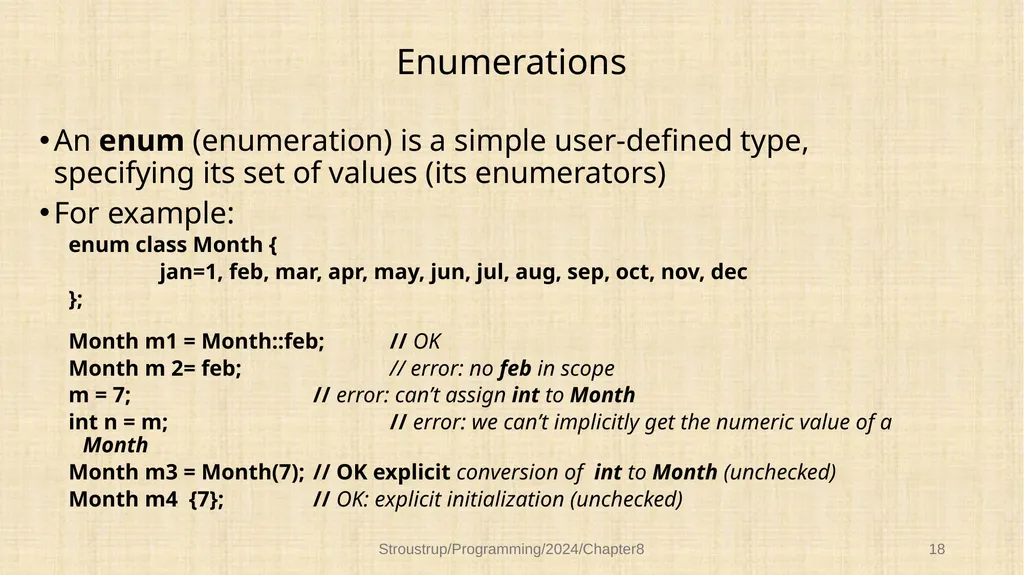
Enumerations An enum (enumeration) is a simple user-defined type, specifying its set of values (its enumerators)
For example:
enum class Month {
jan=1, feb, mar, apr, may, jun, jul, aug, sep, oct, nov, dec
};
Month m1 = Month::feb; // OK
Month m 2= feb; // error: no feb in scope
m = 7; // error: can’t assign int to Month
int n = m; // error: we can’t implicitly get the numeric value of a Month
Month m3 = Month(7); // OK explicit conversion of int to Month (unchecked)
Month m4 {7}; // OK: explicit initialization (unchecked) Stroustrup/Programming/2024/Chapter8 18<br>
For example:
enum class Month {
jan=1, feb, mar, apr, may, jun, jul, aug, sep, oct, nov, dec
};
Month m1 = Month::feb; // OK
Month m 2= feb; // error: no feb in scope
m = 7; // error: can’t assign int to Month
int n = m; // error: we can’t implicitly get the numeric value of a Month
Month m3 = Month(7); // OK explicit conversion of int to Month (unchecked)
Month m4 {7}; // OK: explicit initialization (unchecked) Stroustrup/Programming/2024/Chapter8 18<br>
19
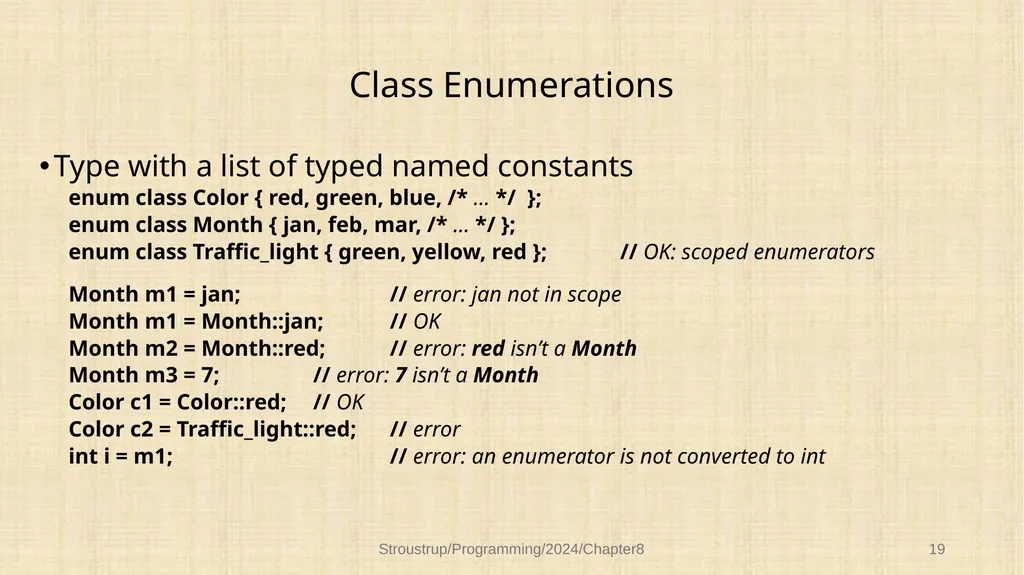
Class Enumerations Type with a list of typed named constants
enum class Color { red, green, blue, /* … */ };
enum class Month { jan, feb, mar, /* … */ };
enum class Traffic_light { green, yellow, red }; // OK: scoped enumerators
Month m1 = jan; // error: jan not in scope
Month m1 = Month::jan; // OK
Month m2 = Month::red; // error: red isn’t a Month
Month m3 = 7; // error: 7 isn’t a Month
Color c1 = Color::red; // OK
Color c2 = Traffic_light::red; // error
int i = m1; // error: an enumerator is not converted to int Stroustrup/Programming/2024/Chapter8 19<br>
enum class Color { red, green, blue, /* … */ };
enum class Month { jan, feb, mar, /* … */ };
enum class Traffic_light { green, yellow, red }; // OK: scoped enumerators
Month m1 = jan; // error: jan not in scope
Month m1 = Month::jan; // OK
Month m2 = Month::red; // error: red isn’t a Month
Month m3 = 7; // error: 7 isn’t a Month
Color c1 = Color::red; // OK
Color c2 = Traffic_light::red; // error
int i = m1; // error: an enumerator is not converted to int Stroustrup/Programming/2024/Chapter8 19<br>
20
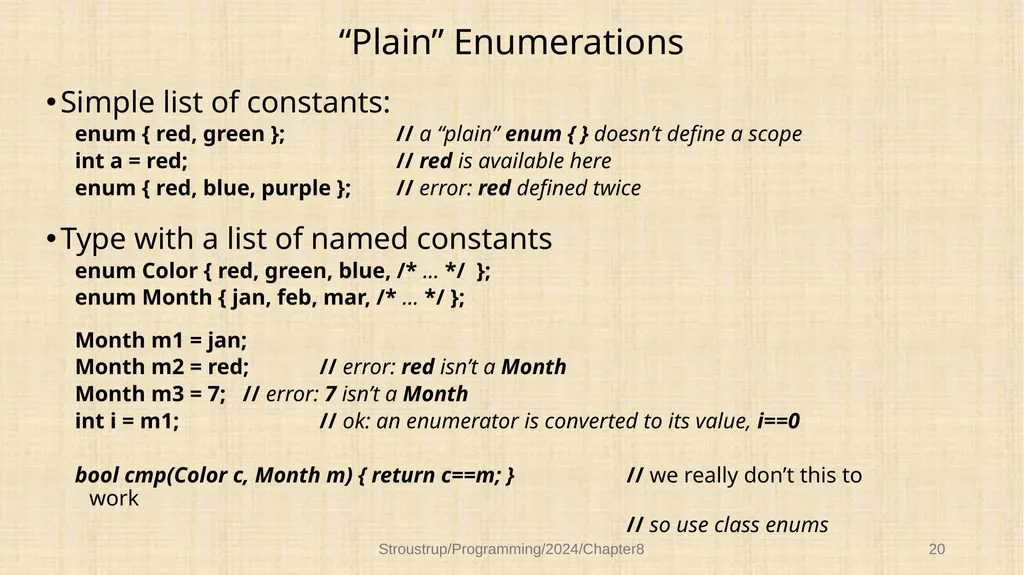
“Plain” Enumerations Simple list of constants:
enum { red, green }; // a “plain” enum { } doesn’t define a scope
int a = red; // red is available here
enum { red, blue, purple }; // error: red defined twice
Type with a list of named constants
enum Color { red, green, blue, /* … */ };
enum Month { jan, feb, mar, /* … */ };
Month m1 = jan;
Month m2 = red; // error: red isn’t a Month
Month m3 = 7; // error: 7 isn’t a Month
int i = m1; // ok: an enumerator is converted to its value, i==0
bool cmp(Color c, Month m) { return c==m; } // we really don’t this to work
// so use class enums Stroustrup/Programming/2024/Chapter8 20<br>
enum { red, green }; // a “plain” enum { } doesn’t define a scope
int a = red; // red is available here
enum { red, blue, purple }; // error: red defined twice
Type with a list of named constants
enum Color { red, green, blue, /* … */ };
enum Month { jan, feb, mar, /* … */ };
Month m1 = jan;
Month m2 = red; // error: red isn’t a Month
Month m3 = 7; // error: 7 isn’t a Month
int i = m1; // ok: an enumerator is converted to its value, i==0
bool cmp(Color c, Month m) { return c==m; } // we really don’t this to work
// so use class enums Stroustrup/Programming/2024/Chapter8 20<br>
21
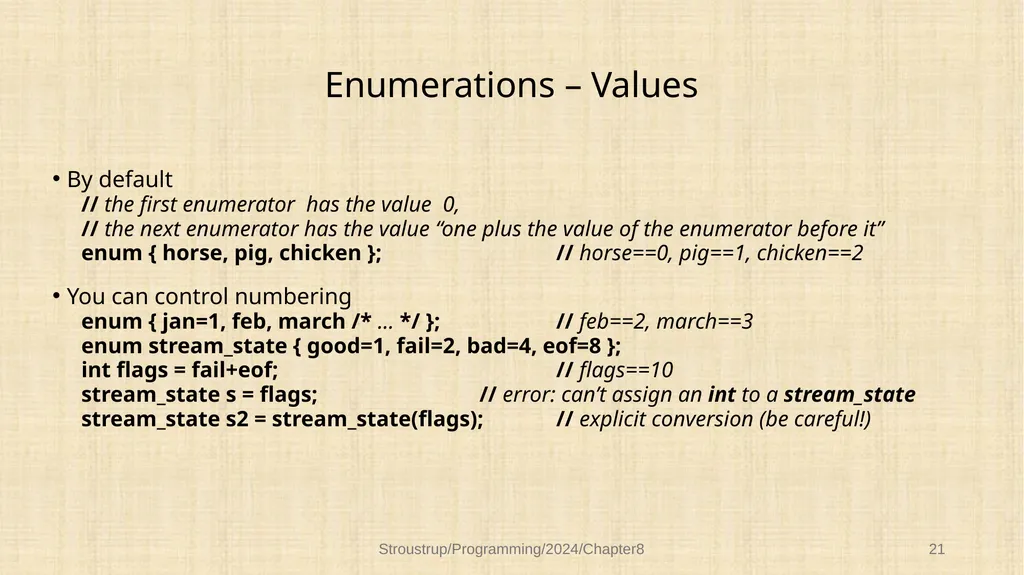
Enumerations – Values By default
// the first enumerator has the value 0,
// the next enumerator has the value “one plus the value of the enumerator before it”
enum { horse, pig, chicken }; // horse==0, pig==1, chicken==2
You can control numbering
enum { jan=1, feb, march /* … */ }; // feb==2, march==3
enum stream_state { good=1, fail=2, bad=4, eof=8 };
int flags = fail+eof; // flags==10
stream_state s = flags; // error: can’t assign an int to a stream_state
stream_state s2 = stream_state(flags); // explicit conversion (be careful!) Stroustrup/Programming/2024/Chapter8 21<br>
// the first enumerator has the value 0,
// the next enumerator has the value “one plus the value of the enumerator before it”
enum { horse, pig, chicken }; // horse==0, pig==1, chicken==2
You can control numbering
enum { jan=1, feb, march /* … */ }; // feb==2, march==3
enum stream_state { good=1, fail=2, bad=4, eof=8 };
int flags = fail+eof; // flags==10
stream_state s = flags; // error: can’t assign an int to a stream_state
stream_state s2 = stream_state(flags); // explicit conversion (be careful!) Stroustrup/Programming/2024/Chapter8 21<br>
22
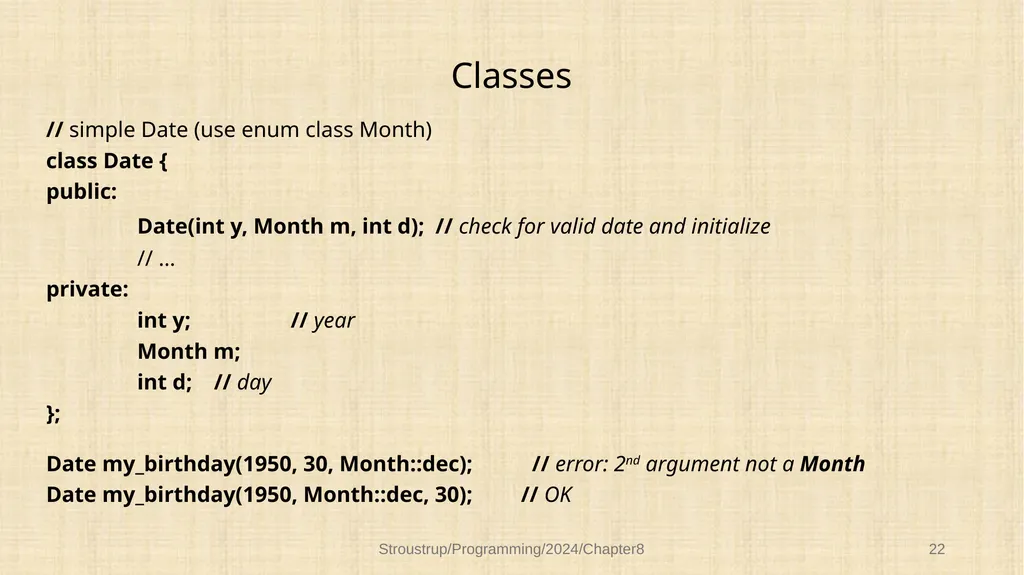
Classes // simple Date (use enum class Month)
class Date {
public:
Date(int y, Month m, int d); // check for valid date and initialize
// …
private:
int y; // year
Month m;
int d; // day
};
Date my_birthday(1950, 30, Month::dec); // error: 2nd argument not a Month
Date my_birthday(1950, Month::dec, 30); // OK Stroustrup/Programming/2024/Chapter8 22<br>
class Date {
public:
Date(int y, Month m, int d); // check for valid date and initialize
// …
private:
int y; // year
Month m;
int d; // day
};
Date my_birthday(1950, 30, Month::dec); // error: 2nd argument not a Month
Date my_birthday(1950, Month::dec, 30); // OK Stroustrup/Programming/2024/Chapter8 22<br>
23
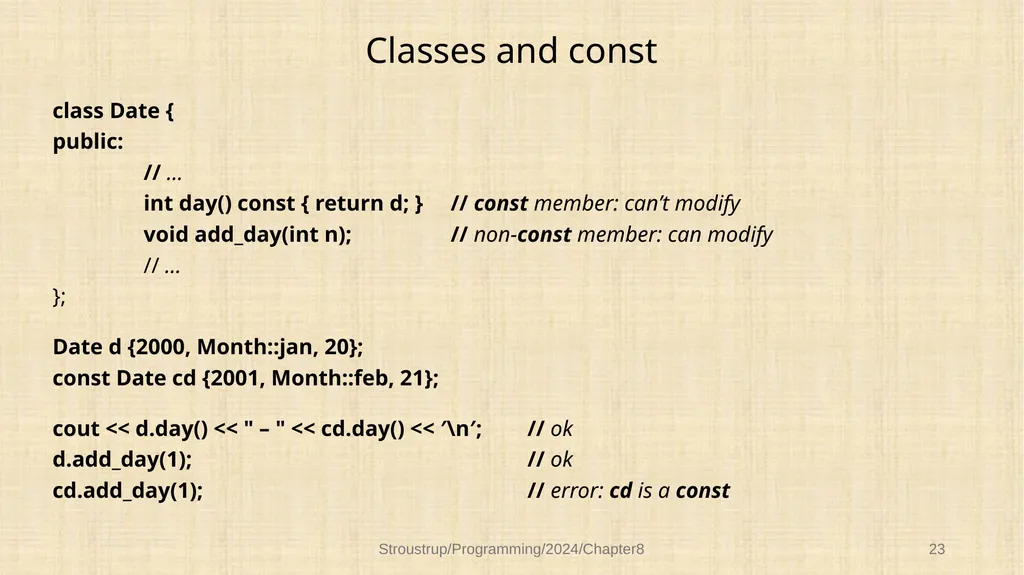
Classes and const class Date {
public:
// …
int day() const { return d; } // const member: can’t modify
void add_day(int n); // non-const member: can modify
// …
};
Date d {2000, Month::jan, 20};
const Date cd {2001, Month::feb, 21};
cout << d.day() << " – " << cd.day() << ′\n′; // ok
d.add_day(1); // ok
cd.add_day(1); // error: cd is a const Stroustrup/Programming/2024/Chapter8 23<br>
public:
// …
int day() const { return d; } // const member: can’t modify
void add_day(int n); // non-const member: can modify
// …
};
Date d {2000, Month::jan, 20};
const Date cd {2001, Month::feb, 21};
cout << d.day() << " – " << cd.day() << ′\n′; // ok
d.add_day(1); // ok
cd.add_day(1); // error: cd is a const Stroustrup/Programming/2024/Chapter8 23<br>
24
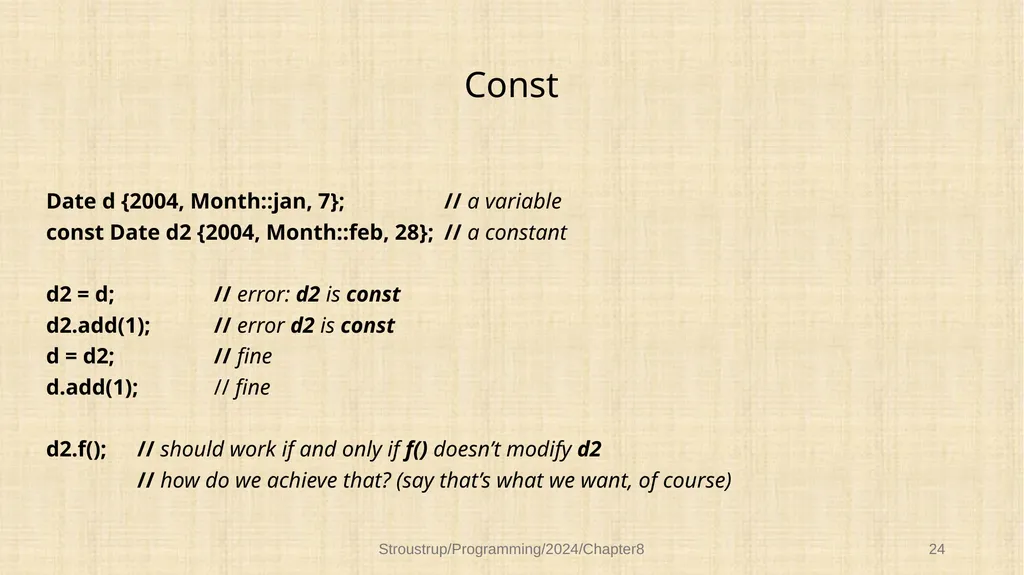
Const Date d {2004, Month::jan, 7}; // a variable
const Date d2 {2004, Month::feb, 28}; // a constant
d2 = d; // error: d2 is const
d2.add(1); // error d2 is const
d = d2; // fine
d.add(1); // fine
d2.f(); // should work if and only if f() doesn’t modify d2
// how do we achieve that? (say that’s what we want, of course) Stroustrup/Programming/2024/Chapter8 24<br>
const Date d2 {2004, Month::feb, 28}; // a constant
d2 = d; // error: d2 is const
d2.add(1); // error d2 is const
d = d2; // fine
d.add(1); // fine
d2.f(); // should work if and only if f() doesn’t modify d2
// how do we achieve that? (say that’s what we want, of course) Stroustrup/Programming/2024/Chapter8 24<br>
25
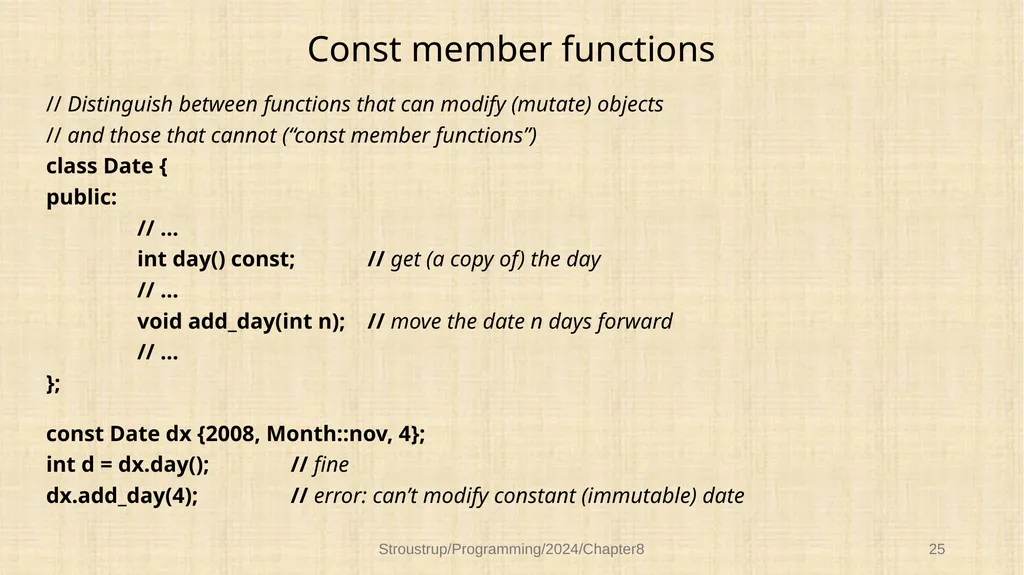
Const member functions // Distinguish between functions that can modify (mutate) objects
// and those that cannot (“const member functions”)
class Date {
public:
// …
int day() const; // get (a copy of) the day
// …
void add_day(int n); // move the date n days forward
// …
};
const Date dx {2008, Month::nov, 4};
int d = dx.day(); // fine
dx.add_day(4); // error: can’t modify constant (immutable) date Stroustrup/Programming/2024/Chapter8 25<br>
// and those that cannot (“const member functions”)
class Date {
public:
// …
int day() const; // get (a copy of) the day
// …
void add_day(int n); // move the date n days forward
// …
};
const Date dx {2008, Month::nov, 4};
int d = dx.day(); // fine
dx.add_day(4); // error: can’t modify constant (immutable) date Stroustrup/Programming/2024/Chapter8 25<br>
26
Classes What makes a good interface?
Minimal
As small as possible
Complete
And no smaller
Type safe
Beware of confusing argument orders
Beware of over-general types (e.g., int to represent a month)
Const correct Stroustrup/Programming/2024/Chapter8 26<br>
Minimal
As small as possible
Complete
And no smaller
Type safe
Beware of confusing argument orders
Beware of over-general types (e.g., int to represent a month)
Const correct Stroustrup/Programming/2024/Chapter8 26<br>
27
Classes Essential operations
Default constructor (defaults to: nothing)
No default if any other constructor is declared
Copy constructor (defaults to: copy the member)
Copy assignment (defaults to: copy the members)
Move constructor (defaults to: copy the member)
Move assignment (defaults to: copy the members)
Destructor (defaults to: nothing)
For example
Date d; // error: no default constructor
Date d2 = d; // ok: copy initialized (copy the elements)
d = d2; // ok copy assignment (copy the elements) Stroustrup/Programming/2024/Chapter8 27<br>
Default constructor (defaults to: nothing)
No default if any other constructor is declared
Copy constructor (defaults to: copy the member)
Copy assignment (defaults to: copy the members)
Move constructor (defaults to: copy the member)
Move assignment (defaults to: copy the members)
Destructor (defaults to: nothing)
For example
Date d; // error: no default constructor
Date d2 = d; // ok: copy initialized (copy the elements)
d = d2; // ok copy assignment (copy the elements) Stroustrup/Programming/2024/Chapter8 27<br>
28
Interfaces and “helper functions” Keep a class interface (the set of public functions) minimal
Simplifies understanding
Simplifies debugging
Simplifies maintenance
When we keep the class interface simple and minimal, we need extra “helper functions” outside the class (non-member functions)
E.g. == (equality) , != (inequality)
next_weekday(), next_Sunday() Stroustrup/Programming/2024/Chapter8 28<br>
Simplifies understanding
Simplifies debugging
Simplifies maintenance
When we keep the class interface simple and minimal, we need extra “helper functions” outside the class (non-member functions)
E.g. == (equality) , != (inequality)
next_weekday(), next_Sunday() Stroustrup/Programming/2024/Chapter8 28<br>
29
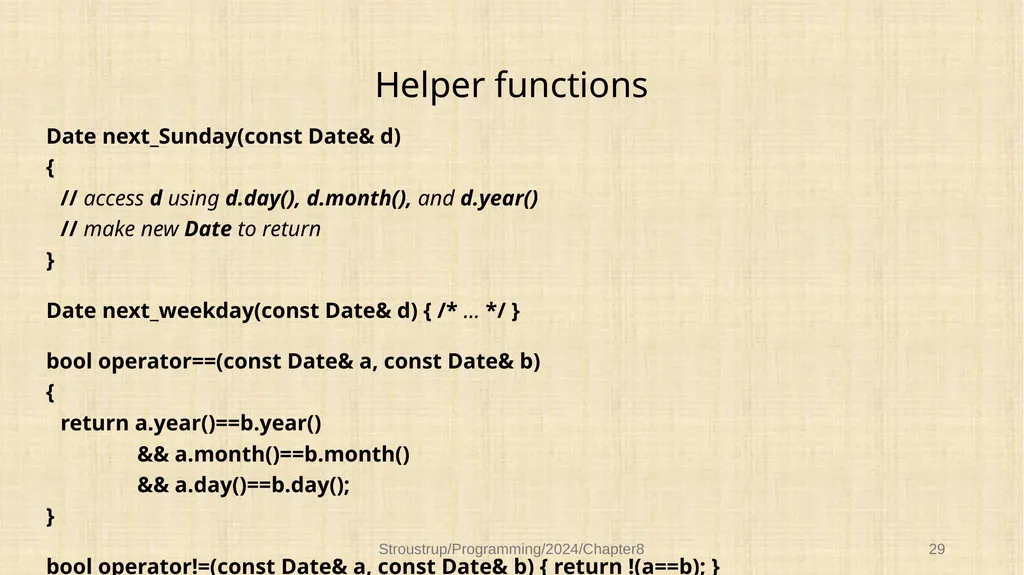
Helper functions Date next_Sunday(const Date& d)
{
// access d using d.day(), d.month(), and d.year()
// make new Date to return
}
Date next_weekday(const Date& d) { /* … */ }
bool operator==(const Date& a, const Date& b)
{
return a.year()==b.year()
&& a.month()==b.month()
&& a.day()==b.day();
}
bool operator!=(const Date& a, const Date& b) { return !(a==b); } Stroustrup/Programming/2024/Chapter8 29<br>
{
// access d using d.day(), d.month(), and d.year()
// make new Date to return
}
Date next_weekday(const Date& d) { /* … */ }
bool operator==(const Date& a, const Date& b)
{
return a.year()==b.year()
&& a.month()==b.month()
&& a.day()==b.day();
}
bool operator!=(const Date& a, const Date& b) { return !(a==b); } Stroustrup/Programming/2024/Chapter8 29<br>
30
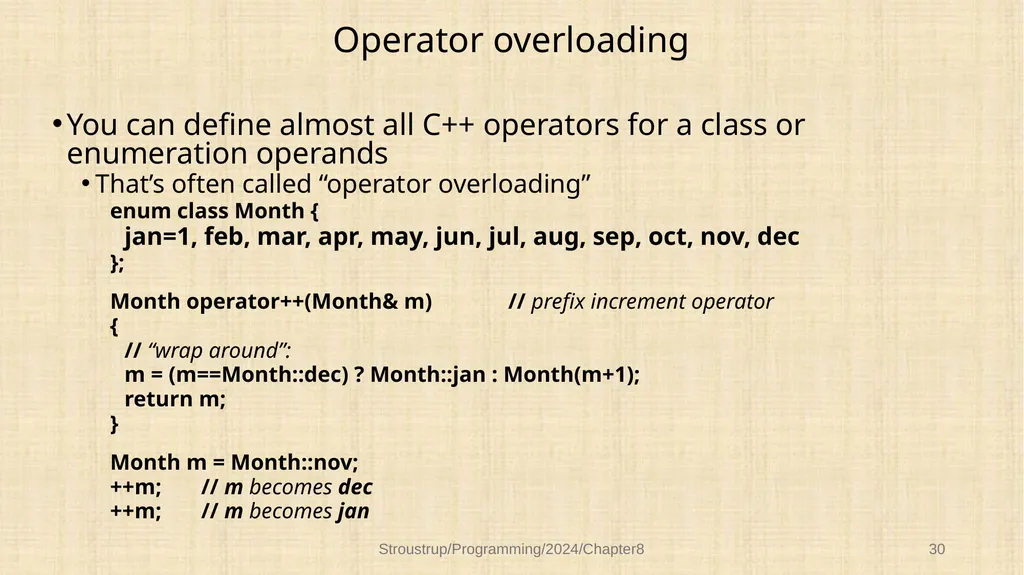
Operator overloading You can define almost all C++ operators for a class or enumeration operands
That’s often called “operator overloading”
enum class Month {
jan=1, feb, mar, apr, may, jun, jul, aug, sep, oct, nov, dec
};
Month operator++(Month& m) // prefix increment operator
{
// “wrap around”:
m = (m==Month::dec) ? Month::jan : Month(m+1);
return m;
}
Month m = Month::nov;
++m; // m becomes dec
++m; // m becomes jan Stroustrup/Programming/2024/Chapter8 30<br>
That’s often called “operator overloading”
enum class Month {
jan=1, feb, mar, apr, may, jun, jul, aug, sep, oct, nov, dec
};
Month operator++(Month& m) // prefix increment operator
{
// “wrap around”:
m = (m==Month::dec) ? Month::jan : Month(m+1);
return m;
}
Month m = Month::nov;
++m; // m becomes dec
++m; // m becomes jan Stroustrup/Programming/2024/Chapter8 30<br>
31
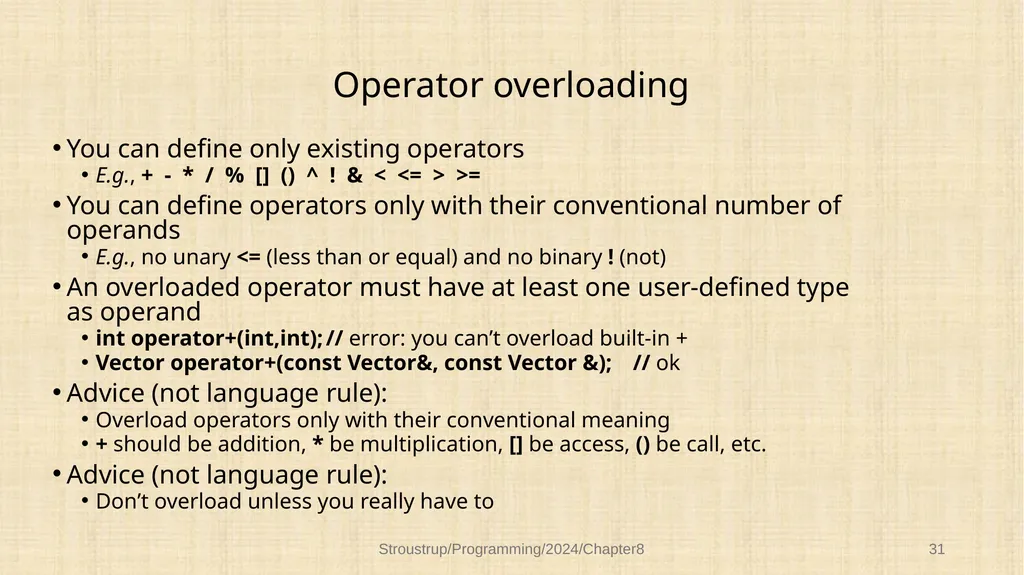
Operator overloading You can define only existing operators
E.g., + - * / % [] () ^ ! & < <= > >=
You can define operators only with their conventional number of operands
E.g., no unary <= (less than or equal) and no binary ! (not)
An overloaded operator must have at least one user-defined type as operand
int operator+(int,int); // error: you can’t overload built-in +
Vector operator+(const Vector&, const Vector &); // ok
Advice (not language rule):
Overload operators only with their conventional meaning
+ should be addition, * be multiplication, [] be access, () be call, etc.
Advice (not language rule):
Don’t overload unless you really have to Stroustrup/Programming/2024/Chapter8 31<br>
E.g., + - * / % [] () ^ ! & < <= > >=
You can define operators only with their conventional number of operands
E.g., no unary <= (less than or equal) and no binary ! (not)
An overloaded operator must have at least one user-defined type as operand
int operator+(int,int); // error: you can’t overload built-in +
Vector operator+(const Vector&, const Vector &); // ok
Advice (not language rule):
Overload operators only with their conventional meaning
+ should be addition, * be multiplication, [] be access, () be call, etc.
Advice (not language rule):
Don’t overload unless you really have to Stroustrup/Programming/2024/Chapter8 31<br>
32
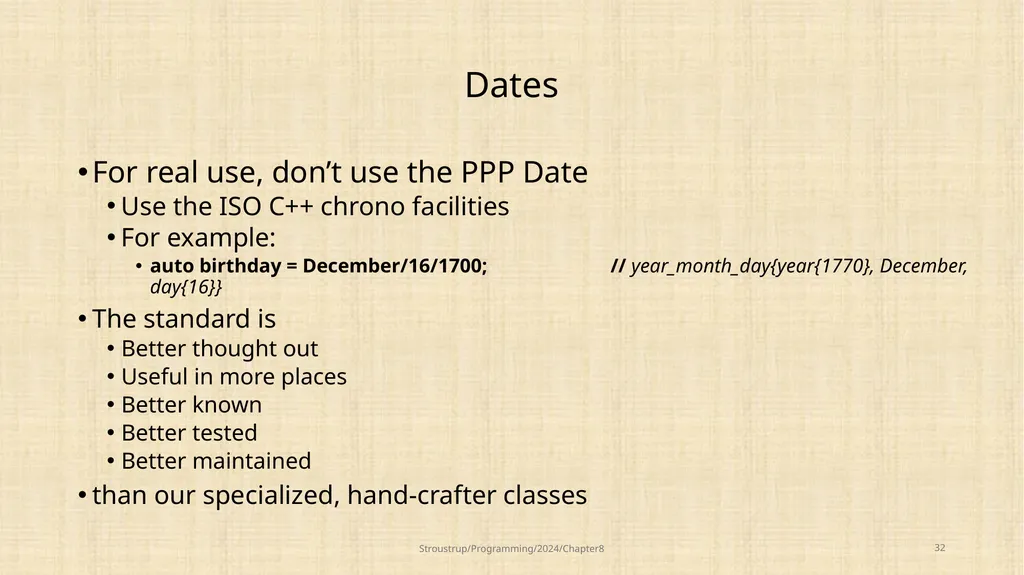
Dates For real use, don’t use the PPP Date
Use the ISO C++ chrono facilities
For example:
auto birthday = December/16/1700; // year_month_day{year{1770}, December, day{16}}
The standard is
Better thought out
Useful in more places
Better known
Better tested
Better maintained
than our specialized, hand-crafter classes Stroustrup/Programming/2024/Chapter8 32<br>
Use the ISO C++ chrono facilities
For example:
auto birthday = December/16/1700; // year_month_day{year{1770}, December, day{16}}
The standard is
Better thought out
Useful in more places
Better known
Better tested
Better maintained
than our specialized, hand-crafter classes Stroustrup/Programming/2024/Chapter8 32<br>
33
Next class I/O streams
Text oriented input and output Stroustrup/Programming/2024/Chapter8 33<br>
Text oriented input and output Stroustrup/Programming/2024/Chapter8 33<br>