
Chapter 9 Social Interaction and Investing
LS
Published · 23 slides · 0 views
1 / 1


Description
Chapter 9 Social Interaction and Investing Conversation Social economic and finance paradigm Professor Hirshleifers 2020 presidential address to the American Finance Association Conversation allows for the rapid exchange of information,
Related Topics
Share
Embed code
Download this presentation From Below
"Chapter 9 Social Interaction and Investing" is the property of its rightful owner. Permission is granted to download and print the materials on this website for personal, non-commercial use only, and to display it on your personal computer provided you do not modify the materials and that you retain all copyright notices contained in the materials. By downloading content from our website, you accept the terms of this agreement.
Presentation Transcript
01
Chapter 9
Social Interaction and Investing<br>
02
Conversation Social economic and finance paradigm
Professor Hirshleifer’s 2020 presidential address to the American Finance Association
Conversation allows for the rapid exchange of information, opinions, and emotions
Ramifications are that the resulting actions can generate price bubbles, herding, and investor sentiment 2<br>
Professor Hirshleifer’s 2020 presidential address to the American Finance Association
Conversation allows for the rapid exchange of information, opinions, and emotions
Ramifications are that the resulting actions can generate price bubbles, herding, and investor sentiment 2<br>
03
Social People and Investing Interaction makes people more comfortable investing
Survey of 7,500 households in Health and Retirement Study of Households found that:
Social households are more likely to invest in the stock market
This is magnified if the household is in a high stock-market participation community Harrison Hong, Jeffrey D. Kubik, and Jeremy C. Stein, “Social Interaction and Stock-Market Participation,” Journal of Finance 59(2004): 137–163 3<br>
Survey of 7,500 households in Health and Retirement Study of Households found that:
Social households are more likely to invest in the stock market
This is magnified if the household is in a high stock-market participation community Harrison Hong, Jeffrey D. Kubik, and Jeremy C. Stein, “Social Interaction and Stock-Market Participation,” Journal of Finance 59(2004): 137–163 3<br>
04
Using both IRS data or stock brokerage data, studies find that…
When a neighbor increases purchases in an industry by 10%, the household increases ownership by 2%
Neighbor increases ownership in local company, household also increases by the same amount
This word-of-mouth information diffusion is stronger in states that are considered to be more social
Professional investor neighbors also have similar portfolios
Especially when they have the same ethnic background
Sharing a culture makes them more likely to socially connect See Zoran Ivkovic and Scott Weisbenner, “Information Diffusion Effects in Individual Investor’s Common Stock Purchases: Covet They Neighbors’ Investment Choices,” Review of Financial Studies 20:4(2007): 1327–1357, and Jeffery R. Brown, Zoran Ivkovic, Paul A. Smith, and Scott Weisbenner, “Neighbors Matter: Causal Community Effects and Stock Market Participation,” Journal of Finance 63:3(2008): 1509–1531. Pool, Stoffman, and Yonker, 2015, “The People in Your Neighborhood: Social Interactions and Mutual Fund Portfolios,” Journal of Finance 70(6), 2679-2731. Neighborly Influence 4<br>
When a neighbor increases purchases in an industry by 10%, the household increases ownership by 2%
Neighbor increases ownership in local company, household also increases by the same amount
This word-of-mouth information diffusion is stronger in states that are considered to be more social
Professional investor neighbors also have similar portfolios
Especially when they have the same ethnic background
Sharing a culture makes them more likely to socially connect See Zoran Ivkovic and Scott Weisbenner, “Information Diffusion Effects in Individual Investor’s Common Stock Purchases: Covet They Neighbors’ Investment Choices,” Review of Financial Studies 20:4(2007): 1327–1357, and Jeffery R. Brown, Zoran Ivkovic, Paul A. Smith, and Scott Weisbenner, “Neighbors Matter: Causal Community Effects and Stock Market Participation,” Journal of Finance 63:3(2008): 1509–1531. Pool, Stoffman, and Yonker, 2015, “The People in Your Neighborhood: Social Interactions and Mutual Fund Portfolios,” Journal of Finance 70(6), 2679-2731. Neighborly Influence 4<br>
05
Social Influences Social norms
The informal opinions, rules, and procedures of a group.
Your peers and social groups influence your investment participation
Herding
The movement into or out of a stock or industry of companies by large groups of investors.
Desire for unprofitable Internet companies in late 1990s
Meme investors herding into GameStop 5<br>
The informal opinions, rules, and procedures of a group.
Your peers and social groups influence your investment participation
Herding
The movement into or out of a stock or industry of companies by large groups of investors.
Desire for unprofitable Internet companies in late 1990s
Meme investors herding into GameStop 5<br>
06
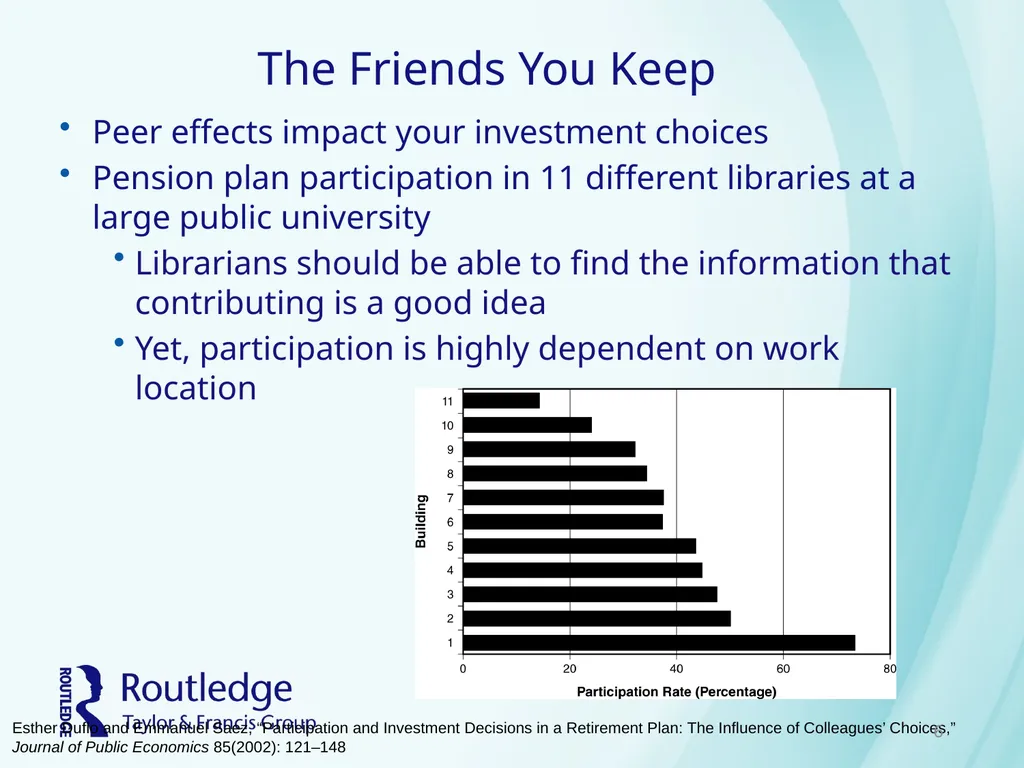
The Friends You Keep Peer effects impact your investment choices
Pension plan participation in 11 different libraries at a large public university
Librarians should be able to find the information that contributing is a good idea
Yet, participation is highly dependent on work location Esther Duflo and Emmanuel Saez, “Participation and Investment Decisions in a Retirement Plan: The Influence of Colleagues’ Choices,” Journal of Public Economics 85(2002): 121–148 6<br>
Pension plan participation in 11 different libraries at a large public university
Librarians should be able to find the information that contributing is a good idea
Yet, participation is highly dependent on work location Esther Duflo and Emmanuel Saez, “Participation and Investment Decisions in a Retirement Plan: The Influence of Colleagues’ Choices,” Journal of Public Economics 85(2002): 121–148 6<br>
07
Wincapita Ponzi Scheme Finnish “investment” operation that was active from 2003 to 2008
Word-of-mouth information dissemination only
It offered investors large returns, initially claiming that the profits were generated by sports betting and later by currency trading (but there was never any cash flow generated)
Profits” were simply the incoming cash flows came from new and existing investors
Ultimately growing to over 10,000 members, approximately 0.2% of the total population of Finland
Exceeded €100 million. The average amount invested was €15,100 with a median of €8,000
Personal relationships made the collapse of the scheme emotionally tragic
large financial losses, destroyed relationships, several mentions of suicides, divorces, and mental health problems 7 Ville Rantala, “How Do Investment Ideas Spread through Social Interaction? Evidence from a Ponzi Scheme,” The Journal of Finance 74 (2019): 2349-2389.<br>
Word-of-mouth information dissemination only
It offered investors large returns, initially claiming that the profits were generated by sports betting and later by currency trading (but there was never any cash flow generated)
Profits” were simply the incoming cash flows came from new and existing investors
Ultimately growing to over 10,000 members, approximately 0.2% of the total population of Finland
Exceeded €100 million. The average amount invested was €15,100 with a median of €8,000
Personal relationships made the collapse of the scheme emotionally tragic
large financial losses, destroyed relationships, several mentions of suicides, divorces, and mental health problems 7 Ville Rantala, “How Do Investment Ideas Spread through Social Interaction? Evidence from a Ponzi Scheme,” The Journal of Finance 74 (2019): 2349-2389.<br>
08
Effective Seminars and Social Interaction Consider this experiment with invitations to a DC fair at a major university:
Some departments offered a $20 reward to some of their faculty for going, other departments did not.
People who knew about the $20 reward were five times more likely to attend than other invitees
Colleagues of $20 invitees were three times more likely to attend than those who didn’t know about it!
$20 invitees and their colleagues were more likely to enroll than other invitees. Continued 8<br>
Some departments offered a $20 reward to some of their faculty for going, other departments did not.
People who knew about the $20 reward were five times more likely to attend than other invitees
Colleagues of $20 invitees were three times more likely to attend than those who didn’t know about it!
$20 invitees and their colleagues were more likely to enroll than other invitees. Continued 8<br>
09
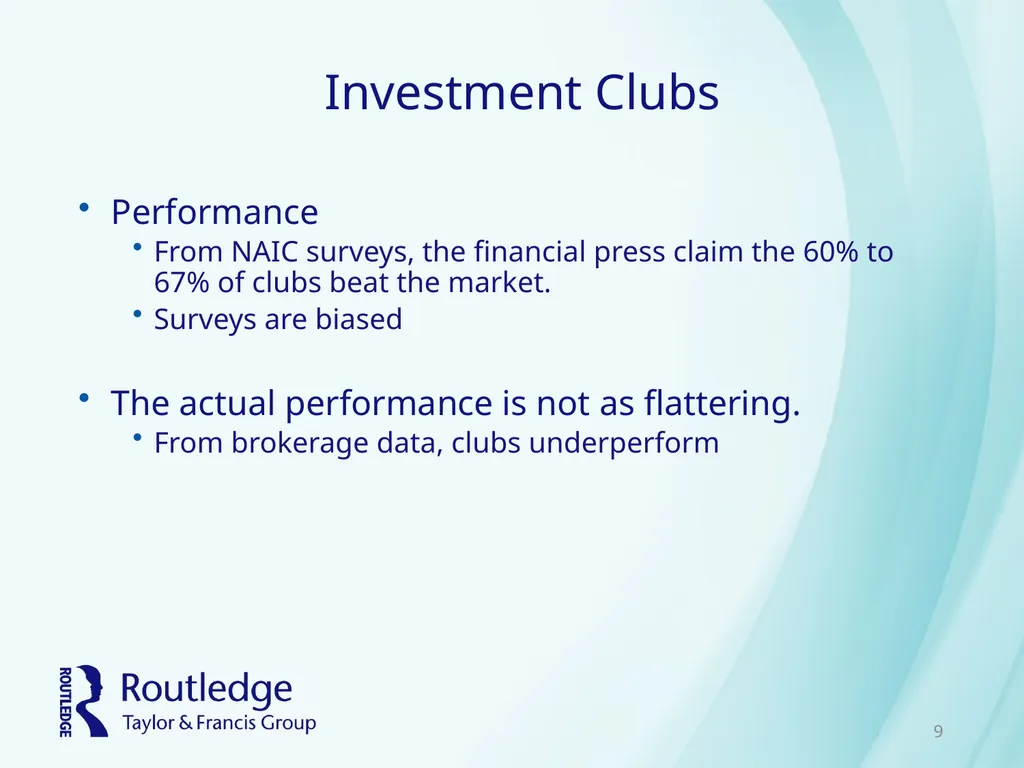
Investment Clubs Performance
From NAIC surveys, the financial press claim the 60% to 67% of clubs beat the market.
Surveys are biased
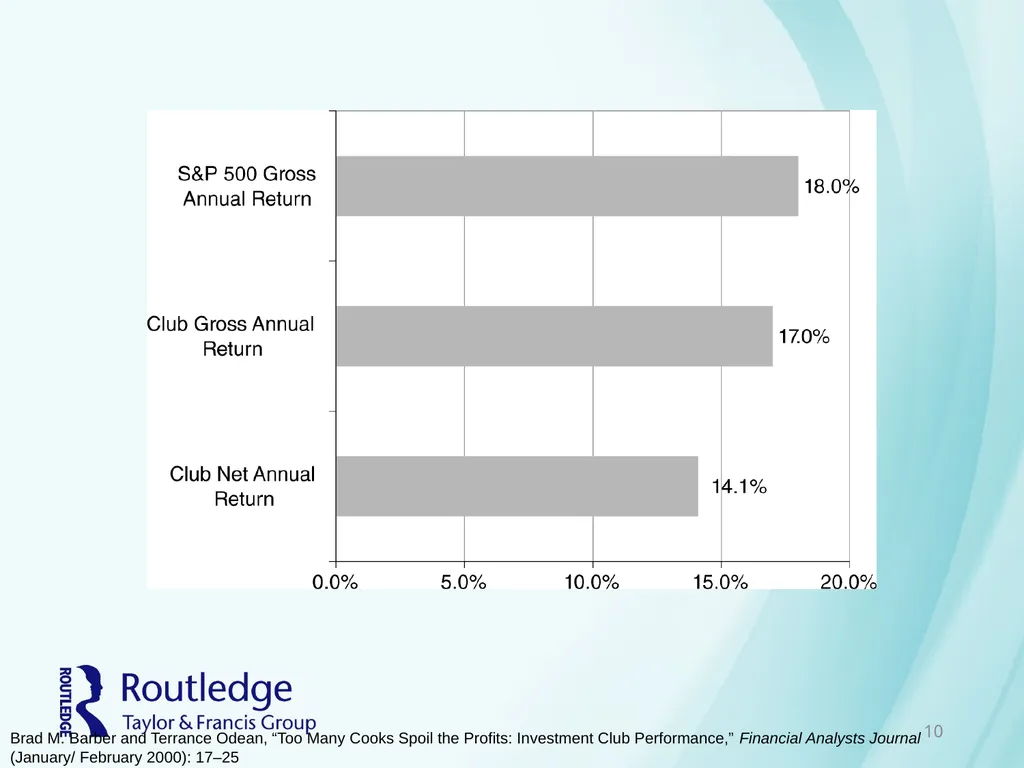
The actual performance is not as flattering.
From brokerage data, clubs underperform 9<br>
From NAIC surveys, the financial press claim the 60% to 67% of clubs beat the market.
Surveys are biased
The actual performance is not as flattering.
From brokerage data, clubs underperform 9<br>
10
Brad M. Barber and Terrance Odean, “Too Many Cooks Spoil the Profits: Investment Club Performance,” Financial Analysts Journal (January/ February 2000): 17–25 10<br>
11
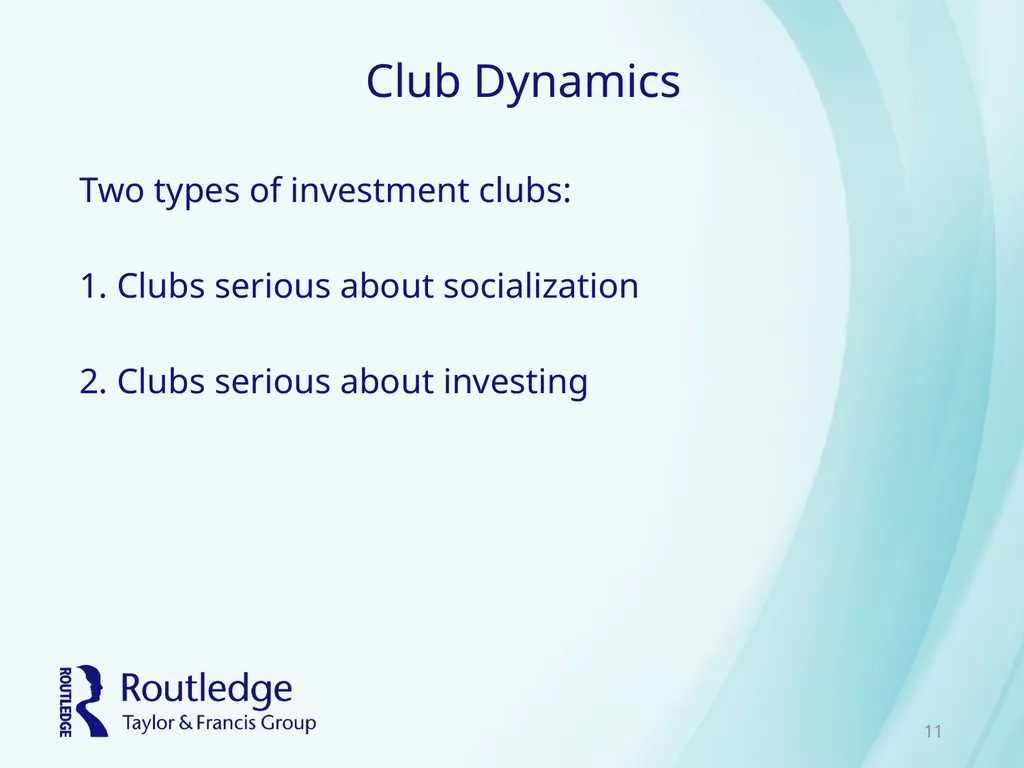
Club Dynamics Two types of investment clubs:
1. Clubs serious about socialization
2. Clubs serious about investing 11<br>
1. Clubs serious about socialization
2. Clubs serious about investing 11<br>
12
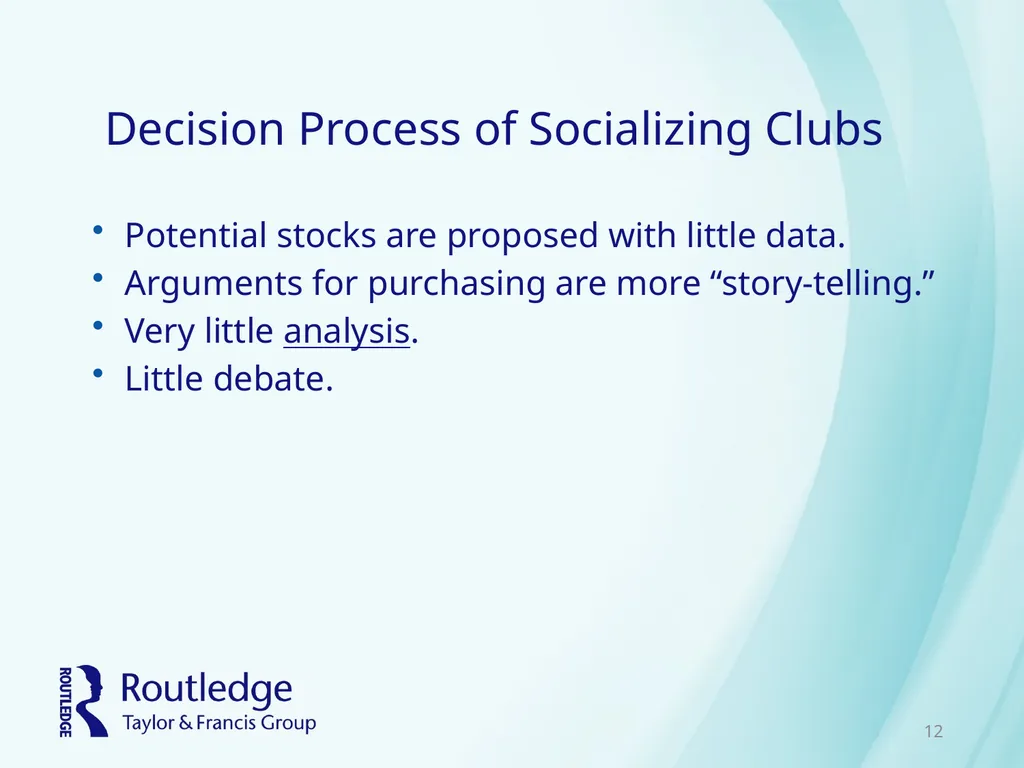
Decision Process of Socializing Clubs Potential stocks are proposed with little data.
Arguments for purchasing are more “story-telling.”
Very little analysis.
Little debate. 12<br>
Arguments for purchasing are more “story-telling.”
Very little analysis.
Little debate. 12<br>
13
Decision Process of Investing Clubs Formal procedures for proposing stocks.
Have specific info available
Fill out work sheets
Have investment criteria
Like positive earnings, dividends, PE lower than 30, etc.
These procedures help overcome emotional and psychological biases. 13<br>
Have specific info available
Fill out work sheets
Have investment criteria
Like positive earnings, dividends, PE lower than 30, etc.
These procedures help overcome emotional and psychological biases. 13<br>
14
Social media is the new talk Twitter
German scholars investigated the relationship between 250,000 stock-related tweets and activities in the stock market
The sentiment of the tweets is positively related to the stock returns
Positive sentiment exhibited in the tweets is associated with positive returns
A higher number of tweets is connected to a larger volume of stock trading
A greater disagreement with the tweets is related to more volatility in the market 14 Timm O. Sprenger, Andranik Tumasjan, Philipp G. Sandner, and Isabell M. Welpe, “Tweets and Trades: The Information Content of Stock Microblogs,” European Financial Management 20(2014), 926–957.<br>
German scholars investigated the relationship between 250,000 stock-related tweets and activities in the stock market
The sentiment of the tweets is positively related to the stock returns
Positive sentiment exhibited in the tweets is associated with positive returns
A higher number of tweets is connected to a larger volume of stock trading
A greater disagreement with the tweets is related to more volatility in the market 14 Timm O. Sprenger, Andranik Tumasjan, Philipp G. Sandner, and Isabell M. Welpe, “Tweets and Trades: The Information Content of Stock Microblogs,” European Financial Management 20(2014), 926–957.<br>
15
Language Matters! Words are inherently less objective than numbers
Some words create vivid imagery that is emotionally interesting
“Apple’s sales jumped” versus “Apple’s sales increased” “The difference between the right word and the almost right word is the difference between lightning and the lightning bug.”
Mark Twain 15<br>
Some words create vivid imagery that is emotionally interesting
“Apple’s sales jumped” versus “Apple’s sales increased” “The difference between the right word and the almost right word is the difference between lightning and the lightning bug.”
Mark Twain 15<br>
16
A language experiment Study the impact of vivid words during bull and bear markets
During bull market
Subjects divided into those having long and short positions
Positive news is framed in either vivid or pallid phrases
Asked for a forecast of the future market performance
The long position group gave similar forecasts no matter the vividness of the news
Short position group’s forecasts were impacted—higher predictions given for more vividly phrased news Continued 16<br>
During bull market
Subjects divided into those having long and short positions
Positive news is framed in either vivid or pallid phrases
Asked for a forecast of the future market performance
The long position group gave similar forecasts no matter the vividness of the news
Short position group’s forecasts were impacted—higher predictions given for more vividly phrased news Continued 16<br>
17
A language experiment During bear market
Long position investors were impacted
It is contrarian investors who are most impacted by the hype, not the popular consensus investors! Jeffrey Hales, Xi (Jason) Kuang, and Shankar Venkatatraman, “Who Believes the Hype? An Experimental Examination of How Language Affects Investor Judgments,” Journal of Accounting Research 49(2011): 223–255 17<br>
Long position investors were impacted
It is contrarian investors who are most impacted by the hype, not the popular consensus investors! Jeffrey Hales, Xi (Jason) Kuang, and Shankar Venkatatraman, “Who Believes the Hype? An Experimental Examination of How Language Affects Investor Judgments,” Journal of Accounting Research 49(2011): 223–255 17<br>
18
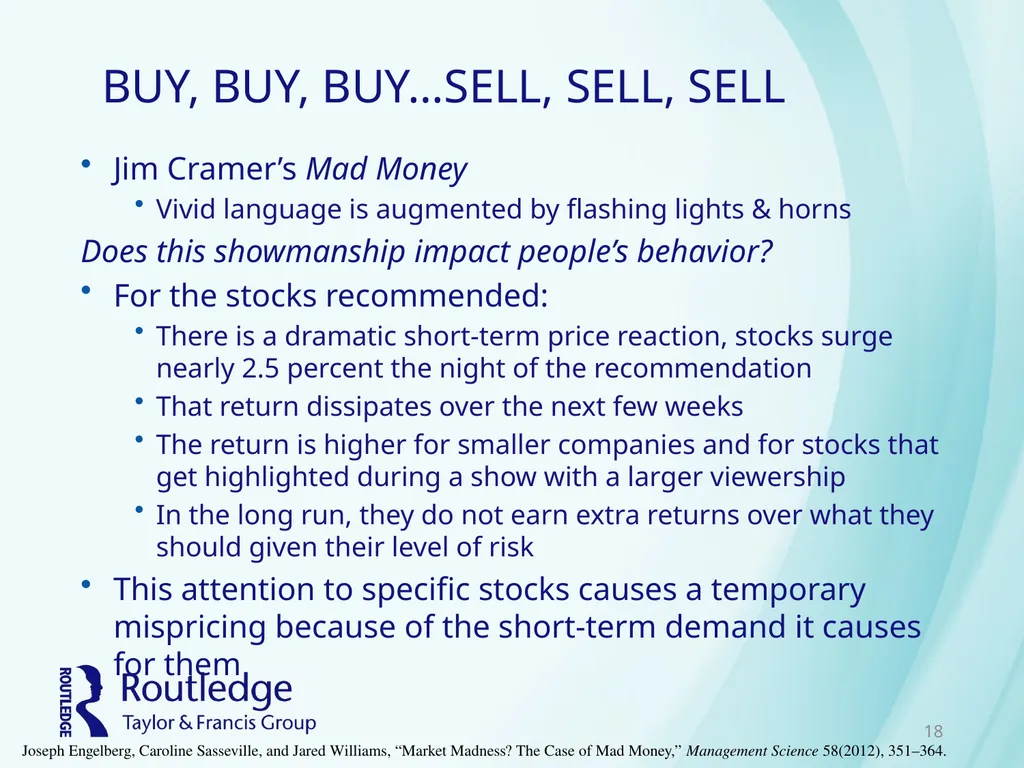
BUY, BUY, BUY…SELL, SELL, SELL Jim Cramer’s Mad Money
Vivid language is augmented by flashing lights & horns
Does this showmanship impact people’s behavior?
For the stocks recommended:
There is a dramatic short-term price reaction, stocks surge nearly 2.5 percent the night of the recommendation
That return dissipates over the next few weeks
The return is higher for smaller companies and for stocks that get highlighted during a show with a larger viewership
In the long run, they do not earn extra returns over what they should given their level of risk
This attention to specific stocks causes a temporary mispricing because of the short-term demand it causes for them Joseph Engelberg, Caroline Sasseville, and Jared Williams, “Market Madness? The Case of Mad Money,” Management Science 58(2012), 351–364. 18<br>
Vivid language is augmented by flashing lights & horns
Does this showmanship impact people’s behavior?
For the stocks recommended:
There is a dramatic short-term price reaction, stocks surge nearly 2.5 percent the night of the recommendation
That return dissipates over the next few weeks
The return is higher for smaller companies and for stocks that get highlighted during a show with a larger viewership
In the long run, they do not earn extra returns over what they should given their level of risk
This attention to specific stocks causes a temporary mispricing because of the short-term demand it causes for them Joseph Engelberg, Caroline Sasseville, and Jared Williams, “Market Madness? The Case of Mad Money,” Management Science 58(2012), 351–364. 18<br>
19
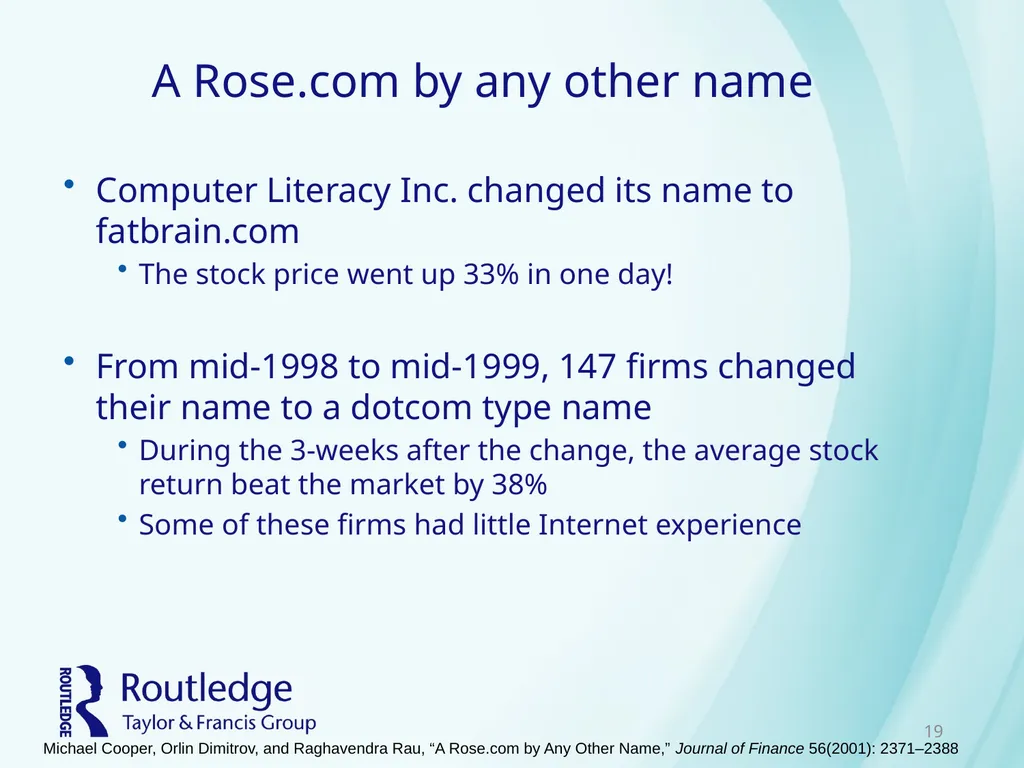
A Rose.com by any other name Computer Literacy Inc. changed its name to fatbrain.com
The stock price went up 33% in one day!
From mid-1998 to mid-1999, 147 firms changed their name to a dotcom type name
During the 3-weeks after the change, the average stock return beat the market by 38%
Some of these firms had little Internet experience Michael Cooper, Orlin Dimitrov, and Raghavendra Rau, “A Rose.com by Any Other Name,” Journal of Finance 56(2001): 2371–2388 19<br>
The stock price went up 33% in one day!
From mid-1998 to mid-1999, 147 firms changed their name to a dotcom type name
During the 3-weeks after the change, the average stock return beat the market by 38%
Some of these firms had little Internet experience Michael Cooper, Orlin Dimitrov, and Raghavendra Rau, “A Rose.com by Any Other Name,” Journal of Finance 56(2001): 2371–2388 19<br>
20
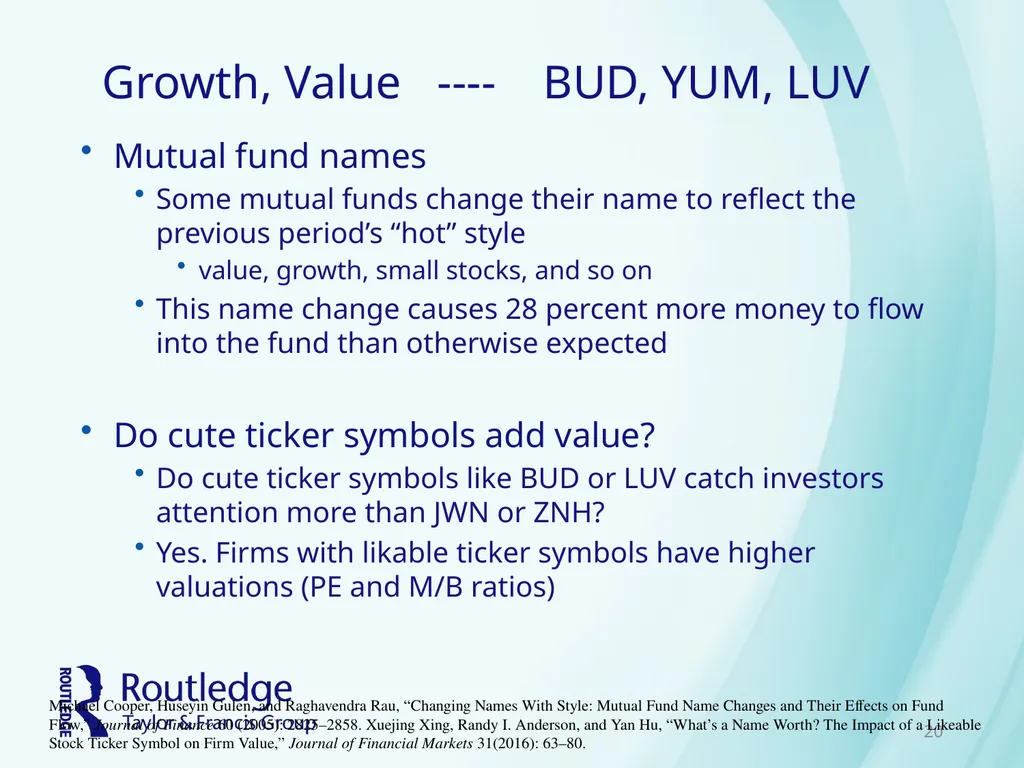
Growth, Value ---- BUD, YUM, LUV Mutual fund names
Some mutual funds change their name to reflect the previous period’s “hot” style
value, growth, small stocks, and so on
This name change causes 28 percent more money to flow into the fund than otherwise expected
Do cute ticker symbols add value?
Do cute ticker symbols like BUD or LUV catch investors attention more than JWN or ZNH?
Yes. Firms with likable ticker symbols have higher valuations (PE and M/B ratios) 20 Michael Cooper, Huseyin Gulen, and Raghavendra Rau, “Changing Names With Style: Mutual Fund Name Changes and Their Effects on Fund Flow,” Journal of Finance 60 (2005): 2825–2858. Xuejing Xing, Randy I. Anderson, and Yan Hu, “What’s a Name Worth? The Impact of a Likeable Stock Ticker Symbol on Firm Value,” Journal of Financial Markets 31(2016): 63–80.<br>
Some mutual funds change their name to reflect the previous period’s “hot” style
value, growth, small stocks, and so on
This name change causes 28 percent more money to flow into the fund than otherwise expected
Do cute ticker symbols add value?
Do cute ticker symbols like BUD or LUV catch investors attention more than JWN or ZNH?
Yes. Firms with likable ticker symbols have higher valuations (PE and M/B ratios) 20 Michael Cooper, Huseyin Gulen, and Raghavendra Rau, “Changing Names With Style: Mutual Fund Name Changes and Their Effects on Fund Flow,” Journal of Finance 60 (2005): 2825–2858. Xuejing Xing, Randy I. Anderson, and Yan Hu, “What’s a Name Worth? The Impact of a Likeable Stock Ticker Symbol on Firm Value,” Journal of Financial Markets 31(2016): 63–80.<br>
21
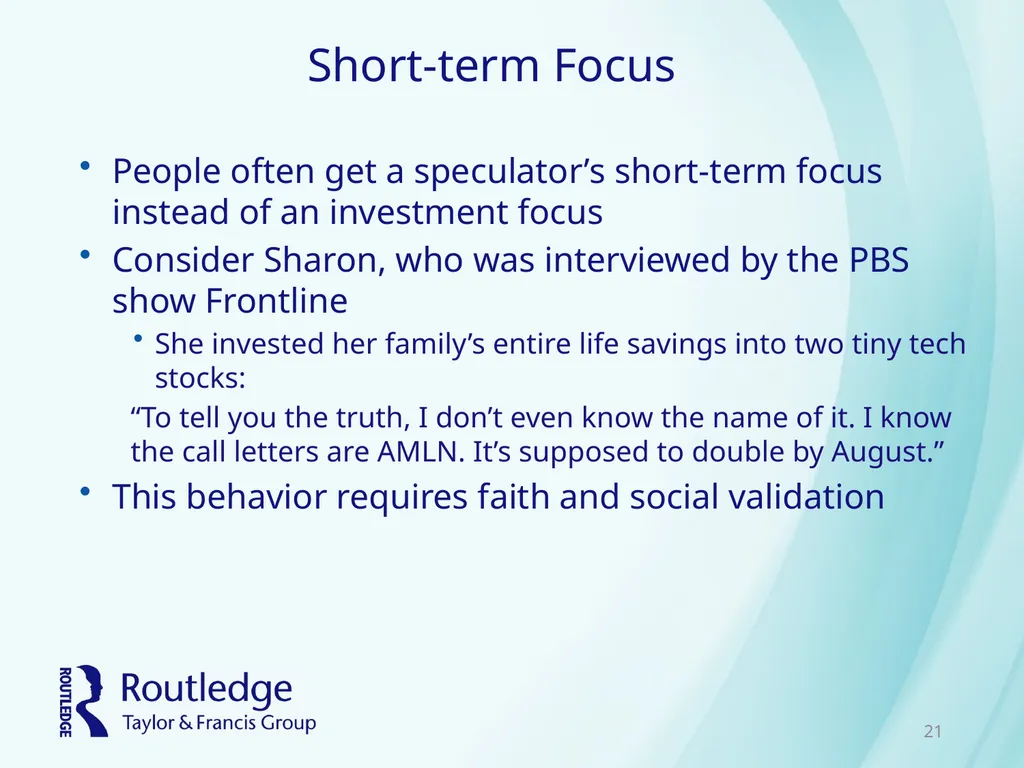
Short-term Focus People often get a speculator’s short-term focus instead of an investment focus
Consider Sharon, who was interviewed by the PBS show Frontline
She invested her family’s entire life savings into two tiny tech stocks:
“To tell you the truth, I don’t even know the name of it. I know the call letters are AMLN. It’s supposed to double by August.”
This behavior requires faith and social validation 21<br>
Consider Sharon, who was interviewed by the PBS show Frontline
She invested her family’s entire life savings into two tiny tech stocks:
“To tell you the truth, I don’t even know the name of it. I know the call letters are AMLN. It’s supposed to double by August.”
This behavior requires faith and social validation 21<br>
22
Summary People learn through interacting with each other.
We talk about our beliefs about investing and seek the opinions of others.
The opinions of our neighbors, friends, and colleagues impact our decisions.
Investment clubs are a formalized process of investing socialization.
But clubs with a stricter investment procedure have more success than clubs focused on social activities. Continued 22<br>
We talk about our beliefs about investing and seek the opinions of others.
The opinions of our neighbors, friends, and colleagues impact our decisions.
Investment clubs are a formalized process of investing socialization.
But clubs with a stricter investment procedure have more success than clubs focused on social activities. Continued 22<br>
23
Summary Language and name are important
The media transmits much of the information we use to make investment decisions.
Vivid language, or hype, influences the investors with contrarian positions.
Unfortunately, investors tend to react too quickly to news stories.
This short-term focus can be costly.
Tweets matter too. 23<br>
The media transmits much of the information we use to make investment decisions.
Vivid language, or hype, influences the investors with contrarian positions.
Unfortunately, investors tend to react too quickly to news stories.
This short-term focus can be costly.
Tweets matter too. 23<br>