CHAPTER 9: StateFederal National Historic Preservation Act Regulatory Training Program Welcome Learning Objectives for NHPA Identify Requirements applicable to the fishery management process Recognize what triggers these requirements
"CHAPTER 9: State/Federal National Historic" is the property of its rightful owner. Permission is granted to
download and print the materials on this website for personal, non-commercial use only, and to display it
on your personal computer provided you do not modify the materials and that you retain all copyright
notices contained in the materials. By downloading content from our website, you accept the terms of this
agreement.
Presentation Transcript
01
CHAPTER 9: State/Federal
National Historic Preservation Act
Regulatory Training Program Welcome<br>
02
Learning Objectives for NHPA Identify Requirements applicable to the fishery management process
Recognize what triggers these requirements
Locate and Apply Guidance for complying
Plan a timeline<br>
03
Background and History of NHPA After World War II, the United States experienced a period of rapid socioeconomic change. The Federal government initiated several large-scale projects, including the construction of dams and reservoirs by the U.S. Army Corps of Engineers and the creation of the Interstate Highway System under the Eisenhower Administration. Established by the National Interstate and Defense Highways Act of 1956, the highway system was intended to enable rapid deployment of troops in the case of an attack. These projects resulted in “alarming damage to historic neighborhoods, buildings, structures, and archeological sites.”
In the 1960s, the Kennedy Administration created the Urban Renewal Program, which was focused on revitalizing city “slums”, sometimes at the expense of historic resources. During the Johnson Administration, First Lady Bird Johnson initiated a beautification program which led to the production of a comprehensive report, With Heritage So Rich. The report recommended creating a national historic preservation program, which ultimately led to Congress passing the National Historic Preservation Act in 1966.<br>
04
Overview Requires federal agencies to consider the effects of their undertakings on historic properties in the United States, including the outer continental shelf and the exclusive economic zone (section 106, 16 U.S.C. § 470f).
Outside of U.S. must take into account adverse effects on sites on World Heritage List
Requires agencies to withhold permits or funding for applicants who intentionally significantly adversely affect historic properties.
b
c<br>
05
Key Terms: ACHP (Advisory Council on Historic Preservation) Independent agency
Advises President and Congress on historic preservation matters,
Reviews agency policies and programs to improve their consistency with the purposes of the Act,
Administers 106 review process<br>
06
Key Terms: National Register of Historic Places Over 89,000 properties listed
Over 600 vessels and shipwrecks, some on Outer Continental Shelf<br>
07
Key Terms: “Undertaking” A project, program , or activity funded, permitted, or licensed by a Federal agency<br>
08
Key Terms: Historic Properties “Any prehistoric or historic district, site, building structure, or object…”
“Included on, or eligible for inclusion on, the National Register…”<br>
09
Key Terms: National Register of Historic Places List is Maintained by Secretary of Interior. Includes sites significant in American history, architecture, archaeology, engineering, and culture.
“Landmarks” meet criteria at 30 CFR 60.4
Provides for state programs.
Special Provisions for Indian Tribes and Native Hawaiian Organizations<br>
10
Key Terms World Heritage List: a Foreign Nation’s equivalent of the National Register for purposes of avoiding or mitigating adverse impacts.<br>
11
Key Terms Section 106 Process:
Regulatory process by which Federal agencies take into account effects of action on historic properties. Includes comment process for the Council on Historic Preservation.<br>
12
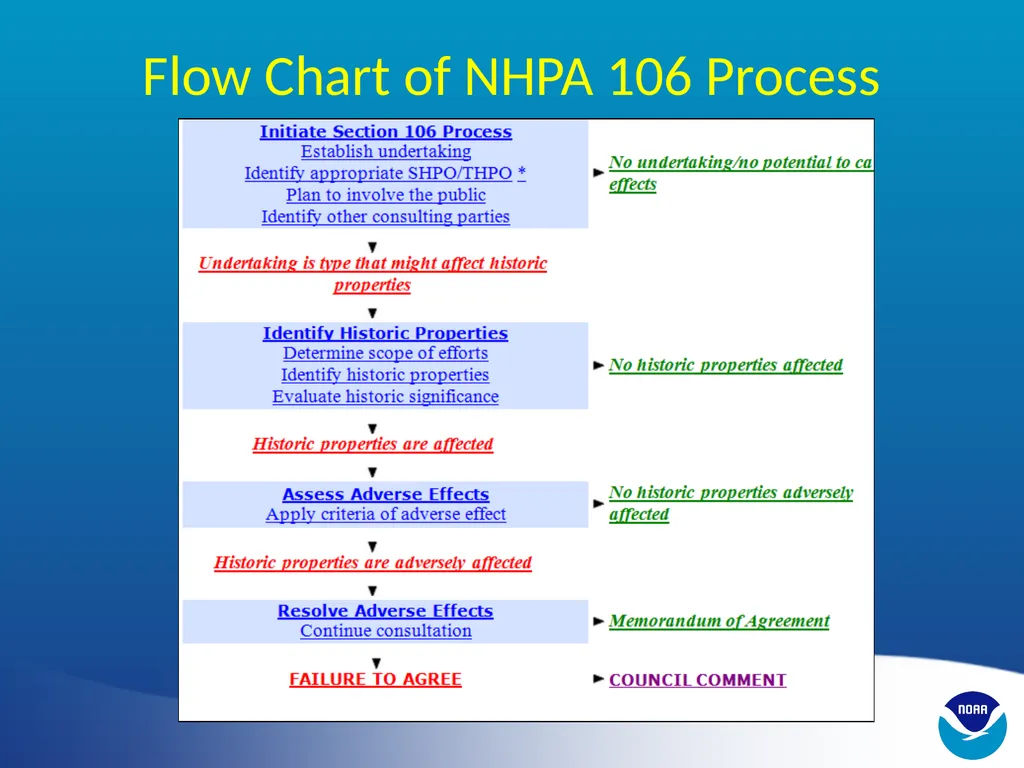
How the Process Works Initiate Section 106 Process
Is it a type of action that may affect historic properties?
If yes, identify the State Historic Preservation Officer (SHPO) or Tribal Historic Preservation Office (THPO) to consult with
If no, then done<br>
13
How the Process Works If a project has potential to affect historic property (listed or eligible)
The Federal Agency must identify historic properties within the “Area of Potential Effects”
Review existing information on the area
Seek additional information as appropriate
may involve background research, consultation, oral history, interviews, investigation, field surveys
Consult with Indian tribes and Native Hawaiians (religious, or cultural significance)<br>
14
How the Process Works IF the action is a type that may affect, then
The agency identifies historic properties in the area (listed or eligible)
Can be a very broad inquiry
Park Service can provide formal eligibility determination
If no properties, then the agency documents the finding and provides it to SHPO/THPO for 30 days
If no objection, proceed
If properties are present, assess adverse effect<br>
15
How the Process Works Assess Adverse Effects
Resolve Adverse effects (consult on ways to avoid, minimize, or mitigate adverse effects)
Memorandum of Agreement
Or
Agreement that adverse effects must be accepted for public interest<br>
16
Consultation with Council (ACHP) When consultation with state or tribe terminates without agreement, agency MUST consult with ACHP
Depending on which party terminates, ACHP will either enter an MOA with action agency, provide formal comments, or provide advisory comments
Be aware of addressing comments reasonably on RECORD
W<br>
17
Flow Chart of NHPA 106 Process<br>
18
Example: Monk Seals 2014 Programmatic Environmental Impact Statement; Appendix B; Final PEIS for Hawaiian Monk Seal Recovery Actions; March 2014<br>