04
Bonds and notes may be purchased directly from the Treasury
Note maturity is 1-10 years; Bond maturity is 10-30 years
Denomination can be as small as $100, but $1,000 is more common
Bid price of 100:08 means 100 8/32 or $1002.50 U.S. Treasury Bonds<br>
05
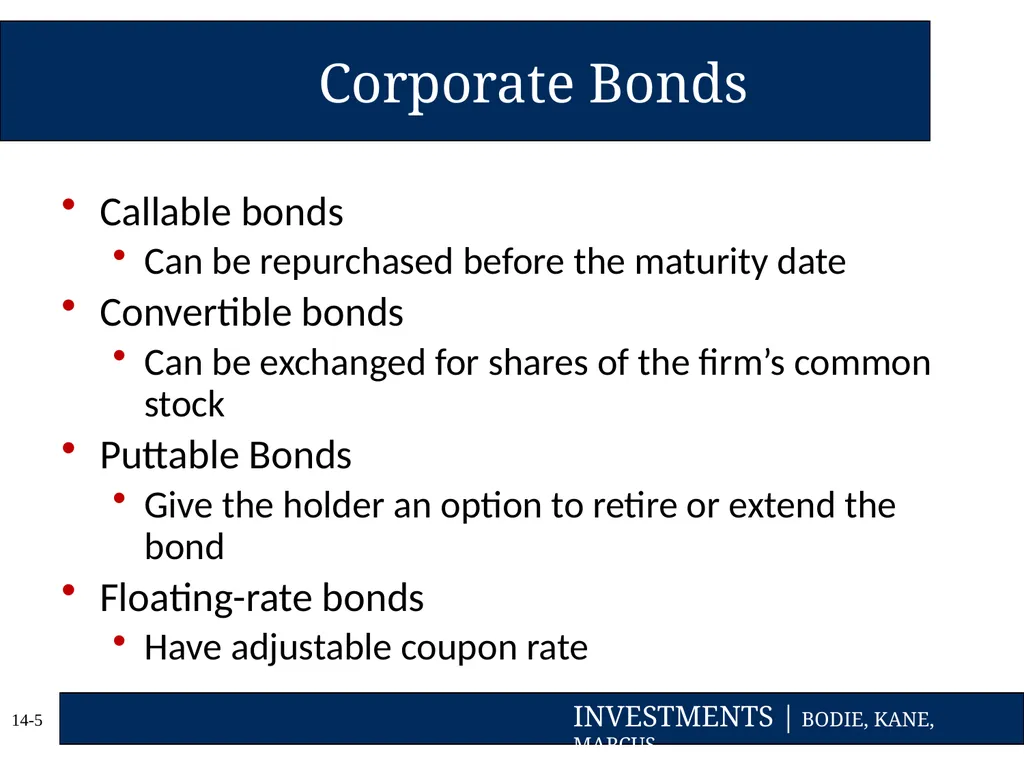
Callable bonds
Can be repurchased before the maturity date
Convertible bonds
Can be exchanged for shares of the firm’s common stock
Puttable Bonds
Give the holder an option to retire or extend the bond
Floating-rate bonds
Have adjustable coupon rate Corporate Bonds<br>
06
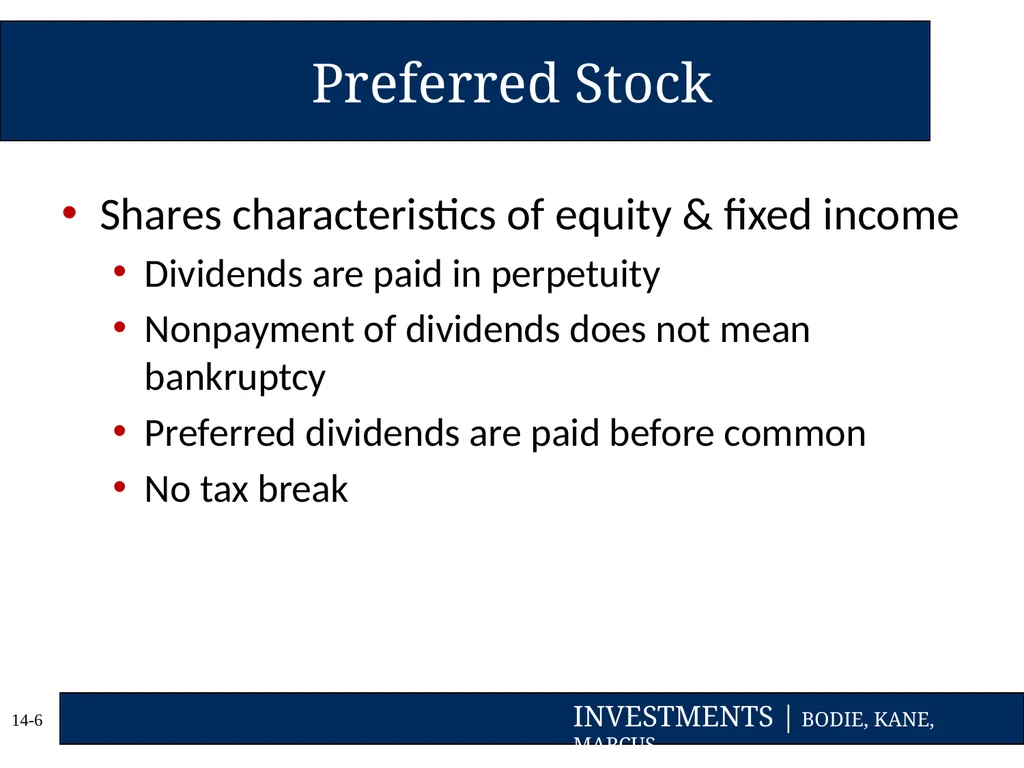
Shares characteristics of equity & fixed income
Dividends are paid in perpetuity
Nonpayment of dividends does not mean bankruptcy
Preferred dividends are paid before common
No tax break Preferred Stock<br>
07
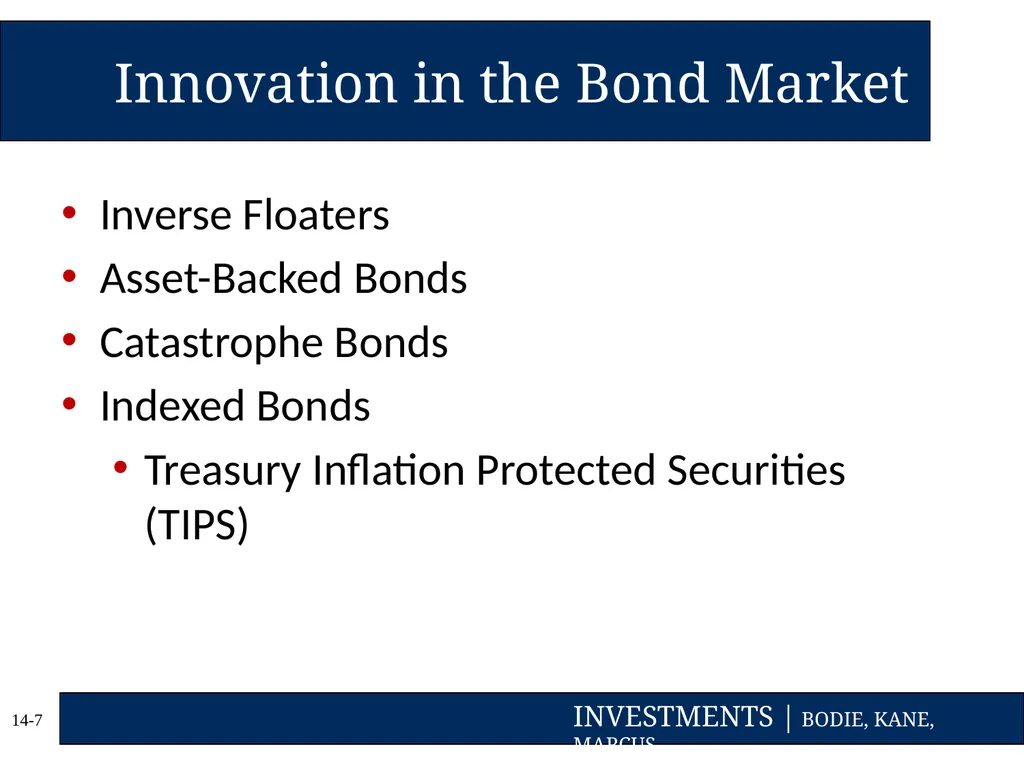
Inverse Floaters
Asset-Backed Bonds
Catastrophe Bonds
Indexed Bonds
Treasury Inflation Protected Securities (TIPS) Innovation in the Bond Market<br>
08
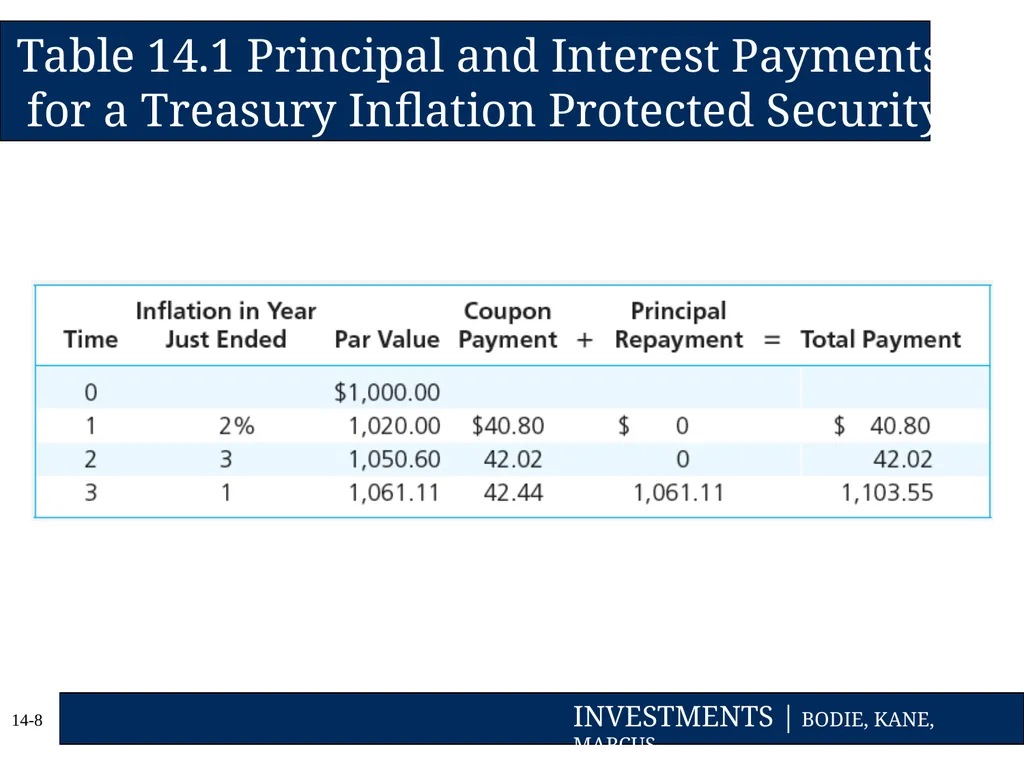
Table 14.1 Principal and Interest Payments �for a Treasury Inflation Protected Security<br>
09
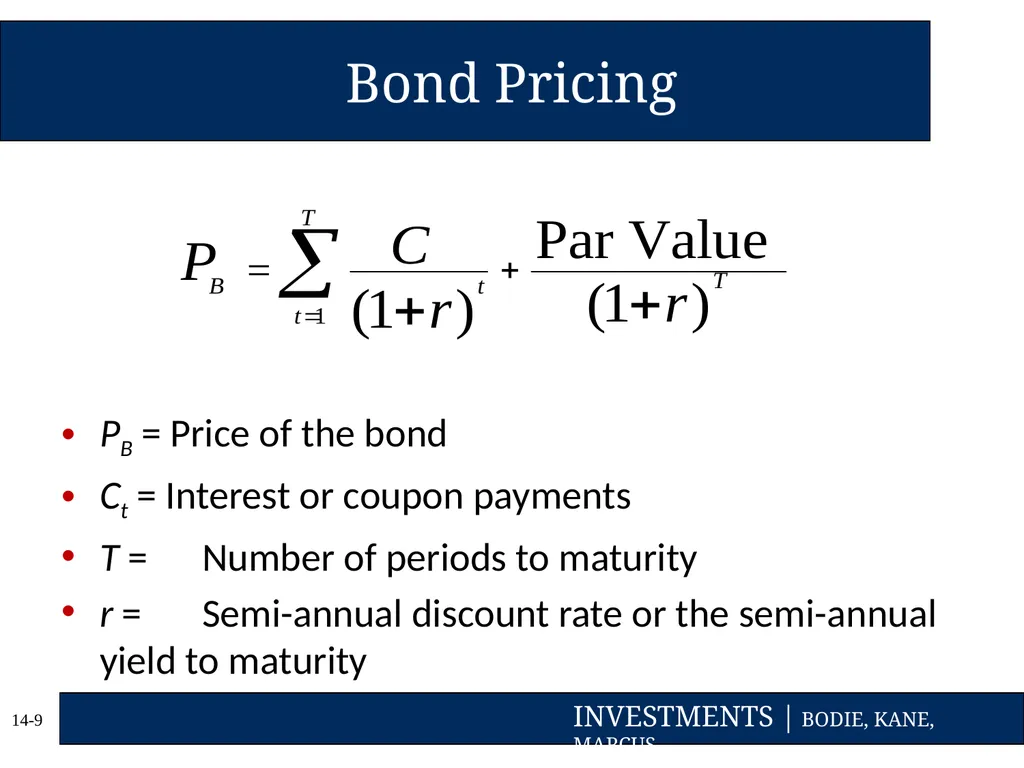
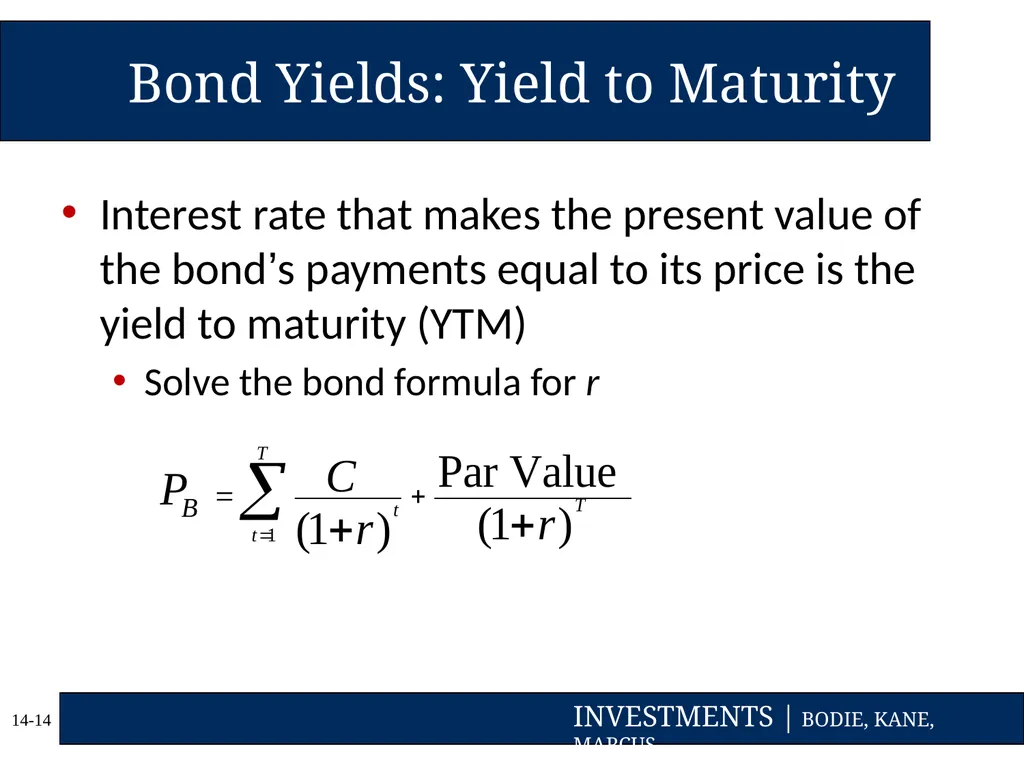
PB = Price of the bond
Ct = Interest or coupon payments
T = Number of periods to maturity
r = Semi-annual discount rate or the semi-annual yield to maturity Bond Pricing<br>
10
Price of a 30 year, 8% coupon bond. Market rate of interest is 10%. Example 14.2: Bond Pricing<br>
11
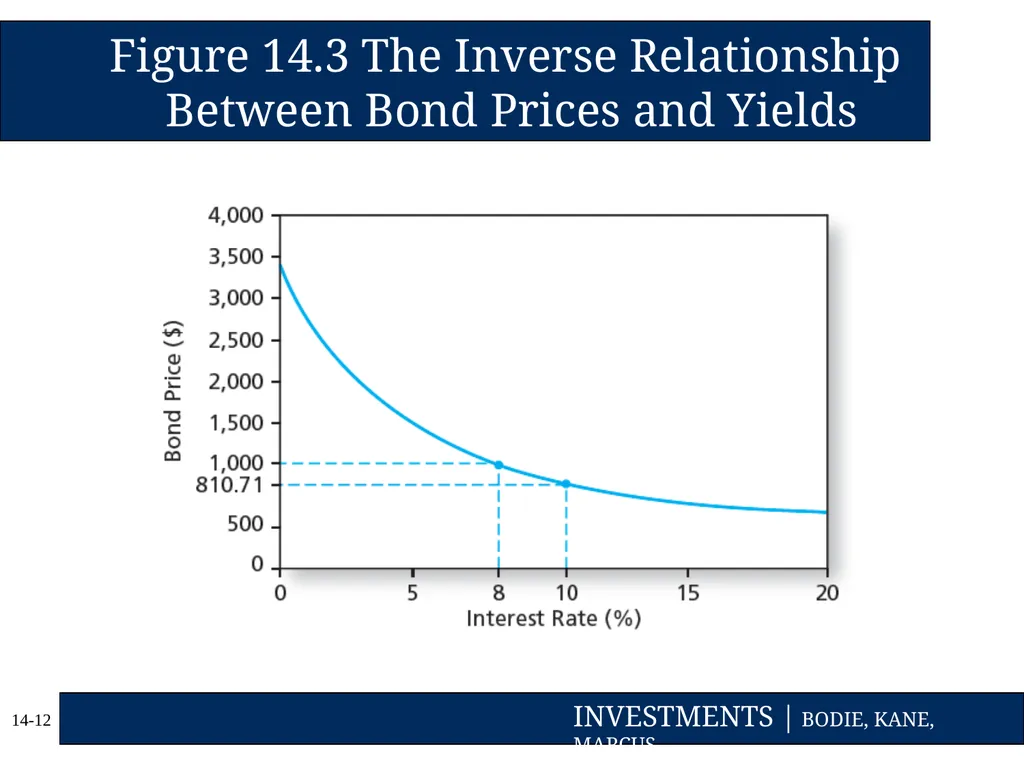
Prices and yields (required rates of return) have an inverse relationship
The bond price curve (Figure 14.3) is convex
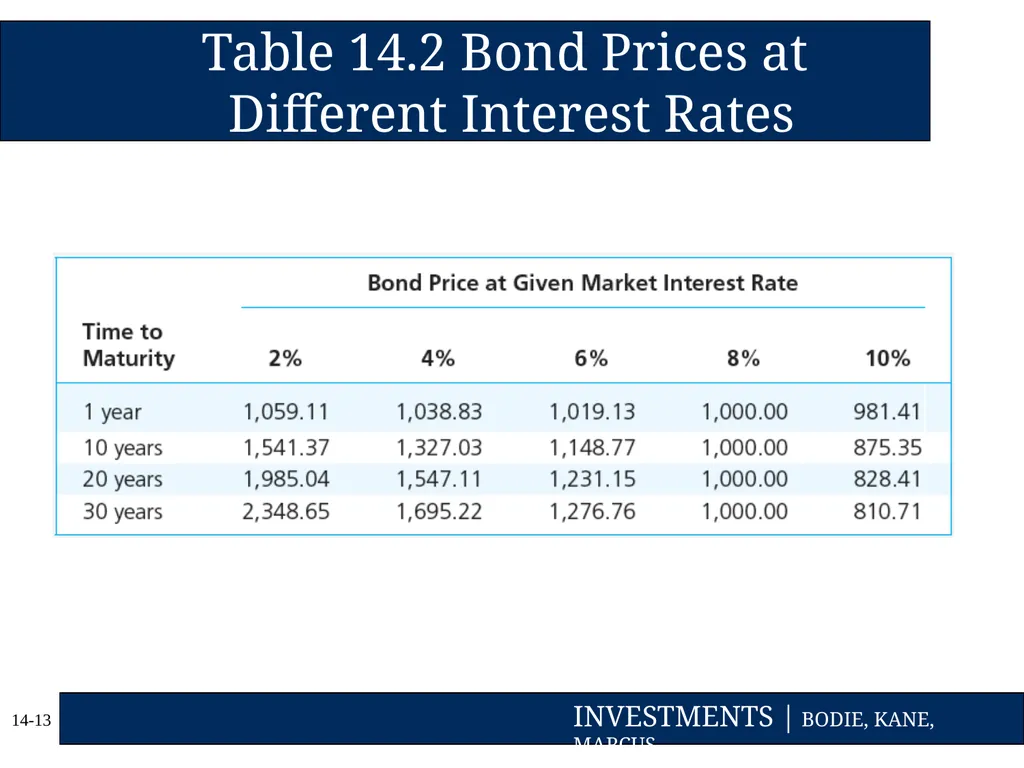
The longer the maturity, the more sensitive the bond’s price to changes in market interest rates Bond Prices and Yields<br>
12
Figure 14.3 The Inverse Relationship �Between Bond Prices and Yields<br>
13
Table 14.2 Bond Prices at �Different Interest Rates<br>
14
Interest rate that makes the present value of the bond’s payments equal to its price is the yield to maturity (YTM)
Solve the bond formula for r Bond Yields: Yield to Maturity<br>
15
Suppose an 8% coupon, 30 year bond is selling for $1276.76. What is its average rate of return?
r = 3% per half year
Bond equivalent yield = 6%
EAR = ((1.03)2) – 1 = 6.09% Yield to Maturity Example<br>
16
Yield to Maturity
Bond’s internal rate of return
The interest rate that makes the PV of a bond’s payments equal to its price; assumes that all bond coupons can be reinvested at the YTM
Current Yield
Bond’s annual coupon payment divided by the bond price
For premium bonds
Coupon rate > Current yield > YTM
For discount bonds, relationships are reversed Bond Yields: YTM vs. Current Yield<br>
17
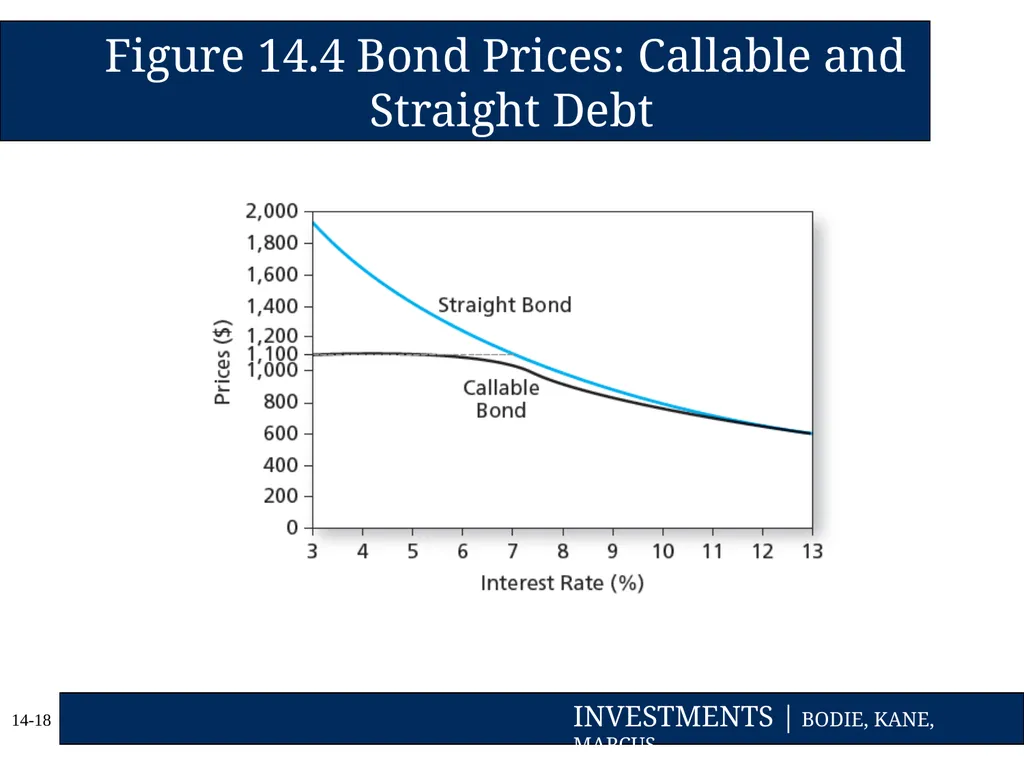
If interest rates fall, price of straight bond can rise considerably
The price of the callable bond is flat over a range of low interest rates because the risk of repurchase or call is high
When interest rates are high, the risk of call is negligible and the values of the straight and the callable bond converge Bond Yields: Yield to Call<br>
18
Figure 14.4 Bond Prices: Callable and �Straight Debt<br>
19
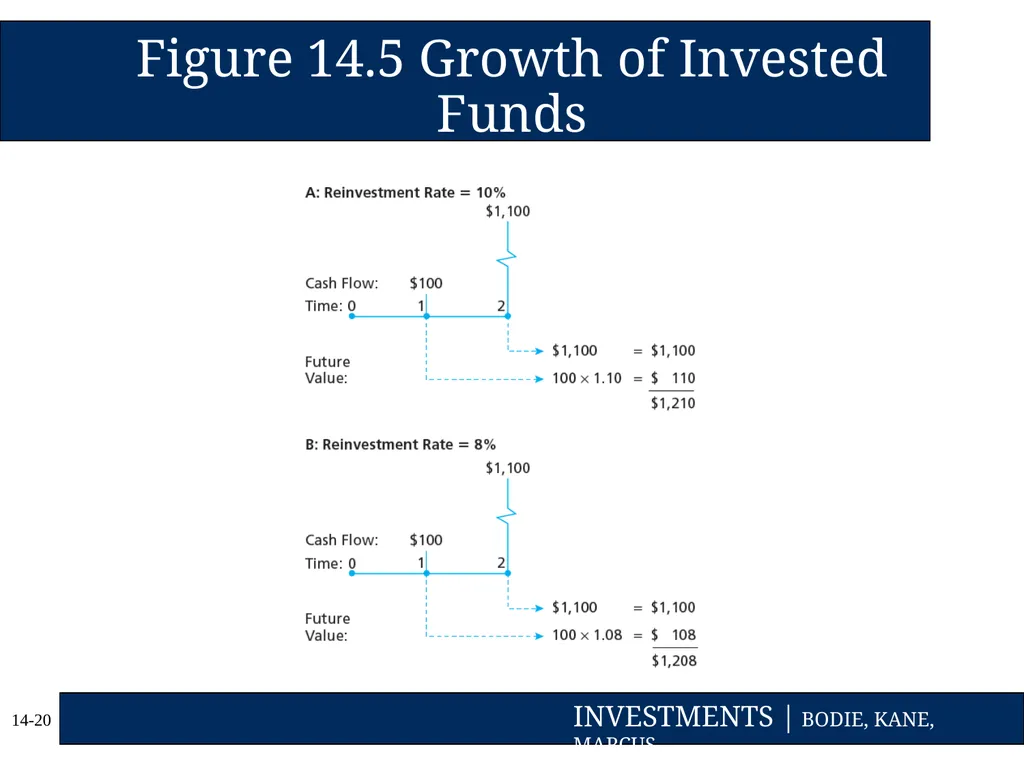
Reinvestment Assumptions
Holding Period Return
Changes in rates affect returns
Reinvestment of coupon payments
Change in price of the bond Bond Yields: �Realized Yield versus YTM<br>
20
Figure 14.5 Growth of Invested Funds<br>
21
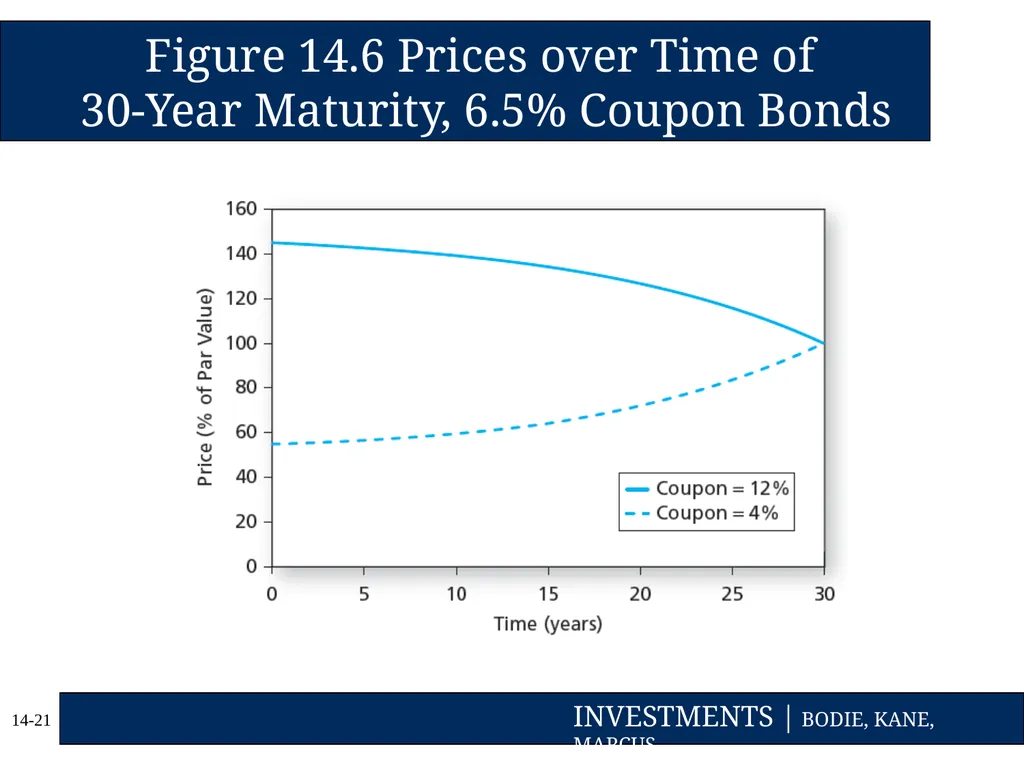
Figure 14.6 Prices over Time of �30-Year Maturity, 6.5% Coupon Bonds<br>
22
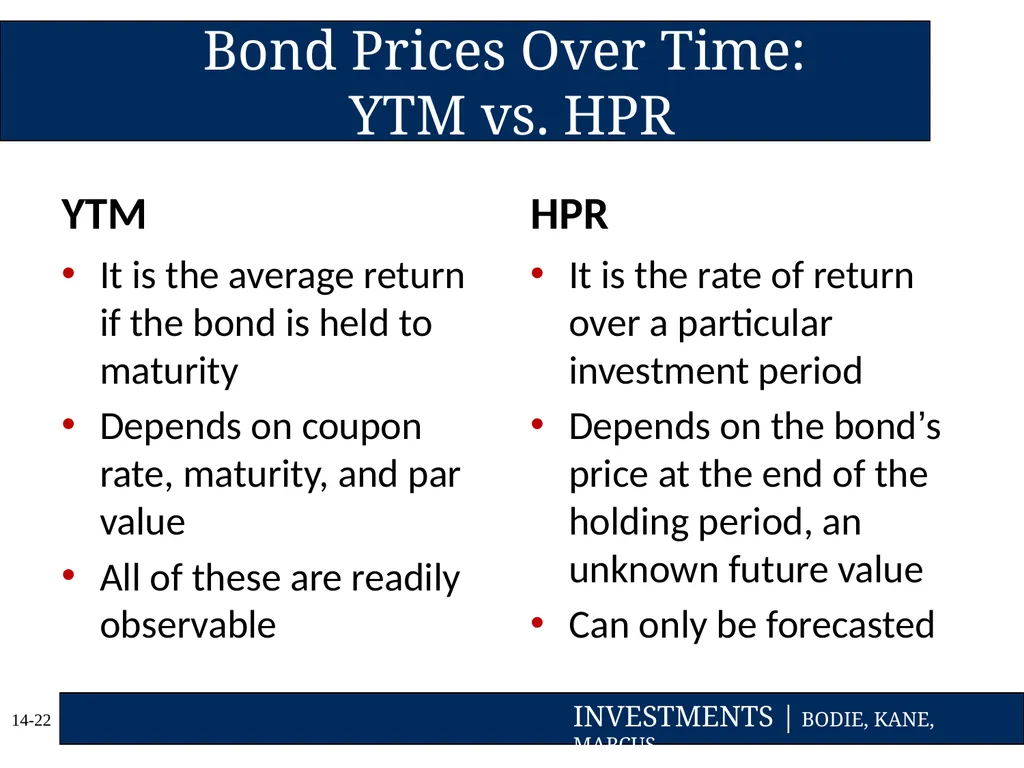
Bond Prices Over Time: �YTM vs. HPR YTM It is the average return if the bond is held to maturity
Depends on coupon rate, maturity, and par value
All of these are readily observable HPR It is the rate of return over a particular investment period
Depends on the bond’s price at the end of the holding period, an unknown future value
Can only be forecasted<br>
23
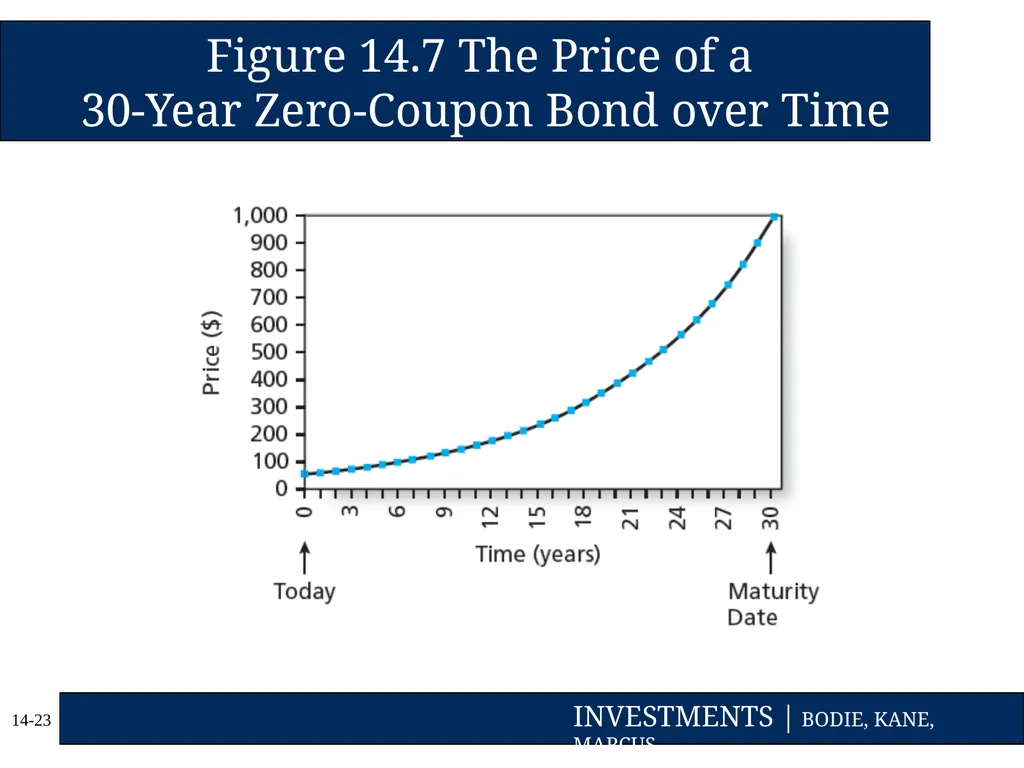
Figure 14.7 The Price of a �30-Year Zero-Coupon Bond over Time<br>
24
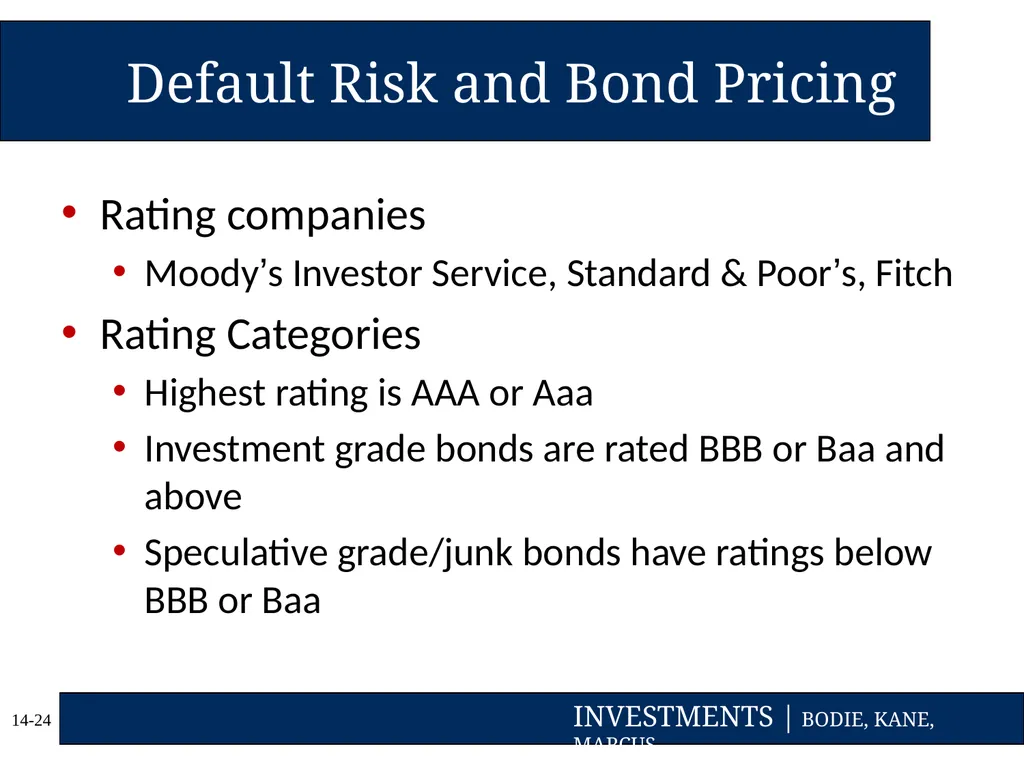
Rating companies
Moody’s Investor Service, Standard & Poor’s, Fitch
Rating Categories
Highest rating is AAA or Aaa
Investment grade bonds are rated BBB or Baa and above
Speculative grade/junk bonds have ratings below BBB or Baa Default Risk and Bond Pricing<br>
25
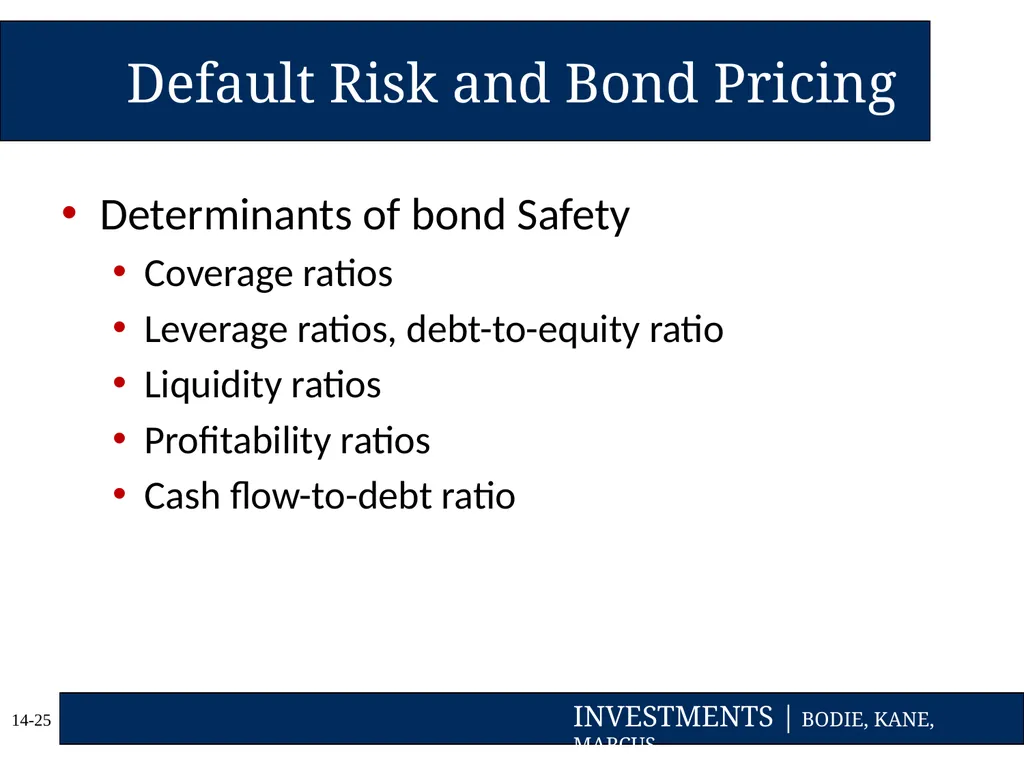
Determinants of bond Safety
Coverage ratios
Leverage ratios, debt-to-equity ratio
Liquidity ratios
Profitability ratios
Cash flow-to-debt ratio Default Risk and Bond Pricing<br>
26
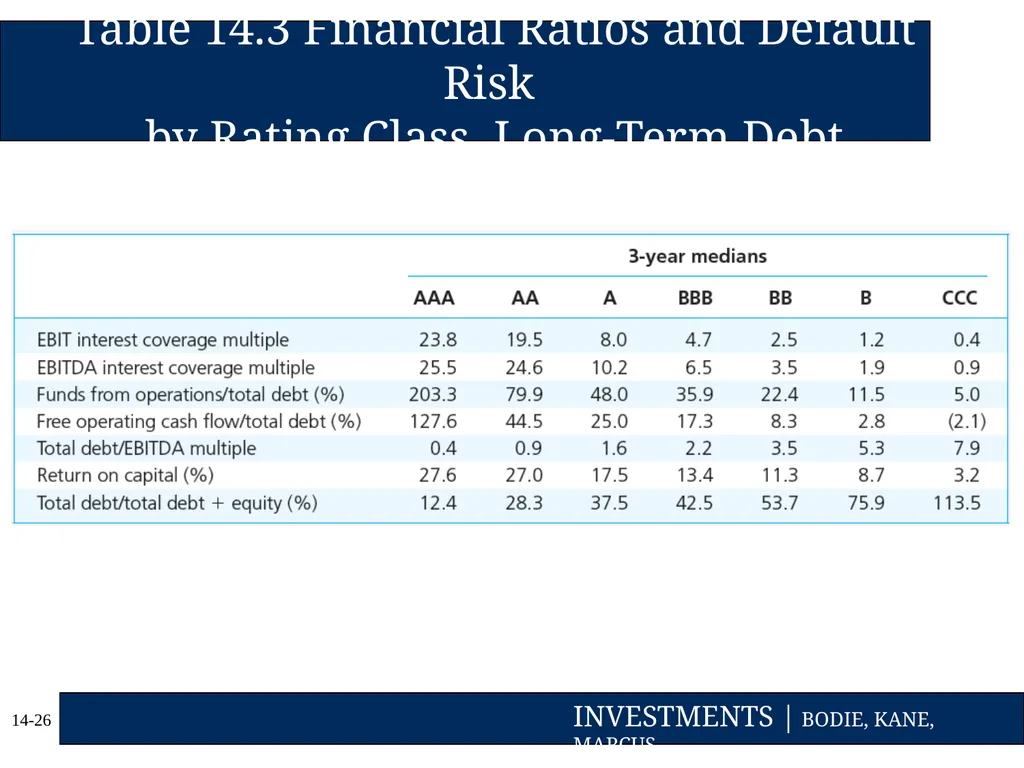
Table 14.3 Financial Ratios and Default Risk �by Rating Class, Long-Term Debt<br>
27
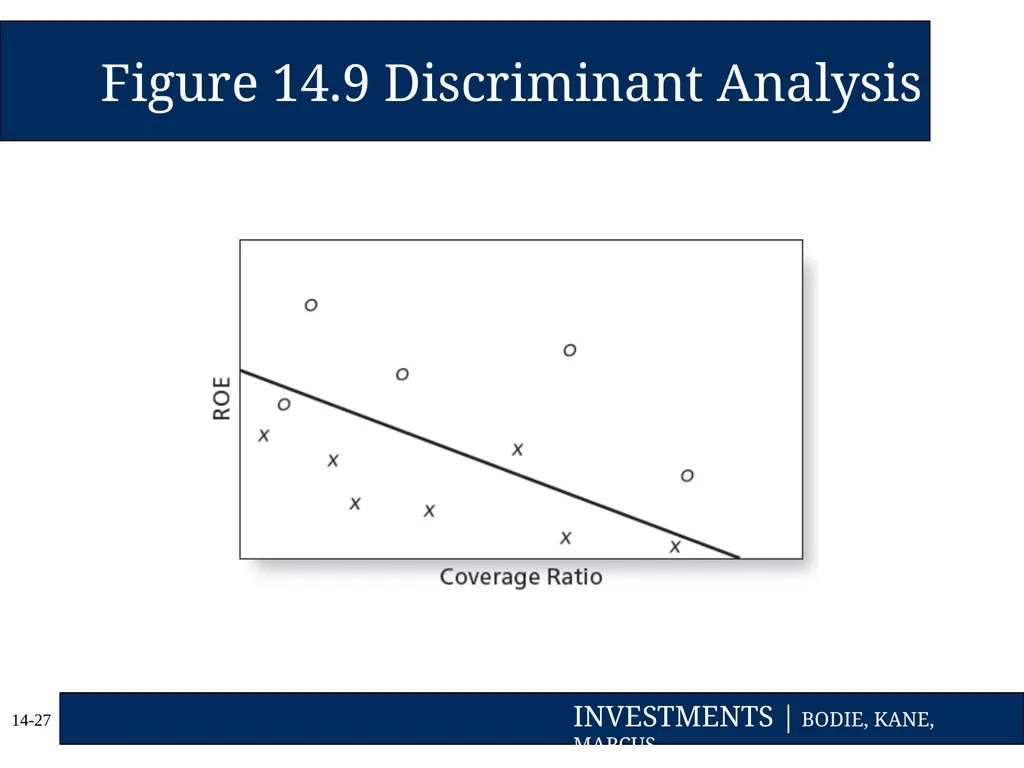
Figure 14.9 Discriminant Analysis<br>
28
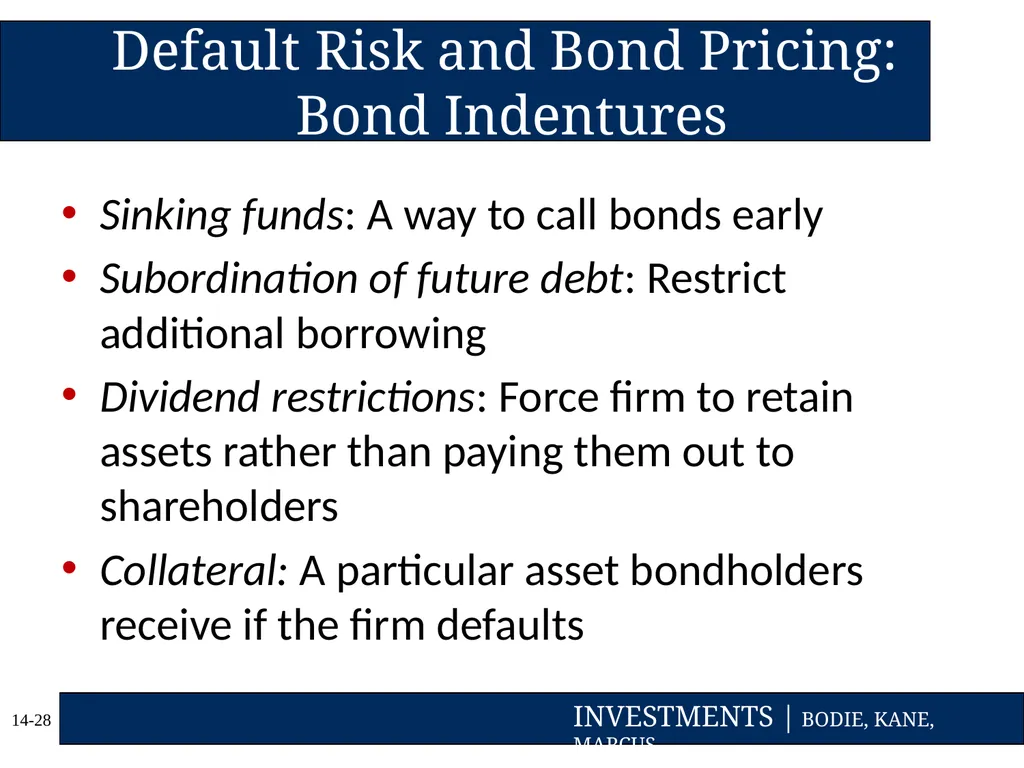
Sinking funds: A way to call bonds early
Subordination of future debt: Restrict additional borrowing
Dividend restrictions: Force firm to retain assets rather than paying them out to shareholders
Collateral: A particular asset bondholders receive if the firm defaults Default Risk and Bond Pricing: �Bond Indentures<br>
29
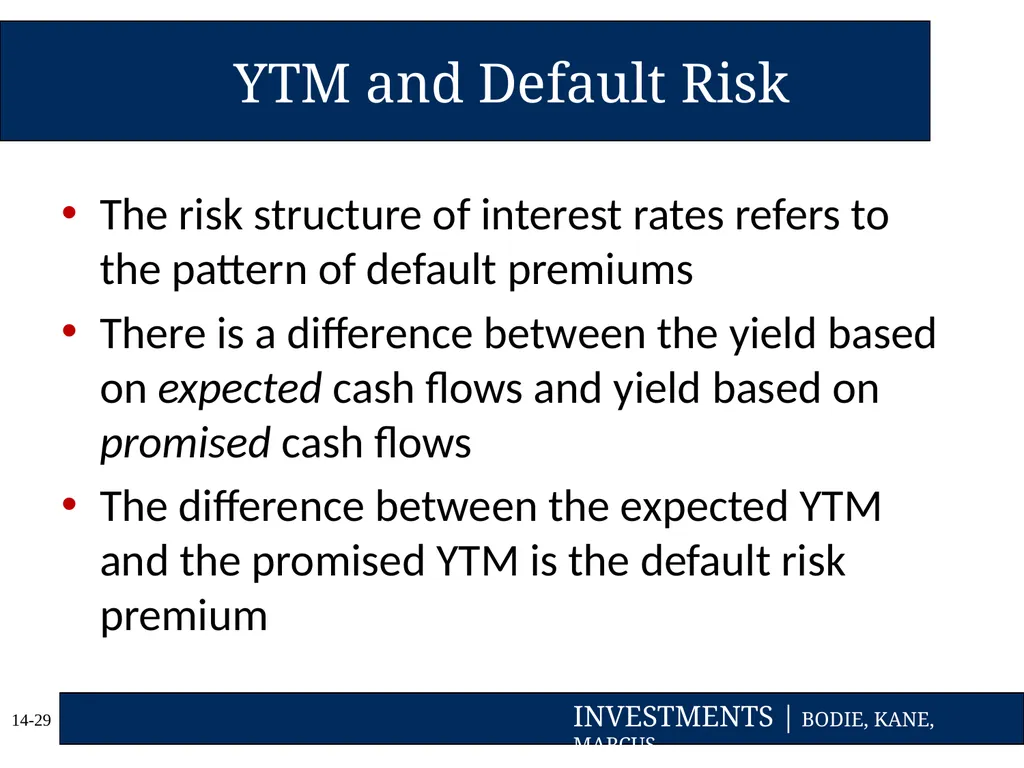
The risk structure of interest rates refers to the pattern of default premiums
There is a difference between the yield based on expected cash flows and yield based on promised cash flows
The difference between the expected YTM and the promised YTM is the default risk premium YTM and Default Risk<br>
30
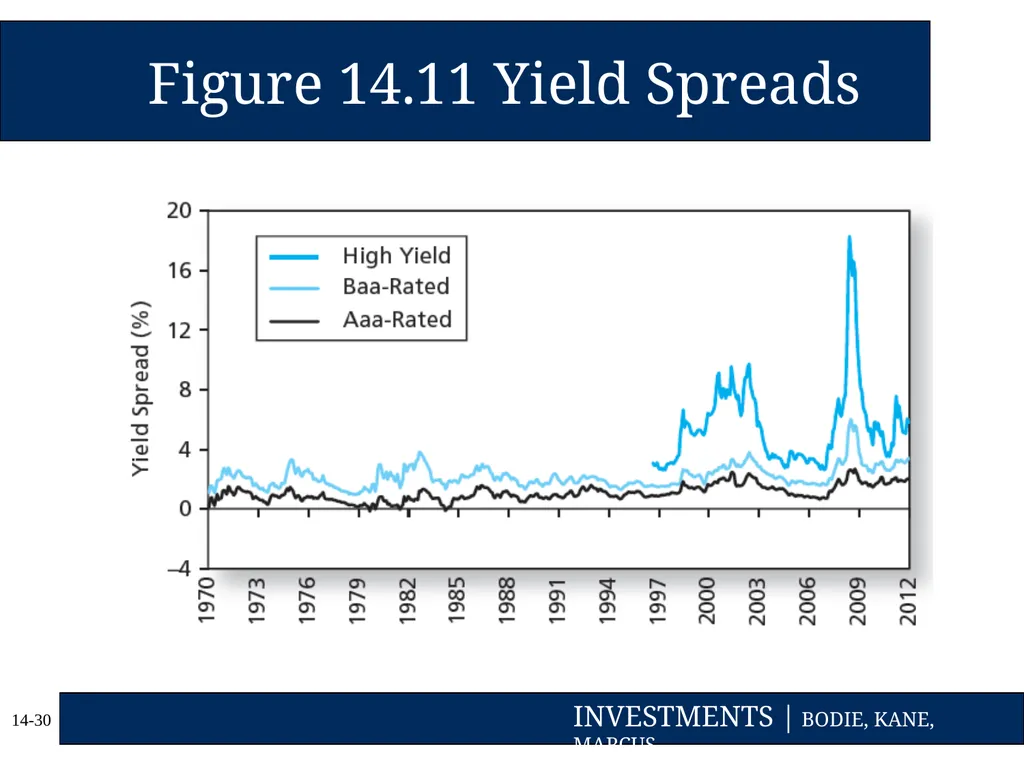
Figure 14.11 Yield Spreads<br>
31
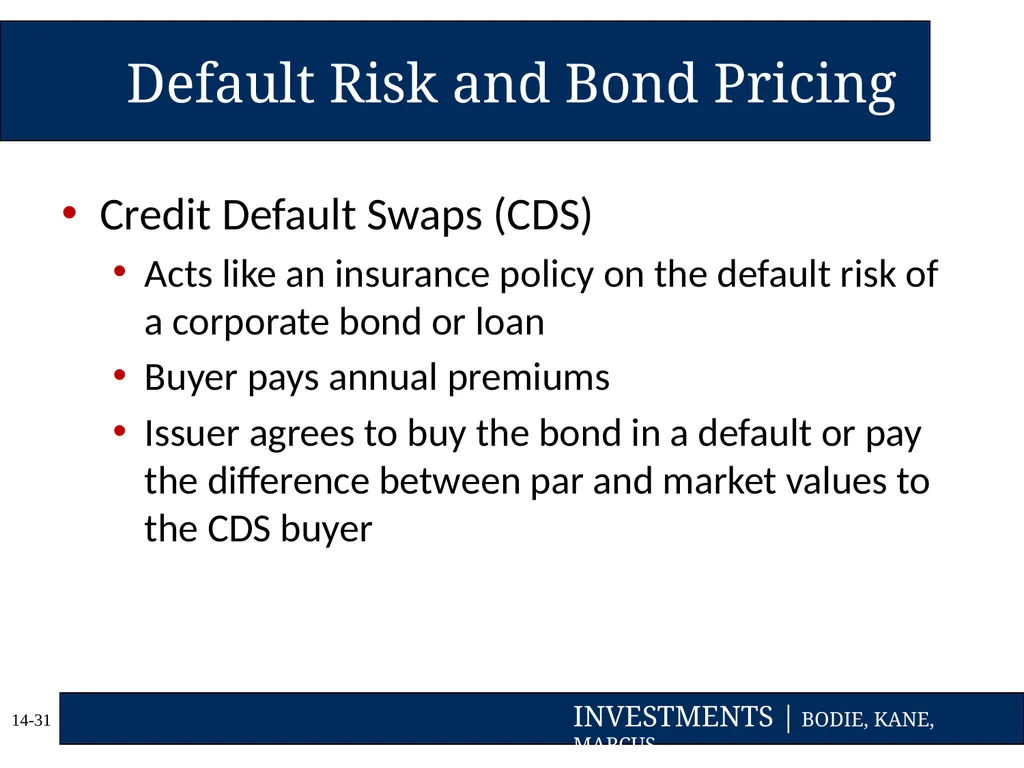
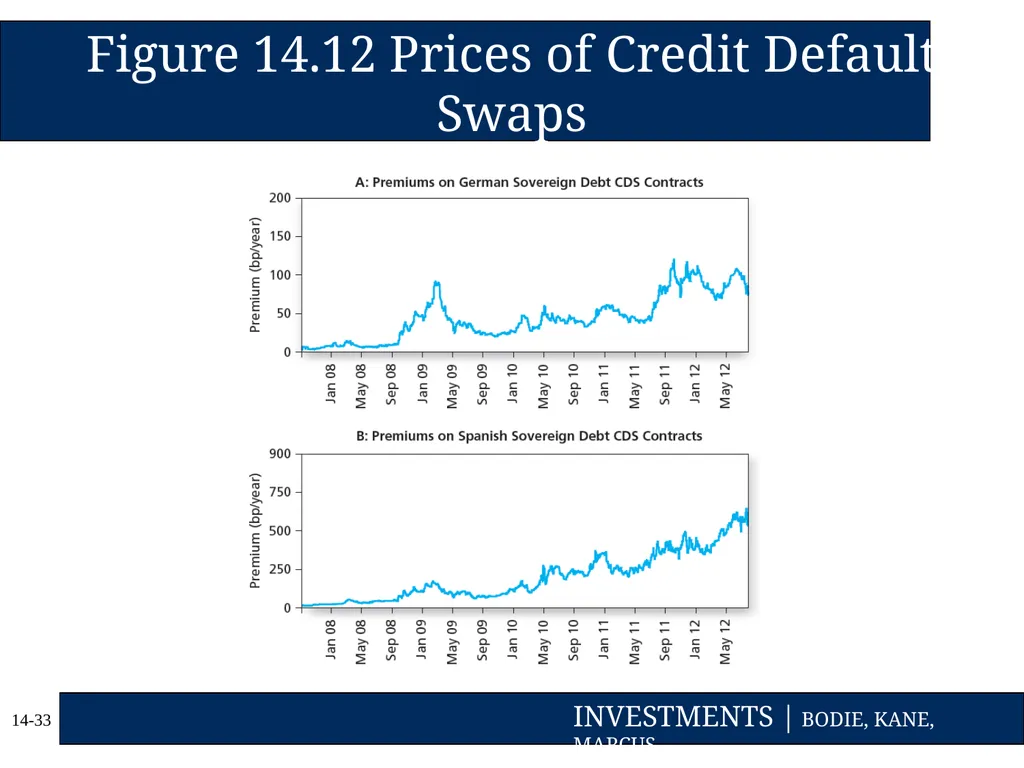
Credit Default Swaps (CDS)
Acts like an insurance policy on the default risk of a corporate bond or loan
Buyer pays annual premiums
Issuer agrees to buy the bond in a default or pay the difference between par and market values to the CDS buyer Default Risk and Bond Pricing<br>
32
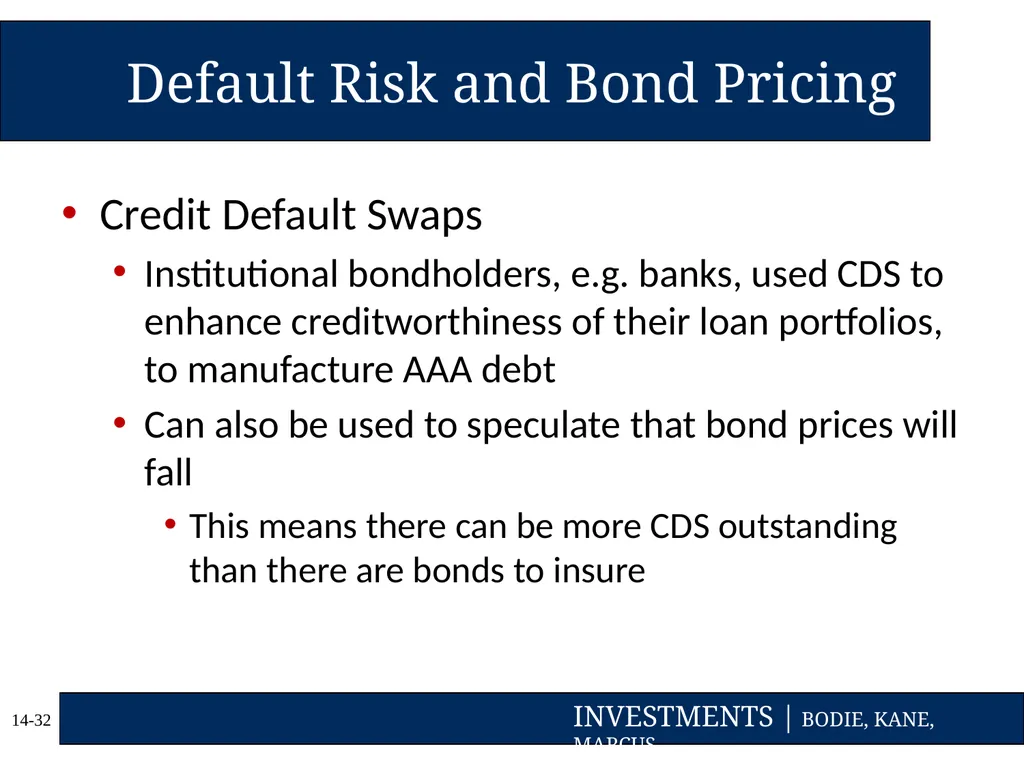
Credit Default Swaps
Institutional bondholders, e.g. banks, used CDS to enhance creditworthiness of their loan portfolios, to manufacture AAA debt
Can also be used to speculate that bond prices will fall
This means there can be more CDS outstanding than there are bonds to insure Default Risk and Bond Pricing<br>
33
Figure 14.12 Prices of Credit Default Swaps<br>
34
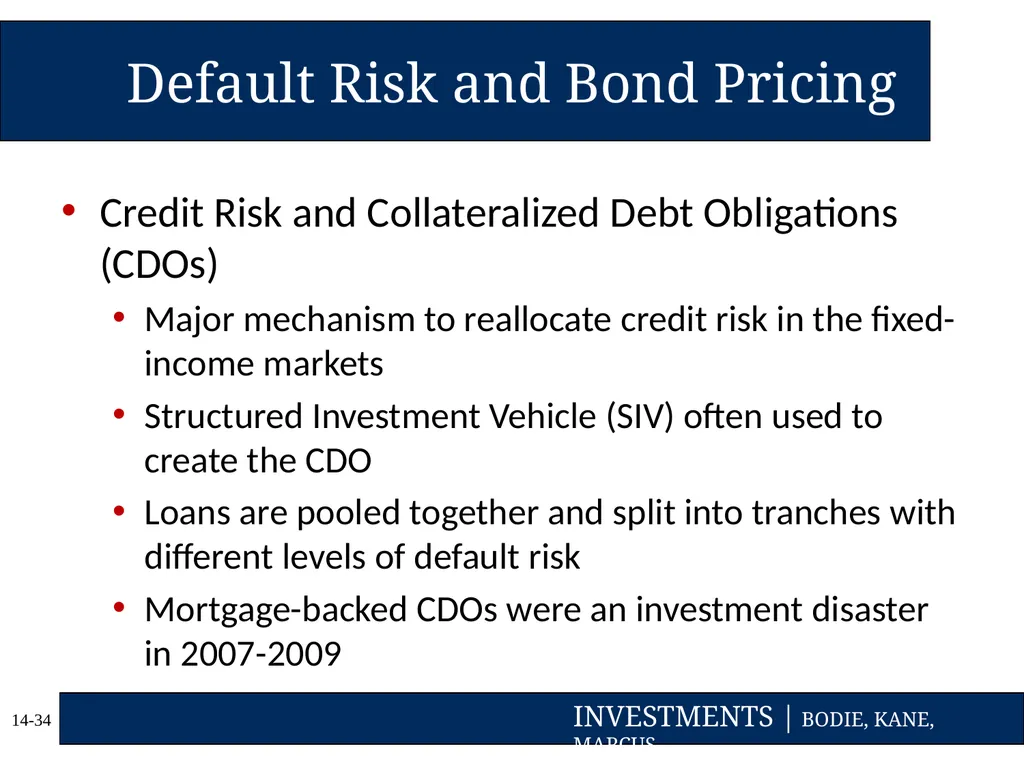
Credit Risk and Collateralized Debt Obligations (CDOs)
Major mechanism to reallocate credit risk in the fixed-income markets
Structured Investment Vehicle (SIV) often used to create the CDO
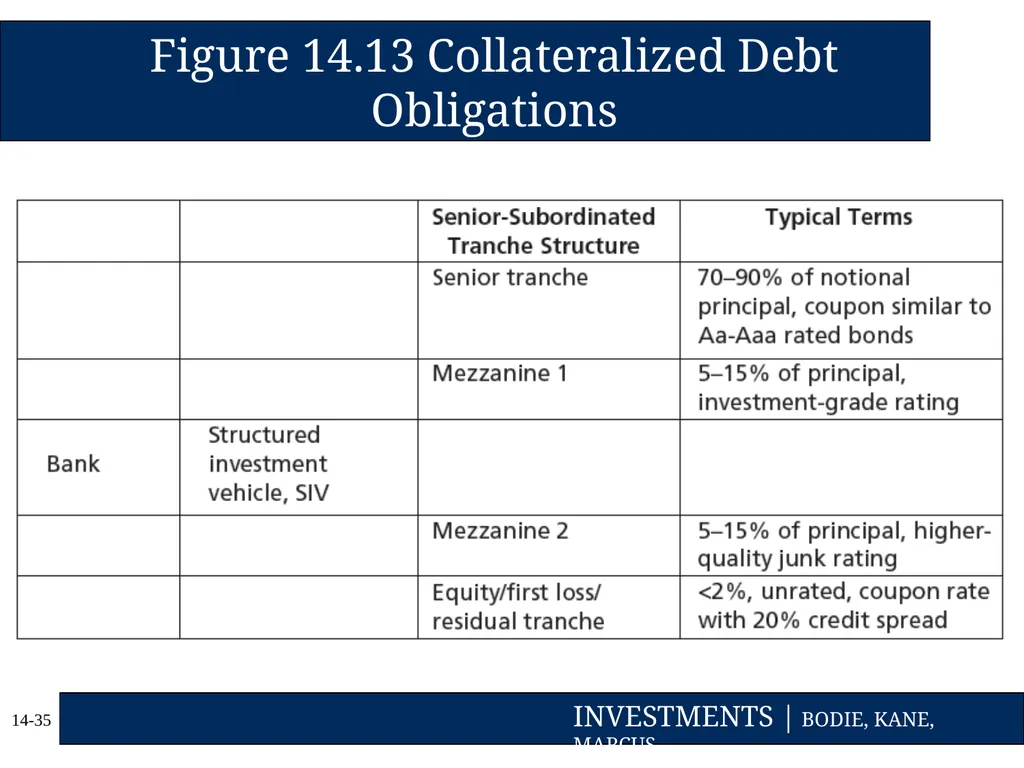
Loans are pooled together and split into tranches with different levels of default risk
Mortgage-backed CDOs were an investment disaster in 2007-2009 Default Risk and Bond Pricing<br>
35
Figure 14.13 Collateralized Debt Obligations<br>