
Chapter One Copyright © 2021 by the McGraw-Hill


Description: Chapter One Copyright 2021 by the McGraw-Hill Companies, Inc. All rights reserved. Globalization and the Multinational Firm Overview Whats special about international finance? Goals for international financial management Globalization
Related Topics
Download Presentation
"Chapter One Copyright © 2021 by the McGraw-Hill" is the property of its rightful owner. Permission is granted to download and print the materials on this website for personal, non-commercial use only, and to display it on your personal computer provided you do not modify the materials and that you retain all copyright notices contained in the materials. By downloading content from our website, you accept the terms of this agreement.
Presentation Transcript
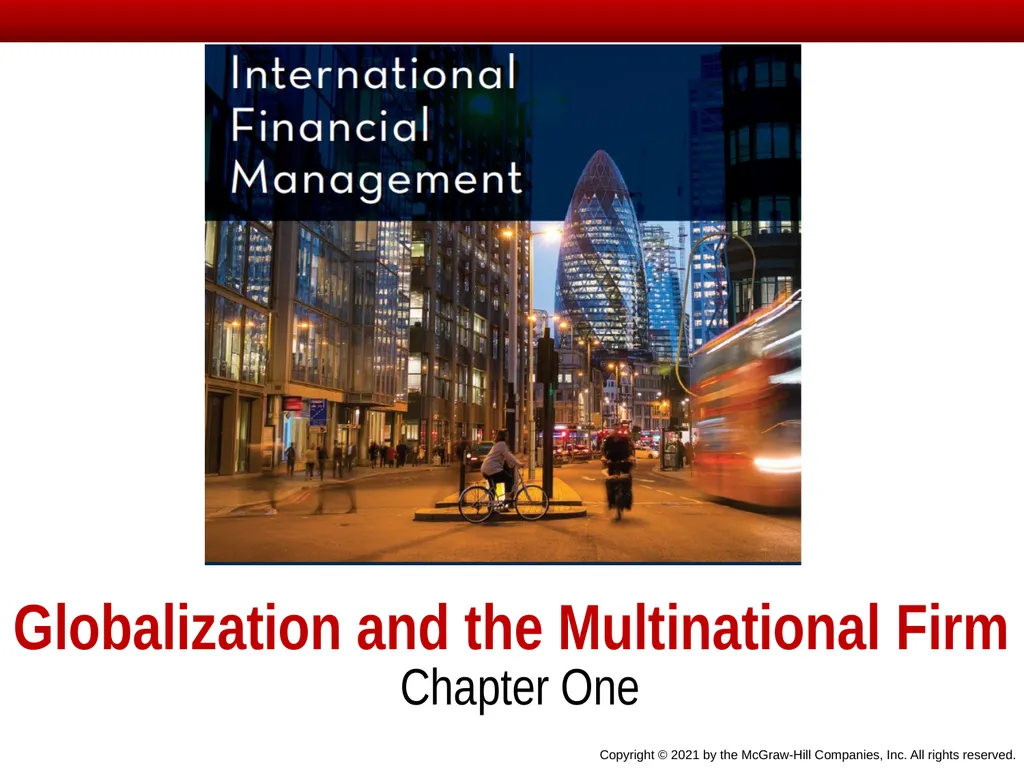
slide1. Chapter One Copyright © 2021 by the McGraw-Hill Companies, Inc. All rights reserved. Globalization and the Multinational Firm<br>
slide2. Overview What’s special about “international” finance?
Goals for international financial management
Globalization of the world economy
Multinational corporations Copyright © 2021 by the McGraw-Hill Companies, Inc. All rights reserved. 1-2<br>
slide3. What’s Special about “International” Finance? Three major dimensions set international finance apart from domestic finance
Foreign exchange risk and political risks
Market imperfections
Expanded opportunity set
Largely stem from the fact that sovereign nations have the right to issue currencies, formulate their own economic policies, impose taxes, and regulate movements of people, goods and capital across their borders Copyright © 2021 by the McGraw-Hill Companies, Inc. All rights reserved. 1-3<br>
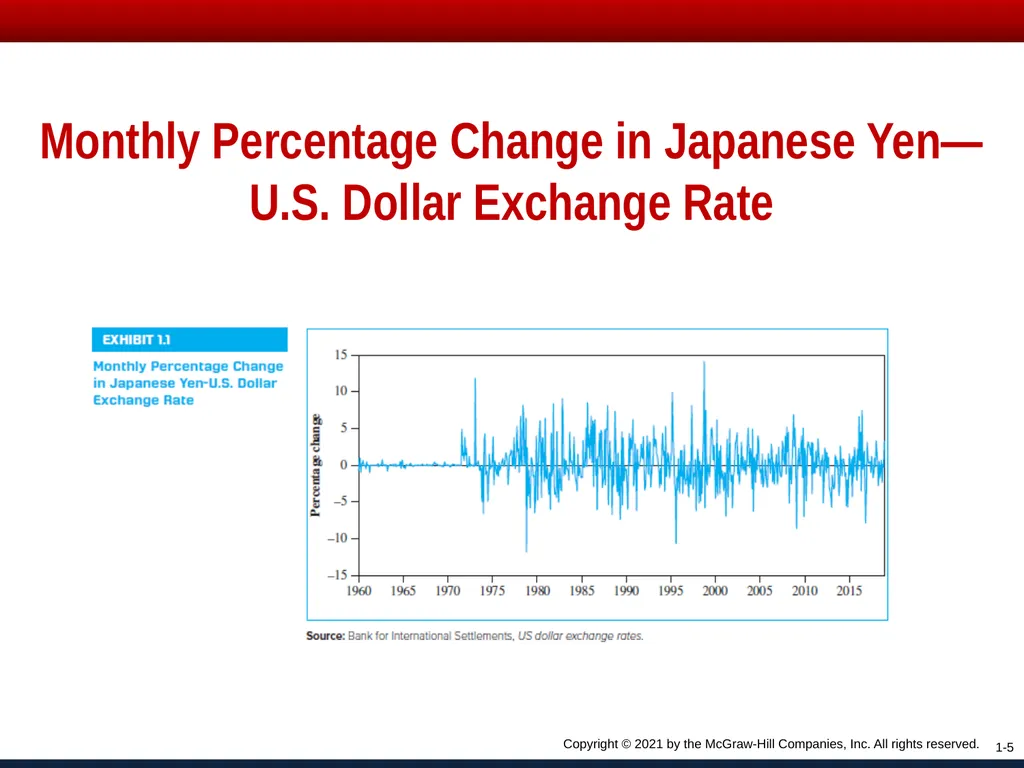
slide4. Foreign exchange risk is the risk of facing uncertain future exchange rates
In addition to businesses, individuals and households may also be seriously exposed to uncertain exchange rates
Exchange rates among major currencies (e.g., U.S. dollar, Japanese yen, British pound, and euro) fluctuate continuously in an unpredictable manner
Exchange rate uncertainty influences all major economic functions, including consumption, production, and investment What’s Special about “International” Finance: Foreign Exchange Risk 1-4 Copyright © 2021 by the McGraw-Hill Companies, Inc. All rights reserved.<br>
slide5. Monthly Percentage Change in Japanese Yen—U.S. Dollar Exchange Rate 1-5 Copyright © 2021 by the McGraw-Hill Companies, Inc. All rights reserved.<br>
slide6. Political risk arises from potential losses to the parent firm resulting from adverse political developments in the host country
Ranges from unexpected changes in tax rules to outright expropriation of assets held by foreigners
Arises from the fact that a sovereign country can change the “rules of the game” and the affected parties may not have effective recourse
Especially relevant in those countries without a traditional rule of law 1-6 What’s Special about “International” Finance: Political Risk Copyright © 2021 by the McGraw-Hill Companies, Inc. All rights reserved.<br>
slide7. Market imperfections may be described as various frictions, such as transaction costs and legal restrictions, that prevent the markets from functioning perfectly
World markets are highly imperfect
Numerous barriers hamper the free movement of people, goods, services, and capital across national boundaries (e.g., legal restrictions, excessive transaction and transportation costs, information asymmetry, and discriminatory taxation)
Restrict the extent to which investors can diversify their portfolios 1-7 What’s Special about “International” Finance: Market Imperfections Copyright © 2021 by the McGraw-Hill Companies, Inc. All rights reserved.<br>
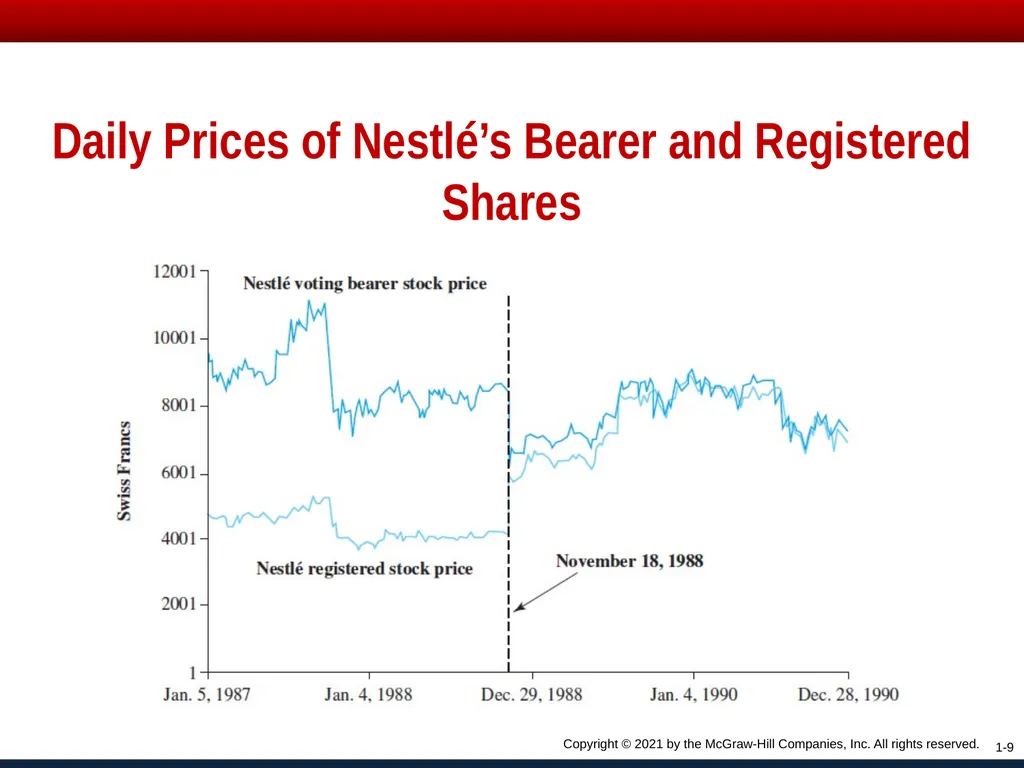
slide8. The Example of Nestlé’s Market Imperfection Nestlé used to issue two different classes of common stock, bearer shares and registered shares
Foreigners were only allowed to hold bearer shares
Swiss residents could buy registered shares
The bearer stock was more expensive
On November 18, 1988, Nestlé lifted restrictions imposed on foreigners, allowing them to hold registered shares as well as bearer shares
Price spread between the two types narrowed drastically 1-8 Copyright © 2021 by the McGraw-Hill Companies, Inc. All rights reserved.<br>
slide9. Daily Prices of Nestlé’s Bearer and Registered Shares 1-9 Copyright © 2021 by the McGraw-Hill Companies, Inc. All rights reserved.<br>
slide10. Firms may benefit from an expanded opportunity set when they venture into the arena of global markets
Firms can gain from greater economies of scale when their tangible and intangible assets are deployed on a global basis
True for corporations, as well as individual investors
“It just doesn’t make sense to play in only one corner of the sandbox.” 1-10 What’s Special about “International” Finance: Expanded Opportunity Set Copyright © 2021 by the McGraw-Hill Companies, Inc. All rights reserved.<br>
slide11. Goals for International Financial Management The focus of the text is to provide today’s financial managers with an understanding of the fundamental concepts and the tools necessary to be effective global managers
Fundamental goal of sound financial management is shareholder wealth maximization, which means the firm makes all business decisions and investments with an eye toward making the owners of the firm (i.e., shareholders) better off financially
Generally accepted in Anglo-Saxon countries, but not as widely embraced in other parts of the world 1-11 Copyright © 2021 by the McGraw-Hill Companies, Inc. All rights reserved.<br>
slide12. Other Stakeholders In other countries shareholders are viewed as merely one among many “stakeholders” of the firm, others being:
Employees
Suppliers
Customers
Banks
In Japan, managers have typically sought to maximize the value of the keiretsu—a family of firms to which the individual firms belongs 1-12 Copyright © 2021 by the McGraw-Hill Companies, Inc. All rights reserved.<br>
slide13. Corporate Governance As shown by a series of recent corporate scandals at companies like Enron, WorldCom, Parmalat, and Global Crossing, managers may pursue their own private interests at the expense of shareholders when they are not closely monitored
This “agency problem” is a major weakness of the public corporation
Reinforces the importance of corporate governance, the financial and legal framework for regulating the relationship between a firm’s management and its shareholders 1-13 Copyright © 2021 by the McGraw-Hill Companies, Inc. All rights reserved.<br>
slide14. Emergence of Globalized Financial Markets
Emergence of the Euro as a Global Currency
Europe’s Sovereign Debt Crisis of 2010
Trade Liberalization and Economic Integration
Privatization
Global Financial Crisis of 2008-2009
Brexit 1-14 Globalization of the World Economy: Major Trends and Developments Copyright © 2021 by the McGraw-Hill Companies, Inc. All rights reserved.<br>
slide15. Deregulation of foreign exchange and capital markets
Financial innovations resulted in the introduction of various instruments:
Currency futures and options
Multicurrency bonds
International mutual funds
Country funds
Exchange-traded funds (ETFs)
Foreign stock index futures and options
Advances in computer and telecommunications technology 1-15 Emergence of Globalized Financial Markets Copyright © 2021 by the McGraw-Hill Companies, Inc. All rights reserved.<br>
slide16. Emergence of the Euro as a Global Currency Momentous event in history of world financial system
Currently more than 300 million Europeans in 19 countries are using the common currency on a daily basis
Austria, Belgium, Cyprus, Estonia, Finland, France, Germany, Greece, Ireland, Italy, Latvia, Lithuania, Luxembourg, Malta, the Netherlands, Portugal, Slovakia, Slovenia, and Spain
Transaction domain of the euro may become larger than that of the U.S. dollar in the future 1-16 Copyright © 2021 by the McGraw-Hill Companies, Inc. All rights reserved.<br>
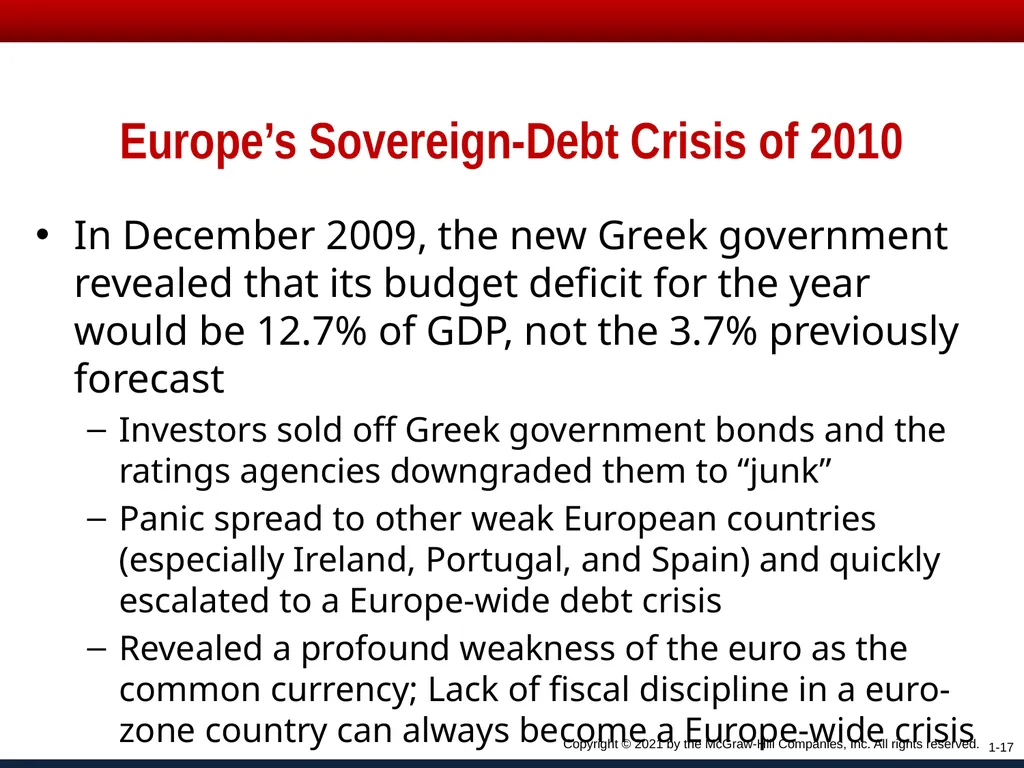
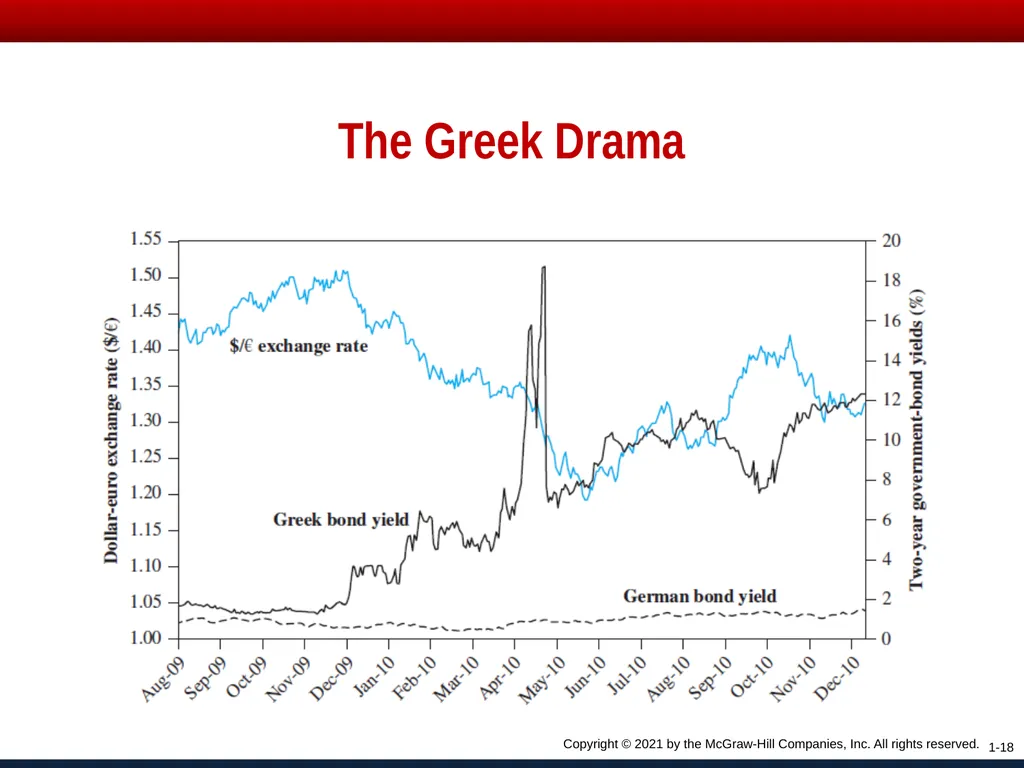
slide17. Europe’s Sovereign-Debt Crisis of 2010 In December 2009, the new Greek government revealed that its budget deficit for the year would be 12.7% of GDP, not the 3.7% previously forecast
Investors sold off Greek government bonds and the ratings agencies downgraded them to “junk”
Panic spread to other weak European countries (especially Ireland, Portugal, and Spain) and quickly escalated to a Europe-wide debt crisis
Revealed a profound weakness of the euro as the common currency; Lack of fiscal discipline in a euro-zone country can always become a Europe-wide crisis 1-17 Copyright © 2021 by the McGraw-Hill Companies, Inc. All rights reserved.<br>
slide18. The Greek Drama 1-18 Copyright © 2021 by the McGraw-Hill Companies, Inc. All rights reserved.<br>
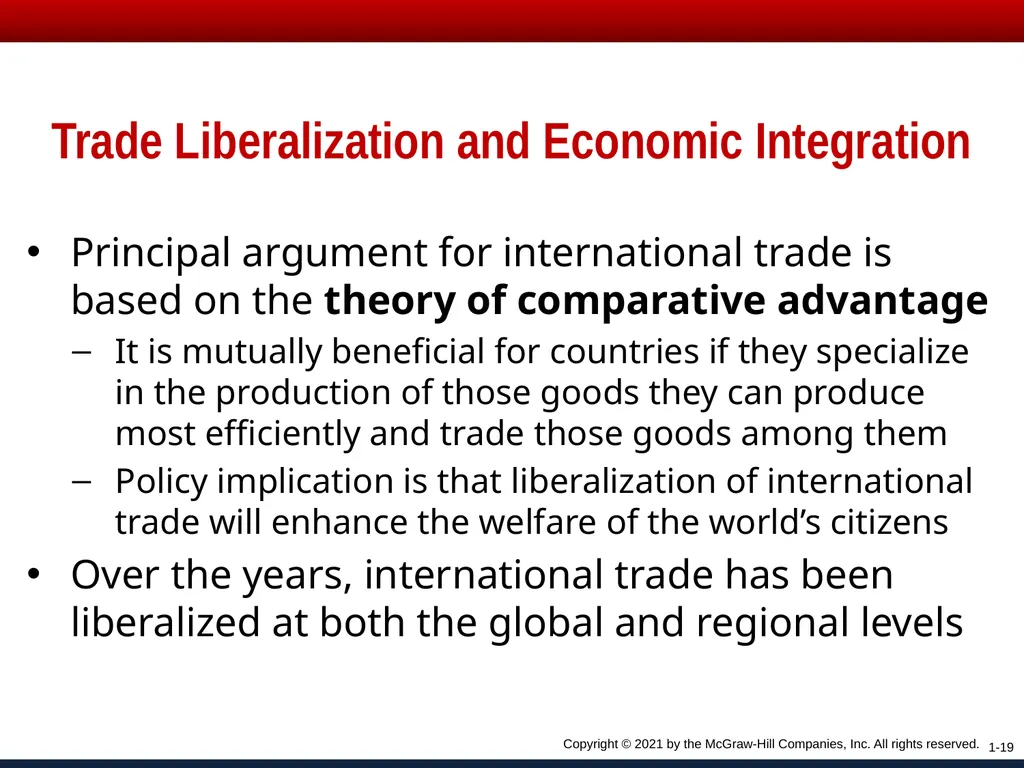
slide19. Trade Liberalization and Economic Integration Principal argument for international trade is based on the theory of comparative advantage
It is mutually beneficial for countries if they specialize in the production of those goods they can produce most efficiently and trade those goods among them
Policy implication is that liberalization of international trade will enhance the welfare of the world’s citizens
Over the years, international trade has been liberalized at both the global and regional levels 1-19 Copyright © 2021 by the McGraw-Hill Companies, Inc. All rights reserved.<br>
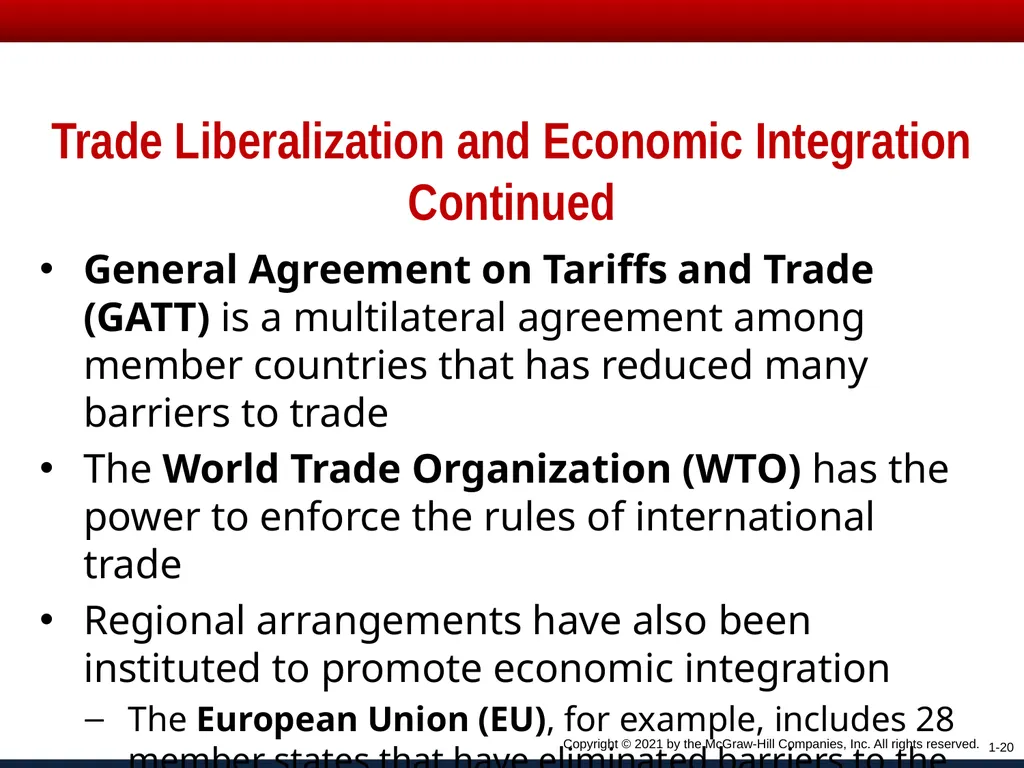
slide20. General Agreement on Tariffs and Trade (GATT) is a multilateral agreement among member countries that has reduced many barriers to trade
The World Trade Organization (WTO) has the power to enforce the rules of international trade
Regional arrangements have also been instituted to promote economic integration
The European Union (EU), for example, includes 28 member states that have eliminated barriers to the free flow of goods, capital, and people 1-20 Trade Liberalization and Economic Integration Continued Copyright © 2021 by the McGraw-Hill Companies, Inc. All rights reserved.<br>
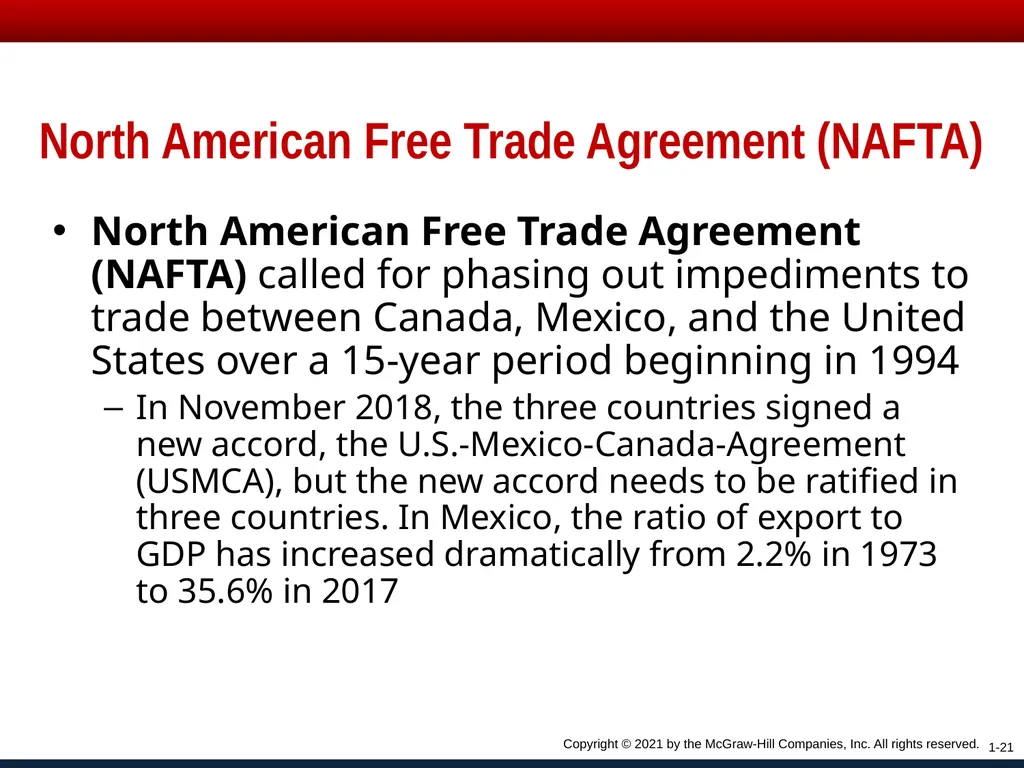
slide21. North American Free Trade Agreement (NAFTA) North American Free Trade Agreement (NAFTA) called for phasing out impediments to trade between Canada, Mexico, and the United States over a 15-year period beginning in 1994
In November 2018, the three countries signed a new accord, the U.S.-Mexico-Canada-Agreement (USMCA), but the new accord needs to be ratified in three countries. In Mexico, the ratio of export to GDP has increased dramatically from 2.2% in 1973 to 35.6% in 2017 1-21 Copyright © 2021 by the McGraw-Hill Companies, Inc. All rights reserved.<br>
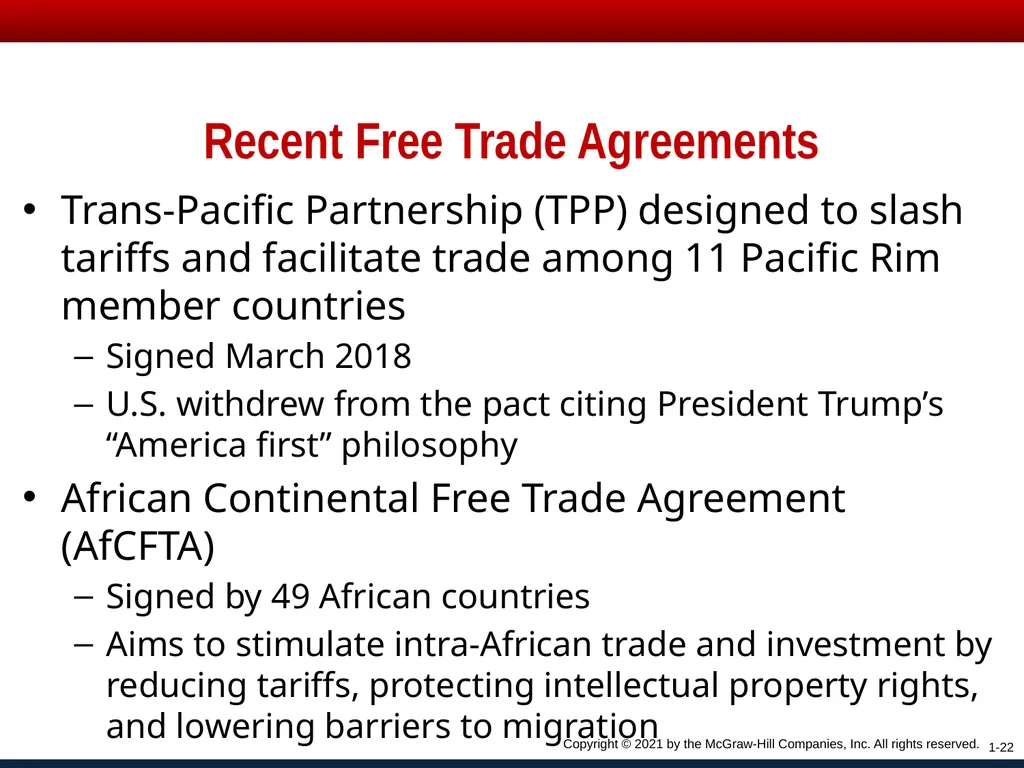
slide22. Recent Free Trade Agreements Trans-Pacific Partnership (TPP) designed to slash tariffs and facilitate trade among 11 Pacific Rim member countries
Signed March 2018
U.S. withdrew from the pact citing President Trump’s “America first” philosophy
African Continental Free Trade Agreement (AfCFTA)
Signed by 49 African countries
Aims to stimulate intra-African trade and investment by reducing tariffs, protecting intellectual property rights, and lowering barriers to migration 1-22 Copyright © 2021 by the McGraw-Hill Companies, Inc. All rights reserved.<br>
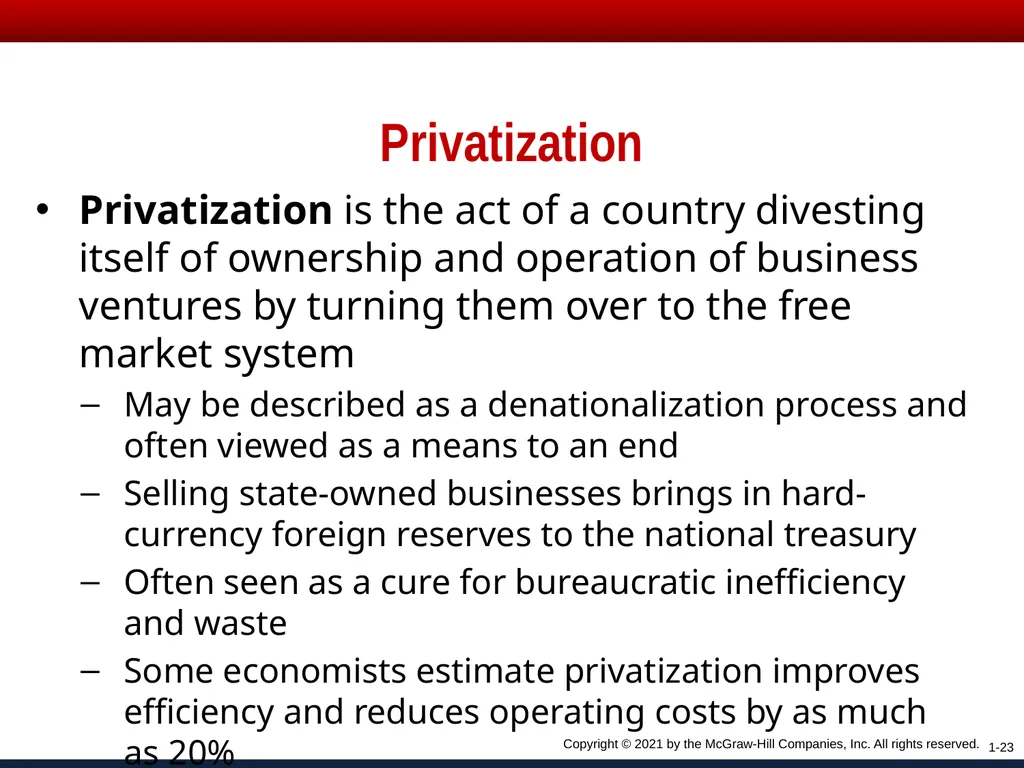
slide23. Privatization Privatization is the act of a country divesting itself of ownership and operation of business ventures by turning them over to the free market system
May be described as a denationalization process and often viewed as a means to an end
Selling state-owned businesses brings in hard-currency foreign reserves to the national treasury
Often seen as a cure for bureaucratic inefficiency and waste
Some economists estimate privatization improves efficiency and reduces operating costs by as much as 20% 1-23 Copyright © 2021 by the McGraw-Hill Companies, Inc. All rights reserved.<br>
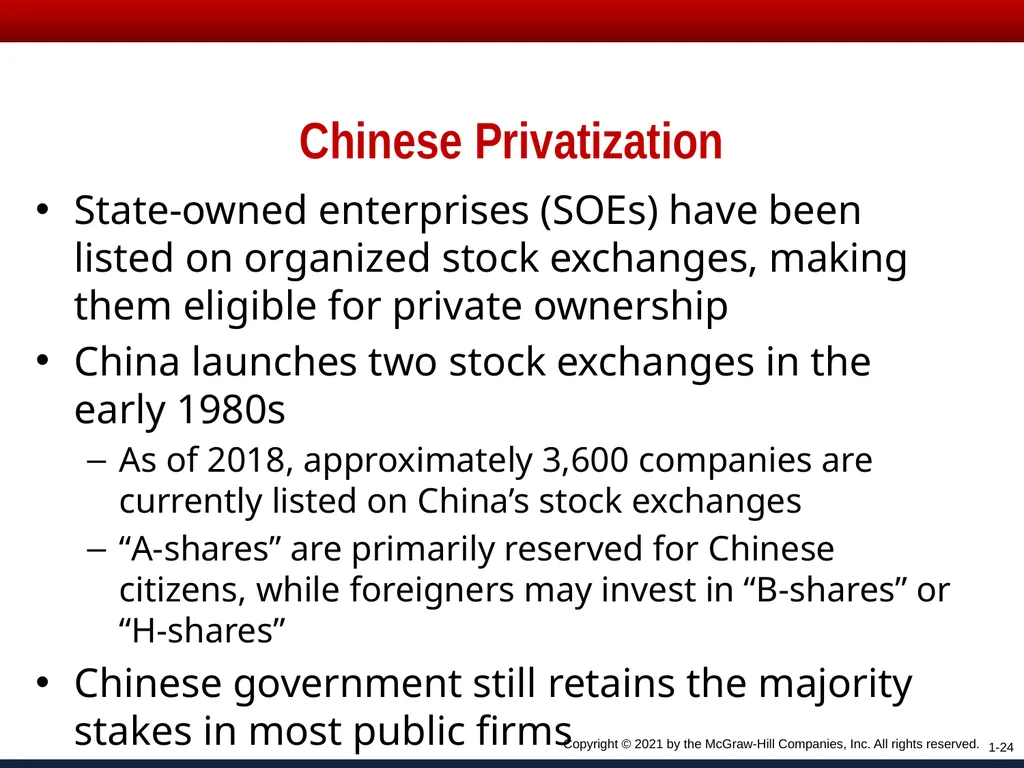
slide24. Chinese Privatization State-owned enterprises (SOEs) have been listed on organized stock exchanges, making them eligible for private ownership
China launches two stock exchanges in the early 1980s
As of 2018, approximately 3,600 companies are currently listed on China’s stock exchanges
“A-shares” are primarily reserved for Chinese citizens, while foreigners may invest in “B-shares” or “H-shares”
Chinese government still retains the majority stakes in most public firms 1-24 Copyright © 2021 by the McGraw-Hill Companies, Inc. All rights reserved.<br>
slide25. Factors that drove the financial crisis:
Households and financial institutions borrowed too much and took too much risk
Crisis was amplified and transmitted globally by securitization; financial engineers designed opaque and complex mortgage-based securities that could be used for excessive risk-taking
“Invisible hands” of free markets apparently failed to self-regulate excesses, contributing to the banking crisis
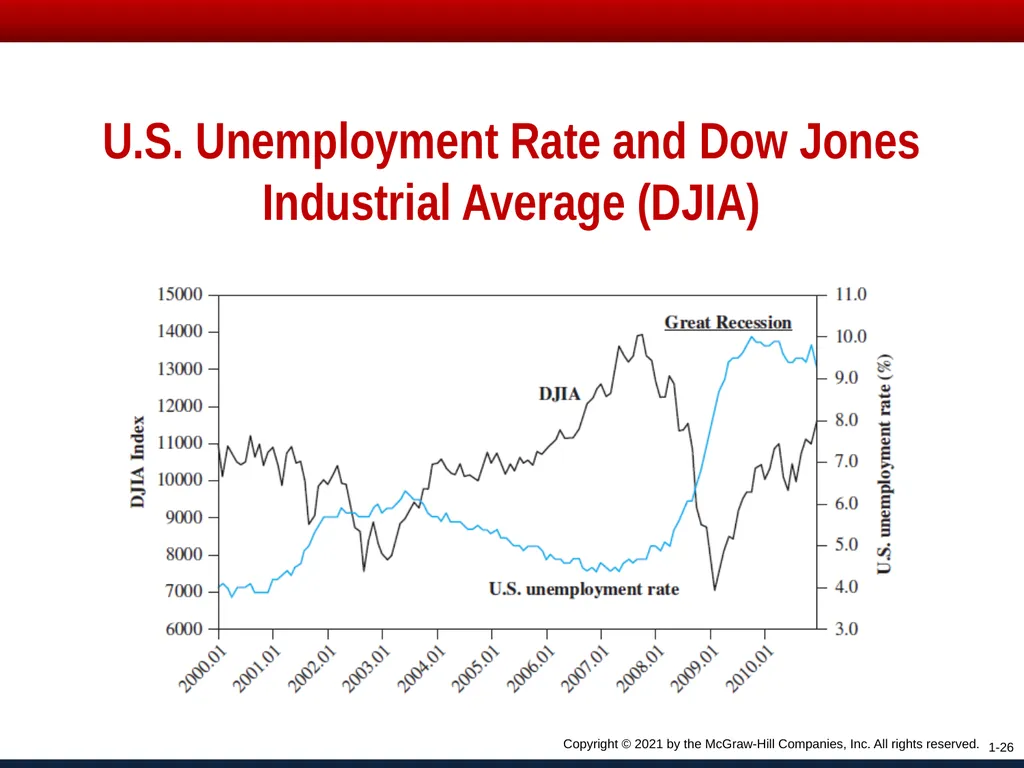
International financial markets are highly interconnected and integrated 1-25 Global Financial Crisis of 2008—2009 Copyright © 2021 by the McGraw-Hill Companies, Inc. All rights reserved.<br>
slide26. 1-26 U.S. Unemployment Rate and Dow Jones Industrial Average (DJIA) Copyright © 2021 by the McGraw-Hill Companies, Inc. All rights reserved.<br>
slide27. Brexit “Brexit” describes the voting decision of a majority of Britons to leave the EU
Likely to weaken the United Kingdom and the EU, both economically and politically
London’s position as the dominant center of European finance may deteriorate if the UK loses unrestricted access to Europe’s single market
How did this happen?
Majority of voters outside of London felt alienated from the globalized economy and were worried about competition for jobs from immigrants
60% of Londoners voted to remain in the EU; 45% of voters in the rest of England voted the same way 1-27 Copyright © 2021 by the McGraw-Hill Companies, Inc. All rights reserved.<br>
slide28. Multinational Corporations A multinational corporation (MNC) is a firm that has been incorporated in one country and has production and sales operations in other countries
Approximately 60,000 MNCs in the world with over 500,000 foreign affiliates
Benefit from the economy of scale in many ways:
Spreading R&D expenditures and advertising costs over their global sales
Pooling global purchasing power over suppliers
Utilizing their technological and managerial know-how globally with minimum additional costs 1-28 Copyright © 2021 by the McGraw-Hill Companies, Inc. All rights reserved.<br>
slide2. Overview What’s special about “international” finance?
Goals for international financial management
Globalization of the world economy
Multinational corporations Copyright © 2021 by the McGraw-Hill Companies, Inc. All rights reserved. 1-2<br>
slide3. What’s Special about “International” Finance? Three major dimensions set international finance apart from domestic finance
Foreign exchange risk and political risks
Market imperfections
Expanded opportunity set
Largely stem from the fact that sovereign nations have the right to issue currencies, formulate their own economic policies, impose taxes, and regulate movements of people, goods and capital across their borders Copyright © 2021 by the McGraw-Hill Companies, Inc. All rights reserved. 1-3<br>
slide4. Foreign exchange risk is the risk of facing uncertain future exchange rates
In addition to businesses, individuals and households may also be seriously exposed to uncertain exchange rates
Exchange rates among major currencies (e.g., U.S. dollar, Japanese yen, British pound, and euro) fluctuate continuously in an unpredictable manner
Exchange rate uncertainty influences all major economic functions, including consumption, production, and investment What’s Special about “International” Finance: Foreign Exchange Risk 1-4 Copyright © 2021 by the McGraw-Hill Companies, Inc. All rights reserved.<br>
slide5. Monthly Percentage Change in Japanese Yen—U.S. Dollar Exchange Rate 1-5 Copyright © 2021 by the McGraw-Hill Companies, Inc. All rights reserved.<br>
slide6. Political risk arises from potential losses to the parent firm resulting from adverse political developments in the host country
Ranges from unexpected changes in tax rules to outright expropriation of assets held by foreigners
Arises from the fact that a sovereign country can change the “rules of the game” and the affected parties may not have effective recourse
Especially relevant in those countries without a traditional rule of law 1-6 What’s Special about “International” Finance: Political Risk Copyright © 2021 by the McGraw-Hill Companies, Inc. All rights reserved.<br>
slide7. Market imperfections may be described as various frictions, such as transaction costs and legal restrictions, that prevent the markets from functioning perfectly
World markets are highly imperfect
Numerous barriers hamper the free movement of people, goods, services, and capital across national boundaries (e.g., legal restrictions, excessive transaction and transportation costs, information asymmetry, and discriminatory taxation)
Restrict the extent to which investors can diversify their portfolios 1-7 What’s Special about “International” Finance: Market Imperfections Copyright © 2021 by the McGraw-Hill Companies, Inc. All rights reserved.<br>
slide8. The Example of Nestlé’s Market Imperfection Nestlé used to issue two different classes of common stock, bearer shares and registered shares
Foreigners were only allowed to hold bearer shares
Swiss residents could buy registered shares
The bearer stock was more expensive
On November 18, 1988, Nestlé lifted restrictions imposed on foreigners, allowing them to hold registered shares as well as bearer shares
Price spread between the two types narrowed drastically 1-8 Copyright © 2021 by the McGraw-Hill Companies, Inc. All rights reserved.<br>
slide9. Daily Prices of Nestlé’s Bearer and Registered Shares 1-9 Copyright © 2021 by the McGraw-Hill Companies, Inc. All rights reserved.<br>
slide10. Firms may benefit from an expanded opportunity set when they venture into the arena of global markets
Firms can gain from greater economies of scale when their tangible and intangible assets are deployed on a global basis
True for corporations, as well as individual investors
“It just doesn’t make sense to play in only one corner of the sandbox.” 1-10 What’s Special about “International” Finance: Expanded Opportunity Set Copyright © 2021 by the McGraw-Hill Companies, Inc. All rights reserved.<br>
slide11. Goals for International Financial Management The focus of the text is to provide today’s financial managers with an understanding of the fundamental concepts and the tools necessary to be effective global managers
Fundamental goal of sound financial management is shareholder wealth maximization, which means the firm makes all business decisions and investments with an eye toward making the owners of the firm (i.e., shareholders) better off financially
Generally accepted in Anglo-Saxon countries, but not as widely embraced in other parts of the world 1-11 Copyright © 2021 by the McGraw-Hill Companies, Inc. All rights reserved.<br>
slide12. Other Stakeholders In other countries shareholders are viewed as merely one among many “stakeholders” of the firm, others being:
Employees
Suppliers
Customers
Banks
In Japan, managers have typically sought to maximize the value of the keiretsu—a family of firms to which the individual firms belongs 1-12 Copyright © 2021 by the McGraw-Hill Companies, Inc. All rights reserved.<br>
slide13. Corporate Governance As shown by a series of recent corporate scandals at companies like Enron, WorldCom, Parmalat, and Global Crossing, managers may pursue their own private interests at the expense of shareholders when they are not closely monitored
This “agency problem” is a major weakness of the public corporation
Reinforces the importance of corporate governance, the financial and legal framework for regulating the relationship between a firm’s management and its shareholders 1-13 Copyright © 2021 by the McGraw-Hill Companies, Inc. All rights reserved.<br>
slide14. Emergence of Globalized Financial Markets
Emergence of the Euro as a Global Currency
Europe’s Sovereign Debt Crisis of 2010
Trade Liberalization and Economic Integration
Privatization
Global Financial Crisis of 2008-2009
Brexit 1-14 Globalization of the World Economy: Major Trends and Developments Copyright © 2021 by the McGraw-Hill Companies, Inc. All rights reserved.<br>
slide15. Deregulation of foreign exchange and capital markets
Financial innovations resulted in the introduction of various instruments:
Currency futures and options
Multicurrency bonds
International mutual funds
Country funds
Exchange-traded funds (ETFs)
Foreign stock index futures and options
Advances in computer and telecommunications technology 1-15 Emergence of Globalized Financial Markets Copyright © 2021 by the McGraw-Hill Companies, Inc. All rights reserved.<br>
slide16. Emergence of the Euro as a Global Currency Momentous event in history of world financial system
Currently more than 300 million Europeans in 19 countries are using the common currency on a daily basis
Austria, Belgium, Cyprus, Estonia, Finland, France, Germany, Greece, Ireland, Italy, Latvia, Lithuania, Luxembourg, Malta, the Netherlands, Portugal, Slovakia, Slovenia, and Spain
Transaction domain of the euro may become larger than that of the U.S. dollar in the future 1-16 Copyright © 2021 by the McGraw-Hill Companies, Inc. All rights reserved.<br>
slide17. Europe’s Sovereign-Debt Crisis of 2010 In December 2009, the new Greek government revealed that its budget deficit for the year would be 12.7% of GDP, not the 3.7% previously forecast
Investors sold off Greek government bonds and the ratings agencies downgraded them to “junk”
Panic spread to other weak European countries (especially Ireland, Portugal, and Spain) and quickly escalated to a Europe-wide debt crisis
Revealed a profound weakness of the euro as the common currency; Lack of fiscal discipline in a euro-zone country can always become a Europe-wide crisis 1-17 Copyright © 2021 by the McGraw-Hill Companies, Inc. All rights reserved.<br>
slide18. The Greek Drama 1-18 Copyright © 2021 by the McGraw-Hill Companies, Inc. All rights reserved.<br>
slide19. Trade Liberalization and Economic Integration Principal argument for international trade is based on the theory of comparative advantage
It is mutually beneficial for countries if they specialize in the production of those goods they can produce most efficiently and trade those goods among them
Policy implication is that liberalization of international trade will enhance the welfare of the world’s citizens
Over the years, international trade has been liberalized at both the global and regional levels 1-19 Copyright © 2021 by the McGraw-Hill Companies, Inc. All rights reserved.<br>
slide20. General Agreement on Tariffs and Trade (GATT) is a multilateral agreement among member countries that has reduced many barriers to trade
The World Trade Organization (WTO) has the power to enforce the rules of international trade
Regional arrangements have also been instituted to promote economic integration
The European Union (EU), for example, includes 28 member states that have eliminated barriers to the free flow of goods, capital, and people 1-20 Trade Liberalization and Economic Integration Continued Copyright © 2021 by the McGraw-Hill Companies, Inc. All rights reserved.<br>
slide21. North American Free Trade Agreement (NAFTA) North American Free Trade Agreement (NAFTA) called for phasing out impediments to trade between Canada, Mexico, and the United States over a 15-year period beginning in 1994
In November 2018, the three countries signed a new accord, the U.S.-Mexico-Canada-Agreement (USMCA), but the new accord needs to be ratified in three countries. In Mexico, the ratio of export to GDP has increased dramatically from 2.2% in 1973 to 35.6% in 2017 1-21 Copyright © 2021 by the McGraw-Hill Companies, Inc. All rights reserved.<br>
slide22. Recent Free Trade Agreements Trans-Pacific Partnership (TPP) designed to slash tariffs and facilitate trade among 11 Pacific Rim member countries
Signed March 2018
U.S. withdrew from the pact citing President Trump’s “America first” philosophy
African Continental Free Trade Agreement (AfCFTA)
Signed by 49 African countries
Aims to stimulate intra-African trade and investment by reducing tariffs, protecting intellectual property rights, and lowering barriers to migration 1-22 Copyright © 2021 by the McGraw-Hill Companies, Inc. All rights reserved.<br>
slide23. Privatization Privatization is the act of a country divesting itself of ownership and operation of business ventures by turning them over to the free market system
May be described as a denationalization process and often viewed as a means to an end
Selling state-owned businesses brings in hard-currency foreign reserves to the national treasury
Often seen as a cure for bureaucratic inefficiency and waste
Some economists estimate privatization improves efficiency and reduces operating costs by as much as 20% 1-23 Copyright © 2021 by the McGraw-Hill Companies, Inc. All rights reserved.<br>
slide24. Chinese Privatization State-owned enterprises (SOEs) have been listed on organized stock exchanges, making them eligible for private ownership
China launches two stock exchanges in the early 1980s
As of 2018, approximately 3,600 companies are currently listed on China’s stock exchanges
“A-shares” are primarily reserved for Chinese citizens, while foreigners may invest in “B-shares” or “H-shares”
Chinese government still retains the majority stakes in most public firms 1-24 Copyright © 2021 by the McGraw-Hill Companies, Inc. All rights reserved.<br>
slide25. Factors that drove the financial crisis:
Households and financial institutions borrowed too much and took too much risk
Crisis was amplified and transmitted globally by securitization; financial engineers designed opaque and complex mortgage-based securities that could be used for excessive risk-taking
“Invisible hands” of free markets apparently failed to self-regulate excesses, contributing to the banking crisis
International financial markets are highly interconnected and integrated 1-25 Global Financial Crisis of 2008—2009 Copyright © 2021 by the McGraw-Hill Companies, Inc. All rights reserved.<br>
slide26. 1-26 U.S. Unemployment Rate and Dow Jones Industrial Average (DJIA) Copyright © 2021 by the McGraw-Hill Companies, Inc. All rights reserved.<br>
slide27. Brexit “Brexit” describes the voting decision of a majority of Britons to leave the EU
Likely to weaken the United Kingdom and the EU, both economically and politically
London’s position as the dominant center of European finance may deteriorate if the UK loses unrestricted access to Europe’s single market
How did this happen?
Majority of voters outside of London felt alienated from the globalized economy and were worried about competition for jobs from immigrants
60% of Londoners voted to remain in the EU; 45% of voters in the rest of England voted the same way 1-27 Copyright © 2021 by the McGraw-Hill Companies, Inc. All rights reserved.<br>
slide28. Multinational Corporations A multinational corporation (MNC) is a firm that has been incorporated in one country and has production and sales operations in other countries
Approximately 60,000 MNCs in the world with over 500,000 foreign affiliates
Benefit from the economy of scale in many ways:
Spreading R&D expenditures and advertising costs over their global sales
Pooling global purchasing power over suppliers
Utilizing their technological and managerial know-how globally with minimum additional costs 1-28 Copyright © 2021 by the McGraw-Hill Companies, Inc. All rights reserved.<br>