
Chapter one Historical background of Tennis table
CP
Published · 118 slides · 0 views

1 / 1


Description
Chapter one Historical background of Tennis table ,Tennis and Badminton A Brief History of table tennis Table Tennis is a direct descendent of the game of royal tennis. Most historians believe tennis began in the 12th century when French
Related Topics
Share
Embed code
Download this presentation From Below
"Chapter one Historical background of Tennis table" is the property of its rightful owner. Permission is granted to download and print the materials on this website for personal, non-commercial use only, and to display it on your personal computer provided you do not modify the materials and that you retain all copyright notices contained in the materials. By downloading content from our website, you accept the terms of this agreement.
Presentation Transcript
01
Chapter one Historical background of Tennis table ,Tennis and Badminton
A Brief History of table tennis
Table Tennis is a direct descendent of the game of royal tennis. Most historians believe tennis began in the 12th century when French religious played a game they called “jeu de paume” [game of the hand].
The religious would call out “tenez” [Take this! Or Play!] as they hit the ball at their opponent to start the game. The original ball was made of wood and later, the ball was a wad of hair, wool, or cork wrapped in string and cloth or leather<br>
A Brief History of table tennis
Table Tennis is a direct descendent of the game of royal tennis. Most historians believe tennis began in the 12th century when French religious played a game they called “jeu de paume” [game of the hand].
The religious would call out “tenez” [Take this! Or Play!] as they hit the ball at their opponent to start the game. The original ball was made of wood and later, the ball was a wad of hair, wool, or cork wrapped in string and cloth or leather<br>
02
conti The game was played indoors with players hitting the ball into door jams and other imperfections in the walls strategically trying to outjoke their opponent. The “net” was usually a rope tied across the court five feet high at the sides and drooping to three feet at the middle. The game was played at first with the hand and as time passed gloves were used, and then paddles with webbing, and eventually a handle was added to form a primitive racket.<br>
03
conti Through the 18th century, the game was very popular in France with most noblemen and royalty taking to the game. At this time the game was called “royal tennis” or “Real Tennis” and it was played indoors.
The game of tennis as we know it today started in 1850 when Charles Goodyear invented a vulcanization process for rubber and the bouncing ball was invented. People began experimenting by playing the game outdoor on grass. In 1874, Major Walter Clopton Wingfield patented the game “Lawn Tennis” [“Modern Tennis”] and its rules<br>
The game of tennis as we know it today started in 1850 when Charles Goodyear invented a vulcanization process for rubber and the bouncing ball was invented. People began experimenting by playing the game outdoor on grass. In 1874, Major Walter Clopton Wingfield patented the game “Lawn Tennis” [“Modern Tennis”] and its rules<br>
04
conti The original court was an hourglass shape and many of the rules were difficult. Many rule changes took place over the years but by 1882 the court, net, and rules of play had become standardized.<br>
05
Tennis Tennis is a racket sport that can be played individually against a single opponent (singles) or between two teams of two players each (doubles). Each player uses a tennis racket that is strung with cord to strike a hollow rubber ball covered with felt over or around a net and into the opponent's court. The object of the game is to play the ball in such a way that the opponent is not able to play a valid return. The player who is unable to return the ball will not gain a point, while the opposite player will.<br>
06
conti Tennis is an Olympic sport and is played at all levels of society and at all ages. The sport can be played by anyone who can hold a racket, including wheelchair users. The modern game of tennis originated in Birmingham, England, in the late 19th century as "lawn (grass) tennis”. It had close connections both to various field ("lawn") games such as croquet and bowls as well as to the older racket sport of real tennis
During most of the 19th century, in fact, the term "tennis" referred to real tennis, not lawn tennis<br>
During most of the 19th century, in fact, the term "tennis" referred to real tennis, not lawn tennis<br>
07
conti The rules of tennis have changed little since the 1890s. Two exceptions are that from 1908 to 1961 the server had to keep one foot on the ground at all times, and the adoption of the tiebreak in the 1970s. A recent addition to professional tennis has been the adoption of electronic review technology attached with a point challenge system, which allows a player to contest the line call of a point, a system known as Hawk-Eye.<br>
08
conti Historians believe that the game's ancient origin lay in 12th century northern France, where a ball was struck with the palm of the hand. Louis X of France was a strong player of "game of the palm", which evolved into real tennis, and became famous as the first person to construct indoor tennis courts in the modern style. Louis was unhappy with playing tennis outdoors and accordingly had indoor, enclosed courts made in Paris "around the end of the 13th century”<br>
09
conti It wasn't until the 16th century that rackets came into use, and the game began to be called "tennis", from the French term tenez, which can be translated as "hold!", "receive!" or "take!", an interjection used as a call from the server to his opponent. It was popular in England and France, although the game was only played indoors where the ball could be hit off the wall. Henry was a big follower of this game, which is now known as real tennis<br>
10
conti In 1954, Van Alen founded the International Tennis Hall of Fame, a non-profit museum in Newport, Rhode Island. The building contains a large collection of tennis memorabilia as well as a hall of fame honoring prominent members and tennis players from all over the world. Each year, a grass court tournament and an induction ceremony honoring new Hall of Fame members are hosted on its grounds.<br>
11
Badminton Badminton is a racquet sport played using racquets to hit a shuttlecock across a net. Although it may be played with larger teams, the most common forms of the game are "singles" (with one player per side) and "doubles" (with two players per side). Badminton is often played as a casual outdoor activity in a yard or on a beach; formal games are played on a rectangular indoor court. Points are scored by striking the shuttlecock with the racquet and landing it within the opposing side's half of the court.<br>
12
History of badminton The game of badminton originated in Siam, China over 2,000 years ago. It was brought to England in 1870 and was played somewhat like tennis. After being played in Canada, badminton arrived in America and has been popular since 1929. Since 1992, badminton has been an Olympic sport, with bird speeds reaching<br>
13
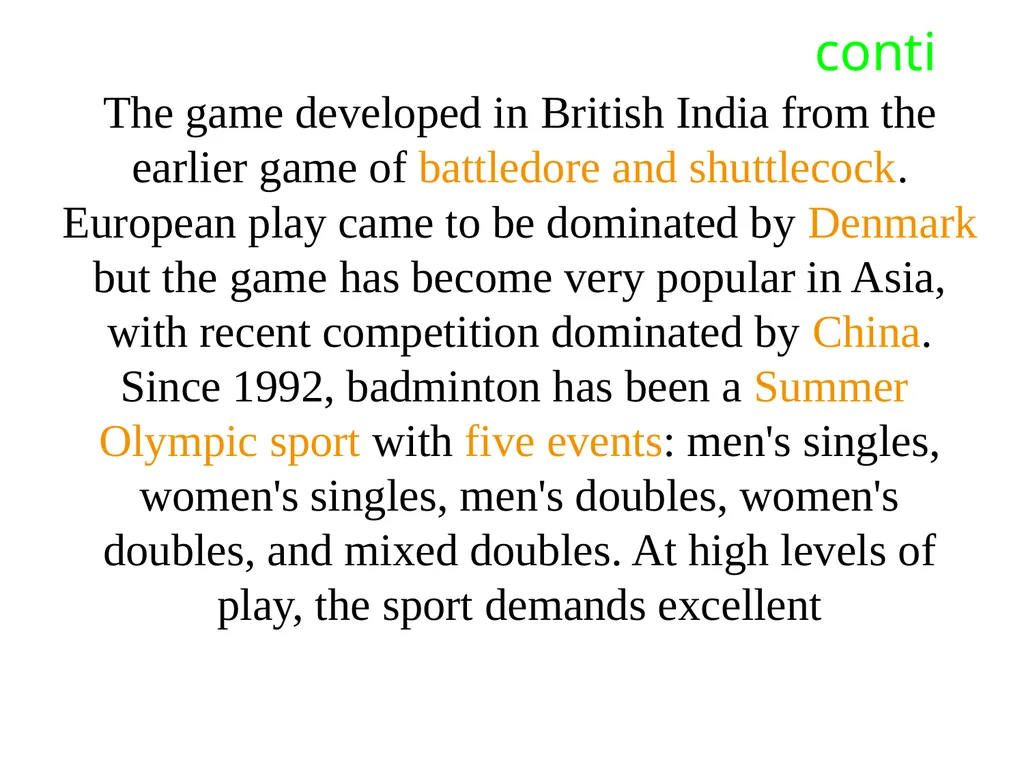
conti The game developed in British India from the earlier game of battledore and shuttlecock. European play came to be dominated by Denmark but the game has become very popular in Asia, with recent competition dominated by China. Since 1992, badminton has been a Summer Olympic sport with five events: men's singles, women's singles, men's doubles, women's doubles, and mixed doubles. At high levels of play, the sport demands excellent<br>
14
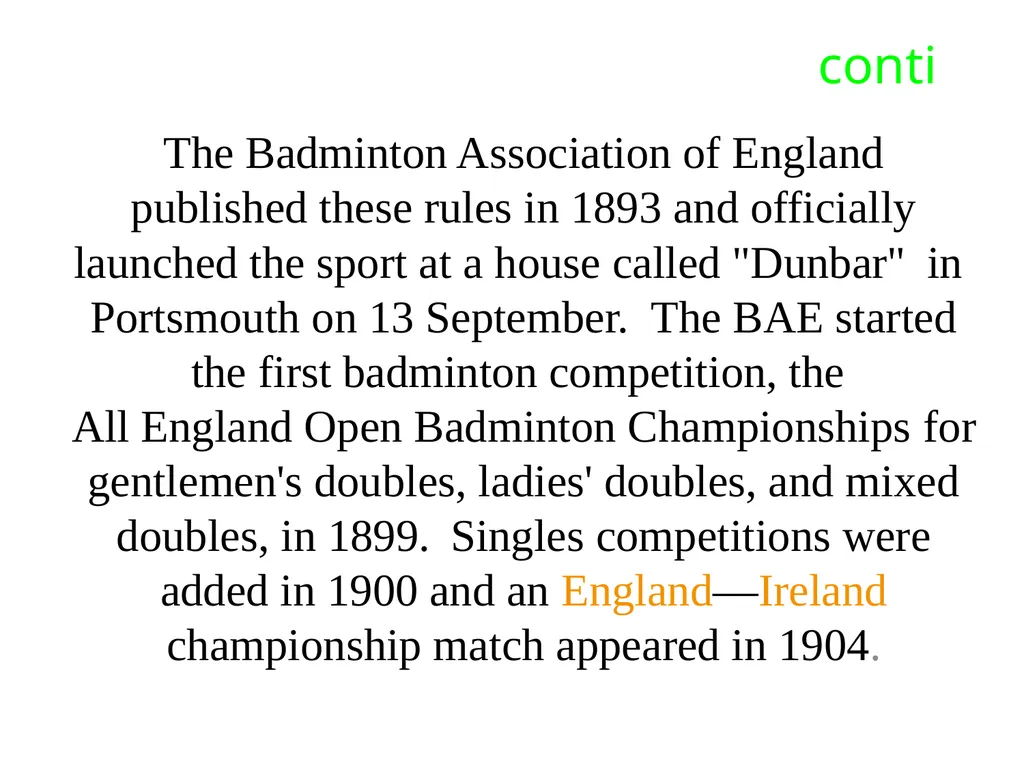
conti The Badminton Association of England published these rules in 1893 and officially launched the sport at a house called "Dunbar" in Portsmouth on 13 September. The BAE started the first badminton competition, the All England Open Badminton Championships for gentlemen's doubles, ladies' doubles, and mixed doubles, in 1899. Singles competitions were added in 1900 and an England—Ireland championship match appeared in 1904.<br>
15
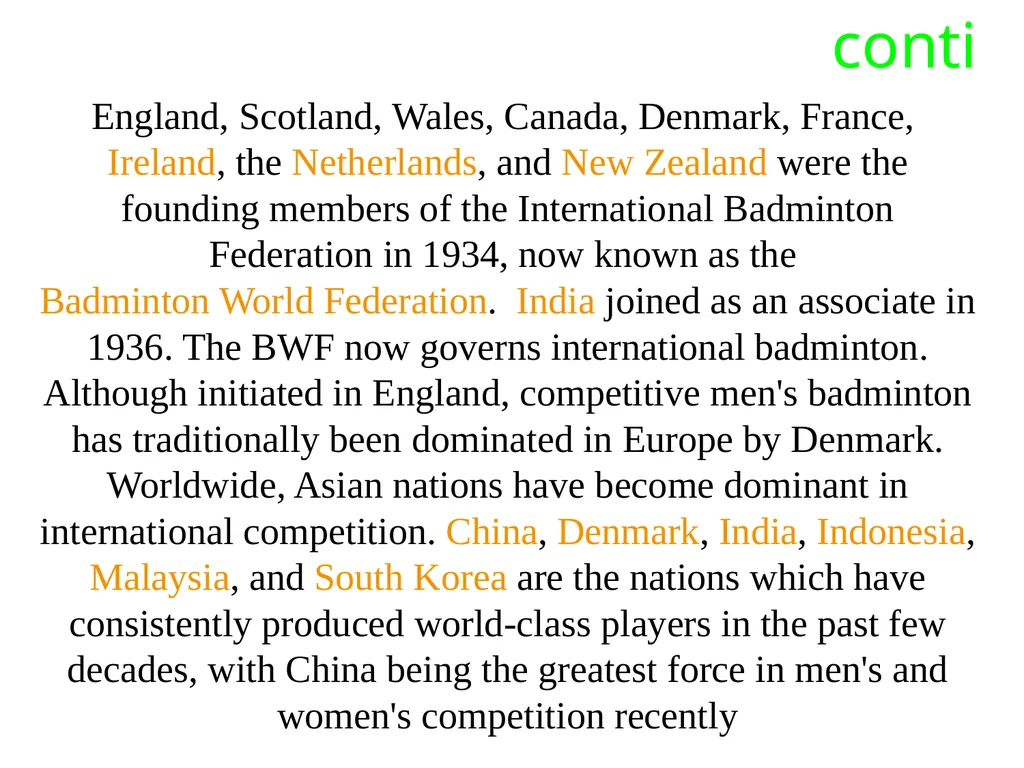
conti England, Scotland, Wales, Canada, Denmark, France, Ireland, the Netherlands, and New Zealand were the founding members of the International Badminton Federation in 1934, now known as the Badminton World Federation. India joined as an associate in 1936. The BWF now governs international badminton. Although initiated in England, competitive men's badminton has traditionally been dominated in Europe by Denmark. Worldwide, Asian nations have become dominant in international competition. China, Denmark, India, Indonesia, Malaysia, and South Korea are the nations which have consistently produced world-class players in the past few decades, with China being the greatest force in men's and women's competition recently<br>
16
Chapter two
2.1 Basic rules and regulation of the game of Table Tennis, Tennis, and Badminton
2.1.1 Rules of the Game table tennis: Scoring
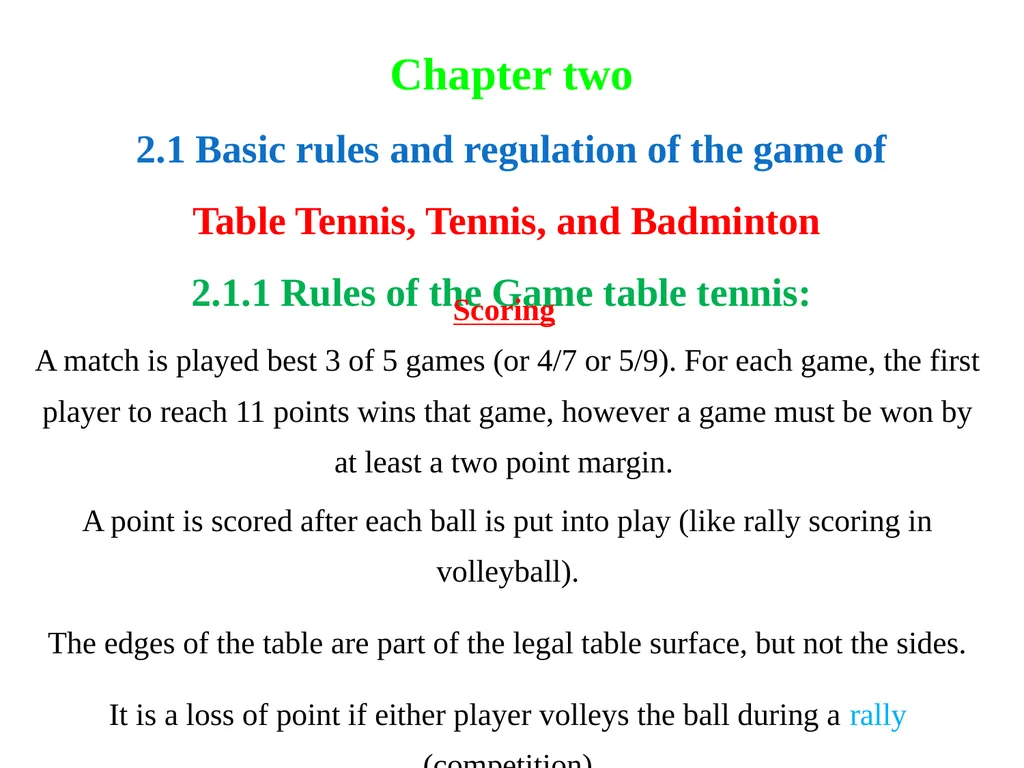
A match is played best 3 of 5 games (or 4/7 or 5/9). For each game, the first player to reach 11 points wins that game, however a game must be won by at least a two point margin.
A point is scored after each ball is put into play (like rally scoring in volleyball).
The edges of the table are part of the legal table surface, but not the sides.
It is a loss of point if either player volleys the ball during a rally (competition)<br>
A point is scored after each ball is put into play (like rally scoring in volleyball).
The edges of the table are part of the legal table surface, but not the sides.
It is a loss of point if either player volleys the ball during a rally (competition)<br>
17
Flow of the Match - Singles Each player serves two points in a row and then switch server. However, if a score of 10-10 is reached in any game, then each server serves only one point and then the server is switched. After each game, the players switch side of the table. In the final game (ie 5th game), the players switch side again after either player reaches 5 points.<br>
18
Flow of the Match – Doubles The player on the right side serves on an angle to his opponent on the right side [diagonally across the net]. The return of serve must be played by the server’s partner and his shot must be returned by the second opponent.
To simplify – player alternate taking shots; you can never hit the ball twice in a row. Each server serves two points in a row and then the serve goes to the opponents. After a player finishes serving he/she switch positions with their partner [players should never serve/receive from the same opponent if you are rotating properly].<br>
To simplify – player alternate taking shots; you can never hit the ball twice in a row. Each server serves two points in a row and then the serve goes to the opponents. After a player finishes serving he/she switch positions with their partner [players should never serve/receive from the same opponent if you are rotating properly].<br>
19
conti In doubles, at each change of service the previous receiver shall become the server and the partner of the previous server shall become the receiver.
If a score of 10-10 is reached in any game, then each server serves only one point and then the server is switched.
After each game, the players switch sides of the table. In the final game (ie 5th game), the players switch side again after either team reaches 5 points.<br>
If a score of 10-10 is reached in any game, then each server serves only one point and then the server is switched.
After each game, the players switch sides of the table. In the final game (ie 5th game), the players switch side again after either team reaches 5 points.<br>
20
Legal Service The ball must rest on an open hand palm. Then it must be tossed up at least 6 inches and struck(hit) so the ball first bounces on the server's side and then the opponent's side. If the serve is legal except that it touches the net, it is called a let serve. Let serves are not scored and are re-served.<br>
21
Equipment The paddle should have a red and a black side. The ball should be either orange or white and 40 mm in size.
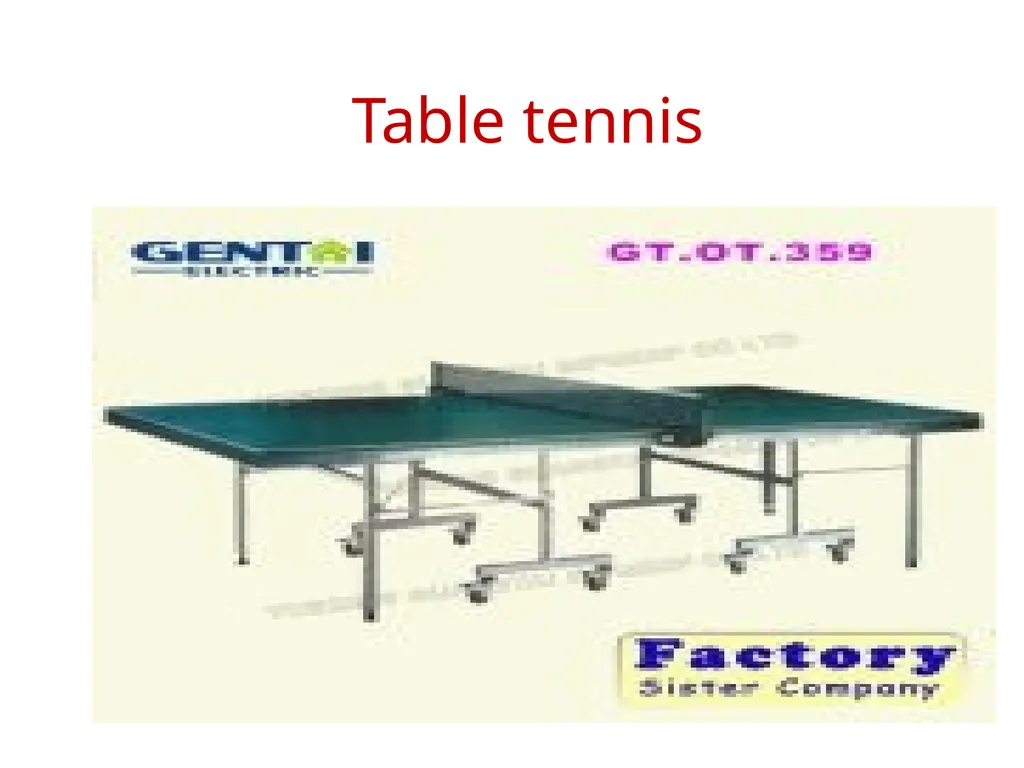
The table should be 2.74 meters long, 1.525 m wide and 0.76 m high.<br>
The table should be 2.74 meters long, 1.525 m wide and 0.76 m high.<br>
22
Table tennis<br>
23
2.1.2 Basic rules of Tennis
Equipment (racket) Under modern rules of tennis, the rackets must follow to the following guideline
The hitting area, composed of the strings, must be flat and generally uniform.
The frame of the hitting area may not be more than 29 inches (74 cm) in length and 12.5 inches (32 cm) in width.
The entire racket must be of a fixed shape, size, weight, and weight distribution. There may not be any energy source built into the rackets.
The rackets must not provide any kind of communication, instruction or advice to the player during the match.<br>
The hitting area, composed of the strings, must be flat and generally uniform.
The frame of the hitting area may not be more than 29 inches (74 cm) in length and 12.5 inches (32 cm) in width.
The entire racket must be of a fixed shape, size, weight, and weight distribution. There may not be any energy source built into the rackets.
The rackets must not provide any kind of communication, instruction or advice to the player during the match.<br>
24
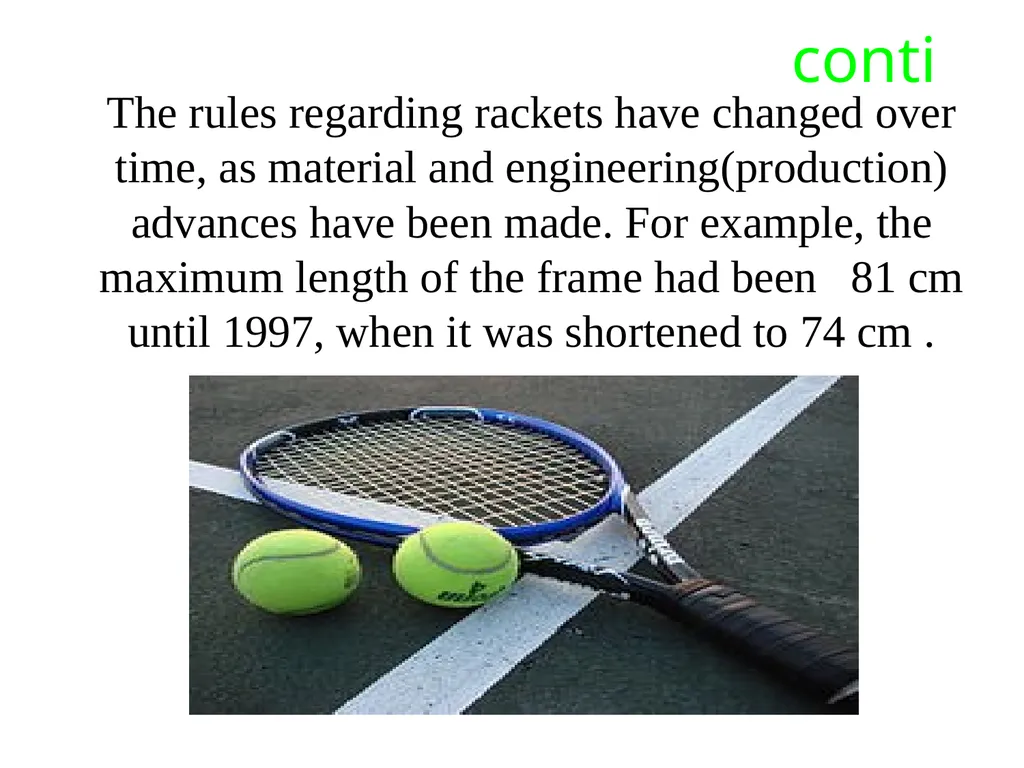
conti The rules regarding rackets have changed over time, as material and engineering(production) advances have been made. For example, the maximum length of the frame had been 81 cm until 1997, when it was shortened to 74 cm .<br>
25
Tennis ball Tennis ball
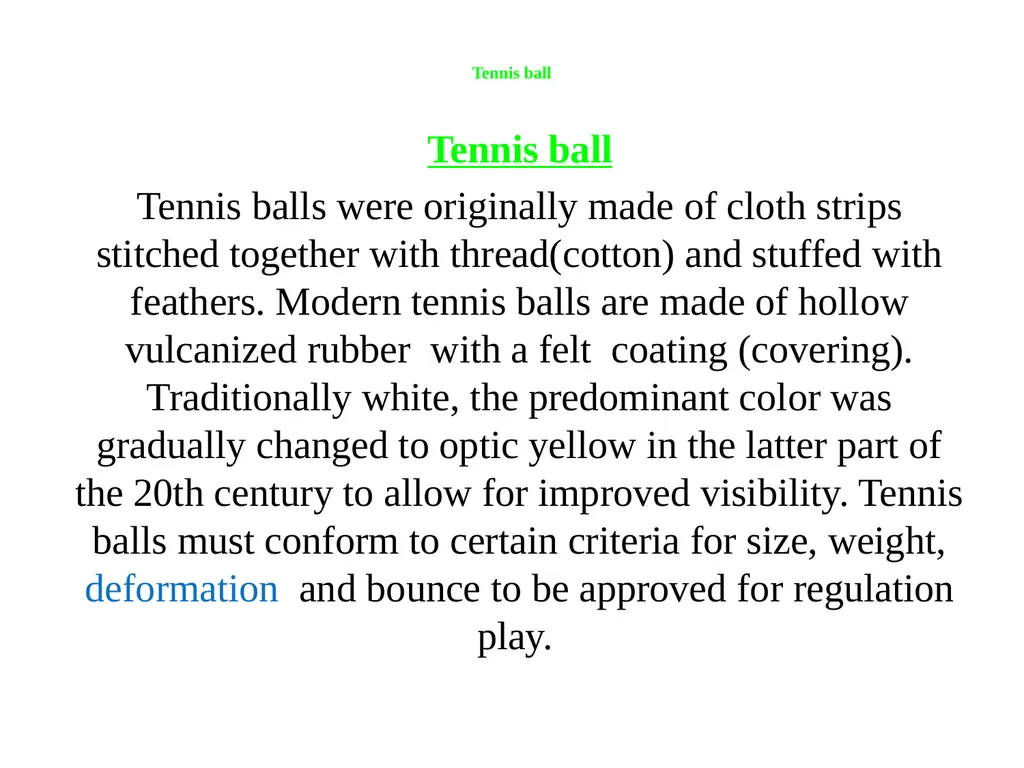
Tennis balls were originally made of cloth strips stitched together with thread(cotton) and stuffed with feathers. Modern tennis balls are made of hollow vulcanized rubber with a felt coating (covering). Traditionally white, the predominant color was gradually changed to optic yellow in the latter part of the 20th century to allow for improved visibility. Tennis balls must conform to certain criteria for size, weight, deformation and bounce to be approved for regulation play.<br>
Tennis balls were originally made of cloth strips stitched together with thread(cotton) and stuffed with feathers. Modern tennis balls are made of hollow vulcanized rubber with a felt coating (covering). Traditionally white, the predominant color was gradually changed to optic yellow in the latter part of the 20th century to allow for improved visibility. Tennis balls must conform to certain criteria for size, weight, deformation and bounce to be approved for regulation play.<br>
26
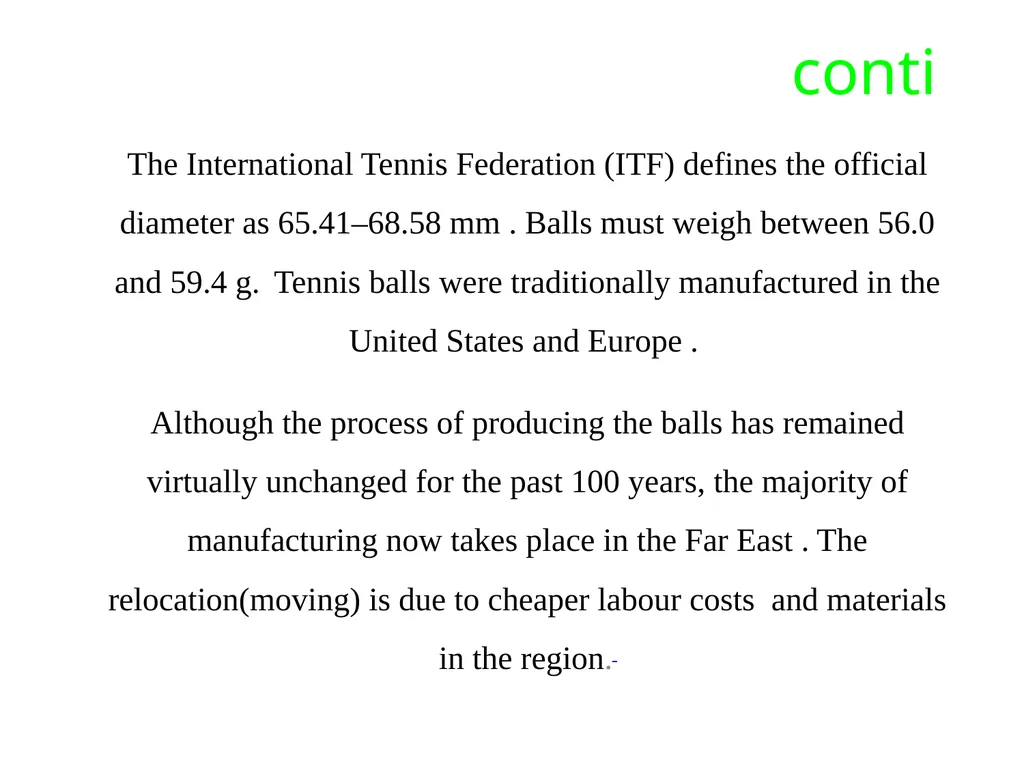
conti The International Tennis Federation (ITF) defines the official diameter as 65.41–68.58 mm . Balls must weigh between 56.0 and 59.4 g. Tennis balls were traditionally manufactured in the United States and Europe .
Although the process of producing the balls has remained virtually unchanged for the past 100 years, the majority of manufacturing now takes place in the Far East . The relocation(moving) is due to cheaper labour costs and materials in the region.<br>
Although the process of producing the balls has remained virtually unchanged for the past 100 years, the majority of manufacturing now takes place in the Far East . The relocation(moving) is due to cheaper labour costs and materials in the region.<br>
27
Court
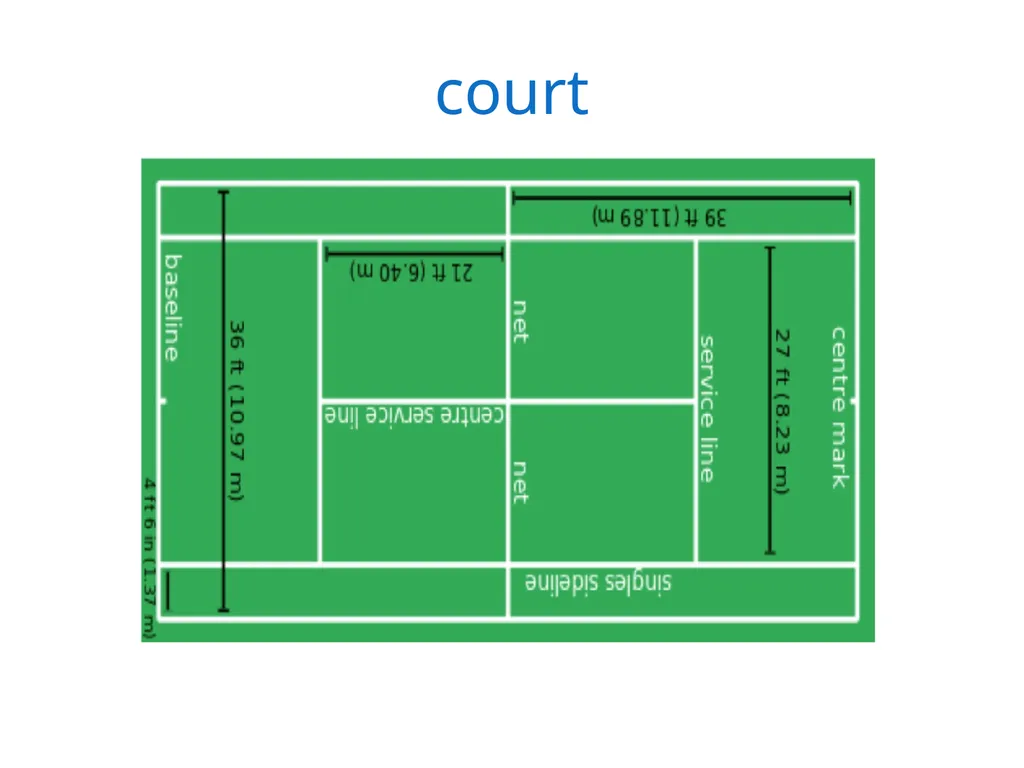
Tennis court Tennis is played on a rectangular, flat surface. The court is 23.77 m long, and 8.23 m wide for singles matches and 11 m for doubles matches. Additional clear space around the court is required in order for players to reach overrun balls. A net is stretched across the full width of the court, parallel with the baselines, dividing it into two equal ends. It is held up by either a metal rope or cord that can be no more than 0.8 cm. The net is 3 feet 6 inches high at the posts and 3 feet high in the center. The net posts are 0.91 m outside the doubles court on each side or, for a singles net, 0.91 m outside the singles court on each side.<br>
28
court<br>
29
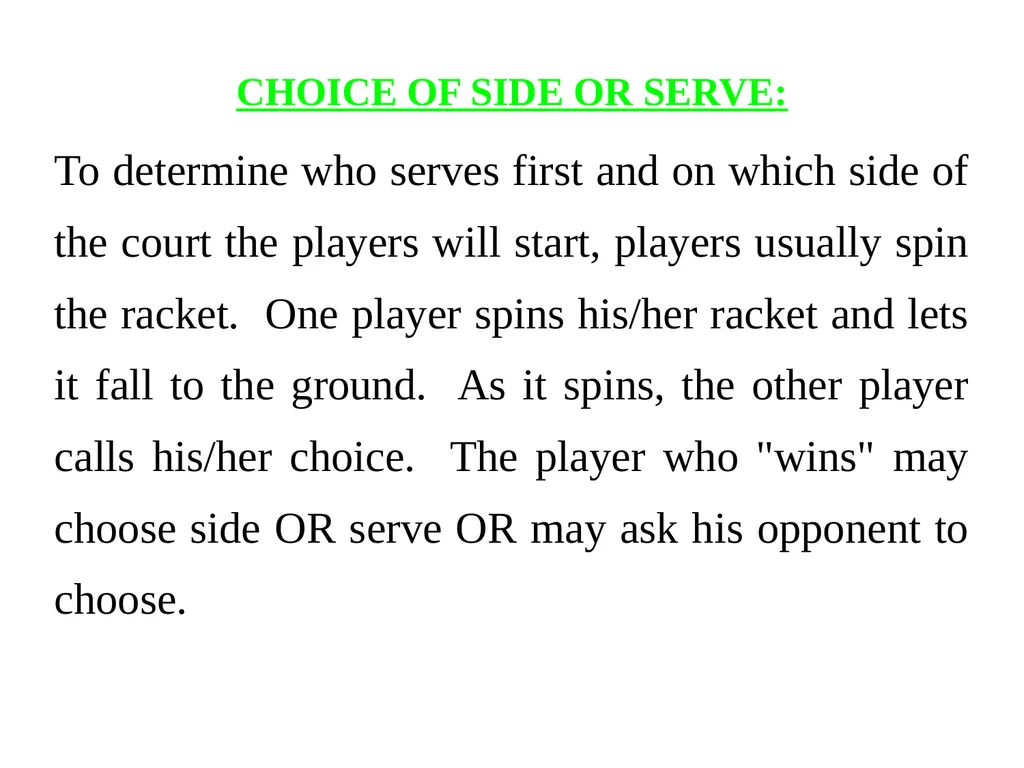
CHOICE OF SIDE OR SERVE: To determine who serves first and on which side of the court the players will start, players usually spin the racket. One player spins his/her racket and lets it fall to the ground. As it spins, the other player calls his/her choice. The player who "wins" may choose side OR serve OR may ask his opponent to choose.<br>
30
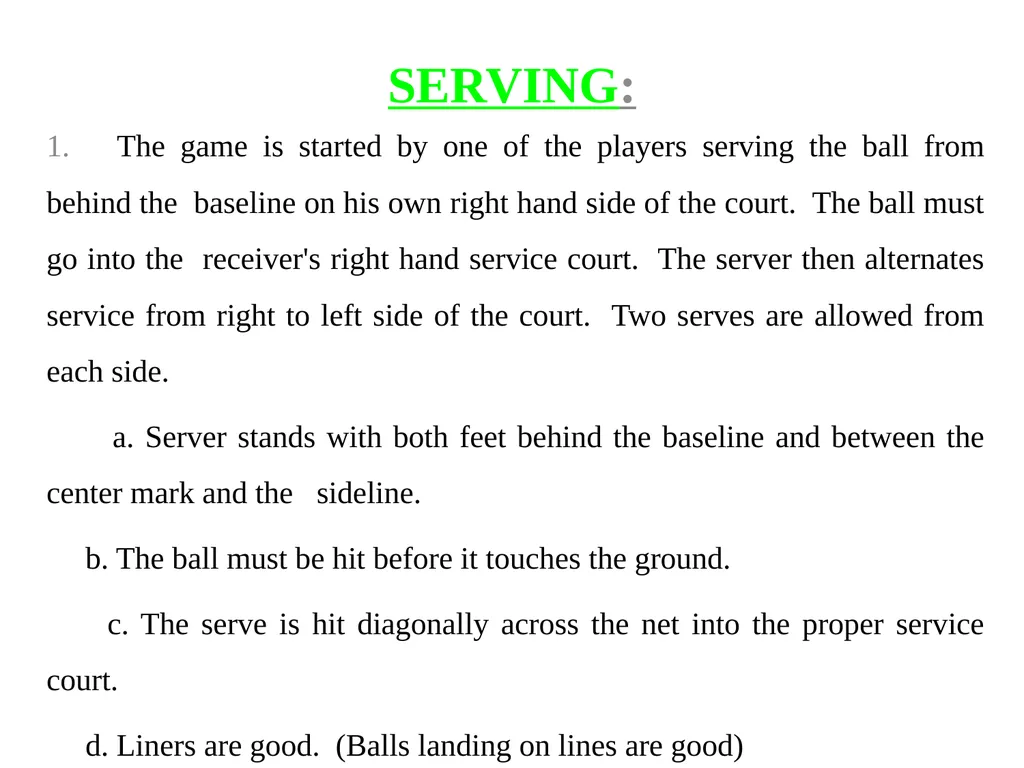
SERVING: 1. The game is started by one of the players serving the ball from behind the baseline on his own right hand side of the court. The ball must go into the receiver's right hand service court. The server then alternates service from right to left side of the court. Two serves are allowed from each side.
a. Server stands with both feet behind the baseline and between the center mark and the sideline.
b. The ball must be hit before it touches the ground.
c. The serve is hit diagonally across the net into the proper service court.
d. Liners are good. (Balls landing on lines are good)<br>
a. Server stands with both feet behind the baseline and between the center mark and the sideline.
b. The ball must be hit before it touches the ground.
c. The serve is hit diagonally across the net into the proper service court.
d. Liners are good. (Balls landing on lines are good)<br>
31
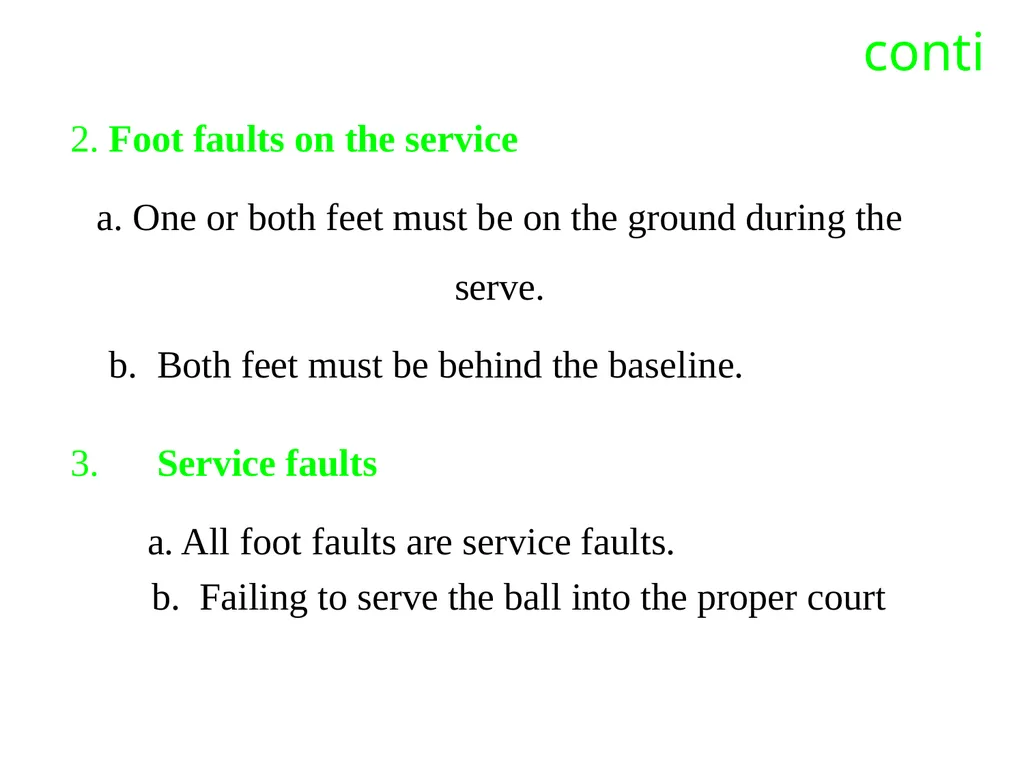
conti 2. Foot faults on the service
a. One or both feet must be on the ground during the serve.
b. Both feet must be behind the baseline.
3. Service faults
a. All foot faults are service faults.
b. Failing to serve the ball into the proper court<br>
a. One or both feet must be on the ground during the serve.
b. Both feet must be behind the baseline.
3. Service faults
a. All foot faults are service faults.
b. Failing to serve the ball into the proper court<br>
32
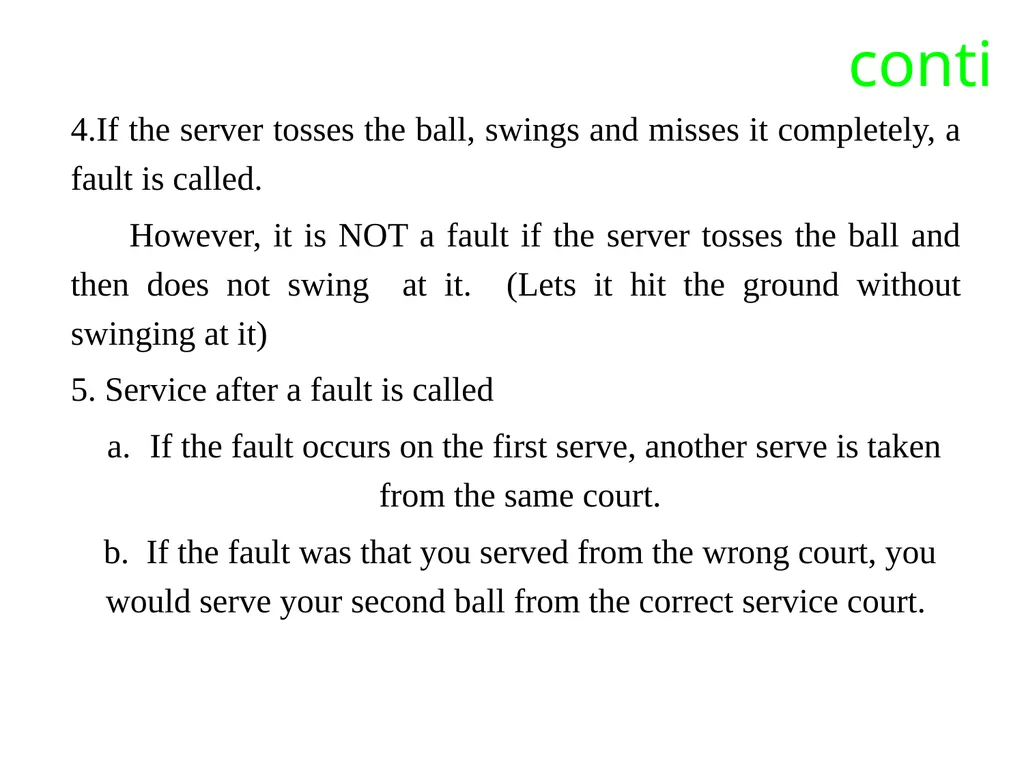
conti 4.If the server tosses the ball, swings and misses it completely, a fault is called.
However, it is NOT a fault if the server tosses the ball and then does not swing at it. (Lets it hit the ground without swinging at it)
5. Service after a fault is called
a. If the fault occurs on the first serve, another serve is taken from the same court.
b. If the fault was that you served from the wrong court, you would serve your second ball from the correct service court.<br>
However, it is NOT a fault if the server tosses the ball and then does not swing at it. (Lets it hit the ground without swinging at it)
5. Service after a fault is called
a. If the fault occurs on the first serve, another serve is taken from the same court.
b. If the fault was that you served from the wrong court, you would serve your second ball from the correct service court.<br>
33
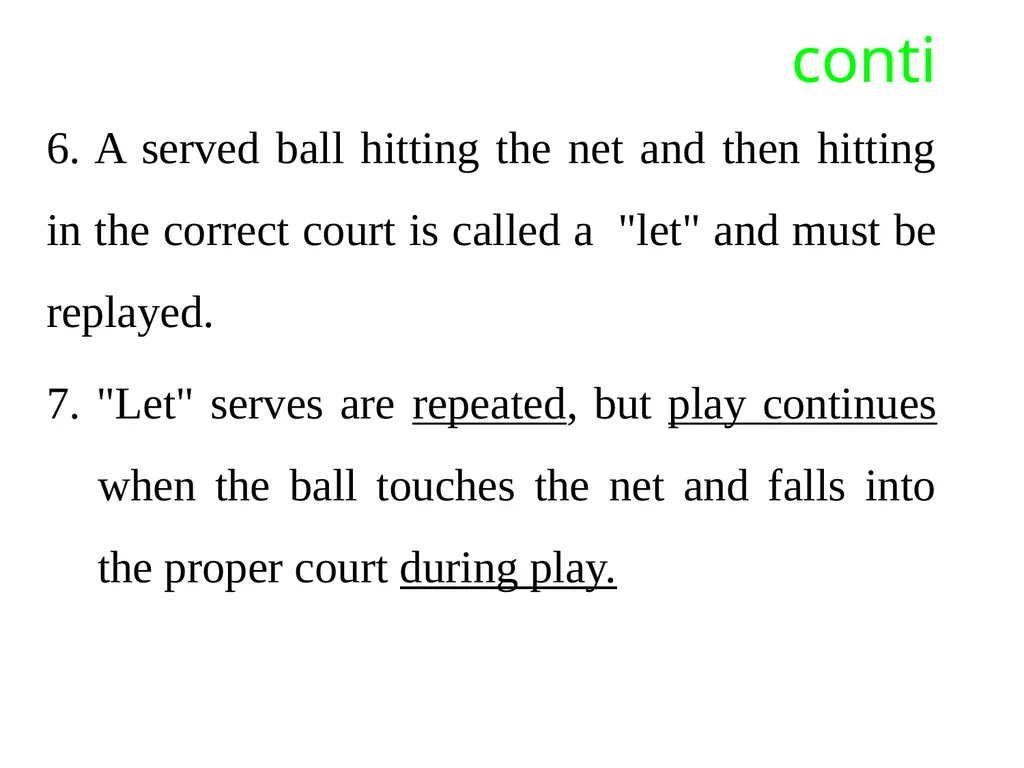
conti 6. A served ball hitting the net and then hitting in the correct court is called a "let" and must be replayed.
7. "Let" serves are repeated, but play continues when the ball touches the net and falls into the proper court during play.<br>
7. "Let" serves are repeated, but play continues when the ball touches the net and falls into the proper court during play.<br>
34
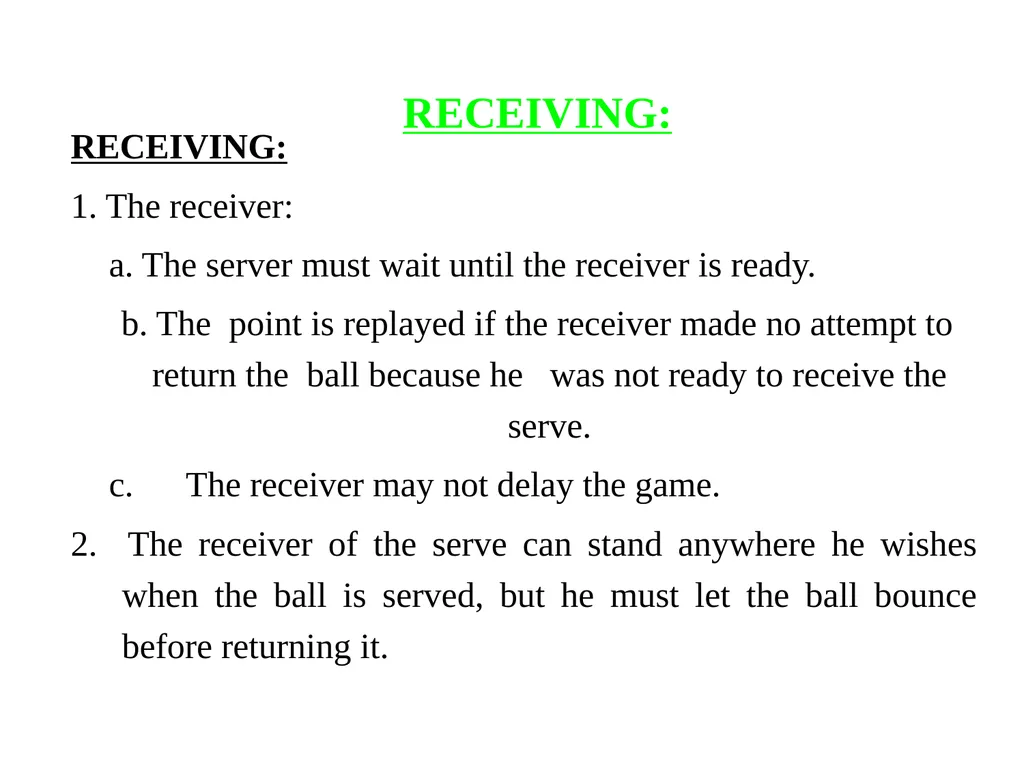
RECEIVING: RECEIVING:
1. The receiver:
a. The server must wait until the receiver is ready.
b. The point is replayed if the receiver made no attempt to return the ball because he was not ready to receive the serve.
c. The receiver may not delay the game.
2. The receiver of the serve can stand anywhere he wishes when the ball is served, but he must let the ball bounce before returning it.<br>
1. The receiver:
a. The server must wait until the receiver is ready.
b. The point is replayed if the receiver made no attempt to return the ball because he was not ready to receive the serve.
c. The receiver may not delay the game.
2. The receiver of the serve can stand anywhere he wishes when the ball is served, but he must let the ball bounce before returning it.<br>
35
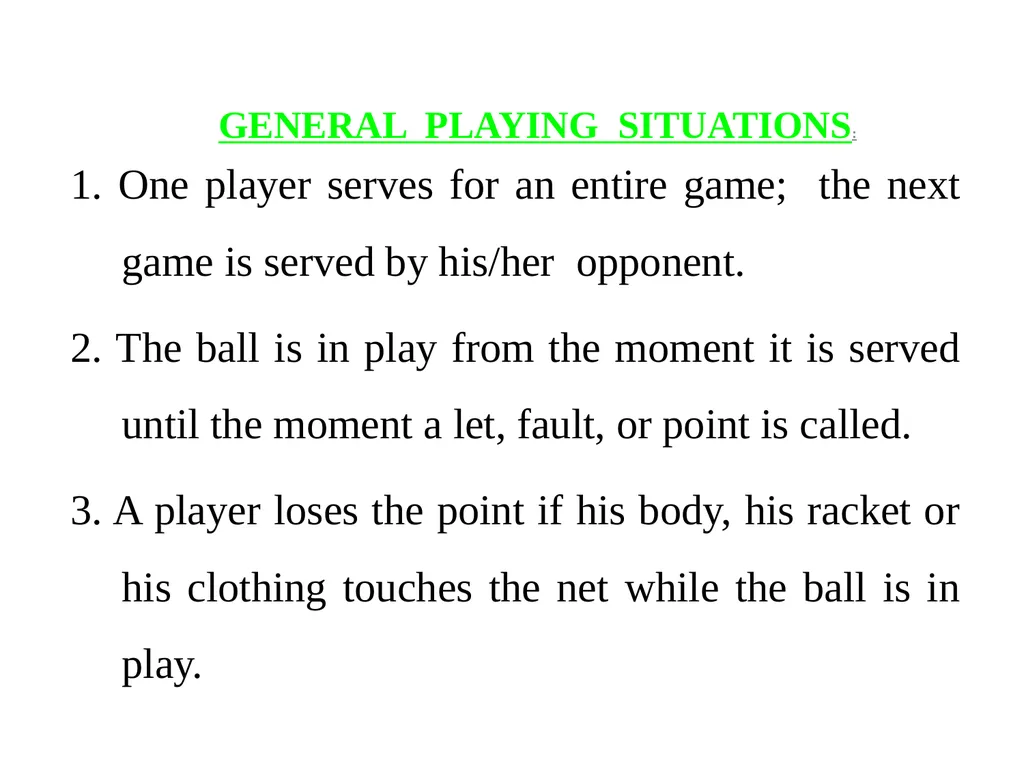
GENERAL PLAYING SITUATIONS: 1. One player serves for an entire game; the next game is served by his/her opponent.
2. The ball is in play from the moment it is served until the moment a let, fault, or point is called.
3. A player loses the point if his body, his racket or his clothing touches the net while the ball is in play.<br>
2. The ball is in play from the moment it is served until the moment a let, fault, or point is called.
3. A player loses the point if his body, his racket or his clothing touches the net while the ball is in play.<br>
36
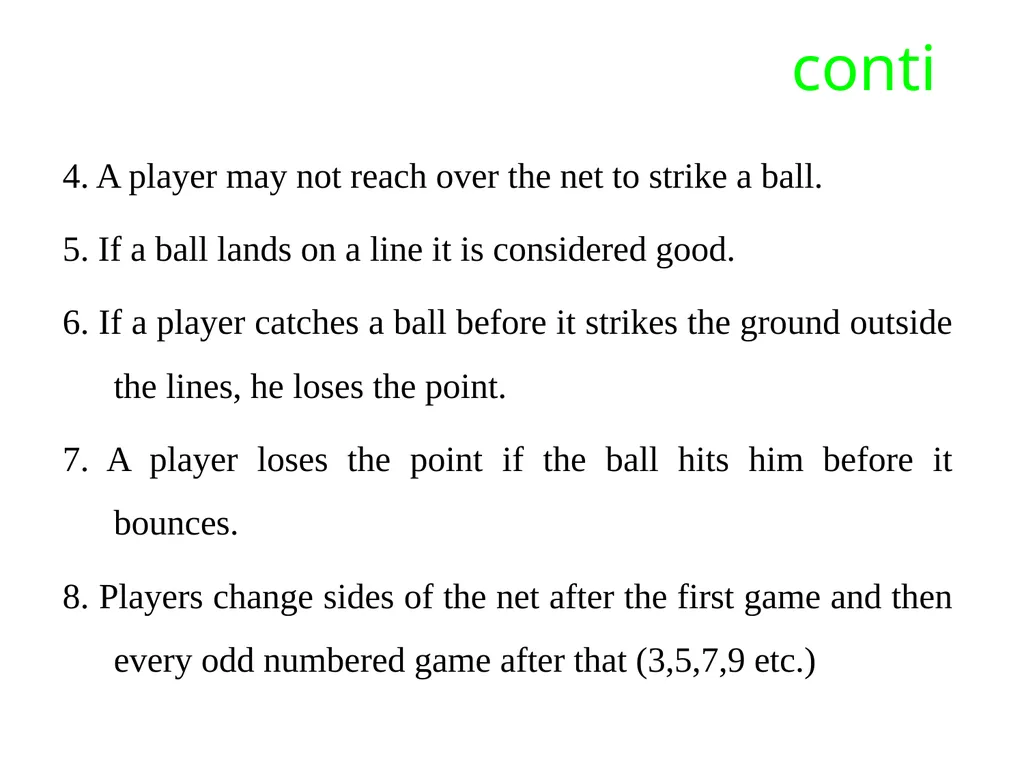
conti 4. A player may not reach over the net to strike a ball.
5. If a ball lands on a line it is considered good.
6. If a player catches a ball before it strikes the ground outside the lines, he loses the point.
7. A player loses the point if the ball hits him before it bounces.
8. Players change sides of the net after the first game and then every odd numbered game after that (3,5,7,9 etc.)<br>
5. If a ball lands on a line it is considered good.
6. If a player catches a ball before it strikes the ground outside the lines, he loses the point.
7. A player loses the point if the ball hits him before it bounces.
8. Players change sides of the net after the first game and then every odd numbered game after that (3,5,7,9 etc.)<br>
37
TENNIS ETIQUETTE: 1. If your ball goes into another court, ask the players to return it when they have completed playing a point.
2. Return the ball gently and directly to the person that asked for it.
3. Play a point over in case of interference.
4. Wait until your opponent is ready before serving.<br>
2. Return the ball gently and directly to the person that asked for it.
3. Play a point over in case of interference.
4. Wait until your opponent is ready before serving.<br>
38
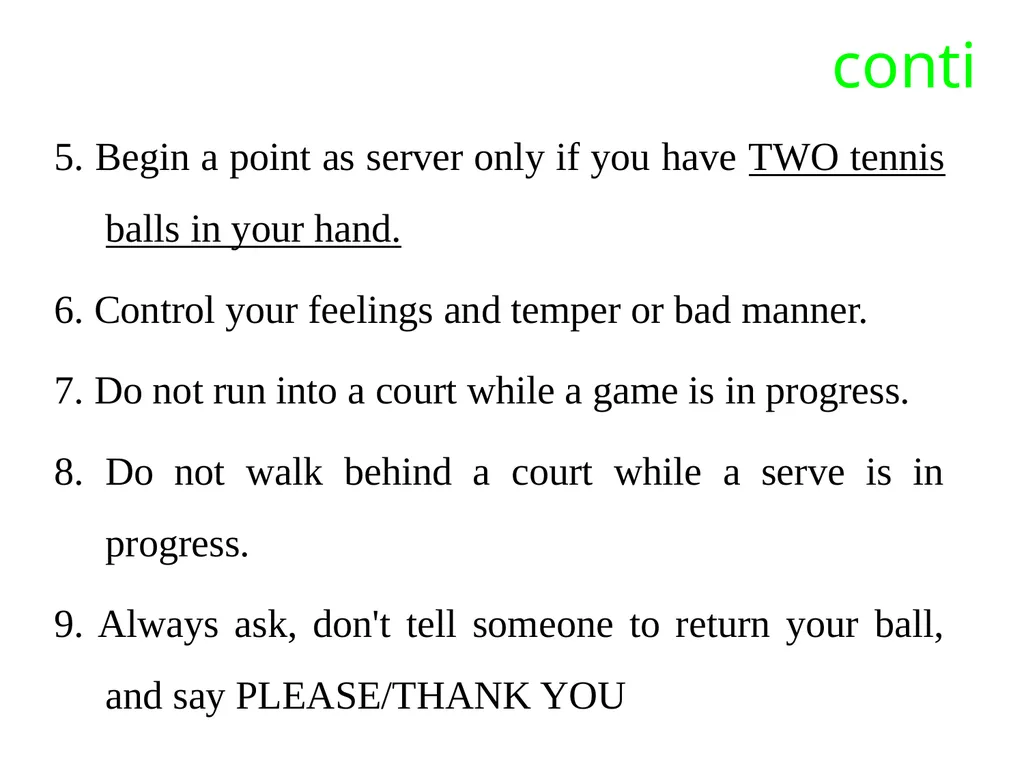
conti 5. Begin a point as server only if you have TWO tennis balls in your hand.
6. Control your feelings and temper or bad manner.
7. Do not run into a court while a game is in progress.
8. Do not walk behind a court while a serve is in progress.
9. Always ask, don't tell someone to return your ball, and say PLEASE/THANK YOU<br>
6. Control your feelings and temper or bad manner.
7. Do not run into a court while a game is in progress.
8. Do not walk behind a court while a serve is in progress.
9. Always ask, don't tell someone to return your ball, and say PLEASE/THANK YOU<br>
39
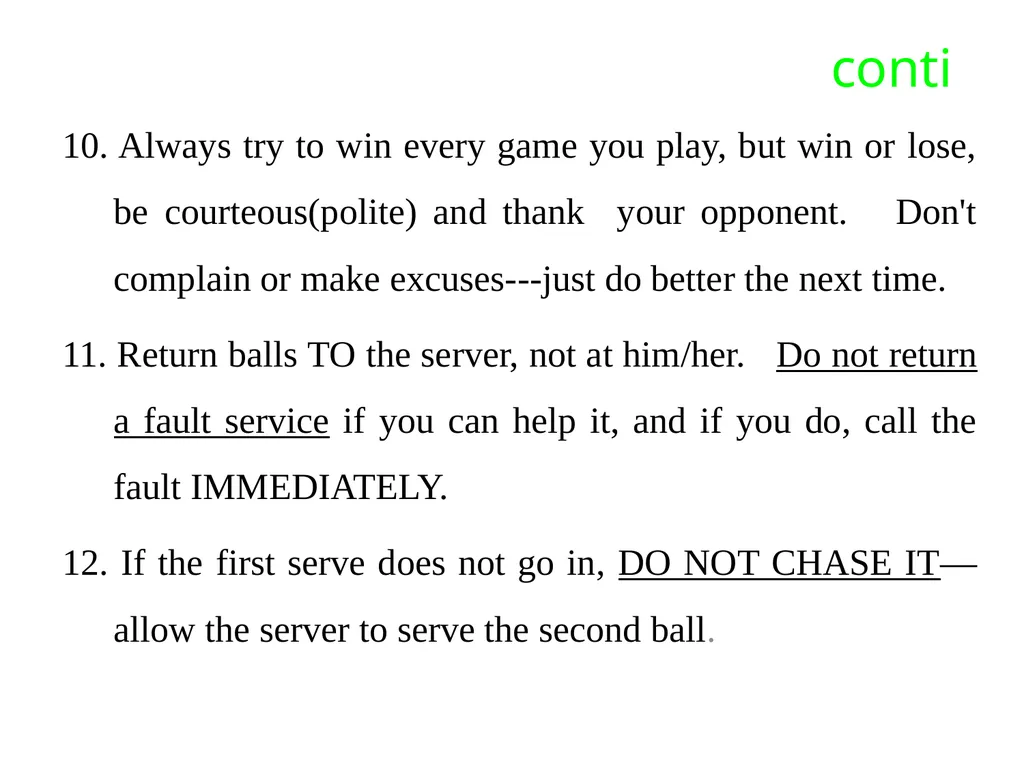
conti 10. Always try to win every game you play, but win or lose, be courteous(polite) and thank your opponent. Don't complain or make excuses---just do better the next time.
11. Return balls TO the server, not at him/her. Do not return a fault service if you can help it, and if you do, call the fault IMMEDIATELY.
12. If the first serve does not go in, DO NOT CHASE IT—allow the server to serve the second ball.<br>
11. Return balls TO the server, not at him/her. Do not return a fault service if you can help it, and if you do, call the fault IMMEDIATELY.
12. If the first serve does not go in, DO NOT CHASE IT—allow the server to serve the second ball.<br>
40
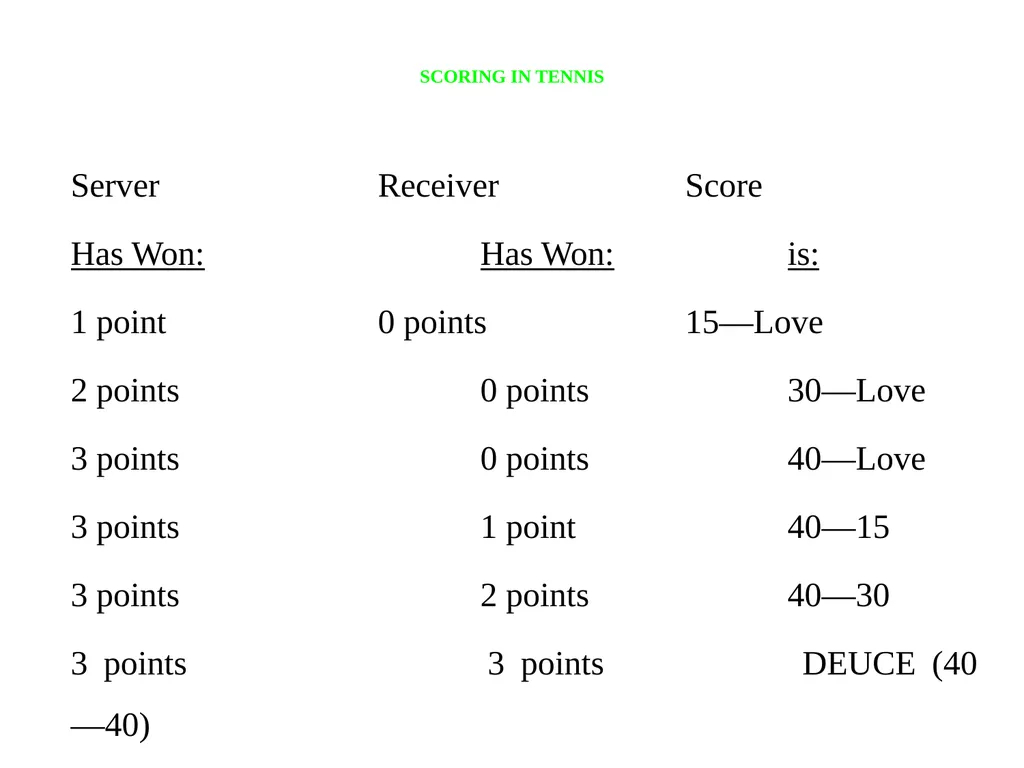
SCORING IN TENNIS Server Receiver Score
Has Won: Has Won: is:
1 point 0 points 15—Love
2 points 0 points 30—Love
3 points 0 points 40—Love
3 points 1 point 40—15
3 points 2 points 40—30
3 points 3 points DEUCE (40—40)<br>
Has Won: Has Won: is:
1 point 0 points 15—Love
2 points 0 points 30—Love
3 points 0 points 40—Love
3 points 1 point 40—15
3 points 2 points 40—30
3 points 3 points DEUCE (40—40)<br>
41
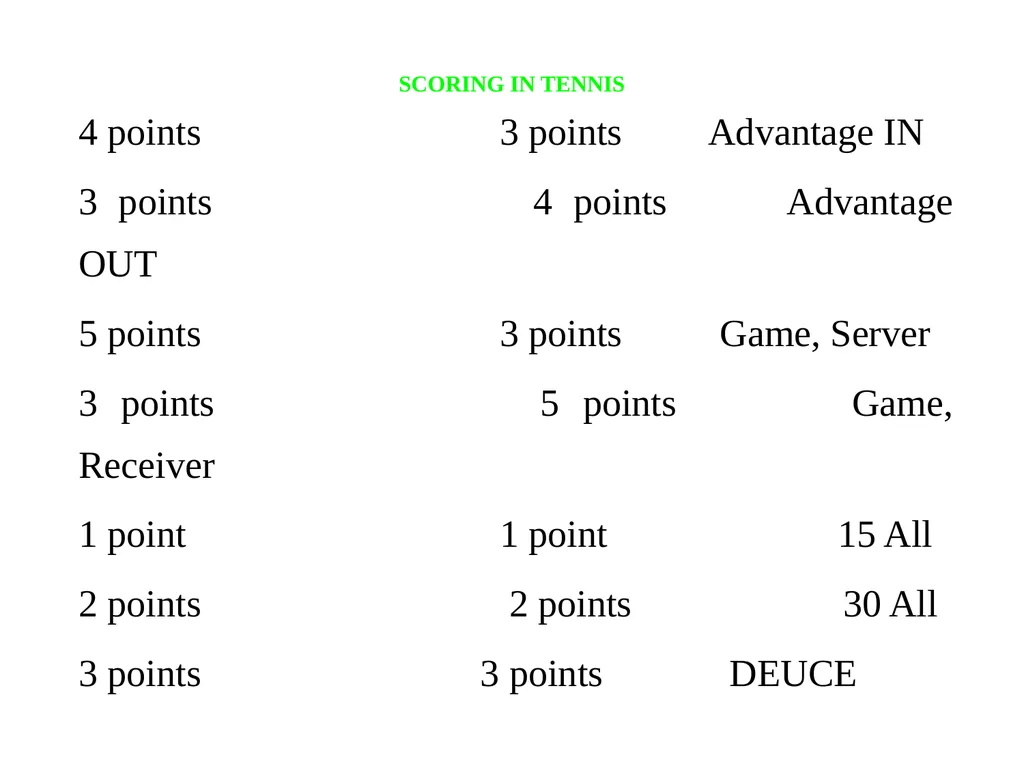
SCORING IN TENNIS 4 points 3 points Advantage IN
3 points 4 points Advantage OUT
5 points 3 points Game, Server
3 points 5 points Game, Receiver
1 point 1 point 15 All
2 points 2 points 30 All
3 points 3 points DEUCE<br>
3 points 4 points Advantage OUT
5 points 3 points Game, Server
3 points 5 points Game, Receiver
1 point 1 point 15 All
2 points 2 points 30 All
3 points 3 points DEUCE<br>
42
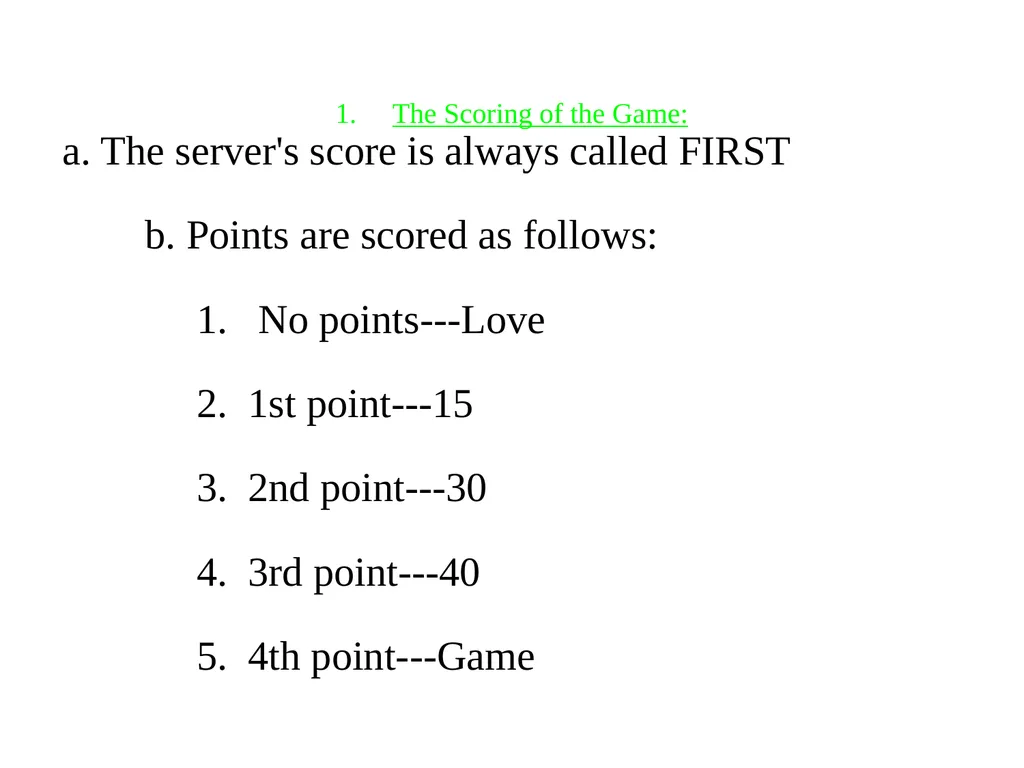
1. The Scoring of the Game: a. The server's score is always called FIRST
b. Points are scored as follows:
1. No points---Love
2. 1st point---15
3. 2nd point---30
4. 3rd point---40
5. 4th point---Game<br>
b. Points are scored as follows:
1. No points---Love
2. 1st point---15
3. 2nd point---30
4. 3rd point---40
5. 4th point---Game<br>
43
conti 6. "Deuce"---each side has 3 points (One side must now win 2 consecutive points to win the game)
7. "Advantage"---The first point after deuce.
a. If the server wins the first point after deuce, the score is called "Advantage IN".
b. If the receiver wins the first point after deuce, the score is called "Advantage OUT".<br>
7. "Advantage"---The first point after deuce.
a. If the server wins the first point after deuce, the score is called "Advantage IN".
b. If the receiver wins the first point after deuce, the score is called "Advantage OUT".<br>
44
2. The Scoring of a Set: a. The side first winning six games (6) wins the SET, provided it is ahead by at least 2 games. (If the score is 6—7 or 5—6, play continues until someone gets 2 games ahead. For example: 6--8 or 5--7, etc.)
b. An average set takes about 30 minutes to complete.
3. The Scoring of a Match:
a. A MATCH consists of the first person or side to win two of three SETS.
b. In top men's tournaments, a match may consist of three of five sets.<br>
b. An average set takes about 30 minutes to complete.
3. The Scoring of a Match:
a. A MATCH consists of the first person or side to win two of three SETS.
b. In top men's tournaments, a match may consist of three of five sets.<br>
45
COURT POSITIONS A. Server and receiver:
1. The server stands close to the baseline and within four feet of the center mark.
2. The receiver stands near the baseline (inside the baseline for a soft serve or when preparing to attack: slightly beyond the baseline for a hard serve) and in a line that bisects the angle where the serve might be hit.<br>
1. The server stands close to the baseline and within four feet of the center mark.
2. The receiver stands near the baseline (inside the baseline for a soft serve or when preparing to attack: slightly beyond the baseline for a hard serve) and in a line that bisects the angle where the serve might be hit.<br>
46
Game, set, match Game
A game consists of a sequence of points played with the same player serving. A game is won by the first player to have won at least four points in total and at least two points more than the opponent. The running score of each game is described in a manner irregular to tennis: scores from zero to three points are described as "love", "fifteen", "thirty", and "forty", respectively. If at least three points have been scored by each player, making the player's scores equal at forty respectively, the score is not called out as "forty-forty", but rather as "deuce".<br>
A game consists of a sequence of points played with the same player serving. A game is won by the first player to have won at least four points in total and at least two points more than the opponent. The running score of each game is described in a manner irregular to tennis: scores from zero to three points are described as "love", "fifteen", "thirty", and "forty", respectively. If at least three points have been scored by each player, making the player's scores equal at forty respectively, the score is not called out as "forty-forty", but rather as "deuce".<br>
47
conti If at least three points have been scored by each side and a player has one more point than his opponent, the score of the game is "advantage" for the player in the lead. During informal games, "advantage" can also be called "ad in" or "van in" when the serving player is ahead, and "ad out" or "van out" when the receiving player is ahead.<br>
48
Set A set consists of a sequence of games played with service alternating between games, ending when the count of games won meets certain criteria. Typically, a player wins a set by winning at least six games and at least two games more than the opponent. If one player has won six games and the opponent five, an additional game is played. If the leading player wins that game, the player wins the set 7–5. If the trailing player wins the game, a tie-break is played.<br>
49
conti A tie-break, played under a separate set of rules, allows one player to win one more game and thus the set, to give a final set score of 7–6. A "love" set means that the loser of the set won zero games, colloquially termed a 'jam donut' in the USA. In tournament play, the chair umpire announces the winner of the set and the overall score. The final score in sets is always read with the winning player's score first, e.g. "6–2, 4–6, 6–0, 7–5".<br>
50
Match A match consists of a sequence of sets. The outcome is determined through a best of three or five sets system. Recreational players may agree to play any number of sets, depending upon time availability or stamina.<br>
51
Basic rules of badminton Court
Badminton court, isometric view
The court is rectangular and divided into halves by a net. Courts are usually marked for both singles and doubles play, although badminton rules permit a court to be marked for singles only. The doubles court is wider than the singles court, but both are of same length. The exception, which often causes confusion to newer players, is that the doubles court has a shorter serve-length dimension.<br>
Badminton court, isometric view
The court is rectangular and divided into halves by a net. Courts are usually marked for both singles and doubles play, although badminton rules permit a court to be marked for singles only. The doubles court is wider than the singles court, but both are of same length. The exception, which often causes confusion to newer players, is that the doubles court has a shorter serve-length dimension.<br>
52
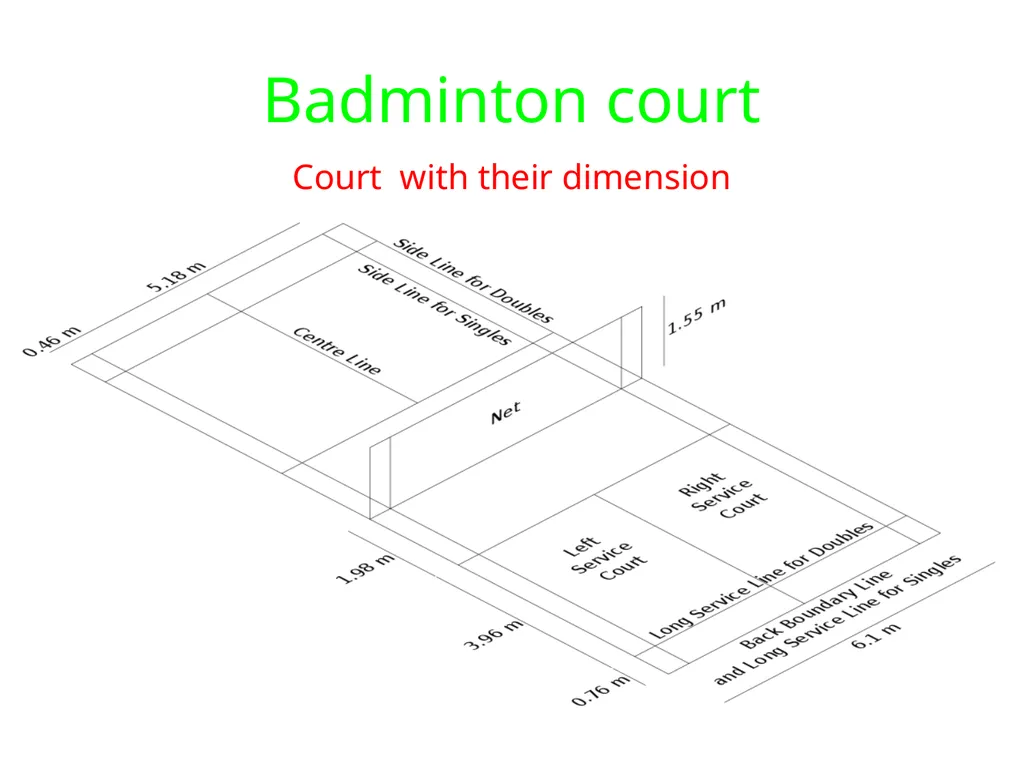
Badminton court Court with their dimension<br>
53
conti The full width of the court is 6.1 meters, and in singles this width is reduced to 5.18 meters .
The full length of the court is 13.4 meters. The service courts are marked by a center line dividing the width of the court, by a short service line at a distance of 1.98 meters from the net, and by the outer side and back boundaries. In doubles, the service court is also marked by a long service line, which is 0.76 meters from the back boundary.<br>
The full length of the court is 13.4 meters. The service courts are marked by a center line dividing the width of the court, by a short service line at a distance of 1.98 meters from the net, and by the outer side and back boundaries. In doubles, the service court is also marked by a long service line, which is 0.76 meters from the back boundary.<br>
54
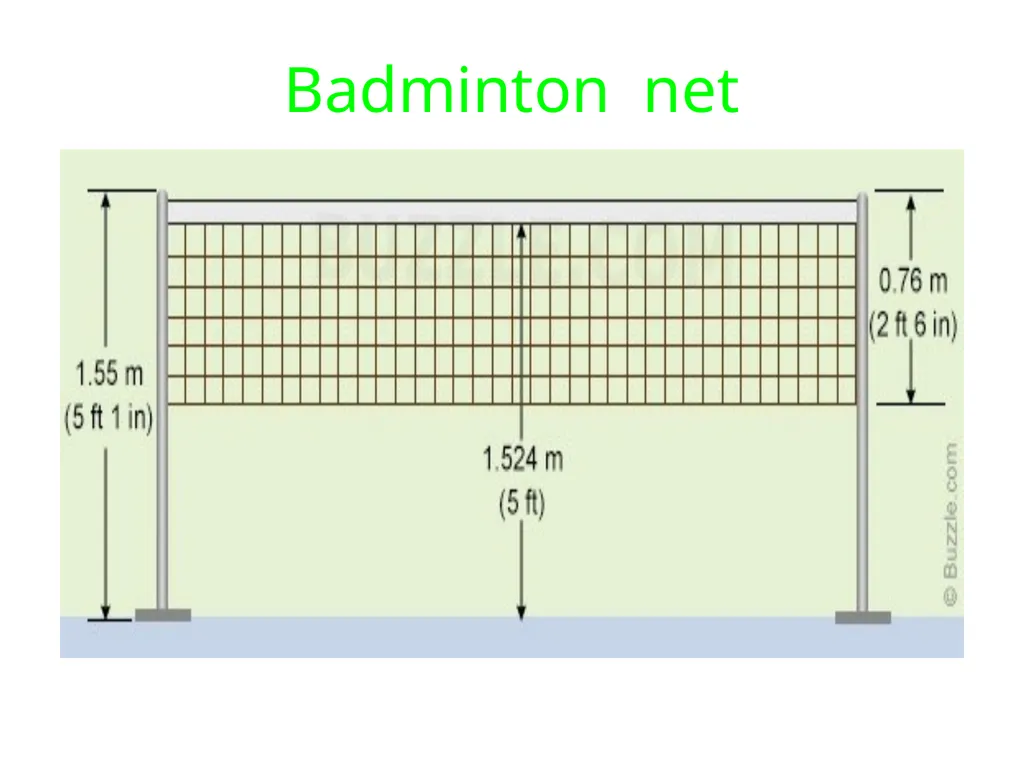
conti The net is 1.55 meters high at the edges and 1.524 meters high in the center.
The net posts are placed over the doubles sidelines, even when singles is played.
The minimum height for the maximum above the court is not mentioned in the Laws of Badminton. However, a badminton court will not be suitable if the top limit is likely to be hit on a high serve.<br>
The net posts are placed over the doubles sidelines, even when singles is played.
The minimum height for the maximum above the court is not mentioned in the Laws of Badminton. However, a badminton court will not be suitable if the top limit is likely to be hit on a high serve.<br>
55
Badminton net<br>
56
Scoring Scoring system development of badminton
Each game is played to 21 points, with players scoring a point when ever they win a rally regardless of whether they A match is the best of three games.
If the score reaches 20-all, then the game continues until one side gains a two-point lead (such as 24–22), except when there is a tie at 29-all, in which the game goes to a golden point. Whoever scores this point will win.<br>
Each game is played to 21 points, with players scoring a point when ever they win a rally regardless of whether they A match is the best of three games.
If the score reaches 20-all, then the game continues until one side gains a two-point lead (such as 24–22), except when there is a tie at 29-all, in which the game goes to a golden point. Whoever scores this point will win.<br>
57
conti At the start of a match, the shuttlecock is cast and the side towards which the shuttlecock is pointing serves first. Alternatively, a coin may be tossed, with the winners choosing whether to serve or receive first, or choosing which end of the court to occupy first, and their opponents making the leftover the remaining choice.
In subsequent games, the winners of the previous game serve first. Matches are best out of three: a player or pair must win two games (of 21 points each) to win the match.<br>
In subsequent games, the winners of the previous game serve first. Matches are best out of three: a player or pair must win two games (of 21 points each) to win the match.<br>
58
conti For the first rally of any doubles game, the serving pair may decide who serves and the receiving pair may decide who receives. The players change ends at the start of the second game; if the match reaches a third game, they change ends both at the start of the game and when the leading player's or pair's score reaches 11 points.
The server and receiver must remain within their service courts, without touching the boundary lines, until the server strikes the shuttlecock. The other two players may stand wherever they wish, so long as they do not block the vision of the server or receiver.<br>
The server and receiver must remain within their service courts, without touching the boundary lines, until the server strikes the shuttlecock. The other two players may stand wherever they wish, so long as they do not block the vision of the server or receiver.<br>
59
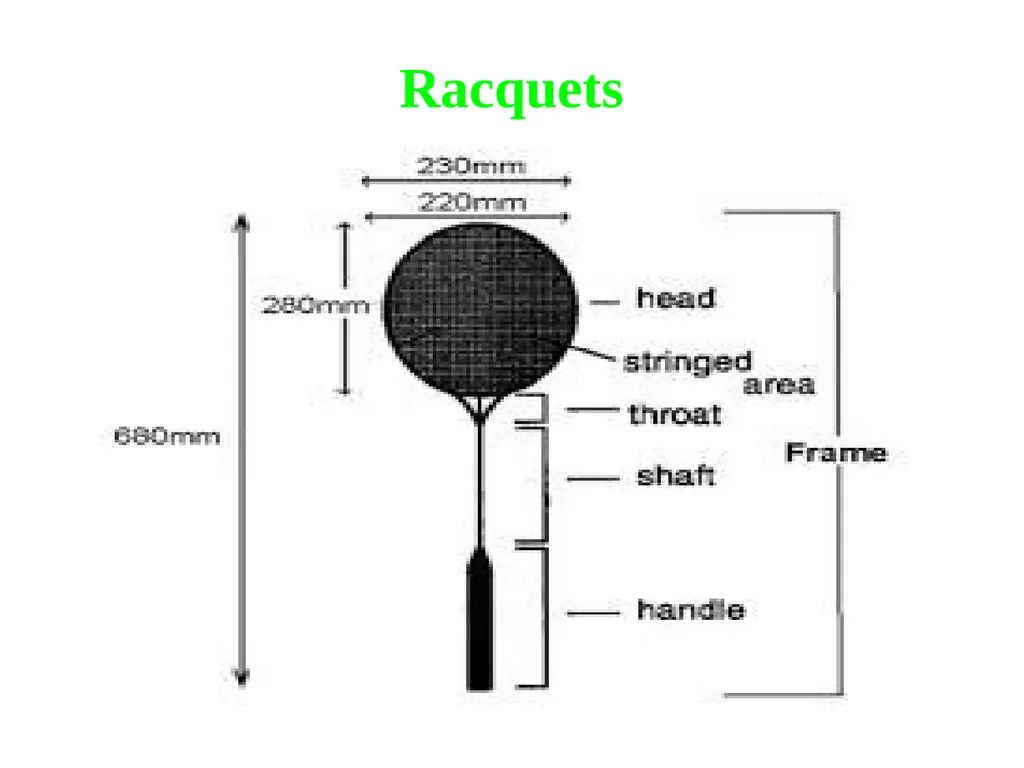
Racquets Badminton racquets are lightweight, with top quality racquets weighing between 70 and 95 grams. Not including grip or strings. They are composed of many different materials reaching from carbon fibre composite ( reinforced plastic ) to solid steel, which may be augmented(increased) by a variety of materials. Carbon fibre has an excellent strength to weight ratio, is inflexible, and gives excellent kinetic energy transfer. Before the adoption of carbon fibre composite, racquets were made of light metals such as aluminum.<br>
60
Racquets<br>
61
conti Earlier still, racquets were made of wood. Cheap racquets are still often made of metals such as steel, but wooden racquets are no longer manufactured for the ordinary market, because of their excessive mass and cost. Nowadays, nanomaterials such as fullerene and carbon nanotubes are added to racquets giving them greater durability.
There is a wide variety of racquet designs, although the laws limit the racquet size and shape. Different racquets have playing characteristics that appeal to different players. The traditional oval head shape is still available, but an isometric head shape is increasingly common in new racquets.<br>
There is a wide variety of racquet designs, although the laws limit the racquet size and shape. Different racquets have playing characteristics that appeal to different players. The traditional oval head shape is still available, but an isometric head shape is increasingly common in new racquets.<br>
62
Strings Badminton strings are thin, high performing strings with thicknesses reaching from about 0.62 to 0.73 mm. Thicker strings are more durable, but many players wish the feel of thinner strings.
Recreational players generally string at lower tensions than professionals,<br>
Recreational players generally string at lower tensions than professionals,<br>
63
Grip The choice of grip allows a player to increase the thickness of their racquet handle and choose a comfortable surface to hold. A player may build up the handle with one or several grips before applying the final layer.
Players may choose between varieties of grip materials. The most common choices are synthetic grips or to welling grips. Grip choice is a matter of personal preference. Players often find that sweat becomes a problem; in this case, a drying agent may be applied to the grip or hands, sweatbands may be used, the player may choose another grip material or change his/her grip more frequently.<br>
Players may choose between varieties of grip materials. The most common choices are synthetic grips or to welling grips. Grip choice is a matter of personal preference. Players often find that sweat becomes a problem; in this case, a drying agent may be applied to the grip or hands, sweatbands may be used, the player may choose another grip material or change his/her grip more frequently.<br>
64
conti There are two main types of grip: replacement grips and overgrips. Replacement grips are thicker, and are often used to increase the size of the handle. Overgrips are thinner (less than 1 mm), and are often used as the final layer. Many players, however, prefer to use replacement grips as the final layer. Toweling grips are always replacement grips. Replacement grips have an paste backing, whereas overgrips have only a small patch of adhesive(paste) at the start of the tape and must be applied under tension; overgrips are more convenient for players who change grips frequently, because they may be removed more rapidly without damaging the underlying material.<br>
65
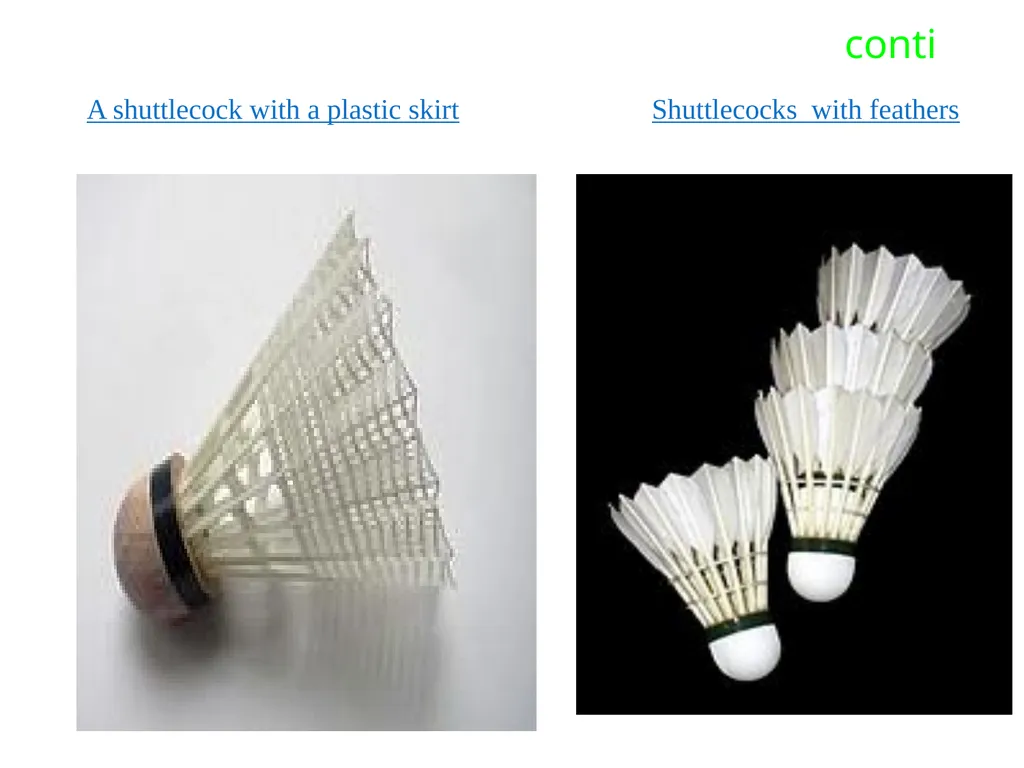
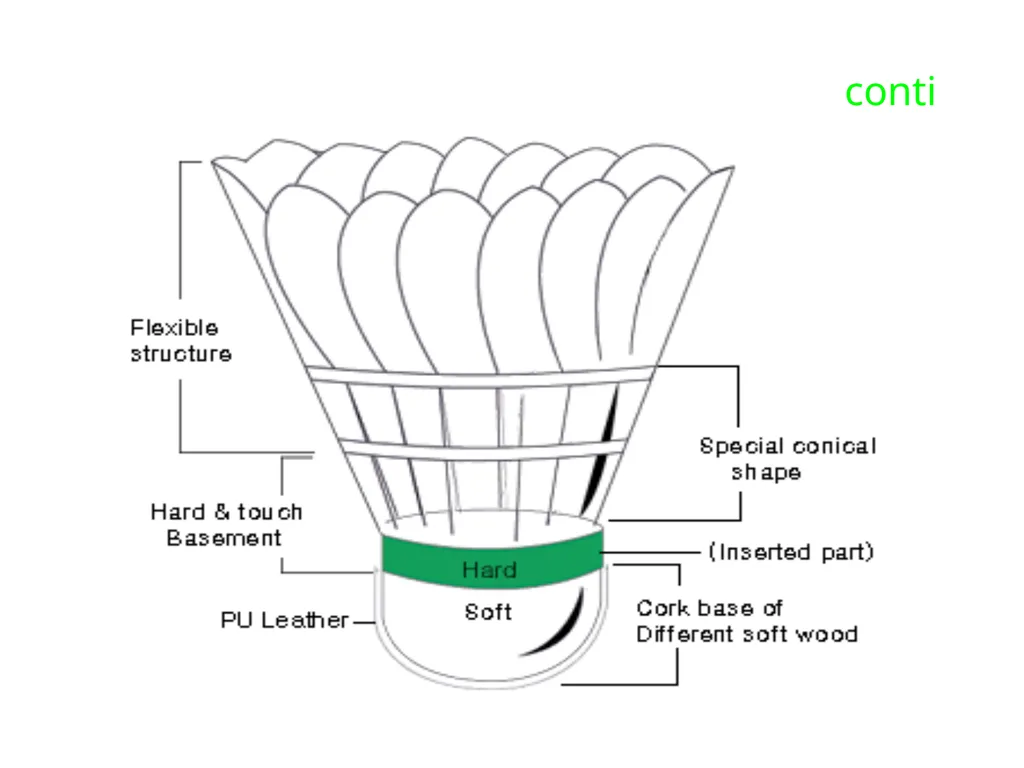
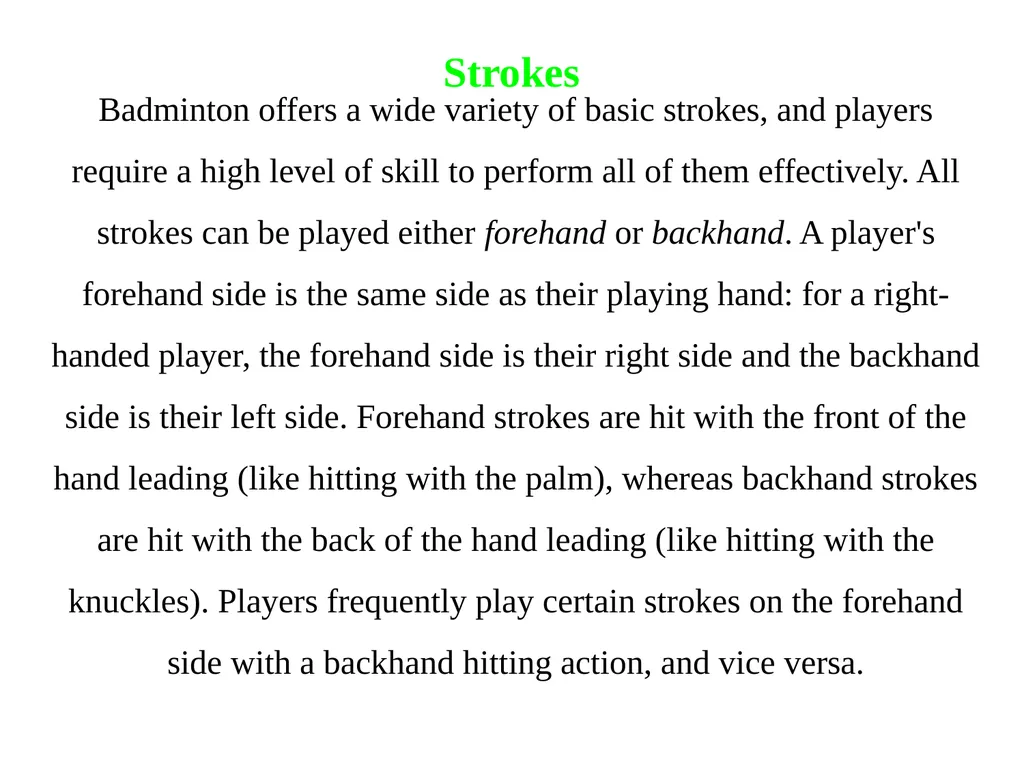
A shuttlecock A shuttlecock (often abbreviated to shuttle; also called a birdie) is a high-drag projectile , with an open narrowed shape , the cone is formed from sixteen overlapping feathers surrounded into a rounded cork base. The cork is covered with thin leather or synthetic material. Synthetic shuttles are often used by recreational players to reduce their costs as feathered shuttles break easily. These nylon shuttles may be constructed with either natural cork or synthetic lather base, and a plastic skirt.<br>
66
conti Badminton rules also provide for testing a shuttlecock for the correct speed:
To test a shuttlecock, hit a full underhand stroke which makes contact with the shuttlecock over the back boundary line. The shuttlecock shall be hit at an upward angle and in a direction parallel to the side lines.
A shuttlecock of the correct speed will land not less than 530 mm and not more than 990 mm short of the other back boundary line.<br>
To test a shuttlecock, hit a full underhand stroke which makes contact with the shuttlecock over the back boundary line. The shuttlecock shall be hit at an upward angle and in a direction parallel to the side lines.
A shuttlecock of the correct speed will land not less than 530 mm and not more than 990 mm short of the other back boundary line.<br>
67
conti A shuttlecock with a plastic skirt Shuttlecocks with feathers<br>
68
conti<br>
69
Strokes Badminton offers a wide variety of basic strokes, and players require a high level of skill to perform all of them effectively. All strokes can be played either forehand or backhand. A player's forehand side is the same side as their playing hand: for a right-handed player, the forehand side is their right side and the backhand side is their left side. Forehand strokes are hit with the front of the hand leading (like hitting with the palm), whereas backhand strokes are hit with the back of the hand leading (like hitting with the knuckles). Players frequently play certain strokes on the forehand side with a backhand hitting action, and vice versa.<br>
70
conti In the forecourt and midcourt, most strokes can be played equally effectively on either the forehand or backhand side; but in the rear court, players will attempt to play as many strokes as possible on their forehands, often preferring to play a round-the-head forehand overhead (a forehand "on the backhand side") rather than attempt a backhand overhead. Playing a backhand overhead has two main disadvantages. First, the player must turn their back to their opponents, restricting their view of them and the court. Second, backhand overheads cannot be hit with as much power as forehands: the hitting action is limited by the shoulder joint, which permits a much greater range of movement for a forehand overhead than for a backhand.<br>
71
conti The backhand clear is considered by most players and coaches to be the most difficult basic stroke in the game, since precise technique is needed in order to muster enough power for the shuttlecock to travel the full length of the court. For the same reason, backhand smashes tend to be weak.
The choice of stroke depends on how near the shuttlecock is to the net, whether it is above net height, and where an opponent is currently positioned: players have much better attacking options if they can reach the shuttlecock well above net height, especially if it is also close to the net.<br>
The choice of stroke depends on how near the shuttlecock is to the net, whether it is above net height, and where an opponent is currently positioned: players have much better attacking options if they can reach the shuttlecock well above net height, especially if it is also close to the net.<br>
72
conti In the forecourt, a high shuttlecock will be met with a net kill, hitting it steeply downwards and attempting to win the rally immediately. This is why it is best to drop the shuttlecock just over the net in this situation. In the midcourt, a high shuttlecock will usually be met with a powerful smash, also hitting downwards and hoping for an outright winner or a weak reply. Athletic jump smashes, where players jump upwards for a steeper smash angle, are a common and spectacular element of elite men's doubles play. In the rear court, players strive to hit the shuttlecock while it is still above them, rather than allowing it to drop lower.<br>
73
conti This overhead hitting allows them to play smashes, clears (hitting the shuttlecock high and to the back of the opponents' court), and drop shots (hitting the shuttlecock softly so that it falls sharply downwards into the opponents' forecourt). If the shuttlecock has dropped lower, then a smash is impossible and a full-length, high clear is difficult.<br>
74
conti When the shuttlecock is well below net height, players have no choice but to hit upwards. Lifts, where the shuttlecock is hit upwards to the back of the opponents' court, can be played from all parts of the court. If a player does not lift, his only remaining option is to push the shuttlecock softly back to the net: in the forecourt this is called a netshot; in the midcourt or rear court, it is often called a push or block.<br>
75
conti When the shuttlecock is near to net height, players can hit drives, which travel flat and rapidly over the net into the opponents' rear midcourt and rearcourt. Pushes may also be hit flatter, placing the shuttlecock into the front midcourt. Drives and pushes may be played from the midcourt or forecourt, and are most often used in doubles: they are an attempt to regain the attack, rather than choosing to lift the shuttlecock and defend against smashes. After a successful drive or push, the opponents will often be forced to lift the shuttlecock.<br>
76
Spin Balls may be spun to alter their bounce (for example, topspin and backspin in tennis) or trajectory, and players may slice the ball (strike it with an angled racquet face) to produce such spin; but, since the shuttlecock is not allowed to bounce, this does not apply to badminton.
Slicing the shuttlecock so that it spins, however, does have applications, and some are particular to badminton.<br>
Slicing the shuttlecock so that it spins, however, does have applications, and some are particular to badminton.<br>
77
Nature of the Game Badminton is played as a singles or doubles game with one or two players on a side. The object of the game is to hit the shuttlecock or “bird” back and forth with a racket across a net five feet high at its canter. The bird should be hit with such speed and accuracy that the opponent is unable to return the shot successfully. The game can either be fast or slow paced, depending on the skill level of the players.<br>
78
Safety/Etiquette 1. Keep a firm grip on the racket.
2. be careful not to hit your partner with the racket.
3. Stay in your own court to avoid the possibility of collision with other players.
4. Stop play if other players enter your court.
5. Wait until there is a stop in the action to retrieve a bird from another court.
6. Be aware of the walls and the net posts.
7. Before play, agree on the boundaries and determine the first server.
8. Players call their own lines; replay the point if in doubt.
9. Shake hands after the game/match.<br>
2. be careful not to hit your partner with the racket.
3. Stay in your own court to avoid the possibility of collision with other players.
4. Stop play if other players enter your court.
5. Wait until there is a stop in the action to retrieve a bird from another court.
6. Be aware of the walls and the net posts.
7. Before play, agree on the boundaries and determine the first server.
8. Players call their own lines; replay the point if in doubt.
9. Shake hands after the game/match.<br>
79
Facilities/Equipment 1. Rackets are fragile. Avoid striking the floor, wall, net, posts, or your partner. Also avoid flipping, throwing, or twirling rackets.
2. Shuttlecocks should be handled by the tips only. Birds caught in the net should be removed carefully.
3. Each student is responsible for reporting any damaged rackets to the instructor.
4. Rackets are returned to the proper slot and birds to the basket at the end of each period.<br>
2. Shuttlecocks should be handled by the tips only. Birds caught in the net should be removed carefully.
3. Each student is responsible for reporting any damaged rackets to the instructor.
4. Rackets are returned to the proper slot and birds to the basket at the end of each period.<br>
80
Game Rules/Scoring Players
1. Singles – one player on a side.
2. Doubles – two players on a side.
3. Mixed Doubles – one male and one female partner opposing a male and female opponent.<br>
1. Singles – one player on a side.
2. Doubles – two players on a side.
3. Mixed Doubles – one male and one female partner opposing a male and female opponent.<br>
81
Scoring 1. Rally scoring allows for a point to be won by either team regardless of which team is serving.
2. Both singles and doubles games are won with 21 points.
3. The side winning a rally adds a point to their score.
4. At 20 all, the side that gains a 2 point lead first, wins that game.
5. At 29 all, the side scoring the 30th point wins that game.
6. In the third game of singles and doubles, players change sides when a side scores 11 points.
7. A match is won by winning two out of three games<br>
2. Both singles and doubles games are won with 21 points.
3. The side winning a rally adds a point to their score.
4. At 20 all, the side that gains a 2 point lead first, wins that game.
5. At 29 all, the side scoring the 30th point wins that game.
6. In the third game of singles and doubles, players change sides when a side scores 11 points.
7. A match is won by winning two out of three games<br>
82
General Rules/Regulations
1. Serving a. The server must keep both feet in contact with the floor at the time of the serve.
b. The bird must be contacted below the waist.
c. The racket head must be below the server’s wrist.
d. The server should not serve until the receiver is ready; the opponent is deemed ready if a return is attempted.
e. Partners of the server and receiver may stand anywhere on the court providing they do not obstruct the opponent’s view.
f. A bird that touches the net on the serve and goes into the proper service court is legal.
g. If the server misses the bird on the serve attempt, it still counts. In singles and doubles the serve would go to the opponent.<br>
b. The bird must be contacted below the waist.
c. The racket head must be below the server’s wrist.
d. The server should not serve until the receiver is ready; the opponent is deemed ready if a return is attempted.
e. Partners of the server and receiver may stand anywhere on the court providing they do not obstruct the opponent’s view.
f. A bird that touches the net on the serve and goes into the proper service court is legal.
g. If the server misses the bird on the serve attempt, it still counts. In singles and doubles the serve would go to the opponent.<br>
83
2. Serving Order – Singles a. At the beginning of the game (0-0) and when the server’s score is even, the serve will begin from the right service court. When the server’s score is odd, the serve will be from the left service court.
b. If the server wins a rally, the server scores a point and will then serve again from the alternate service court.
c. If the receiver wins a rally, the receiver scores a point and becomes the new server. They serve from the appropriate service court – left if the score is odd and right if it is even.<br>
b. If the server wins a rally, the server scores a point and will then serve again from the alternate service court.
c. If the receiver wins a rally, the receiver scores a point and becomes the new server. They serve from the appropriate service court – left if the score is odd and right if it is even.<br>
84
3. Serving Order - Doubles a. A team will only have one player serve, per “service”.
b. At the beginning of the game and when the score is even (0,2,4,6, etc.) the server serves from the right service court. When it is odd (1,3,5,7, etc.) the server serves from the left service court.
c. If the serving side wins a rally, the serving side scores a point and the same server serves again from the alternate service court.
d. If the receiving side wins a rally, the receiving side scores a point. The receiving side becomes the new serving side.
e. The players do not change their respective service courts until they win a point when their side is serving.<br>
b. At the beginning of the game and when the score is even (0,2,4,6, etc.) the server serves from the right service court. When it is odd (1,3,5,7, etc.) the server serves from the left service court.
c. If the serving side wins a rally, the serving side scores a point and the same server serves again from the alternate service court.
d. If the receiving side wins a rally, the receiving side scores a point. The receiving side becomes the new serving side.
e. The players do not change their respective service courts until they win a point when their side is serving.<br>
85
conti 4. The winners of the first game serve first in the next game.
5. Birds falling on the lines are considered good.
6. During a rally, a bird that touches the net and goes over is in play.
7. A fault (violation of rules) occurs if:
a. On the service, any part of the racket head is higher than the server’s wrist and contact is made above the waist.
b. The service fails to cross the net or go into the unproper service court.
c. The feet of the server and receiver are not in the proper courts at time of service.
d. The server hesitates or stops (feint/balk) the service motion or misses the bird.<br>
5. Birds falling on the lines are considered good.
6. During a rally, a bird that touches the net and goes over is in play.
7. A fault (violation of rules) occurs if:
a. On the service, any part of the racket head is higher than the server’s wrist and contact is made above the waist.
b. The service fails to cross the net or go into the unproper service court.
c. The feet of the server and receiver are not in the proper courts at time of service.
d. The server hesitates or stops (feint/balk) the service motion or misses the bird.<br>
86
conti e. The improper receiver returns the bird on the serve.
f. A bird hit into the net, under the net, against the wall or ceiling is out-of-bounds.
g. A player hits the bird before it crosses the net.
h. The bird touches a player or clothing.
i. The player touches the net while the bird is in play.
j. The bird is hit twice in succession by one/both partners.
k. The bird is held, caught, or carried on the racket when struck.
l. A player obstructs an opponent.<br>
f. A bird hit into the net, under the net, against the wall or ceiling is out-of-bounds.
g. A player hits the bird before it crosses the net.
h. The bird touches a player or clothing.
i. The player touches the net while the bird is in play.
j. The bird is hit twice in succession by one/both partners.
k. The bird is held, caught, or carried on the racket when struck.
l. A player obstructs an opponent.<br>
87
conti 8. Let (a play allowed to be replayed)
a. The bird becomes caught in or on the net after passing over the net.
b. The bird hits the basketball supports or net.
c. The following situations occur before the next serve and if the offending side wins the rally:
1. The correct server serves from the wrong court.
2. The wrong server serves from either the correct/incorrect service court.
3. The correct receiver receives in the wrong court.<br>
a. The bird becomes caught in or on the net after passing over the net.
b. The bird hits the basketball supports or net.
c. The following situations occur before the next serve and if the offending side wins the rally:
1. The correct server serves from the wrong court.
2. The wrong server serves from either the correct/incorrect service court.
3. The correct receiver receives in the wrong court.<br>
88
Basic Skills A. Grip
1. Forehand – with the racket head perpendicular to the floor, shake hands with the grip so the “V” formed by the thumb and forefinger is on the top of the handle.
2. Backhand – using a forehand grip, rotate the hand slightly so the thumb is along and parallel to the wide side of the handle.<br>
1. Forehand – with the racket head perpendicular to the floor, shake hands with the grip so the “V” formed by the thumb and forefinger is on the top of the handle.
2. Backhand – using a forehand grip, rotate the hand slightly so the thumb is along and parallel to the wide side of the handle.<br>
89
B. Footwork 1. Move toward the shot with short steps and end with a long stride.
2. In the ready position the racket is held high, the knees are slightly bent, and the body weight is on the balls of the feet.<br>
2. In the ready position the racket is held high, the knees are slightly bent, and the body weight is on the balls of the feet.<br>
90
C. Strokes By using the same motion for all shots, the opponent is unable to detect what shot you are going to make until the bird is actually hit. A good wrist action allows more power and control with much less effort. A forehand stroke is one from the dominant side; the backhand stroke is from the non-dominant side. The racket is swung back, the arm is bent with the elbow up, the wrist is cocked, and the body weight is placed on the back foot. From this position, the stroke is made by throwing the hand at the point of contact between bird and racket with weight being transferred to the forward foot. If possible, shots should be made with an overhand stroke.<br>
91
conti 1. Clear – a shot used to drive your opponent away from the net or forecourt or to slow the game. The bird should fly above the opponent’s reach and fall within one foot of the baseline.
2. Smash – an attacking shot made at the limit of one’s upward reach and slightly in front of the shoulder. At the moment of contact, the arm and wrist come down forcibly.
3. Drive – A flat shot kept as low as possible and is second only to the smash as an attacking shot.
4. Drop Shot – any shot that drops immediately after crossing the net. The descent of the bird is controlled with little follow-through.
5. Net Shot – any shot played as near to the net as possible, controlled by wrist and forearm. The hairpin shot is an example of a net shot.<br>
2. Smash – an attacking shot made at the limit of one’s upward reach and slightly in front of the shoulder. At the moment of contact, the arm and wrist come down forcibly.
3. Drive – A flat shot kept as low as possible and is second only to the smash as an attacking shot.
4. Drop Shot – any shot that drops immediately after crossing the net. The descent of the bird is controlled with little follow-through.
5. Net Shot – any shot played as near to the net as possible, controlled by wrist and forearm. The hairpin shot is an example of a net shot.<br>
92
D. Serves 1. High and deep (singles) – take a position near and on the proper side of the center line and about four feet behind the short service line. Drop the bird on the racket side and swing the racket forward.
2. Low and short (doubles) – take a position closer to the front service line. The racket is swung forward with little follow-through.
3. Drive (flick) – a quick snap of the wrist in the backhand grip with the bird held directly in front of the body. The bird travels in a direct line at the receiver.<br>
2. Low and short (doubles) – take a position closer to the front service line. The racket is swung forward with little follow-through.
3. Drive (flick) – a quick snap of the wrist in the backhand grip with the bird held directly in front of the body. The bird travels in a direct line at the receiver.<br>
93
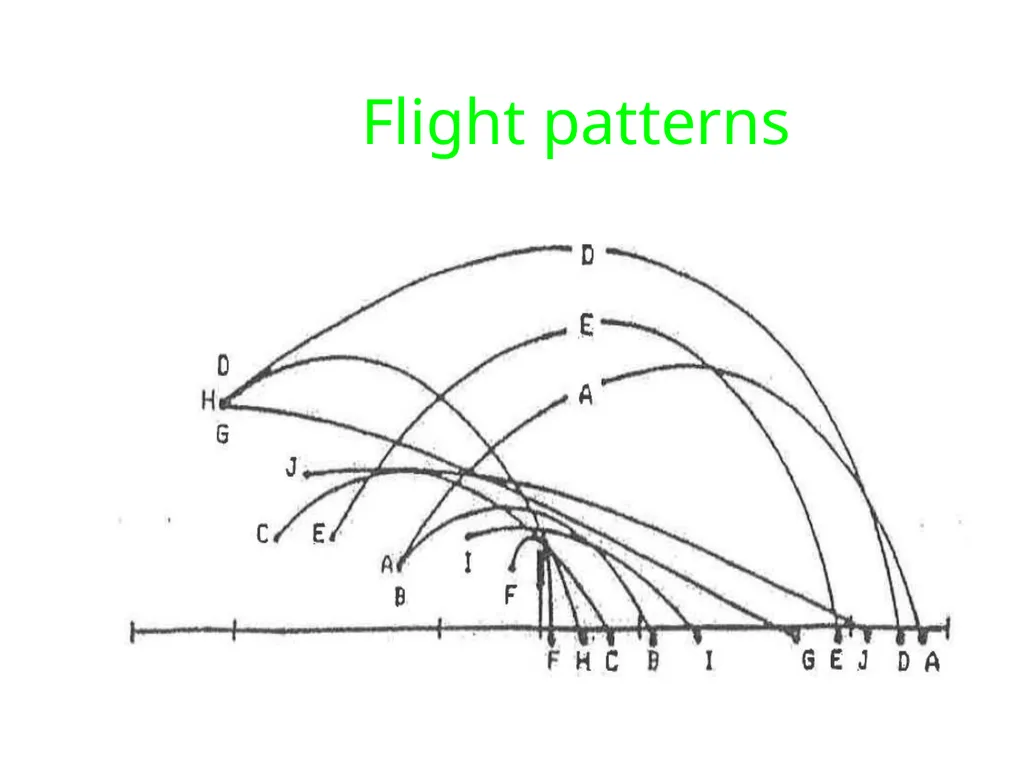
Flight patterns<br>
94
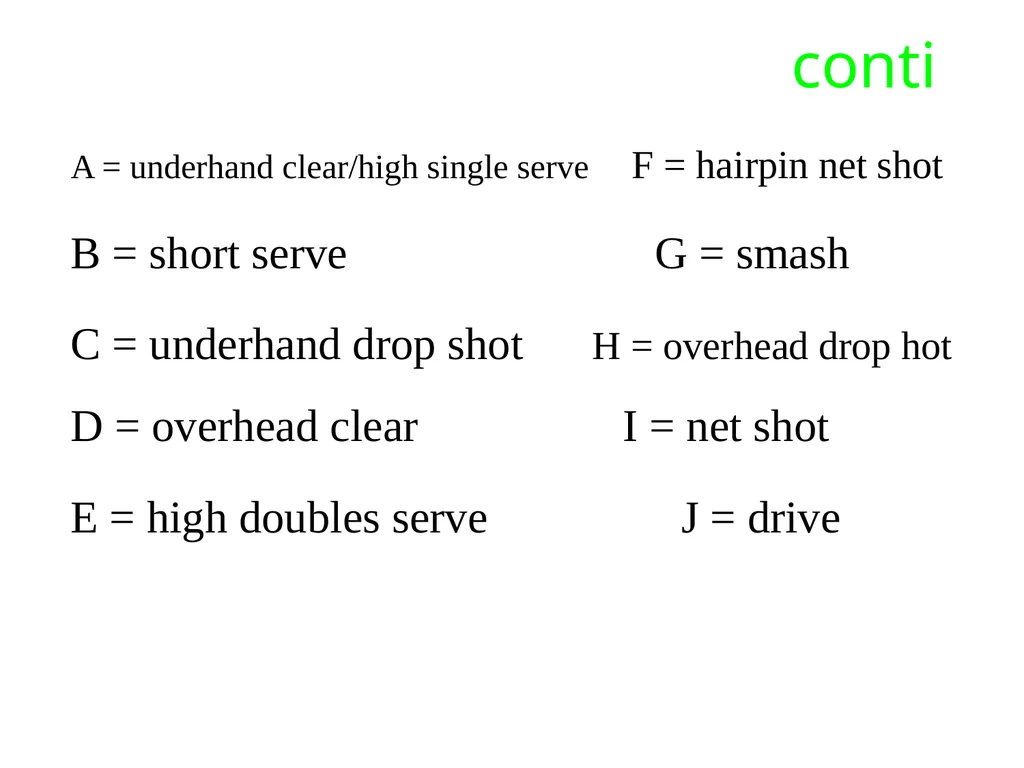
conti A = underhand clear/high single serve F = hairpin net shot
B = short serve G = smash
C = underhand drop shot H = overhead drop hot D = overhead clear I = net shot
E = high doubles serve J = drive<br>
B = short serve G = smash
C = underhand drop shot H = overhead drop hot D = overhead clear I = net shot
E = high doubles serve J = drive<br>
95
Playing Strategy A. Singles – serve long most of the time. Return a high serve with a drop or clear. Build the game plan on a basis of alternate drop and clear shots, and then use the smash/drive as openings occur. Run your opponent from the front to back and from side to side of the court.
B. Doubles – make shots, the return of which will leave an opening for your partner to play a winning shot. Never play a shot that leaves your partner open to smashes. Always make an attacking shot. This implies that all shots should be hit down. Most serves should be short and low. Attack short serves when receiving.<br>
B. Doubles – make shots, the return of which will leave an opening for your partner to play a winning shot. Never play a shot that leaves your partner open to smashes. Always make an attacking shot. This implies that all shots should be hit down. Most serves should be short and low. Attack short serves when receiving.<br>
96
conti 1. Side-by side – each partner is responsible for half of the playing court, net to baseline.
2. Up-and-back – one member plays the front portion of the court, operating from the centre line and just behind the short service line. The partner plays the rear portion of the court from the canter line and just in front of the double rear service line.
3. Up/back rotation – combines the two doubles’ strategies, using the side- by-side position for defence, and up and back formation for attack.<br>
2. Up-and-back – one member plays the front portion of the court, operating from the centre line and just behind the short service line. The partner plays the rear portion of the court from the canter line and just in front of the double rear service line.
3. Up/back rotation – combines the two doubles’ strategies, using the side- by-side position for defence, and up and back formation for attack.<br>
97
Chapter three Basic skills of table Tennis, Tennis and Badminton
Grip
How to Hold the Racket: There are two widely used grips.
Shake hands Grip –
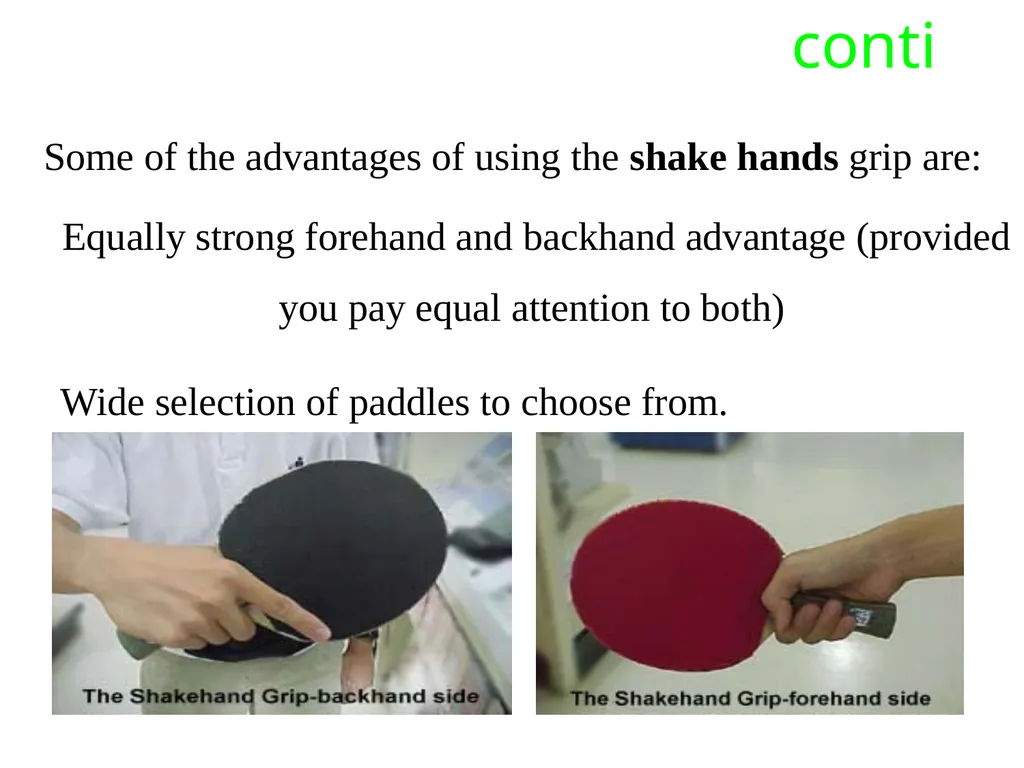
This grip is the prevalent grip in table tennis (as of 1998), used by the majority of recreational and professional players. The paddle is gripped with all fingers, with the thumb resting by itself on the opposite side as the index finger. The grip is analogous to shaking a hand at an approximately 45-degree angle. The pinky, ring, and middle finger wrap around one side of the handle, and the index finger rests on the bottom edge of the rubber. The thumb rests on the top of the handle on the other side, thumbnail perpendicular to the wood. It should point in the same direction as the index finger.<br>
Grip
How to Hold the Racket: There are two widely used grips.
Shake hands Grip –
This grip is the prevalent grip in table tennis (as of 1998), used by the majority of recreational and professional players. The paddle is gripped with all fingers, with the thumb resting by itself on the opposite side as the index finger. The grip is analogous to shaking a hand at an approximately 45-degree angle. The pinky, ring, and middle finger wrap around one side of the handle, and the index finger rests on the bottom edge of the rubber. The thumb rests on the top of the handle on the other side, thumbnail perpendicular to the wood. It should point in the same direction as the index finger.<br>
98
conti When held out straight in front of you, the paddle's edge should form a line with the outstretched arm. The grip should feel natural, with no particularly uncomfortable areas. Too tight a grip can sacrifice control and power. Be sure to grab the handle loosely enough so that another person would have no trouble plucking it from your hand. But at the same time, maintain enough tightness so the paddle won't fly out of your hand during an intense shot.<br>
99
conti Some of the advantages of using the shake hands grip are:
Equally strong forehand and backhand advantage (provided you pay equal attention to both)
Wide selection of paddles to choose from.<br>
Equally strong forehand and backhand advantage (provided you pay equal attention to both)
Wide selection of paddles to choose from.<br>
100
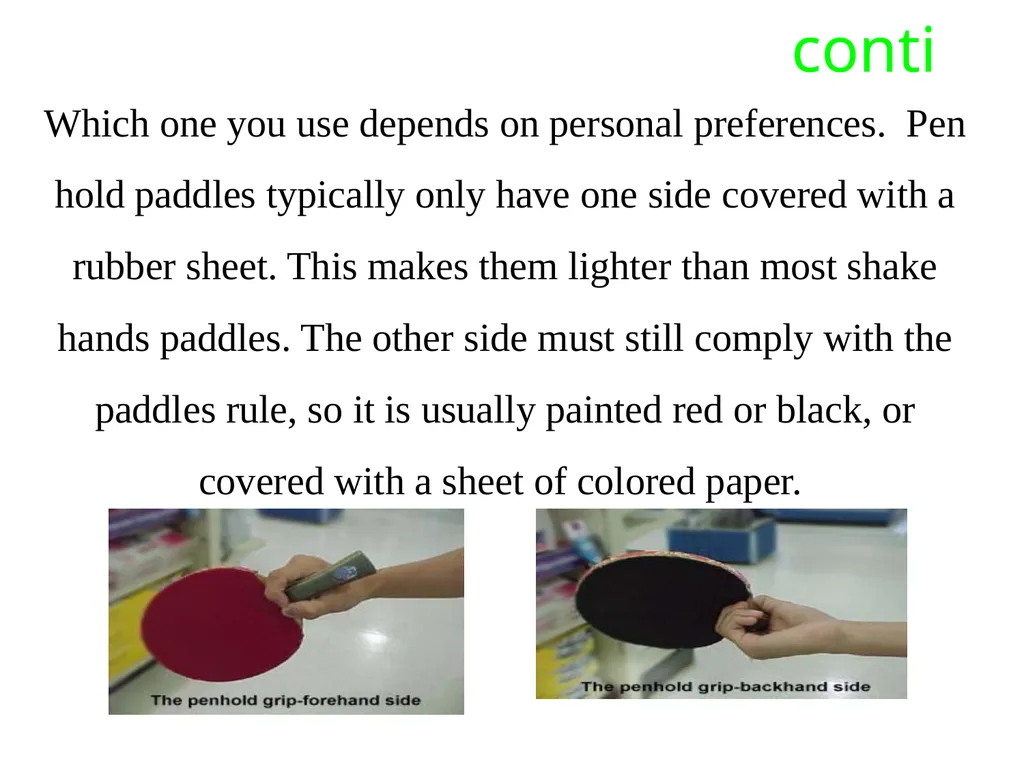
Pen hold Grip Once was the dominant grip in its heyday. The pen hold grip still has its supporters, world class players included. The racket is gripped as one would grip a pen, with the thumb and index finger, with the rest of the fingers being tucked away on the other side. There are several variations to this grip, and two types of paddles to reflect this. The "chinese" paddles are basically shake hands paddles with a shortened handle. The remaining fingers rest against the other side. "Japanese" paddles have a raised handle, which is called a "hook." The index finger curls around the "hook" for extra leverage.<br>
101
conti Which one you use depends on personal preferences. Pen hold paddles typically only have one side covered with a rubber sheet. This makes them lighter than most shake hands paddles. The other side must still comply with the paddles rule, so it is usually painted red or black, or covered with a sheet of colored paper.<br>
102
conti Some of the advantages of using the penhold grip are:
A dominant forehand game(while backhands are possible with this grip, the vast majority of pen hold players rely on their forehand game)-quick feet are required to sustain this!
Since it is not as widely used, an element of surprise against opponents unfamiliar with the grip<br>
A dominant forehand game(while backhands are possible with this grip, the vast majority of pen hold players rely on their forehand game)-quick feet are required to sustain this!
Since it is not as widely used, an element of surprise against opponents unfamiliar with the grip<br>
103
Defensive Shots: Block Shot -- This shot would normally be used when the approaching ball is moving very quickly towards you with heavy topspin and the purpose of this stroke is to catch your opponent out of position and reduce the time available for them to play their next shot. A block is executed by simply placing the racket in front of the ball right after the ball bounces; thus, the ball rebounds back toward the opponent nearly as fast as it came to you. Blocks almost always produce the same spin as was received, usually topspin.<br>
104
conti Push [Chop] Shot -- The push (or "slice" in Asia) is usually used for keeping the point alive and creating offensive opportunities. A push resembles a tennis slice: the racket cuts underneath the ball, imparting backspin and causing the ball to float slowly to the other side of the table.
Lob – A shot where the ball is returned very high in the air and deep on the table. This shot is used to slow down play against high-speed shots.<br>
Lob – A shot where the ball is returned very high in the air and deep on the table. This shot is used to slow down play against high-speed shots.<br>
105
Offensive Shots: Drive Shot-- The primary offensive shot in table tennis that produces light topspin. Executing this stroke the racket is primarily perpendicular to the direction of the stroke creating a shot that does not arc much but is fast enough that it can be difficult to return. A drive is used mostly for keeping the ball in play, applying pressure on the opponent, and potentially opening up an opportunity for a more powerful attack.<br>
106
conti Flick -- Hitting a ball early making contact over the back or top of the ball using a loose wrist action to impart topspin.
Smash [Kill] -- Smashing is self-explanatory—large backswing and rapid acceleration imparting as much speed on the ball as possible. A player will execute a smash when his or her opponent has returned a ball that bounces too high or too close to the net. The goal of a smash is to get the ball to move so quickly that the opponent simply cannot return it. Because the ball speed is the main aim of this shot, often the spin on the ball is something other than topspin. Sidespin can be used effectively with a smash to alter the ball's trajectory significantly.<br>
Smash [Kill] -- Smashing is self-explanatory—large backswing and rapid acceleration imparting as much speed on the ball as possible. A player will execute a smash when his or her opponent has returned a ball that bounces too high or too close to the net. The goal of a smash is to get the ball to move so quickly that the opponent simply cannot return it. Because the ball speed is the main aim of this shot, often the spin on the ball is something other than topspin. Sidespin can be used effectively with a smash to alter the ball's trajectory significantly.<br>
107
Grip tennis A grip is a way of holding the racket in order to hit shots during a match. The grip affects the angle of the racket face when it hits the ball and influences the pace, spin, and placement of the shot. Players use various grips during play, including the Continental (The "Handshake Grip"), Eastern (Can be either semi-eastern or full eastern. Usually used for backhands.), and Western (semi-western or full western, usually for forehand grips) grips. Most players change grips during a match depending on what shot they are hitting; for example, slice shots and serves call for a Continental grip.<br>
108
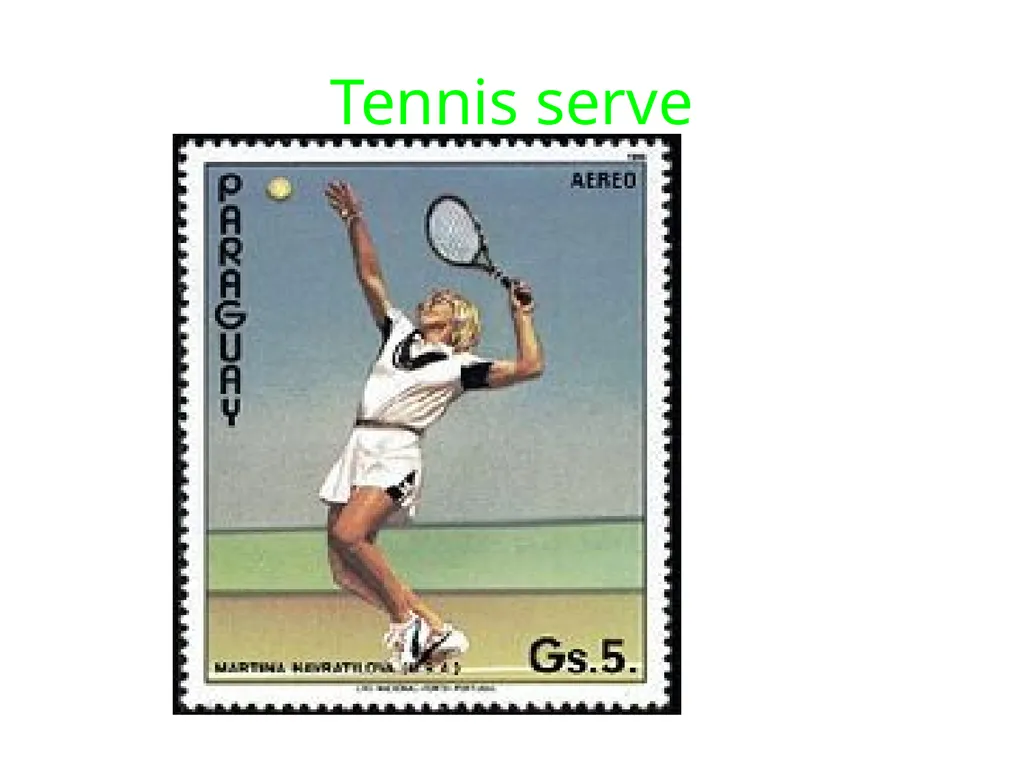
conti A serve (or, more formally, a "service") in tennis is a shot to start a point. The serve is initiated by tossing the ball into the air and hitting it (usually near the apex of its trajectory) into the diagonally opposite service box without touching the net. The serve may be hit under- or overhand although underhand serving remains a rarity. If the ball hits the net on the first serve and bounces over into the correct diagonal box then it is called a "let" and the server gets two more additional serves to get it in. There can also be a let if the server serves the ball and the receiver isn't prepared If the server misses his or her first serve and gets a let on the second serve, then they get one more try to get the serve in the box.<br>
109
Tennis serve<br>
110
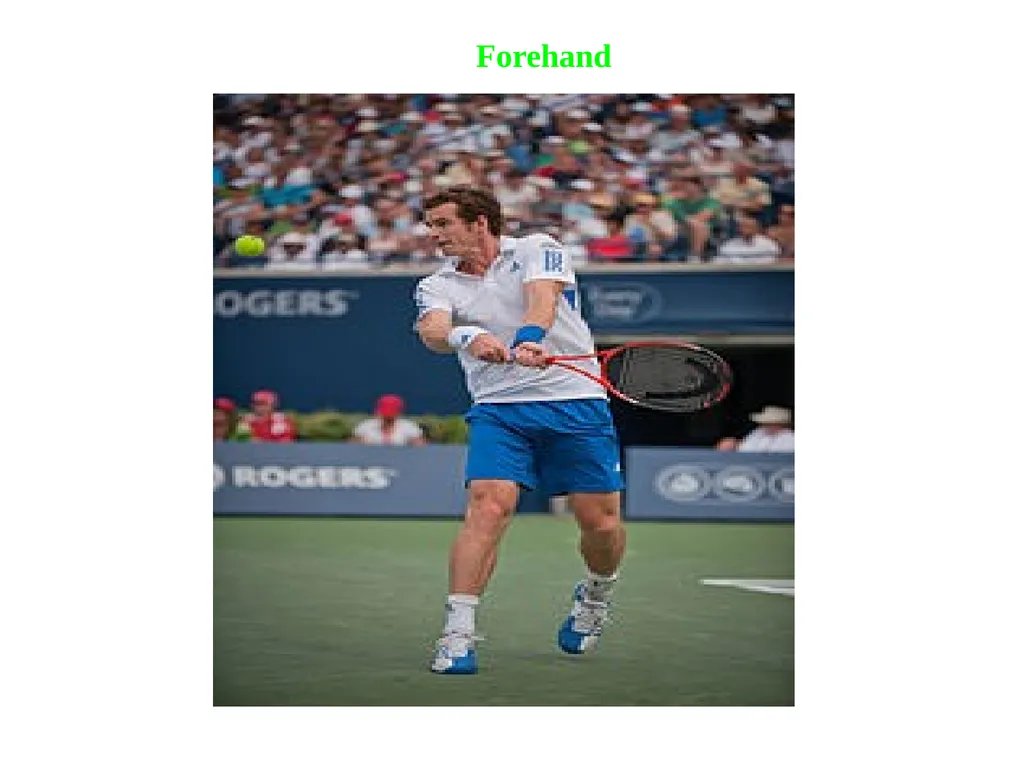
Forehand For a right-handed player, the forehand is a stroke that begins on the right side of the body, continues across the body as contact is made with the ball, and ends on the left side of the body. There are various grips for executing the forehand, and their popularity has fluctuated over the years. The most important ones are the continental, the eastern, the semi-western, and the western.<br>
111
Forehand<br>
112
Other shots A volley is a shot returned to the opponent in mid-air before the ball bounces, generally performed near the net, and is usually made with a stiff-wristed punching motion to hit the ball into an open area of the opponent's court. The half volley is made by hitting the ball on the rise just after it has bounced, also generally in the vicinity of the net, and played with the racket close to the ground. The swinging volley is hit out of the air as the player approaches the net.<br>
113
Grip badminton Grip
The choice of grip allows a player to increase the thickness of their racquet handle and choose a comfortable surface to hold. A player may build up the handle with one or several grips before applying the final layer.
Players may choose between varieties of grip materials. The most common choices are synthetic grips or to welling grips. Grip choice is a matter of personal preference. Players often find that sweat becomes a problem; in this case, a drying agent may be applied to the grip or hands, sweatbands may be used, the player may choose another grip material or change his/her grip more frequently.<br>
The choice of grip allows a player to increase the thickness of their racquet handle and choose a comfortable surface to hold. A player may build up the handle with one or several grips before applying the final layer.
Players may choose between varieties of grip materials. The most common choices are synthetic grips or to welling grips. Grip choice is a matter of personal preference. Players often find that sweat becomes a problem; in this case, a drying agent may be applied to the grip or hands, sweatbands may be used, the player may choose another grip material or change his/her grip more frequently.<br>
114
conti There are two main types of grip: replacement grips and overgrips. Replacement grips are thicker, and are often used to increase the size of the handle. Overgrips are thinner (less than 1 mm), and are often used as the final layer. Many players, however, prefer to use replacement grips as the final layer. Towelling grips are always replacement grips. Replacement grips have an adhesive backing, whereas overgrips have only a small patch of adhesive at the start of the tape and must be applied under tension; overgrips are more convenient for players who change grips frequently, because they may be removed more rapidly without damaging the underlying material.<br>
115
Strokes Badminton offers a wide variety of basic strokes, and players require a high level of skill to perform all of them effectively. All strokes can be played either forehand or backhand. A player's forehand side is the same side as their playing hand: for a right-handed player, the forehand side is their right side and the backhand side is their left side. Forehand strokes are hit with the front of the hand leading (like hitting with the palm), whereas backhand strokes are hit with the back of the hand leading (like hitting with the knuckles). Players frequently play certain strokes on the forehand side with a backhand hitting action, and vice versa.<br>
116
conti In the forecourt and midcourt, most strokes can be played equally effectively on either the forehand or backhand side; but in the rear court, players will attempt to play as many strokes as possible on their forehands, often preferring to play a round-the-head forehand overhead (a forehand "on the backhand side") rather than attempt a backhand overhead. Playing a backhand overhead has two main disadvantages. First, the player must turn their back to their opponents, restricting their view of them and the court. Second, backhand overheads cannot be hit with as much power as forehands: the hitting action is limited by the shoulder joint, which permits a much greater range of movement for a forehand overhead than for a backhand.<br>
117
conti The backhand clear is considered by most players and coaches to be the most difficult basic stroke in the game, since precise technique is needed in order to muster enough power for the shuttlecock to travel the full length of the court. For the same reason, backhand smashes tend to be weak.
The choice of stroke depends on how near the shuttlecock is to the net, whether it is above net height, and where an opponent is currently positioned: players have much better attacking options if they can reach the shuttlecock well above net height, especially if it is also close to the net. In the forecourt, a high shuttlecock will be met with a net kill, hitting it steeply downwards and attempting to win the rally immediately. This is why it is best to drop the shuttlecock just over the net in this situation.<br>
The choice of stroke depends on how near the shuttlecock is to the net, whether it is above net height, and where an opponent is currently positioned: players have much better attacking options if they can reach the shuttlecock well above net height, especially if it is also close to the net. In the forecourt, a high shuttlecock will be met with a net kill, hitting it steeply downwards and attempting to win the rally immediately. This is why it is best to drop the shuttlecock just over the net in this situation.<br>
118
conti In the midcourt, a high shuttlecock will usually be met with a powerful smash, also hitting downwards and hoping for an outright winner or a weak reply. Athletic jump smashes, where players jump upwards for a steeper smash angle, are a common and spectacular element of elite men's doubles play. In the rearcourt, players strive to hit the shuttlecock while it is still above them, rather than allowing it to drop lower. This overhead hitting allows them to play smashes, clears (hitting the shuttlecock high and to the back of the opponents' court), and drop shots (hitting the shuttlecock softly so that it falls sharply downwards into the opponents' forecourt). If the shuttlecock has dropped lower, then a smash is impossible and a full-length, high clear is difficult<br>