Chapter One :Introduction Computational
Description: Chapter One :Introduction Computational Intelligence Alyaa Jaber Jalil Syllabus Development of system intelligent( Concepts , models , algorithms and tools). Artificial Neural Networks. Genetic Algorithms. Fuzzy Systems. Swarm intelligence.
Related Topics
Download Presentation
"Chapter One :Introduction Computational" is the property of its rightful owner. Permission is granted to download and print the materials on this website for personal, non-commercial use only, and to display it on your personal computer provided you do not modify the materials and that you retain all copyright notices contained in the materials. By downloading content from our website, you accept the terms of this agreement.
Presentation Transcript
slide1. Chapter One :Introduction Computational Intelligence Alyaa Jaber Jalil<br>
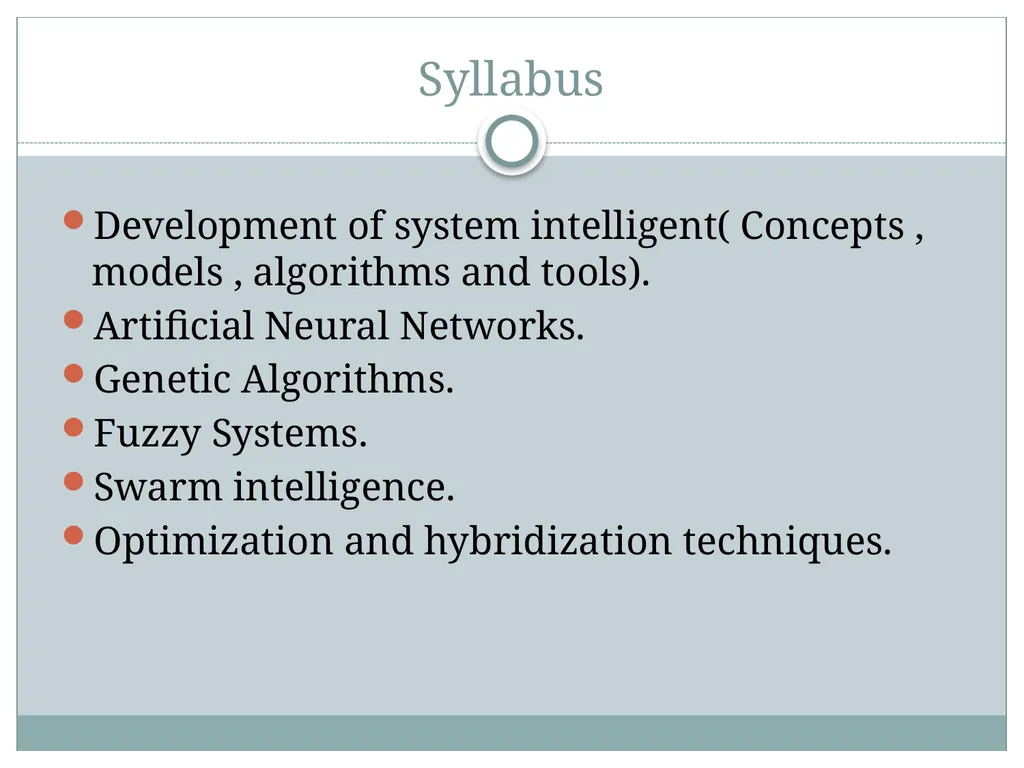
slide2. Syllabus Development of system intelligent( Concepts , models , algorithms and tools).
Artificial Neural Networks.
Genetic Algorithms.
Fuzzy Systems.
Swarm intelligence.
Optimization and hybridization techniques.<br>
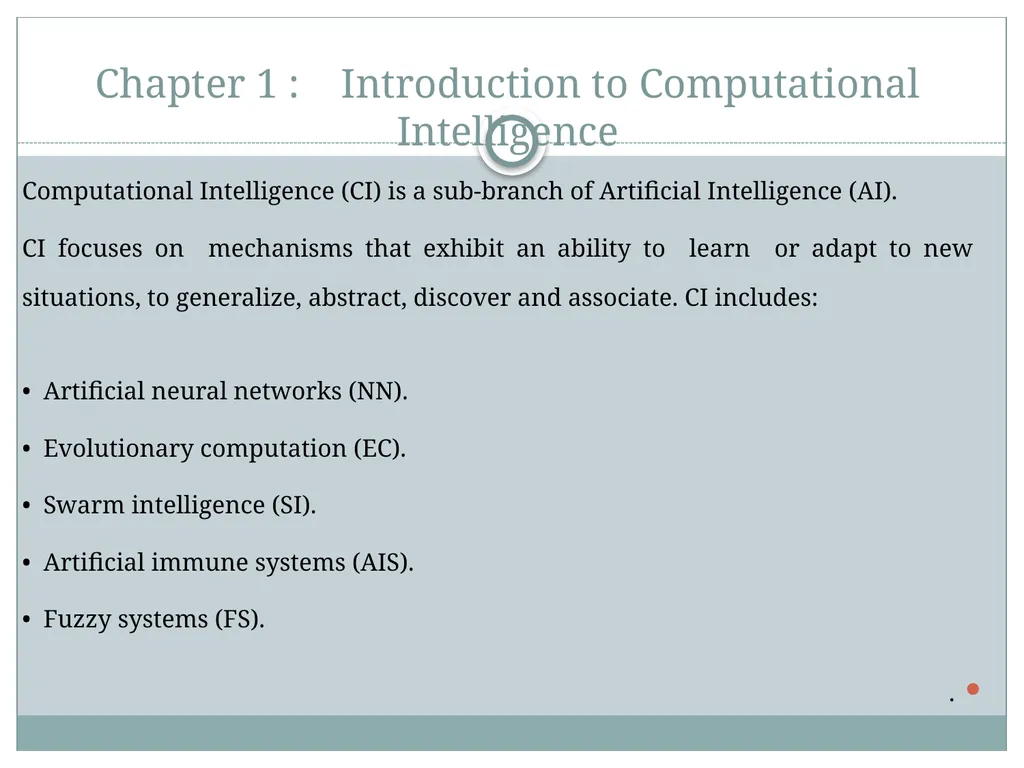
slide3. Chapter 1 : Introduction to Computational Intelligence Computational Intelligence (CI) is a sub-branch of Artificial Intelligence (AI).
CI focuses on mechanisms that exhibit an ability to learn or adapt to new situations, to generalize, abstract, discover and associate. CI includes:
• Artificial neural networks (NN).
• Evolutionary computation (EC).
• Swarm intelligence (SI).
• Artificial immune systems (AIS).
• Fuzzy systems (FS).
.<br>
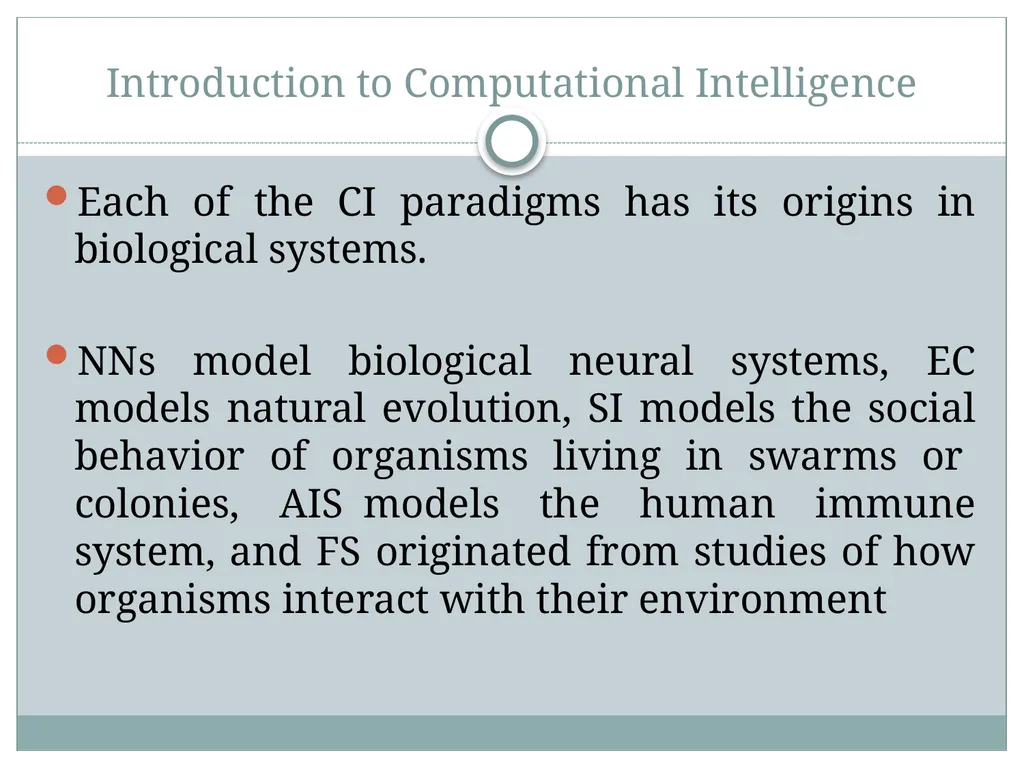
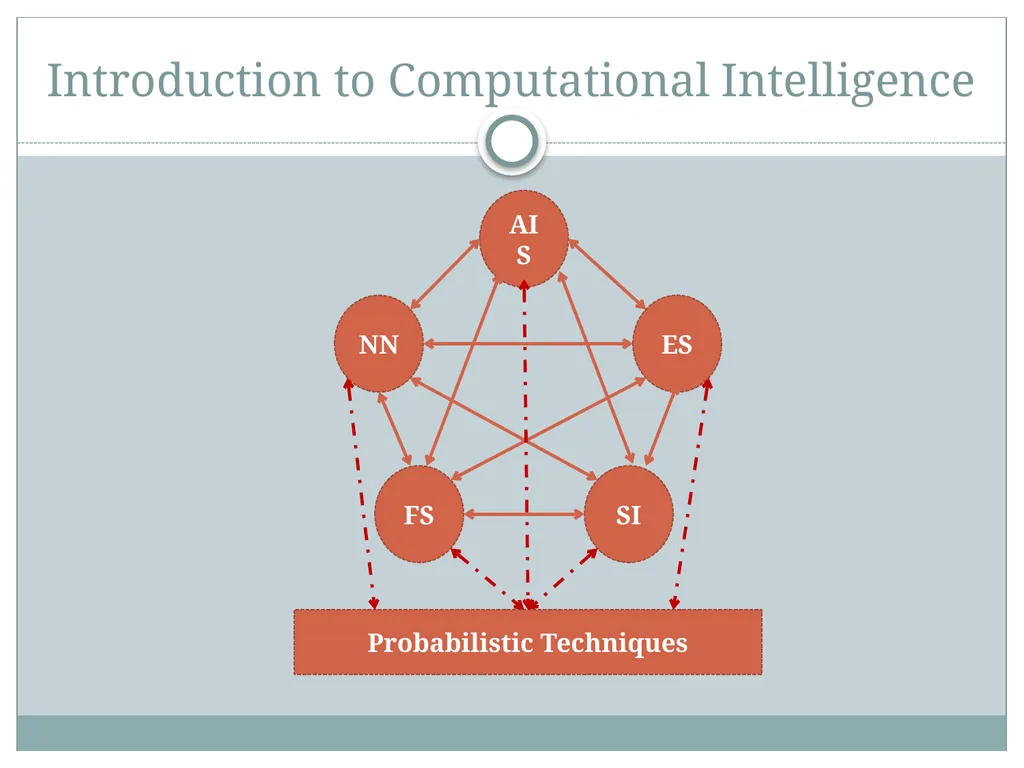
slide4. Introduction to Computational Intelligence Each of the CI paradigms has its origins in biological systems.
NNs model biological neural systems, EC models natural evolution, SI models the social behavior of organisms living in swarms or colonies, AIS models the human immune system, and FS originated from studies of how organisms interact with their environment<br>
slide5. Introduction to Computational Intelligence AIS SI FS ES NN Probabilistic Techniques<br>
slide6. Artificial Neural Networks Artificial neural networks, refer to the mathematical models of human brain functions such as: perception, computation and memory.
The basic building blocks of biological neural systems are: nerve cells, referred to as neurons.
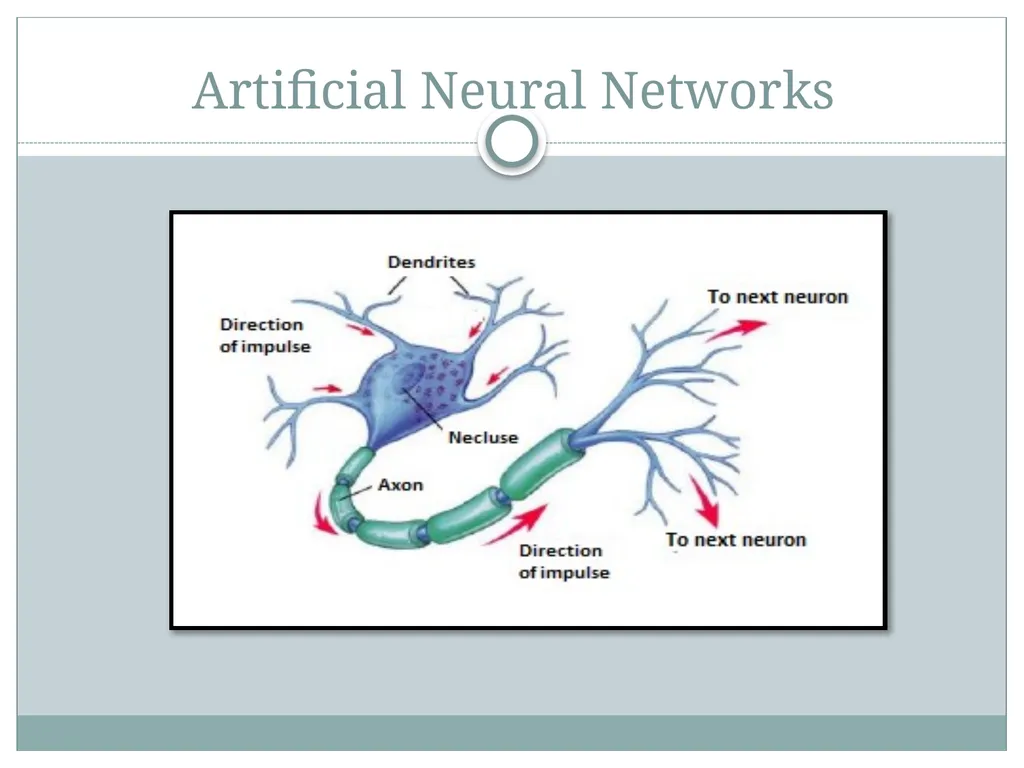
A neuron consists of a cell body, dendrites and an axon.<br>
slide7. Artificial Neural Networks Neurons are interconnected, where an interconnection is between the axon of one neuron and a dendrite of another neuron. This connection is referred to as a synapse.
Signals propagate from the dendrites, through the cell body to the axon.
A signal is transmitted to the axon of a neuron only when the cell “fires”. A neuron can either inhibit or excite a signal.<br>
slide8. Artificial Neural Networks<br>
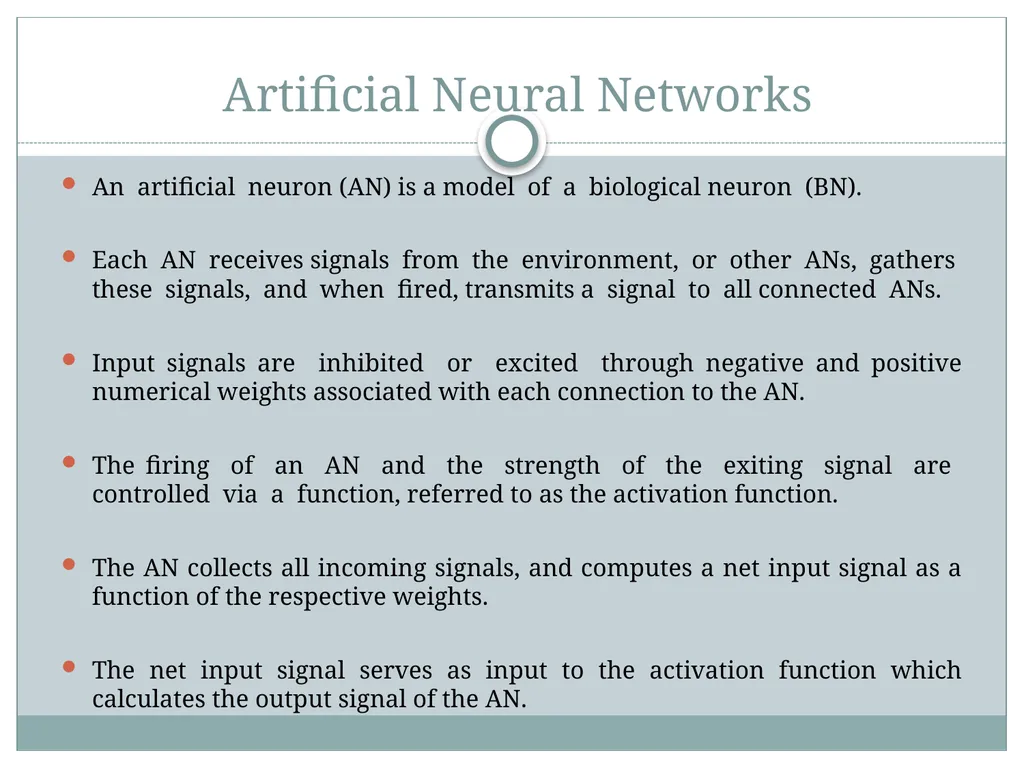
slide9. Artificial Neural Networks An artificial neuron (AN) is a model of a biological neuron (BN).
Each AN receives signals from the environment, or other ANs, gathers these signals, and when fired, transmits a signal to all connected ANs.
Input signals are inhibited or excited through negative and positive numerical weights associated with each connection to the AN.
The firing of an AN and the strength of the exiting signal are controlled via a function, referred to as the activation function.
The AN collects all incoming signals, and computes a net input signal as a function of the respective weights.
The net input signal serves as input to the activation function which calculates the output signal of the AN.<br>
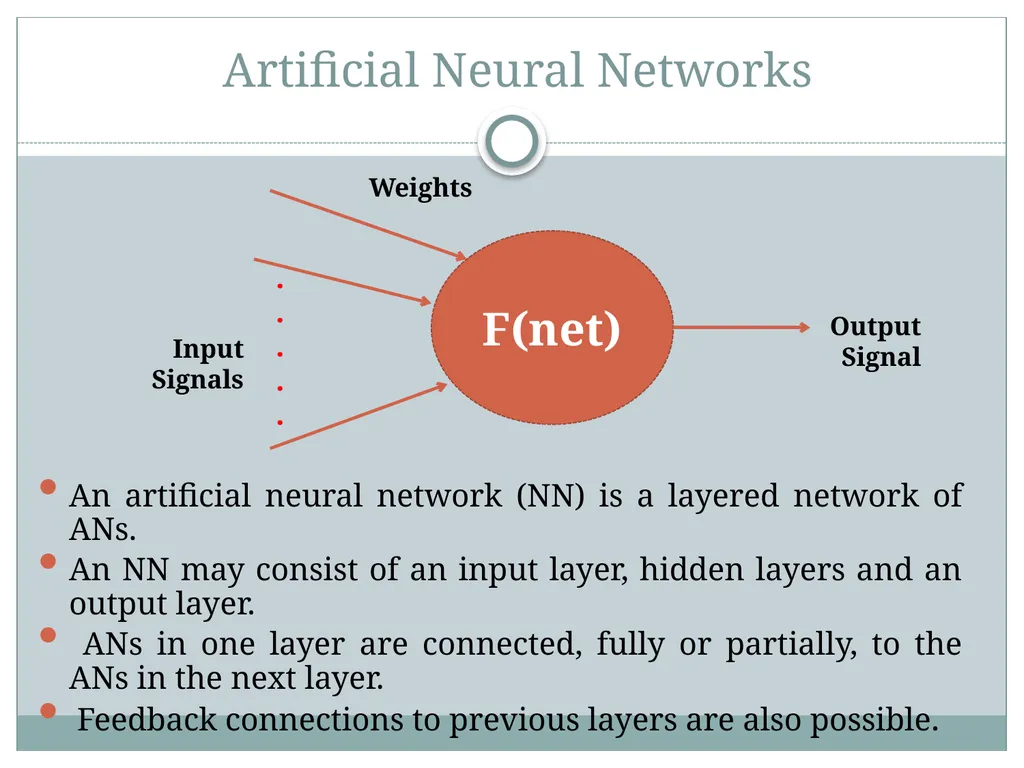
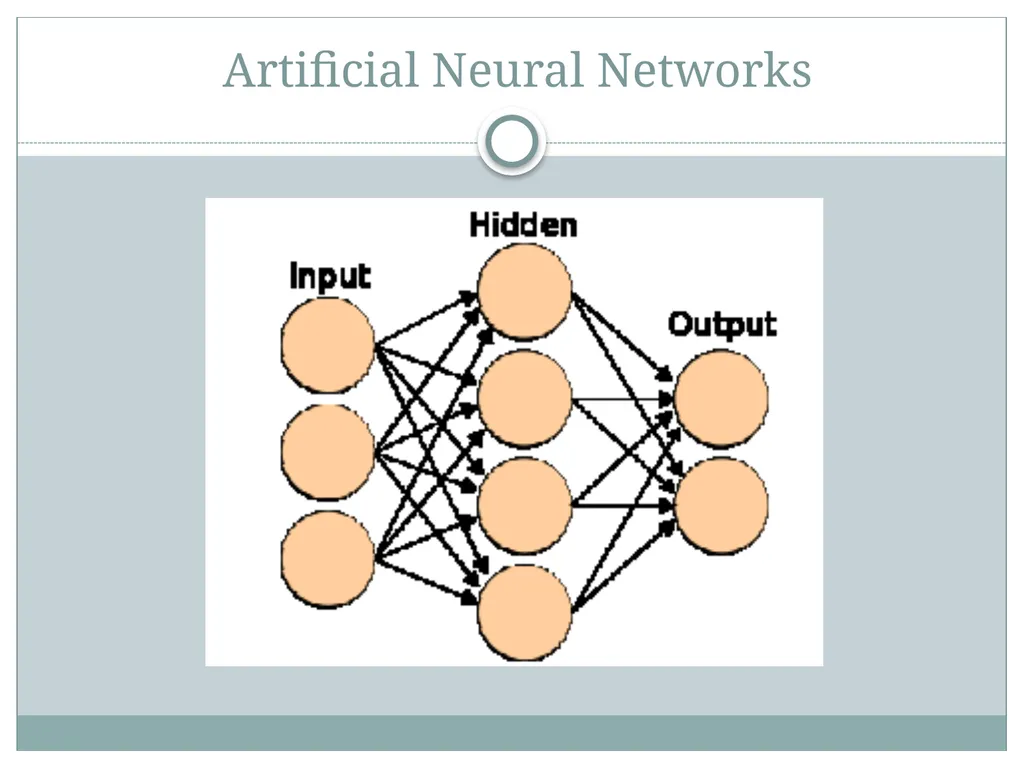
slide10. Artificial Neural Networks An artificial neural network (NN) is a layered network of ANs.
An NN may consist of an input layer, hidden layers and an output layer.
ANs in one layer are connected, fully or partially, to the ANs in the next layer.
Feedback connections to previous layers are also possible. F(net) .
.
.
.
. Weights Input Signals Output Signal<br>
slide11. Artificial Neural Networks<br>
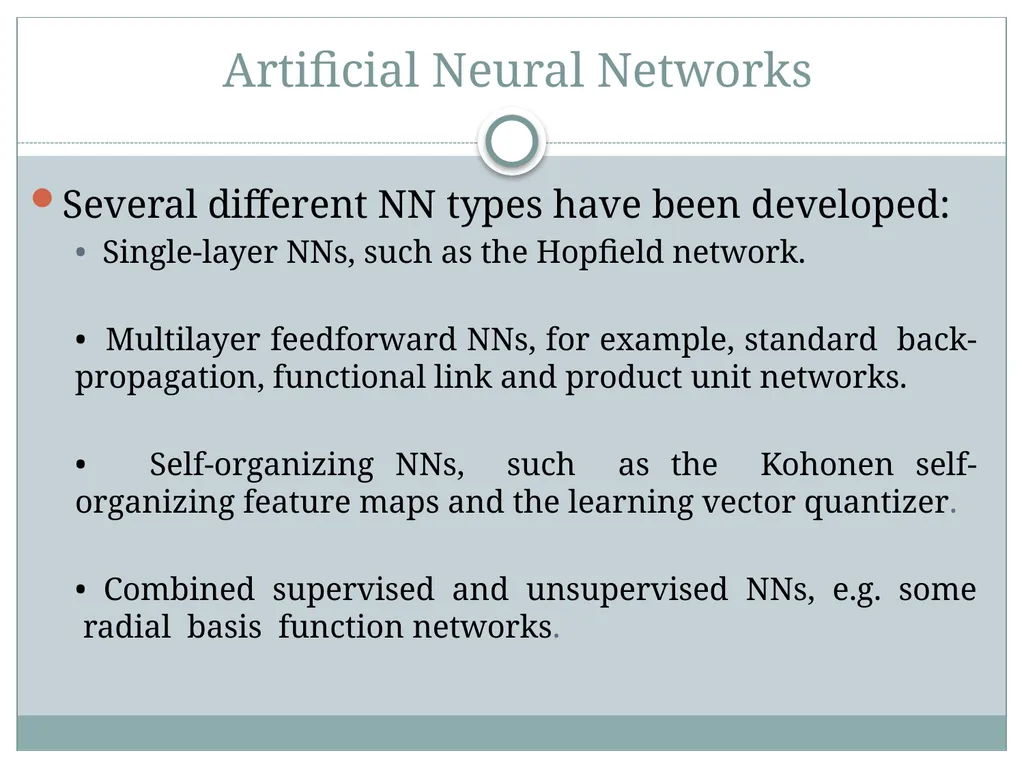
slide12. Artificial Neural Networks Several different NN types have been developed:
• Single-layer NNs, such as the Hopfield network.
• Multilayer feedforward NNs, for example, standard back-propagation, functional link and product unit networks.
• Self-organizing NNs, such as the Kohonen self-organizing feature maps and the learning vector quantizer.
• Combined supervised and unsupervised NNs, e.g. some radial basis function networks.<br>
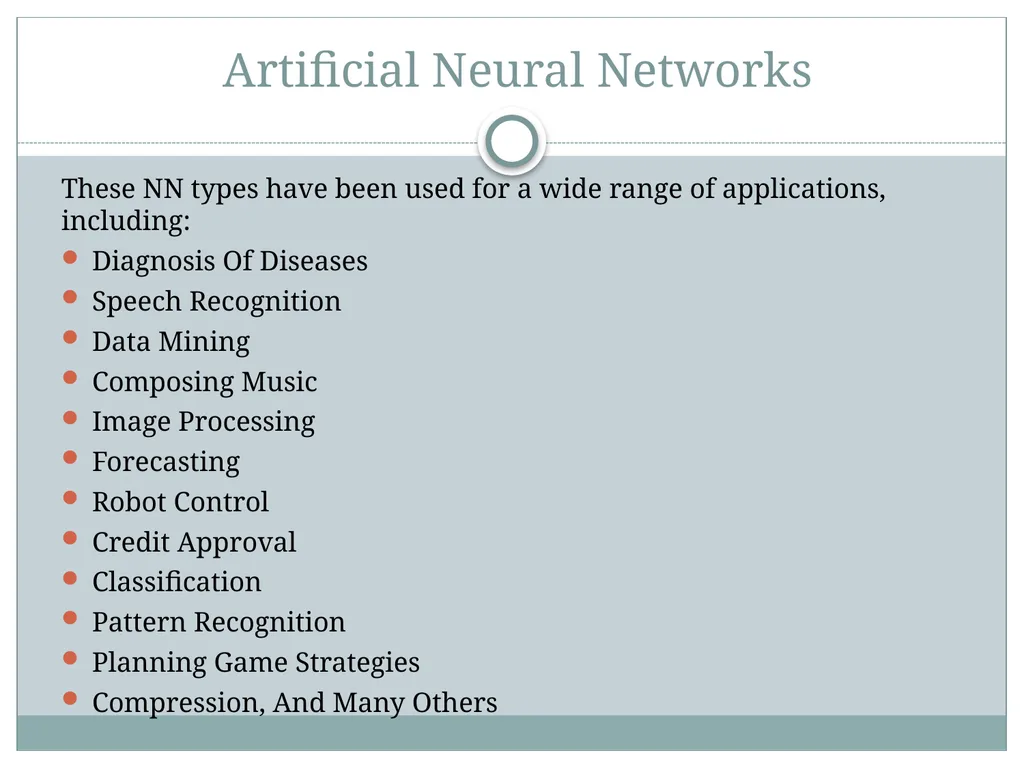
slide13. Artificial Neural Networks These NN types have been used for a wide range of applications, including:
Diagnosis Of Diseases
Speech Recognition
Data Mining
Composing Music
Image Processing
Forecasting
Robot Control
Credit Approval
Classification
Pattern Recognition
Planning Game Strategies
Compression, And Many Others<br>
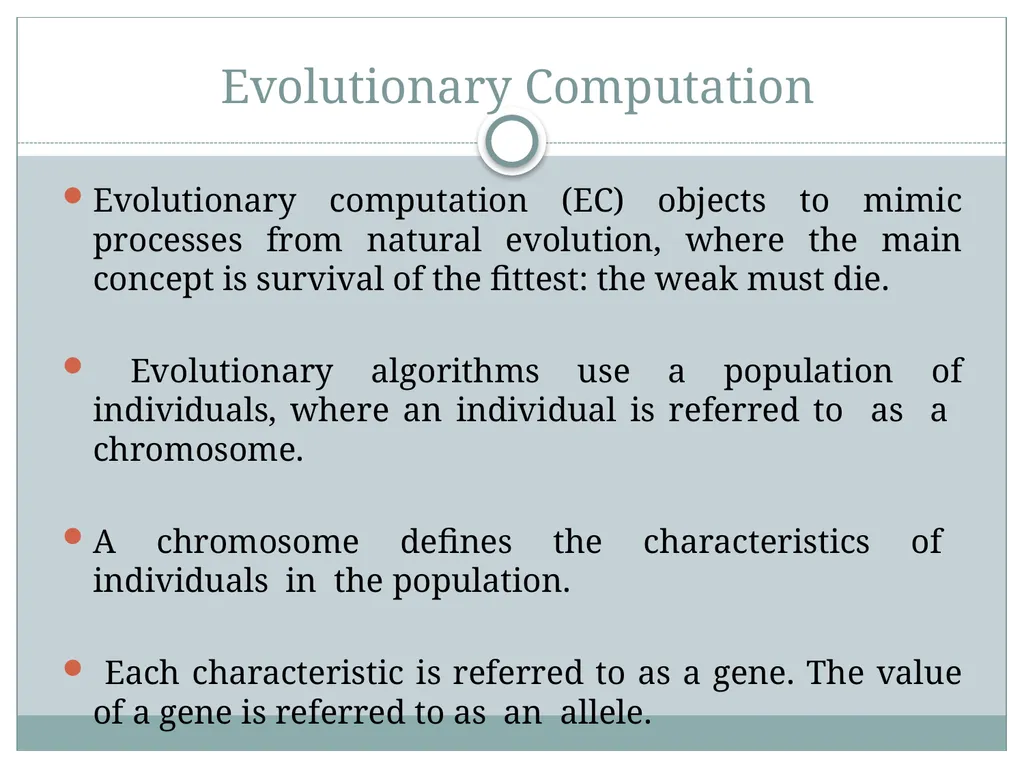
slide14. Evolutionary Computation Evolutionary computation (EC) objects to mimic processes from natural evolution, where the main concept is survival of the fittest: the weak must die.
Evolutionary algorithms use a population of individuals, where an individual is referred to as a chromosome.
A chromosome defines the characteristics of individuals in the population.
Each characteristic is referred to as a gene. The value of a gene is referred to as an allele.<br>
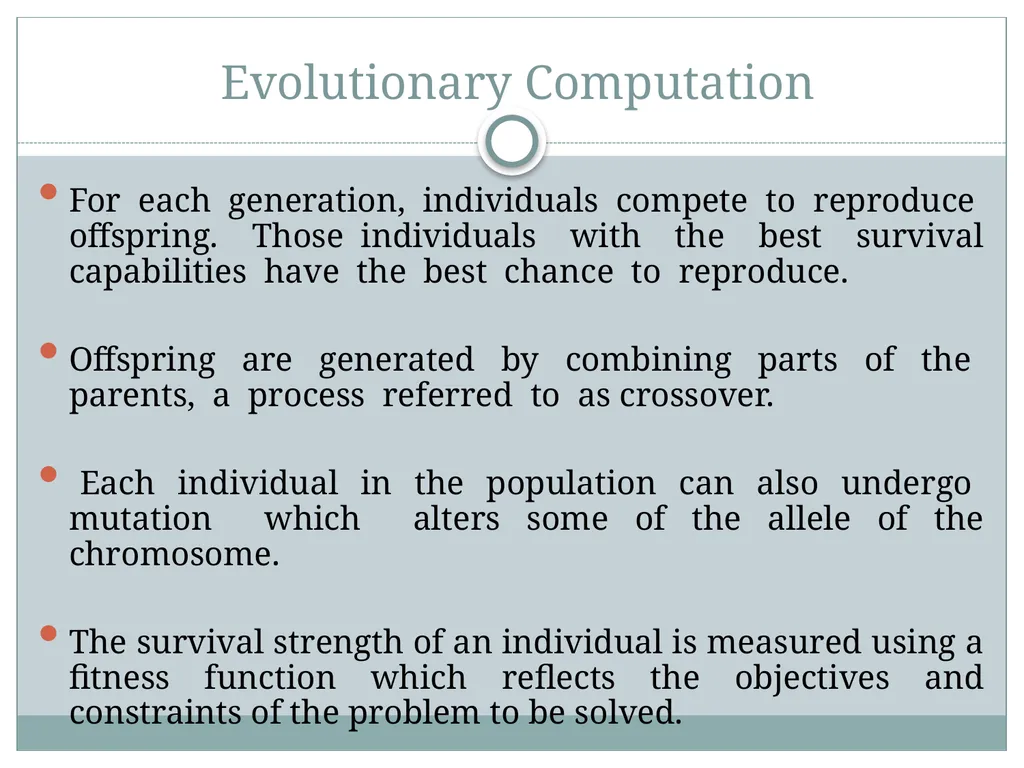
slide15. Evolutionary Computation For each generation, individuals compete to reproduce offspring. Those individuals with the best survival capabilities have the best chance to reproduce.
Offspring are generated by combining parts of the parents, a process referred to as crossover.
Each individual in the population can also undergo mutation which alters some of the allele of the chromosome.
The survival strength of an individual is measured using a fitness function which reflects the objectives and constraints of the problem to be solved.<br>
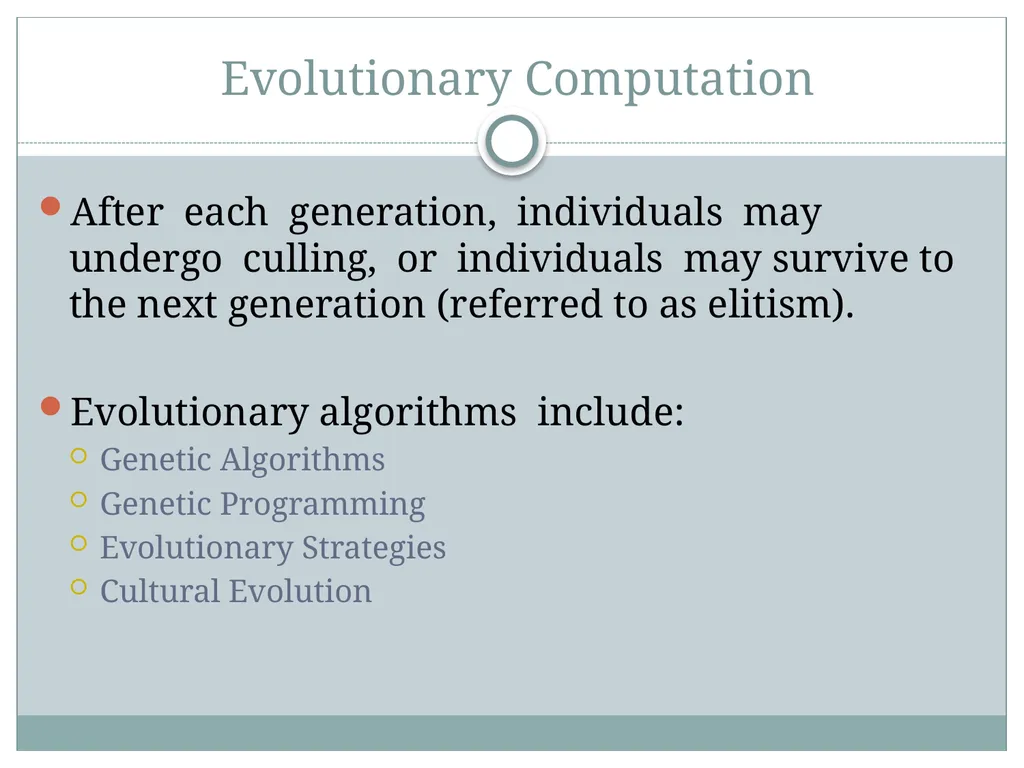
slide16. Evolutionary Computation After each generation, individuals may undergo culling, or individuals may survive to the next generation (referred to as elitism).
Evolutionary algorithms include:
Genetic Algorithms
Genetic Programming
Evolutionary Strategies
Cultural Evolution<br>
slide17. Swarm intelligence Swarm intelligence (SI) originated from the study of colonies, or swarms of social organisms.
Particle swarm optimization (PSO) is a population-based search procedure where the individuals, referred to as particles, are grouped into a swarm.
Each particle in the swarm represents a candidate solution to the optimization problem. In a PSO system, each particle is “flown” through the multidimensional search space, adjusting its position in search space according to its own experience and that of neighboring particles.<br>
slide18. Swarm intelligence A particle therefore makes use of the best position encountered by itself and the best position of its neighbors to position itself toward an optimum solution.
The performance of each particle is measured according to a predefined fitness function which is related to the problem being solved.
Applications of PSO include:
Function Approximation
Clustering
Optimization Of Mechanical Structures
Solving Systems Of Equations.<br>
slide19. Fuzzy Systems Traditional set theory requires elements to be either part of a set or not.
Human reasoning is, however, almost always not this exact. Our observations and reasoning usually include a measure of uncertainty. For example, humans are capable of understanding the sentence: “Some Computer Science students can program in most languages”.
But how can a computer represent and reason with this fact?<br>
slide20. Fuzzy Systems Fuzzy sets and fuzzy logic allow what is referred to as approximate reasoning. With fuzzy sets, an element belongs to a set to a certain degree of certainty.
Fuzzy logic allows reasoning with these uncertain facts to infer new facts, with a degree of certainty associated with each fact.
Fuzzy systems have been applied successfully to control systems, gear transmission and braking systems in vehicles, controlling lifts, home appliances, controlling traffic signals, and many others.<br>

slide22. Any Question??<br>
slide2. Syllabus Development of system intelligent( Concepts , models , algorithms and tools).
Artificial Neural Networks.
Genetic Algorithms.
Fuzzy Systems.
Swarm intelligence.
Optimization and hybridization techniques.<br>
slide3. Chapter 1 : Introduction to Computational Intelligence Computational Intelligence (CI) is a sub-branch of Artificial Intelligence (AI).
CI focuses on mechanisms that exhibit an ability to learn or adapt to new situations, to generalize, abstract, discover and associate. CI includes:
• Artificial neural networks (NN).
• Evolutionary computation (EC).
• Swarm intelligence (SI).
• Artificial immune systems (AIS).
• Fuzzy systems (FS).
.<br>
slide4. Introduction to Computational Intelligence Each of the CI paradigms has its origins in biological systems.
NNs model biological neural systems, EC models natural evolution, SI models the social behavior of organisms living in swarms or colonies, AIS models the human immune system, and FS originated from studies of how organisms interact with their environment<br>
slide5. Introduction to Computational Intelligence AIS SI FS ES NN Probabilistic Techniques<br>
slide6. Artificial Neural Networks Artificial neural networks, refer to the mathematical models of human brain functions such as: perception, computation and memory.
The basic building blocks of biological neural systems are: nerve cells, referred to as neurons.
A neuron consists of a cell body, dendrites and an axon.<br>
slide7. Artificial Neural Networks Neurons are interconnected, where an interconnection is between the axon of one neuron and a dendrite of another neuron. This connection is referred to as a synapse.
Signals propagate from the dendrites, through the cell body to the axon.
A signal is transmitted to the axon of a neuron only when the cell “fires”. A neuron can either inhibit or excite a signal.<br>
slide8. Artificial Neural Networks<br>
slide9. Artificial Neural Networks An artificial neuron (AN) is a model of a biological neuron (BN).
Each AN receives signals from the environment, or other ANs, gathers these signals, and when fired, transmits a signal to all connected ANs.
Input signals are inhibited or excited through negative and positive numerical weights associated with each connection to the AN.
The firing of an AN and the strength of the exiting signal are controlled via a function, referred to as the activation function.
The AN collects all incoming signals, and computes a net input signal as a function of the respective weights.
The net input signal serves as input to the activation function which calculates the output signal of the AN.<br>
slide10. Artificial Neural Networks An artificial neural network (NN) is a layered network of ANs.
An NN may consist of an input layer, hidden layers and an output layer.
ANs in one layer are connected, fully or partially, to the ANs in the next layer.
Feedback connections to previous layers are also possible. F(net) .
.
.
.
. Weights Input Signals Output Signal<br>
slide11. Artificial Neural Networks<br>
slide12. Artificial Neural Networks Several different NN types have been developed:
• Single-layer NNs, such as the Hopfield network.
• Multilayer feedforward NNs, for example, standard back-propagation, functional link and product unit networks.
• Self-organizing NNs, such as the Kohonen self-organizing feature maps and the learning vector quantizer.
• Combined supervised and unsupervised NNs, e.g. some radial basis function networks.<br>
slide13. Artificial Neural Networks These NN types have been used for a wide range of applications, including:
Diagnosis Of Diseases
Speech Recognition
Data Mining
Composing Music
Image Processing
Forecasting
Robot Control
Credit Approval
Classification
Pattern Recognition
Planning Game Strategies
Compression, And Many Others<br>
slide14. Evolutionary Computation Evolutionary computation (EC) objects to mimic processes from natural evolution, where the main concept is survival of the fittest: the weak must die.
Evolutionary algorithms use a population of individuals, where an individual is referred to as a chromosome.
A chromosome defines the characteristics of individuals in the population.
Each characteristic is referred to as a gene. The value of a gene is referred to as an allele.<br>
slide15. Evolutionary Computation For each generation, individuals compete to reproduce offspring. Those individuals with the best survival capabilities have the best chance to reproduce.
Offspring are generated by combining parts of the parents, a process referred to as crossover.
Each individual in the population can also undergo mutation which alters some of the allele of the chromosome.
The survival strength of an individual is measured using a fitness function which reflects the objectives and constraints of the problem to be solved.<br>
slide16. Evolutionary Computation After each generation, individuals may undergo culling, or individuals may survive to the next generation (referred to as elitism).
Evolutionary algorithms include:
Genetic Algorithms
Genetic Programming
Evolutionary Strategies
Cultural Evolution<br>
slide17. Swarm intelligence Swarm intelligence (SI) originated from the study of colonies, or swarms of social organisms.
Particle swarm optimization (PSO) is a population-based search procedure where the individuals, referred to as particles, are grouped into a swarm.
Each particle in the swarm represents a candidate solution to the optimization problem. In a PSO system, each particle is “flown” through the multidimensional search space, adjusting its position in search space according to its own experience and that of neighboring particles.<br>
slide18. Swarm intelligence A particle therefore makes use of the best position encountered by itself and the best position of its neighbors to position itself toward an optimum solution.
The performance of each particle is measured according to a predefined fitness function which is related to the problem being solved.
Applications of PSO include:
Function Approximation
Clustering
Optimization Of Mechanical Structures
Solving Systems Of Equations.<br>
slide19. Fuzzy Systems Traditional set theory requires elements to be either part of a set or not.
Human reasoning is, however, almost always not this exact. Our observations and reasoning usually include a measure of uncertainty. For example, humans are capable of understanding the sentence: “Some Computer Science students can program in most languages”.
But how can a computer represent and reason with this fact?<br>
slide20. Fuzzy Systems Fuzzy sets and fuzzy logic allow what is referred to as approximate reasoning. With fuzzy sets, an element belongs to a set to a certain degree of certainty.
Fuzzy logic allows reasoning with these uncertain facts to infer new facts, with a degree of certainty associated with each fact.
Fuzzy systems have been applied successfully to control systems, gear transmission and braking systems in vehicles, controlling lifts, home appliances, controlling traffic signals, and many others.<br>
slide22. Any Question??<br>