CHARGE OF THE LIGHT BRIGADE ALFRED LORD TENNYSON
Description: CHARGE OF THE LIGHT BRIGADE ALFRED LORD TENNYSON TODAY WE ARE LEARNING TO analyse and interpret ALFRED LORD TENNYSONS poem CHARGE OF THE LIGHT BRIGADE Born on August 6, 1809, in Somersby, Lincolnshire, England, Alfred Tennyson is one
Related Topics
Download Presentation
"CHARGE OF THE LIGHT BRIGADE ALFRED LORD TENNYSON" is the property of its rightful owner. Permission is granted to download and print the materials on this website for personal, non-commercial use only, and to display it on your personal computer provided you do not modify the materials and that you retain all copyright notices contained in the materials. By downloading content from our website, you accept the terms of this agreement.
Presentation Transcript
slide1. CHARGE OF THE LIGHT BRIGADE ALFRED LORD TENNYSON<br>
slide2. TODAY WE ARE LEARNING TO … analyse and interpret ALFRED LORD TENNYSON’S poem ‘CHARGE OF THE LIGHT BRIGADE’<br>
slide3. Born on August 6, 1809, in Somersby, Lincolnshire, England, Alfred Tennyson is one of the most well-loved Victorian poets. Tennyson, the fourth of twelve children, showed an early talent for writing. At the age of twelve he wrote a 6,000-line epic poem.
In 1830, Tennyson published Poems, Chiefly Lyrical and in 1832 he published a second volume entitled simply Poems. Some reviewers condemned these books as “affected” and “obscure.” Tennyson, stung by the reviews, would not publish another book for nine years. In 1842, however, Tennyson’s Poems in two volumes was a tremendous critical and popular success. In 1850, with the publication of In Memoriam, Tennyson became one of Britain’s most popular poets. He was selected Poet Laureate in succession to Wordsworth.
At the age of 41, Tennyson had established himself as the most popular poet of the Victorian era. The money from his poetry (at times exceeding 10,000 pounds per year) allowed him to purchase a house in the country and to write in relative seclusion. In 1884, he accepted a peerage, becoming Alfred Lord Tennyson. Tennyson died on October 6, 1892, and was buried in Westminster Abbey.<br>
slide4. What do you think is happening here? Who is involved? When and where do you think this event took place? Why?<br>
slide5. The fall of Sebastopol Relevant contextual details: the Crimean War 1853-1856. This image shows French and Russian soldiers engaged in hand-to-hand combat at the Malakoff tower. In the Victorian era in which this war took place, it was commonly held that it is sweet and fitting to die for your country. What attitude to this idea does this picture suggest? How is this attitude suggested?<br>
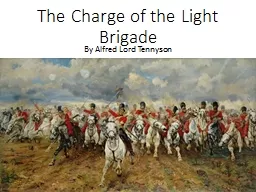
slide6. Background to the poem The doomed Charge of the Light Brigade took place on 25th October 1854 during the Battle of Balaclava in the Crimean War. About 600 lightly armed cavalry troops charged bravely to their death against 25,000 Russians because of a mistake of their commanders. Only 195 came back.
William Howard Russell was a journalist on The Times and one the earliest examples of an ‘embedded’ reporter. He despatched an article published in the second edition of The Times on 13th November, 1854 and then again the following day.
Alfred Tennyson read the report, saw the line ‘Someone had blundered,’ and was inspired to write the poem straight away. It was changed about twenty times and published in The Examiner on Saturday 9th December, 1854.
Alfred Tennyson was the Poet Laureate and so was meant to write about nationally significant events. It is interesting that he wrote a poem suggesting criticism of military leadership. The poem was published first in a national periodical, The Examiner, then in a book and then in single sheets. Many variants are held in the Tennyson Research Centre.<br>
slide7. Crimean war Watch documentary about Crimean war https://www.youtube.com/watch?v=oQIr39lN7iU
Battle of alma from movie
https://www.youtube.com/watch?v=ipdjwuSQcfE<br>
slide8. The Times/1854/News/The Charge of the Light Brigade 1/3 This November 14, 1854 dispatch in the London Times, written by William Howard Russell from the front of the Crimean War, later led Alfred Tennyson to compose the famous poem of the same name, The Charge of the Light Brigade.
HEIGHTS BEFORE SEBASTOPOL, OCTOBER 25 -- If the exhibition of the most brilliant valour, of the excess of courage, and of a daring which would have reflected luster on the best days of chivalry can afford full consolation for the disaster of today, we can have no reason to regret the melancholy loss which we sustained in a contest with a savage and barbarian enemy.
I shall proceed to describe, to the best of my power, what occurred under my own eyes, and to state the facts which I have heard from men whose veracity is unimpeachible, reserving to myself the right of private judgement in making public and in surpressing the details of what occurred on this memorable day...
[After losing ground to a British force half its size, the Russians retreated to the heights above Sebastopol, a port town on the Black sea] .
At 11:00 our Light Cavalry Brigade rushed to the front... The Russians opened on them with guns from the redoubts on the right, with volleys of musketry and rifles.<br>
slide9. The Times/1854/News/The Charge of the Light Brigade 2/3 They swept proudly past, glittering in the morning sun in all the pride and splendor of war. We could hardly believe the evidence of our senses. Surely that handful of men were not going to charge an army in position? Alas! It was but too true -- their desperate valour knew no bounds, and far indeed was it removed from its so-called better part -- discretion. They advanced in two lines, quickening the pace as they closed towards the enemy. A more fearful spectacle was never witnessed than by those who, without the power to aid, beheld their heroic countrymen rushing to the arms of sudden death. At the distance of 1200 yards the whole line of the enemy belched forth, from thirty iron mouths, a flood of smoke and flame through which hissed the deadly balls. Their flight was marked by instant gaps in our ranks, the dead men and horses, by steeds flying wounded or riderless across the plain. The first line was broken -- it was joined by the second, they never halted or checked their speed an instant. With diminished ranks, thinned by those thirty guns, which the Russians had laid with the most deadly accuracy, with a halo of flashing steel above their heads, and with a cheer which was many a noble fellow's death cry, they flew into the smoke of the batteries; but ere they were lost from view, the plain was strewed with their bodies and with the carcasses of horses. They were exposed to an oblique fire from the batteries on the hills on both sides, as well as to a direct fire of musketry.<br>
slide10. The Times/1854/News/The Charge of the Light Brigade 3/3 Through the clouds of smoke we could see their sabers flashing as they rode up to the guns and dashed between them, cutting down the gunners as they stood. The blaze of their steel, like an officer standing near me said, "was like the turn of a shoal of mackerel." We saw them riding through the guns, as I have said; to our delight, we saw them returning, after breaking through a column of Russian infantry and scattering them like chaff, when the flank fire of the battery on the hill swept them down, scattered and broken as they were. Wounded men and dismounted troopers flying towards us told the sad tale -- demigods could not have done what they had failed to do. At the very moment when they were about to retreat, a regiment of lancers was hurled upon their flank. Colonel Shewell, of the 8th Hussars, saw the danger and rode his men straight at them, cutting his way through with fearful loss. The other regiments turned and engaged in a desperate encounter. With courage too great almost for credence, they were breaking their way through the columns which enveloped them, where there took place an act of atrocity without parallel in modern warfare of civilized nations. The Russian gunners, when the storm of cavalry passed, returned to their guns. They saw their own cavalry mingled with the troopers who had just ridden over them, and to the eternal disgrace of the Russian name, the miscreants poured a murderous volley of grape and canister on the mass of struggling men and horses, mingling friend and foe in one common ruin. It was as much as our Heavy Cavalry Brigade could do to cover the retreat of the miserable remnants of that band of heroes as they returned to the place they had so lately quitted in all the pride of life.
At 11:35 not a British soldier, except the dead and dying, was left in front of those bloody Muscovite guns...<br>
slide11. HALF a league, half a league, Half a league onward, All in the valley of Death Rode the six hundred. 'Forward, the Light Brigade! Charge for the guns!' he said: Into the valley of Death Rode the six hundred. 'Forward, the Light Brigade!' Was there a man dismay'd ? Not tho' the soldier knew Some one had blunder'd: Their's not to make reply, Their's not to reason why, Their's but to do and die: Into the valley of Death Rode the six hundred. Cannon to right of them, Cannon to left of them, Cannon in front of them Volley'd and thunder'd; Storm'd at with shot and shell, Boldly they rode and well, Into the jaws of Death, Into the mouth of Hell Rode the six hundred. Flash'd all their sabres bare, Flash'd as they turn'd in air Sabring the gunners there, Charging an army, while All the world wonder'd: Plunged in the battery-smoke Right thro' the line they broke; Cossack and Russian Reel'd from the sabre-stroke Shatter'd and sunder'd. Then they rode back, but not Not the six hundred. Cannon to right of them, Cannon to left of them, Cannon behind them Volley'd and thunder'd; Storm'd at with shot and shell, While horse and hero fell, They that had fought so well Came thro' the jaws of Death, Back from the mouth of Hell, All that was left of them, Left of six hundred. When can their glory fade ? O the wild charge they made! All the world wonder'd. Honour the charge they made! Honour the Light Brigade, Noble six hundred!<br>
slide12. Analysis questions Refer to questions in your booklet and answer them in your notebook.<br>
slide13. Analysis of Poetic techniques After this slide<br>
slide14. Stanza 1 HALF a league, half a league, Half a league onward, All in the valley of Death Rode the six hundred. 'Forward, the Light Brigade! Charge for the guns!' he said: Into the valley of Death Rode the six hundred<br>
slide15. Stanza 2 'Forward, the Light Brigade!' Was there a man dismay'd ? Not tho' the soldier knew Some one had blunder'd: Their's not to make reply, Their's not to reason why, Their's but to do and die: Into the valley of Death Rode the six hundred.<br>
slide16. Stanza 3 Cannon to right of them, Cannon to left of them, Cannon in front of them Volley'd and thunder'd; Storm'd at with shot and shell, Boldly they rode and well, Into the jaws of Death, Into the mouth of Hell Rode the six hundred.<br>
slide17. Stanza 4 Flash'd all their sabres bare, Flash'd as they turn'd in air Sabring the gunners there, Charging an army, while All the world wonder'd: Plunged in the battery-smoke Right thro' the line they broke; Cossack and Russian Reel'd from the sabre-stroke Shatter'd and sunder'd. Then they rode back, but not Not the six hundred.<br>
slide18. Stanza 5 Cannon to right of them, Cannon to left of them, Cannon behind them Volley'd and thunder'd; Storm'd at with shot and shell, While horse and hero fell, They that had fought so well Came thro' the jaws of Death, Back from the mouth of Hell, All that was left of them, Left of six hundred.<br>
slide19. Stanza 6 When can their glory fade ? O the wild charge they made! All the world wonder'd. Honour the charge they made! Honour the Light Brigade, Noble six hundred!<br>
slide2. TODAY WE ARE LEARNING TO … analyse and interpret ALFRED LORD TENNYSON’S poem ‘CHARGE OF THE LIGHT BRIGADE’<br>
slide3. Born on August 6, 1809, in Somersby, Lincolnshire, England, Alfred Tennyson is one of the most well-loved Victorian poets. Tennyson, the fourth of twelve children, showed an early talent for writing. At the age of twelve he wrote a 6,000-line epic poem.
In 1830, Tennyson published Poems, Chiefly Lyrical and in 1832 he published a second volume entitled simply Poems. Some reviewers condemned these books as “affected” and “obscure.” Tennyson, stung by the reviews, would not publish another book for nine years. In 1842, however, Tennyson’s Poems in two volumes was a tremendous critical and popular success. In 1850, with the publication of In Memoriam, Tennyson became one of Britain’s most popular poets. He was selected Poet Laureate in succession to Wordsworth.
At the age of 41, Tennyson had established himself as the most popular poet of the Victorian era. The money from his poetry (at times exceeding 10,000 pounds per year) allowed him to purchase a house in the country and to write in relative seclusion. In 1884, he accepted a peerage, becoming Alfred Lord Tennyson. Tennyson died on October 6, 1892, and was buried in Westminster Abbey.<br>
slide4. What do you think is happening here? Who is involved? When and where do you think this event took place? Why?<br>
slide5. The fall of Sebastopol Relevant contextual details: the Crimean War 1853-1856. This image shows French and Russian soldiers engaged in hand-to-hand combat at the Malakoff tower. In the Victorian era in which this war took place, it was commonly held that it is sweet and fitting to die for your country. What attitude to this idea does this picture suggest? How is this attitude suggested?<br>
slide6. Background to the poem The doomed Charge of the Light Brigade took place on 25th October 1854 during the Battle of Balaclava in the Crimean War. About 600 lightly armed cavalry troops charged bravely to their death against 25,000 Russians because of a mistake of their commanders. Only 195 came back.
William Howard Russell was a journalist on The Times and one the earliest examples of an ‘embedded’ reporter. He despatched an article published in the second edition of The Times on 13th November, 1854 and then again the following day.
Alfred Tennyson read the report, saw the line ‘Someone had blundered,’ and was inspired to write the poem straight away. It was changed about twenty times and published in The Examiner on Saturday 9th December, 1854.
Alfred Tennyson was the Poet Laureate and so was meant to write about nationally significant events. It is interesting that he wrote a poem suggesting criticism of military leadership. The poem was published first in a national periodical, The Examiner, then in a book and then in single sheets. Many variants are held in the Tennyson Research Centre.<br>
slide7. Crimean war Watch documentary about Crimean war https://www.youtube.com/watch?v=oQIr39lN7iU
Battle of alma from movie
https://www.youtube.com/watch?v=ipdjwuSQcfE<br>
slide8. The Times/1854/News/The Charge of the Light Brigade 1/3 This November 14, 1854 dispatch in the London Times, written by William Howard Russell from the front of the Crimean War, later led Alfred Tennyson to compose the famous poem of the same name, The Charge of the Light Brigade.
HEIGHTS BEFORE SEBASTOPOL, OCTOBER 25 -- If the exhibition of the most brilliant valour, of the excess of courage, and of a daring which would have reflected luster on the best days of chivalry can afford full consolation for the disaster of today, we can have no reason to regret the melancholy loss which we sustained in a contest with a savage and barbarian enemy.
I shall proceed to describe, to the best of my power, what occurred under my own eyes, and to state the facts which I have heard from men whose veracity is unimpeachible, reserving to myself the right of private judgement in making public and in surpressing the details of what occurred on this memorable day...
[After losing ground to a British force half its size, the Russians retreated to the heights above Sebastopol, a port town on the Black sea] .
At 11:00 our Light Cavalry Brigade rushed to the front... The Russians opened on them with guns from the redoubts on the right, with volleys of musketry and rifles.<br>
slide9. The Times/1854/News/The Charge of the Light Brigade 2/3 They swept proudly past, glittering in the morning sun in all the pride and splendor of war. We could hardly believe the evidence of our senses. Surely that handful of men were not going to charge an army in position? Alas! It was but too true -- their desperate valour knew no bounds, and far indeed was it removed from its so-called better part -- discretion. They advanced in two lines, quickening the pace as they closed towards the enemy. A more fearful spectacle was never witnessed than by those who, without the power to aid, beheld their heroic countrymen rushing to the arms of sudden death. At the distance of 1200 yards the whole line of the enemy belched forth, from thirty iron mouths, a flood of smoke and flame through which hissed the deadly balls. Their flight was marked by instant gaps in our ranks, the dead men and horses, by steeds flying wounded or riderless across the plain. The first line was broken -- it was joined by the second, they never halted or checked their speed an instant. With diminished ranks, thinned by those thirty guns, which the Russians had laid with the most deadly accuracy, with a halo of flashing steel above their heads, and with a cheer which was many a noble fellow's death cry, they flew into the smoke of the batteries; but ere they were lost from view, the plain was strewed with their bodies and with the carcasses of horses. They were exposed to an oblique fire from the batteries on the hills on both sides, as well as to a direct fire of musketry.<br>
slide10. The Times/1854/News/The Charge of the Light Brigade 3/3 Through the clouds of smoke we could see their sabers flashing as they rode up to the guns and dashed between them, cutting down the gunners as they stood. The blaze of their steel, like an officer standing near me said, "was like the turn of a shoal of mackerel." We saw them riding through the guns, as I have said; to our delight, we saw them returning, after breaking through a column of Russian infantry and scattering them like chaff, when the flank fire of the battery on the hill swept them down, scattered and broken as they were. Wounded men and dismounted troopers flying towards us told the sad tale -- demigods could not have done what they had failed to do. At the very moment when they were about to retreat, a regiment of lancers was hurled upon their flank. Colonel Shewell, of the 8th Hussars, saw the danger and rode his men straight at them, cutting his way through with fearful loss. The other regiments turned and engaged in a desperate encounter. With courage too great almost for credence, they were breaking their way through the columns which enveloped them, where there took place an act of atrocity without parallel in modern warfare of civilized nations. The Russian gunners, when the storm of cavalry passed, returned to their guns. They saw their own cavalry mingled with the troopers who had just ridden over them, and to the eternal disgrace of the Russian name, the miscreants poured a murderous volley of grape and canister on the mass of struggling men and horses, mingling friend and foe in one common ruin. It was as much as our Heavy Cavalry Brigade could do to cover the retreat of the miserable remnants of that band of heroes as they returned to the place they had so lately quitted in all the pride of life.
At 11:35 not a British soldier, except the dead and dying, was left in front of those bloody Muscovite guns...<br>
slide11. HALF a league, half a league, Half a league onward, All in the valley of Death Rode the six hundred. 'Forward, the Light Brigade! Charge for the guns!' he said: Into the valley of Death Rode the six hundred. 'Forward, the Light Brigade!' Was there a man dismay'd ? Not tho' the soldier knew Some one had blunder'd: Their's not to make reply, Their's not to reason why, Their's but to do and die: Into the valley of Death Rode the six hundred. Cannon to right of them, Cannon to left of them, Cannon in front of them Volley'd and thunder'd; Storm'd at with shot and shell, Boldly they rode and well, Into the jaws of Death, Into the mouth of Hell Rode the six hundred. Flash'd all their sabres bare, Flash'd as they turn'd in air Sabring the gunners there, Charging an army, while All the world wonder'd: Plunged in the battery-smoke Right thro' the line they broke; Cossack and Russian Reel'd from the sabre-stroke Shatter'd and sunder'd. Then they rode back, but not Not the six hundred. Cannon to right of them, Cannon to left of them, Cannon behind them Volley'd and thunder'd; Storm'd at with shot and shell, While horse and hero fell, They that had fought so well Came thro' the jaws of Death, Back from the mouth of Hell, All that was left of them, Left of six hundred. When can their glory fade ? O the wild charge they made! All the world wonder'd. Honour the charge they made! Honour the Light Brigade, Noble six hundred!<br>
slide12. Analysis questions Refer to questions in your booklet and answer them in your notebook.<br>
slide13. Analysis of Poetic techniques After this slide<br>
slide14. Stanza 1 HALF a league, half a league, Half a league onward, All in the valley of Death Rode the six hundred. 'Forward, the Light Brigade! Charge for the guns!' he said: Into the valley of Death Rode the six hundred<br>
slide15. Stanza 2 'Forward, the Light Brigade!' Was there a man dismay'd ? Not tho' the soldier knew Some one had blunder'd: Their's not to make reply, Their's not to reason why, Their's but to do and die: Into the valley of Death Rode the six hundred.<br>
slide16. Stanza 3 Cannon to right of them, Cannon to left of them, Cannon in front of them Volley'd and thunder'd; Storm'd at with shot and shell, Boldly they rode and well, Into the jaws of Death, Into the mouth of Hell Rode the six hundred.<br>
slide17. Stanza 4 Flash'd all their sabres bare, Flash'd as they turn'd in air Sabring the gunners there, Charging an army, while All the world wonder'd: Plunged in the battery-smoke Right thro' the line they broke; Cossack and Russian Reel'd from the sabre-stroke Shatter'd and sunder'd. Then they rode back, but not Not the six hundred.<br>
slide18. Stanza 5 Cannon to right of them, Cannon to left of them, Cannon behind them Volley'd and thunder'd; Storm'd at with shot and shell, While horse and hero fell, They that had fought so well Came thro' the jaws of Death, Back from the mouth of Hell, All that was left of them, Left of six hundred.<br>
slide19. Stanza 6 When can their glory fade ? O the wild charge they made! All the world wonder'd. Honour the charge they made! Honour the Light Brigade, Noble six hundred!<br>