Charter Review Committee Overview Town of Williamstown EDWARD J. COLLINS, JR. CENTER FOR PUBLIC MANAGEMENT JOHN W. McCORMACK GRADUATE SCHOOL OF POLICY AND GLOBAL STUDIES UNIVERSITY OF MASSACHUSETTS BOSTON Thursday, December 1, 2022 Michael
"Charter Review Committee Overview Town of" is the property of its rightful owner. Permission is granted to
download and print the materials on this website for personal, non-commercial use only, and to display it
on your personal computer provided you do not modify the materials and that you retain all copyright
notices contained in the materials. By downloading content from our website, you accept the terms of this
agreement.
Presentation Transcript
01
Charter Review Committee Overview
Town of Williamstown EDWARD J. COLLINS, JR. CENTER FOR PUBLIC MANAGEMENT
JOHN W. McCORMACK GRADUATE SCHOOL OF POLICY AND GLOBAL STUDIES
UNIVERSITY OF MASSACHUSETTS BOSTON Thursday, December 1, 2022
Michael Ward, Director
Marilyn Contreas, Senior Associate
Patricia Lloyd, Associate<br>
02
Collins Center Background
Examples of proposed revisions/updates to Williamstown charter
General trends in charters
Benefits and detriments of forms of governments
Questions/suggestions for further analysis 2 PRESENTATION AGENDA<br>
03
Collins Center Background 3<br>
04
Created in 2008 by the Commonwealth
Provides technical assistance to municipalities, school districts, state agencies, and other organizations
Management consulting with a public service mission
>800 projects; mostly municipalities; mostly MA
Worked in more than two thirds of MA’s 351 municipalities
Primary areas of focus: finance, HR, operations, analytics, recruitment, IT, charter/organizational structure About the Collins Center 4<br>
05
Need for Charter Revisions/Updates 5<br>
06
Pre-Home Rule Amendment Charter
Williamstown, like many towns, has addressed gender neutrality by Special Act
Many towns have remove residency requirement for town managers and Williamstown is undergoing that process
Changes to state law, e.g., Open Meeting Law
Introduction of technology as tool of public information
Removal of outdated references, e.g., Welfare Agent
Adding features noted in “General Trends” section below Williamstown Charter Proposed Revision Examples 6<br>
07
Replace references to elected School Committee
Prudential Committee (Fire District)
Library Board of Trustees Specific charges to Committee 7<br>
08
General Trends in Charters 8<br>
09
Reduction in number of elected officials
Centralization of management under town manager or administrator
Emphasis on budget process
Requirement to develop and maintain a capital plan
Using the charter to highlight powers of towns as state law provides
Adoption of recall
Acknowledging technology
Requiring periodic reviews of charter and bylaws
Standard procedures for boards and committees
Availability of rules and regulations
Standard procedure for removals and suspensions
Standard procedure for notice of vacancies Predominant Trends 9<br>
10
While not as prevalent yet, we are also seeing:
Removal of gender references in charter provisions
Removal of residency requirements for certain officers
Mechanisms for assuring the charter is enforced
Defining coordination of emergency management activities/resources
Emphasis on how residents may participate and stay informed on town policies, functions, activities, etc., which may include development of a community engagement strategy
The Collins Center can help facilitate the Committee’s analysis of predominant and emerging trends, including discussing best practices and providing sample language. Emerging Trends 10<br>
11
Forms of Town Government Available to Williamstown 11<br>
12
Williamstown’s population size allows for either an Open or Representative Town meeting.
At least 6,000 residents are required to form a Representative Town Meeting.
Williamstown currently has approximately 7,500 residents.
Some towns have changed to a town council-manager form of government. However, while allowed to use the term town, these are actually city forms of government. At least 12,000 required for a City government. Open or Representative Town Meeting 12<br>
13
Some benefits of Open Town Meeting:
Direct representation
Creating a tradition of broad engagement in government
Each resident has one vote and a say in the town’s administration
Some potential issues with Open Town Meeting:
Difficulty meeting quorums
Disenfranchisement of those who cannot attend Town Meeting
Potential for special interest groups to dominate certain issues
Increased need for Special Meetings
Lengthy meetings when attendance and discussion is robust Open or Representative Town Meeting 13<br>
14
Potential solutions to Open Town Meeting concerns:
Scheduling at least two Town Meetings annually
Adopting a zero quorum so meeting can proceed despite low attendance
Consider adoption of a Representative Town Meeting Open or Representative Town Meeting 14<br>
15
Representative Town Meeting features:
Usually elected for staggered 3-year terms by each precinct
Size of Representative Town Meetings varies greatly from about 50 to 300 members. Size does not necessarily equate with population of town.
Consider Williamstown’s own experience with town meeting attendance if determining number of Town Meeting members Representative Town Meeting 15<br>
16
More towns moving to a more centralized management with town manager/administrator providing coordination and oversight to ensure effective and efficient town operations
Williamstown has already achieved this aim but may make some modest changes to meet new challenges going forward
Examples include examining the town manager’s authority to hire staff, organize departments and implement policies Town Management 16<br>
17
Guiding Precepts 17<br>
18
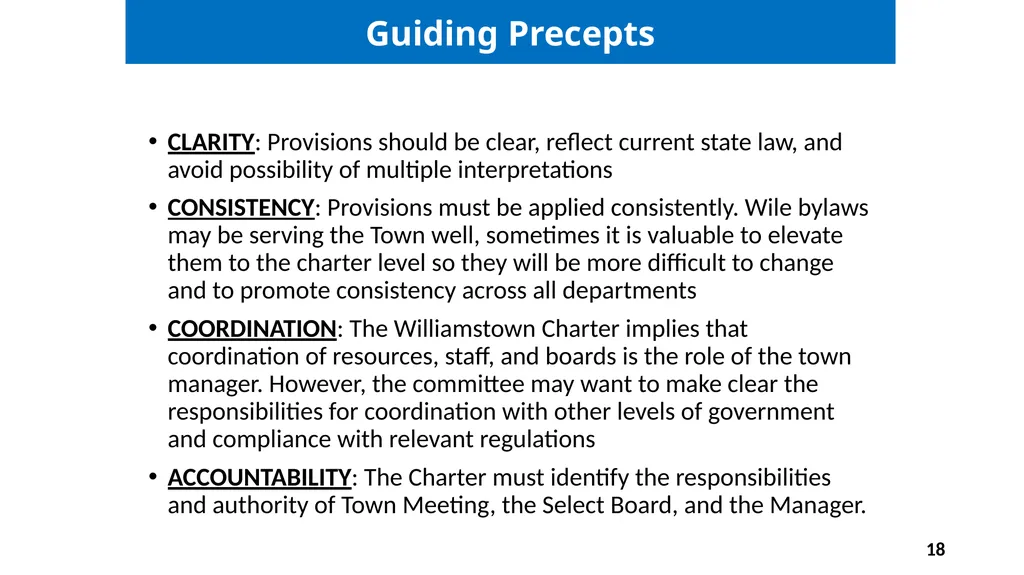
CLARITY: Provisions should be clear, reflect current state law, and avoid possibility of multiple interpretations
CONSISTENCY: Provisions must be applied consistently. Wile bylaws may be serving the Town well, sometimes it is valuable to elevate them to the charter level so they will be more difficult to change and to promote consistency across all departments
COORDINATION: The Williamstown Charter implies that coordination of resources, staff, and boards is the role of the town manager. However, the committee may want to make clear the responsibilities for coordination with other levels of government and compliance with relevant regulations
ACCOUNTABILITY: The Charter must identify the responsibilities and authority of Town Meeting, the Select Board, and the Manager. Guiding Precepts 18<br>
19
Questions/Issues for Further Study 19<br>
20
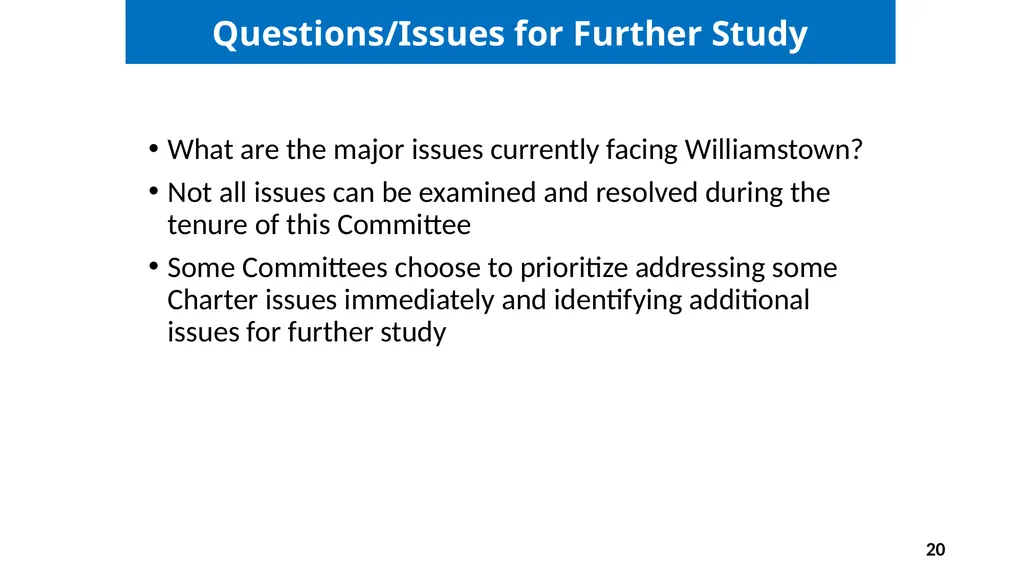
What are the major issues currently facing Williamstown?
Not all issues can be examined and resolved during the tenure of this Committee
Some Committees choose to prioritize addressing some Charter issues immediately and identifying additional issues for further study Questions/Issues for Further Study 20<br>