"CHE2060 Lecture 3: Molecular conformations Daley &" is the property of its rightful owner. Permission is granted to
download and print the materials on this website for personal, non-commercial use only, and to display it
on your personal computer provided you do not modify the materials and that you retain all copyright
notices contained in the materials. By downloading content from our website, you accept the terms of this
agreement.
3.2 Cycloalkane conformations
Planar vs. pucker
Cyclohexane: chair & boat
Flipping
Equatorial vs. axial
3.3 Ring stereoisomers: cis vs. trans
Stability
Lab: Modeling conformations<br>
02
Alkane conformation
Staggered vs. eclipsed
2D & 3D representations
Effect on energy levels?<br>
03
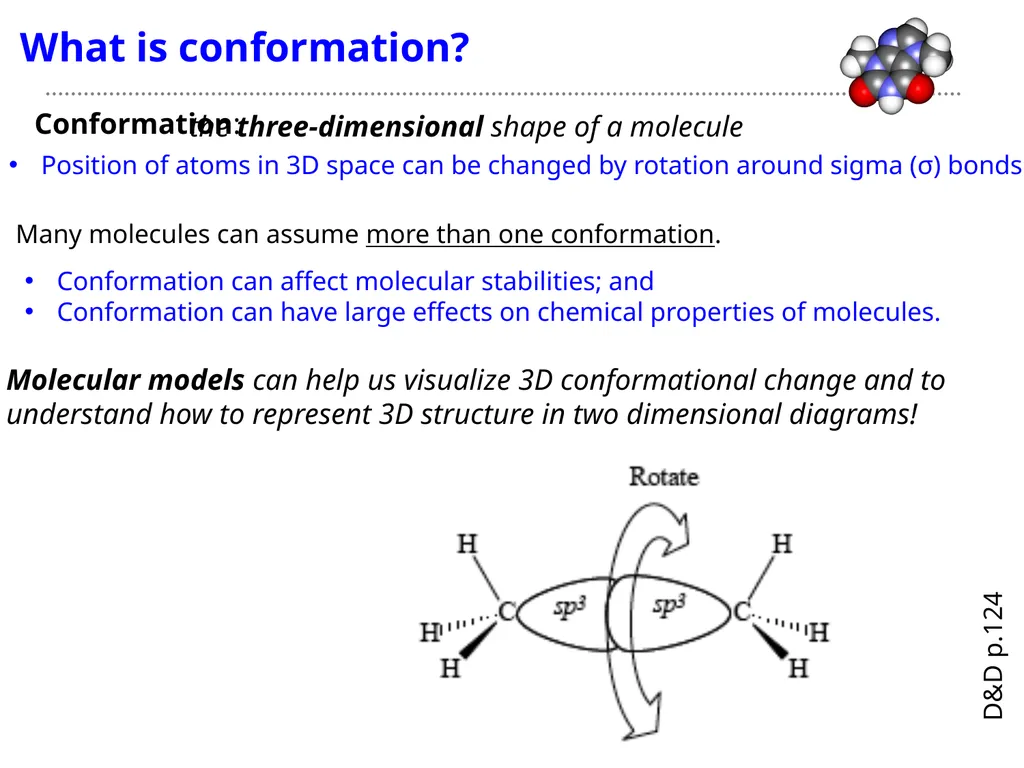
What is conformation? Conformation: D&D p.124 the three-dimensional shape of a molecule Position of atoms in 3D space can be changed by rotation around sigma (σ) bonds. Conformation can affect molecular stabilities; and
Conformation can have large effects on chemical properties of molecules. Molecular models can help us visualize 3D conformational change and to understand how to represent 3D structure in two dimensional diagrams! Many molecules can assume more than one conformation.<br>
04
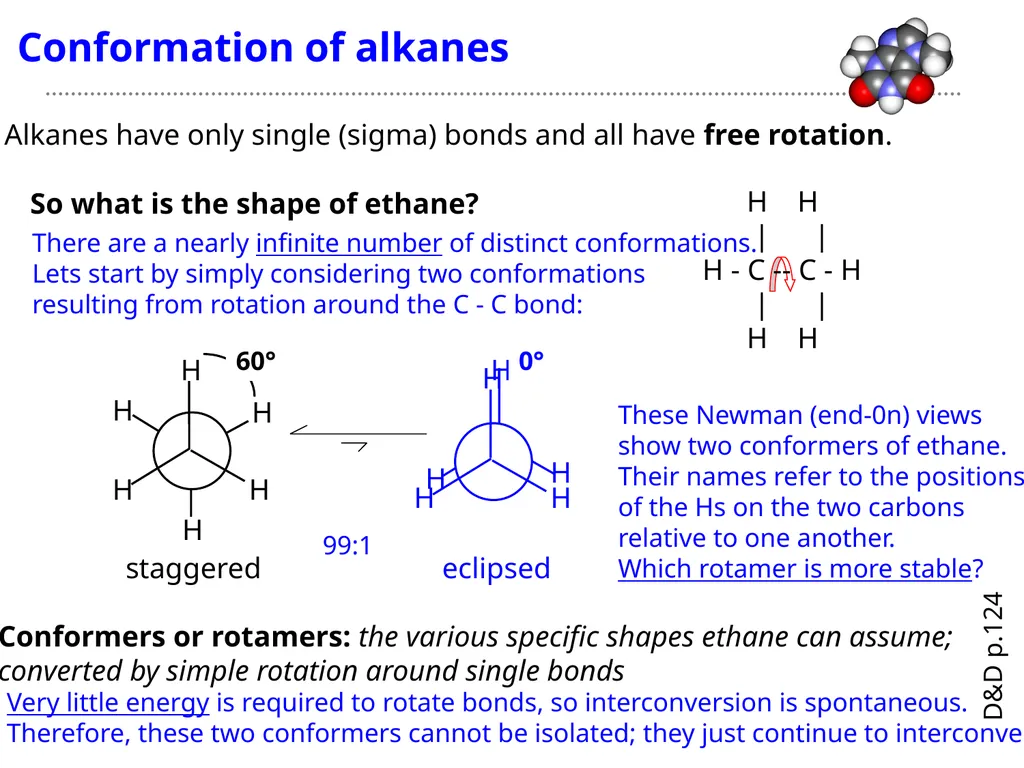
Conformation of alkanes So what is the shape of ethane? H H
| |
H - C -- C - H
| |
H H There are a nearly infinite number of distinct conformations.
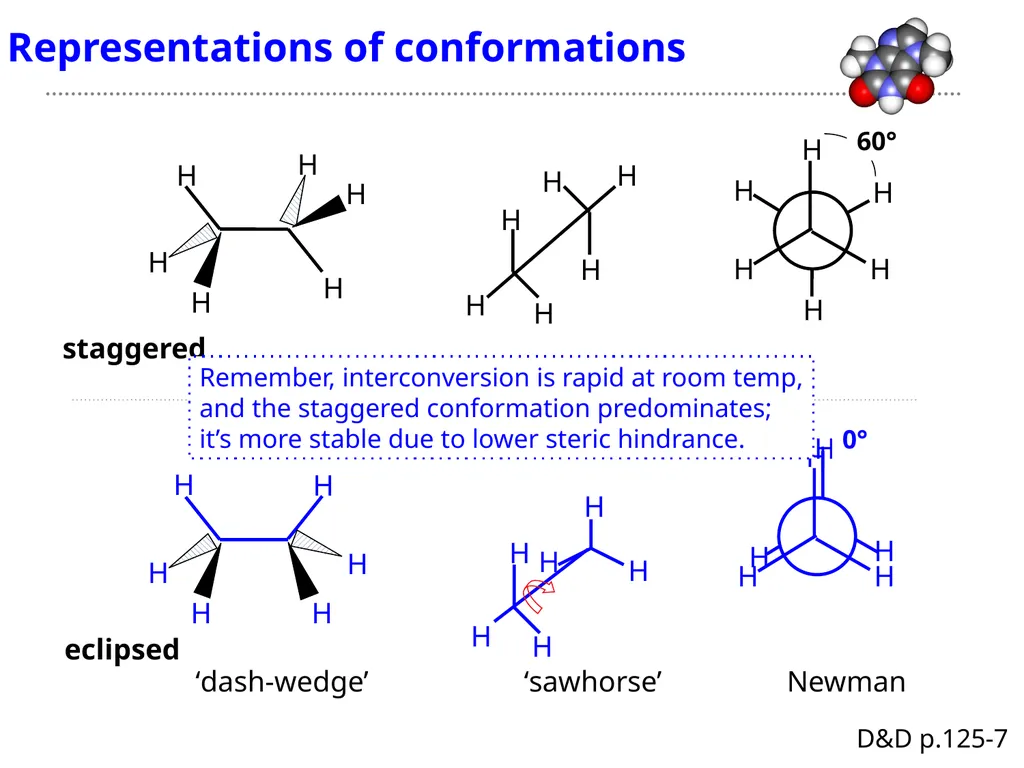
Lets start by simply considering two conformations resulting from rotation around the C - C bond: Conformers or rotamers: the various specific shapes ethane can assume; converted by simple rotation around single bonds Alkanes have only single (sigma) bonds and all have free rotation. H H H H H H 60° H H H H H H 0° These Newman (end-0n) views show two conformers of ethane. Their names refer to the positions of the Hs on the two carbons relative to one another. Which rotamer is more stable? staggered eclipsed 99:1 D&D p.124 Very little energy is required to rotate bonds, so interconversion is spontaneous. Therefore, these two conformers cannot be isolated; they just continue to interconvert.<br>
05
Representations of conformations H H H H H H staggered H H H H H H eclipsed ‘dash-wedge’ H H H H H H ‘sawhorse’ H H H H H H 0° Newman Remember, interconversion is rapid at room temp, and the staggered conformation predominates; it’s more stable due to lower steric hindrance. D&D p.125-7<br>
06
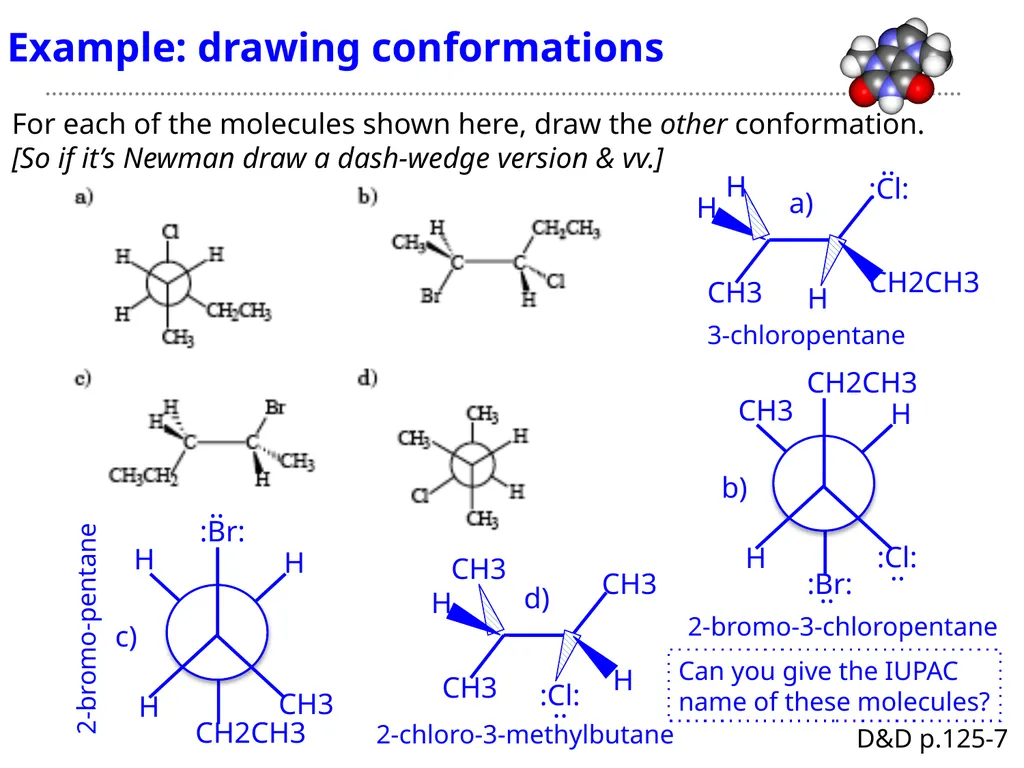
Example: drawing conformations D&D p.125-7 For each of the molecules shown here, draw the other conformation. [So if it’s Newman draw a dash-wedge version & vv.] CH2CH3 H :Cl: H H CH3 a) CH2CH3 :Cl: H CH3 H :Br: b) :Br: CH3 H H H CH2CH3 c) H :Cl: CH3 CH3 H CH3 d) Can you give the IUPAC name of these molecules? .. .. .. .. .. 3-chloropentane 2-bromo-3-chloropentane 2-chloro-3-methylbutane 2-bromo-pentane<br>
07
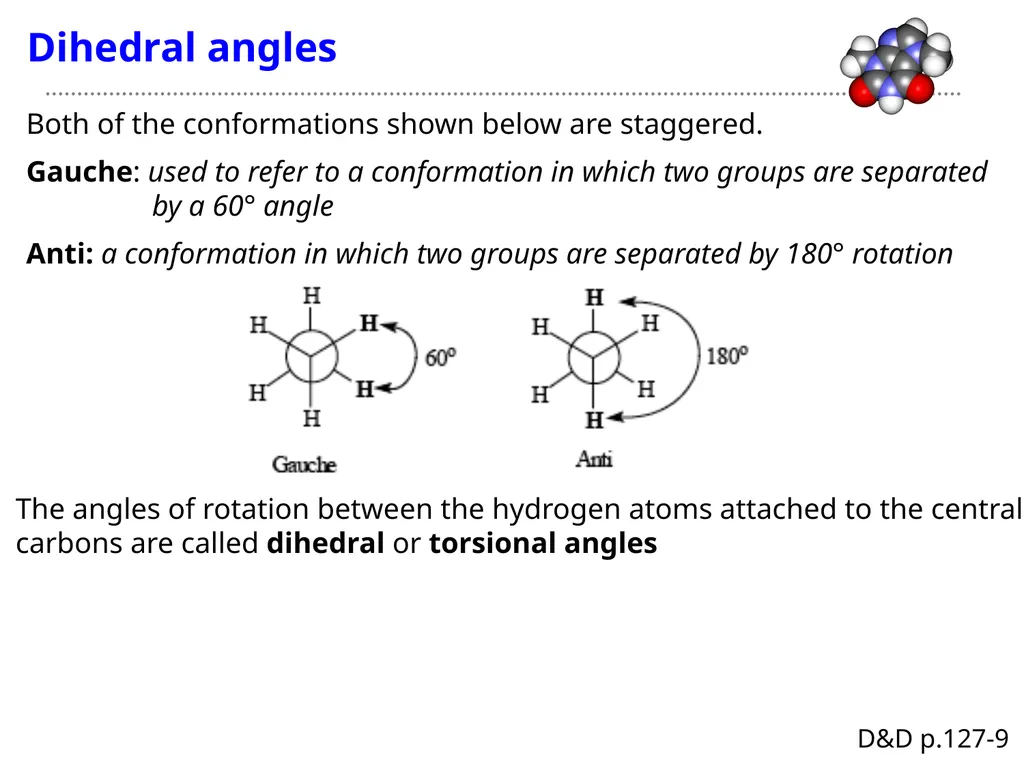
Dihedral angles D&D p.127-9 Both of the conformations shown below are staggered.
Gauche: used to refer to a conformation in which two groups are separated by a 60° angle
Anti: a conformation in which two groups are separated by 180° rotation The angles of rotation between the hydrogen atoms attached to the central carbons are called dihedral or torsional angles<br>
08
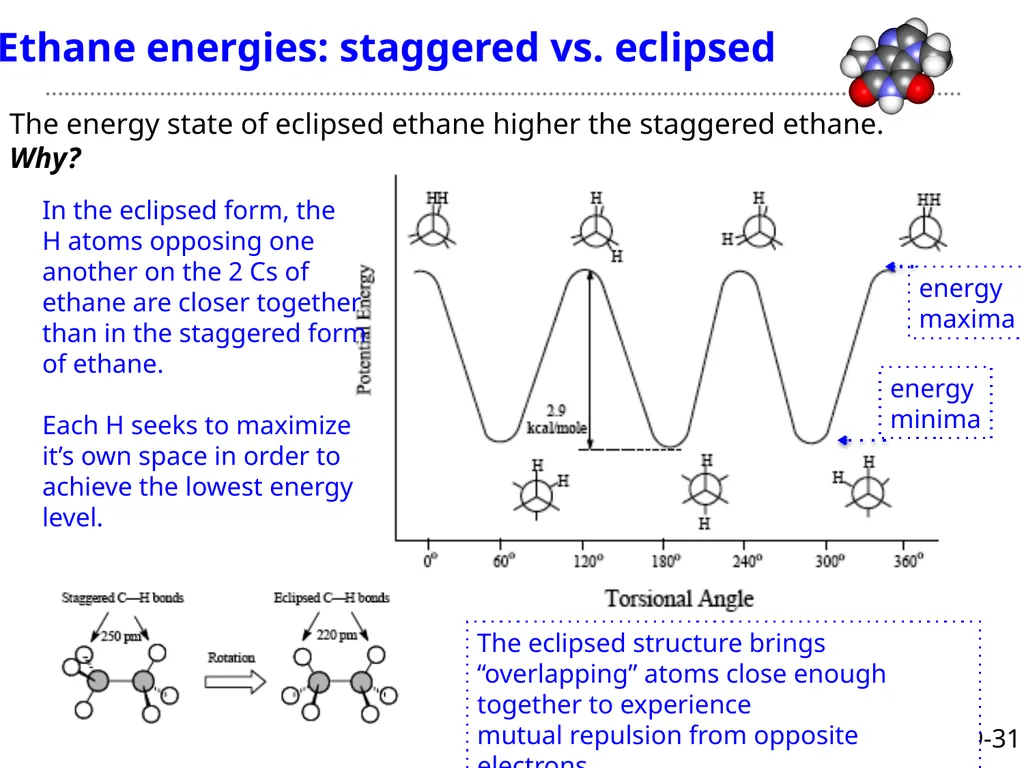
Ethane energies: staggered vs. eclipsed D&D p.129-31 The energy state of eclipsed ethane higher the staggered ethane. Why? In the eclipsed form, the H atoms opposing one another on the 2 Cs of ethane are closer together than in the staggered form of ethane.
Each H seeks to maximize it’s own space in order to achieve the lowest energy level. energy
minima energy
maxima The eclipsed structure brings “overlapping” atoms close enough together to experience mutual repulsion from opposite electrons.<br>
09
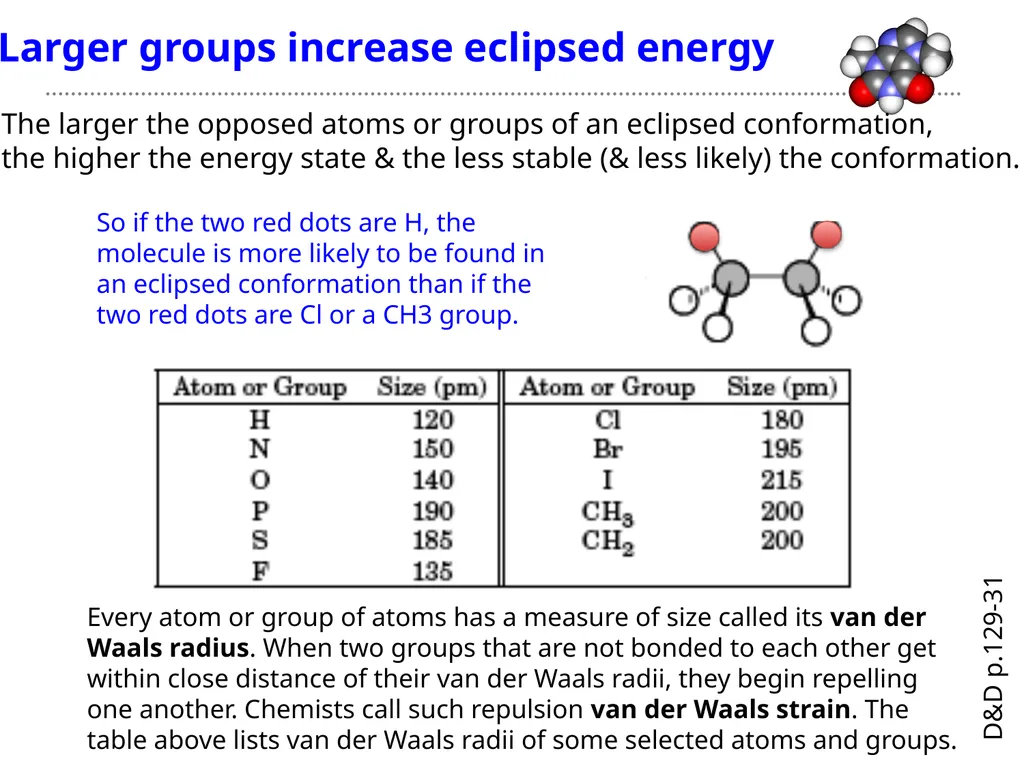
Larger groups increase eclipsed energy D&D p.129-31 The larger the opposed atoms or groups of an eclipsed conformation, the higher the energy state & the less stable (& less likely) the conformation. So if the two red dots are H, the molecule is more likely to be found in an eclipsed conformation than if the two red dots are Cl or a CH3 group. Every atom or group of atoms has a measure of size called its van der Waals radius. When two groups that are not bonded to each other get within close distance of their van der Waals radii, they begin repelling one another. Chemists call such repulsion van der Waals strain. The table above lists van der Waals radii of some selected atoms and groups.<br>
10
So, let’s look at butane… more complex D&D p.132-3 In a Newman projection you represent two C’s as central and two as CH3s. These are both staggered forms. Anti is more stable – lower crowding. These are both eclipsed forms. Left is less stable because it increases crowding. Notice that there are now variations in the energy levels of both the eclipsed & staggered conformations of the butane.
As the methyl groups approach one another, energy levels rise.<br>