
Chemical Weapons Convention (CWC) Dr. Thamina


Description: Chemical Weapons Convention (CWC) Dr. Thamina Acter Chemical Weapons Convention (CWC) It is an arms control agreement. For making a world free of Chemical Weapons and using chemicals only for peace, progress, and prosperity, CWC entered
Related Topics
Download Presentation
"Chemical Weapons Convention (CWC) Dr. Thamina" is the property of its rightful owner. Permission is granted to download and print the materials on this website for personal, non-commercial use only, and to display it on your personal computer provided you do not modify the materials and that you retain all copyright notices contained in the materials. By downloading content from our website, you accept the terms of this agreement.
Presentation Transcript
slide1. Chemical Weapons Convention (CWC) Dr. Thamina Acter<br>
slide2. Chemical Weapons Convention (CWC) It is an arms control agreement. For making a world free of Chemical Weapons and using chemicals only for peace, progress, and prosperity, CWC entered into force on 29 April 1997.
Summary of the conventions are:
All member states must destroy all Chemical Weapons and related production facilities.
Member states can produce/use toxic chemicals for peaceful purpose only.
Every member state should have National Authority to implement the CWC at the national level.
All member states must have necessary legislations for implementation of the CWC.<br>
slide3. Chemical Weapons A toxic chemical contained in a delivery system, such as a bomb or shell.
According to Chemical Weapons Convention CWC, the term chemical weapon is applied to any toxic chemical or its precursor that can cause death, injury, temporary incapacitation or sensory irritation through its chemical action.
Munitions or other delivery devices designed to deliver chemical weapons, whether filled or unfilled, are also considered weapons themselves.<br>
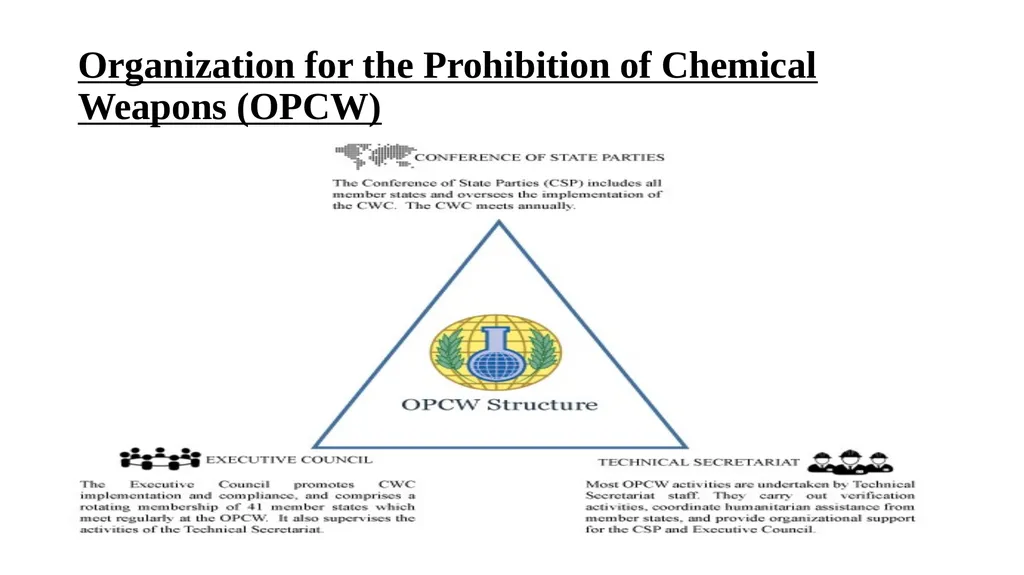
slide4. Organization for the Prohibition of Chemical Weapons (OPCW)<br>
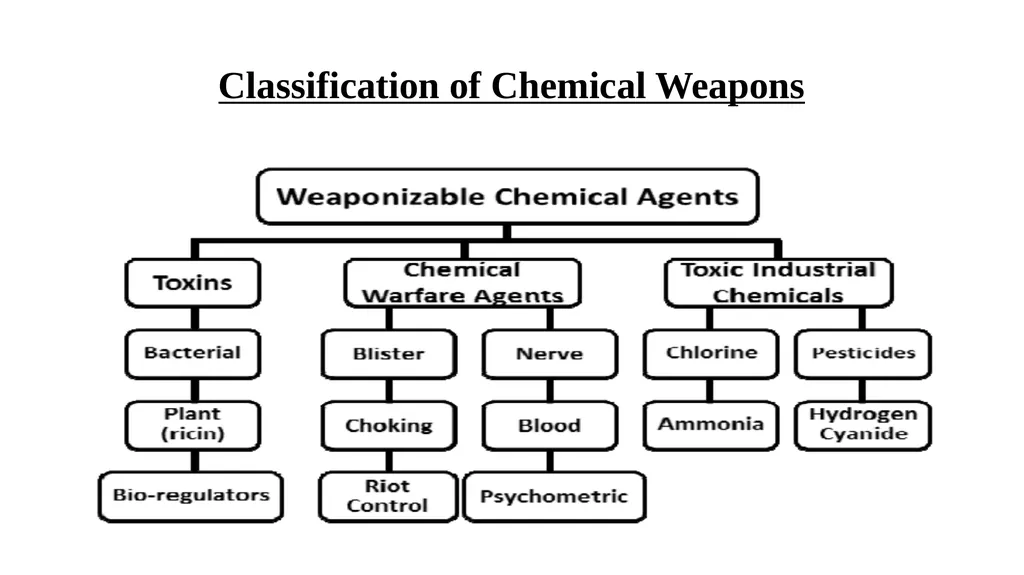
slide5. Classification of Chemical Weapons<br>
slide6. Scheduled Chemicals and Their Effects<br>
slide7. Dual Use of Chemicals Any chemical that has legitimate peaceful uses but which may also be used to make chemical weapons is a dual-use chemical.
Hydrogen cyanide, which is itself a potent toxic agent and also may be used to make the nerve agent tabun, is commonly used in the manufacture of nylon. Cyanides may also be found in dyes and pigments.
Phosphorus trichloride is a precursor to chemicals that can be used to make VX, another nerve agent, but it is also used to produce lubricants and pesticides.<br>
slide8. Chemical Threats Several things you should keep in mind about chemical threats:
While potentially lethal, they are difficult to deliver in lethal concentrations.
Chemical agents are difficult to produce in large quantities.
A chemical attack could come without warning.
They dissipate rapidly outdoors.
Chemical poisons may be odorless and tasteless and hard to detect.<br>
slide2. Chemical Weapons Convention (CWC) It is an arms control agreement. For making a world free of Chemical Weapons and using chemicals only for peace, progress, and prosperity, CWC entered into force on 29 April 1997.
Summary of the conventions are:
All member states must destroy all Chemical Weapons and related production facilities.
Member states can produce/use toxic chemicals for peaceful purpose only.
Every member state should have National Authority to implement the CWC at the national level.
All member states must have necessary legislations for implementation of the CWC.<br>
slide3. Chemical Weapons A toxic chemical contained in a delivery system, such as a bomb or shell.
According to Chemical Weapons Convention CWC, the term chemical weapon is applied to any toxic chemical or its precursor that can cause death, injury, temporary incapacitation or sensory irritation through its chemical action.
Munitions or other delivery devices designed to deliver chemical weapons, whether filled or unfilled, are also considered weapons themselves.<br>
slide4. Organization for the Prohibition of Chemical Weapons (OPCW)<br>
slide5. Classification of Chemical Weapons<br>
slide6. Scheduled Chemicals and Their Effects<br>
slide7. Dual Use of Chemicals Any chemical that has legitimate peaceful uses but which may also be used to make chemical weapons is a dual-use chemical.
Hydrogen cyanide, which is itself a potent toxic agent and also may be used to make the nerve agent tabun, is commonly used in the manufacture of nylon. Cyanides may also be found in dyes and pigments.
Phosphorus trichloride is a precursor to chemicals that can be used to make VX, another nerve agent, but it is also used to produce lubricants and pesticides.<br>
slide8. Chemical Threats Several things you should keep in mind about chemical threats:
While potentially lethal, they are difficult to deliver in lethal concentrations.
Chemical agents are difficult to produce in large quantities.
A chemical attack could come without warning.
They dissipate rapidly outdoors.
Chemical poisons may be odorless and tasteless and hard to detect.<br>