
Chemistry of complex compounds. Basic concepts of


Description: Chemistry of complex compounds. Basic concepts of chemical coordination compounds. Classification and nomenclature of complex compounds pHd Bakhadur askar Al-Farabi Kazakh National University Faculty of Chemistry and Chemical technology
Related Topics
Download Presentation
"Chemistry of complex compounds. Basic concepts of" is the property of its rightful owner. Permission is granted to download and print the materials on this website for personal, non-commercial use only, and to display it on your personal computer provided you do not modify the materials and that you retain all copyright notices contained in the materials. By downloading content from our website, you accept the terms of this agreement.
Presentation Transcript
slide1. Chemistry of complex compounds. Basic concepts of chemical coordination compounds. Classification and nomenclature of complex compounds pHd Bakhadur askar Al-Farabi Kazakh National University
Faculty of Chemistry and Chemical technology
Department of General and Inorganic Chemistry<br>
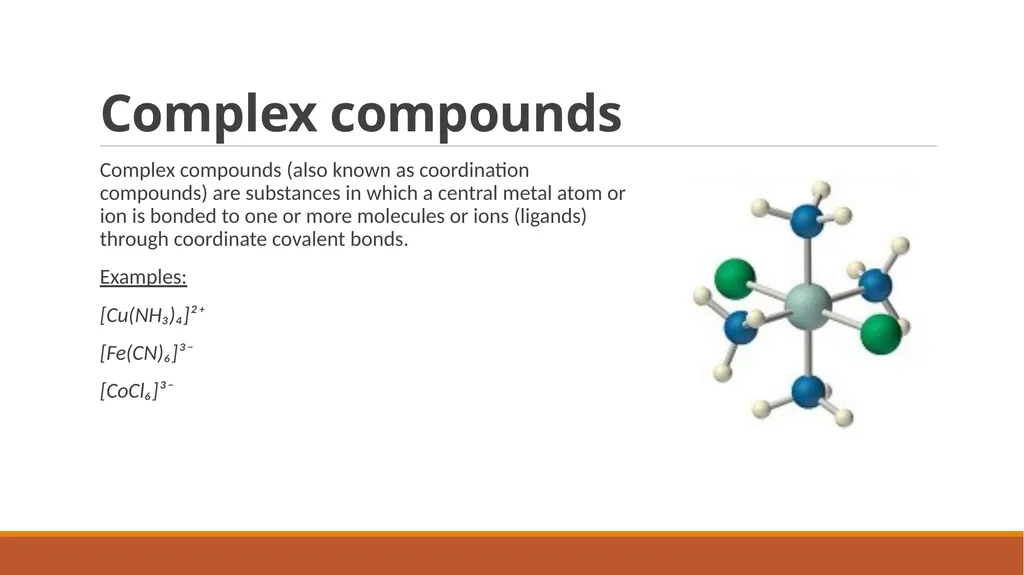
slide2. Complex compounds Complex compounds (also known as coordination compounds) are substances in which a central metal atom or ion is bonded to one or more molecules or ions (ligands) through coordinate covalent bonds.
Examples:
[Cu(NH₃)₄]²⁺
[Fe(CN)₆]³⁻
[CoCl₆]³⁻<br>
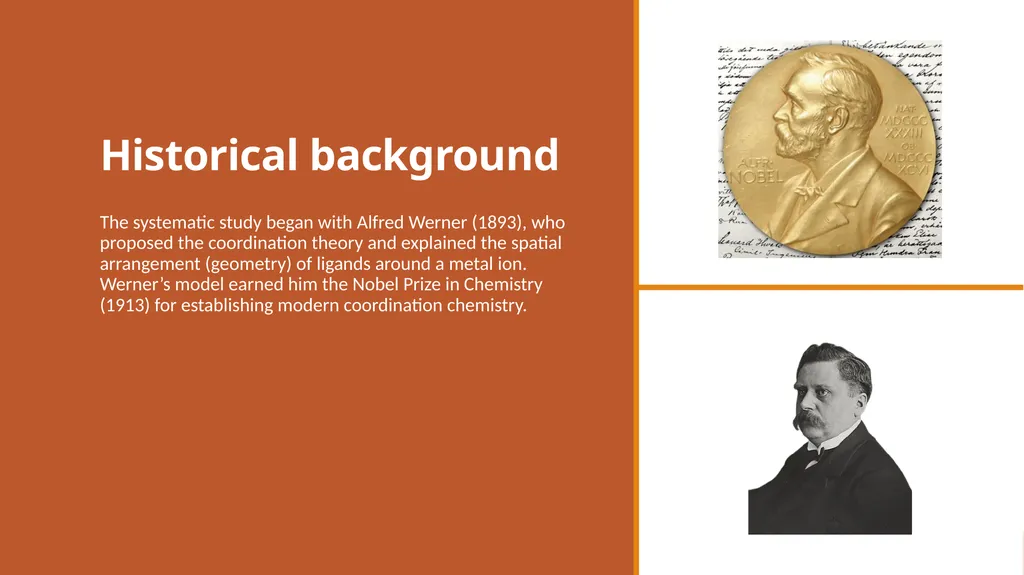
slide3. Historical background The systematic study began with Alfred Werner (1893), who proposed the coordination theory and explained the spatial arrangement (geometry) of ligands around a metal ion. Werner’s model earned him the Nobel Prize in Chemistry (1913) for establishing modern coordination chemistry.<br>
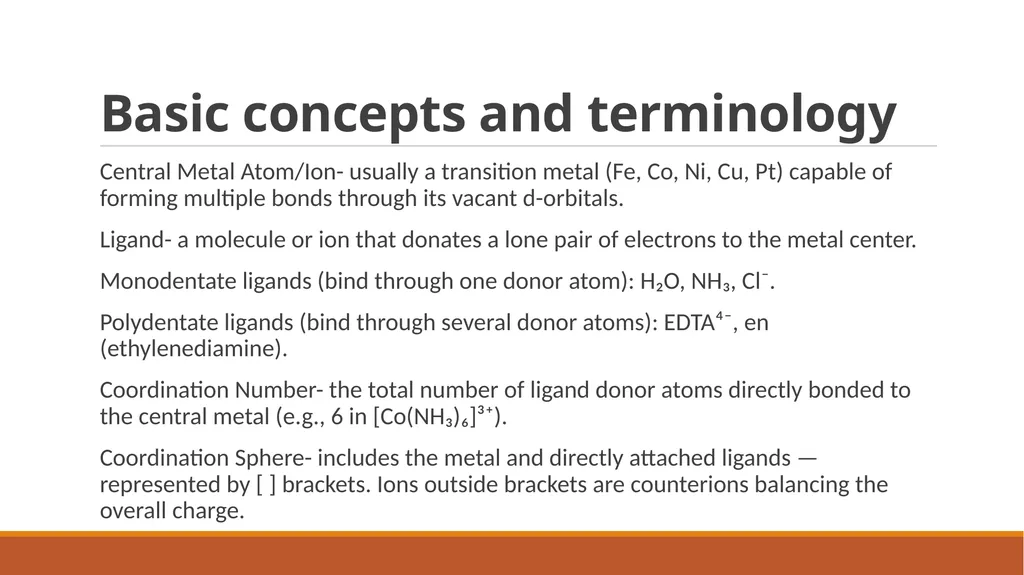
slide4. Basic concepts and terminology Central Metal Atom/Ion- usually a transition metal (Fe, Co, Ni, Cu, Pt) capable of forming multiple bonds through its vacant d-orbitals.
Ligand- a molecule or ion that donates a lone pair of electrons to the metal center.
Monodentate ligands (bind through one donor atom): H₂O, NH₃, Cl⁻.
Polydentate ligands (bind through several donor atoms): EDTA⁴⁻, en (ethylenediamine).
Coordination Number- the total number of ligand donor atoms directly bonded to the central metal (e.g., 6 in [Co(NH₃)₆]³⁺).
Coordination Sphere- includes the metal and directly attached ligands — represented by [ ] brackets. Ions outside brackets are counterions balancing the overall charge.<br>
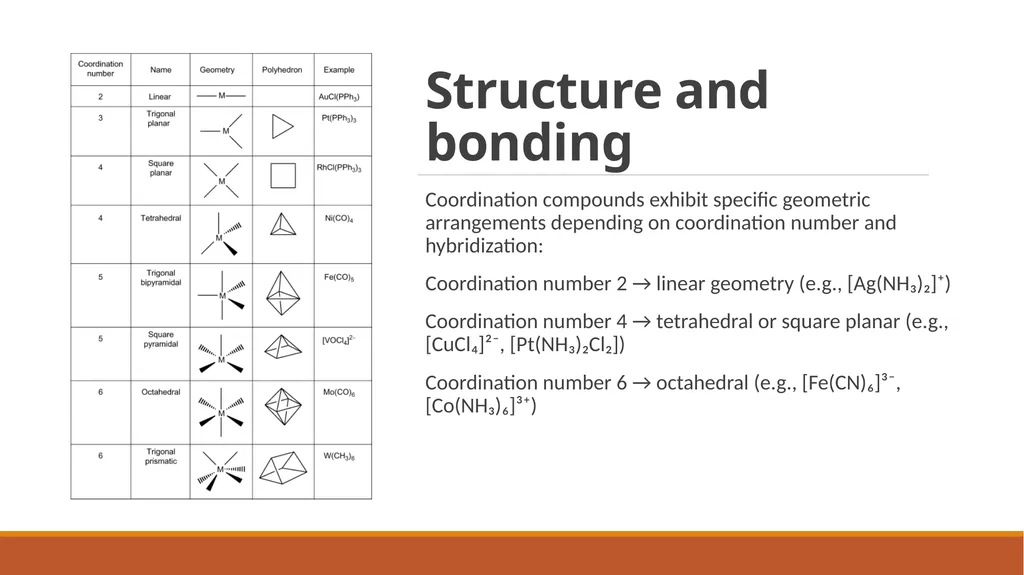
slide5. Structure and bonding Coordination compounds exhibit specific geometric arrangements depending on coordination number and hybridization:
Coordination number 2 → linear geometry (e.g., [Ag(NH₃)₂]⁺)
Coordination number 4 → tetrahedral or square planar (e.g., [CuCl₄]²⁻, [Pt(NH₃)₂Cl₂])
Coordination number 6 → octahedral (e.g., [Fe(CN)₆]³⁻, [Co(NH₃)₆]³⁺)<br>
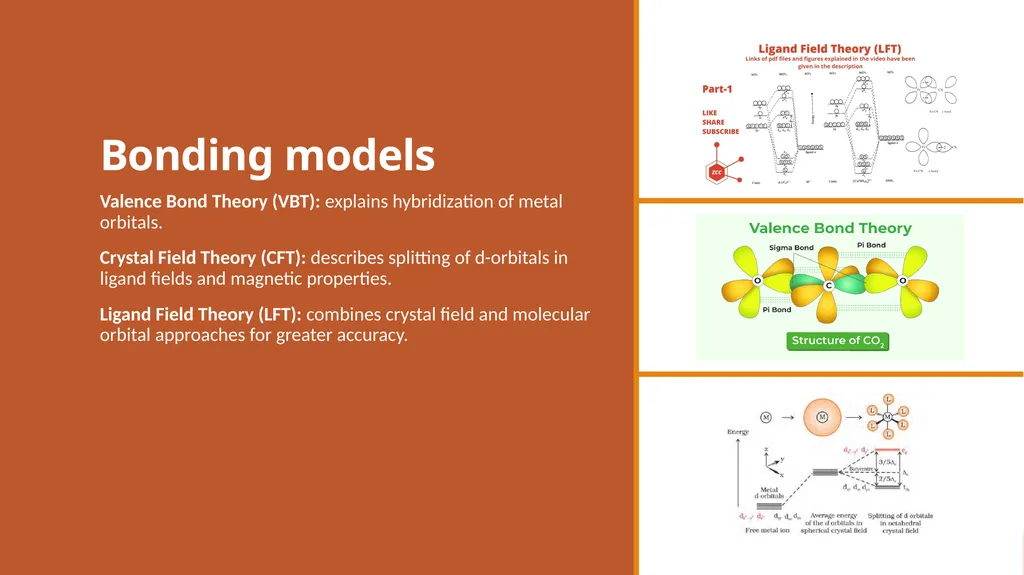
slide6. Bonding models Valence Bond Theory (VBT): explains hybridization of metal orbitals.
Crystal Field Theory (CFT): describes splitting of d-orbitals in ligand fields and magnetic properties.
Ligand Field Theory (LFT): combines crystal field and molecular orbital approaches for greater accuracy.<br>
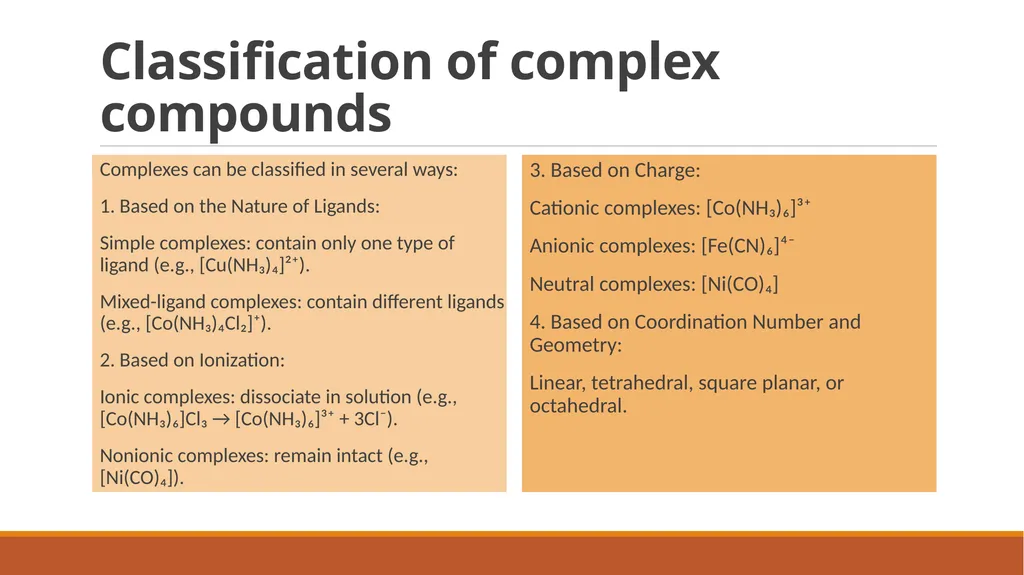
slide7. Classification of complex compounds Complexes can be classified in several ways:
1. Based on the Nature of Ligands:
Simple complexes: contain only one type of ligand (e.g., [Cu(NH₃)₄]²⁺).
Mixed-ligand complexes: contain different ligands (e.g., [Co(NH₃)₄Cl₂]⁺).
2. Based on Ionization:
Ionic complexes: dissociate in solution (e.g., [Co(NH₃)₆]Cl₃ → [Co(NH₃)₆]³⁺ + 3Cl⁻).
Nonionic complexes: remain intact (e.g., [Ni(CO)₄]). 3. Based on Charge:
Cationic complexes: [Co(NH₃)₆]³⁺
Anionic complexes: [Fe(CN)₆]⁴⁻
Neutral complexes: [Ni(CO)₄]
4. Based on Coordination Number and Geometry:
Linear, tetrahedral, square planar, or octahedral.<br>
slide8. Nomenclature rules (IUPAC system) Nomenclature of complex compounds follows IUPAC conventions:
Cation named before anion (whether complex or simple).
Within the complex ion:
Ligands are named alphabetically before the metal.
Prefixes (di-, tri-, tetra-, etc.) denote the number of identical ligands.
For polydentate ligands, use special prefixes (bis-, tris-, tetrakis-).
Anionic ligands end with “-o” (Cl⁻ → chloro, CN⁻ → cyano, OH⁻ → hydroxo).
Neutral ligands keep their molecular names (NH₃ → ammine, H₂O → aqua, CO → carbonyl).
Metal names:
Cationic complex → metal name unchanged (e.g., cobalt).
Anionic complex → metal name ends in “-ate” (e.g., ferrate for Fe).
Oxidation state of metal is shown in Roman numerals in parentheses.
Examples:
[Cr(H₂O)₆]Cl₃ → hexaaquachromium(III) chloride
[Co(NH₃)₄Cl₂]Cl → tetraamminedichlorocobalt(III) chloride
K₂[PtCl₆] → potassium hexachloroplatinate(IV)<br>
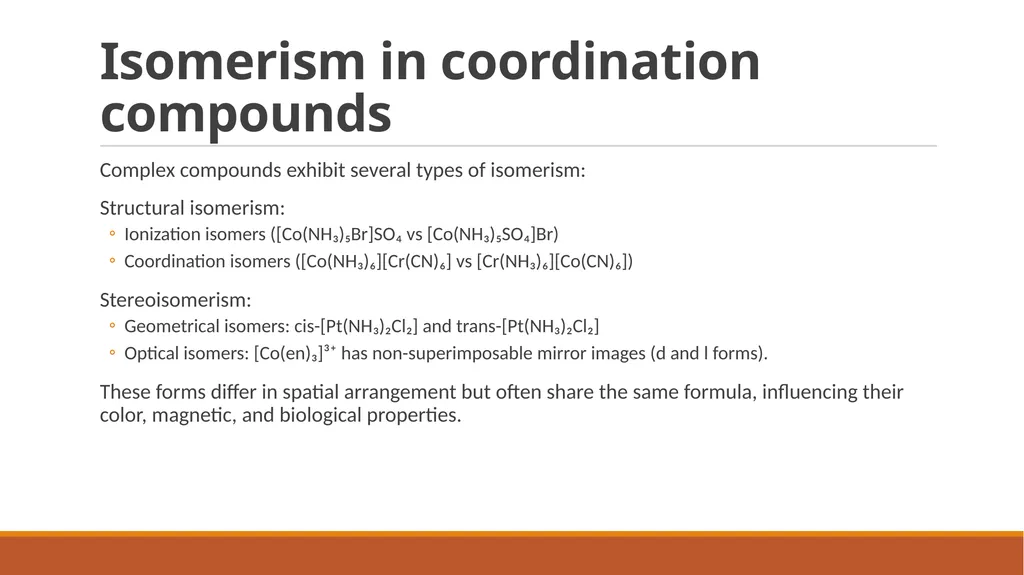
slide9. Isomerism in coordination compounds Complex compounds exhibit several types of isomerism:
Structural isomerism:
Ionization isomers ([Co(NH₃)₅Br]SO₄ vs [Co(NH₃)₅SO₄]Br)
Coordination isomers ([Co(NH₃)₆][Cr(CN)₆] vs [Cr(NH₃)₆][Co(CN)₆])
Stereoisomerism:
Geometrical isomers: cis-[Pt(NH₃)₂Cl₂] and trans-[Pt(NH₃)₂Cl₂]
Optical isomers: [Co(en)₃]³⁺ has non-superimposable mirror images (d and l forms).
These forms differ in spatial arrangement but often share the same formula, influencing their color, magnetic, and biological properties.<br>
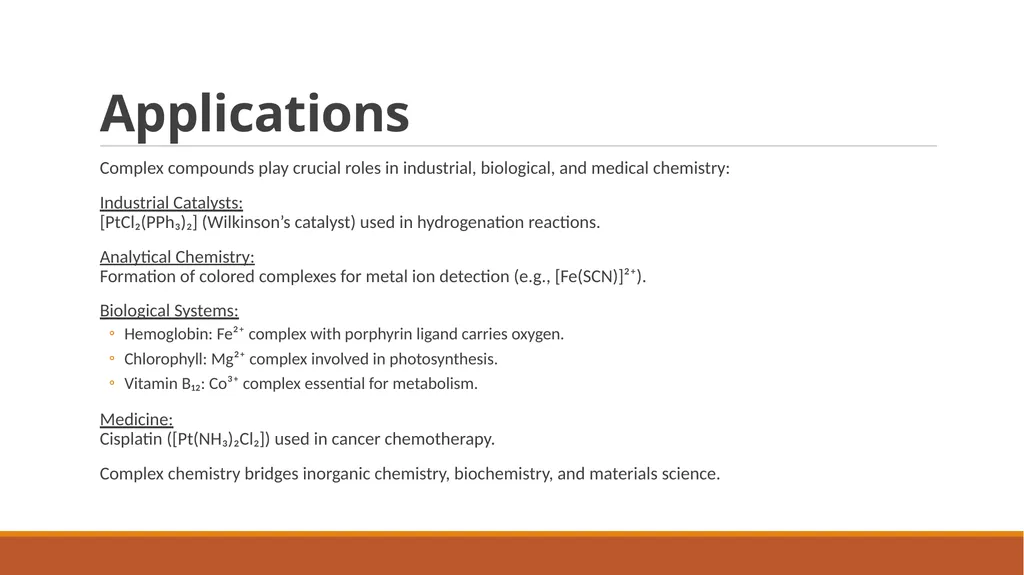
slide10. Applications Complex compounds play crucial roles in industrial, biological, and medical chemistry:
Industrial Catalysts: [PtCl₂(PPh₃)₂] (Wilkinson’s catalyst) used in hydrogenation reactions.
Analytical Chemistry: Formation of colored complexes for metal ion detection (e.g., [Fe(SCN)]²⁺).
Biological Systems:
Hemoglobin: Fe²⁺ complex with porphyrin ligand carries oxygen.
Chlorophyll: Mg²⁺ complex involved in photosynthesis.
Vitamin B₁₂: Co³⁺ complex essential for metabolism.
Medicine: Cisplatin ([Pt(NH₃)₂Cl₂]) used in cancer chemotherapy.
Complex chemistry bridges inorganic chemistry, biochemistry, and materials science.<br>
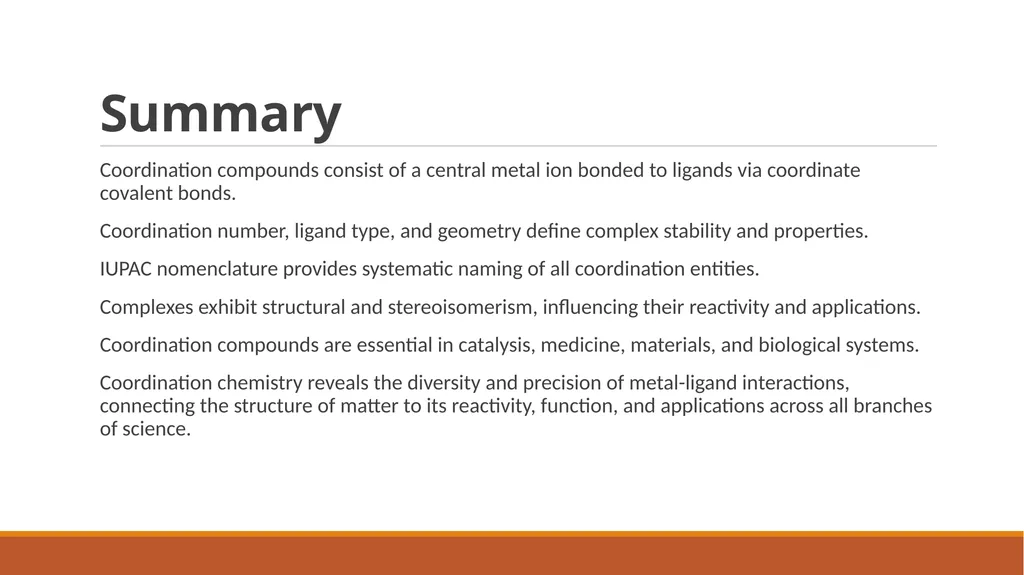
slide11. Summary Coordination compounds consist of a central metal ion bonded to ligands via coordinate covalent bonds.
Coordination number, ligand type, and geometry define complex stability and properties.
IUPAC nomenclature provides systematic naming of all coordination entities.
Complexes exhibit structural and stereoisomerism, influencing their reactivity and applications.
Coordination compounds are essential in catalysis, medicine, materials, and biological systems.
Coordination chemistry reveals the diversity and precision of metal-ligand interactions, connecting the structure of matter to its reactivity, function, and applications across all branches of science.<br>
slide12. Questions?<br>
Faculty of Chemistry and Chemical technology
Department of General and Inorganic Chemistry<br>
slide2. Complex compounds Complex compounds (also known as coordination compounds) are substances in which a central metal atom or ion is bonded to one or more molecules or ions (ligands) through coordinate covalent bonds.
Examples:
[Cu(NH₃)₄]²⁺
[Fe(CN)₆]³⁻
[CoCl₆]³⁻<br>
slide3. Historical background The systematic study began with Alfred Werner (1893), who proposed the coordination theory and explained the spatial arrangement (geometry) of ligands around a metal ion. Werner’s model earned him the Nobel Prize in Chemistry (1913) for establishing modern coordination chemistry.<br>
slide4. Basic concepts and terminology Central Metal Atom/Ion- usually a transition metal (Fe, Co, Ni, Cu, Pt) capable of forming multiple bonds through its vacant d-orbitals.
Ligand- a molecule or ion that donates a lone pair of electrons to the metal center.
Monodentate ligands (bind through one donor atom): H₂O, NH₃, Cl⁻.
Polydentate ligands (bind through several donor atoms): EDTA⁴⁻, en (ethylenediamine).
Coordination Number- the total number of ligand donor atoms directly bonded to the central metal (e.g., 6 in [Co(NH₃)₆]³⁺).
Coordination Sphere- includes the metal and directly attached ligands — represented by [ ] brackets. Ions outside brackets are counterions balancing the overall charge.<br>
slide5. Structure and bonding Coordination compounds exhibit specific geometric arrangements depending on coordination number and hybridization:
Coordination number 2 → linear geometry (e.g., [Ag(NH₃)₂]⁺)
Coordination number 4 → tetrahedral or square planar (e.g., [CuCl₄]²⁻, [Pt(NH₃)₂Cl₂])
Coordination number 6 → octahedral (e.g., [Fe(CN)₆]³⁻, [Co(NH₃)₆]³⁺)<br>
slide6. Bonding models Valence Bond Theory (VBT): explains hybridization of metal orbitals.
Crystal Field Theory (CFT): describes splitting of d-orbitals in ligand fields and magnetic properties.
Ligand Field Theory (LFT): combines crystal field and molecular orbital approaches for greater accuracy.<br>
slide7. Classification of complex compounds Complexes can be classified in several ways:
1. Based on the Nature of Ligands:
Simple complexes: contain only one type of ligand (e.g., [Cu(NH₃)₄]²⁺).
Mixed-ligand complexes: contain different ligands (e.g., [Co(NH₃)₄Cl₂]⁺).
2. Based on Ionization:
Ionic complexes: dissociate in solution (e.g., [Co(NH₃)₆]Cl₃ → [Co(NH₃)₆]³⁺ + 3Cl⁻).
Nonionic complexes: remain intact (e.g., [Ni(CO)₄]). 3. Based on Charge:
Cationic complexes: [Co(NH₃)₆]³⁺
Anionic complexes: [Fe(CN)₆]⁴⁻
Neutral complexes: [Ni(CO)₄]
4. Based on Coordination Number and Geometry:
Linear, tetrahedral, square planar, or octahedral.<br>
slide8. Nomenclature rules (IUPAC system) Nomenclature of complex compounds follows IUPAC conventions:
Cation named before anion (whether complex or simple).
Within the complex ion:
Ligands are named alphabetically before the metal.
Prefixes (di-, tri-, tetra-, etc.) denote the number of identical ligands.
For polydentate ligands, use special prefixes (bis-, tris-, tetrakis-).
Anionic ligands end with “-o” (Cl⁻ → chloro, CN⁻ → cyano, OH⁻ → hydroxo).
Neutral ligands keep their molecular names (NH₃ → ammine, H₂O → aqua, CO → carbonyl).
Metal names:
Cationic complex → metal name unchanged (e.g., cobalt).
Anionic complex → metal name ends in “-ate” (e.g., ferrate for Fe).
Oxidation state of metal is shown in Roman numerals in parentheses.
Examples:
[Cr(H₂O)₆]Cl₃ → hexaaquachromium(III) chloride
[Co(NH₃)₄Cl₂]Cl → tetraamminedichlorocobalt(III) chloride
K₂[PtCl₆] → potassium hexachloroplatinate(IV)<br>
slide9. Isomerism in coordination compounds Complex compounds exhibit several types of isomerism:
Structural isomerism:
Ionization isomers ([Co(NH₃)₅Br]SO₄ vs [Co(NH₃)₅SO₄]Br)
Coordination isomers ([Co(NH₃)₆][Cr(CN)₆] vs [Cr(NH₃)₆][Co(CN)₆])
Stereoisomerism:
Geometrical isomers: cis-[Pt(NH₃)₂Cl₂] and trans-[Pt(NH₃)₂Cl₂]
Optical isomers: [Co(en)₃]³⁺ has non-superimposable mirror images (d and l forms).
These forms differ in spatial arrangement but often share the same formula, influencing their color, magnetic, and biological properties.<br>
slide10. Applications Complex compounds play crucial roles in industrial, biological, and medical chemistry:
Industrial Catalysts: [PtCl₂(PPh₃)₂] (Wilkinson’s catalyst) used in hydrogenation reactions.
Analytical Chemistry: Formation of colored complexes for metal ion detection (e.g., [Fe(SCN)]²⁺).
Biological Systems:
Hemoglobin: Fe²⁺ complex with porphyrin ligand carries oxygen.
Chlorophyll: Mg²⁺ complex involved in photosynthesis.
Vitamin B₁₂: Co³⁺ complex essential for metabolism.
Medicine: Cisplatin ([Pt(NH₃)₂Cl₂]) used in cancer chemotherapy.
Complex chemistry bridges inorganic chemistry, biochemistry, and materials science.<br>
slide11. Summary Coordination compounds consist of a central metal ion bonded to ligands via coordinate covalent bonds.
Coordination number, ligand type, and geometry define complex stability and properties.
IUPAC nomenclature provides systematic naming of all coordination entities.
Complexes exhibit structural and stereoisomerism, influencing their reactivity and applications.
Coordination compounds are essential in catalysis, medicine, materials, and biological systems.
Coordination chemistry reveals the diversity and precision of metal-ligand interactions, connecting the structure of matter to its reactivity, function, and applications across all branches of science.<br>
slide12. Questions?<br>