
Child Abuse Recognition and Reporting in
TA
Published · 125 slides · 0 views

1 / 1
Description
Child Abuse Recognition and Reporting in Pennsylvania Name of Your AgencyOrganization 1 10152024 Introduction 2 Suggestion: Introduce the presenter(s). Provide your agencyorganizations contact information (e.g., email address, phone
Related Topics
Share
Embed code
Download this presentation From Below
"Child Abuse Recognition and Reporting in" is the property of its rightful owner. Permission is granted to download and print the materials on this website for personal, non-commercial use only, and to display it on your personal computer provided you do not modify the materials and that you retain all copyright notices contained in the materials. By downloading content from our website, you accept the terms of this agreement.
Presentation Transcript
01
Child Abuse Recognition and Reporting
in Pennsylvania [Name of Your Agency/Organization] 1 10/15/2024<br>
02
Introduction 2 Suggestion:
Introduce the presenter(s).
Provide your agency/organization’s contact information (e.g., email address, phone number, link to website) in which participants can contact if they have questions related to the course – such as navigating the course, obtaining their Certificate of Completion, etc.
Introduce your agency/organization.
Provide the link to our Trainings page, on our Keep Kids Safe website – https://www.dhs.pa.gov/KeepKidsSafe/Pages/Trainings.aspx.<br>
Introduce the presenter(s).
Provide your agency/organization’s contact information (e.g., email address, phone number, link to website) in which participants can contact if they have questions related to the course – such as navigating the course, obtaining their Certificate of Completion, etc.
Introduce your agency/organization.
Provide the link to our Trainings page, on our Keep Kids Safe website – https://www.dhs.pa.gov/KeepKidsSafe/Pages/Trainings.aspx.<br>
03
3 Course Overview 10/15/2024<br>
04
Course Overview 4 Suggestion: Agenda/Outline
Child Abuse Recognition and Reporting in Pennsylvania
Course Overview
Child Welfare in Pennsylvania
Mandatory Notification of Substance Affected Infants by Health Care Providers & Plan of Safe Care
Recognizing Child Abuse
Reporting Suspected Child Abuse
Case/Reporting Scenarios
Quiz Questions
Sources<br>
Child Abuse Recognition and Reporting in Pennsylvania
Course Overview
Child Welfare in Pennsylvania
Mandatory Notification of Substance Affected Infants by Health Care Providers & Plan of Safe Care
Recognizing Child Abuse
Reporting Suspected Child Abuse
Case/Reporting Scenarios
Quiz Questions
Sources<br>
05
Course Overview 5 Suggestion: Learning Objectives
Should target the “Key Takeaways” (*see notes section associated with this slide for additional clarification*) and be worded in a way that reflects what the audience will learn:
Definition/categories of child abuse as outlined in the PA CPSL
Common indicators of suspected child abuse
Roles and responsibilities for persons required to report suspected child abuse (mandated reporters)
Requirements and procedures for reporting suspected child abuse
Penalties for mandated reporters who willfully fail to report suspected child abuse<br>
Should target the “Key Takeaways” (*see notes section associated with this slide for additional clarification*) and be worded in a way that reflects what the audience will learn:
Definition/categories of child abuse as outlined in the PA CPSL
Common indicators of suspected child abuse
Roles and responsibilities for persons required to report suspected child abuse (mandated reporters)
Requirements and procedures for reporting suspected child abuse
Penalties for mandated reporters who willfully fail to report suspected child abuse<br>
06
Course Overview 6 Suggestion: Targeted/Intended Audience
Provide a brief description of the targeted/intended audience, such as any of the following:
Mandated reporters
Mandated and permissive reporters
Individuals seeking or renewing licensure in Pennsylvania
School staff, school contractors, school volunteers
Healthcare professionals
Mental health professionals<br>
Provide a brief description of the targeted/intended audience, such as any of the following:
Mandated reporters
Mandated and permissive reporters
Individuals seeking or renewing licensure in Pennsylvania
School staff, school contractors, school volunteers
Healthcare professionals
Mental health professionals<br>
07
Course Overview 7 Suggestion: Approval(s)/Credit
Number of credit hours – three (3) hours or two (2) hours
Indicate training approval(s) and relevant requirements completing your training will fulfill, such as:
This training is approved by the Pennsylvania Department of Human Services (DHS) in accordance with 23 Pa.C.S.§6383 (relating to education and training).
Note: Those applying for initial licensure/certification under the jurisdiction of DOS must take a 3-hour training approved by DHS.
This training is approved by the Pennsylvania Department of State (DOS) in accordance with Act 31 of 2014 for professional licensees.
Note: Those renewing licensure/certification under the jurisdiction of DOS must take at least two (2) hours of training jointly approved by DHS and DOS.
This training is approved by the Pennsylvania Department of Education (PDE) in accordance with Act 126 of 2012 [(if applicable) for Act 48 CE credit].
Any other relevant requirements completing your training will fulfill<br>
Number of credit hours – three (3) hours or two (2) hours
Indicate training approval(s) and relevant requirements completing your training will fulfill, such as:
This training is approved by the Pennsylvania Department of Human Services (DHS) in accordance with 23 Pa.C.S.§6383 (relating to education and training).
Note: Those applying for initial licensure/certification under the jurisdiction of DOS must take a 3-hour training approved by DHS.
This training is approved by the Pennsylvania Department of State (DOS) in accordance with Act 31 of 2014 for professional licensees.
Note: Those renewing licensure/certification under the jurisdiction of DOS must take at least two (2) hours of training jointly approved by DHS and DOS.
This training is approved by the Pennsylvania Department of Education (PDE) in accordance with Act 126 of 2012 [(if applicable) for Act 48 CE credit].
Any other relevant requirements completing your training will fulfill<br>
08
Course Overview 8 Suggestion: Delivery/Navigation
Method(s) of delivery, such as:
Online
In-person
Self-study
Live
How to navigate through the training/presentation, especially if it is online.<br>
Method(s) of delivery, such as:
Online
In-person
Self-study
Live
How to navigate through the training/presentation, especially if it is online.<br>
09
Course Overview 9 Suggestion: Materials
Any and all materials associated with the curriculum, such as:
PowerPoint presentation
Hyperlinks
Videos
Handouts, such as:
Glossary for supplementary definitions
Pre-test questions
Case scenario questions
Post-test questions<br>
Any and all materials associated with the curriculum, such as:
PowerPoint presentation
Hyperlinks
Videos
Handouts, such as:
Glossary for supplementary definitions
Pre-test questions
Case scenario questions
Post-test questions<br>
10
Course Overview 10 Suggestion: Disclaimers
Discuss any additional information or disclaimers you feel are pertinent prior to starting the training, such as:
If a participant would want a copy of their Certificate of Completion.
They need to contact your agency/organization directly, as your agency/organization is required to maintain all participant records.
Note: If your agency/organization is seeking DOS approval:
In accordance with DOS standards, your agency/organization is required to electronically forward a participant’s information to DOS for the participant to receive credit toward licensure or certification. Participants should contact their licensing board directly to confirm receipt. If a participant’s licensing board did not receive confirmation they completed the course, the participant may need to forward their information and their Certificate of Completion to their licensing board directly.<br>
Discuss any additional information or disclaimers you feel are pertinent prior to starting the training, such as:
If a participant would want a copy of their Certificate of Completion.
They need to contact your agency/organization directly, as your agency/organization is required to maintain all participant records.
Note: If your agency/organization is seeking DOS approval:
In accordance with DOS standards, your agency/organization is required to electronically forward a participant’s information to DOS for the participant to receive credit toward licensure or certification. Participants should contact their licensing board directly to confirm receipt. If a participant’s licensing board did not receive confirmation they completed the course, the participant may need to forward their information and their Certificate of Completion to their licensing board directly.<br>
11
Child Welfare in Pennsylvania 11 10/15/2024<br>
12
Child Welfare in Pennsylvania 12 Suggestion:
Brief history of child welfare in Pennsylvania
Data/statistics specific to Pennsylvania
*Please provide the source(s)/appropriate citation(s)*<br>
Brief history of child welfare in Pennsylvania
Data/statistics specific to Pennsylvania
*Please provide the source(s)/appropriate citation(s)*<br>
13
Child Welfare in Pennsylvania 13 The Pennsylvania Child Protective Services Law (CPSL)
The Pennsylvania Child Protective Services Law (CPSL) (23 Pa.C.S. Chapter 63, Child Protective Services) was established in 1975 to protect children from abuse, allow the opportunity for healthy growth and development, and preserve and stabilize the family whenever possible.
The PA CPSL does not restrict the generally recognized existing rights of parents to use reasonable supervision and control when raising their children.
Recent amendments relevant to child abuse recognition and reporting:
Act 115 of 2016 (relating to human trafficking)
Act 54 of 2018 (relating to notification of substance affected infants by healthcare providers & plan of safe care)
Act 88 of 2019 (relating to penalties for failure to report or refer)<br>
The Pennsylvania Child Protective Services Law (CPSL) (23 Pa.C.S. Chapter 63, Child Protective Services) was established in 1975 to protect children from abuse, allow the opportunity for healthy growth and development, and preserve and stabilize the family whenever possible.
The PA CPSL does not restrict the generally recognized existing rights of parents to use reasonable supervision and control when raising their children.
Recent amendments relevant to child abuse recognition and reporting:
Act 115 of 2016 (relating to human trafficking)
Act 54 of 2018 (relating to notification of substance affected infants by healthcare providers & plan of safe care)
Act 88 of 2019 (relating to penalties for failure to report or refer)<br>
14
Child Welfare in Pennsylvania 14 The Pennsylvania Child Welfare System
The Pennsylvania child welfare system is state-supervised and county-administered.
County children-and-youth agencies (CCYAs) have two main functions:
Child Protective Services (CPS) – services and activities provided by DHS and each county agency for child abuse cases
General Protective Services (GPS) – services and activities provided by each county agency for cases requiring protective services as defined by DHS in regulations<br>
The Pennsylvania child welfare system is state-supervised and county-administered.
County children-and-youth agencies (CCYAs) have two main functions:
Child Protective Services (CPS) – services and activities provided by DHS and each county agency for child abuse cases
General Protective Services (GPS) – services and activities provided by each county agency for cases requiring protective services as defined by DHS in regulations<br>
15
Child Welfare in Pennsylvania 15 The Pennsylvania Child Welfare System (cont.)
County children-and-youth agencies (CCYAs) have two main functions:
Child Protective Services (CPS) – services and activities provided by DHS and each county agency for child abuse cases (cont.)
Cases identified as “CPS” require an investigation because the alleged act or failure to act meets the definition of child abuse.
The PA CPSL recognizes 10 separate categories of child abuse.
Examples of CPS Cases --
Causing bodily injury to a child through any recent act or failure to act
Causing sexual abuse or exploitation of a child through any act or failure to act
Creating a reasonable likelihood of bodily injury to a child through any recent act or failure to act
Creating a likelihood of sexual abuse or exploitation of a child through any recent act or failure to act<br>
County children-and-youth agencies (CCYAs) have two main functions:
Child Protective Services (CPS) – services and activities provided by DHS and each county agency for child abuse cases (cont.)
Cases identified as “CPS” require an investigation because the alleged act or failure to act meets the definition of child abuse.
The PA CPSL recognizes 10 separate categories of child abuse.
Examples of CPS Cases --
Causing bodily injury to a child through any recent act or failure to act
Causing sexual abuse or exploitation of a child through any act or failure to act
Creating a reasonable likelihood of bodily injury to a child through any recent act or failure to act
Creating a likelihood of sexual abuse or exploitation of a child through any recent act or failure to act<br>
16
Child Welfare in Pennsylvania 16 The Pennsylvania Child Welfare System (cont.)
County children-and-youth agencies (CCYAs) have two main functions:
Child Protective Services (CPS) – services and activities provided by DHS and each county agency for child abuse cases (cont.)
Examples of CPS Cases – (cont.)
Fabricating, feigning or intentionally exaggerating or inducing a medical symptom or disease which results in a potentially harmful medical evaluation or treatment to the child through any recent act
Causing or substantially contributing to serious mental injury to a child through any act or failure to act or a series of such acts or failures to act
Causing serious physical neglect of a child
Engaging in a specific recent “per se” act
Causing the death of the child through any act or failure to act
Engaging a child in a severe form of trafficking in persons or sex trafficking<br>
County children-and-youth agencies (CCYAs) have two main functions:
Child Protective Services (CPS) – services and activities provided by DHS and each county agency for child abuse cases (cont.)
Examples of CPS Cases – (cont.)
Fabricating, feigning or intentionally exaggerating or inducing a medical symptom or disease which results in a potentially harmful medical evaluation or treatment to the child through any recent act
Causing or substantially contributing to serious mental injury to a child through any act or failure to act or a series of such acts or failures to act
Causing serious physical neglect of a child
Engaging in a specific recent “per se” act
Causing the death of the child through any act or failure to act
Engaging a child in a severe form of trafficking in persons or sex trafficking<br>
17
Child Welfare in Pennsylvania 17 The Pennsylvania Child Welfare System (cont.)
County children-and-youth agencies (CCYAs) have two main functions:
General Protective Services (GPS) – services and activities provided by each county agency for cases requiring protective services (cont.)
Cases identified as “GPS” require an assessment for services and supports.
In these cases, the alleged act or failure to act may not meet the definition of child abuse but is still detrimental to a child.
The primary purpose of GPS is to protect the rights and welfare of children so that they have an opportunity for healthy growth and development.<br>
County children-and-youth agencies (CCYAs) have two main functions:
General Protective Services (GPS) – services and activities provided by each county agency for cases requiring protective services (cont.)
Cases identified as “GPS” require an assessment for services and supports.
In these cases, the alleged act or failure to act may not meet the definition of child abuse but is still detrimental to a child.
The primary purpose of GPS is to protect the rights and welfare of children so that they have an opportunity for healthy growth and development.<br>
18
Child Welfare in Pennsylvania 18 The Pennsylvania Child Welfare System (cont.)
County children-and-youth agencies (CCYAs) have two main functions:
General Protective Services (GPS) – services and activities provided by each county agency for cases requiring protective services (cont.)
Examples of GPS Cases -- Services to prevent the potential for harm to a child who meets one of the following conditions:
Is without parental care or control, subsistence, education as required by law, or other care or control necessary for their physical, mental, or emotional health or morals
Has been placed for care or adoption in violation of law
Has been abandoned by their parents, guardian, or other custodian
Is without a parent, guardian, or legal custodian
Is habitually and without justification truant from school while subject to compulsory school attendance
Is under 10 years of age and has committed a delinquent act<br>
County children-and-youth agencies (CCYAs) have two main functions:
General Protective Services (GPS) – services and activities provided by each county agency for cases requiring protective services (cont.)
Examples of GPS Cases -- Services to prevent the potential for harm to a child who meets one of the following conditions:
Is without parental care or control, subsistence, education as required by law, or other care or control necessary for their physical, mental, or emotional health or morals
Has been placed for care or adoption in violation of law
Has been abandoned by their parents, guardian, or other custodian
Is without a parent, guardian, or legal custodian
Is habitually and without justification truant from school while subject to compulsory school attendance
Is under 10 years of age and has committed a delinquent act<br>
19
Child Welfare in Pennsylvania 19 The Pennsylvania Child Welfare System (cont.)
County children-and-youth agencies (CCYAs) have two main functions:
General Protective Services (GPS) – services and activities provided by each county agency for cases requiring protective services (cont.)
Examples of GPS Cases -- Services to prevent the potential for harm to a child who meets one of the following conditions: (cont.)
Has committed a specific act of habitual disobedience of the reasonable and lawful commands of their parent, guardian, or other custodian and who is ungovernable and found to be in need of care, treatment, or supervision
Has been formerly adjudicated dependent under section 6341 of the Juvenile Act (relating to adjudication) and is under the jurisdiction of the court, subject to its conditions or placements, and who commits an act which is ungovernable
Has been referred under section 6323 of the Juvenile Act (relating to informal adjustment) and who commits an act which is ungovernable<br>
County children-and-youth agencies (CCYAs) have two main functions:
General Protective Services (GPS) – services and activities provided by each county agency for cases requiring protective services (cont.)
Examples of GPS Cases -- Services to prevent the potential for harm to a child who meets one of the following conditions: (cont.)
Has committed a specific act of habitual disobedience of the reasonable and lawful commands of their parent, guardian, or other custodian and who is ungovernable and found to be in need of care, treatment, or supervision
Has been formerly adjudicated dependent under section 6341 of the Juvenile Act (relating to adjudication) and is under the jurisdiction of the court, subject to its conditions or placements, and who commits an act which is ungovernable
Has been referred under section 6323 of the Juvenile Act (relating to informal adjustment) and who commits an act which is ungovernable<br>
20
Mandatory Notification of Substance Affected Infants by Health Care Providers & Plan of Safe Care (Act 54 of 2018) 20 10/15/2024<br>
21
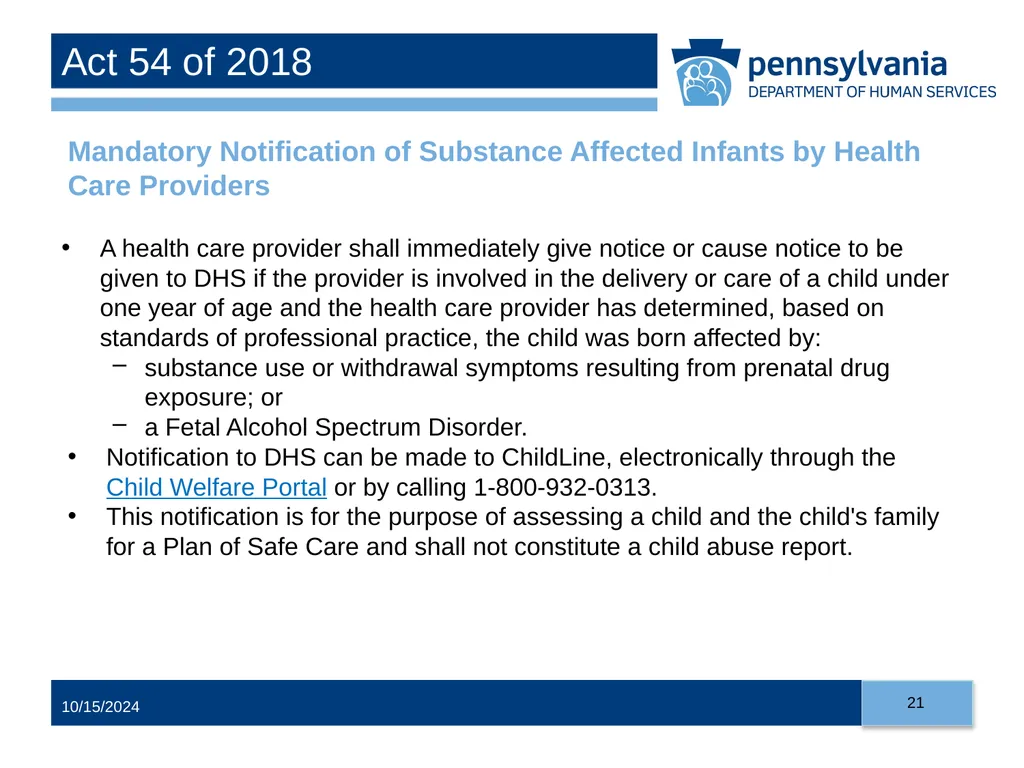
Act 54 of 2018 21 Mandatory Notification of Substance Affected Infants by Health Care Providers
A health care provider shall immediately give notice or cause notice to be given to DHS if the provider is involved in the delivery or care of a child under one year of age and the health care provider has determined, based on standards of professional practice, the child was born affected by:
substance use or withdrawal symptoms resulting from prenatal drug exposure; or
a Fetal Alcohol Spectrum Disorder.
Notification to DHS can be made to ChildLine, electronically through the Child Welfare Portal or by calling 1-800-932-0313.
This notification is for the purpose of assessing a child and the child's family for a Plan of Safe Care and shall not constitute a child abuse report.<br>
A health care provider shall immediately give notice or cause notice to be given to DHS if the provider is involved in the delivery or care of a child under one year of age and the health care provider has determined, based on standards of professional practice, the child was born affected by:
substance use or withdrawal symptoms resulting from prenatal drug exposure; or
a Fetal Alcohol Spectrum Disorder.
Notification to DHS can be made to ChildLine, electronically through the Child Welfare Portal or by calling 1-800-932-0313.
This notification is for the purpose of assessing a child and the child's family for a Plan of Safe Care and shall not constitute a child abuse report.<br>
22
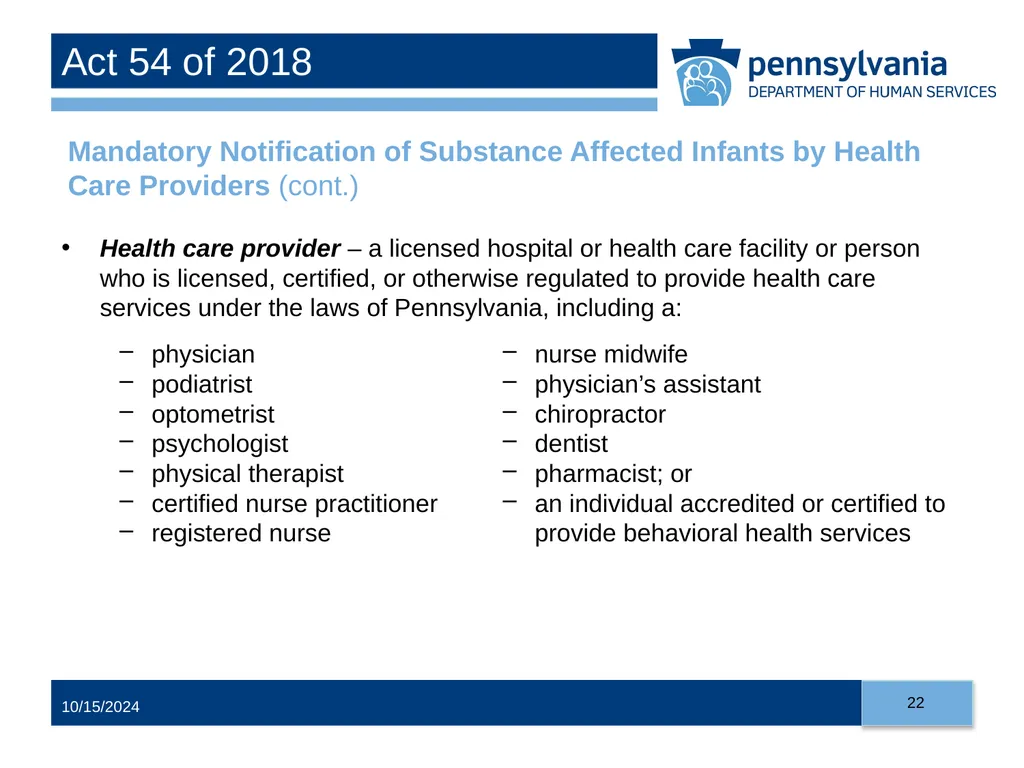
Act 54 of 2018 22 Mandatory Notification of Substance Affected Infants by Health Care Providers (cont.)
Health care provider – a licensed hospital or health care facility or person who is licensed, certified, or otherwise regulated to provide health care services under the laws of Pennsylvania, including a: physician
podiatrist
optometrist
psychologist
physical therapist
certified nurse practitioner
registered nurse nurse midwife
physician’s assistant
chiropractor
dentist
pharmacist; or
an individual accredited or certified to provide behavioral health services<br>
Health care provider – a licensed hospital or health care facility or person who is licensed, certified, or otherwise regulated to provide health care services under the laws of Pennsylvania, including a: physician
podiatrist
optometrist
psychologist
physical therapist
certified nurse practitioner
registered nurse nurse midwife
physician’s assistant
chiropractor
dentist
pharmacist; or
an individual accredited or certified to provide behavioral health services<br>
23
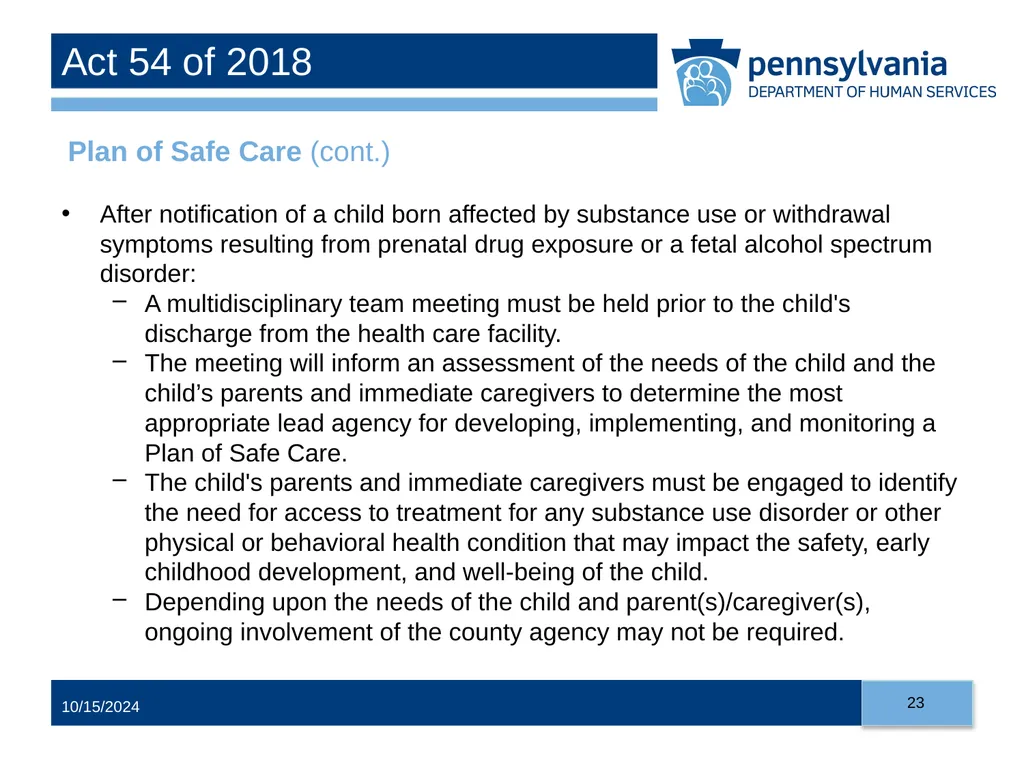
Act 54 of 2018 23 Plan of Safe Care (cont.)
After notification of a child born affected by substance use or withdrawal symptoms resulting from prenatal drug exposure or a fetal alcohol spectrum disorder:
A multidisciplinary team meeting must be held prior to the child's discharge from the health care facility.
The meeting will inform an assessment of the needs of the child and the child’s parents and immediate caregivers to determine the most appropriate lead agency for developing, implementing, and monitoring a Plan of Safe Care.
The child's parents and immediate caregivers must be engaged to identify the need for access to treatment for any substance use disorder or other physical or behavioral health condition that may impact the safety, early childhood development, and well-being of the child.
Depending upon the needs of the child and parent(s)/caregiver(s), ongoing involvement of the county agency may not be required.<br>
After notification of a child born affected by substance use or withdrawal symptoms resulting from prenatal drug exposure or a fetal alcohol spectrum disorder:
A multidisciplinary team meeting must be held prior to the child's discharge from the health care facility.
The meeting will inform an assessment of the needs of the child and the child’s parents and immediate caregivers to determine the most appropriate lead agency for developing, implementing, and monitoring a Plan of Safe Care.
The child's parents and immediate caregivers must be engaged to identify the need for access to treatment for any substance use disorder or other physical or behavioral health condition that may impact the safety, early childhood development, and well-being of the child.
Depending upon the needs of the child and parent(s)/caregiver(s), ongoing involvement of the county agency may not be required.<br>
24
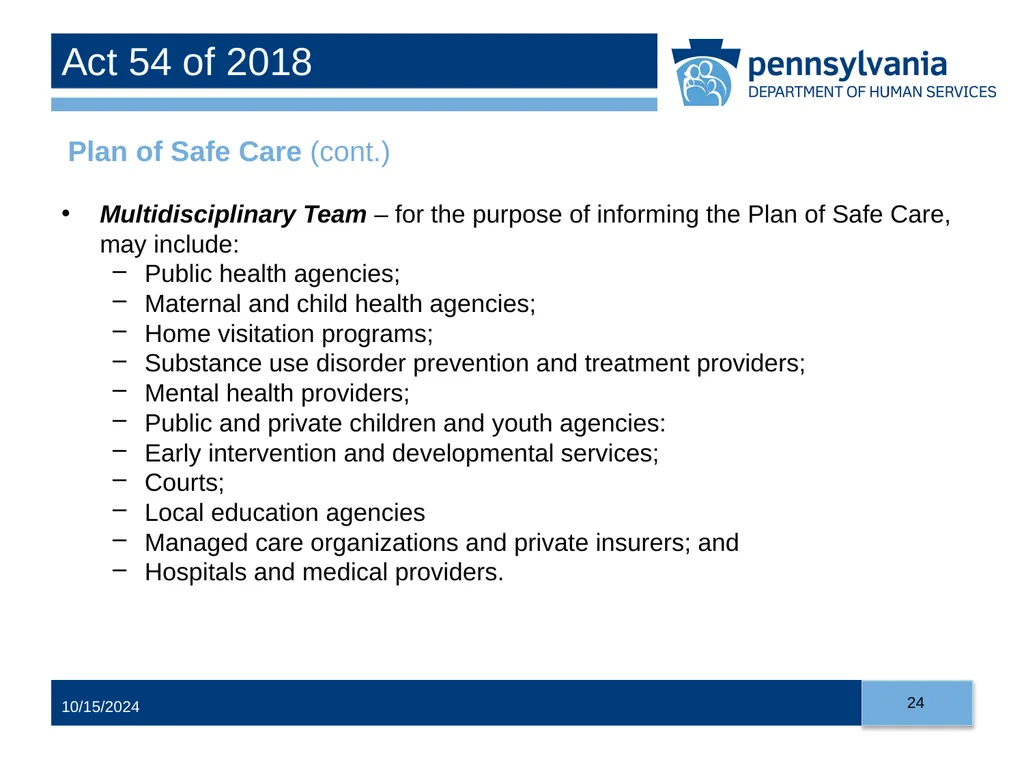
Act 54 of 2018 24 Plan of Safe Care (cont.)
Multidisciplinary Team – for the purpose of informing the Plan of Safe Care, may include:
Public health agencies;
Maternal and child health agencies;
Home visitation programs;
Substance use disorder prevention and treatment providers;
Mental health providers;
Public and private children and youth agencies:
Early intervention and developmental services;
Courts;
Local education agencies
Managed care organizations and private insurers; and
Hospitals and medical providers.<br>
Multidisciplinary Team – for the purpose of informing the Plan of Safe Care, may include:
Public health agencies;
Maternal and child health agencies;
Home visitation programs;
Substance use disorder prevention and treatment providers;
Mental health providers;
Public and private children and youth agencies:
Early intervention and developmental services;
Courts;
Local education agencies
Managed care organizations and private insurers; and
Hospitals and medical providers.<br>
25
Recognizing Child Abuse 25 10/15/2024<br>
26
Recognizing Child Abuse 26 Key Components of Child Abuse
Child: An individual under 18 years of age
Recent act; Act or failure to act; Recent act or failure to act; Series of Acts or Failures to act
Act: Something that is done to harm or cause potential harm to a child
Failure to act: Something that is NOT done to prevent harm or potential harm to a child
Recent act: Any act committed within two years of the date of the report to DHS or county agency
Recent act or failure to act: Any act or failure to act committed within two (2) years of the date of the report to DHS or county agency
Intentionally, Knowingly, or Recklessly
Intentionally: Done with the direct purpose of causing the type of harm that resulted
Knowingly: Awareness that harm is practically certain to result
Recklessly: Conscious disregard of substantial and unjustifiable risk<br>
Child: An individual under 18 years of age
Recent act; Act or failure to act; Recent act or failure to act; Series of Acts or Failures to act
Act: Something that is done to harm or cause potential harm to a child
Failure to act: Something that is NOT done to prevent harm or potential harm to a child
Recent act: Any act committed within two years of the date of the report to DHS or county agency
Recent act or failure to act: Any act or failure to act committed within two (2) years of the date of the report to DHS or county agency
Intentionally, Knowingly, or Recklessly
Intentionally: Done with the direct purpose of causing the type of harm that resulted
Knowingly: Awareness that harm is practically certain to result
Recklessly: Conscious disregard of substantial and unjustifiable risk<br>
27
Recognizing Child Abuse 27 Perpetrator
An individual who has committed child abuse as defined under section 6303(b.1) of the PA CPSL (relating to definitions).
NOTE: Nothing in the PA CPSL requires a person who has reasonable cause to suspect a child is a victim of child abuse to identify the person responsible for the child abuse in order to make a report of suspected child abuse.<br>
An individual who has committed child abuse as defined under section 6303(b.1) of the PA CPSL (relating to definitions).
NOTE: Nothing in the PA CPSL requires a person who has reasonable cause to suspect a child is a victim of child abuse to identify the person responsible for the child abuse in order to make a report of suspected child abuse.<br>
28
Recognizing Child Abuse 28 Perpetrator (cont.)
The term includes only the following:
A parent of the child
A spouse or former spouse of the child’s parent
A paramour or former paramour of the child’s parent
A person 14 years of age or older who is responsible for the child’s welfare or has direct contact with children as an employee of childcare services, a school, or through a program, activity, or service
An individual 14 years of age or older who resides in the same home as the child
An individual 18 years of age or older who does not reside in the same home as the child but is related within the third degree of consanguinity or affinity by birth or adoption to the child
An individual 18 years of age or older who engages a child in severe forms of trafficking in persons or sex trafficking<br>
The term includes only the following:
A parent of the child
A spouse or former spouse of the child’s parent
A paramour or former paramour of the child’s parent
A person 14 years of age or older who is responsible for the child’s welfare or has direct contact with children as an employee of childcare services, a school, or through a program, activity, or service
An individual 14 years of age or older who resides in the same home as the child
An individual 18 years of age or older who does not reside in the same home as the child but is related within the third degree of consanguinity or affinity by birth or adoption to the child
An individual 18 years of age or older who engages a child in severe forms of trafficking in persons or sex trafficking<br>
29
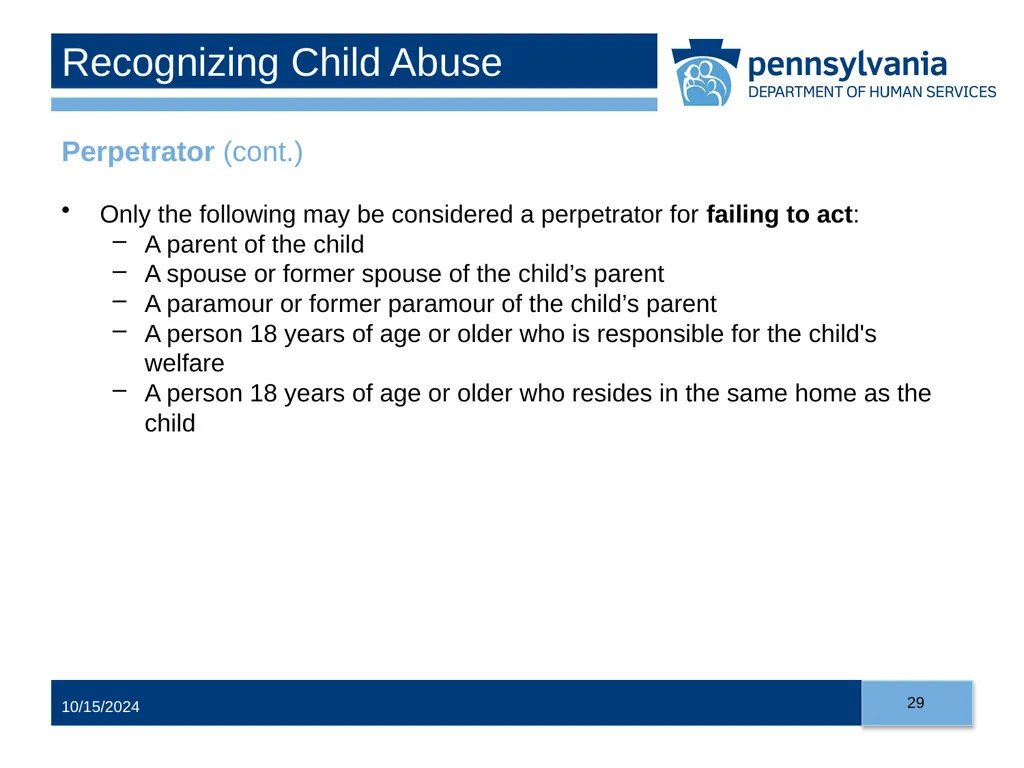
Recognizing Child Abuse 29 Perpetrator (cont.)
Only the following may be considered a perpetrator for failing to act:
A parent of the child
A spouse or former spouse of the child’s parent
A paramour or former paramour of the child’s parent
A person 18 years of age or older who is responsible for the child's welfare
A person 18 years of age or older who resides in the same home as the child<br>
Only the following may be considered a perpetrator for failing to act:
A parent of the child
A spouse or former spouse of the child’s parent
A paramour or former paramour of the child’s parent
A person 18 years of age or older who is responsible for the child's welfare
A person 18 years of age or older who resides in the same home as the child<br>
30
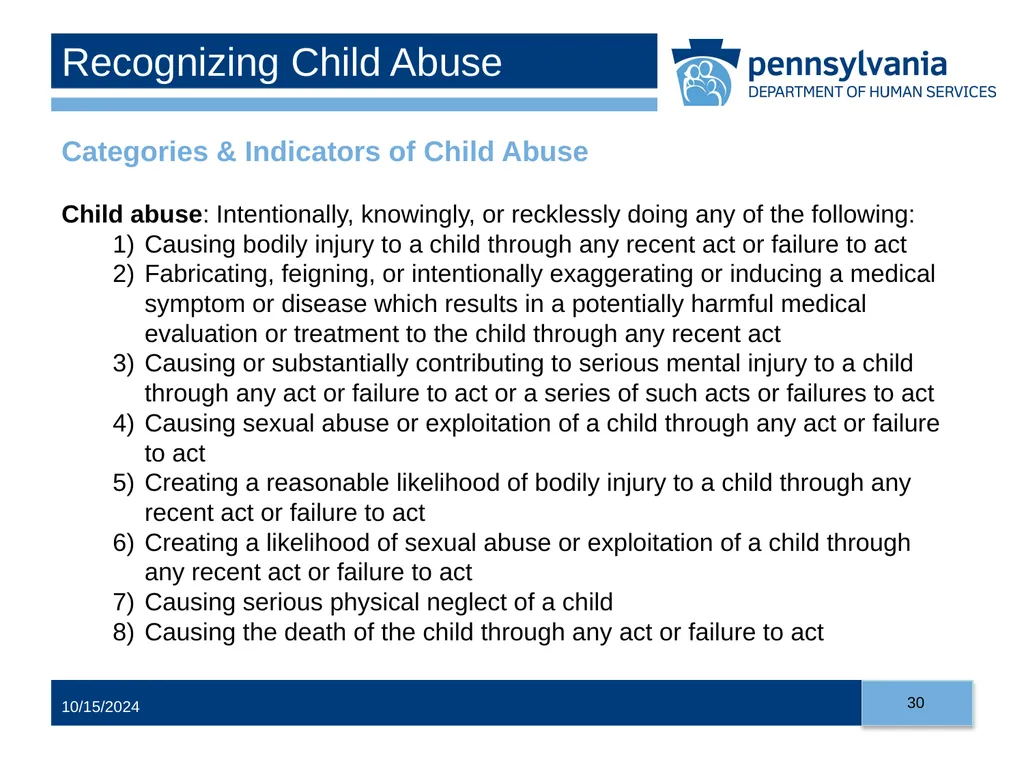
Recognizing Child Abuse 30 Categories & Indicators of Child Abuse
Child abuse: Intentionally, knowingly, or recklessly doing any of the following:
Causing bodily injury to a child through any recent act or failure to act
Fabricating, feigning, or intentionally exaggerating or inducing a medical symptom or disease which results in a potentially harmful medical evaluation or treatment to the child through any recent act
Causing or substantially contributing to serious mental injury to a child through any act or failure to act or a series of such acts or failures to act
Causing sexual abuse or exploitation of a child through any act or failure to act
Creating a reasonable likelihood of bodily injury to a child through any recent act or failure to act
Creating a likelihood of sexual abuse or exploitation of a child through any recent act or failure to act
Causing serious physical neglect of a child
Causing the death of the child through any act or failure to act<br>
Child abuse: Intentionally, knowingly, or recklessly doing any of the following:
Causing bodily injury to a child through any recent act or failure to act
Fabricating, feigning, or intentionally exaggerating or inducing a medical symptom or disease which results in a potentially harmful medical evaluation or treatment to the child through any recent act
Causing or substantially contributing to serious mental injury to a child through any act or failure to act or a series of such acts or failures to act
Causing sexual abuse or exploitation of a child through any act or failure to act
Creating a reasonable likelihood of bodily injury to a child through any recent act or failure to act
Creating a likelihood of sexual abuse or exploitation of a child through any recent act or failure to act
Causing serious physical neglect of a child
Causing the death of the child through any act or failure to act<br>
31
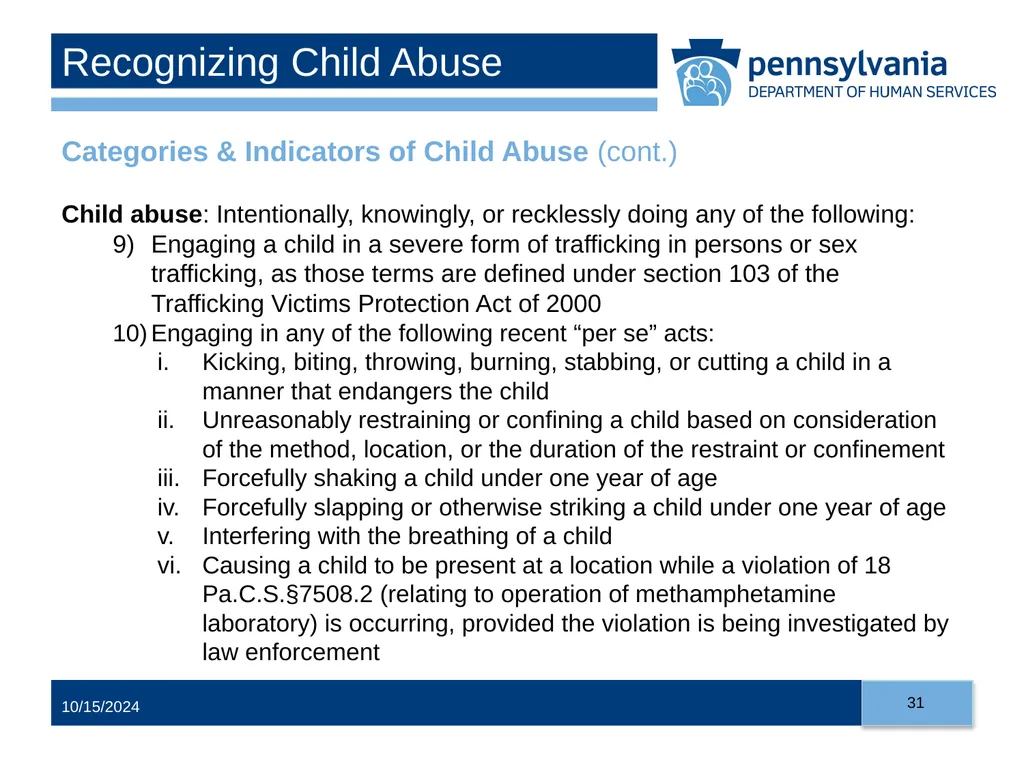
Recognizing Child Abuse 31 Categories & Indicators of Child Abuse (cont.)
Child abuse: Intentionally, knowingly, or recklessly doing any of the following:
Engaging a child in a severe form of trafficking in persons or sex trafficking, as those terms are defined under section 103 of the Trafficking Victims Protection Act of 2000
Engaging in any of the following recent “per se” acts:
Kicking, biting, throwing, burning, stabbing, or cutting a child in a manner that endangers the child
Unreasonably restraining or confining a child based on consideration of the method, location, or the duration of the restraint or confinement
Forcefully shaking a child under one year of age
Forcefully slapping or otherwise striking a child under one year of age
Interfering with the breathing of a child
Causing a child to be present at a location while a violation of 18 Pa.C.S.§7508.2 (relating to operation of methamphetamine laboratory) is occurring, provided the violation is being investigated by law enforcement<br>
Child abuse: Intentionally, knowingly, or recklessly doing any of the following:
Engaging a child in a severe form of trafficking in persons or sex trafficking, as those terms are defined under section 103 of the Trafficking Victims Protection Act of 2000
Engaging in any of the following recent “per se” acts:
Kicking, biting, throwing, burning, stabbing, or cutting a child in a manner that endangers the child
Unreasonably restraining or confining a child based on consideration of the method, location, or the duration of the restraint or confinement
Forcefully shaking a child under one year of age
Forcefully slapping or otherwise striking a child under one year of age
Interfering with the breathing of a child
Causing a child to be present at a location while a violation of 18 Pa.C.S.§7508.2 (relating to operation of methamphetamine laboratory) is occurring, provided the violation is being investigated by law enforcement<br>
32
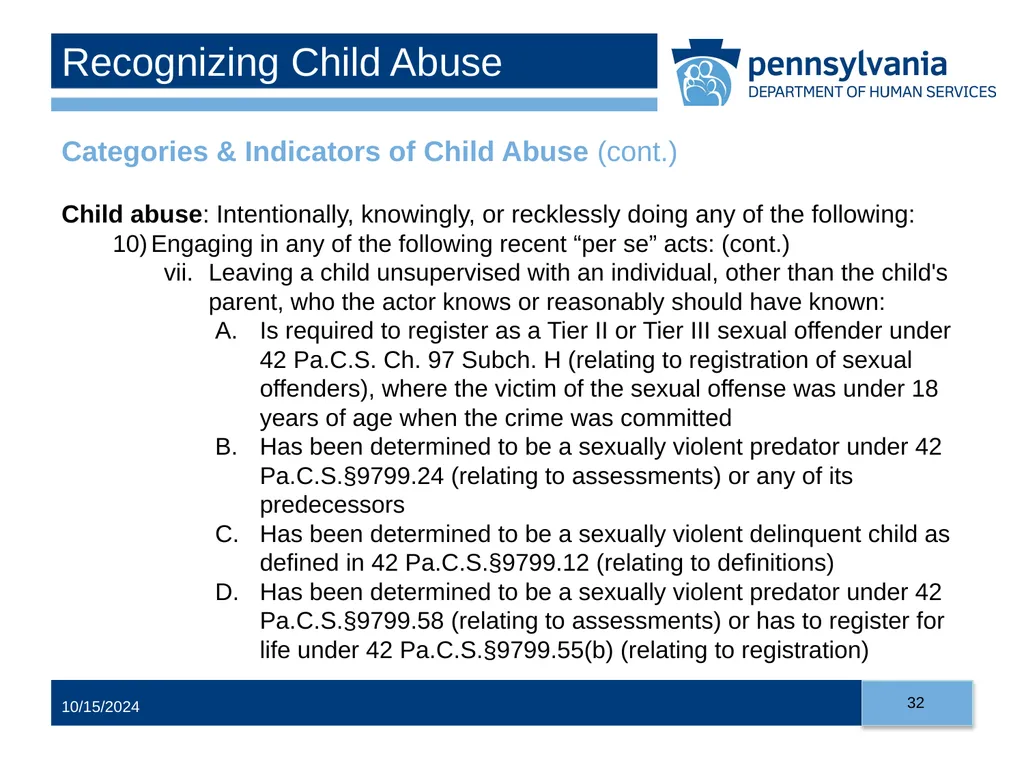
Recognizing Child Abuse 32 Categories & Indicators of Child Abuse (cont.)
Child abuse: Intentionally, knowingly, or recklessly doing any of the following:
Engaging in any of the following recent “per se” acts: (cont.)
Leaving a child unsupervised with an individual, other than the child's parent, who the actor knows or reasonably should have known:
Is required to register as a Tier II or Tier III sexual offender under 42 Pa.C.S. Ch. 97 Subch. H (relating to registration of sexual offenders), where the victim of the sexual offense was under 18 years of age when the crime was committed
Has been determined to be a sexually violent predator under 42 Pa.C.S.§9799.24 (relating to assessments) or any of its predecessors
Has been determined to be a sexually violent delinquent child as defined in 42 Pa.C.S.§9799.12 (relating to definitions)
Has been determined to be a sexually violent predator under 42 Pa.C.S.§9799.58 (relating to assessments) or has to register for life under 42 Pa.C.S.§9799.55(b) (relating to registration)<br>
Child abuse: Intentionally, knowingly, or recklessly doing any of the following:
Engaging in any of the following recent “per se” acts: (cont.)
Leaving a child unsupervised with an individual, other than the child's parent, who the actor knows or reasonably should have known:
Is required to register as a Tier II or Tier III sexual offender under 42 Pa.C.S. Ch. 97 Subch. H (relating to registration of sexual offenders), where the victim of the sexual offense was under 18 years of age when the crime was committed
Has been determined to be a sexually violent predator under 42 Pa.C.S.§9799.24 (relating to assessments) or any of its predecessors
Has been determined to be a sexually violent delinquent child as defined in 42 Pa.C.S.§9799.12 (relating to definitions)
Has been determined to be a sexually violent predator under 42 Pa.C.S.§9799.58 (relating to assessments) or has to register for life under 42 Pa.C.S.§9799.55(b) (relating to registration)<br>
33
Recognizing Child Abuse 33 Categories & Indicators of Child Abuse (cont.)
Bodily injury: Impairment of physical condition or substantial pain
Impairment: If, due to the injury, the child’s ability to function is reduced temporarily or permanently in any way
Substantial pain: If the child experiences what a reasonable person believes to be substantial pain<br>
Bodily injury: Impairment of physical condition or substantial pain
Impairment: If, due to the injury, the child’s ability to function is reduced temporarily or permanently in any way
Substantial pain: If the child experiences what a reasonable person believes to be substantial pain<br>
34
Recognizing Child Abuse 34 Categories & Indicators of Child Abuse (cont.)
Bodily injury (cont.)
Indicators:
Fear of going home
Fear of parent or caregiver
Extreme apprehensiveness/vigilance
Pronounced aggression or passivity
Flinches easily or avoids being touched
Play includes abusive talk or behavior
Unexplained injuries
Unbelievable or inconsistent explanations of injuries
Injuries inconsistent with a child’s age/developmental level
Unable to recall how injuries occurred or account of injuries is inconsistent with the nature of the injuries
Multiple bruises in various stages of healing
Bruises located on face, ears, neck, buttocks, back, chest, thighs, back of legs, and genitalia Bruises that resemble objects such as a hand, fist, belt buckle, or rope
Burns<br>
Bodily injury (cont.)
Indicators:
Fear of going home
Fear of parent or caregiver
Extreme apprehensiveness/vigilance
Pronounced aggression or passivity
Flinches easily or avoids being touched
Play includes abusive talk or behavior
Unexplained injuries
Unbelievable or inconsistent explanations of injuries
Injuries inconsistent with a child’s age/developmental level
Unable to recall how injuries occurred or account of injuries is inconsistent with the nature of the injuries
Multiple bruises in various stages of healing
Bruises located on face, ears, neck, buttocks, back, chest, thighs, back of legs, and genitalia Bruises that resemble objects such as a hand, fist, belt buckle, or rope
Burns<br>
35
Recognizing Child Abuse 35 Categories & Indicators of Child Abuse (cont.)
Bodily injury (cont.)
Suggestion: At-Risk Youth Populations:
*please provide a source/citation*<br>
Bodily injury (cont.)
Suggestion: At-Risk Youth Populations:
*please provide a source/citation*<br>
36
Recognizing Child Abuse 36 Categories & Indicators of Child Abuse (cont.)
Serious mental injury: A psychological condition, as diagnosed by a physician or licensed psychologist, including the refusal of appropriate treatment, that:
Renders a child chronically and severely anxious, agitated, depressed, socially withdrawn, psychotic, or in reasonable fear that the child's life or safety is threatened; or
Seriously interferes with a child's ability to accomplish age-appropriate developmental and social tasks.<br>
Serious mental injury: A psychological condition, as diagnosed by a physician or licensed psychologist, including the refusal of appropriate treatment, that:
Renders a child chronically and severely anxious, agitated, depressed, socially withdrawn, psychotic, or in reasonable fear that the child's life or safety is threatened; or
Seriously interferes with a child's ability to accomplish age-appropriate developmental and social tasks.<br>
37
Recognizing Child Abuse 37 Categories & Indicators of Child Abuse (cont.)
Serious mental injury (cont.)
Indicators:
Expressing feelings of inadequacy
Fearful of trying new things
Overly compliant
Poor peer relationships
Excessive dependence on adults
Habit disorders (sucking, rocking, etc.)
Eating disorders
Frequent psychosomatic complaints (nausea, stomachache, headache, etc.)
Bed-wetting
Self-harm
Speech disorders<br>
Serious mental injury (cont.)
Indicators:
Expressing feelings of inadequacy
Fearful of trying new things
Overly compliant
Poor peer relationships
Excessive dependence on adults
Habit disorders (sucking, rocking, etc.)
Eating disorders
Frequent psychosomatic complaints (nausea, stomachache, headache, etc.)
Bed-wetting
Self-harm
Speech disorders<br>
38
Recognizing Child Abuse 38 Categories & Indicators of Child Abuse (cont.)
Serious mental injury (cont.)
Suggestion: At-Risk Youth Populations:
*please provide a source/citation*<br>
Serious mental injury (cont.)
Suggestion: At-Risk Youth Populations:
*please provide a source/citation*<br>
39
Recognizing Child Abuse 39 Categories & Indicators of Child Abuse (cont.)
Serious physical neglect: Any of the following when committed by a perpetrator that endangers a child's life or health, threatens a child's well-being, causes bodily injury, or impairs a child's health, development, or functioning:
A repeated, prolonged or egregious failure to supervise a child in a manner that is appropriate considering the child's developmental age and abilities
The failure to provide a child with adequate essentials of life, including food, shelter, or medical care<br>
Serious physical neglect: Any of the following when committed by a perpetrator that endangers a child's life or health, threatens a child's well-being, causes bodily injury, or impairs a child's health, development, or functioning:
A repeated, prolonged or egregious failure to supervise a child in a manner that is appropriate considering the child's developmental age and abilities
The failure to provide a child with adequate essentials of life, including food, shelter, or medical care<br>
40
Recognizing Child Abuse 40 Categories & Indicators of Child Abuse (cont.)
Serious physical neglect (cont.)
Indicators:
Not registered in school
Inadequate or inappropriate supervision
Poor impulse control
Frequently fatigued
Parentified behaviors
Lack of adequate medical and dental care
Often hungry
Lack of shelter
Weight is significantly lower than normal for age and gender
Developmental delays
Persistent (untreated) conditions (e.g., head lice, diaper rash)
Exposure to hazards (e.g., illegal drugs, rodent/insect infestation, mold)
Clothing that is dirty, inappropriate for the weather, too small, or too large<br>
Serious physical neglect (cont.)
Indicators:
Not registered in school
Inadequate or inappropriate supervision
Poor impulse control
Frequently fatigued
Parentified behaviors
Lack of adequate medical and dental care
Often hungry
Lack of shelter
Weight is significantly lower than normal for age and gender
Developmental delays
Persistent (untreated) conditions (e.g., head lice, diaper rash)
Exposure to hazards (e.g., illegal drugs, rodent/insect infestation, mold)
Clothing that is dirty, inappropriate for the weather, too small, or too large<br>
41
Recognizing Child Abuse 41 Categories & Indicators of Child Abuse (cont.)
Serious physical neglect (cont.)
Suggestion: At-Risk Youth Populations:
*please provide a source/citation*<br>
Serious physical neglect (cont.)
Suggestion: At-Risk Youth Populations:
*please provide a source/citation*<br>
42
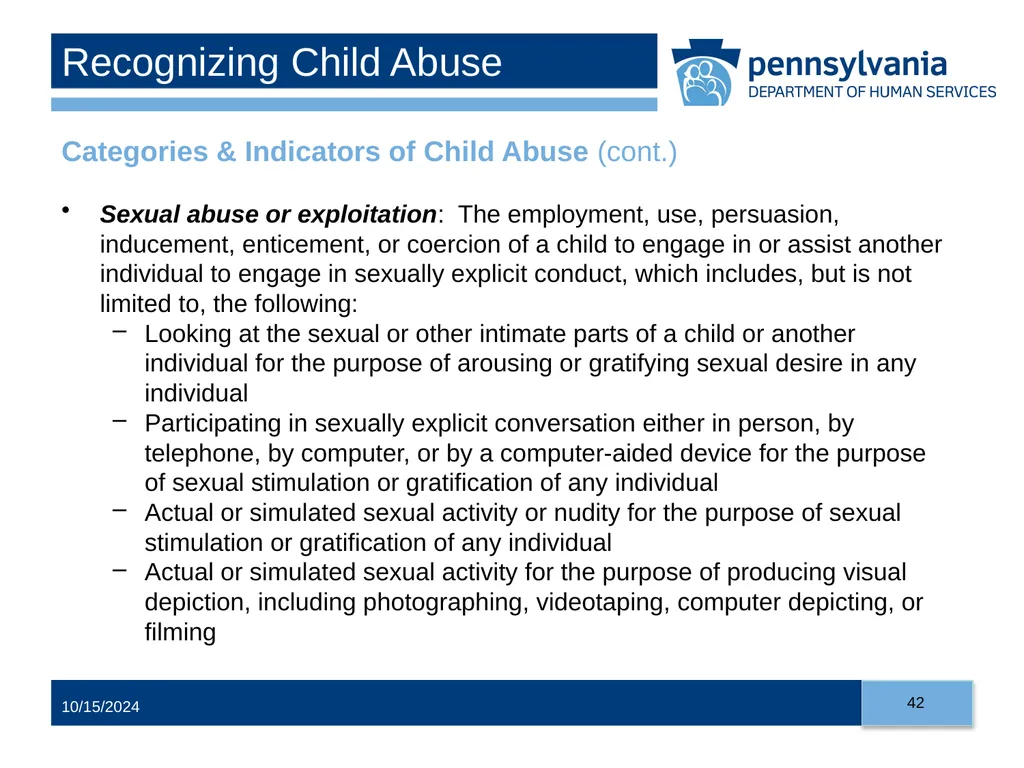
Recognizing Child Abuse 42 Categories & Indicators of Child Abuse (cont.)
Sexual abuse or exploitation: The employment, use, persuasion, inducement, enticement, or coercion of a child to engage in or assist another individual to engage in sexually explicit conduct, which includes, but is not limited to, the following:
Looking at the sexual or other intimate parts of a child or another individual for the purpose of arousing or gratifying sexual desire in any individual
Participating in sexually explicit conversation either in person, by telephone, by computer, or by a computer-aided device for the purpose of sexual stimulation or gratification of any individual
Actual or simulated sexual activity or nudity for the purpose of sexual stimulation or gratification of any individual
Actual or simulated sexual activity for the purpose of producing visual depiction, including photographing, videotaping, computer depicting, or filming<br>
Sexual abuse or exploitation: The employment, use, persuasion, inducement, enticement, or coercion of a child to engage in or assist another individual to engage in sexually explicit conduct, which includes, but is not limited to, the following:
Looking at the sexual or other intimate parts of a child or another individual for the purpose of arousing or gratifying sexual desire in any individual
Participating in sexually explicit conversation either in person, by telephone, by computer, or by a computer-aided device for the purpose of sexual stimulation or gratification of any individual
Actual or simulated sexual activity or nudity for the purpose of sexual stimulation or gratification of any individual
Actual or simulated sexual activity for the purpose of producing visual depiction, including photographing, videotaping, computer depicting, or filming<br>
43
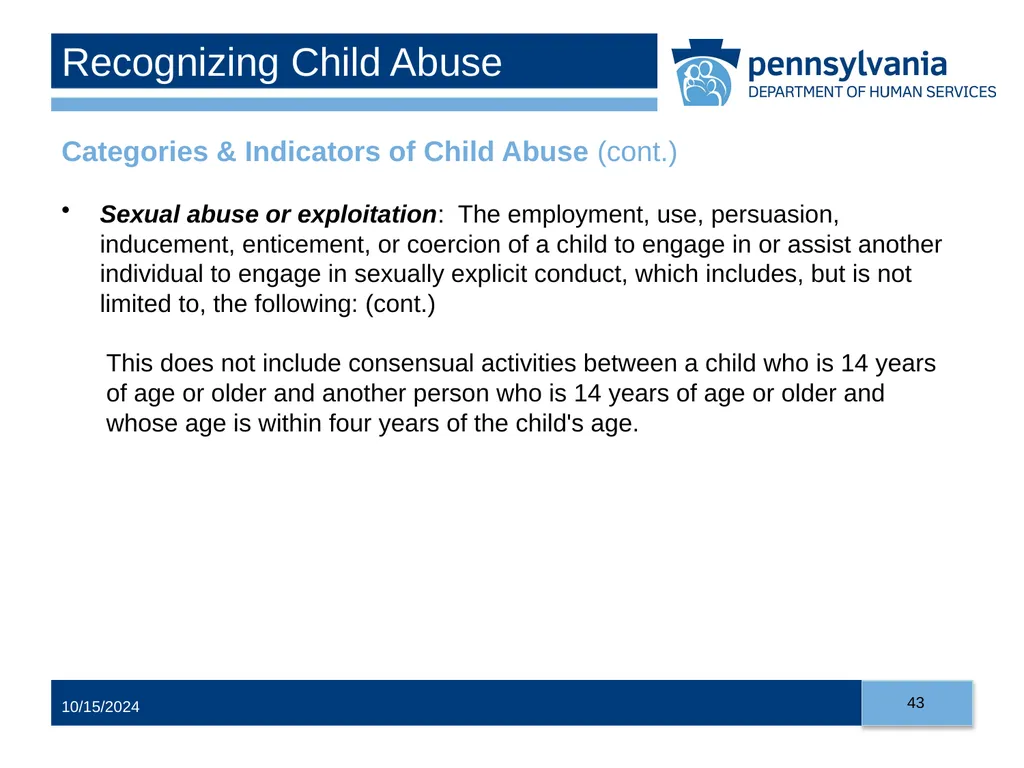
Recognizing Child Abuse 43 Categories & Indicators of Child Abuse (cont.)
Sexual abuse or exploitation: The employment, use, persuasion, inducement, enticement, or coercion of a child to engage in or assist another individual to engage in sexually explicit conduct, which includes, but is not limited to, the following: (cont.)
This does not include consensual activities between a child who is 14 years of age or older and another person who is 14 years of age or older and whose age is within four years of the child's age.<br>
Sexual abuse or exploitation: The employment, use, persuasion, inducement, enticement, or coercion of a child to engage in or assist another individual to engage in sexually explicit conduct, which includes, but is not limited to, the following: (cont.)
This does not include consensual activities between a child who is 14 years of age or older and another person who is 14 years of age or older and whose age is within four years of the child's age.<br>
44
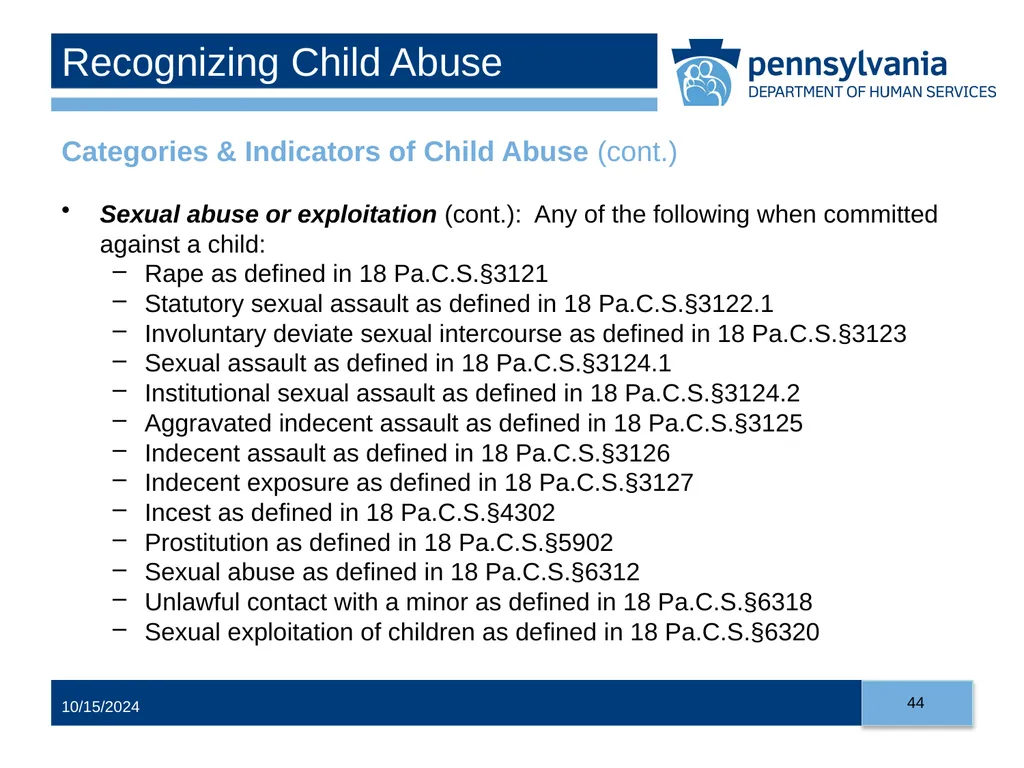
Recognizing Child Abuse 44 Categories & Indicators of Child Abuse (cont.)
Sexual abuse or exploitation (cont.): Any of the following when committed against a child:
Rape as defined in 18 Pa.C.S.§3121
Statutory sexual assault as defined in 18 Pa.C.S.§3122.1
Involuntary deviate sexual intercourse as defined in 18 Pa.C.S.§3123
Sexual assault as defined in 18 Pa.C.S.§3124.1
Institutional sexual assault as defined in 18 Pa.C.S.§3124.2
Aggravated indecent assault as defined in 18 Pa.C.S.§3125
Indecent assault as defined in 18 Pa.C.S.§3126
Indecent exposure as defined in 18 Pa.C.S.§3127
Incest as defined in 18 Pa.C.S.§4302
Prostitution as defined in 18 Pa.C.S.§5902
Sexual abuse as defined in 18 Pa.C.S.§6312
Unlawful contact with a minor as defined in 18 Pa.C.S.§6318
Sexual exploitation of children as defined in 18 Pa.C.S.§6320<br>
Sexual abuse or exploitation (cont.): Any of the following when committed against a child:
Rape as defined in 18 Pa.C.S.§3121
Statutory sexual assault as defined in 18 Pa.C.S.§3122.1
Involuntary deviate sexual intercourse as defined in 18 Pa.C.S.§3123
Sexual assault as defined in 18 Pa.C.S.§3124.1
Institutional sexual assault as defined in 18 Pa.C.S.§3124.2
Aggravated indecent assault as defined in 18 Pa.C.S.§3125
Indecent assault as defined in 18 Pa.C.S.§3126
Indecent exposure as defined in 18 Pa.C.S.§3127
Incest as defined in 18 Pa.C.S.§4302
Prostitution as defined in 18 Pa.C.S.§5902
Sexual abuse as defined in 18 Pa.C.S.§6312
Unlawful contact with a minor as defined in 18 Pa.C.S.§6318
Sexual exploitation of children as defined in 18 Pa.C.S.§6320<br>
45
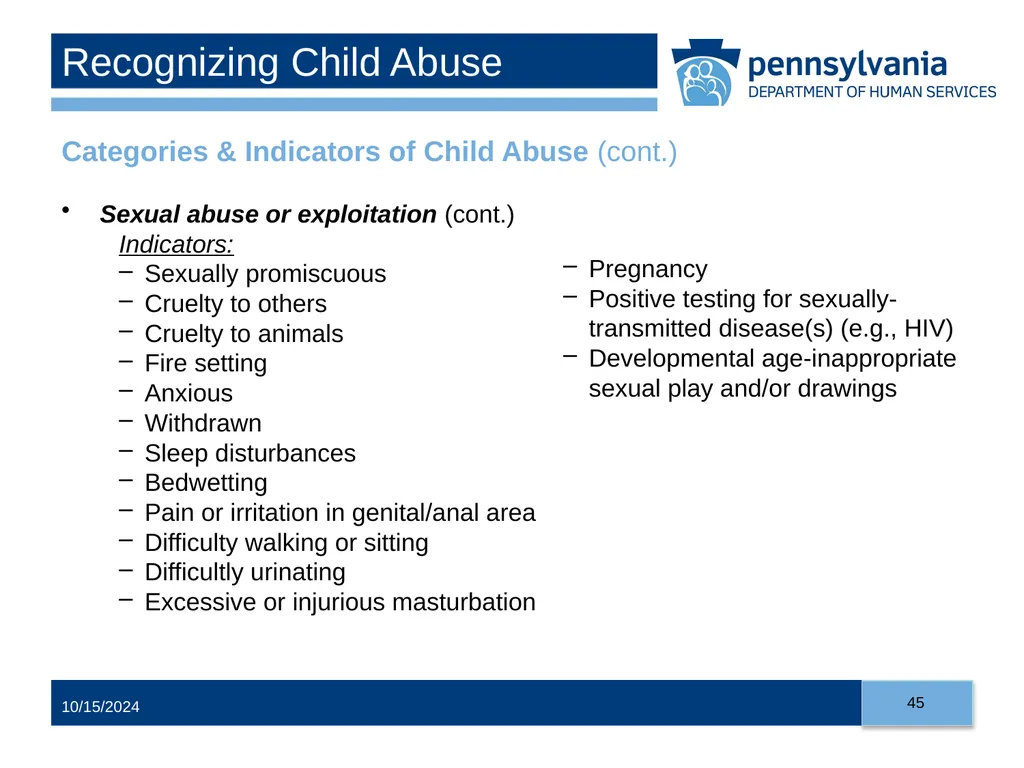
Recognizing Child Abuse 45 Categories & Indicators of Child Abuse (cont.)
Sexual abuse or exploitation (cont.)
Indicators:
Sexually promiscuous
Cruelty to others
Cruelty to animals
Fire setting
Anxious
Withdrawn
Sleep disturbances
Bedwetting
Pain or irritation in genital/anal area
Difficulty walking or sitting
Difficultly urinating
Excessive or injurious masturbation Pregnancy
Positive testing for sexually-transmitted disease(s) (e.g., HIV)
Developmental age-inappropriate sexual play and/or drawings<br>
Sexual abuse or exploitation (cont.)
Indicators:
Sexually promiscuous
Cruelty to others
Cruelty to animals
Fire setting
Anxious
Withdrawn
Sleep disturbances
Bedwetting
Pain or irritation in genital/anal area
Difficulty walking or sitting
Difficultly urinating
Excessive or injurious masturbation Pregnancy
Positive testing for sexually-transmitted disease(s) (e.g., HIV)
Developmental age-inappropriate sexual play and/or drawings<br>
46
Recognizing Child Abuse 46 Categories & Indicators of Child Abuse (cont.)
Sexual abuse or exploitation (cont.)
Suggestion: At-Risk Youth Populations:
*please provide a source/citation*<br>
Sexual abuse or exploitation (cont.)
Suggestion: At-Risk Youth Populations:
*please provide a source/citation*<br>
47
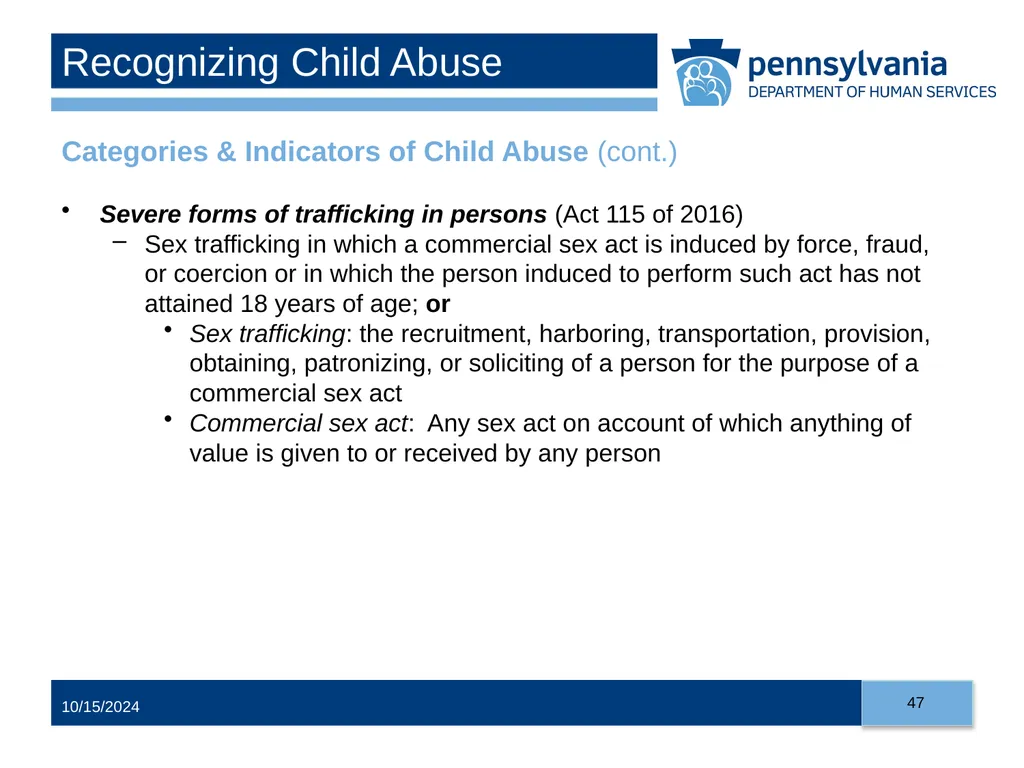
Recognizing Child Abuse 47 Categories & Indicators of Child Abuse (cont.)
Severe forms of trafficking in persons (Act 115 of 2016)
Sex trafficking in which a commercial sex act is induced by force, fraud, or coercion or in which the person induced to perform such act has not attained 18 years of age; or
Sex trafficking: the recruitment, harboring, transportation, provision, obtaining, patronizing, or soliciting of a person for the purpose of a commercial sex act
Commercial sex act: Any sex act on account of which anything of value is given to or received by any person<br>
Severe forms of trafficking in persons (Act 115 of 2016)
Sex trafficking in which a commercial sex act is induced by force, fraud, or coercion or in which the person induced to perform such act has not attained 18 years of age; or
Sex trafficking: the recruitment, harboring, transportation, provision, obtaining, patronizing, or soliciting of a person for the purpose of a commercial sex act
Commercial sex act: Any sex act on account of which anything of value is given to or received by any person<br>
48
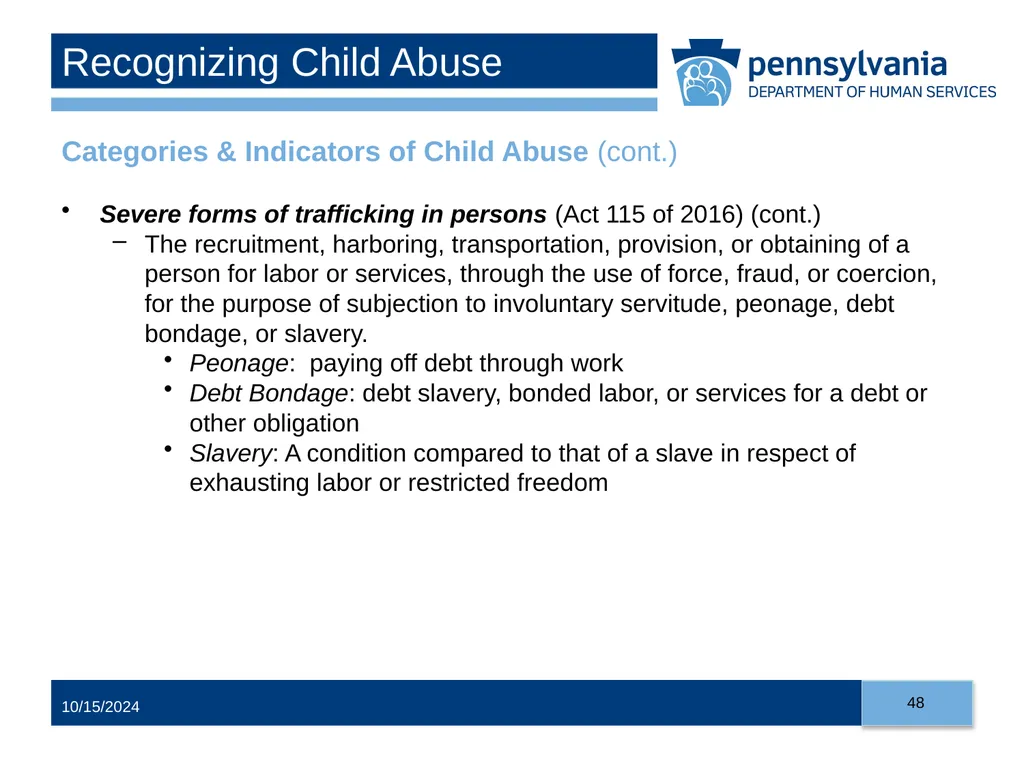
Recognizing Child Abuse 48 Categories & Indicators of Child Abuse (cont.)
Severe forms of trafficking in persons (Act 115 of 2016) (cont.)
The recruitment, harboring, transportation, provision, or obtaining of a person for labor or services, through the use of force, fraud, or coercion, for the purpose of subjection to involuntary servitude, peonage, debt bondage, or slavery.
Peonage: paying off debt through work
Debt Bondage: debt slavery, bonded labor, or services for a debt or other obligation
Slavery: A condition compared to that of a slave in respect of exhausting labor or restricted freedom<br>
Severe forms of trafficking in persons (Act 115 of 2016) (cont.)
The recruitment, harboring, transportation, provision, or obtaining of a person for labor or services, through the use of force, fraud, or coercion, for the purpose of subjection to involuntary servitude, peonage, debt bondage, or slavery.
Peonage: paying off debt through work
Debt Bondage: debt slavery, bonded labor, or services for a debt or other obligation
Slavery: A condition compared to that of a slave in respect of exhausting labor or restricted freedom<br>
49
Recognizing Child Abuse 49 Categories & Indicators of Child Abuse (cont.)
Severe forms of trafficking in persons (Act 115 of 2016) (cont.)
Labor trafficking: Labor obtained by use of threat of serious harm, physical restraint, or abuse of legal process
Examples:
Being forced to work for little or no pay (frequently in factories and farms)
Domestic servitude: providing services within a household for 10-16 hours per day, such as, but not limited to: childcare, cooking, cleaning, yard work, gardening, etc.<br>
Severe forms of trafficking in persons (Act 115 of 2016) (cont.)
Labor trafficking: Labor obtained by use of threat of serious harm, physical restraint, or abuse of legal process
Examples:
Being forced to work for little or no pay (frequently in factories and farms)
Domestic servitude: providing services within a household for 10-16 hours per day, such as, but not limited to: childcare, cooking, cleaning, yard work, gardening, etc.<br>
50
Recognizing Child Abuse 50 Categories & Indicators of Child Abuse (cont.)
Severe forms of trafficking in persons (Act 115 of 2016) (cont.)
Victim Identification/Warning Signs – including, but not limited to:
Has been verified to be under the age of 18 and is in any way involved in a commercial sex act industry or has a record of prior arrest for prostitution or related charges
Has an explicitly sexual online profile
Excessively frequents internet chat rooms and classified sites
Depicts elements of sexual exploitation in drawing, poetry, or other modes of creative expression
Secrecy about whereabouts
Has late nights or unusual hours
Is found in a hotel, street track, truck stop, or strip club
Lies about or has no identification or knowledge of personal data, such as but not limited to: age, name, and/or date of birth
Does not have insurance or control over own finances<br>
Severe forms of trafficking in persons (Act 115 of 2016) (cont.)
Victim Identification/Warning Signs – including, but not limited to:
Has been verified to be under the age of 18 and is in any way involved in a commercial sex act industry or has a record of prior arrest for prostitution or related charges
Has an explicitly sexual online profile
Excessively frequents internet chat rooms and classified sites
Depicts elements of sexual exploitation in drawing, poetry, or other modes of creative expression
Secrecy about whereabouts
Has late nights or unusual hours
Is found in a hotel, street track, truck stop, or strip club
Lies about or has no identification or knowledge of personal data, such as but not limited to: age, name, and/or date of birth
Does not have insurance or control over own finances<br>
51
Recognizing Child Abuse 51 Categories & Indicators of Child Abuse (cont.)
Severe forms of trafficking in persons (Act 115 of 2016) (cont.)
Victim Identification/Warning Signs – including, but not limited to: (cont.)
Wears clothing that is dirty and inappropriate for the weather; it may be too large or too small (often dresses or skirts that are provocative in nature)
Wears new clothes of any style and gets hair and/or nails done with no financial means
Has multiple cell phones or very expensive items that they have no way of purchasing on their own
Has unaddressed medical issues or goes to the ER or clinic alone or with an unrelated adult
Exhibits hypervigilance or paranoid behaviors
Is in a controlling or dominating relationship
Avoids answering questions and lets someone else speak for them<br>
Severe forms of trafficking in persons (Act 115 of 2016) (cont.)
Victim Identification/Warning Signs – including, but not limited to: (cont.)
Wears clothing that is dirty and inappropriate for the weather; it may be too large or too small (often dresses or skirts that are provocative in nature)
Wears new clothes of any style and gets hair and/or nails done with no financial means
Has multiple cell phones or very expensive items that they have no way of purchasing on their own
Has unaddressed medical issues or goes to the ER or clinic alone or with an unrelated adult
Exhibits hypervigilance or paranoid behaviors
Is in a controlling or dominating relationship
Avoids answering questions and lets someone else speak for them<br>
52
Recognizing Child Abuse 52 Categories & Indicators of Child Abuse (cont.)
Severe forms of trafficking in persons (Act 115 of 2016) (cont.)
Victim Identification/Warning Signs – including, but not limited to: (cont.)
Expresses interest in or is in relationships with adults or much older adults
Has significant change in behavior, including increased social media and new associates or friends at school
Has frequent or multiple sexually transmitted diseases or pregnancies
Has unexplained injuries and/or unbelievable or inconsistent explanations of injuries
Has multiple bruises or cuts in various stages of healing
Has a tattoo they’re reluctant to explain
Uses specific terms such as "trick", "the life", or "the game"<br>
Severe forms of trafficking in persons (Act 115 of 2016) (cont.)
Victim Identification/Warning Signs – including, but not limited to: (cont.)
Expresses interest in or is in relationships with adults or much older adults
Has significant change in behavior, including increased social media and new associates or friends at school
Has frequent or multiple sexually transmitted diseases or pregnancies
Has unexplained injuries and/or unbelievable or inconsistent explanations of injuries
Has multiple bruises or cuts in various stages of healing
Has a tattoo they’re reluctant to explain
Uses specific terms such as "trick", "the life", or "the game"<br>
53
Recognizing Child Abuse 53 Categories & Indicators of Child Abuse (cont.)
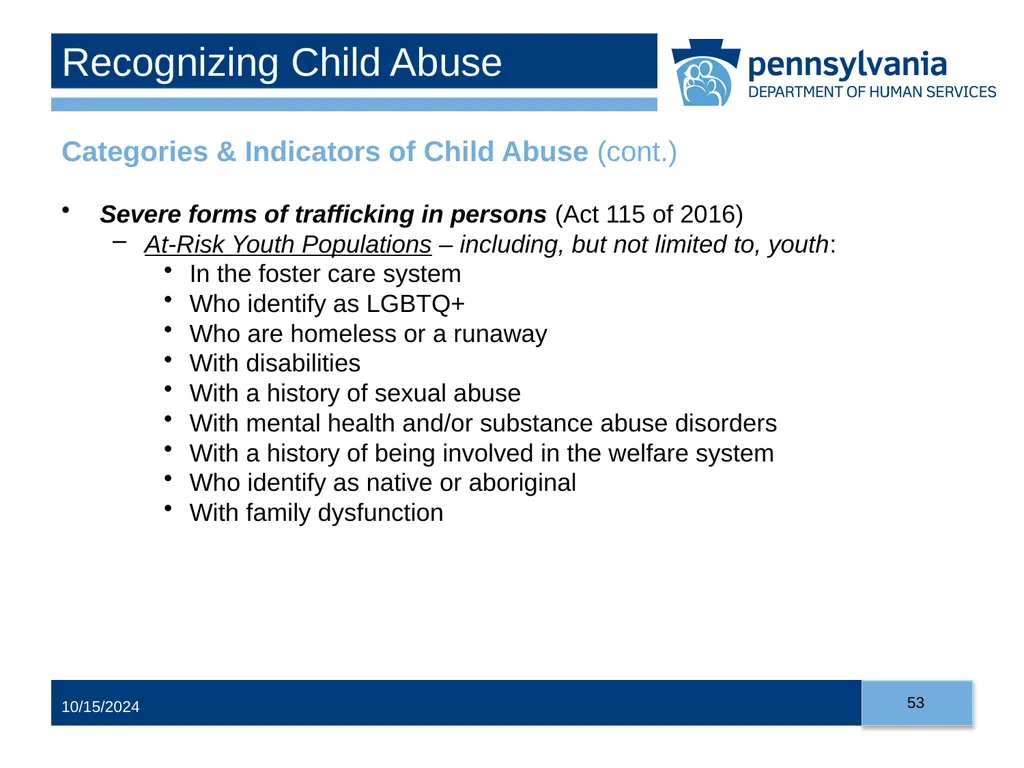
Severe forms of trafficking in persons (Act 115 of 2016)
At-Risk Youth Populations – including, but not limited to, youth:
In the foster care system
Who identify as LGBTQ+
Who are homeless or a runaway
With disabilities
With a history of sexual abuse
With mental health and/or substance abuse disorders
With a history of being involved in the welfare system
Who identify as native or aboriginal
With family dysfunction<br>
Severe forms of trafficking in persons (Act 115 of 2016)
At-Risk Youth Populations – including, but not limited to, youth:
In the foster care system
Who identify as LGBTQ+
Who are homeless or a runaway
With disabilities
With a history of sexual abuse
With mental health and/or substance abuse disorders
With a history of being involved in the welfare system
Who identify as native or aboriginal
With family dysfunction<br>
54
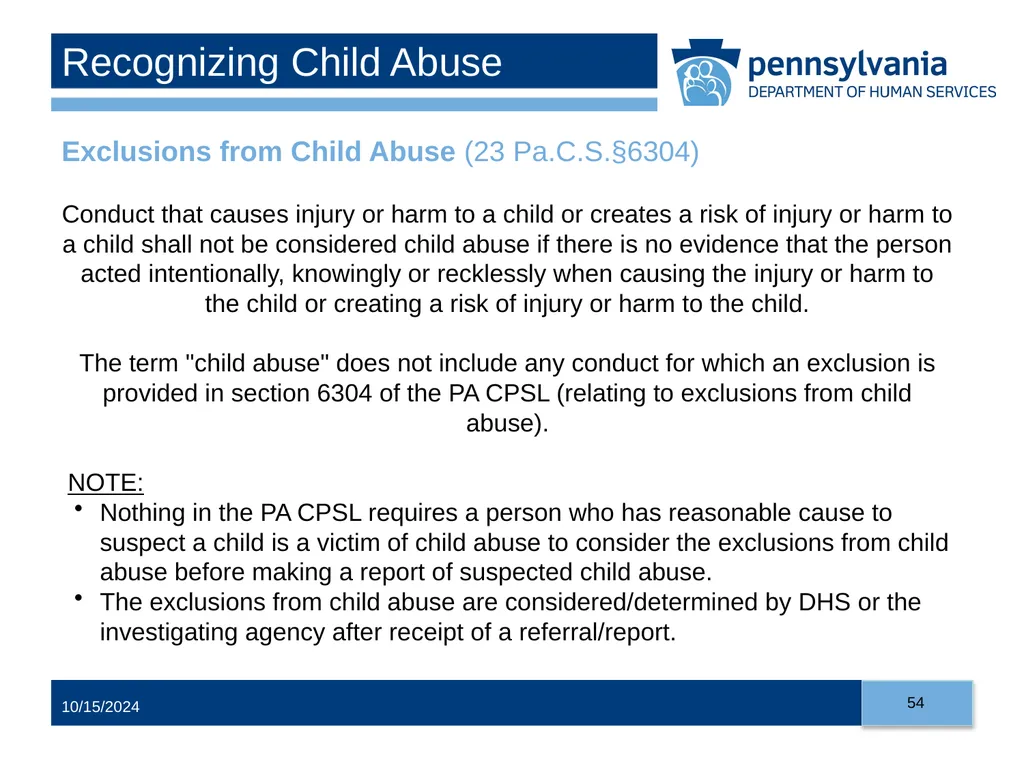
Recognizing Child Abuse 54 Exclusions from Child Abuse (23 Pa.C.S.§6304)
Conduct that causes injury or harm to a child or creates a risk of injury or harm to a child shall not be considered child abuse if there is no evidence that the person acted intentionally, knowingly or recklessly when causing the injury or harm to the child or creating a risk of injury or harm to the child.
The term "child abuse" does not include any conduct for which an exclusion is provided in section 6304 of the PA CPSL (relating to exclusions from child abuse).
NOTE:
Nothing in the PA CPSL requires a person who has reasonable cause to suspect a child is a victim of child abuse to consider the exclusions from child abuse before making a report of suspected child abuse.
The exclusions from child abuse are considered/determined by DHS or the investigating agency after receipt of a referral/report.<br>
Conduct that causes injury or harm to a child or creates a risk of injury or harm to a child shall not be considered child abuse if there is no evidence that the person acted intentionally, knowingly or recklessly when causing the injury or harm to the child or creating a risk of injury or harm to the child.
The term "child abuse" does not include any conduct for which an exclusion is provided in section 6304 of the PA CPSL (relating to exclusions from child abuse).
NOTE:
Nothing in the PA CPSL requires a person who has reasonable cause to suspect a child is a victim of child abuse to consider the exclusions from child abuse before making a report of suspected child abuse.
The exclusions from child abuse are considered/determined by DHS or the investigating agency after receipt of a referral/report.<br>
55
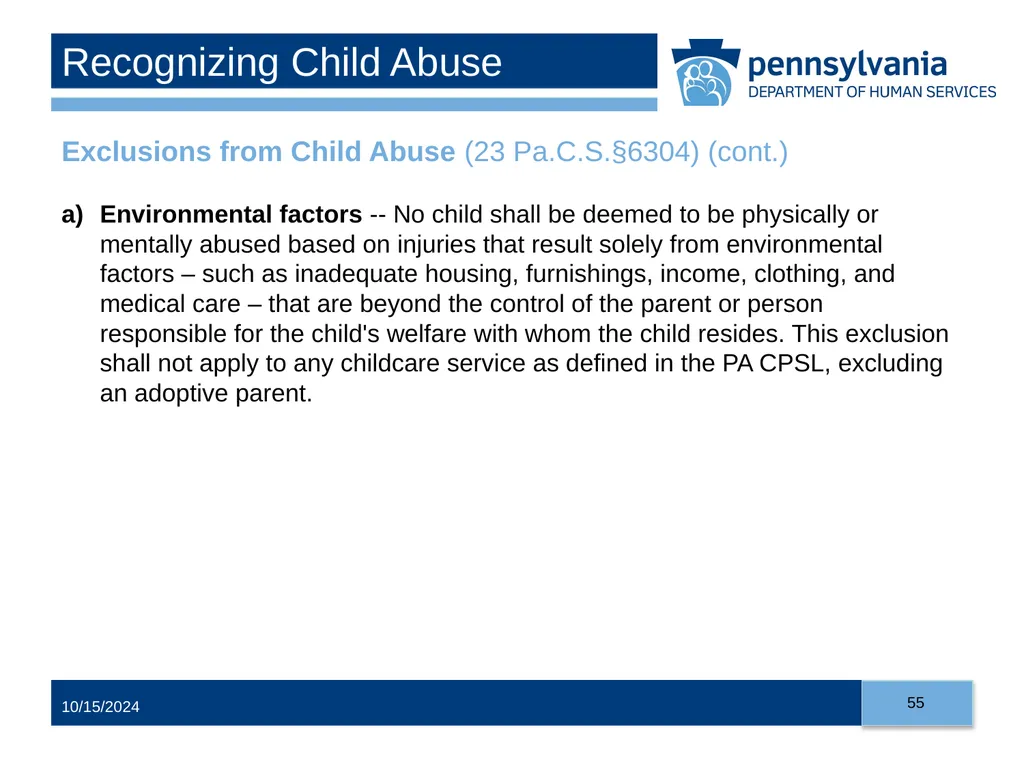
Recognizing Child Abuse 55 Exclusions from Child Abuse (23 Pa.C.S.§6304) (cont.)
Environmental factors -- No child shall be deemed to be physically or mentally abused based on injuries that result solely from environmental factors – such as inadequate housing, furnishings, income, clothing, and medical care – that are beyond the control of the parent or person responsible for the child's welfare with whom the child resides. This exclusion shall not apply to any childcare service as defined in the PA CPSL, excluding an adoptive parent.<br>
Environmental factors -- No child shall be deemed to be physically or mentally abused based on injuries that result solely from environmental factors – such as inadequate housing, furnishings, income, clothing, and medical care – that are beyond the control of the parent or person responsible for the child's welfare with whom the child resides. This exclusion shall not apply to any childcare service as defined in the PA CPSL, excluding an adoptive parent.<br>
56
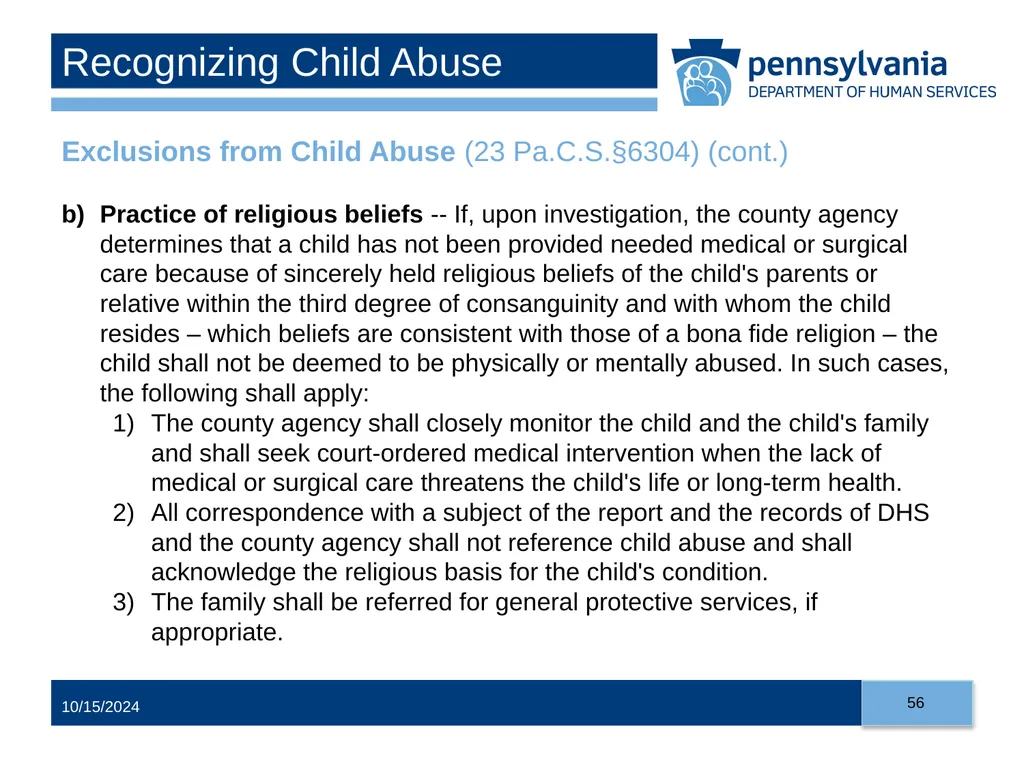
Recognizing Child Abuse 56 Exclusions from Child Abuse (23 Pa.C.S.§6304) (cont.)
Practice of religious beliefs -- If, upon investigation, the county agency determines that a child has not been provided needed medical or surgical care because of sincerely held religious beliefs of the child's parents or relative within the third degree of consanguinity and with whom the child resides – which beliefs are consistent with those of a bona fide religion – the child shall not be deemed to be physically or mentally abused. In such cases, the following shall apply:
The county agency shall closely monitor the child and the child's family and shall seek court-ordered medical intervention when the lack of medical or surgical care threatens the child's life or long-term health.
All correspondence with a subject of the report and the records of DHS and the county agency shall not reference child abuse and shall acknowledge the religious basis for the child's condition.
The family shall be referred for general protective services, if appropriate.<br>
Practice of religious beliefs -- If, upon investigation, the county agency determines that a child has not been provided needed medical or surgical care because of sincerely held religious beliefs of the child's parents or relative within the third degree of consanguinity and with whom the child resides – which beliefs are consistent with those of a bona fide religion – the child shall not be deemed to be physically or mentally abused. In such cases, the following shall apply:
The county agency shall closely monitor the child and the child's family and shall seek court-ordered medical intervention when the lack of medical or surgical care threatens the child's life or long-term health.
All correspondence with a subject of the report and the records of DHS and the county agency shall not reference child abuse and shall acknowledge the religious basis for the child's condition.
The family shall be referred for general protective services, if appropriate.<br>
57
Recognizing Child Abuse 57 Exclusions from Child Abuse (23 Pa.C.S.§6304) (cont.)
Practice of religious beliefs -- If, upon investigation, the county agency determines that a child has not been provided needed medical or surgical care because of sincerely held religious beliefs of the child's parents or relative within the third degree of consanguinity and with whom the child resides – and which beliefs are consistent with those of a bona fide religion – the child shall not be deemed to be physically or mentally abused. In such cases, the following shall apply: (cont.)
This exclusion shall not apply if the failure to provide needed medical or surgical care causes the death of the child.
This exclusion shall not apply to any childcare service (excluding an adoptive parent).<br>
Practice of religious beliefs -- If, upon investigation, the county agency determines that a child has not been provided needed medical or surgical care because of sincerely held religious beliefs of the child's parents or relative within the third degree of consanguinity and with whom the child resides – and which beliefs are consistent with those of a bona fide religion – the child shall not be deemed to be physically or mentally abused. In such cases, the following shall apply: (cont.)
This exclusion shall not apply if the failure to provide needed medical or surgical care causes the death of the child.
This exclusion shall not apply to any childcare service (excluding an adoptive parent).<br>
58
Recognizing Child Abuse 58 Exclusions from Child Abuse (23 Pa.C.S.§6304) (cont.)
Use of force for supervision, control, and safety purposes -- Subject to subsection (d) (relating to rights of parents), the use of reasonable force on or against a child by the child's own parent or person responsible for the child's welfare shall not be considered child abuse if any of the following conditions apply:
The use of reasonable force constitutes incidental, minor, or reasonable physical contact with the child or other actions that are designed to maintain order and control.<br>
Use of force for supervision, control, and safety purposes -- Subject to subsection (d) (relating to rights of parents), the use of reasonable force on or against a child by the child's own parent or person responsible for the child's welfare shall not be considered child abuse if any of the following conditions apply:
The use of reasonable force constitutes incidental, minor, or reasonable physical contact with the child or other actions that are designed to maintain order and control.<br>
59
Recognizing Child Abuse 59 Exclusions from Child Abuse (23 Pa.C.S.§6304) (cont.)
Use of force for supervision, control, and safety purposes -- Subject to subsection (d) (relating to rights of parents), the use of reasonable force on or against a child by the child's own parent or person responsible for the child's welfare shall not be considered child abuse if any of the following conditions apply: (cont.)
The use of reasonable force is necessary:
to quell a disturbance or remove the child from the scene of a disturbance that threatens physical injury to persons or damage to property;
to prevent the child from self-inflicted physical harm;
for self-defense or the defense of another individual; or
to obtain possession of weapons or other dangerous objects or controlled substances or paraphernalia that are on the child or within the control of the child.<br>
Use of force for supervision, control, and safety purposes -- Subject to subsection (d) (relating to rights of parents), the use of reasonable force on or against a child by the child's own parent or person responsible for the child's welfare shall not be considered child abuse if any of the following conditions apply: (cont.)
The use of reasonable force is necessary:
to quell a disturbance or remove the child from the scene of a disturbance that threatens physical injury to persons or damage to property;
to prevent the child from self-inflicted physical harm;
for self-defense or the defense of another individual; or
to obtain possession of weapons or other dangerous objects or controlled substances or paraphernalia that are on the child or within the control of the child.<br>
60
Recognizing Child Abuse 60 Exclusions from Child Abuse (23 Pa.C.S.§6304) (cont.)
Rights of parents -- Nothing in the PA CPSL shall be construed to restrict the generally recognized existing rights of parents to use reasonable force on or against their children for the purposes of supervision, control, and discipline of their children. Such reasonable force shall not constitute child abuse.<br>
Rights of parents -- Nothing in the PA CPSL shall be construed to restrict the generally recognized existing rights of parents to use reasonable force on or against their children for the purposes of supervision, control, and discipline of their children. Such reasonable force shall not constitute child abuse.<br>
61
Recognizing Child Abuse 61 Exclusions from Child Abuse (23 Pa.C.S.§6304) (cont.)
Participation in events that involve physical contact with child -- An individual participating in a practice or competition in an interscholastic sport, physical education, a recreational activity, or an extracurricular activity that involves physical contact with a child does not, in itself, constitute contact that is subject to the reporting requirements of the PA CPSL.<br>
Participation in events that involve physical contact with child -- An individual participating in a practice or competition in an interscholastic sport, physical education, a recreational activity, or an extracurricular activity that involves physical contact with a child does not, in itself, constitute contact that is subject to the reporting requirements of the PA CPSL.<br>
62
Recognizing Child Abuse 62 Exclusions from Child Abuse (23 Pa.C.S.§6304) (cont.)
Child-on-child contact
Harm or injury to a child that results from the act of another child shall not constitute child abuse unless the child who caused the harm or injury is a perpetrator.
Notwithstanding paragraph (1) above, the following shall apply:
Acts constituting any of the following crimes against a child shall be subject to the reporting requirements of the PA CPSL:
Rape as defined in 18 Pa.C.S.§3121
Involuntary deviate sexual intercourse as defined in 18 Pa.C.S. §3123
Sexual assault as defined in 18 Pa.C.S.§3124.1
Aggravated indecent assault as defined in 18 Pa.C.S.§3125
Indecent assault as defined in 18 Pa.C.S.§3126
Indecent exposure as defined in 18 Pa.C.S.§3127<br>
Child-on-child contact
Harm or injury to a child that results from the act of another child shall not constitute child abuse unless the child who caused the harm or injury is a perpetrator.
Notwithstanding paragraph (1) above, the following shall apply:
Acts constituting any of the following crimes against a child shall be subject to the reporting requirements of the PA CPSL:
Rape as defined in 18 Pa.C.S.§3121
Involuntary deviate sexual intercourse as defined in 18 Pa.C.S. §3123
Sexual assault as defined in 18 Pa.C.S.§3124.1
Aggravated indecent assault as defined in 18 Pa.C.S.§3125
Indecent assault as defined in 18 Pa.C.S.§3126
Indecent exposure as defined in 18 Pa.C.S.§3127<br>
63
Recognizing Child Abuse 63 Exclusions from Child Abuse (23 Pa.C.S.§6304) (cont.)
Child-on-child contact (cont.)
Harm or injury to a child that results from the act of another child shall not constitute child abuse unless the child who caused the harm or injury is a perpetrator.
Notwithstanding paragraph (1) above, the following shall apply: (cont.)
No child shall be deemed to be a perpetrator of child abuse based solely on physical or mental injuries caused to another child in the course of a dispute, fight, or scuffle entered into by mutual consent.
A law enforcement official who receives a report of suspected child abuse is not required to make a report to DHS if the person allegedly responsible for the child abuse is a non-perpetrator child.<br>
Child-on-child contact (cont.)
Harm or injury to a child that results from the act of another child shall not constitute child abuse unless the child who caused the harm or injury is a perpetrator.
Notwithstanding paragraph (1) above, the following shall apply: (cont.)
No child shall be deemed to be a perpetrator of child abuse based solely on physical or mental injuries caused to another child in the course of a dispute, fight, or scuffle entered into by mutual consent.
A law enforcement official who receives a report of suspected child abuse is not required to make a report to DHS if the person allegedly responsible for the child abuse is a non-perpetrator child.<br>
64
Recognizing Child Abuse 64 Exclusions from Child Abuse (23 Pa.C.S.§6304) (cont.)
Defensive force -- Reasonable force for self-defense or the defense of another individual consistent with the provisions of 18 Pa.C.S.§§505 (relating to use of force in self-protection) and 506 (relating to use of force for the protection of other persons) shall not be considered child abuse.<br>
Defensive force -- Reasonable force for self-defense or the defense of another individual consistent with the provisions of 18 Pa.C.S.§§505 (relating to use of force in self-protection) and 506 (relating to use of force for the protection of other persons) shall not be considered child abuse.<br>
65
Reporting Suspected Child Abuse 65 10/15/2024<br>
66
Reporting Suspected Child Abuse 66 Reasonable Cause to Suspect
"Reasonable cause to suspect" may be a determination you make based on your training/experience and all known circumstances – to include “who”, “what”, “when”, and “how”, observations (e.g., indicators of abuse or "red flags", behavior/demeanor of the child(ren), behavior/demeanor of the adult(s), etc.), as well as familiarity with the individuals (e.g., family situation and relevant history or similar prior incidents, etc.).
Some indicators may be more apparent than others depending on the type of abuse and/or depending on the child's health, development, and well-being. For example, some indicators may be visible on the child's body while other indicators may be present in the child's behaviors.<br>
"Reasonable cause to suspect" may be a determination you make based on your training/experience and all known circumstances – to include “who”, “what”, “when”, and “how”, observations (e.g., indicators of abuse or "red flags", behavior/demeanor of the child(ren), behavior/demeanor of the adult(s), etc.), as well as familiarity with the individuals (e.g., family situation and relevant history or similar prior incidents, etc.).
Some indicators may be more apparent than others depending on the type of abuse and/or depending on the child's health, development, and well-being. For example, some indicators may be visible on the child's body while other indicators may be present in the child's behaviors.<br>
67
Reporting Suspected Child Abuse 67 Persons Encouraged to Report (23 Pa.C.S.§6312)
Any person may make an oral/verbal (1-800-932-0313) or written report of suspected child abuse, which may be submitted electronically, or cause a report of suspected child abuse to be made to DHS, county agency, or law enforcement, if that person has reasonable cause to suspect that a child is a victim of child abuse.<br>
Any person may make an oral/verbal (1-800-932-0313) or written report of suspected child abuse, which may be submitted electronically, or cause a report of suspected child abuse to be made to DHS, county agency, or law enforcement, if that person has reasonable cause to suspect that a child is a victim of child abuse.<br>
68
Reporting Suspected Child Abuse 68 Persons Required to Report (23 Pa.C.S.§6311)
Mandated reporters -- The following adults shall make a report of suspected child abuse, subject to subsection (b) (relating to basis to report), if they have reasonable cause to suspect that a child is a victim of child abuse:
A person licensed or certified to practice in any health-related field under the jurisdiction of the Department of State (DOS)
A medical examiner, coroner, or funeral director
An employee of a health care facility or provider licensed by the Department of Health (DOH) who is engaged in the admission, examination, care, or treatment of individuals
A school employee
An employee of a child-care service who has direct contact with children in the course of employment
An independent contractor
A clergyman, priest, rabbi, minister, Christian Science practitioner, religious healer, or spiritual leader of any regularly established church or other religious organization<br>
Mandated reporters -- The following adults shall make a report of suspected child abuse, subject to subsection (b) (relating to basis to report), if they have reasonable cause to suspect that a child is a victim of child abuse:
A person licensed or certified to practice in any health-related field under the jurisdiction of the Department of State (DOS)
A medical examiner, coroner, or funeral director
An employee of a health care facility or provider licensed by the Department of Health (DOH) who is engaged in the admission, examination, care, or treatment of individuals
A school employee
An employee of a child-care service who has direct contact with children in the course of employment
An independent contractor
A clergyman, priest, rabbi, minister, Christian Science practitioner, religious healer, or spiritual leader of any regularly established church or other religious organization<br>
69
Reporting Suspected Child Abuse 69 Persons Required to Report (23 Pa.C.S.§6311) (cont.)
Mandated reporters -- The following adults shall make a report of suspected child abuse, subject to subsection (b) (relating to basis to report), if they have reasonable cause to suspect that a child is a victim of child abuse: (cont.)
An individual paid or unpaid, who – on the basis of the individual’s role as an integral part of a regularly scheduled program, activity, or service – is a person responsible for the child’s welfare or has direct contact with children
An employee of a social service agency who has direct contact with children in the course of employment
A peace officer or law enforcement official
An emergency medical services provider certified by DOH
An employee of a public library who has direct contact with children in the course of employment
An individual supervised or managed by a person listed immediately above and on the previous slide who has direct contact with children in the course of employment<br>
Mandated reporters -- The following adults shall make a report of suspected child abuse, subject to subsection (b) (relating to basis to report), if they have reasonable cause to suspect that a child is a victim of child abuse: (cont.)
An individual paid or unpaid, who – on the basis of the individual’s role as an integral part of a regularly scheduled program, activity, or service – is a person responsible for the child’s welfare or has direct contact with children
An employee of a social service agency who has direct contact with children in the course of employment
A peace officer or law enforcement official
An emergency medical services provider certified by DOH
An employee of a public library who has direct contact with children in the course of employment
An individual supervised or managed by a person listed immediately above and on the previous slide who has direct contact with children in the course of employment<br>
70
Reporting Suspected Child Abuse 70 Persons Required to Report (23 Pa.C.S.§6311) (cont.)
Mandated reporters -- The following adults shall make a report of suspected child abuse, subject to subsection (b) (relating to basis to report), if they have reasonable cause to suspect that a child is a victim of child abuse: (cont.)
An attorney affiliated with an agency, institution, organization, or other entity, including a school or regularly established religious organization that is responsible for the care, supervision, guidance, or control of children
A foster parent
An adult family member who is a person responsible for the child's welfare and provides services to a child in a family living home, community home for individuals with an intellectual disability, or host home for children which are subject to supervision or licensure by DHS under Articles IX and X of the act of June 13, 1967 (P.L.31, No.21) known as the Human Services Code (formerly the Public Welfare Code)<br>
Mandated reporters -- The following adults shall make a report of suspected child abuse, subject to subsection (b) (relating to basis to report), if they have reasonable cause to suspect that a child is a victim of child abuse: (cont.)
An attorney affiliated with an agency, institution, organization, or other entity, including a school or regularly established religious organization that is responsible for the care, supervision, guidance, or control of children
A foster parent
An adult family member who is a person responsible for the child's welfare and provides services to a child in a family living home, community home for individuals with an intellectual disability, or host home for children which are subject to supervision or licensure by DHS under Articles IX and X of the act of June 13, 1967 (P.L.31, No.21) known as the Human Services Code (formerly the Public Welfare Code)<br>
71
Reporting Suspected Child Abuse 71 Persons Required to Report (23 Pa.C.S.§6311) (cont.)
Basis to Report -- A mandated reporter shall make a report of suspected child abuse in accordance with section 6313 (relating to reporting procedure) if they have reasonable cause to suspect that a child is a victim of child abuse under any of the following circumstances:
The mandated reporter comes into contact with the child in the course of employment, occupation, and practice of a profession or through a regularly scheduled program, activity, or service
The mandated reporter is directly responsible for the care, supervision, guidance, or training of the child, or is affiliated with an agency, institution, organization, school, regularly established church or religious organization, or other entity that is directly responsible for the care, supervision, guidance, or training of the child
A person makes a specific disclosure to the mandated reporter that an identifiable child is the victim of child abuse
An individual 14 years of age or older makes a specific disclosure to the mandated reporter that the individual has committed child abuse<br>
Basis to Report -- A mandated reporter shall make a report of suspected child abuse in accordance with section 6313 (relating to reporting procedure) if they have reasonable cause to suspect that a child is a victim of child abuse under any of the following circumstances:
The mandated reporter comes into contact with the child in the course of employment, occupation, and practice of a profession or through a regularly scheduled program, activity, or service
The mandated reporter is directly responsible for the care, supervision, guidance, or training of the child, or is affiliated with an agency, institution, organization, school, regularly established church or religious organization, or other entity that is directly responsible for the care, supervision, guidance, or training of the child
A person makes a specific disclosure to the mandated reporter that an identifiable child is the victim of child abuse
An individual 14 years of age or older makes a specific disclosure to the mandated reporter that the individual has committed child abuse<br>
72
Reporting Suspected Child Abuse 72 Persons Required to Report (23 Pa.C.S.§6311) (cont.)
Nothing in this section shall require a child to come before the mandated reporter in order for the mandated reporter in order to make a report of suspected child abuse.
Nothing in this section shall require the mandated reporter to identify the person responsible for the child abuse in order to make a report of suspected child abuse.<br>
Nothing in this section shall require a child to come before the mandated reporter in order for the mandated reporter in order to make a report of suspected child abuse.
Nothing in this section shall require the mandated reporter to identify the person responsible for the child abuse in order to make a report of suspected child abuse.<br>
73
Reporting Suspected Child Abuse 73 Persons Required to Report (23 Pa.C.S.§6311) (cont.)
Staff members of institutions, etc. -- Whenever a person is required to report under subsection (b) (relating to basis to report) in the capacity as a member of the staff of a medical or other public or private institution, school, facility, or agency, that person shall report immediately in accordance with section 6313 (relating to reporting procedure) and shall immediately thereafter notify the person in charge of the institution, school, facility, or agency or the designated agent of the person in charge. Upon notification, the person in charge or the designated agent, if any, shall facilitate the cooperation of the institution, school, facility, or agency with the investigation of the report. Any intimidation, retaliation, or obstruction in the investigation of the report is subject to the provisions of 18 Pa.C.S.§4958 (relating to intimidation, retaliation or obstruction in child abuse cases). The PA CPSL does not require more than one report from any such institution, school, facility, or agency.<br>
Staff members of institutions, etc. -- Whenever a person is required to report under subsection (b) (relating to basis to report) in the capacity as a member of the staff of a medical or other public or private institution, school, facility, or agency, that person shall report immediately in accordance with section 6313 (relating to reporting procedure) and shall immediately thereafter notify the person in charge of the institution, school, facility, or agency or the designated agent of the person in charge. Upon notification, the person in charge or the designated agent, if any, shall facilitate the cooperation of the institution, school, facility, or agency with the investigation of the report. Any intimidation, retaliation, or obstruction in the investigation of the report is subject to the provisions of 18 Pa.C.S.§4958 (relating to intimidation, retaliation or obstruction in child abuse cases). The PA CPSL does not require more than one report from any such institution, school, facility, or agency.<br>
74
Reporting Suspected Child Abuse 74 Privileged Communications (23 Pa.C.S.§6311.1)
General rule -- Subject to subsection (b) (relating to confidential communications) below, the privileged communications between a mandated reporter and a patient or client of the mandated reporter shall not:
Apply to a situation involving child abuse.
Relieve the mandated reporter of the duty to make a report of suspected child abuse.
Confidential communications -- The following protections shall apply:
Confidential communications made to a member of the clergy are protected under 42 Pa.C.S.§5943 (relating to confidential communications to clergymen).
Confidential communications made to an attorney are protected so long as they are within the scope of 42 Pa.C.S.§§5916 (relating to confidential communications to attorney) and 5928 (relating to confidential communications to attorney), the attorney work product doctrine, or the rules of professional conduct for attorneys.<br>
General rule -- Subject to subsection (b) (relating to confidential communications) below, the privileged communications between a mandated reporter and a patient or client of the mandated reporter shall not:
Apply to a situation involving child abuse.
Relieve the mandated reporter of the duty to make a report of suspected child abuse.
Confidential communications -- The following protections shall apply:
Confidential communications made to a member of the clergy are protected under 42 Pa.C.S.§5943 (relating to confidential communications to clergymen).
Confidential communications made to an attorney are protected so long as they are within the scope of 42 Pa.C.S.§§5916 (relating to confidential communications to attorney) and 5928 (relating to confidential communications to attorney), the attorney work product doctrine, or the rules of professional conduct for attorneys.<br>
75
Reporting Suspected Child Abuse 75 Reporting Procedure (23 Pa.C.S.§6313)
Report by mandated reporter --
A mandated reporter shall immediately make an oral/verbal report of suspected child abuse to DHS via the Statewide toll-free telephone number (1-800-932-0313) or a written report using electronic technologies via the self-service Child Welfare Portal.
A mandated reporter making an oral/verbal report of suspected child abuse to DHS via the Statewide toll-free telephone number shall also make a written report, which may be submitted electronically, within 48 hours to DHS or the county agency assigned to the case by using the CY-47 form.
The failure of the mandated reporter to file the written report (CY-47) shall not relieve the county agency from any duty under the PA CPSL, and the county agency shall proceed as though the mandated reporter complied.<br>
Report by mandated reporter --
A mandated reporter shall immediately make an oral/verbal report of suspected child abuse to DHS via the Statewide toll-free telephone number (1-800-932-0313) or a written report using electronic technologies via the self-service Child Welfare Portal.
A mandated reporter making an oral/verbal report of suspected child abuse to DHS via the Statewide toll-free telephone number shall also make a written report, which may be submitted electronically, within 48 hours to DHS or the county agency assigned to the case by using the CY-47 form.
The failure of the mandated reporter to file the written report (CY-47) shall not relieve the county agency from any duty under the PA CPSL, and the county agency shall proceed as though the mandated reporter complied.<br>
76
Reporting Suspected Child Abuse 76 Pursuant to 23 Pa.C.S. § 6383 (relating to education and training), if your agency/organization is an institution, facility, or agency which cares for children and is subject to supervision by PA DHS under Article IX of the Human Services (formerly Public Welfare) Code, your training must also include your internal policies related to reporting suspected child abuse.
*If this does not apply to your agency/organization, we encourage you to include a statement referring participants to their employer for any internal policies related to reporting suspected child abuse that they may have.*<br>
*If this does not apply to your agency/organization, we encourage you to include a statement referring participants to their employer for any internal policies related to reporting suspected child abuse that they may have.*<br>
77
Reporting Suspected Child Abuse 77 Reporting Procedure (23 Pa.C.S.§6313) (cont.)
Contents of report -- A written report of suspected child abuse, which may be submitted electronically, shall include the following information, if known:
The names and addresses of the child, the child's parents, and any other person responsible for the child's welfare
Where the suspected abuse occurred
The age and sex of each subject of the report
The nature and extent of the suspected child abuse, including any evidence of prior abuse to the child or any sibling of the child
The name and relationship of each individual responsible for causing the suspected abuse and any evidence of prior abuse by each individual
Family composition<br>
Contents of report -- A written report of suspected child abuse, which may be submitted electronically, shall include the following information, if known:
The names and addresses of the child, the child's parents, and any other person responsible for the child's welfare
Where the suspected abuse occurred
The age and sex of each subject of the report
The nature and extent of the suspected child abuse, including any evidence of prior abuse to the child or any sibling of the child
The name and relationship of each individual responsible for causing the suspected abuse and any evidence of prior abuse by each individual
Family composition<br>
78
Reporting Suspected Child Abuse 78 Reporting Procedure (23 Pa.C.S.§6313) (cont.)
Contents of report -- A written report of suspected child abuse, which may be submitted electronically, shall include the following information, if known: (cont.)
The source of the report
The name, telephone number and e-mail address of the person making the report
The actions taken by the person making the report, including those actions taken under section 6314 (relating to photographs, medical tests and X-rays of child subject to report), 6315 (relating to taking child into protective custody), 6316 (relating to admission to private and public hospitals) or 6317 (relating to mandatory reporting and postmortem investigation of deaths)
Any other information required by Federal law or regulation
Any other information that DHS requires by regulation<br>
Contents of report -- A written report of suspected child abuse, which may be submitted electronically, shall include the following information, if known: (cont.)
The source of the report
The name, telephone number and e-mail address of the person making the report
The actions taken by the person making the report, including those actions taken under section 6314 (relating to photographs, medical tests and X-rays of child subject to report), 6315 (relating to taking child into protective custody), 6316 (relating to admission to private and public hospitals) or 6317 (relating to mandatory reporting and postmortem investigation of deaths)
Any other information required by Federal law or regulation
Any other information that DHS requires by regulation<br>
79
Reporting Suspected Child Abuse 79 Reporting Procedure (23 Pa.C.S.§6313) (cont.)
Applicability of Mental Health Procedures Act -- Notwithstanding any other provision of law, a mandated reporter who makes a report of suspected child abuse or who makes a report of a crime against a child to law enforcement officials shall not be in violation of the act of July 9, 1976 (P.L.817, No.143), known as the Mental Health Procedures Act, by releasing information necessary to complete the report.<br>
Applicability of Mental Health Procedures Act -- Notwithstanding any other provision of law, a mandated reporter who makes a report of suspected child abuse or who makes a report of a crime against a child to law enforcement officials shall not be in violation of the act of July 9, 1976 (P.L.817, No.143), known as the Mental Health Procedures Act, by releasing information necessary to complete the report.<br>
80
Reporting Suspected Child Abuse 80 Statewide Toll-Free Telephone Number (23 Pa.C.S.§6332)
The Statewide toll-free telephone number is available for all persons, whether mandated by law or not, to use to report cases of suspected child abuse or children allegedly in need of general protective services.
1-800-932-0313<br>
The Statewide toll-free telephone number is available for all persons, whether mandated by law or not, to use to report cases of suspected child abuse or children allegedly in need of general protective services.
1-800-932-0313<br>
81
Reporting Suspected Child Abuse 81 Electronic Reporting (23 Pa.C.S.§6305)
Confirmation of reports -- A confirmation by DHS of the receipt of a report of suspected child abuse submitted electronically shall relieve the person making the report of making an additional oral/verbal or written report of suspected child abuse, subject to section 6313 (relating to reporting procedure).<br>
Confirmation of reports -- A confirmation by DHS of the receipt of a report of suspected child abuse submitted electronically shall relieve the person making the report of making an additional oral/verbal or written report of suspected child abuse, subject to section 6313 (relating to reporting procedure).<br>
82
Reporting Suspected Child Abuse 82 Confidentiality of Reports (23 Pa.C.S.§6339)
Except as otherwise provided in subchapter C of the PA CPSL (relating to powers and duties of department) or by the Pennsylvania Rules of Juvenile Court Procedure, reports made pursuant to the PA CPSL, including, but not limited to, report summaries of child abuse and reports made pursuant to section 6313 (relating to reporting procedure) as well as any other information obtained, reports written, or photographs or X-rays taken concerning alleged instances of child abuse in the possession of DHS or a county agency shall be confidential.<br>
Except as otherwise provided in subchapter C of the PA CPSL (relating to powers and duties of department) or by the Pennsylvania Rules of Juvenile Court Procedure, reports made pursuant to the PA CPSL, including, but not limited to, report summaries of child abuse and reports made pursuant to section 6313 (relating to reporting procedure) as well as any other information obtained, reports written, or photographs or X-rays taken concerning alleged instances of child abuse in the possession of DHS or a county agency shall be confidential.<br>
83
Reporting Suspected Child Abuse 83 Release of Information in Confidential Reports (23 Pa.C.S.§6340)
Protecting identity -- Except for reports under section 6340(a)(9) and (10) of the PA CPSL and in response to a law enforcement official investigating allegations of false reports under 18 Pa.C.S.§4906.1 (relating to false reports of child abuse), the release of data by DHS, county, institution, school, facility, or agency or designated agent of the person in charge that would identify the person who made a report of suspected child abuse or who cooperated in a subsequent investigation is prohibited. Law enforcement officials shall treat all reporting sources as confidential informants.<br>
Protecting identity -- Except for reports under section 6340(a)(9) and (10) of the PA CPSL and in response to a law enforcement official investigating allegations of false reports under 18 Pa.C.S.§4906.1 (relating to false reports of child abuse), the release of data by DHS, county, institution, school, facility, or agency or designated agent of the person in charge that would identify the person who made a report of suspected child abuse or who cooperated in a subsequent investigation is prohibited. Law enforcement officials shall treat all reporting sources as confidential informants.<br>
84
Reporting Suspected Child Abuse 84 Immunity from Liability (23 Pa.C.S.§6318)
General rule -- A person, hospital, institution, school, facility, agency, or agency employee acting in good faith shall have immunity from civil and criminal liability that might otherwise result from any of the following:
Making a report of suspected child abuse or making a referral for general protective services, regardless of whether the report is required to be made under the PA CPSL
Cooperating or consulting with an investigation under the PA CPSL, including providing information to a child fatality or near-fatality review team
Testifying in a proceeding arising out of an instance of suspected child abuse or general protective services
Engaging in any action authorized under 23 Pa.C.S.§6314 (relating to photographs, medical tests and X-rays of child subject to report),§6315 (relating to taking child into protective custody),§6316 (relating to admission to private and public hospitals), or §6317 (relating to mandatory reporting and postmortem investigation of deaths)<br>
General rule -- A person, hospital, institution, school, facility, agency, or agency employee acting in good faith shall have immunity from civil and criminal liability that might otherwise result from any of the following:
Making a report of suspected child abuse or making a referral for general protective services, regardless of whether the report is required to be made under the PA CPSL
Cooperating or consulting with an investigation under the PA CPSL, including providing information to a child fatality or near-fatality review team
Testifying in a proceeding arising out of an instance of suspected child abuse or general protective services
Engaging in any action authorized under 23 Pa.C.S.§6314 (relating to photographs, medical tests and X-rays of child subject to report),§6315 (relating to taking child into protective custody),§6316 (relating to admission to private and public hospitals), or §6317 (relating to mandatory reporting and postmortem investigation of deaths)<br>
85
Reporting Suspected Child Abuse 85 Immunity from Liability (23 Pa.C.S.§6318) (cont.)
Departmental and county agency immunity -- An official or employee of DHS or county agency who refers a report of suspected child abuse for general protective services to law enforcement authorities or provides services as authorized by the PA CPSL shall have immunity from civil and criminal liability that might otherwise result from the action.<br>
Departmental and county agency immunity -- An official or employee of DHS or county agency who refers a report of suspected child abuse for general protective services to law enforcement authorities or provides services as authorized by the PA CPSL shall have immunity from civil and criminal liability that might otherwise result from the action.<br>
86
Reporting Suspected Child Abuse 86 Immunity from Liability (23 Pa.C.S.§6318) (cont.)
Presumption of good faith -- For the purpose of any civil or criminal proceeding, the good faith of a person required to report suspected child abuse and of any person required to make a referral to law enforcement officers under the PA CPSL shall be presumed.<br>
Presumption of good faith -- For the purpose of any civil or criminal proceeding, the good faith of a person required to report suspected child abuse and of any person required to make a referral to law enforcement officers under the PA CPSL shall be presumed.<br>
87
Reporting Suspected Child Abuse 87 Protection from Employment Discrimination (23 Pa.C.S.§6320)
Basis for relief -- A person may commence an action for appropriate relief if all of the following apply:
The person is required or encouraged by the PA CPSL to report suspected child abuse.
The person acted in good faith in making or causing the report of suspected child abuse to be made.
As a result of making the report of suspected child abuse, the person is discharged from employment or is discriminated against with respect to compensation, hire, tenure, terms, conditions, or privileges of employment.
Applicability – This section does not apply to an individual making a report of suspected child abuse who is found to be a perpetrator because of the report or to any individual who fails to make a report of suspected child abuse as required and is subject to conviction for failure to report or to refer.<br>
Basis for relief -- A person may commence an action for appropriate relief if all of the following apply:
The person is required or encouraged by the PA CPSL to report suspected child abuse.
The person acted in good faith in making or causing the report of suspected child abuse to be made.
As a result of making the report of suspected child abuse, the person is discharged from employment or is discriminated against with respect to compensation, hire, tenure, terms, conditions, or privileges of employment.
Applicability – This section does not apply to an individual making a report of suspected child abuse who is found to be a perpetrator because of the report or to any individual who fails to make a report of suspected child abuse as required and is subject to conviction for failure to report or to refer.<br>
88
Reporting Suspected Child Abuse 88 Penalties (23 Pa.C.S.§6319)
Failure to report or refer --
A person or official required by the PA CPSL to report a case of suspected child abuse or to make a referral to the appropriate authorities commits an offense if the person or official willfully fails to do so.
An offense under this section is a felony of the third degree if:
The person or official willfully fails to report;
The child abuse constitutes a felony of the first degree or higher; and
The person or official has direct knowledge of the nature of the abuse.
An offense not otherwise specified in paragraph (2) above is a misdemeanor of the second degree.
A report of suspected child abuse to law enforcement or the appropriate county agency by a mandated reporter, made in lieu of a report to DHS, shall not constitute an offense under this subsection, provided that the report was made in a good faith effort to comply with the requirements of the PA CPSL.<br>
Failure to report or refer --
A person or official required by the PA CPSL to report a case of suspected child abuse or to make a referral to the appropriate authorities commits an offense if the person or official willfully fails to do so.
An offense under this section is a felony of the third degree if:
The person or official willfully fails to report;
The child abuse constitutes a felony of the first degree or higher; and
The person or official has direct knowledge of the nature of the abuse.
An offense not otherwise specified in paragraph (2) above is a misdemeanor of the second degree.
A report of suspected child abuse to law enforcement or the appropriate county agency by a mandated reporter, made in lieu of a report to DHS, shall not constitute an offense under this subsection, provided that the report was made in a good faith effort to comply with the requirements of the PA CPSL.<br>
89
Reporting Suspected Child Abuse 89 Penalties (23 Pa.C.S.§6319) (cont.)
Continuing course of action -- If a person's willful failure to report an individual suspected of child abuse continues while the person knows or has reasonable cause to suspect a child is being subjected to child abuse by the same individual, or while the person knows or has reasonable cause to suspect that the same individual continues to have direct contact with children through the individual's employment, program, activity, or service, the person commits a felony of the third degree…except that, if the child abuse constitutes a felony of the first degree or higher, the person commits a felony of the second degree.
Multiple offenses -- A person who, at the time of sentencing for an offense under this section, has been convicted of a prior offense under this section commits a felony of the third degree…except that, if the child abuse constitutes a felony of the first degree or higher, the penalty for the second or subsequent offenses is a felony of the second degree.<br>
Continuing course of action -- If a person's willful failure to report an individual suspected of child abuse continues while the person knows or has reasonable cause to suspect a child is being subjected to child abuse by the same individual, or while the person knows or has reasonable cause to suspect that the same individual continues to have direct contact with children through the individual's employment, program, activity, or service, the person commits a felony of the third degree…except that, if the child abuse constitutes a felony of the first degree or higher, the person commits a felony of the second degree.
Multiple offenses -- A person who, at the time of sentencing for an offense under this section, has been convicted of a prior offense under this section commits a felony of the third degree…except that, if the child abuse constitutes a felony of the first degree or higher, the penalty for the second or subsequent offenses is a felony of the second degree.<br>
90
Reporting Suspected Child Abuse 90 Penalties (23 Pa.C.S.§6319) (cont.)
Statute of limitations -- The statute of limitations for an offense under this section shall be either the statute of limitations for the crime committed against the minor child or five years, whichever is greater.<br>
Statute of limitations -- The statute of limitations for an offense under this section shall be either the statute of limitations for the crime committed against the minor child or five years, whichever is greater.<br>
91
Reporting Suspected Child Abuse 91 Disposition of Complaints Received (23 Pa.C.S.§6334) & Responsibility for Investigation (23 Pa.C.S.§6334.1)
When a county agency or law enforcement receives a referral/report, the county agency or law enforcement official is to notify DHS/ChildLine after ensuring the immediate safety of the child and any other child(ren) in the child's home.
When DHS/ChildLine receives a referral/report, DHS/ChildLine will immediately evaluate and transmit the information to the appropriate agency for assessment or investigation.<br>
When a county agency or law enforcement receives a referral/report, the county agency or law enforcement official is to notify DHS/ChildLine after ensuring the immediate safety of the child and any other child(ren) in the child's home.
When DHS/ChildLine receives a referral/report, DHS/ChildLine will immediately evaluate and transmit the information to the appropriate agency for assessment or investigation.<br>
92
Reporting Suspected Child Abuse 92 Disposition of Complaints Received (23 Pa.C.S.§6334) & Responsibility for Investigation (23 Pa.C.S.§6334.1) (cont.)
Referral to county agency (CPS) – If the suspected child abuse is alleged to have been committed by a perpetrator, DHS/ChildLine will transmit the information to the county agency where the suspected child abuse is alleged to have occurred for investigation of the allegation(s).
Referral to county agency and law enforcement officials (LEO) – If the suspected child abuse is alleged to have been committed by a perpetrator and the behavior constituting the suspected child abuse may include a violation of a criminal offense, DHS/ChildLine will transmit the information to the appropriate law enforcement official in the county where the suspected child abuse is alleged to have occurred for a joint investigation of the allegation(s).<br>
Referral to county agency (CPS) – If the suspected child abuse is alleged to have been committed by a perpetrator, DHS/ChildLine will transmit the information to the county agency where the suspected child abuse is alleged to have occurred for investigation of the allegation(s).
Referral to county agency and law enforcement officials (LEO) – If the suspected child abuse is alleged to have been committed by a perpetrator and the behavior constituting the suspected child abuse may include a violation of a criminal offense, DHS/ChildLine will transmit the information to the appropriate law enforcement official in the county where the suspected child abuse is alleged to have occurred for a joint investigation of the allegation(s).<br>
93
Reporting Suspected Child Abuse 93 Disposition of Complaints Received (23 Pa.C.S.§6334) & Responsibility for Investigation (23 Pa.C.S.§6334.1) (cont.)
Referral to law enforcement officials only (LEO) – If the person suspected of committing child abuse is not a perpetrator but the behavior constituting the suspected child abuse may include a violation of a criminal offense, DHS/ChildLine will transmit the information to the appropriate law enforcement official in the county where the suspected child abuse is alleged to have occurred for investigation of the allegation(s).
Referral to county agency (GPS) – If the referral/report does not suggest the child is in need of protective services but suggests the child is in need of other services, DHS/ChildLine will transmit the information to the appropriate county agency for assessment of the needs of the child.<br>
Referral to law enforcement officials only (LEO) – If the person suspected of committing child abuse is not a perpetrator but the behavior constituting the suspected child abuse may include a violation of a criminal offense, DHS/ChildLine will transmit the information to the appropriate law enforcement official in the county where the suspected child abuse is alleged to have occurred for investigation of the allegation(s).
Referral to county agency (GPS) – If the referral/report does not suggest the child is in need of protective services but suggests the child is in need of other services, DHS/ChildLine will transmit the information to the appropriate county agency for assessment of the needs of the child.<br>
94
Reporting Suspected Child Abuse 94 Investigation of Reports (23 Pa.C.S.§6319)
Notice to mandated reporter -- If a report was made by a mandated reporter, DHS shall notify the mandated reporter who made the report of suspected child abuse of all of the following within three (3) business days of DHS's receipt of the results of the investigation:
Whether the child abuse report is founded, indicated, or unfounded.
Any services provided, arranged for, or to be provided by the county agency to protect the child.<br>
Notice to mandated reporter -- If a report was made by a mandated reporter, DHS shall notify the mandated reporter who made the report of suspected child abuse of all of the following within three (3) business days of DHS's receipt of the results of the investigation:
Whether the child abuse report is founded, indicated, or unfounded.
Any services provided, arranged for, or to be provided by the county agency to protect the child.<br>
95
Reporting Suspected Child Abuse 95 The Child Welfare Portal
Homepage
To create an account, click the <create individual account> button and follow the prompts.
If you already have a login, click the <individual login> button.
Need Help? Contact the CWIS
Support Center at 1-877-343-0494.<br>
Homepage
To create an account, click the <create individual account> button and follow the prompts.
If you already have a login, click the <individual login> button.
Need Help? Contact the CWIS
Support Center at 1-877-343-0494.<br>
96
Reporting Suspected Child Abuse 96 The Child Welfare Portal (cont.)
Create Keystone ID
When creating a new account, the reporter will see the “Citizen Registration page.”
The reporter should read this page and then click <next>.
Need Help? Contact the CWIS
Support Center at 1-877-343-0494.<br>
Create Keystone ID
When creating a new account, the reporter will see the “Citizen Registration page.”
The reporter should read this page and then click <next>.
Need Help? Contact the CWIS
Support Center at 1-877-343-0494.<br>
97
Reporting Suspected Child Abuse 97 The Child Welfare Portal (cont.)
Create Keystone ID
Input the required information about the reporter and click on <finish>
Need Help? Contact the CWIS
Support Center at 1-877-343-0494.<br>
Create Keystone ID
Input the required information about the reporter and click on <finish>
Need Help? Contact the CWIS
Support Center at 1-877-343-0494.<br>
98
Reporting Suspected Child Abuse 98 The Child Welfare Portal (cont.)
Create Keystone ID
A temporary password will be sent to the e-mail address that the reporter provided during the initial set-up process.
Note: The temporary password will be used the first time the reporter logs in and then they will be asked to create a new password.
Need Help? Contact the CWIS
Support Center at 1-877-343-0494.<br>
Create Keystone ID
A temporary password will be sent to the e-mail address that the reporter provided during the initial set-up process.
Note: The temporary password will be used the first time the reporter logs in and then they will be asked to create a new password.
Need Help? Contact the CWIS
Support Center at 1-877-343-0494.<br>
99
Reporting Suspected Child Abuse 99 The Child Welfare Portal (cont.)
Keystone Key Sign-In
Enter the new or existing username and password
Note: If you login incorrectly five times, you will be locked out and will need to wait 30 minutes to reset your password.
Need Help? Contact the CWIS
Support Center at 1-877-343-0494.<br>
Keystone Key Sign-In
Enter the new or existing username and password
Note: If you login incorrectly five times, you will be locked out and will need to wait 30 minutes to reset your password.
Need Help? Contact the CWIS
Support Center at 1-877-343-0494.<br>
100
Reporting Suspected Child Abuse 100 The Child Welfare Portal (cont.)
What Would You Like To Do Today?
Access my clearances
Access my referrals (use this option to report suspected child abuse)
Need Help? Contact the CWIS
Support Center at 1-877-343-0494.<br>
What Would You Like To Do Today?
Access my clearances
Access my referrals (use this option to report suspected child abuse)
Need Help? Contact the CWIS
Support Center at 1-877-343-0494.<br>
101
Reporting Suspected Child Abuse 101 The Child Welfare Portal (cont.)
“Learn More”
This page provides general information about the child welfare portal and the process.
Once you have reviewed this information, click <continue> at the bottom right.
Need Help? Contact the CWIS
Support Center at 1-877-343-0494.<br>
“Learn More”
This page provides general information about the child welfare portal and the process.
Once you have reviewed this information, click <continue> at the bottom right.
Need Help? Contact the CWIS
Support Center at 1-877-343-0494.<br>
102
Reporting Suspected Child Abuse 102 The Child Welfare Portal (cont.)
My Abuse Referrals
Create a new referral
View previous referrals
Edit or delete previously saved, non-submitted referrals
Manage Your Organization Note: Organization information must be updated annually. The system will prompt the user to review and update/confirm data.
Need Help? Contact the CWIS
Support Center at 1-877-343-0494.<br>
My Abuse Referrals
Create a new referral
View previous referrals
Edit or delete previously saved, non-submitted referrals
Manage Your Organization Note: Organization information must be updated annually. The system will prompt the user to review and update/confirm data.
Need Help? Contact the CWIS
Support Center at 1-877-343-0494.<br>
103
Reporting Suspected Child Abuse 103 The Child Welfare Portal (cont.)
Manage Organization Profile
This will provide a list of organizations that the reporter has submitted referrals for.
The reporter is required to select an organization before a new referral can be submitted.
Click on <add>.
If it is a new organization, organization information must be added.
Need Help? Contact the CWIS
Support Center at 1-877-343-0494.<br>
Manage Organization Profile
This will provide a list of organizations that the reporter has submitted referrals for.
The reporter is required to select an organization before a new referral can be submitted.
Click on <add>.
If it is a new organization, organization information must be added.
Need Help? Contact the CWIS
Support Center at 1-877-343-0494.<br>
104
Reporting Suspected Child Abuse 104 The Child Welfare Portal (cont.)
Getting Started
This page comes up when the reporter clicks on the <Create Referral> tab from the Referral Account Overview Page.
This page provides general information to prepare the reporter.
Need Help? Contact the CWIS
Support Center at 1-877-343-0494.<br>
Getting Started
This page comes up when the reporter clicks on the <Create Referral> tab from the Referral Account Overview Page.
This page provides general information to prepare the reporter.
Need Help? Contact the CWIS
Support Center at 1-877-343-0494.<br>
105
Reporting Suspected Child Abuse 105 The Child Welfare Portal (cont.)
Mandated Reporter Definition
Mandated reporters are to read this page and indicate that they understand and acknowledge their role.
Need Help? Contact the CWIS
Support Center at 1-877-343-0494.<br>
Mandated Reporter Definition
Mandated reporters are to read this page and indicate that they understand and acknowledge their role.
Need Help? Contact the CWIS
Support Center at 1-877-343-0494.<br>
106
Reporting Suspected Child Abuse 106 The Child Welfare Portal (cont.)
Reporter Details
This page captures the information about the reporter.
You will see navigation controls along the left side throughout the referral process.
Note: The reporter must visit the pages in sequential order initially. After initial review, then the reporter can use these buttons as shortcuts to navigate to various pages.
Need Help? Contact the CWIS
Support Center at 1-877-343-0494.<br>
Reporter Details
This page captures the information about the reporter.
You will see navigation controls along the left side throughout the referral process.
Note: The reporter must visit the pages in sequential order initially. After initial review, then the reporter can use these buttons as shortcuts to navigate to various pages.
Need Help? Contact the CWIS
Support Center at 1-877-343-0494.<br>
107
Reporting Suspected Child Abuse 107 The Child Welfare Portal (cont.)
Contact Information
Anytime during the referral process, the reporter can add contact information. The contact information box will appear. The reporter will add the data and click the <save> button.
Need Help? Contact the CWIS
Support Center at 1-877-343-0494.<br>
Contact Information
Anytime during the referral process, the reporter can add contact information. The contact information box will appear. The reporter will add the data and click the <save> button.
Need Help? Contact the CWIS
Support Center at 1-877-343-0494.<br>
108
Reporting Suspected Child Abuse 108 The Child Welfare Portal (cont.)
Victim Details
This page captures basic information about the alleged victim.
Note: Even if the full name of the alleged victim is not known, the reporter should input what they know; however, the <Full Name Unknown> box must be checked.
Need Help? Contact the CWIS
Support Center at 1-877-343-0494.<br>
Victim Details
This page captures basic information about the alleged victim.
Note: Even if the full name of the alleged victim is not known, the reporter should input what they know; however, the <Full Name Unknown> box must be checked.
Need Help? Contact the CWIS
Support Center at 1-877-343-0494.<br>
109
Reporting Suspected Child Abuse 109 The Child Welfare Portal (cont.)
Household Member Details
This page captures basic information on all household members (to include parents/guardians).
Reporters can indicate a household member as the alleged perpetrator here.
Need Help? Contact the CWIS
Support Center at 1-877-343-0494.<br>
Household Member Details
This page captures basic information on all household members (to include parents/guardians).
Reporters can indicate a household member as the alleged perpetrator here.
Need Help? Contact the CWIS
Support Center at 1-877-343-0494.<br>
110
Reporting Suspected Child Abuse 110 The Child Welfare Portal (cont.)
Parent/Guardian Details
This page captures the basic information of the parent/guardian.
Reports should indicate if a parent/guardian is an alleged perpetrator
Note: Click on <add parent guardian> to add information. The information will then come up in a grid format.
Need Help? Contact the CWIS
Support Center at 1-877-343-0494.<br>
Parent/Guardian Details
This page captures the basic information of the parent/guardian.
Reports should indicate if a parent/guardian is an alleged perpetrator
Note: Click on <add parent guardian> to add information. The information will then come up in a grid format.
Need Help? Contact the CWIS
Support Center at 1-877-343-0494.<br>
111
Reporting Suspected Child Abuse 111 The Child Welfare Portal (cont.)
Other Person Responsible Details
This page allows the reporter to provide basic information on any other person that was responsible for the welfare and safety of the child.
Note: Reporters can indicate if any of the “other persons responsible” were the alleged perpetrator.
Need Help? Contact the CWIS
Support Center at 1-877-343-0494.<br>
Other Person Responsible Details
This page allows the reporter to provide basic information on any other person that was responsible for the welfare and safety of the child.
Note: Reporters can indicate if any of the “other persons responsible” were the alleged perpetrator.
Need Help? Contact the CWIS
Support Center at 1-877-343-0494.<br>
112
Reporting Suspected Child Abuse 112 The Child Welfare Portal (cont.)
Alleged Perpetrator Details
This page captures basic information about the alleged perpetrator (multiple perpetrators can be added).
Note: If an individual(s) has already been identified as the alleged perpetrator, their basic information will prefill here.
Need Help? Contact the CWIS
Support Center at 1-877-343-0494.<br>
Alleged Perpetrator Details
This page captures basic information about the alleged perpetrator (multiple perpetrators can be added).
Note: If an individual(s) has already been identified as the alleged perpetrator, their basic information will prefill here.
Need Help? Contact the CWIS
Support Center at 1-877-343-0494.<br>
113
Reporting Suspected Child Abuse 113 The Child Welfare Portal (cont.)
Alleged Abuse Details
Information regarding the alleged abuse is entered on this page.
This page is also where the reporter will specify where signs of abuse were viewable via the interactive body diagram.
Need Help? Contact the CWIS
Support Center at 1-877-343-0494.<br>
Alleged Abuse Details
Information regarding the alleged abuse is entered on this page.
This page is also where the reporter will specify where signs of abuse were viewable via the interactive body diagram.
Need Help? Contact the CWIS
Support Center at 1-877-343-0494.<br>
114
Reporting Suspected Child Abuse 114 The Child Welfare Portal (cont.)
Alleged Abuse Details
The reporter can click on the location of the body where the abuse occurred or use the dropdown menu.
The reporter must specify the injury type and the alleged perpetrator who caused the injury.
Need Help? Contact the CWIS
Support Center at 1-877-343-0494.<br>
Alleged Abuse Details
The reporter can click on the location of the body where the abuse occurred or use the dropdown menu.
The reporter must specify the injury type and the alleged perpetrator who caused the injury.
Need Help? Contact the CWIS
Support Center at 1-877-343-0494.<br>
115
Reporting Suspected Child Abuse 115 The Child Welfare Portal (cont.)
Safety Concerns
The reporter answers questions regarding the child’s safety.
The data on this page is used to evaluate the risk or dangers that may affect the child.
Need Help? Contact the CWIS
Support Center at 1-877-343-0494.<br>
Safety Concerns
The reporter answers questions regarding the child’s safety.
The data on this page is used to evaluate the risk or dangers that may affect the child.
Need Help? Contact the CWIS
Support Center at 1-877-343-0494.<br>
116
Reporting Suspected Child Abuse 116 The Child Welfare Portal (cont.)
Actions Taken
This page will display a list of actions already taken to ensure the immediate health and safety of the child.
Need Help? Contact the CWIS
Support Center at 1-877-343-0494.<br>
Actions Taken
This page will display a list of actions already taken to ensure the immediate health and safety of the child.
Need Help? Contact the CWIS
Support Center at 1-877-343-0494.<br>
117
Reporting Suspected Child Abuse 117 The Child Welfare Portal (cont.)
Additional Information
This page gives the reporter the option to enter any data not already gathered in previous screens.
Need Help? Contact the CWIS
Support Center at 1-877-343-0494.<br>
Additional Information
This page gives the reporter the option to enter any data not already gathered in previous screens.
Need Help? Contact the CWIS
Support Center at 1-877-343-0494.<br>
118
Reporting Suspected Child Abuse 118 The Child Welfare Portal (cont.)
Referral Summary
This page summarizes all information captured on the referral.
A reporter can and should make edits to the referral prior to submission.
Note: If you click the <edit> button, the system will take you back to the page where the information was originally entered.
Need Help? Contact the CWIS
Support Center at 1-877-343-0494.<br>
Referral Summary
This page summarizes all information captured on the referral.
A reporter can and should make edits to the referral prior to submission.
Note: If you click the <edit> button, the system will take you back to the page where the information was originally entered.
Need Help? Contact the CWIS
Support Center at 1-877-343-0494.<br>
119
Reporting Suspected Child Abuse 119 The Child Welfare Portal (cont.)
eSignature
This page is where the reporter will sign the referral prior to submitting.
Once the reporter has made all necessary edits and signed the referral, the reporter needs to click the <submit referral> button.
Need Help? Contact the CWIS
Support Center at 1-877-343-0494.<br>
eSignature
This page is where the reporter will sign the referral prior to submitting.
Once the reporter has made all necessary edits and signed the referral, the reporter needs to click the <submit referral> button.
Need Help? Contact the CWIS
Support Center at 1-877-343-0494.<br>
120
Reporting Suspected Child Abuse 120 The Child Welfare Portal (cont.)
Copy This Referral
After submitting the referral, there’s an option to create a copy of the referral if there is another alleged victim in the same household.
Click on <copy & Submit>
The reporter can continue this referral for up to 6 months.
Note: the reporter will receive a reminder every day that the referral remains unsubmitted.
Need Help? Contact the CWIS
Support Center at 1-877-343-0494.<br>
Copy This Referral
After submitting the referral, there’s an option to create a copy of the referral if there is another alleged victim in the same household.
Click on <copy & Submit>
The reporter can continue this referral for up to 6 months.
Note: the reporter will receive a reminder every day that the referral remains unsubmitted.
Need Help? Contact the CWIS
Support Center at 1-877-343-0494.<br>
121
Reporting Suspected Child Abuse 121 The Child Welfare Portal (cont.)
Submission Confirmation
Once the reporter clicks on the <copy & submit> or <do not copy & submit>, the referral is sent to ChildLine.
Note: One of two system generated e-mails will be received. (1) a submission confirmation or (2) a referral update notification.
Need Help? Contact the CWIS
Support Center at 1-877-343-0494.<br>
Submission Confirmation
Once the reporter clicks on the <copy & submit> or <do not copy & submit>, the referral is sent to ChildLine.
Note: One of two system generated e-mails will be received. (1) a submission confirmation or (2) a referral update notification.
Need Help? Contact the CWIS
Support Center at 1-877-343-0494.<br>
122
Case/Reporting Scenarios You must compose case/reporting scenarios which present an example of a case scenario and test your audience’s comprehension of the appropriate course of action.
*see notes section associated with this slide for more guidance* 122 10/15/2024<br>
*see notes section associated with this slide for more guidance* 122 10/15/2024<br>
123
Quiz Questions In addition to the case/reporting scenarios described on the previous slide, you must compose questions to test your audience’s comprehension of your training material.
*see notes section associated with this slide for more guidance* 123 10/15/2024<br>
*see notes section associated with this slide for more guidance* 123 10/15/2024<br>
124
Sources 124 10/15/2024<br>
125
Sources 125 23 Pa.C.S. Chapter 63 (Child Protective Services)
Section 103 of the Trafficking Victims Protection Act of 2000 (114 Stat. 1466, 22 U.S.C. § 7102)
18 Pa.C.S. CRIMES AND OFFENSES
DHS Keep Kids Safe website
The Child Welfare Portal
42 Pa.C.S. JUDICIARY AND JUDICIAL PROCEDURE
42 Pa.C.S. Ch. 97 Subch. H (relating to registration of sexual offenders)
Tips & Recommendations:
Ensure sources are recent/current.
Include direct hyperlinks to sources.
Provide the appropriate source/citation for the information covered on each slide or with a chunk of information as appropriate – e.g., definition of child abuse: 23 Pa.C.S.§6303(b.1) – in addition to providing a list of the sources you use (see “Relevant Resources” in the Notes sections for each slide, which lists relevant sections of the CPSL and any additional law mentioned on the slide).<br>
Section 103 of the Trafficking Victims Protection Act of 2000 (114 Stat. 1466, 22 U.S.C. § 7102)
18 Pa.C.S. CRIMES AND OFFENSES
DHS Keep Kids Safe website
The Child Welfare Portal
42 Pa.C.S. JUDICIARY AND JUDICIAL PROCEDURE
42 Pa.C.S. Ch. 97 Subch. H (relating to registration of sexual offenders)
Tips & Recommendations:
Ensure sources are recent/current.
Include direct hyperlinks to sources.
Provide the appropriate source/citation for the information covered on each slide or with a chunk of information as appropriate – e.g., definition of child abuse: 23 Pa.C.S.§6303(b.1) – in addition to providing a list of the sources you use (see “Relevant Resources” in the Notes sections for each slide, which lists relevant sections of the CPSL and any additional law mentioned on the slide).<br>