
CHILD FIND Locate, Identify, Evaluate 2026-2027
TA
Published · 30 slides · 0 views

1 / 1




Description
CHILD FIND Locate, Identify, Evaluate 2026-2027 AGENDA What is Child Find? What are the LEAs Responsibilities? Who is Covered? Reminders Who Can Initiate a Referral? Resources Child Find is the affirmative and ongoing process of public
Related Topics
Share
Embed code
Download this presentation From Below
"CHILD FIND Locate, Identify, Evaluate 2026-2027" is the property of its rightful owner. Permission is granted to download and print the materials on this website for personal, non-commercial use only, and to display it on your personal computer provided you do not modify the materials and that you retain all copyright notices contained in the materials. By downloading content from our website, you accept the terms of this agreement.
Presentation Transcript
01
CHILD
FIND Locate, Identify, Evaluate 2026-2027<br>
FIND Locate, Identify, Evaluate 2026-2027<br>
02
AGENDA What is Child Find? What are the LEAs Responsibilities? Who is Covered? Reminders Who Can Initiate a Referral? Resources<br>
03
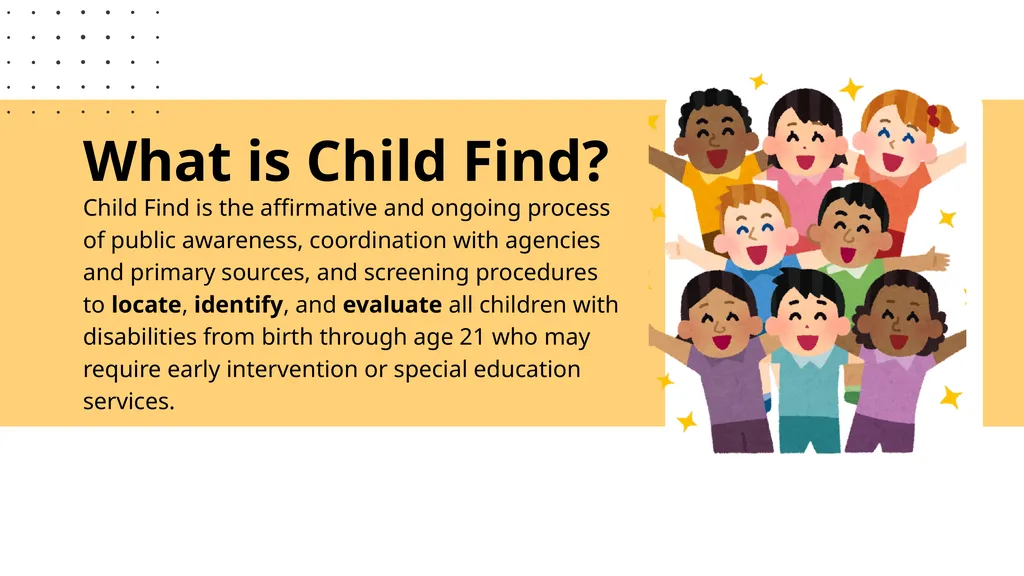
Child Find is the affirmative and ongoing process of public awareness, coordination with agencies and primary sources, and screening procedures to locate, identify, and evaluate all children with disabilities from birth through age 21 who may require early intervention or special education services. What is Child Find?<br>
04
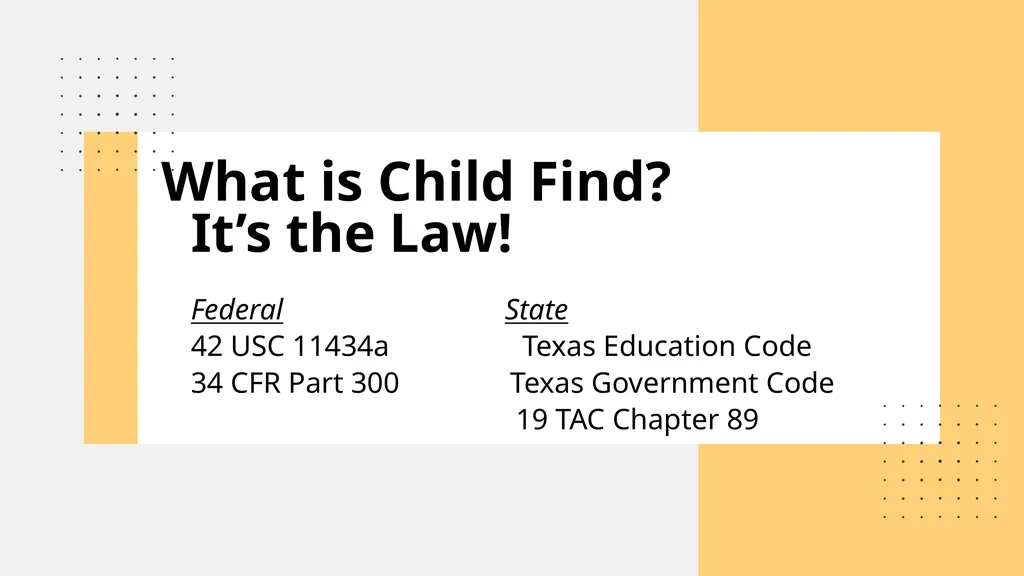
What is Child Find? It’s the Law!
Federal State
42 USC 11434a Texas Education Code
34 CFR Part 300 Texas Government Code
19 TAC Chapter 89<br>
Federal State
42 USC 11434a Texas Education Code
34 CFR Part 300 Texas Government Code
19 TAC Chapter 89<br>
05
What is Child Find? Child Find refers to the federal requirement under the Individuals with Disabilities Education Act (IDEA) that all children in need of special education services are identified, located, and evaluated. Schools are responsible for conducting Child Find and identifying all IDEA-eligible students that reside in their jurisdiction. Child Find is not a passive activity, but rather an active process.<br>
06
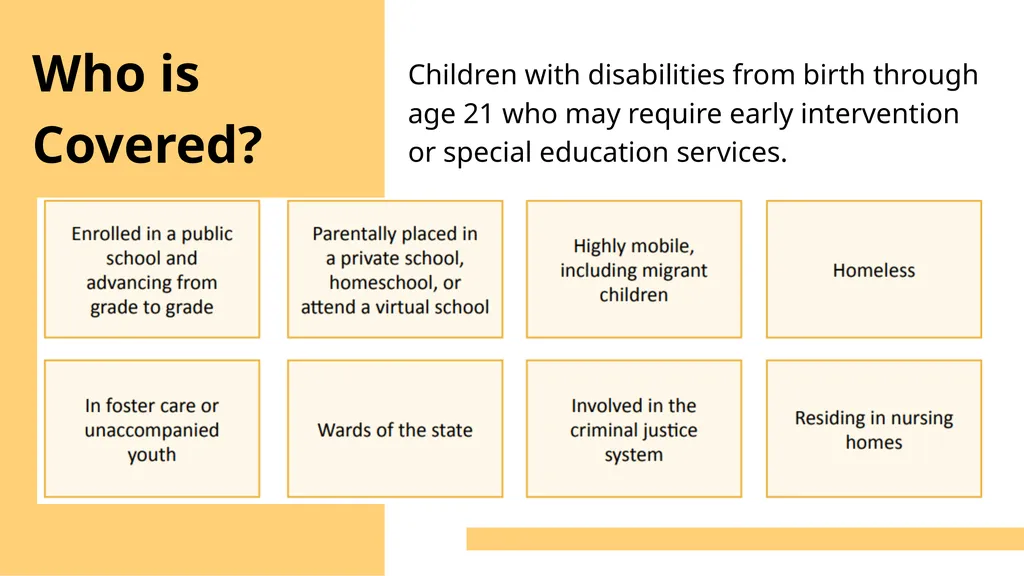
Who is Covered? Children with disabilities from birth through age 21 who may require early intervention or special education services.<br>
07
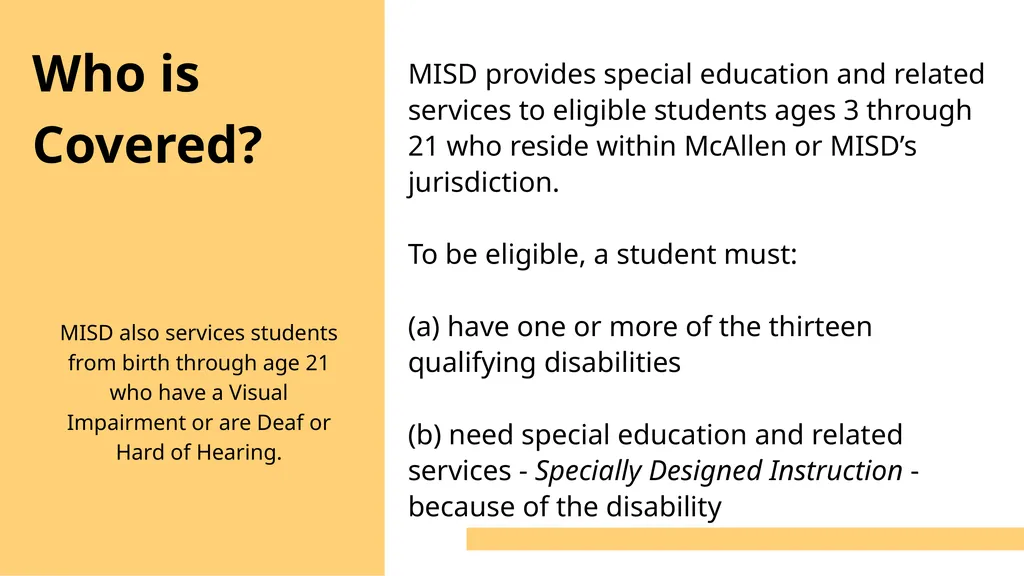
Who is Covered? MISD provides special education and related services to eligible students ages 3 through 21 who reside within McAllen or MISD’s jurisdiction.
To be eligible, a student must:
(a) have one or more of the thirteen qualifying disabilities
(b) need special education and related services - Specially Designed Instruction - because of the disability MISD also services students from birth through age 21 who have a Visual Impairment or are Deaf or Hard of Hearing.<br>
To be eligible, a student must:
(a) have one or more of the thirteen qualifying disabilities
(b) need special education and related services - Specially Designed Instruction - because of the disability MISD also services students from birth through age 21 who have a Visual Impairment or are Deaf or Hard of Hearing.<br>
08
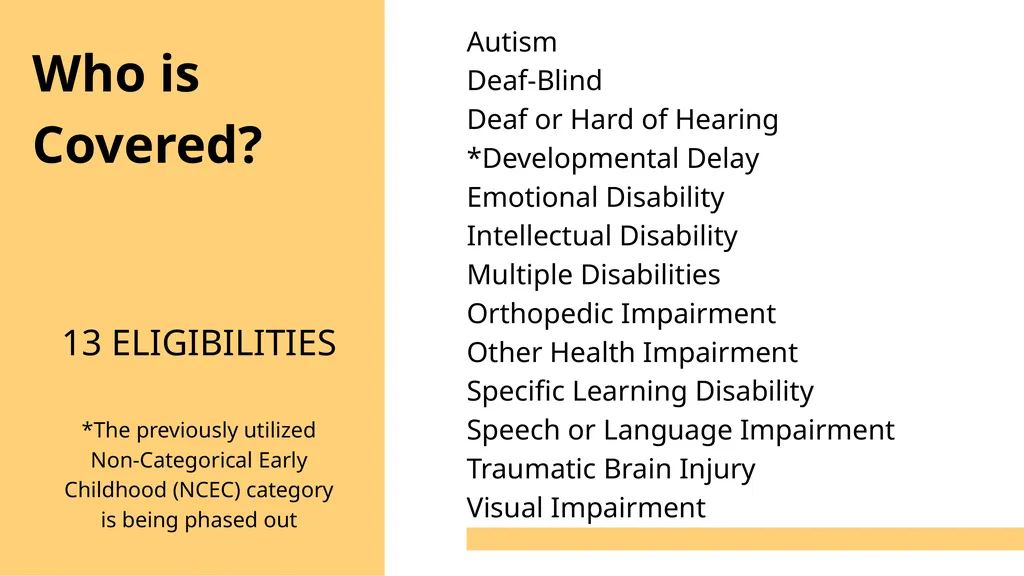
Who is Covered? Autism
Deaf-Blind
Deaf or Hard of Hearing
*Developmental Delay
Emotional Disability
Intellectual Disability
Multiple Disabilities
Orthopedic Impairment
Other Health Impairment
Specific Learning Disability
Speech or Language Impairment
Traumatic Brain Injury
Visual Impairment 13 ELIGIBILITIES
*The previously utilized Non-Categorical Early Childhood (NCEC) category is being phased out<br>
Deaf-Blind
Deaf or Hard of Hearing
*Developmental Delay
Emotional Disability
Intellectual Disability
Multiple Disabilities
Orthopedic Impairment
Other Health Impairment
Specific Learning Disability
Speech or Language Impairment
Traumatic Brain Injury
Visual Impairment 13 ELIGIBILITIES
*The previously utilized Non-Categorical Early Childhood (NCEC) category is being phased out<br>
09
Students Served in Special Education (TX) During the 2019-2020 school year, special education students represented 10.7% of the total student population in Texas.
As of the 2025-2026 school year, the percentage has increased to 15.5% of the total student population.
The total numbers served has increased from 588, 820 to 903,072 TEA: Source data from a. Speced_dis_student24f by unique student id total is and Windham submission. Dataset was collected as Enrollment in Oct Fall, 2025. TE<br>
As of the 2025-2026 school year, the percentage has increased to 15.5% of the total student population.
The total numbers served has increased from 588, 820 to 903,072 TEA: Source data from a. Speced_dis_student24f by unique student id total is and Windham submission. Dataset was collected as Enrollment in Oct Fall, 2025. TE<br>
10
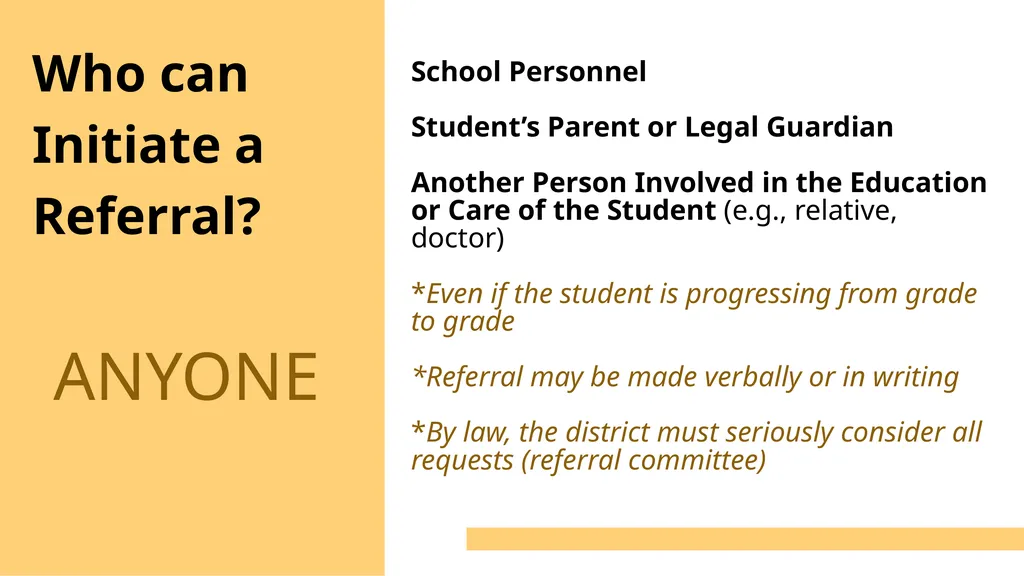
Who can Initiate a Referral? School Personnel
Student’s Parent or Legal Guardian
Another Person Involved in the Education or Care of the Student (e.g., relative, doctor)
*Even if the student is progressing from grade to grade
*Referral may be made verbally or in writing
*By law, the district must seriously consider all requests (referral committee) ANYONE<br>
Student’s Parent or Legal Guardian
Another Person Involved in the Education or Care of the Student (e.g., relative, doctor)
*Even if the student is progressing from grade to grade
*Referral may be made verbally or in writing
*By law, the district must seriously consider all requests (referral committee) ANYONE<br>
11
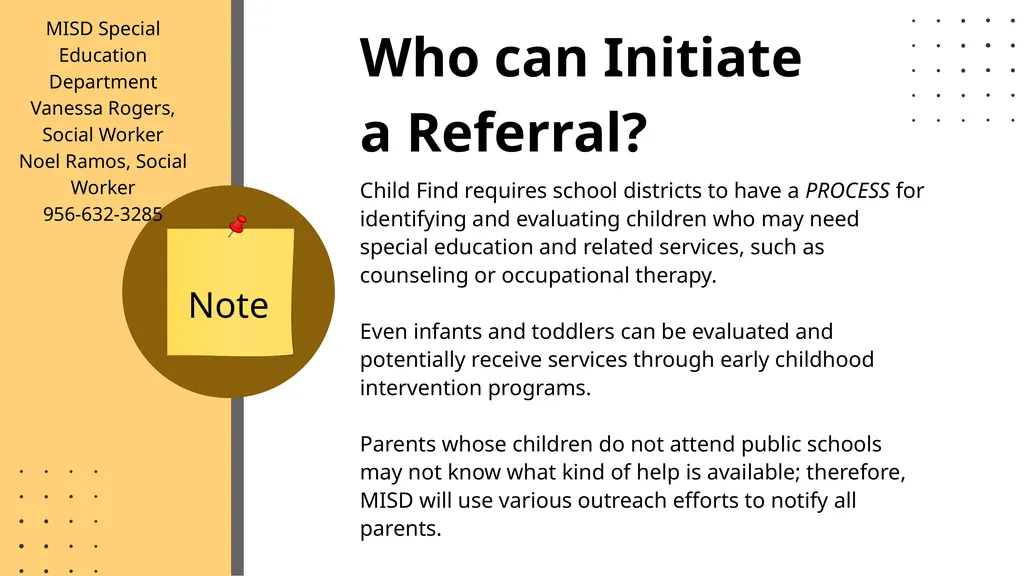
Child Find requires school districts to have a PROCESS for identifying and evaluating children who may need special education and related services, such as counseling or occupational therapy.
Even infants and toddlers can be evaluated and potentially receive services through early childhood intervention programs.
Parents whose children do not attend public schools may not know what kind of help is available; therefore, MISD will use various outreach efforts to notify all parents. Who can Initiate a Referral? Note MISD Special
Education Department
Vanessa Rogers,
Social Worker
Noel Ramos, Social Worker
956-632-3285<br>
Even infants and toddlers can be evaluated and potentially receive services through early childhood intervention programs.
Parents whose children do not attend public schools may not know what kind of help is available; therefore, MISD will use various outreach efforts to notify all parents. Who can Initiate a Referral? Note MISD Special
Education Department
Vanessa Rogers,
Social Worker
Noel Ramos, Social Worker
956-632-3285<br>
12
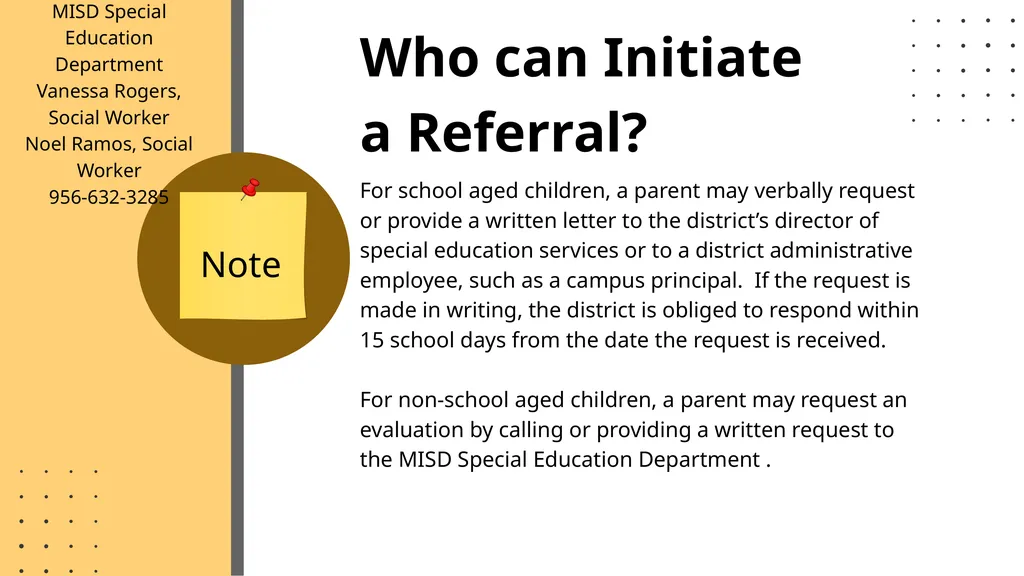
For school aged children, a parent may verbally request or provide a written letter to the district’s director of special education services or to a district administrative employee, such as a campus principal. If the request is made in writing, the district is obliged to respond within 15 school days from the date the request is received.
For non-school aged children, a parent may request an evaluation by calling or providing a written request to the MISD Special Education Department . Who can Initiate a Referral? Note MISD Special
Education Department
Vanessa Rogers,
Social Worker
Noel Ramos, Social Worker
956-632-3285<br>
For non-school aged children, a parent may request an evaluation by calling or providing a written request to the MISD Special Education Department . Who can Initiate a Referral? Note MISD Special
Education Department
Vanessa Rogers,
Social Worker
Noel Ramos, Social Worker
956-632-3285<br>
13
Students who are struggling in the general education classroom should be considered for support services (e.g., tutorial, compensatory, response to intervention, other academic or behavioral support services provided through MTSS) and potentially referred for a special education evaluation under IDEA in addition to receiving support services. Support services can continue during an evaluation.
Early intervention and identification can prevent failure and frustration. Who can Initiate a Referral? MTSS
Multi-Tiered
System of Support
504 Student Services Plan<br>
Early intervention and identification can prevent failure and frustration. Who can Initiate a Referral? MTSS
Multi-Tiered
System of Support
504 Student Services Plan<br>
14
What are the LEAs Responsibilities? The Local Education Agency (LEA) must develop a child find process which includes the following responsibilities:<br>
15
What are the LEAs Responsibilities? Develop written local policies and operating procedures. 1<br>
16
What are the LEAs Responsibilities? Engage in public and parent/guardian awareness activities, including partnering with primary referral sources. 2 *At the time of a student’s placement in the disciplinary alternative education program (DAEP), information regarding Child Find will be provided to the student’s parent or guardian.<br>
17
What are the LEAs Responsibilities? Notify parents by providing the Right to Information Statement annually. 3 MISD Website MISD Student Code of Conduct MISD Student Handbook<br>
18
What are the LEAs Responsibilities? Conduct school-wide screenings. 4 MAP Testing K & 1st Dyslexia Screeners IReady Circle<br>
19
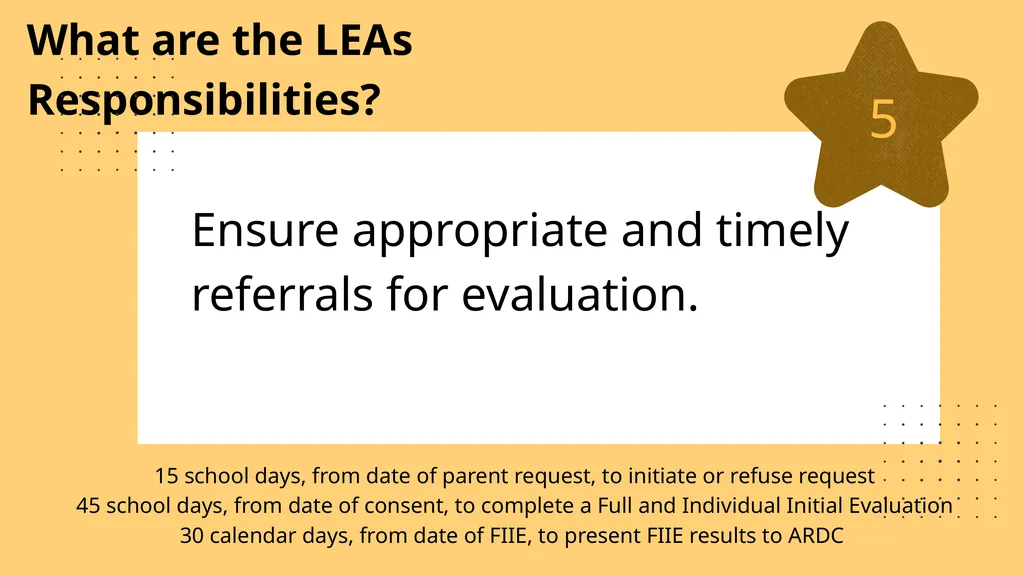
What are the LEAs Responsibilities? Ensure appropriate and timely referrals for evaluation. 5 15 school days, from date of parent request, to initiate or refuse request
45 school days, from date of consent, to complete a Full and Individual Initial Evaluation
30 calendar days, from date of FIIE, to present FIIE results to ARDC<br>
45 school days, from date of consent, to complete a Full and Individual Initial Evaluation
30 calendar days, from date of FIIE, to present FIIE results to ARDC<br>
20
What are the LEAs Responsibilities? Coordinate with other agencies, including Early Childhood Intervention (ECI). 6<br>
21
What are the LEAs Responsibilities? Maintain and report accurate data. 7 State Performance Plan Indicator (SPPI) 11 - ages 3-21
State Performance Plan Indicator (SPPI) 12 - prior to age 3<br>
State Performance Plan Indicator (SPPI) 12 - prior to age 3<br>
22
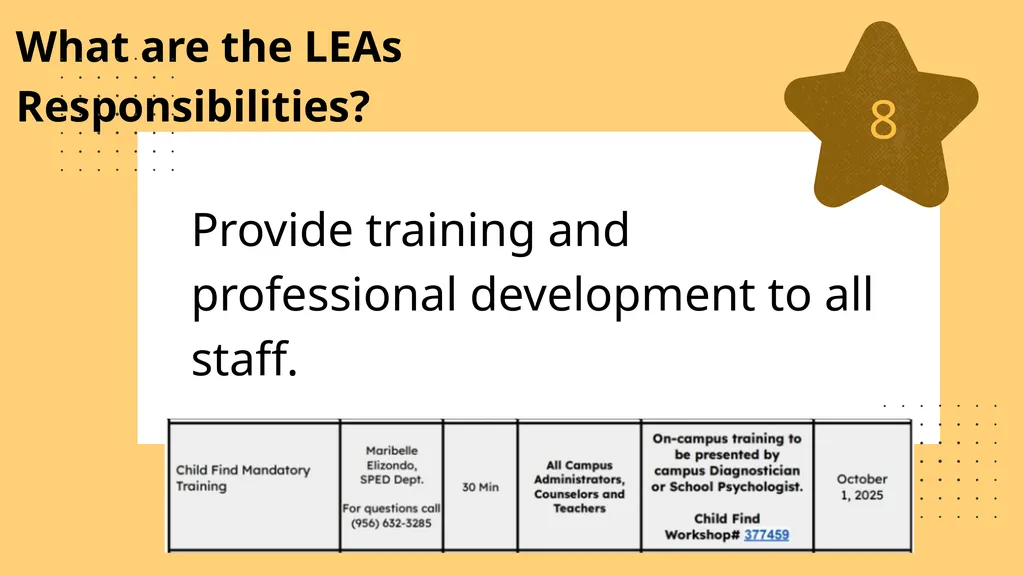
What are the LEAs Responsibilities? Provide training and professional development to all staff. 8<br>
23
Reminders Child Find is not a passive process. LEAs should not wait for others to refer students for special education services. LEAs must seek out Individuals with Disabilities Education Act (IDEA) eligible students.<br>
24
Reminders A public awareness campaign should target a wide variety of people who may work with the student, such as parents/families, daycares, summer camps, physicians and medical clinics, and religious institutions.<br>
25
Reminders Referrals for an initial evaluation should not be delayed or denied because pre-referral interventions have not been implemented with a student. If there is a basis to suspect a student has a disability and needs special education related services based on this disability, the student must be referred for an evaluation.<br>
26
Reminders Parents must be notified annually of the options and requirements for assisting students who may need special education services. The notice includes the rights of a child and the general process available to initiate a referral.<br>
27
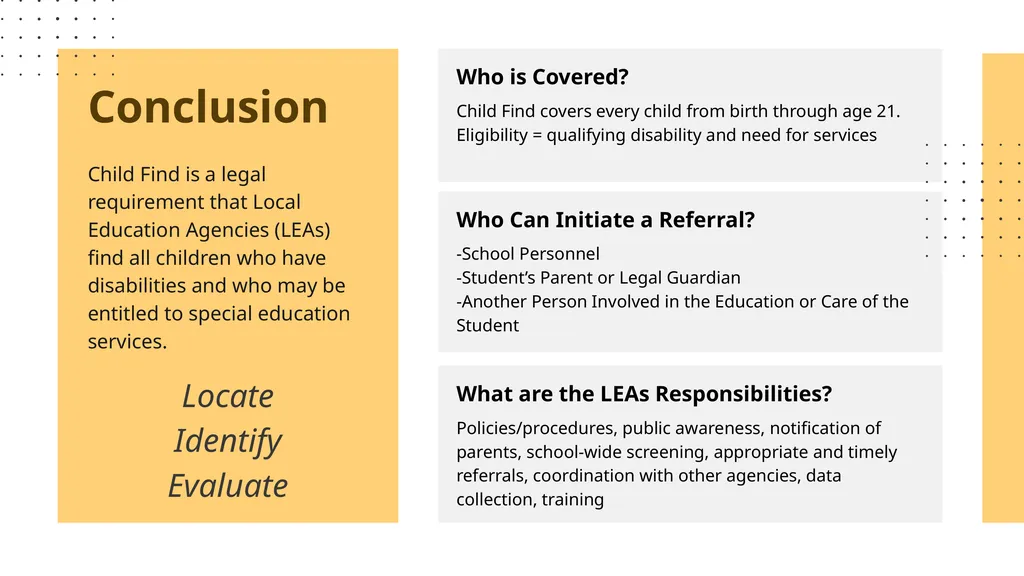
Conclusion Child Find is a legal requirement that Local Education Agencies (LEAs) find all children who have disabilities and who may be entitled to special education services. Child Find covers every child from birth through age 21. Eligibility = qualifying disability and need for services -School Personnel
-Student’s Parent or Legal Guardian
-Another Person Involved in the Education or Care of the Student Who is Covered? Who Can Initiate a Referral? Policies/procedures, public awareness, notification of parents, school-wide screening, appropriate and timely referrals, coordination with other agencies, data collection, training What are the LEAs Responsibilities? Locate
Identify
Evaluate<br>
-Student’s Parent or Legal Guardian
-Another Person Involved in the Education or Care of the Student Who is Covered? Who Can Initiate a Referral? Policies/procedures, public awareness, notification of parents, school-wide screening, appropriate and timely referrals, coordination with other agencies, data collection, training What are the LEAs Responsibilities? Locate
Identify
Evaluate<br>
28
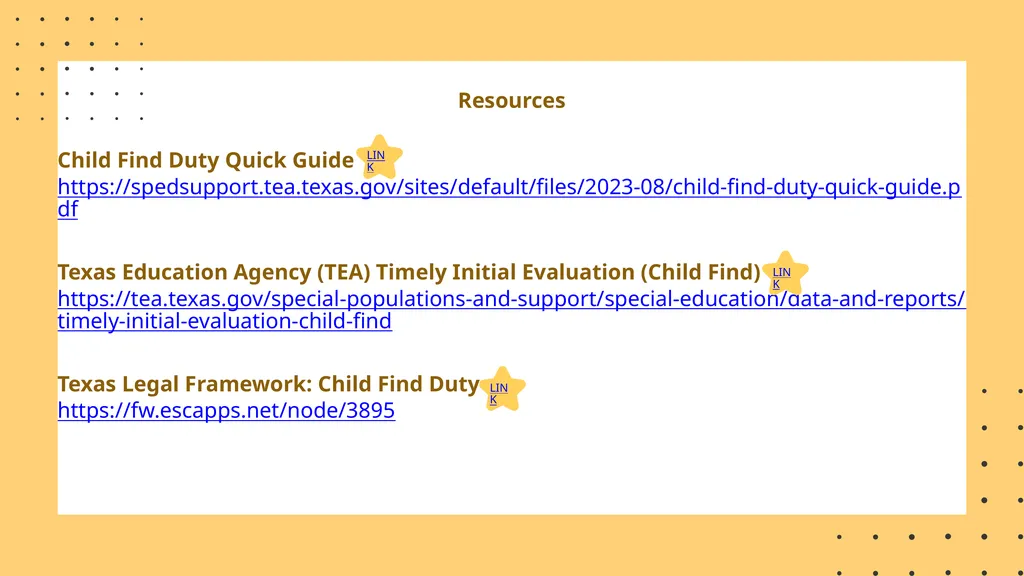
Resources
Child Find Duty Quick Guide
https://spedsupport.tea.texas.gov/sites/default/files/2023-08/child-find-duty-quick-guide.pdf
Texas Education Agency (TEA) Timely Initial Evaluation (Child Find)
https://tea.texas.gov/special-populations-and-support/special-education/data-and-reports/timely-initial-evaluation-child-find
Texas Legal Framework: Child Find Duty
https://fw.escapps.net/node/3895 LINK LINK LINK<br>
Child Find Duty Quick Guide
https://spedsupport.tea.texas.gov/sites/default/files/2023-08/child-find-duty-quick-guide.pdf
Texas Education Agency (TEA) Timely Initial Evaluation (Child Find)
https://tea.texas.gov/special-populations-and-support/special-education/data-and-reports/timely-initial-evaluation-child-find
Texas Legal Framework: Child Find Duty
https://fw.escapps.net/node/3895 LINK LINK LINK<br>
29
Executive Director Special Education:
Ms. Maribelle Elizondo
Director for Regional Day School Program for the Deaf:
Ms. Liza Lara
Special Education Supervisors:
Ms. Karla Barnett , Ms. Jacquelin Espinosa, Ms. Jessica Garza, Ms. Rachael Montgomery
Social Workers:
Ms. Vanessa Rogers vanessa.rogers@mcallenisd.net
Mr. Noel Ramos NOEL.RAMOS@mcallenisd.net
Special Education Department
2100 W. Hackberry Avenue
McAllen, TX 78501
P: 956-632-3285
F: 956-632-3269<br>
Ms. Maribelle Elizondo
Director for Regional Day School Program for the Deaf:
Ms. Liza Lara
Special Education Supervisors:
Ms. Karla Barnett , Ms. Jacquelin Espinosa, Ms. Jessica Garza, Ms. Rachael Montgomery
Social Workers:
Ms. Vanessa Rogers vanessa.rogers@mcallenisd.net
Mr. Noel Ramos NOEL.RAMOS@mcallenisd.net
Special Education Department
2100 W. Hackberry Avenue
McAllen, TX 78501
P: 956-632-3285
F: 956-632-3269<br>
30
THANK YOU QUESTIONS?<br>