
ChildFund Alliance Five Year Strategic Plan
LD
Published · 45 slides · 0 views

1 / 1




Description
ChildFund Alliance Five Year Strategic Plan (2016-2021) Perseverance is more prevailing than violence, and many things which cannot be overcome when they are taken together, yield themselves up when taken little by little. -- Plutarch
Related Topics
Share
Embed code
Download this presentation From Below
"ChildFund Alliance Five Year Strategic Plan" is the property of its rightful owner. Permission is granted to download and print the materials on this website for personal, non-commercial use only, and to display it on your personal computer provided you do not modify the materials and that you retain all copyright notices contained in the materials. By downloading content from our website, you accept the terms of this agreement.
Presentation Transcript
01
ChildFund Alliance Five Year Strategic Plan (2016-2021)<br>
02
Perseverance is more prevailing than violence, and many things which cannot be overcome when they are taken together, yield themselves up when taken little by little. -- Plutarch Forward from Secretary General<br>
03
Children have an inherent and universal right to a life free from violence, abuse, exploitation and neglect as well as a right to survival and development. Forward from the Secretary General<br>
04
Today, more than one billion children – more than half of the world’s children – are exposed to violence each year. Forward from the Secretary General<br>
05
The ChildFund Alliance commissioned Overseas Development Institute (ODI) report estimates that the economic impact of the consequences of physical, psychological and sexual violence against children is as high as $7 trillion over a lifetime. Introduction<br>
06
In 2014, nearly a billion children lived in countries affected by conflict and an estimated 246 million of these children were directly affected by these conflicts. Introduction<br>
07
Children make up over half of the populations affected by disasters, more than half of all refugees and nearly half of the world’s displaced population. Introduction<br>
08
Humanitarian crises affect a significant proportion of a child’s formative years, impacting their survival, growth and development. Introduction<br>
09
Many who live with violence day in and day out assume that it is an intrinsic part of the human condition. But this is not so. Violence can be prevented. Government, communities and individuals can make a difference. (Nelson Mandela.) Introduction<br>
10
Violence against children in both humanitarian and non-humanitarian settings is preventable. Introduction<br>
11
Research shows that:
training on parenting skills;
helping children to develop socio emotional skills;
raising access to health;
child protection services; and
empowering families economically
are among the key interventions proven to reduce of violence against children. Introduction<br>
training on parenting skills;
helping children to develop socio emotional skills;
raising access to health;
child protection services; and
empowering families economically
are among the key interventions proven to reduce of violence against children. Introduction<br>
12
Transforming our World: The 2030 Agenda for Sustainable Development
was adopted by the United Nations General Assembly in September 2015.
All people yearn to live in peaceful and harmonious societies, free from fear and violence. We want to foster peaceful, safe and inclusive societies…to ensure equal justice and to protect the human rights of all men, women, boys and girls.
(Preamble) Taking Stock: Key Accomplishments from 2012-2015<br>
was adopted by the United Nations General Assembly in September 2015.
All people yearn to live in peaceful and harmonious societies, free from fear and violence. We want to foster peaceful, safe and inclusive societies…to ensure equal justice and to protect the human rights of all men, women, boys and girls.
(Preamble) Taking Stock: Key Accomplishments from 2012-2015<br>
13
The 2030 Agenda is a set of 17 universal goals, 169 targets and indicators to frame the global development agenda for the next 15 year.
These goals and targets are called the: Taking Stock: Key Accomplishments from 2012 to 2015.<br>
These goals and targets are called the: Taking Stock: Key Accomplishments from 2012 to 2015.<br>
14
In partnership with others, ChildFund Alliance secured a standalone target on Violence against Children: (16.2) End abuse exploitation, trafficking and all forms of violence against and torture of children. Taking Stock: Key Accomplishments from: 2012-2015<br>
15
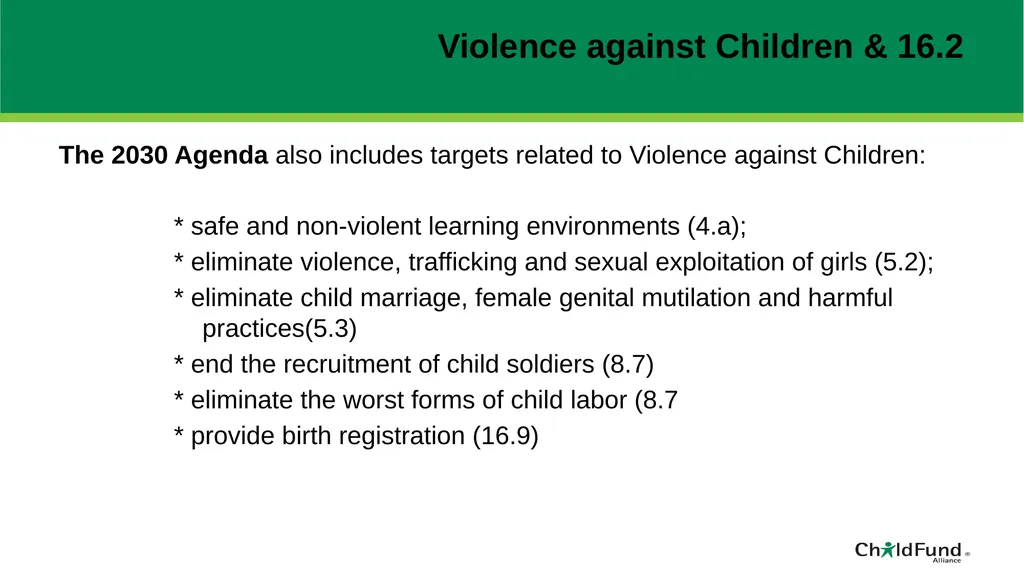
The 2030 Agenda also includes targets related to Violence against Children:
* safe and non-violent learning environments (4.a);
* eliminate violence, trafficking and sexual exploitation of girls (5.2);
* eliminate child marriage, female genital mutilation and harmful practices(5.3)
* end the recruitment of child soldiers (8.7)
* eliminate the worst forms of child labor (8.7
* provide birth registration (16.9) Violence against Children & 16.2<br>
* safe and non-violent learning environments (4.a);
* eliminate violence, trafficking and sexual exploitation of girls (5.2);
* eliminate child marriage, female genital mutilation and harmful practices(5.3)
* end the recruitment of child soldiers (8.7)
* eliminate the worst forms of child labor (8.7
* provide birth registration (16.9) Violence against Children & 16.2<br>
16
The free from violence and exploitation campaign contributed to making the protection of children from violence and exploitation a global priority within the Sustainable Development Goals plus:
• Created a stronger ChildFund Alliance;
• Enhanced capacity across our membership;
• Increased our visibility with institutional donors and governments;
• Bolstered our work in collaboration with the largest child-focused agencies; and
• Improved our access to governments, inter-governmental organizations, academia and the donor community. Lessons Learned<br>
• Created a stronger ChildFund Alliance;
• Enhanced capacity across our membership;
• Increased our visibility with institutional donors and governments;
• Bolstered our work in collaboration with the largest child-focused agencies; and
• Improved our access to governments, inter-governmental organizations, academia and the donor community. Lessons Learned<br>
17
Based on its accomplishments, Child Fund Alliance is now well positioned to build on its accomplishments and move forward in this new era for development cooperation.
Mindful of the wisdom of the late Nelson Mandela, we must act wisely and work together to create a safer world for children. Moving Forward<br>
Mindful of the wisdom of the late Nelson Mandela, we must act wisely and work together to create a safer world for children. Moving Forward<br>
18
Our Plan will be guided by the following strategic intent:
To become a global voice with and for children, to highlight the issues children care about, and to mobilize effectively to address threats to their lives, safety and well-being. Moving Forward: Highlights of the Five-Year Strategic Plan (2016-2021)<br>
To become a global voice with and for children, to highlight the issues children care about, and to mobilize effectively to address threats to their lives, safety and well-being. Moving Forward: Highlights of the Five-Year Strategic Plan (2016-2021)<br>
19
ChildFund Alliance will equip member organizations with the advocacy tools and resources required to mobilize political will and funding for improved policies and programs for children. 1. Advance the Achievement of Sustainable Development Goal 16.2<br>
20
Establish our advocacy on evidence from proven strategies that prevent and protect child violence.
Enhance our global presence as a thought leader on the prevention and protection of violence against children
Work with members on an ad hoc basis to customize advocacy asks to national and local contexts. Advance the Achievement of the Sustainable Development Goals<br>
Enhance our global presence as a thought leader on the prevention and protection of violence against children
Work with members on an ad hoc basis to customize advocacy asks to national and local contexts. Advance the Achievement of the Sustainable Development Goals<br>
21
Examples of advocacy asks include:
Ensure a targeted budget & allocation of resources to prevent/respond to violence
Review an effectively implement legal frameworks to protect children from violence.
Endorse and implement the package of proven solutions
Positive parenting education
School safety
Treating victims of violence
Working with authorities to enforce laws
Fostering norms that protect children Advance the Achievement of the Sustainable Development Goals<br>
Ensure a targeted budget & allocation of resources to prevent/respond to violence
Review an effectively implement legal frameworks to protect children from violence.
Endorse and implement the package of proven solutions
Positive parenting education
School safety
Treating victims of violence
Working with authorities to enforce laws
Fostering norms that protect children Advance the Achievement of the Sustainable Development Goals<br>
22
Key Performance Indicators:
50% of Members conduct outreach to Member States, relevant regional bodies, UN entities coalitions and others with advocacy requests.
Up to 10 priority Member States are identified based on strategic value and targeted in advocacy related to implementation of SDG target 16.2 Advance the Achievement of the SDGS<br>
50% of Members conduct outreach to Member States, relevant regional bodies, UN entities coalitions and others with advocacy requests.
Up to 10 priority Member States are identified based on strategic value and targeted in advocacy related to implementation of SDG target 16.2 Advance the Achievement of the SDGS<br>
23
KPIs
Relevant program evidence is compiled from 30% of areas where ChildFund is active to serve as the basis for effective joint advocacy. Advance the Achievement of the Sustainable Development Goals<br>
Relevant program evidence is compiled from 30% of areas where ChildFund is active to serve as the basis for effective joint advocacy. Advance the Achievement of the Sustainable Development Goals<br>
24
KPIs
The Secretariat produces five pieces of research on violence against children.
The Secretariat produces five evidence based reports to support work around policy change. Advance the Achievement of the SDGs<br>
The Secretariat produces five pieces of research on violence against children.
The Secretariat produces five evidence based reports to support work around policy change. Advance the Achievement of the SDGs<br>
25
It is expected that children and youth will have a central role to play in the follow up of goal 16.2 at the local, national, regional and global levels. Child Friendly Accountability<br>
26
Children and young women and men are critical agents of change and will find in the new goals a platform to channel their infinite capacities for activism into the creation of a better world.
Transforming Our World: The 2030 Agenda for Sustainable, the United Nations, 2015. Child Friendly Accountability<br>
Transforming Our World: The 2030 Agenda for Sustainable, the United Nations, 2015. Child Friendly Accountability<br>
27
It is expected that children and youth will have a central role to play in the formulation, implementation and follow-up for SDG 16.2 at the local, national and global levels. 1. a Engage in Child Friendly Accountability.<br>
28
Child Friendly Accountability is a set of strategic efforts to ensure that the voices of children are meaningfully taken into account in the follow-up and review of The 2030 Agenda. 1a. Child Friendly Accountability<br>
29
Building on our expertise in child participation, the Alliance will develop a child-friendly and participatory methodology to monitor and advocate for the complete implementation of Sustainable Development Goal16.2. 1a. Child Friendly Accountability<br>
30
The central goal of Child Friendly Accountability is to work with children in selected countries to hold governments and local leaders accountable to their obligation to end all violence against children as per target 16.2 of the Sustainable Development Goals. 1a Child Friendly Accountability<br>
31
Objectives
1. To help children access relevant age appropriate data and information an contribute to monitoring violence against children in their schools and communities. Child Friendly Accountability<br>
1. To help children access relevant age appropriate data and information an contribute to monitoring violence against children in their schools and communities. Child Friendly Accountability<br>
32
2. To support children in holding their government and local authorities accountable to their commitments and target 16.2
3. To advocate for international, national and local systems and policies focused on eliminating violence against children. 1a Child Friendly Accountability<br>
3. To advocate for international, national and local systems and policies focused on eliminating violence against children. 1a Child Friendly Accountability<br>
33
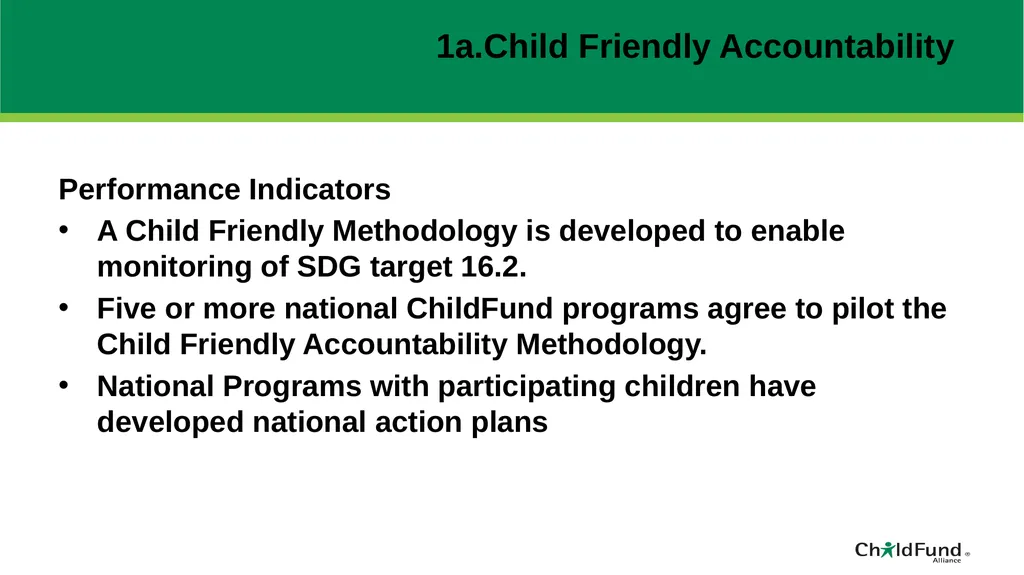
Performance Indicators
A Child Friendly Methodology is developed to enable monitoring of SDG target 16.2.
Five or more national ChildFund programs agree to pilot the Child Friendly Accountability Methodology.
National Programs with participating children have developed national action plans 1a.Child Friendly Accountability<br>
A Child Friendly Methodology is developed to enable monitoring of SDG target 16.2.
Five or more national ChildFund programs agree to pilot the Child Friendly Accountability Methodology.
National Programs with participating children have developed national action plans 1a.Child Friendly Accountability<br>
34
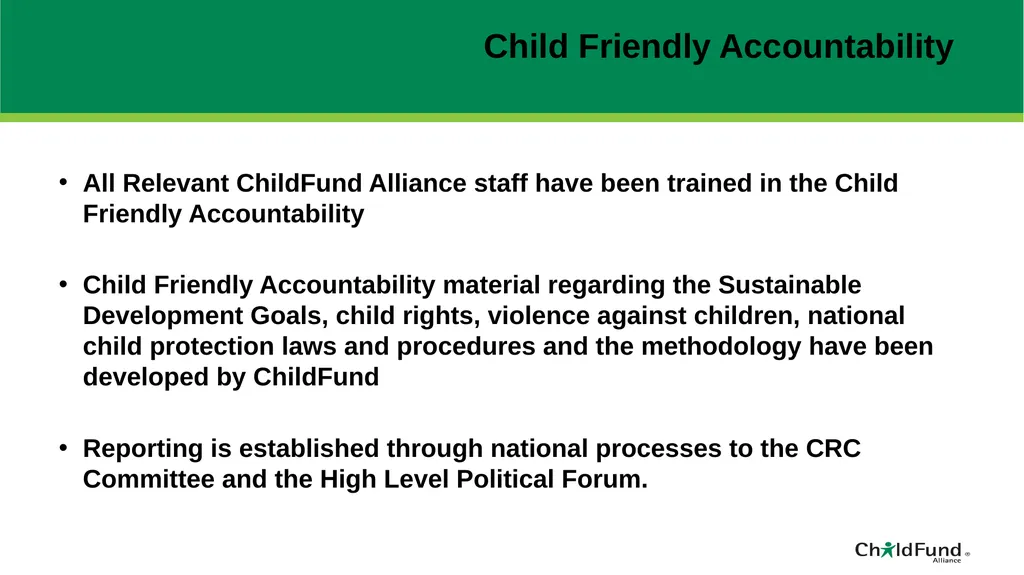
All Relevant ChildFund Alliance staff have been trained in the Child Friendly Accountability
Child Friendly Accountability material regarding the Sustainable Development Goals, child rights, violence against children, national child protection laws and procedures and the methodology have been developed by ChildFund
Reporting is established through national processes to the CRC Committee and the High Level Political Forum. Child Friendly Accountability<br>
Child Friendly Accountability material regarding the Sustainable Development Goals, child rights, violence against children, national child protection laws and procedures and the methodology have been developed by ChildFund
Reporting is established through national processes to the CRC Committee and the High Level Political Forum. Child Friendly Accountability<br>
35
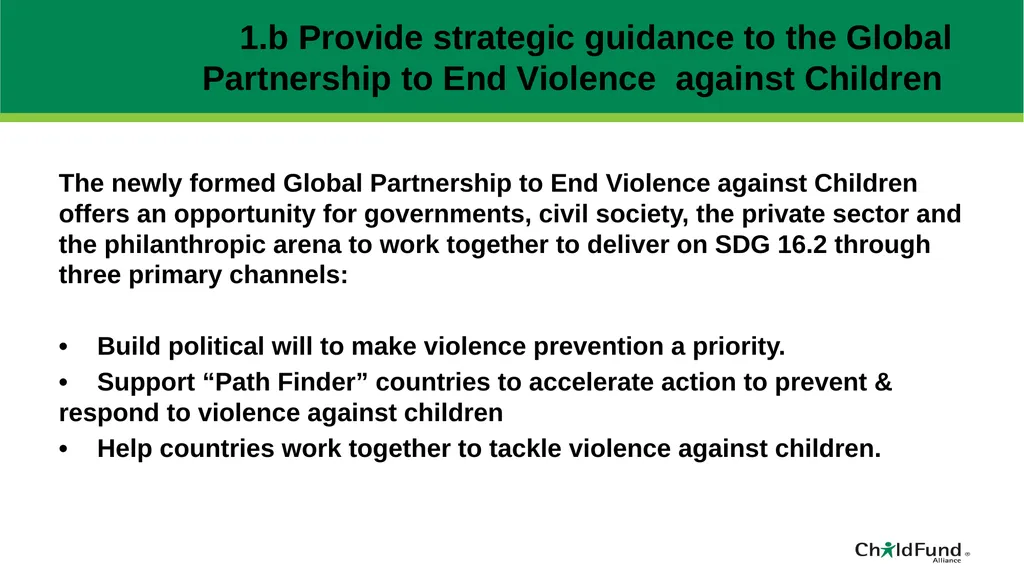
The newly formed Global Partnership to End Violence against Children offers an opportunity for governments, civil society, the private sector and the philanthropic arena to work together to deliver on SDG 16.2 through three primary channels:
• Build political will to make violence prevention a priority.
• Support “Path Finder” countries to accelerate action to prevent & respond to violence against children
• Help countries work together to tackle violence against children. 1.b Provide strategic guidance to the Global Partnership to End Violence against Children<br>
• Build political will to make violence prevention a priority.
• Support “Path Finder” countries to accelerate action to prevent & respond to violence against children
• Help countries work together to tackle violence against children. 1.b Provide strategic guidance to the Global Partnership to End Violence against Children<br>
36
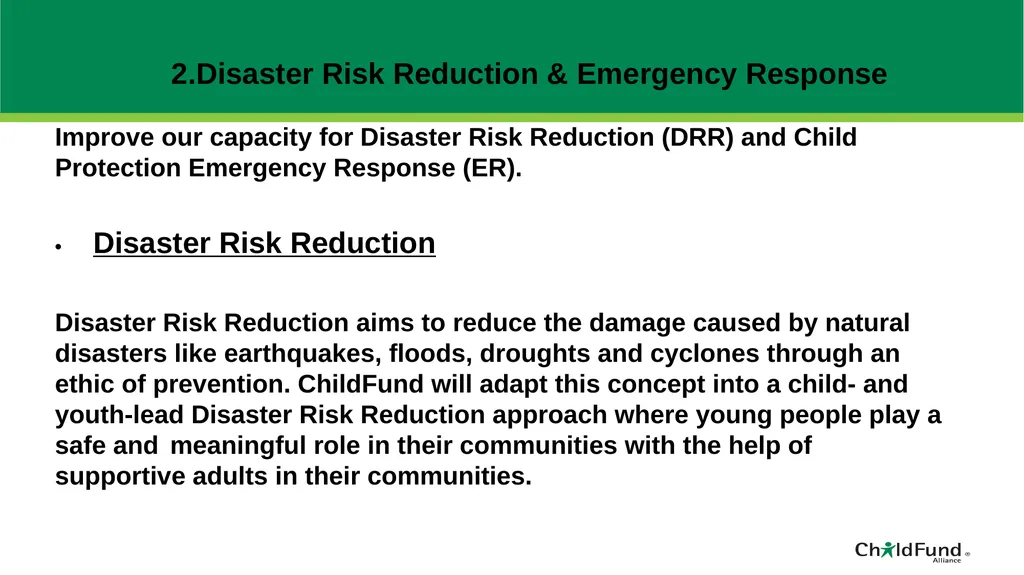
Improve our capacity for Disaster Risk Reduction (DRR) and Child Protection Emergency Response (ER).
• Disaster Risk Reduction
Disaster Risk Reduction aims to reduce the damage caused by natural disasters like earthquakes, floods, droughts and cyclones through an ethic of prevention. ChildFund will adapt this concept into a child- and youth-lead Disaster Risk Reduction approach where young people play a safe and meaningful role in their communities with the help of supportive adults in their communities. 2.Disaster Risk Reduction & Emergency Response<br>
• Disaster Risk Reduction
Disaster Risk Reduction aims to reduce the damage caused by natural disasters like earthquakes, floods, droughts and cyclones through an ethic of prevention. ChildFund will adapt this concept into a child- and youth-lead Disaster Risk Reduction approach where young people play a safe and meaningful role in their communities with the help of supportive adults in their communities. 2.Disaster Risk Reduction & Emergency Response<br>
37
Child Protection in Emergencies.
Child protection in emergencies is defined as the prevention of and response to abuse, neglect, exploitation, and violence against children in times of emergency caused by natural or manmade disasters, conflicts or other crisis. It involves specific activities by child protection actors, whether national or community-based, and/or by humanitarian staff and others supporting local capacities Disaster Risk Reduction & Emergency Response<br>
Child protection in emergencies is defined as the prevention of and response to abuse, neglect, exploitation, and violence against children in times of emergency caused by natural or manmade disasters, conflicts or other crisis. It involves specific activities by child protection actors, whether national or community-based, and/or by humanitarian staff and others supporting local capacities Disaster Risk Reduction & Emergency Response<br>
38
Building on its experiences in emergency response to large scale disasters during the last two years, we will strengthen our expertise:
Develop local capacity in response to disasters.
Focus on preparedness and response to child protection risks in emergencies.
Analyze member innovations in Child Protection in Emergencies to highlight key success factors and develop models for replication. Disaster Risk Reduction and Emergency Response<br>
Develop local capacity in response to disasters.
Focus on preparedness and response to child protection risks in emergencies.
Analyze member innovations in Child Protection in Emergencies to highlight key success factors and develop models for replication. Disaster Risk Reduction and Emergency Response<br>
39
Key Performance Indicators
Disaster Risk measures are included in development plans at the community level in 50% of areas where child fund is working.
Youth are recognized as key actors in vulnerability and capacity assessments and also in the implementation of Disaster Risk Reduction activities at the community level in 25% of areas where Child Fund is working. Disaster Risk Reduction & Emergency Response<br>
Disaster Risk measures are included in development plans at the community level in 50% of areas where child fund is working.
Youth are recognized as key actors in vulnerability and capacity assessments and also in the implementation of Disaster Risk Reduction activities at the community level in 25% of areas where Child Fund is working. Disaster Risk Reduction & Emergency Response<br>
40
Key Performance Indicators:
ChildFund is either directly or indirectly through partners responding to child protection in emergencies needs of children in between 30% of large scale emergencies.
Decision on whether or not to respond to sudden onset large scale disaster is made within 72 hours of the event in all cases. Disaster Risk Reduction & Emergency Response<br>
ChildFund is either directly or indirectly through partners responding to child protection in emergencies needs of children in between 30% of large scale emergencies.
Decision on whether or not to respond to sudden onset large scale disaster is made within 72 hours of the event in all cases. Disaster Risk Reduction & Emergency Response<br>
41
Strengthen Membership Engagement and Growth
To build on its lifesaving work for children, ChildFund Alliance is committed to strengthening and growing our membership. Strategic Priority: #3 Strengthen Membership<br>
To build on its lifesaving work for children, ChildFund Alliance is committed to strengthening and growing our membership. Strategic Priority: #3 Strengthen Membership<br>
42
There are a number of potential benefits to membership growth for Alliance members:
Greater Alignment and Scale to bring strategic focus and increased investments for children.
Stronger Global Influence by growing the number and diversity of organizations advocating for children.<br>
Greater Alignment and Scale to bring strategic focus and increased investments for children.
Stronger Global Influence by growing the number and diversity of organizations advocating for children.<br>
43
Efficient use of resources to streamline critical capabilities
Improved Collaboration and Knowledge Sharing to facilitate new partnerships and share best practices. Membership Growth and Strengthening<br>
Improved Collaboration and Knowledge Sharing to facilitate new partnerships and share best practices. Membership Growth and Strengthening<br>
44
ChildFund Alliance will recruit three new members based on our experience with partners at the field level. Strengthening and Growing Membership<br>
45
World leaders should have in mind that children are the barometer of development. – 17 year old boy, Guinea
From: Children speak about being free from violence and exploitation, ChildFund Alliance 2014 Conclusion<br>
From: Children speak about being free from violence and exploitation, ChildFund Alliance 2014 Conclusion<br>