
CHIPPER: A Low-complexity Bufferless Deflection
Description: CHIPPER: A Low-complexity Bufferless Deflection Router Chris Fallin Chris Craik Onur Mutlu Motivation In many-core chips, on-chip interconnect (NoC) consumes significant power. Intel Terascale: 30; MIT RAW: 40 of system power Must
Related Topics
Download Presentation
"CHIPPER: A Low-complexity Bufferless Deflection" is the property of its rightful owner. Permission is granted to download and print the materials on this website for personal, non-commercial use only, and to display it on your personal computer provided you do not modify the materials and that you retain all copyright notices contained in the materials. By downloading content from our website, you accept the terms of this agreement.
Presentation Transcript
slide1. CHIPPER: A Low-complexity
Bufferless Deflection Router Chris Fallin
Chris Craik
Onur Mutlu<br>
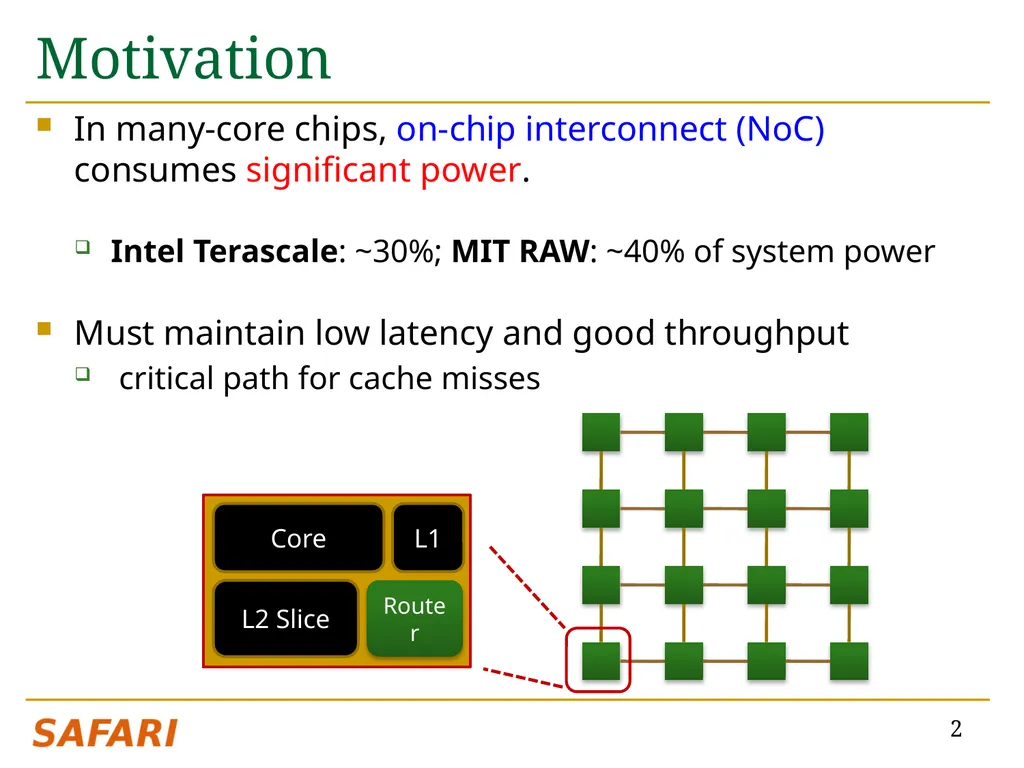
slide2. Motivation In many-core chips, on-chip interconnect (NoC) consumes significant power.
Intel Terascale: ~30%; MIT RAW: ~40% of system power
Must maintain low latency and good throughput
critical path for cache misses 2<br>
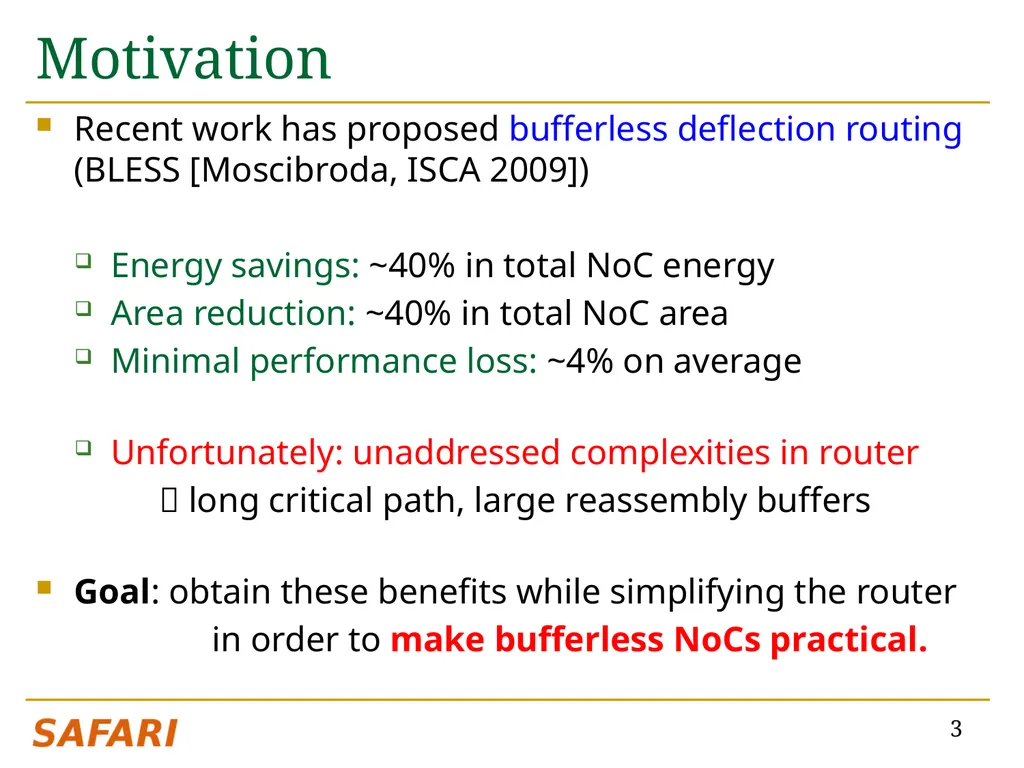
slide3. Motivation Recent work has proposed bufferless deflection routing (BLESS [Moscibroda, ISCA 2009])
Energy savings: ~40% in total NoC energy
Area reduction: ~40% in total NoC area
Minimal performance loss: ~4% on average
Unfortunately: unaddressed complexities in router
long critical path, large reassembly buffers
Goal: obtain these benefits while simplifying the router
in order to make bufferless NoCs practical. 3<br>
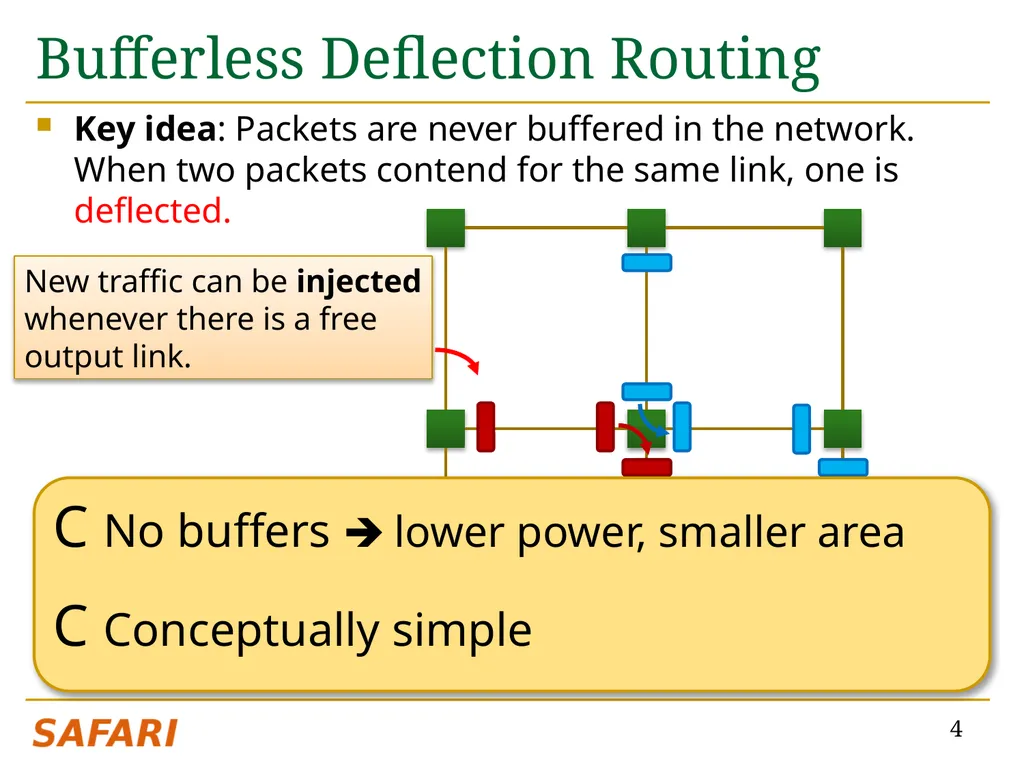
slide4. Destination Bufferless Deflection Routing Key idea: Packets are never buffered in the network. When two packets contend for the same link, one is deflected. 4 New traffic can be injected
whenever there is a free
output link.<br>
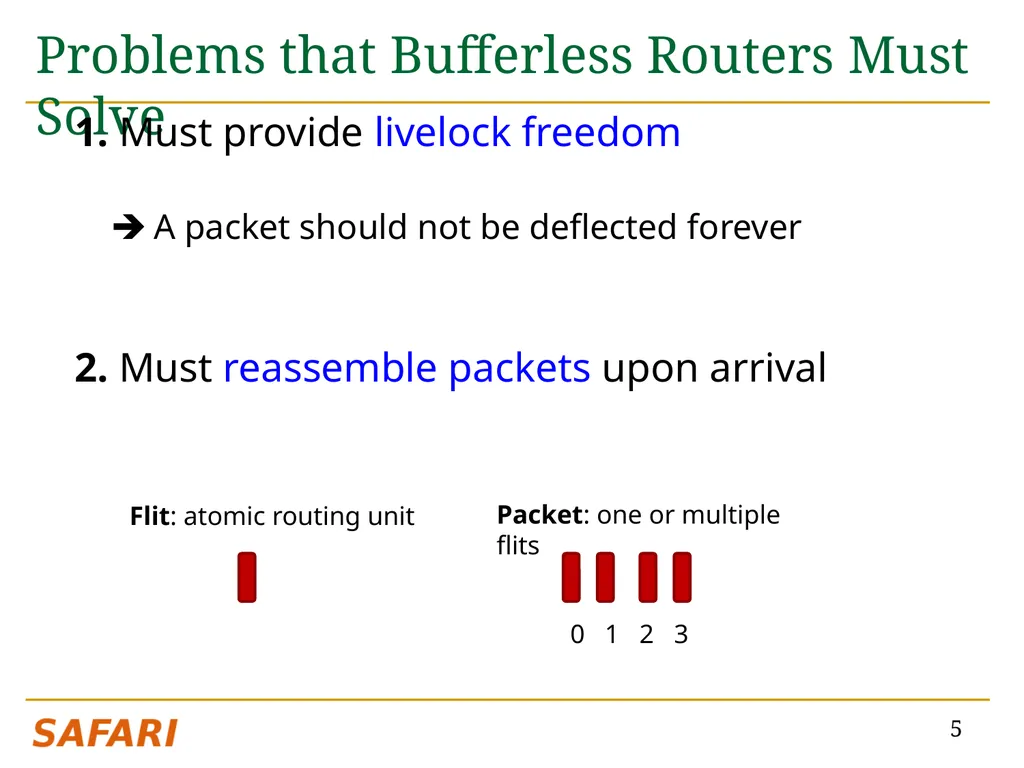
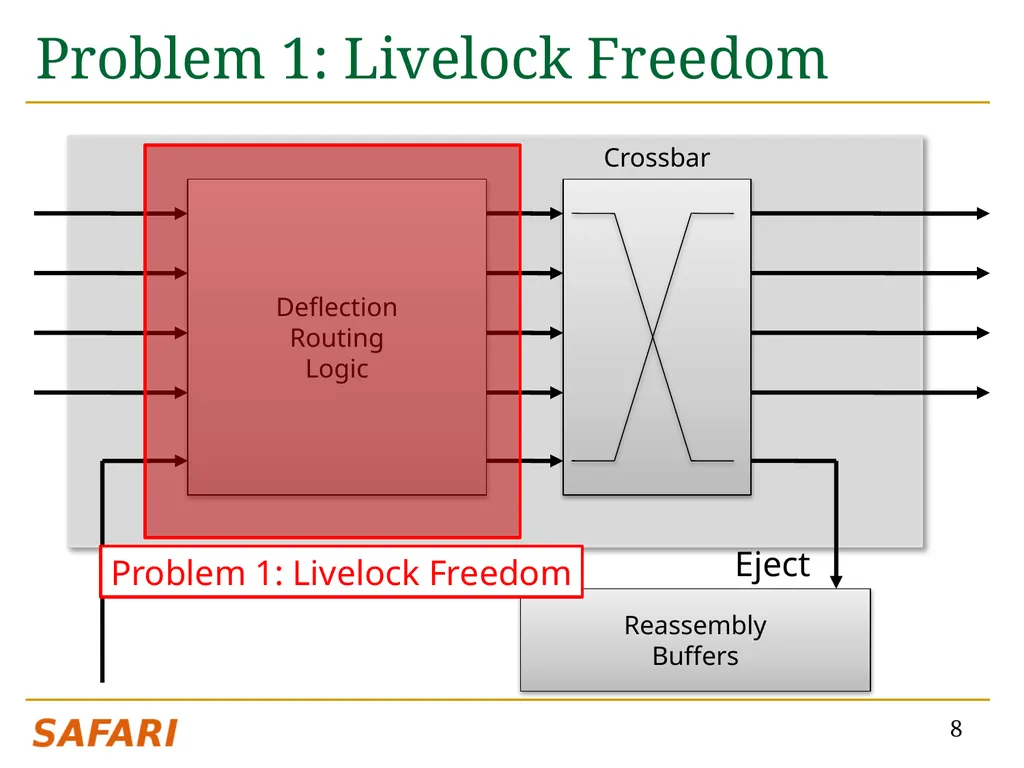
slide5. Problems that Bufferless Routers Must Solve 1. Must provide livelock freedom
A packet should not be deflected forever
2. Must reassemble packets upon arrival 5 Flit: atomic routing unit 0 1 2 3 Packet: one or multiple flits<br>
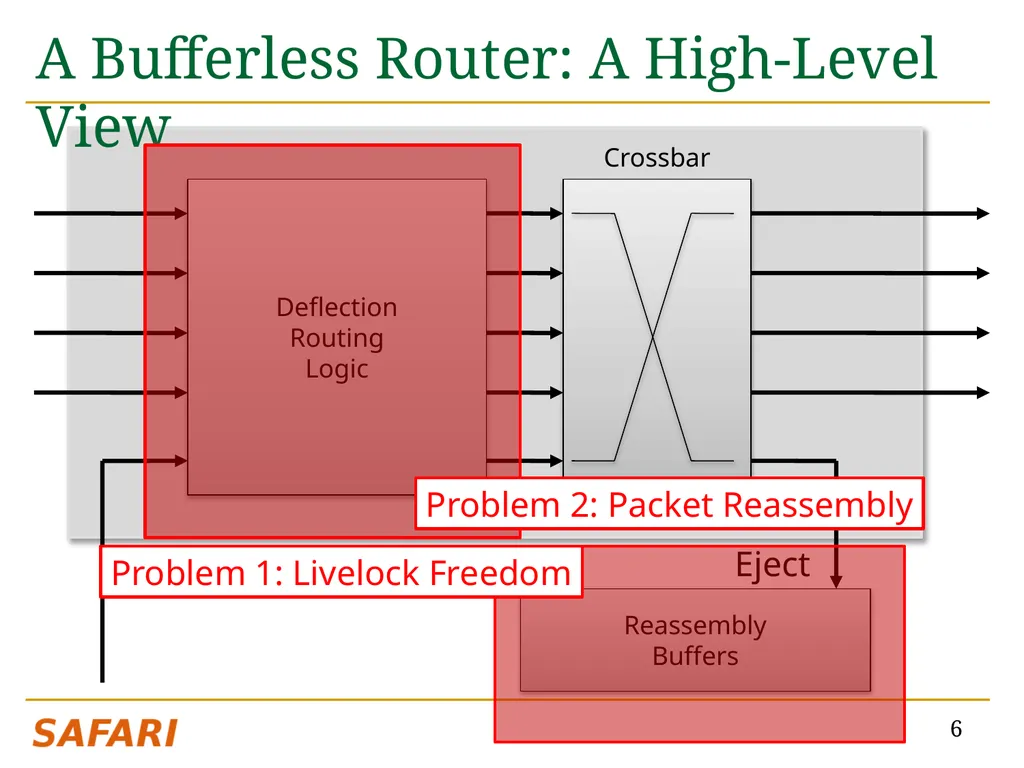
slide6. Inject Deflection
Routing
Logic Crossbar A Bufferless Router: A High-Level View 6 Reassembly
Buffers Eject Problem 2: Packet Reassembly Problem 1: Livelock Freedom<br>
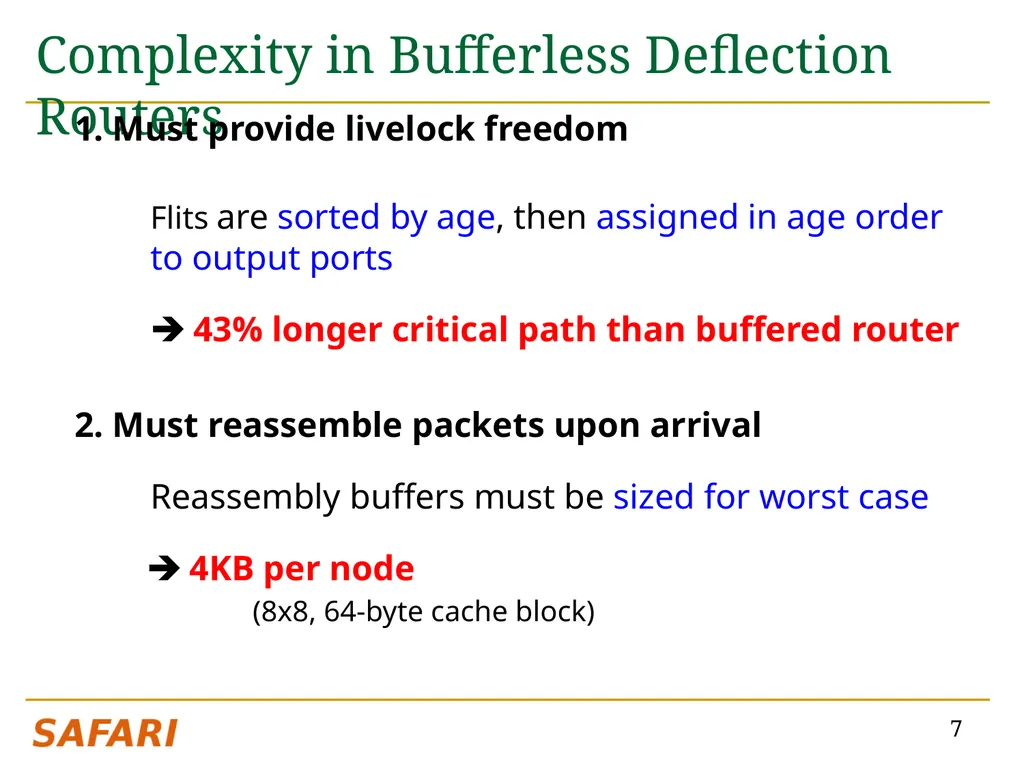
slide7. Complexity in Bufferless Deflection Routers 1. Must provide livelock freedom
Flits are sorted by age, then assigned in age order to output ports
43% longer critical path than buffered router
2. Must reassemble packets upon arrival
Reassembly buffers must be sized for worst case
4KB per node
(8x8, 64-byte cache block) 7<br>
slide8. Inject Deflection
Routing
Logic Crossbar Problem 1: Livelock Freedom 8 Reassembly
Buffers Eject Problem 1: Livelock Freedom<br>
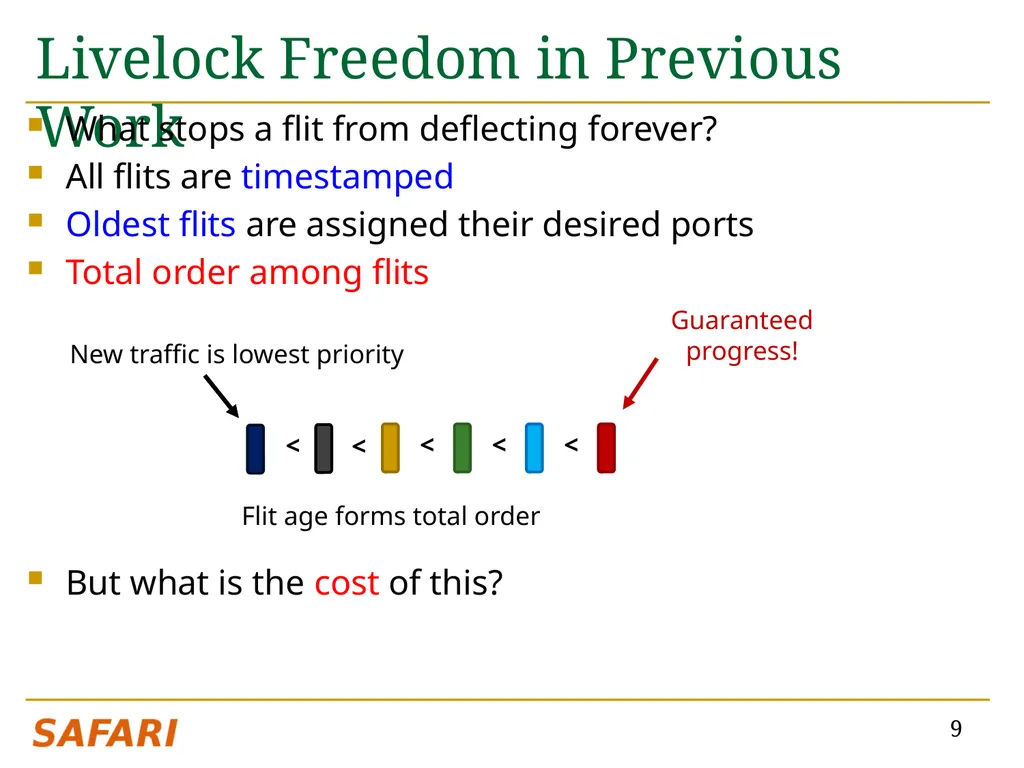
slide9. Livelock Freedom in Previous Work What stops a flit from deflecting forever?
All flits are timestamped
Oldest flits are assigned their desired ports
Total order among flits
But what is the cost of this? 9 Flit age forms total order<br>
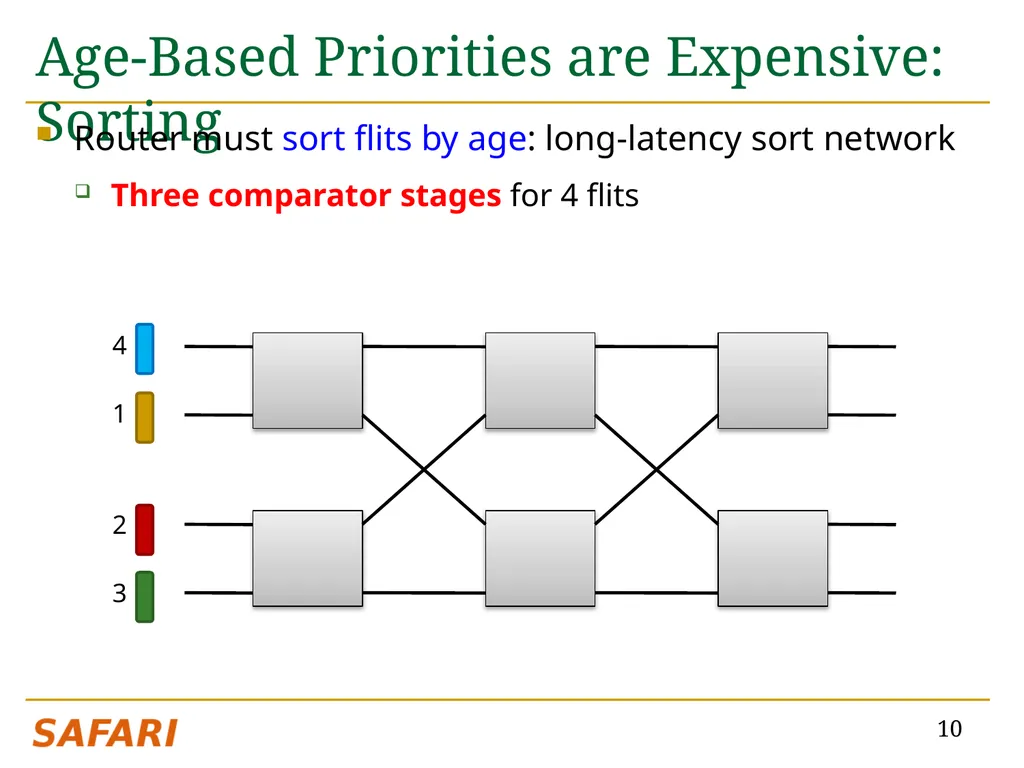
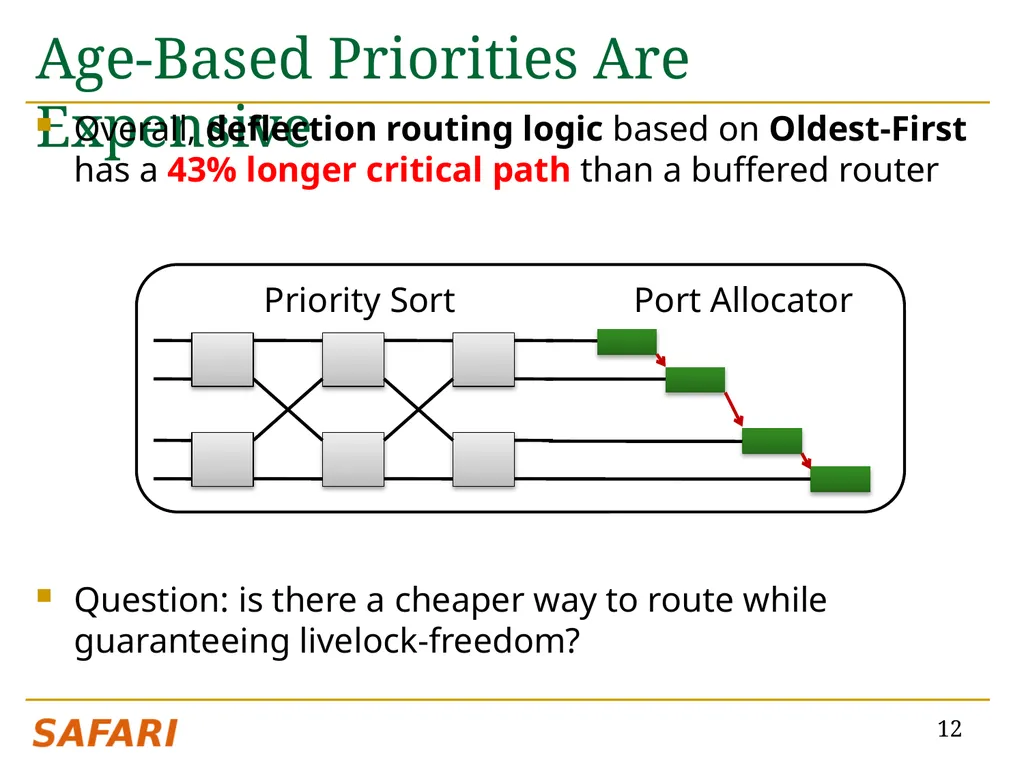
slide10. Age-Based Priorities are Expensive: Sorting Router must sort flits by age: long-latency sort network
Three comparator stages for 4 flits 10<br>
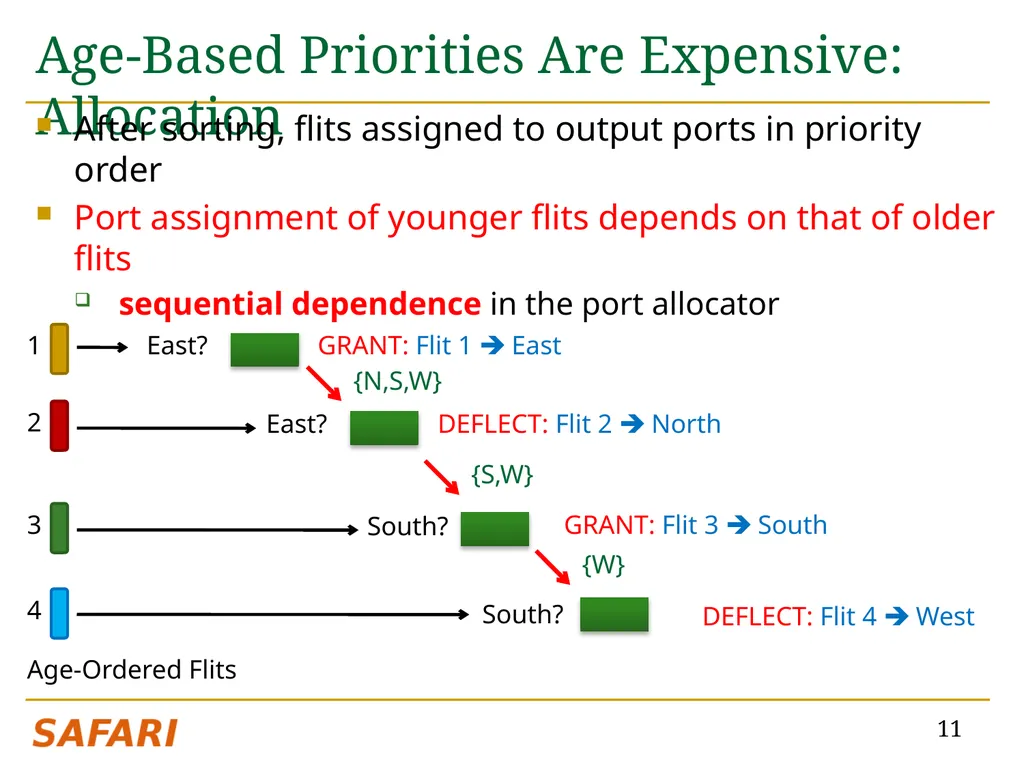
slide11. Age-Based Priorities Are Expensive: Allocation After sorting, flits assigned to output ports in priority order
Port assignment of younger flits depends on that of older flits
sequential dependence in the port allocator 11 East? GRANT: Flit 1 East DEFLECT: Flit 2 North GRANT: Flit 3 South DEFLECT: Flit 4 West East? {N,S,W} {S,W} {W} South? South? Age-Ordered Flits 1 2 3 4<br>
slide12. Age-Based Priorities Are Expensive Overall, deflection routing logic based on Oldest-First has a 43% longer critical path than a buffered router
Question: is there a cheaper way to route while guaranteeing livelock-freedom? 12<br>
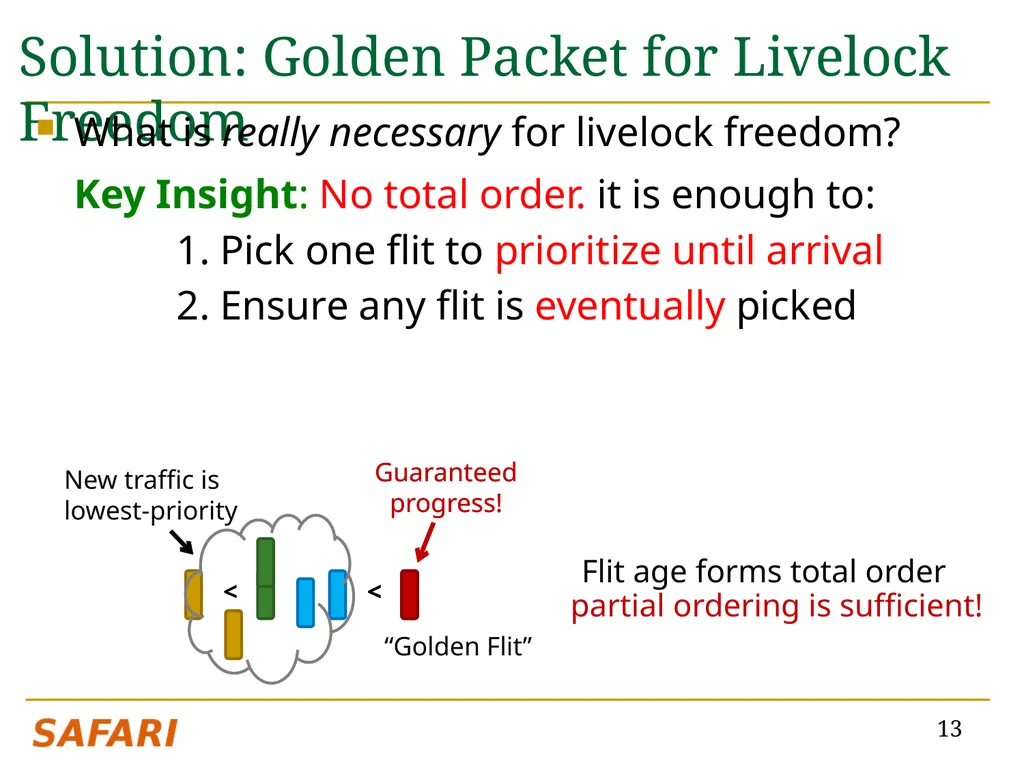
slide13. Solution: Golden Packet for Livelock Freedom What is really necessary for livelock freedom?
Key Insight: No total order. it is enough to:
1. Pick one flit to prioritize until arrival
2. Ensure any flit is eventually picked 13 Guaranteed
progress! < “Golden Flit” partial ordering is sufficient!<br>
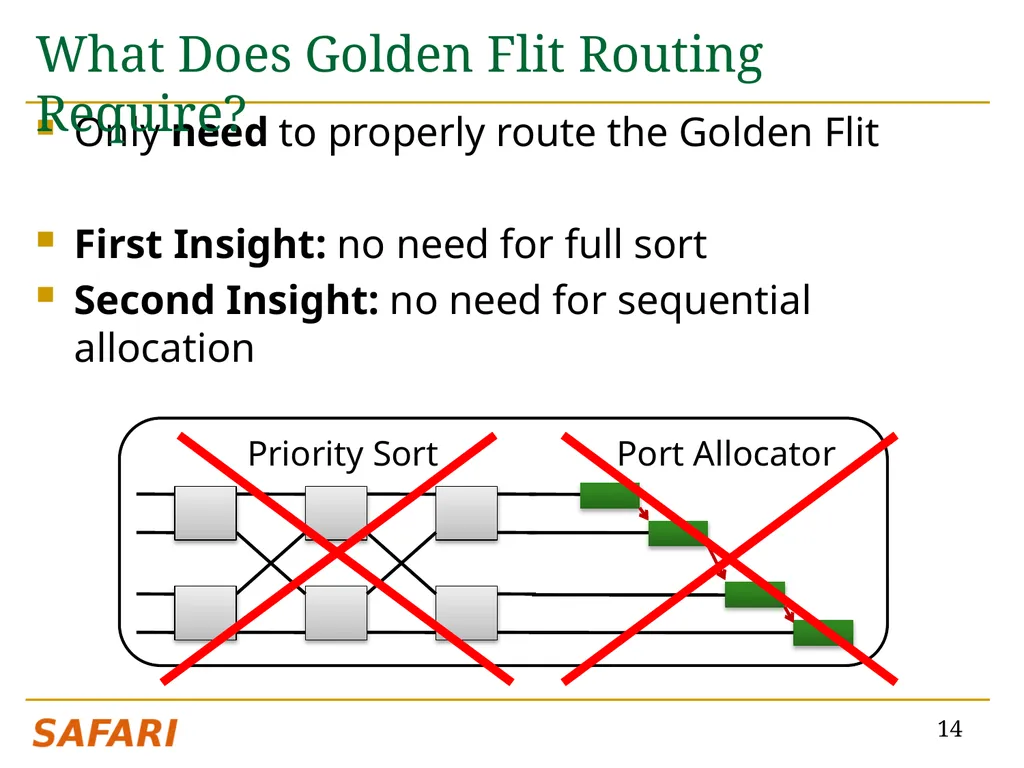
slide14. Only need to properly route the Golden Flit
First Insight: no need for full sort
Second Insight: no need for sequential allocation What Does Golden Flit Routing Require? 14<br>
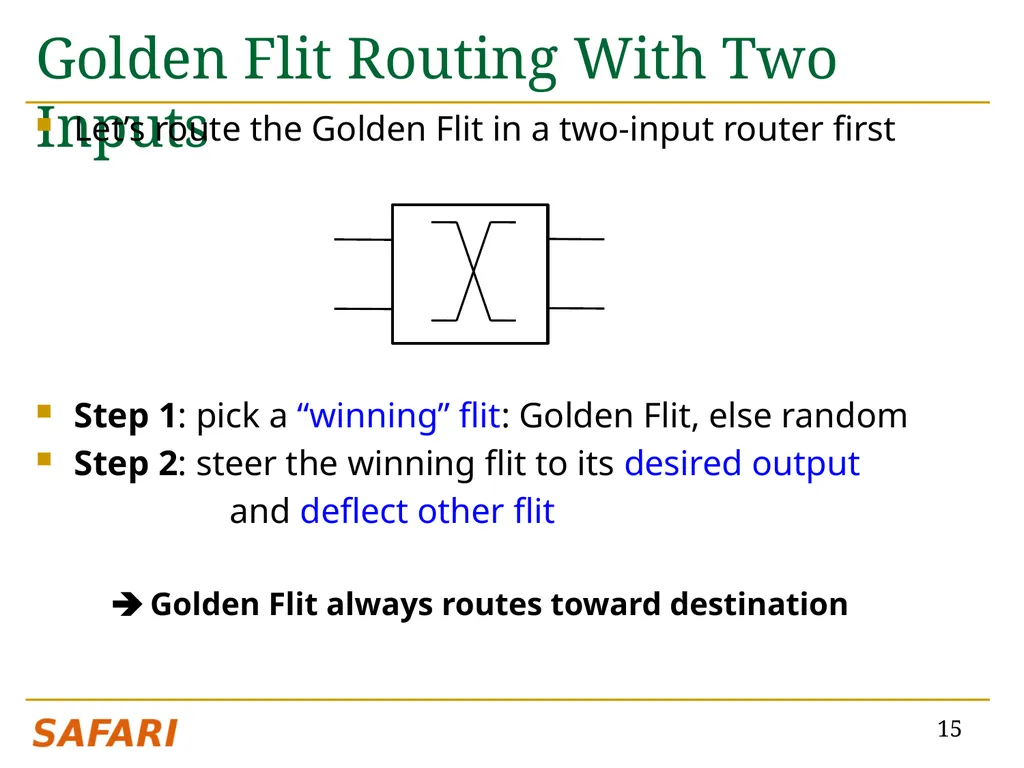
slide15. Golden Flit Routing With Two Inputs Let’s route the Golden Flit in a two-input router first
Step 1: pick a “winning” flit: Golden Flit, else random
Step 2: steer the winning flit to its desired output
and deflect other flit
Golden Flit always routes toward destination 15<br>
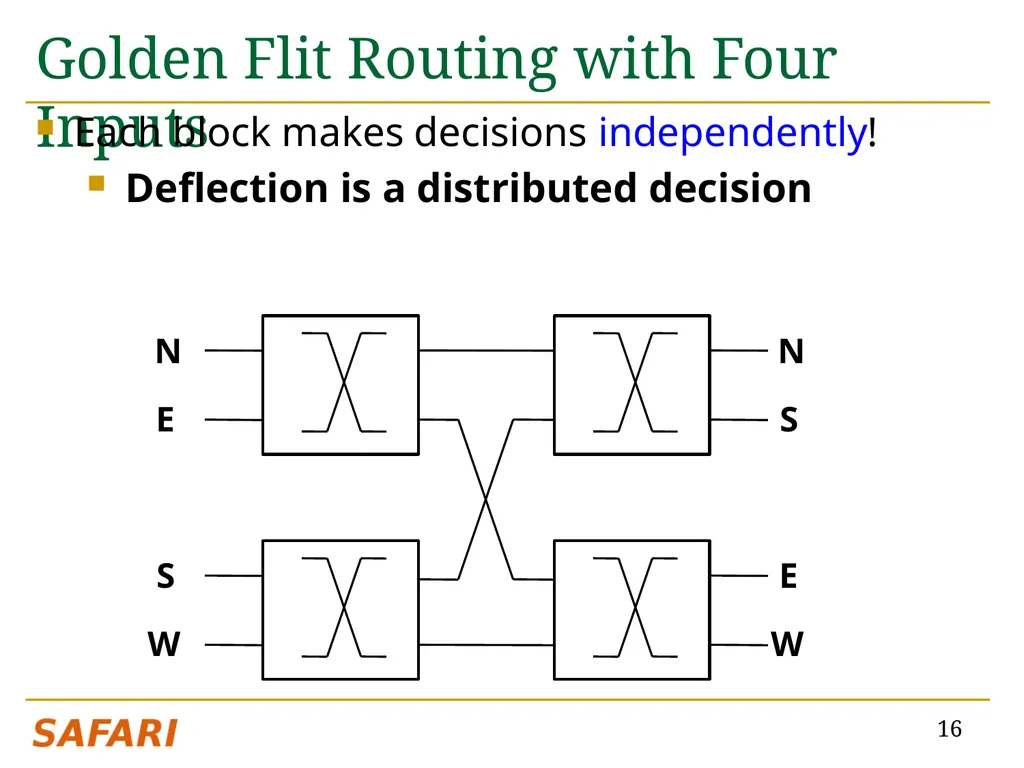
slide16. Golden Flit Routing with Four Inputs 16 Each block makes decisions independently!
Deflection is a distributed decision N E S W N S E W<br>
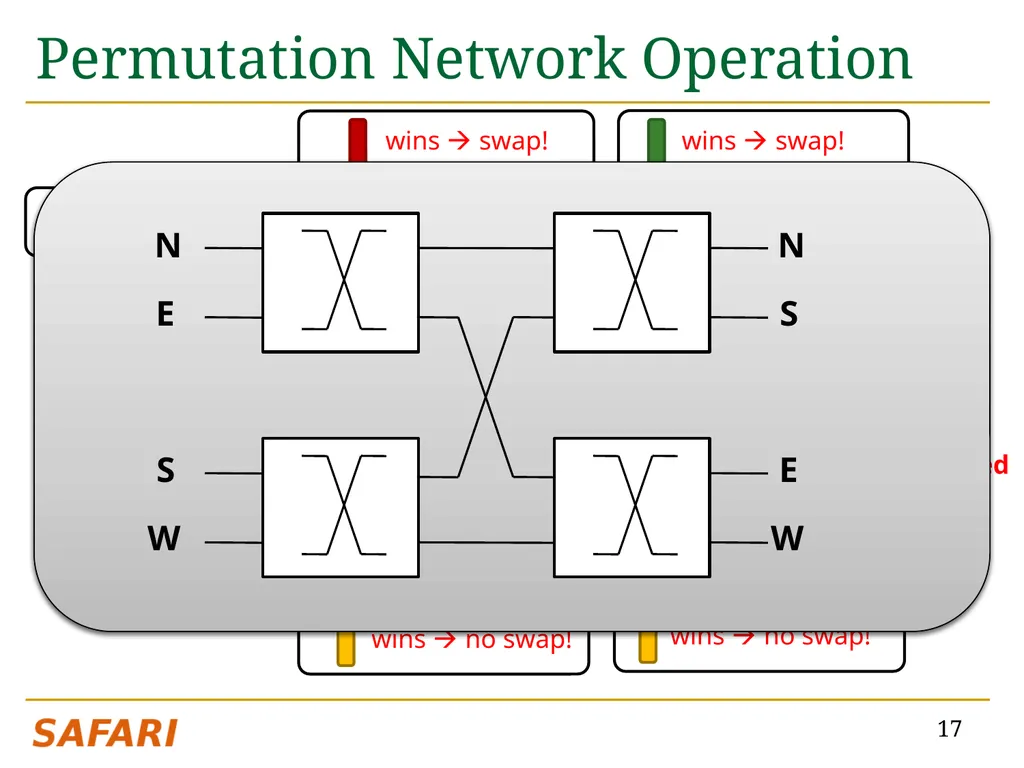
slide17. Permutation Network Operation 17 N E S W wins swap! wins no swap! wins no swap! deflected Golden: wins swap! x N E S W N S E W<br>
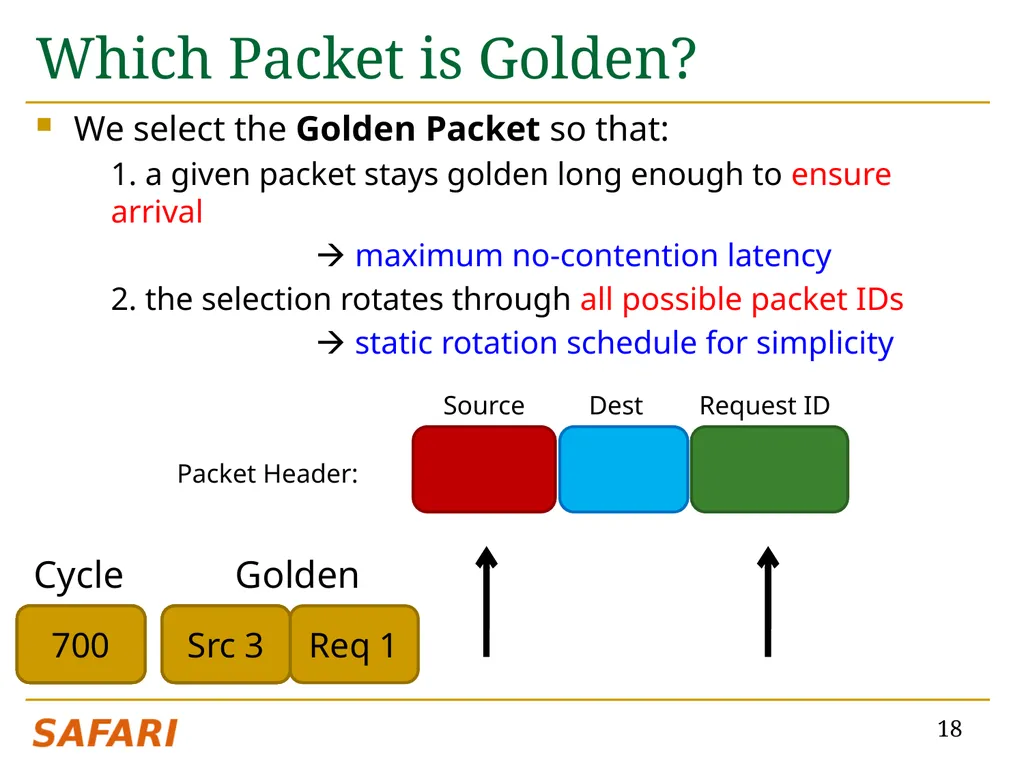
slide18. Which Packet is Golden? We select the Golden Packet so that:
1. a given packet stays golden long enough to ensure arrival
maximum no-contention latency
2. the selection rotates through all possible packet IDs
static rotation schedule for simplicity 18 Source Dest Request ID Src 0 Req 0 Golden Src 1 Src 2 Src 3 Src 0 Req 1 Src 1 Src 2 Src 3 Packet Header: Cycle 0 100 200 300 400 500 600 700<br>
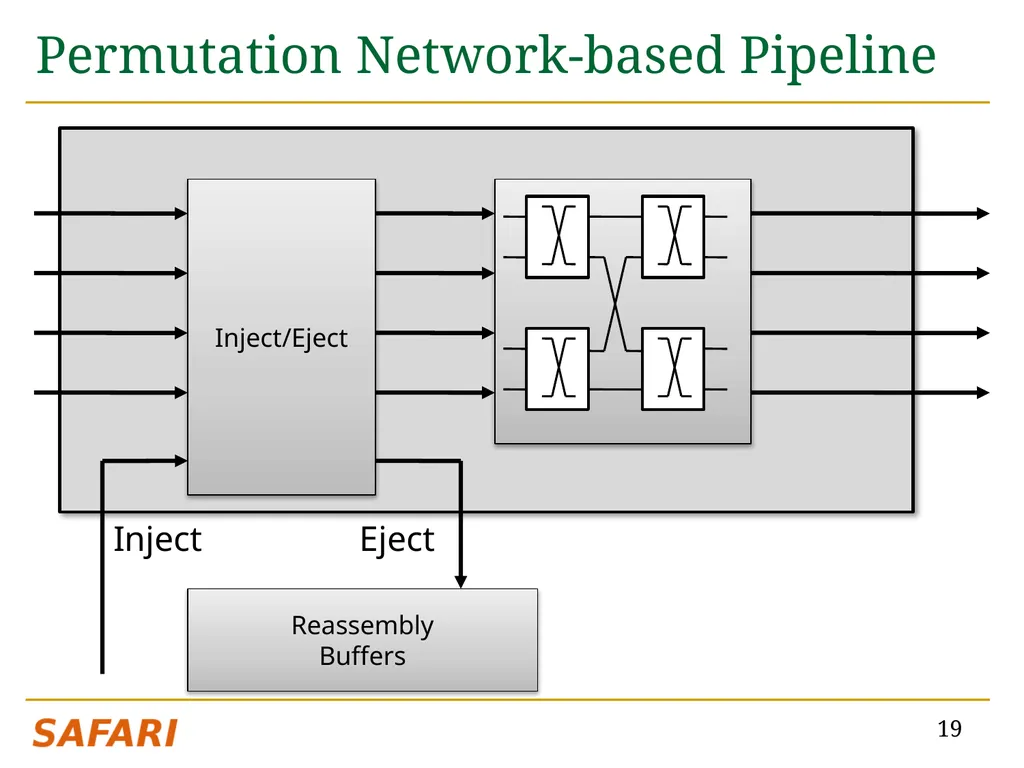
slide19. Permutation Network-based Pipeline 19 Inject/Eject Reassembly
Buffers Inject Eject<br>
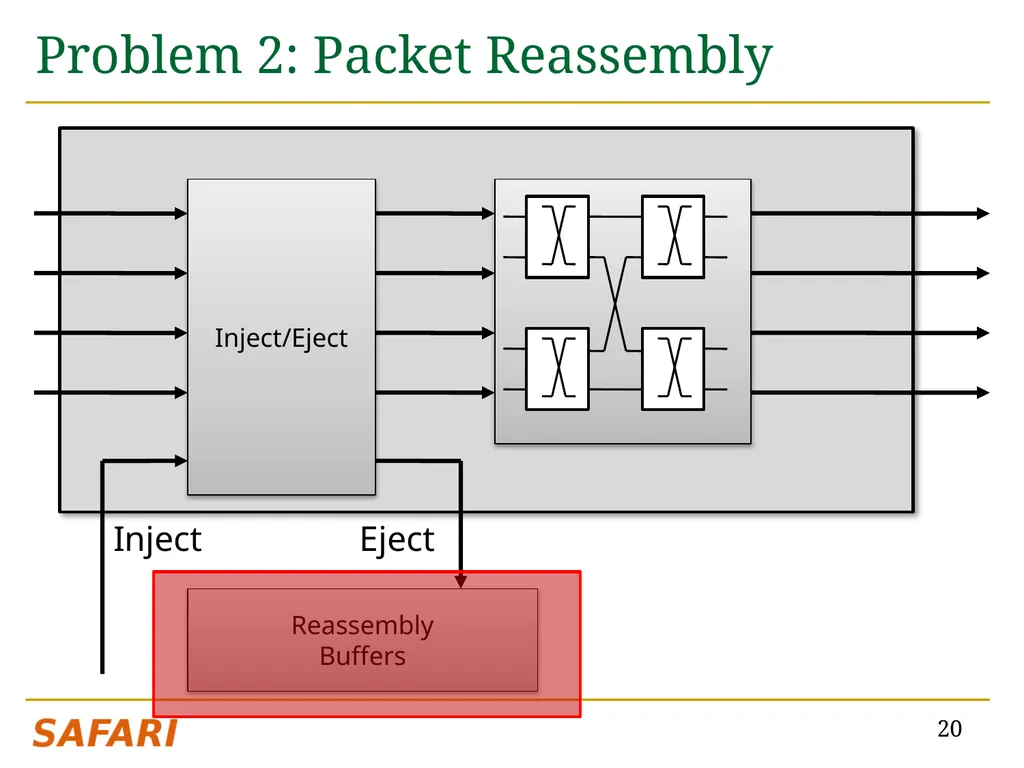
slide20. Problem 2: Packet Reassembly 20 Inject/Eject Reassembly
Buffers Inject Eject<br>
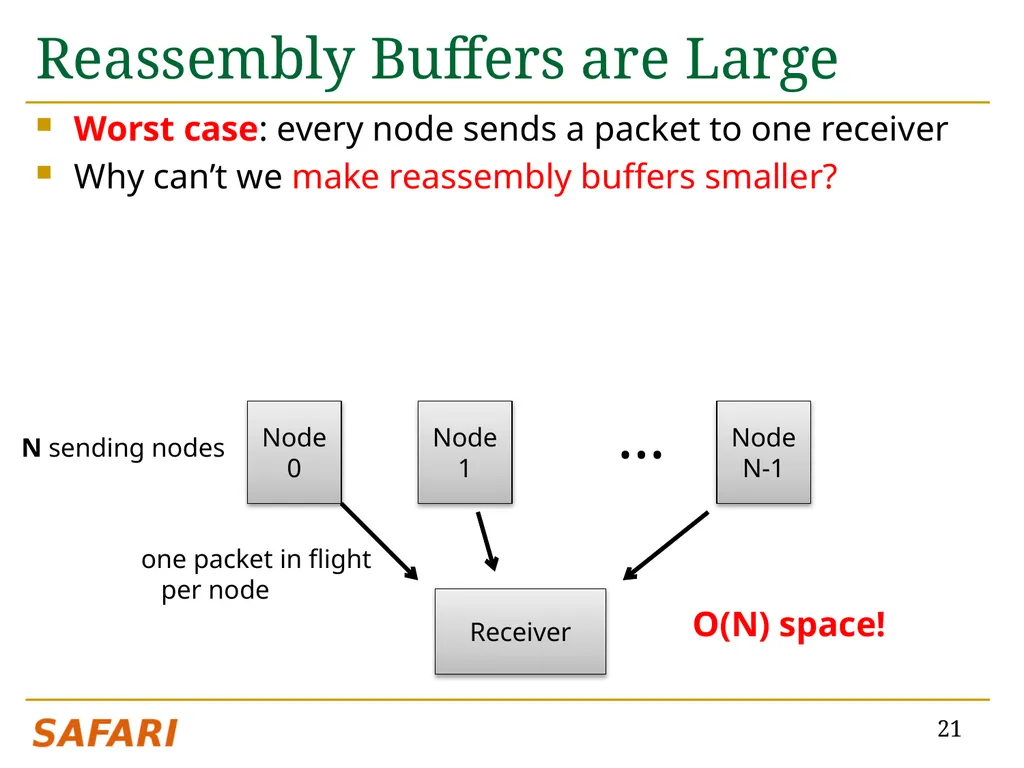
slide21. Reassembly Buffers are Large Worst case: every node sends a packet to one receiver
Why can’t we make reassembly buffers smaller? 21 Node 0 Node 1 Node N-1 Receiver one packet in flight
per node N sending nodes … O(N) space!<br>
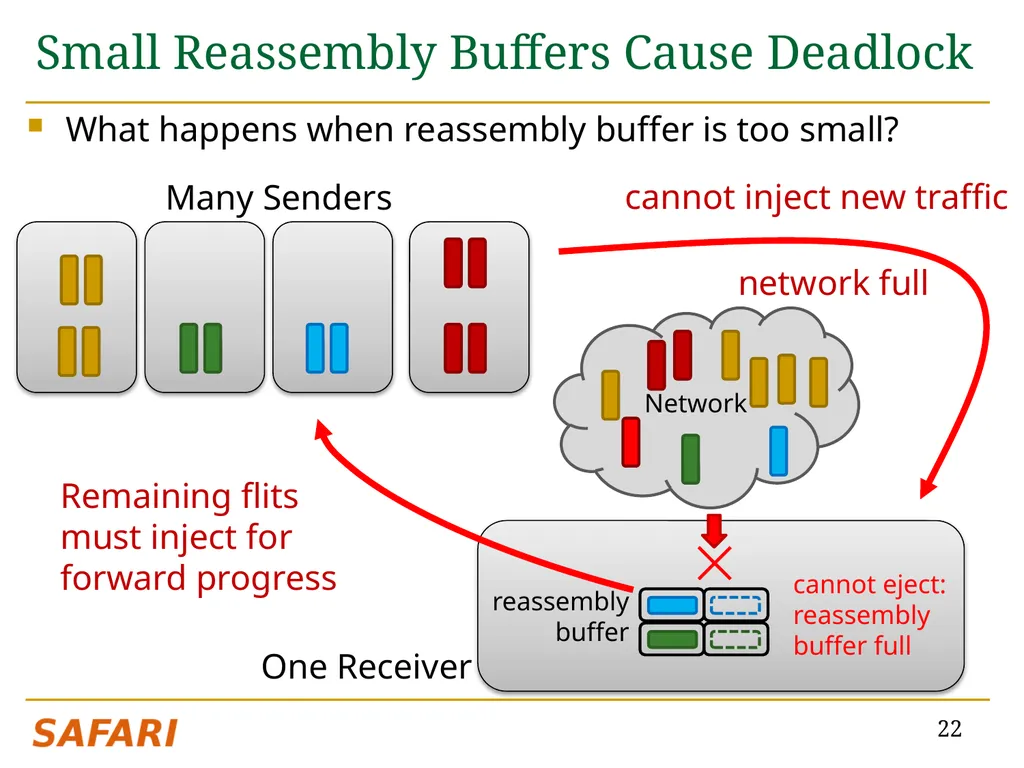
slide22. Small Reassembly Buffers Cause Deadlock What happens when reassembly buffer is too small? 22 Network cannot eject:
reassembly
buffer full reassembly
buffer Many Senders One Receiver Remaining flits
must inject for
forward progress cannot inject new traffic network full<br>
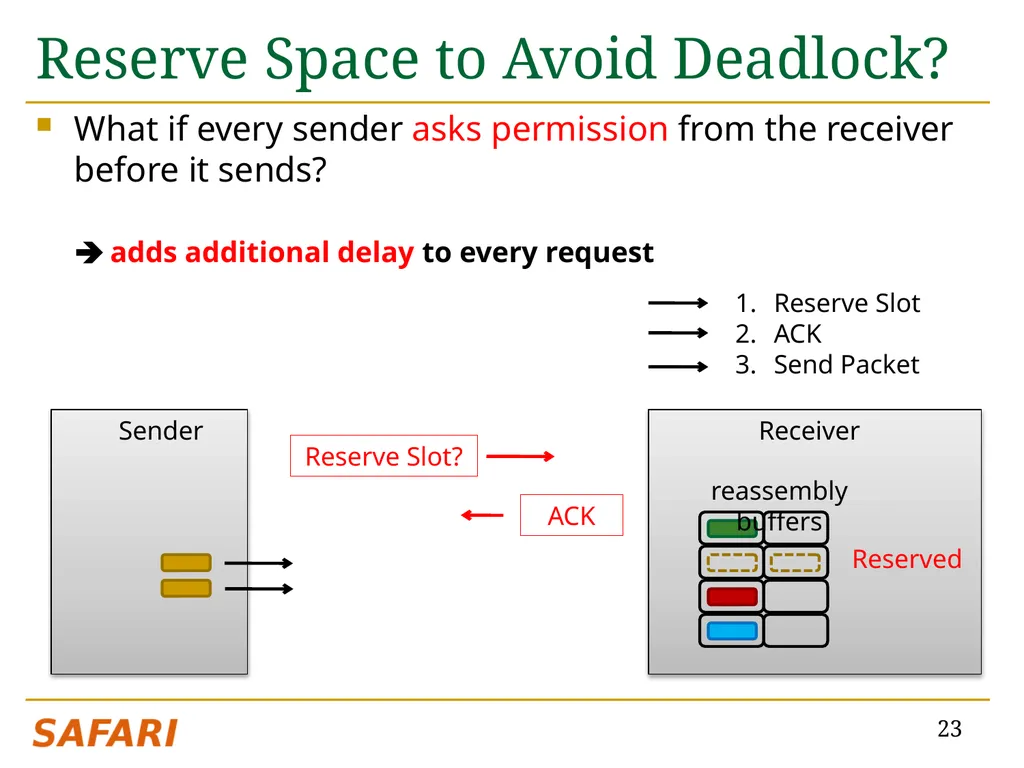
slide23. Reserve Space to Avoid Deadlock? What if every sender asks permission from the receiver before it sends?
adds additional delay to every request 23 reassembly buffers Reserve Slot? Reserved ACK Sender Reserve Slot
ACK
Send Packet Receiver<br>
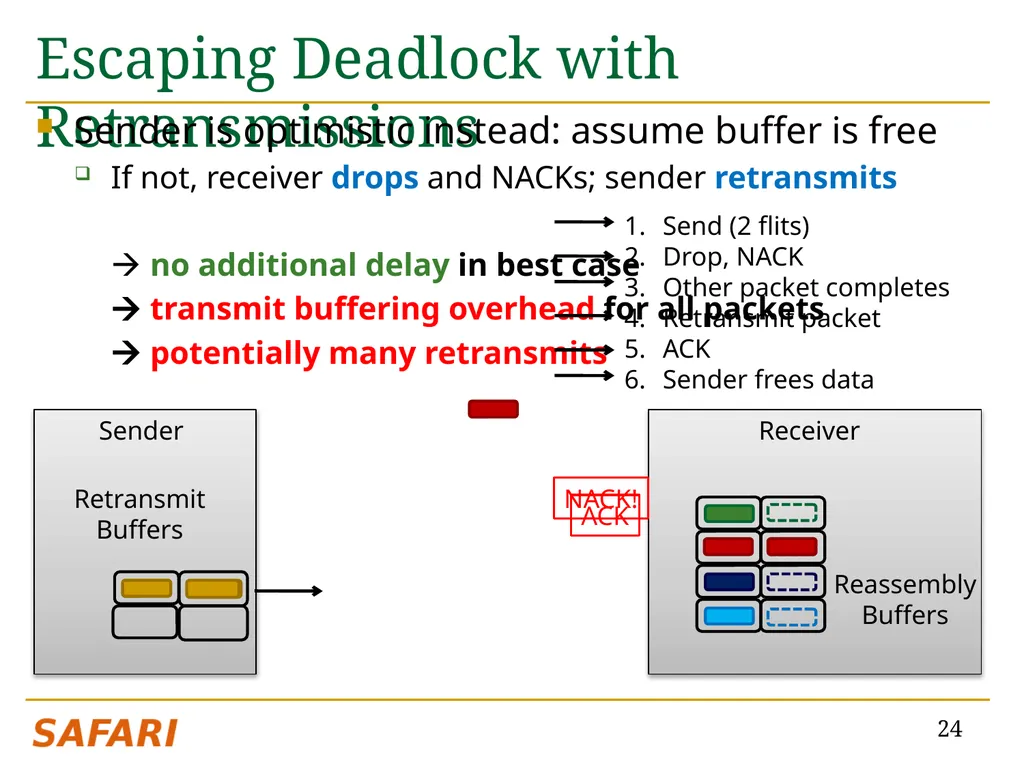
slide24. Escaping Deadlock with Retransmissions Sender is optimistic instead: assume buffer is free
If not, receiver drops and NACKs; sender retransmits
no additional delay in best case
transmit buffering overhead for all packets
potentially many retransmits 24 Reassembly
Buffers Retransmit
Buffers NACK! Sender ACK Receiver Send (2 flits)
Drop, NACK
Other packet completes
Retransmit packet
ACK
Sender frees data<br>
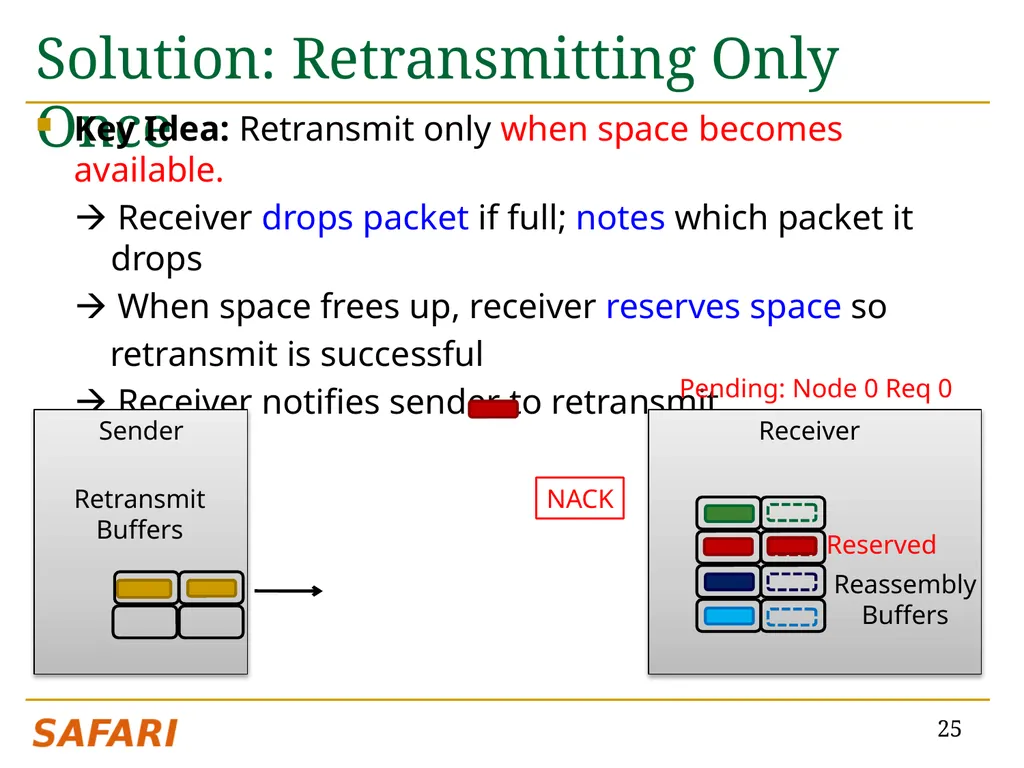
slide25. Solution: Retransmitting Only Once Key Idea: Retransmit only when space becomes available.
Receiver drops packet if full; notes which packet it drops
When space frees up, receiver reserves space so
retransmit is successful
Receiver notifies sender to retransmit 25 Reassembly
Buffers Retransmit
Buffers NACK Sender Reserved Receiver Pending: Node 0 Req 0<br>
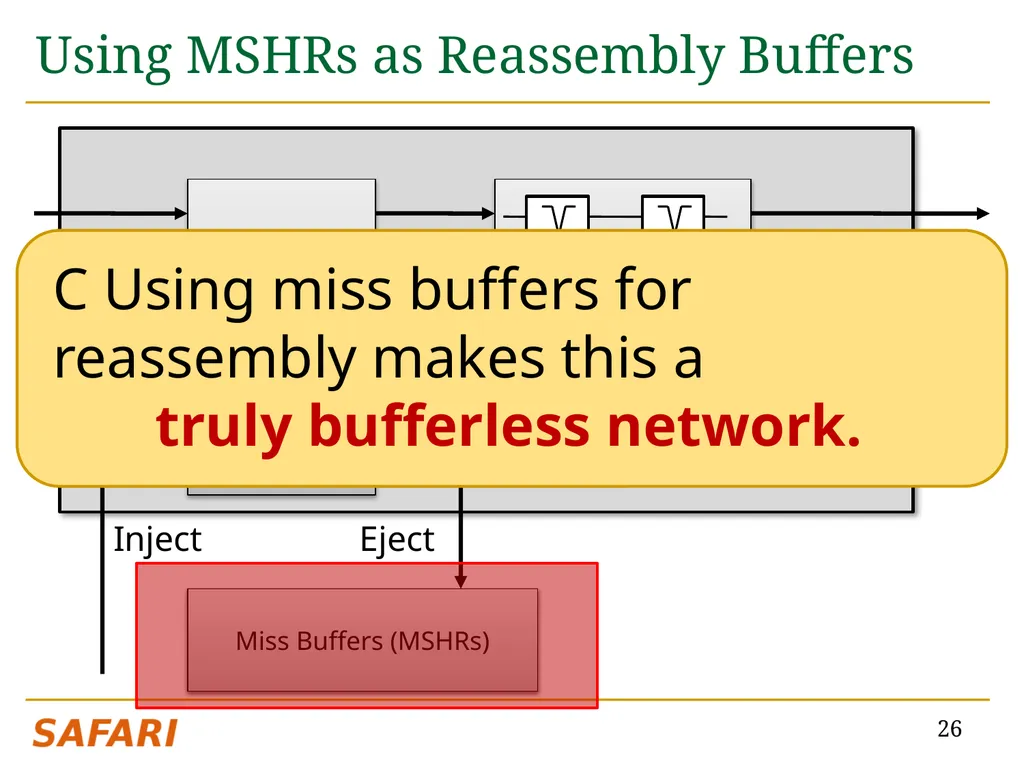
slide26. Using MSHRs as Reassembly Buffers 26 Inject/Eject Reassembly
Buffers Inject Eject Miss Buffers (MSHRs) C Using miss buffers for reassembly makes this a
truly bufferless network.<br>
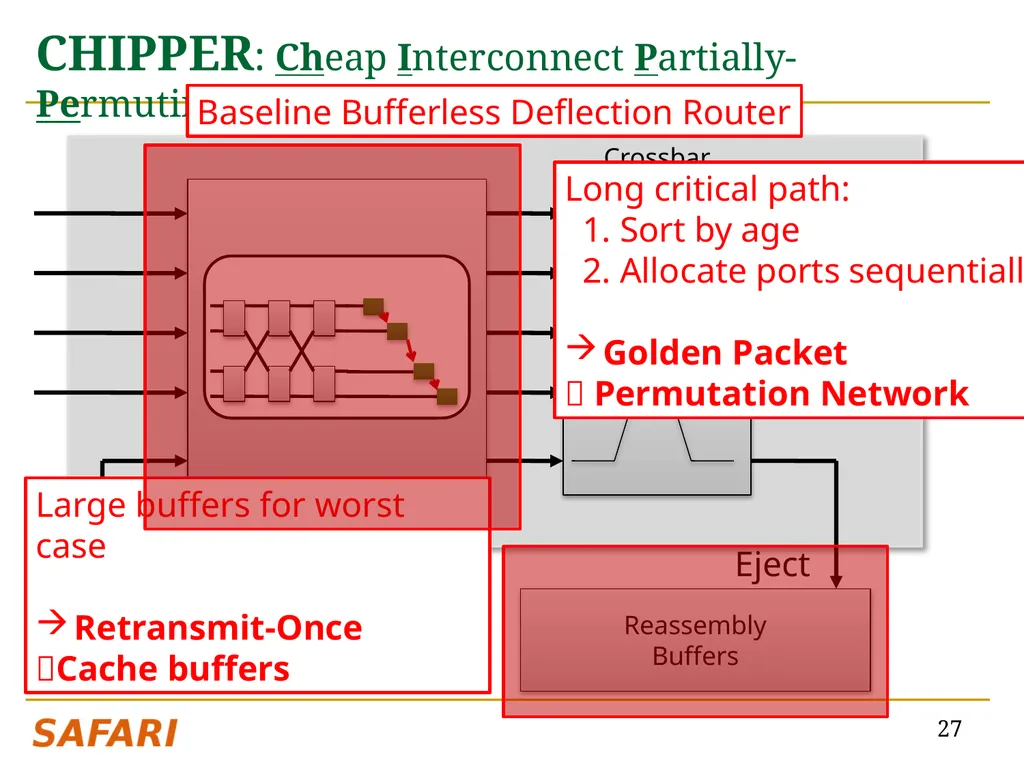
slide27. Inject Deflection
Routing
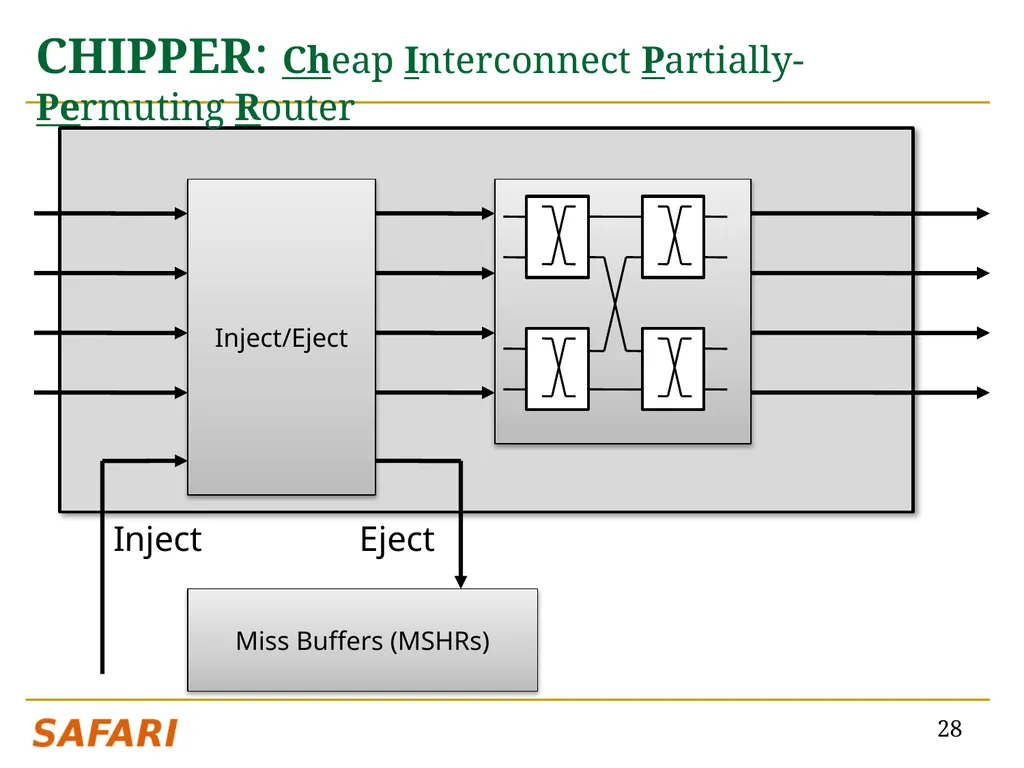
Logic Crossbar CHIPPER: Cheap Interconnect Partially-Permuting Router 27 Reassembly
Buffers Eject Baseline Bufferless Deflection Router Large buffers for worst case
Retransmit-Once
Cache buffers Long critical path:
1. Sort by age
2. Allocate ports sequentially
Golden Packet
Permutation Network<br>
slide28. CHIPPER: Cheap Interconnect Partially-Permuting Router 28 Inject/Eject Miss Buffers (MSHRs) Inject Eject<br>
slide29. EVALUATION 29<br>
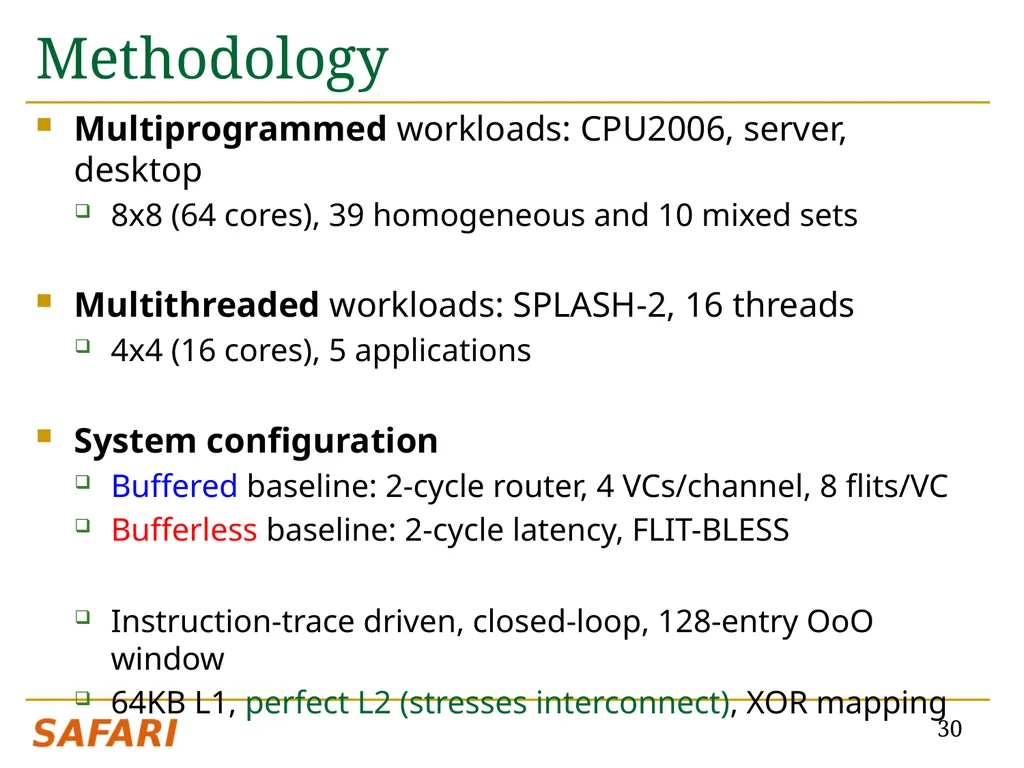
slide30. Methodology Multiprogrammed workloads: CPU2006, server, desktop
8x8 (64 cores), 39 homogeneous and 10 mixed sets
Multithreaded workloads: SPLASH-2, 16 threads
4x4 (16 cores), 5 applications
System configuration
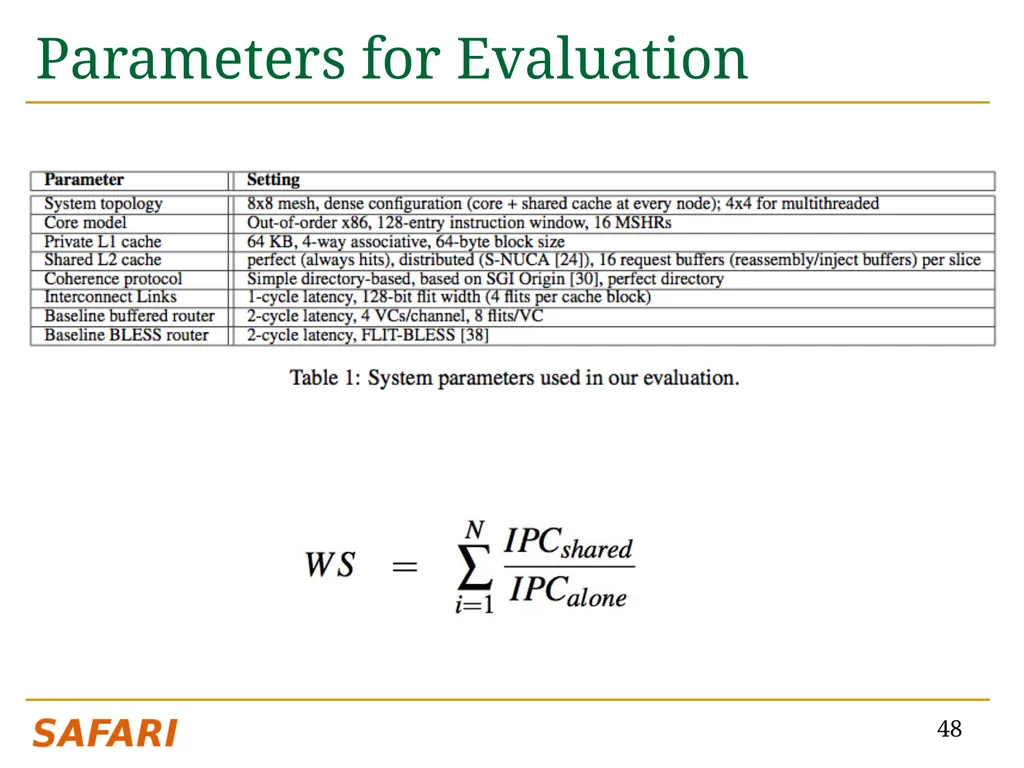
Buffered baseline: 2-cycle router, 4 VCs/channel, 8 flits/VC
Bufferless baseline: 2-cycle latency, FLIT-BLESS
Instruction-trace driven, closed-loop, 128-entry OoO window
64KB L1, perfect L2 (stresses interconnect), XOR mapping 30<br>
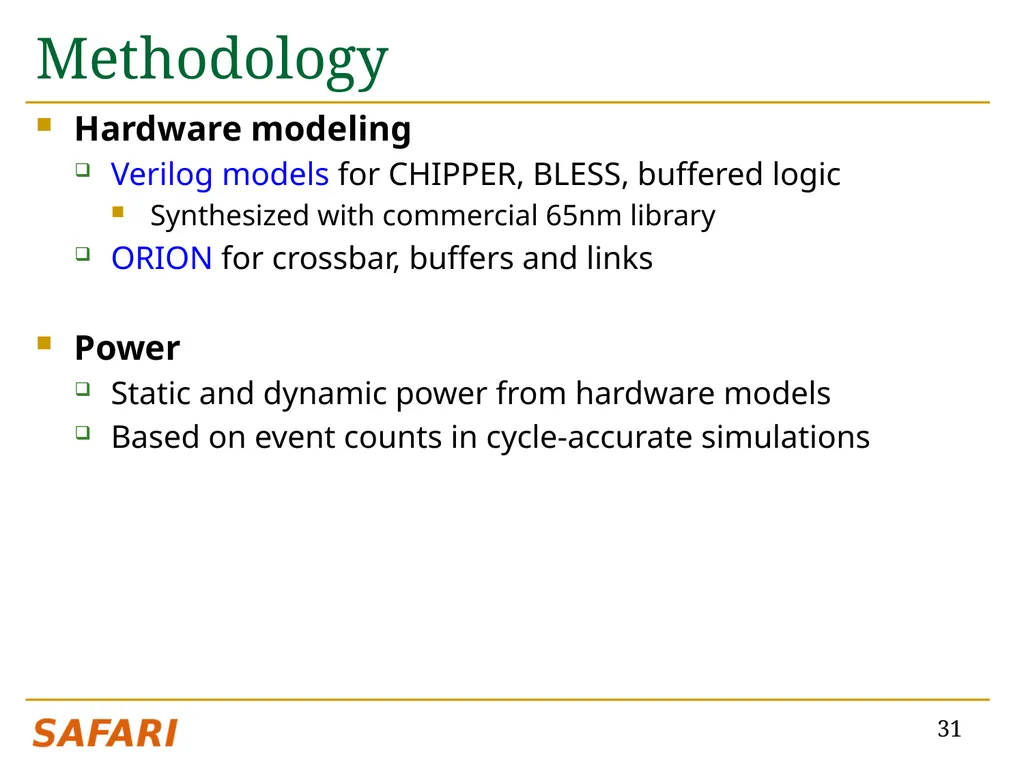
slide31. Methodology Hardware modeling
Verilog models for CHIPPER, BLESS, buffered logic
Synthesized with commercial 65nm library
ORION for crossbar, buffers and links
Power
Static and dynamic power from hardware models
Based on event counts in cycle-accurate simulations 31<br>
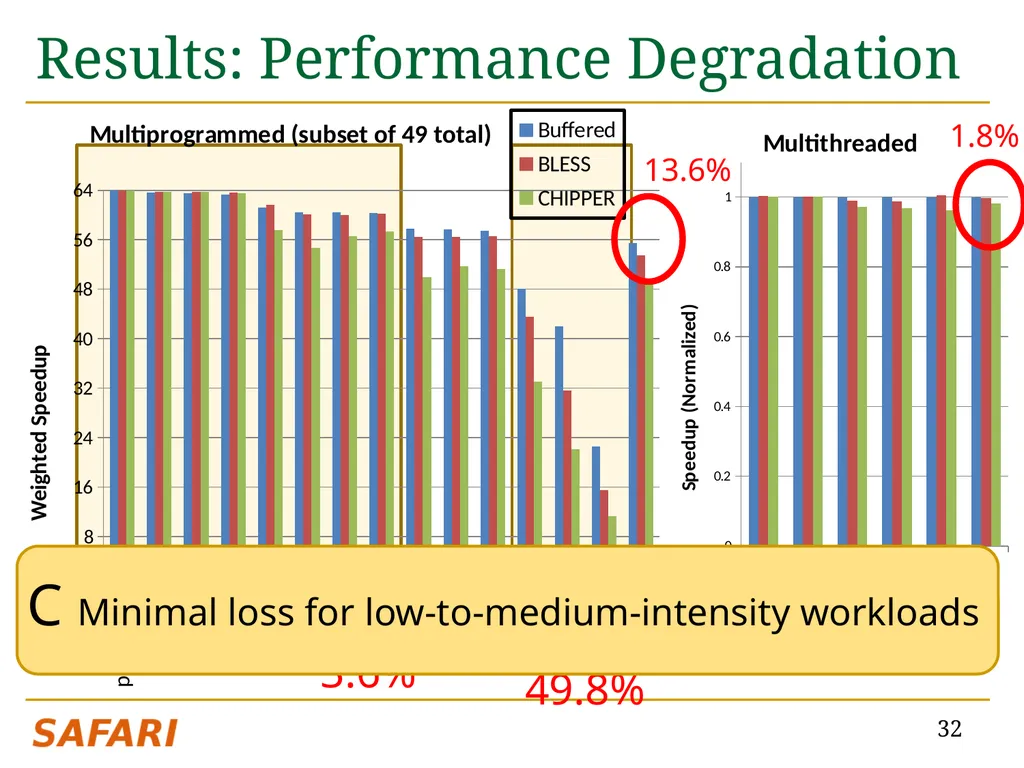
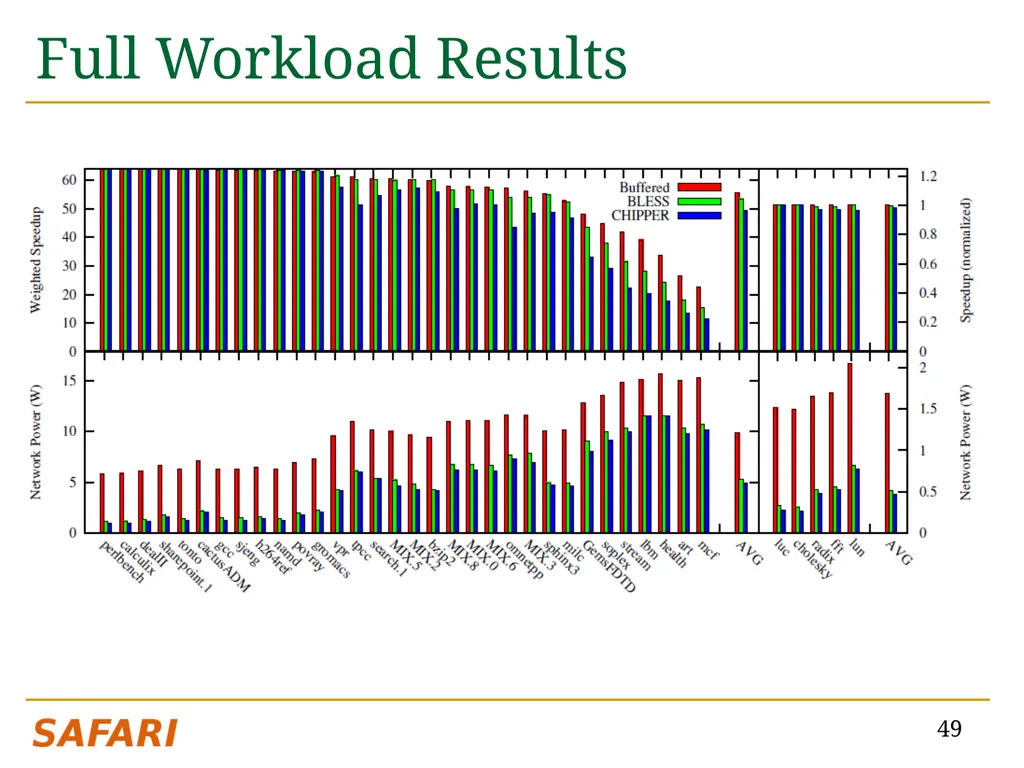
slide32. Results: Performance Degradation 32 13.6% 1.8% 3.6% 49.8% C Minimal loss for low-to-medium-intensity workloads<br>
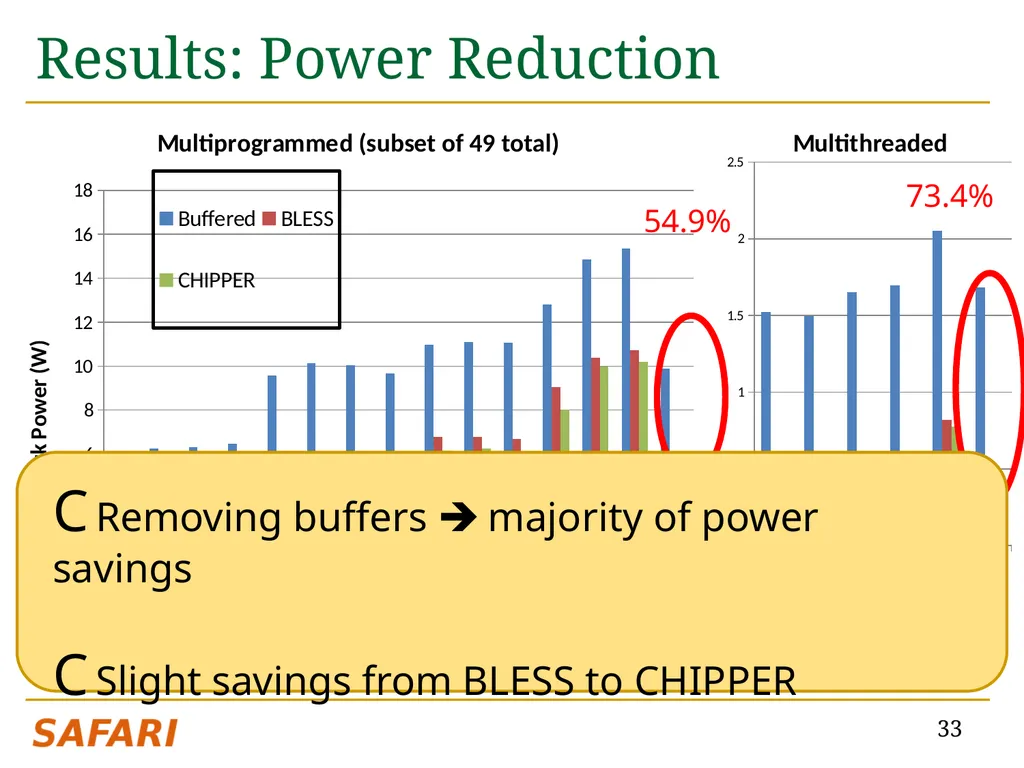
slide33. Results: Power Reduction 33 54.9% 73.4% C Removing buffers majority of power savings
C Slight savings from BLESS to CHIPPER<br>
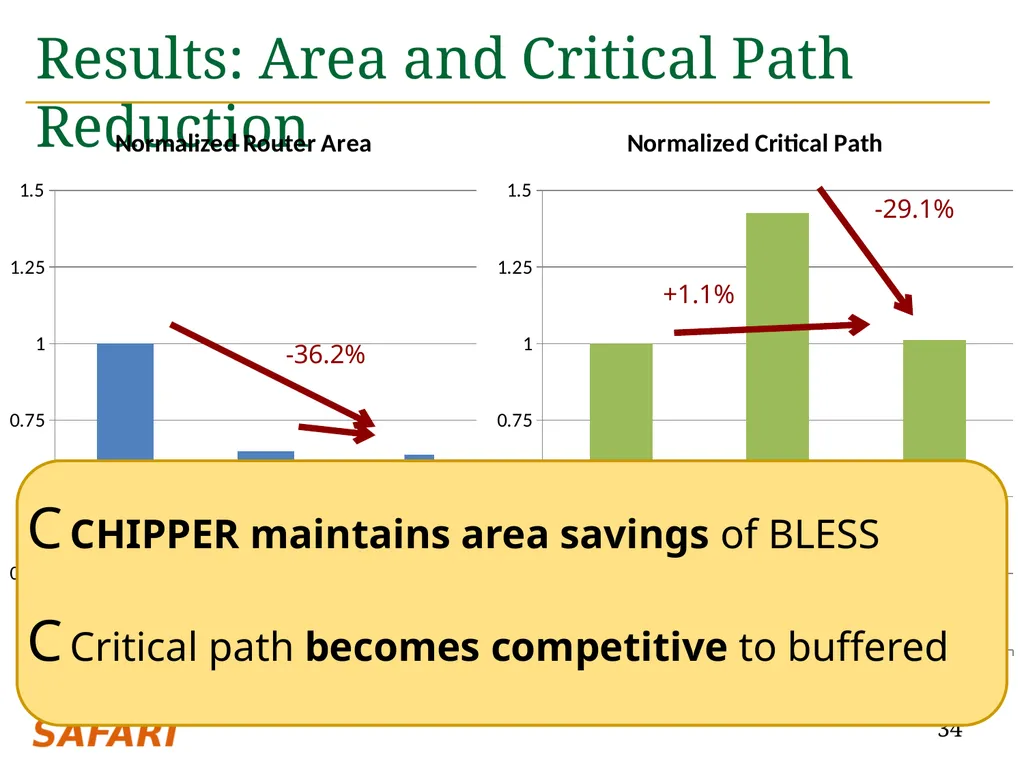
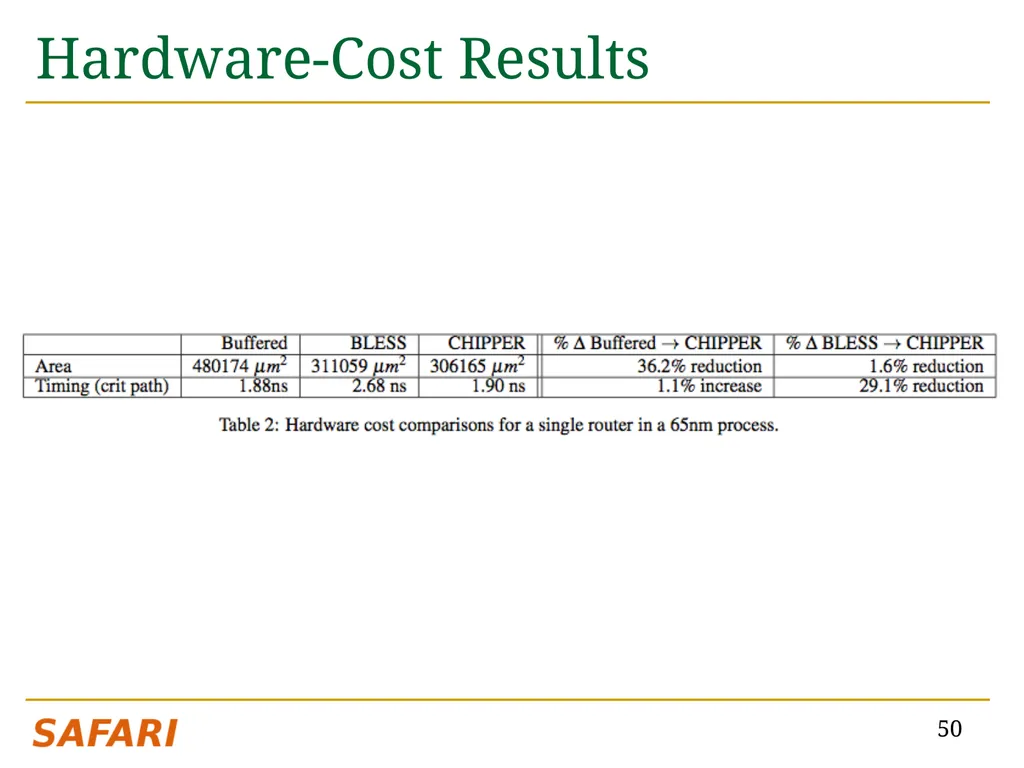
slide34. Results: Area and Critical Path Reduction 34 -36.2% -29.1% +1.1% -1.6% C CHIPPER maintains area savings of BLESS
C Critical path becomes competitive to buffered<br>
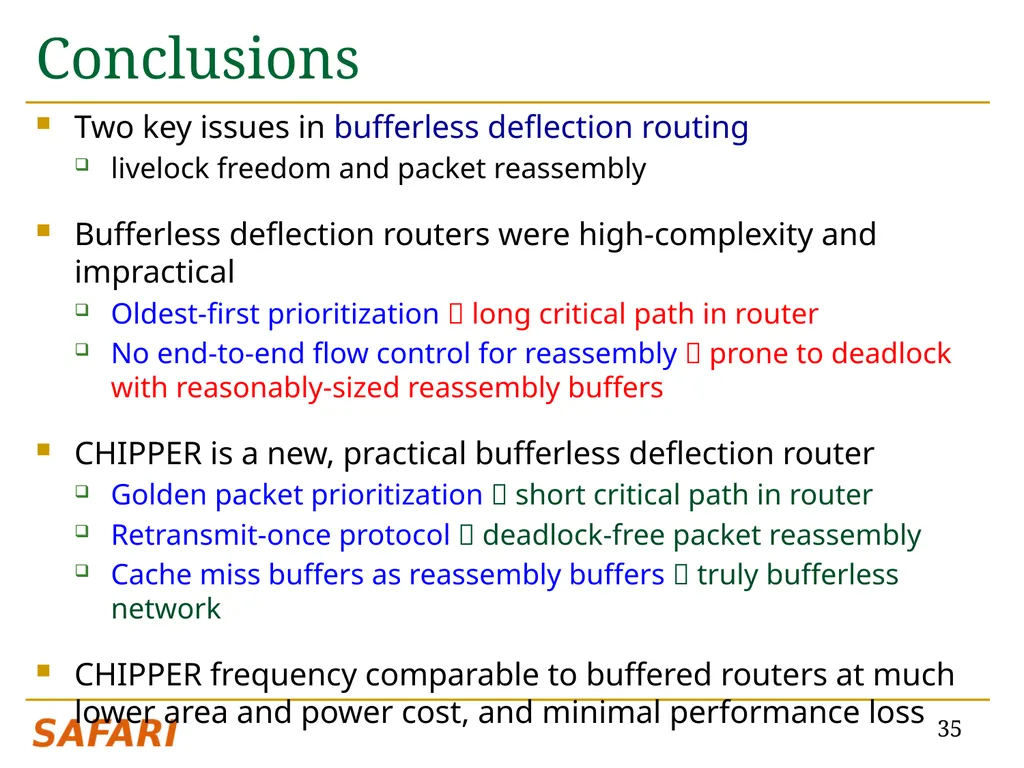
slide35. Conclusions Two key issues in bufferless deflection routing
livelock freedom and packet reassembly
Bufferless deflection routers were high-complexity and impractical
Oldest-first prioritization long critical path in router
No end-to-end flow control for reassembly prone to deadlock with reasonably-sized reassembly buffers
CHIPPER is a new, practical bufferless deflection router
Golden packet prioritization short critical path in router
Retransmit-once protocol deadlock-free packet reassembly
Cache miss buffers as reassembly buffers truly bufferless network
CHIPPER frequency comparable to buffered routers at much lower area and power cost, and minimal performance loss 35<br>
slide36. Thank you! The packet flew quick through the NoC,
Paced by the clock’s constant tock.
But the critical path
Soon unleashed its wrath –
And further improvements did block. 36<br>
slide37. CHIPPER: A Low-complexity Bufferless Deflection Router Chris Fallin
Chris Craik
Onur Mutlu<br>
slide38. Backup Slides 38<br>
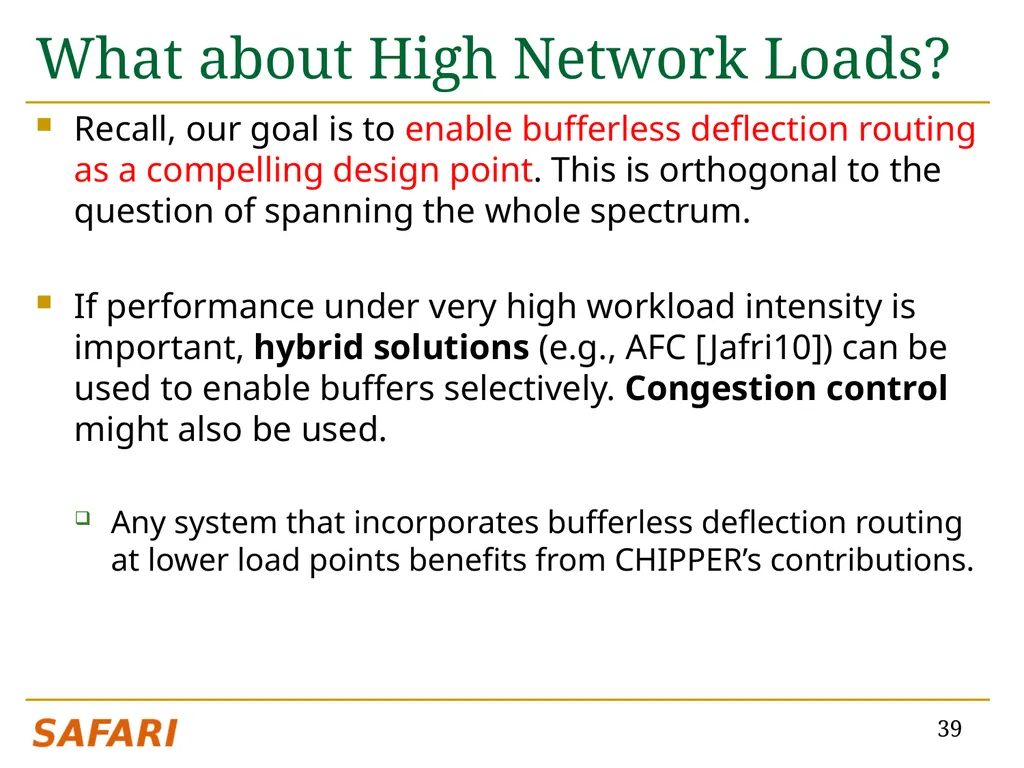
slide39. What about High Network Loads? Recall, our goal is to enable bufferless deflection routing as a compelling design point. This is orthogonal to the question of spanning the whole spectrum.
If performance under very high workload intensity is important, hybrid solutions (e.g., AFC [Jafri10]) can be used to enable buffers selectively. Congestion control might also be used.
Any system that incorporates bufferless deflection routing at lower load points benefits from CHIPPER’s contributions. 39<br>
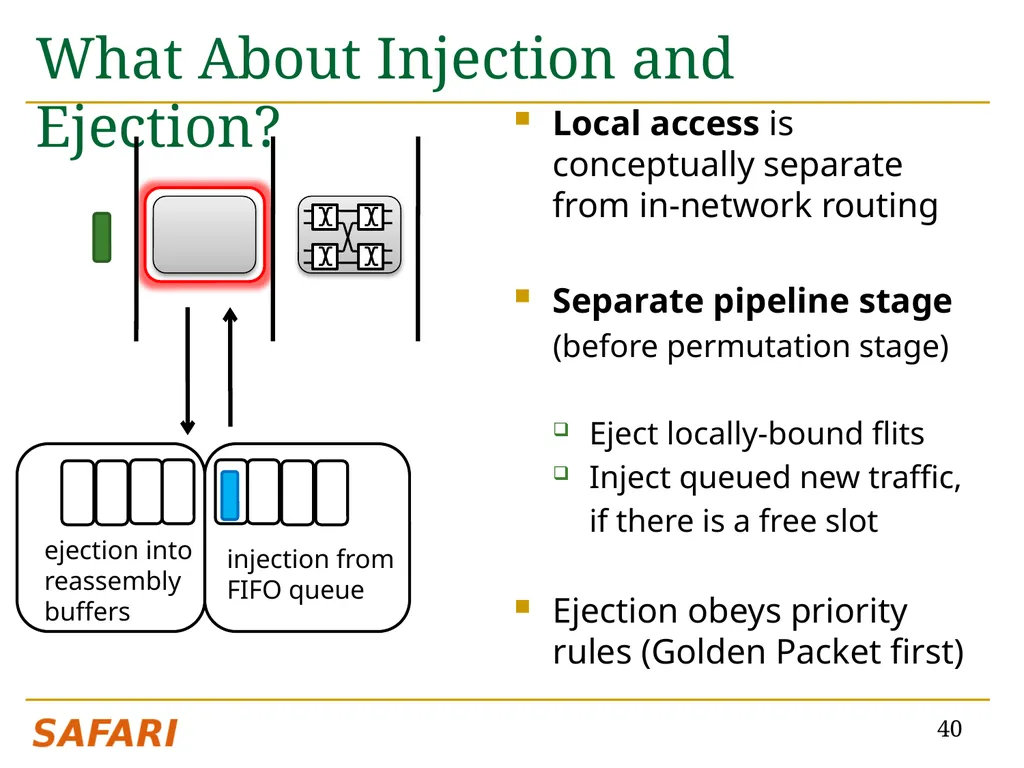
slide40. What About Injection and Ejection? Local access is conceptually separate from in-network routing
Separate pipeline stage
(before permutation stage)
Eject locally-bound flits
Inject queued new traffic,
if there is a free slot
Ejection obeys priority rules (Golden Packet first) 40 ejection into
reassembly buffers injection from
FIFO queue<br>
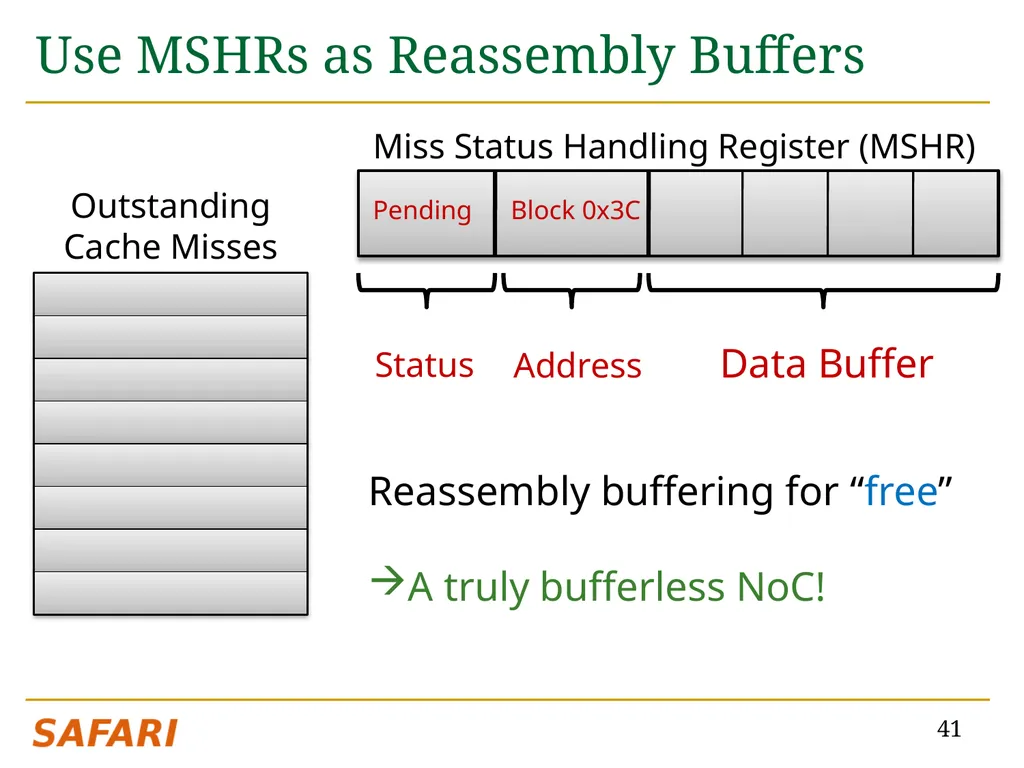
slide41. Use MSHRs as Reassembly Buffers 41 Outstanding
Cache Misses Miss Status Handling Register (MSHR) Pending Block 0x3C Data Buffer Status Address Reassembly buffering for “free”
A truly bufferless NoC!<br>
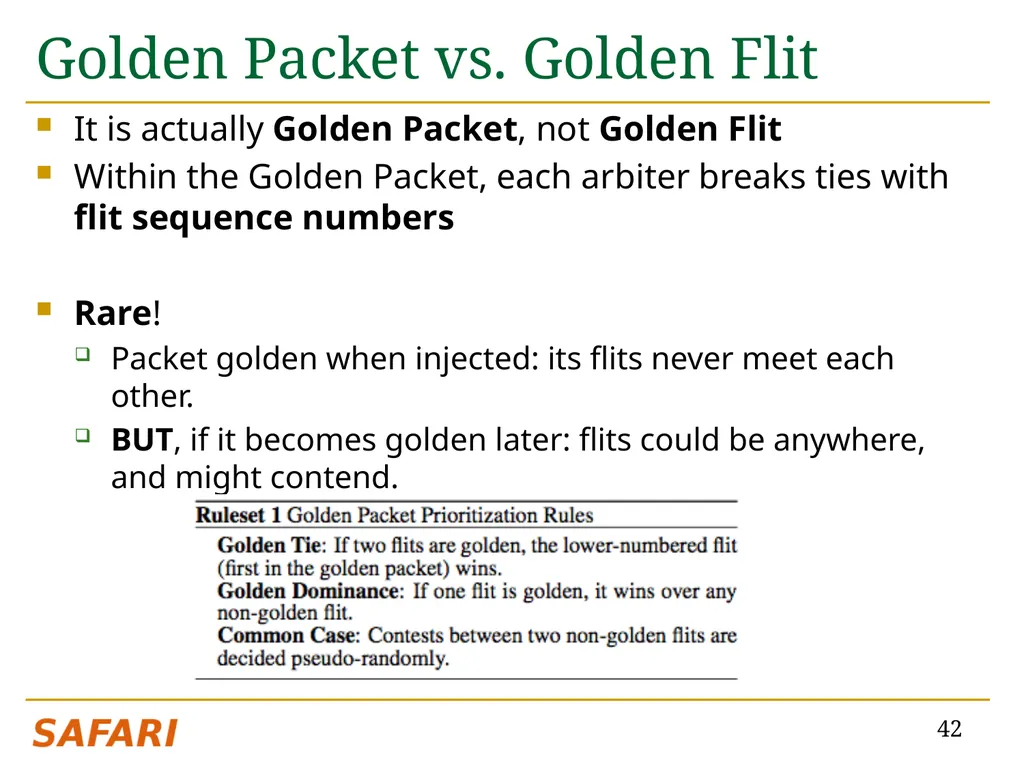
slide42. Golden Packet vs. Golden Flit It is actually Golden Packet, not Golden Flit
Within the Golden Packet, each arbiter breaks ties with flit sequence numbers
Rare!
Packet golden when injected: its flits never meet each other.
BUT, if it becomes golden later: flits could be anywhere, and might contend. 42<br>
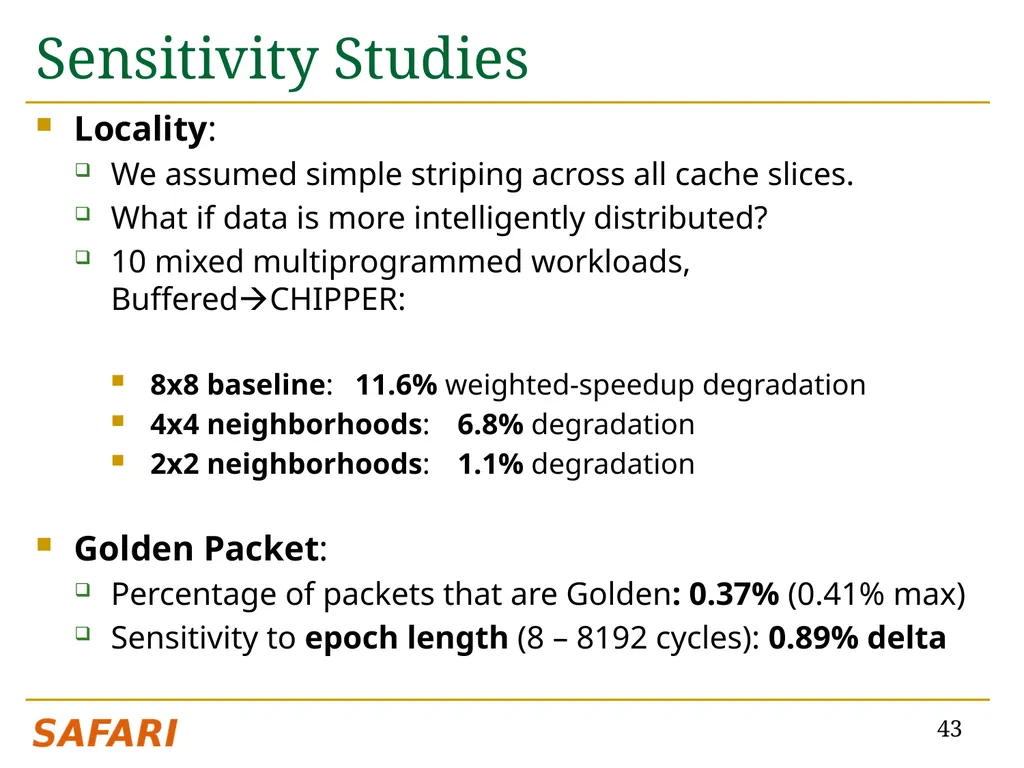
slide43. Sensitivity Studies Locality:
We assumed simple striping across all cache slices.
What if data is more intelligently distributed?
10 mixed multiprogrammed workloads, BufferedCHIPPER:
8x8 baseline: 11.6% weighted-speedup degradation
4x4 neighborhoods: 6.8% degradation
2x2 neighborhoods: 1.1% degradation
Golden Packet:
Percentage of packets that are Golden: 0.37% (0.41% max)
Sensitivity to epoch length (8 – 8192 cycles): 0.89% delta 43<br>
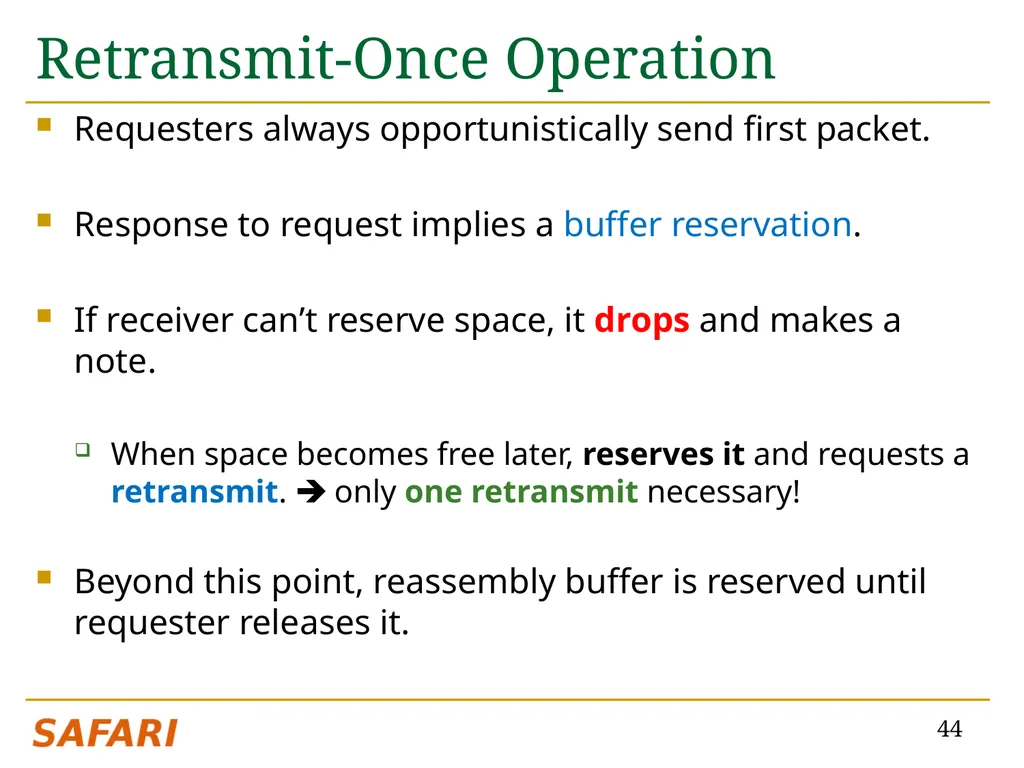
slide44. Retransmit-Once Operation Requesters always opportunistically send first packet.
Response to request implies a buffer reservation.
If receiver can’t reserve space, it drops and makes a note.
When space becomes free later, reserves it and requests a retransmit. only one retransmit necessary!
Beyond this point, reassembly buffer is reserved until requester releases it. 44<br>
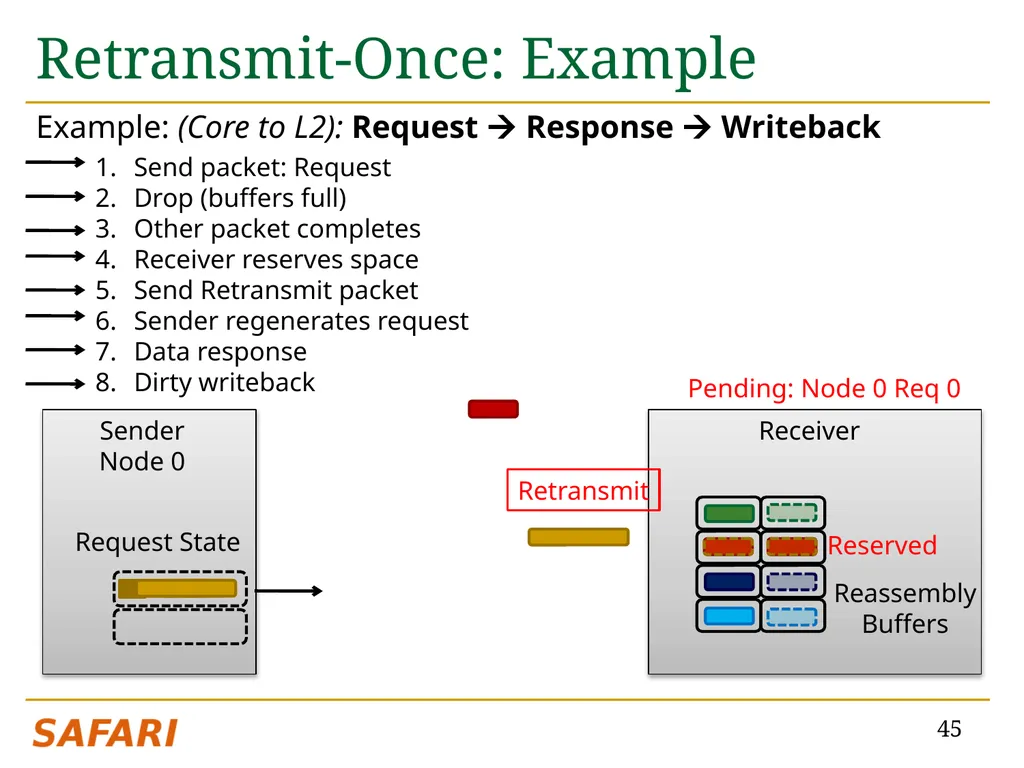
slide45. Retransmit-Once: Example Example: (Core to L2): Request Response Writeback 45 Reassembly
Buffers Request State Retransmit Sender
Node 0 Pending: Node 0 Req 0 Receiver Reserved Send packet: Request
Drop (buffers full)
Other packet completes
Receiver reserves space
Send Retransmit packet
Sender regenerates request
Data response
Dirty writeback<br>
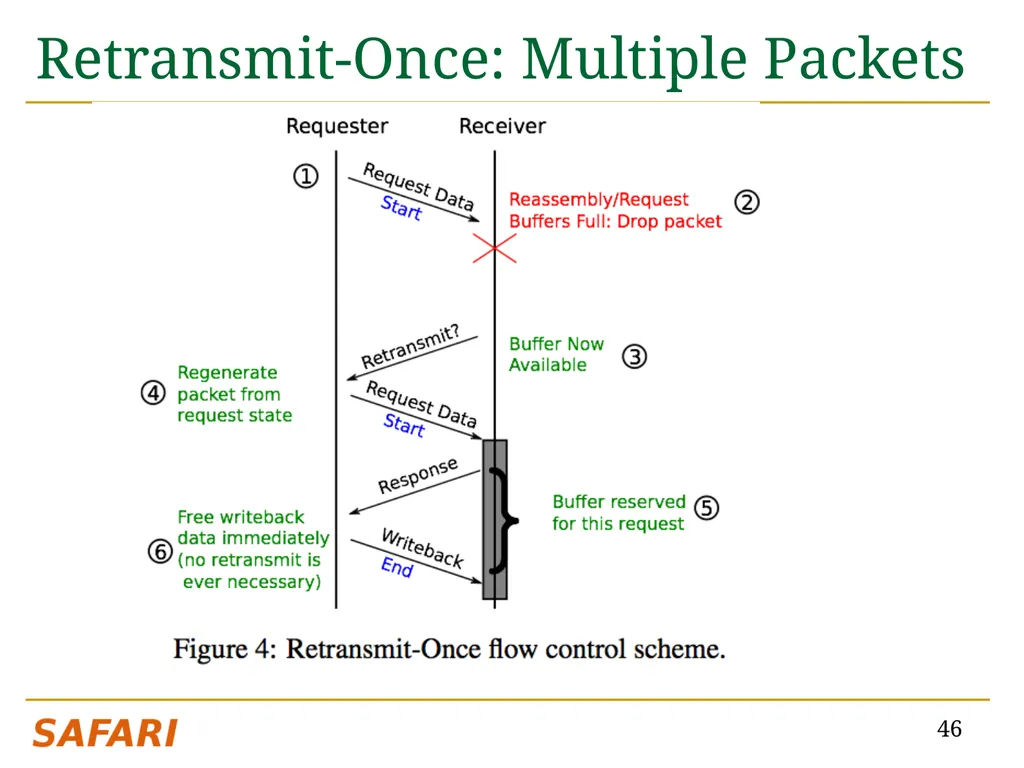
slide46. Retransmit-Once: Multiple Packets 46<br>
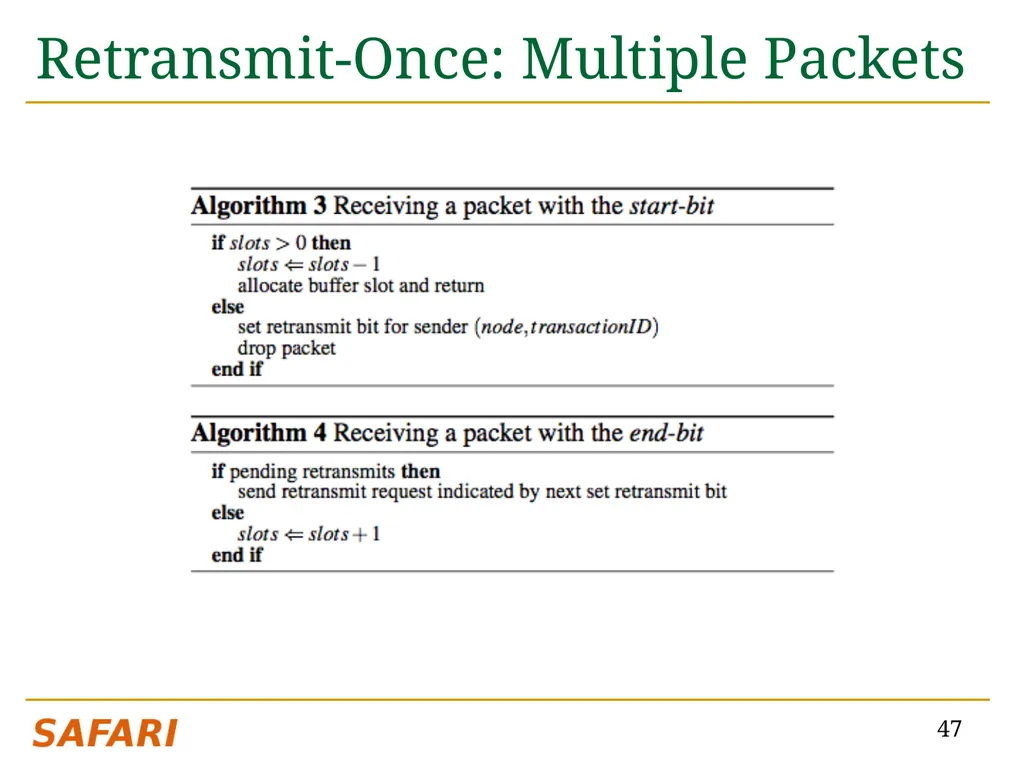
slide47. Retransmit-Once: Multiple Packets 47<br>
slide48. Parameters for Evaluation 48<br>
slide49. Full Workload Results 49<br>
slide50. Hardware-Cost Results 50<br>
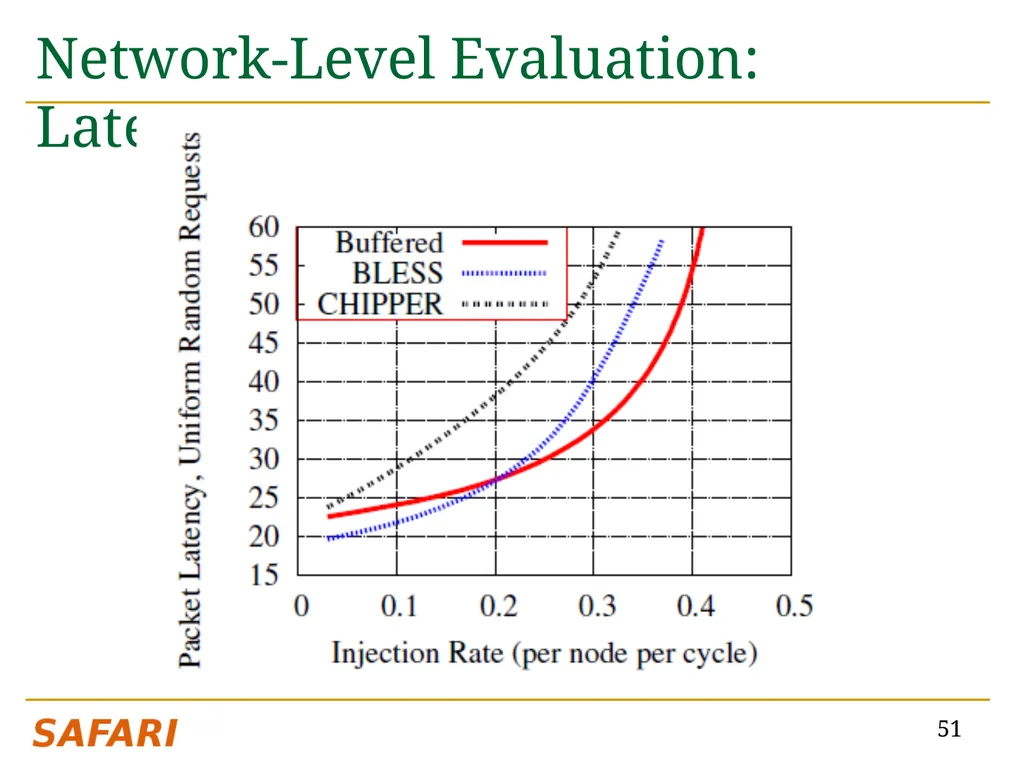
slide51. Network-Level Evaluation: Latency 51<br>
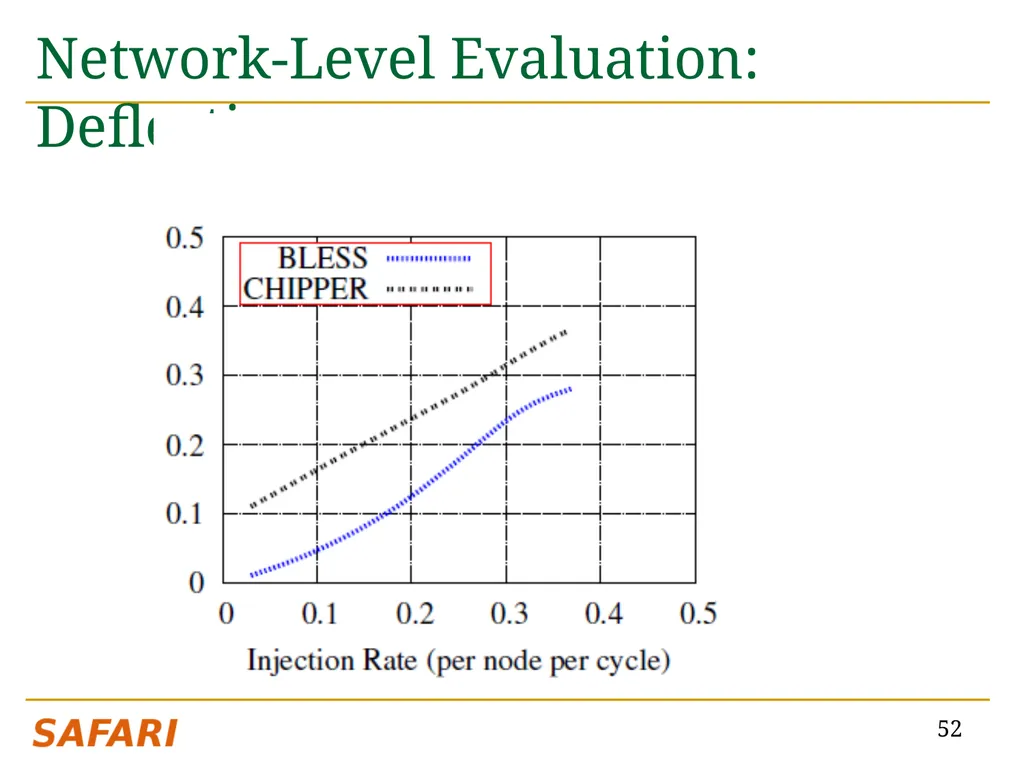
slide52. Network-Level Evaluation: Deflections 52<br>
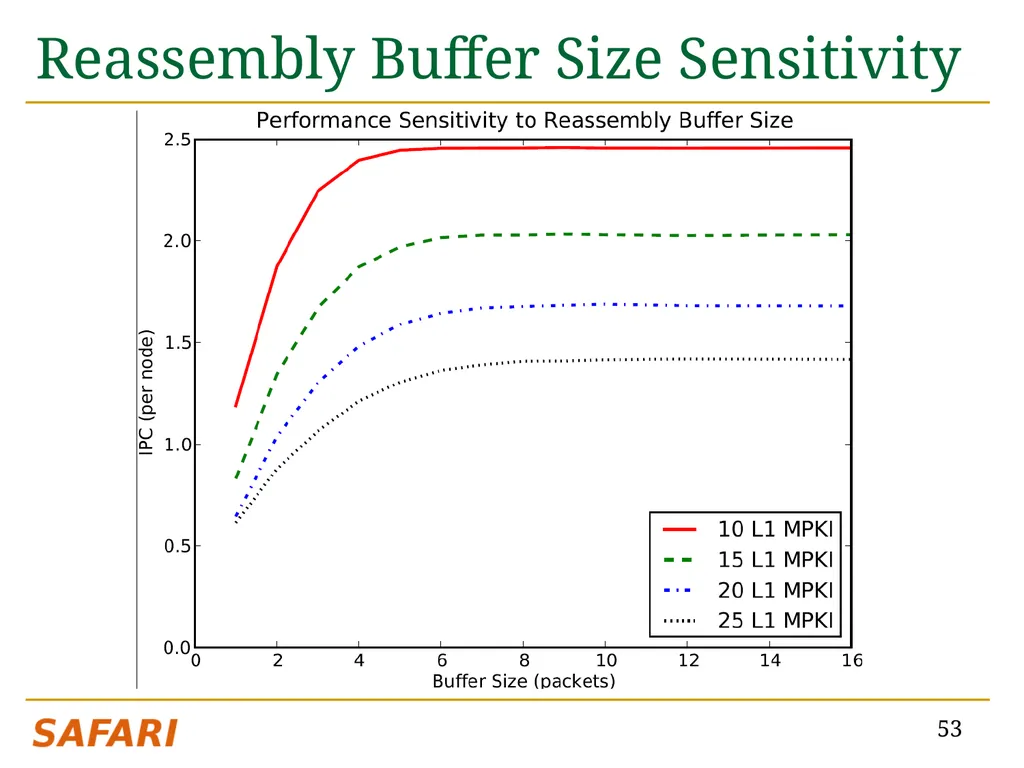
slide53. Reassembly Buffer Size Sensitivity 53<br>
Chris Craik
Onur Mutlu<br>
slide2. Motivation In many-core chips, on-chip interconnect (NoC) consumes significant power.
Intel Terascale: ~30%; MIT RAW: ~40% of system power
Must maintain low latency and good throughput
critical path for cache misses 2<br>
slide3. Motivation Recent work has proposed bufferless deflection routing (BLESS [Moscibroda, ISCA 2009])
Energy savings: ~40% in total NoC energy
Area reduction: ~40% in total NoC area
Minimal performance loss: ~4% on average
Unfortunately: unaddressed complexities in router
long critical path, large reassembly buffers
Goal: obtain these benefits while simplifying the router
in order to make bufferless NoCs practical. 3<br>
slide4. Destination Bufferless Deflection Routing Key idea: Packets are never buffered in the network. When two packets contend for the same link, one is deflected. 4 New traffic can be injected
whenever there is a free
output link.<br>
slide5. Problems that Bufferless Routers Must Solve 1. Must provide livelock freedom
A packet should not be deflected forever
2. Must reassemble packets upon arrival 5 Flit: atomic routing unit 0 1 2 3 Packet: one or multiple flits<br>
slide6. Inject Deflection
Routing
Logic Crossbar A Bufferless Router: A High-Level View 6 Reassembly
Buffers Eject Problem 2: Packet Reassembly Problem 1: Livelock Freedom<br>
slide7. Complexity in Bufferless Deflection Routers 1. Must provide livelock freedom
Flits are sorted by age, then assigned in age order to output ports
43% longer critical path than buffered router
2. Must reassemble packets upon arrival
Reassembly buffers must be sized for worst case
4KB per node
(8x8, 64-byte cache block) 7<br>
slide8. Inject Deflection
Routing
Logic Crossbar Problem 1: Livelock Freedom 8 Reassembly
Buffers Eject Problem 1: Livelock Freedom<br>
slide9. Livelock Freedom in Previous Work What stops a flit from deflecting forever?
All flits are timestamped
Oldest flits are assigned their desired ports
Total order among flits
But what is the cost of this? 9 Flit age forms total order<br>
slide10. Age-Based Priorities are Expensive: Sorting Router must sort flits by age: long-latency sort network
Three comparator stages for 4 flits 10<br>
slide11. Age-Based Priorities Are Expensive: Allocation After sorting, flits assigned to output ports in priority order
Port assignment of younger flits depends on that of older flits
sequential dependence in the port allocator 11 East? GRANT: Flit 1 East DEFLECT: Flit 2 North GRANT: Flit 3 South DEFLECT: Flit 4 West East? {N,S,W} {S,W} {W} South? South? Age-Ordered Flits 1 2 3 4<br>
slide12. Age-Based Priorities Are Expensive Overall, deflection routing logic based on Oldest-First has a 43% longer critical path than a buffered router
Question: is there a cheaper way to route while guaranteeing livelock-freedom? 12<br>
slide13. Solution: Golden Packet for Livelock Freedom What is really necessary for livelock freedom?
Key Insight: No total order. it is enough to:
1. Pick one flit to prioritize until arrival
2. Ensure any flit is eventually picked 13 Guaranteed
progress! < “Golden Flit” partial ordering is sufficient!<br>
slide14. Only need to properly route the Golden Flit
First Insight: no need for full sort
Second Insight: no need for sequential allocation What Does Golden Flit Routing Require? 14<br>
slide15. Golden Flit Routing With Two Inputs Let’s route the Golden Flit in a two-input router first
Step 1: pick a “winning” flit: Golden Flit, else random
Step 2: steer the winning flit to its desired output
and deflect other flit
Golden Flit always routes toward destination 15<br>
slide16. Golden Flit Routing with Four Inputs 16 Each block makes decisions independently!
Deflection is a distributed decision N E S W N S E W<br>
slide17. Permutation Network Operation 17 N E S W wins swap! wins no swap! wins no swap! deflected Golden: wins swap! x N E S W N S E W<br>
slide18. Which Packet is Golden? We select the Golden Packet so that:
1. a given packet stays golden long enough to ensure arrival
maximum no-contention latency
2. the selection rotates through all possible packet IDs
static rotation schedule for simplicity 18 Source Dest Request ID Src 0 Req 0 Golden Src 1 Src 2 Src 3 Src 0 Req 1 Src 1 Src 2 Src 3 Packet Header: Cycle 0 100 200 300 400 500 600 700<br>
slide19. Permutation Network-based Pipeline 19 Inject/Eject Reassembly
Buffers Inject Eject<br>
slide20. Problem 2: Packet Reassembly 20 Inject/Eject Reassembly
Buffers Inject Eject<br>
slide21. Reassembly Buffers are Large Worst case: every node sends a packet to one receiver
Why can’t we make reassembly buffers smaller? 21 Node 0 Node 1 Node N-1 Receiver one packet in flight
per node N sending nodes … O(N) space!<br>
slide22. Small Reassembly Buffers Cause Deadlock What happens when reassembly buffer is too small? 22 Network cannot eject:
reassembly
buffer full reassembly
buffer Many Senders One Receiver Remaining flits
must inject for
forward progress cannot inject new traffic network full<br>
slide23. Reserve Space to Avoid Deadlock? What if every sender asks permission from the receiver before it sends?
adds additional delay to every request 23 reassembly buffers Reserve Slot? Reserved ACK Sender Reserve Slot
ACK
Send Packet Receiver<br>
slide24. Escaping Deadlock with Retransmissions Sender is optimistic instead: assume buffer is free
If not, receiver drops and NACKs; sender retransmits
no additional delay in best case
transmit buffering overhead for all packets
potentially many retransmits 24 Reassembly
Buffers Retransmit
Buffers NACK! Sender ACK Receiver Send (2 flits)
Drop, NACK
Other packet completes
Retransmit packet
ACK
Sender frees data<br>
slide25. Solution: Retransmitting Only Once Key Idea: Retransmit only when space becomes available.
Receiver drops packet if full; notes which packet it drops
When space frees up, receiver reserves space so
retransmit is successful
Receiver notifies sender to retransmit 25 Reassembly
Buffers Retransmit
Buffers NACK Sender Reserved Receiver Pending: Node 0 Req 0<br>
slide26. Using MSHRs as Reassembly Buffers 26 Inject/Eject Reassembly
Buffers Inject Eject Miss Buffers (MSHRs) C Using miss buffers for reassembly makes this a
truly bufferless network.<br>
slide27. Inject Deflection
Routing
Logic Crossbar CHIPPER: Cheap Interconnect Partially-Permuting Router 27 Reassembly
Buffers Eject Baseline Bufferless Deflection Router Large buffers for worst case
Retransmit-Once
Cache buffers Long critical path:
1. Sort by age
2. Allocate ports sequentially
Golden Packet
Permutation Network<br>
slide28. CHIPPER: Cheap Interconnect Partially-Permuting Router 28 Inject/Eject Miss Buffers (MSHRs) Inject Eject<br>
slide29. EVALUATION 29<br>
slide30. Methodology Multiprogrammed workloads: CPU2006, server, desktop
8x8 (64 cores), 39 homogeneous and 10 mixed sets
Multithreaded workloads: SPLASH-2, 16 threads
4x4 (16 cores), 5 applications
System configuration
Buffered baseline: 2-cycle router, 4 VCs/channel, 8 flits/VC
Bufferless baseline: 2-cycle latency, FLIT-BLESS
Instruction-trace driven, closed-loop, 128-entry OoO window
64KB L1, perfect L2 (stresses interconnect), XOR mapping 30<br>
slide31. Methodology Hardware modeling
Verilog models for CHIPPER, BLESS, buffered logic
Synthesized with commercial 65nm library
ORION for crossbar, buffers and links
Power
Static and dynamic power from hardware models
Based on event counts in cycle-accurate simulations 31<br>
slide32. Results: Performance Degradation 32 13.6% 1.8% 3.6% 49.8% C Minimal loss for low-to-medium-intensity workloads<br>
slide33. Results: Power Reduction 33 54.9% 73.4% C Removing buffers majority of power savings
C Slight savings from BLESS to CHIPPER<br>
slide34. Results: Area and Critical Path Reduction 34 -36.2% -29.1% +1.1% -1.6% C CHIPPER maintains area savings of BLESS
C Critical path becomes competitive to buffered<br>
slide35. Conclusions Two key issues in bufferless deflection routing
livelock freedom and packet reassembly
Bufferless deflection routers were high-complexity and impractical
Oldest-first prioritization long critical path in router
No end-to-end flow control for reassembly prone to deadlock with reasonably-sized reassembly buffers
CHIPPER is a new, practical bufferless deflection router
Golden packet prioritization short critical path in router
Retransmit-once protocol deadlock-free packet reassembly
Cache miss buffers as reassembly buffers truly bufferless network
CHIPPER frequency comparable to buffered routers at much lower area and power cost, and minimal performance loss 35<br>
slide36. Thank you! The packet flew quick through the NoC,
Paced by the clock’s constant tock.
But the critical path
Soon unleashed its wrath –
And further improvements did block. 36<br>
slide37. CHIPPER: A Low-complexity Bufferless Deflection Router Chris Fallin
Chris Craik
Onur Mutlu<br>
slide38. Backup Slides 38<br>
slide39. What about High Network Loads? Recall, our goal is to enable bufferless deflection routing as a compelling design point. This is orthogonal to the question of spanning the whole spectrum.
If performance under very high workload intensity is important, hybrid solutions (e.g., AFC [Jafri10]) can be used to enable buffers selectively. Congestion control might also be used.
Any system that incorporates bufferless deflection routing at lower load points benefits from CHIPPER’s contributions. 39<br>
slide40. What About Injection and Ejection? Local access is conceptually separate from in-network routing
Separate pipeline stage
(before permutation stage)
Eject locally-bound flits
Inject queued new traffic,
if there is a free slot
Ejection obeys priority rules (Golden Packet first) 40 ejection into
reassembly buffers injection from
FIFO queue<br>
slide41. Use MSHRs as Reassembly Buffers 41 Outstanding
Cache Misses Miss Status Handling Register (MSHR) Pending Block 0x3C Data Buffer Status Address Reassembly buffering for “free”
A truly bufferless NoC!<br>
slide42. Golden Packet vs. Golden Flit It is actually Golden Packet, not Golden Flit
Within the Golden Packet, each arbiter breaks ties with flit sequence numbers
Rare!
Packet golden when injected: its flits never meet each other.
BUT, if it becomes golden later: flits could be anywhere, and might contend. 42<br>
slide43. Sensitivity Studies Locality:
We assumed simple striping across all cache slices.
What if data is more intelligently distributed?
10 mixed multiprogrammed workloads, BufferedCHIPPER:
8x8 baseline: 11.6% weighted-speedup degradation
4x4 neighborhoods: 6.8% degradation
2x2 neighborhoods: 1.1% degradation
Golden Packet:
Percentage of packets that are Golden: 0.37% (0.41% max)
Sensitivity to epoch length (8 – 8192 cycles): 0.89% delta 43<br>
slide44. Retransmit-Once Operation Requesters always opportunistically send first packet.
Response to request implies a buffer reservation.
If receiver can’t reserve space, it drops and makes a note.
When space becomes free later, reserves it and requests a retransmit. only one retransmit necessary!
Beyond this point, reassembly buffer is reserved until requester releases it. 44<br>
slide45. Retransmit-Once: Example Example: (Core to L2): Request Response Writeback 45 Reassembly
Buffers Request State Retransmit Sender
Node 0 Pending: Node 0 Req 0 Receiver Reserved Send packet: Request
Drop (buffers full)
Other packet completes
Receiver reserves space
Send Retransmit packet
Sender regenerates request
Data response
Dirty writeback<br>
slide46. Retransmit-Once: Multiple Packets 46<br>
slide47. Retransmit-Once: Multiple Packets 47<br>
slide48. Parameters for Evaluation 48<br>
slide49. Full Workload Results 49<br>
slide50. Hardware-Cost Results 50<br>
slide51. Network-Level Evaluation: Latency 51<br>
slide52. Network-Level Evaluation: Deflections 52<br>
slide53. Reassembly Buffer Size Sensitivity 53<br>