
Chp.4 Basic Principles and Organizations of the
LS
Published · 33 slides · 0 views

1 / 1
Description
Chp.4 Basic Principles and Organizations of the United Nations A. Le Roy Bennett and James K. Oliver, International Organizations Basic Principles and Organizations of the United Nations The United Nations charter outlines all the United
Related Topics
Share
Embed code
Download this presentation From Below
"Chp.4 Basic Principles and Organizations of the" is the property of its rightful owner. Permission is granted to download and print the materials on this website for personal, non-commercial use only, and to display it on your personal computer provided you do not modify the materials and that you retain all copyright notices contained in the materials. By downloading content from our website, you accept the terms of this agreement.
Presentation Transcript
01
Chp.4
Basic Principles and Organizations of the United Nations A. Le Roy Bennett and James K. Oliver, International Organizations<br>
Basic Principles and Organizations of the United Nations A. Le Roy Bennett and James K. Oliver, International Organizations<br>
02
Basic Principles and Organizations of the United Nations The United Nations charter outlines all the United Nations’ subsequent relationships and programs. As a written constitution, the Charter provides the UN’s organizational structure, principles, powers and functions.
Because the UN is at most, a weak confederation, its members’ obligations are limited and only their cooperation can bring about the implementation of the UN functions. It has no measures of enforcing its measures, unlike individual governments, and even the final interpretation of Charter obligations is made by its members.<br>
Because the UN is at most, a weak confederation, its members’ obligations are limited and only their cooperation can bring about the implementation of the UN functions. It has no measures of enforcing its measures, unlike individual governments, and even the final interpretation of Charter obligations is made by its members.<br>
03
Basic Principles and Organizations of the United Nations As with most constitutions, not all principles and practices can be determined merely by reading the Charter. Interpretation and actual usage of the document have been important. Only by examining UN practices can its Charter’s functions, nonfunctions and malfunctions really be understood. Sometimes its constitutional principles have acted either as catalysts or as barriers to action; at other times, the attitude and will of the members have been more influential.<br>
04
Objectives of the United Nations The statement of purposes in the UN Charter is both general and redundant. The aims are broad enough to express the desire of war-weary nations for an organization and program capable of helping them to avoid future military contests and to improve economic and social relationships among states.
The primary goal of both the League of Nations and the United Nations is to maintain international peace and security. The means for goal achievement include peaceful settlement of disputes and collective measures for the prevention and removal of both threats to the peace or acts of agression.<br>
The primary goal of both the League of Nations and the United Nations is to maintain international peace and security. The means for goal achievement include peaceful settlement of disputes and collective measures for the prevention and removal of both threats to the peace or acts of agression.<br>
05
Objectives of the United Nations Major sections of the Charter detail the instruments and methods for implementing this objective. The Security Council is assigned primary responsibility for peace maintenance but shares this function with the General Assembly and the International Court of Justice. Chapter VI of the Charter is devoted to methods of peaceful settlement of disputes, and Chapter VII outlines measures to be taken in the more serious situations involving threats to the peace, breaches of the peace, and acts of agression.<br>
06
Objectives of the United Nations Second to peace maintenance, the Charter emphasizes the aim of promoting international economic and social cooperation. The Economic and Social Council is to serve as the major organ for implementing this goal, with substantial support from the General Assembly and from such autonomous international specialized agencies in the econoic and social sphere as governments may create and bring into formal relationship with the United Nations.<br>
07
Objectives of the United Nations A third purpose of the United Nations is to promote respect for human rights for all peoples. The reference in Article 1 to human rights and fundamental freedoms lacks any specific or detailed meaning and provides no guidelines for implementation. No further definition appears elsewhere in the Charter. Major responsibilities for promoting human rights are assigned to the General Assembly and to the Economic and Social Council.<br>
08
Basic Principles of the Charter The first principle: the sovereign equality of all members. Equality refers to legal status rather than to size, power and wealth.
The fact that the United Nations is an organization of sovereign states places drastic restrictions on the independent power of the organization. Sovereignity indicates that the members reserve the power of ultimate decision making for themselves and confer no real authority upon the international agency. This reservation of authority requires the United Nations to depend for its effective performance on the willingness of the members to cooperate in collective action and to accept stalemate or frustration when cooperation is withheld in favor of national interests.<br>
The fact that the United Nations is an organization of sovereign states places drastic restrictions on the independent power of the organization. Sovereignity indicates that the members reserve the power of ultimate decision making for themselves and confer no real authority upon the international agency. This reservation of authority requires the United Nations to depend for its effective performance on the willingness of the members to cooperate in collective action and to accept stalemate or frustration when cooperation is withheld in favor of national interests.<br>
09
Basic Principles of the Charter Closely related to the primary goal of the United Nations to maintain international peace and security are the twin principles that all member states (1) shall refrain from the threat or use of force in any manner inconsistent with UN purposes (2) shall settle their international disputes by peaceful means. The substitution of peaceful settlement for the reliance on force has been disappointing in the UN record. Portions of the UN Charter that envision the establishment of international military forces have not been implemented.<br>
10
Basic Principles of Charter Two other Charter principles closely related to those of peaceful settlement and international enforcement are (1) the obligations of members to support enforcement actions of the United Nations and to refrain from giving assistance to states that are the objects of UN preventive or enforcement action and 2) collective responsibility to require nonmember states to conform sufficiently to Charter principles to ensure the maintenance of international peace and security.
Without the cooperation of nonmember states, any assurance of efficacious action by the United Nations is diminished. (Remember the US and League of Nations experience).<br>
Without the cooperation of nonmember states, any assurance of efficacious action by the United Nations is diminished. (Remember the US and League of Nations experience).<br>
11
Basic Principles of Charter The “domestic jurisdiction” clause, forbids the United Nations “to intervene in matters which are essentially within the domestic jurisdiction of any state. The impossibility of always drawing a clear distinction between domestic and international affairs makes reconciliation of this clause with the positive obligations of this Charter difficult. (Yet the United Nations is so generally ineffective that individual nations have little to fear concerning interference from the United Nations).<br>
12
Basic Principles of the Charter Another principle of the Charter is the statement found in Article 51- the “right of individual or collective self-defense” against armed attack. The primary responsibility for dealing with acts of agression resides in the Security Council, and member states are obligated to report their responses to enemy attacks to the Security Council but are not required to wait for effective UN action before taking self-defense measures.
By ignoring the obligation to report individual or collective self-defense measures to the Security Council or by the use of the veto in the Security Council, a major power may nullify the role of the United Nations and proceed to handle the situation independently.<br>
By ignoring the obligation to report individual or collective self-defense measures to the Security Council or by the use of the veto in the Security Council, a major power may nullify the role of the United Nations and proceed to handle the situation independently.<br>
13
Principal Organs of the United Nations The Charter designates six agencies as principal organs of the United Nations. These are (1) the General Assembly, (2) the Security Council, (3) the Economic and Social Council, (4) the Trusteeship Council (5) the Secretariat and (6) the International Court of Justice<br>
14
Principal Organs of the United Nations The General Assembly: is central to the organization. This centrality was not necessarily established by design in the Charter but was soon achieved through vigorous exercise by the General Assembly of its clearly designated functions and through its assertion of additional authority in areas, such as the maintenance of peace and security, in which its Charter mandate is ambigious.
The General Assembly serves as an arena for general debate for the United Nations. Of the six principal organs, the General Assembly is the only one in which all member states are represented.<br>
The General Assembly serves as an arena for general debate for the United Nations. Of the six principal organs, the General Assembly is the only one in which all member states are represented.<br>
15
Principal Organs of the United Nations General Assembly meets within a three month period each year. Regular sessions begin on the third Tuesday in September.
The Charter provides for the calling of special sessions of the General Assembly, and as of 1999 twenty-three such sessions have met. Few examples: Palestine (1947), Disarmament (1978), Drug Problems (1998)<br>
The Charter provides for the calling of special sessions of the General Assembly, and as of 1999 twenty-three such sessions have met. Few examples: Palestine (1947), Disarmament (1978), Drug Problems (1998)<br>
16
Principal Organs of the United Nations The bulk of the work of the General Assembly is carried on in the seven main committees to which the agenda items are allocated according to subject matter.These committees are:
Political and Security Committee
Special Political Committee
Economic and Financial Committee
Social, Humanitarian and Cultural Committee
Trusteeship Committee
Administrative and Bugdetary Committee
Legal Committee
Each member of the United Nations is entitled to be represented on each of the main committees.<br>
Political and Security Committee
Special Political Committee
Economic and Financial Committee
Social, Humanitarian and Cultural Committee
Trusteeship Committee
Administrative and Bugdetary Committee
Legal Committee
Each member of the United Nations is entitled to be represented on each of the main committees.<br>
17
Principal Organs of the United Nations The most comprehensive and important function of the General Assembly is its power to discuss and recommend. Article 10 of the Charter grants an almost unlimited mandate to the General Assembly in regard to the range of subjects that the body may consider.
Two limitations:
The General Assembly may discuss but make no recommendation on “any dispute or situation” under consideration by the Security Council.
General Assembly’s authority is limited to recommendations that are not binding on member states. Whether recommendations will be enforced or even observed as guidelines depends upon the cooperation and action of individual states.<br>
Two limitations:
The General Assembly may discuss but make no recommendation on “any dispute or situation” under consideration by the Security Council.
General Assembly’s authority is limited to recommendations that are not binding on member states. Whether recommendations will be enforced or even observed as guidelines depends upon the cooperation and action of individual states.<br>
18
Principal Organs of the United Nations A second function assigned to the General Assembly is the supervision and review of all activities of the United Nations. The General Assembly acts as a central coordinating body for the other United Nations organs and agencies. In this capacity it receives and reviews annual reports from the Secretary-General, the Security Council, the Economic and Social Security, and the Trusteeship Council.<br>
19
Principal Organs of the United Nations Deciding financial matters constitutes a third major function of the General Assembly. The General Assembly has the authority to consider and approve the budget, to apportion expenses among the members, and to examine and make recommendations on the budgets of the seperate specialized agencies.
Within the General Assembly resides the exclusive power to elect the nonpermanent members of the Security Council and all members of the Economic and Social Council. The selection of judges of the International Court of Justice is the joint responsibility of the General Assembly and the Security Council.<br>
Within the General Assembly resides the exclusive power to elect the nonpermanent members of the Security Council and all members of the Economic and Social Council. The selection of judges of the International Court of Justice is the joint responsibility of the General Assembly and the Security Council.<br>
20
Principal Organs of the United Nations Furthermore, except for the original members, the General Assembly shares with the Security Council control over admission of states. A two-thirds vote is required in the General Assembly to admit an applicant. By a similar vote the Assembly may suspend the rights and privileges or may expel a member state, but all these actions are dependent upon a prior recommendations of the Security Council.<br>
21
Principal Organs of the United Nations The final area of major responsibility of the General Assembly is its role in Charter amendment and revision. This function includes the General Assembly’s power to propose amendments by a two-thirds of the member governments, including all the permanent members of the Security Council.<br>
22
Principal Organs of the United Nations The Security Council:
The big powers visualized the Security Council as the paramount organ of the United Nations. Without cooperation among the most powerful states, solutions were virtually impossible. Therefore, it was felt that the big powers should have positions of authority on the Security Council commensurate with their responsibilities for maintaining world peace and security.
Primary responsibility for maintaining peace and security was concentrated in the Security Council, and unanimity among the permanent members was required on all votes on substantive matters.<br>
The big powers visualized the Security Council as the paramount organ of the United Nations. Without cooperation among the most powerful states, solutions were virtually impossible. Therefore, it was felt that the big powers should have positions of authority on the Security Council commensurate with their responsibilities for maintaining world peace and security.
Primary responsibility for maintaining peace and security was concentrated in the Security Council, and unanimity among the permanent members was required on all votes on substantive matters.<br>
23
Principal Organs of the United Nations During the first three years the Security Council held an average of more than 130 meetings per year and debated a substantial number of critical political issues. Yet the development of the Cold War doomed the continued collaboration among the great powers that was necessary for effective Security Council action. Growing disagreement manifested itself in the increasing use of the veto by the Soviet Union.<br>
24
Principal Organs of the United Nations In 1965, the adoption of the first amendments to the Charter, providing for an enlargement of the Security Council from eleven to fifteen members. The General Assembly adopted a resolution alloting the ten effective nonpermanent seats as follows: five for Africa and Asia, two for Latin America, one for Eastern Europe and two for Western Europe and other states.
Current members: Azerbaijan, India, South Africa, Colombia, Morocco, Togo, Germany, Pakistan, Guatemala, Portugal<br>
Current members: Azerbaijan, India, South Africa, Colombia, Morocco, Togo, Germany, Pakistan, Guatemala, Portugal<br>
25
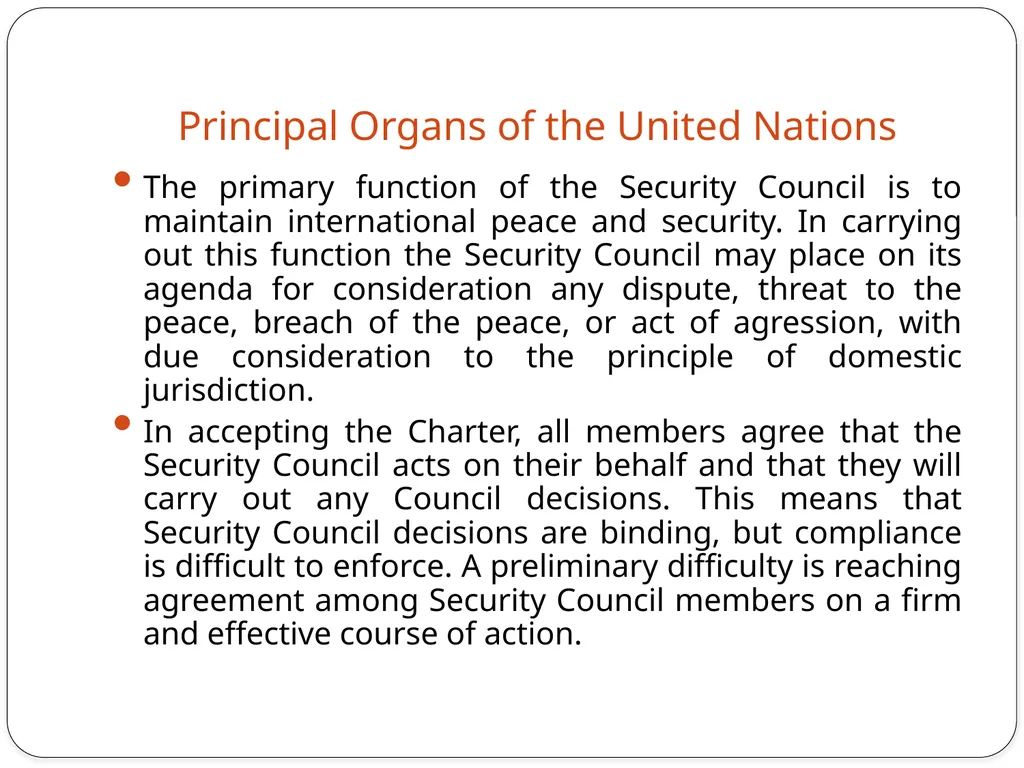
Principal Organs of the United Nations The primary function of the Security Council is to maintain international peace and security. In carrying out this function the Security Council may place on its agenda for consideration any dispute, threat to the peace, breach of the peace, or act of agression, with due consideration to the principle of domestic jurisdiction.
In accepting the Charter, all members agree that the Security Council acts on their behalf and that they will carry out any Council decisions. This means that Security Council decisions are binding, but compliance is difficult to enforce. A preliminary difficulty is reaching agreement among Security Council members on a firm and effective course of action.<br>
In accepting the Charter, all members agree that the Security Council acts on their behalf and that they will carry out any Council decisions. This means that Security Council decisions are binding, but compliance is difficult to enforce. A preliminary difficulty is reaching agreement among Security Council members on a firm and effective course of action.<br>
26
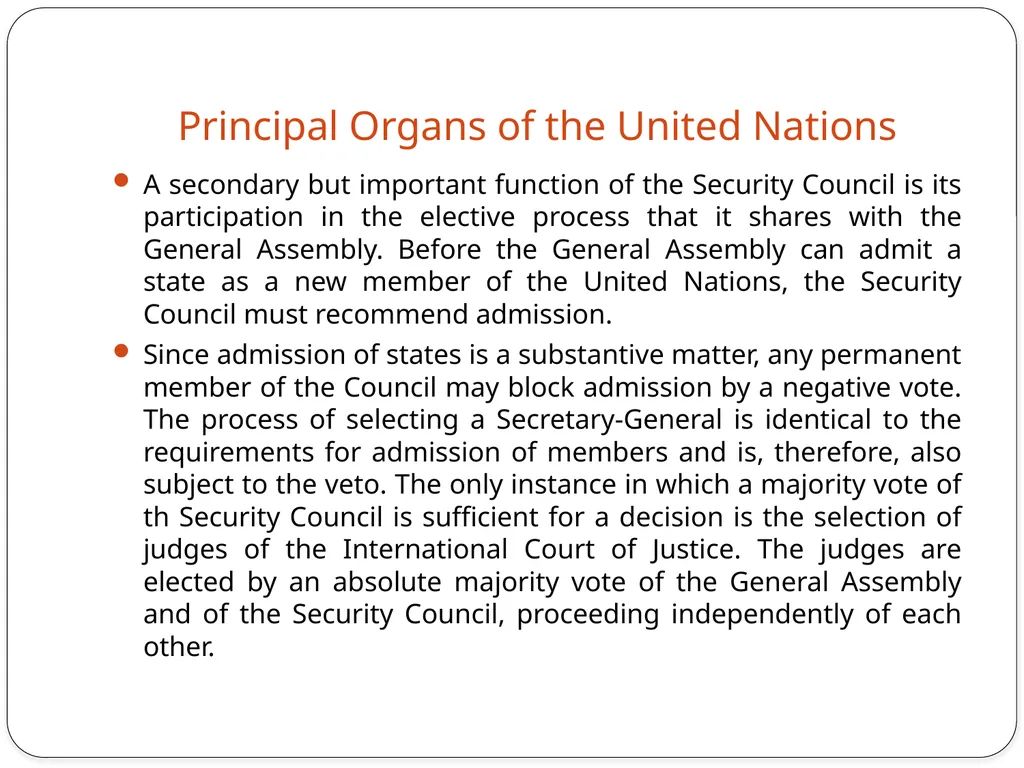
Principal Organs of the United Nations A secondary but important function of the Security Council is its participation in the elective process that it shares with the General Assembly. Before the General Assembly can admit a state as a new member of the United Nations, the Security Council must recommend admission.
Since admission of states is a substantive matter, any permanent member of the Council may block admission by a negative vote. The process of selecting a Secretary-General is identical to the requirements for admission of members and is, therefore, also subject to the veto. The only instance in which a majority vote of th Security Council is sufficient for a decision is the selection of judges of the International Court of Justice. The judges are elected by an absolute majority vote of the General Assembly and of the Security Council, proceeding independently of each other.<br>
Since admission of states is a substantive matter, any permanent member of the Council may block admission by a negative vote. The process of selecting a Secretary-General is identical to the requirements for admission of members and is, therefore, also subject to the veto. The only instance in which a majority vote of th Security Council is sufficient for a decision is the selection of judges of the International Court of Justice. The judges are elected by an absolute majority vote of the General Assembly and of the Security Council, proceeding independently of each other.<br>
27
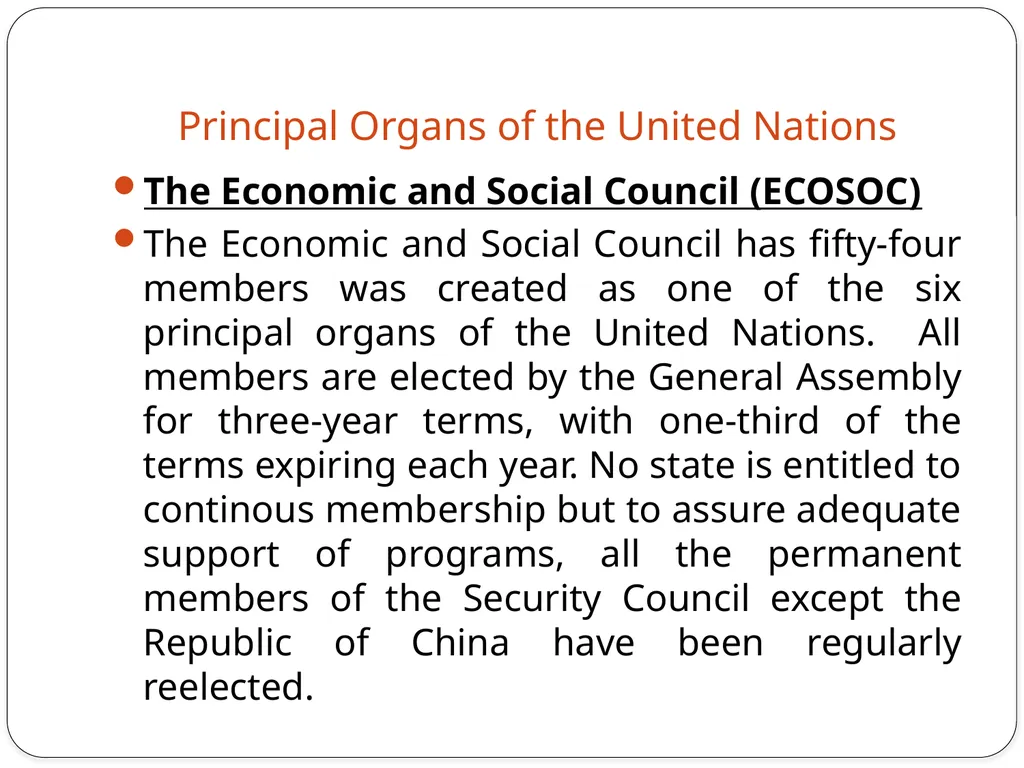
Principal Organs of the United Nations The Economic and Social Council (ECOSOC)
The Economic and Social Council has fifty-four members was created as one of the six principal organs of the United Nations. All members are elected by the General Assembly for three-year terms, with one-third of the terms expiring each year. No state is entitled to continous membership but to assure adequate support of programs, all the permanent members of the Security Council except the Republic of China have been regularly reelected.<br>
The Economic and Social Council has fifty-four members was created as one of the six principal organs of the United Nations. All members are elected by the General Assembly for three-year terms, with one-third of the terms expiring each year. No state is entitled to continous membership but to assure adequate support of programs, all the permanent members of the Security Council except the Republic of China have been regularly reelected.<br>
28
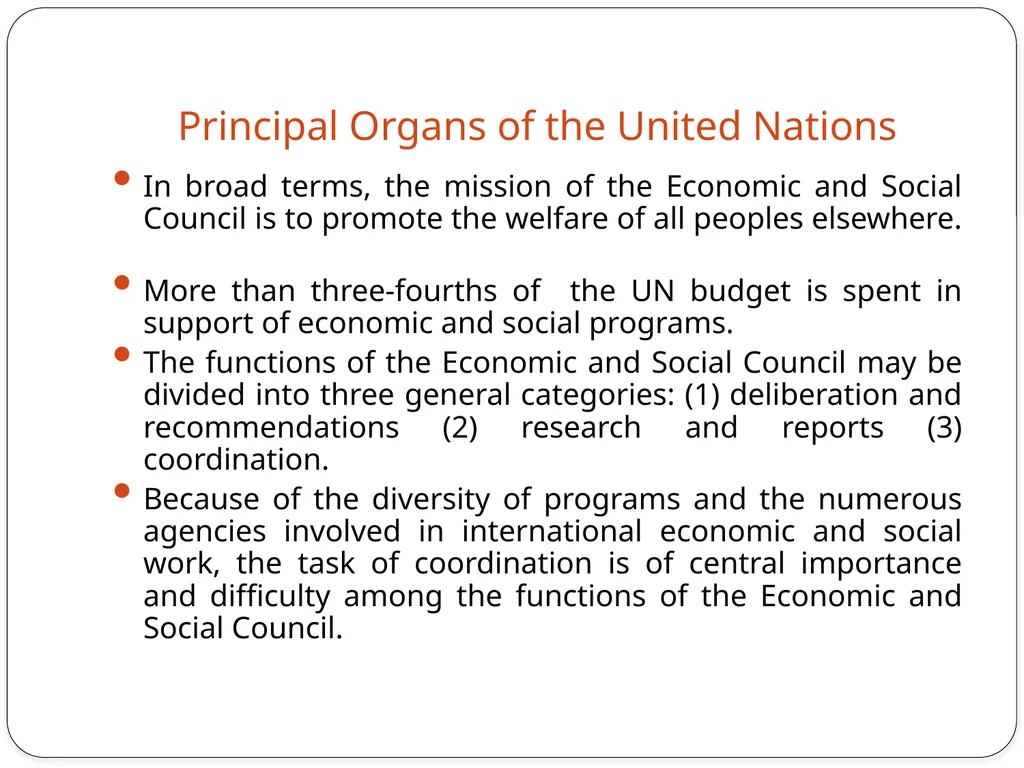
Principal Organs of the United Nations In broad terms, the mission of the Economic and Social Council is to promote the welfare of all peoples elsewhere.
More than three-fourths of the UN budget is spent in support of economic and social programs.
The functions of the Economic and Social Council may be divided into three general categories: (1) deliberation and recommendations (2) research and reports (3) coordination.
Because of the diversity of programs and the numerous agencies involved in international economic and social work, the task of coordination is of central importance and difficulty among the functions of the Economic and Social Council.<br>
More than three-fourths of the UN budget is spent in support of economic and social programs.
The functions of the Economic and Social Council may be divided into three general categories: (1) deliberation and recommendations (2) research and reports (3) coordination.
Because of the diversity of programs and the numerous agencies involved in international economic and social work, the task of coordination is of central importance and difficulty among the functions of the Economic and Social Council.<br>
29
Principal Organs of the United Nations The Trusteeship Council
(Inactive since 1994)
The role of the Trusteeship Council was to provide, on behalf of the international community, supervision of those non self-governing territories that were designated as trust territories.
The administration of each territory was carried out by a specific state, but certain supervisory responsibilities were performed by the General Assembly through the agency of the Trusteeship Council.<br>
(Inactive since 1994)
The role of the Trusteeship Council was to provide, on behalf of the international community, supervision of those non self-governing territories that were designated as trust territories.
The administration of each territory was carried out by a specific state, but certain supervisory responsibilities were performed by the General Assembly through the agency of the Trusteeship Council.<br>
30
Principal Organs of the United Nations The Secretariat:
The UN Secretariat is a body of international civil servants headed by the Secretary-General. It is constituted of full-time employees of the organization, who must preserve their neutrality in the interests of serving the entire membership and of promoting the international goals of the United Nations.
The independence of the Secretary members from national pressures was a principle not clearly stated in the Covenant but established at the inception of the League of Nations by its Secretary-General.<br>
The UN Secretariat is a body of international civil servants headed by the Secretary-General. It is constituted of full-time employees of the organization, who must preserve their neutrality in the interests of serving the entire membership and of promoting the international goals of the United Nations.
The independence of the Secretary members from national pressures was a principle not clearly stated in the Covenant but established at the inception of the League of Nations by its Secretary-General.<br>
31
Principal Organs of the United Nations The Secretary-General is appointed by the General Assembly, acting by two-thirds vote, upon recommendation of the Security Council.
The major functions of the Secretary-General are outlined in the Charter and they include:
1- to be the chief administrative officer of the organization
2- to act as secretary to all the major delegate bodies of the United Nations
3-to perform functions assigned by the General Assembly and the 3 councils
4- to make an annual report to the General Assembly on the work of the organization
5-to appoint the Secretariat staff under regulations established by the General Assembly.<br>
The major functions of the Secretary-General are outlined in the Charter and they include:
1- to be the chief administrative officer of the organization
2- to act as secretary to all the major delegate bodies of the United Nations
3-to perform functions assigned by the General Assembly and the 3 councils
4- to make an annual report to the General Assembly on the work of the organization
5-to appoint the Secretariat staff under regulations established by the General Assembly.<br>
32
Principal Organs of the United Nations International Court of Justice (headquarters in The Hague): The Statute of the ICJ is an integral part of the Charter and is almost identical to the Statute of the previous Permanent Court of International Justice (PCIJ). Yet, unlike the League arrangement, all members of the United Nations are automatically members of the ICJ.
The Court is composed of fifteen judges elected by concurrent vote of the General Assembly and the Security Council. No two judges may be of the same nationality. Judges serve nine-year terms , with the terms of five judges expiring every third year. No limit is set on the number of terms for which a judge may be reelected.<br>
The Court is composed of fifteen judges elected by concurrent vote of the General Assembly and the Security Council. No two judges may be of the same nationality. Judges serve nine-year terms , with the terms of five judges expiring every third year. No limit is set on the number of terms for which a judge may be reelected.<br>
33
Principal Organs of the United Nations In hearing a specific case, if there is no judge on the Court of the nationality of one or more of the states that are parties to the case, such state or states may appoint a national judge to sit for that case. These additional judges participate with full voting rights.
Only states may bring cases before the Court, but no state is required to submit any case for hearing and decision. This lack of compulsory jurisdiction is a major deficiency of international as contrasted with national legal systems.
In addition to hearing cases, the ICJ is authorized to give advisory opinion on legal questions.<br>
Only states may bring cases before the Court, but no state is required to submit any case for hearing and decision. This lack of compulsory jurisdiction is a major deficiency of international as contrasted with national legal systems.
In addition to hearing cases, the ICJ is authorized to give advisory opinion on legal questions.<br>