
Chronic Obstructive Pulmonary Disease And Its
NS
Published · 19 slides · 0 views
1 / 1
Description
Chronic Obstructive Pulmonary Disease And Its Affect On Deglutition Kimberly King, B.A. Candidate for Masters of Arts Speech Language Pathology Wayne State University Chronic Obstructive Pulmonary Disease, One of the Most Common Diseases to
Related Topics
Share
Embed code
Download this presentation From Below
"Chronic Obstructive Pulmonary Disease And Its" is the property of its rightful owner. Permission is granted to download and print the materials on this website for personal, non-commercial use only, and to display it on your personal computer provided you do not modify the materials and that you retain all copyright notices contained in the materials. By downloading content from our website, you accept the terms of this agreement.
Presentation Transcript
01
Chronic Obstructive Pulmonary Disease
And Its Affect On
Deglutition Kimberly King, B.A.
Candidate for Masters of Arts
Speech Language Pathology
Wayne State University<br>
Candidate for Masters of Arts
Speech Language Pathology
Wayne State University<br>
02
Chronic Obstructive Pulmonary Disease, One of the Most Common Diseases to Affect the Lungs Global Initiative for Chronic Obstructive Lung Disease (GOLD) definition:
common, preventable, & treatable
usually progressive & associated with persistent airflow limitation
chronic inflammatory response in the airway & lungs to noxious particles or gasses
Chronic Obstructive Pulmonary Disease (COPD) is typically expressed in 2 ways:
Emphysema
Chronic Bronchitis<br>
common, preventable, & treatable
usually progressive & associated with persistent airflow limitation
chronic inflammatory response in the airway & lungs to noxious particles or gasses
Chronic Obstructive Pulmonary Disease (COPD) is typically expressed in 2 ways:
Emphysema
Chronic Bronchitis<br>
03
Chronic Obstructive Pulmonary Disease Etiology Smoking is the number one cause
Other causes include secondhand smoke certain gases or fumes, pollutants, and physical structural defects that affect pulmonary function.<br>
Other causes include secondhand smoke certain gases or fumes, pollutants, and physical structural defects that affect pulmonary function.<br>
04
Chronic Obstructive Pulmonary Disease and the Numbers 8 million physician office visits (in 2000)
1.5 million ER visits (in 2000)
726,000 hospitalizations (in 2000)
Affects 14 million people in the US (in 2002)
Leading cause of morbidity and mortality worldwide, resulting in substantial and increasing economic and social burden (GOLD, 2011)<br>
1.5 million ER visits (in 2000)
726,000 hospitalizations (in 2000)
Affects 14 million people in the US (in 2002)
Leading cause of morbidity and mortality worldwide, resulting in substantial and increasing economic and social burden (GOLD, 2011)<br>
05
Understanding COPD’s Affect On Deglutition Complications:
discoordination of the oral and pharyngeal swallowing stage
impaired coordination of respiration and deglutition could contribute to increased exacerbations and aspiration
Trademark symptom: dyspnea<br>
discoordination of the oral and pharyngeal swallowing stage
impaired coordination of respiration and deglutition could contribute to increased exacerbations and aspiration
Trademark symptom: dyspnea<br>
06
COPD’s Affect on Respiration and Deglutition Exhale-swallow-exhale preferred by normal adults
Altered swallow in COPD in which the inhalation occurs after the swallow could be dangerous
Studies found that participant risk for aspiration was greater due to the negative pressure of inhalation<br>
Altered swallow in COPD in which the inhalation occurs after the swallow could be dangerous
Studies found that participant risk for aspiration was greater due to the negative pressure of inhalation<br>
07
Susceptibility To Aspiration COPD participants swallowed food during inhalation more and inhaled more quickly after swallowing semi-solid material than control group
In another study, COPD participants had higher resting respiratory rates during 5mm swallows in upright and supine positions
They found increase resp. rate = increase number of swallows<br>
In another study, COPD participants had higher resting respiratory rates during 5mm swallows in upright and supine positions
They found increase resp. rate = increase number of swallows<br>
08
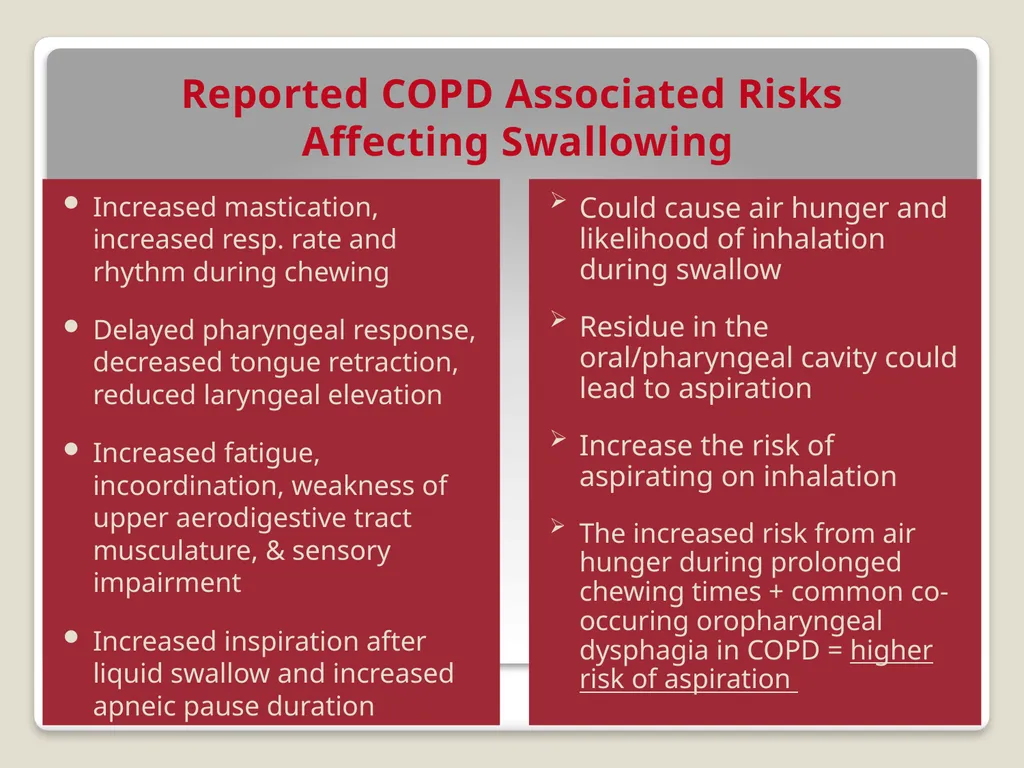
Increased mastication, increased resp. rate and rhythm during chewing
Delayed pharyngeal response, decreased tongue retraction, reduced laryngeal elevation
Increased fatigue, incoordination, weakness of upper aerodigestive tract musculature, & sensory impairment
Increased inspiration after liquid swallow and increased apneic pause duration Could cause air hunger and likelihood of inhalation during swallow
Residue in the oral/pharyngeal cavity could lead to aspiration
Increase the risk of aspirating on inhalation
The increased risk from air hunger during prolonged chewing times + common co-occuring oropharyngeal dysphagia in COPD = higher risk of aspiration Reported COPD Associated Risks
Affecting Swallowing<br>
Delayed pharyngeal response, decreased tongue retraction, reduced laryngeal elevation
Increased fatigue, incoordination, weakness of upper aerodigestive tract musculature, & sensory impairment
Increased inspiration after liquid swallow and increased apneic pause duration Could cause air hunger and likelihood of inhalation during swallow
Residue in the oral/pharyngeal cavity could lead to aspiration
Increase the risk of aspirating on inhalation
The increased risk from air hunger during prolonged chewing times + common co-occuring oropharyngeal dysphagia in COPD = higher risk of aspiration Reported COPD Associated Risks
Affecting Swallowing<br>
09
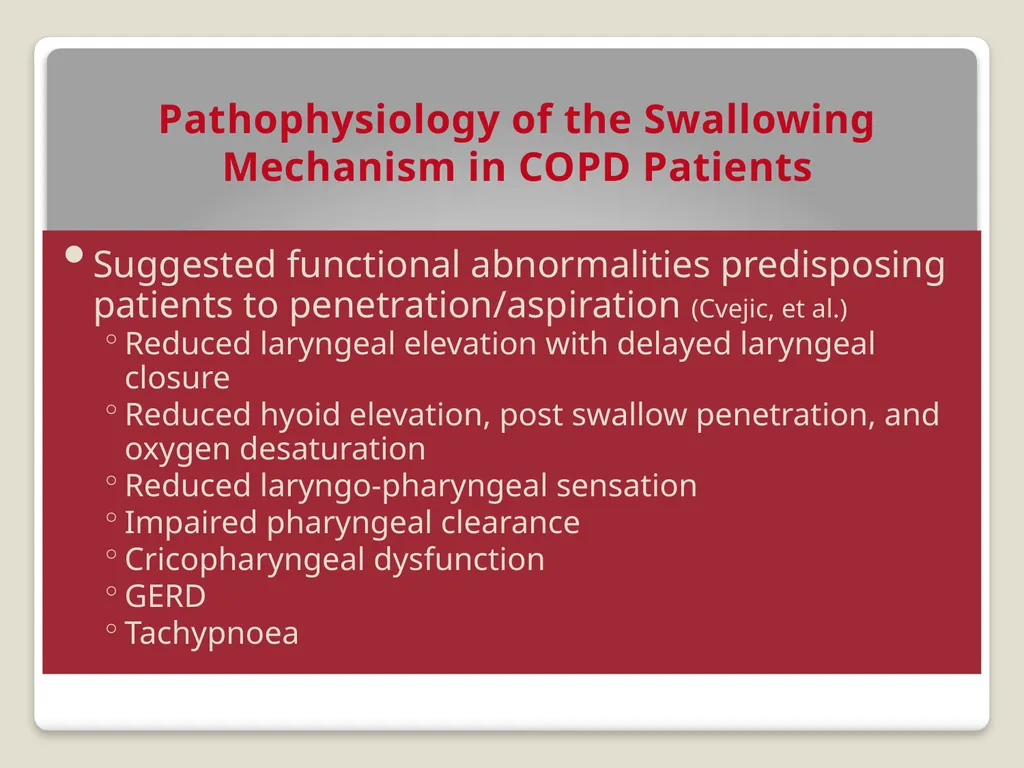
Pathophysiology of the Swallowing Mechanism in COPD Patients Suggested functional abnormalities predisposing patients to penetration/aspiration (Cvejic, et al.)
Reduced laryngeal elevation with delayed laryngeal closure
Reduced hyoid elevation, post swallow penetration, and oxygen desaturation
Reduced laryngo-pharyngeal sensation
Impaired pharyngeal clearance
Cricopharyngeal dysfunction
GERD
Tachypnoea<br>
Reduced laryngeal elevation with delayed laryngeal closure
Reduced hyoid elevation, post swallow penetration, and oxygen desaturation
Reduced laryngo-pharyngeal sensation
Impaired pharyngeal clearance
Cricopharyngeal dysfunction
GERD
Tachypnoea<br>
10
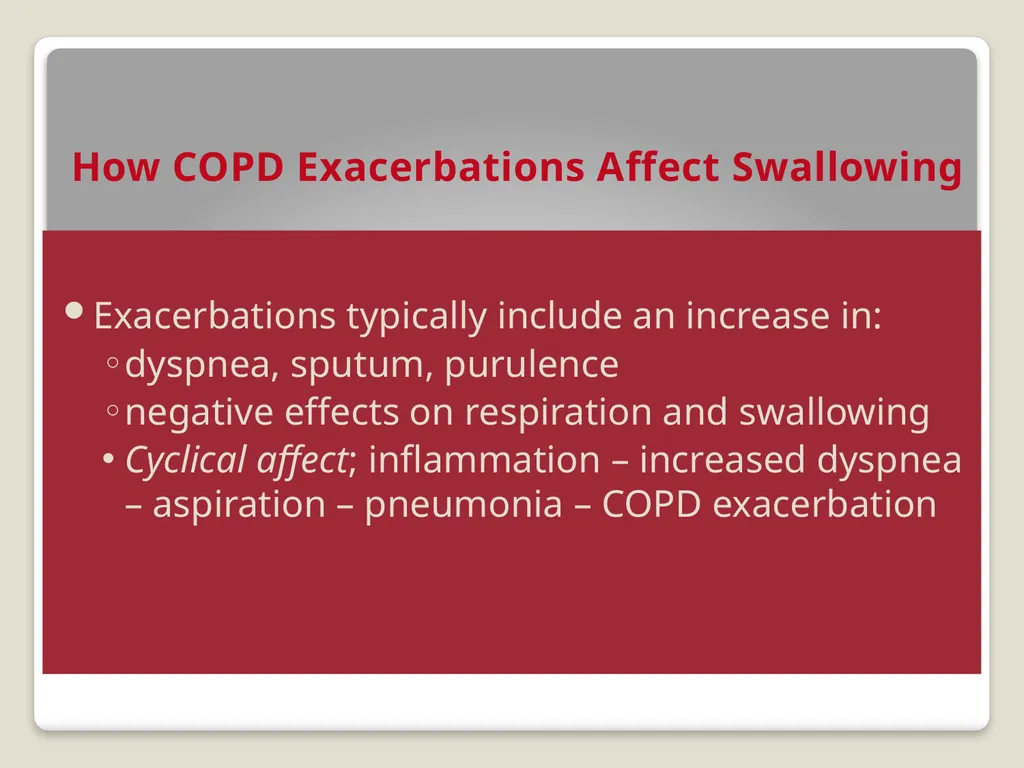
How COPD Exacerbations Affect Swallowing Exacerbations typically include an increase in:
dyspnea, sputum, purulence
negative effects on respiration and swallowing
Cyclical affect; inflammation – increased dyspnea – aspiration – pneumonia – COPD exacerbation<br>
dyspnea, sputum, purulence
negative effects on respiration and swallowing
Cyclical affect; inflammation – increased dyspnea – aspiration – pneumonia – COPD exacerbation<br>
11
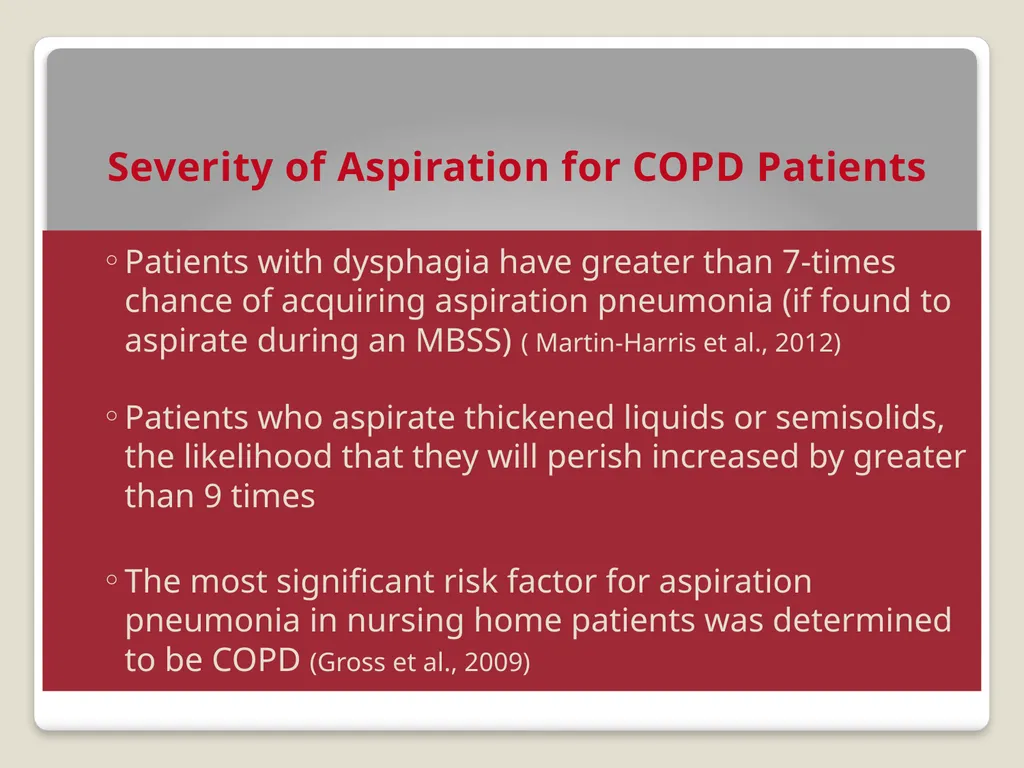
Severity of Aspiration for COPD Patients Patients with dysphagia have greater than 7-times chance of acquiring aspiration pneumonia (if found to aspirate during an MBSS) ( Martin-Harris et al., 2012)
Patients who aspirate thickened liquids or semisolids, the likelihood that they will perish increased by greater than 9 times
The most significant risk factor for aspiration pneumonia in nursing home patients was determined to be COPD (Gross et al., 2009)<br>
Patients who aspirate thickened liquids or semisolids, the likelihood that they will perish increased by greater than 9 times
The most significant risk factor for aspiration pneumonia in nursing home patients was determined to be COPD (Gross et al., 2009)<br>
12
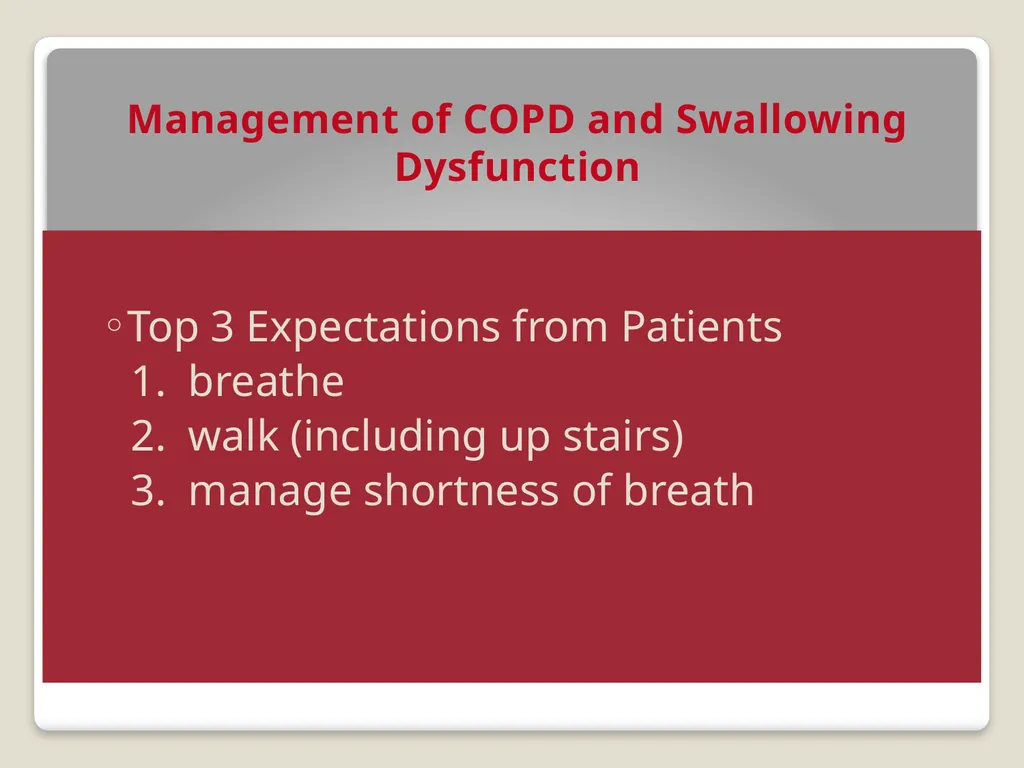
Management of COPD and Swallowing Dysfunction Top 3 Expectations from Patients
breathe
walk (including up stairs)
manage shortness of breath<br>
breathe
walk (including up stairs)
manage shortness of breath<br>
13
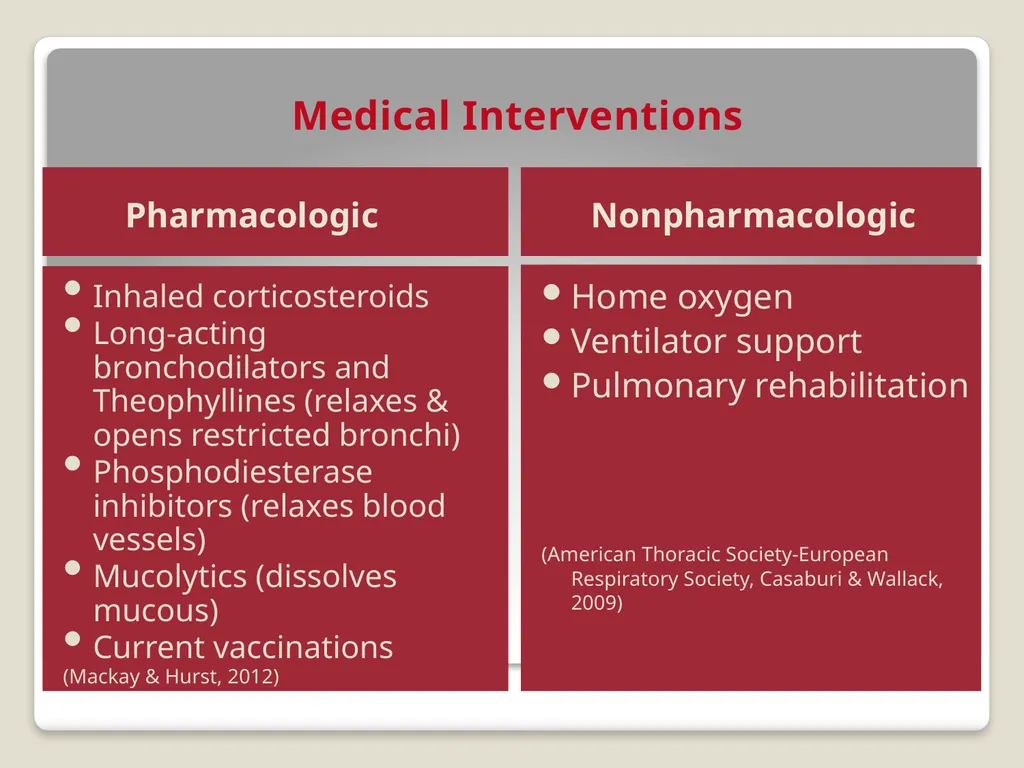
Pharmacologic Nonpharmacologic Inhaled corticosteroids
Long-acting bronchodilators and Theophyllines (relaxes & opens restricted bronchi)
Phosphodiesterase inhibitors (relaxes blood vessels)
Mucolytics (dissolves mucous)
Current vaccinations
(Mackay & Hurst, 2012) Home oxygen
Ventilator support
Pulmonary rehabilitation
(American Thoracic Society-European Respiratory Society, Casaburi & Wallack, 2009) Medical Interventions<br>
Long-acting bronchodilators and Theophyllines (relaxes & opens restricted bronchi)
Phosphodiesterase inhibitors (relaxes blood vessels)
Mucolytics (dissolves mucous)
Current vaccinations
(Mackay & Hurst, 2012) Home oxygen
Ventilator support
Pulmonary rehabilitation
(American Thoracic Society-European Respiratory Society, Casaburi & Wallack, 2009) Medical Interventions<br>
14
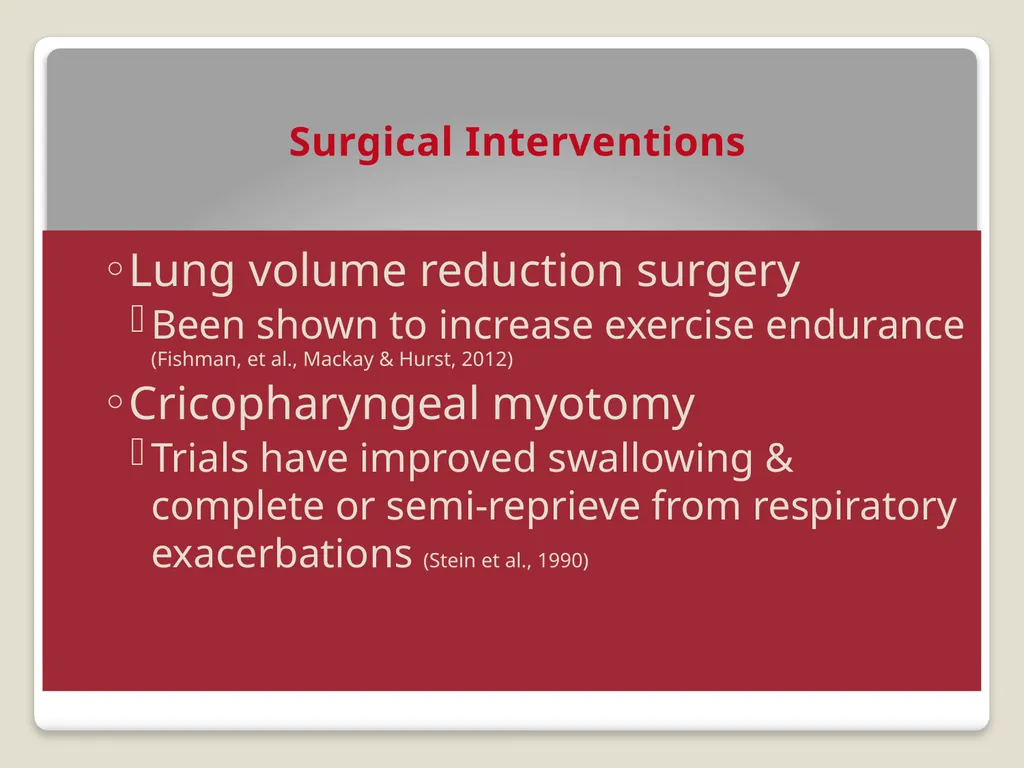
Surgical Interventions Lung volume reduction surgery
Been shown to increase exercise endurance (Fishman, et al., Mackay & Hurst, 2012)
Cricopharyngeal myotomy
Trials have improved swallowing & complete or semi-reprieve from respiratory exacerbations (Stein et al., 1990)<br>
Been shown to increase exercise endurance (Fishman, et al., Mackay & Hurst, 2012)
Cricopharyngeal myotomy
Trials have improved swallowing & complete or semi-reprieve from respiratory exacerbations (Stein et al., 1990)<br>
15
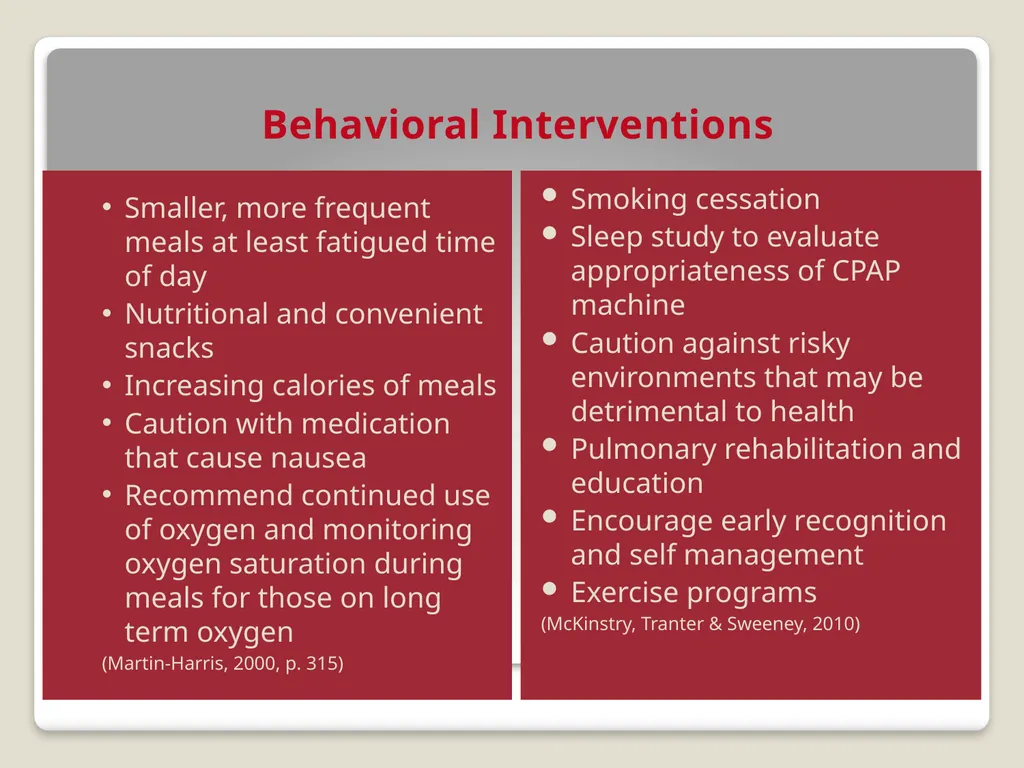
Smaller, more frequent meals at least fatigued time of day
Nutritional and convenient snacks
Increasing calories of meals
Caution with medication that cause nausea
Recommend continued use of oxygen and monitoring oxygen saturation during meals for those on long term oxygen
(Martin-Harris, 2000, p. 315) Smoking cessation
Sleep study to evaluate appropriateness of CPAP machine
Caution against risky environments that may be detrimental to health
Pulmonary rehabilitation and education
Encourage early recognition and self management
Exercise programs
(McKinstry, Tranter & Sweeney, 2010) Behavioral Interventions<br>
Nutritional and convenient snacks
Increasing calories of meals
Caution with medication that cause nausea
Recommend continued use of oxygen and monitoring oxygen saturation during meals for those on long term oxygen
(Martin-Harris, 2000, p. 315) Smoking cessation
Sleep study to evaluate appropriateness of CPAP machine
Caution against risky environments that may be detrimental to health
Pulmonary rehabilitation and education
Encourage early recognition and self management
Exercise programs
(McKinstry, Tranter & Sweeney, 2010) Behavioral Interventions<br>
16
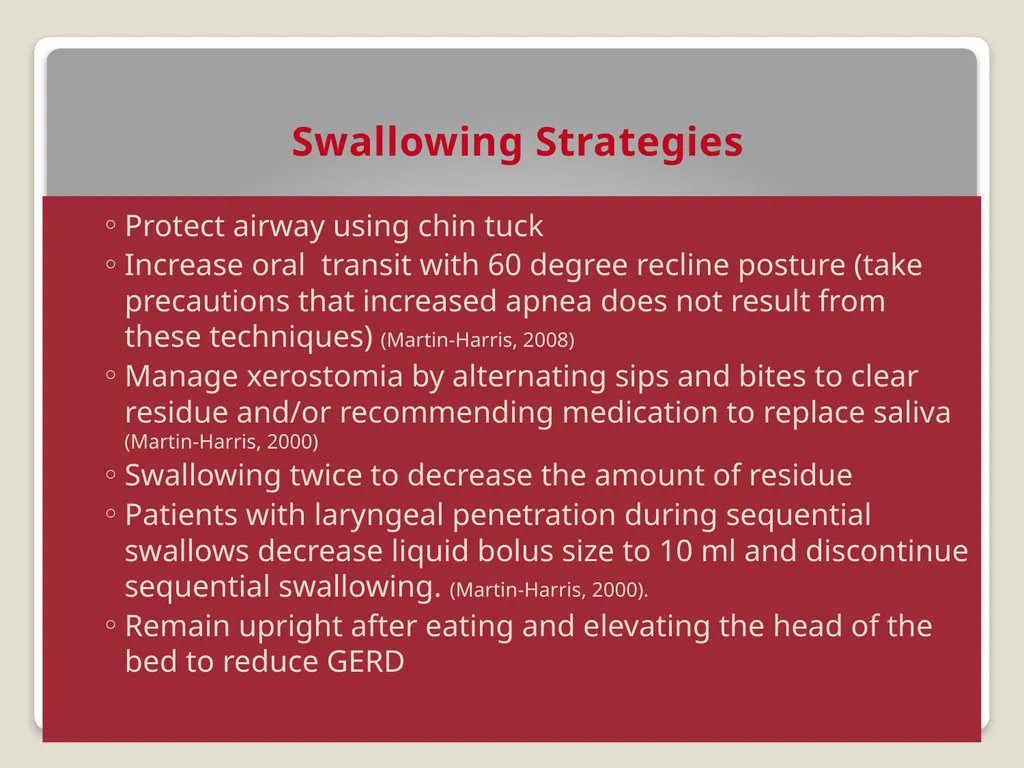
Swallowing Strategies Protect airway using chin tuck
Increase oral transit with 60 degree recline posture (take precautions that increased apnea does not result from these techniques) (Martin-Harris, 2008)
Manage xerostomia by alternating sips and bites to clear residue and/or recommending medication to replace saliva (Martin-Harris, 2000)
Swallowing twice to decrease the amount of residue
Patients with laryngeal penetration during sequential swallows decrease liquid bolus size to 10 ml and discontinue sequential swallowing. (Martin-Harris, 2000).
Remain upright after eating and elevating the head of the bed to reduce GERD<br>
Increase oral transit with 60 degree recline posture (take precautions that increased apnea does not result from these techniques) (Martin-Harris, 2008)
Manage xerostomia by alternating sips and bites to clear residue and/or recommending medication to replace saliva (Martin-Harris, 2000)
Swallowing twice to decrease the amount of residue
Patients with laryngeal penetration during sequential swallows decrease liquid bolus size to 10 ml and discontinue sequential swallowing. (Martin-Harris, 2000).
Remain upright after eating and elevating the head of the bed to reduce GERD<br>
17
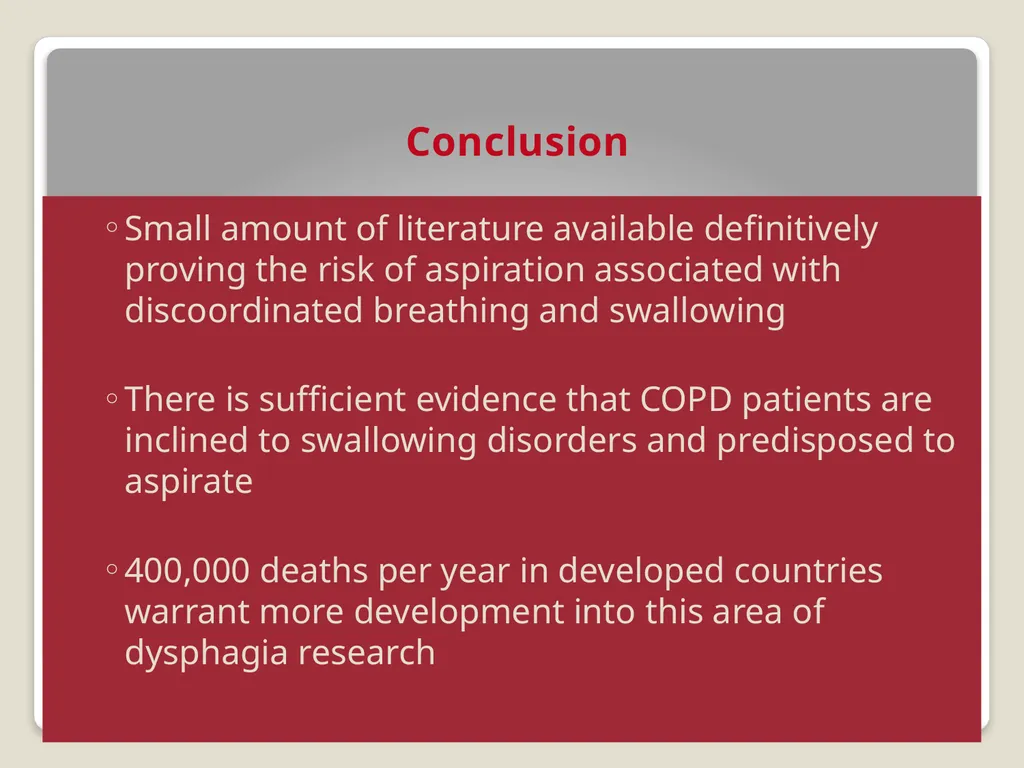
Conclusion Small amount of literature available definitively proving the risk of aspiration associated with discoordinated breathing and swallowing
There is sufficient evidence that COPD patients are inclined to swallowing disorders and predisposed to aspirate
400,000 deaths per year in developed countries warrant more development into this area of dysphagia research<br>
There is sufficient evidence that COPD patients are inclined to swallowing disorders and predisposed to aspirate
400,000 deaths per year in developed countries warrant more development into this area of dysphagia research<br>
18
References Casaburi R., ZuWallack R. (2009).Pulmonary rehabilitation for management of chronic obstructive pulmonary disease. N Engl J Med 360. (13), 1329-1335.
Cvejic, L., Harding, R., Churchward, T., Turton, A., Finlay, P., Massey, D., & ... Guy, P. (2011). Laryngeal penetration and aspiration in individuals with stable COPD. Respirology (Carlton, Vic.), 16(2), 269-275.
Fishman, A., Martinez, F., Naunheim, K., Piantadosi, S., Wise, R., Ries, A., & ... Wood, D. (2003). A randomized trial comparing lung-volume-reduction surgery with medical therapy for severe emphysema. The New England Journal Of Medicine, 348(21), 2059-2073.
Global Strategy for the Diagnosis, Management and Prevention of COPD, Global Initiative for Chronic Obstructive Lung Disease (GOLD) (2011). Retrieved from: http://www.goldcopd.org/.
Gross, R., Atwood, C., Ross, S., Olszewski, J., & Eichhorn, K. (2009). The coordination of breathing and swallowing in chronic obstructive pulmonary disease. American Journal Of Respiratory And Critical Care Medicine, 179(7), 559-565.
Klahn, M.S., Perlman, A.L. (1999). Temporal and durational patterns associating respiration and swallowing. Dysphagia, 14: 131-8.
Lopez, A., Shibuya, K., Rao, C., Mathers, C., Hansell, A., Held, L., & Buist, S. (2006). Chronic obstructive pulmonary disease: current burden and future projections. The European Respiratory Journal: Official Journal Of The European Society For Clinical Respiratory Physiology, 27(2), 397-412.
Mannino DM, Homa DM, Akinbami LJ, Ford ES, Redd SC. Chronic obstructive pulmonary disease surveillance -- United States, 1971-2000. MMWR Surveill Summ 2002;51(SS-6):1-16.
Mackay, A., & Hurst, J. (2012). COPD Exacerbations: Causes, Prevention, and Treatment. The Medical Clinics Of North America, 96(4), 789-809.<br>
Cvejic, L., Harding, R., Churchward, T., Turton, A., Finlay, P., Massey, D., & ... Guy, P. (2011). Laryngeal penetration and aspiration in individuals with stable COPD. Respirology (Carlton, Vic.), 16(2), 269-275.
Fishman, A., Martinez, F., Naunheim, K., Piantadosi, S., Wise, R., Ries, A., & ... Wood, D. (2003). A randomized trial comparing lung-volume-reduction surgery with medical therapy for severe emphysema. The New England Journal Of Medicine, 348(21), 2059-2073.
Global Strategy for the Diagnosis, Management and Prevention of COPD, Global Initiative for Chronic Obstructive Lung Disease (GOLD) (2011). Retrieved from: http://www.goldcopd.org/.
Gross, R., Atwood, C., Ross, S., Olszewski, J., & Eichhorn, K. (2009). The coordination of breathing and swallowing in chronic obstructive pulmonary disease. American Journal Of Respiratory And Critical Care Medicine, 179(7), 559-565.
Klahn, M.S., Perlman, A.L. (1999). Temporal and durational patterns associating respiration and swallowing. Dysphagia, 14: 131-8.
Lopez, A., Shibuya, K., Rao, C., Mathers, C., Hansell, A., Held, L., & Buist, S. (2006). Chronic obstructive pulmonary disease: current burden and future projections. The European Respiratory Journal: Official Journal Of The European Society For Clinical Respiratory Physiology, 27(2), 397-412.
Mannino DM, Homa DM, Akinbami LJ, Ford ES, Redd SC. Chronic obstructive pulmonary disease surveillance -- United States, 1971-2000. MMWR Surveill Summ 2002;51(SS-6):1-16.
Mackay, A., & Hurst, J. (2012). COPD Exacerbations: Causes, Prevention, and Treatment. The Medical Clinics Of North America, 96(4), 789-809.<br>
19
References Martin-Harris, B. (2000). Optimal patterns of care in patients with chronic obstructive pulmonary disease. Seminars In Speech And Language, 21(4), 311-321.
Martin-Harris, B. (2008). Clinical implications of respiratory-swallowing interactions. Current Opinion In Otolaryngology & Head And Neck Surgery, 16(3), 194-199.
Martin-Harris, B., Brodsky, M., Michel, Y., Ford, C., Walters, B., & Heffner, J. (2005). Breathing and swallowing dynamics across the adult lifespan. Archives Of Otolaryngology--Head & Neck Surgery, 131(9), 762-770.
McFarland, D., & Lund, J. (1995). Modification of mastication and respiration during swallowing in the adult human. Journal Of Neurophysiology, 74(4), 1509-1517.
McKinstry, A., Tranter, M., & Sweeney, J. (2010). Outcomes of dysphagia intervention in a pulmonary rehabilitation program. Dysphagia, 25(2), 104-111.
Mokhlesi, B., Logemann, J., Rademaker, A., Stangl, C., & Corbridge, T. (2002). Oropharyngeal deglutition in stable COPD. Chest, 121(2), 361-369.
Pauwels, R., Buist, A., Calverley, P., Jenkins, C., & Hurd, S. (2001). Global strategy for the diagnosis, management, and prevention of chronic obstructive pulmonary disease. NHLBI/WHO Global Initiative for Chronic Obstructive Lung Disease (GOLD) Workshop summary. American Journal Of Respiratory And Critical Care Medicine, 163(5), 1256-1276.
Polatlı, M., Bilgin, C., Şaylan, B., Başlılar, Ş., Toprak, E., Ergen, H., & ... Yılmaz, M. (2012). A cross sectional observational study on the influence of chronic obstructive pulmonary disease on activities of daily living: the COPD-Life study. Tüberküloz Ve Toraks, 60(1),1-12.
Shaker, R., Li, Q., Ren, J., Townsend, W., Dodds, W., Martin, B., & ... Rynders, A. (1992). Coordination of deglutition and phases of respiration: effect of aging, tachypnea, bolus volume, and chronic obstructive pulmonary disease. The American Journal Of Physiology, 263(5 Pt 1), G750-G755.
Stein, M., Williams, A., Grossman, F., Weinberg, A., & Zuckerbraun, L. (1990). Cricopharyngeal dysfunction in chronic obstructive pulmonary disease. Chest, 97(2), 347-352<br>
Martin-Harris, B. (2008). Clinical implications of respiratory-swallowing interactions. Current Opinion In Otolaryngology & Head And Neck Surgery, 16(3), 194-199.
Martin-Harris, B., Brodsky, M., Michel, Y., Ford, C., Walters, B., & Heffner, J. (2005). Breathing and swallowing dynamics across the adult lifespan. Archives Of Otolaryngology--Head & Neck Surgery, 131(9), 762-770.
McFarland, D., & Lund, J. (1995). Modification of mastication and respiration during swallowing in the adult human. Journal Of Neurophysiology, 74(4), 1509-1517.
McKinstry, A., Tranter, M., & Sweeney, J. (2010). Outcomes of dysphagia intervention in a pulmonary rehabilitation program. Dysphagia, 25(2), 104-111.
Mokhlesi, B., Logemann, J., Rademaker, A., Stangl, C., & Corbridge, T. (2002). Oropharyngeal deglutition in stable COPD. Chest, 121(2), 361-369.
Pauwels, R., Buist, A., Calverley, P., Jenkins, C., & Hurd, S. (2001). Global strategy for the diagnosis, management, and prevention of chronic obstructive pulmonary disease. NHLBI/WHO Global Initiative for Chronic Obstructive Lung Disease (GOLD) Workshop summary. American Journal Of Respiratory And Critical Care Medicine, 163(5), 1256-1276.
Polatlı, M., Bilgin, C., Şaylan, B., Başlılar, Ş., Toprak, E., Ergen, H., & ... Yılmaz, M. (2012). A cross sectional observational study on the influence of chronic obstructive pulmonary disease on activities of daily living: the COPD-Life study. Tüberküloz Ve Toraks, 60(1),1-12.
Shaker, R., Li, Q., Ren, J., Townsend, W., Dodds, W., Martin, B., & ... Rynders, A. (1992). Coordination of deglutition and phases of respiration: effect of aging, tachypnea, bolus volume, and chronic obstructive pulmonary disease. The American Journal Of Physiology, 263(5 Pt 1), G750-G755.
Stein, M., Williams, A., Grossman, F., Weinberg, A., & Zuckerbraun, L. (1990). Cricopharyngeal dysfunction in chronic obstructive pulmonary disease. Chest, 97(2), 347-352<br>