Civil Engineering Department College of Engineering Course: Soil and Rock Mechanics (CE 260) Lecturer: Dr. Frederick Owusu-Nimo Introduction Engineering Uses of Rocks: Rocks are used for engineering purposes in two primary ways: As a
"Civil Engineering Department College of" is the property of its rightful owner. Permission is granted to
download and print the materials on this website for personal, non-commercial use only, and to display it
on your personal computer provided you do not modify the materials and that you retain all copyright
notices contained in the materials. By downloading content from our website, you accept the terms of this
agreement.
Presentation Transcript
01
Civil Engineering Department College of Engineering Course: Soil and Rock Mechanics (CE 260) Lecturer: Dr. Frederick Owusu-Nimo<br>
02
Introduction Engineering Uses of Rocks: Rocks are used for engineering purposes in two primary ways:
As a building material : aggregates, cut stones, decorative panels, etc.
As a foundation : bedrock determines kind of structure that can be built.
Knowledge and understanding of basic rock properties will
Enable us assess the usefulness and quality of aggregates
allow structures to be founded correctly so the required support will be there<br>
03
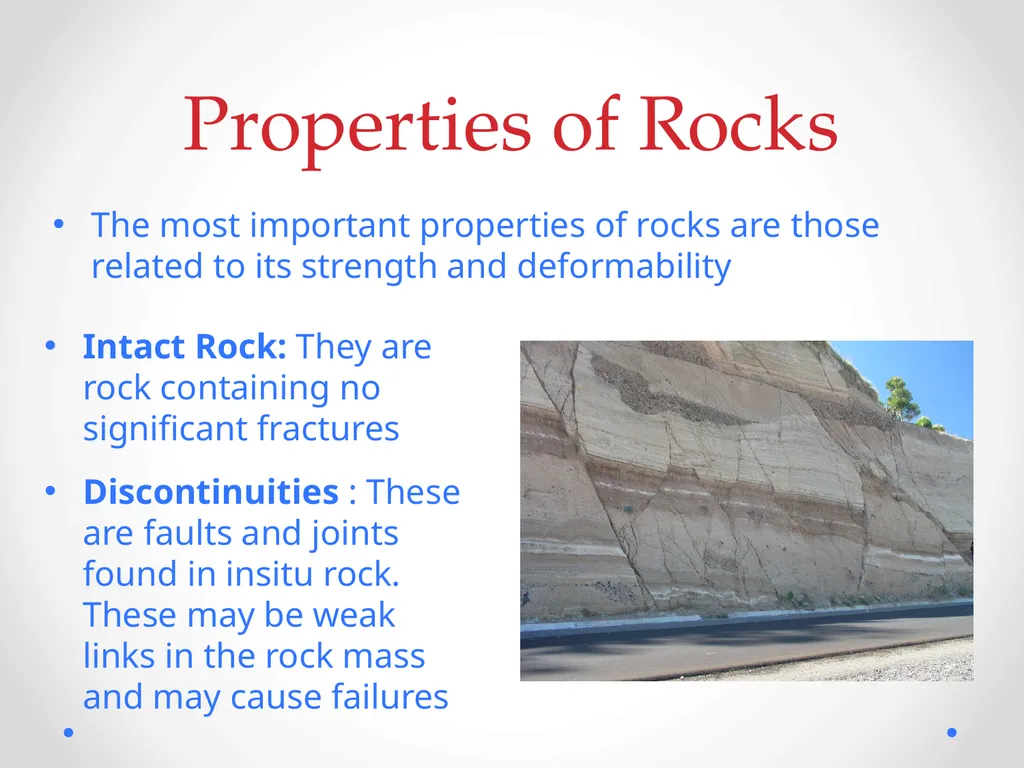
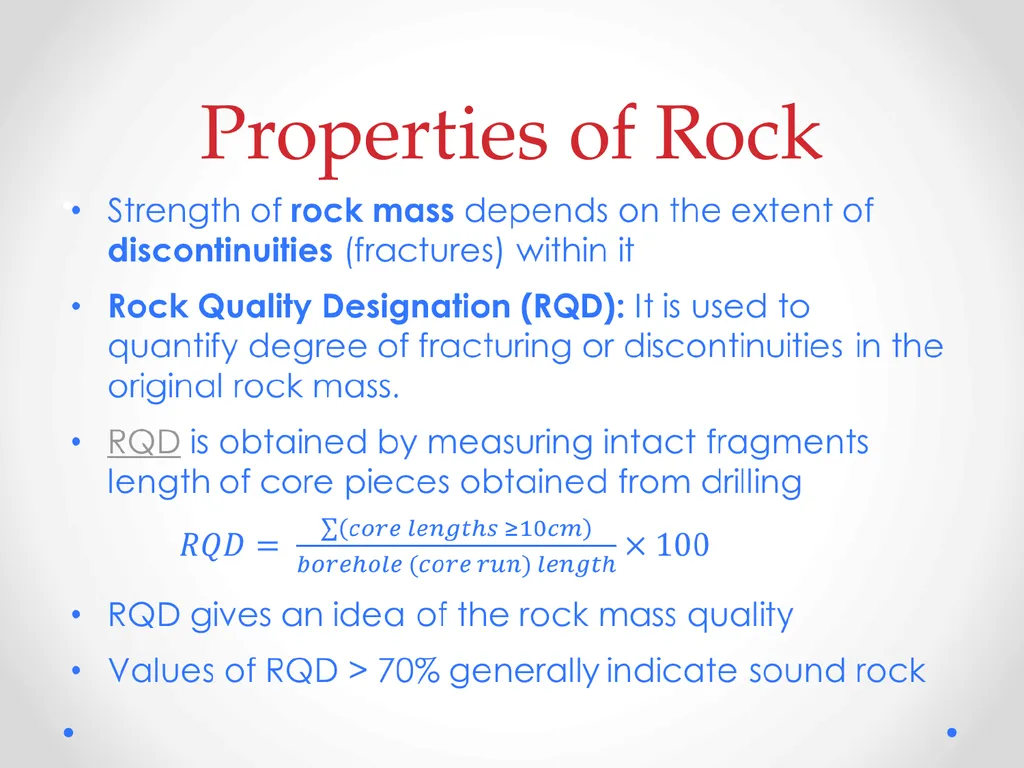
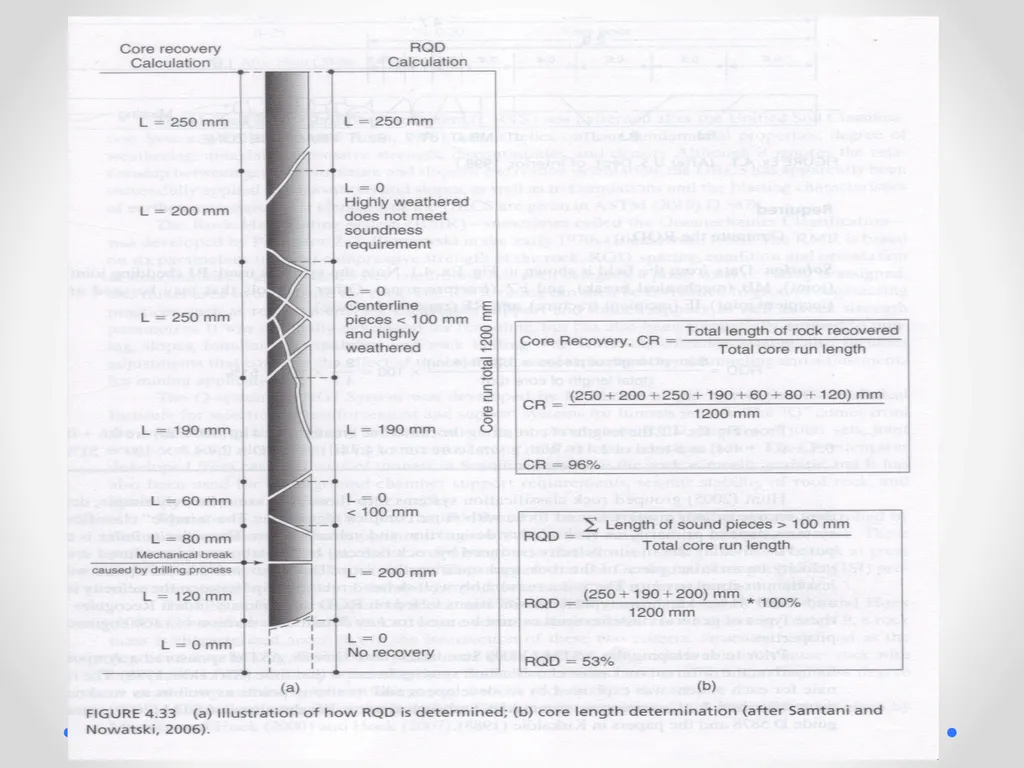
Properties of Rocks The most important properties of rocks are those related to its strength and deformability Intact Rock: They are rock containing no significant fractures
Discontinuities : These are faults and joints found in insitu rock. These may be weak links in the rock mass and may cause failures<br>
04
Properties of Rocks The strength of rocks is the maximum stress it can sustain under a given set of conditions
Uniaxial Compressive Strength: It is stress which will cause a cylindrical rock sample to fail when it is subjected to two opposing (compressing forces).
Tensile Strength: It is stress which will cause a cylindrical rock sample to fail when it is subjected to two opposing (outward forces). Tensile strength of rocks is usually much lower than compressive strength
Shear Strength: It is the shear stress that acts on the plane of failure when rock is subjected to compressive or tensile forces<br>
05
Properties of Rock<br>
06
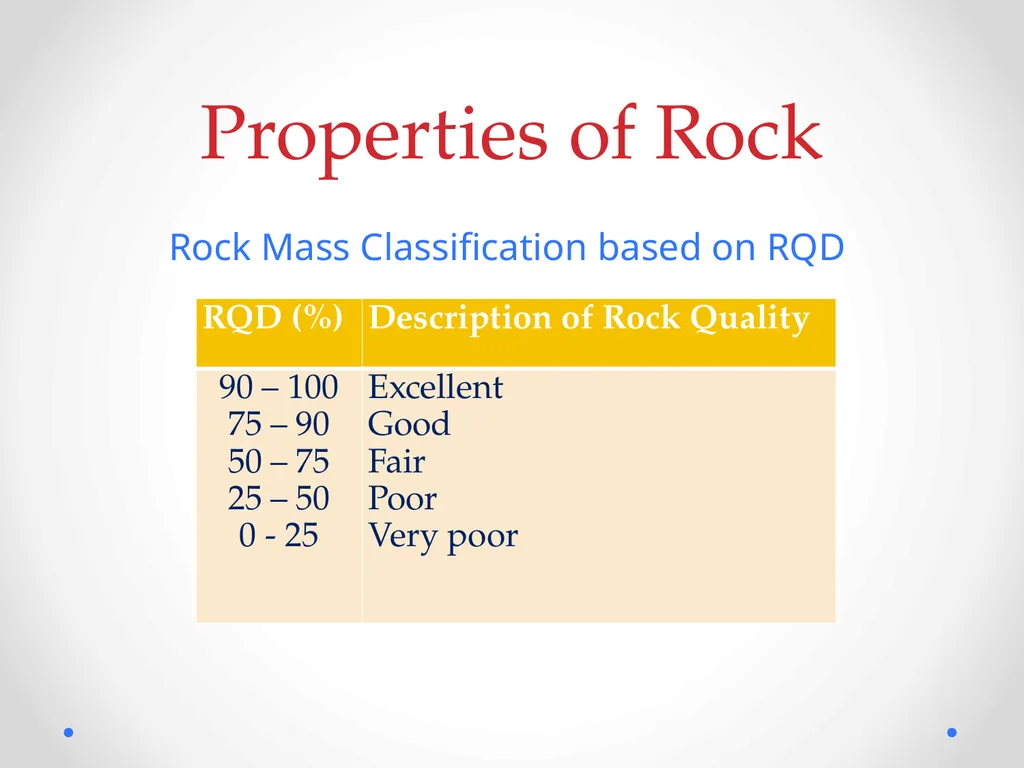
Properties of Rock Rock Mass Classification based on RQD<br>
07
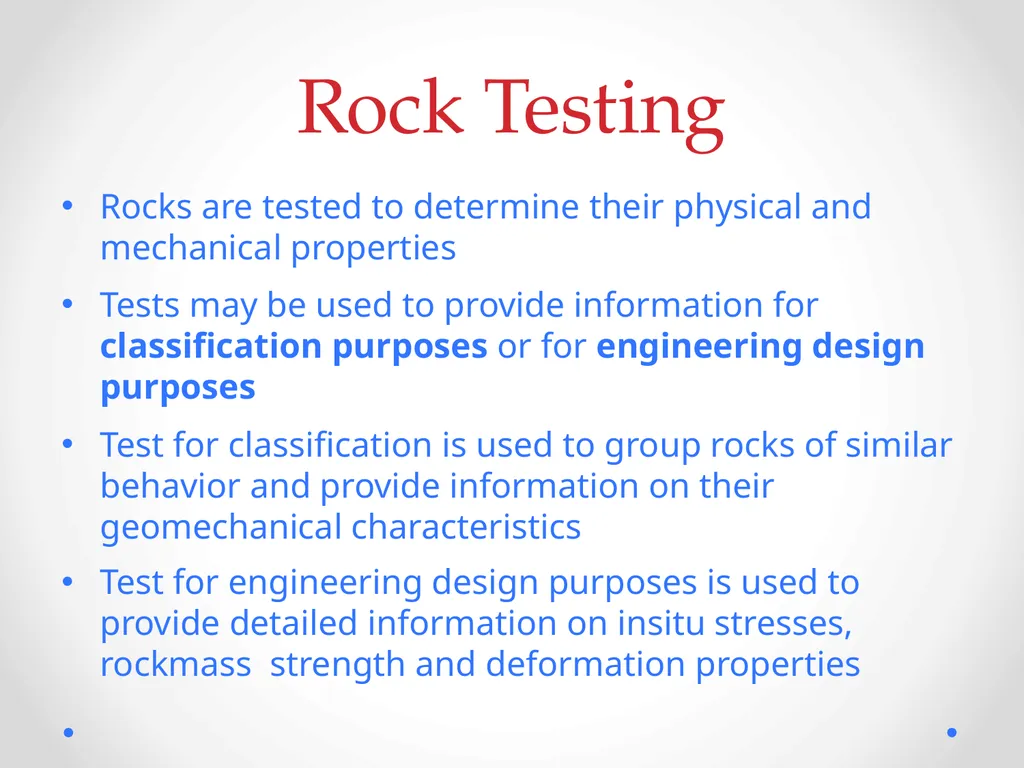
Rock Testing Rocks are tested to determine their physical and mechanical properties
Tests may be used to provide information for classification purposes or for engineering design purposes
Test for classification is used to group rocks of similar behavior and provide information on their geomechanical characteristics
Test for engineering design purposes is used to provide detailed information on insitu stresses, rockmass strength and deformation properties<br>
08
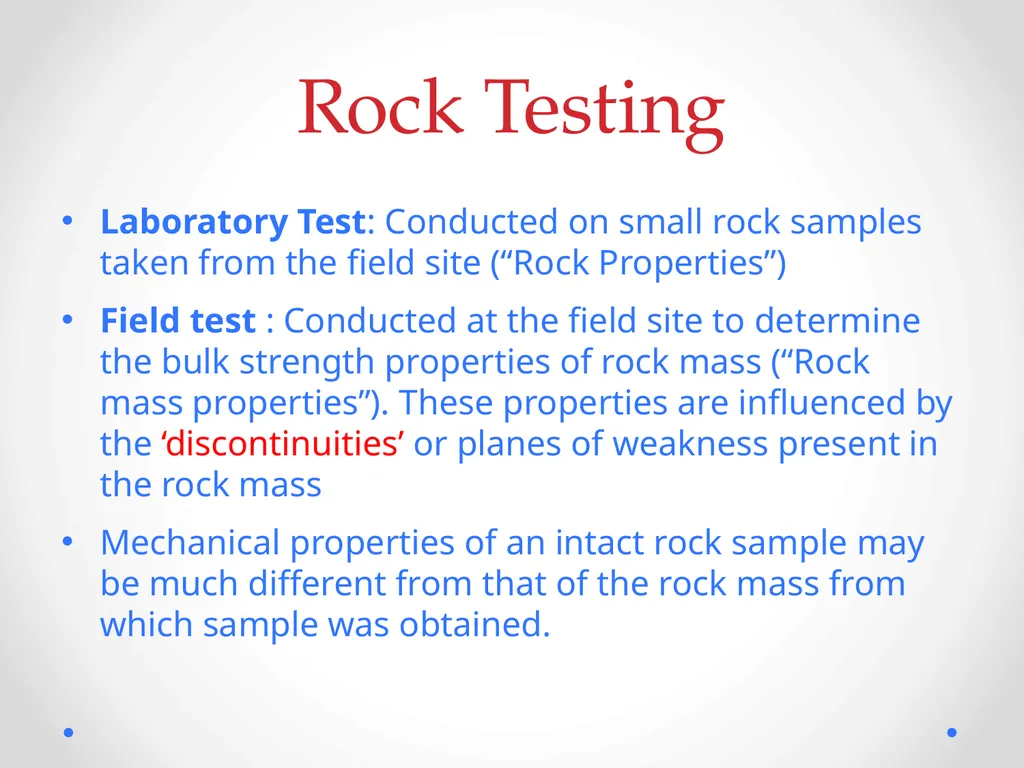
Rock Testing Laboratory Test: Conducted on small rock samples taken from the field site (“Rock Properties”)
Field test : Conducted at the field site to determine the bulk strength properties of rock mass (“Rock mass properties”). These properties are influenced by the ‘discontinuities’ or planes of weakness present in the rock mass
Mechanical properties of an intact rock sample may be much different from that of the rock mass from which sample was obtained.<br>
09
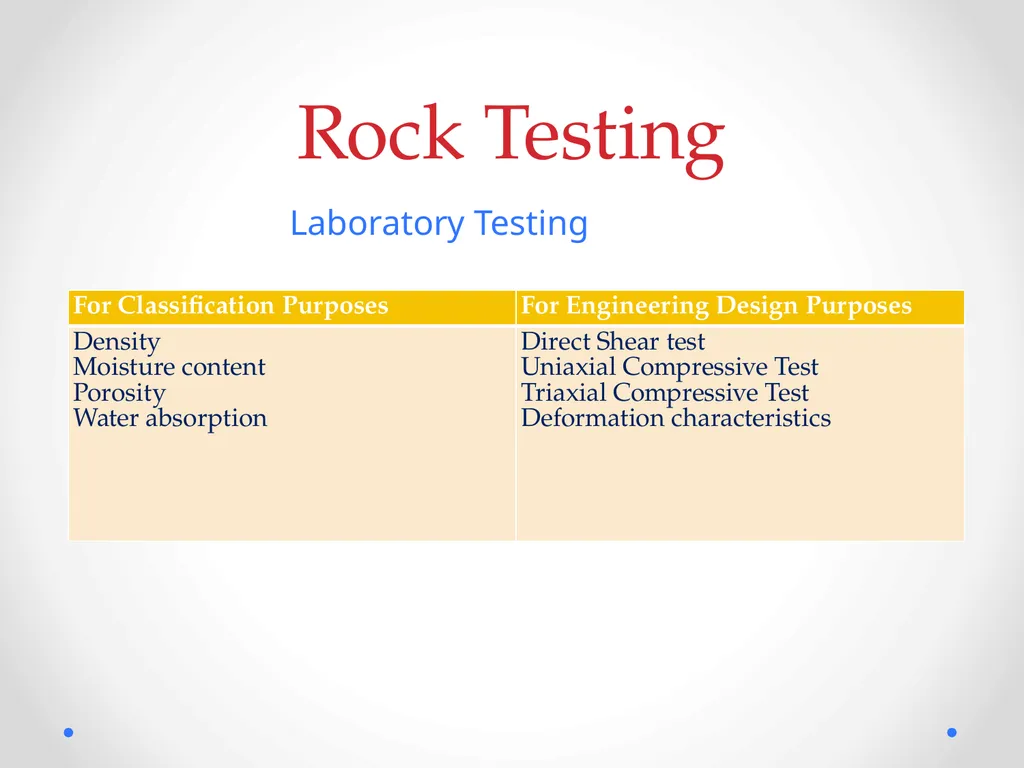
Rock Testing Laboratory Testing<br>
10
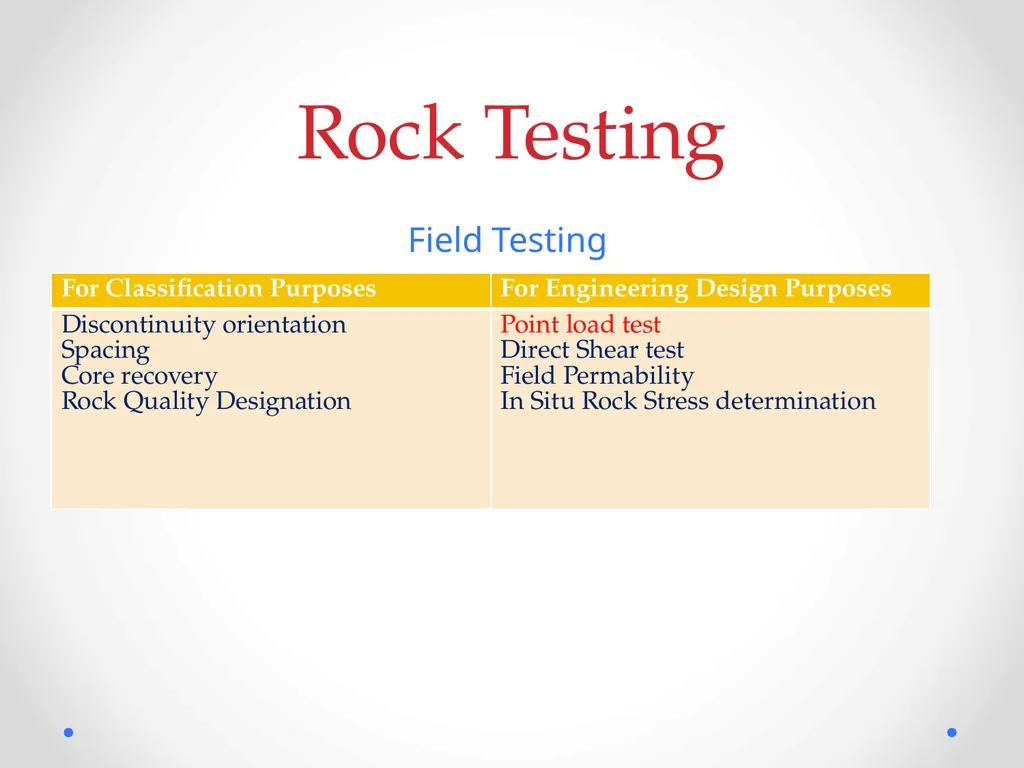
Rock Testing Field Testing<br>
11
Rock Materials Reasons for laboratory Testing of Rocks Materials (Aggregates)
To assess the usefulness and quality of a new source of aggregate (quarry site)
Compare quality of rock materials from different sources
Predict performance in service
Predict durability<br>
12
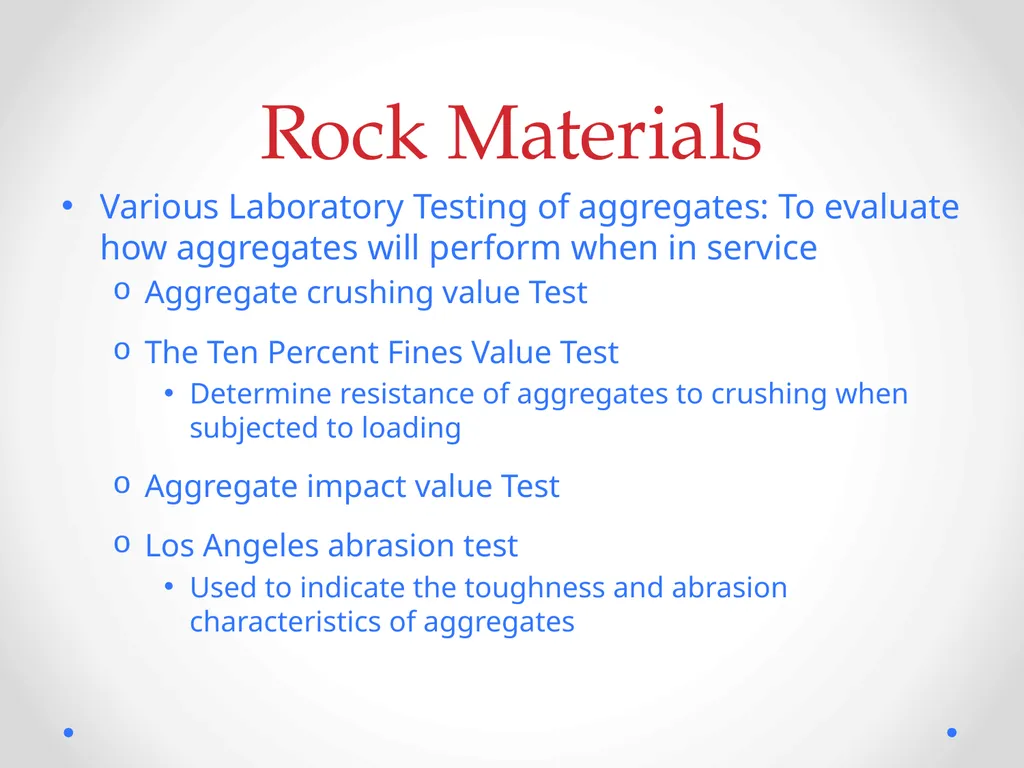
Rock Materials Various Laboratory Testing of aggregates: To evaluate how aggregates will perform when in service
Aggregate crushing value Test
The Ten Percent Fines Value Test
Determine resistance of aggregates to crushing when subjected to loading
Aggregate impact value Test
Los Angeles abrasion test
Used to indicate the toughness and abrasion characteristics of aggregates<br>
13
Effect of water on Strength of Rocks Presence of water can significantly reduce rock strength in two ways
Water interrupts the bonding between minerals and allows the break up of clay cement leading to a reduction in rock strength and increased deformability
Water in joints may induce pore water pressure which acts in opposition to compressive stress, thus reducing effective normal stress between the rock surface.
Water greatly reduces strength of porous sedimentary rock but have minimal effect on intact rock with low porosity<br>