
Class 23 Dumping and Anti-Dumping Policy by Alan
PC
Published · 62 slides · 0 views

1 / 1






Description
Class 23 Dumping and Anti-Dumping Policy by Alan V. Deardorff University of Michigan 2022 PubPolEcon 541 Announcements Course Evaluations Please do them 6 of you had as of this morning Office Hour Monday Dec 5: 4:00 PM, not 10:00 AM Quiz:
Related Topics
Share
Embed code
Download this presentation From Below
"Class 23 Dumping and Anti-Dumping Policy by Alan" is the property of its rightful owner. Permission is granted to download and print the materials on this website for personal, non-commercial use only, and to display it on your personal computer provided you do not modify the materials and that you retain all copyright notices contained in the materials. By downloading content from our website, you accept the terms of this agreement.
Presentation Transcript
01
Class 23
Dumping and
Anti-Dumping Policy
by
Alan V. Deardorff
University of Michigan
2022 PubPol/Econ 541<br>
02
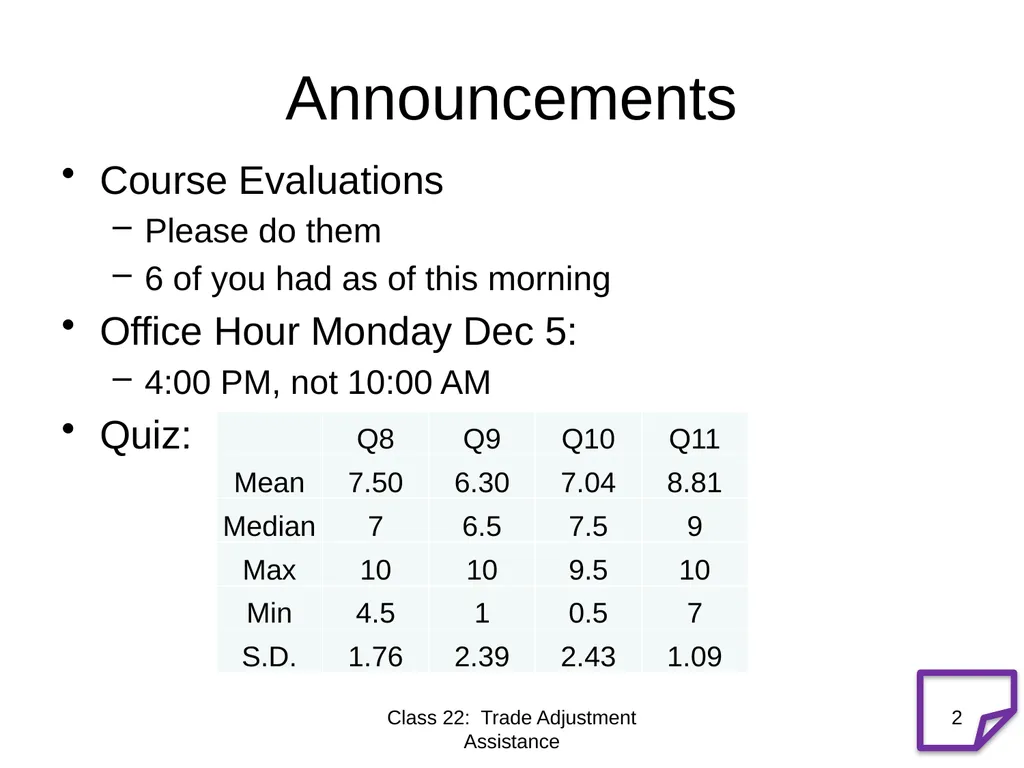
Announcements Course Evaluations
Please do them
6 of you had as of this morning
Office Hour Monday Dec 5:
4:00 PM, not 10:00 AM
Quiz: Class 22: Trade Adjustment Assistance 2<br>
Please do them
6 of you had as of this morning
Office Hour Monday Dec 5:
4:00 PM, not 10:00 AM
Quiz: Class 22: Trade Adjustment Assistance 2<br>
03
Class 20: FTAs and Other Trade Deals 3 Pause for News<br>
04
Announcements Quiz: Not graded yet, as it was accepted until Monday midnight
Last 2 quizzes also due Sunday midnight and accepted (with penalty) until Monday midnight
Course Evaluations
Please do them
Six of you had as of yesterday afternoon Class 22: Trade Adjustment Assistance 4<br>
Last 2 quizzes also due Sunday midnight and accepted (with penalty) until Monday midnight
Course Evaluations
Please do them
Six of you had as of yesterday afternoon Class 22: Trade Adjustment Assistance 4<br>
05
Pause for Discussion Class 23: Dumping and Anti-Dumping Policy 5<br>
06
Questions on Jackson Under what circumstances are imports regarded as “dumped”?
What is the “dumping margin”? Class 23: Dumping and Anti-Dumping Policy 6<br>
What is the “dumping margin”? Class 23: Dumping and Anti-Dumping Policy 6<br>
07
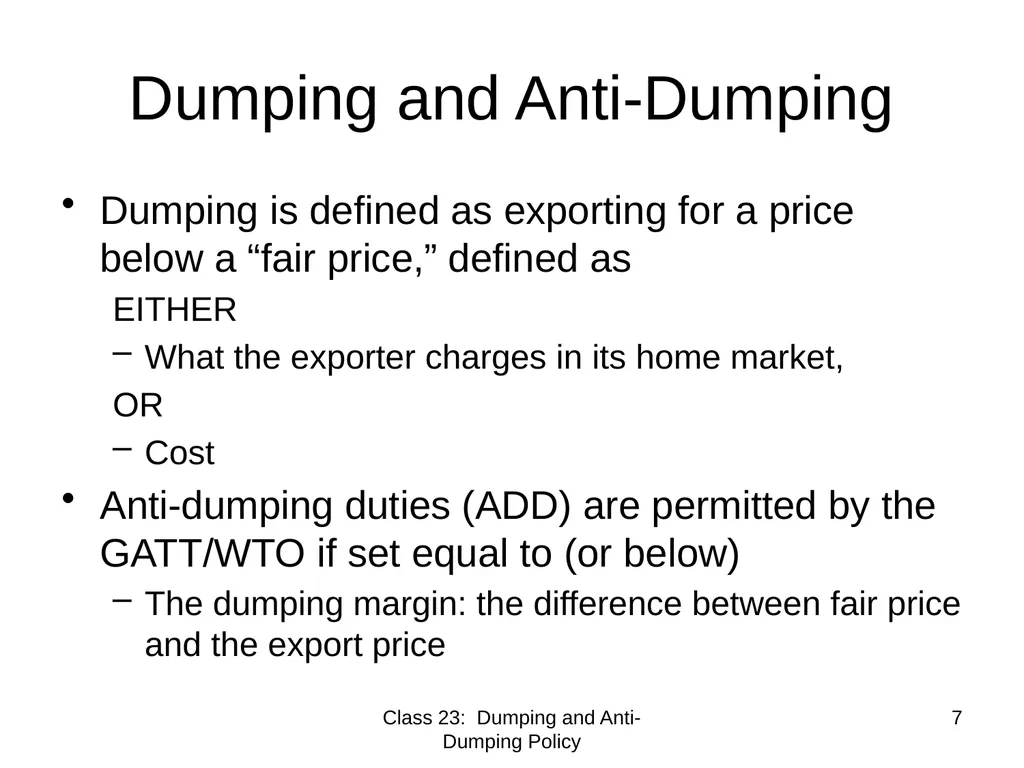
Dumping and Anti-Dumping Dumping is defined as exporting for a price below a “fair price,” defined as
EITHER
What the exporter charges in its home market,
OR
Cost
Anti-dumping duties (ADD) are permitted by the GATT/WTO if set equal to (or below)
The dumping margin: the difference between fair price and the export price 7 Class 23: Dumping and Anti-Dumping Policy<br>
EITHER
What the exporter charges in its home market,
OR
Cost
Anti-dumping duties (ADD) are permitted by the GATT/WTO if set equal to (or below)
The dumping margin: the difference between fair price and the export price 7 Class 23: Dumping and Anti-Dumping Policy<br>
08
Outline Why firms dump
Predation? No
Protected home market
Interface problem
Other reasons
Procedures and data
Effects of ADD 8 Class 23: Dumping and Anti-Dumping Policy<br>
Predation? No
Protected home market
Interface problem
Other reasons
Procedures and data
Effects of ADD 8 Class 23: Dumping and Anti-Dumping Policy<br>
09
Outline Why firms dump
Predation? No
Protected home market
Interface problem
Other reasons
Procedures and data
Effects of ADD 9 Class 23: Dumping and Anti-Dumping Policy<br>
Predation? No
Protected home market
Interface problem
Other reasons
Procedures and data
Effects of ADD 9 Class 23: Dumping and Anti-Dumping Policy<br>
10
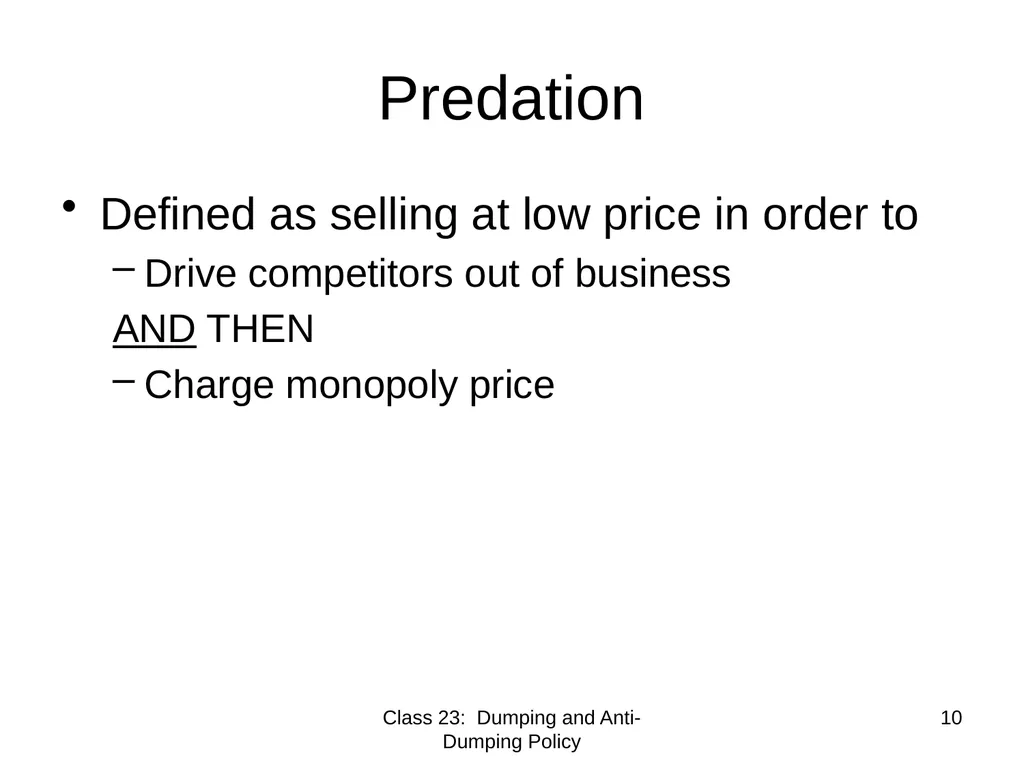
Predation Defined as selling at low price in order to
Drive competitors out of business
AND THEN
Charge monopoly price Class 23: Dumping and Anti-Dumping Policy 10<br>
Drive competitors out of business
AND THEN
Charge monopoly price Class 23: Dumping and Anti-Dumping Policy 10<br>
11
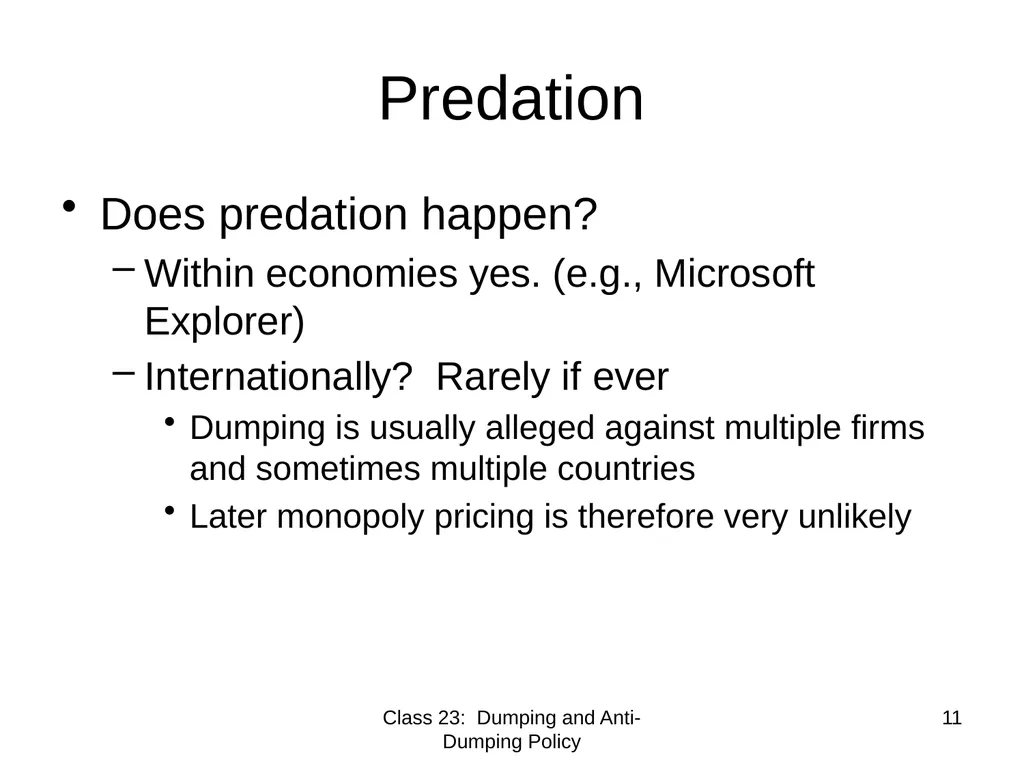
Predation Does predation happen?
Within economies yes. (e.g., Microsoft Explorer)
Internationally? Rarely if ever
Dumping is usually alleged against multiple firms and sometimes multiple countries
Later monopoly pricing is therefore very unlikely Class 23: Dumping and Anti-Dumping Policy 11<br>
Within economies yes. (e.g., Microsoft Explorer)
Internationally? Rarely if ever
Dumping is usually alleged against multiple firms and sometimes multiple countries
Later monopoly pricing is therefore very unlikely Class 23: Dumping and Anti-Dumping Policy 11<br>
12
Outline Why firms dump
Predation? No
Protected home market
Interface problem
Other reasons
Procedures and data
Effects of ADD 12 Class 23: Dumping and Anti-Dumping Policy<br>
Predation? No
Protected home market
Interface problem
Other reasons
Procedures and data
Effects of ADD 12 Class 23: Dumping and Anti-Dumping Policy<br>
13
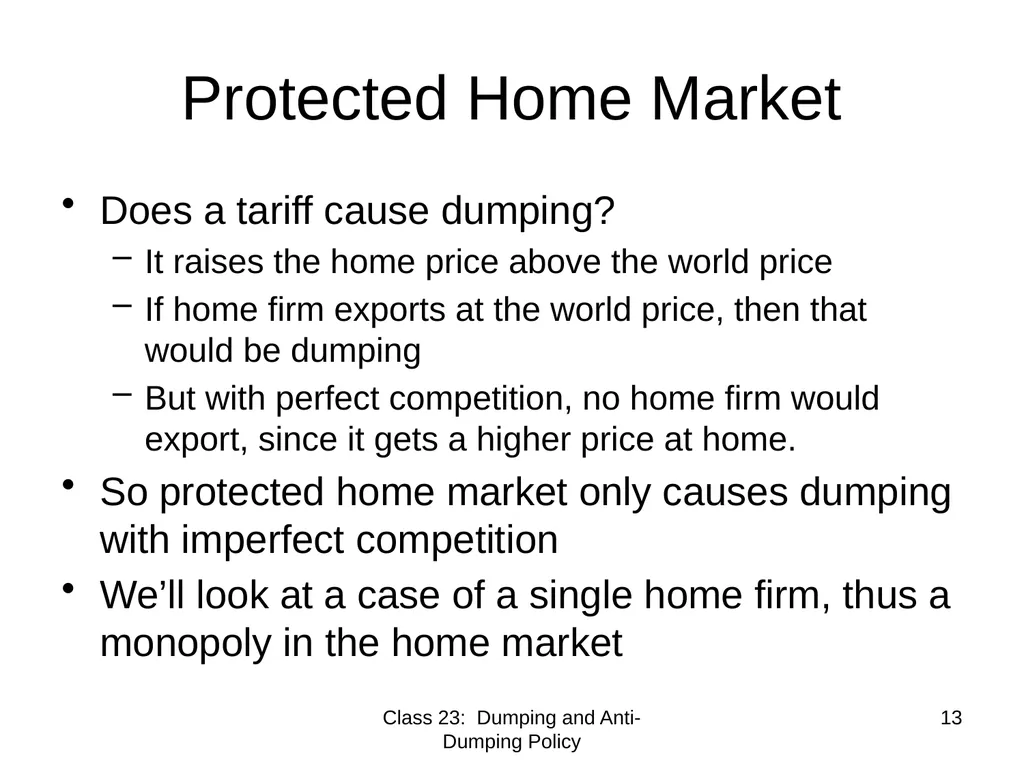
Protected Home Market Does a tariff cause dumping?
It raises the home price above the world price
If home firm exports at the world price, then that would be dumping
But with perfect competition, no home firm would export, since it gets a higher price at home.
So protected home market only causes dumping with imperfect competition
We’ll look at a case of a single home firm, thus a monopoly in the home market Class 23: Dumping and Anti-Dumping Policy 13<br>
It raises the home price above the world price
If home firm exports at the world price, then that would be dumping
But with perfect competition, no home firm would export, since it gets a higher price at home.
So protected home market only causes dumping with imperfect competition
We’ll look at a case of a single home firm, thus a monopoly in the home market Class 23: Dumping and Anti-Dumping Policy 13<br>
14
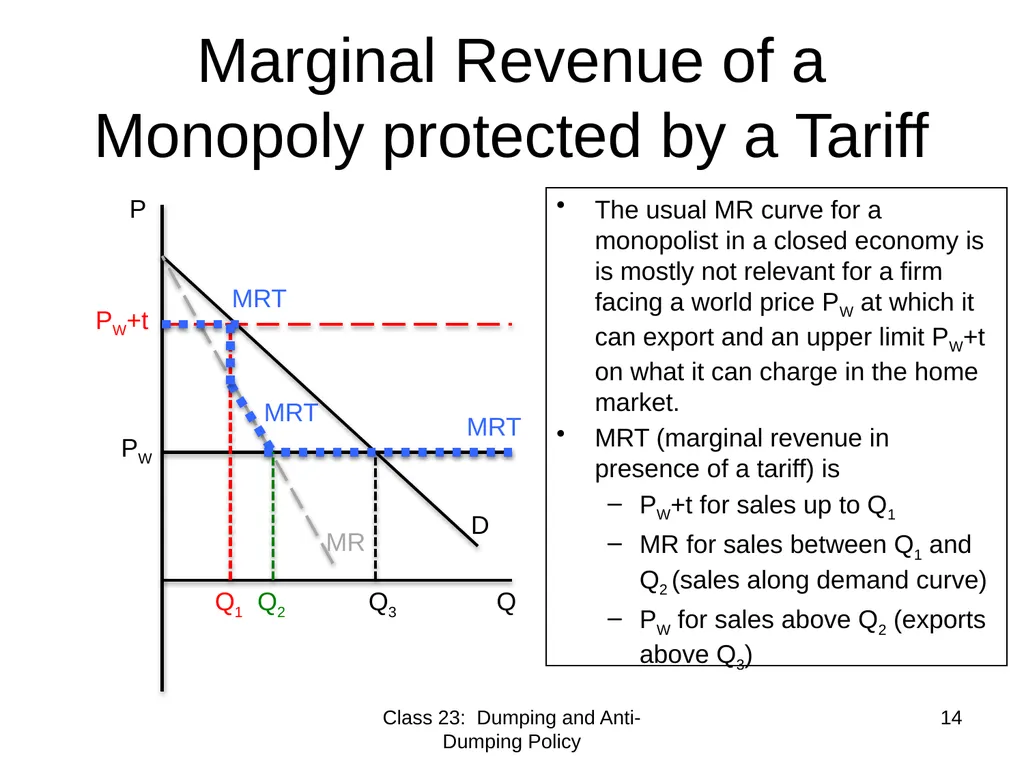
Marginal Revenue of a Monopoly protected by a Tariff 14 P Q MR The usual MR curve for a monopolist in a closed economy is is mostly not relevant for a firm facing a world price PW at which it can export and an upper limit PW+t on what it can charge in the home market.
MRT (marginal revenue in presence of a tariff) is
PW+t for sales up to Q1
MR for sales between Q1 and Q2 (sales along demand curve)
PW for sales above Q2 (exports above Q3) PW PW+t D Q1 Q3 MRT Q2 Class 23: Dumping and Anti-Dumping Policy MRT MRT<br>
MRT (marginal revenue in presence of a tariff) is
PW+t for sales up to Q1
MR for sales between Q1 and Q2 (sales along demand curve)
PW for sales above Q2 (exports above Q3) PW PW+t D Q1 Q3 MRT Q2 Class 23: Dumping and Anti-Dumping Policy MRT MRT<br>
15
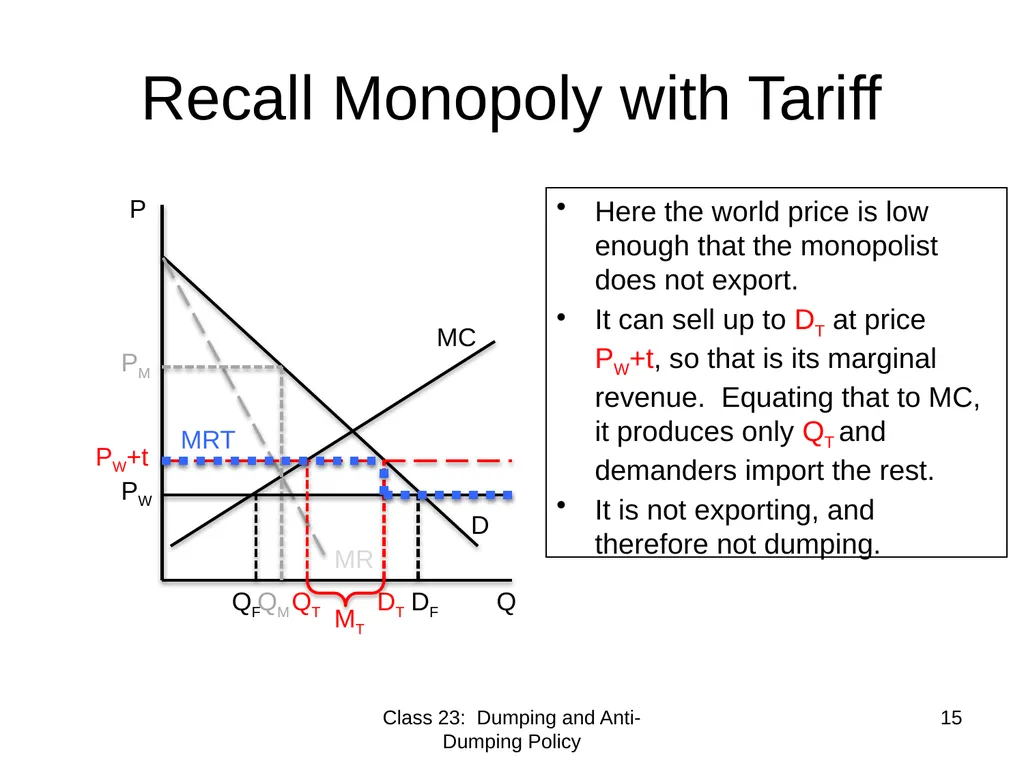
Recall Monopoly with Tariff 15 P Q MC MR QM PM Here the world price is low enough that the monopolist does not export.
It can sell up to DT at price PW+t, so that is its marginal revenue. Equating that to MC, it produces only QT and demanders import the rest.
It is not exporting, and therefore not dumping. PW QF DF PW+t QT DT MT D MRT Class 23: Dumping and Anti-Dumping Policy<br>
It can sell up to DT at price PW+t, so that is its marginal revenue. Equating that to MC, it produces only QT and demanders import the rest.
It is not exporting, and therefore not dumping. PW QF DF PW+t QT DT MT D MRT Class 23: Dumping and Anti-Dumping Policy<br>
16
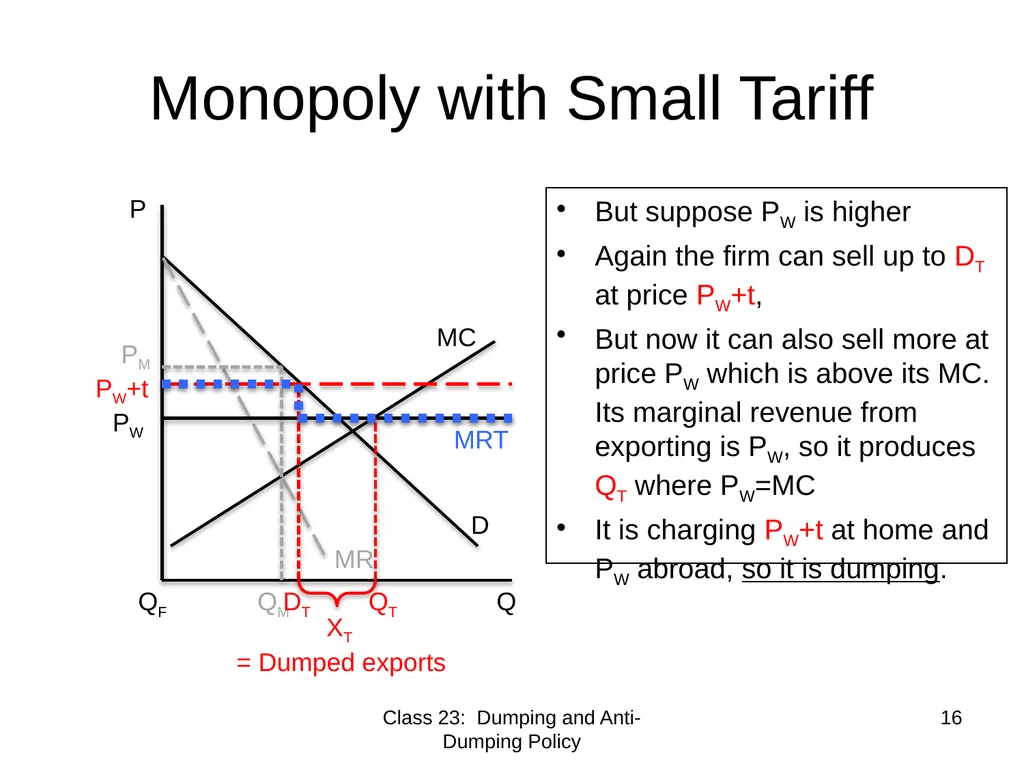
Monopoly with Small Tariff 16 P Q MC MR QM PM But suppose PW is higher
Again the firm can sell up to DT at price PW+t,
But now it can also sell more at price PW which is above its MC. Its marginal revenue from exporting is PW, so it produces QT where PW=MC
It is charging PW+t at home and PW abroad, so it is dumping. PW QF PW+t QT DT XT
= Dumped exports D MRT Class 23: Dumping and Anti-Dumping Policy<br>
Again the firm can sell up to DT at price PW+t,
But now it can also sell more at price PW which is above its MC. Its marginal revenue from exporting is PW, so it produces QT where PW=MC
It is charging PW+t at home and PW abroad, so it is dumping. PW QF PW+t QT DT XT
= Dumped exports D MRT Class 23: Dumping and Anti-Dumping Policy<br>
17
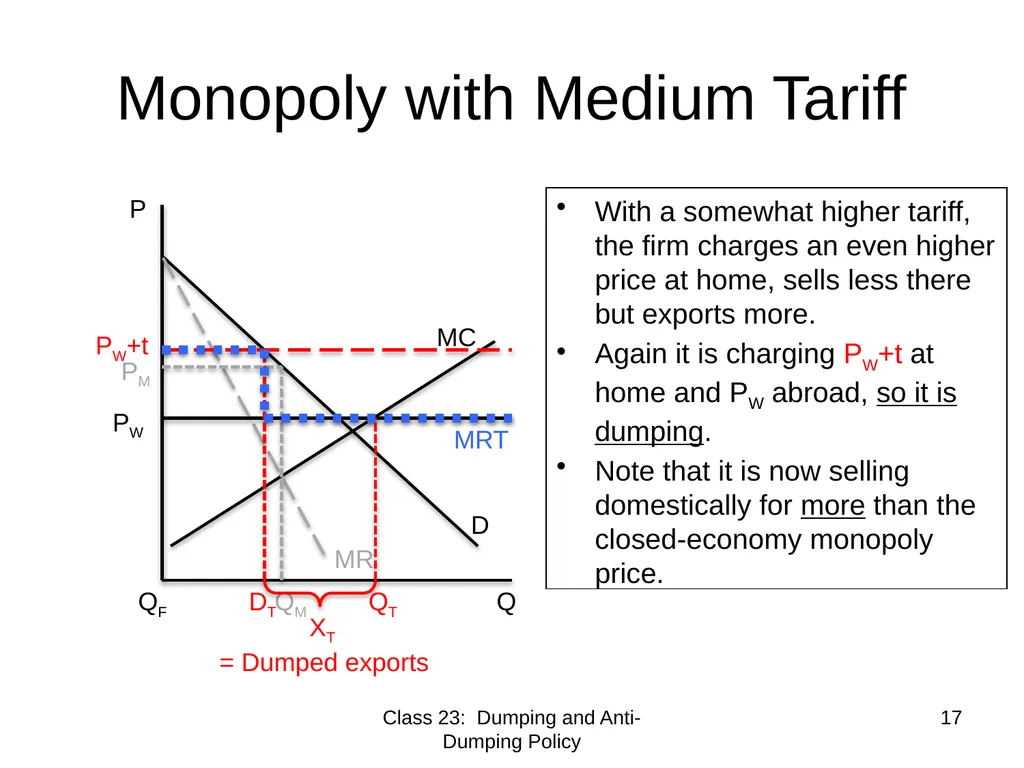
Monopoly with Medium Tariff 17 P Q MC MR QM PM With a somewhat higher tariff, the firm charges an even higher price at home, sells less there but exports more.
Again it is charging PW+t at home and PW abroad, so it is dumping.
Note that it is now selling domestically for more than the closed-economy monopoly price. PW QF PW+t QT DT D MRT XT
= Dumped exports Class 23: Dumping and Anti-Dumping Policy<br>
Again it is charging PW+t at home and PW abroad, so it is dumping.
Note that it is now selling domestically for more than the closed-economy monopoly price. PW QF PW+t QT DT D MRT XT
= Dumped exports Class 23: Dumping and Anti-Dumping Policy<br>
18
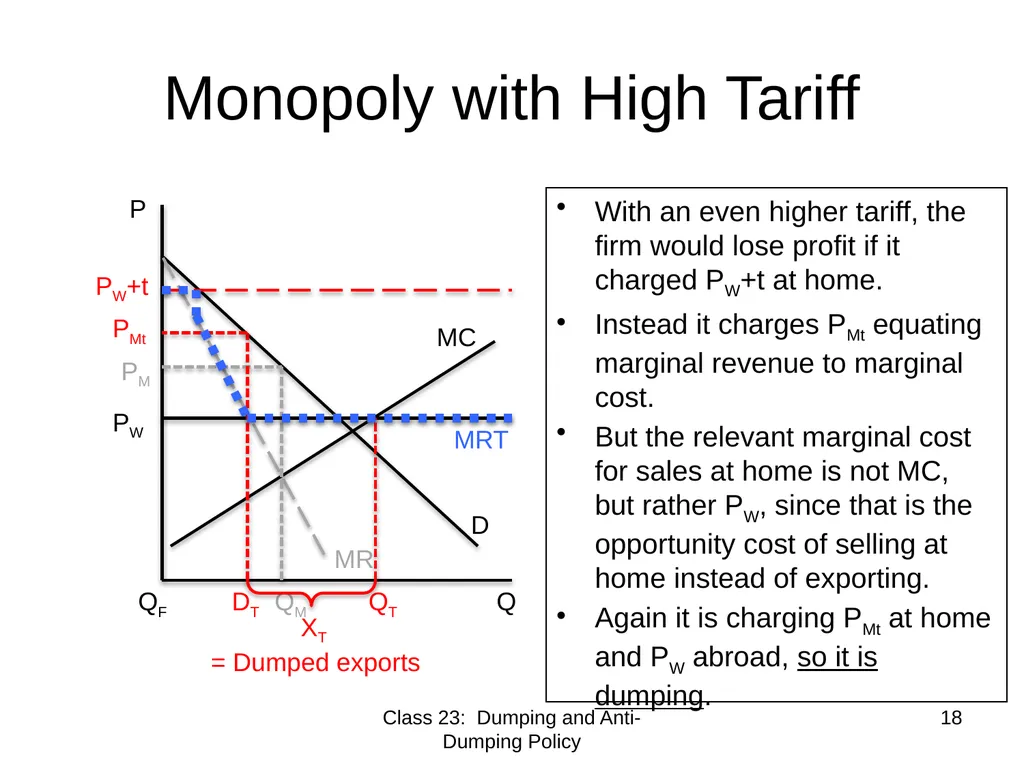
Monopoly with High Tariff 18 P Q MC MR QM PM With an even higher tariff, the firm would lose profit if it charged PW+t at home.
Instead it charges PMt equating marginal revenue to marginal cost.
But the relevant marginal cost for sales at home is not MC, but rather PW, since that is the opportunity cost of selling at home instead of exporting.
Again it is charging PMt at home and PW abroad, so it is dumping. PW QF PW+t QT DT D PMt MRT XT
= Dumped exports Class 23: Dumping and Anti-Dumping Policy<br>
Instead it charges PMt equating marginal revenue to marginal cost.
But the relevant marginal cost for sales at home is not MC, but rather PW, since that is the opportunity cost of selling at home instead of exporting.
Again it is charging PMt at home and PW abroad, so it is dumping. PW QF PW+t QT DT D PMt MRT XT
= Dumped exports Class 23: Dumping and Anti-Dumping Policy<br>
19
Pause for Discussion Class 23: Dumping and Anti-Dumping Policy 19<br>
20
Questions (not asked before) Why will a tariff not cause dumping (by price definition) if markets are perfectly competitive?
If dumping is due to a protected home market, to what extent is it harmful to the
Importing country?
Exporting country? Class 23: Dumping and Anti-Dumping Policy 20<br>
If dumping is due to a protected home market, to what extent is it harmful to the
Importing country?
Exporting country? Class 23: Dumping and Anti-Dumping Policy 20<br>
21
Outline Why firms dump
Predation? No
Protected home market
Interface problem
Other reasons
Procedures and data
Effects of ADD 21 Class 23: Dumping and Anti-Dumping Policy<br>
Predation? No
Protected home market
Interface problem
Other reasons
Procedures and data
Effects of ADD 21 Class 23: Dumping and Anti-Dumping Policy<br>
22
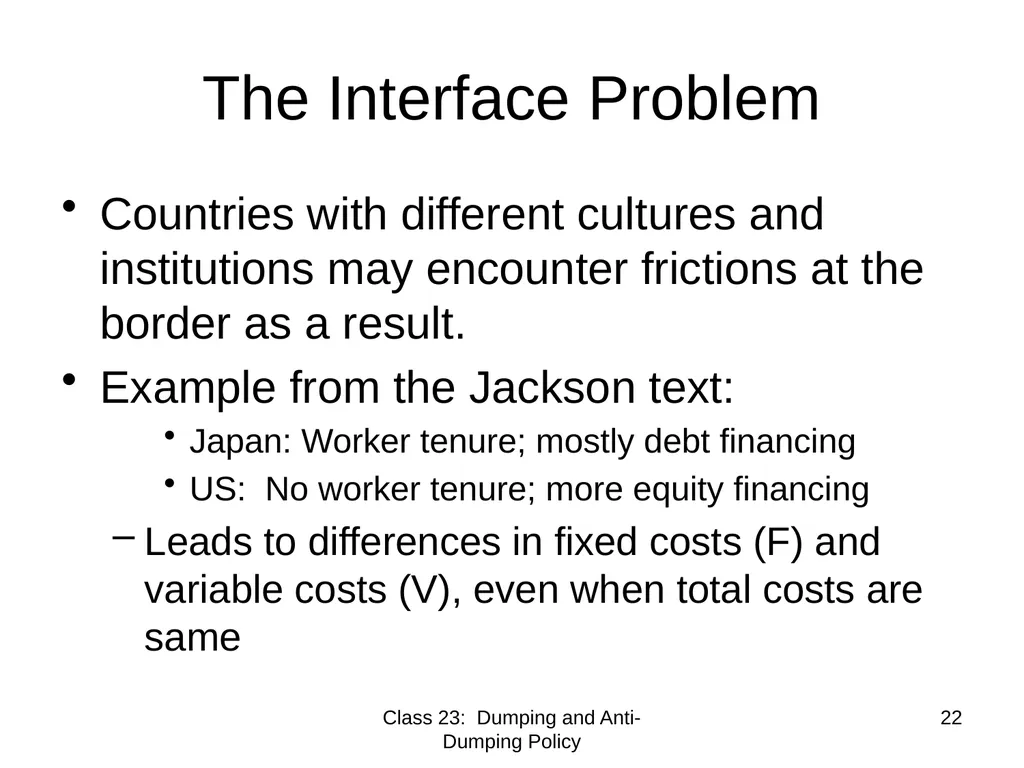
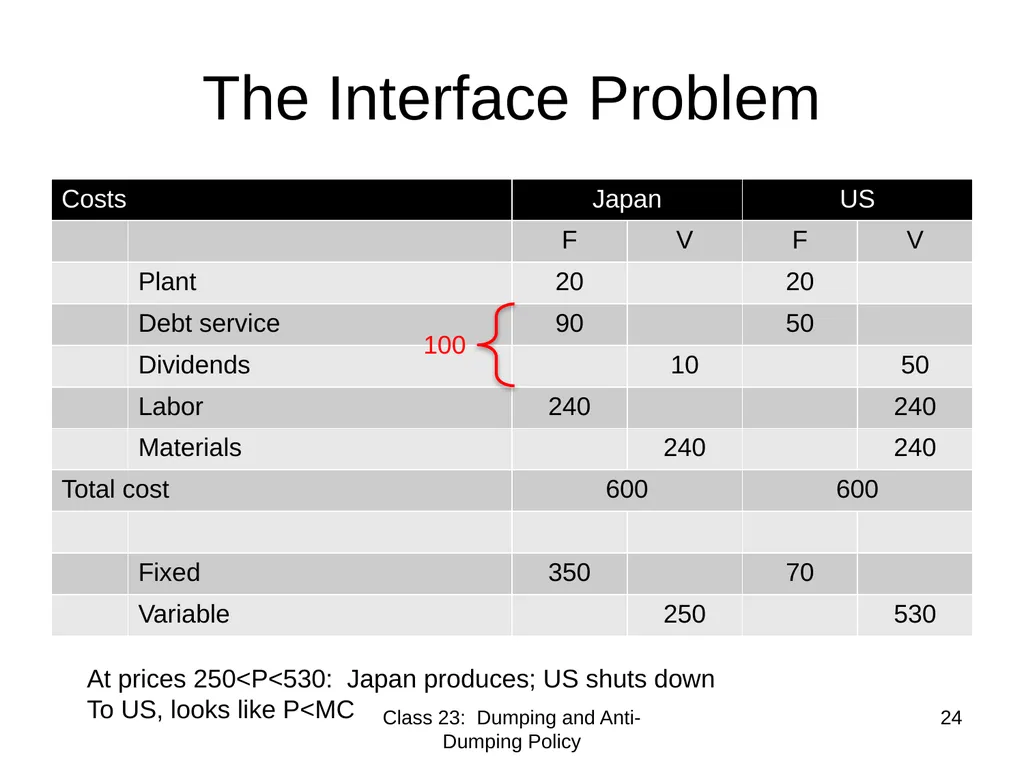
The Interface Problem Countries with different cultures and institutions may encounter frictions at the border as a result.
Example from the Jackson text:
Japan: Worker tenure; mostly debt financing
US: No worker tenure; more equity financing
Leads to differences in fixed costs (F) and variable costs (V), even when total costs are same Class 23: Dumping and Anti-Dumping Policy 22<br>
Example from the Jackson text:
Japan: Worker tenure; mostly debt financing
US: No worker tenure; more equity financing
Leads to differences in fixed costs (F) and variable costs (V), even when total costs are same Class 23: Dumping and Anti-Dumping Policy 22<br>
23
100 The Interface Problem Class 23: Dumping and Anti-Dumping Policy 23<br>
24
The Interface Problem Class 23: Dumping and Anti-Dumping Policy 24 At prices 250<P<530: Japan produces; US shuts down
To US, looks like P<MC 100<br>
To US, looks like P<MC 100<br>
25
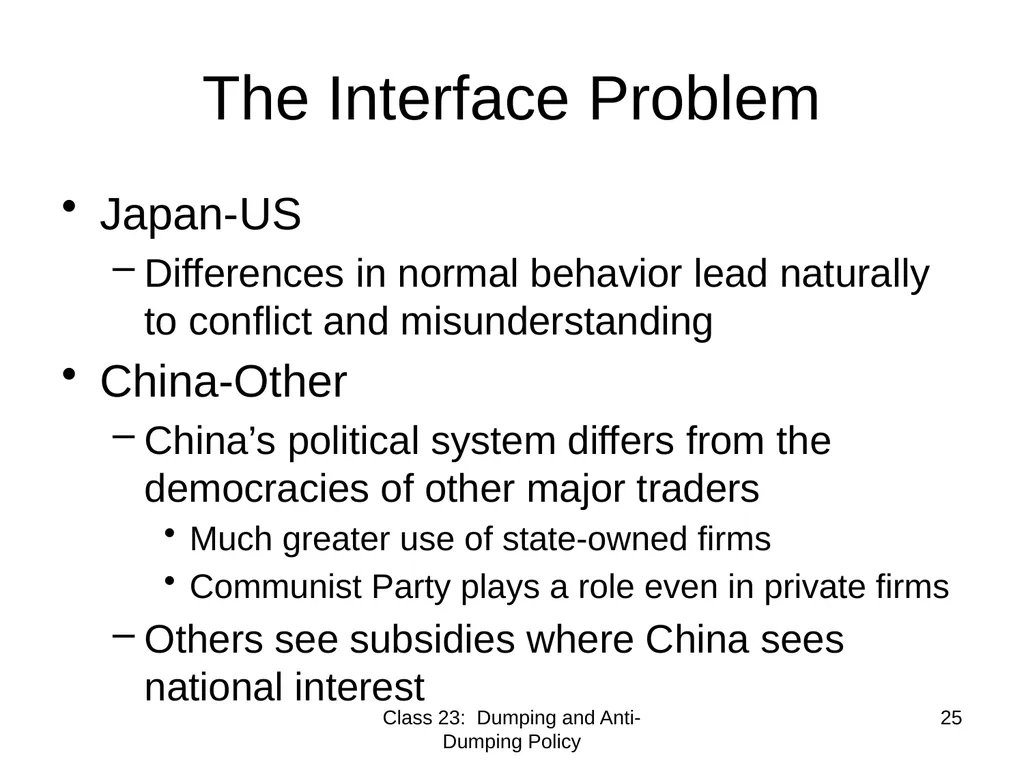
The Interface Problem Japan-US
Differences in normal behavior lead naturally to conflict and misunderstanding
China-Other
China’s political system differs from the democracies of other major traders
Much greater use of state-owned firms
Communist Party plays a role even in private firms
Others see subsidies where China sees national interest Class 23: Dumping and Anti-Dumping Policy 25<br>
Differences in normal behavior lead naturally to conflict and misunderstanding
China-Other
China’s political system differs from the democracies of other major traders
Much greater use of state-owned firms
Communist Party plays a role even in private firms
Others see subsidies where China sees national interest Class 23: Dumping and Anti-Dumping Policy 25<br>
26
Outline Why firms dump
Predation? No
Protected home market
Interface problem
Other reasons
Procedures and data
Effects of ADD 26 Class 23: Dumping and Anti-Dumping Policy<br>
Predation? No
Protected home market
Interface problem
Other reasons
Procedures and data
Effects of ADD 26 Class 23: Dumping and Anti-Dumping Policy<br>
27
Other Reasons for Dumping Below-average-cost dumping
Temporary weak demand (recession)
World excess supply
Below-marginal-cost dumping
Producer learning
Consumer learning
Other thoughts? 27 Class 23: Dumping and Anti-Dumping Policy<br>
Temporary weak demand (recession)
World excess supply
Below-marginal-cost dumping
Producer learning
Consumer learning
Other thoughts? 27 Class 23: Dumping and Anti-Dumping Policy<br>
28
Pause for Discussion Class 23: Dumping and Anti-Dumping Policy 28<br>
29
Questions on Deardorff, (“Economic Perspectives…”) Why might an exporter dump, based on the below-cost definition? Who is harmed in these cases (answer may depend on which of several reasons apply)?
How common is “predatory dumping”, and why? Class 23: Dumping and Anti-Dumping Policy 29<br>
How common is “predatory dumping”, and why? Class 23: Dumping and Anti-Dumping Policy 29<br>
30
Outline Why firms dump
Predation? No
Protected home market
Interface problem
Other reasons
Procedures and data
Effects of ADD 30 Class 23: Dumping and Anti-Dumping Policy<br>
Predation? No
Protected home market
Interface problem
Other reasons
Procedures and data
Effects of ADD 30 Class 23: Dumping and Anti-Dumping Policy<br>
31
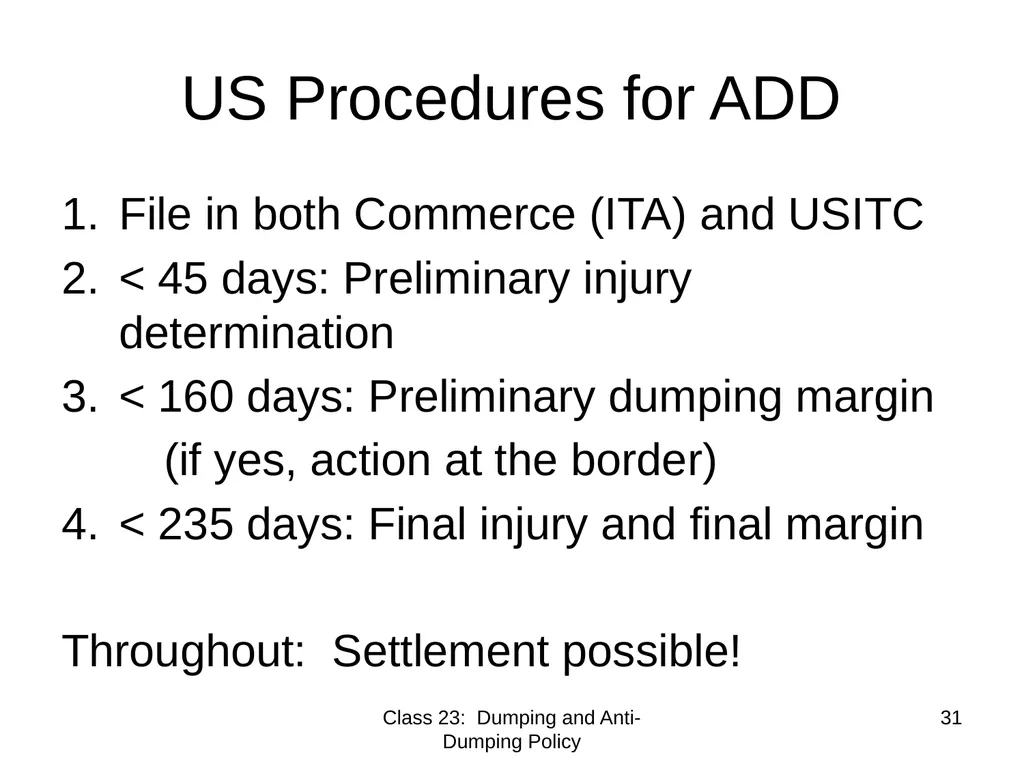
US Procedures for ADD File in both Commerce (ITA) and USITC
< 45 days: Preliminary injury determination
< 160 days: Preliminary dumping margin
(if yes, action at the border)
< 235 days: Final injury and final margin
Throughout: Settlement possible! Class 23: Dumping and Anti-Dumping Policy 31<br>
< 45 days: Preliminary injury determination
< 160 days: Preliminary dumping margin
(if yes, action at the border)
< 235 days: Final injury and final margin
Throughout: Settlement possible! Class 23: Dumping and Anti-Dumping Policy 31<br>
32
Class 23: Dumping and Anti-Dumping Policy 32<br>
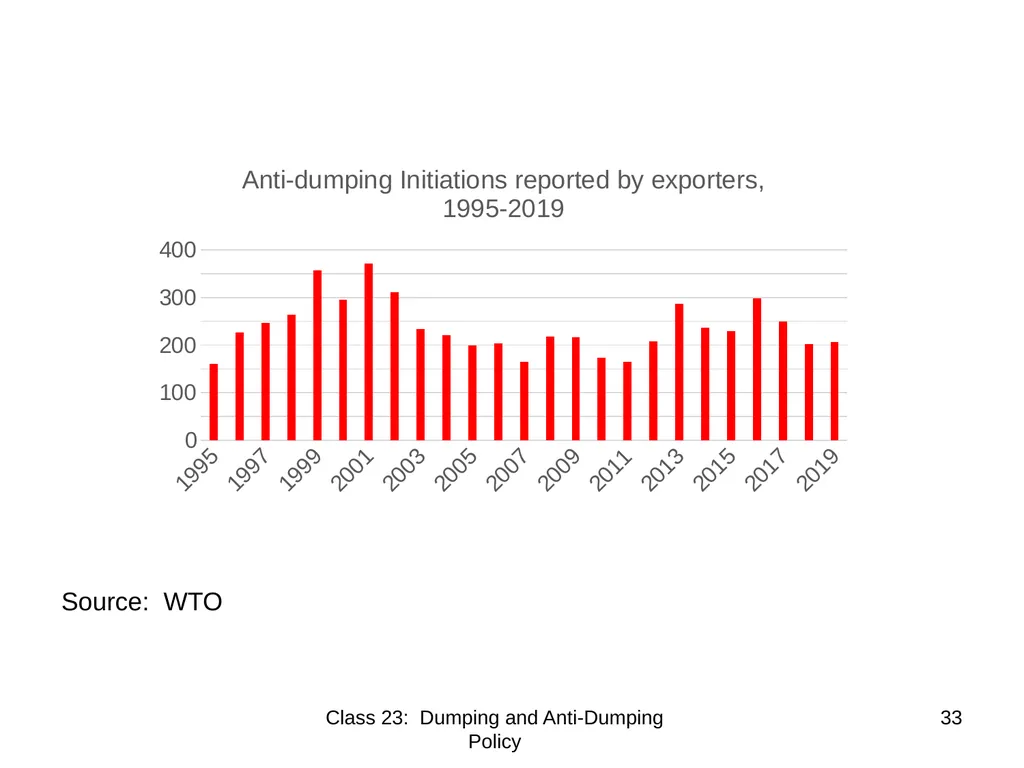
33
Class 23: Dumping and Anti-Dumping Policy 33 Source: WTO<br>
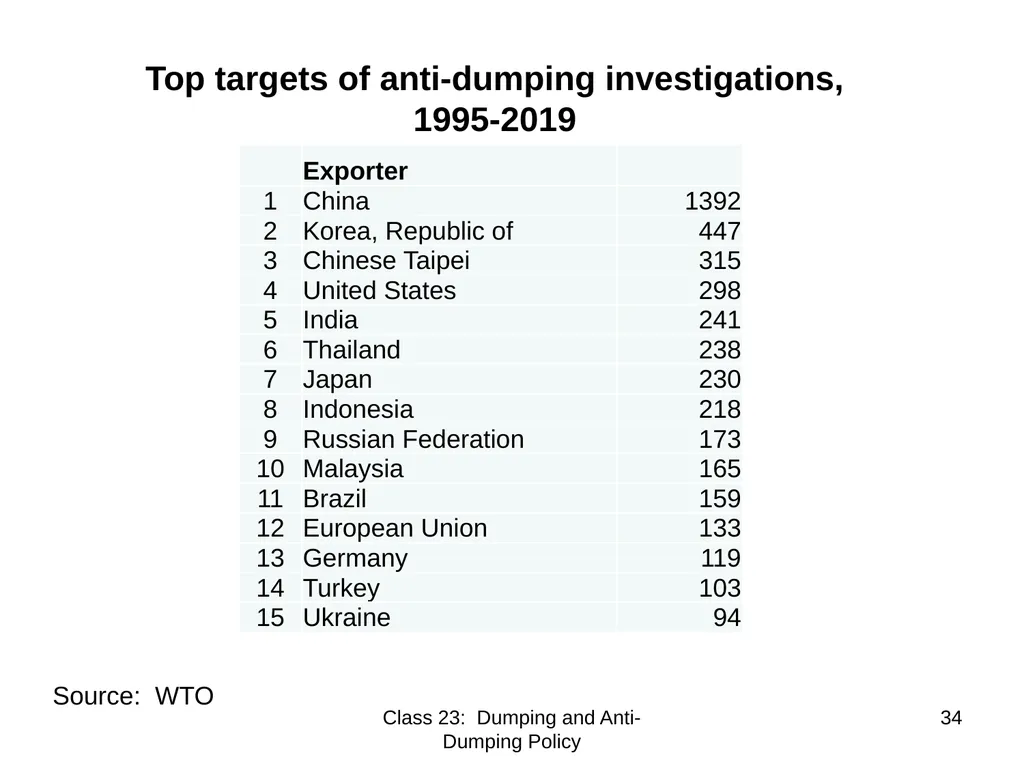
34
Class 23: Dumping and Anti-Dumping Policy 34 Top targets of anti-dumping investigations, 1995-2019 Source: WTO<br>
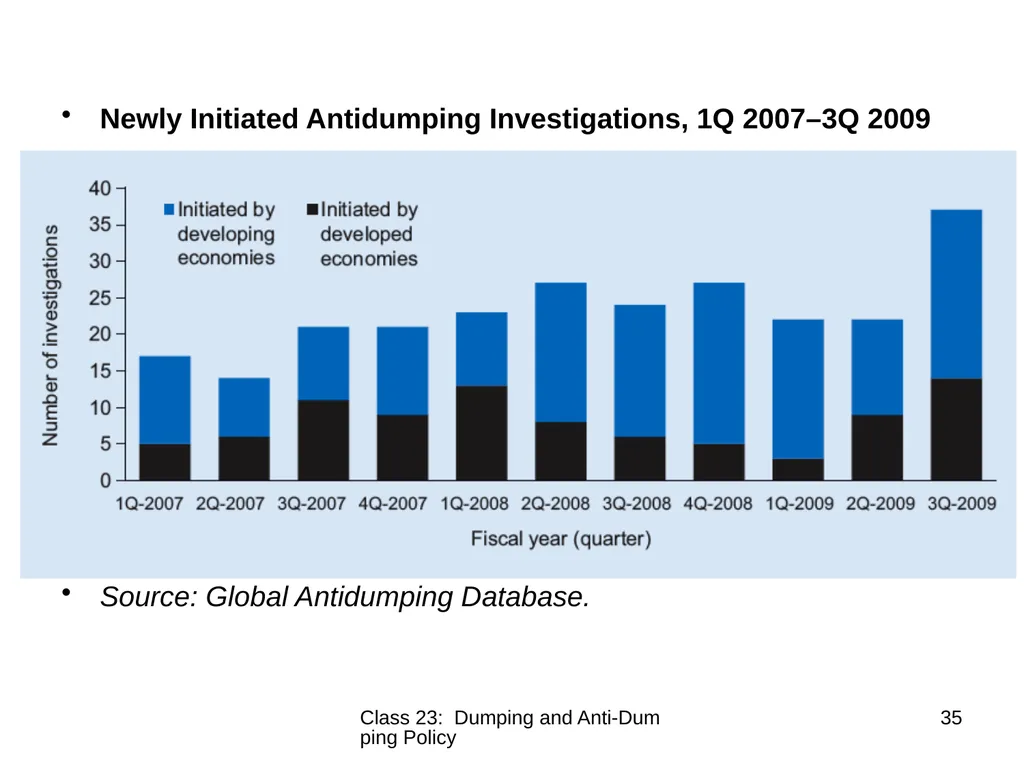
35
Class 23: Dumping and Anti-Dumping Policy 35 Newly Initiated Antidumping Investigations, 1Q 2007–3Q 2009
Source: Global Antidumping Database.<br>
Source: Global Antidumping Database.<br>
36
Anti-Dumping Issues Cumulation
Margins analysis Class 23: Dumping and Anti-Dumping Policy 36<br>
Margins analysis Class 23: Dumping and Anti-Dumping Policy 36<br>
37
Pause for Discussion Class 23: Dumping and Anti-Dumping Policy 37<br>
38
Questions on Jackson Does “cumulation” make it more or less likely that a country whose exports are dumped will face an anti-dumping duty?
Does “margins analysis” make it more or less likely that a country whose exports are dumped will face an anti-dumping duty? Class 23: Dumping and Anti-Dumping Policy 38<br>
Does “margins analysis” make it more or less likely that a country whose exports are dumped will face an anti-dumping duty? Class 23: Dumping and Anti-Dumping Policy 38<br>
39
Anti-Dumping Issues Cumulation
Margins analysis
Lesser-Duty Rule Class 23: Dumping and Anti-Dumping Policy 39<br>
Margins analysis
Lesser-Duty Rule Class 23: Dumping and Anti-Dumping Policy 39<br>
40
Pause for Discussion Class 23: Dumping and Anti-Dumping Policy 40<br>
41
Questions on Jackson What is the level of the injury test in dumping cases?
If dumping and injury are both found, what determines the size of the anti-dumping duty? Must it then be applied? Are the rules any different in the EU than in the US? Class 23: Dumping and Anti-Dumping Policy 41<br>
If dumping and injury are both found, what determines the size of the anti-dumping duty? Must it then be applied? Are the rules any different in the EU than in the US? Class 23: Dumping and Anti-Dumping Policy 41<br>
42
Questions on Jackson (cont.) What is the “lesser-duty rule”? In what countries is it applied, and in what countries is it not applied?
Suppose an anti-dumping duty will cause harm to some in an economy that is greater than the benefit to the protected industry.
Can authorities therefore choose not levy the duty?
For those who can decline to levy the duty, what must be true in order for them to do so? Class 23: Dumping and Anti-Dumping Policy 42<br>
Suppose an anti-dumping duty will cause harm to some in an economy that is greater than the benefit to the protected industry.
Can authorities therefore choose not levy the duty?
For those who can decline to levy the duty, what must be true in order for them to do so? Class 23: Dumping and Anti-Dumping Policy 42<br>
43
Questions on EC, DG-Trade Who decides on anti-dumping in the EU?
Do the criteria for anti-dumping measures differ from those of the US?
What forms do EU anti-dumping measures take, and for how long?
What is the size of an anti-dumping duty in the EU? Class 23: Dumping and Anti-Dumping Policy 43<br>
Do the criteria for anti-dumping measures differ from those of the US?
What forms do EU anti-dumping measures take, and for how long?
What is the size of an anti-dumping duty in the EU? Class 23: Dumping and Anti-Dumping Policy 43<br>
44
Questions on Jakob,
“Lesser Duty Rule…” What does Jakob view as “fair competition”?
What is the “lesser-duty rule”?
In what countries is it applied, and in what countries is it not applied?
In those that apply it, how often has the smaller injury margin been used?
In what countries can an anti-dumping duty be denied based on other interests of the country?
What is the “proportionality test” for this? Class 23: Dumping and Anti-Dumping Policy 44<br>
What is the “lesser-duty rule”?
In what countries is it applied, and in what countries is it not applied?
In those that apply it, how often has the smaller injury margin been used?
In what countries can an anti-dumping duty be denied based on other interests of the country?
What is the “proportionality test” for this? Class 23: Dumping and Anti-Dumping Policy 44<br>
45
Outline Why firms dump
Predation? No
Protected home market
Interface problem
Other reasons
Procedures and data
Effects of ADD
We’ll skip the analysis this year and go right to summary of results 45 Class 23: Dumping and Anti-Dumping Policy<br>
Predation? No
Protected home market
Interface problem
Other reasons
Procedures and data
Effects of ADD
We’ll skip the analysis this year and go right to summary of results 45 Class 23: Dumping and Anti-Dumping Policy<br>
46
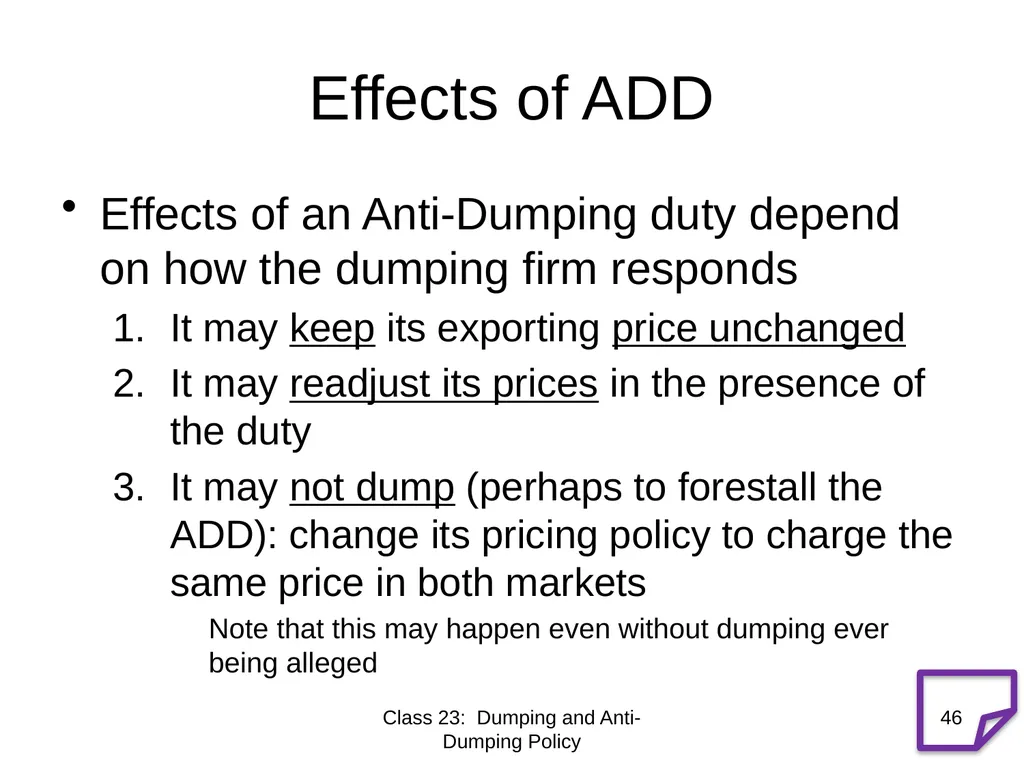
Effects of ADD Effects of an Anti-Dumping duty depend on how the dumping firm responds
It may keep its exporting price unchanged
It may readjust its prices in the presence of the duty
It may not dump (perhaps to forestall the ADD): change its pricing policy to charge the same price in both markets
Note that this may happen even without dumping ever being alleged 46 Class 23: Dumping and Anti-Dumping Policy<br>
It may keep its exporting price unchanged
It may readjust its prices in the presence of the duty
It may not dump (perhaps to forestall the ADD): change its pricing policy to charge the same price in both markets
Note that this may happen even without dumping ever being alleged 46 Class 23: Dumping and Anti-Dumping Policy<br>
47
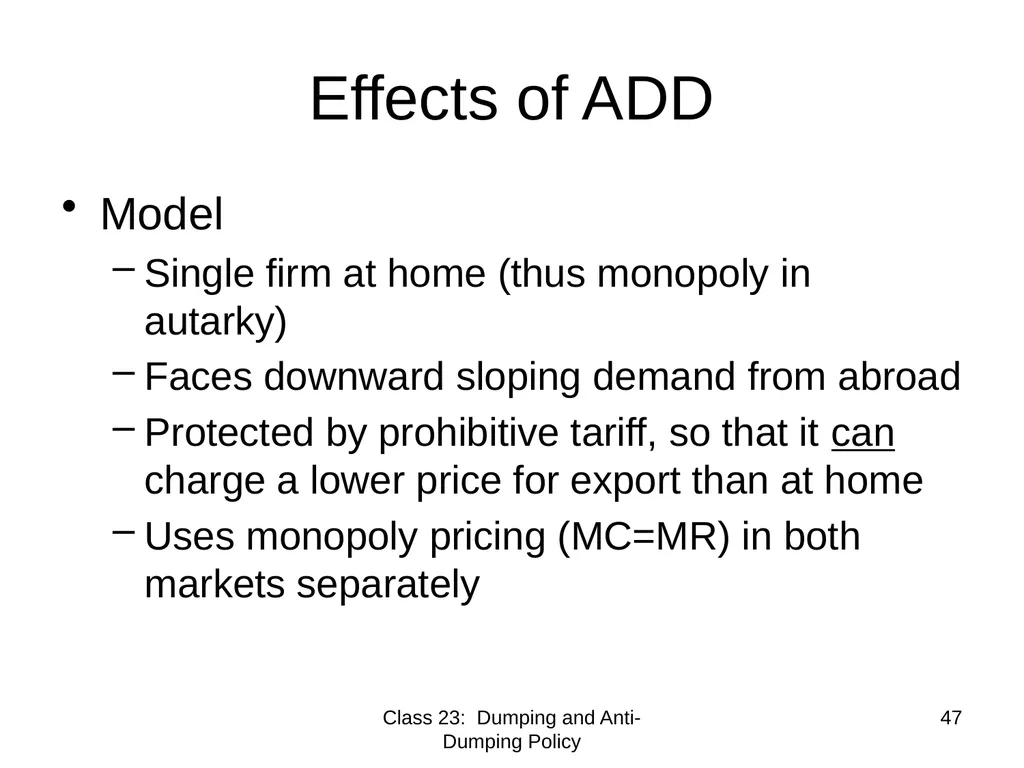
Effects of ADD Model
Single firm at home (thus monopoly in autarky)
Faces downward sloping demand from abroad
Protected by prohibitive tariff, so that it can charge a lower price for export than at home
Uses monopoly pricing (MC=MR) in both markets separately Class 23: Dumping and Anti-Dumping Policy 47<br>
Single firm at home (thus monopoly in autarky)
Faces downward sloping demand from abroad
Protected by prohibitive tariff, so that it can charge a lower price for export than at home
Uses monopoly pricing (MC=MR) in both markets separately Class 23: Dumping and Anti-Dumping Policy 47<br>
48
Class 23: Dumping and Anti-Dumping Policy Dumping Equilibrium 48 Q Cty A
Dom Mkt Q Q P P P Cty B
Dom Mkt Cty B
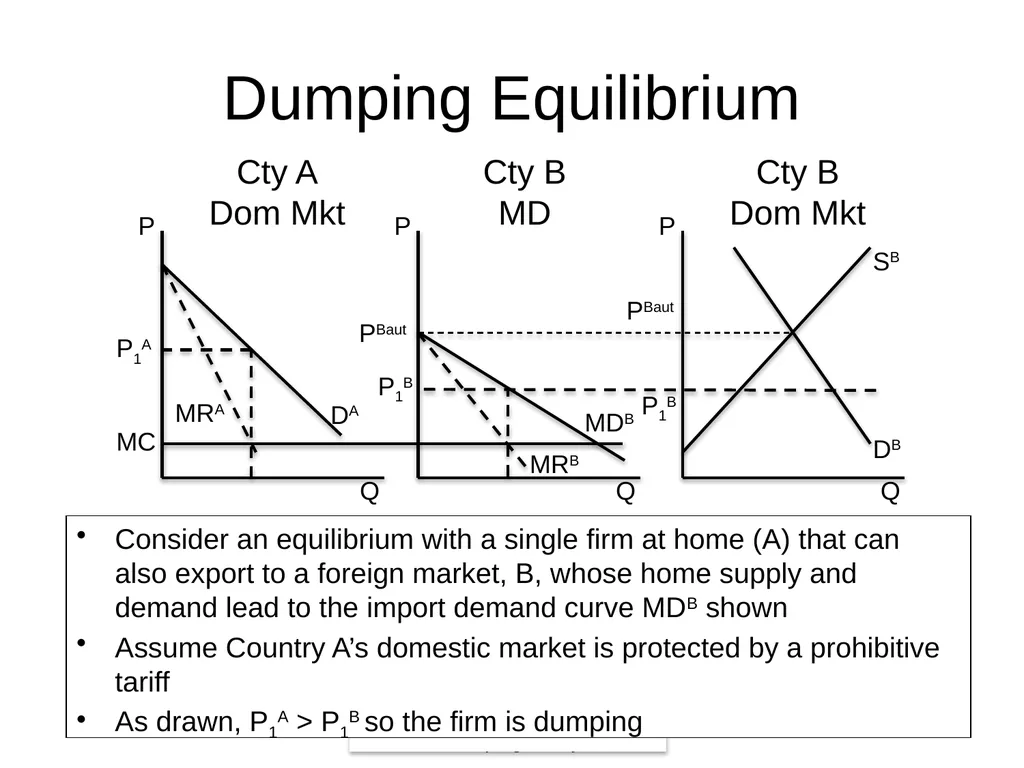
MD SB DB MDB MRB PBaut PBaut DA MRA MC P1B P1B P1A Consider an equilibrium with a single firm at home (A) that can also export to a foreign market, B, whose home supply and demand lead to the import demand curve MDB shown
Assume Country A’s domestic market is protected by a prohibitive tariff
As drawn, P1A > P1B so the firm is dumping<br>
Dom Mkt Q Q P P P Cty B
Dom Mkt Cty B
MD SB DB MDB MRB PBaut PBaut DA MRA MC P1B P1B P1A Consider an equilibrium with a single firm at home (A) that can also export to a foreign market, B, whose home supply and demand lead to the import demand curve MDB shown
Assume Country A’s domestic market is protected by a prohibitive tariff
As drawn, P1A > P1B so the firm is dumping<br>
49
1. ADD Effects with unchanged export price 49 Q Cty A
Dom Mkt Q Q P P P Cty B
Dom Mkt Cty B
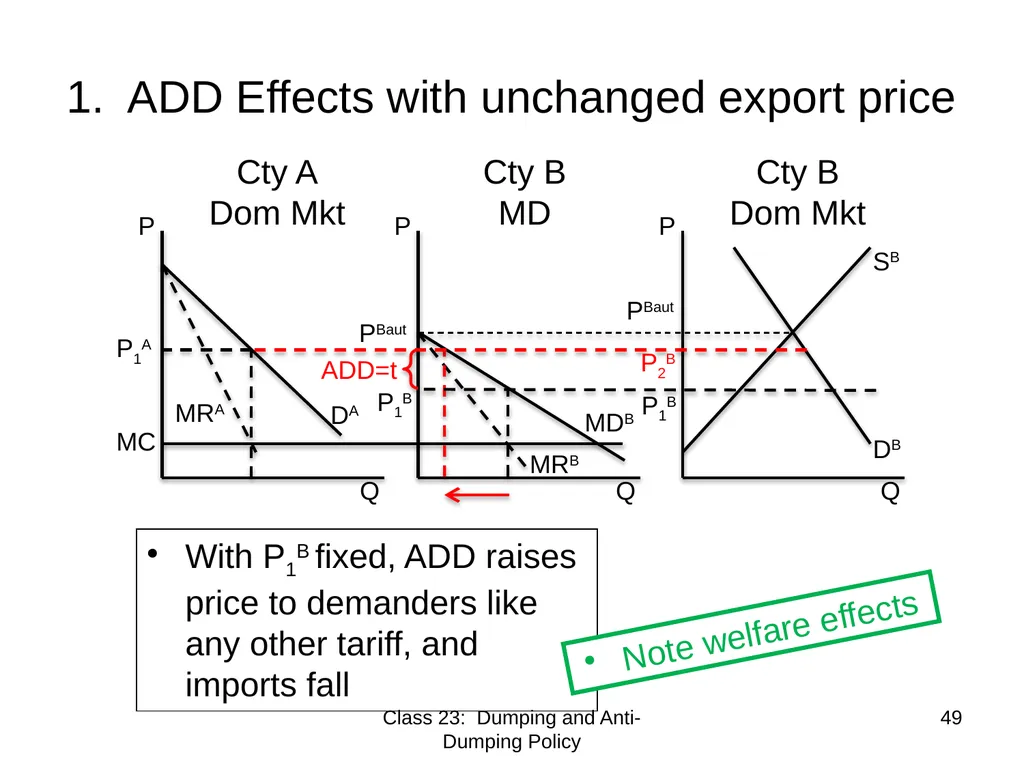
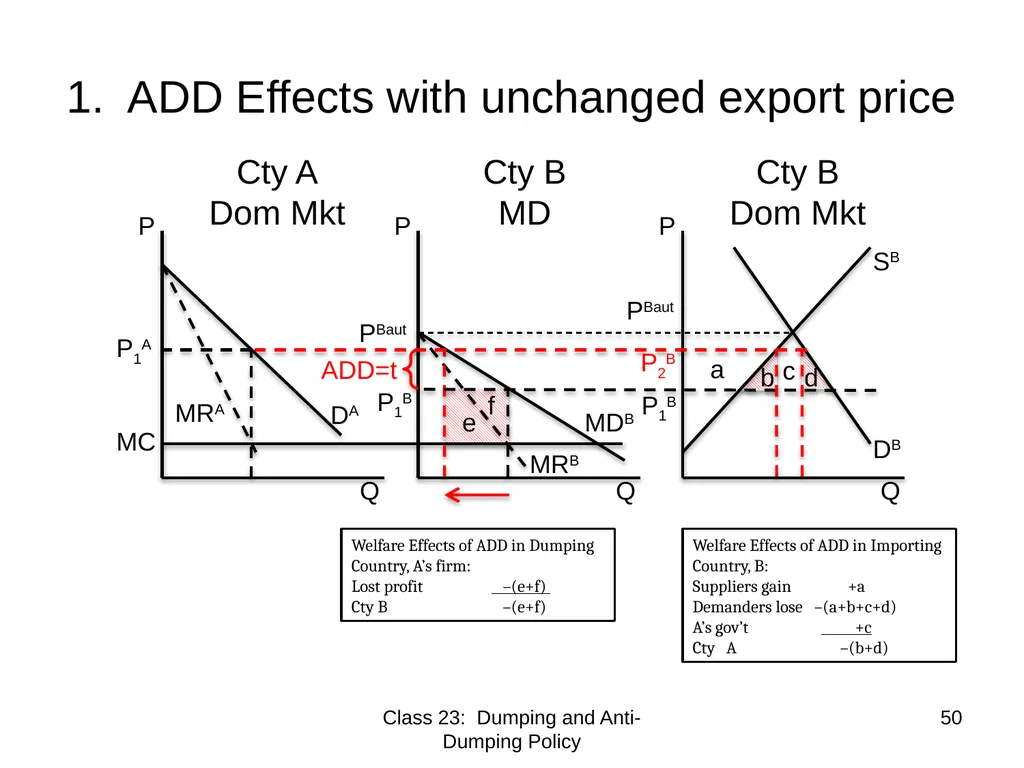
MD SB DB MDB MRB PBaut PBaut DA MRA MC P1B P1B P1A ADD=t With P1B fixed, ADD raises price to demanders like any other tariff, and imports fall P2B Note welfare effects Class 23: Dumping and Anti-Dumping Policy<br>
Dom Mkt Q Q P P P Cty B
Dom Mkt Cty B
MD SB DB MDB MRB PBaut PBaut DA MRA MC P1B P1B P1A ADD=t With P1B fixed, ADD raises price to demanders like any other tariff, and imports fall P2B Note welfare effects Class 23: Dumping and Anti-Dumping Policy<br>
50
1. ADD Effects with unchanged export price 50 Q Cty A
Dom Mkt Q Q P P P Cty B
Dom Mkt Cty B
MD SB DB MDB MRB PBaut PBaut DA MRA MC P1B P1B P1A ADD=t P2B Welfare Effects of ADD in Importing Country, B:
Suppliers gain +a
Demanders lose –(a+b+c+d)
A’s gov’t +c
Cty A –(b+d) a b c d Welfare Effects of ADD in Dumping Country, A’s firm:
Lost profit –(e+f)
Cty B –(e+f) e f Class 23: Dumping and Anti-Dumping Policy<br>
Dom Mkt Q Q P P P Cty B
Dom Mkt Cty B
MD SB DB MDB MRB PBaut PBaut DA MRA MC P1B P1B P1A ADD=t P2B Welfare Effects of ADD in Importing Country, B:
Suppliers gain +a
Demanders lose –(a+b+c+d)
A’s gov’t +c
Cty A –(b+d) a b c d Welfare Effects of ADD in Dumping Country, A’s firm:
Lost profit –(e+f)
Cty B –(e+f) e f Class 23: Dumping and Anti-Dumping Policy<br>
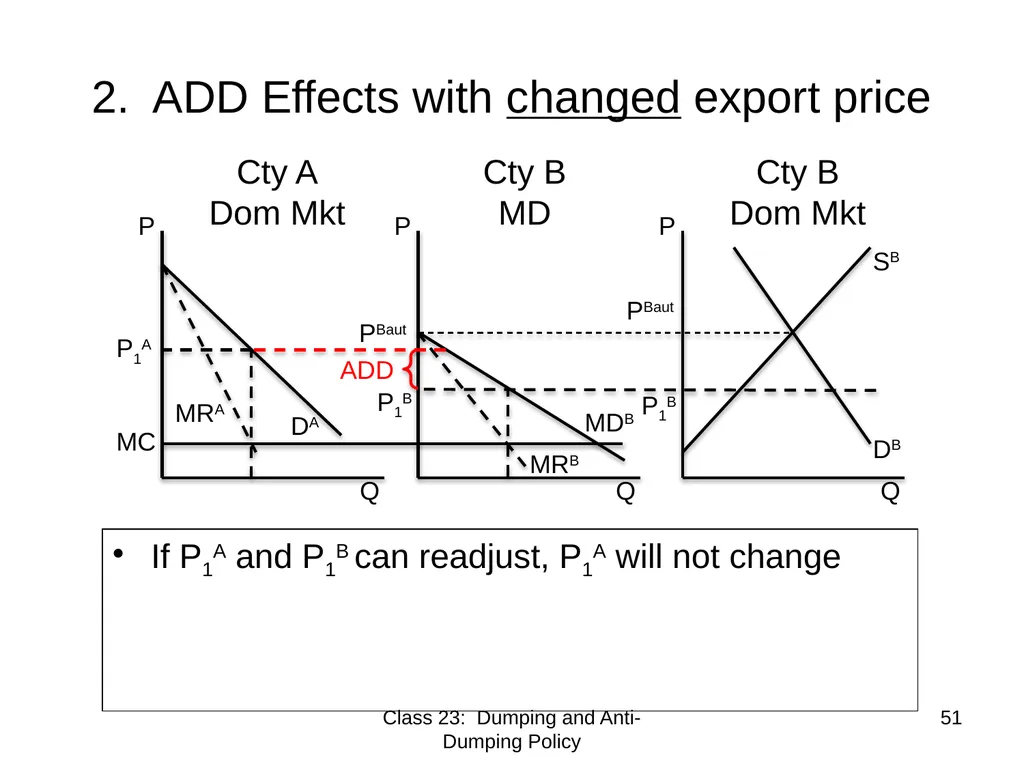
51
2. ADD Effects with changed export price 51 Q Cty A
Dom Mkt Q Q P P P Cty B
Dom Mkt Cty B
MD SB DB MDB MRB PBaut PBaut DA MRA MC P1B P1B P1A If P1A and P1B can readjust, P1A will not change Class 23: Dumping and Anti-Dumping Policy<br>
Dom Mkt Q Q P P P Cty B
Dom Mkt Cty B
MD SB DB MDB MRB PBaut PBaut DA MRA MC P1B P1B P1A If P1A and P1B can readjust, P1A will not change Class 23: Dumping and Anti-Dumping Policy<br>
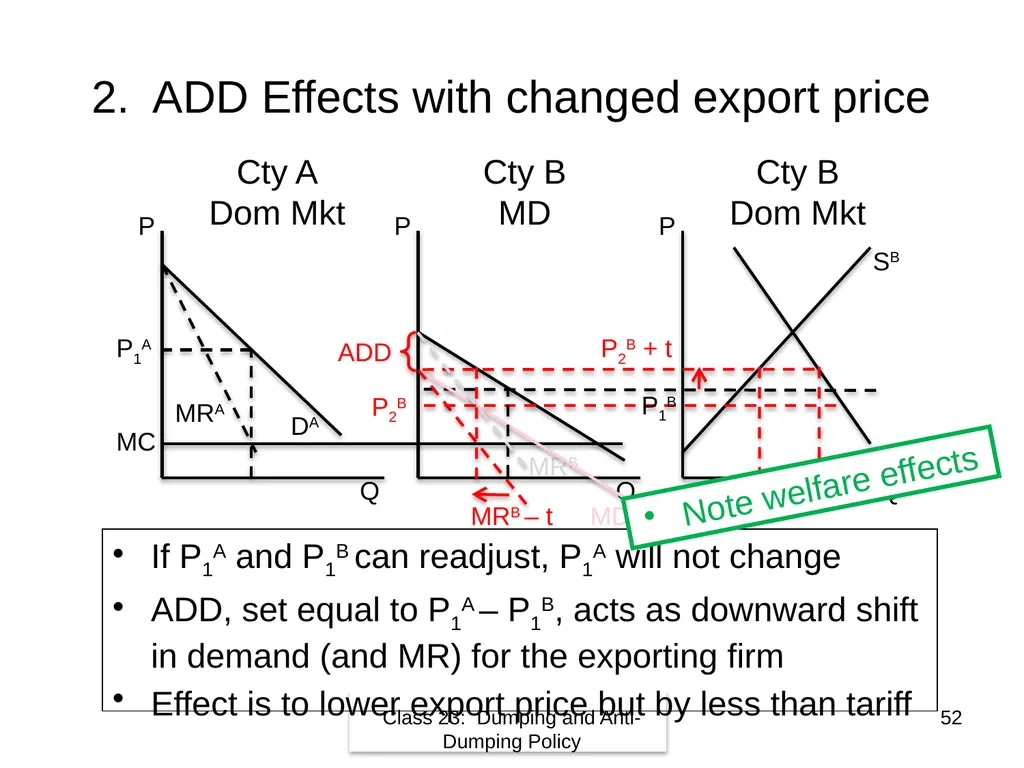
52
2. ADD Effects with changed export price 52 Q Cty A
Dom Mkt Q Q P P P Cty B
Dom Mkt Cty B
MD SB MRB DA MRA MC P1A MRB – t MDB – t If P1A and P1B can readjust, P1A will not change
ADD, set equal to P1A – P1B, acts as downward shift in demand (and MR) for the exporting firm
Effect is to lower export price but by less than tariff P1B P2B Note welfare effects P2B + t Class 23: Dumping and Anti-Dumping Policy<br>
Dom Mkt Q Q P P P Cty B
Dom Mkt Cty B
MD SB MRB DA MRA MC P1A MRB – t MDB – t If P1A and P1B can readjust, P1A will not change
ADD, set equal to P1A – P1B, acts as downward shift in demand (and MR) for the exporting firm
Effect is to lower export price but by less than tariff P1B P2B Note welfare effects P2B + t Class 23: Dumping and Anti-Dumping Policy<br>
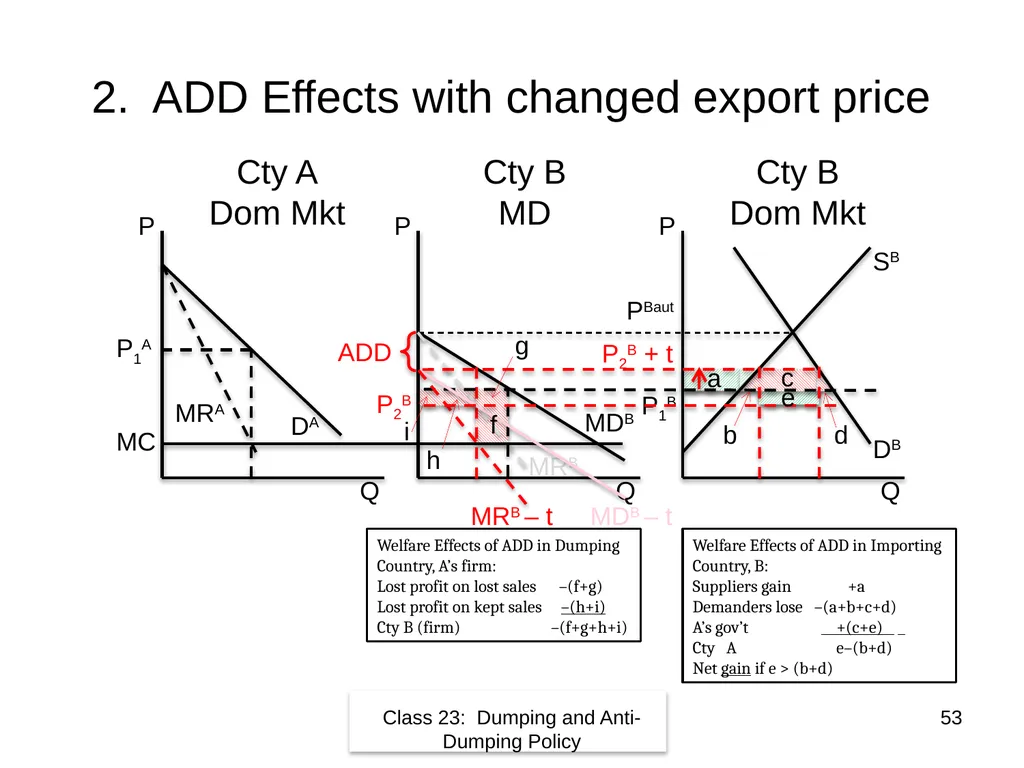
53
2. ADD Effects with changed export price 53 Q Cty A
Dom Mkt Q Q P P P Cty B
Dom Mkt Cty B
MD SB DB MDB MRB PBaut DA MRA MC P1B P1A MRB – t MDB – t Welfare Effects of ADD in Importing Country, B:
Suppliers gain +a
Demanders lose –(a+b+c+d)
A’s gov’t +(c+e)
Cty A e–(b+d)
Net gain if e > (b+d) a c d b e Welfare Effects of ADD in Dumping Country, A’s firm:
Lost profit on lost sales –(f+g)
Lost profit on kept sales –(h+i)
Cty B (firm) –(f+g+h+i) f g h i P2B + t P2B Class 23: Dumping and Anti-Dumping Policy<br>
Dom Mkt Q Q P P P Cty B
Dom Mkt Cty B
MD SB DB MDB MRB PBaut DA MRA MC P1B P1A MRB – t MDB – t Welfare Effects of ADD in Importing Country, B:
Suppliers gain +a
Demanders lose –(a+b+c+d)
A’s gov’t +(c+e)
Cty A e–(b+d)
Net gain if e > (b+d) a c d b e Welfare Effects of ADD in Dumping Country, A’s firm:
Lost profit on lost sales –(f+g)
Lost profit on kept sales –(h+i)
Cty B (firm) –(f+g+h+i) f g h i P2B + t P2B Class 23: Dumping and Anti-Dumping Policy<br>
54
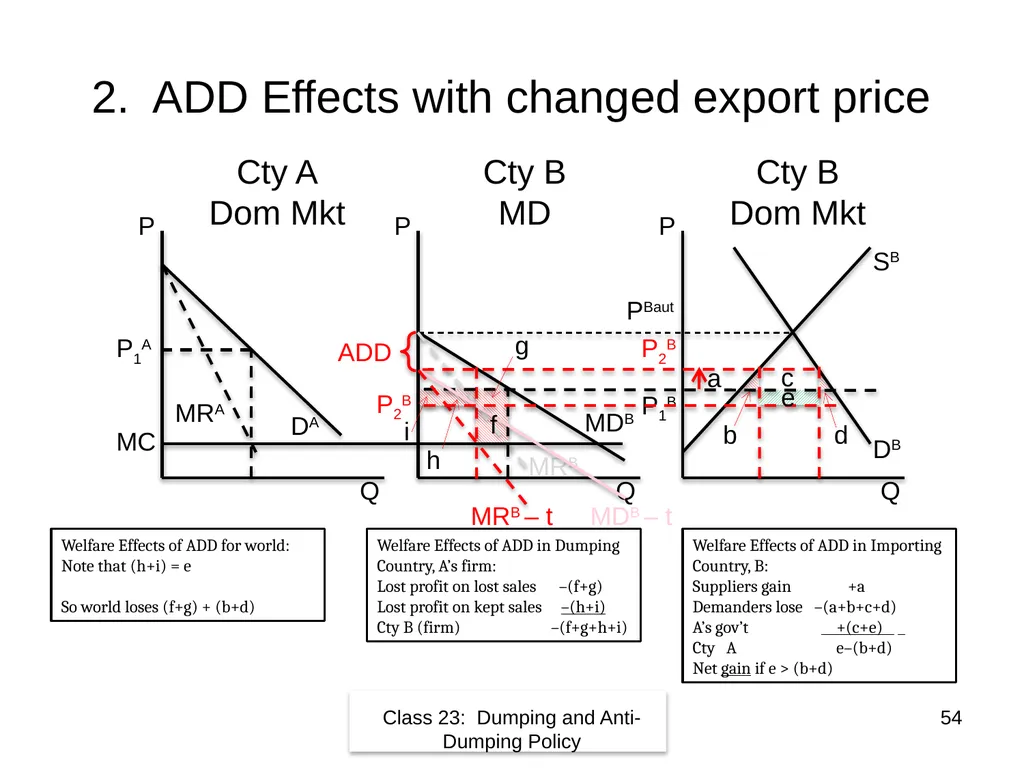
2. ADD Effects with changed export price 54 Q Cty A
Dom Mkt Q Q P P P Cty B
Dom Mkt Cty B
MD SB DB MDB MRB PBaut DA MRA MC P1B P1A P2B MRB – t MDB – t Welfare Effects of ADD in Importing Country, B:
Suppliers gain +a
Demanders lose –(a+b+c+d)
A’s gov’t +(c+e)
Cty A e–(b+d)
Net gain if e > (b+d) a c d b e Welfare Effects of ADD in Dumping Country, A’s firm:
Lost profit on lost sales –(f+g)
Lost profit on kept sales –(h+i)
Cty B (firm) –(f+g+h+i) f g h Welfare Effects of ADD for world:
Note that (h+i) = e
So world loses (f+g) + (b+d) i P2B Class 23: Dumping and Anti-Dumping Policy<br>
Dom Mkt Q Q P P P Cty B
Dom Mkt Cty B
MD SB DB MDB MRB PBaut DA MRA MC P1B P1A P2B MRB – t MDB – t Welfare Effects of ADD in Importing Country, B:
Suppliers gain +a
Demanders lose –(a+b+c+d)
A’s gov’t +(c+e)
Cty A e–(b+d)
Net gain if e > (b+d) a c d b e Welfare Effects of ADD in Dumping Country, A’s firm:
Lost profit on lost sales –(f+g)
Lost profit on kept sales –(h+i)
Cty B (firm) –(f+g+h+i) f g h Welfare Effects of ADD for world:
Note that (h+i) = e
So world loses (f+g) + (b+d) i P2B Class 23: Dumping and Anti-Dumping Policy<br>
55
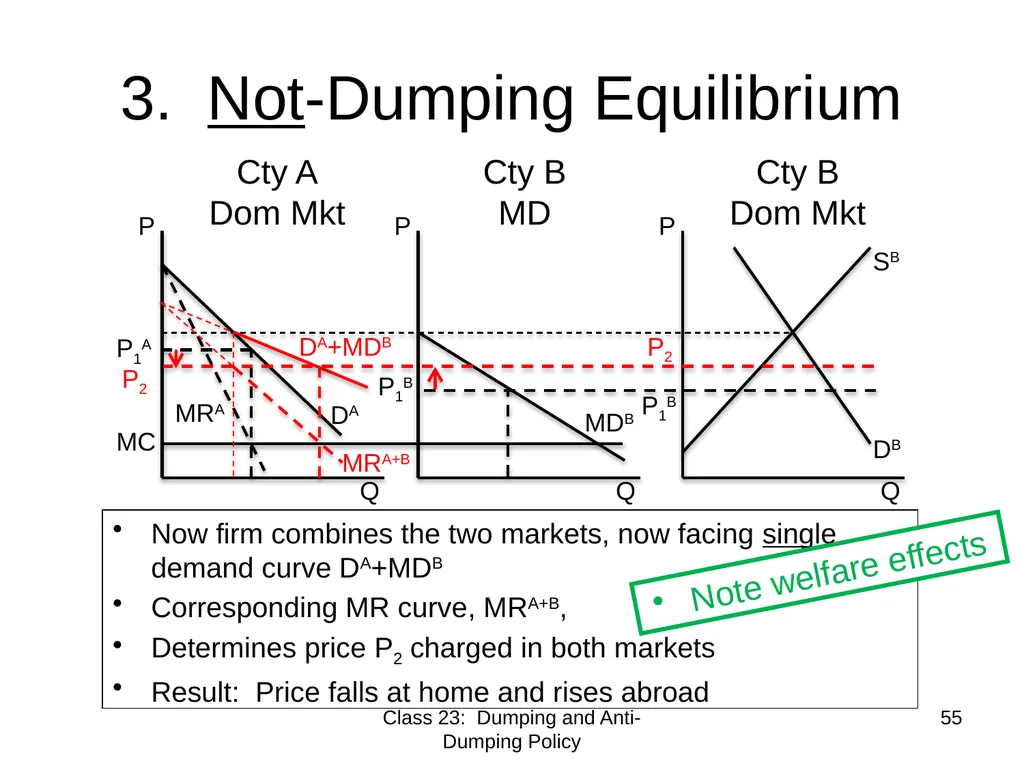
3. Not-Dumping Equilibrium 55 Q Cty A
Dom Mkt Q Q P P P Cty B
Dom Mkt Cty B
MD P1A MC MRA P1B SB MDB DB P1B DA DA+MDB MRA+B P2 P2 Now firm combines the two markets, now facing single demand curve DA+MDB
Corresponding MR curve, MRA+B,
Determines price P2 charged in both markets
Result: Price falls at home and rises abroad Note welfare effects Class 23: Dumping and Anti-Dumping Policy<br>
Dom Mkt Q Q P P P Cty B
Dom Mkt Cty B
MD P1A MC MRA P1B SB MDB DB P1B DA DA+MDB MRA+B P2 P2 Now firm combines the two markets, now facing single demand curve DA+MDB
Corresponding MR curve, MRA+B,
Determines price P2 charged in both markets
Result: Price falls at home and rises abroad Note welfare effects Class 23: Dumping and Anti-Dumping Policy<br>
56
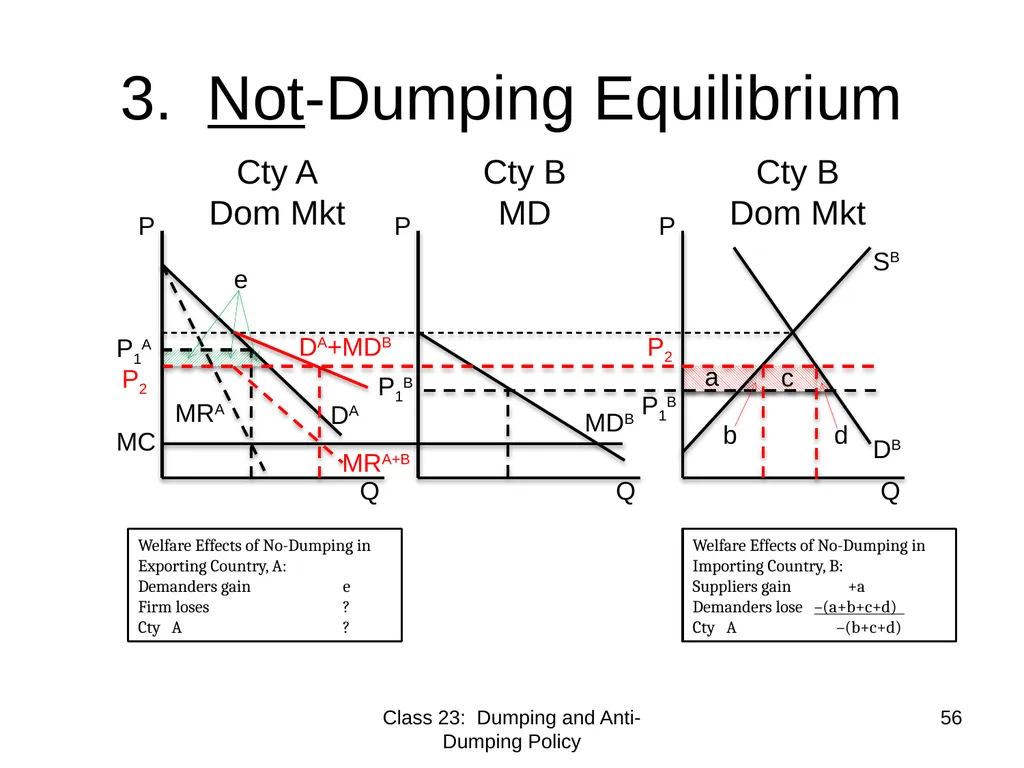
3. Not-Dumping Equilibrium 56 Q Cty A
Dom Mkt Q Q P P P Cty B
Dom Mkt Cty B
MD P1A MC MRA P1B SB MDB DB P1B DA DA+MDB MRA+B P2 P2 Welfare Effects of No-Dumping in Importing Country, B:
Suppliers gain +a
Demanders lose –(a+b+c+d)
Cty A –(b+c+d) a c d b Welfare Effects of No-Dumping in Exporting Country, A:
Demanders gain e
Firm loses ?
Cty A ? e Class 23: Dumping and Anti-Dumping Policy<br>
Dom Mkt Q Q P P P Cty B
Dom Mkt Cty B
MD P1A MC MRA P1B SB MDB DB P1B DA DA+MDB MRA+B P2 P2 Welfare Effects of No-Dumping in Importing Country, B:
Suppliers gain +a
Demanders lose –(a+b+c+d)
Cty A –(b+c+d) a c d b Welfare Effects of No-Dumping in Exporting Country, A:
Demanders gain e
Firm loses ?
Cty A ? e Class 23: Dumping and Anti-Dumping Policy<br>
57
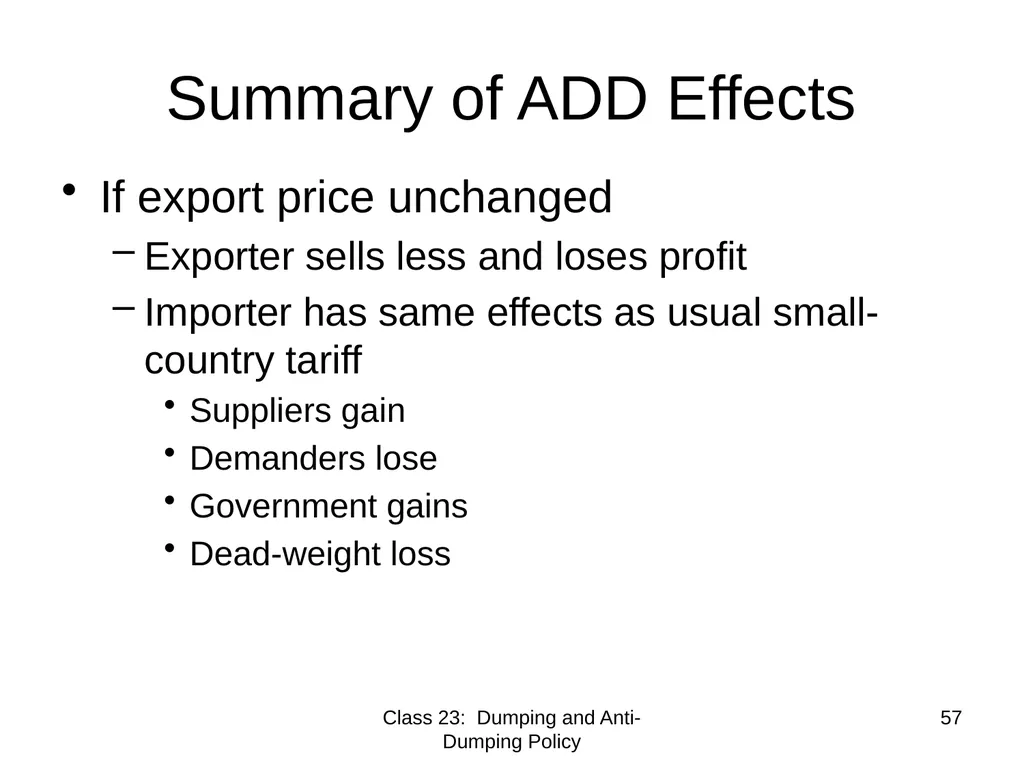
Summary of ADD Effects If export price unchanged
Exporter sells less and loses profit
Importer has same effects as usual small-country tariff
Suppliers gain
Demanders lose
Government gains
Dead-weight loss Class 23: Dumping and Anti-Dumping Policy 57<br>
Exporter sells less and loses profit
Importer has same effects as usual small-country tariff
Suppliers gain
Demanders lose
Government gains
Dead-weight loss Class 23: Dumping and Anti-Dumping Policy 57<br>
58
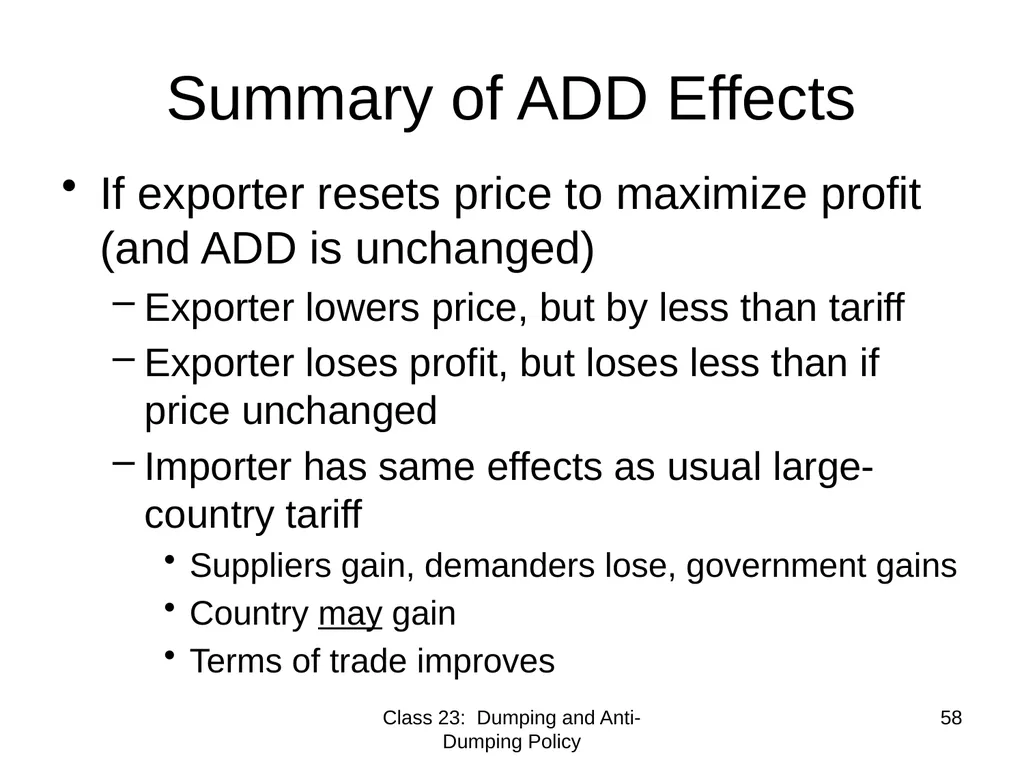
Summary of ADD Effects If exporter resets price to maximize profit (and ADD is unchanged)
Exporter lowers price, but by less than tariff
Exporter loses profit, but loses less than if price unchanged
Importer has same effects as usual large-country tariff
Suppliers gain, demanders lose, government gains
Country may gain
Terms of trade improves Class 23: Dumping and Anti-Dumping Policy 58<br>
Exporter lowers price, but by less than tariff
Exporter loses profit, but loses less than if price unchanged
Importer has same effects as usual large-country tariff
Suppliers gain, demanders lose, government gains
Country may gain
Terms of trade improves Class 23: Dumping and Anti-Dumping Policy 58<br>
59
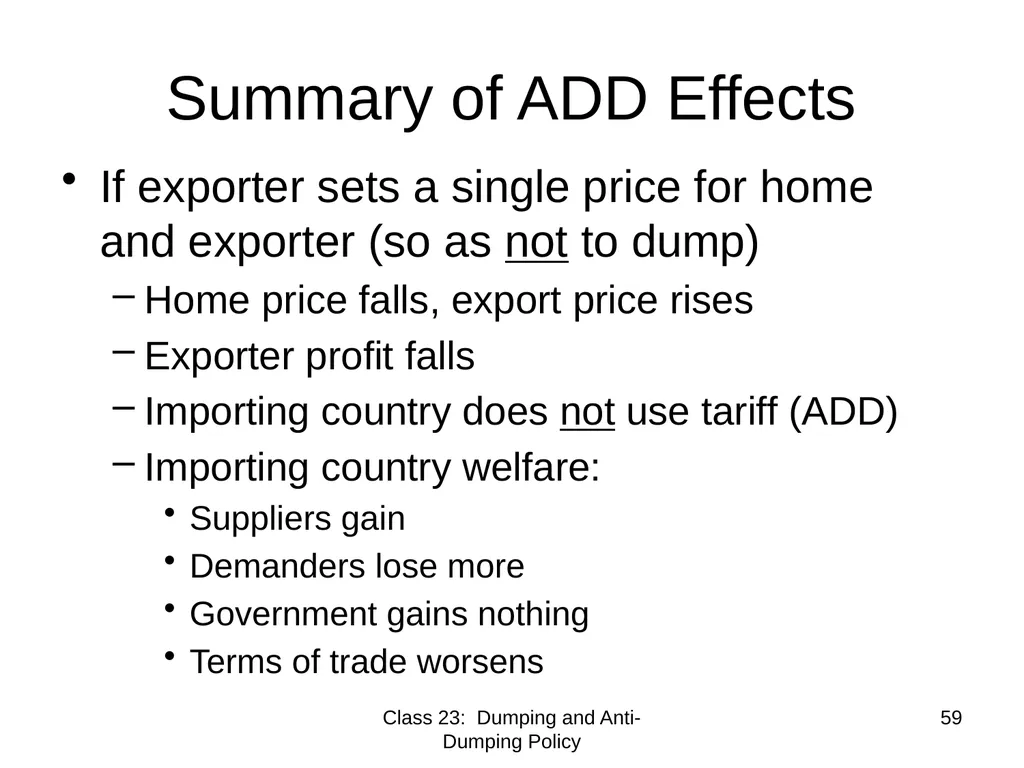
Summary of ADD Effects If exporter sets a single price for home and exporter (so as not to dump)
Home price falls, export price rises
Exporter profit falls
Importing country does not use tariff (ADD)
Importing country welfare:
Suppliers gain
Demanders lose more
Government gains nothing
Terms of trade worsens Class 23: Dumping and Anti-Dumping Policy 59<br>
Home price falls, export price rises
Exporter profit falls
Importing country does not use tariff (ADD)
Importing country welfare:
Suppliers gain
Demanders lose more
Government gains nothing
Terms of trade worsens Class 23: Dumping and Anti-Dumping Policy 59<br>
60
Pause for Discussion Class 23: Dumping and Anti-Dumping Policy 60<br>
61
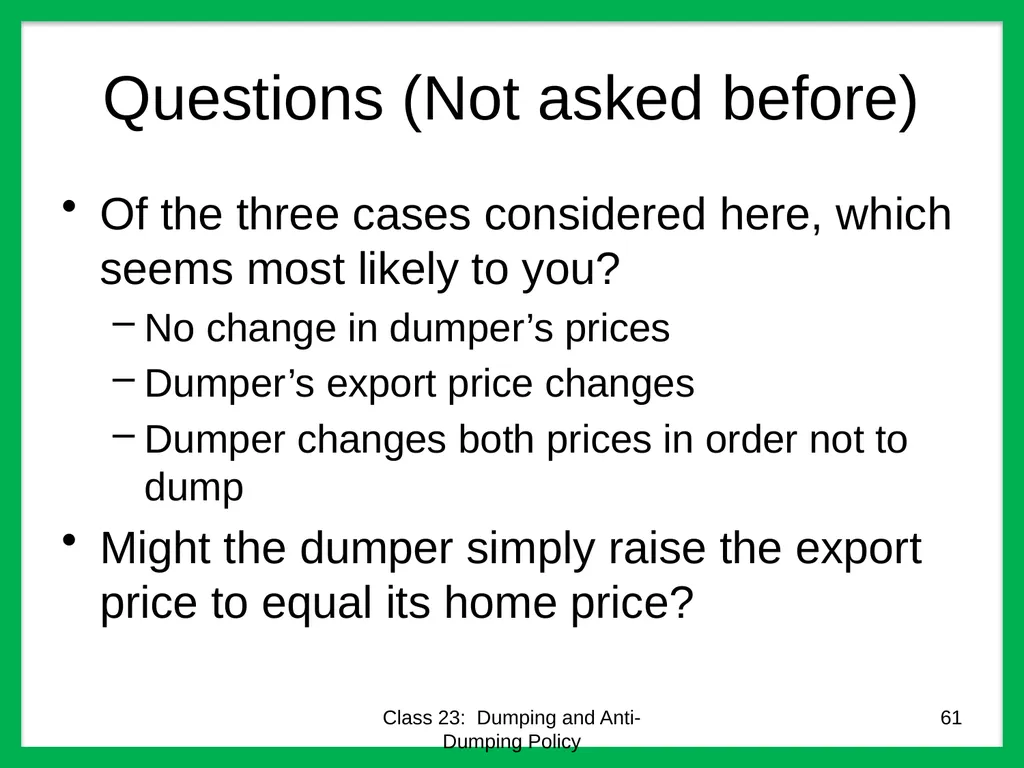
Questions (Not asked before) Of the three cases considered here, which seems most likely to you?
No change in dumper’s prices
Dumper’s export price changes
Dumper changes both prices in order not to dump
Might the dumper simply raise the export price to equal its home price? Class 23: Dumping and Anti-Dumping Policy 61<br>
No change in dumper’s prices
Dumper’s export price changes
Dumper changes both prices in order not to dump
Might the dumper simply raise the export price to equal its home price? Class 23: Dumping and Anti-Dumping Policy 61<br>
62
Class 23: Dumping and Anti-Dumping Policy 62<br>