CLASS-X MATHEMATICS TOPIC:APPLICATIONS OF TRIGONOMETRY PDF OF THE CHAPTER http:www.ncert.nic.inncertsljemh109.pdf LEARNING OBJECTIVES: Students will be able to: Define the six trigonometric ratio for a given angle. Apply the
"CLASS-X MATHEMATICS TOPIC:APPLICATIONS OF" is the property of its rightful owner. Permission is granted to
download and print the materials on this website for personal, non-commercial use only, and to display it
on your personal computer provided you do not modify the materials and that you retain all copyright
notices contained in the materials. By downloading content from our website, you accept the terms of this
agreement.
Presentation Transcript
01
CLASS-X
MATHEMATICS
TOPIC:APPLICATIONS OF TRIGONOMETRY<br>
02
PDF OF THE CHAPTER http://www.ncert.nic.in/ncerts/l/jemh109.pdf<br>
03
LEARNING OBJECTIVES: Students will be able to:
Define the six trigonometric ratio for a given angle.
Apply the definitions of angle of elevation and angle of depression in real life applications.
Apply the six trigonometric ratios of an acute angle in a right triangle.
Find the reference angle for a given triangle.
Apply the properties of reference angles in appropriate situations.
Understand the trigonometric complimentary angle relations.
Predict what would happen when the value of adjacent , opposite , and hypotenuse is changed.
To determine the height or the depth of an object at a certain distance using trigonometric ratios.
For example: We can calculate the height of a tower by standing a certain distance away from it and calculating the angle of elevation, thereby determining the height of the tower.<br>
04
CONTENTS: INTRODUCTION
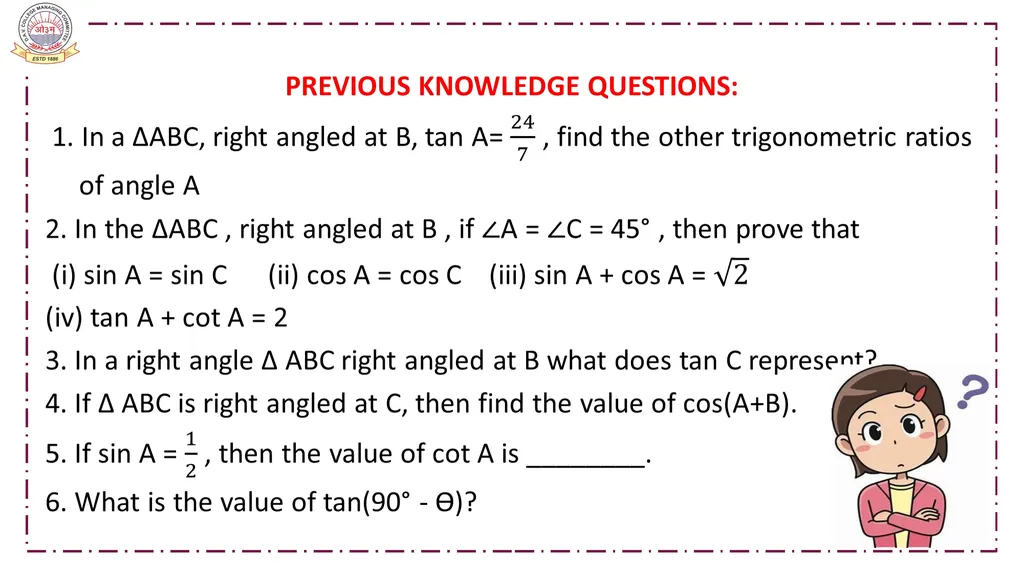
PREVIOUS KNOWLEDGE QUESTIONS
REAL LIFE APPLICATIONS
THE TRIGONOMETRIC TABLE
BASIC FUNDAMENTALS
INTERESTING FACT
EXAMPLES
CONCEPT-1
CONCEPT BASED QUESTION
CONCEPT-2
CONCEPT BASED QUESTION CONCEPT-3
CONCEPT BASED QUESTION
CONCEPT-4
CONCEPT BASED QUESTION
CONCEPT-5
CONCEPT BASED QUESTION
CBSE BOARD QUESTION 2020
HOTS
QUESTION FOR YOU
ACTIVITY
MIND MAP
INTERESTING FACT
SUMMARY<br>
05
INTRODUCTION Trigonometry is a Greek-originated word where ‘Tri’ means three, ‘gon’ means sides and ‘Metry’ means measure. It is a branch of mathematics that studies relationships between side lengths and angles of triangles. The field emerged in the Hellenistic world during the 3rd century B.C. from applications of geometry to astronomical studies.<br>
06
REAL LIFE APPLICATIONS: Trigonometry is used in various fields. It has applications in wider fields like engineering, physics, surveyors, architects, astronauts and even investigation of a crime scene. Apart from astronomy and geography, trigonometry is applicable in various fields like satellite navigation, developing computer music, chemistry number theory, medical imaging, electronics, electrical engineering, civil engineering, architecture, mechanical engineering, oceanography, seismology, phonetics, image compression and game development.<br>
07
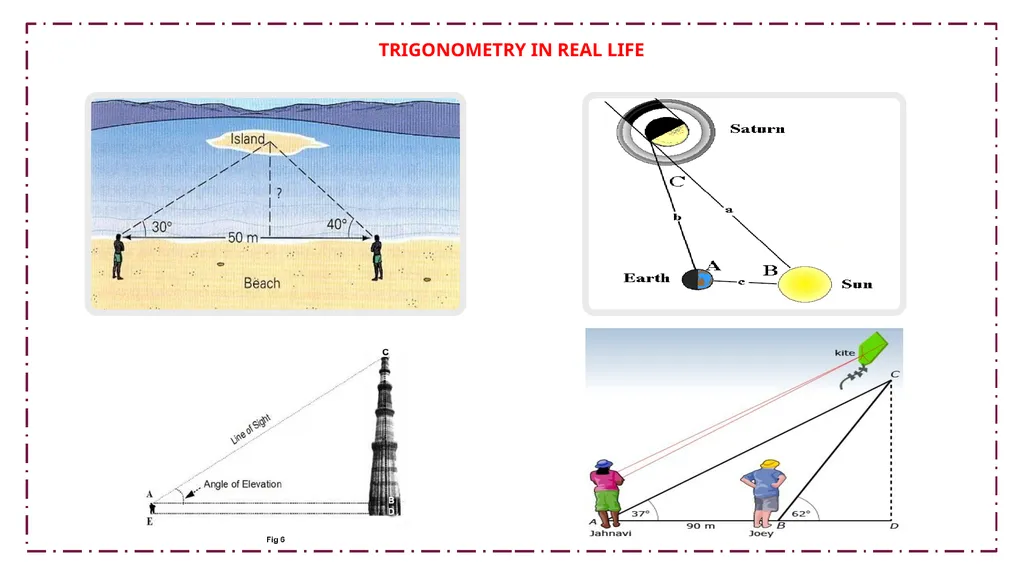
TRIGONOMETRY IN REAL LIFE<br>
08
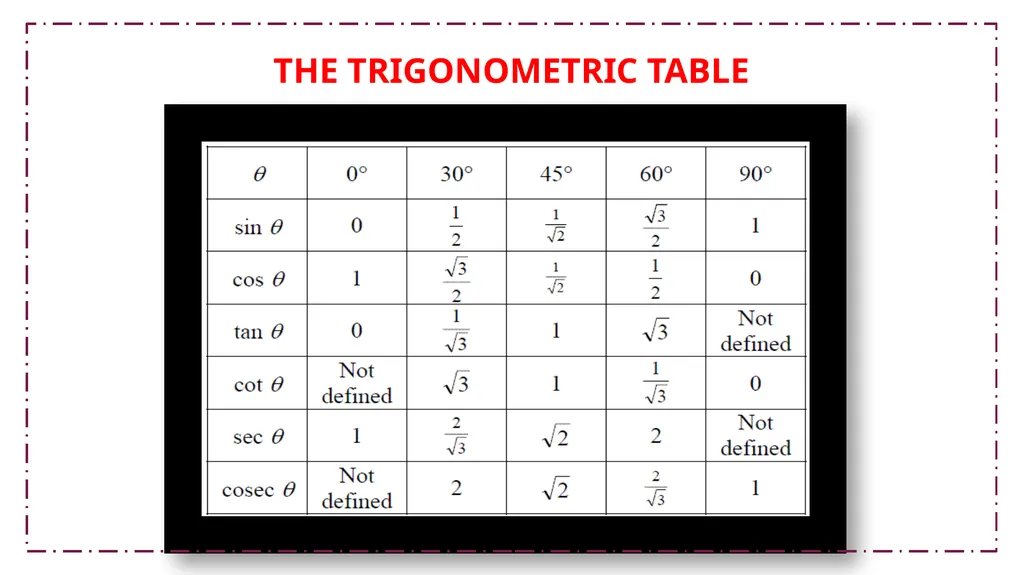
THE TRIGONOMETRIC TABLE<br>
09
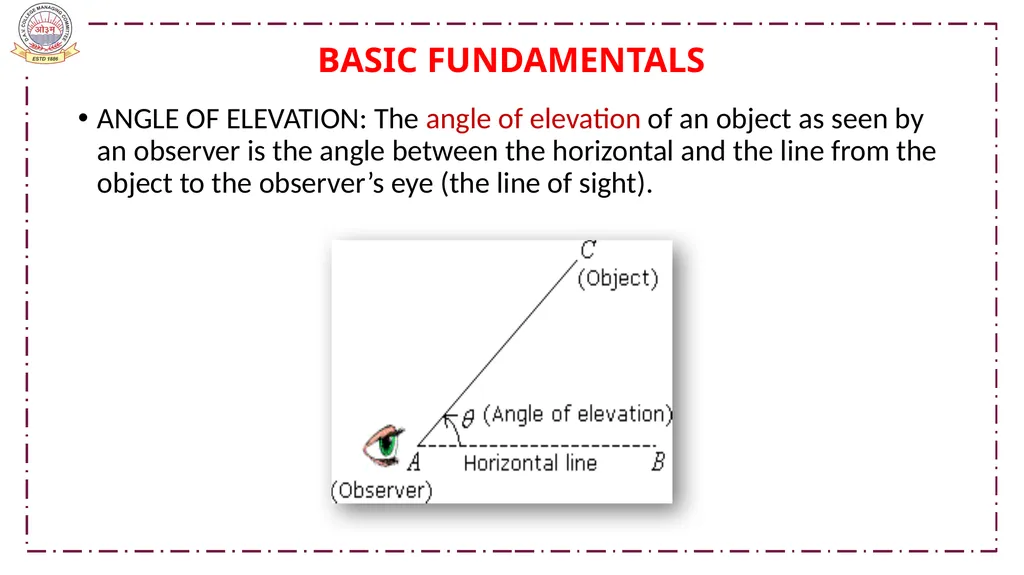
BASIC FUNDAMENTALS ANGLE OF ELEVATION: The angle of elevation of an object as seen by an observer is the angle between the horizontal and the line from the object to the observer’s eye (the line of sight).<br>
10
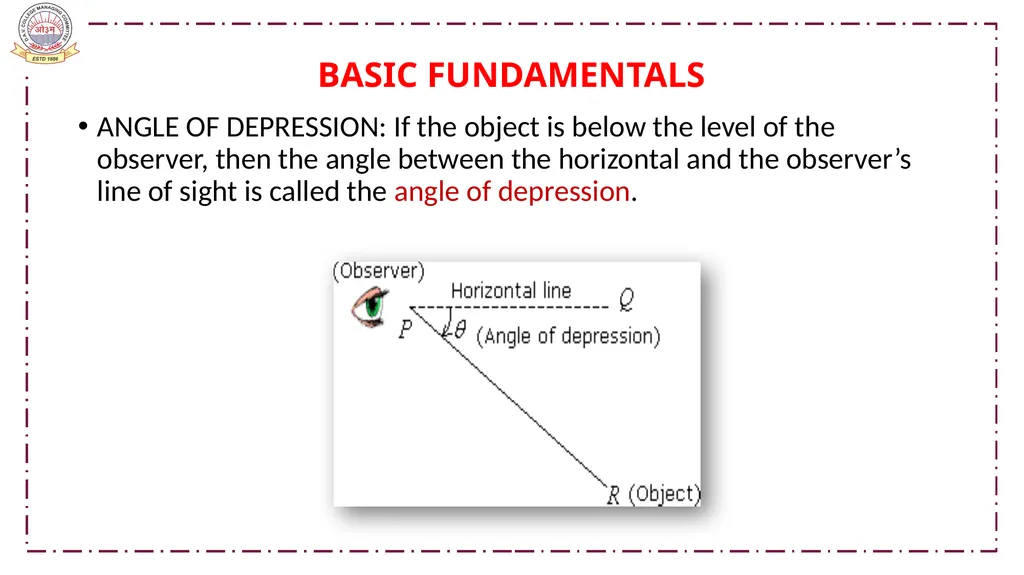
BASIC FUNDAMENTALS ANGLE OF DEPRESSION: If the object is below the level of the observer, then the angle between the horizontal and the observer’s line of sight is called the angle of depression.<br>
11
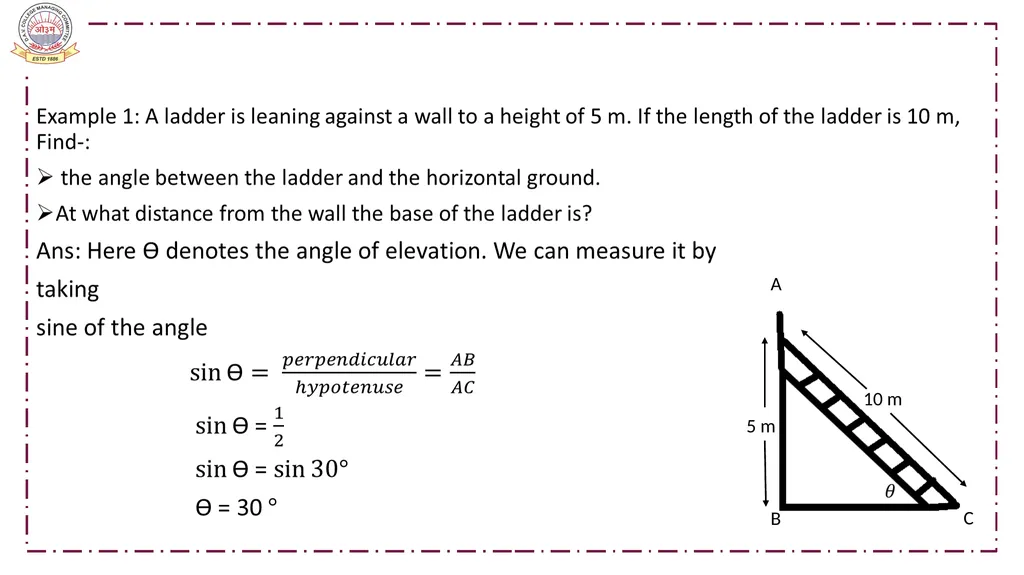
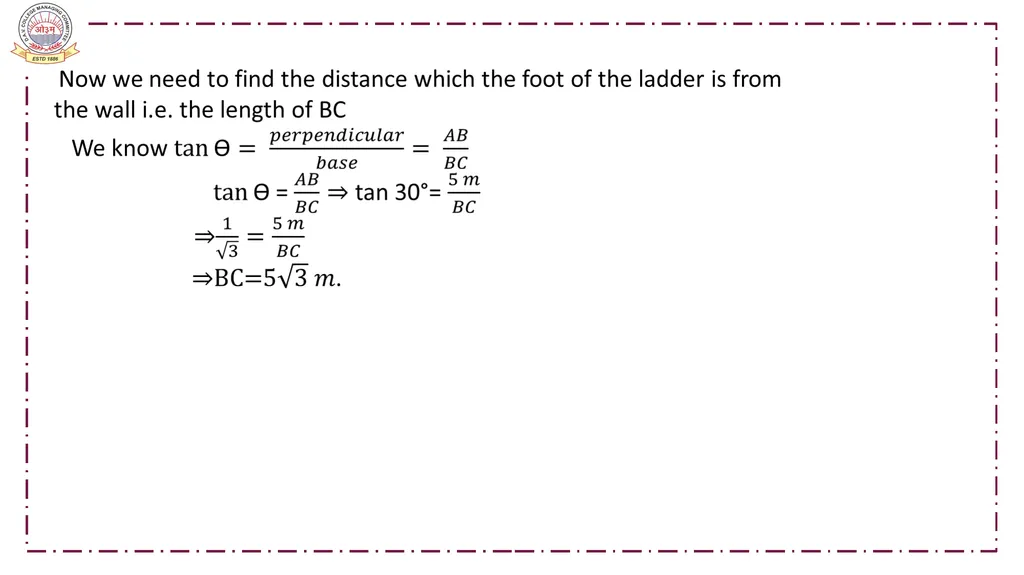
10 m 5 m A B C<br>
12
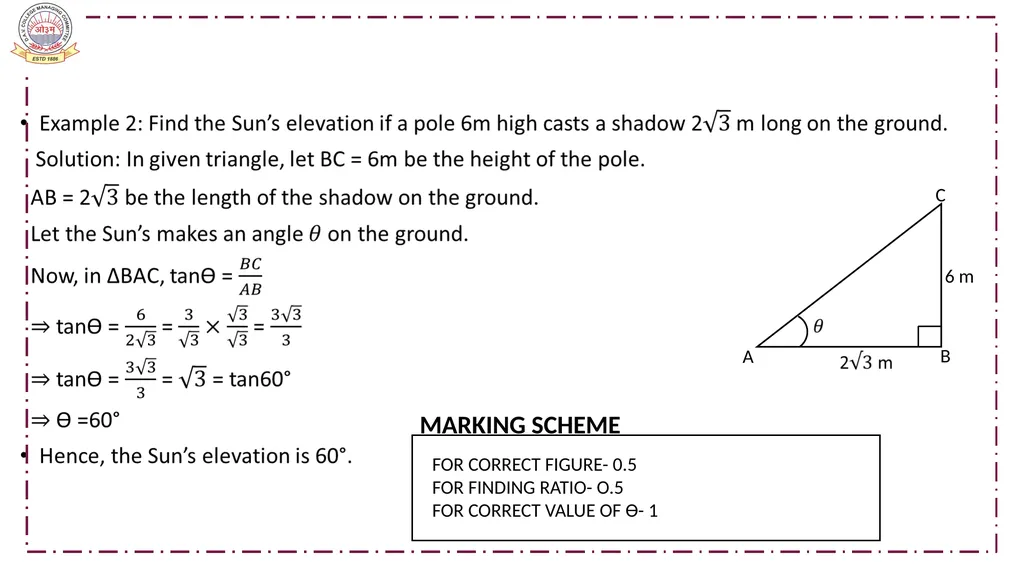
A B C 6 m FOR CORRECT FIGURE- 0.5
FOR FINDING RATIO- O.5
FOR CORRECT VALUE OF ϴ- 1 MARKING SCHEME<br>
13
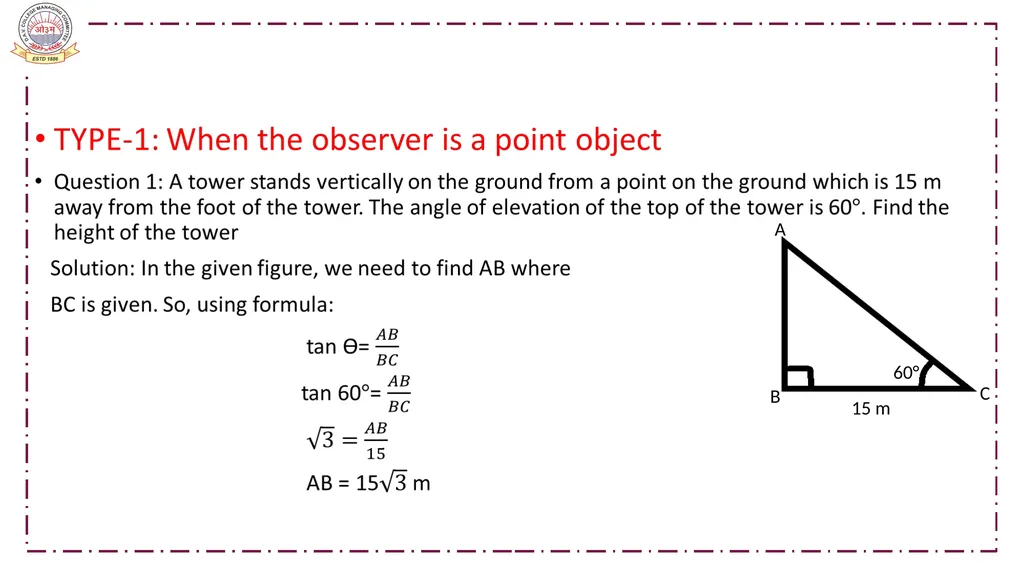
60° C B 15 m A<br>
14
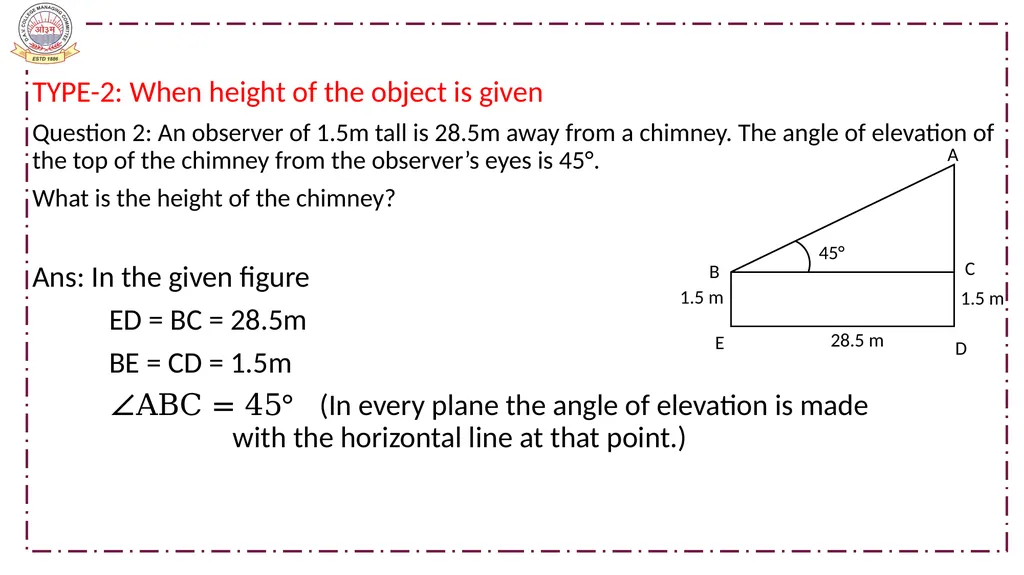
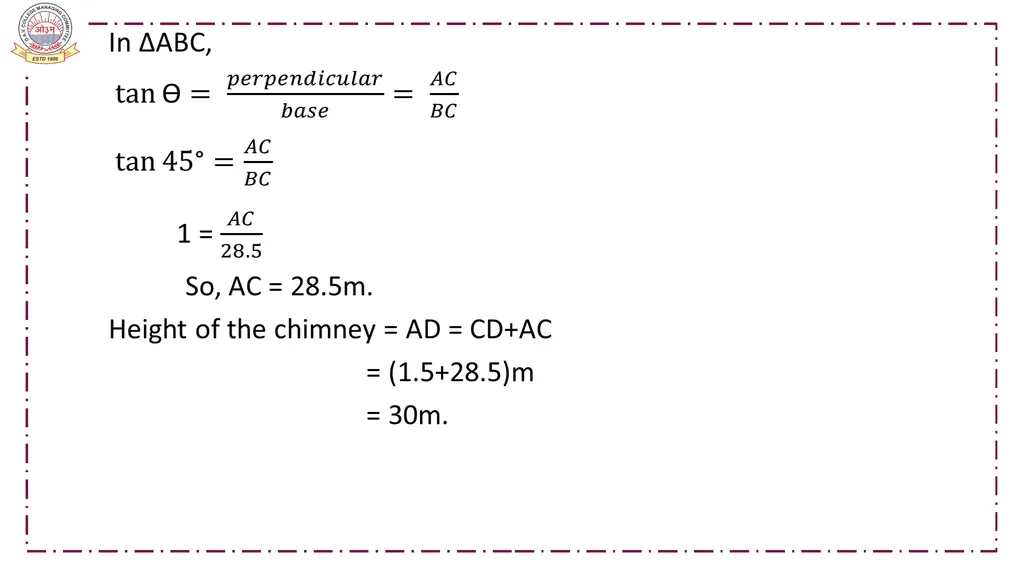
TYPE-2: When height of the object is given
Question 2: An observer of 1.5m tall is 28.5m away from a chimney. The angle of elevation of the top of the chimney from the observer’s eyes is 45°.
What is the height of the chimney?
Ans: In the given figure
ED = BC = 28.5m
BE = CD = 1.5m
∠ABC = 45° (In every plane the angle of elevation is made with the horizontal line at that point.) 28.5 m 1.5 m 1.5 m 45° A D C B E<br>
15
\<br>
16
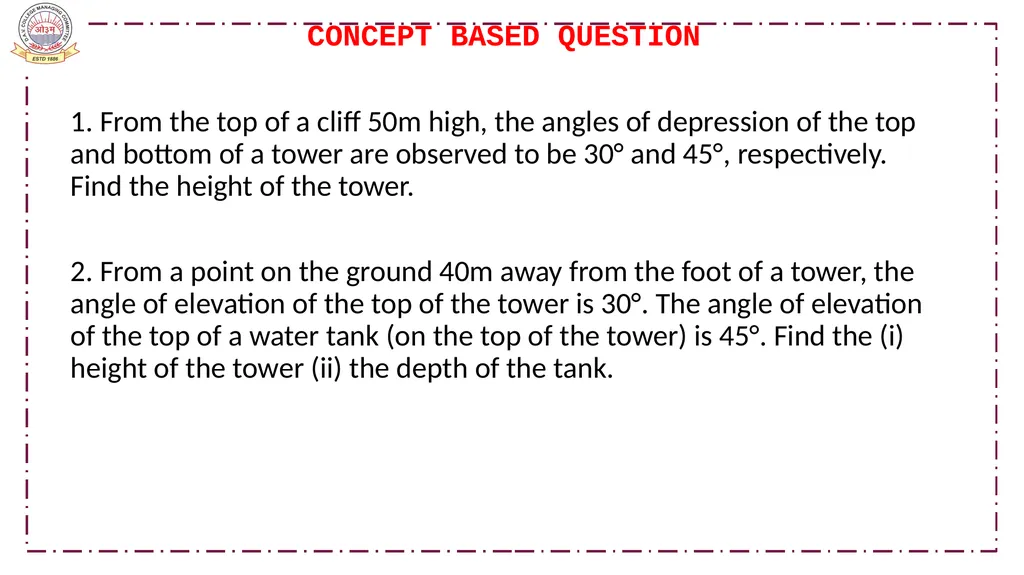
CONCEPT BASED QUESTION
1. From the top of a cliff 50m high, the angles of depression of the top and bottom of a tower are observed to be 30° and 45°, respectively. Find the height of the tower.
2. From a point on the ground 40m away from the foot of a tower, the angle of elevation of the top of the tower is 30°. The angle of elevation of the top of a water tank (on the top of the tower) is 45°. Find the (i) height of the tower (ii) the depth of the tank.<br>
17
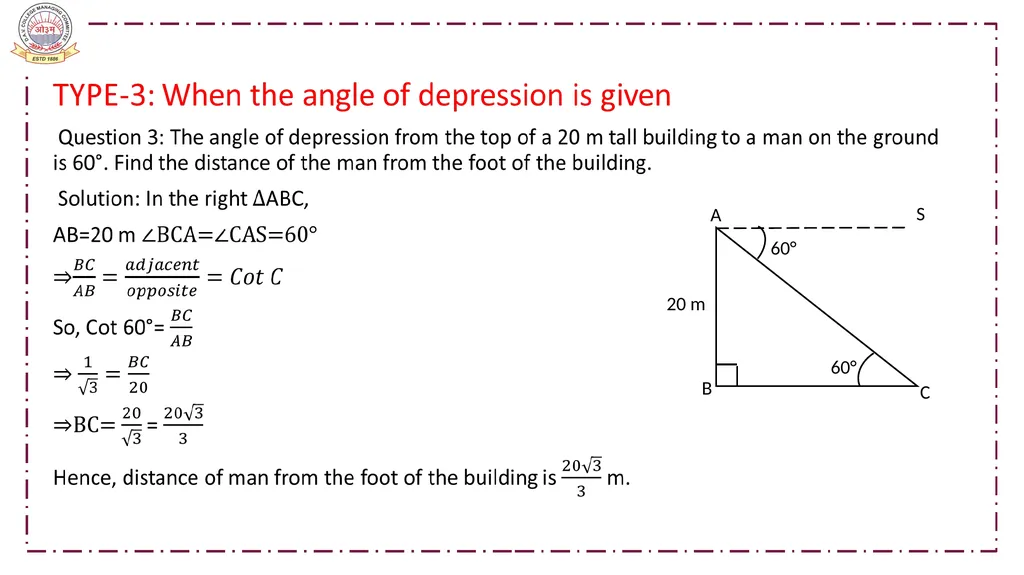
60° 60° 20 m A C B S<br>
18
CONCEPT BASED QUESTION
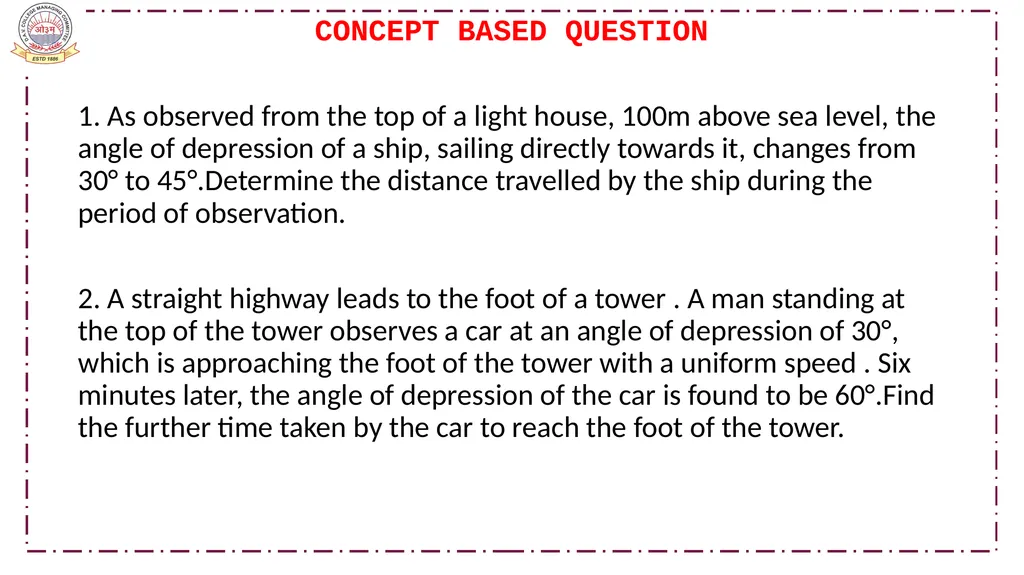
1. As observed from the top of a light house, 100m above sea level, the angle of depression of a ship, sailing directly towards it, changes from 30° to 45°.Determine the distance travelled by the ship during the period of observation.
2. A straight highway leads to the foot of a tower . A man standing at the top of the tower observes a car at an angle of depression of 30°, which is approaching the foot of the tower with a uniform speed . Six minutes later, the angle of depression of the car is found to be 60°.Find the further time taken by the car to reach the foot of the tower.<br>
19
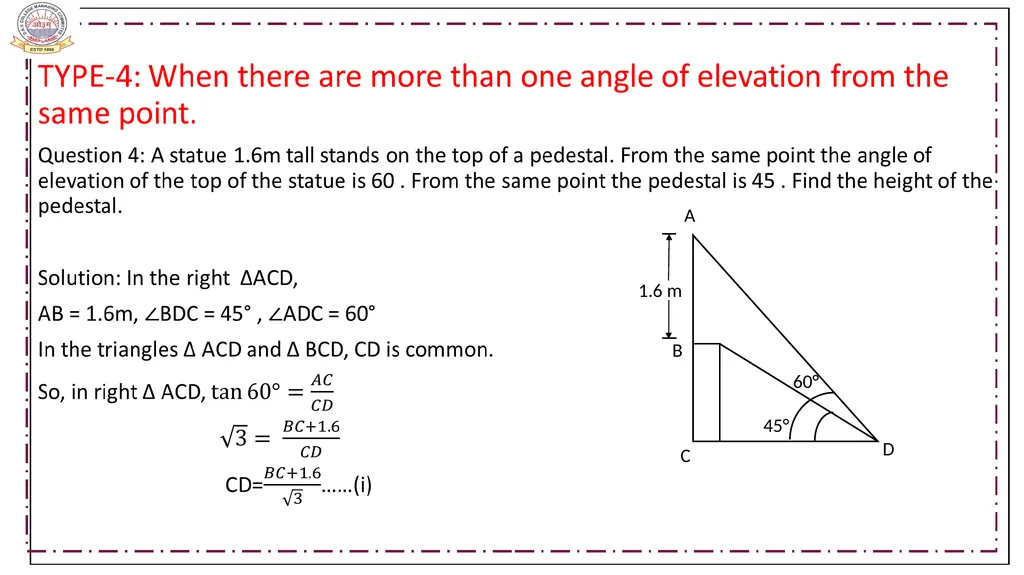
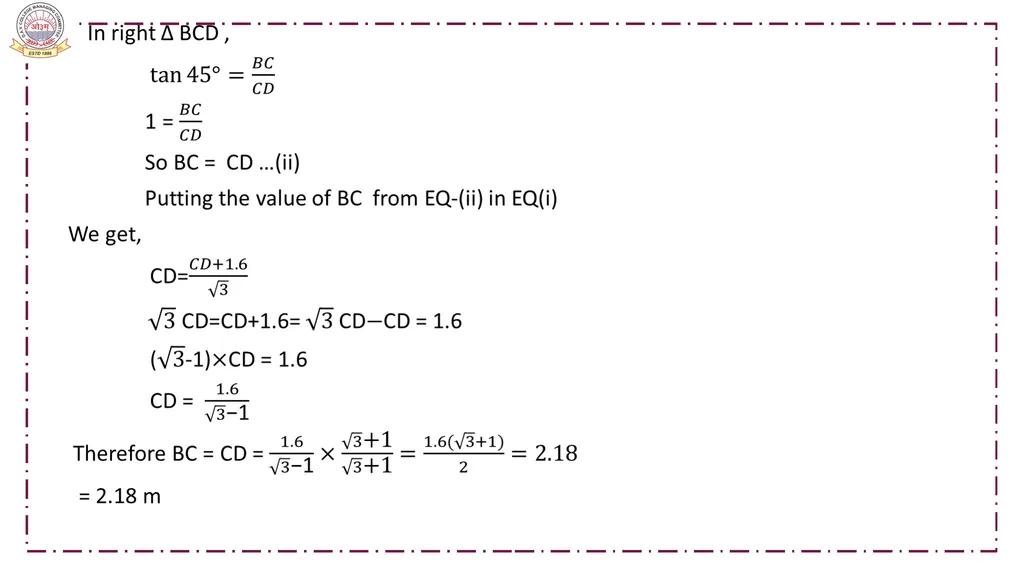
45° 60° 1.6 m A C D B<br>
20
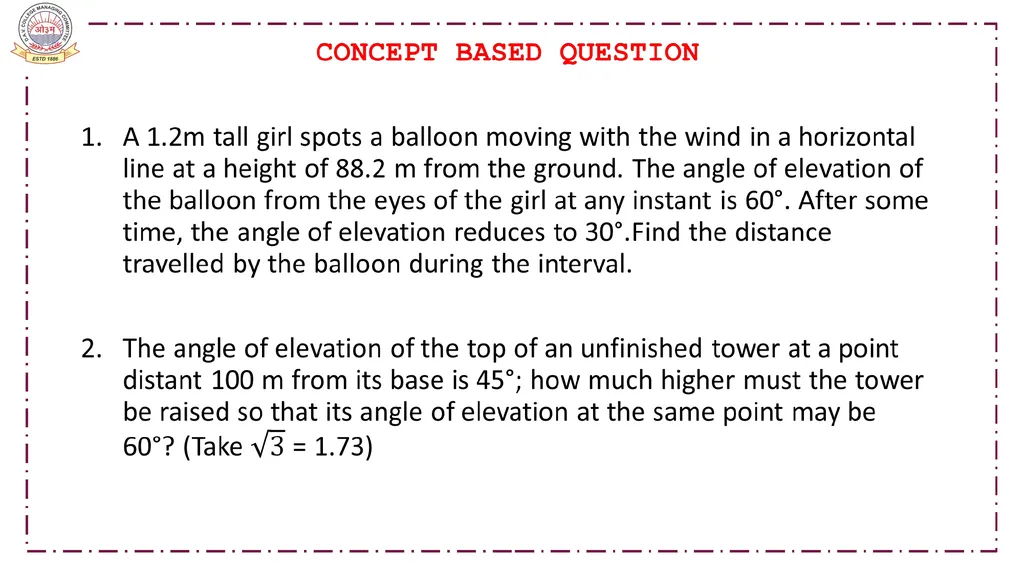
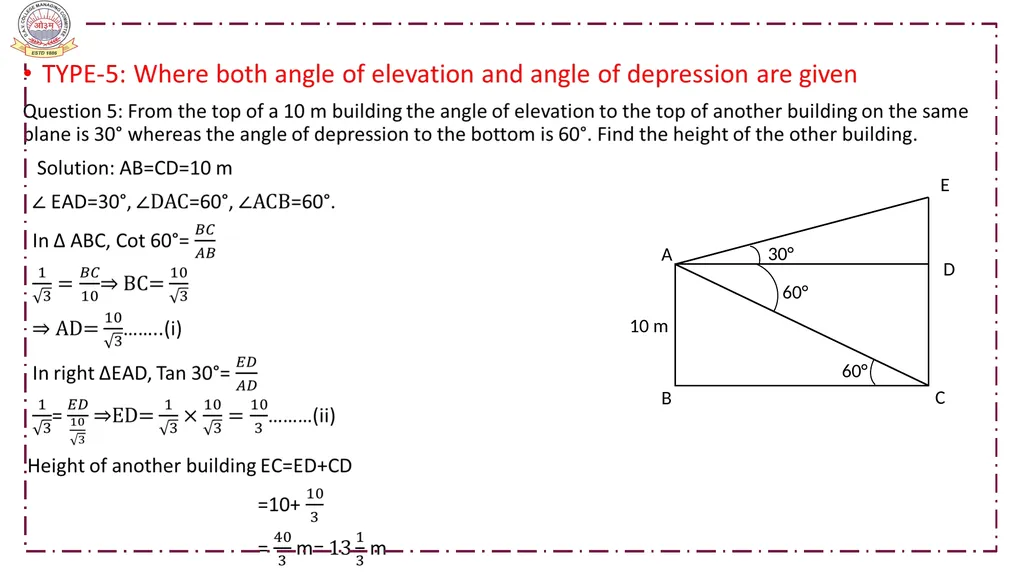
30° 60° 60° 10 m A E B C D<br>
21
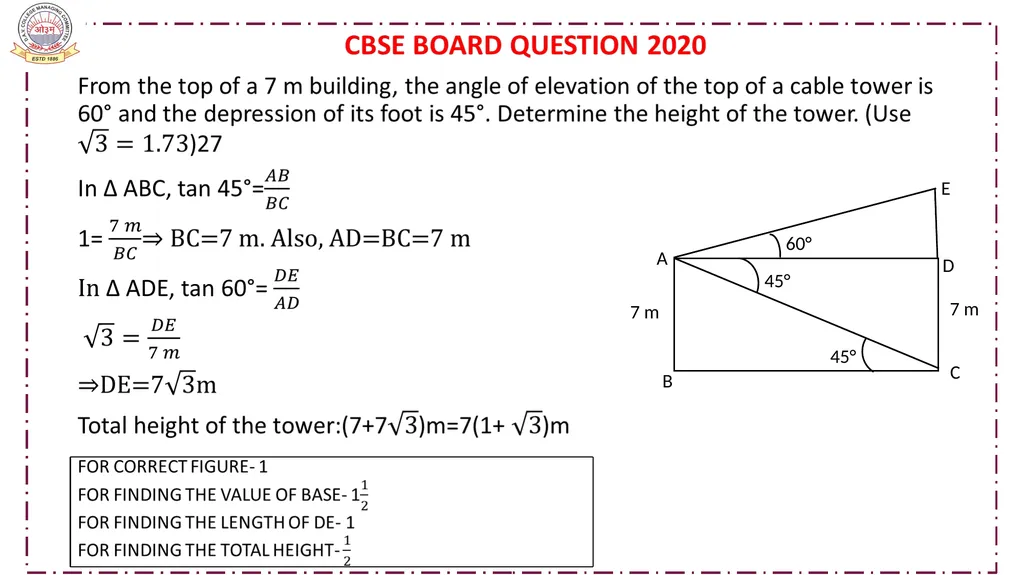
60° 45° 45° 7 m 7 m A B E D C<br>
22
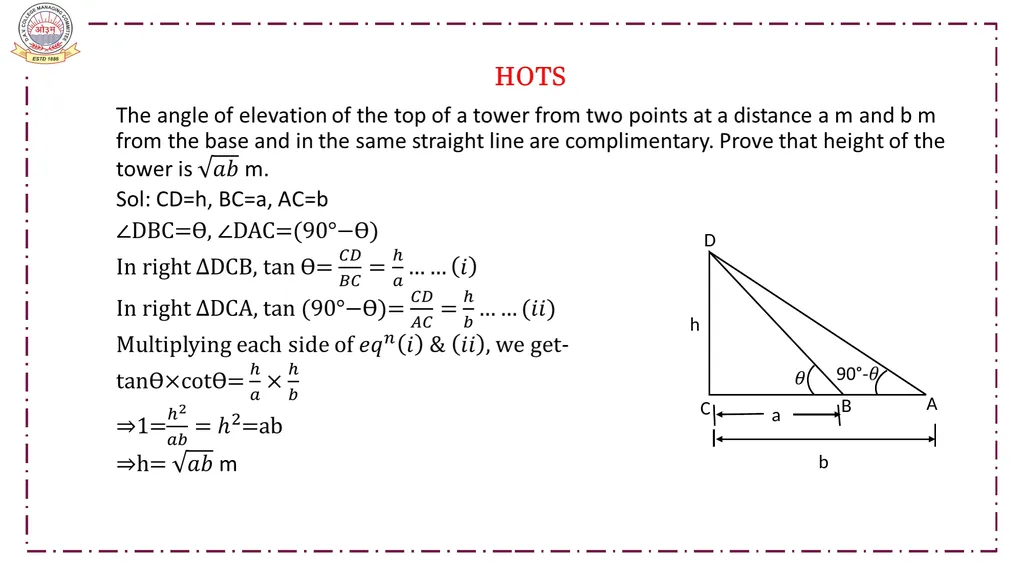
-[ D h C B A a b<br>
23
QUESTION FOR YOU
The angles of depression of the top and bottom of an 8 m tall building from top of a multistoried building are 30° and 45° respectively. Find the height of the multistoried building and the distance between the two buildings.<br>
24
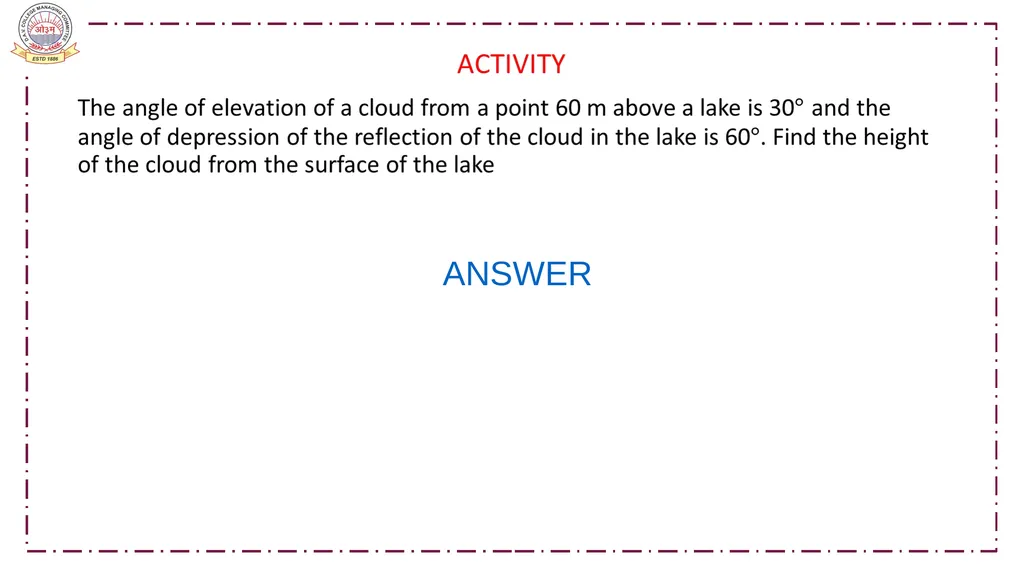
ACTIVITY
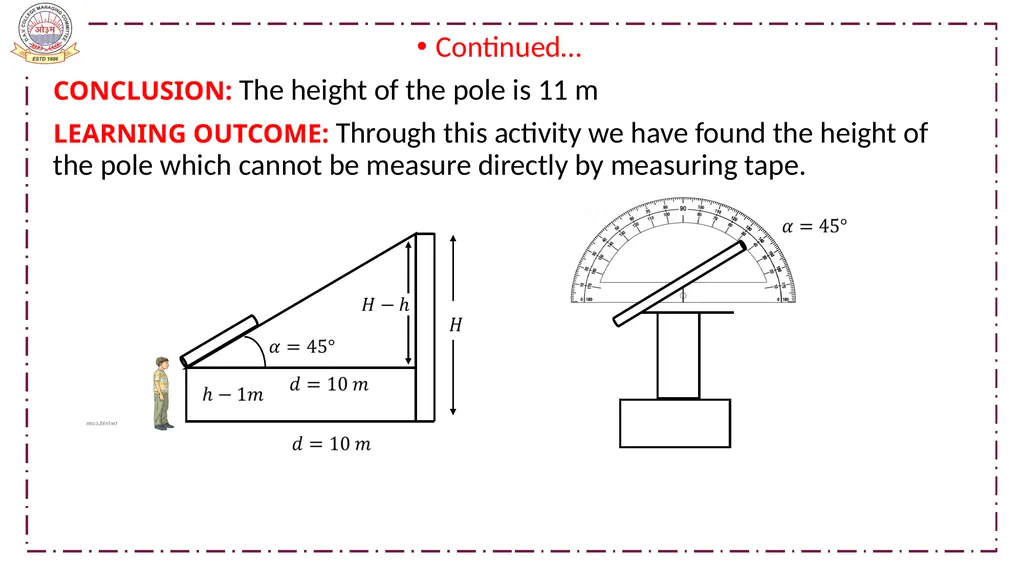
OBJECTIVE: To find out the height of a pole.
PRE- REQUISITE KNOWLEDGE:
(i) TRIGONOMETRIC RATIOS
(ii) TRIGONOMETRIC TABLE
MATERIALS REQUIRED:
(i) COMPLETE PROTRACTOR
(ii) A THIN PIPE OF ALUMINIUM
(iii) A PROTRACTOR FIXED ON A STAND
(iv) MEASURING TAPE<br>
25
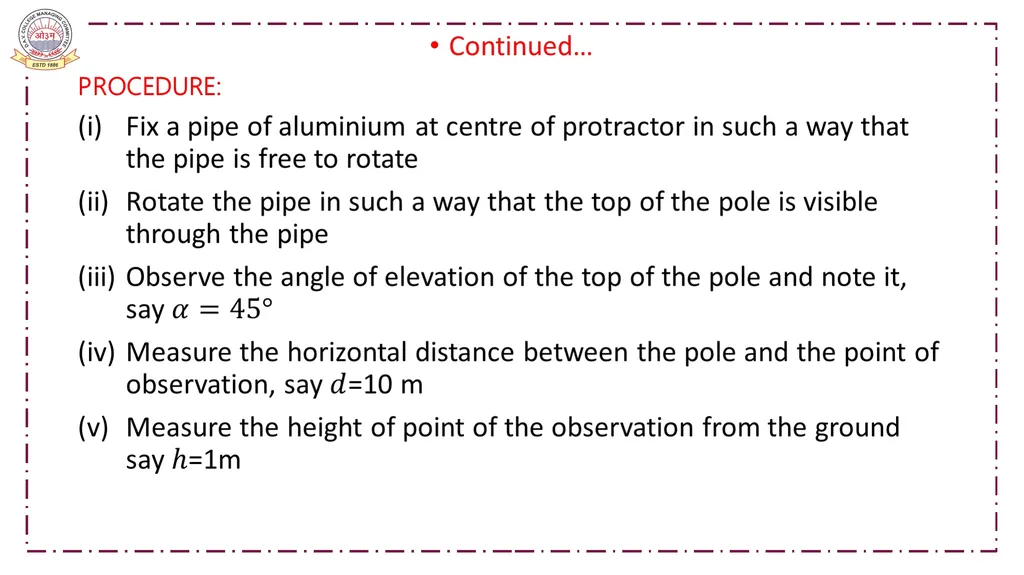
Continued…
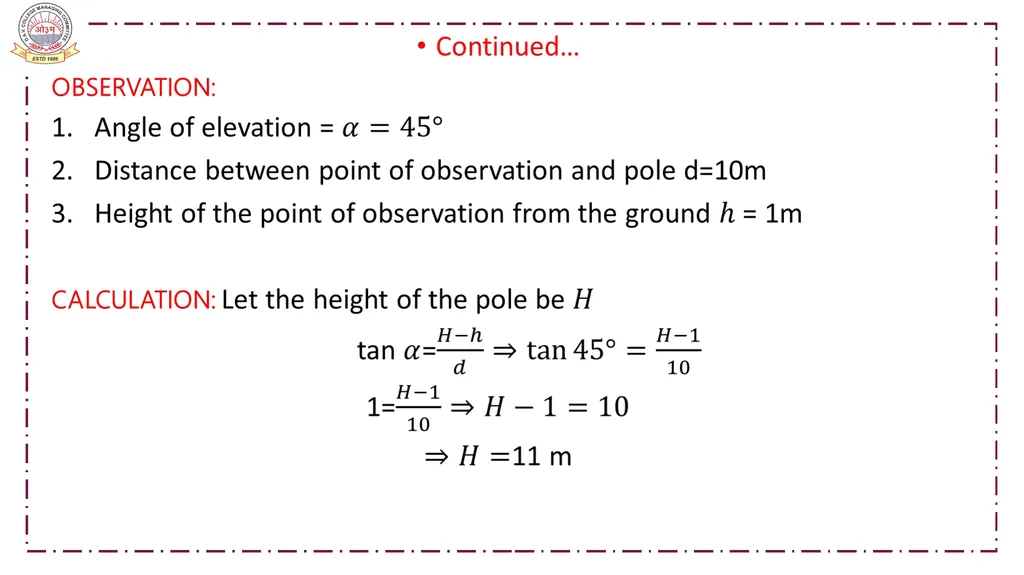
CONCLUSION: The height of the pole is 11 m
LEARNING OUTCOME: Through this activity we have found the height of the pole which cannot be measure directly by measuring tape.<br>
26
ANSWER<br>
27
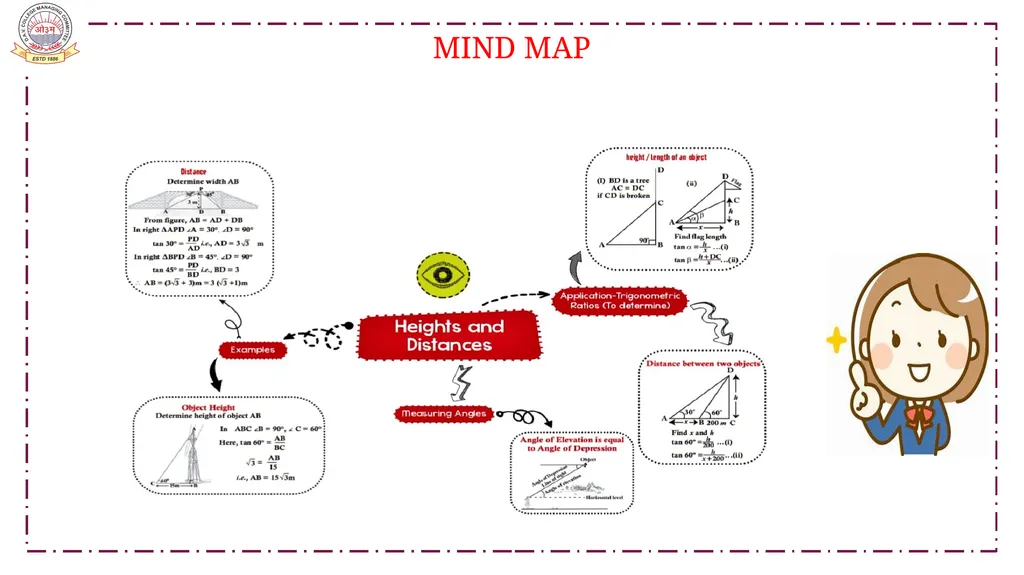
MIND MAP<br>
28
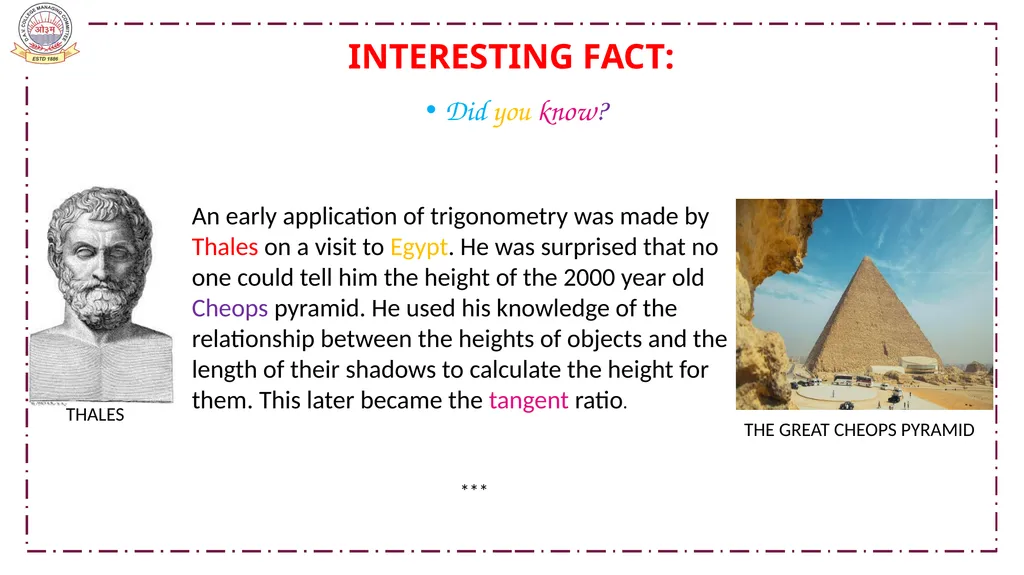
INTERESTING FACT: Did you know? An early application of trigonometry was made by Thales on a visit to Egypt. He was surprised that no one could tell him the height of the 2000 year old Cheops pyramid. He used his knowledge of the relationship between the heights of objects and the length of their shadows to calculate the height for them. This later became the tangent ratio. THALES THE GREAT CHEOPS PYRAMID ***<br>
29
SUMMARY In this chapter, you have studied the following points :
The line drawn from the eye of an observer to a point in the object where the person is viewing is called the line of sight.
The angle formed by the line of sight with the horizontal when the object is above the horizontal level is called the angle of elevation.
The angle formed by the line of sight with the horizontal when the object is below the horizontal level is called the angle of depression.
The height of an object or the distance between distant objects can be determined with the help of trigonometric ratios. ***<br>