
CLASS- XII RELATION OBJECTIVE TO understand the


Description: CLASS- XII RELATION OBJECTIVE TO understand the meaning of relation and how the term in mathematics is completely same as the relation in our practical life. To know about different types of relations and how to identify and differentiate
Related Topics
Download Presentation
"CLASS- XII RELATION OBJECTIVE TO understand the" is the property of its rightful owner. Permission is granted to download and print the materials on this website for personal, non-commercial use only, and to display it on your personal computer provided you do not modify the materials and that you retain all copyright notices contained in the materials. By downloading content from our website, you accept the terms of this agreement.
Presentation Transcript
slide1. CLASS- XII<br>
slide2. RELATION<br>
slide3. OBJECTIVE TO understand the meaning of relation and how the term in mathematics is completely same as the relation in our practical life.
To know about different types of relations and how to identify and differentiate them.<br>
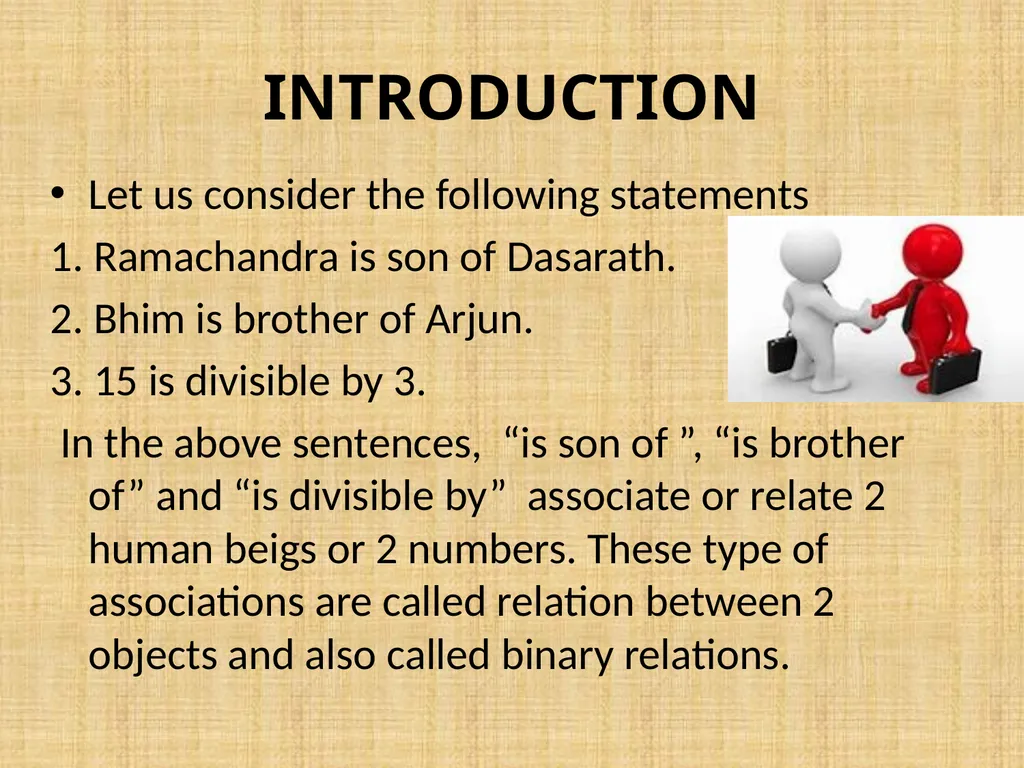
slide4. INTRODUCTION Let us consider the following statements
1. Ramachandra is son of Dasarath.
2. Bhim is brother of Arjun.
3. 15 is divisible by 3.
In the above sentences, “is son of ”, “is brother of” and “is divisible by” associate or relate 2 human beigs or 2 numbers. These type of associations are called relation between 2 objects and also called binary relations.<br>
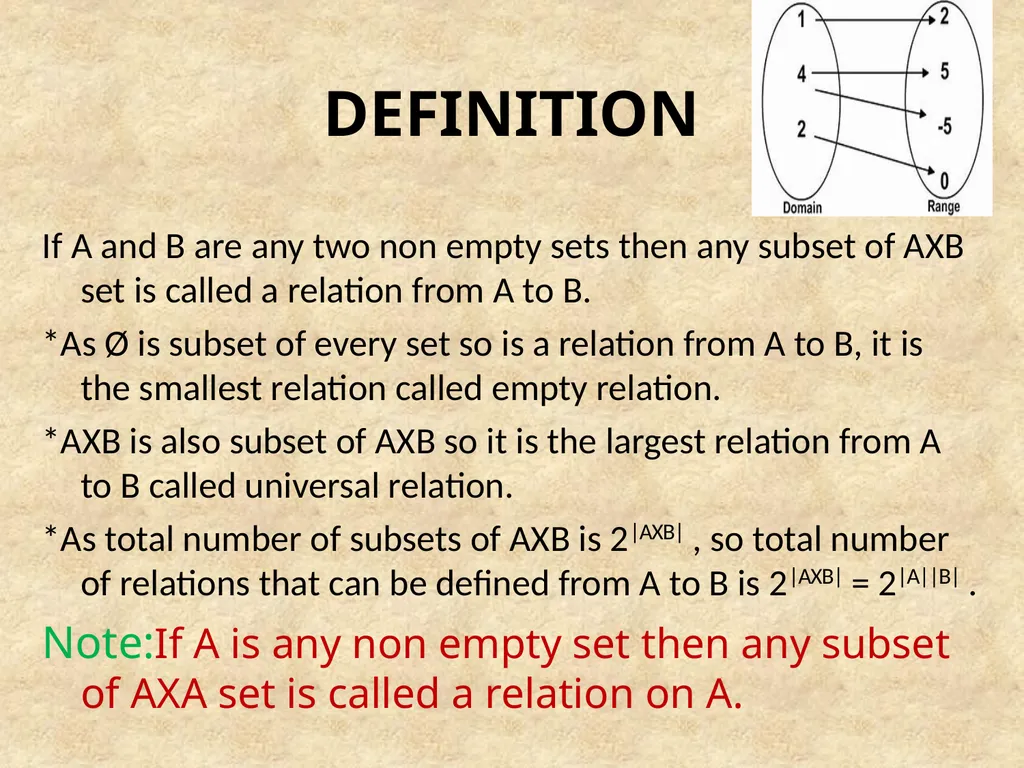
slide5. DEFINITION If A and B are any two non empty sets then any subset of AXB set is called a relation from A to B.
*As Ø is subset of every set so is a relation from A to B, it is the smallest relation called empty relation.
*AXB is also subset of AXB so it is the largest relation from A to B called universal relation.
*As total number of subsets of AXB is 2|AXB| , so total number of relations that can be defined from A to B is 2|AXB| = 2|A||B| .
Note:If A is any non empty set then any subset of AXA set is called a relation on A.<br>
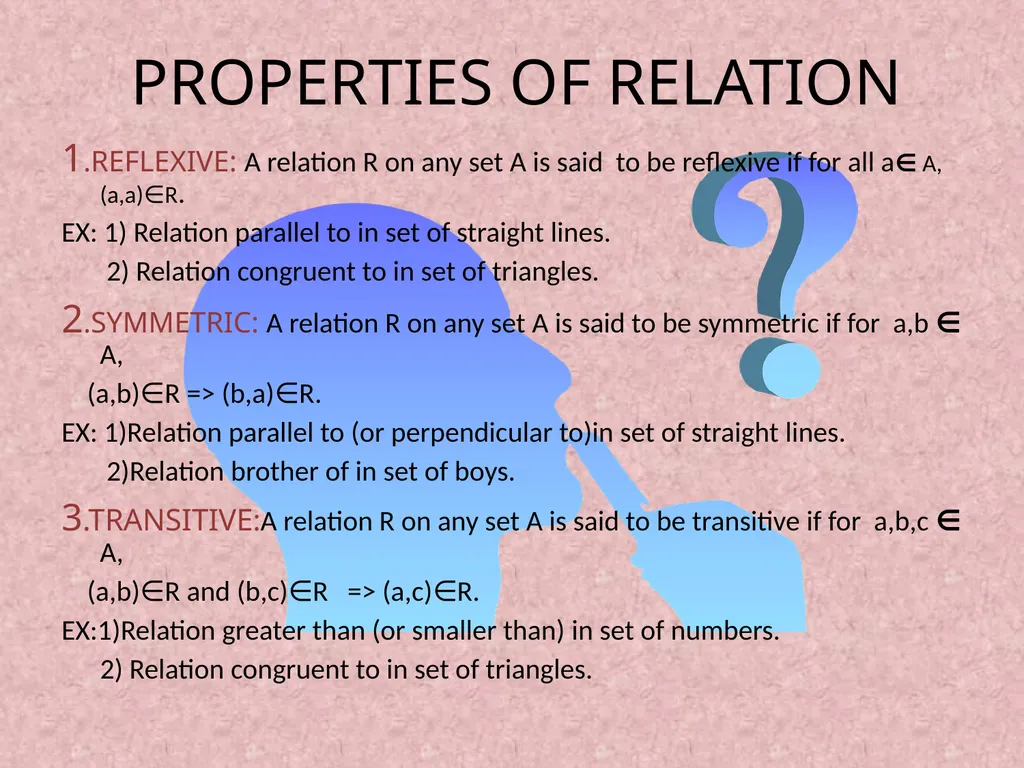
slide6. PROPERTIES OF RELATION 1.REFLEXIVE: A relation R on any set A is said to be reflexive if for all a∈ A, (a,a)∈R.
EX: 1) Relation parallel to in set of straight lines.
2) Relation congruent to in set of triangles.
2.SYMMETRIC: A relation R on any set A is said to be symmetric if for a,b ∈ A,
(a,b)∈R => (b,a)∈R.
EX: 1)Relation parallel to (or perpendicular to)in set of straight lines.
2)Relation brother of in set of boys.
3.TRANSITIVE:A relation R on any set A is said to be transitive if for a,b,c ∈ A,
(a,b)∈R and (b,c)∈R => (a,c)∈R.
EX:1)Relation greater than (or smaller than) in set of numbers.
2) Relation congruent to in set of triangles.<br>
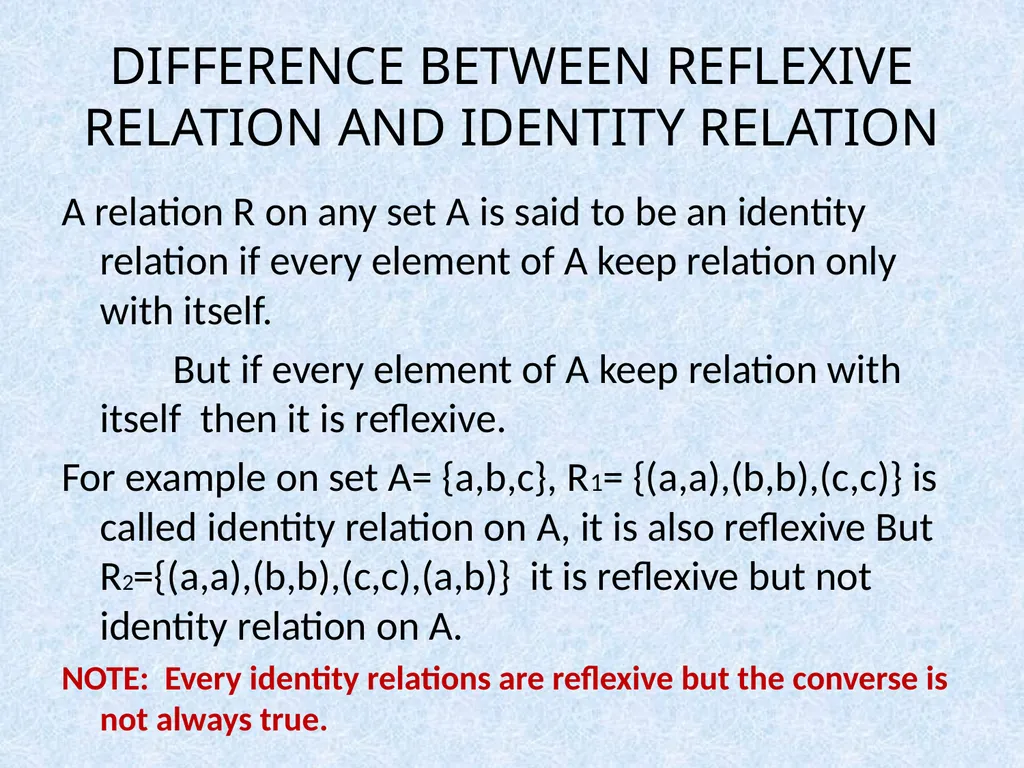
slide7. DIFFERENCE BETWEEN REFLEXIVE RELATION AND IDENTITY RELATION A relation R on any set A is said to be an identity relation if every element of A keep relation only with itself.
But if every element of A keep relation with itself then it is reflexive.
For example on set A= {a,b,c}, R1= {(a,a),(b,b),(c,c)} is called identity relation on A, it is also reflexive But R2={(a,a),(b,b),(c,c),(a,b)} it is reflexive but not identity relation on A.
NOTE: Every identity relations are reflexive but the converse is not always true.<br>
slide8. Equivalence relation A relation R on any set A is said to be an equivalence relation if R is reflexive , symmetric and transitive.
EX: 1) Relation parallel to in set of straight lines.
2) Relation congruent to in set of triangles.
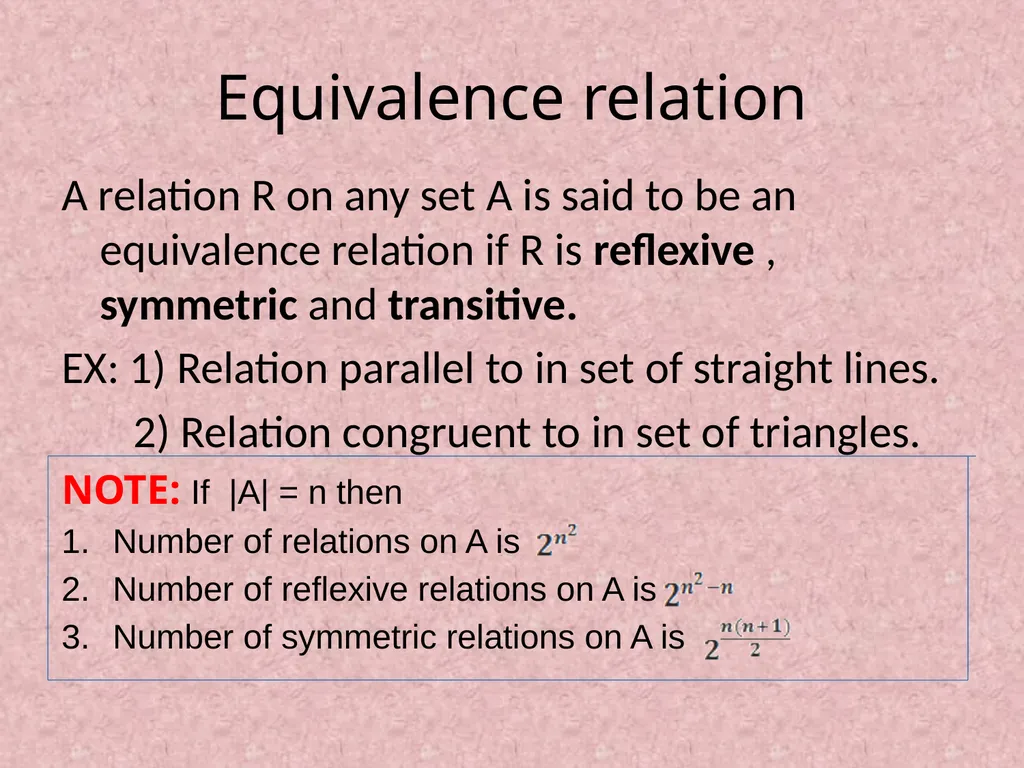
NOTE: If |A| = n then
Number of relations on A is
Number of reflexive relations on A is
Number of symmetric relations on A is<br>
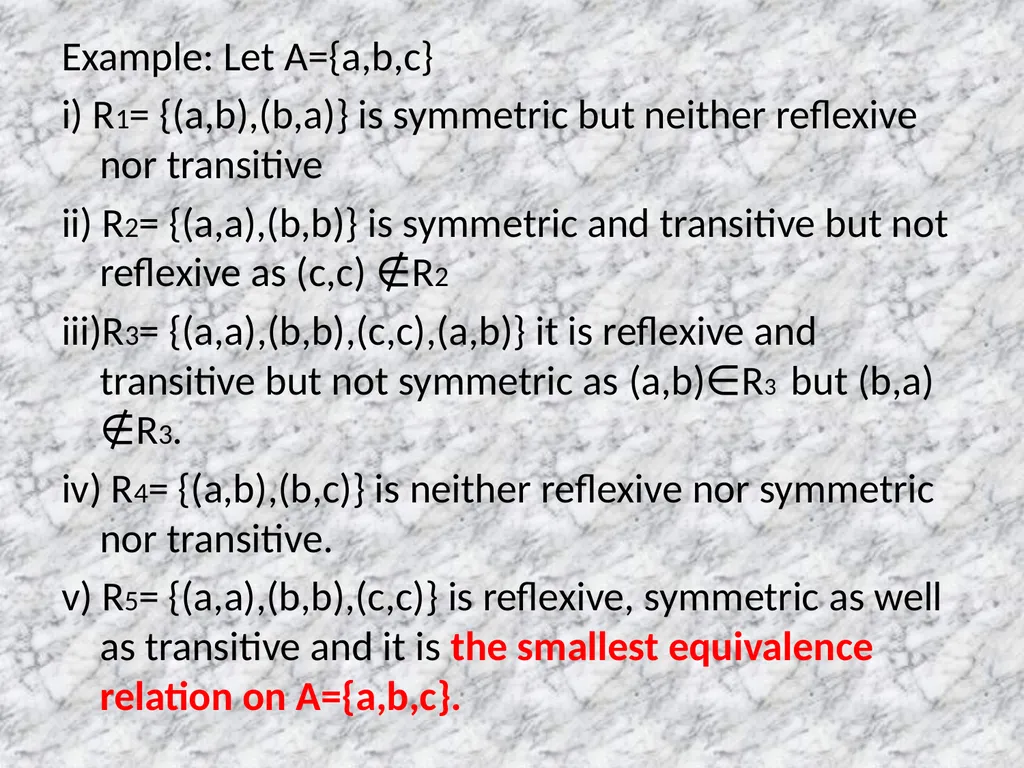
slide9. Example: Let A={a,b,c}
i) R1= {(a,b),(b,a)} is symmetric but neither reflexive nor transitive
ii) R2= {(a,a),(b,b)} is symmetric and transitive but not reflexive as (c,c) ∉R2
iii)R3= {(a,a),(b,b),(c,c),(a,b)} it is reflexive and transitive but not symmetric as (a,b)∈R3 but (b,a) ∉R3.
iv) R4= {(a,b),(b,c)} is neither reflexive nor symmetric nor transitive.
v) R5= {(a,a),(b,b),(c,c)} is reflexive, symmetric as well as transitive and it is the smallest equivalence relation on A={a,b,c}.<br>
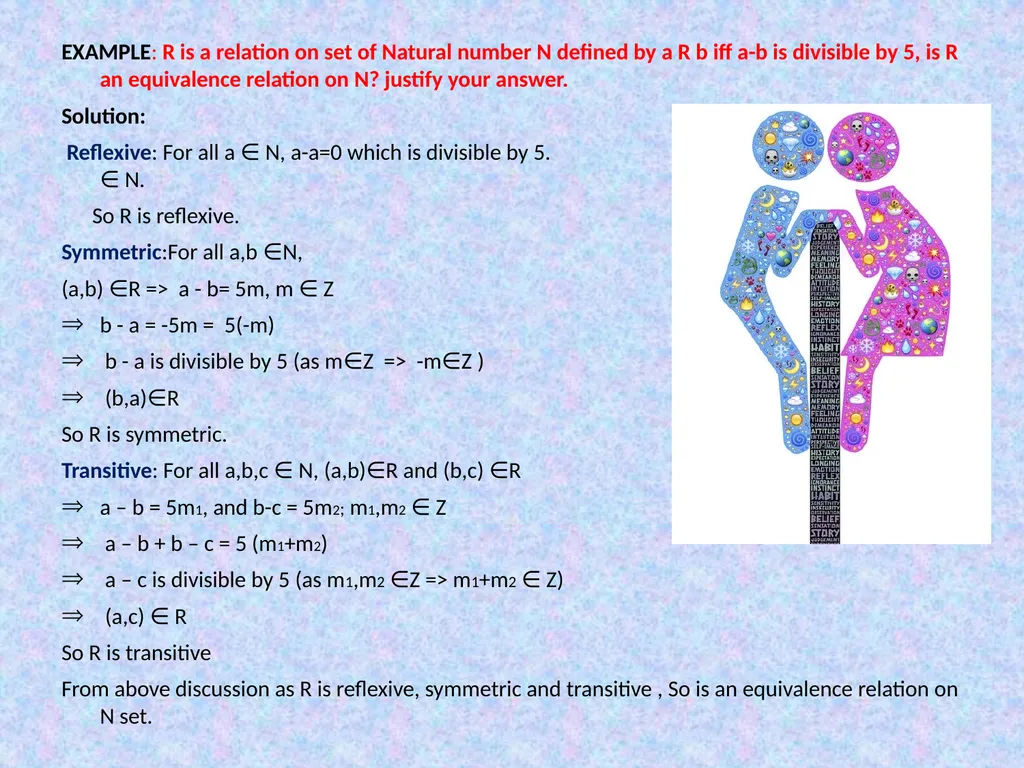
slide10. EXAMPLE: R is a relation on set of Natural number N defined by a R b iff a-b is divisible by 5, is R an equivalence relation on N? justify your answer.
Solution:
Reflexive: For all a ∈ N, a-a=0 which is divisible by 5. Hence (a,a) ∈R for all a ∈ N.
So R is reflexive.
Symmetric:For all a,b ∈N,
(a,b) ∈R => a - b= 5m, m ∈ Z
b - a = -5m = 5(-m)
b - a is divisible by 5 (as m∈Z => -m∈Z )
(b,a)∈R
So R is symmetric.
Transitive: For all a,b,c ∈ N, (a,b)∈R and (b,c) ∈R
a – b = 5m1, and b-c = 5m2; m1,m2 ∈ Z
a – b + b – c = 5 (m1+m2)
a – c is divisible by 5 (as m1,m2 ∈Z => m1+m2 ∈ Z)
(a,c) ∈ R
So R is transitive
From above discussion as R is reflexive, symmetric and transitive , So is an equivalence relation on N set.<br>
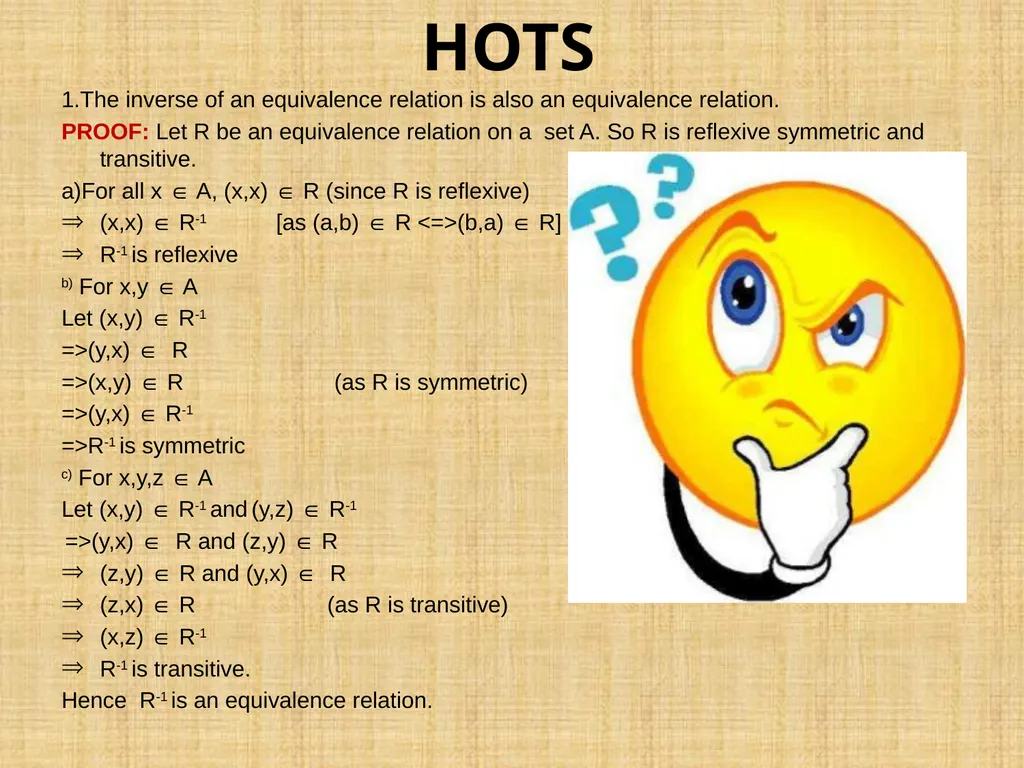
slide11. HOTS 1.The inverse of an equivalence relation is also an equivalence relation.
PROOF: Let R be an equivalence relation on a set A. So R is reflexive symmetric and transitive.
a)For all x ∈ A, (x,x) ∈ R (since R is reflexive)
(x,x) ∈ R-1 [as (a,b) ∈ R <=>(b,a) ∈ R]
R-1 is reflexive
b) For x,y ∈ A
Let (x,y) ∈ R-1
=>(y,x) ∈ R
=>(x,y) ∈ R (as R is symmetric)
=>(y,x) ∈ R-1
=>R-1 is symmetric
c) For x,y,z ∈ A
Let (x,y) ∈ R-1 and (y,z) ∈ R-1
=>(y,x) ∈ R and (z,y) ∈ R
(z,y) ∈ R and (y,x) ∈ R
(z,x) ∈ R (as R is transitive)
(x,z) ∈ R-1
R-1 is transitive.
Hence R-1 is an equivalence relation.<br>
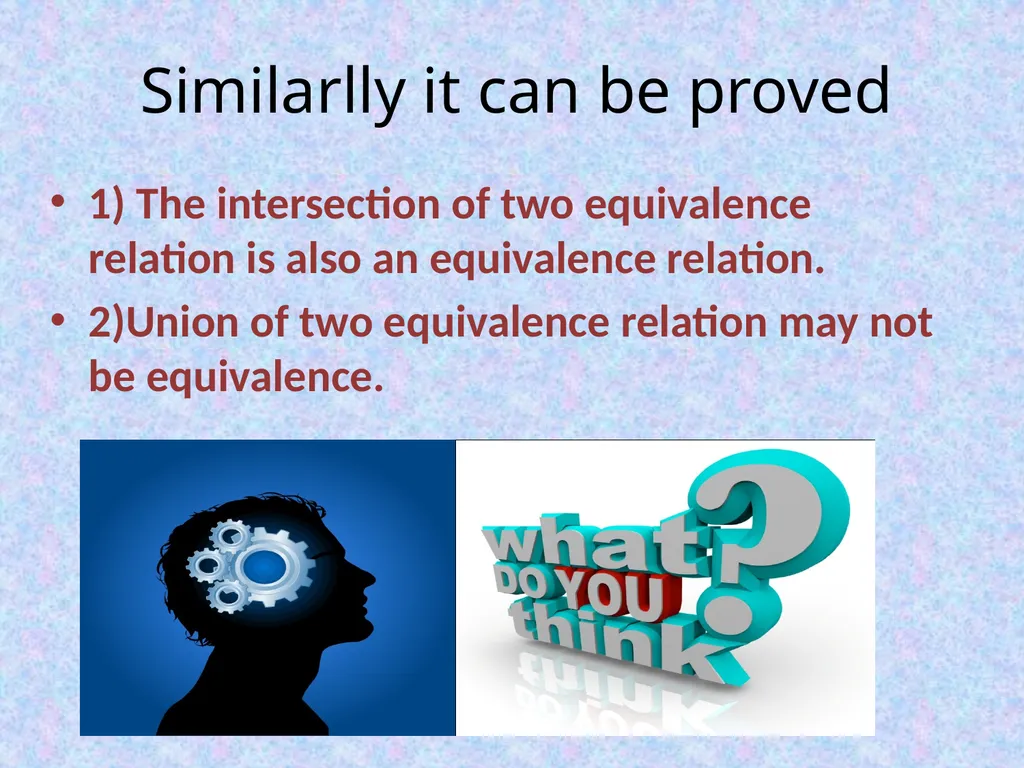
slide12. Similarlly it can be proved 1) The intersection of two equivalence relation is also an equivalence relation.
2)Union of two equivalence relation may not be equivalence.<br>
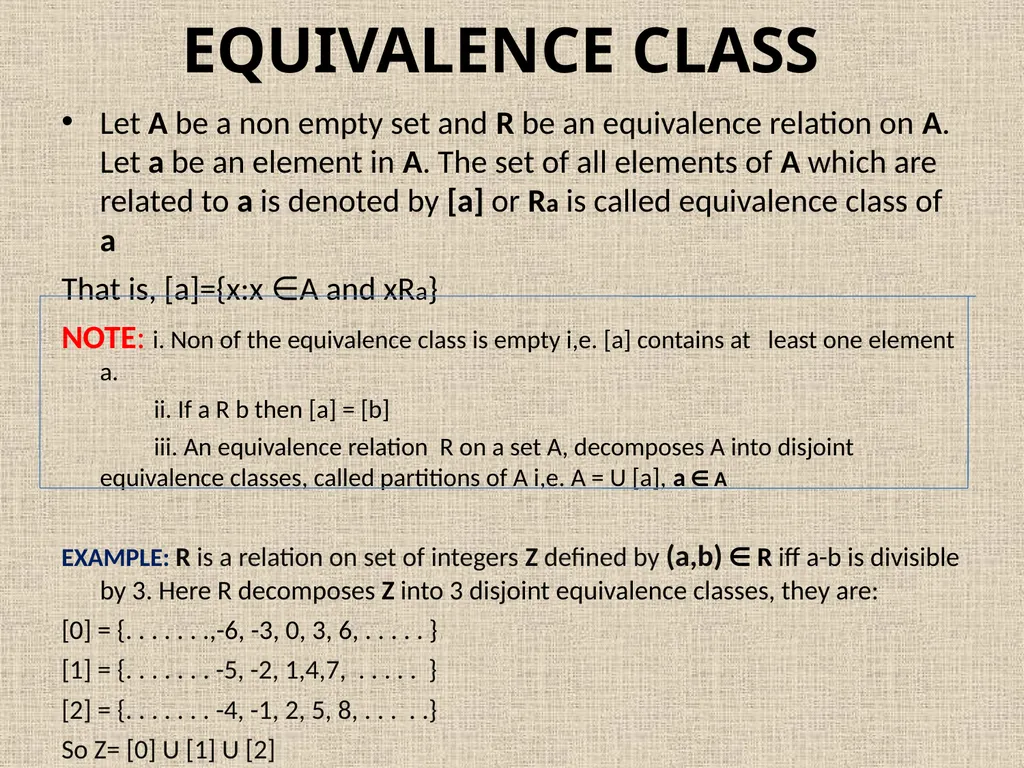
slide13. EQUIVALENCE CLASS Let A be a non empty set and R be an equivalence relation on A. Let a be an element in A. The set of all elements of A which are related to a is denoted by [a] or Ra is called equivalence class of a
That is, [a]={x:x ∈A and xRa}
NOTE: i. Non of the equivalence class is empty i,e. [a] contains at least one element a.
ii. If a R b then [a] = [b]
iii. An equivalence relation R on a set A, decomposes A into disjoint equivalence classes, called partitions of A i,e. A = U [a], a ∈ A
EXAMPLE: R is a relation on set of integers Z defined by (a,b) ∈ R iff a-b is divisible by 3. Here R decomposes Z into 3 disjoint equivalence classes, they are:
[0] = {. . . . . . .,-6, -3, 0, 3, 6, . . . . . }
[1] = {. . . . . . . -5, -2, 1,4,7, . . . . . }
[2] = {. . . . . . . -4, -1, 2, 5, 8, . . . . .}
So Z= [0] U [1] U [2]<br>
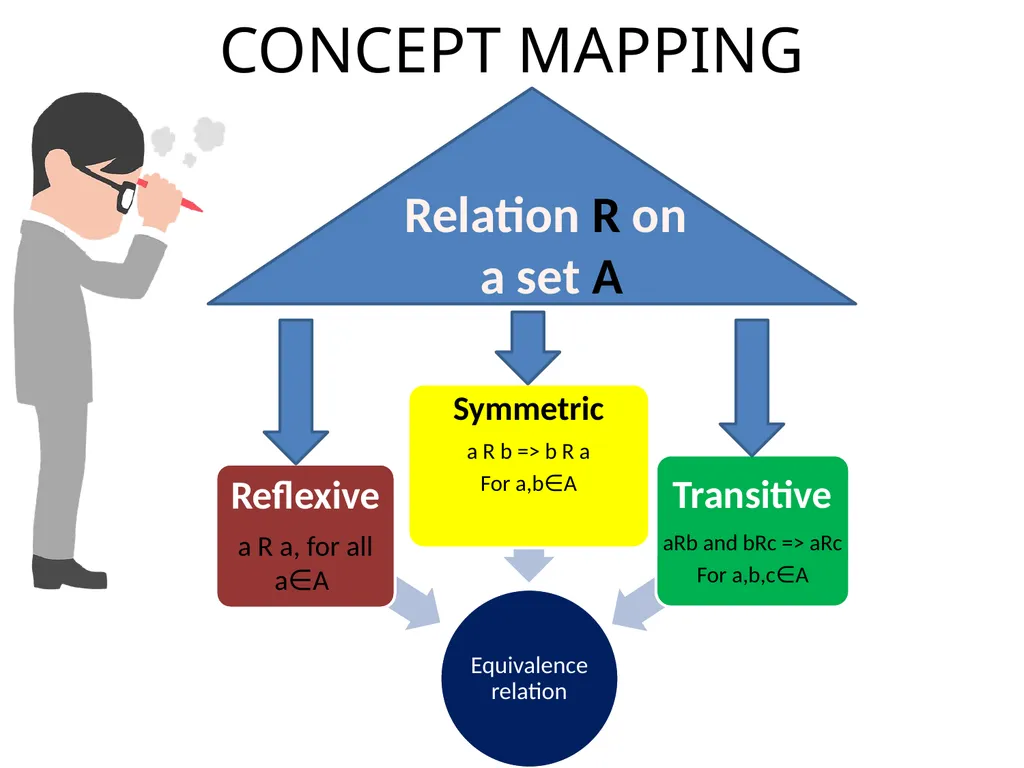
slide14. CONCEPT MAPPING Relation R on
a set A<br>
slide15. Thank you<br>
slide2. RELATION<br>
slide3. OBJECTIVE TO understand the meaning of relation and how the term in mathematics is completely same as the relation in our practical life.
To know about different types of relations and how to identify and differentiate them.<br>
slide4. INTRODUCTION Let us consider the following statements
1. Ramachandra is son of Dasarath.
2. Bhim is brother of Arjun.
3. 15 is divisible by 3.
In the above sentences, “is son of ”, “is brother of” and “is divisible by” associate or relate 2 human beigs or 2 numbers. These type of associations are called relation between 2 objects and also called binary relations.<br>
slide5. DEFINITION If A and B are any two non empty sets then any subset of AXB set is called a relation from A to B.
*As Ø is subset of every set so is a relation from A to B, it is the smallest relation called empty relation.
*AXB is also subset of AXB so it is the largest relation from A to B called universal relation.
*As total number of subsets of AXB is 2|AXB| , so total number of relations that can be defined from A to B is 2|AXB| = 2|A||B| .
Note:If A is any non empty set then any subset of AXA set is called a relation on A.<br>
slide6. PROPERTIES OF RELATION 1.REFLEXIVE: A relation R on any set A is said to be reflexive if for all a∈ A, (a,a)∈R.
EX: 1) Relation parallel to in set of straight lines.
2) Relation congruent to in set of triangles.
2.SYMMETRIC: A relation R on any set A is said to be symmetric if for a,b ∈ A,
(a,b)∈R => (b,a)∈R.
EX: 1)Relation parallel to (or perpendicular to)in set of straight lines.
2)Relation brother of in set of boys.
3.TRANSITIVE:A relation R on any set A is said to be transitive if for a,b,c ∈ A,
(a,b)∈R and (b,c)∈R => (a,c)∈R.
EX:1)Relation greater than (or smaller than) in set of numbers.
2) Relation congruent to in set of triangles.<br>
slide7. DIFFERENCE BETWEEN REFLEXIVE RELATION AND IDENTITY RELATION A relation R on any set A is said to be an identity relation if every element of A keep relation only with itself.
But if every element of A keep relation with itself then it is reflexive.
For example on set A= {a,b,c}, R1= {(a,a),(b,b),(c,c)} is called identity relation on A, it is also reflexive But R2={(a,a),(b,b),(c,c),(a,b)} it is reflexive but not identity relation on A.
NOTE: Every identity relations are reflexive but the converse is not always true.<br>
slide8. Equivalence relation A relation R on any set A is said to be an equivalence relation if R is reflexive , symmetric and transitive.
EX: 1) Relation parallel to in set of straight lines.
2) Relation congruent to in set of triangles.
NOTE: If |A| = n then
Number of relations on A is
Number of reflexive relations on A is
Number of symmetric relations on A is<br>
slide9. Example: Let A={a,b,c}
i) R1= {(a,b),(b,a)} is symmetric but neither reflexive nor transitive
ii) R2= {(a,a),(b,b)} is symmetric and transitive but not reflexive as (c,c) ∉R2
iii)R3= {(a,a),(b,b),(c,c),(a,b)} it is reflexive and transitive but not symmetric as (a,b)∈R3 but (b,a) ∉R3.
iv) R4= {(a,b),(b,c)} is neither reflexive nor symmetric nor transitive.
v) R5= {(a,a),(b,b),(c,c)} is reflexive, symmetric as well as transitive and it is the smallest equivalence relation on A={a,b,c}.<br>
slide10. EXAMPLE: R is a relation on set of Natural number N defined by a R b iff a-b is divisible by 5, is R an equivalence relation on N? justify your answer.
Solution:
Reflexive: For all a ∈ N, a-a=0 which is divisible by 5. Hence (a,a) ∈R for all a ∈ N.
So R is reflexive.
Symmetric:For all a,b ∈N,
(a,b) ∈R => a - b= 5m, m ∈ Z
b - a = -5m = 5(-m)
b - a is divisible by 5 (as m∈Z => -m∈Z )
(b,a)∈R
So R is symmetric.
Transitive: For all a,b,c ∈ N, (a,b)∈R and (b,c) ∈R
a – b = 5m1, and b-c = 5m2; m1,m2 ∈ Z
a – b + b – c = 5 (m1+m2)
a – c is divisible by 5 (as m1,m2 ∈Z => m1+m2 ∈ Z)
(a,c) ∈ R
So R is transitive
From above discussion as R is reflexive, symmetric and transitive , So is an equivalence relation on N set.<br>
slide11. HOTS 1.The inverse of an equivalence relation is also an equivalence relation.
PROOF: Let R be an equivalence relation on a set A. So R is reflexive symmetric and transitive.
a)For all x ∈ A, (x,x) ∈ R (since R is reflexive)
(x,x) ∈ R-1 [as (a,b) ∈ R <=>(b,a) ∈ R]
R-1 is reflexive
b) For x,y ∈ A
Let (x,y) ∈ R-1
=>(y,x) ∈ R
=>(x,y) ∈ R (as R is symmetric)
=>(y,x) ∈ R-1
=>R-1 is symmetric
c) For x,y,z ∈ A
Let (x,y) ∈ R-1 and (y,z) ∈ R-1
=>(y,x) ∈ R and (z,y) ∈ R
(z,y) ∈ R and (y,x) ∈ R
(z,x) ∈ R (as R is transitive)
(x,z) ∈ R-1
R-1 is transitive.
Hence R-1 is an equivalence relation.<br>
slide12. Similarlly it can be proved 1) The intersection of two equivalence relation is also an equivalence relation.
2)Union of two equivalence relation may not be equivalence.<br>
slide13. EQUIVALENCE CLASS Let A be a non empty set and R be an equivalence relation on A. Let a be an element in A. The set of all elements of A which are related to a is denoted by [a] or Ra is called equivalence class of a
That is, [a]={x:x ∈A and xRa}
NOTE: i. Non of the equivalence class is empty i,e. [a] contains at least one element a.
ii. If a R b then [a] = [b]
iii. An equivalence relation R on a set A, decomposes A into disjoint equivalence classes, called partitions of A i,e. A = U [a], a ∈ A
EXAMPLE: R is a relation on set of integers Z defined by (a,b) ∈ R iff a-b is divisible by 3. Here R decomposes Z into 3 disjoint equivalence classes, they are:
[0] = {. . . . . . .,-6, -3, 0, 3, 6, . . . . . }
[1] = {. . . . . . . -5, -2, 1,4,7, . . . . . }
[2] = {. . . . . . . -4, -1, 2, 5, 8, . . . . .}
So Z= [0] U [1] U [2]<br>
slide14. CONCEPT MAPPING Relation R on
a set A<br>
slide15. Thank you<br>