Classification Essential Question: How do scientists classify living organisms? Standards: S7L1a. Demonstrate the process for the development of a dichotomous key. S7L1b. Classify organisms based on physical characteristics using a
"Classification Essential Question: How do" is the property of its rightful owner. Permission is granted to
download and print the materials on this website for personal, non-commercial use only, and to display it
on your personal computer provided you do not modify the materials and that you retain all copyright
notices contained in the materials. By downloading content from our website, you accept the terms of this
agreement.
Presentation Transcript
01
Classification<br>
02
Essential Question: How do scientists classify living organisms?<br>
03
Standards: S7L1a. Demonstrate the process for the development of a dichotomous key.
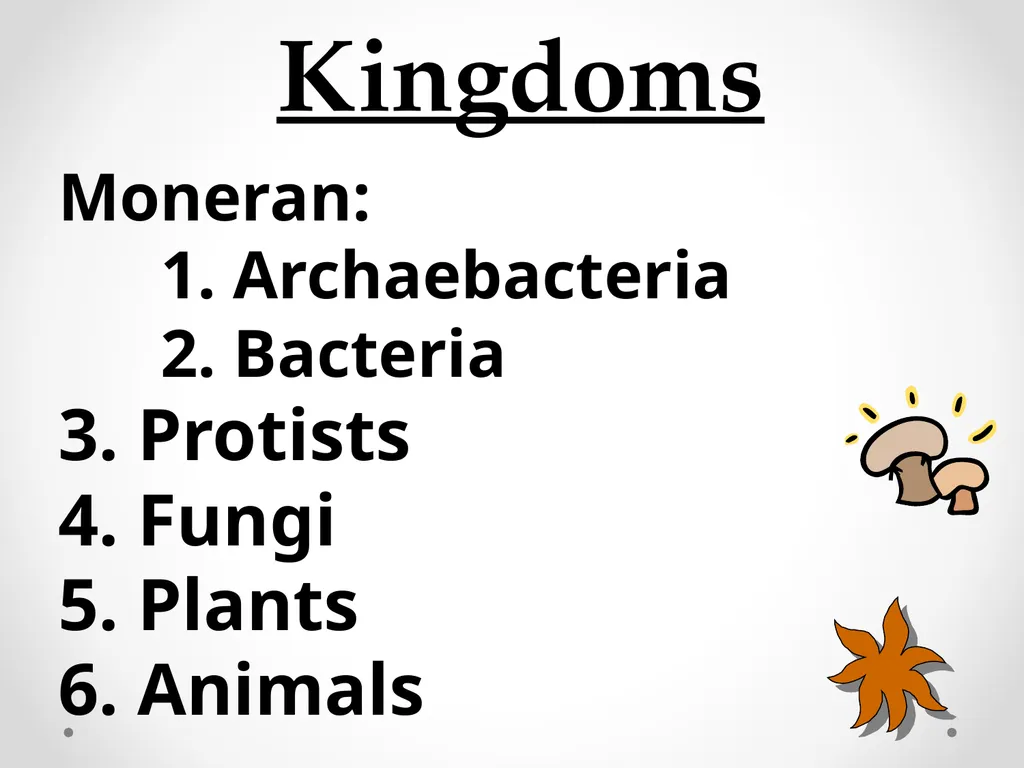
S7L1b. Classify organisms based on physical characteristics using a dichotomous key of the six kingdom system (archaebacteria, eubacteria, protists, fungi, plants, and animals)
S7L3b. Compare and contrast that organisms reproduce asexually and sexually (bacteria, protists, fungi, plants and animals)<br>
04
What is classification? Classification is the process of arranging organisms into groups based on similarities.<br>
05
Why should things be classified? Classification makes things easier to find, identify, and study.<br>
06
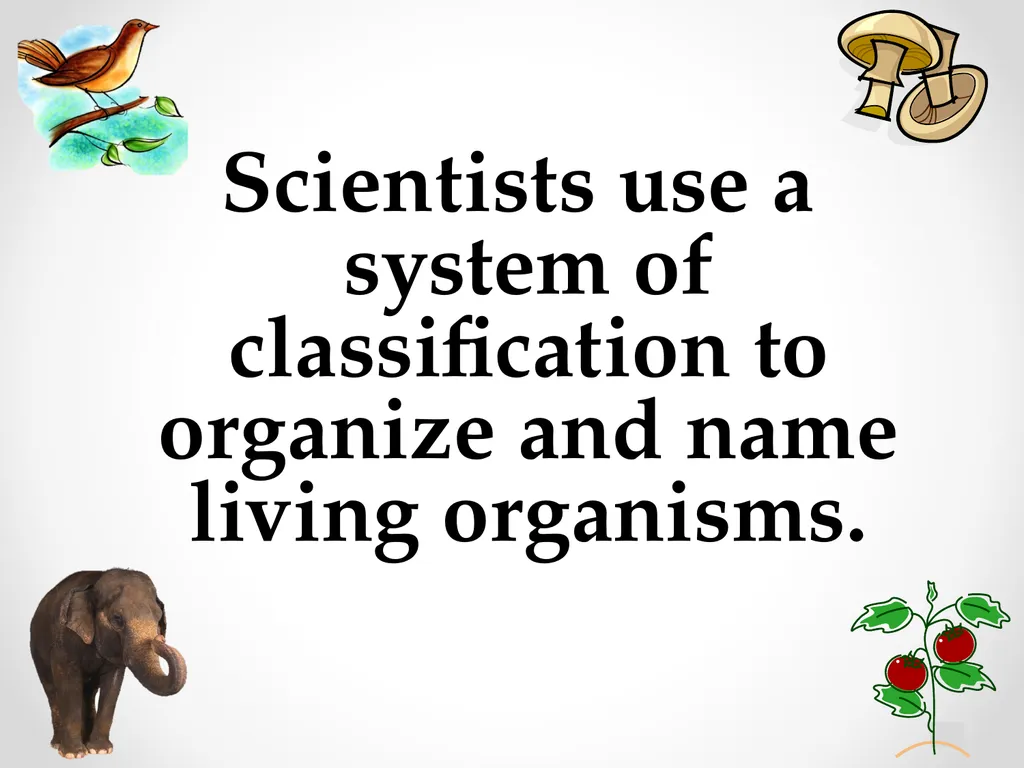
Scientists use a system of classification to organize and name living organisms.<br>
07
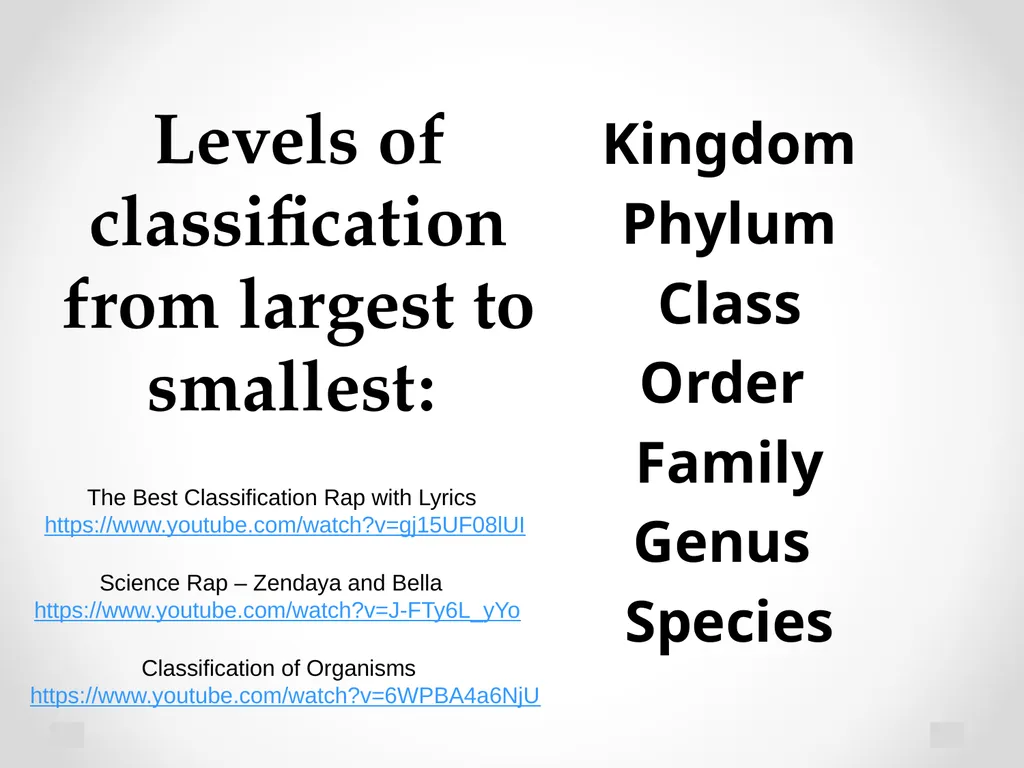
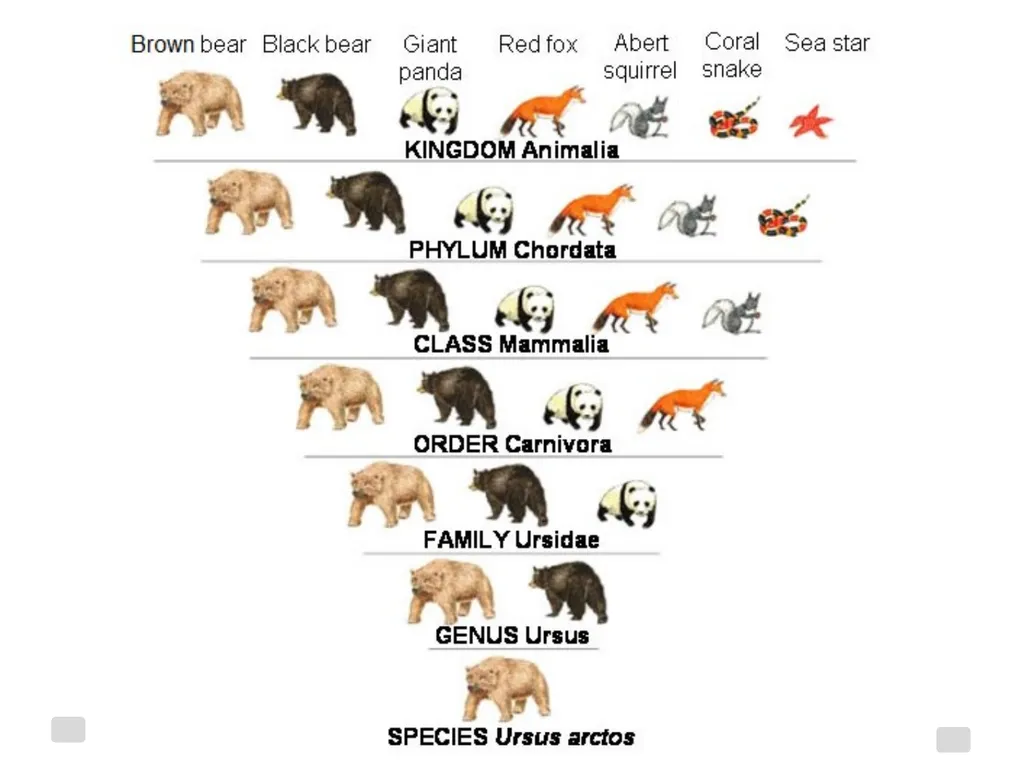
Levels of classification from largest to smallest: Kingdom
Phylum
Class
Order
Family
Genus
Species Science Rap – Zendaya and Bella https://www.youtube.com/watch?v=J-FTy6L_yYo Classification of Organisms https://www.youtube.com/watch?v=6WPBA4a6NjU The Best Classification Rap with Lyrics https://www.youtube.com/watch?v=gj15UF08lUI<br>
08
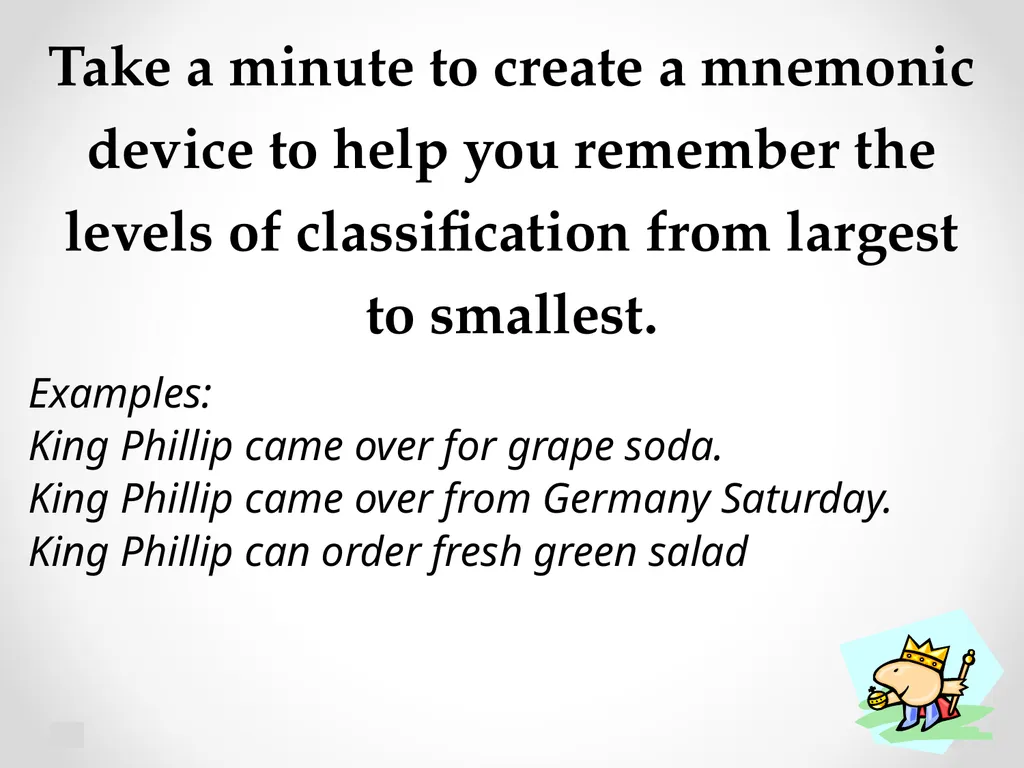
Take a minute to create a mnemonic device to help you remember the levels of classification from largest to smallest. Examples:
King Phillip came over for grape soda.
King Phillip came over from Germany Saturday.
King Phillip can order fresh green salad<br>
09
.
Is it necessary to go through the entire seven-level classification system to identify a plant or animal?<br>
10
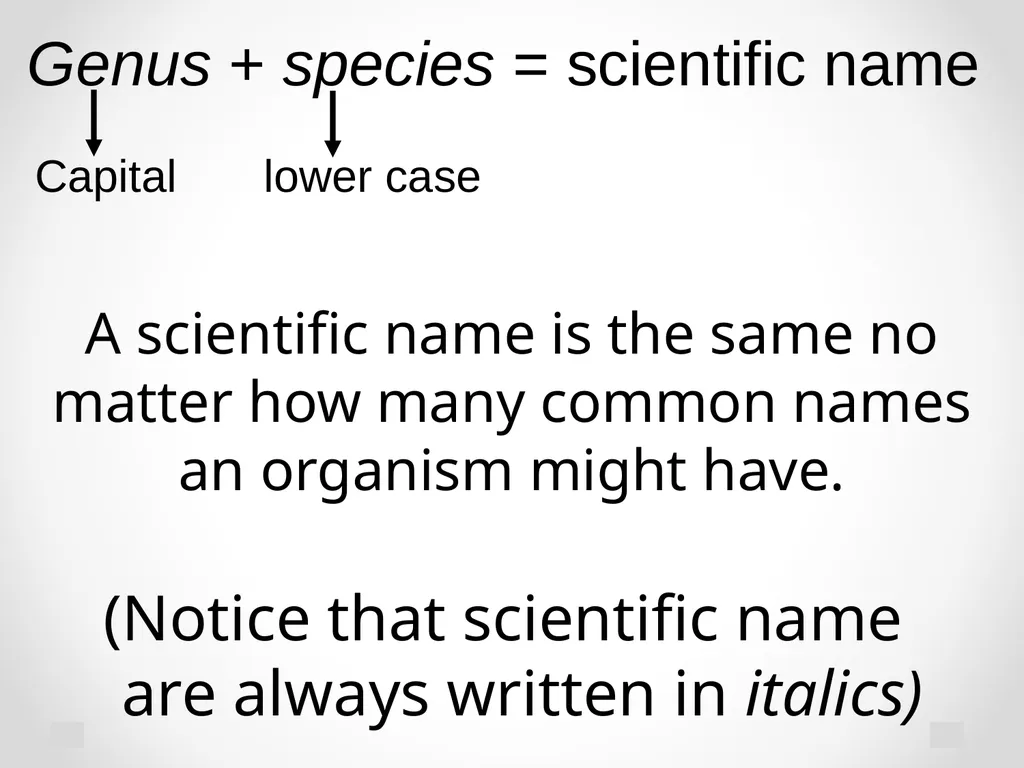
Latin and Greek words are used to give organisms a name (similar to a first and last name) for identification. The GENUS and SPECIES names are enough… Thus, the scientific name for the brown squirrel is Tamiasciurus hudsonicus<br>
11
A scientific name is the same no matter how many common names an organism might have. (Notice that scientific name are always written in italics)<br>
12
Classification of Living Things Video: https://www.youtube.com/watch?v=5hMqYiWry8U Mr. Parr: Classification Song (modified w/pics) https://www.youtube.com/watch?v=wgivfVM9yOQ Mr. Parr: Classification Song (same but with words) https://www.youtube.com/watch?v=dnF_UdPbJZ0<br>
13
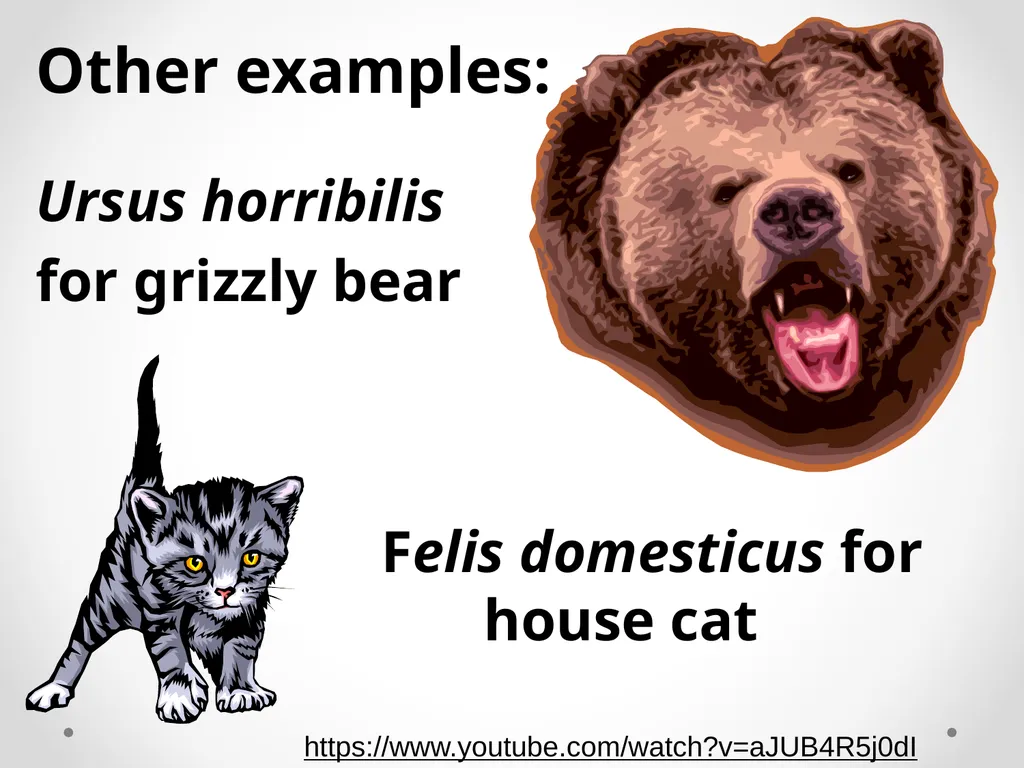
Other examples:
Ursus horribilis
for grizzly bear
Felis domesticus for house cat https://www.youtube.com/watch?v=aJUB4R5j0dI<br>
14
A dichotomous key is a tool used to identify organisms.
A dichotomous key asks a series of questions that can be answered by yes or no.
Dichotomous keys work like a funnel. It narrows down the characteristics to a specific organism.<br>
15
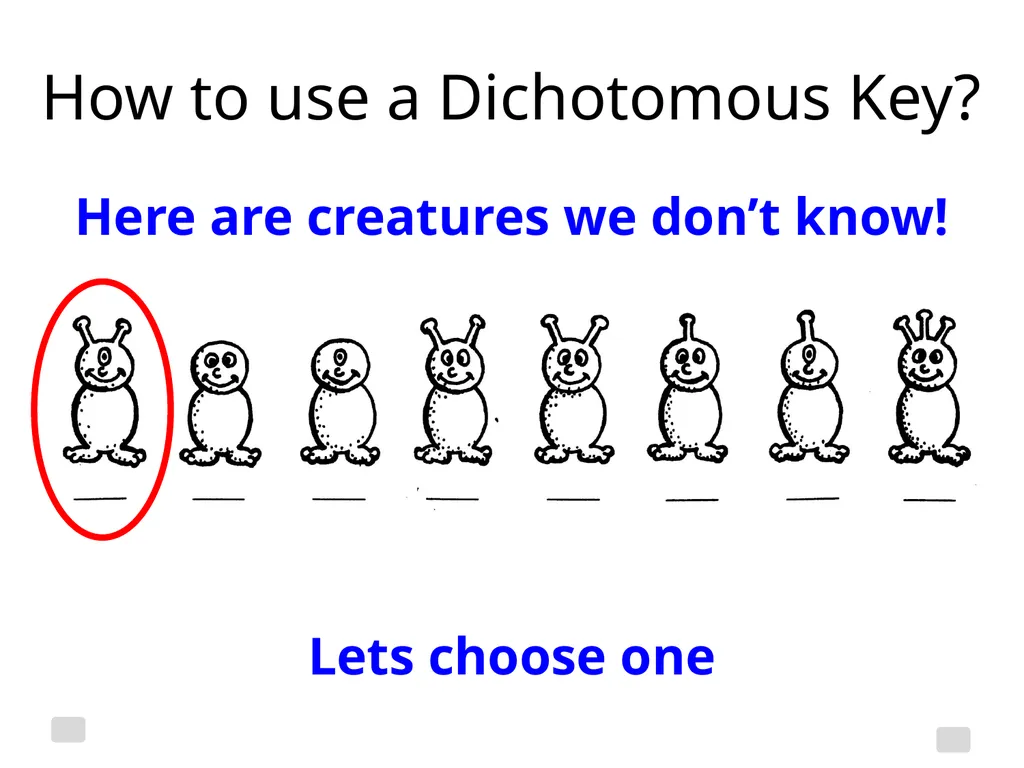
Here are creatures we don’t know!
Lets choose one How to use a Dichotomous Key?<br>
16
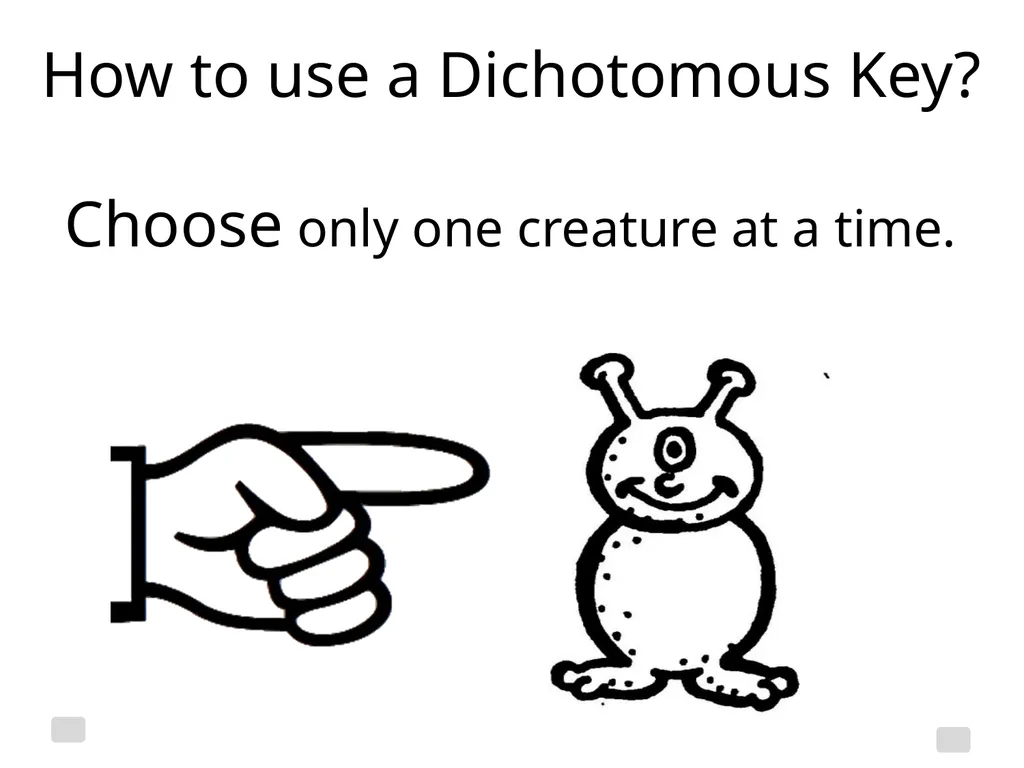
How to use a Dichotomous Key? Choose only one creature at a time.<br>
17
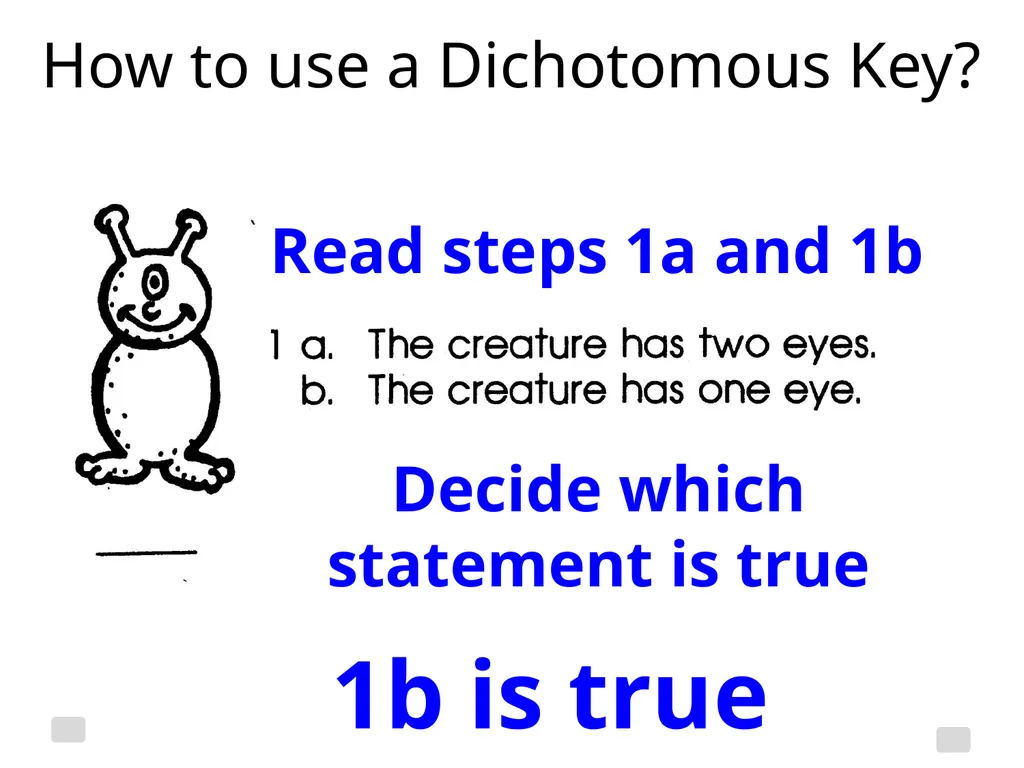
Read steps 1a and 1b Decide which statement is true How to use a Dichotomous Key? 1b is true<br>
18
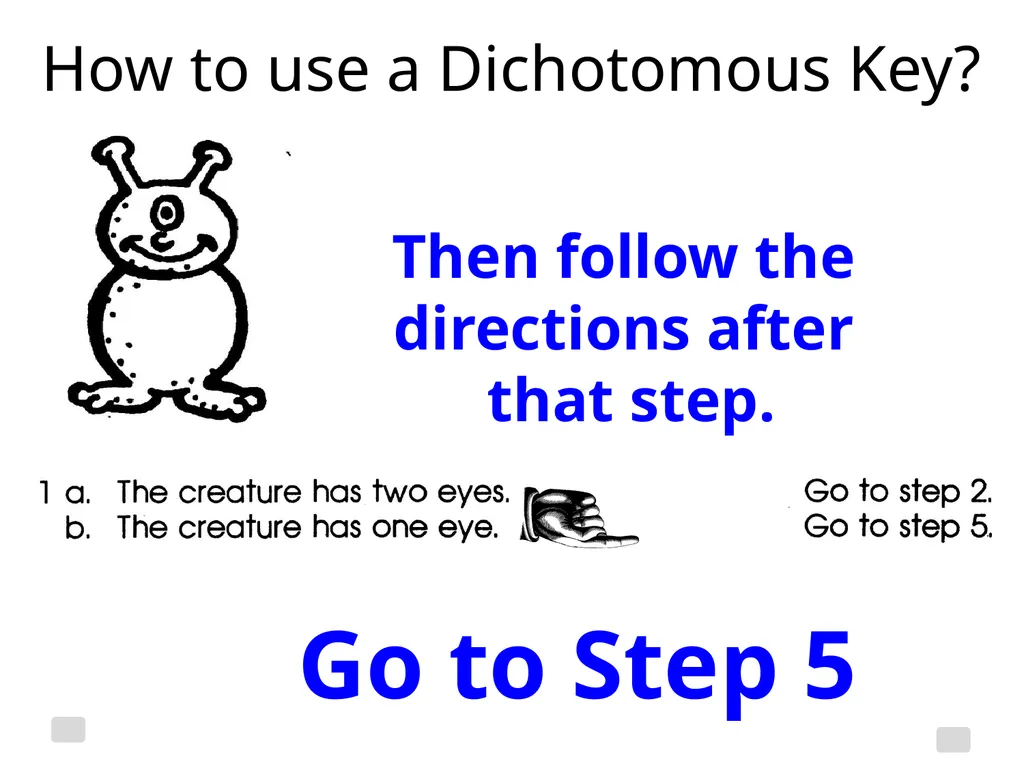
How to use a Dichotomous Key? Then follow the directions after that step. Go to Step 5<br>
19
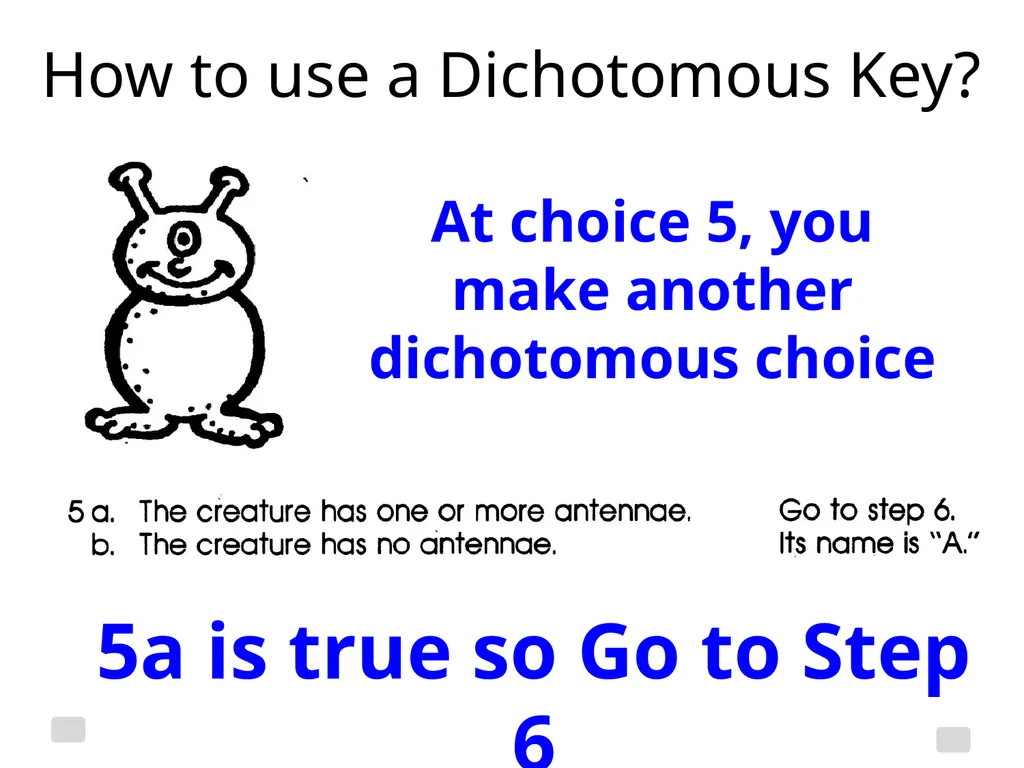
How to use a Dichotomous Key? At choice 5, you make another dichotomous choice 5a is true so Go to Step 6<br>
20
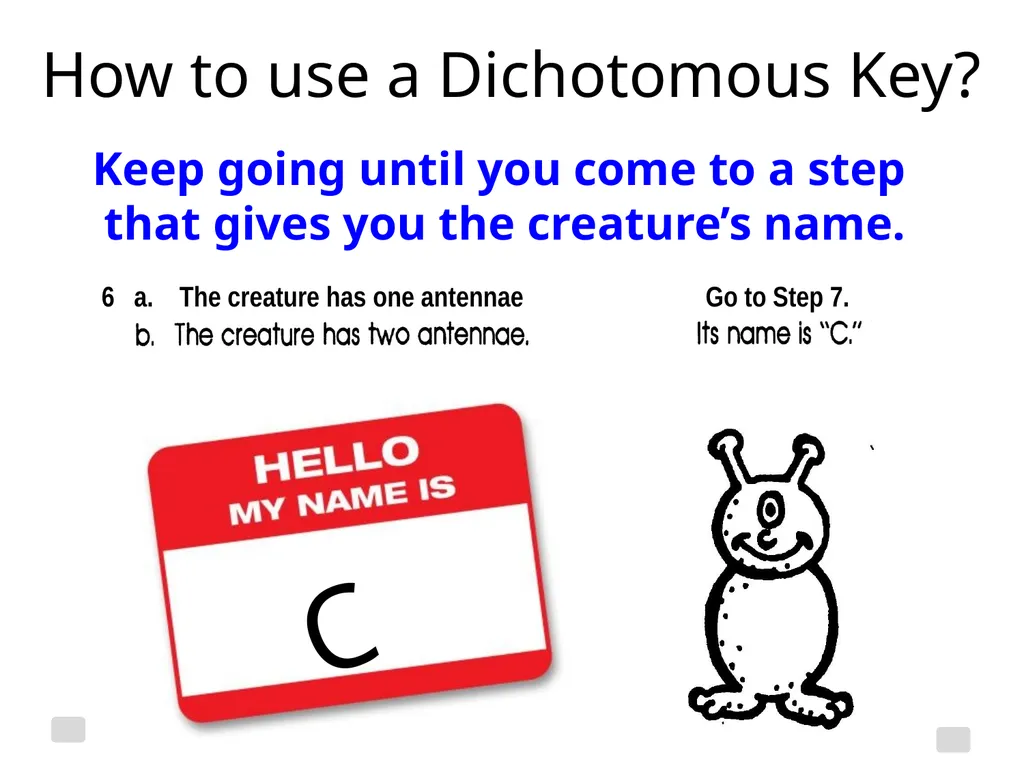
Keep going until you come to a step
that gives you the creature’s name. How to use a Dichotomous Key?<br>
21
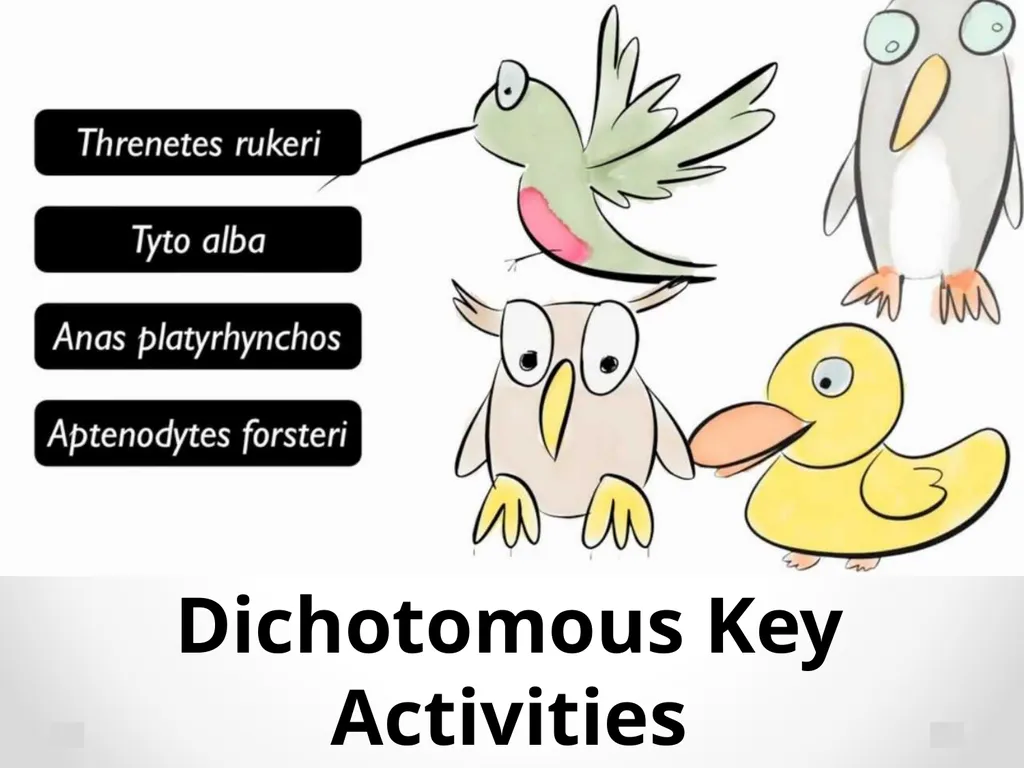
Dichotomous Key Activities<br>
22
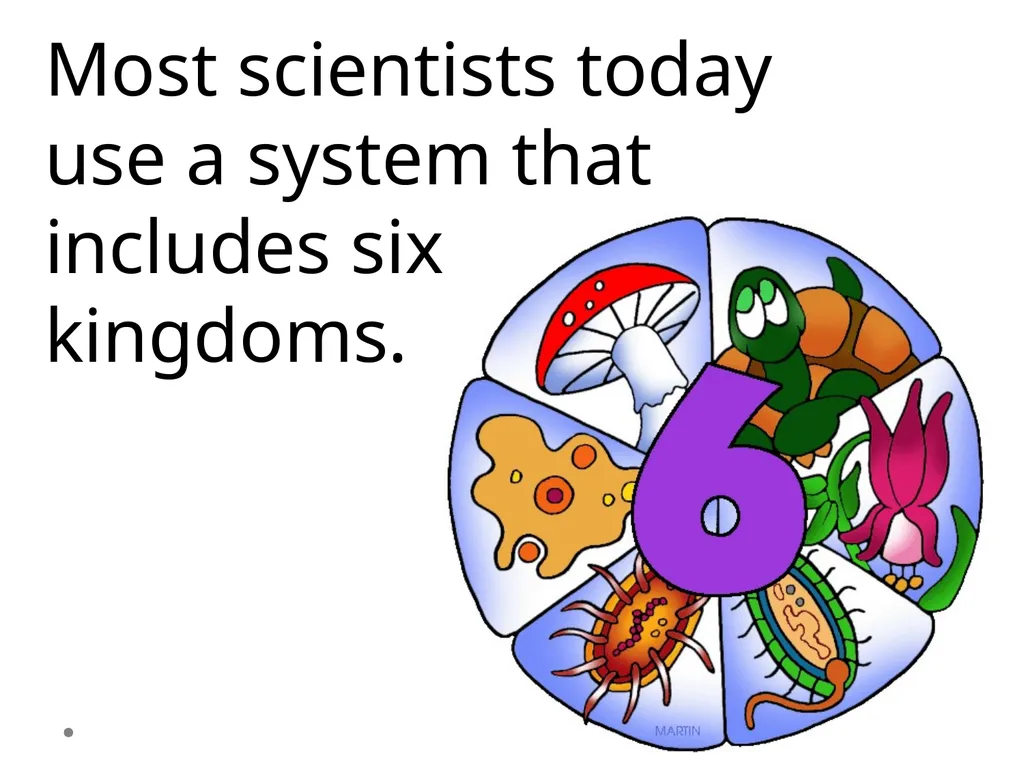
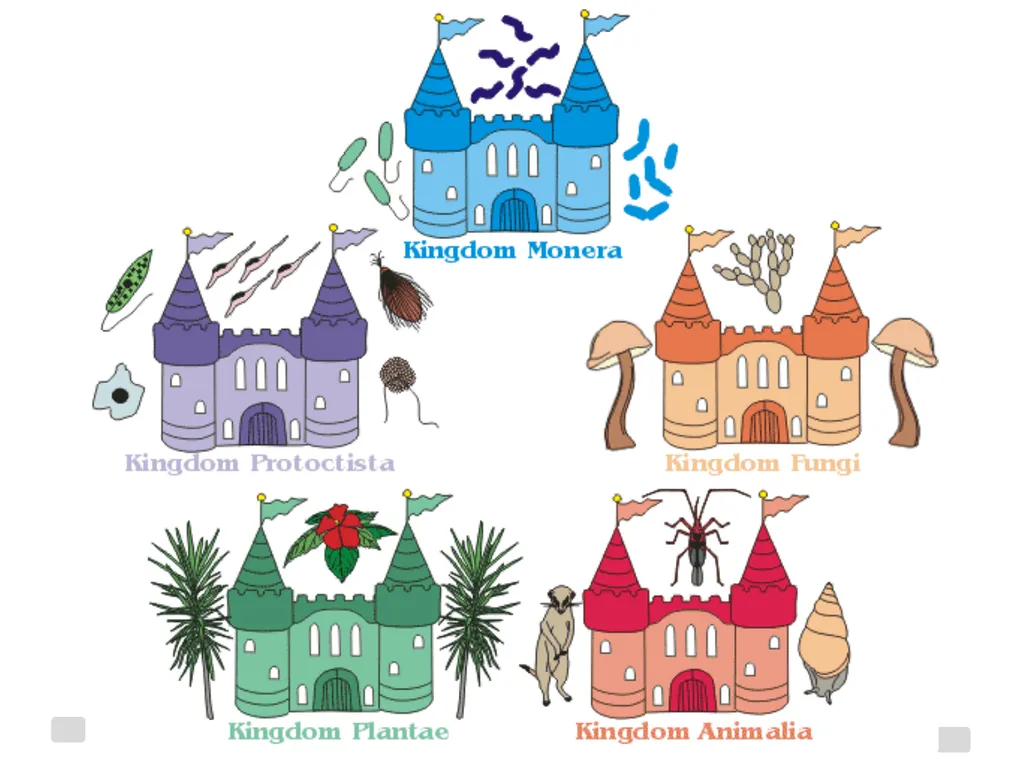
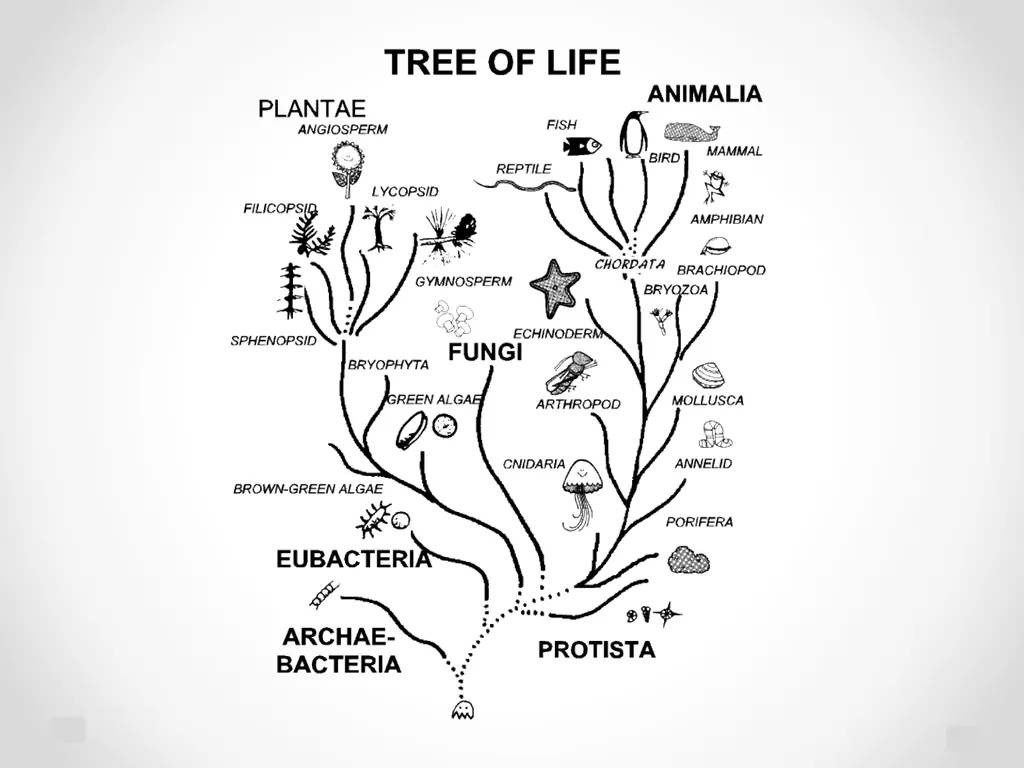
Most scientists today use a system that includes six kingdoms.<br>
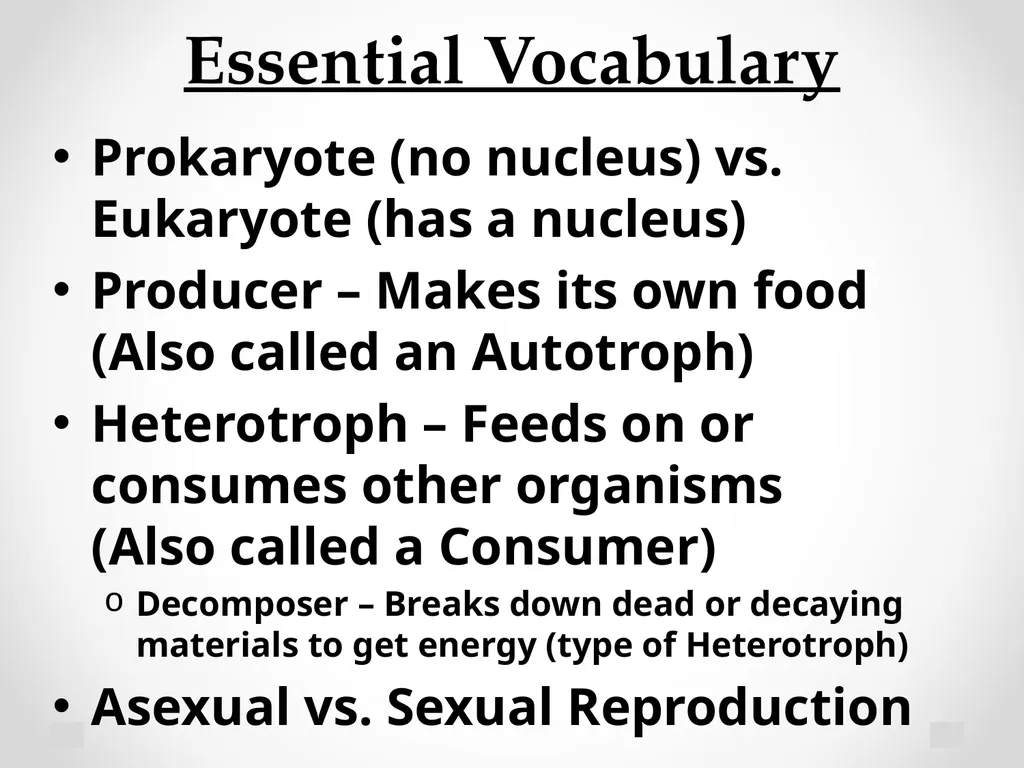
Essential Vocabulary Prokaryote (no nucleus) vs. Eukaryote (has a nucleus)
Producer – Makes its own food (Also called an Autotroph)
Heterotroph – Feeds on or consumes other organisms (Also called a Consumer)
Decomposer – Breaks down dead or decaying materials to get energy (type of Heterotroph)
Asexual vs. Sexual Reproduction<br>
25
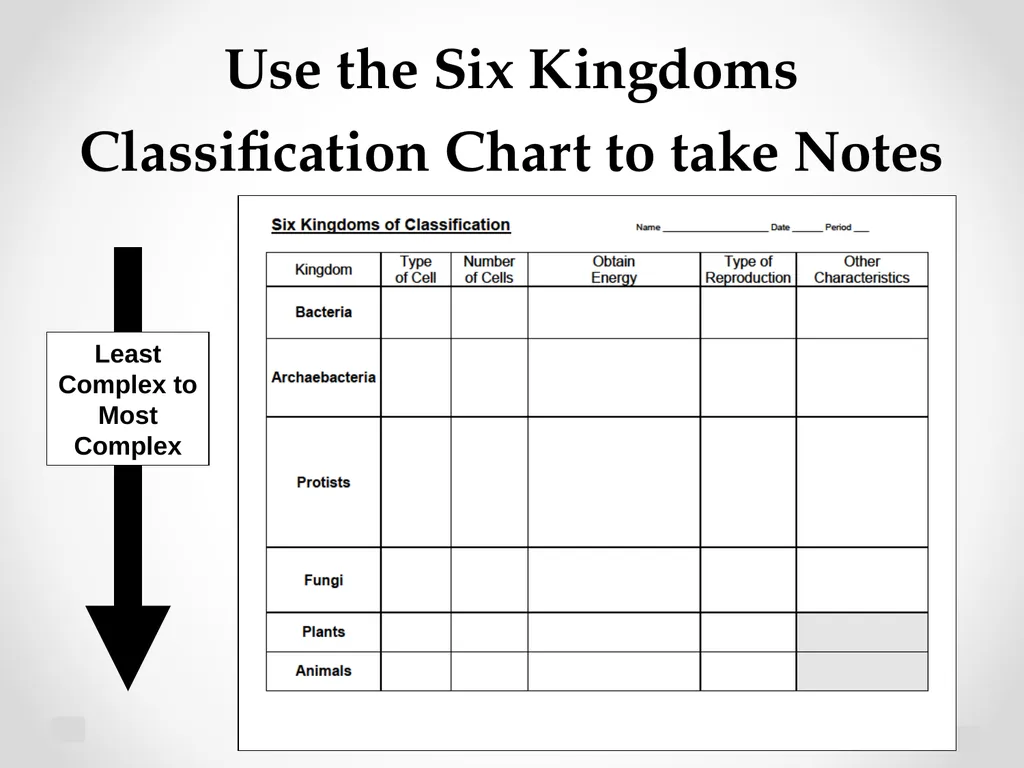
Use the Six Kingdoms Classification Chart to take Notes Least Complex to Most Complex<br>
26
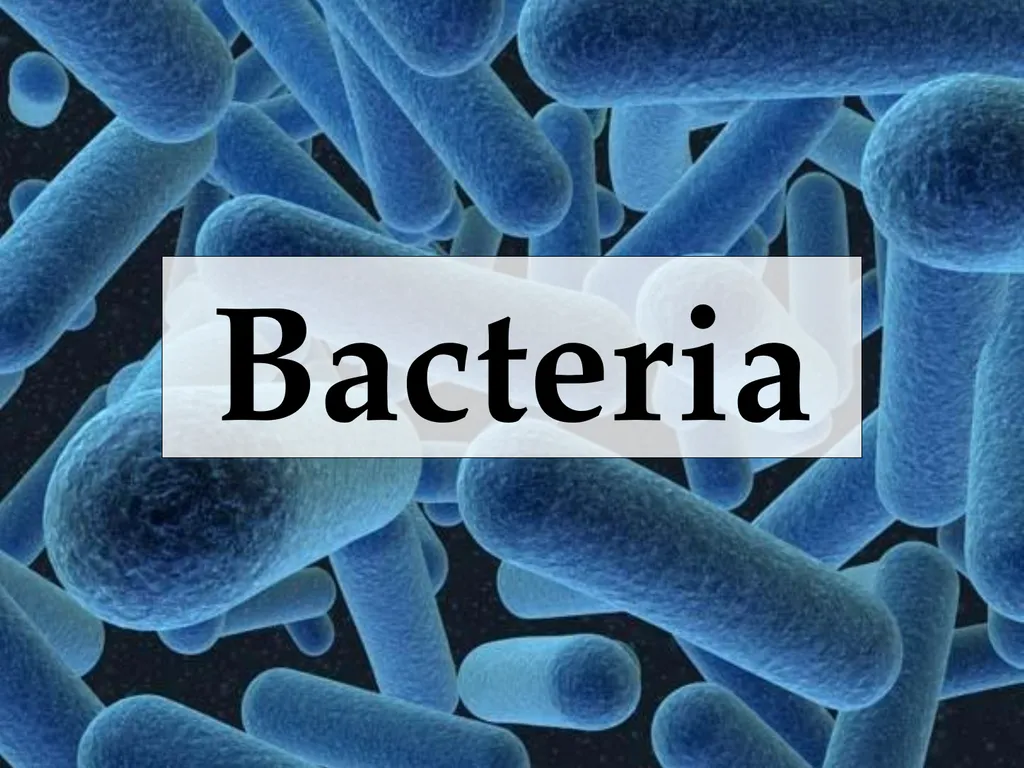
Bacteria<br>
27
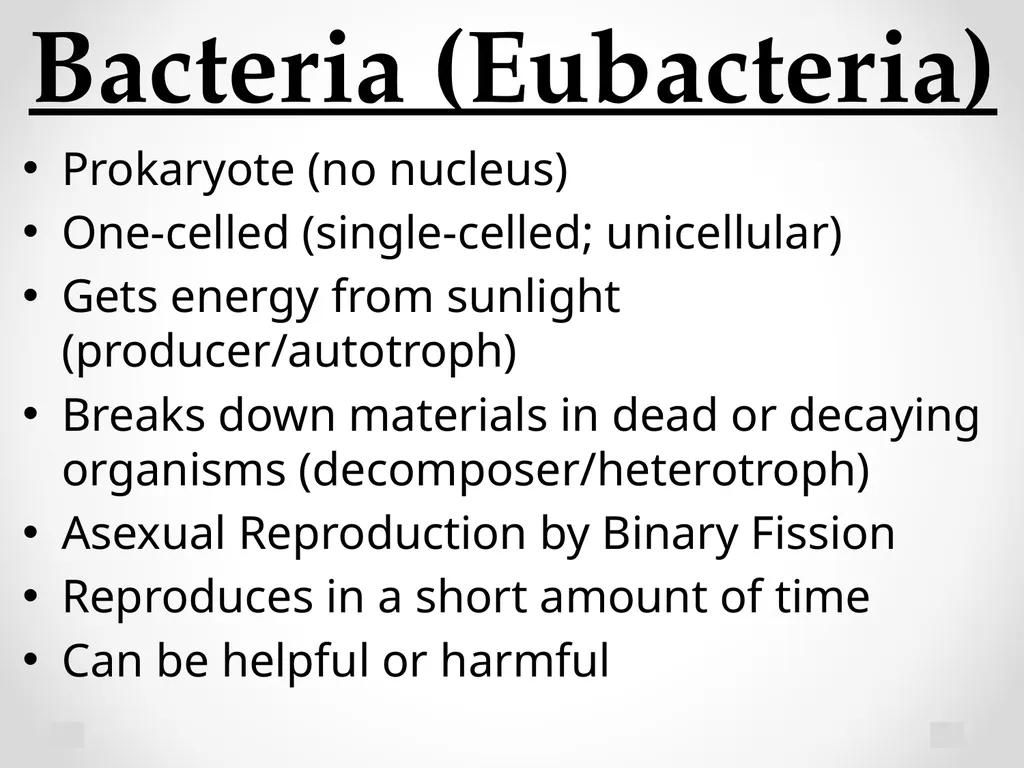
Bacteria (Eubacteria) Prokaryote (no nucleus)
One-celled (single-celled; unicellular)
Gets energy from sunlight (producer/autotroph)
Breaks down materials in dead or decaying organisms (decomposer/heterotroph)
Asexual Reproduction by Binary Fission
Reproduces in a short amount of time
Can be helpful or harmful<br>
28
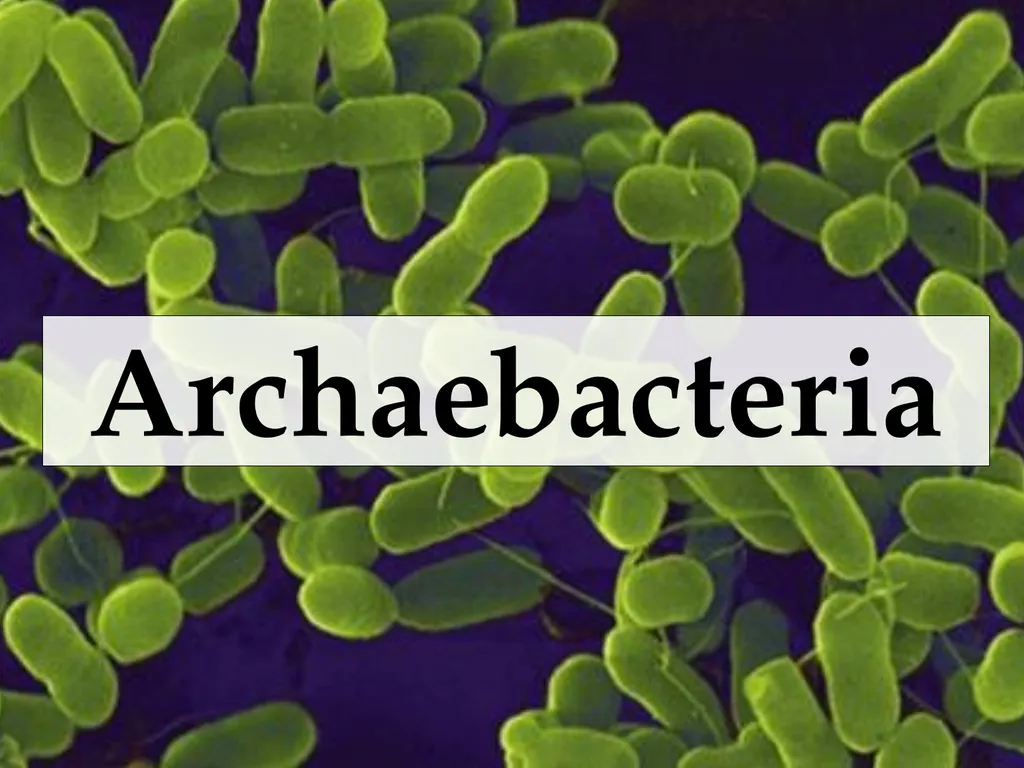
Archaebacteria<br>
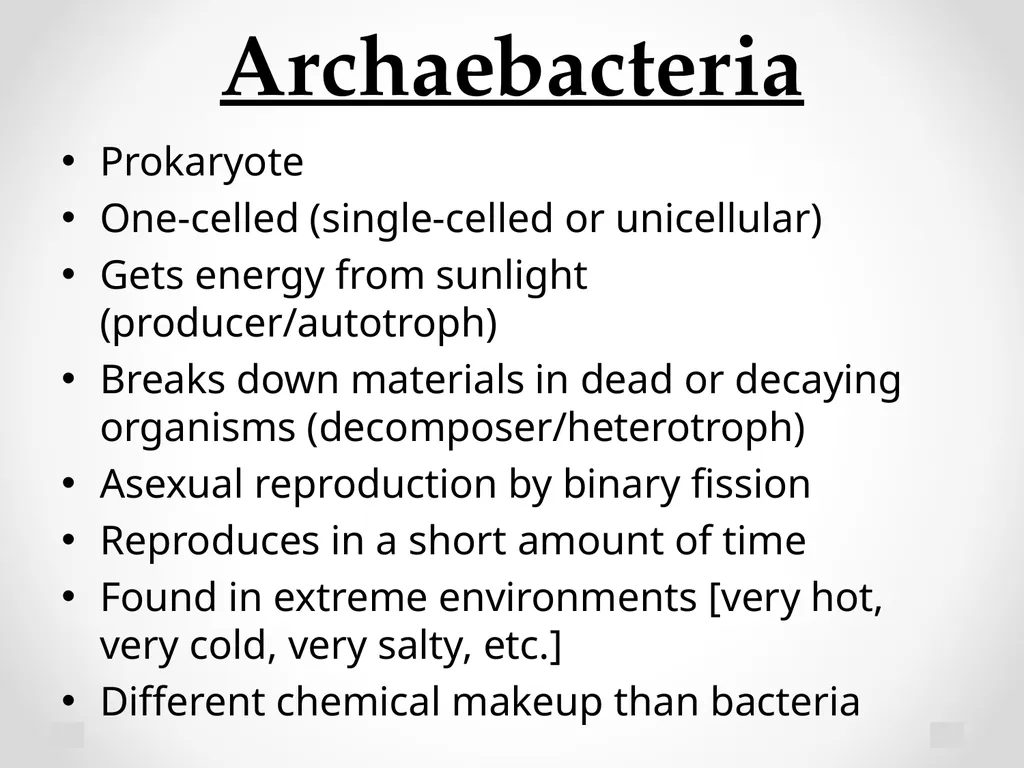
29
Archaebacteria Prokaryote
One-celled (single-celled or unicellular)
Gets energy from sunlight (producer/autotroph)
Breaks down materials in dead or decaying organisms (decomposer/heterotroph)
Asexual reproduction by binary fission
Reproduces in a short amount of time
Found in extreme environments [very hot, very cold, very salty, etc.]
Different chemical makeup than bacteria<br>
30
Protists<br>
31
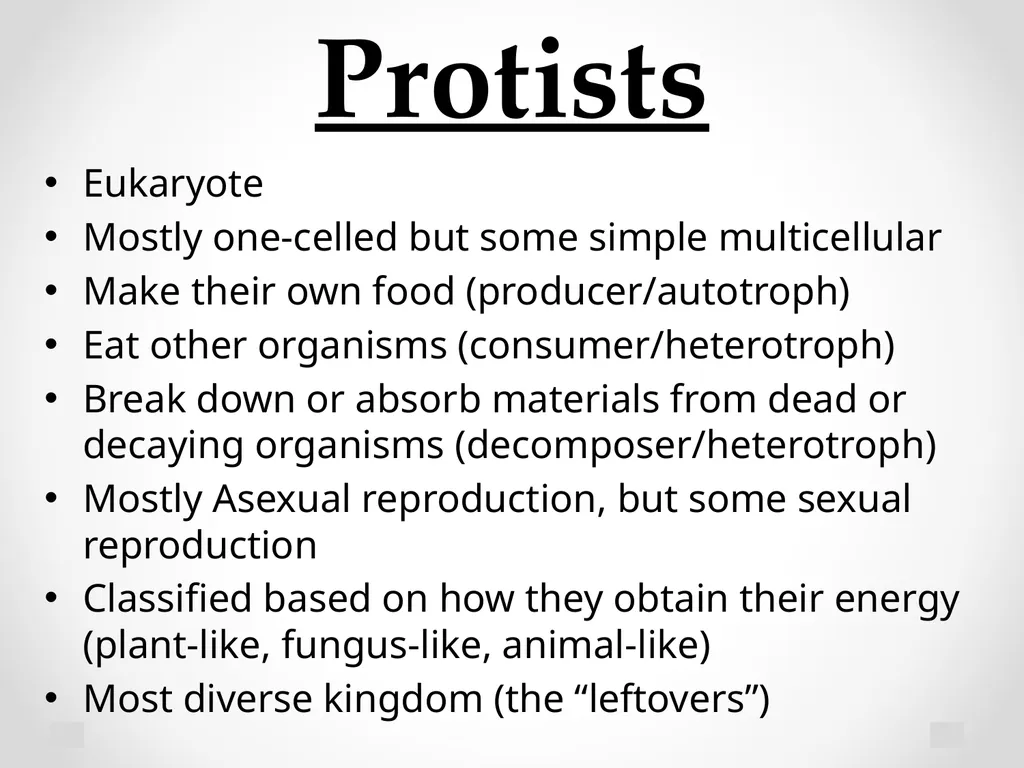
Protists Eukaryote
Mostly one-celled but some simple multicellular
Make their own food (producer/autotroph)
Eat other organisms (consumer/heterotroph)
Break down or absorb materials from dead or decaying organisms (decomposer/heterotroph)
Mostly Asexual reproduction, but some sexual reproduction
Classified based on how they obtain their energy (plant-like, fungus-like, animal-like)
Most diverse kingdom (the “leftovers”)<br>
32
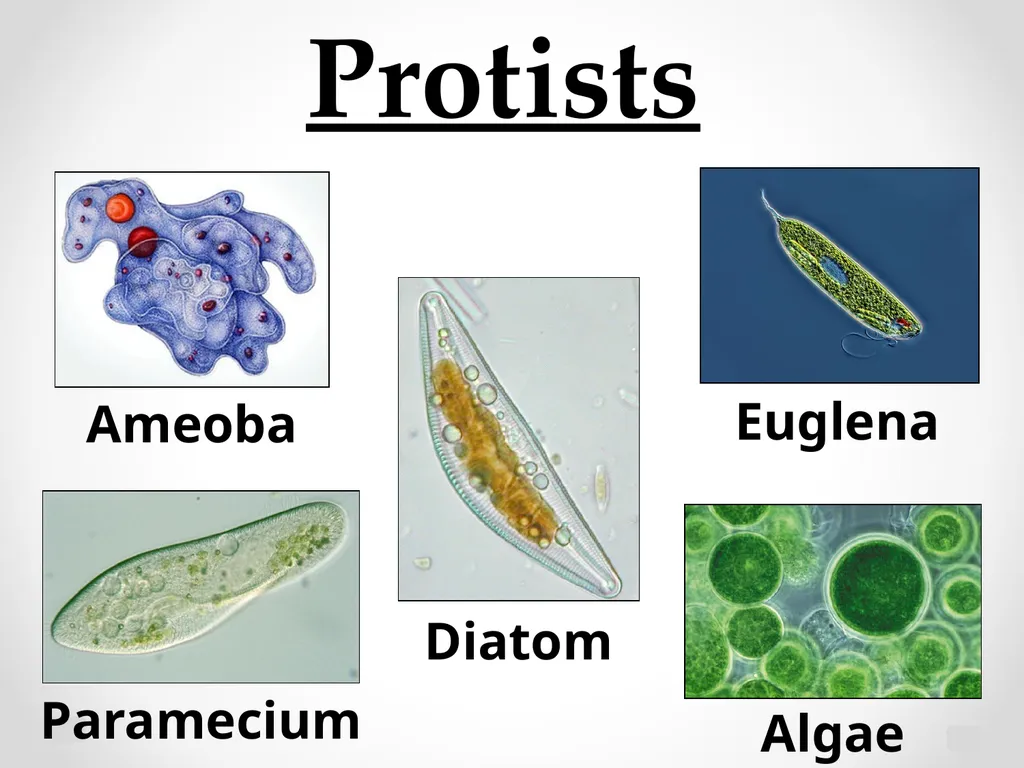
Protists<br>
33
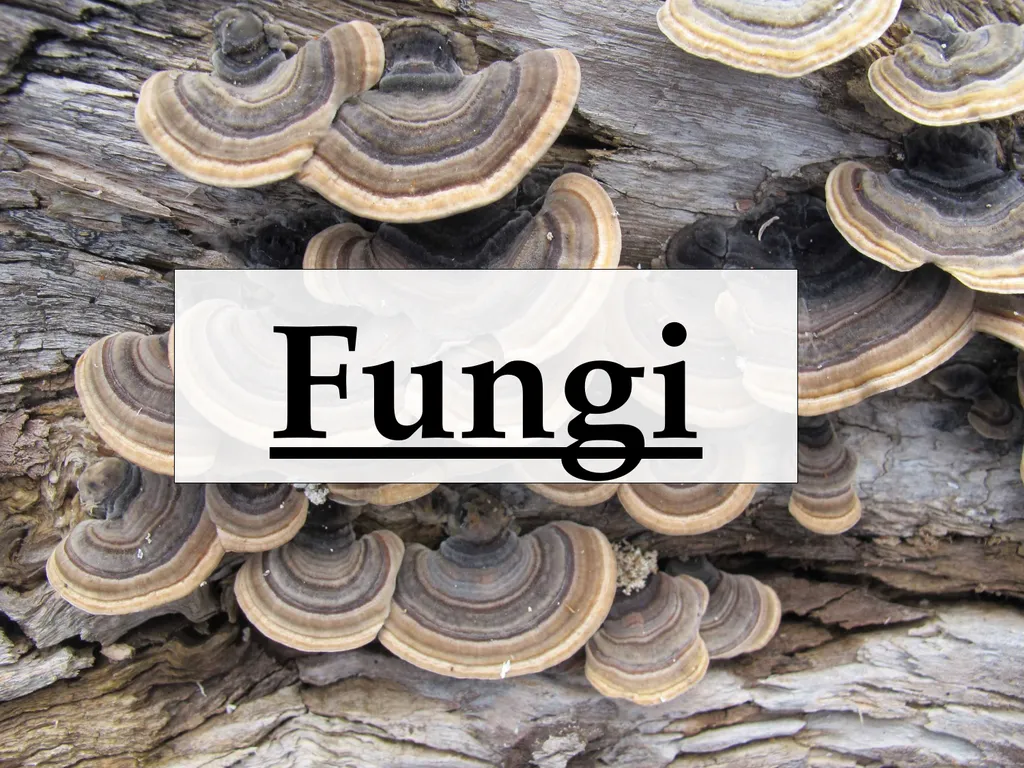
Fungi<br>
34
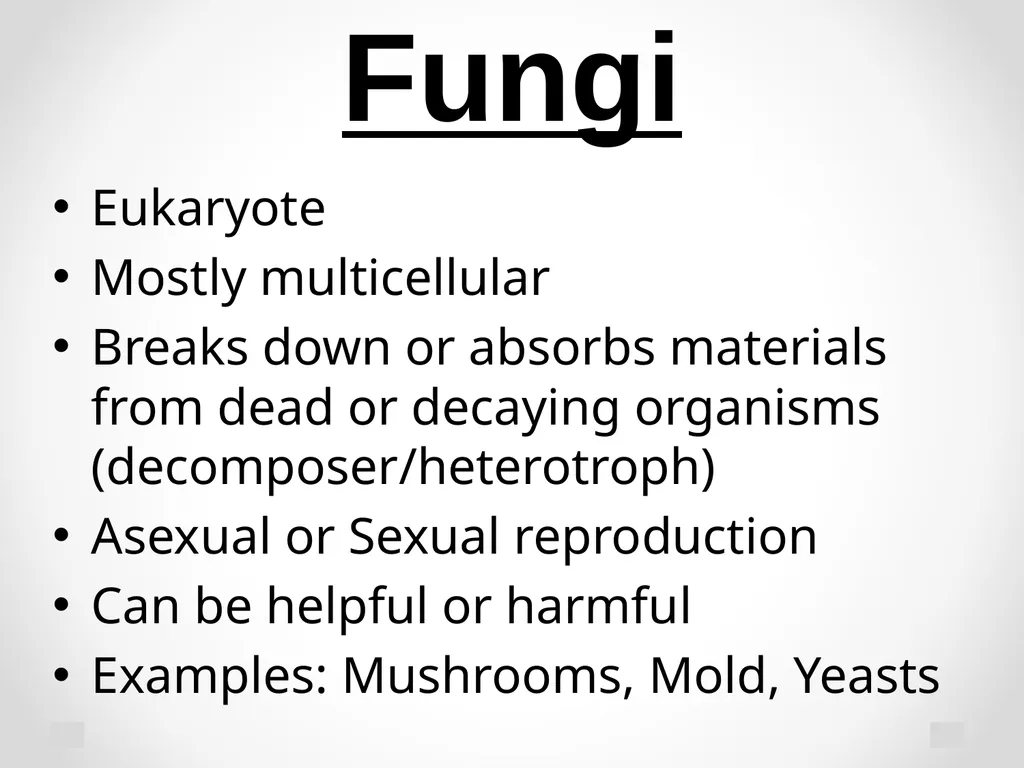
Fungi Eukaryote
Mostly multicellular
Breaks down or absorbs materials from dead or decaying organisms (decomposer/heterotroph)
Asexual or Sexual reproduction
Can be helpful or harmful
Examples: Mushrooms, Mold, Yeasts<br>
35
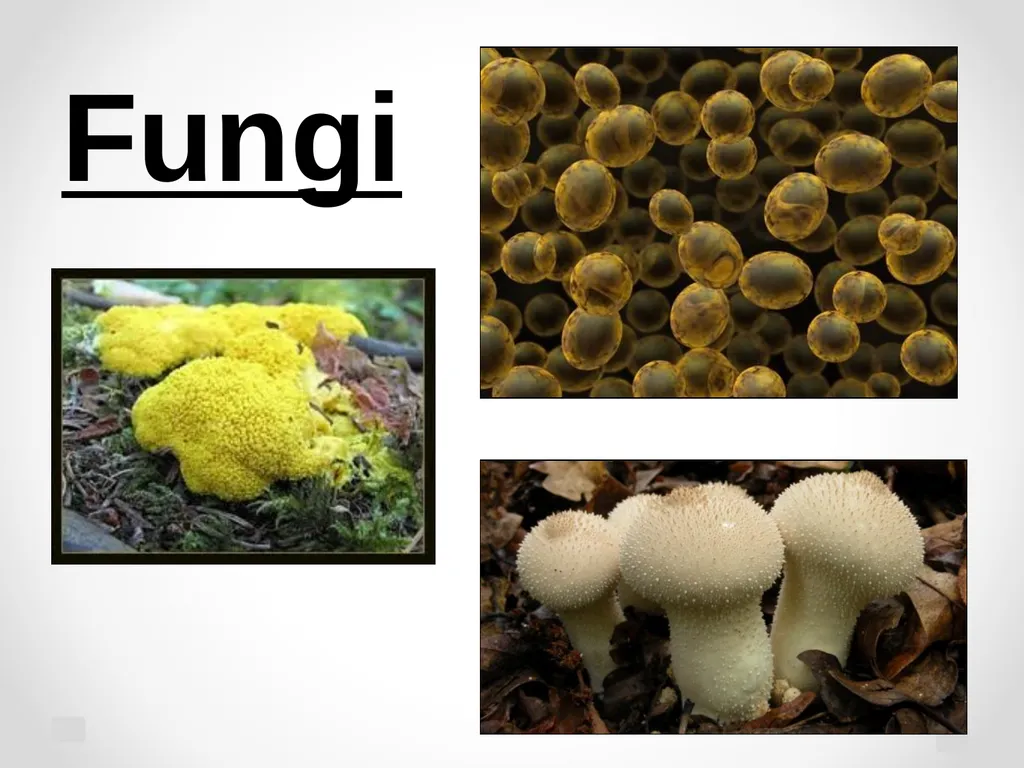
Fungi<br>
36
Mr. Parr: Fungi Song http://www.youtube.com/watch?v=H15Po5vHiDs<br>
37
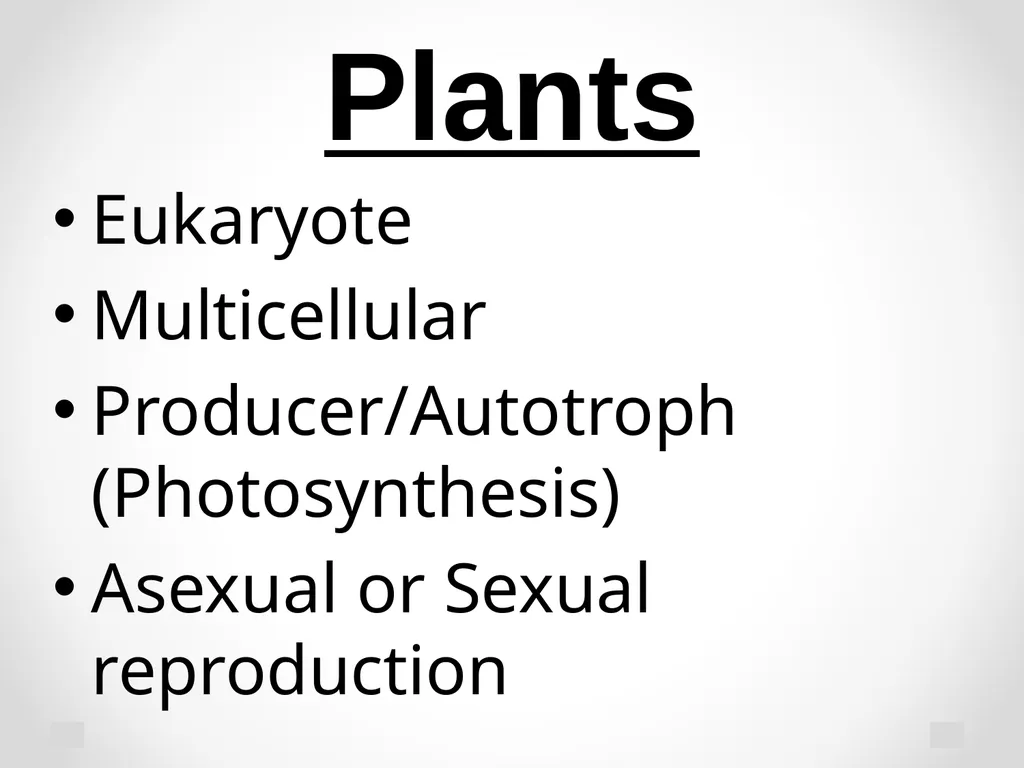
Plants Eukaryote
Multicellular
Producer/Autotroph (Photosynthesis)
Asexual or Sexual reproduction<br>
38
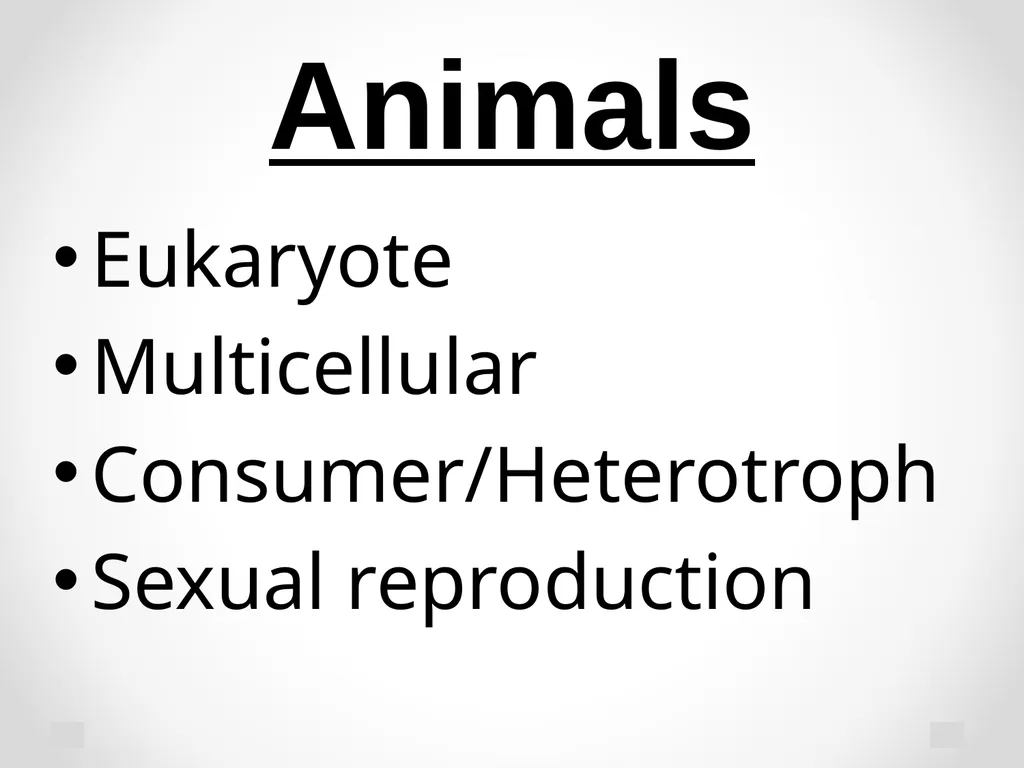
Animals Eukaryote
Multicellular
Consumer/Heterotroph
Sexual reproduction<br>