
Classification of Attributes Attributes In DBMS,
Description: Classification of Attributes Attributes In DBMS, we have entities, and each entity contains some property about their behaviour which is also called the attribute. In relational databases, we have tables, and each column contains some
Related Topics
Download Presentation
"Classification of Attributes Attributes In DBMS," is the property of its rightful owner. Permission is granted to download and print the materials on this website for personal, non-commercial use only, and to display it on your personal computer provided you do not modify the materials and that you retain all copyright notices contained in the materials. By downloading content from our website, you accept the terms of this agreement.
Presentation Transcript
slide1. Classification of Attributes<br>
slide2. Attributes
In DBMS, we have entities, and each entity contains some property about their behaviour which is also called the attribute. In relational databases, we have tables, and each column contains some entity that has some attributes, so all the entries for that column should strictly follow the attribute of the entity. Entities define the characteristic property of the attribute.<br>
slide4. Simple Attribute:
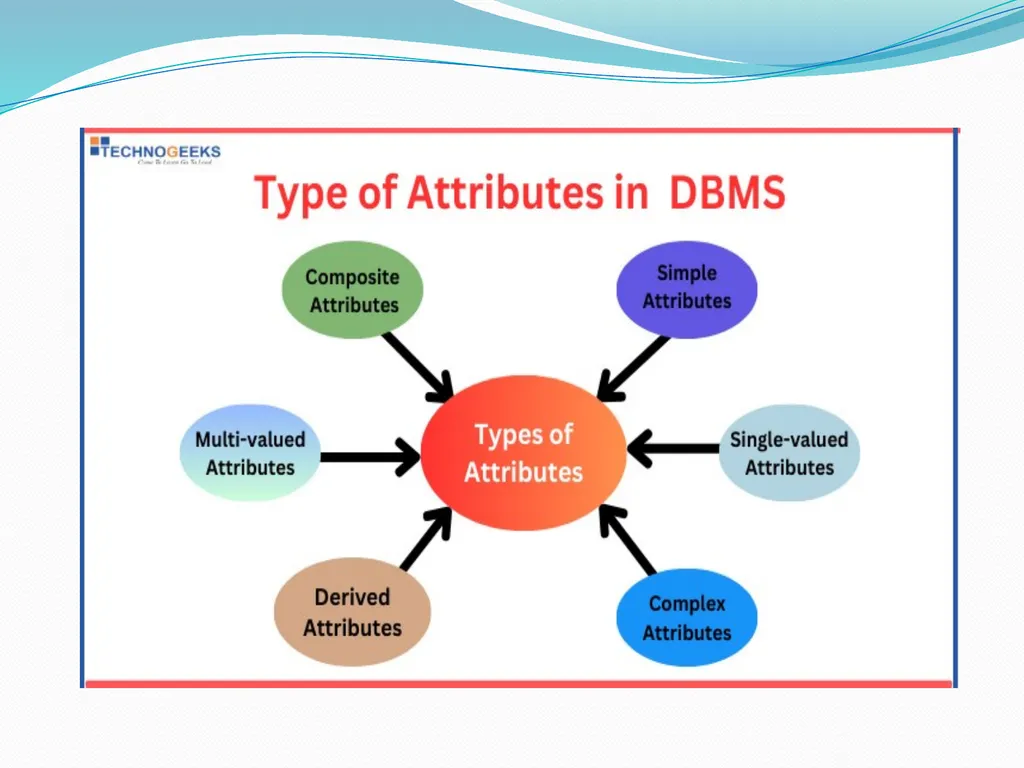
It is also known as atomic attributes. When an attribute cannot be divided further, then it is called a simple attribute.
For example, in a student table, the branch attribute cannot be further divided. It is called a simple or atomic attribute because it contains only a single value that cannot be broken further. Composite Attribute:
Composite attributes are those that are made up of the composition of more than one attribute. When any attribute can be divided further into more sub-attributes, then that attribute is called a composite attribute.<br>
slide5. Single-valued Attribute:
Those attributes which can have exactly one value are known as single valued attributes. They contain singular values, so more than one value is not allowed.
For example, the DOB of a student can be a single valued attribute. Another example is gender because one person can have only one gender.
Multi-valued Attribute:
Those attributes which can have more than one entry or which contain more than one value are called multi valued attributes. In the Entity Relationship (ER) diagram, we represent the multi valued attribute by double oval representation.<br>
slide6. Derived Attribute:
Derived attributes are also called stored attributes. When one attribute can be derived from the other attribute, then it is called a derived attribute. We can do some calculations on normal attributes and create derived attributes.
For example, the age of a student can be a derived attribute because we can get it by the DOB of the student.
Complex Attribute:
If any attribute has the combining property of multi values and composite attributes, then it is called a complex attribute.<br>
slide7. THANK YOU<br>
slide2. Attributes
In DBMS, we have entities, and each entity contains some property about their behaviour which is also called the attribute. In relational databases, we have tables, and each column contains some entity that has some attributes, so all the entries for that column should strictly follow the attribute of the entity. Entities define the characteristic property of the attribute.<br>
slide4. Simple Attribute:
It is also known as atomic attributes. When an attribute cannot be divided further, then it is called a simple attribute.
For example, in a student table, the branch attribute cannot be further divided. It is called a simple or atomic attribute because it contains only a single value that cannot be broken further. Composite Attribute:
Composite attributes are those that are made up of the composition of more than one attribute. When any attribute can be divided further into more sub-attributes, then that attribute is called a composite attribute.<br>
slide5. Single-valued Attribute:
Those attributes which can have exactly one value are known as single valued attributes. They contain singular values, so more than one value is not allowed.
For example, the DOB of a student can be a single valued attribute. Another example is gender because one person can have only one gender.
Multi-valued Attribute:
Those attributes which can have more than one entry or which contain more than one value are called multi valued attributes. In the Entity Relationship (ER) diagram, we represent the multi valued attribute by double oval representation.<br>
slide6. Derived Attribute:
Derived attributes are also called stored attributes. When one attribute can be derived from the other attribute, then it is called a derived attribute. We can do some calculations on normal attributes and create derived attributes.
For example, the age of a student can be a derived attribute because we can get it by the DOB of the student.
Complex Attribute:
If any attribute has the combining property of multi values and composite attributes, then it is called a complex attribute.<br>
slide7. THANK YOU<br>