CLASSIFICATION OF CONSONANTS ACCORDING TO MANNER OF ARTICULATION PLACE OF ARTICULATION MRS.K.DEEPA M.A.,M.Phil.,M.Ed.,M.Phil.,NET ASSTISTANT PROFESSOR OF ENGLISH EDUCATION AVINASHILINGAM INSTITUTE FOR HOME SCIENCE AND HIGHER EDUCATION FOR
"CLASSIFICATION OF CONSONANTS ACCORDING TO MANNER" is the property of its rightful owner. Permission is granted to
download and print the materials on this website for personal, non-commercial use only, and to display it
on your personal computer provided you do not modify the materials and that you retain all copyright
notices contained in the materials. By downloading content from our website, you accept the terms of this
agreement.
Presentation Transcript
01
CLASSIFICATION OF CONSONANTS ACCORDING TO MANNER OF ARTICULATION & PLACE OF ARTICULATION MRS.K.DEEPA M.A.,M.Phil.,M.Ed.,M.Phil.,NET
ASSTISTANT PROFESSOR OF ENGLISH EDUCATION
AVINASHILINGAM INSTITUTE FOR HOME SCIENCE AND HIGHER EDUCATION FOR WOMEN
COIMBATORE<br>
02
INTRODUCTION Producing a consonant involves making the vocal tract narrower at some location than it usually is
We call this narrowing a constriction
Which consonant you're pronouncing depends on where in the vocal tract the constriction is and how narrow it is
It also depends on a few other things, such as whether the vocal folds are vibrating and whether air is flowing through the nose<br>
03
…cont We classify consonants along three major dimensions:
place of articulation
manner of articulation
voicing The place of articulation dimension specifies where in the vocal tract the constriction is
The manner of articulation dimension specifies how narrow the constriction is, whether air is flowing through the nose, and whether the tongue is dropped down on one side
The voicing parameter specifies whether the vocal folds are vibrating<br>
04
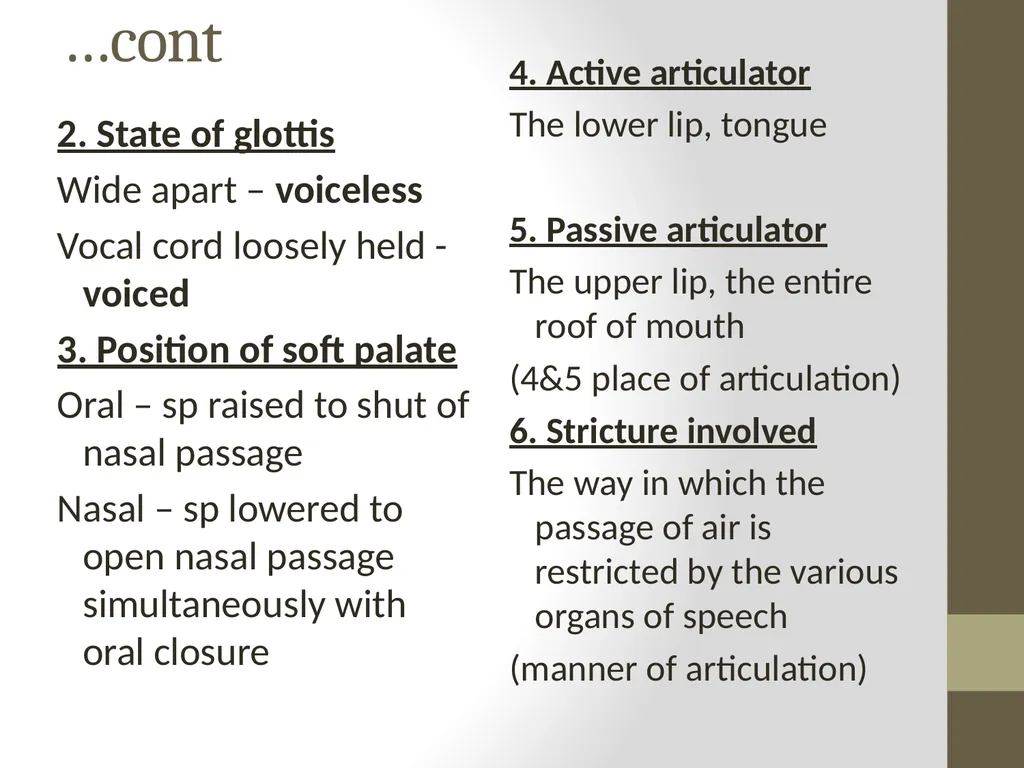
Six important aspects in manner of articulation The air-stream mechanism
The state of glottis
The position of the soft palate
The active articulator
The passive articulator
The stricture involved 1.Airstream mechanisms
Pulmonic: movement of lung air by respiratory muscles
Glottalic: movement of pharynx air by action of glottis
Velaric: movement of mouth air by action of tongue Egressive: outward-moving
Ingressive: inward-moving<br>
05
…cont 2. State of glottis
Wide apart – voiceless
Vocal cord loosely held - voiced
3. Position of soft palate
Oral – sp raised to shut of nasal passage
Nasal – sp lowered to open nasal passage simultaneously with oral closure 4. Active articulator
The lower lip, tongue
5. Passive articulator
The upper lip, the entire roof of mouth
(4&5 place of articulation)
6. Stricture involved
The way in which the passage of air is restricted by the various organs of speech
(manner of articulation)<br>
06
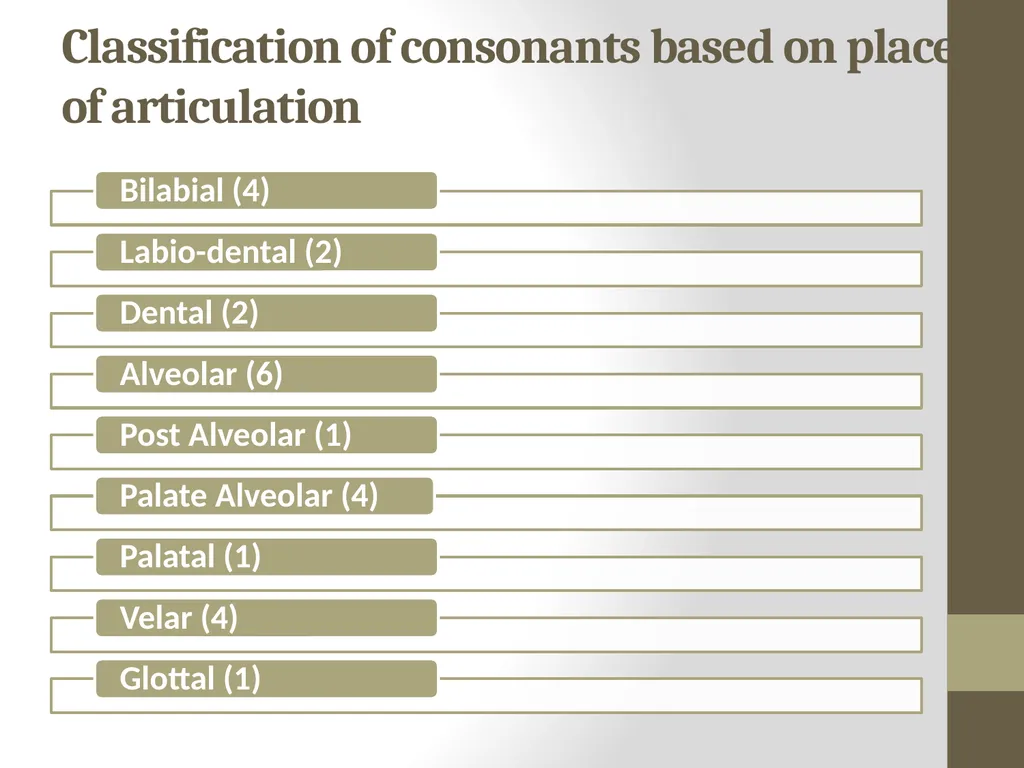
Classification of consonants based on place of articulation<br>
07
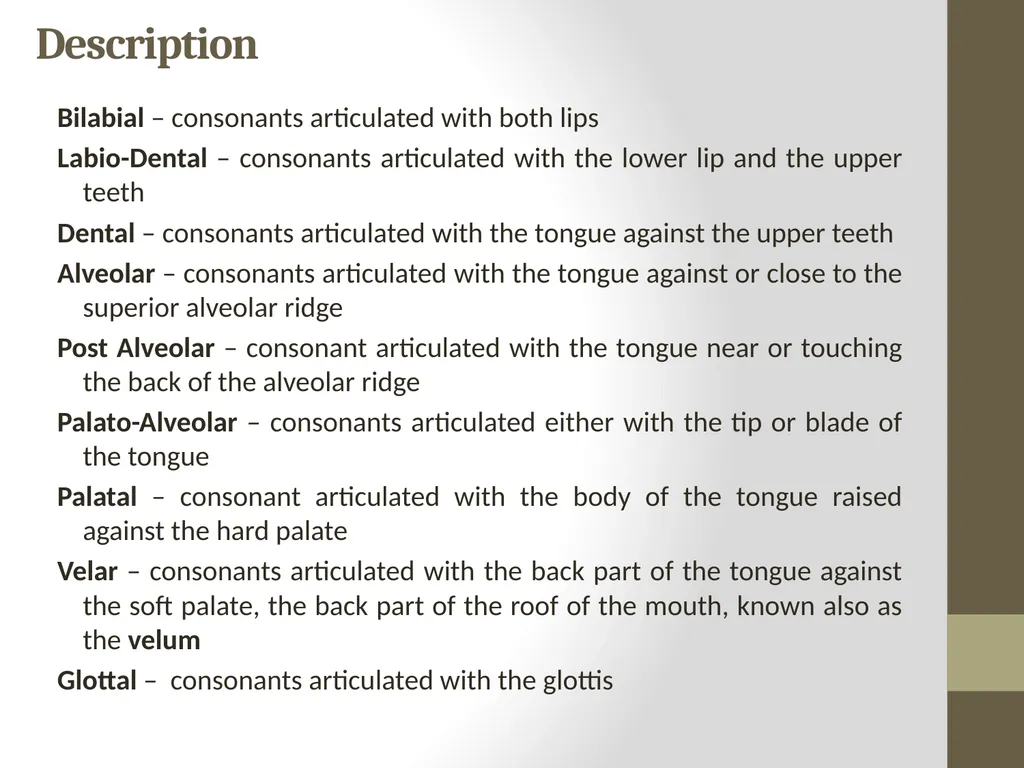
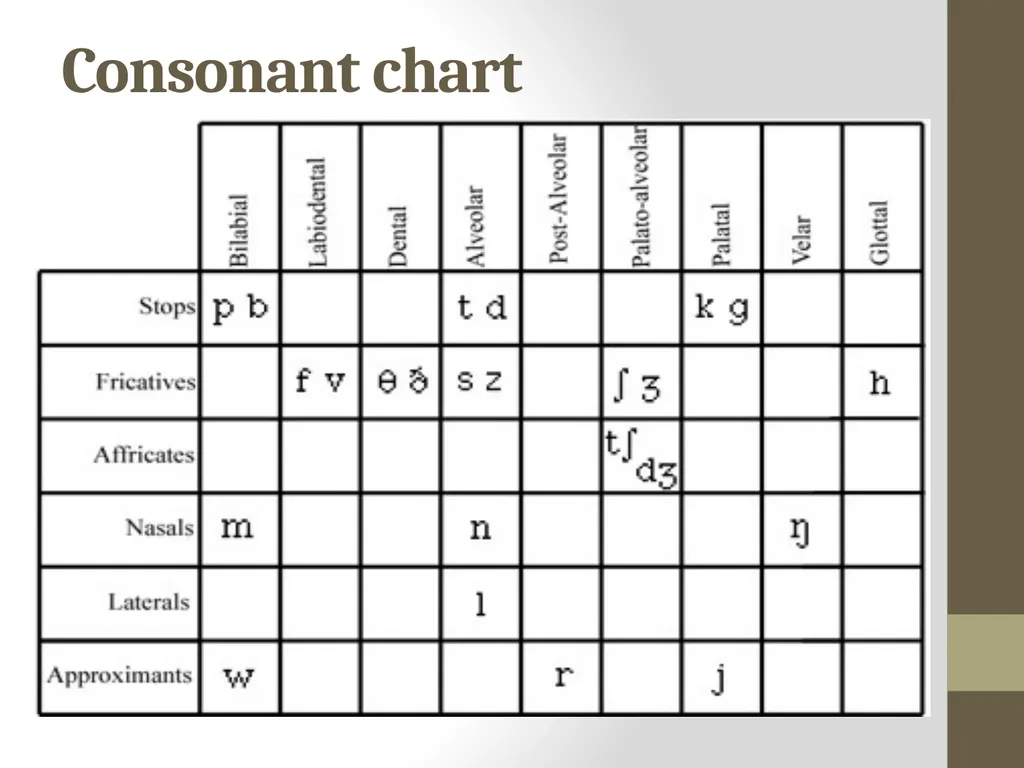
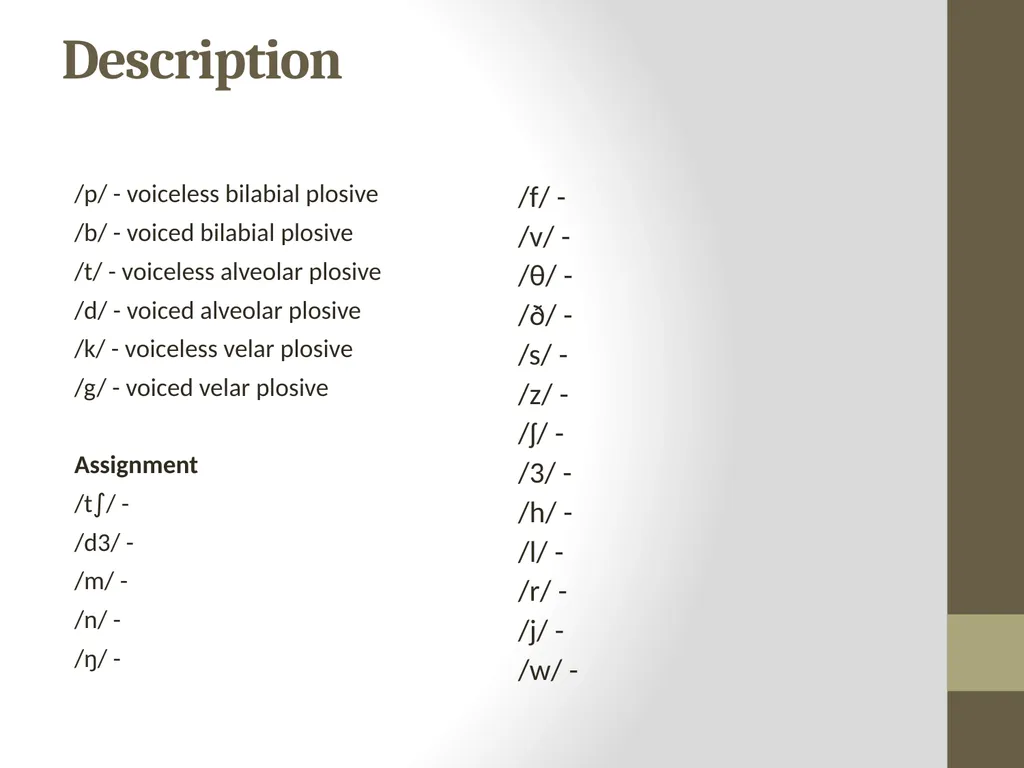
Description Bilabial – consonants articulated with both lips
Labio-Dental – consonants articulated with the lower lip and the upper teeth
Dental – consonants articulated with the tongue against the upper teeth
Alveolar – consonants articulated with the tongue against or close to the superior alveolar ridge
Post Alveolar – consonant articulated with the tongue near or touching the back of the alveolar ridge
Palato-Alveolar – consonants articulated either with the tip or blade of the tongue
Palatal – consonant articulated with the body of the tongue raised against the hard palate
Velar – consonants articulated with the back part of the tongue against the soft palate, the back part of the roof of the mouth, known also as the velum
Glottal – consonants articulated with the glottis<br>
08
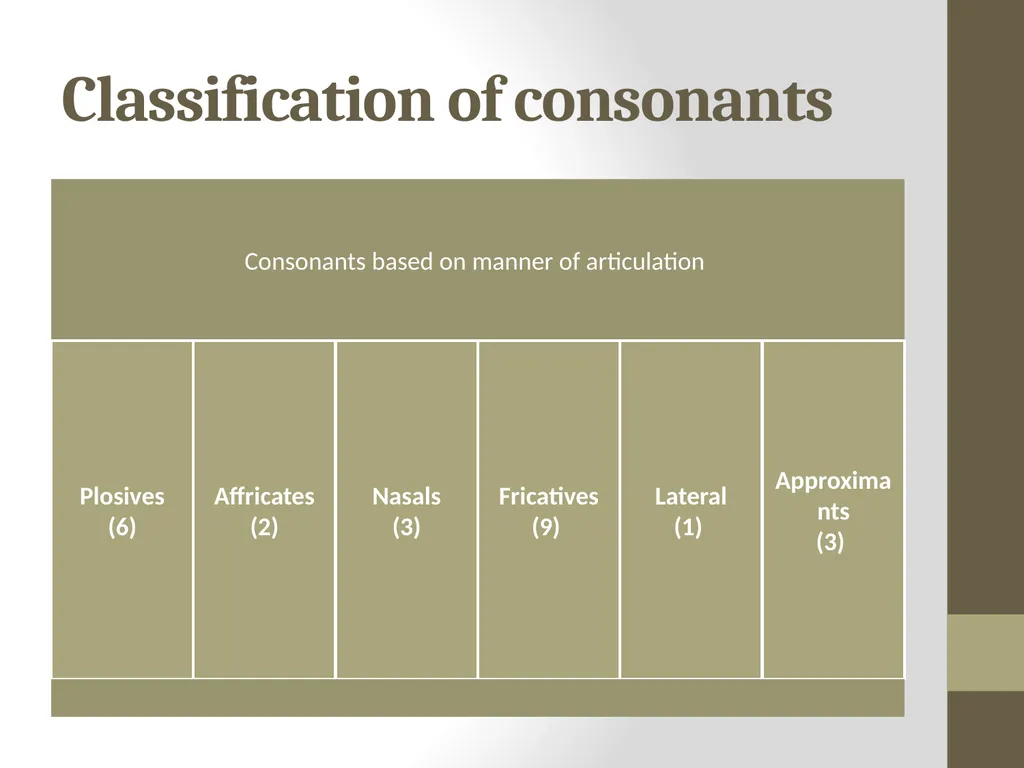
Classification of consonants<br>
09
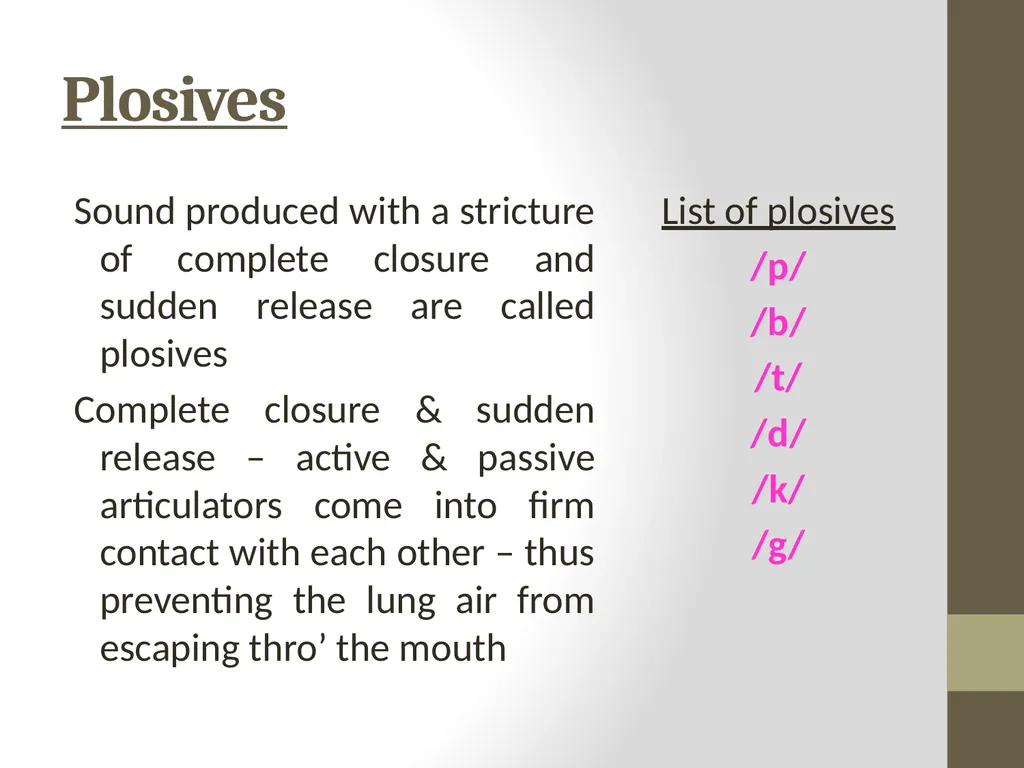
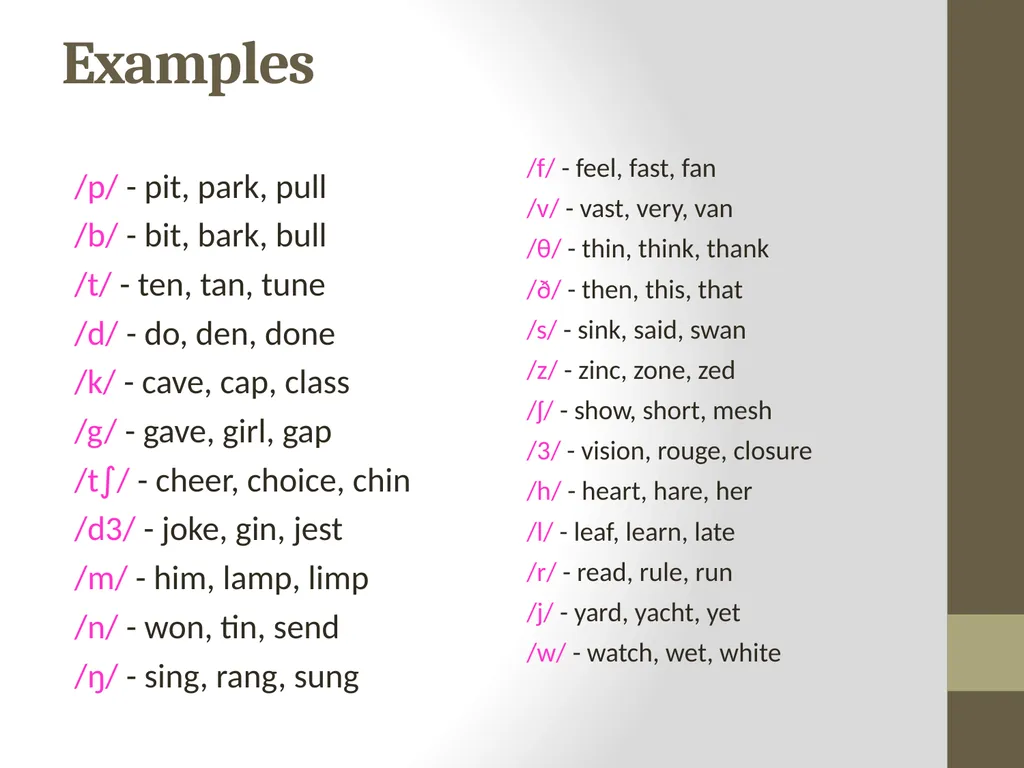
Plosives Sound produced with a stricture of complete closure and sudden release are called plosives
Complete closure & sudden release – active & passive articulators come into firm contact with each other – thus preventing the lung air from escaping thro’ the mouth List of plosives
/p/
/b/
/t/
/d/
/k/
/g/<br>
10
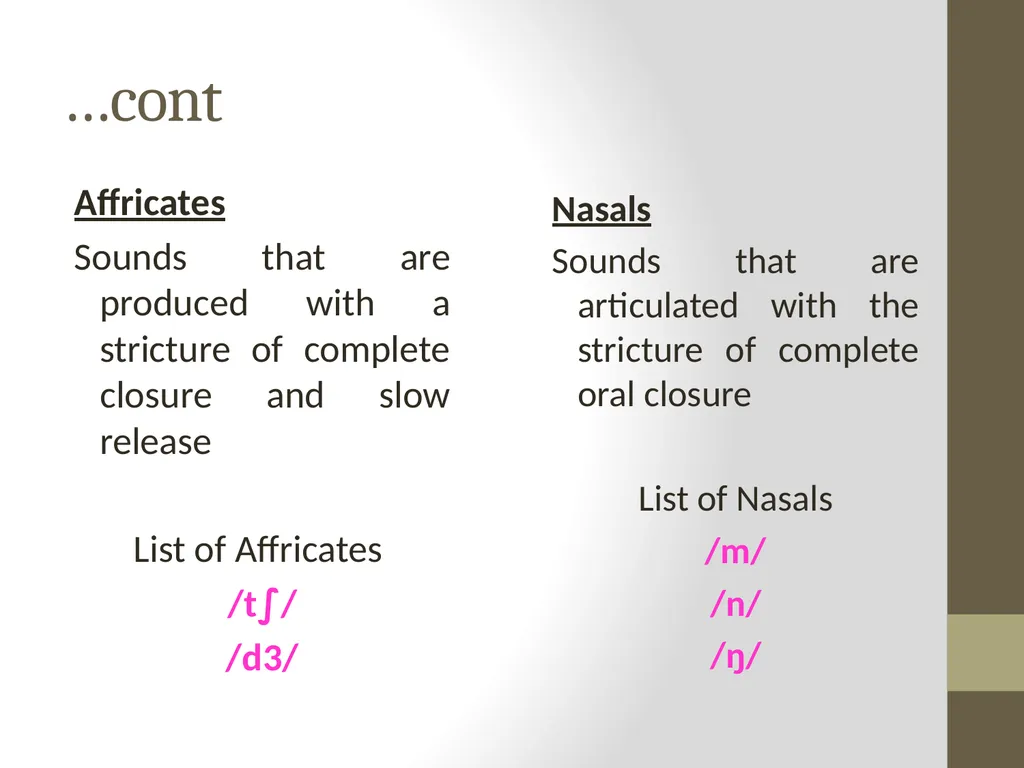
…cont Affricates
Sounds that are produced with a stricture of complete closure and slow release
List of Affricates
/t∫/
/d3/ Nasals
Sounds that are articulated with the stricture of complete oral closure
List of Nasals
/m/
/n/
/ŋ/<br>
11
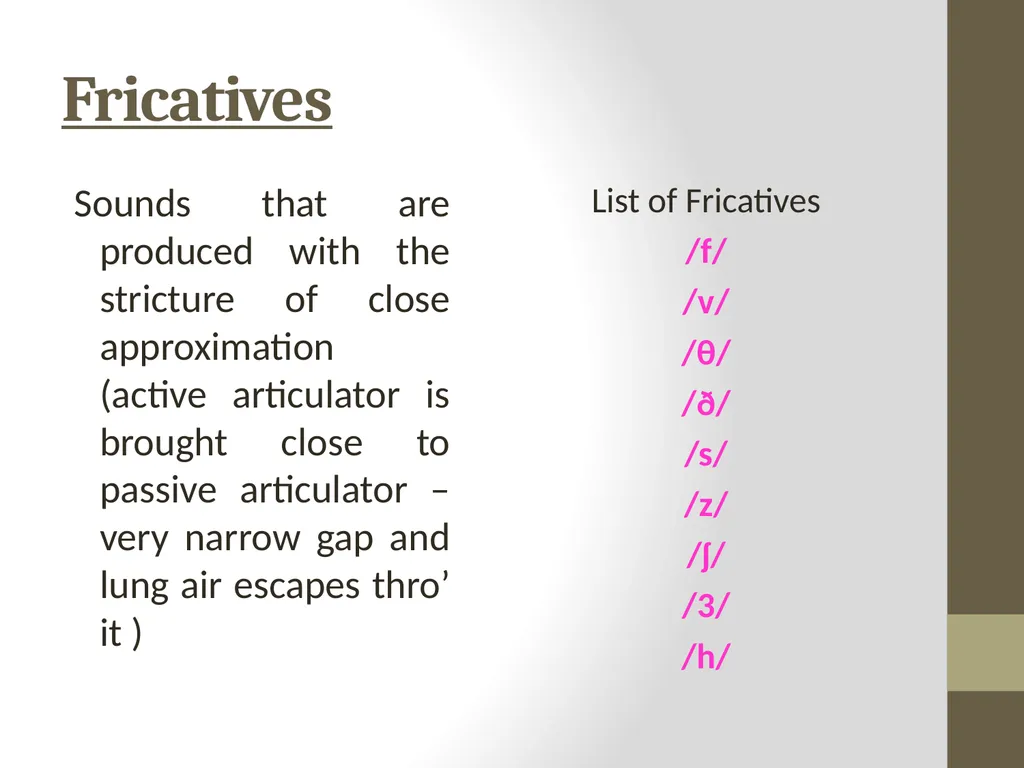
Fricatives Sounds that are produced with the stricture of close approximation (active articulator is brought close to passive articulator – very narrow gap and lung air escapes thro’ it ) List of Fricatives
/f/
/v/
/θ/
/ð/
/s/
/z/
/ʃ/
/3/
/h/<br>
12
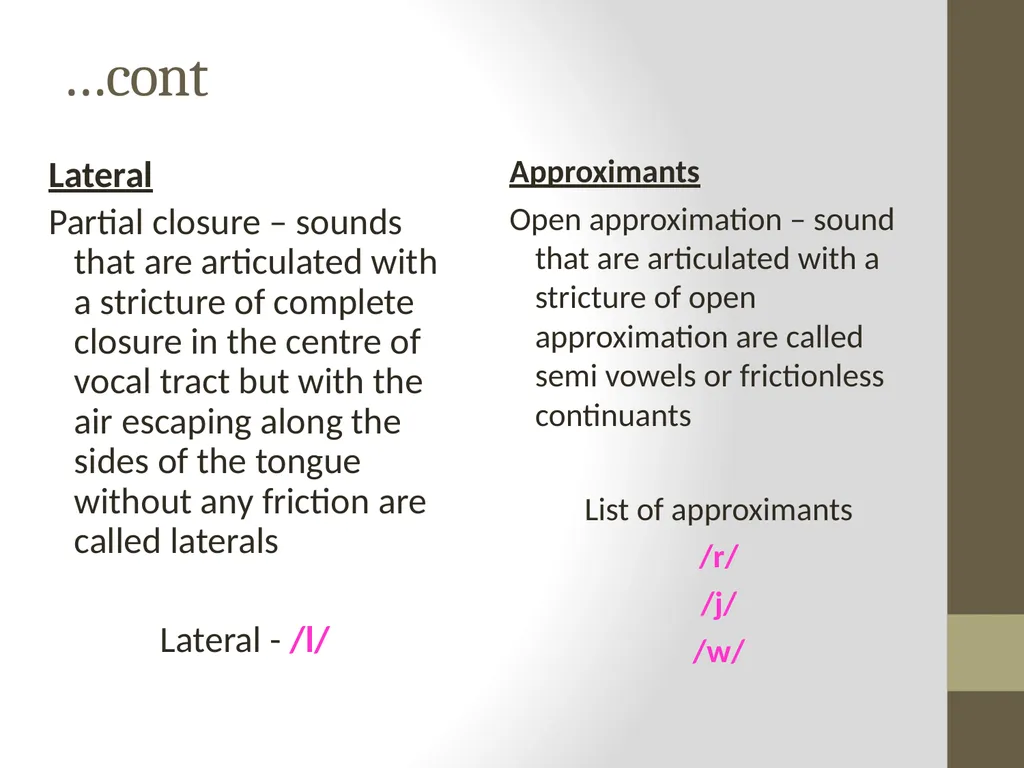
…cont Lateral
Partial closure – sounds that are articulated with a stricture of complete closure in the centre of vocal tract but with the air escaping along the sides of the tongue without any friction are called laterals
Lateral - /l/ Approximants
Open approximation – sound that are articulated with a stricture of open approximation are called semi vowels or frictionless continuants
List of approximants
/r/
/j/
/w/<br>
13
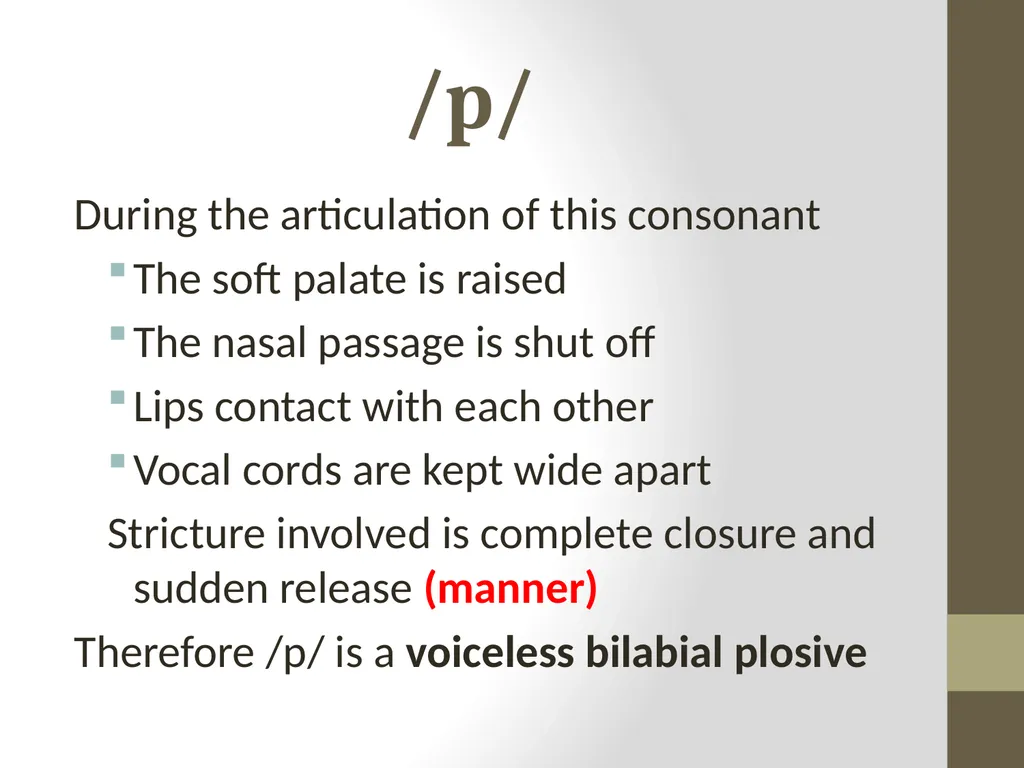
/p/ During the articulation of this consonant
The soft palate is raised
The nasal passage is shut off
Lips contact with each other
Vocal cords are kept wide apart
Stricture involved is complete closure and sudden release (manner)
Therefore /p/ is a voiceless bilabial plosive<br>