Classification of RP Technologies There are
Description: Classification of RP Technologies There are various ways to classify the RP techniques that have currently been developed The RP classification used here is based on the form of the starting material: Liquid-based Solid-based Powder-based
Related Topics
Download Presentation
"Classification of RP Technologies There are" is the property of its rightful owner. Permission is granted to download and print the materials on this website for personal, non-commercial use only, and to display it on your personal computer provided you do not modify the materials and that you retain all copyright notices contained in the materials. By downloading content from our website, you accept the terms of this agreement.
Presentation Transcript
slide1. Classification of RP Technologies There are various ways to classify the RP techniques that have currently been developed
The RP classification used here is based on the form of the starting material:
Liquid-based
Solid-based
Powder-based<br>
slide2. Liquid-Based Rapid Prototyping Systems Starting material is a liquid
About a dozen RP technologies are in this category
Includes the following processes:
Stereolithography (STL)
Solid ground curing (SLG)
Droplet deposition manufacturing ©2007 John Wiley & Sons, Inc. M P Groover, Fundamentals of Modern Manufacturing 3/e<br>
slide3. The laser cures the resin near surface, forming a hardening layer. LIQUID BASED RAPID PROTOTYPING SYTEMS Most liquid based rapid proto typing systems build parts in a vat curable resin, which cures or solidifies under the effect of exposure to laser radiation, usually in UV range. When a layer of a part is formed, it is lowered by an elevation control system to allow the next layer of resin to be similarly formed over it. This continues until the entire part is completed. The vat can then be drained out and the part is removed for further processing.<br>
slide4. There are variations to this technique by the various vendors and they are dependent on the type of light or laser, method of scanning or exposure, type of liquid resin, type of elevation and optical system used.<br>
slide5. Stereolithography Stereo – three dimensions
Lithography – printing
Started with acrylic resins in the early 1980’s
Epoxy resins are more common now
Very good accuracy
UV Laser cure
Relatively slow speed
Newer resins with improved properties 5<br>
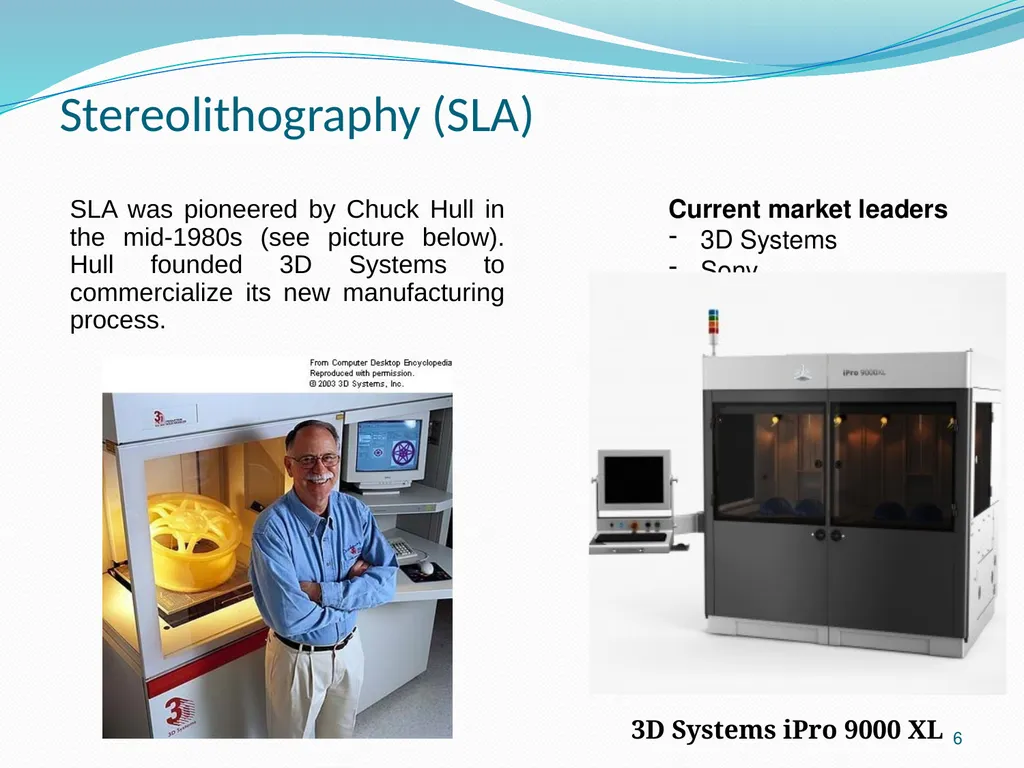
slide6. Stereolithography (SLA) SLA was pioneered by Chuck Hull in the mid-1980s (see picture below). Hull founded 3D Systems to commercialize its new manufacturing process. 6 Current market leaders
3D Systems
Sony 3D Systems iPro 9000 XL<br>
slide7. A "rapid-prototyping" process which produces a physical, three dimensional object from a 3D CAD file. Fabricating a solid plastic part out of a photosensitive liquid polymer using a directed laser beam to solidify the polymer
Part fabrication is accomplished as a series of layers - each layer is added onto the previous layer to gradually build the 3-D geometry What is Stereolithography (SLA)?<br>
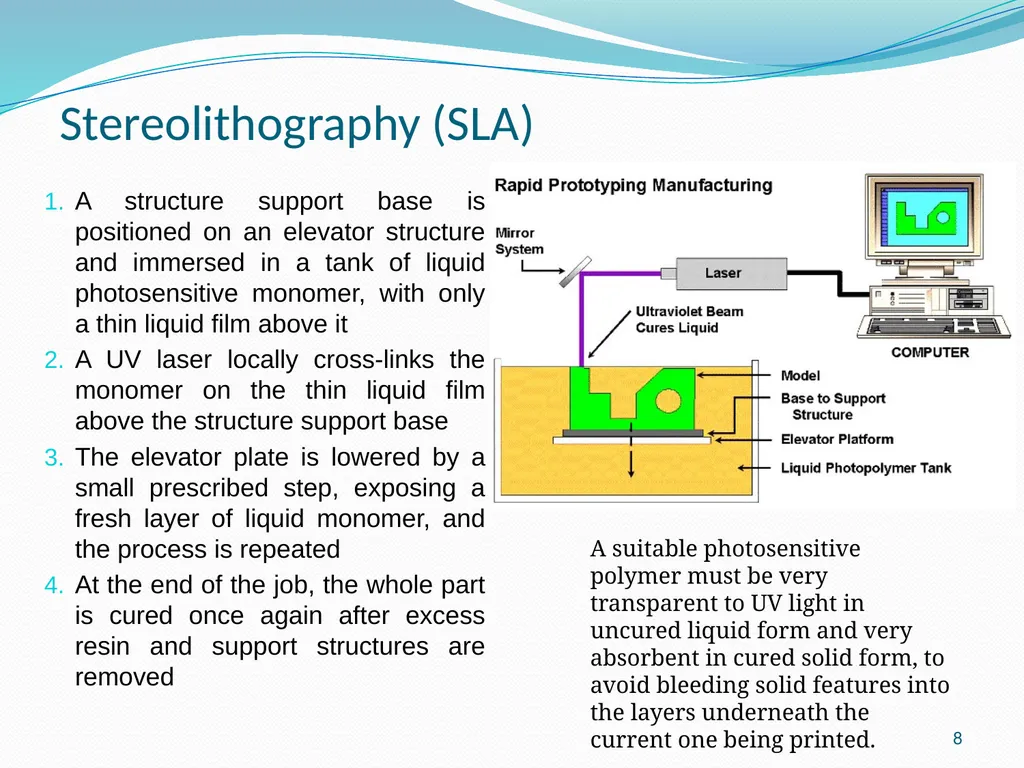
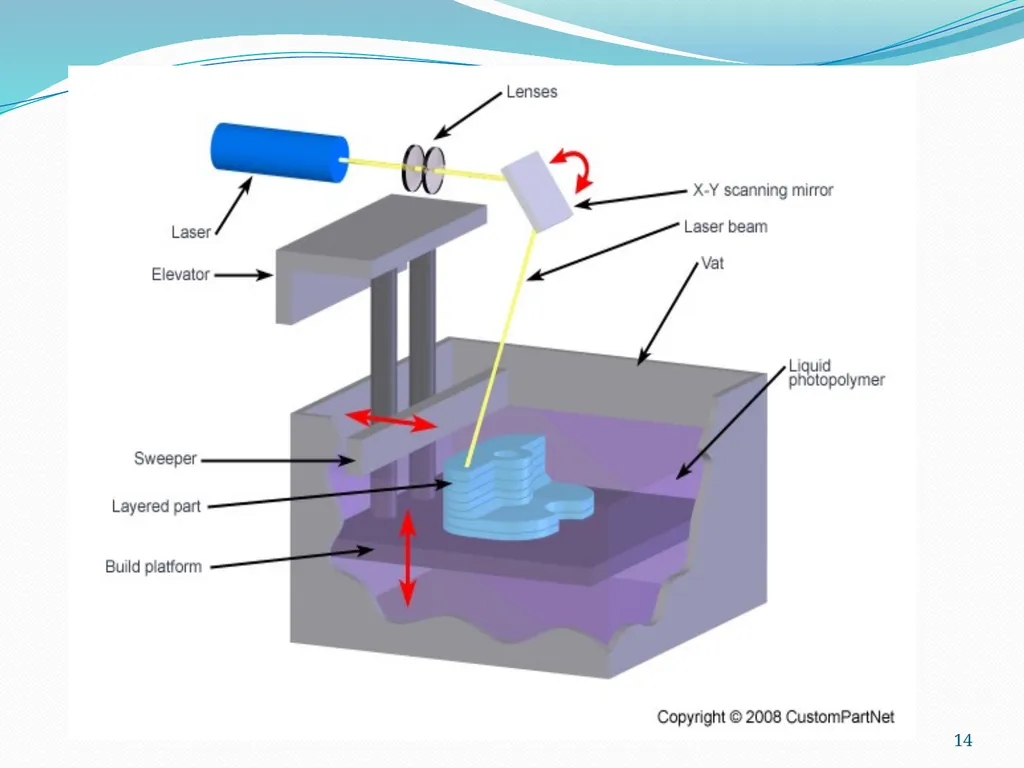
slide8. Stereolithography (SLA) A structure support base is positioned on an elevator structure and immersed in a tank of liquid photosensitive monomer, with only a thin liquid film above it
A UV laser locally cross-links the monomer on the thin liquid film above the structure support base
The elevator plate is lowered by a small prescribed step, exposing a fresh layer of liquid monomer, and the process is repeated
At the end of the job, the whole part is cured once again after excess resin and support structures are removed 8 A suitable photosensitive polymer must be very transparent to UV light in uncured liquid form and very absorbent in cured solid form, to avoid bleeding solid features into the layers underneath the current one being printed.<br>
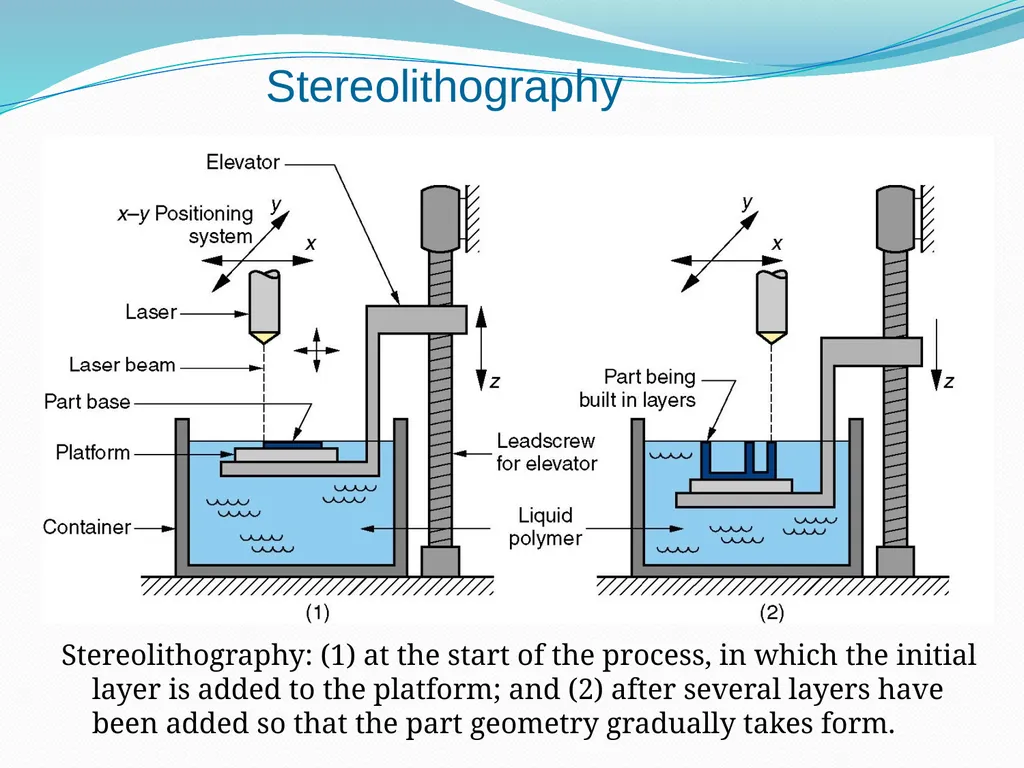
slide9. Stereolithography: (1) at the start of the process, in which the initial layer is added to the platform; and (2) after several layers have been added so that the part geometry gradually takes form. Stereolithography<br>
slide10. 2. The building is done layer by layer, each layer being scanned by the optical scanning system and controlled by an elevation mechanism which lowers at the completion of each layer. Principle: The SLA process is based on the following principles. 1. Parts are built from a photo-curable liquid resin that cures when exposed to a laser beam which scans across the surface of the resin.<br>
slide11. UV curable photo polymers are resins which are formulated from photo iniators and reactive liquid monomers. Photopolymers There are many types of liquid photopolymers that can be solidified by exposure to electro-magnetic radiation, including wavelengths in the gamma rays, X-rays, UV and visible range. The vast majority of photopolymers used in the commercial RP systems are curable in the UV range.<br>
slide12. Photo polymerization is polymerization initiated by a photochemical process whereby the starting point is usually the induction of energy from the radiation source. The process through which photopolymers are cured is called as photo polymerization process. It is the process of linking small molecules (monomers) into chain like larger molecules (polymers). When the chain like polymers are linked further to one another, a cross linked polymer is said to be formed. Photo polymerization<br>
slide13. Layering Technology, Laser and Laser scanning: Almost all RP systems use layering technology in the creation of prototype parts. The basic principle is the availability of computer software to slice a CAD model into layers and reproduce it in an output device like a laser scanning system. The layer thickness is controlled by a precision elevation mechanism. It will correspond directly to the slice thickness of the computer model and the cured thickness of the resin. The important component of the building process is the laser and its optical scanning system. The key to the strength of the SLA is its ability to rapidly direct focused radiation of appropriate power and wavelength onto the surface of the liquid photopolymers resin, forming patterns of solidified photopolymer according to the cross-sectional data generated by the computer.<br>
slide14. 14<br>
slide15. Advantages
Round the clock operation without much attention.
Good user support
Build volumes. From small to large size to suit the needs.
Good Accuracy
Good surface finish. Best among many RP technologies.
Wide range of materials. For general purpose materials to specific applications.<br>
slide16. Disadvantages
Requires support structures
Requires post processing
Requires post curing<br>
slide17. Models for conceptualization, packaging and presentation
Prototypes for design, analysis, verification and functional testing
Parts for prototype tooling and low volume production tooling
Patterns for investment casting, sand casting and molding
Tools for fixture and tooling design, and production tooling. Applications:<br>
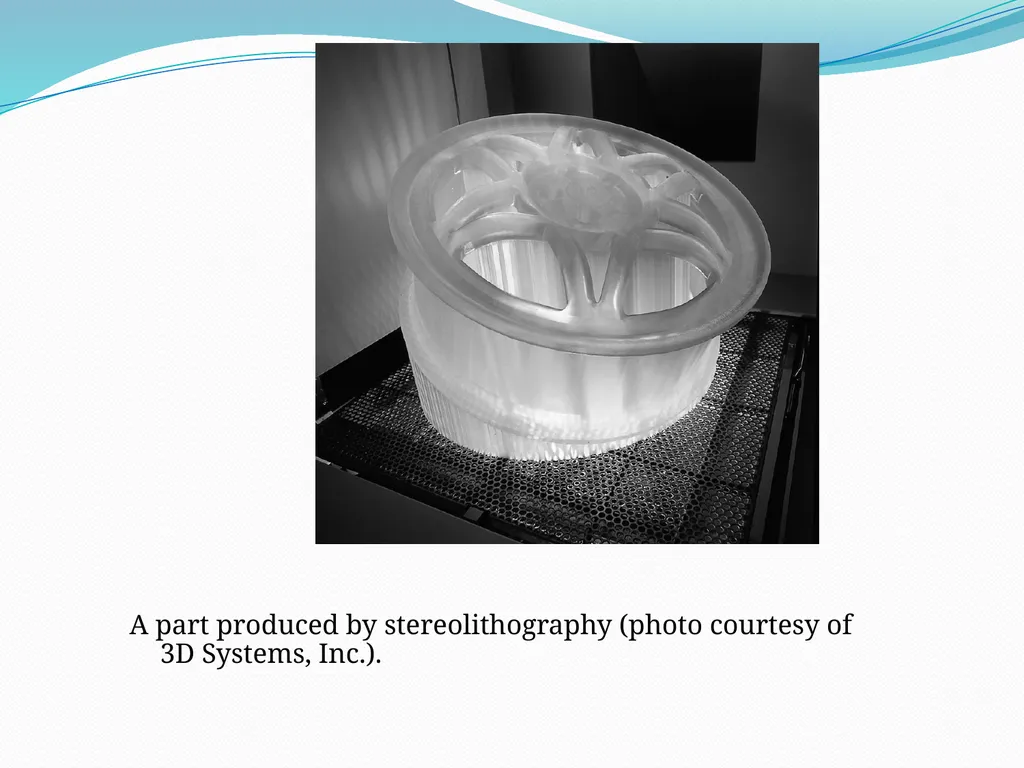
slide18. A part produced by stereolithography (photo courtesy of 3D Systems, Inc.).<br>
slide19. Conclusions Stereolithography is a liquid based RP process. Fast and effective.
Material: Photosensitive resin
Tool: Low powered laser (UV light)
Process: Curing the photo polymer through photo polymerization process.
Can be applied to almost every industry, including oil refining, petrochemical, power, marine, and municipal
Saves time, money, allows speed delivery, and improve designs.<br>

The RP classification used here is based on the form of the starting material:
Liquid-based
Solid-based
Powder-based<br>
slide2. Liquid-Based Rapid Prototyping Systems Starting material is a liquid
About a dozen RP technologies are in this category
Includes the following processes:
Stereolithography (STL)
Solid ground curing (SLG)
Droplet deposition manufacturing ©2007 John Wiley & Sons, Inc. M P Groover, Fundamentals of Modern Manufacturing 3/e<br>
slide3. The laser cures the resin near surface, forming a hardening layer. LIQUID BASED RAPID PROTOTYPING SYTEMS Most liquid based rapid proto typing systems build parts in a vat curable resin, which cures or solidifies under the effect of exposure to laser radiation, usually in UV range. When a layer of a part is formed, it is lowered by an elevation control system to allow the next layer of resin to be similarly formed over it. This continues until the entire part is completed. The vat can then be drained out and the part is removed for further processing.<br>
slide4. There are variations to this technique by the various vendors and they are dependent on the type of light or laser, method of scanning or exposure, type of liquid resin, type of elevation and optical system used.<br>
slide5. Stereolithography Stereo – three dimensions
Lithography – printing
Started with acrylic resins in the early 1980’s
Epoxy resins are more common now
Very good accuracy
UV Laser cure
Relatively slow speed
Newer resins with improved properties 5<br>
slide6. Stereolithography (SLA) SLA was pioneered by Chuck Hull in the mid-1980s (see picture below). Hull founded 3D Systems to commercialize its new manufacturing process. 6 Current market leaders
3D Systems
Sony 3D Systems iPro 9000 XL<br>
slide7. A "rapid-prototyping" process which produces a physical, three dimensional object from a 3D CAD file. Fabricating a solid plastic part out of a photosensitive liquid polymer using a directed laser beam to solidify the polymer
Part fabrication is accomplished as a series of layers - each layer is added onto the previous layer to gradually build the 3-D geometry What is Stereolithography (SLA)?<br>
slide8. Stereolithography (SLA) A structure support base is positioned on an elevator structure and immersed in a tank of liquid photosensitive monomer, with only a thin liquid film above it
A UV laser locally cross-links the monomer on the thin liquid film above the structure support base
The elevator plate is lowered by a small prescribed step, exposing a fresh layer of liquid monomer, and the process is repeated
At the end of the job, the whole part is cured once again after excess resin and support structures are removed 8 A suitable photosensitive polymer must be very transparent to UV light in uncured liquid form and very absorbent in cured solid form, to avoid bleeding solid features into the layers underneath the current one being printed.<br>
slide9. Stereolithography: (1) at the start of the process, in which the initial layer is added to the platform; and (2) after several layers have been added so that the part geometry gradually takes form. Stereolithography<br>
slide10. 2. The building is done layer by layer, each layer being scanned by the optical scanning system and controlled by an elevation mechanism which lowers at the completion of each layer. Principle: The SLA process is based on the following principles. 1. Parts are built from a photo-curable liquid resin that cures when exposed to a laser beam which scans across the surface of the resin.<br>
slide11. UV curable photo polymers are resins which are formulated from photo iniators and reactive liquid monomers. Photopolymers There are many types of liquid photopolymers that can be solidified by exposure to electro-magnetic radiation, including wavelengths in the gamma rays, X-rays, UV and visible range. The vast majority of photopolymers used in the commercial RP systems are curable in the UV range.<br>
slide12. Photo polymerization is polymerization initiated by a photochemical process whereby the starting point is usually the induction of energy from the radiation source. The process through which photopolymers are cured is called as photo polymerization process. It is the process of linking small molecules (monomers) into chain like larger molecules (polymers). When the chain like polymers are linked further to one another, a cross linked polymer is said to be formed. Photo polymerization<br>
slide13. Layering Technology, Laser and Laser scanning: Almost all RP systems use layering technology in the creation of prototype parts. The basic principle is the availability of computer software to slice a CAD model into layers and reproduce it in an output device like a laser scanning system. The layer thickness is controlled by a precision elevation mechanism. It will correspond directly to the slice thickness of the computer model and the cured thickness of the resin. The important component of the building process is the laser and its optical scanning system. The key to the strength of the SLA is its ability to rapidly direct focused radiation of appropriate power and wavelength onto the surface of the liquid photopolymers resin, forming patterns of solidified photopolymer according to the cross-sectional data generated by the computer.<br>
slide14. 14<br>
slide15. Advantages
Round the clock operation without much attention.
Good user support
Build volumes. From small to large size to suit the needs.
Good Accuracy
Good surface finish. Best among many RP technologies.
Wide range of materials. For general purpose materials to specific applications.<br>
slide16. Disadvantages
Requires support structures
Requires post processing
Requires post curing<br>
slide17. Models for conceptualization, packaging and presentation
Prototypes for design, analysis, verification and functional testing
Parts for prototype tooling and low volume production tooling
Patterns for investment casting, sand casting and molding
Tools for fixture and tooling design, and production tooling. Applications:<br>
slide18. A part produced by stereolithography (photo courtesy of 3D Systems, Inc.).<br>
slide19. Conclusions Stereolithography is a liquid based RP process. Fast and effective.
Material: Photosensitive resin
Tool: Low powered laser (UV light)
Process: Curing the photo polymer through photo polymerization process.
Can be applied to almost every industry, including oil refining, petrochemical, power, marine, and municipal
Saves time, money, allows speed delivery, and improve designs.<br>