"Classroom Management Bumps Responding to" is the property of its rightful owner. Permission is granted to
download and print the materials on this website for personal, non-commercial use only, and to display it
on your personal computer provided you do not modify the materials and that you retain all copyright
notices contained in the materials. By downloading content from our website, you accept the terms of this
agreement.
Presentation Transcript
01
Classroom Management Bumps Responding to Challenging Behaviour Adapted from Classroom Management, Bennett & Smilanich (1994)<br>
02
Goals of misbehaviour. Attention seeking
Power/defiance
Revenge (physical or emotional)
Assumed disability (low self confidence/self esteem)<br>
03
What effects our decision to respond? Past behaviour of the student
Severity of misbehaviour
Frequency of misbehaviour
Time between misbehaviours
Importance of lesson
School discipline policy
Student’s life at home
Student’s respect for the teacher
Reaction by allies<br>
04
Pre-empt where possible. Win students over
Greet at the door
Show interest
Be polite
Be alert<br>
05
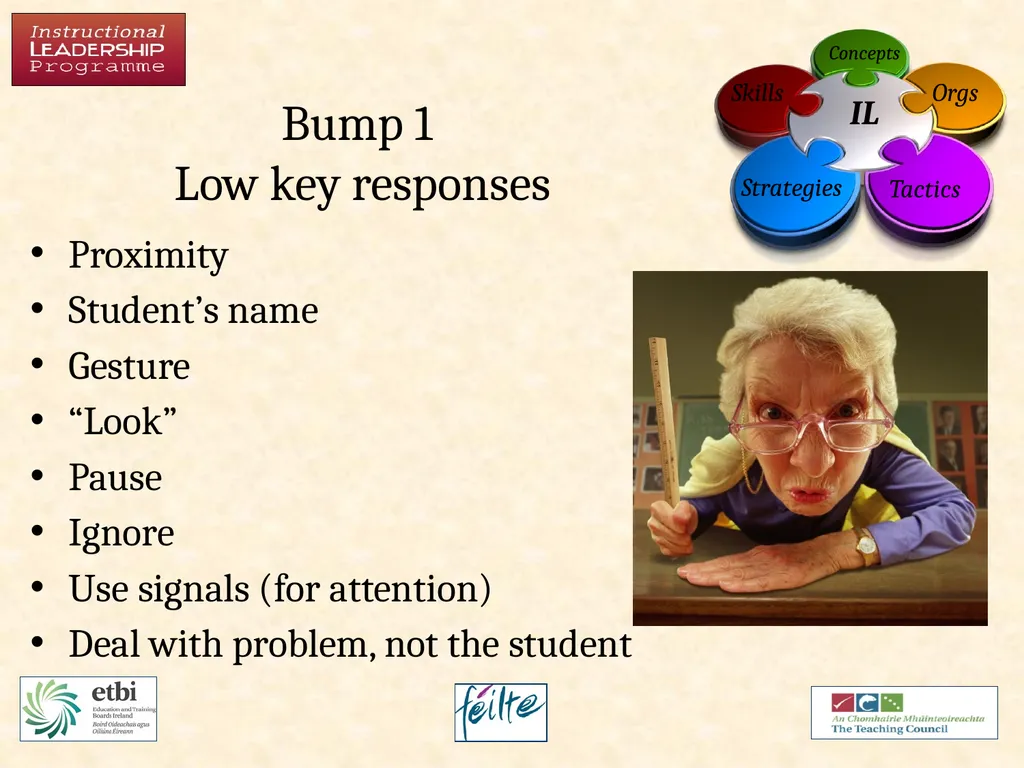
Bump 1 Low key responses Proximity
Student’s name
Gesture
“Look”
Pause
Ignore
Use signals (for attention)
Deal with problem, not the student<br>
06
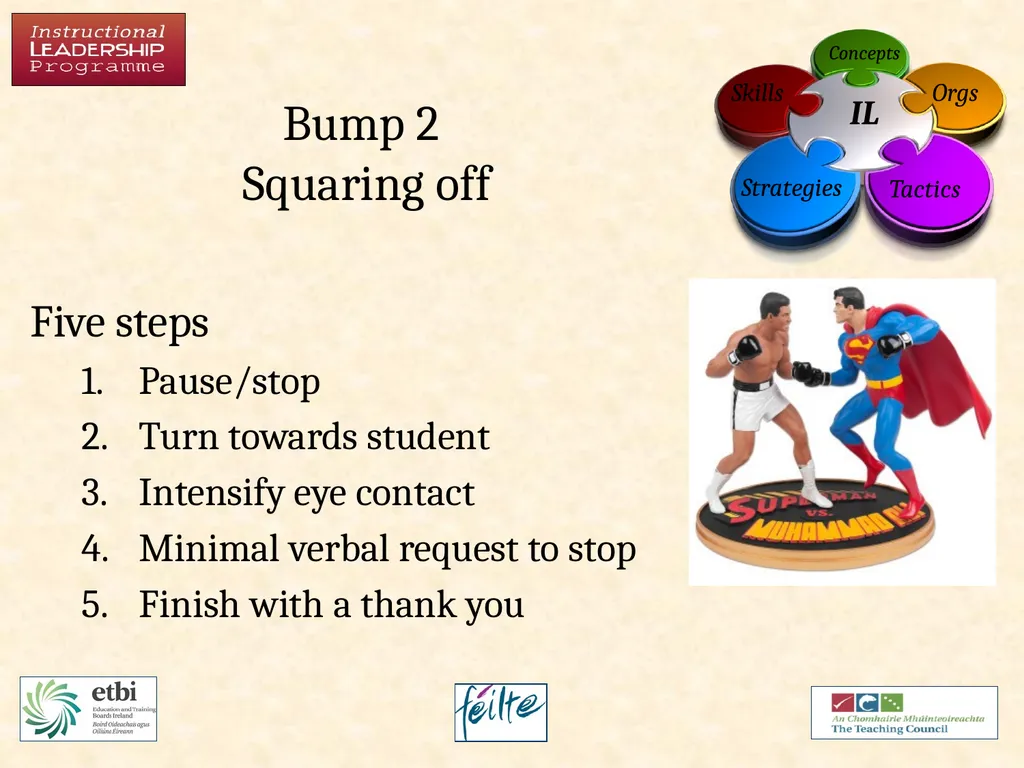
Bump 2 Squaring off Five steps
Pause/stop
Turn towards student
Intensify eye contact
Minimal verbal request to stop
Finish with a thank you<br>
07
Bumps 3 and 4 Choices and the implied choice<br>
08
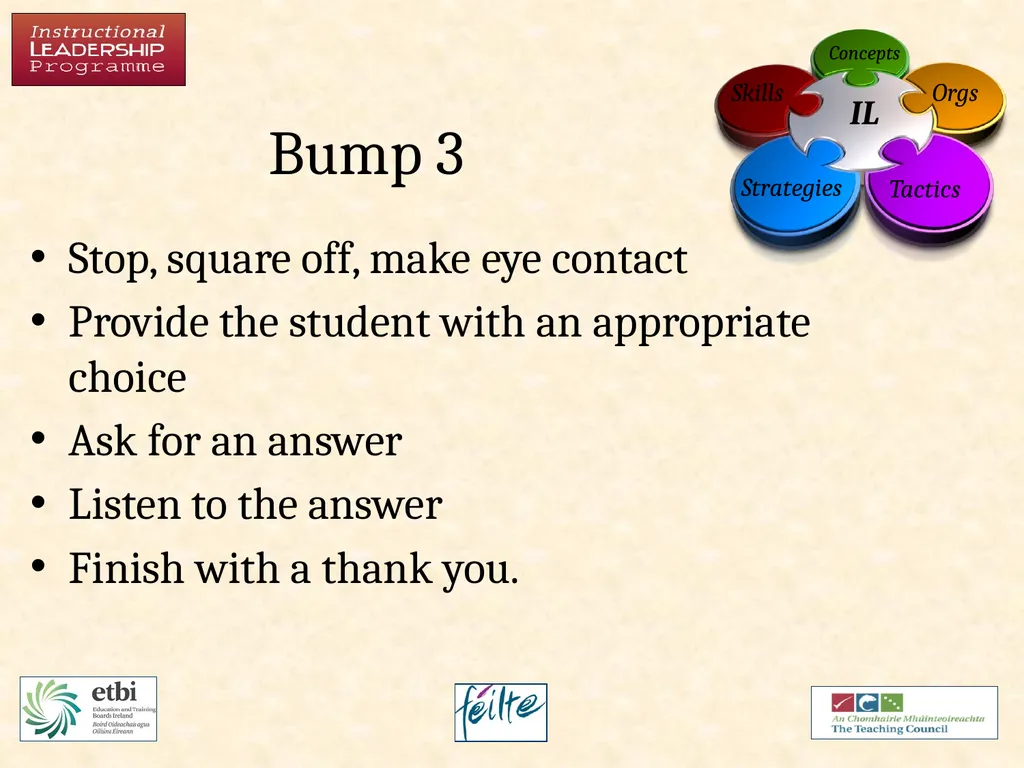
Bump 3 Stop, square off, make eye contact
Provide the student with an appropriate choice
Ask for an answer
Listen to the answer
Finish with a thank you.<br>
09
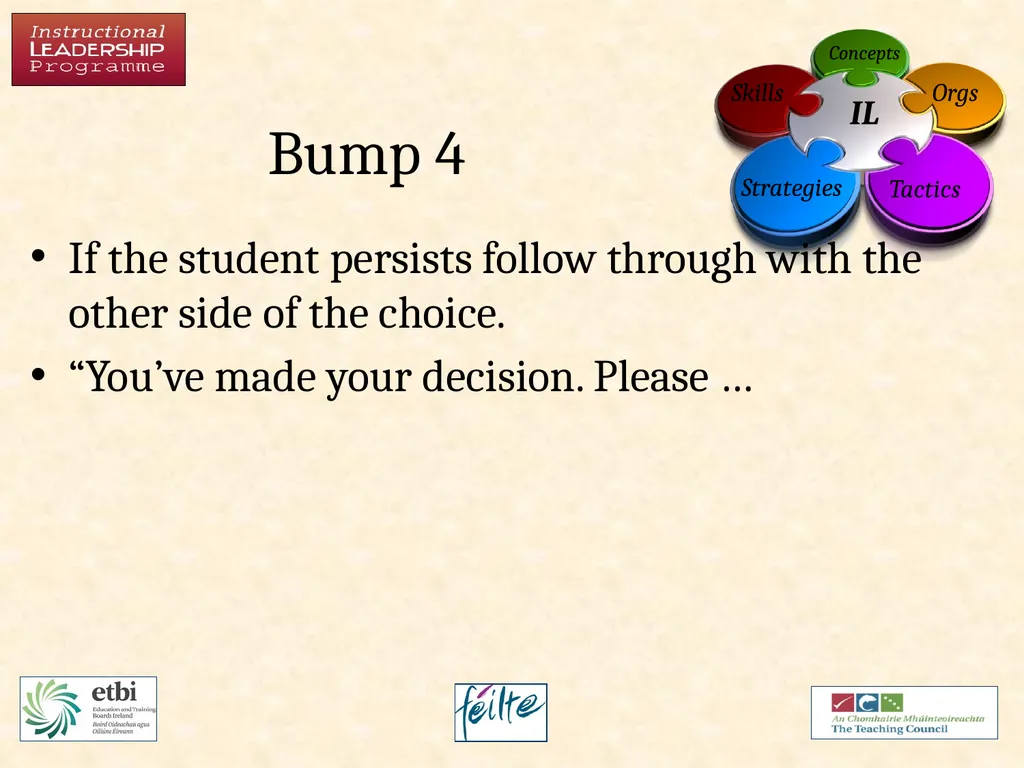
Bump 4 If the student persists follow through with the other side of the choice.
“You’ve made your decision. Please …<br>
10
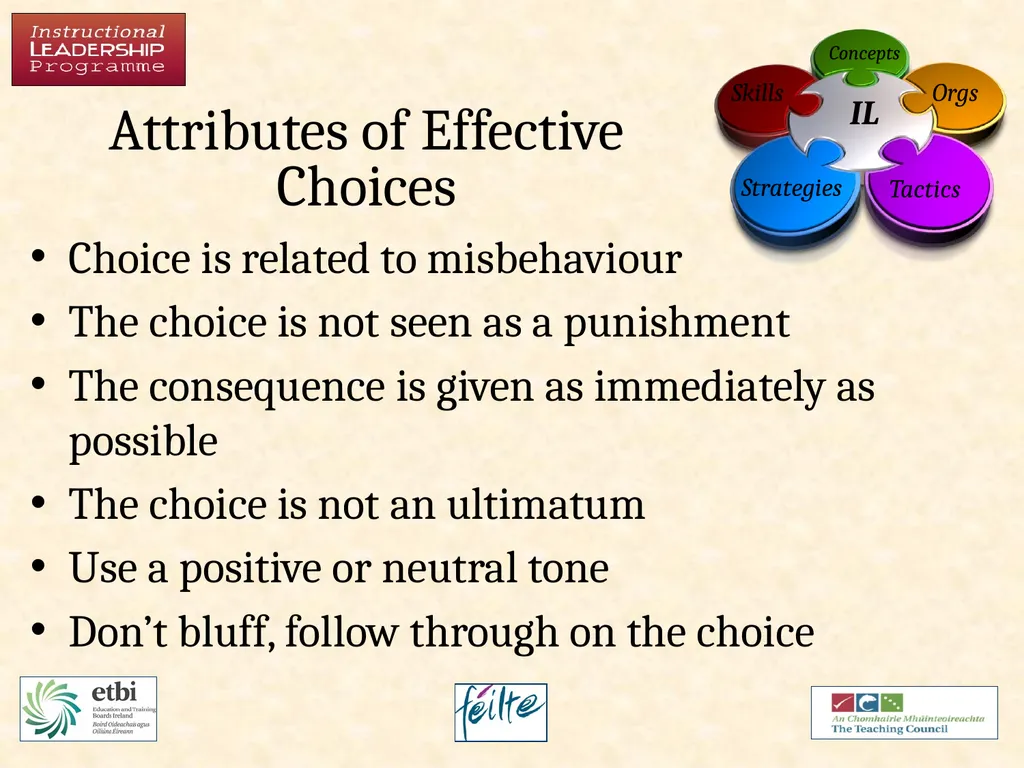
Attributes of Effective Choices Choice is related to misbehaviour
The choice is not seen as a punishment
The consequence is given as immediately as possible
The choice is not an ultimatum
Use a positive or neutral tone
Don’t bluff, follow through on the choice<br>
11
Bump 5 Defusing the power struggle<br>
12
Bump 5 Defusing the power struggle Stop, square off, make eye contact (2-3s)
Take one or more deep breaths
Deal with any allies
Shift the locus of control
Pause and allow the student to save face
Closure by saying thank you.<br>
13
Responses to power situations Ignore it
Short circuit it
Describe the situation and inform the student you are not interested
Put ball back in student’s court
Provide a choice
Student leaves the class<br>
14
Bump 6 Informal Agreement Greet student and set atmosphere
Define problem
Generate alternatives
Agree on alternatives to try and when to begin
Review what has been agreed upon
End conference positively<br>
15
Bump 6 Informal Agreement Shifts the responsibility to the student
Minimises the time spent dealing with misbehaviour during class time
Allows student and teacher to work together
Opportunity to establish a more positive relationship<br>
A collective response by staff and parents to assist the student to take action about whether or not to be part of that school’s learning environment<br>