
CLEAN AIR -KNUST SUMMER SCHOOL: AIR POLLUTION AND
PC
Published · 23 slides · 0 views

1 / 1



Description
CLEAN AIR -KNUST SUMMER SCHOOL: AIR POLLUTION AND EMISSIONS STANDARD AND REGULATIONS IN GHANA PRESENTER: EMMANUEL K-E APPOH (MANAGING CONSULTANTASSIST. FACILITY MANAGER OF AFRI-SETFACILITATOR) VENUE: KNUST, KUMASI DATE: 30TH OCTOBER 2023
Related Topics
Share
Embed code
Download this presentation From Below
"CLEAN AIR -KNUST SUMMER SCHOOL: AIR POLLUTION AND" is the property of its rightful owner. Permission is granted to download and print the materials on this website for personal, non-commercial use only, and to display it on your personal computer provided you do not modify the materials and that you retain all copyright notices contained in the materials. By downloading content from our website, you accept the terms of this agreement.
Presentation Transcript
01
CLEAN AIR -KNUST SUMMER SCHOOL:
AIR POLLUTION AND EMISSIONS STANDARD AND REGULATIONS IN GHANA PRESENTER:
EMMANUEL K-E APPOH
(MANAGING CONSULTANT/ASSIST. FACILITY MANAGER OF AFRI-SET/FACILITATOR)
VENUE: KNUST, KUMASI
DATE: 30TH OCTOBER 2023 2023 CLEAN AIR-KNUST SUMMER SCHOOL ON AIR QUALITY AND POLLUTION PREVENTION
2ND NOVEMBER 2023<br>
EMMANUEL K-E APPOH
(MANAGING CONSULTANT/ASSIST. FACILITY MANAGER OF AFRI-SET/FACILITATOR)
VENUE: KNUST, KUMASI
DATE: 30TH OCTOBER 2023 2023 CLEAN AIR-KNUST SUMMER SCHOOL ON AIR QUALITY AND POLLUTION PREVENTION
2ND NOVEMBER 2023<br>
02
Presentation Outline What are Standards and their importance?
EPA’S Mandate & Local Government
Why are Standards set?
Processes involved in setting the Ghana Standards for Environmental Quality
The Ghana Air quality and Vehicle Emission Standards
conclusion<br>
EPA’S Mandate & Local Government
Why are Standards set?
Processes involved in setting the Ghana Standards for Environmental Quality
The Ghana Air quality and Vehicle Emission Standards
conclusion<br>
03
What is a Standard & why are they Important? Standards are published documents that establish specifications and procedures designed to ensure the reliability of the materials, products, methods, and/or services people use every day.
Standards address a range of issues, including but not limited to various protocols that help ensure product functionality and compatibility, facilitate interoperability and support consumer safety and public health.
Standards make it easier to understand and compare competing products. As standards are globally adopted and applied in many markets, they also fuel international trade.
Application of standards brings about the credibility of new products and new markets can be verified.
They are useful for fuelling the development and implementation of technologies that influence and transform the way we live, work and communicate. They are maximum threshold limits for parameters, that are set to protect the environment and public health<br>
Standards address a range of issues, including but not limited to various protocols that help ensure product functionality and compatibility, facilitate interoperability and support consumer safety and public health.
Standards make it easier to understand and compare competing products. As standards are globally adopted and applied in many markets, they also fuel international trade.
Application of standards brings about the credibility of new products and new markets can be verified.
They are useful for fuelling the development and implementation of technologies that influence and transform the way we live, work and communicate. They are maximum threshold limits for parameters, that are set to protect the environment and public health<br>
04
EPA’S Mandate Constitution of Ghana
Article 36(9) of Ghana’s Constitution requires: the State to take appropriate measures to safeguard the national environment for posterity. Article 41(K) enjoins every citizen to protect and safeguard the environment.
- EPA Act 1994, Act 490,
Agency mandated to oversee, coordinate and regulate all issues regarding the environment in Ghana and with a mission to co-manage, protect and enhance the country’s environment, in particular, as well as seek common solutions to global environmental problems.
The mission is to be achieved by implementing 17 functions set out in Part 1 Section 2 of the Act. Two key functions of the Agency involve in environmental quality management include:
(i) Development of a comprehensive environmental quality database to guide policy formulation and implementation, and
(ii) Prescription of guidelines, standards and regulations relating to the pollution of air, water, land and any other forms of environmental pollution including the discharge of waste and the control of toxic substances.<br>
Article 36(9) of Ghana’s Constitution requires: the State to take appropriate measures to safeguard the national environment for posterity. Article 41(K) enjoins every citizen to protect and safeguard the environment.
- EPA Act 1994, Act 490,
Agency mandated to oversee, coordinate and regulate all issues regarding the environment in Ghana and with a mission to co-manage, protect and enhance the country’s environment, in particular, as well as seek common solutions to global environmental problems.
The mission is to be achieved by implementing 17 functions set out in Part 1 Section 2 of the Act. Two key functions of the Agency involve in environmental quality management include:
(i) Development of a comprehensive environmental quality database to guide policy formulation and implementation, and
(ii) Prescription of guidelines, standards and regulations relating to the pollution of air, water, land and any other forms of environmental pollution including the discharge of waste and the control of toxic substances.<br>
05
EPA’S Mandate (11) EPA first developed air and effluent (wastewater) quality and noise guidelines in 2000 and applied them till January 2019 when they were replaced by standards.
Other Legal Drivers for Environmental management: EAR 1999 LI1652, Hazardous & Electronic waste control & management Act 2016, Act 917 and Regulations LI2250; Environmental Policy,
Sustainable Development Goals 3,11
Target 3.9: substantially reduce the number of deaths and illnesses from hazardous chemicals and air, water and soil pollution and contamination
Goal 11: Make cities and human settlements inclusive, safe, resilient and sustainable
Target 11.6: reduce the adverse per capita environmental impact of cities, including by paying special attention to air quality and municipal and other waste management.
Indicator 11.6.2: Annual mean levels of fine particulate matter (e.g. PM2.5 and PM10) in cities (population weighted). Etc.<br>
Other Legal Drivers for Environmental management: EAR 1999 LI1652, Hazardous & Electronic waste control & management Act 2016, Act 917 and Regulations LI2250; Environmental Policy,
Sustainable Development Goals 3,11
Target 3.9: substantially reduce the number of deaths and illnesses from hazardous chemicals and air, water and soil pollution and contamination
Goal 11: Make cities and human settlements inclusive, safe, resilient and sustainable
Target 11.6: reduce the adverse per capita environmental impact of cities, including by paying special attention to air quality and municipal and other waste management.
Indicator 11.6.2: Annual mean levels of fine particulate matter (e.g. PM2.5 and PM10) in cities (population weighted). Etc.<br>
06
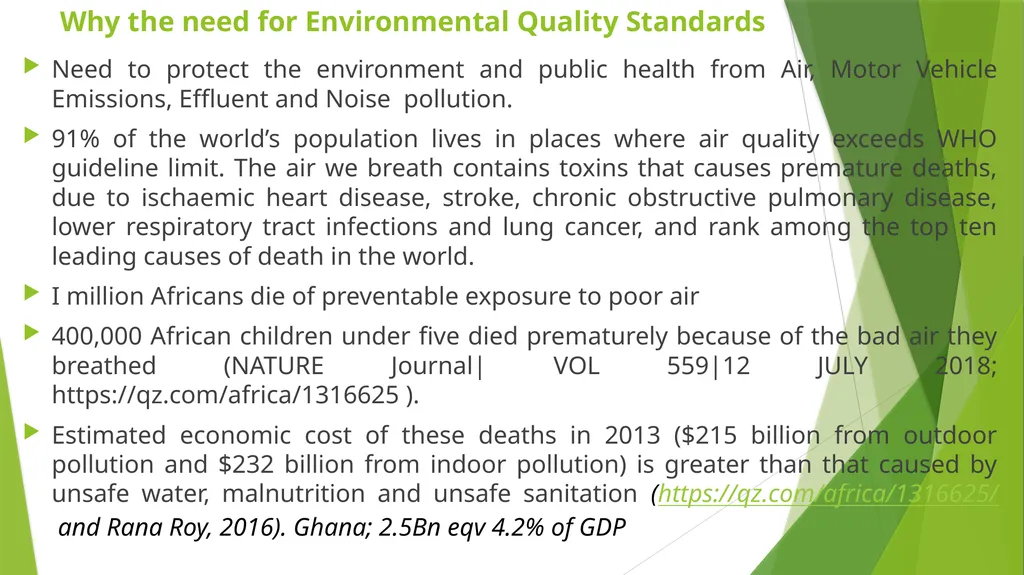
Why the need for Environmental Quality Standards Need to protect the environment and public health from Air, Motor Vehicle Emissions, Effluent and Noise pollution.
91% of the world’s population lives in places where air quality exceeds WHO guideline limit. The air we breath contains toxins that causes premature deaths, due to ischaemic heart disease, stroke, chronic obstructive pulmonary disease, lower respiratory tract infections and lung cancer, and rank among the top ten leading causes of death in the world.
I million Africans die of preventable exposure to poor air
400,000 African children under five died prematurely because of the bad air they breathed (NATURE Journal| VOL 559|12 JULY 2018; https://qz.com/africa/1316625 ).
Estimated economic cost of these deaths in 2013 ($215 billion from outdoor pollution and $232 billion from indoor pollution) is greater than that caused by unsafe water, malnutrition and unsafe sanitation (https://qz.com/africa/1316625/ and Rana Roy, 2016). Ghana; 2.5Bn eqv 4.2% of GDP<br>
91% of the world’s population lives in places where air quality exceeds WHO guideline limit. The air we breath contains toxins that causes premature deaths, due to ischaemic heart disease, stroke, chronic obstructive pulmonary disease, lower respiratory tract infections and lung cancer, and rank among the top ten leading causes of death in the world.
I million Africans die of preventable exposure to poor air
400,000 African children under five died prematurely because of the bad air they breathed (NATURE Journal| VOL 559|12 JULY 2018; https://qz.com/africa/1316625 ).
Estimated economic cost of these deaths in 2013 ($215 billion from outdoor pollution and $232 billion from indoor pollution) is greater than that caused by unsafe water, malnutrition and unsafe sanitation (https://qz.com/africa/1316625/ and Rana Roy, 2016). Ghana; 2.5Bn eqv 4.2% of GDP<br>
07
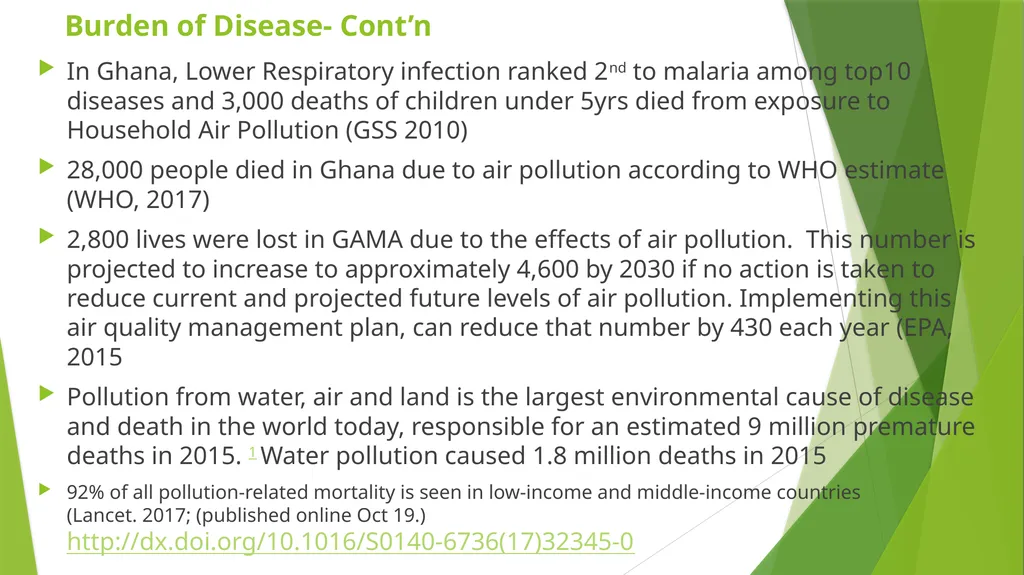
Burden of Disease- Cont’n In Ghana, Lower Respiratory infection ranked 2nd to malaria among top10 diseases and 3,000 deaths of children under 5yrs died from exposure to Household Air Pollution (GSS 2010)
28,000 people died in Ghana due to air pollution according to WHO estimate (WHO, 2017)
2,800 lives were lost in GAMA due to the effects of air pollution. This number is projected to increase to approximately 4,600 by 2030 if no action is taken to reduce current and projected future levels of air pollution. Implementing this air quality management plan, can reduce that number by 430 each year (EPA, 2015
Pollution from water, air and land is the largest environmental cause of disease and death in the world today, responsible for an estimated 9 million premature deaths in 2015. 1 Water pollution caused 1.8 million deaths in 2015
92% of all pollution-related mortality is seen in low-income and middle-income countries (Lancet. 2017; (published online Oct 19.) http://dx.doi.org/10.1016/S0140-6736(17)32345-0<br>
28,000 people died in Ghana due to air pollution according to WHO estimate (WHO, 2017)
2,800 lives were lost in GAMA due to the effects of air pollution. This number is projected to increase to approximately 4,600 by 2030 if no action is taken to reduce current and projected future levels of air pollution. Implementing this air quality management plan, can reduce that number by 430 each year (EPA, 2015
Pollution from water, air and land is the largest environmental cause of disease and death in the world today, responsible for an estimated 9 million premature deaths in 2015. 1 Water pollution caused 1.8 million deaths in 2015
92% of all pollution-related mortality is seen in low-income and middle-income countries (Lancet. 2017; (published online Oct 19.) http://dx.doi.org/10.1016/S0140-6736(17)32345-0<br>
08
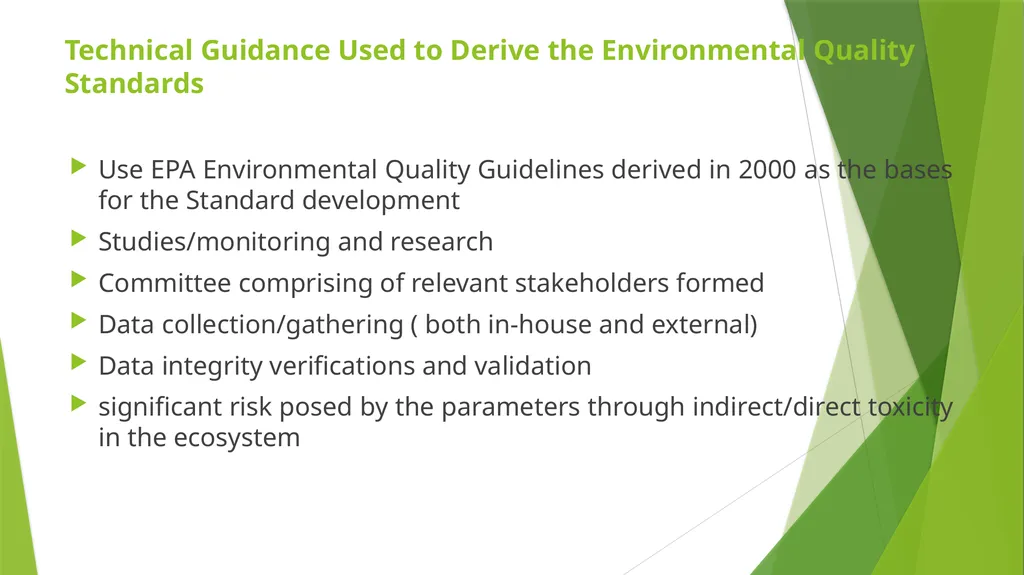
Technical Guidance Used to Derive the Environmental Quality Standards Use EPA Environmental Quality Guidelines derived in 2000 as the bases for the Standard development
Studies/monitoring and research
Committee comprising of relevant stakeholders formed
Data collection/gathering ( both in-house and external)
Data integrity verifications and validation
significant risk posed by the parameters through indirect/direct toxicity in the ecosystem<br>
Studies/monitoring and research
Committee comprising of relevant stakeholders formed
Data collection/gathering ( both in-house and external)
Data integrity verifications and validation
significant risk posed by the parameters through indirect/direct toxicity in the ecosystem<br>
09
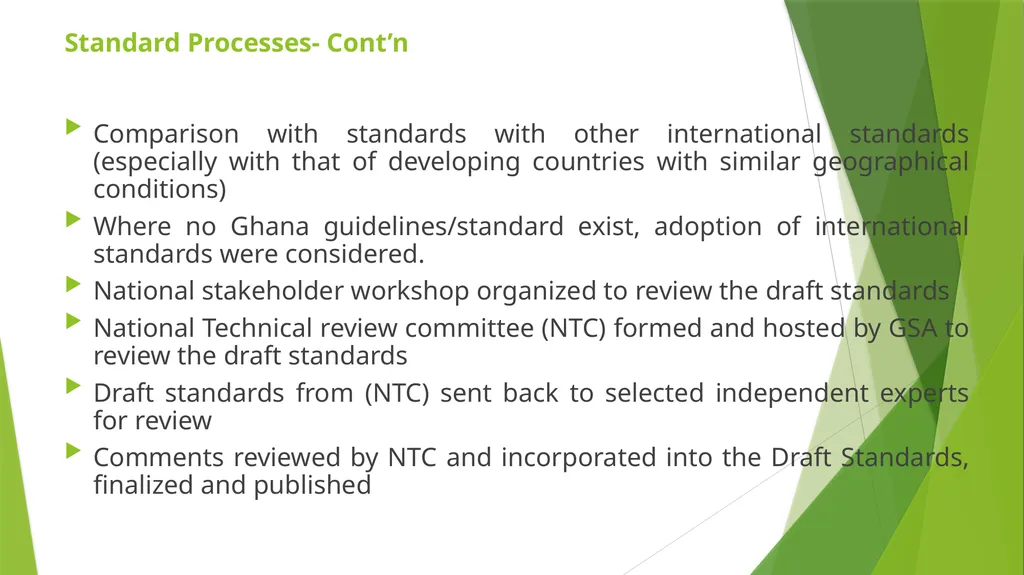
Standard Processes- Cont’n Comparison with standards with other international standards (especially with that of developing countries with similar geographical conditions)
Where no Ghana guidelines/standard exist, adoption of international standards were considered.
National stakeholder workshop organized to review the draft standards
National Technical review committee (NTC) formed and hosted by GSA to review the draft standards
Draft standards from (NTC) sent back to selected independent experts for review
Comments reviewed by NTC and incorporated into the Draft Standards, finalized and published<br>
Where no Ghana guidelines/standard exist, adoption of international standards were considered.
National stakeholder workshop organized to review the draft standards
National Technical review committee (NTC) formed and hosted by GSA to review the draft standards
Draft standards from (NTC) sent back to selected independent experts for review
Comments reviewed by NTC and incorporated into the Draft Standards, finalized and published<br>
10
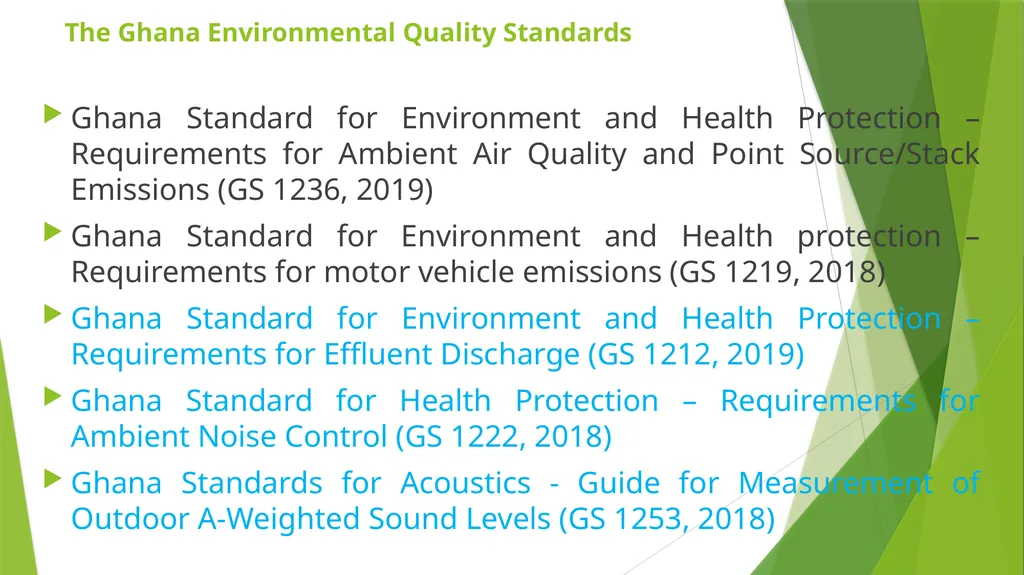
The Ghana Environmental Quality Standards Ghana Standard for Environment and Health Protection – Requirements for Ambient Air Quality and Point Source/Stack Emissions (GS 1236, 2019)
Ghana Standard for Environment and Health protection – Requirements for motor vehicle emissions (GS 1219, 2018)
Ghana Standard for Environment and Health Protection – Requirements for Effluent Discharge (GS 1212, 2019)
Ghana Standard for Health Protection – Requirements for Ambient Noise Control (GS 1222, 2018)
Ghana Standards for Acoustics - Guide for Measurement of Outdoor A-Weighted Sound Levels (GS 1253, 2018)<br>
Ghana Standard for Environment and Health protection – Requirements for motor vehicle emissions (GS 1219, 2018)
Ghana Standard for Environment and Health Protection – Requirements for Effluent Discharge (GS 1212, 2019)
Ghana Standard for Health Protection – Requirements for Ambient Noise Control (GS 1222, 2018)
Ghana Standards for Acoustics - Guide for Measurement of Outdoor A-Weighted Sound Levels (GS 1253, 2018)<br>
11
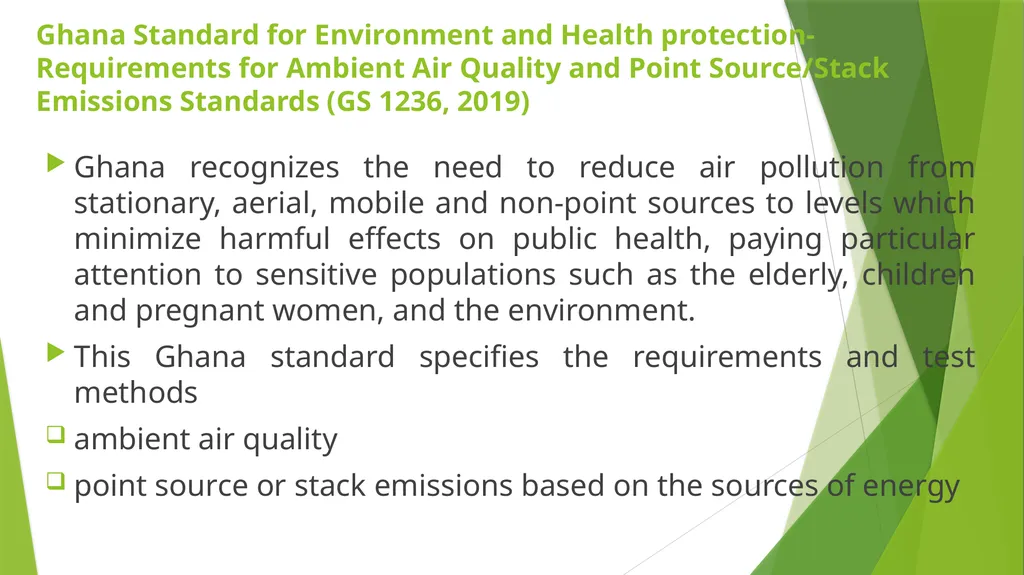
Ghana Standard for Environment and Health protection-Requirements for Ambient Air Quality and Point Source/Stack Emissions Standards (GS 1236, 2019) Ghana recognizes the need to reduce air pollution from stationary, aerial, mobile and non-point sources to levels which minimize harmful effects on public health, paying particular attention to sensitive populations such as the elderly, children and pregnant women, and the environment.
This Ghana standard specifies the requirements and test methods
ambient air quality
point source or stack emissions based on the sources of energy<br>
This Ghana standard specifies the requirements and test methods
ambient air quality
point source or stack emissions based on the sources of energy<br>
12
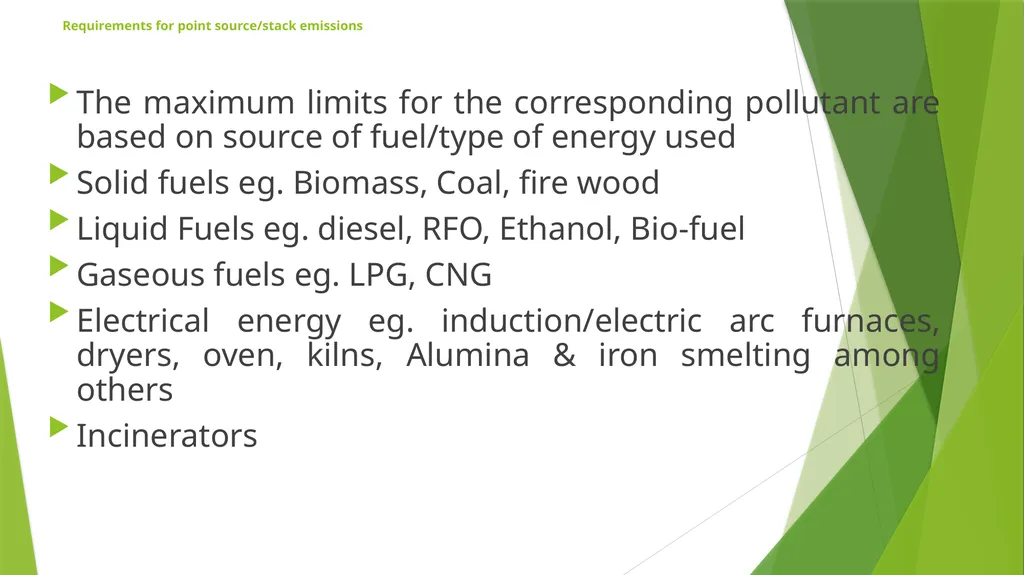
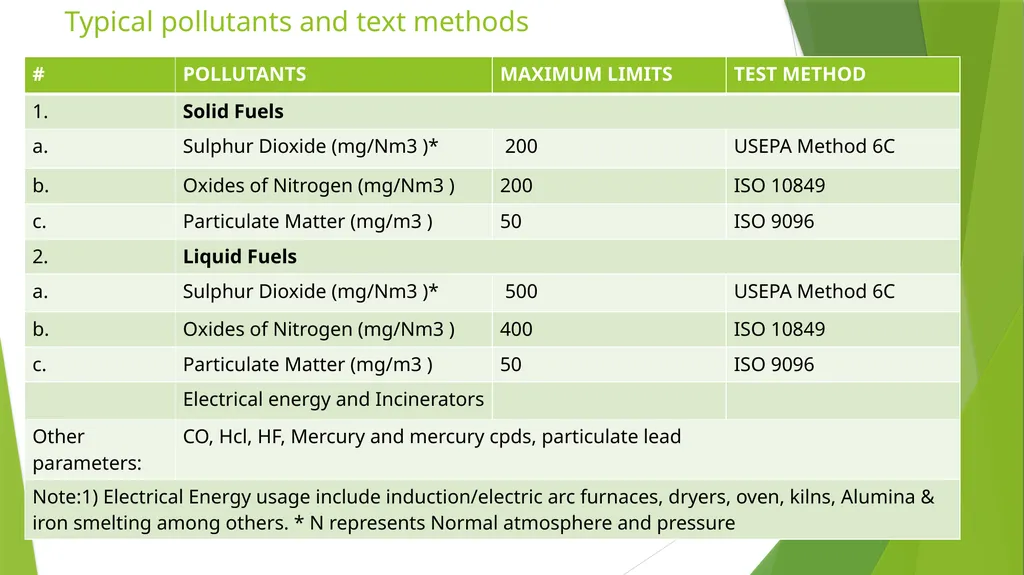
Requirements for point source/stack emissions The maximum limits for the corresponding pollutant are based on source of fuel/type of energy used
Solid fuels eg. Biomass, Coal, fire wood
Liquid Fuels eg. diesel, RFO, Ethanol, Bio-fuel
Gaseous fuels eg. LPG, CNG
Electrical energy eg. induction/electric arc furnaces, dryers, oven, kilns, Alumina & iron smelting among others
Incinerators<br>
Solid fuels eg. Biomass, Coal, fire wood
Liquid Fuels eg. diesel, RFO, Ethanol, Bio-fuel
Gaseous fuels eg. LPG, CNG
Electrical energy eg. induction/electric arc furnaces, dryers, oven, kilns, Alumina & iron smelting among others
Incinerators<br>
13
Typical pollutants and text methods<br>
14
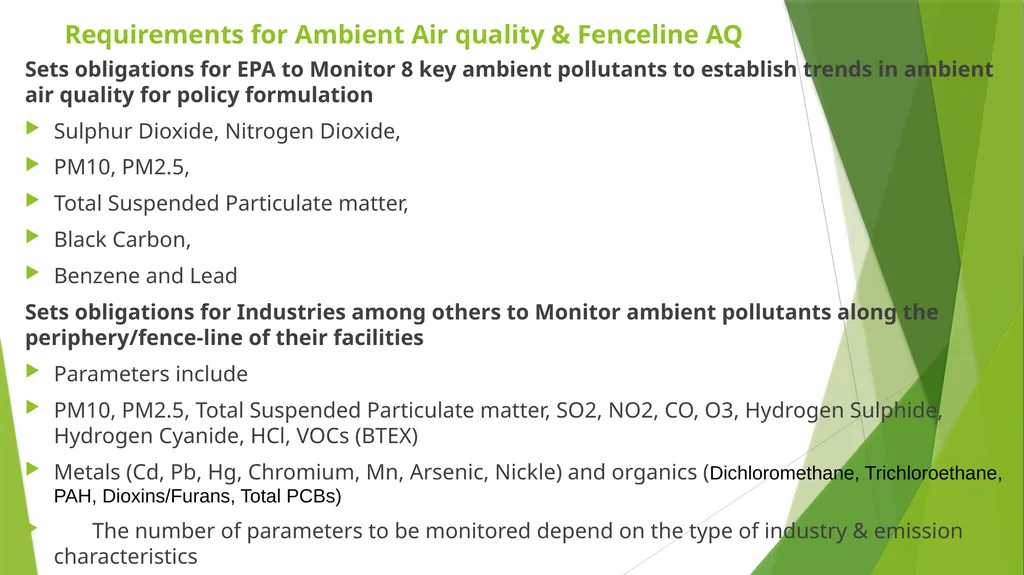
Requirements for Ambient Air quality & Fenceline AQ Sets obligations for EPA to Monitor 8 key ambient pollutants to establish trends in ambient air quality for policy formulation
Sulphur Dioxide, Nitrogen Dioxide,
PM10, PM2.5,
Total Suspended Particulate matter,
Black Carbon,
Benzene and Lead
Sets obligations for Industries among others to Monitor ambient pollutants along the periphery/fence-line of their facilities
Parameters include
PM10, PM2.5, Total Suspended Particulate matter, SO2, NO2, CO, O3, Hydrogen Sulphide, Hydrogen Cyanide, HCl, VOCs (BTEX)
Metals (Cd, Pb, Hg, Chromium, Mn, Arsenic, Nickle) and organics (Dichloromethane, Trichloroethane, PAH, Dioxins/Furans, Total PCBs)
The number of parameters to be monitored depend on the type of industry & emission characteristics<br>
Sulphur Dioxide, Nitrogen Dioxide,
PM10, PM2.5,
Total Suspended Particulate matter,
Black Carbon,
Benzene and Lead
Sets obligations for Industries among others to Monitor ambient pollutants along the periphery/fence-line of their facilities
Parameters include
PM10, PM2.5, Total Suspended Particulate matter, SO2, NO2, CO, O3, Hydrogen Sulphide, Hydrogen Cyanide, HCl, VOCs (BTEX)
Metals (Cd, Pb, Hg, Chromium, Mn, Arsenic, Nickle) and organics (Dichloromethane, Trichloroethane, PAH, Dioxins/Furans, Total PCBs)
The number of parameters to be monitored depend on the type of industry & emission characteristics<br>
15
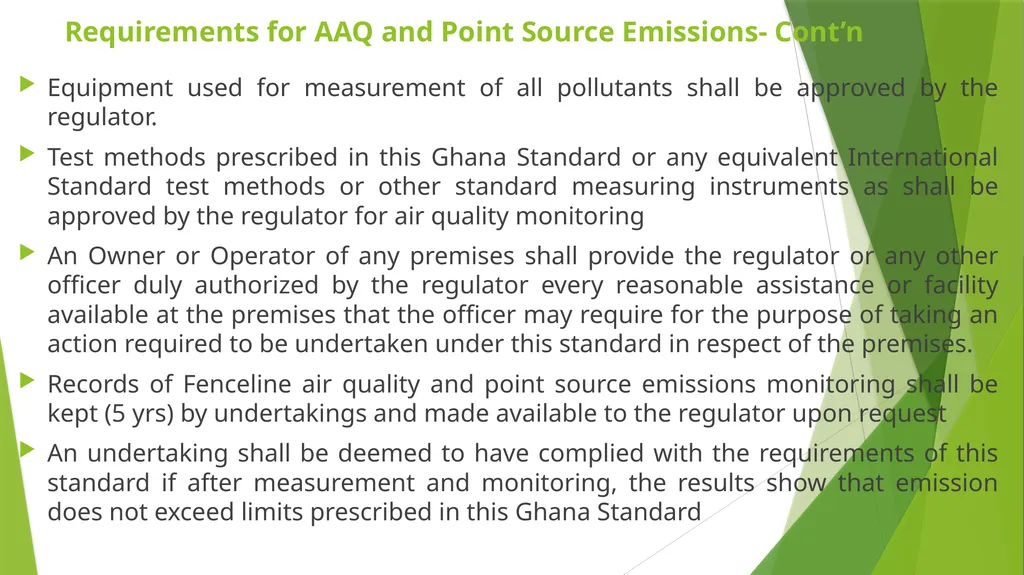
Requirements for AAQ and Point Source Emissions- Cont’n Equipment used for measurement of all pollutants shall be approved by the regulator.
Test methods prescribed in this Ghana Standard or any equivalent International Standard test methods or other standard measuring instruments as shall be approved by the regulator for air quality monitoring
An Owner or Operator of any premises shall provide the regulator or any other officer duly authorized by the regulator every reasonable assistance or facility available at the premises that the officer may require for the purpose of taking an action required to be undertaken under this standard in respect of the premises.
Records of Fenceline air quality and point source emissions monitoring shall be kept (5 yrs) by undertakings and made available to the regulator upon request
An undertaking shall be deemed to have complied with the requirements of this standard if after measurement and monitoring, the results show that emission does not exceed limits prescribed in this Ghana Standard<br>
Test methods prescribed in this Ghana Standard or any equivalent International Standard test methods or other standard measuring instruments as shall be approved by the regulator for air quality monitoring
An Owner or Operator of any premises shall provide the regulator or any other officer duly authorized by the regulator every reasonable assistance or facility available at the premises that the officer may require for the purpose of taking an action required to be undertaken under this standard in respect of the premises.
Records of Fenceline air quality and point source emissions monitoring shall be kept (5 yrs) by undertakings and made available to the regulator upon request
An undertaking shall be deemed to have complied with the requirements of this standard if after measurement and monitoring, the results show that emission does not exceed limits prescribed in this Ghana Standard<br>
16
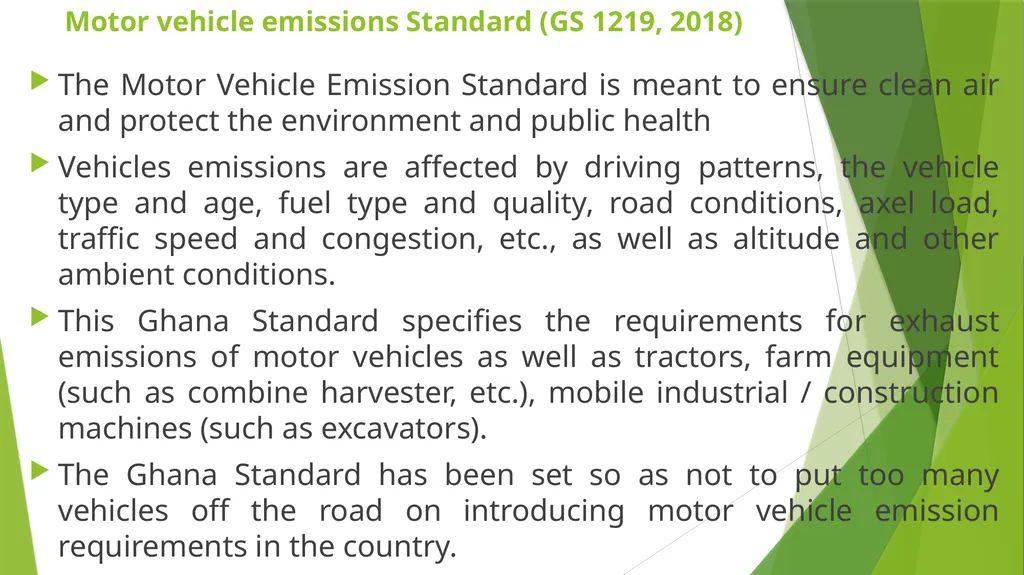
Motor vehicle emissions Standard (GS 1219, 2018) The Motor Vehicle Emission Standard is meant to ensure clean air and protect the environment and public health
Vehicles emissions are affected by driving patterns, the vehicle type and age, fuel type and quality, road conditions, axel load, traffic speed and congestion, etc., as well as altitude and other ambient conditions.
This Ghana Standard specifies the requirements for exhaust emissions of motor vehicles as well as tractors, farm equipment (such as combine harvester, etc.), mobile industrial / construction machines (such as excavators).
The Ghana Standard has been set so as not to put too many vehicles off the road on introducing motor vehicle emission requirements in the country.
.<br>
Vehicles emissions are affected by driving patterns, the vehicle type and age, fuel type and quality, road conditions, axel load, traffic speed and congestion, etc., as well as altitude and other ambient conditions.
This Ghana Standard specifies the requirements for exhaust emissions of motor vehicles as well as tractors, farm equipment (such as combine harvester, etc.), mobile industrial / construction machines (such as excavators).
The Ghana Standard has been set so as not to put too many vehicles off the road on introducing motor vehicle emission requirements in the country.
.<br>
17
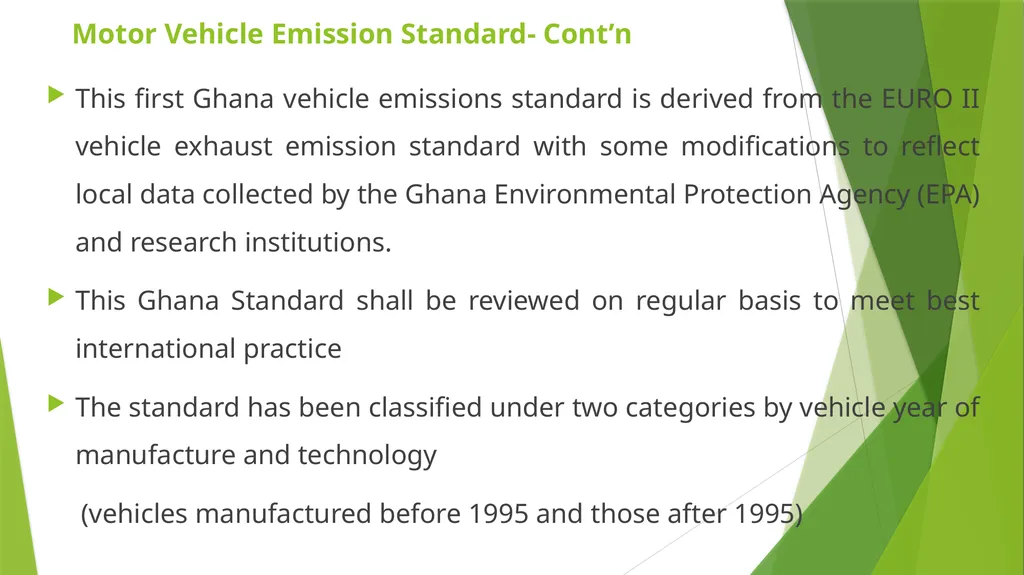
Motor Vehicle Emission Standard- Cont’n This first Ghana vehicle emissions standard is derived from the EURO II vehicle exhaust emission standard with some modifications to reflect local data collected by the Ghana Environmental Protection Agency (EPA) and research institutions.
This Ghana Standard shall be reviewed on regular basis to meet best international practice
The standard has been classified under two categories by vehicle year of manufacture and technology
(vehicles manufactured before 1995 and those after 1995)<br>
This Ghana Standard shall be reviewed on regular basis to meet best international practice
The standard has been classified under two categories by vehicle year of manufacture and technology
(vehicles manufactured before 1995 and those after 1995)<br>
18
Emission requirements for vehicles based on fuel type<br>
19
Emission requirements for motorcycles Equipment used for testing shall be approved by the regulator.
A vehicle shall be deemed to have complied with the requirements of this Standard if after testing, the results show that emissions for all parameters as prescribed in Table 1 and 2 for the vehicle engine type and year of manufacture fall below the limits indicated in the table<br>
A vehicle shall be deemed to have complied with the requirements of this Standard if after testing, the results show that emissions for all parameters as prescribed in Table 1 and 2 for the vehicle engine type and year of manufacture fall below the limits indicated in the table<br>
20
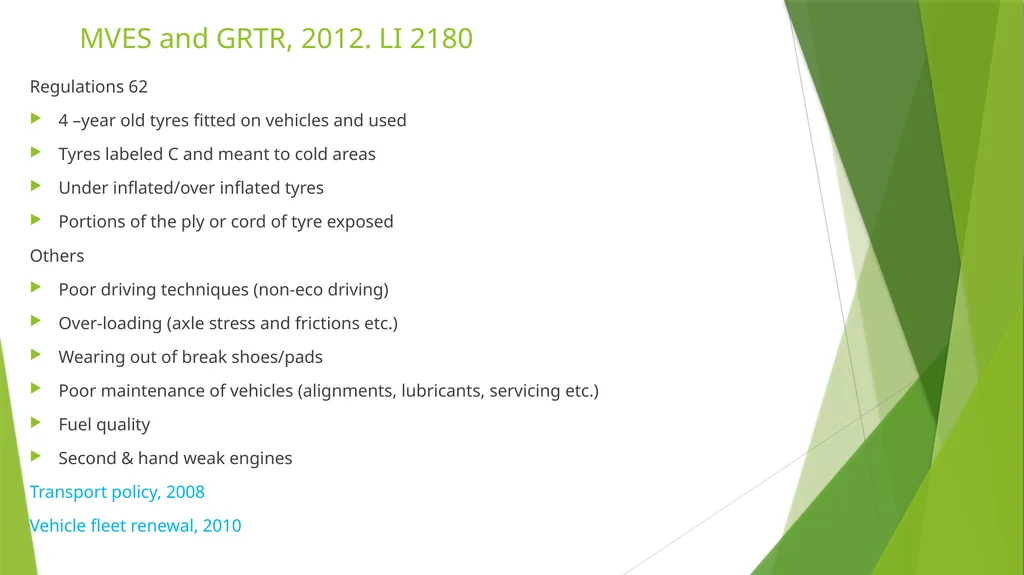
MVES and GRTR, 2012. LI 2180 Regulations 62
4 –year old tyres fitted on vehicles and used
Tyres labeled C and meant to cold areas
Under inflated/over inflated tyres
Portions of the ply or cord of tyre exposed
Others
Poor driving techniques (non-eco driving)
Over-loading (axle stress and frictions etc.)
Wearing out of break shoes/pads
Poor maintenance of vehicles (alignments, lubricants, servicing etc.)
Fuel quality
Second & hand weak engines
Transport policy, 2008
Vehicle fleet renewal, 2010<br>
4 –year old tyres fitted on vehicles and used
Tyres labeled C and meant to cold areas
Under inflated/over inflated tyres
Portions of the ply or cord of tyre exposed
Others
Poor driving techniques (non-eco driving)
Over-loading (axle stress and frictions etc.)
Wearing out of break shoes/pads
Poor maintenance of vehicles (alignments, lubricants, servicing etc.)
Fuel quality
Second & hand weak engines
Transport policy, 2008
Vehicle fleet renewal, 2010<br>
21
Regulations Regulations
MVE regulations
Air quality Regulations<br>
MVE regulations
Air quality Regulations<br>
22
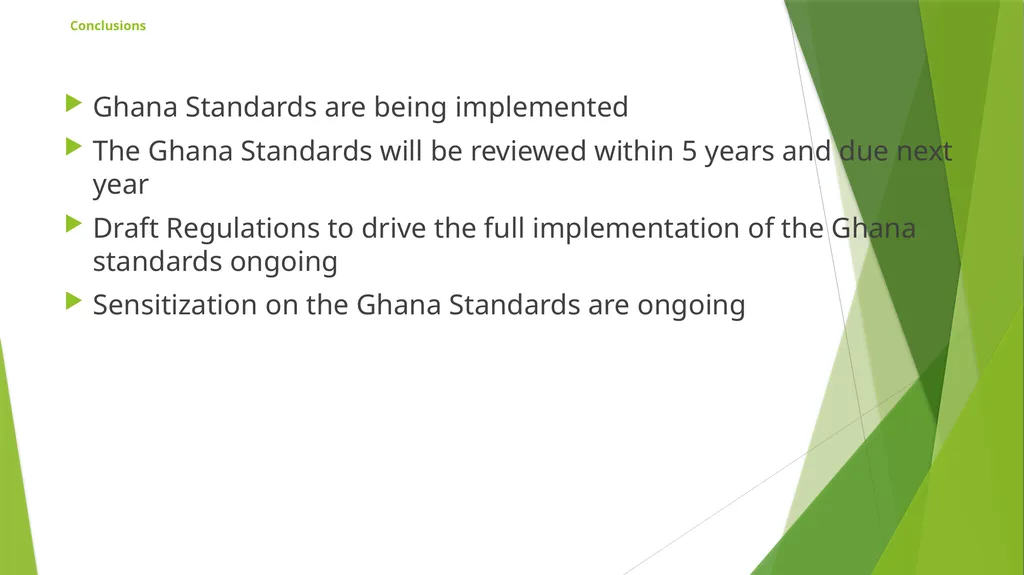
Conclusions Ghana Standards are being implemented
The Ghana Standards will be reviewed within 5 years and due next year
Draft Regulations to drive the full implementation of the Ghana standards ongoing
Sensitization on the Ghana Standards are ongoing<br>
The Ghana Standards will be reviewed within 5 years and due next year
Draft Regulations to drive the full implementation of the Ghana standards ongoing
Sensitization on the Ghana Standards are ongoing<br>
23
Let’s embrace the standards and regulations to ensure environmental safety, good health & wealth.
Thank you!
For further enquiry contact
eeappoh@yahoo.com
Tel: 0244-206475<br>
Thank you!
For further enquiry contact
eeappoh@yahoo.com
Tel: 0244-206475<br>