
Cleaning and Disinfection Production Situations,



Description: Cleaning and Disinfection Production Situations, Safety Issues Adapted from the FAD PRePNAHEMS Guidelines: Cleaning and Disinfection (2014) Production Situations 2 Multiple areas, varied equipment Housing, nesting boxes Open floor areas
Related Topics
Download Presentation
"Cleaning and Disinfection Production Situations," is the property of its rightful owner. Permission is granted to download and print the materials on this website for personal, non-commercial use only, and to display it on your personal computer provided you do not modify the materials and that you retain all copyright notices contained in the materials. By downloading content from our website, you accept the terms of this agreement.
Presentation Transcript
slide1. Cleaning and Disinfection Production Situations, Safety Issues Adapted from the FAD PReP/NAHEMS
Guidelines: Cleaning and Disinfection (2014)<br>
slide2. Production Situations 2<br>
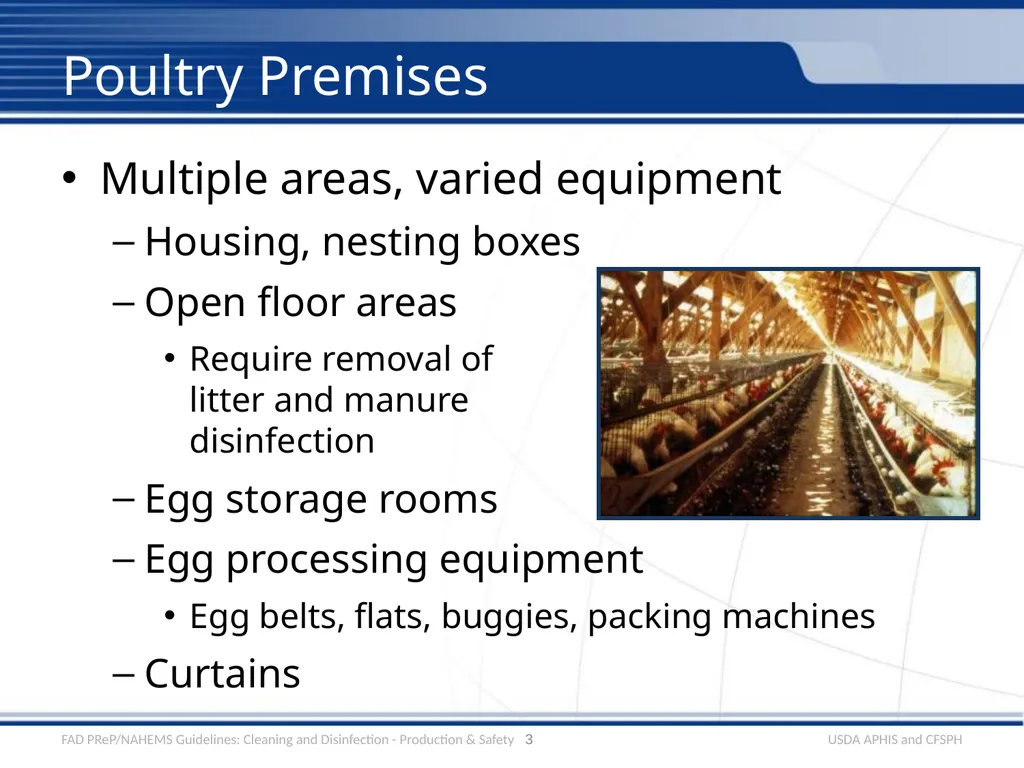
slide3. Multiple areas, varied equipment
Housing, nesting boxes
Open floor areas
Require removal of litter and manure prior to disinfection
Egg storage rooms
Egg processing equipment
Egg belts, flats, buggies, packing machines
Curtains USDA APHIS and CFSPH FAD PReP/NAHEMS Guidelines: Cleaning and Disinfection - Production & Safety Poultry Premises 3<br>
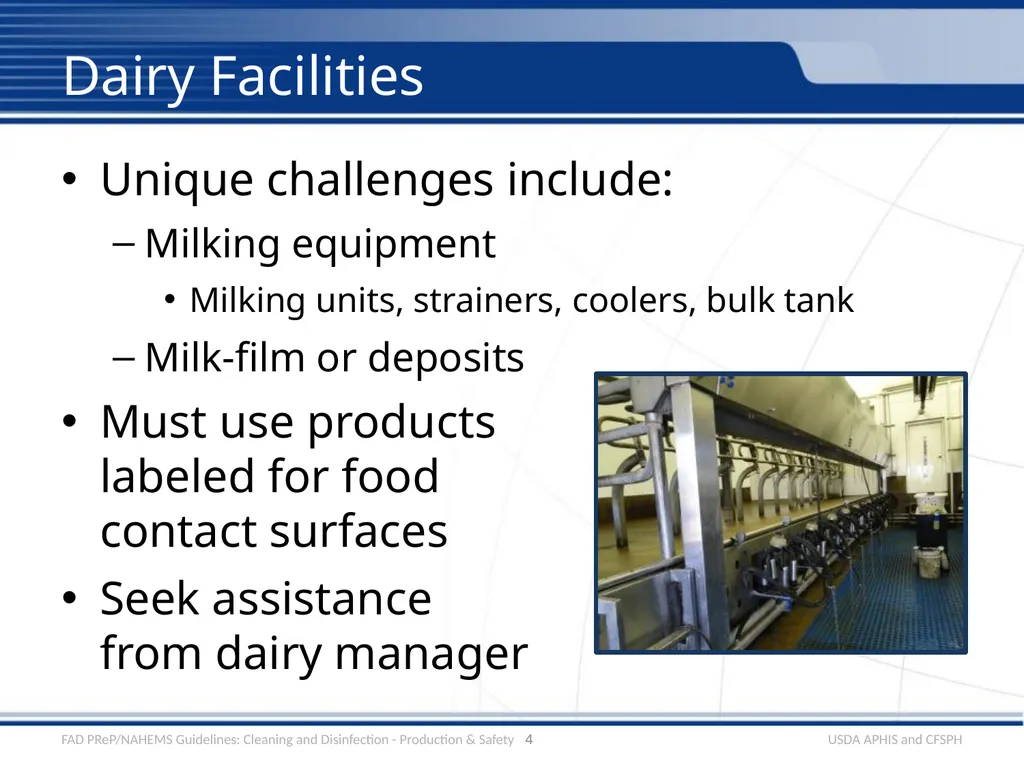
slide4. Unique challenges include:
Milking equipment
Milking units, strainers, coolers, bulk tank
Milk-film or deposits
Must use products labeled for food contact surfaces
Seek assistance from dairy manager USDA APHIS and CFSPH FAD PReP/NAHEMS Guidelines: Cleaning and Disinfection - Production & Safety Dairy Facilities 4<br>
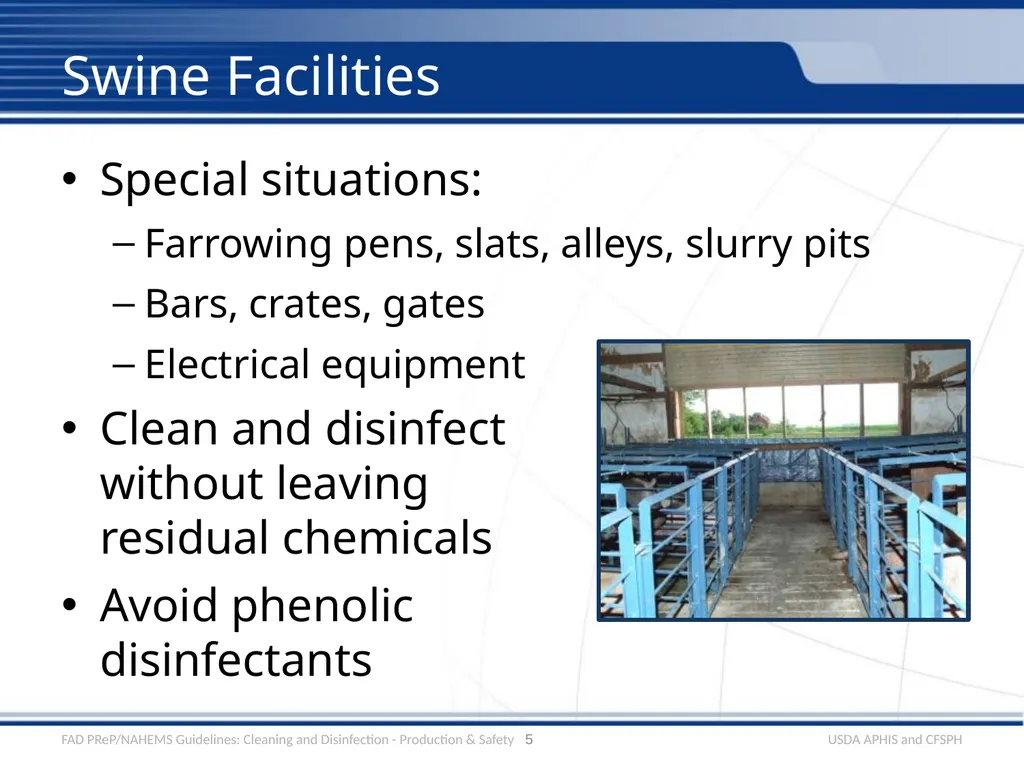
slide5. Special situations:
Farrowing pens, slats, alleys, slurry pits
Bars, crates, gates
Electrical equipment
Clean and disinfect without leaving residual chemicals
Avoid phenolic disinfectants USDA APHIS and CFSPH FAD PReP/NAHEMS Guidelines: Cleaning and Disinfection - Production & Safety Swine Facilities 5<br>
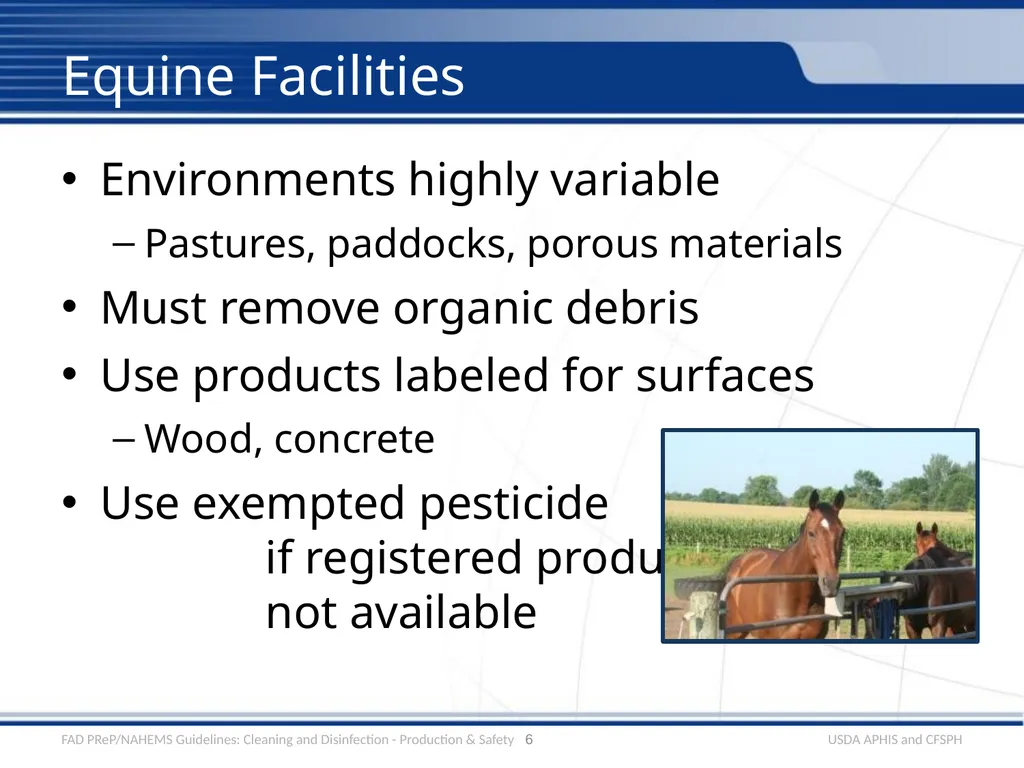
slide6. Environments highly variable
Pastures, paddocks, porous materials
Must remove organic debris
Use products labeled for surfaces
Wood, concrete
Use exempted pesticide if registered product not available USDA APHIS and CFSPH FAD PReP/NAHEMS Guidelines: Cleaning and Disinfection - Production & Safety Equine Facilities 6<br>
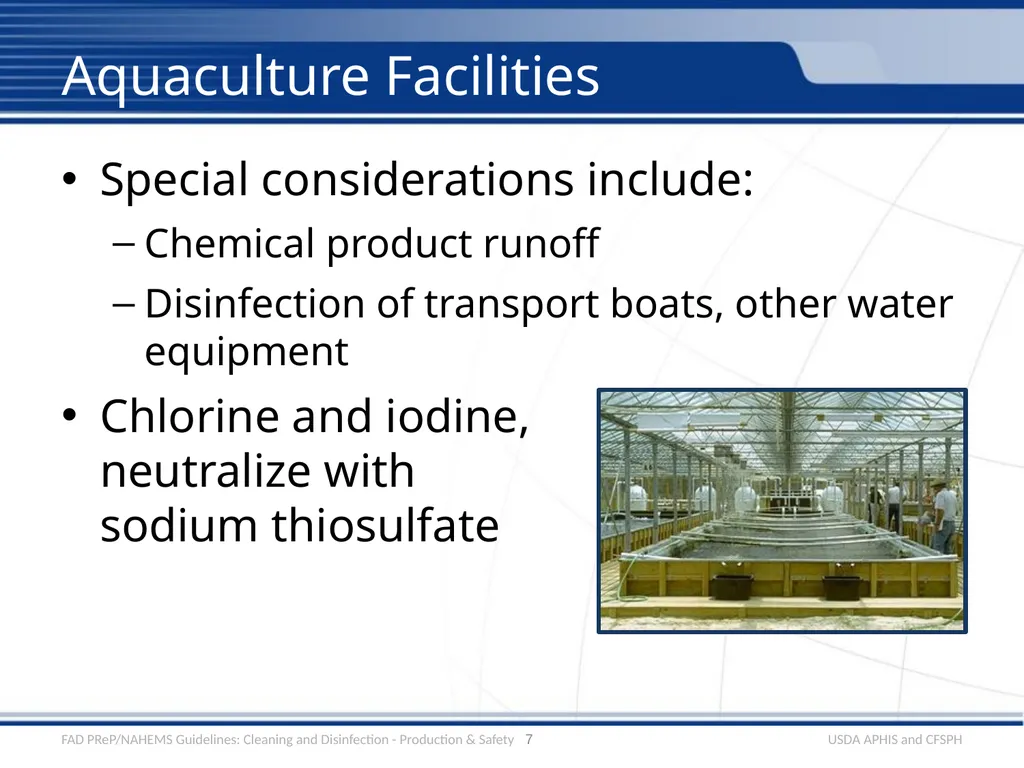
slide7. Special considerations include:
Chemical product runoff
Disinfection of transport boats, other water equipment
Chlorine and iodine, neutralize with sodium thiosulfate USDA APHIS and CFSPH FAD PReP/NAHEMS Guidelines: Cleaning and Disinfection - Production & Safety Aquaculture Facilities 7<br>
slide8. Highly resistant
Disinfectants, heat, UV, ionizing radiation
Physical inactivation
Autoclaving
134-138oC for 18 minutes at 30 lb/in2
Not practical
No products registered/exempted by EPA for agricultural facilities
Exemption would be needed USDA APHIS and CFSPH FAD PReP/NAHEMS Guidelines: Cleaning and Disinfection - Production & Safety Prions 8<br>
slide9. Inspection of a site by experienced personnel
All contaminated areas/equipment C&D’d
Fixtures/fittings dismantled
Disinfectant at proper concentration and contact time
Gross debris (manure, bedding) disposed
Other items disposed in a biosecure manner
Effluent avoids environmental impact
Disinfection measures repeated, if necessary USDA APHIS and CFSPH FAD PReP/NAHEMS Guidelines: Cleaning and Disinfection - Production & Safety Evaluation 9<br>
slide10. Safety Issues and Precautions 10<br>
slide11. Chemical disinfectants have health hazards or risks
All products must be used with care and appropriate PPE
Prepare and store disinfectants as directed
Rinse areas thoroughly before reintroducing animals USDA APHIS and CFSPH FAD PReP/NAHEMS Guidelines: Cleaning and Disinfection - Production & Safety Chemical Hazards 11<br>
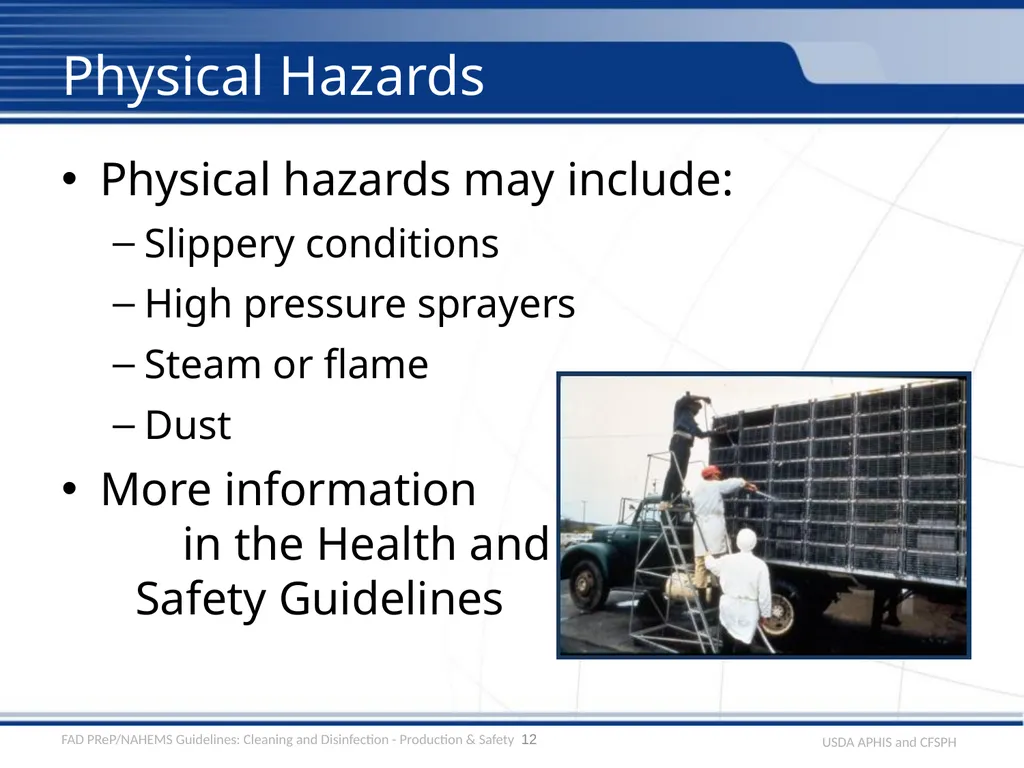
slide12. Physical hazards may include:
Slippery conditions
High pressure sprayers
Steam or flame
Dust
More information in the Health and Safety Guidelines USDA APHIS and CFSPH FAD PReP/NAHEMS Guidelines: Cleaning and Disinfection - Production & Safety Physical Hazards 12<br>
slide13. Zoonotic diseases
C&D conducted in contaminated areas
Sweeping, scraping, blowing may disperse pathogen
Inhale, ingest, direct contact
Avoid exposure with careful C&D measures and PPE USDA APHIS and CFSPH FAD PReP/NAHEMS Guidelines: Cleaning and Disinfection - Production & Safety Biological Hazards 13<br>
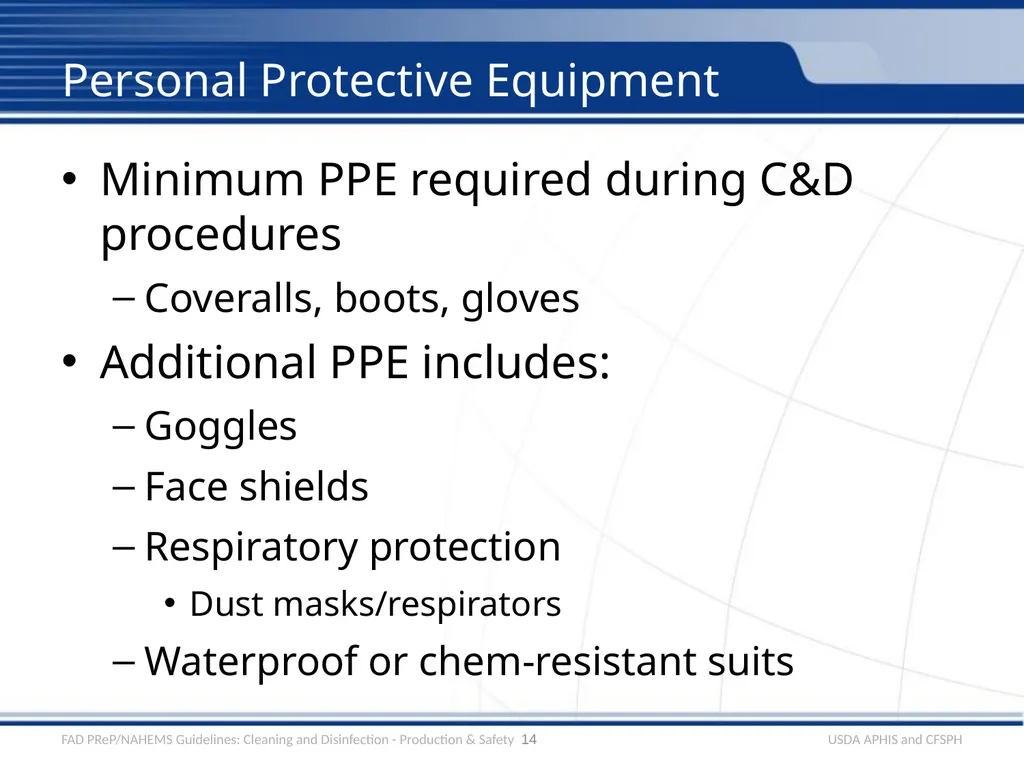
slide14. Minimum PPE required during C&D procedures
Coveralls, boots, gloves
Additional PPE includes:
Goggles
Face shields
Respiratory protection
Dust masks/respirators
Waterproof or chem-resistant suits USDA APHIS and CFSPH FAD PReP/NAHEMS Guidelines: Cleaning and Disinfection - Production & Safety Personal Protective Equipment 14<br>
slide15. All C&D team members should have a complete orientation covering potential hazards
Complete understanding of specific safety precautions must be obtained before entering premises USDA APHIS and CFSPH FAD PReP/NAHEMS Guidelines: Cleaning and Disinfection - Production & Safety Hazard Communication 15<br>
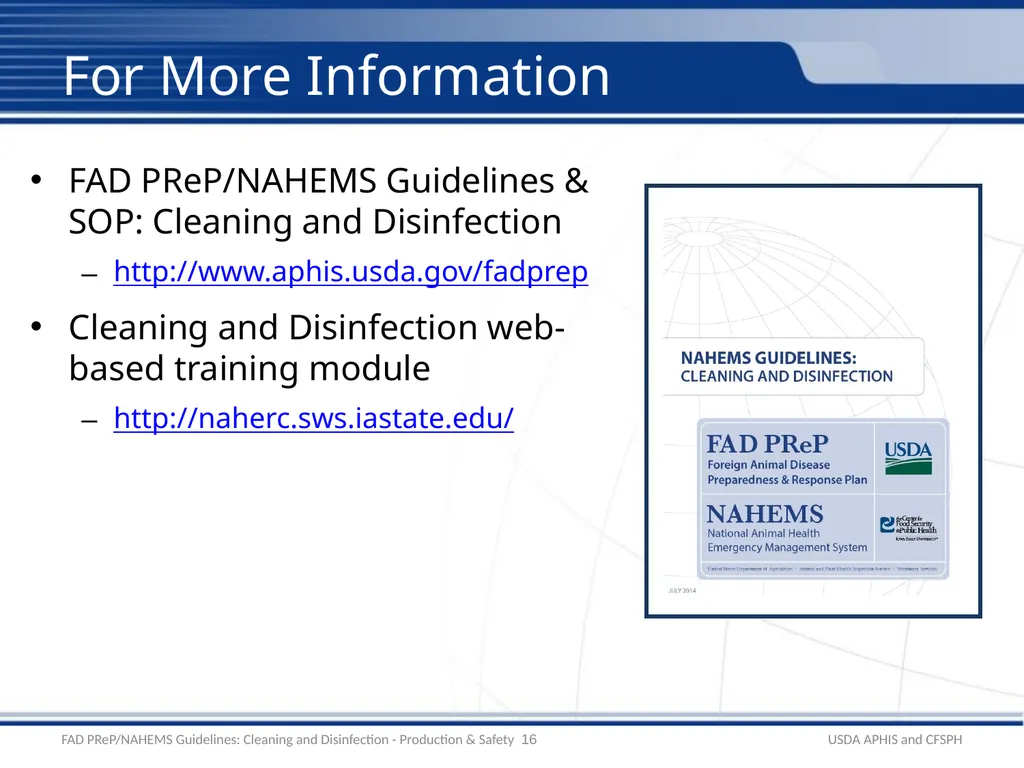
slide16. FAD PReP/NAHEMS Guidelines & SOP: Cleaning and Disinfection
http://www.aphis.usda.gov/fadprep
Cleaning and Disinfection web-based training module
http://naherc.sws.iastate.edu/ USDA APHIS and CFSPH FAD PReP/NAHEMS Guidelines: Cleaning and Disinfection - Production & Safety For More Information 16<br>
slide17. Authors (CFSPH)
Glenda Dvorak, DVM, MS, MPH, DACVPM
Nichollette Rider, Junior Veterinary Student
Reviewers (USDA)
Nathan G. Birnbaum, DVM
Samantha B. Floyd, Biologist USDA APHIS and CFSPH FAD PReP/NAHEMS Guidelines: Cleaning and Disinfection - Production & Safety Guidelines Content 17<br>
slide18. Acknowledgments Development of this presentation was by the Center for Food Security and Public Health at Iowa State University through funding from the USDA APHIS Veterinary Services PPT Authors: Dawn Bailey, BS; Kerry Leedom Larson, DVM, MPH, PhD, DACVPM; Reviewers: Glenda Dvorak, DVM, MPH, DACVPM; Patricia Futoma, Veterinary Student; Janice Mogan, DVM<br>
slide2. Production Situations 2<br>
slide3. Multiple areas, varied equipment
Housing, nesting boxes
Open floor areas
Require removal of litter and manure prior to disinfection
Egg storage rooms
Egg processing equipment
Egg belts, flats, buggies, packing machines
Curtains USDA APHIS and CFSPH FAD PReP/NAHEMS Guidelines: Cleaning and Disinfection - Production & Safety Poultry Premises 3<br>
slide4. Unique challenges include:
Milking equipment
Milking units, strainers, coolers, bulk tank
Milk-film or deposits
Must use products labeled for food contact surfaces
Seek assistance from dairy manager USDA APHIS and CFSPH FAD PReP/NAHEMS Guidelines: Cleaning and Disinfection - Production & Safety Dairy Facilities 4<br>
slide5. Special situations:
Farrowing pens, slats, alleys, slurry pits
Bars, crates, gates
Electrical equipment
Clean and disinfect without leaving residual chemicals
Avoid phenolic disinfectants USDA APHIS and CFSPH FAD PReP/NAHEMS Guidelines: Cleaning and Disinfection - Production & Safety Swine Facilities 5<br>
slide6. Environments highly variable
Pastures, paddocks, porous materials
Must remove organic debris
Use products labeled for surfaces
Wood, concrete
Use exempted pesticide if registered product not available USDA APHIS and CFSPH FAD PReP/NAHEMS Guidelines: Cleaning and Disinfection - Production & Safety Equine Facilities 6<br>
slide7. Special considerations include:
Chemical product runoff
Disinfection of transport boats, other water equipment
Chlorine and iodine, neutralize with sodium thiosulfate USDA APHIS and CFSPH FAD PReP/NAHEMS Guidelines: Cleaning and Disinfection - Production & Safety Aquaculture Facilities 7<br>
slide8. Highly resistant
Disinfectants, heat, UV, ionizing radiation
Physical inactivation
Autoclaving
134-138oC for 18 minutes at 30 lb/in2
Not practical
No products registered/exempted by EPA for agricultural facilities
Exemption would be needed USDA APHIS and CFSPH FAD PReP/NAHEMS Guidelines: Cleaning and Disinfection - Production & Safety Prions 8<br>
slide9. Inspection of a site by experienced personnel
All contaminated areas/equipment C&D’d
Fixtures/fittings dismantled
Disinfectant at proper concentration and contact time
Gross debris (manure, bedding) disposed
Other items disposed in a biosecure manner
Effluent avoids environmental impact
Disinfection measures repeated, if necessary USDA APHIS and CFSPH FAD PReP/NAHEMS Guidelines: Cleaning and Disinfection - Production & Safety Evaluation 9<br>
slide10. Safety Issues and Precautions 10<br>
slide11. Chemical disinfectants have health hazards or risks
All products must be used with care and appropriate PPE
Prepare and store disinfectants as directed
Rinse areas thoroughly before reintroducing animals USDA APHIS and CFSPH FAD PReP/NAHEMS Guidelines: Cleaning and Disinfection - Production & Safety Chemical Hazards 11<br>
slide12. Physical hazards may include:
Slippery conditions
High pressure sprayers
Steam or flame
Dust
More information in the Health and Safety Guidelines USDA APHIS and CFSPH FAD PReP/NAHEMS Guidelines: Cleaning and Disinfection - Production & Safety Physical Hazards 12<br>
slide13. Zoonotic diseases
C&D conducted in contaminated areas
Sweeping, scraping, blowing may disperse pathogen
Inhale, ingest, direct contact
Avoid exposure with careful C&D measures and PPE USDA APHIS and CFSPH FAD PReP/NAHEMS Guidelines: Cleaning and Disinfection - Production & Safety Biological Hazards 13<br>
slide14. Minimum PPE required during C&D procedures
Coveralls, boots, gloves
Additional PPE includes:
Goggles
Face shields
Respiratory protection
Dust masks/respirators
Waterproof or chem-resistant suits USDA APHIS and CFSPH FAD PReP/NAHEMS Guidelines: Cleaning and Disinfection - Production & Safety Personal Protective Equipment 14<br>
slide15. All C&D team members should have a complete orientation covering potential hazards
Complete understanding of specific safety precautions must be obtained before entering premises USDA APHIS and CFSPH FAD PReP/NAHEMS Guidelines: Cleaning and Disinfection - Production & Safety Hazard Communication 15<br>
slide16. FAD PReP/NAHEMS Guidelines & SOP: Cleaning and Disinfection
http://www.aphis.usda.gov/fadprep
Cleaning and Disinfection web-based training module
http://naherc.sws.iastate.edu/ USDA APHIS and CFSPH FAD PReP/NAHEMS Guidelines: Cleaning and Disinfection - Production & Safety For More Information 16<br>
slide17. Authors (CFSPH)
Glenda Dvorak, DVM, MS, MPH, DACVPM
Nichollette Rider, Junior Veterinary Student
Reviewers (USDA)
Nathan G. Birnbaum, DVM
Samantha B. Floyd, Biologist USDA APHIS and CFSPH FAD PReP/NAHEMS Guidelines: Cleaning and Disinfection - Production & Safety Guidelines Content 17<br>
slide18. Acknowledgments Development of this presentation was by the Center for Food Security and Public Health at Iowa State University through funding from the USDA APHIS Veterinary Services PPT Authors: Dawn Bailey, BS; Kerry Leedom Larson, DVM, MPH, PhD, DACVPM; Reviewers: Glenda Dvorak, DVM, MPH, DACVPM; Patricia Futoma, Veterinary Student; Janice Mogan, DVM<br>