04
Functions
Provide input to Command level
Provide technical advice
Coordinate with Logistics Section
Provide necessary supplies
Ensure ample supply of disinfectant products
Establish, operate, and maintain C&D stations
Schedule and certify C&D procedures USDA APHIS and CFSPH FAD PReP/NAHEMS Guidelines: Cleaning and Disinfection - Roles C&D Group Personnel 4<br>
05
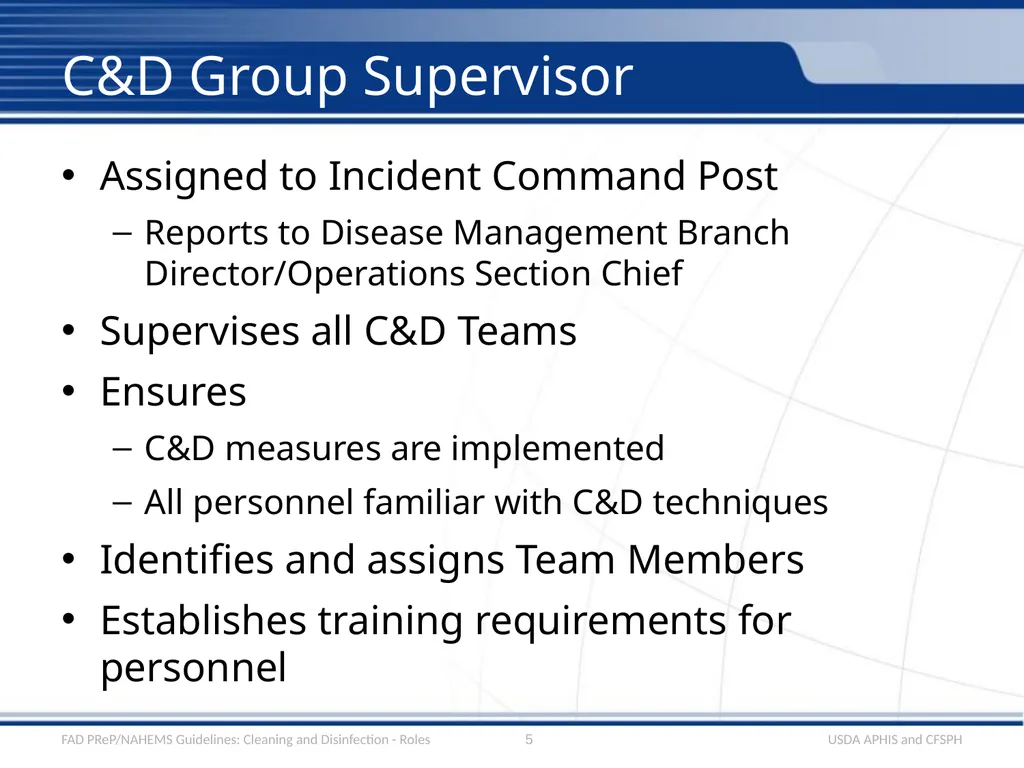
Assigned to Incident Command Post
Reports to Disease Management Branch Director/Operations Section Chief
Supervises all C&D Teams
Ensures
C&D measures are implemented
All personnel familiar with C&D techniques
Identifies and assigns Team Members
Establishes training requirements for personnel USDA APHIS and CFSPH FAD PReP/NAHEMS Guidelines: Cleaning and Disinfection - Roles C&D Group Supervisor 5<br>
06
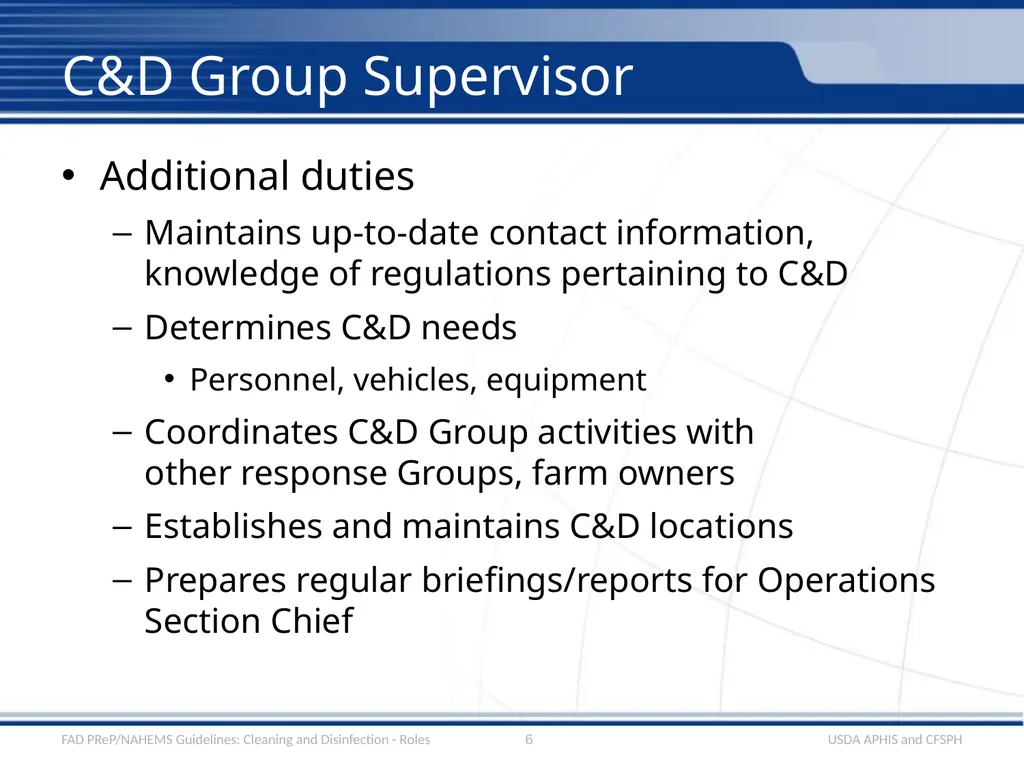
Additional duties
Maintains up-to-date contact information, knowledge of regulations pertaining to C&D
Determines C&D needs
Personnel, vehicles, equipment
Coordinates C&D Group activities with �other response Groups, farm owners
Establishes and maintains C&D locations
Prepares regular briefings/reports for Operations Section Chief USDA APHIS and CFSPH FAD PReP/NAHEMS Guidelines: Cleaning and Disinfection - Roles C&D Group Supervisor 6<br>
07
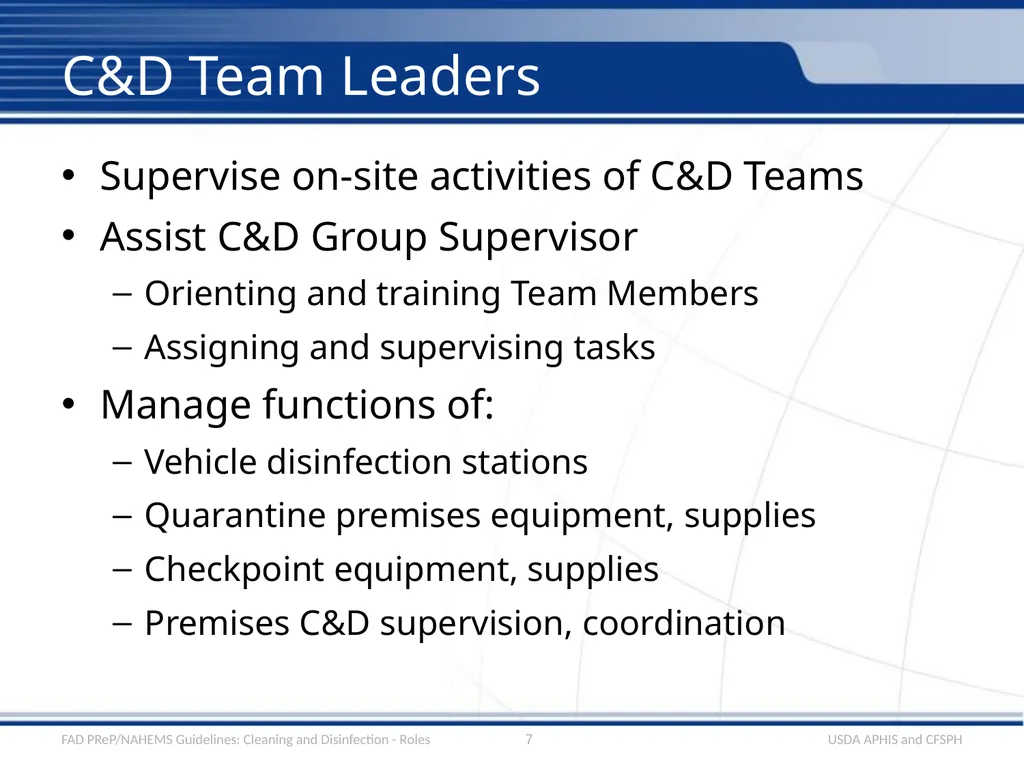
Supervise on-site activities of C&D Teams
Assist C&D Group Supervisor
Orienting and training Team Members
Assigning and supervising tasks
Manage functions of:
Vehicle disinfection stations
Quarantine premises equipment, supplies
Checkpoint equipment, supplies
Premises C&D supervision, coordination USDA APHIS and CFSPH FAD PReP/NAHEMS Guidelines: Cleaning and Disinfection - Roles C&D Team Leaders 7<br>
08
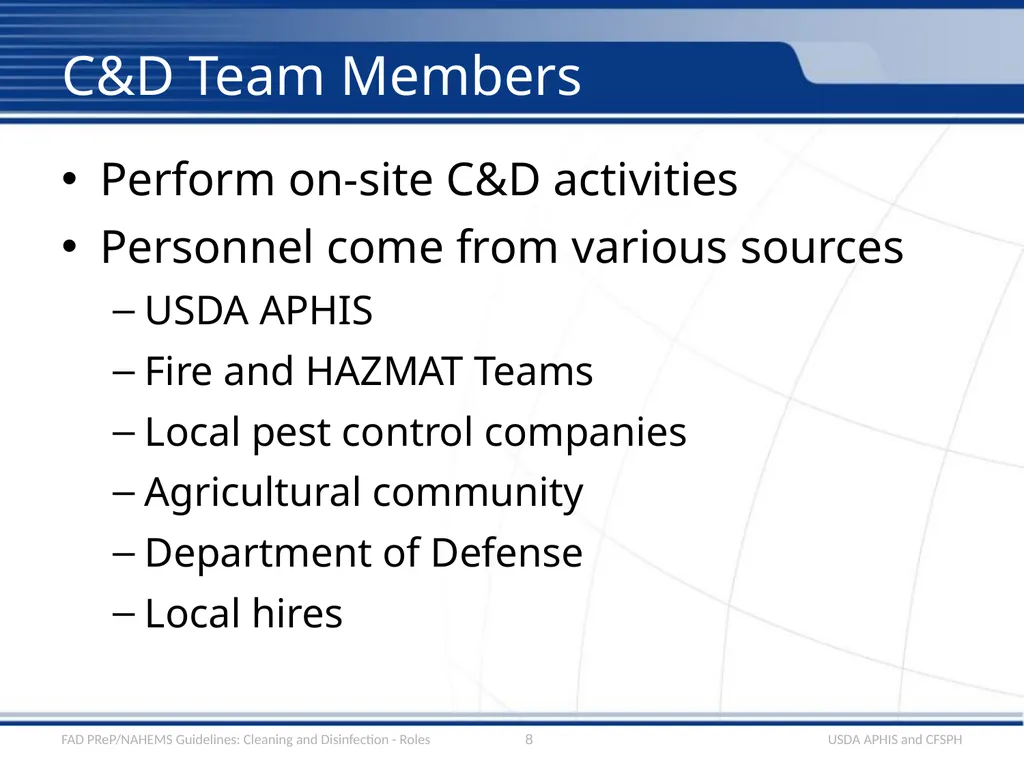
Perform on-site C&D activities
Personnel come from various sources
USDA APHIS
Fire and HAZMAT Teams
Local pest control companies
Agricultural community
Department of Defense
Local hires USDA APHIS and CFSPH FAD PReP/NAHEMS Guidelines: Cleaning and Disinfection - Roles C&D Team Members 8<br>
09
Basic C&D Protocol 9<br>
10
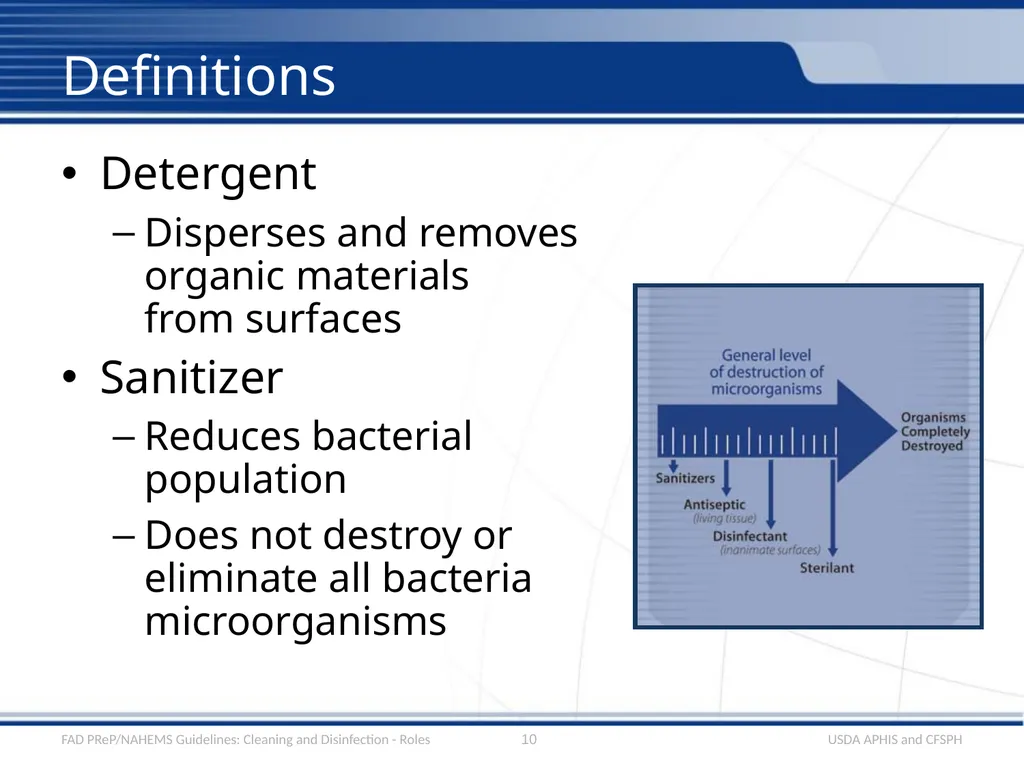
Detergent
Disperses and removes�organic materials�from surfaces
Sanitizer
Reduces bacterial �population
Does not destroy or eliminate all bacteria or microorganisms USDA APHIS and CFSPH FAD PReP/NAHEMS Guidelines: Cleaning and Disinfection - Roles Definitions 10<br>
11
Antiseptic (FDA)
Kills or inhibits growth of �microorganisms on skin
Disinfectant (EPA)
Destroys or eliminates �specific species
Sterilant
Destroys all forms of �microbial life USDA APHIS and CFSPH FAD PReP/NAHEMS Guidelines: Cleaning and Disinfection - Roles Definitions (cont’d) 11<br>
12
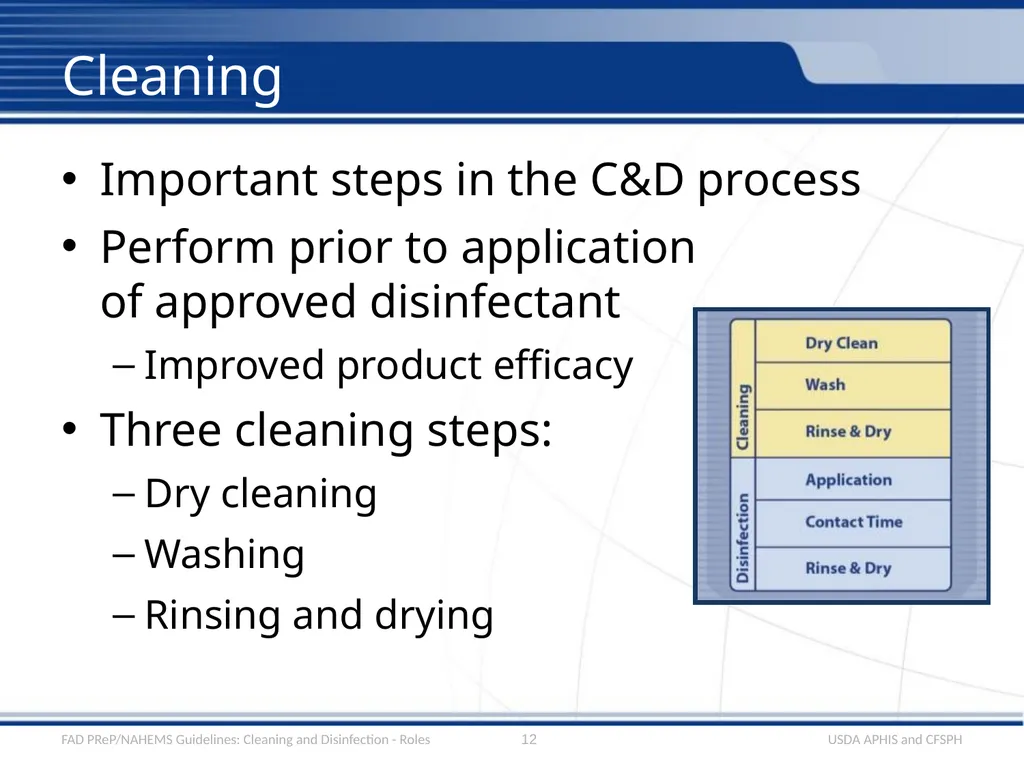
Important steps in the C&D process
Perform prior to application�of approved disinfectant
Improved product efficacy
Three cleaning steps:
Dry cleaning
Washing
Rinsing and drying USDA APHIS and CFSPH FAD PReP/NAHEMS Guidelines: Cleaning and Disinfection - Roles Cleaning 12<br>
13
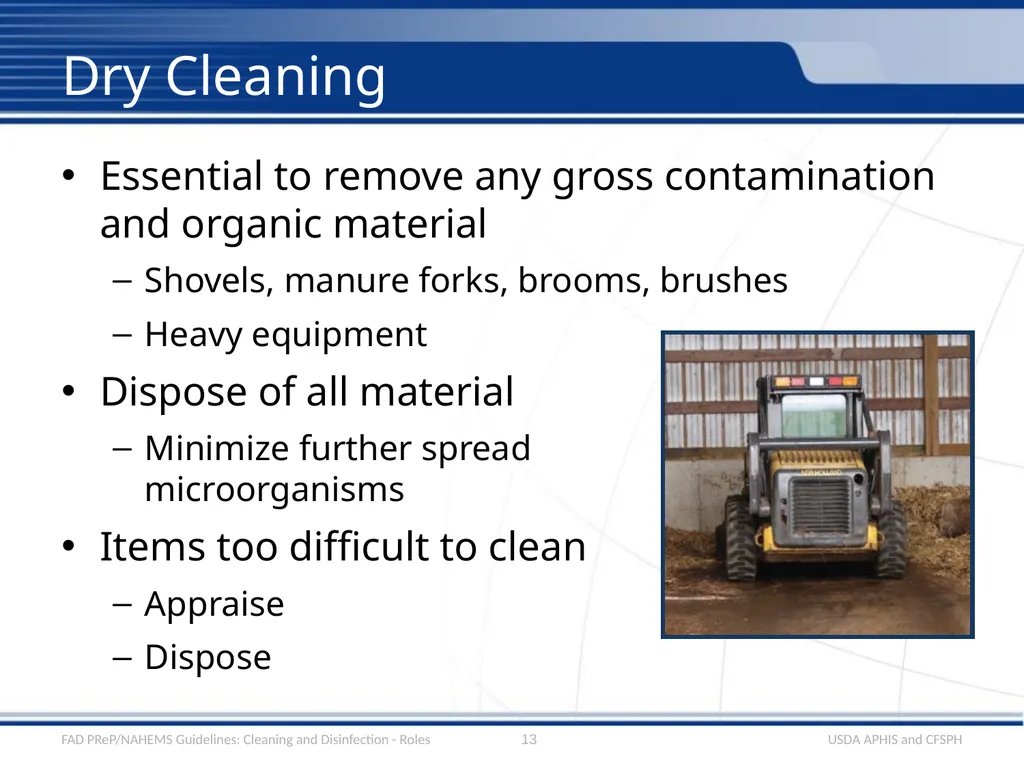
Essential to remove any gross contamination and organic material
Shovels, manure forks, brooms, brushes
Heavy equipment
Dispose of all material
Minimize further spread of microorganisms
Items too difficult to clean
Appraise
Dispose USDA APHIS and CFSPH FAD PReP/NAHEMS Guidelines: Cleaning and Disinfection - Roles Dry Cleaning 13<br>
14
Follows dry cleaning
Wash items with detergent
Reduces number of microorganisms
Removes oil, grease, exudates
Turn off electrical equipment
Pre-soak areas with organic material adhered to surfaces
Ensure cleaning products used are compatible with disinfectant USDA APHIS and CFSPH FAD PReP/NAHEMS Guidelines: Cleaning and Disinfection - Roles Washing 14<br>
15
Mechanical scrubbing to �remove oil, grease, exudate
Deep cracks, crevices, pits, pores
High pressure water and detergent
Use caution to avoid dispersal of pathogen
High temperature
90-130oF/32-54oC
Increases product efficacy USDA APHIS and CFSPH FAD PReP/NAHEMS Guidelines: Cleaning and Disinfection - Roles Washing (cont’d) 15<br>
16
Rinse surfaces after wash
Low pressure, cold water
Inspect to ensure surfaces are �visibly clean
Before disinfection, allow surfaces to �dry completely
Blowers, fans, compressors
Avoid high pressure systems with highly infectious, zoonotic pathogens USDA APHIS and CFSPH FAD PReP/NAHEMS Guidelines: Cleaning and Disinfection - Roles Rinsing and Drying 16<br>
17
Application
After surfaces are clean, rinsed, dried
Physical or chemical
Contact time
Allow adequate contact time for the disinfection process to work
Rinse and dry
Thoroughly rinse after disinfection
Air dry prior to restocking animals USDA APHIS and CFSPH FAD PReP/NAHEMS Guidelines: Cleaning and Disinfection - Roles Disinfection 17<br>
18
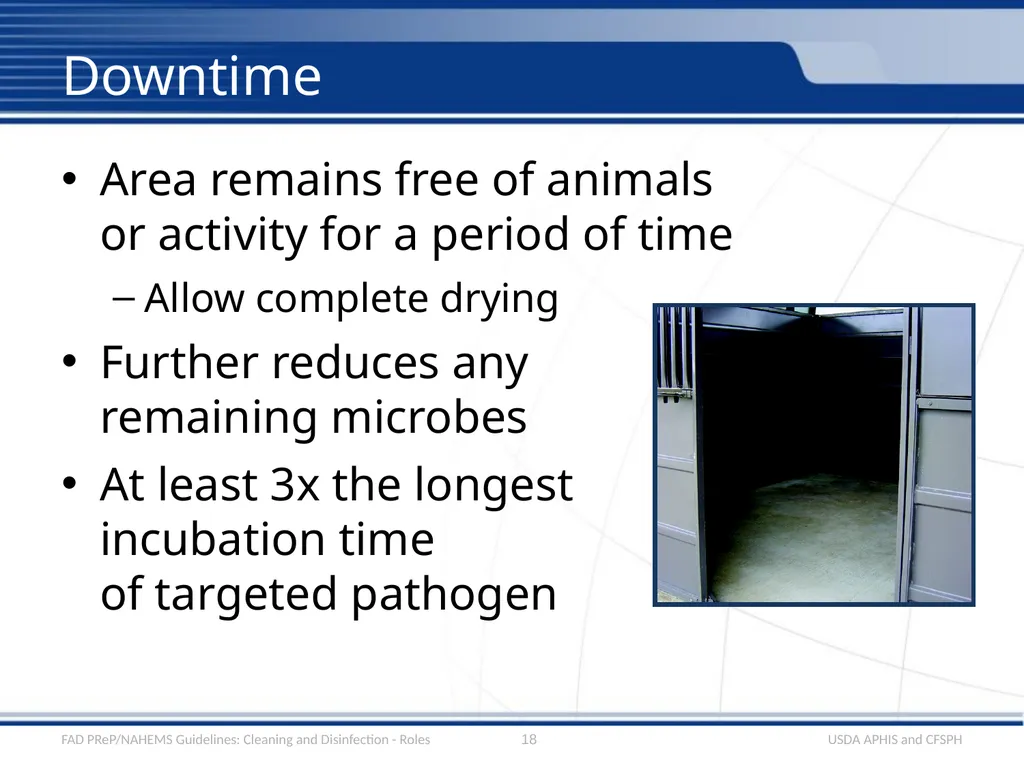
Area remains free of animals�or activity for a period of time
Allow complete drying
Further reduces any �remaining microbes
At least 3x the longest�incubation time�of targeted pathogen USDA APHIS and CFSPH FAD PReP/NAHEMS Guidelines: Cleaning and Disinfection - Roles Downtime 18<br>
19
FAD PReP/NAHEMS Guidelines & SOP: Cleaning and Disinfection
http://www.aphis.usda.gov/fadprep
Cleaning and Disinfection web-based training module
http://naherc.sws.iastate.edu/ USDA APHIS and CFSPH FAD PReP/NAHEMS Guidelines: Cleaning and Disinfection - Roles For More Information 19<br>
20
Author (CFSPH)
Glenda Dvorak, DVM, MS, MPH, DACVPM
Nichollette Rider, Junior Veterinary Student
Reviewers (USDA)
Nathan G. Birnbaum, DVM
Samantha B. Floyd, Biologist USDA APHIS and CFSPH FAD PReP/NAHEMS Guidelines: Cleaning and Disinfection - Roles Guidelines Content 20<br>
21
Acknowledgments Development of this presentation was by the Center for Food Security and Public Health at Iowa State University through funding from the USDA APHIS, Veterinary Services PPT Authors: Dawn Bailey, BS; Kerry Leedom Larson, DVM, MPH, PhD, DACVPM; �Reviewers: Glenda Dvorak, DVM, MPH, DACVPM; Patricia Futoma, Veterinary Student;
Janice Mogan, DVM<br>